




CBSE Class 12 Biology Set 3 Question Paper PDF 57-7-3 is available for download. CBSE conducted the Class 12 Biology examination on March 25, 2025. The question paper consists of 33 questions carrying a total of 70 marks. Section A includes 16 MCQs for 1 mark each, Section B contains 5 very short-answer questions for 2 marks each, Section C comprises 7 short-answer questions for 3 marks each, Section D comprises 2 Case-based questions carrying 4 marks each, and Section E comprises 3 long-answer questions carrying 5 marks each.
CBSE Class 12 2025 Biology Question Paper 57-7-2 with Answer Key
| CBSE Class 12 2025 Biology Question Paper with Answer Key | Download PDF | Check Solution |

The RNA triplet UAG acts as a stop codon which terminates the synthesis of a polypeptide. Below is given a strand of DNA which codes for four amino acids.
In which position will an insertion of a thymine nucleotide result in the termination of translation?
DNA strand:
3′ T C C A C C C G A T G C 5′
View Solution
The given DNA strand is 3′ to 5′, and the mRNA will be complementary in 5′ to 3′ direction. Without insertion, the original codons would be:
DNA: 3′ TCC ACC CGA TGC 5′
mRNA: 5′ AGG UGG GCU ACG 3′ — coding for four amino acids.
Inserting a thymine (T) at position (B) would result in a frameshift mutation. The sequence becomes:
DNA: 3′ TCC ACC TCG ATG C 5′
mRNA: 5′ AGG UGG AGC UAC G 3′ — which includes the stop codon UAG, terminating translation prematurely. Quick Tip: Frameshift mutations due to base insertion can create premature stop codons like UAG, ending translation early.
Which of the following conditions correctly describes the manner of determining the sex in the given options?
View Solution
In grasshoppers, the presence of only one sex chromosome (XO) leads to male development, while the presence of two (XX) results in females. This is a well-documented mode of sex determination in insects. Quick Tip: XO sex determination is common in insects like grasshoppers, where absence of a second sex chromosome leads to male development.
Which one of the following is not the product of transgenic experiments?
View Solution
While pest-resistant and drought-tolerant crops are examples of transgenic experiments, insulin production through recombinant DNA technology does not involve a transgenic crop, but bacteria genetically modified to produce insulin. Quick Tip: Transgenic experiments in crops aim for traits like pest resistance or drought tolerance, not pharmaceutical production like insulin.
Penetration of the sperm in the ovum is followed by:
View Solution
After sperm penetrates the ovum, the secondary oocyte completes Meiosis II, resulting in the formation of the ovum and a second polar body before fertilization is complete. Quick Tip: Meiosis II in the ovum completes only after sperm entry, making it a critical post-penetration step.
India has only 2.4% of the world's land area but its share of the global species diversity is:
View Solution
Despite its relatively small land area, India is one of the 12 mega biodiversity countries of the world, housing about 8.1% of the world's species diversity. Quick Tip: India is rich in biodiversity — 8.1% of global species are found here despite having only 2.4% of global land area.
Out of the following, select the correct match:
View Solution
ELISA (Enzyme-Linked Immunosorbent Assay) is a diagnostic tool that functions on the principle of antigen-antibody interaction and is widely used in detecting infections like HIV. Quick Tip: ELISA detects diseases by antigen-antibody interaction and is used in diagnosing HIV and other infections.
In a certain population, the frequency of three genotypes is as follows:
Genotypes: PP Pp pp
Frequency: 22% 62% 16%
Choose the option that shows the frequency of P and p alleles correctly:
View Solution
Let frequency of P = p\textsubscript{P and p = p\textsubscript{p.
Given:
PP = 22% → Homozygous dominant = 22% contributes 100% P allele = 0.22
Pp = 62% → Heterozygous = contributes 50% P and 50% p = 0.31 P + 0.31 p
pp = 16% → Homozygous recessive = 16% contributes 100% p = 0.16
So, frequency of P = 0.22 + 0.31 = 0.53 or 53%
Frequency of p = 0.31 + 0.16 = 0.47 or 47% Quick Tip: To calculate allele frequency from genotype frequency, use: Allele frequency = (2 × Homozygous + 1 × Heterozygous) ÷ (2 × Total individuals).
Study the items of columns I and II where drugs and their effects are given and match them correctly.
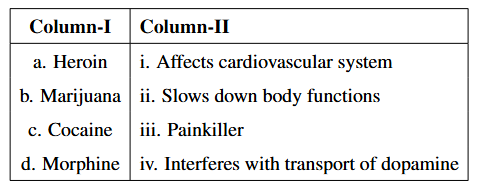
Choose the correct answer from the options given below:
View Solution
Heroin is a depressant — it slows down body functions (ii).
Marijuana affects cardiovascular and neural functions (i).
Cocaine interferes with dopamine reuptake — causes euphoric high (iv).
Morphine is a painkiller (iii). Quick Tip: Remember drug classifications: depressants (e.g., heroin), stimulants (e.g., cocaine), hallucinogens (e.g., marijuana), and analgesics (e.g., morphine).
Choose the option that correctly describes the gynoecium of Michelia:
View Solution
In Michelia, the gynoecium consists of multiple free carpels, meaning it is multicarpellary and apocarpous (carpels are not fused). Quick Tip: Apocarpous: free carpels; Syncarpous: fused carpels. \textit{Michelia has many free carpels = Multicarpellary Apocarpous.
Read the passage given below and answer the question.
Food chains ‘P’ and ‘Q’ form an interconnection. ‘P’ initiates with wheat grass whose population supports a few grasshoppers, frogs and snakes.
‘Q’ starts with dead decaying leaves of wheat grass which are eaten by earthworms and then food chain is continued with frog of food chain ‘P’.
Identify the types of food chains ‘P’ and ‘Q’:
View Solution
Food chain 'P' starts from wheat grass and follows a typical grazing food chain (grass → herbivore → carnivore).
Food chain 'Q' starts from dead organic matter (detritus) consumed by earthworms, which join food chain 'P' at the frog level — this makes it a detritus food chain. Quick Tip: Grazing food chains begin with living plants; detritus food chains begin with dead and decaying matter.
Identify the incorrect statement regarding PCR.
View Solution
Annealing is the step where primers bind to single-stranded DNA after denaturation.
Strand separation is achieved during the denaturation step (usually at 94–96°C), not during annealing. Quick Tip: PCR steps: Denaturation (strand separation), Annealing (primer binding), Extension (DNA synthesis).
The following information is about drugs and tobacco. Select the correct statement from the options given below.
View Solution
Morphine is an opioid analgesic, used clinically to relieve severe pain during or after surgery.
Other statements are false: Cocaine is a harmful stimulant, tobacco raises blood pressure, and barbiturates are depressants, not truth serums. Quick Tip: Morphine is a natural opiate and effective painkiller; misuse of stimulants or depressants can lead to addiction.
Assertion (A): A male individual always inherits haemophilia from his mother.
Reason (R): The gene for haemophilia lies on X-chromosome.
View Solution
Haemophilia is an X-linked recessive disorder. A male (XY) receives his single X chromosome from his mother. If this X carries the defective haemophilia gene, he will express the disorder. Hence, both Assertion and Reason are true and Reason explains the Assertion. Quick Tip: X-linked recessive traits like haemophilia are inherited by sons from carrier mothers.
Assertion (A): Biotechnology produces transgenic microorganisms that function as microfactories for proteins.
Reason (R): Transgenic microorganisms can be developed to produce proteins of human use, like insulin.
View Solution
Biotechnology uses genetically modified microorganisms to produce proteins like insulin, which are used in medicine. These transgenic microbes act as microfactories, thus justifying both the Assertion and the Reason. Quick Tip: Transgenic bacteria can mass-produce human proteins like insulin and growth hormones.
Assertion (A): A piece of DNA inserted into an alien organism generally does not replicate, if not inserted into a chromosome.
Reason (R): \textit{Chromosomes have specific sequences called ‘ori’ region, where DNA replication is initiated.
View Solution
For a DNA segment to replicate inside a host, it must contain an origin of replication (ori). If it doesn’t and isn’t inserted into a host chromosome (which does have an ori), it won't be replicated. So both statements are true and the Reason correctly explains the Assertion. Quick Tip: DNA without an ori sequence or chromosomal integration cannot replicate in host cells.
Assertion (A): Swiss cheese is characterized by large holes due to CO\textsubscript{2 production.
Reason (R): It is ripened by growing a specific fungi.
View Solution
Swiss cheese contains holes due to carbon dioxide produced by \textit{Propionibacterium shermanii, not fungi. Hence, the assertion is correct but the reason is incorrect. Quick Tip: Bacteria, not fungi, are responsible for the hole formation in Swiss cheese.
Student to attempt either option (A) or (B):
(A) How is DNA isolated in purified form from a bacterial cell?
OR
(B) Explain how human functional insulin was produced by using recombinant DNA (rDNA) technology.
View Solution
(A)
Step 1: Bacterial cells are lysed using enzymes such as lysozyme to break the cell wall.
Step 2: Detergents like SDS (sodium dodecyl sulfate) are used to break open cell membranes and release cellular contents.
Step 3: Proteins and RNA are removed by treatment with protease and RNase enzymes respectively.
Step 4: The purified DNA is then precipitated by adding chilled ethanol or isopropanol.
\medskip
OR
(B)
Step 1: DNA sequences encoding the insulin A and B chains were isolated and inserted into plasmids.
Step 2: These recombinant plasmids were introduced into \textit{E. coli bacteria.
Step 3: The bacteria produced the A and B chains separately.
Step 4: These chains were extracted and chemically joined to form functional human insulin. Quick Tip: DNA isolation uses enzymes and alcohol for purification. Insulin production via rDNA involves expressing and joining A and B chains in bacteria.
A few stages and their respective time period in the evolutionary history of human beings are mentioned in the flowchart given below:
15 mya — Primates walking like gorillas and chimpanzees existed.
3–4 mya — Man-like primates walked in Eastern Africa. Fossils of their bones were discovered.
2 mya — This ancestor lived in the East African grasslands and ate fruits.
1.5 mya — This hominid had a brain size of 900 cc and probably ate meat.
Based on the above information, answer the following questions:
[(a)] Name one primate about 15 mya.
[(b)] Name one place where fossils of primates were discovered in Eastern Africa.
[(c)] Name the ancestor that lived in the East African grasslands about 2 mya.
[(d)] Name the hominid that was found around 1.5 mya.
View Solution
[(a)] Dryopithecus or Ramapithecus.
[(b)] Ethiopia or Tanzania.
[(c)] Australopithecus.
[(d)] Homo erectus. Quick Tip: Dryopithecus and Ramapithecus are ancient primates from 15 mya. Homo erectus had a 900 cc brain and used tools.
A karyotype of a human suffering from a certain disorder is given below:

Answer the following:
[(a)] Identify the disorder.
[(b)] Write the symptoms of the disorder.
[(c)] Give reason for such a disorder.
View Solution
[(a)] The disorder is Down’s syndrome (Trisomy 21).
[(b)] Symptoms include:
Mental retardation.
Short stature.
Broad face.
Furrowed tongue.
Physical growth delay.
[(c)] The disorder occurs due to trisomy of chromosome 21, caused by non-disjunction during gamete formation, leading to an extra chromosome 21. Quick Tip: Down’s syndrome results from an extra chromosome 21. It’s a chromosomal numerical abnormality.
Student to attempt either option (A) or (B):
(A) Ravi lives in a village where he suggested to the local farmers to introduce a fungus as biofertilizer into their crop fields. State the benefits provided by the fungus to the crop.
OR
(B)
[(i)] How do secondary lymphoid organs provide immunity?
[(ii)] Highlight the role of spleen as an organ that provides immunity.
View Solution
(A)
Step 1: The fungus suggested as a biofertilizer is mycorrhiza.
Step 2: Mycorrhizal fungi form a symbiotic association with plant roots.
Step 3: They enhance water and nutrient (especially phosphorus) absorption.
Step 4: They also offer protection from pathogens and improve plant growth and resistance.
\medskip
OR
(B)
(i) Secondary lymphoid organs like lymph nodes and spleen are sites where lymphocytes interact with antigens. These organs provide an environment for the activation and proliferation of immune cells.
(ii) The spleen filters blood, traps blood-borne antigens, and provides a site for immune responses. It also destroys old RBCs and stores immune cells like lymphocytes. Quick Tip: Mycorrhiza improves nutrient uptake and resistance in crops. Secondary lymphoid organs are essential for initiating adaptive immune responses.
Student to attempt either option (A) or (B):
(A) “A fully developed foetus initiates its delivery from the mother’s womb.” Explain.
OR
(B) Give reasons for the following:
Why can a woman generally not conceive a child after 50 years of age?
Polar bodies are formed during oogenesis and not during spermatogenesis.
View Solution
(A)
Step 1: A fully developed foetus sends signals to the maternal system through hormones.
Step 2: Foetal ejection reflex is triggered by mild uterine contractions.
Step 3: This stimulates the release of oxytocin from the maternal pituitary.
Step 4: Oxytocin enhances uterine contractions in a positive feedback loop until delivery occurs.
\medskip
OR
(B)
(i)
After 50 years of age, a woman usually undergoes menopause, where the ovaries stop releasing eggs and hormonal support for conception ceases.
(ii)
During oogenesis, unequal cytoplasmic division occurs to preserve maximum cytoplasm in the ovum. The small, non-functional cells produced alongside are called polar bodies. In spermatogenesis, equal division produces four functional sperms, hence no polar bodies form. Quick Tip: Delivery is triggered by oxytocin via foetal signals. Polar bodies form in oogenesis due to unequal divisions, unlike spermatogenesis.
Gene therapy can be used to treat an ADA deficient patient. Explain.
Is it a permanent cure? How can ADA be cured permanently?
View Solution
Gene therapy involves the insertion of functional ADA gene into the lymphocytes of the patient. These cells are grown in vitro and returned to the patient’s body. This restores the ADA enzyme temporarily.
Permanent cure: It can be achieved by introducing the functional gene into cells at the embryonic stage, ensuring a lifelong supply of ADA. Quick Tip: ADA deficiency can be treated temporarily by gene therapy or permanently through early-stage gene insertion.
Name the type of food chains responsible for the flow of larger fraction of energy in an aquatic ecosystem and a terrestrial ecosystem, respectively. Mention any two differences between the two food chains.
View Solution
Aquatic ecosystem: Grazing food chain
Terrestrial ecosystem: Detritus food chain
Differences:
In aquatic ecosystems, phytoplankton are consumed directly by herbivores, ensuring better energy flow through the grazing food chain.
In terrestrial ecosystems, a large amount of biomass goes into detritus, making the detritus food chain more dominant. Quick Tip: Energy flow is more efficient in aquatic grazing food chains compared to terrestrial detritus food chains.
Construct and label a transcription unit from which the RNA segment given below has been transcribed. Write the complete name of the enzyme that transcribed this RNA.

View Solution
Enzyme: RNA polymerase
Transcription unit: A segment of DNA with a promoter, structural gene, and terminator.
The DNA sequence complementary to RNA: \[ 3'TAC GTA CGT ACG5' \] Quick Tip: RNA polymerase reads the template DNA strand in 3’ to 5’ direction and synthesizes RNA in 5’ to 3’ direction.
A village health worker was taking a session with women. She tells them that one has to be careful while using oral pills as a method of birth control. Wrong usage can actually promote conception.
Analyse the above statement and compare the merits and demerits of using oral pills and surgical methods of birth control.
Village women are confused as to how a thin metallic copper loop can provide protection against pregnancy. Explain the mode of action of IUDs. Give two points.
View Solution
[(a)] Oral pills: Convenient and reversible but must be taken regularly. Improper usage can lead to hormonal imbalance and possible pregnancy.
Surgical methods: Permanent and highly effective, but involve surgical intervention and are irreversible.
[(b)] Copper IUDs:
Release copper ions that suppress sperm motility and fertilising capacity.
Induce local inflammation to prevent implantation. Quick Tip: IUDs are long-term contraceptives. Oral pills require discipline in use for effective contraception.
(a) The process of evolution of different species in a given geographical area starts from a point and literally radiates to other geographical areas.Explain it with an example.
(b) Cite an example where more than one adaptive radiation has occurred in an isolated geographical area. Name the type of evolution your example depicts.
View Solution
[(a)] This describes adaptive radiation. Example: Darwin’s finches on Galápagos Islands radiated into different species based on beak types for different food sources.
[(b)] Example: Australian marsupials, where different species evolved in isolation to fill various ecological niches. It represents convergent evolution. Quick Tip: Adaptive radiation is rapid evolution from a common ancestor in varied environments. Convergent evolution involves similar traits in unrelated lineages.
Why are transgenic animals so called?
With the help of an example each, explain the role of transgenic animals in the following:
[(i)] Vaccine safety
[(ii)] Biological products
View Solution
[label=(\alph*)]
Transgenic animals are those animals whose DNA has been altered by introducing a foreign gene from another organism. They carry and express an extra (trans) gene.
[(i)] Vaccine Safety: Transgenic mice are used to test the safety of vaccines before they are used on humans. Example: Polio vaccine trials.
[(ii)] Biological Products: Transgenic animals are engineered to produce useful biological substances like proteins. Example: Transgenic sheep producing human alpha-1-antitrypsin to treat emphysema. Quick Tip: Transgenic animals help in testing vaccine safety and producing human therapeutic proteins, making biotechnology more impactful.
A person is suffering from high grade fever. Which symptoms will help to identify if he/she is suffering from Typhoid, Pneumonia or Malaria?
View Solution
Typhoid: Sustained high fever, weakness, stomach pain, constipation, headache, and intestinal perforation in severe cases.
Pneumonia: Fever, chills, cough, breathing difficulty, and greyish-blue lips and fingernails due to oxygen deficiency.
Malaria: Recurring high fever with chills and sweating at regular intervals due to Plasmodium infection. Quick Tip: The pattern of fever and associated symptoms help distinguish between infections like typhoid, pneumonia, and malaria.
Study the figure given below and answer the questions that follow.

Identify the figure and state its importance.
Why is air diffused into the aerator tank? Explain.
[(i)] What changes take place in the settling tank?
OR
[(ii)] How is BOD related to organic matter present in the water?
View Solution
[label=(\alph*)]
The figure represents the Secondary Treatment or Biological Treatment in a Sewage Treatment Plant.
\textit{Importance: This stage helps in removing the biodegradable organic matter from the wastewater using aerobic microorganisms.
Air is diffused into the aerator tank to provide oxygen to aerobic bacteria and microbes. These microbes utilize the oxygen to break down organic matter in the sewage efficiently, reducing the Biochemical Oxygen Demand (BOD) of the water.
[(i)] In the settling tank, the activated sludge settles down at the bottom due to gravity. The clear water or effluent is then separated from the top. A portion of the activated sludge is returned to the aeration tank (Return Activated Sludge - RAS), while the rest is removed as Waste Activated Sludge (WAS).
OR
[(ii)] BOD (Biochemical Oxygen Demand) is directly proportional to the amount of organic matter present in water. The more the organic content, the more oxygen is required by aerobic bacteria to break it down, leading to a higher BOD value. Quick Tip: The secondary treatment in sewage involves aerobic microbes that degrade organic waste. High BOD means more organic pollution in water.
The following question is based on pollination. Study the figures carefully and answer the questions that follow.

Give the scientific terms for the processes taking place in Figures A and B respectively.
Mention two conditions necessary for the process occurring in Figure B.
[(i)] State one advantage and one disadvantage of the process occurring in Figure B.
OR
[(ii)] Name one plant where, in some flowers only, the process in Figure B takes place and give the reason responsible for it.
View Solution
[label=(\alph*)]
The scientific terms are:
Figure A — Cross-pollination
Figure B — Autogamy (a type of self-pollination)
Two conditions necessary for autogamy:
(i) Anther and stigma must mature simultaneously (synchronous maturation).
(ii) Anther and stigma must be positioned closely to facilitate transfer of pollen grains.
[(i)]
Advantage: Maintains genetic purity of the species.
Disadvantage: Leads to reduced genetic variation, which may limit adaptability.
OR
[(ii)] One such plant is Viola (commonly known as pansy).
\textit{Reason: It shows cleistogamy, where some flowers do not open and ensure autogamy as the only mode of pollination. Quick Tip: Cross-pollination promotes genetic diversity, while autogamy ensures reproductive assurance, especially in isolated environments.
Student to attempt either option-(A) or (B):
(A) [(i)] How does alien species invasion cause a decline in biodiversity? Explain.
How have the following contributed to biodiversity loss?
I. Nile Perch
II. Lantana and \textit{Eichhornia
III. Clarias gariepinus
[(ii)] Why have certain regions been declared as biodiversity hotspots by environmentalists of the world? Name any two such regions in India.
OR
(B)
[(i)] Write an equation for Verhulst-Pearl Logistic Growth Curve where:
N = Population density at time ‘t’
r = Intrinsic rate of natural increase
[(ii)] Draw a graph for a population whose population density has reached carrying capacity.
[(iii)] Draw a growth curve where resources are non-limiting to growth of population.
[(iv)] Which growth curve is considered more realistic and why? Explain.
View Solution
(A)
[(i)] Alien species invasion causes biodiversity loss by outcompeting native species for resources, altering habitats, or introducing new diseases.
Nile Perch: Introduced in Lake Victoria, it caused the extinction of over 200 native cichlid fish species.
\textit{Lantana and \textit{Eichhornia: These invasive plants choke native vegetation and water bodies, respectively, altering ecosystem structure.
\textit{Clarias gariepinus: An exotic African catfish introduced in Indian waters that threatens indigenous fish diversity by predation and competition.
[(ii)] Regions rich in endemic species and facing severe threats are declared as biodiversity hotspots. These areas are prioritized for conservation.
Two biodiversity hotspots in India:
Western Ghats
Indo-Burma region
OR
(B)
[(i)] The equation for Verhulst-Pearl Logistic Growth is:
\[ \frac{dN{dt} = rN\left(\frac{K - N}{K}\right) \]
Where:
\( N \) = Population density at time \( t \)
\( r \) = Intrinsic rate of natural increase
\( K \) = Carrying capacity
[(ii)] % Logistic Growth Curve Graph
\textit{(Draw an S-shaped sigmoid curve showing slow start, exponential growth, and leveling off at K)
[(iii)] % Exponential Growth Curve Graph
\textit{(Draw a J-shaped curve showing continuous rise in population size)
[(iv)] The logistic growth curve is considered more realistic because:
It takes into account limited resources and environmental resistance.
It reflects the natural population growth trend where growth slows as resources become scarce and population approaches carrying capacity. Quick Tip: Invasive species disrupt native ecosystems. Logistic growth models real-world population trends, considering environmental limits.
Student to attempt either option (A) or (B):
(A) What is meant by ‘right’ and ‘wrong’ type of pollen when pollen lands on the stigma? A two-celled right type pollen has landed on the stigma. Explain the events taking place till fertilization in angiosperms. Why is pollen pistil interaction said to be dynamic?
OR
(B) Give the schematic representation of oogenesis in human females indicating chromosome number at each step.
In which part of the female reproductive system do the following events take place?
I. Formation of corpus luteum
II. Maturation of tertiary follicle
III. Fertilisation
IV. Implantation
View Solution
(A)
‘Right’ type of pollen is compatible with the stigma and initiates pollen germination; ‘wrong’ type is incompatible and does not germinate.
After a compatible (right) pollen lands, it germinates to form a pollen tube through which male gametes travel.
The tube grows through the style, enters the ovule via the micropyle, and releases two male gametes.
One male gamete fuses with the egg (syngamy), the other with two polar nuclei (triple fusion), resulting in double fertilization.
Pollen-pistil interaction is dynamic as the pistil selects suitable pollen and promotes or inhibits pollen tube growth accordingly.
\medskip
OR
(B)
[label=(\roman*)]
Oogenesis schematic:
Oogonium (2n) → Primary oocyte (2n) → Secondary oocyte (n) + First polar body (n) → Ovum (n) + Second polar body (n)
Location of events:
I. Corpus luteum – Ovary
II. Tertiary follicle maturation – Ovary
III. Fertilisation – Fallopian tube
IV. Implantation – Uterus Quick Tip: In angiosperms, double fertilization is a unique event. Oogenesis and reproductive processes are tightly regulated spatially in the female reproductive tract.
Student to attempt either option (A) or (B):
(A) Write the features a molecule should have to act as a genetic material. In the light of the above features, evaluate and justify the suitability of the molecule that is preferred as an ideal genetic material.
OR
(B) Differentiate between the following:
Polygenic Inheritance and Pleiotropy
Dominance, Codominance and Incomplete dominance
View Solution
(A)
Essential features of genetic material:
Should be able to replicate.
Should be stable chemically and structurally.
Should allow slow mutation for evolution.
Should express itself in the form of Mendelian characters.
Justification:
DNA fulfills all the above criteria.
It replicates semi-conservatively, is chemically stable (due to deoxyribose and double helix), mutates slowly, and controls traits.
\medskip
OR
(B)
[(i)] Polygenic Inheritance: A single trait is controlled by multiple genes (e.g., skin color in humans).
Pleiotropy: A single gene influences multiple traits (e.g., phenylketonuria).
[(ii)] Dominance: One allele masks the expression of the other (e.g., Tt showing tallness).
Codominance: Both alleles express equally (e.g., AB blood group).
Incomplete Dominance: Neither allele is completely dominant, resulting in intermediate phenotype (e.g., pink flowers in Mirabilis). Quick Tip: DNA is preferred as genetic material due to its stability and capability to store information. Inheritance patterns differ by gene interactions.




Comments