




CBSE Class 12 Geography Question Paper 2025 PDF Set 1 64-6-1 is available for download here. CBSE conducted the Geography exam on February 24, 2025, from 10:30 AM to 1:30 PM. The total marks for the theory paper are 70. The question paper contains 20% MCQ-based questions, 40% competency-based questions, and 40% short and long answer-type questions. Candidates can download the official CBSE Class 12 Geography Question Paper 2025 with Solution PDF using the link below.
CBSE Class 12 2025 Geography 64-6-1 Question Paper with Solution PDF
| CBSE Board Class 12 Geography Question Paper with Answer Key | Download PDF | Check Solutions |
Consumption of information-based services come under which one of the following sectors?
View Solution
Who among the following considered an increase in freedom of the people as the main objective of human development?
View Solution
"The number of people would increase faster than the food supply." This concept was given by which one of the following?
View Solution
Read the following characteristics of tertiary activities carefully and choose the correct option.
I. It is involved in processing of physical raw materials.
II. It is an output of services.
III. Many of the services are highly specialised.IV. Electrician, doctor, lawyer, driver are some of its examples.
View Solution
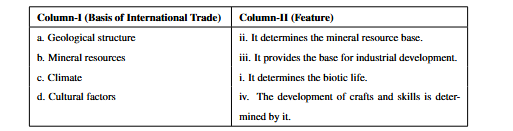
Match Column-I with Column-II and choose the correct option.
View Solution
The correct match is as follows:
a. Geological structure — ii: It determines the mineral resource base.
b. Mineral resources — iii: It provides the base for industrial development.
c. Climate — i: It determines the biotic life.
d. Cultural factors — iv: The development of crafts and skills is determined by it.
Hence, the correct matching is: a–ii, b–iii, c–i, d–iv Quick Tip: Relate physical aspects like geological structure and climate with natural features, and human aspects like culture with skills and development.
Read the following characteristics of workforce carefully, where work is performed through outsourcing and choose the correct option.
I. Availability of cheap and skilled workers
II. Good English language skill of involved workforce
III. Highly-skilled well-paid professionals
IV. Facility of customer support and call centre services
View Solution
Which one of the following is the disadvantage of 'free trade' for developing countries?
View Solution
The successful implementation of watershed management programme in Jhabua district of Madhya Pradesh was funded by which one of the following?
View Solution
Choose the correct option from the following related to World Trade Organisation (WTO).
View Solution
Two statements are given below. They are Assertion (A) and Reason (R). Read both the statements carefully and choose the correct option.
Assertion (A): Lack of basic necessities such as housing, health and drinking water, etc. are found in slum settlements.
Reason (R): The government of India launched 'The Swachh Bharat Mission' to improve the quality of life in urban slums.
View Solution
Which one of the following plan was introduced to improve the conditions of roads in India?
View Solution
Arrange the following towns of India from the oldest to the newest on the basis of their evolution and choose the correct option.
I. Lucknow
II. Varanasi
III. Bhilai
IV. Jamshedpur
View Solution
Which one of the following is an industrial town in India?
View Solution
Choose the correctly matched pair.
View Solution
To understand the earth surface in geography, which one of the following is inseparable?
View Solution
The passage emphasizes that geography as a discipline studies both nature and human beings because the earth is the home of humans. Understanding the earth’s surface requires an inseparable study of natural elements and human activities since they are interconnected.
Hence, the inseparable elements to understand the earth surface in geography are Nature and Human. Quick Tip: Geography studies the interaction between natural environment and human beings together, not separately.
The core concern of geography as a discipline is which one of the following? Choose the most appropriate option.
View Solution
According to the passage, the core concern of geography is to understand the Earth as the home of human beings. Geography focuses on the interaction between humans and their physical environment, making humans the central element.
Thus, the correct answer is that geography studies the Earth primarily as the home of human beings. Quick Tip: Geography studies human-environment relationships and views Earth as human habitat.
Which one of the following helped human beings to develop high order of technology? Choose the most appropriate option.
View Solution
The passage states that human beings were able to develop technology after gaining a better understanding of natural laws. This understanding enabled the creation of tools and techniques that improved cultural development and technological advancement.
Hence, the key factor that helped humans develop higher technology is the better understanding of natural laws. Quick Tip: Technological advancement depends on understanding the principles of nature and applying them effectively.
18.1 Name any two areas of human development.
View Solution
Two key areas of human development are:
Access to resources
Health and education
These areas are important to expand people's capabilities and choices for a better quality of life. Quick Tip: Human development focuses on improving access to resources, health, and education to enhance people's freedoms and choices.
18.2 Mention any two reasons which lead to lack of capability and freedom to make even basic choices.
View Solution
Several factors lead to the lack of capability and freedom for people to make even basic life choices:
Material Poverty: People living in poverty often lack the financial resources necessary to access basic needs such as education, healthcare, and nutrition. This economic deprivation severely limits their freedom to make choices that can improve their lives.
Social Discrimination: Discrimination based on caste, gender, ethnicity, or other social factors marginalizes certain groups, restricting their opportunities and access to resources. This social inequality limits their ability to make free and informed decisions.
Inability to Acquire Knowledge: Lack of education and awareness further restricts individuals from understanding or pursuing better options for their well-being.
Inefficiency of Institutions: Poor functioning of public institutions like schools, hospitals, and welfare agencies can prevent people from receiving the support they need, thus limiting their choices.
These reasons collectively prevent many individuals from leading healthy, educated, and dignified lives by limiting their real freedoms and capabilities. Quick Tip: Freedom to choose depends not only on resources but also on social equality, education, and effective institutions.
18.3 Explain the condition in which the choices of people are restricted.
View Solution
The choices of people are restricted when they lack the necessary capabilities and resources to pursue their desired options. This can happen under the following conditions:
Lack of Education: For example, an uneducated child cannot choose to become a doctor because their limited knowledge and skills restrict such an option.
Material Poverty: Poor people may not afford medical treatment, food, or other basic necessities, limiting their ability to make healthy or beneficial choices.
Social and Institutional Barriers: Discrimination, social inequality, and inefficient institutions may block access to opportunities, further restricting freedom of choice.
Therefore, when individuals do not have capabilities in areas such as education, health, and access to resources, their choices get limited, preventing them from leading fulfilling lives. Quick Tip: Restricted choices occur when people lack education, resources, or face social and institutional barriers.
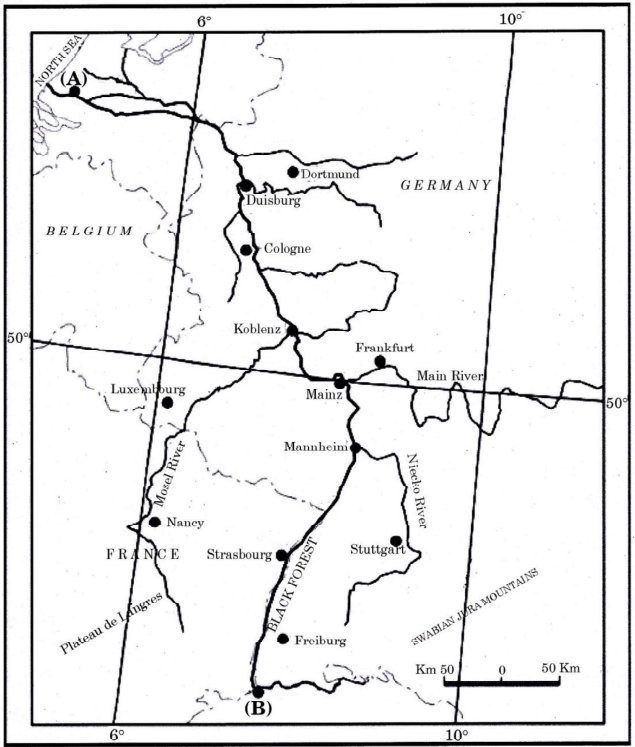
19.1Name the waterway given in the map.
View Solution
The waterway shown in the map is the Rhine Waterway. It is one of the major inland waterways in Europe, facilitating transportation and trade. Quick Tip: Rhine Waterway is an important European river used extensively for navigation and trade.
19.2 Name the ports marked (A) and (B) on the given map.
View Solution
The ports marked on the map are:
(A) Rotterdam — One of the largest and busiest ports in Europe, located in the Netherlands.
(B) Basel — A major inland port located in Switzerland on the Rhine River. Quick Tip: Rotterdam is a major sea port, while Basel is an important inland river port on the Rhine waterway.
19.3 Explain the economic significance of the river as an inland waterway.
View Solution
Rivers used as inland waterways have great economic significance for the regions they flow through:
Facilitates Trade and Transport: Rivers provide a natural and cost-effective means of transporting goods and raw materials, reducing transportation costs compared to road or rail.
Connects Inland Regions to Ports: Inland waterways link interior regions with sea ports, helping in export-import activities and boosting trade.
Supports Industrial Development: Availability of efficient transport encourages the establishment of industries along the river banks.
Promotes Tourism and Employment: River transport and scenic waterways promote tourism, creating jobs in transport, logistics, and hospitality sectors.
Environmentally Friendly: Waterway transport is energy-efficient and less polluting compared to road and air transport.
Therefore, rivers as inland waterways play a crucial role in the economic growth and development of a region by enhancing connectivity and trade. Quick Tip: Inland waterways reduce transport costs, boost trade, encourage industries, and promote sustainable economic development.
Suggest the measures to overcome the problem of water pollution in India.
Explain the main features of the 'Bharatmala Project' for road connectivity.
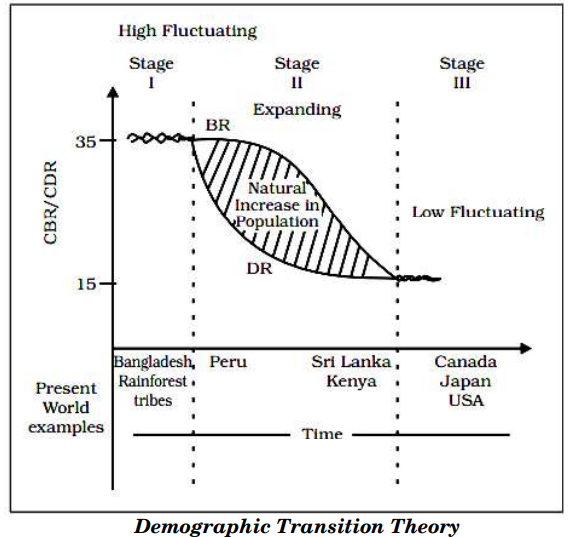
22.1 Explain the reason of high net population increase in Stage II of Demographic Transition Theory.
View Solution
- In Stage II of the demographic transition, there is a high net population increase due to a significant decline in the death rate (DR) while the birth rate (BR) remains relatively high.
- The decline in the death rate is primarily driven by improvements in public health, sanitation, medical advancements, and better nutrition. These factors reduce mortality rates, especially among infants and children.
- However, the birth rate remains high because traditional cultural norms and practices continue to encourage large families, and there may be a lack of access to family planning or contraception.
- The difference between the birth rate and the death rate results in a high natural increase in population, leading to rapid population growth. Quick Tip: Stage II is marked by falling death rates and still-high birth rates, resulting in a rapid rise in population.
22.2 Differentiate between Stage I and Stage III of Demographic Transition Theory.
View Solution
Differentiate between stage I and III of demographic transition theory.
- Stage I (High Fluctuating):
- Characteristics: High birth rates and high death rates, resulting in low population growth.
- Causes: Poor healthcare, high infant mortality, limited access to food and resources, and frequent epidemics.
- Examples: Rainforest tribes, some remote communities.
- Stage III (Low Fluctuating):
- Characteristics: Low birth rates and low death rates, resulting in very low population growth or even population decline.
- Causes: Advanced healthcare, widespread use of contraception, higher education levels, and economic development leading to smaller family sizes.
- Examples: Developed countries like Canada, Japan, USA.
- Key Differences:
- Birth Rate: High in Stage I, low in Stage III.
- Death Rate: High in Stage I, low in Stage III.
- Population Growth: Low in Stage I, very low or stable in Stage III.
- Socio-economic Conditions: Primitive or underdeveloped in Stage I, highly developed in Stage III. Quick Tip: Stage I has both high birth and death rates, while Stage III sees declining birth rates and low death rates due to development and awareness.
22.3 Describe the socio-economic conditions of countries under Stage III of Demographic Transition Theory.
View Solution
- Economic Development: Countries in Stage III are typically highly developed with advanced economies. They have diversified industries, high levels of technological innovation, and strong infrastructure.
- Healthcare and Education: There is universal access to high-quality healthcare and education. Life expectancy is high, and infant mortality rates are very low.
- Family Planning: Access to family planning and contraception is widespread, leading to lower fertility rates as people choose to have smaller families.
- Urbanization: A high percentage of the population lives in urban areas, and there is a shift from agrarian economies to service-based and knowledge-driven economies.
- Social Security: Robust social security systems provide support for the elderly, reducing the need for large families as a form of insurance against old age.
- Environmental Awareness: There is greater awareness and action regarding environmental sustainability, reflecting the advanced socio-economic conditions. Quick Tip: Stage III reflects socio-economic progress—urbanisation, female education, and healthcare reforms reduce birth rates and stabilise population growth.
(a) Explain the main characteristics of Kolkata sea port and its hinterland.
View Solution
Kolkata Port is one of the major riverine ports of India, located on the Hooghly River in West Bengal. It plays a vital role in the eastern region's trade and commerce.
Riverine Port: It is the only major riverine port in India, situated about 128 km inland from the Bay of Bengal.
Tidal Port: The port experiences tidal effects, requiring continuous dredging to maintain navigability.
Twin Dock Systems: It has two dock systems — Kolkata Dock System and Haldia Dock Complex.
Oldest Operating Port: Kolkata Port is one of the oldest operating ports in India, serving as a gateway for trade with East and Southeast Asia.
Hinterland: The port serves a large hinterland including West Bengal, Bihar, Jharkhand, eastern Uttar Pradesh, Assam, and the landlocked countries of Nepal and Bhutan. Quick Tip: Kolkata Port is a riverine and tidal port with strategic inland connectivity and international importance for eastern India.
(b) Explain the main characteristics of Mumbai sea port and its hinterland.
View Solution
Mumbai Port is the largest natural harbour port in India and plays a key role in India's maritime trade.
Natural Harbour: Mumbai Port is a natural deep-sea harbour, well-sheltered by the Konkan coast, which provides safe anchorage.
Largest Port in India: It handles large volumes of cargo, including petroleum products, chemicals, textiles, machinery, and electronic goods.
Well-Connected Infrastructure: The port has excellent connectivity via road, rail, and air, supporting fast inland distribution.
Modern Facilities: Equipped with modern facilities like container terminals and dry docks for ship repair and maintenance.
Hinterland: It serves a vast and economically important hinterland including Maharashtra, Madhya Pradesh, Gujarat, Karnataka, Telangana, and parts of northern India. Quick Tip: Mumbai Port is India’s largest natural port, handling diverse cargo and serving a vast industrial hinterland in western and central India.
Explain any five problems faced by the agricultural sector in India.
(a) Analyse the main features of plantation agriculture in the world.
(b) Analyse the main features of nomadic herding in the world.
(a) "Industries maximise profits by reducing costs." Explain the statement with examples.
View Solution
Industries aim to maximise profits by reducing production and transportation costs. This is achieved through several strategies:
Location Near Raw Materials: Locating industries close to the source of raw materials reduces transportation cost.
\textit{Example: Iron and steel plants near coal and iron ore mines in Jharkhand and Chhattisgarh.
Access to Cheap Labour: Setting up industries in regions with abundant low-cost labour reduces wage bills.
\textit{Example: Textile industries in India benefit from cheap and skilled labour.
Proximity to Market: Industries near large markets save on distribution costs and meet demand quickly.
\textit{Example: Consumer goods industries near metro cities like Delhi and Mumbai.
Use of Efficient Technology: Adoption of modern machinery reduces wastage and improves productivity, thus lowering costs.
Clustering of Industries: Establishing industries in clusters or industrial hubs enables sharing of infrastructure and services, lowering overall costs.
\textit{Example: IT parks and SEZs.
Thus, cost reduction in these ways helps industries earn higher profits and remain competitive. Quick Tip: Industries reduce cost through location planning, use of cheap labour, modern technology, and efficient supply chains to increase profits.
(b) Explain the classification of industries on the basis of raw materials with examples.
View Solution
Industries can be classified based on the type of raw materials they use:
Agro-based Industries: Use agricultural products as raw materials.
\textit{Example: Sugar, cotton textile, dairy, tea industries.
Mineral-based Industries: Use minerals and ores as raw materials.
\textit{Example: Iron and steel, cement, aluminium industries.
Forest-based Industries: Use forest products as raw materials.
\textit{Example: Paper, plywood, furniture, lac industries.
Animal-based Industries: Use products obtained from animals.
\textit{Example: Leather, wool, meat processing industries.
This classification helps understand the resource dependency and regional distribution of industries. Quick Tip: Industries are classified by raw material type: agro-based, mineral-based, forest-based, and animal-based.
(a) Explain the main objectives of Jal Kranti Abhiyan in India.
(b) Explain the different methods of rainwater harvesting in India.
(a) Analyse the regional variation in population growth in India.
View Solution
Population growth in India shows significant regional variation due to socio-economic, cultural, and environmental differences across states.
High Growth States: States like Bihar, Uttar Pradesh, Madhya Pradesh, and Rajasthan have higher population growth due to high birth rates, early marriage, and low literacy levels.
Moderate Growth States: States like Haryana, Gujarat, West Bengal, and Andhra Pradesh show moderate growth due to improving education and health indicators.
Low Growth States: States like Kerala, Tamil Nadu, and Goa have low population growth due to higher literacy rates, better healthcare, and family planning awareness.
Negative or Stagnant Growth Regions: Some hilly or tribal areas like Nagaland and Sikkim have witnessed stagnation or even decline due to migration and low fertility.
Urban-Rural Divide: Urban areas show slower growth compared to rural areas, mainly due to lifestyle changes and access to family planning.
Thus, population growth varies widely due to regional socio-economic development and demographic trends. Quick Tip: Population growth in India is high in less developed northern states and low in southern states with better social indicators.
(b) Analyse any five factors responsible for uneven population distribution in India.
View Solution
Population in India is unevenly distributed due to a variety of physical and human factors:
Topography: Plains (e.g., Indo-Gangetic Plain) support dense population due to flat land and fertile soil, while mountains and plateaus (e.g., Himalayas) are sparsely populated.
Climate: Moderate climate regions attract more people. Harsh climates like deserts (Thar) or extreme cold (Ladakh) discourage settlement.
Soil Fertility: Fertile alluvial soil supports agriculture and dense population (e.g., Punjab, Bihar), while infertile areas see sparse population.
Availability of Water: River basins like Ganga and Brahmaputra are densely populated due to ample water supply.
Economic Development: Industrial and urban centres (e.g., Mumbai, Delhi) attract large populations due to employment opportunities.
These physical and socio-economic factors cause variations in where people live in India. Quick Tip: Fertile plains, water availability, and economic opportunities lead to dense population, while harsh terrain and poor infrastructure result in sparse settlement.
On the given political outline map of the world, seven geographical features have been marked as A, B, C, D, E, F and G. Identify them with the help of the following information and write their correct names on the lines drawn near them:
A. An area of extensive commercial grain farming
B. An area of subsistence gathering
C. A major sea port
D. A major airport
E. A major sea port
F. A major area of nomadic herding
G. An inland waterway
OR On the given political outline map of India, locate and label the following seven geographical features with appropriate symbols:
The state leading in the production of cotton
Iron ore mines located in southern part of Chhattisgarh
Copper mines located in northern part of Jharkhand
A major sea port of Goa
An international airport in Gujarat
A sea port built to relieve the pressure of Kolkata sea port
The state leading in the production of tea



Comments