




CBSE Class 12 Geography Question Paper 2025 PDF Set 1 64-7-1 is available for download here. CBSE conducted the Geography exam on February 24, 2025, from 10:30 AM to 1:30 PM. The total marks for the theory paper are 70. The question paper contains 20% MCQ-based questions, 40% competency-based questions, and 40% short and long answer-type questions. Candidates can download the official CBSE Class 12 Geography Question Paper 2025 with Solution PDF using the link below.
CBSE Class 12 2025 Geography 64-7-1 Question Paper with Solution PDF
| CBSE Board Class 12 Geography Question Paper with Answer Key | Download PDF | Check Solutions |

Which of the following are branches of Dravidian language in India? Choose the correct option.
I. Central Dravidian
II. East Dravidian
III. South Dravidian
IV. North Dravidian
View Solution
Two statements are given below. They are Assertion (A) and Reason (R). Read both the statements carefully and choose the correct option.
Assertion (A): There is an inverse relationship between quality and quantity of minerals.
Reason (R): Good quality minerals are less in quantity as compared to low quality minerals.
View Solution
The road between Chandigarh and Manali was constructed by which of the following?
View Solution
Identify the area where lift irrigation is available in the 'Indira Gandhi Canal Command Area'?
Two statements are given below. They are Assertion (A) and Reason (R). Read both the statements carefully and choose the correct option.
Assertion (A) : India has highly uneven pattern of population distribution.
Reason (R) : Population distribution is highly associated with physical, socio-economic and historical factors.
View Solution
Identify the practical measure from the following to control air pollution in the metropolitan cities in India. Choose the most appropriate option.
View Solution
In which one of the following approaches of human development are human beings the targets of all developmental activities? Choose the most appropriate option.
View Solution
Identify the type of agriculture predominantly practised in the Australian Downs.
View Solution
Identify the sector concerned with the work of converting raw materials into finished products.
View Solution
Automatic vending machines and the internet are examples of which of the following types of trade?
View Solution
Which one of the following is correct about growth and development?
View Solution
Which one of the following is an example of a 'Gold Collar' professional?
View Solution
Match Column I with Column II and choose the correct option.
a. Equity & i. Providing better health facilities to everyone
b. Sustainability & ii. Good governance and people-oriented policies
c. Productivity & iii. Each generation must ensure the availability of choices and opportunities to its future generations
d. Empowerment & iv. Equal access of opportunities for everyone
View Solution
N/A
Read the following characteristics of tertiary activities carefully and choose the correct option.
I. Tertiary activities include all types of services.
II. Trade, transport and communication are parts of tertiary activities.
III. Raw material is transformed into finished goods under tertiary activities.
IV. Teachers, lawyers and traders are some of the examples of tertiary activities.
View Solution
Which one of the following is called 'free trade'?
View Solution
Free trade refers to the removal or reduction of trade barriers such as tariffs and quotas, allowing goods and services to move freely across countries. This process is known as trade liberalisation. Quick Tip: Free trade = Trade liberalisation = Removal of trade barriers.
The most adverse effect of 'free trade' is observed with which one of the following?
View Solution
Developing countries often suffer the most adverse effects of free trade due to unequal competition with developed nations, which have better resources and technology. Free trade without a level playing field can hurt domestic industries in developing countries. Quick Tip: Free trade often disadvantages developing countries due to unequal competition.
Which one of the following is the impact of the development of transport and communication on trade?
View Solution
Advancements in transport and communication have allowed goods and services to be transported more quickly over longer distances than ever before, thus increasing the scope and speed of trade globally. Quick Tip: Better transport and communication = Faster and farther movement of goods and services.
Read the given passage carefully and answer the questions that follow:
Promoting Gender Sensitivity through ‘Beti Bachao–Beti Padhao’ Social Campaign
The division of the society into male, female and transgender is believed to be natural and
biological. But, in reality, there are social constructs and roles assigned to individuals which
are reinforced by social institutions. Consequently, these biological differences become the
basis of social differentiations, discriminations and exclusions. The exclusion of over half of
the population becomes a serious handicap to any developing and civilised society. It is a
global challenge, which has been acknowledged by the UNDP when it mentioned that, “If
development is not engendered it is endangered” (HDR UNDP 1995). Discrimination, in
general, and gender discrimination, in particular, is a crime against humanity.
All efforts need to be made to address the denial of opportunities of education, employment,
political representation, low wages for similar types of work, disregard to their entitlement to
live a dignified life, etc. A society, which fails to acknowledge and take effective measures to
remove such discriminations, cannot be treated as a civilised one. The Government of India
has duly acknowledged the adverse impacts of these discriminations and launched a
nationwide campaign called ‘Beti Bachao – Beti Padhao’.
18.1 Describe any one ill-effect of gender discrimination on a society.
View Solution
N/A Quick Tip: Eliminating gender discrimination is essential for inclusive growth, equality, and sustainable development.
“If development is not engendered it is endangered.” Explain the statement.
View Solution
N/A Quick Tip: Sustainable development requires equal opportunities and empowerment for all genders to truly succeed.
Explain the main objective of ‘Beti Bachao Beti Padhao’ campaign.
View Solution
N/A Quick Tip: ‘Beti Bachao Beti Padhao’ focuses on saving girls and promoting their education and empowerment to build a more equal society.
Question 19:
Study the given figure carefully and answer the questions that follow :
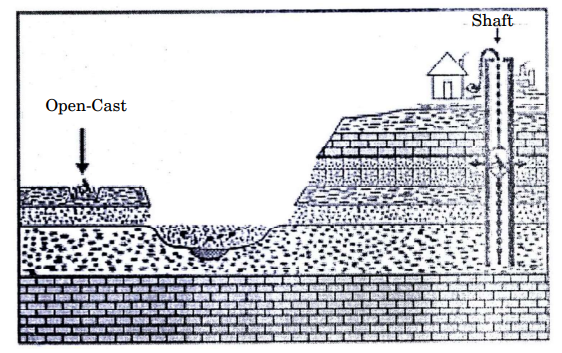
19.1 Mention the methods of mining given in the picture.
View Solution
The methods of mining shown in the picture are:
Open-cast Mining – Minerals are extracted by removing surface layers of soil and rock.
Shaft Mining – Deep vertical shafts are dug to reach minerals lying at great depths. Quick Tip: Different methods of mining are used depending on the depth and type of mineral deposit—surface mining for shallow minerals and underground mining for deeper ones.
19.2 Differentiate between the two methods of mining given in the picture.
View Solution
The two commonly depicted methods of mining are Open-cast Mining and Shaft Mining. Their differences are:
\begin{tabular{|p{6.5cm|p{6.5cm|
\hline
Open-cast Mining & Shaft Mining
\hline
Used for extracting minerals that lie close to the surface. & Used for extracting minerals that lie deep below the surface.
\hline
Involves removal of surface layers to reach the mineral deposit. & Involves digging deep vertical shafts to access underground minerals.
\hline
Less expensive and less dangerous. & More expensive and riskier due to depth and safety concerns.
\hline
\end{tabular Quick Tip: Open-cast mining is suitable for shallow deposits, while shaft mining is used when minerals are located deep inside the Earth.
19.3 Which mining method is more life threatening?
View Solution
Shaft mining is more life-threatening because it involves digging deep underground shafts, which poses risks such as:
Possibility of tunnel collapse or cave-ins
Exposure to harmful gases and dust
Poor ventilation and lighting
Higher chances of fire, flooding, or accidents Quick Tip: Shaft mining is riskier than open-cast mining due to its depth, confined spaces, and hazardous working conditions.
(a) Explain the main reasons for uneven distribution of modern manufacturing industries in the world.
View Solution
The distribution of modern manufacturing industries is highly uneven across the world due to various geographical and human factors.
Availability of Raw Materials: Industries tend to be located near sources of raw materials to reduce transport costs.
Power Supply: Constant and cheap electricity or fuel supply is essential for industrial activity.
Labour Supply: Availability of both skilled and unskilled labour supports industrial growth.
Transport and Infrastructure: Efficient transport and communication networks encourage industrial development.
Market Proximity: Industries are located near large markets to ensure quick delivery and reduce distribution costs.
Government Policies: Policies regarding taxation, subsidies, and infrastructure influence industrial location.
Historical and Political Factors: Colonial history or political stability has shaped industrial patterns in many regions. Quick Tip: Industrial distribution is affected by access to raw materials, labour, infrastructure, and supportive government policies.
(b) Classify the industries based on product and explain their characteristics.
View Solution
Industries can be classified on the basis of the type of product they produce. The major types are:
Agro-based Industries:
These use agricultural raw materials.
\textit{Example: Cotton textile, sugar, jute.
Mineral-based Industries:
These use mineral ores as raw materials.
\textit{Example: Iron and steel, aluminium, cement.
Forest-based Industries:
These depend on forest produce.
\textit{Example: Paper, furniture, plywood.
Animal-based Industries:
These use animal products as raw materials.
\textit{Example: Leather, dairy, woolen textile. Quick Tip: Industries are classified into agro, mineral, forest, and animal-based depending on the nature of raw material used.
"Humans are directly dependent on natural resources to sustain them." Explain the statement with examples.
22.1 With reference to 1951, how much change has taken place in the percentage of total population in 1991?
View Solution
In 1951, the urban population was 17.29% of the total population. In 1991, it increased to 25.71%.
Change = 25.71% - 17.29% = 8.42% increase in urban population percentage from 1951 to 1991. Quick Tip: Urban population percentage increased by over 8% between 1951 and 1991, showing growing urbanisation.
22.2 Describe the trend of urban population in the given table.
View Solution
The urban population in India has shown a steady increase from 33,456 thousand in 1931 to 2,85,355 thousand in 2001. The percentage of the urban population also rose from 11.99% in 1931 to 27.78% in 2001, indicating rapid urbanisation over the decades. Despite some fluctuations, the overall trend shows significant growth in the number and size of urban areas. Quick Tip: Urban population is steadily rising, reflecting increased migration and growth of cities.
22.3 Explain the reason for the increasing trend of number of towns/UAs from 1961 to 2001.
View Solution
The increase in the number of towns and Urban Agglomerations (UAs) from 1961 to 2001 can be attributed to:
Industrialisation: Growth of industries attracted people to urban areas.
Migration: Large-scale rural to urban migration for better employment opportunities.
Expansion of Existing Towns: Many villages grew and were reclassified as towns.
Better Infrastructure and Services: Improvement in urban amenities attracted more settlements. Quick Tip: More towns/UAs emerge due to industrial growth, migration, and development of infrastructure.
Define water quality. Explain the reasons of deteriorating surface water quality in India.
(a) "Urban centres in India are more differentiated in terms of the socio-economic, politico-cultural and other indicators of development." Evaluate the statement with examples.
View Solution
Urban centres in India show wide variation in development due to differences in history, economy, population, culture, and governance.
Socio-economic Differences: Cities like Mumbai and Bengaluru are highly developed economically, while others like Patna and Gaya lag behind in infrastructure and employment opportunities.
Cultural Variation: Urban centres such as Varanasi focus on religion and tradition, while cities like Pune emphasize education and innovation.
Political Importance: Cities like New Delhi hold national political significance, whereas others have only local administrative roles.
Access to Services: Metro cities offer better healthcare, education, and transport than smaller towns.
Thus, urban centres are highly differentiated due to uneven development and regional disparities. Quick Tip: Urban centres differ in development levels due to variations in economy, culture, infrastructure, and political roles.
(b) "The land degradation due to man-made processes has greater concern than natural processes." Evaluate the statement with examples.
View Solution
Man-made activities are the major contributors to land degradation in India and are more controllable than natural processes.
Deforestation: Large-scale cutting of forests for agriculture and urbanisation leads to soil erosion and loss of fertility.
Overgrazing: Uncontrolled grazing by animals damages vegetation and exposes soil.
Over-irrigation: Causes waterlogging and salinisation, reducing soil productivity.
Mining: Open-cast mining displaces topsoil and pollutes land and water bodies.
In contrast, natural causes like floods or droughts affect land but are less frequent and widespread compared to continuous man-made harm. Quick Tip: Man-made actions like deforestation and over-irrigation are major causes of land degradation and require urgent attention.
Explain the changing patterns of the composition of India's import.
(a) Classify Indian farming practices on the basis of source of moisture and describe them.
View Solution
On the basis of the source of moisture, Indian farming practices are classified into two types:
Irrigated Farming:
In this type of farming, artificial sources like canals, tube wells, tanks, and wells are used to supply water.
\textit{Example: Regions of Punjab and Haryana use canal irrigation for growing wheat and rice.
Rainfed Farming:
This type of farming depends entirely on rainfall for moisture. It is further classified into:
Dryland Farming: Practised in low rainfall areas; crops like millets and pulses are grown.
Wetland Farming: Practised in high rainfall areas; crops like rice, jute, and sugarcane are grown. Quick Tip: Irrigated farming relies on artificial water sources, while rainfed farming depends on natural rainfall.
(b) Define Common Property Resources. How do Common Property Resources help in providing livelihood to the landless and marginal farmers? Explain.
View Solution
Common Property Resources (CPRs) refer to natural resources like pastures, grazing grounds, forests, water bodies, and wastelands that are accessible to all members of a community.
Role in Supporting Livelihoods:
Grazing Land: Marginal farmers and landless people use CPRs for grazing their livestock.
Fuel and Fodder: Forests and common lands provide firewood, fodder, and fruits.
Water Resources: Community ponds and tanks are used for irrigation and household needs.
Supplementary Income: Collection and sale of forest produce help supplement rural incomes.
Thus, CPRs play a vital role in supporting rural livelihoods and reducing dependency on private land ownership. Quick Tip: Common Property Resources support the rural poor by providing grazing land, water, fodder, and forest produce.
(a) Explain the factors affecting the population distribution in the world.
(b) Define migration. Differentiate between pull and push factors of population migration.
(a) Explain the characteristics of "Trans-Canadian Railway.”
Explain the characteristics of "Trans-Siberian Railway.”
On the given political outline map of the world (on page 25), seven geographical features have been marked as A, B, C, D, E, F and G. Identify any five with the help of the following information and write their correct names on the lines drawn near them:
A. A major sea port
B. A major airport
C. A terminal station of Trans-Siberian Railway
D. An inland waterway
E. An area of commercial livestock rearing
F. An area of nomadic herding
G. A major sea port of South America
OR On the given political outline map of India, locate and label any five of the following seven geographical features with appropriate symbols:
(30.1) The state with the highest population density
(30.2) The leading rice producing state
(30.3) Important iron ore mines located in coastal Maharashtra
(30.4) Important coal mines located in Tamil Nadu
(30.5) A major sea port in Gujarat
(30.6) An international airport in Punjab
(30.7) An oil refinery in Uttar Pradesh




Comments