




CBSE Class 12 History 61-7-2 Question Paper PDF set-2 is available for download. CBSE conducted the Class 12 History examination on April 2, 2025, from 10:30 AM to 1:30 PM. The question paper consists of 34 questions carrying a total of 80 marks. Section A includes 21 MCQs for 1 mark each, Section B contains 6 short-answer questions for 3 marks each, Section C comprises 3 long-answer questions for 8 marks each, Section D comprises 3 Source-based questions having three sub-questions, carries 4 marks, and Section E comprises 1 Map-based question that carries 5 marks. Candidates can use the link below to download the CBSE Class 12 History 61-7-2 Question Paper with detailed solutions.
CBSE Class 12 2025 History Question Paper 61-7-2 with Answer Key
| CBSE Class 12 2025 History Question Paper with Answer Key | Download PDF | Check Solution |
Two statements labelled as Assertion (A) and Reason (R) are given below. Read them carefully and select the correct option:
Assertion (A): The American Civil War created a panic in the cotton circles in Britain.
Reason (R): American cotton supplies had dropped drastically which increased the demand for Indian cotton.
View Solution
Choose the correct option from the following to fill in the blank regarding the leaders of the Revolt of 1857.
Arrah (Bihar) : Kunwar Singh; ________ : Birjis Qadr
View Solution
On whose advice did Gandhiji spend a year travelling around British India upon his return in 1915?
View Solution
Which of the following pairs of Committees and their Presidents is correct regarding the Constituent Assembly?
View Solution
Why was Awadh referred to as the ‘Nursery of the Bengal Army’ during the 1850s? Choose the correct option from the following.
View Solution
Which of the following options shows the correct chronological order of events related to the Indian National Movement?
I. Second Round Table Conference
II. Peasant Movement in Bardoli
III. Champaran Satyagraha
IV. Jallianwala Bagh Massacre
View Solution
Why did the British prefer the ‘Ryotwari system’ in Bombay over the ‘Permanent Settlement’?
View Solution
Which of the following pairs is correctly matched regarding the Vijayanagara empire?
View Solution
Why are Chola temples at places like Thanjavur significant in ancient history?
View Solution
Fill in the blank:
Karl Marx’s concept of ‘Asiatic mode of production’ depicted rural society as \underline{\hspace{3cm.
View Solution
Which of the following features of ‘Mulk Abadi’ of Ain-i-Akbari helps historians to understand the administrative structure of the Mughal Empire?
View Solution
Which of the following temple’s priest provided memories that were crucial for the initial survey of Hampi?
View Solution
Which of the following pairs is correctly matched?
View Solution
Match the following Column I with Column II and choose the correct option:
Column I (Traveller) & Column II (Country)
a. Afanasii Nikitin & i. Spain
b. Duarte Barbosa & ii. Turkey
c. Antonio Monserrate & iii. Portugal
d. Seydi Ali Reis & iv. Russia
View Solution
Identify the ancient ruler of India with the help of the following information and choose the correct option:
Was the best known ruler of the Satavahana dynasty.
Claimed to be a unique Brahmana.
Was the son of Rishi Vashishtha.
View Solution
Fill in the blank with the appropriate word from the given options.
In Jaina philosophy, the cycle of birth and rebirth is influenced by _____.
View Solution
Coinage in Ancient India
Which of the following statements accurately describes the coinage of ancient India?
I. Ancient Parthian gold coins showed extensive trade in north India.
II. Ancient Roman coins in South India indicated trade beyond borders.
III. Ancient Yaudheyas issued copper coins that highlighted their economic activity.
IV. Ancient Gupta rulers issued silver coins that facilitated trade.
Options:
View Solution
Identification of Historical Artefact
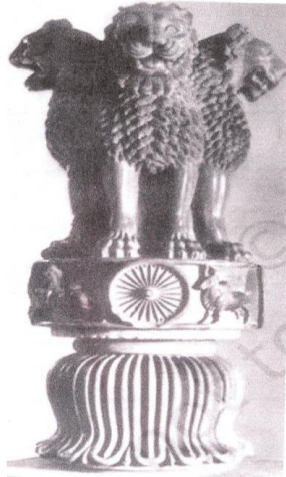
Look at the image given below and identify the historical artefact:
View Solution
Assertion and Reason Based Question
Two statements labelled as Assertion (A) and Reason (R) are given below. Read them carefully and select the correct option:
Assertion (A): Shahjehan Begum was a patron of art and architecture in the 19th century, known for her contribution for Sanchi’s preservation.
Reason (R): Sanchi Stupa is a classical example of early Buddhist architecture.
View Solution
Which of the following statement is correct about the Shungas and Kanvas?
View Solution
The presence of granaries at Harappan sites most likely implies which of the following about their agricultural practices?
View Solution
How did different types of marriages reflect the social systems of ancient India during the Mahabharata Period? Explain with examples.
View Solution
How did familial relations impact the social systems of India during the Mahabharata Period? Explain with examples.
View Solution
How did the restoration of Sanchi by Shahjehan Begum impact the study of ancient Indian history? Explain.
View Solution
“Panchayats played a crucial role in the Mughal rural society.” Justify the statement with suitable arguments.
View Solution
“Many forest-dwelling communities maintained a significant level of political independence.” Examine the statement in the context of Mughal empire.
View Solution
Analyse the conditions of Ryots in the Ryotwari system.
View Solution
Explain the grievances of Indian Sepoys in the British East India Company during the 1850s.
View Solution
Indian sepoys had multiple grievances against the British East India Company, which contributed to widespread resentment and eventually the Revolt of 1857.
Discrimination in Service: Indian soldiers received lower pay and fewer opportunities for promotion compared to British counterparts.
Cultural Insensitivity: The British often disregarded religious and social customs, like the controversial greased cartridge issue.
Overseas Posting: Crossing the sea was considered impure by many sepoys, and the British policies did not respect these beliefs.
Fear of Religious Conversion: There was a widespread fear among sepoys that the British aimed to convert them to Christianity.
These issues created a deep sense of injustice, fueling anger and rebellion among the sepoys.
Imagine you are creating a project on Mirabai’s life. How would you explain the emotions of devotion in her poetry?
View Solution
How do Harappan artifacts contribute to our understanding of the Indus Valley Civilization? Explain with examples.
View Solution
Explain with examples the different views of archaeologists and historians on the religion of Harappans.
View Solution
The Virupaksha Temple is a historic temple located in Hampi. What features make it a key architectural and cultural landmark of the Vijayanagara Empire? Explain.
View Solution
The Royal Centre in Vijayanagara was significant. Which architectural features make it an important cultural landmark? Explain.
View Solution
“Gandhiji initiated the Civil Disobedience Movement to challenge British laws.” Examine the statement.
View Solution
“The ‘Quit India Movement’ was Gandhiji’s call for an end to British rule.” Examine the statement.
View Solution
Examine the main impact of the shift from Rajagaha to Pataliputra, on the Magadhan empire.
View Solution
What message did Xuan Zang wish to convey about Pataliputra?
View Solution
What role did Pataliputra play in the history of the Magadhan empire?
View Solution
How did Bernier’s description reflect the economic significance of the karkhanas in the Mughal empire?
View Solution
How did the crafts in the karkhanas reflect the cultural diversity of the Mughal empire?
View Solution
Analyse the relationship between the Mughal empire and its artisans.
View Solution
How did defining India as a ‘republic’ enhance democratic governance?
View Solution
How does economic democracy promote social equality within a republican framework?
View Solution
How did Jawaharlal Nehru view the role of the Constituent Assembly in shaping democracy in India?
View Solution
On the given political outline map of India (on page 27), locate and label the following with appropriate symbols:
[(i)] Bodh Gaya – An ancient Buddhist site
[(ii)] Lothal – A mature Harappan site
[(iii)] (a) Goa – Territory under Mughal Empire
[OR] (b) Vijayanagara – Capital of Vijayanagara Empire
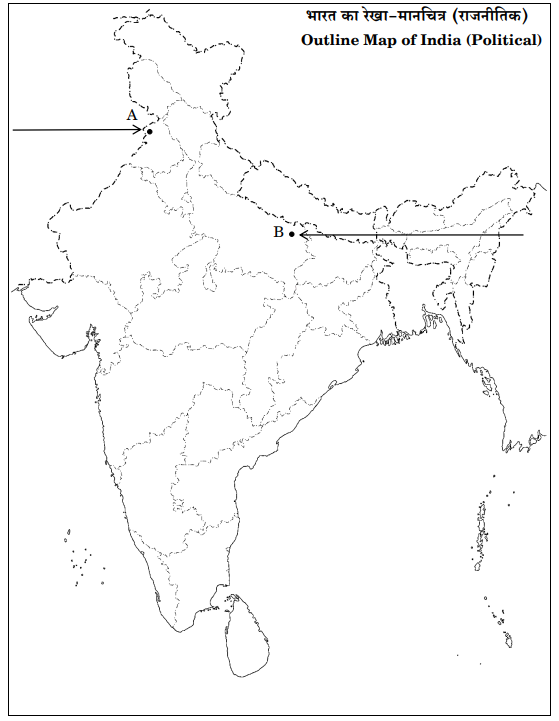
On the same outline map of India, two places have been marked as A and B, the centres of the Indian National Movement. Identify them and write their correct names on the lines drawn near them.
View Solution



Comments