




CBSE Class 12th Board Mathematics exam was conducted on 8th March 2025 from 10:30 AM to 1:30 PM.The Mathematics theory paper is worth 80 marks, and the internal assessment is worth 20 marks. Mathematics question paper includes MCQs (1 mark each), short-answer type questions (2 & 3 marks each), and long-answer type questions (4 & 6 marks each), making up 80 marks.
CBSE Class 12 Mathematics Set-2 (65/1/2) Question Paper and Detailed Solutions PDF is available for download here.
CBSE Class 12 2025 Mathematics 65-1-2 Question Paper with Solution PDF
| CBSE Class 12 2025 Mathematics Question Paper With Answer Key | Download PDF | Check Solutions |

If \( E \) and \( F \) are two independent events such that \( P(E) = \frac{2}{3} \), \( P(F) = \frac{3}{7} \), then \( P(E \,|\, F) \) is equal to:
View Solution
If \( \vec{\alpha} = \hat{i} - 4 \hat{j} + 9 \hat{k} \) and \( \vec{\beta} = 2\hat{i} - 8 \hat{j} + \lambda \hat{k} \) are two mutually parallel vectors, then \( \lambda \) is equal to:
\[ \int \frac{1 - 2 \sin x}{\cos^2 x} \, dx \]
is equal to:
(D) \( \tan x + 2 \sec x + C \)
View Solution
We begin by simplifying the integral: \[ \int \frac{1 - 2 \sin x}{\cos^2 x} \, dx = \int \frac{1}{\cos^2 x} \, dx - 2 \int \frac{\sin x}{\cos^2 x} \, dx. \]
We know that \( \frac{1}{\cos^2 x} = \sec^2 x \), so the first integral becomes: \[ \int \sec^2 x \, dx = \tan x. \]
For the second integral, use the substitution \( u = \cos x \), which gives \( du = -\sin x \, dx \), so: \[ 2 \int \frac{\sin x}{\cos^2 x} \, dx = -2 \int \frac{du}{u^2} = 2 \sec x. \]
Thus, the integral becomes: \[ \tan x + 2 \sec x + C. \]
Therefore, the correct answer is \( \boxed{\tan x + 2 \sec x + C} \). Quick Tip: To solve integrals involving trigonometric functions, look for opportunities to use known identities such as \( \sec^2 x = 1 + \tan^2 x \) and use substitution to simplify complex expressions.
If \( \overrightarrow{a} + \overrightarrow{b} + \overrightarrow{c} = 0 \), \( |\overrightarrow{a}| = \sqrt{37} \), \( |\overrightarrow{b}| = 3 \), and \( |\overrightarrow{c}| = 4 \), then the angle between \( \overrightarrow{b} \) and \( \overrightarrow{c} \) is:
View Solution
The graph of a trigonometric function is as shown. Which of the following will represent the graph of its inverse?

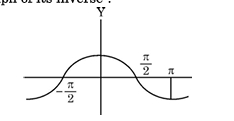
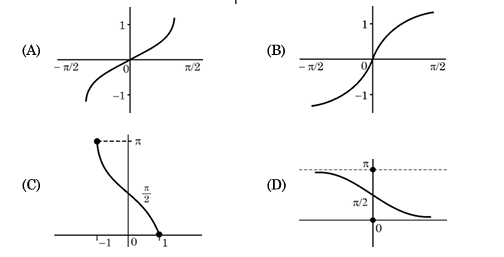
View Solution
If \( A \) is a square matrix of order 3 such that \( \det(A) = 9 \), then \( \det(9A^{-1}) \) is equal to:
Correct Answer:(B) \( 9^2 \)
View Solution
We are given that \( A \) is a square matrix of order 3, and that \( \det(A) = 9 \).
We need to find \( \det(9A^{-1}) \).
We use the property of determinants: \[ \det(cA) = c^n \det(A), \]
where \( c \) is a scalar and \( n \) is the order of the matrix.
For the inverse matrix, we have the property: \[ \det(A^{-1}) = \frac{1}{\det(A)}. \]
Thus, \[ \det(9A^{-1}) = 9^3 \det(A^{-1}) = 9^3 \times \frac{1}{\det(A)}. \]
Since \( \det(A) = 9 \), we substitute: \[ \det(9A^{-1}) = 9^3 \times \frac{1}{9} = 9^2. \]
Thus, the correct answer is \( \boxed{9^2} \). Quick Tip: To find the determinant of a scalar multiple of a matrix or its inverse, use the properties \( \det(cA) = c^n \det(A) \) and \( \det(A^{-1}) = \frac{1}{\det(A)} \).
If \( f(x) = |x| + |x - 1| \), then which of the following is correct?
View Solution
Which of the following is not a homogeneous function of \( x \) \text{ and \( y \)?
View Solution
Let \( A \) be a matrix of order \( m \times n \) and \( B \) be a matrix such that \( A^T B \) and \( B A^T \) are defined. Then, the order of \( B \) is:
The feasible region of a linear programming problem with objective function \( Z = ax + by \), is bounded, then which of the following is correct?
View Solution
If \[ A = \begin{bmatrix} -1 & 0 & 0
0 & 1 & 0
0 & 0 & 1 \end{bmatrix}, then A^{-1} is: \]
The integrating factor of the differential equation \( \frac{dy}{dx} + y = \frac{1 + y}{x} \) is:
Let \( A = [a_{ij}] \) be a square matrix of order 3 such that \( a_{ij} = \hat{i} - 2 \hat{j} \). Then, which of the following is true?
The absolute maximum value of function \( f(x) = x^3 - 3x + 2 \) in \( [0, 2] \) is:
View Solution
If \( \int \frac{1}{2x^2} \, dx = k \cdot 2x + C \), then \( k \) is equal to:
View Solution
If \( A \) and \( B \) are invertible matrices, then which of the following is not correct?
View Solution
The corner points of the feasible region in graphical representation of a L.P.P. are \( (2, 72), (15, 20) \) and \( (40, 15) \). If \( Z = 18x + 9y \) be the objective function, then:
View Solution
The area of the shaded region bounded by the curves \( y^2 = x, x = 4 \) and the x-axis is given by:

View Solution
Assertion (A): Let \( Z \) be the set of integers. A function \( f : Z \to Z \) defined as \( f(x) = 3x - 5 \), \( \forall x \in Z \), is a bijective.
Reason (R): A function is bijective if it is both surjective and injective.
View Solution
Assertion (A)
Assertion (A): \(f(x) = \begin{cases} 3x - 8, & x \leq 5
2k, & x > 5 \end{cases}\)
is continuous at \(x = 5\) for \(k = \frac{5}{2}\).
Reason (R)
Reason (R):
For a function \(f\) to be continuous at \(x = a\), \(\lim\limits_{x \to a^-} f(x) = \lim\limits_{x \to a^+} f(x) = f(a)\).
View Solution
(a) Two friends while flying kites from different locations, find the strings of their kites crossing each other. The strings can be represented by vectors \( \mathbf{a} = 3 \hat{i} + \hat{j} + 2 \hat{k} \) and \( \mathbf{b} = 2 \hat{i} - 2 \hat{j} + 4 \hat{k} \).
Determine the angle formed between the kite strings. Assume there is no slack in the strings.
View Solution
Find the values of \( a \) for which \( f(x) = x^2 - 2ax + b \) is an increasing function for \( x > 0 \).
View Solution
(a) Differentiate \(2\cos^2 x\) w.r.t. \(\cos^2 x\).
View Solution
(b) If \(\tan^{-1}(x^2 + y^2) = a^2\), then find \(\frac{dy}{dx}\).
View Solution
Evaluate: \( \sin^{-1} \left( \sin \frac{3\pi}{5} \right) \).
View Solution
The diagonals of a parallelogram are given by \( \mathbf{a} = 2 \hat{i} - \hat{j} + \hat{k} \) and \( \mathbf{b} = \hat{i} + 3 \hat{j} - \hat{k}\) . Find the area of the parallelogram.
View Solution
(a) Verify that lines given by \( \vec{r} = (1 - \lambda) \hat{i} + (\lambda - 2) \hat{j} + (3 - 2\lambda) \hat{k} \) and \( \vec{r} = (\mu + 1) \hat{i} + (2\mu - 1) \hat{j} - (2\mu + 1) \hat{k} \) are skew lines. Hence, find shortest distance between the lines.
View Solution
(b) During a cricket match, the position of the bowler, the wicket keeper and the leg slip fielder are in a line given by \( \vec{B} = 2\hat{i} + 8\hat{j} \), \( \vec{W} = 6\hat{i} + 12\hat{j} \) and \( \vec{F} = 12\hat{i} + 18\hat{j} \) respectively. Calculate the ratio in which the wicketkeeper divides the line segment joining the bowler and the leg slip fielder.
View Solution
Solve the following linear programming problem graphically:
Maximise \( Z = 20x + 30y \)
Subject to the constraints: \[ x + y \leq 80, \quad 2x + 3y \geq 100, \quad x \geq 14, \quad y \geq 14. \]
View Solution
The area of an expanding rectangle is increasing at the rate of \( 48 \, cm^2/s \). The length of the rectangle is always square of its breadth. At what rate is the length of the rectangle increasing at an instant, when breadth \( = 4.5 \, cm \)?
View Solution
(a) The probability distribution for the number of students being absent in a class on a Saturday is as follows: \[ \begin{array}{|c|c|} \hline X & P(X)
\hline 0 & p
2 & 2p
4 & 3p
5 & p
\hline \end{array} \]
Where \( X \) is the number of students absent.
View Solution
(b) For the vacancy advertised in the newspaper, 3000 candidates submitted their applications. From the data, it was revealed that two-thirds of the total applicants were females and the other were males. The selection for the job was done through a written test. The performance of the applicants indicates that the probability of a male getting a distinction in the written test is 0.4 and that a female getting a distinction is 0.35. Find the probability that the candidate chosen at random will have a distinction in the written test.
View Solution
(a) Find: \[ \int \frac{\cos 2x}{(\sin x + \cos x)^2} \, dx \]
View Solution
(b) Evaluate: \[ \int_0^{\frac{\pi}{2}} \frac{5 \sin x + 3 \cos x}{\sin x + \cos x} \, dx \]
View Solution
Sketch the graph of \( y = |x + 3| \) and find the area of the region enclosed by the curve, x-axis, between \( x = -6 \) and \( x = 0 \), using integration.
View Solution
(a) Differentiate: \[ \frac{\tan^{-1}\left(\frac{\sqrt{1 - x^2}}{x}\right)}{x} \quad w.r.t. \quad \cos^{-1}(2x\sqrt{1 - x^2}), \quad x \in \left(\frac{1}{\sqrt{2}}, 1\right) \]
View Solution
(b) Find: \[ \frac{dy}{dx}, \quad if \quad y = x \tan x + \frac{\sqrt{x^2 + 1}}{2} \]
View Solution
Find the absolute maximum and absolute minimum of the function \( f(x) = 2x^3 - 15x^2 + 36x + 1 \) on \( [1, 5] \).
View Solution
A school wants to allocate students into three clubs: Sports, Music, and Drama, under the following conditions:
- The number of students in the Sports club should be equal to the sum of the number of students in the Music and Drama clubs.
- The number of students in the Music club should be 20 more than half the number of students in the Sports club.
- The total number of students to be allocated in all three clubs is 180.
Find the number of students allocated to different clubs, using the matrix method.
View Solution
(a) Find the image \( A' \) of the point \( A(1, 6, 3) \) in the line \( \frac{x - 1}{1} = \frac{y - 1}{2} = \frac{z - 2}{3} \). Also, find the equation of the line joining \( A \) and \( A' \).
View Solution
(b) Find a point \( P \) on the line \( \frac{x + 5}{1} = \frac{y + 3}{4} = \frac{z - 6}{-9} \) such that its distance from point \( Q(2, 4, -1) \) is 7 units. Also, find the equation of the line joining \( P \) and \( Q \).
View Solution

A bank offers loans to its customers on different types of interest rates namely, fixed rate, floating rate, and variable rate. From the past data with the bank, it is known that a customer avails loan on fixed rate, floating rate, or variable rate with probabilities 10%, 20%, and 70% respectively. A customer after availing a loan can pay the loan or default on loan repayment. The bank data suggests that the probability that a person defaults on loan after availing it at fixed rate, floating rate, and variable rate is 5%, 3%, and 1% respectively.
Based on the above information, answer the following:
View Solution

A technical company is designing a rectangular solar panel installation on a roof using 300 metres of boundary material. The design includes a partition running parallel to one of the sides dividing the area (roof) into two sections.
Let the length of the side perpendicular to the partition be \( x \) metres and the side parallel to the partition be \( y \) metres.
Based on this information, answer the following questions:
(i) Write the equation for the total boundary material used in the boundary and parallel to the partition in terms of \( x \) and \( y \).
(ii) Write the area of the solar panel as a function of \( x \).
(iii) (a) Find the critical points of the area function. Use the second derivative test to determine critical points at the maximum area. Also, find the maximum area.
OR
(iii) (b) Using the first derivative test, calculate the maximum area the company can enclose with the 300 metres of boundary material, considering the parallel partition.
View Solution
A classroom teacher is keen to assess the learning of her students the concept of "relations" taught to them. She writes the following five relations each defined on the set \( A = \{1, 2, 3\} \): \[ R_1 = \{(2, 3), (3, 2)\}, \quad R_2 = \{(1, 2), (1, 3), (3, 2)\}, \quad R_3 = \{(1, 2), (2, 1), (1, 1)\}, \] \[ R_4 = \{(1, 1), (1, 2), (3, 3), (2, 2)\}, \quad R_5 = \{(1, 1), (1, 2), (3, 3), (2, 2), (2, 1), (2, 3), (3, 2)\}. \]
The students are asked to answer the following questions about the above relations:
View Solution



Comments