




CBSE Class 12 English Core Set 2 Question Paper 2026 is available for download here. CBSE conducted the Class 12 English Core exam on March 12, 2026, from 10:30 AM to 1:30 PM. The English Core theory paper is of 80 marks, and the internal assessment is of 20 marks.
The English Core question paper includes MCQs (1 mark each), short-answer type questions (2 & 3 marks each), and long-answer type questions (4 & 6 marks each), making up the total of 80 marks.
Download CBSE Class 12 English Core Set-2 Question Paper 2026 with detailed solutions from the links provided below.
CBSE Class 12 2026 English Core Set 2 Question Paper with Solution PDF
| CBSE 2026 Class 12 English Core Set 2 Question Paper 2026 with Solution PDF | Download PDF | Check Solution |

According to paragraph 1, what role does the suprachiasmatic nucleus play in our daily lives?
View Solution
Step 1: Understanding the Concept:
Paragraph 1 introduces chronobiology and the biological clock that regulates human functions based on natural cues like light.
Step 2: Detailed Explanation:
According to the text, the "suprachiasmatic nucleus" is the specific part of the brain responsible for governing the circadian rhythm.
This rhythm acts as an internal regulator that ensures our bodily functions—including metabolism, sleep patterns, hormone secretion, and emotional states—are synchronized with the external 24-hour day-night cycle.
Without this regulation, our internal systems would not know when to perform specific tasks efficiently.
Step 3: Final Answer:
It acts as the master controller of the circadian rhythm, aligning essential biological processes like metabolism and sleep with the natural day-night cycle.
Quick Tip: When a question asks "according to paragraph X," scan that specific paragraph for technical terms (like suprachiasmatic nucleus) to find the exact function described.
How does the author use the metaphor 'the body remembers the sun even when the mind forgets' in paragraph 2?
View Solution
Step 1: Understanding the Concept:
A metaphor compares two things to highlight a deeper truth. Here, "mind" represents conscious choice/technology, and "body" represents innate biology.
Step 2: Detailed Explanation:
The author uses this metaphor to explain that while we might use artificial lights or screens to "trick" our minds into staying awake, our biological systems are still programmed to follow the sun.
The mention of the University of Colorado study shows that just a brief return to natural light (camping) can reset these rhythms.
This suggests that our physiological needs for natural cycles are more powerful and fundamental than our modern habits.
Step 3: Final Answer:
The metaphor suggests that our biological systems remain intrinsically tied to natural light cycles despite our conscious attempts to override them with artificial environments.
Quick Tip: Metaphors in comprehension usually emphasize the contrast between natural instincts and artificial or conscious behaviors.
Read and complete the following sentence suitably (Para 2).
The phrase biological desynchronization refers to the state in which the :
View Solution
Step 1: Understanding the Concept:
"Desynchronization" implies a loss of harmony or alignment between two systems.
Step 2: Detailed Explanation:
Paragraph 2 mentions that factors like jet lag, night shifts, and screens cause "biological desynchronization."
In this context, the internal clock (circadian rhythm) is being forced away from its natural synchronization with the external environment (the 24-hour cycle of light and dark).
Option (B) focuses only on stress and hormones, which is too narrow and not the primary definition of the term in the passage.
Step 3: Final Answer:
The correct option is (A) because desynchronization specifically refers to the mismatch between internal biological timing and external environmental cues.
Quick Tip: Break down complex terms: "De-" (removal/reversal) + "synchronization" (moving at the same time). It means the body and the sun are no longer moving together.
Complete the following suitably with ONE advantage with reference to Para 2.
Designating space for screen free activity can help _____.
View Solution
Step 1: Understanding the Concept:
The paragraph discusses how artificial light and screens disrupt our rhythms and how removing those disruptions can help.
Step 2: Detailed Explanation:
Paragraph 2 cites a study where camping away from artificial light (which is essentially screen-free/artificial light-free activity) allowed the body to reset its rhythms.
Therefore, limiting screens or having screen-free zones/times helps the body return to its natural "invisible equilibrium."
Step 3: Final Answer:
Designating space for screen-free activity helps in resetting the circadian rhythm and preventing biological desynchronization.
Quick Tip: Look for cause-and-effect relationships in the text. Screens (cause) \(\rightarrow\) disruption (effect). No screens (cause) \(\rightarrow\) reset (effect).
Why does the author call the circadian clock's loyalty to nature as inflexible? (Para 3)
View Solution
Step 1: Understanding the Concept:
"Inflexible loyalty" suggests that despite our attempts to change or trick the clock, it remains tied to its original nature.
Step 2: Detailed Explanation:
Paragraph 3 explains that artificial attempts to override the clock (like caffeine or screens) may work only "temporarily."
The long-term result is a "hidden cost" like chronic fatigue and weakened immunity.
This shows that the clock cannot be easily changed or "flexed" to fit our modern artificial habits; it resists these manipulations and exacts a toll if we try to force it.
Step 3: Final Answer:
The clock is called inflexible because it resists being overridden by artificial substances or lifestyle changes, leading to health issues if its natural cycle is ignored.
Quick Tip: "Inflexible" means something that cannot be bent or changed. Here, it refers to the stubborn nature of our biological needs against modern technology.
Provide ONE textual evidence to support 'The body pays a hidden price for tampering with its natural rhythms'. (Para 3)
View Solution
Step 1: Understanding the Concept:
Textual evidence requires quoting or paraphrasing the specific words from the passage that prove a point.
Step 2: Detailed Explanation:
Paragraph 3 explicitly discusses the "hidden cost" of using artificial means to stay awake.
It lists the specific physical ailments that result from this tampering.
The specific textual evidence is the mention of fatigue, hormonal issues, and immunity loss.
Step 3: Final Answer:
The text states that overriding the natural clock leads to "chronic fatigue, hormonal imbalance and weakened immunity," which represents the hidden price.
Quick Tip: When asked for "textual evidence," look for phrases that follow a colon (:) or words like "such as," as these often list the evidence required.
In the line '... societal obligations pull us in one temporal direction, while our biology tugs us in another', what does this contrast reveal about modern life? (Para 4)
View Solution
Step 1: Understanding the Concept:
This contrast highlights the phenomenon of "social jet lag."
Step 2: Detailed Explanation:
"Societal obligations" refer to fixed timings like school starting at 7 AM or late-night work shifts.
"Biology tugging us in another" refers to our natural urge to sleep or be active at certain times.
In modern life, these two forces are often moving in opposite directions (e.g., a teenager's body wants to sleep until 9 AM, but school starts at 7:30 AM).
This reveals that modern life is often structured in a way that is unhealthy for our biological systems.
Step 3: Final Answer:
The contrast reveals the lack of harmony in modern life, where institutional schedules ignore and override natural human biological rhythms, leading to persistent rest deprivation.
Quick Tip: "Temporal" relates to time. The "temporal direction" refers to the schedule/timeline we are forced to follow.
Scientists use the term 'social jet lag' in paragraph 4 to describe the modern sleep crisis to _____.
View Solution
Step 1: Understanding the Concept:
"Jet lag" is a well-known term for the fatigue felt when traveling across time zones. Adding "social" to it creates a metaphor for daily life.
Step 2: Detailed Explanation:
The passage defines "social jet lag" as a state where societal obligations and biology pull in different directions.
Just as traveling to a new time zone puts your internal clock out of sync with local time, modern social schedules put our internal clocks out of sync with our daily "social" time.
Option (D) is incorrect because the passage says teenagers do have a biological reason (their natural clocks shift later).
Step 3: Final Answer:
Option (A) is the correct interpretation as it correctly identifies the comparison between social schedules and the disruption caused by travel jet lag.
Quick Tip: Terms in quotes like 'social jet lag' are usually analogies. Identify what is being compared to the original term (jet lag).
Explain why adolescents may be at risk of internal time disruption. (Para 4-5)
View Solution
Step 1: Understanding the Concept:
Adolescence involves biological changes that affect sleep patterns.
Step 2: Detailed Explanation:
According to Paragraph 4, during puberty, the "natural clocks shift later."
This biological shift means teenagers naturally feel alert later at night and sleepy later in the morning.
However, "early school timings" force them to wake up before their bodies are ready, leading to a "generation persistently deprived of meaningful rest."
Step 3: Final Answer:
Adolescents face a unique biological shift where their internal clocks move to a later schedule, creating a direct conflict with early-morning school requirements and causing chronic sleep deprivation.
Quick Tip: When explaining "why" for a specific group (adolescents), look for the specific biological or social factor mentioned in relation to that group in the text.
Based on paragraph 6, identify possible obstacles to applying chronobiological principles in everyday life.
View Solution
Step 1: Understanding the Concept:
Obstacles are things that prevent us from making a change. Paragraph 6 suggests what we could do, implying why we aren't doing it now.
Step 2: Detailed Explanation:
The text suggests "designing light-conscious architecture" and "aligning work shifts with biological peaks."
The implication is that our current architecture is not light-conscious and our work shifts are not aligned with biology.
Furthermore, the phrase "racing against time" suggests that the fast pace and pressure of modern productivity act as a barrier to the "radical act" of slowing down to listen to our internal clocks.
Step 3: Final Answer:
The primary obstacles include the current lack of light-sensitive building designs, inflexible work/school schedules, and a societal culture that prioritizes speed and constant activity over biological rest.
Quick Tip: Look for the "solutions" offered in the text (like architecture or shift changes); the opposite of those solutions are the "obstacles."
In the introduction (Para 1), the writer emphasizes on the transformative potential of a quiet revolution by _______.
View Solution
Step 1: Understanding the Concept:
The introduction sets the stage by describing urban farming as a "quiet revolution" and listing the specific urban problems it aims to solve.
Step 2: Detailed Explanation:
The text explicitly states that urban agriculture has evolved from a hobby to a "practical solution."
It addresses three specific areas of transformation:
1. City-based food shortages.
2. Environmental degradation.
3. Mental health challenges.
By linking a simple activity like gardening to these large-scale urban issues, the author emphasizes its transformative potential.
Step 3: Final Answer:
The writer emphasizes the potential by presenting urban farming as a practical solution to urban crises like food insecurity and environmental decay.
Quick Tip: Look for keywords like "practical solution" or "addressed as" to identify how an author justifies the importance of a movement.
What would the following be classified as?
'In Chennai and Pune, tax rebates and community grants are now offered to promote green roof tops.'
View Solution
Step 1: Understanding the Concept:
Incentives are financial or non-financial rewards provided to motivate people to take a specific action.
Step 2: Detailed Explanation:
Tax rebates (reducing the amount of tax one has to pay) and community grants (providing funds for a project) are classic examples of financial incentives.
These are offered by municipal authorities to "promote" a certain behavior—in this case, urban farming.
It is not a "methodology" (how the study was done) or a "conclusion" (the result of the study), but rather a tool used to drive growth.
Step 3: Final Answer:
The correct option is (B) because tax rebates and grants are financial benefits used to encourage public participation.
Quick Tip: In socio-economic passages, any mention of subsidies, rebates, or grants usually falls under the category of "Incentives" or "Policy Interventions."
Based on the passage, why might people opt to grow spinach and tomatoes on their own at home rather than purchasing them? (Para 2)
View Solution
Step 1: Understanding the Concept:
Paragraph 2 discusses the various motivations behind the rise of home-based food cultivation.
Step 2: Detailed Explanation:
The text directly mentions: "some grow spinach and tomatoes to escape pesticide exposure."
This highlights health concerns regarding commercially grown vegetables as a primary driver for people starting their own kitchen or terrace gardens.
While other reasons like "side hustle" are mentioned, they are linked to hydroponics, whereas spinach and tomatoes are specifically linked to avoiding chemicals.
Step 3: Final Answer:
The primary motivation for growing these specific crops at home is the desire to consume chemical-free, healthy food by avoiding pesticide-laden market produce.
Quick Tip: When a question asks for a specific "why" regarding a specific crop (spinach/tomatoes), locate those exact words in the text to find the corresponding reason.
If the current trend as depicted in the table continues, which Indian city is most likely to emerge as a national model for tech-integrated urban farming by 2026? Give your reasoning.
View Solution
Step 1: Understanding the Concept:
This requires analyzing the provided data table and identifying which city uses technology (tech-integrated) and shows the most growth.
Step 2: Key Formula or Approach:
Identify the city with:
1. The highest percentage of engagement (current/projected).
2. A technology-based initiative in the "Notable Initiatives" column.
Step 3: Detailed Explanation:
Looking at the data table:
- Bengaluru (9%), Delhi (11%), and Pune (15%) have lower engagement levels and use traditional policy tools like campaigns or rebates.
- Hyderabad is projected to reach 18% in 2025, which is the highest in the list.
- More importantly, Hyderabad's initiative is an "App-based Micro Farm Programme," which directly aligns with the "tech-integrated" requirement of the question.
By 2026, if the trend continues, Hyderabad's percentage will likely exceed 18%, cementing its status as a leader.
Step 4: Final Answer:
Hyderabad is the most likely candidate because its projected 18% engagement is the highest in the study, and its specific reliance on an app-based platform demonstrates a tech-integrated approach.
Quick Tip: "Tech-integrated" is a clue to look for words like "App," "Software," or "Digital" in the data table.
Analyze from the given data, what distinguishes Pune's approach from Hyderabad's in encouraging urban farming?
View Solution
Step 1: Understanding the Concept:
Distinguishing approaches involves looking at the *type* of initiative each city uses to achieve its goals.
Step 2: Detailed Explanation:
According to the "Notable Initiatives" column in the table:
1. Pune: Uses a "Terrace Garden Tax Rebate." This is a government-led fiscal incentive aimed at reducing the financial burden on residents who farm.
2. Hyderabad: Uses an "App-based Micro Farm Programme." This is a technology-driven support system likely providing guidance and management tools through smartphones.
The distinction lies in Financial Incentive (Pune) vs. Technological Support (Hyderabad).
Step 3: Final Answer:
Pune distinguishes itself by offering monetary benefits through tax breaks, while Hyderabad prioritizes technological integration through a dedicated mobile application.
Quick Tip: When comparing two items from a table, identify the category of each entry (e.g., Economic vs. Technological).
Write any two major challenges that have catalyzed the rise of urban farming.
View Solution
Step 1: Understanding the Concept:
"Catalyzed" means something that acted as a trigger or motivation for a change to occur.
Step 2: Detailed Explanation:
Paragraph 1 lists several challenges that are causing India's metropolises to "swell" and look for new solutions.
Major drivers mentioned include:
- Population growth.
- Pollution.
- Food insecurity.
- Environmental degradation.
Any two of these can be cited as the challenges that pushed the growth of urban farming.
Step 3: Final Answer:
The two major challenges mentioned are the rapid increase in city population and the resulting food insecurity/shortages.
Quick Tip: Problems mentioned in an "Introduction" are usually the "catalysts" for the solutions discussed in the rest of the text.
Name two incentives provided by NGOs or start-ups that encourage urban farming. How does this movement benefit the urban workforce? (Para 4)
View Solution
Step 1: Understanding the Concept:
Para 4 shifts from government initiatives to private/civil society support systems and their psychological benefits.
Step 2: Detailed Explanation:
Incentives: The text lists "seed kits," "app-based guidance," and "balcony farming workshops" as things offered by entities like 'Haryali' and 'Rangeen.'
Benefit to Workforce: The passage specifically mentions "young professionals navigating fast-paced lives." For them, the movement is beneficial because it provides a "tangible" way to feel in control and find "calm" (mental health benefit) while participating in "climate action."
Step 3: Final Answer:
NGOs/start-ups provide seed kits and workshops; this movement benefits the workforce by acting as a stress-reliever and a medium for environmental contribution.
Quick Tip: Always check the "Implications" or "Para 4" section for how a trend affects specific demographics like "professionals" or "the workforce."
Which of the following is NOT a challenge associated with urban farming, according to the passage?
View Solution
Step 1: Understanding the Concept:
The question asks to identify the outlier that the passage does not list as a problem.
Step 2: Detailed Explanation:
- (A) Limited space: While not explicitly listed as a "criticism" in Para 3, the entire context of "rooftops and balconies" implies space is a constraint.
- (C) High equipment costs: Explicitly mentioned in the "Effects" section as "high initial costs for equipment."
- (D) Inconsistent production: Explicitly mentioned as "unreliable yields."
- (B) Excessive food production: This is the opposite of the truth. The passage notes that critics think it's "unsustainable at scale," meaning it doesn't produce *enough* to be a primary source, not that it produces too much.
Step 3: Final Answer:
Option (B) is correct because urban farming is struggling to produce enough food sustainably, so "excessive production" is not a valid challenge.
Quick Tip: "NOT" questions require you to find three items that ARE in the text. Cross them off one by one to find the remaining answer.
The school trekking club is organizing a weekend trek from Dehradun to Mussoorie for the students. You are Pragya / Pragyan, President of the Club. Draft a notice for students of Classes IX to XI informing them about the trek. Include relevant details. Put the notice in a box.
View Solution
Step 1: Understanding the Concept:
A notice is a formal means of communication used to announce events or provide information to a specific group.
For a school trek notice, it must include the target audience (Classes IX-XI), dates, destination, cost, and deadline for registration.
Step 2: Detailed Explanation:
The format must strictly follow CBSE/Competitive exam guidelines:
1. Organization Name (Top center).
2. The word 'NOTICE' (Capitalized).
3. Date of issue (Left-aligned).
4. Descriptive Heading.
5. Body: What, When, Where, and How to participate.
6. Name and Designation.
The tone should be formal and informative.
Step 3: Final Answer:
\fbox{
\begin{minipage{0.9\textwidth
ST. COLUMBA'S SCHOOL, DEHRADUN
NOTICE
12 October 202X \hfill
WEEKEND TREK TO MUSSOORIE
The Trekking Club is organizing a weekend trek from Dehradun to Mussoorie for students of Classes IX to XI. This adventure aims to foster a love for nature and physical fitness.
Details:
Dates: 25th - 26th October 202X
Reporting Time: 6:00 AM at the School Main Gate
Fee: ₹ 1200/- (inclusive of transport and meals)
Interested students must submit a parental consent form and the fee to the undersigned by 20th October. Please carry water bottles and wear trekking gear.
Pragyan
President, Trekking Club
\end{minipage
Quick Tip: Always ensure the 5 Ws (What, When, Where, Why, Who) are covered. Mentioning the "Fee" and "Consent Form" adds realism to school event notices.
The Rotary Club is sponsoring a fund raiser to collect funds to support 'Pratha' a skill education center for girls from less privileged backgrounds. As secretary of the Community Service Club of your school, draft a notice to inform students and invite them to participate in the fund raiser. You are Shakshi / Srikant. Put the notice in a box.
View Solution
Step 1: Understanding the Concept:
A fundraiser notice needs to highlight the "cause" to motivate participation.
In this case, the cause is 'Pratha', supporting skill education for underprivileged girls.
Step 2: Detailed Explanation:
The notice should clearly state that the event is sponsored by the Rotary Club.
It should invite students to either donate or participate in activities (like a fete or donation drive).
The language should be persuasive yet formal.
Step 3: Final Answer:
\fbox{
\begin{minipage{0.9\textwidth
GREEN VALLEY PUBLIC SCHOOL
NOTICE
12 October 202X \hfill
FUND RAISER FOR PROJECT 'PRATHA'
Our school, in collaboration with the Rotary Club, is organizing a Fund Raiser to support 'Pratha', a skill education center for girls from less privileged backgrounds. We invite all students to contribute generously to this noble cause.
Event Details:
Date: 30th October 202X
Venue: School Auditorium
Activities: Charity Bake Sale and Cultural Performance
Contribution can be made in cash or via cheques in favor of 'Pratha Education Fund'. Let's join hands to empower through education.
Srikant
Secretary, Community Service Club
\end{minipage
Quick Tip: For social causes, use a "catchy slogan" or a strong closing sentence to encourage the target audience to contribute.
You are Aanya Gupta / Aarav, a core member of the Green Steps Club, Indirapuram. Your RWA is organizing an 'Eco-Run for Environmental Awareness'. Draft an informal invitation, inviting your friends to participate in this purposeful and energizing run. Include all relevant details.
View Solution
Step 1: Understanding the Concept:
Informal invitations are written to friends or relatives.
The tone is personal, relaxed, and warm, unlike formal invitations which use the third person.
Step 2: Detailed Explanation:
The letter should start with the sender's address and date.
The body should explain the purpose of the 'Eco-Run' and why the friend's presence would be valued.
Include details like the starting point and time.
Step 3: Final Answer:
B-12, Green Apartments
Indirapuram, Ghaziabad
12 October 202X
Dear Rohan,
Hope you are doing great!
I am writing to invite you to a very special event being organized by our RWA and the Green Steps Club. We are hosting an 'Eco-Run for Environmental Awareness' on Sunday, 20th October.
The run starts at 6:30 AM from the Main Park of our society. It’s not just about fitness; it’s a purposeful walk-cum-run to promote a plastic-free lifestyle in our locality. There will be refreshments and some cool eco-friendly goodies for all participants.
It would be awesome if you could join me. Let's contribute our bit to the environment while getting some morning cardio done!
Do let me know if you’re coming.
Warmly,
Aarav
Quick Tip: In informal invitations, avoid being overly rigid. Use phrases like "Hope you are well" or "It would be great to see you" to maintain a friendly tone.
You are Arvind Narayan, a renowned singer. You have been invited by the Principal of Green Valley International School, Dehradun, to deliver a guest lecture on 'Owning the Stage'. Write a formal reply declining the invitation, due to a prior commitment.
View Solution
Step 1: Understanding the Concept:
A formal reply to an invitation is usually written in the third person.
It should express thanks and provide a brief, valid reason for declining.
Step 2: Detailed Explanation:
Structure:
1. Acknowledge the invitation.
2. Express gratitude.
3. State the inability to attend.
4. Mention "prior commitment" as the reason.
5. Extend best wishes for the event's success.
Step 3: Final Answer:
Mr. Arvind Narayan thanks the Principal of Green Valley International School, Dehradun, for the kind invitation to deliver a guest lecture on 'Owning the Stage' scheduled for 25th October 202X.
However, he regrets to inform that he will not be able to attend the event due to a prior professional commitment on the same date.
He extends his best wishes to the staff and students for the successful conduct of the session.
12 October 202X
Quick Tip: Formal replies do not use "I" or "You". Always refer to yourself by name or as "he/she". Do not sign off with "Yours sincerely".
Many apartment complexes and urban homes now use artificial turf and synthetic plants for decoration and landscaping, ignoring the ecological benefits of real greenery. This shift not only affects biodiversity but also contributes to rising urban heat. Write a letter to the editor of your city's environmental magazine 'My City' expressing your concern over this trend. Suggest ways to bring back real plants into urban spaces. You may use the given cues along with your own ideas. You are Niti / Nikhil Arora, a landscape ecologist residing at Bengaluru.
View Solution
Step 1: Understanding the Concept:
A letter to the editor aims to draw public and authority attention to a social or environmental issue.
It must be formal, structured, and offer constructive suggestions.
Step 2: Detailed Explanation:
The letter should address:
1. The Problem: The rise of synthetic plants/turf for low maintenance.
2. The Consequences: Loss of biodiversity (insects/birds), heat island effect, and lack of oxygen production.
3. Solutions: Promoting native species, balcony kitchen gardens, and government/school initiatives to educate on the psychological benefits of real plants.
Step 3: Final Answer:
42, Rose Villa
Bengaluru
12 October 202X
The Editor
'My City' Magazine
Bengaluru
Subject: Concern over the rising trend of artificial landscaping in urban spaces.
Sir/Madam,
Through the columns of your esteemed magazine, I wish to express my grave concern regarding the increasing use of artificial turf and synthetic plants in urban households and apartment complexes. As a landscape ecologist, I find this shift towards "plastic greenery" deeply troubling.
While synthetic options offer convenience and low maintenance, they come at a heavy ecological cost. Artificial turf contributes to the 'Urban Heat Island' effect as it absorbs and retains heat, unlike real grass which cools the environment. Moreover, these plastic replacements offer zero support to urban biodiversity, depriving bees, butterflies, and birds of their natural habitat.
To revive our natural landscape, city planners must incentivize "living walls" and terrace gardens. Schools should involve students in growing native plants to foster a biological connection. Residents should be encouraged to choose low-maintenance native flora over plastic substitutes.
I hope this letter serves as a wake-up call for citizens to choose life over plastic.
Yours sincerely,
Nikhil Arora
Landscape Ecologist
Quick Tip: Use the "Problem-Consequence-Solution" structure for Letters to the Editor to ensure your argument is logical and complete.
You are Sumita / Sumit from Karnataka. You read the given advertisement and wish to apply for the post advertised. Write a job application along with your bio-data.
MERCURY PHARMACEUTICALS
Post: Medical Sales Executive, Kanpur Office.
Qualifications: Graduate in Pharmacy or Business Management
Skills: Excellent verbal and written communication skills. Technical knowledge of pharmaceutical products, medical terminology. Familiarity with digital sales tools.
Work Experience: 1 - 2 years in similar position.
Write to Mr. Srinivasan, 27 Prakhar Avenue, Kanpur.
View Solution
Step 1: Understanding the Concept:
A job application consists of a cover letter (to express interest) and a Bio-data (to provide credentials).
It must align with the specific requirements mentioned in the advertisement (Pharmacy degree, sales skills, etc.).
Step 2: Detailed Explanation:
The cover letter should mention the source of information (the advertisement).
The Bio-data must be organized under clear headings: Personal Details, Academic Profile, Work Experience, Skills, and References.
Step 3: Final Answer:
Sumit
H.No 123, Malleswaram
Bengaluru, Karnataka
12 October 202X
Mr. Srinivasan
27 Prakhar Avenue, Kanpur
Subject: Application for the post of Medical Sales Executive.
Sir,
With reference to your advertisement in 'The Times' dated 10th October, I wish to offer my candidature for the post of Medical Sales Executive in your Kanpur office.
I am a Pharmacy graduate with two years of experience in pharmaceutical sales. I possess strong communication skills and a deep understanding of medical terminology. I am confident that my background and familiarity with digital sales tools will benefit Mercury Pharmaceuticals.
My detailed bio-data is enclosed herewith for your perusal.
Yours faithfully,
Sumit
BIO-DATA
Name: Sumit
Father's Name: Mr. K.S. Rao
Date of Birth: 15 May 199X
Address: H.No 123, Malleswaram, Bengaluru
Academic Qualifications:
B. Pharm from Manipal University (85% marks)
Class XII from CBSE Board (90% marks)
Experience: 2 years as Sales Rep at Cipla, Bengaluru.
Skills: Proficient in CRM software, fluent in English and Hindi, expert in drug classification knowledge.
Languages Known: English, Hindi, Kannada.
References: Dr. A.P. Jha, HOD Pharmacy, Manipal University. Quick Tip: Ensure your Bio-data lists qualifications in reverse chronological order or clearly highlights the degree requested in the ad (Pharmacy/Management).
In a world dominated by screens and social media, the need for regular digital detox has become more important than ever, especially for teenagers. Write an article for your school magazine highlighting the importance of disconnecting from digital devices for mental clarity, real-world connection, and holistic growth. You may use the cues given below along with your own ideas. You are Neelima / Neel Roy of Class XII B.
What are the psychological and emotional impacts of excessive screen time? How will digital detox help? Suggestions on steps that students, parents, and schools can take to promote mini-detoxes.
View Solution
Step 1: Understanding the Concept:
An article is a long-form writing piece intended for a wide audience.
It should have an engaging introduction, a body discussing the "pros and cons," and a visionary conclusion.
Step 2: Detailed Explanation:
1. The Issue: Excessive screen time leads to anxiety, 'FOMO' (Fear of Missing Out), and lack of sleep.
2. The Solution: Digital detox—periodically staying away from gadgets to reconnect with self and nature.
3. Stakeholder Actions: Schools (No-gadget zones), Parents (Screen-free dinner times), Students (App timers).
Step 3: Final Answer:
DIGITAL DETOX: RECLAIMING REAL LIFE
By: Neel Roy, XII B
Today, our lives revolve around the blue light of smartphones. While technology connects us globally, it has paradoxically created a vacuum in our local, real-world interactions. For teenagers, this digital immersion often leads to increased stress, social comparison, and a decline in mental clarity.
Excessive screen time is linked to 'Digital Fatigue'. The constant barrage of notifications keeps our brains in a state of high alert, preventing holistic growth. This is where 'Digital Detox' comes in. Disconnecting allows our minds to rest, fostering creativity and better focus. It enables us to engage in face-to-face conversations and outdoor activities that are essential for emotional well-being.
To promote this, schools should introduce 'Unplugged Hours'. Parents can set boundaries like 'No-Phone Zones' during meals. As students, we must take the initiative to turn off notifications and rediscover the joy of reading a physical book or playing a sport. Remember, the world is much bigger than a five-inch screen.
Quick Tip: Use strong vocabulary like "paradoxically," "holistic," and "blue light" to make your article sound more mature and analytical.
You are Tarini / Tarun Bedi of Class XII E and a member of the school's library council. Your school recently hosted a pop-up literature café in the library, wherein students shared poetry, flash fiction, and held themed table discussions. Write a comprehensive report describing the event, its purpose, student response and how it will contribute to promoting the reading culture in your school. Use the Who-What-When-Where-Why-How structure to organize your report.
View Solution
Step 1: Understanding the Concept:
A report is a factual account of an event that has already happened.
It should be written in the past tense and use the third person.
Step 2: Detailed Explanation:
Structure:
1. Title and By-line.
2. Intro: The What, When, Where, and Who.
3. Body: Detailed description of activities (poetry, discussions).
4. Conclusion/Outcome: How it helped promote reading and student response.
Step 3: Final Answer:
A LITERARY FEAST: POP-UP CAFÉ AT THE LIBRARY
By: Tarini Bedi, Library Council
New Delhi, 12 Oct: Our school library transformed into a vibrant 'Pop-up Literature Café' on 10th October 202X. Organized by the Library Council, the event aimed to celebrate creativity and revive the reading culture among senior secondary students.
The library was decorated with book-themed posters and cozy seating arrangements. The highlight of the day was the 'Poetry Corner' where students from various sections recited original verses. This was followed by a 'Flash Fiction' session where budding writers presented 100-word stories. Themed table discussions on 'Classic vs Modern Literature' saw intense participation.
The response was overwhelming, with over 200 students attending. The relaxed 'café' atmosphere broke the traditional silence of the library, making books feel accessible and fun. Principal Ms. Sharma lauded the initiative, stating that such events are crucial for developing critical thinking and linguistic skills. This café has certainly ignited a new spark for reading in our school.
Quick Tip: In a report, always mention the "Principal's quote" or "Guest's feedback" as it adds authenticity and follows the standard format.
What does the phrase 'the flower of cities' symbolically represent in the context of the poem?
View Solution
Step 1: Understanding the Concept:
In "A Roadside Stand," Robert Frost contrasts the struggling rural poor with the affluent city dwellers.
Step 2: Detailed Explanation:
The "flower of cities" is a metaphor used to describe the best, most beautiful, and most prosperous aspects of urban life.
The poet suggests that just as water supports a flower, the "cash flow" supports the city's economy, preventing it from "sinking and withering faint" (collapsing or decaying).
It highlights that the city's grandeur is entirely dependent on the same money that the rural folk are desperately trying to earn a share of.
Step 3: Final Answer:
It represents the affluent urban lifestyle and the economic vitality of the city that is nurtured by the flow of money.
Quick Tip: Look for metaphors that compare natural growth (flowers/withering) to economic health to understand the poet's critique of urban-rural disparity.
Read the statement and choose the correct option:
Assertion (A): The roadside stand is a desperate appeal for inclusion in economic progress.
Reason (R): The villagers do not seek charity but want to be part of the mainstream financial flow that nourishes urban centers.
View Solution
Step 1: Understanding the Concept:
The poem emphasizes that the rural poor want to earn money through trade, not beg for it as charity.
Step 2: Detailed Explanation:
The Assertion (A) is true because the stand is described as "pathetically" pleading for some city money to improve their lives.
The Reason (R) is also true and directly explains why it is an "appeal for inclusion." The text says, "It would not be fair to say for a dole of bread," meaning they are not asking for a handout (alms), but for the "cash" that supports the city.
Therefore, the desire for a share in the economic flow is the reason behind their plea.
Step 3: Final Answer:
Both statements are accurate based on the text, and the reason logically supports the assertion.
Quick Tip: In A-R questions, check if the "Reason" explains the "Why" behind the "Assertion" by using the word "because" between them.
Select the correct option from those given in brackets, to fill in the blank.
The roadside stand is positioned at the edge of the road to ______ (attract / discourage) the attention of city dwellers in their cars.
View Solution
Step 1: Understanding the Concept:
The location of a stall or shop is always strategically chosen based on the target customer.
Step 2: Detailed Explanation:
The rural folk set up the "little new shed" specifically "In front at the edge of the road where traffic sped."
Their goal is to get the passing motorists to stop and buy their produce (wild berries, etc.) so they can earn "city money."
Thus, the position is intended to catch the eye or attract the city people.
Step 3: Final Answer:
The word is 'attract'.
Quick Tip: Contextual clues like "in front" and "edge of the road" always imply a desire for visibility and customer interaction.
Complete the following suitably:
In the excerpt the phrase 'polished traffic' symbolizes ______.
View Solution
Step 1: Understanding the Concept:
"Polished" often refers to something refined or shiny, contrasting with the "artless" or "shabby" rural setting.
Step 2: Detailed Explanation:
The term "polished traffic" refers to the high-end cars belonging to the urban elite.
Symbolically, it represents the heartless indifference of the rich.
The phrase "passed with a mind ahead" suggests they are so focused on their destinations and goals that they don't care about the people running the roadside stand.
Step 3: Final Answer:
It symbolizes the insensitive urban upper class that is preoccupied with its own progress.
Quick Tip: In poetry, adjectives like "polished" applied to inanimate objects (traffic/cars) often reflect the personality traits of the owners (sophistication/coldness).
Which of the following is NOT supported by the extract?
View Solution
Step 1: Understanding the Concept:
The poet explicitly clarifies the nature of the villagers' request to avoid misunderstanding.
Step 2: Detailed Explanation:
The extract says: "It would not be fair to say for a dole of bread." A "dole" means charity or alms.
Therefore, the statement that they are seeking "alms" is directly contradicted by the text. They want to earn money through trade.
(B) is supported by the "polished traffic" vs "pathetically pled."
(C) is supported by "signs that with N and S turned wrong."
(D) is supported by "passed with a mind ahead."
Step 3: Final Answer:
Option (A) is not supported because the poet specifies they are not begging for charity.
Quick Tip: Pay close attention to negative qualifiers in the text like "It would \textbf{not} be fair to say..." to identify what the characters are \textbf{not} doing.
What is the message that the poet wishes to convey in the given excerpt?
View Solution
Step 1: Understanding the Concept:
Frost uses the roadside stand as a symbol of the rural hope for dignity and financial independence.
Step 2: Detailed Explanation:
The message is one of social protest. The poet shows that while the city flourishes on cash flow, the rural people are left behind, even when they try to participate in the economy.
He points out that the city dwellers only notice the rural landscape when it "mars" their view, completely missing the human struggle behind the "shabby" stand.
The extract calls for empathy and a fairer distribution of wealth.
Step 3: Final Answer:
The message is to draw attention to the pathetic condition of the rural poor and the callousness of the progressive urban class.
Quick Tip: Theme-based questions should always mention the contrast between the "haves" (city) and "have-nots" (roadside stand).
What is the irony reflected in the contrast between Aunt Jennifer and the tigers she embroidered?
View Solution
Step 1: Understanding the Concept:
Irony is a contrast between expectation and reality, or between a creator and their work.
Step 2: Detailed Explanation:
Aunt Jennifer is "terrified" and "mastered by ordeals" (oppressed by patriarchal society/marriage).
Her hands are so weak they can barely pull the ivory needle.
However, the tigers she embroiderers are "prancing, proud and unafraid."
Even after her death, she will remain "ringed" (trapped) by her marriage, while her tigers will continue to embody the freedom and bravery she could never achieve in her lifetime.
Step 3: Final Answer:
The creator is a victim of fear and bondage, while the creation is a symbol of courage and liberty.
Quick Tip: Use the keywords "oppression" for Aunt and "liberation/freedom" for the tigers to highlight the ironic contrast.
Select the phrase that suggests the following:
The oppressive nature of Aunt Jennifer's marriage.
View Solution
Step 1: Understanding the Concept:
The poet uses specific words to show that Aunt Jennifer was not just unhappy, but controlled.
Step 2: Detailed Explanation:
The word "mastered" suggests a master-slave dynamic, where Aunt Jennifer had no agency or voice.
"Ordeals" refers to the difficult, painful experiences she faced within her marriage.
Additionally, the phrase "ringed with ordeals" (referring to her wedding ring) symbolizes that her marriage itself was the source of her entrapment.
Step 3: Final Answer:
The phrase is "ordeals she was mastered by."
Quick Tip: Symbols of marriage (like rings) are often used in literature to represent either commitment or, as in this case, a circle of confinement.
What does the imagery of 'tigers' NOT represent in the given extract?
View Solution
Step 1: Understanding the Concept:
The tigers are described with positive, powerful attributes.
Step 2: Detailed Explanation:
The text describes them as "prancing" (freedom), "proud" (majesty), and "unafraid" (fearlessness).
While tigers are usually objects of terror for others, in this poem, they represent the absence of fear.
Aunt Jennifer is the one who is "terrified," not the tigers. For her, they are a symbol of strength, not a source of fear.
Step 3: Final Answer:
Option (A) is correct because the tigers represent pride and courage, not terror.
Quick Tip: Differentiate between the feelings of the character (Aunt Jennifer) and the nature of the symbol (the tigers).
The poet's attitude towards Aunt Jennifer can BEST be described as:
View Solution
Step 1: Understanding the Concept:
Adrienne Rich wrote this poem as a critique of how women are treated in traditional marriages.
Step 2: Detailed Explanation:
The poet uses compassionate language like "terrified hands" and "ordeals she was mastered by."
She doesn't judge Aunt Jennifer for being weak; instead, she understands the systemic pressure (the "massive weight of Uncle's wedding band") that made her that way.
By contrasting Aunt's tragic reality with the immortality of her art, the poet shows deep sympathy and understanding (empathy) for her plight.
Step 3: Final Answer:
Option (C) is correct because the poet identifies with Aunt Jennifer's suffering and presents it as a collective struggle.
Quick Tip: An author who highlights a character's "ordeals" and "terrors" without blame is typically being empathetic.
Aunt Jennifer is referred to simply as 'Aunt' in the end, highlighting ______.
View Solution
Step 1: Understanding the Concept:
Using a title instead of a name often signifies a loss of self.
Step 2: Detailed Explanation:
By the end of her life, the woman known as Aunt Jennifer has been so "mastered" by her marriage and society that her personal name no longer matters.
She is reduced to a generic figure—an "Aunt"—who exists only in relation to others (Uncle, children, etc.).
It emphasizes that she dies as a victim of her circumstances, having never regained her own identity.
Step 3: Final Answer:
It highlights that her individuality has been completely erased by the patriarchal institution of marriage.
Quick Tip: In literature, when a character loses their name and is referred to by a role (like 'The Wife' or 'Aunt'), it often symbolizes dehumanization.
State in one sentence, what is your advice to Aunt Jennifer with reference to the given extract and other women like her most likely to include?
View Solution
Step 1: Understanding the Concept:
This is an inferential question asking for a modern perspective on the poem's themes.
Step 2: Detailed Explanation:
The extract shows that Aunt Jennifer's only rebellion was through her art (the tigers).
Advice would center on turning that internal strength (symbolized by the tigers) into external action.
It encourages women to break the "rings" of oppression while they are still alive, rather than remaining terrified until death.
Step 3: Final Answer:
The advice would be to reclaim one's autonomy and bravery from within, just like the "proud and unafraid" tigers she created.
Quick Tip: Advice-based questions usually require a link between the character's internal desires (the tigers) and their external reality (the marriage).
Complete the following suitably:
Bama's description of the elder portrays a ______ society.
View Solution
Step 1: Understanding the Concept:
The extract deals with the practice of untouchability in India.
Step 2: Detailed Explanation:
The "elder" had to carry a packet of \textit{vadai by a string so that his fingers wouldn't touch the food meant for the upper-caste landlord.
This act, which seemed "comic" to the young Bama, was actually a forced sign of submissiveness.
It reflects a society divided by rigid hierarchies where one group is considered "polluted" by another based solely on birth.
Step 3: Final Answer:
It portrays a society characterized by social stratification and the inhuman practice of untouchability.
Quick Tip: Terms like "upper caste" and "polluted" are clear indicators of a theme centered on social injustice and discrimination.
What shift in understanding does the narrator undergo after her brother explains the event?
View Solution
Step 1: Understanding the Concept:
The narrator's emotional journey changes as she learns the dark reality behind a seemingly funny event.
Step 2: Detailed Explanation:
Initially, Bama "fell about with laughter" thinking the elder was just being silly or making a game.
After Annan explains the concept of caste "pollution," she stops laughing and becomes "aware" of the systemic humiliation her people face.
This awareness leads to her feeling angry and indignant, marking her loss of innocence regarding social status.
Step 3: Final Answer:
Option (C) is correct because the comical perspective is replaced by a painful social consciousness.
Quick Tip: Identify the specific emotional transition: from seeing a "game" (laughter) to seeing "untouchability" (awareness).
List one emotion that Annan feels on hearing Bama's account.
View Solution
Step 1: Understanding the Concept:
Annan, being older, is already aware of the social evils that Bama is just discovering.
Step 2: Detailed Explanation:
The text says "Annan was not amused." This shows he took the situation very seriously.
He likely felt a sense of indignation or humiliation because he understood that the elder was being dehumanized by the landlord.
Unlike Bama, he sees the tragedy, not the comedy.
Step 3: Final Answer:
Annan feels a sense of somberness or seriousness because he understands the gravity of the social discrimination involved.
Quick Tip: When a character is "not amused" by a joke about suffering, they are likely feeling indignation or empathy for the victim.
Why according to Annan, did the elder have to carry the packet by the string?
View Solution
Step 1: Understanding the Concept:
The act was a physical manifestation of the taboo against physical contact between castes.
Step 2: Detailed Explanation:
Annan explains that the "upper caste" people believed that touching a lower-caste person (like themselves) would make them "polluted" or spiritually unclean.
If the elder's fingers touched the wrapping of the \textit{vadai, the upper-caste person would consider the food unfit for consumption.
Carrying it by the string was a way to deliver the food without "contaminating" it according to these discriminatory beliefs.
Step 3: Final Answer:
It was to maintain the "purity" of the upper-caste man by avoiding any direct physical contact with an "untouchable."
Quick Tip: In questions about caste, the concept of "pollution" and "purity" is central to the explanation.
Complete the following suitably:
The idea evoked by the singing of 'Seeing Nelly Home' and having lemonade on the porch strongly evokes ______.
View Solution
Step 1: Understanding the Concept:
The Third Level represents an escape from the "harsh realities" of the modern world (World War, stress, etc.).
Step 2: Detailed Explanation:
Singing on porches and drinking lemonade are symbols of a pre-industrial, pre-war era (specifically 1894).
It contrasts sharply with the noise, insecurity, and fast-paced nature of Charley's present life in modern New York.
These activities suggest a community where people have time for leisure and simple social interactions.
Step 3: Final Answer:
It evokes a nostalgic and romanticized image of a tranquil past.
Quick Tip: When describing the 1890s in "The Third Level," use words like "idyllic," "tranquil," "nostalgic," and "peaceful."
What is ironical in Sam, the psychiatrist, being the one who 'escapes' to Galesburg?
View Solution
Step 1: Understanding the Concept:
Irony occurs when a person's actions are the opposite of what they preach or expect.
Step 2: Detailed Explanation:
Charley went to Sam for help because he thought he was losing his mind.
Sam analyzed him and told him he was just trying to escape the insecurities of the modern world.
The final twist reveals that Sam himself was so burdened by modern life that he actively searched for and found the very "escape" he warned Charley about.
The "healer" became a fellow fugitive.
Step 3: Final Answer:
It is ironical because the expert who diagnosed the "delusion" fell victim to it (or proved it true) himself.
Quick Tip: Look for the shift from Sam's clinical skepticism at the start of the story to his joyful participation in the past at the end.
Why does Charley want to go back to the third level?
View Solution
Step 1: Understanding the Concept:
The third level is a mental or physical gateway to a "better time."
Step 2: Detailed Explanation:
Charley is an ordinary man living in a post-war world full of anxiety.
He is fascinated by his grandfather's era when "summer evenings were twice as long" and life was calm.
After receiving Sam's letter, his belief is validated, and he feels a desperate need to find Galesburg for himself and his wife, Louisa, to live a life of contentment.
Step 3: Final Answer:
He seeks the third level as a permanent escape from the pressures and unhappiness of modern life.
Quick Tip: Always mention the "1894 Galesburg" as the specific destination representing peace and security.
What is the overall tone that is conveyed through the content and style of Sam's letter to Charley?
View Solution
Step 1: Understanding the Concept:
The tone of a letter is determined by the emotions and calls to action it contains.
Step 2: Detailed Explanation:
Sam describes pleasant scenes like playing the piano and having lemonade.
He uses enthusiastic language like "it's true," "it's worth it," and "believe me!"
He explicitly invites Charley and Louisa to join him ("come on back").
This indicates a mood of happiness, conviction, and warmth.
Step 3: Final Answer:
Option (B) is correct because the letter is full of positive imagery and a welcoming message.
Quick Tip: Exclamation marks and invitations like "come on back" are clear stylistic markers of an "inviting" tone.
Gandhi's method of engaging with the officials, as depicted in the passage, primarily demonstrated:
View Solution
Step 1: Understanding the Concept:
Satyagraha (non-violent resistance) involves civil disobedience combined with personal integrity.
Step 2: Detailed Explanation:
Gandhi was "polite and friendly" even while challenging the British "might."
By helping regulate the crowd, he showed he wasn't there to cause chaos, but to seek justice.
This forced the officials to realize that their authority was no longer "unquestioned."
His refusal to obey the order to leave was based on "the voice of conscience," which is the essence of moral authority.
Step 3: Final Answer:
Option (A) is correct because he successfully challenged the British through calm, principled defiance.
Quick Tip: When Gandhi is described as "polite" yet "challenging," it is always an example of his unique brand of non-violence (Ahimsa).
Select the correct option from those given in brackets to fill the blanks.
The reaction of the officials when Gandhi regulated the crowd was of ______ (bafflement / indifference).
View Solution
Step 1: Understanding the Concept:
The British were used to dealing with Indian crowds with force, not with the help of the leader they were trying to prosecute.
Step 2: Detailed Explanation:
The text states, "The government was baffled."
They didn't know how to handle a man who was breaking the law but also helping them maintain order.
This cooperation made them feel "powerless" because they couldn't use their usual methods of suppression.
Step 3: Final Answer:
The reaction was one of bafflement.
Quick Tip: "Bafflement" is a common reaction of the British authorities in Indigo whenever Gandhi uses non-traditional methods of protest.
The government's decision to postpone the trial to consult higher authorities implies that they ______.
View Solution
Step 1: Understanding the Concept:
A trial is postponed when the prosecution feels its case or the surrounding situation is out of control.
Step 2: Detailed Explanation:
The presence of thousands of peasants in Motihari proved that Gandhi had the masses behind him.
The officials "felt powerless" and the judge was pressured.
By consulting "superiors," they were looking for a way to save face or avoid a riot, as Gandhi's calm "guilty" plea had left them with no legal room to maneuver without making him a martyr.
Step 3: Final Answer:
It implies that the authorities were paralyzed by the effectiveness of Gandhi's civil disobedience.
Quick Tip: In historical narratives, "consulting superiors" often indicates that the local authorities have lost their grip on the situation.
What is reflected through the phrase 'voice of conscience' in the given excerpt?
View Solution
Step 1: Understanding the Concept:
This is the core of "Civil Disobedience"—breaking a law because it is immoral.
Step 2: Detailed Explanation:
Gandhi explains that he isn't a habitual "lawbreaker" who lacks respect for authority.
However, he follows a "higher law of our being."
By choosing his conscience over the court's order, he demonstrates that a person must be true to their own values even at the risk of punishment.
Step 3: Final Answer:
It reflects the triumph of moral integrity over institutionalized injustice.
Quick Tip: "Voice of conscience" is a synonymous term for "inner moral compass" or "ethical conviction."
Choose the correct option:
'On the one hand not to set a bad example as a lawbreaker; on the other hand, to render humanitarian and national service'
The above line from the extract expresses ______.
View Solution
Step 1: Understanding the Concept:
The text explicitly uses the phrase "conflict of duties."
Step 2: Detailed Explanation:
Gandhi is torn between two responsibilities:
1. His duty as a citizen to respect the law (which he doesn't want to undermine).
2. His duty as a human being to help the oppressed sharecroppers of Champaran.
Because these two duties are pulling him in opposite directions, it is a classic internal and ethical conflict.
Step 3: Final Answer:
Option (A) is correct because it depicts a dilemma between legal and moral obligations.
Quick Tip: The structure "On the one hand... on the other hand" is a linguistic signal for a comparison or a \textbf{conflict} between two ideas.
Complete the following with a suitable reason:
Gandhi pleaded guilty because ______.
View Solution
Step 1: Understanding the Concept:
Pleading guilty in Satyagraha is a way to take full responsibility for one's actions and challenge the morality of the law.
Step 2: Detailed Explanation:
Gandhi did not want a long legal battle based on technicalities.
By pleading guilty, he acknowledged the \textit{fact that he broke the law, but simultaneously justified his \textit{motive.
He did this to show that he was willing to suffer the consequences of his "disobedience" to the British but remained "obedient" to his own conscience.
Step 3: Final Answer:
He pleaded guilty to accept the legal penalty while upholding his humanitarian mission.
Quick Tip: Gandhi's "guilty" plea was a masterstroke that prevented the British from portraying him as a common criminal.
Where did she walk after it was dark?
View Solution
Step 1: Understanding the Concept:
Sophie, the protagonist, often escapes into fantasies. This scene describes her going to a secret spot to "meet" her idol, Danny Casey.
Step 2: Detailed Explanation:
The text specifies the path: "by the canal, along a sheltered part."
The lighting comes from "the glare of the lamps from the wharf."
The location is secluded and holds childhood memories for her.
Step 3: Final Answer:
She walked to a quiet, sheltered spot along the canal.
Quick Tip: Locate the specific "After dark" sentence in the text to find the exact geographical details.
Why does the sound of the city being 'muffled and distant' matter in the context of her present mood?
View Solution
Step 1: Understanding the Concept:
Sophie lives in a world of dreams. The setting often mirrors her state of mind.
Step 2: Detailed Explanation:
Sophie has fabricated a meeting with a famous footballer.
The silence ("muffled and distant" city) separates her from the harsh reality of her working-class life.
This quietness allows her to fully immerse herself in her "dreamy" imagination without being interrupted by the real world.
It sets a romantic, private stage for her supposed meeting.
Step 3: Final Answer:
Option (C) is the most accurate as the isolation fuels her imaginative power.
Quick Tip: In Going Places, the "city" usually represents reality and her "dreams" represent escape. Anything that "muffles" the city supports her escape.
How does the description of the setting contribute to the mood of the extract?
View Solution
Step 1: Understanding the Concept:
Mood is the atmosphere created by the writer.
Step 2: Detailed Explanation:
The text mentions it was a place she "played in when she was a child." This adds a layer of nostalgia.
The mention of a "solitary elm" and "lovers" creates an emotionally reflective and romantic atmosphere.
The setting is not "unfamiliar" (she played there as a child), so (B) is incorrect. It is not "lively" (the city is muffled), so (C) is incorrect.
Step 3: Final Answer:
Option (A) is correct as the setting links her present fantasy to her past memories.
Quick Tip: Words like "often played in when she was a child" are direct indicators of a nostalgic mood.
Complete the following sentence with a reason:
She chose the particular location for her meeting because ______.
View Solution
Step 1: Understanding the Concept:
Sophie's "meeting" with Danny Casey is a secret (and imaginary) one.
Step 2: Detailed Explanation:
She knows that a public meeting would be impossible or scrutinized.
The text says she thought it was "perfect... for those who wished not be observed."
This highlights her need for privacy to sustain her illusion and the romanticized nature of her "affair."
Step 3: Final Answer:
She chose it for its privacy and the fact that it was "sheltered" from the public eye.
Quick Tip: "Not be observed" is the key phrase from the text that explains her choice of location.
Why did she feel that he would approve of her choice of location?
View Solution
Step 1: Understanding the Concept:
Sophie projects her own feelings onto Danny Casey.
Step 2: Detailed Explanation:
Since she has invented the entire persona of Danny in her head, she imagines him wanting exactly what she wants—a secret, romantic rendezvous away from the crowds.
The "solitary elm" and "wooden bench" are archetypal settings for lovers, and in her fantasy, Danny would appreciate the "perfect" nature of this spot for their meeting.
Step 3: Final Answer:
It reflects her belief that he shared her desire for a secluded and "perfect" meeting place.
Quick Tip: Remember that Sophie's perspective of Danny Casey is entirely filtered through her own romantic daydreams.
Complete the following with a suitable reason:
She sat down on a wooden bench beneath the solitary elm because ______.
View Solution
Step 1: Understanding the Concept:
Sitting on a bench in a quiet spot is a sign of anticipation.
Step 2: Detailed Explanation:
Sophie has convinced herself that Danny Casey promised to meet her there.
She sits down to "wait," which is the physical act of acting out her internal fantasy.
The bench and the elm are specific details that make the imaginary event feel "real" to her.
Step 3: Final Answer:
She was acting upon her expectation and hope that Danny Casey would actually appear.
Quick Tip: The word "wait" in the text provides the direct reason for her action.
Umberto Eco does many things, but says, 'I am always doing the same thing'. Explain.
View Solution
Step 1: Understanding the Concept:
In "The Interview," Eco explains his concept of "empty spaces" and his unified philosophy.
Step 2: Detailed Explanation:
Eco believes that all his diverse activities are centered on the same fundamental ideas.
Whether he is writing a complex semiotic essay or a popular novel like \textit{The Name of the Rose, he is exploring his "non-violent and ethical interests."
He also mentions working in "interstices" (the empty spaces in time), suggesting a consistent method of operation across different genres.
Step 3: Final Answer:
His "same thing" is the exploration of consistent philosophical and ethical themes throughout his diverse literary and academic output.
Quick Tip: Mention "philosophical/ethical interests" and "non-violence" as the common threads in Eco's work.
Why was the crofter happy to welcome the stranger into the house?
View Solution
Step 1: Understanding the Concept:
In "The Rattrap," the crofter's hospitality stems from his isolation.
Step 2: Detailed Explanation:
Usually, people met the peddler with "sour faces."
The crofter, however, lived alone in his little cottage by the roadside.
He was so starved for social interaction that he immediately served the stranger porridge, played cards (mjolis), and shared his personal confidences about his cow and his money.
Step 3: Final Answer:
He welcomed the stranger because of his deep loneliness and desire for human companionship.
Quick Tip: Keywords: "loneliness," "human companionship," and "starved for interaction."
What qualities made Douglas overcome his fear of water?
View Solution
Step 1: Understanding the Concept:
"Deep Water" is a story of personal triumph over fear.
Step 2: Detailed Explanation:
Douglas was gripped by a "handicap" that ruined his fishing and boating trips.
He decided to get an instructor and practiced for months, five days a week.
He used a systematic approach: learning to breathe under water, then kicking, and finally swimming miles in Lake Wentworth.
It was his refusal to let the "terror" win that ultimately cured him.
Step 3: Final Answer:
His indomitable spirit and disciplined practice were the key qualities for his success.
Quick Tip: For Douglas, emphasize the "systematic practice" and "strong willpower."
Why did Saheb's family shift from their home in Dhaka to Seemapuri?
View Solution
Step 1: Understanding the Concept:
In "Lost Spring," Saheb is a refugee from Bangladesh living in the slums of Delhi.
Step 2: Detailed Explanation:
Saheb's mother tells him that there were many storms that destroyed their property.
They came to the "big city" (Delhi) looking for "gold" (a survival livelihood).
In Seemapuri, they lived in structures of mud, with roofs of tin and tarpaulin, devoid of sewage or running water, but with the hope of food.
Step 3: Final Answer:
Natural disasters and extreme poverty forced them to migrate in search of survival.
Quick Tip: The "storms" in Bangladesh are the primary causal factor mentioned in the text.
Kamala Das smiles to her mother as she says, 'See you soon Amma'. Comment.
View Solution
Step 1: Understanding the Concept:
In "My Mother at Sixty-six," the poet deals with the painful reality of aging parents.
Step 2: Detailed Explanation:
The poet is gripped by her "familiar ache" of childhood fear—the fear of separation.
The sight of her mother, "ashen like that of a corpse," fills her with anxiety.
The words "See you soon" and the repeated "smile and smile and smile" are a mask of optimism used to cover up her intense grief and the realization that she might not see her mother alive again.
Step 3: Final Answer:
The smile represents a brave front against the painful reality of mortality and separation.
Quick Tip: Interpret the smile as a "facade" or a "mask" to hide the poet's "inner fear/ache."
The Madras and the Gemini Studios community were terribly impressed by the plays staged by MRA. Explain with an example from the text.
View Solution
Step 1: Understanding the Concept:
The Moral Re-Armament (MRA) army visited Gemini Studios and staged plays like "Jotham Valley" and "The Forgotten Factor."
Step 2: Detailed Explanation:
The 600 members of Gemini Studios watched the plays over and over again.
The example from the text is that "for many years, all Tamil plays had a scene of sunrise and sunset in the manner of 'Jotham Valley' with a bare stage, a white back-cloth and a tune played on the flute."
This shows how deeply the professional excellence of the MRA affected the local theatre community.
Step 3: Final Answer:
The impact was so profound that the MRA's stage techniques became a standard for local productions.
Quick Tip: Always cite the "sunrise/sunset scene with the flute" as the specific textual example of their influence.
How is the 'Student on Ice Programme', a step towards the future?
View Solution
Step 1: Understanding the Concept:
Geoff Green's program takes youngsters to Antarctica to witness the effects of global warming.
Step 2: Detailed Explanation:
By seeing glaciers retreating and ice-shelves collapsing, students realize that the threat of climate change is real and immediate.
It is a "step towards the future" because these students are at an age where they are ready to absorb, learn, and most importantly, act.
They develop a "life-changing" perspective that will guide their future decisions as global citizens.
Step 3: Final Answer:
It prepares the youth to become environmentally conscious leaders who can protect the Earth's future.
Quick Tip: Focus on the transition from "seeing" to "acting" and the concept of "future policy-makers."
How did Dr. Sadao's father's upbringing impact his values and choices later in life?
View Solution
Step 1: Understanding the Concept:
In "The Enemy," Sadao's character is deeply rooted in his traditional Japanese upbringing.
Step 2: Detailed Explanation:
His father "never joked or played" with him but spent infinite pains for his education.
He sent Sadao to America at 22 to learn surgery and medicine, which was his father's chief concern.
This focus made Sadao not only a brilliant surgeon but also a man who valued "duty" (to his profession and his country) above all else.
His decision to treat the American soldier, despite the risk, reflects his father's teaching that a doctor's duty is to save a life.
Step 3: Final Answer:
His father's influence instilled in him a sense of perfectionism and a rigid adherence to his professional calling.
Quick Tip: Note how Sadao even chose his wife, Hana, according to his father's traditional standards of "purity" of race.
Why does Mr. Lamb tell Derry to shift his focus from his own scarred face to the world outside?
View Solution
Step 1: Understanding the Concept:
Mr. Lamb acts as a mentor who uses "optimism" to heal Derry's "pessimism."
Step 2: Detailed Explanation:
Derry is obsessed with how people look at his burnt face. He has withdrawn into a shell.
Mr. Lamb points to his "weeds" and "bees" to show that everything in nature is beautiful and meaningful in its own way.
He tells Derry he has "two arms, two legs, eyes, ears, a tongue and a brain," implying he is as capable as anyone else.
He wants Derry to look at the "world" instead of looking into a "mirror."
Step 3: Final Answer:
He encourages Derry to adopt a positive perspective and enjoy life regardless of physical flaws.
Quick Tip: The core message is about "inner beauty" vs "outer appearance" and the power of "positive outlook."
In the poem 'Keeping Quiet', nature serves as a model for stillness and rejuvenation and in the poem 'A Thing of Beauty' natural elements offer constant comfort and solace against the hardships of life. Discuss.
View Solution
Step 1: Understanding the Concept:
This comparative question explores the therapeutic and philosophical roles of nature in the works of Pablo Neruda and John Keats.
Step 2: Detailed Explanation:
'Keeping Quiet': Neruda uses the example of the Earth to show that "total inactivity" is not death. In winter, everything seems dead, but later it proves to be alive. Nature models a "stillness" that allows for introspection and eventual rebirth. It suggests that by being still, humanity can end its cycle of wars and self-destruction.
'A Thing of Beauty': Keats argues that "a thing of beauty is a joy forever." Natural elements like the sun, moon, old and young trees, and simple daffodils act as an "endless fountain of immortal drink." They provide a "bower quiet" for us, helping us overcome the "despondence" and "dark spirits" of the world. Nature’s beauty is a "pall" that is lifted from our souls during hard times.
Comparison: While Neruda focuses on nature as a guide for behavior (stillness), Keats focuses on nature as a source of sustenance (solace). Both agree that without nature's influence, human life would be "unhealthy" and "dark."
Step 3: Final Answer:
Nature acts as both a silent teacher of life and a constant source of divine joy, providing the necessary equilibrium for human survival.
Quick Tip: For 'Keeping Quiet', use the \textbf{Earth} metaphor. For 'A Thing of Beauty', use the \textbf{Immortal Fountain} metaphor.
'The Last Lesson' and 'The Interview' highlight the importance of language in one's life. Comment with reference to the given texts.
View Solution
Step 1: Understanding the Concept:
Language represents cultural heritage and intellectual depth.
Step 2: Detailed Explanation:
'The Last Lesson': In the context of the Franco-Prussian war, M. Hamel tells the villagers that French is the "clearest and most logical language in the world." He emphasizes that when a people are enslaved, "as long as they hold fast to their language it is as if they had the key to their prison." Here, language is the guardian of national identity and a tool of resistance.
'The Interview': Umberto Eco discusses how he uses language to bridge the gap between heavy academic concepts and popular fiction. He speaks about the "narrative" style in his essays. For him, language is a medium for philosophical inquiry. He also highlights how the way one uses language (the "interstices") determines productivity and the reach of one's ideas.
Synthesis: Both texts agree that losing or neglecting one's language is a loss of self. For the people of Alsace, it’s a loss of heritage; for Eco, it’s a loss of intellectual precision and reach.
Step 3: Final Answer:
Language is presented as the essential "key" to both political freedom and personal intellectual fulfillment.
Quick Tip: Link the quote "key to their prison" for \textit{The Last Lesson to show the political importance of language.
How does Kalki use irony at the end of the story to deliver poetic justice to the Tiger King?
View Solution
Step 1: Understanding the Concept:
"The Tiger King" is a satire on the vanity of those in power and the inescapability of fate.
Step 2: Detailed Explanation:
The King spent his whole life trying to disprove a prophecy that the hundredth tiger would kill him. He even thought he had killed the 100th tiger, though it actually fainted and was later killed by his hunters.
The final irony comes on his son's birthday when he buys a "cheaply made" wooden tiger. A sliver of wood from this toy pierces his hand, leading to a fatal infection.
Poetic Justice: The King had been "cruel" and "predatory" toward nature, killing 99 tigers just to satisfy his ego. It is fitting that a mere "toy" tiger—a representation of the species he decimated—becomes the instrument of his death. His obsession with his "fate" blinded him to simple dangers.
Step 3: Final Answer:
The King's death by a wooden sliver is the ultimate satirical blow to his pride, proving that man cannot outmaneuver fate or nature.
Quick Tip: Emphasize the contrast between the King's "modern surgery" and the "crude" wooden toy to show the irony of his end.
'No, I will not submit!' How does Zitkala-Sa's resistance reflect her struggle for identity?
View Solution
Step 1: Understanding the Concept:
In "Memories of Childhood," Zitkala-Sa describes the trauma of being stripped of her Native American heritage.
Step 2: Detailed Explanation:
In her culture, long hair was a symbol of bravery and was only cut for "cowards" or people in "mourning."
The forced cutting of her hair was not just a grooming rule; it was a symbolic "scalping" that aimed to make her look like the "shingled" pale-faced girls.
Her resistance—hiding under a bed, kicking and scratching when caught—was her way of saying she was not a "wooden puppet" to be manipulated.
Even when her hair was finally cut and she felt like "one of many little animals driven by a herder," her initial "No, I will not submit!" remains a testament to her resilient spirit.
Step 3: Final Answer:
Her resistance highlights the deep psychological pain of cultural erasure and her fight to remain true to her roots.
Quick Tip: Contrast the "long hair" (bravery/culture) with "shingled hair" (cowardice/assimilation) to explain the depth of her struggle.

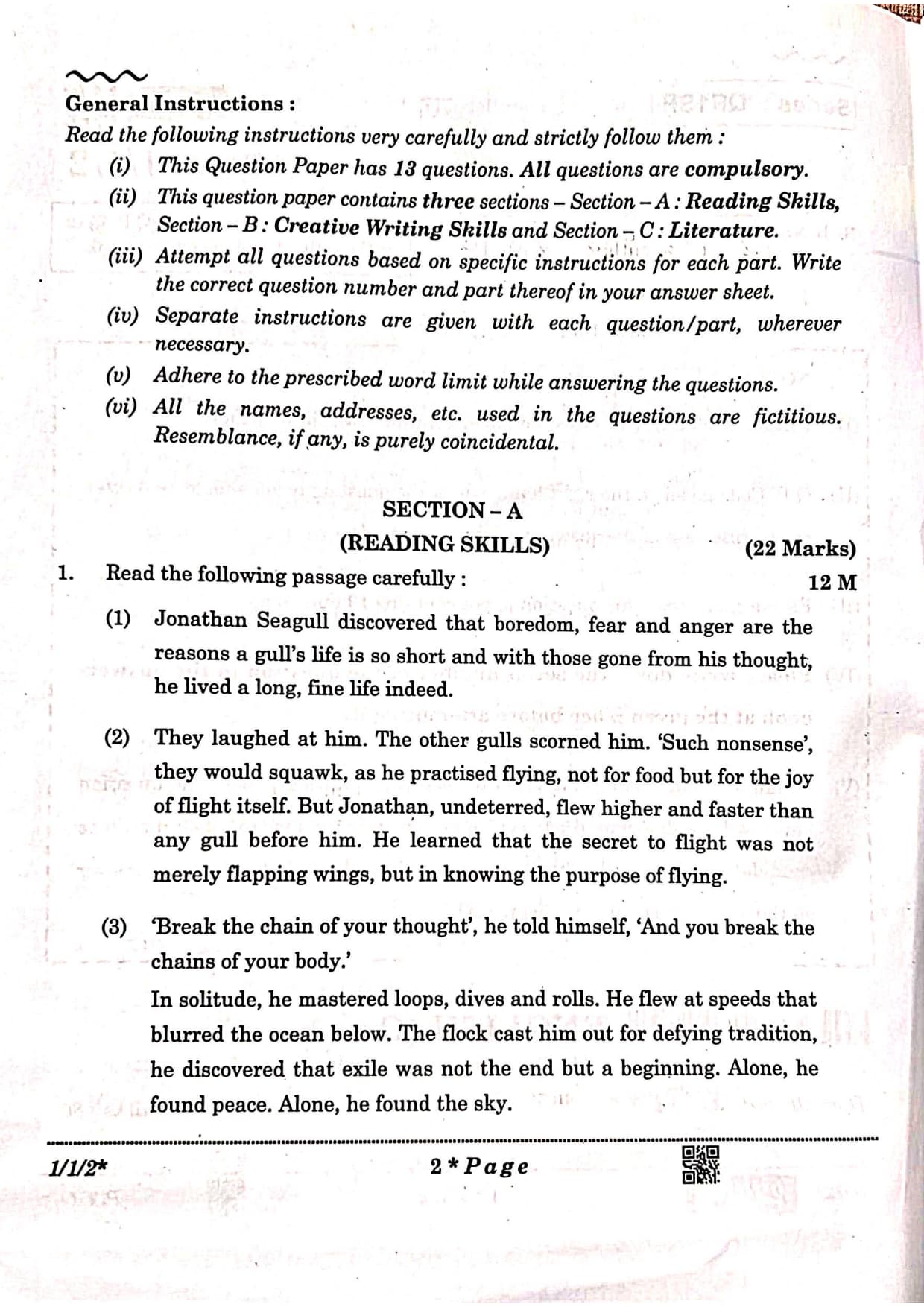





Comments