




CBSE is conducting the CBSE Class 12 Physical Education Board Exam 2026 today, February 18, 2026, from 10:30 AM to 1:30 PM. The CBSE Class 12 Physical Education Question Paper with Solution PDF is available for download as students conclude the session.
CBSE Class 12 2026 Physical Education Question Paper PDF
| CBSE Class 12 Physical Education Question Paper 2026 | Download PDF | Check Solutions |

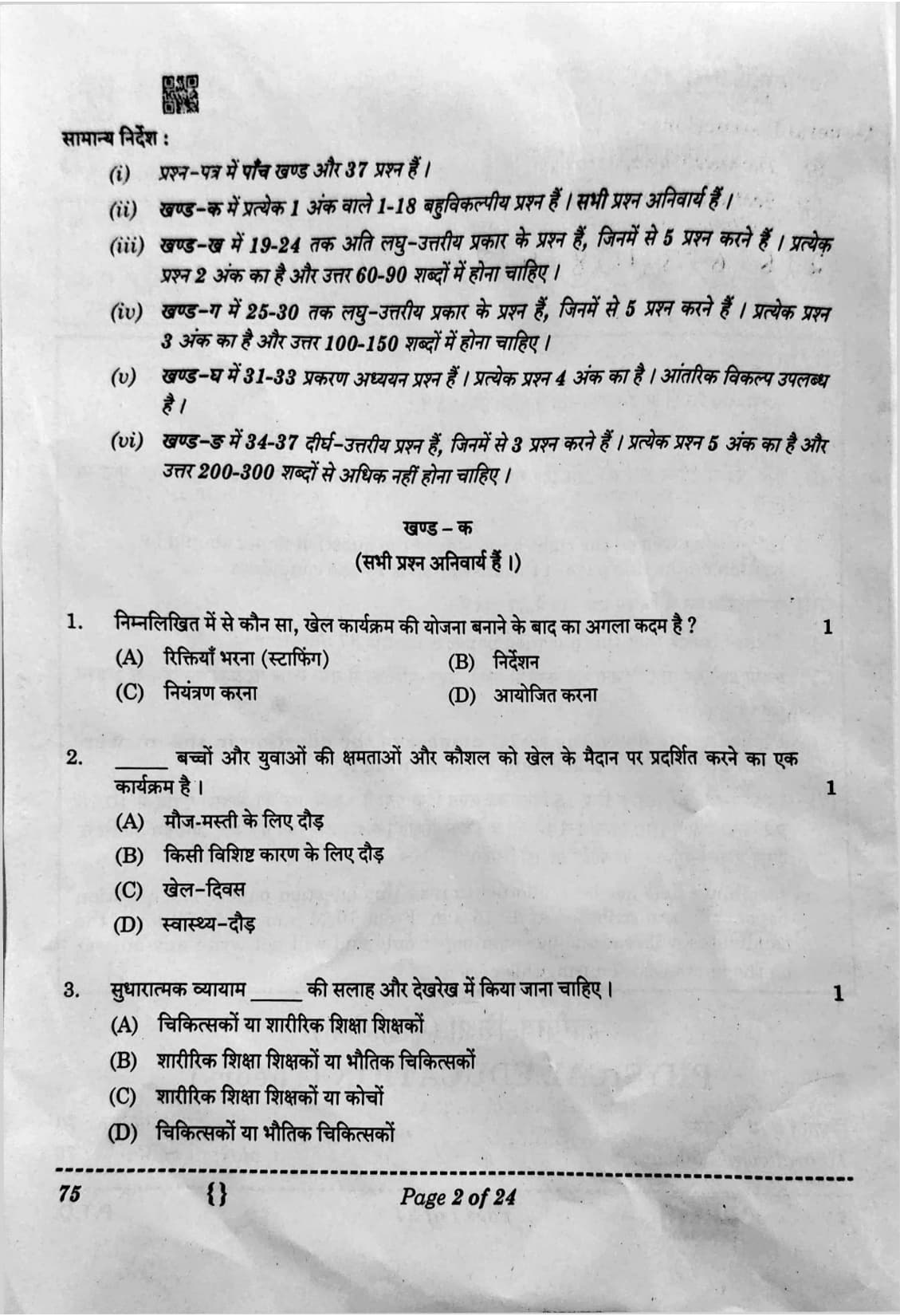
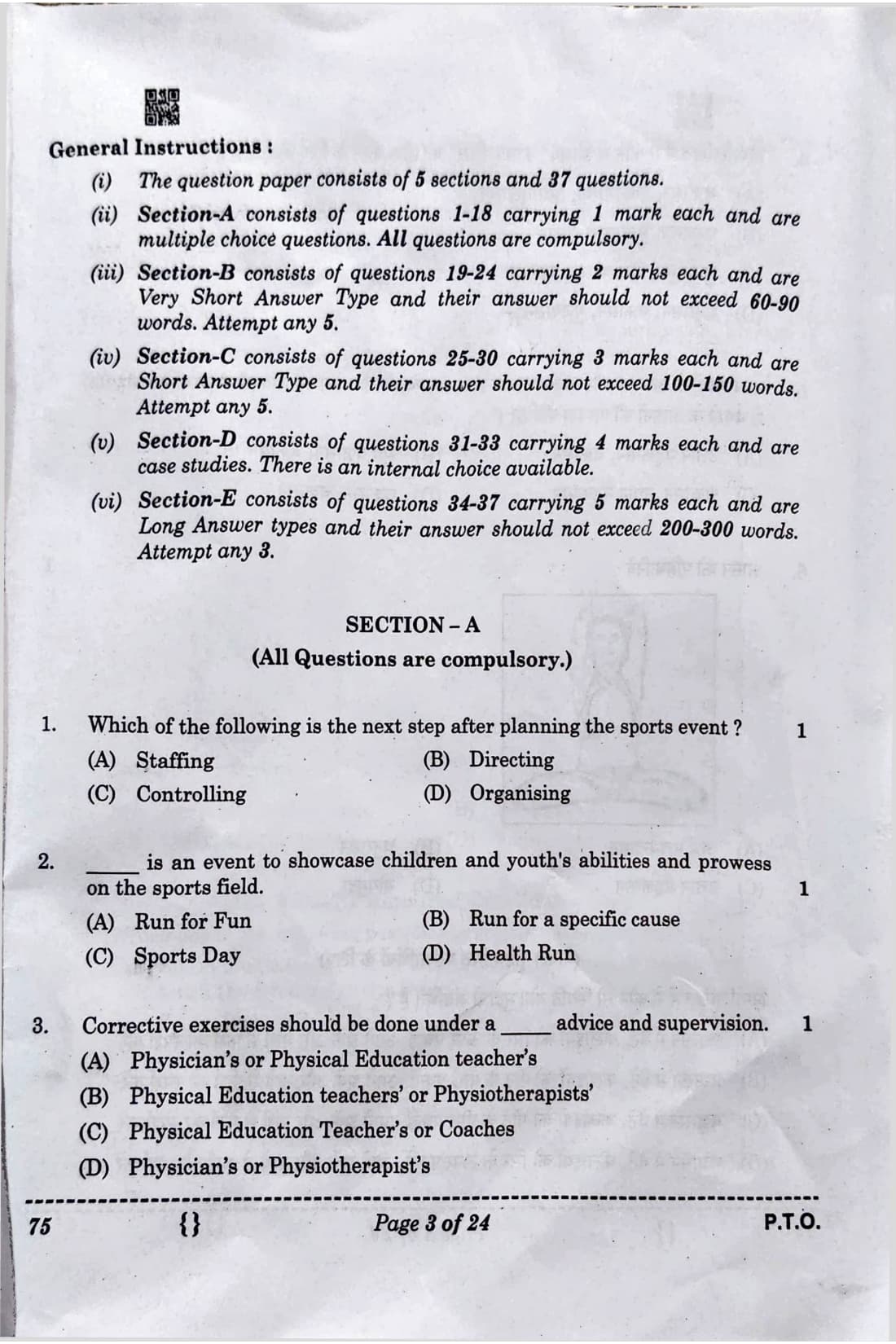
Which of the following is the next step after planning the sports event?
__________ is an event to showcase children and youth's abilities and prowess on the sports field.
Corrective exercises should be done under a __________ advice and supervision.
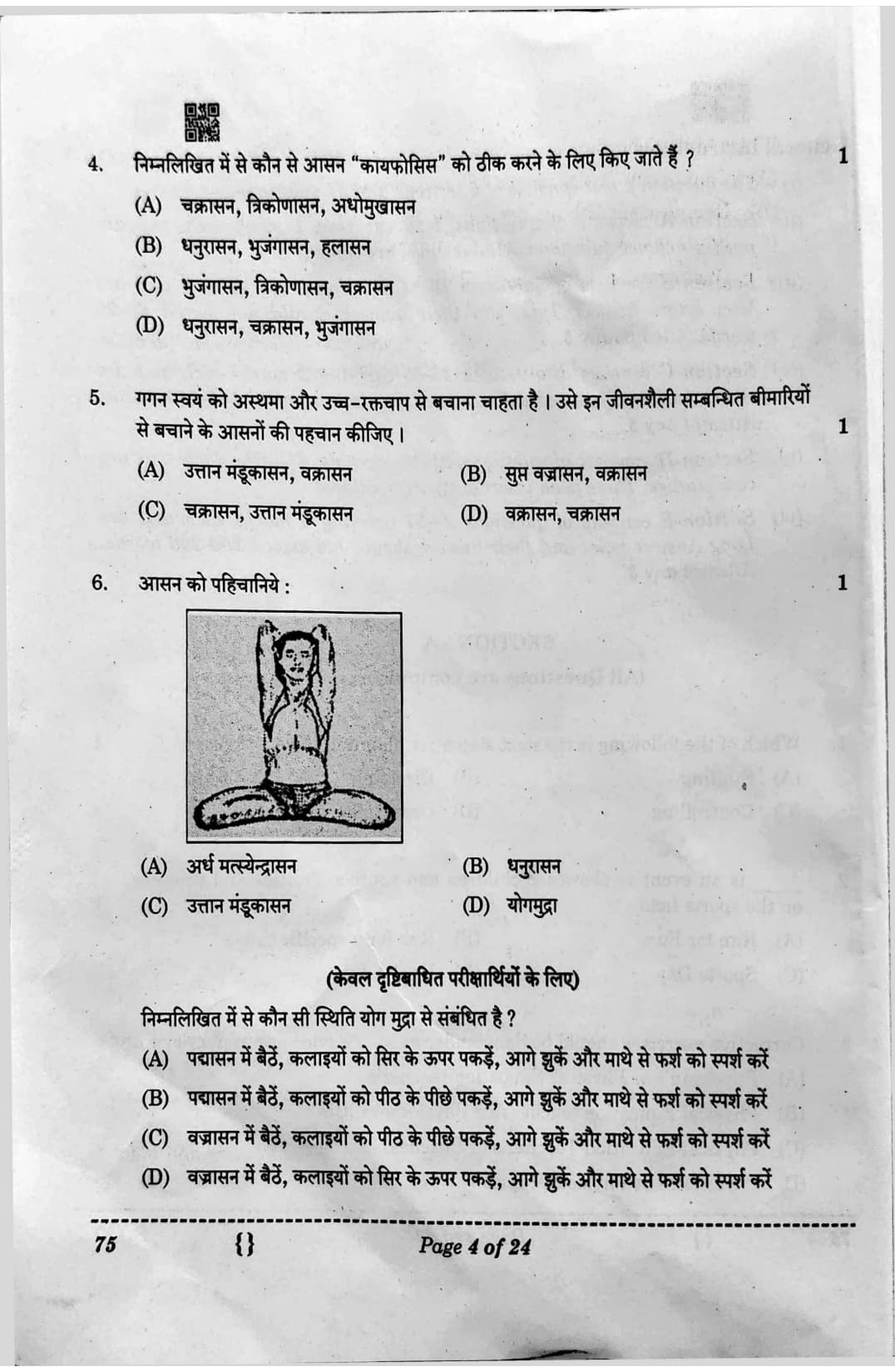
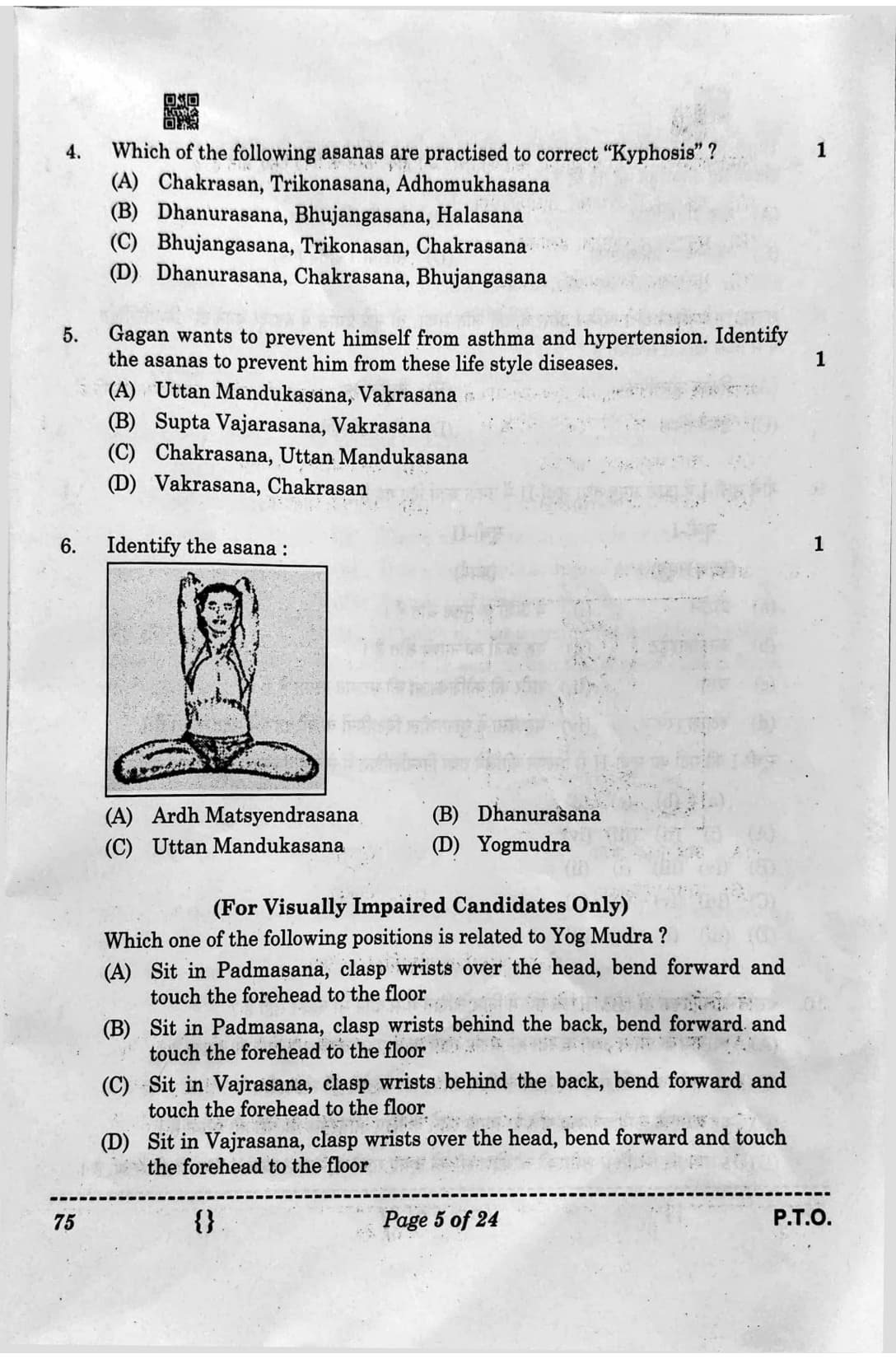
Which of the following asanas are practised to correct “Kyphosis”?
Gagan wants to prevent himself from asthma and hypertension. Identify the asanas to prevent him from these lifestyle diseases.
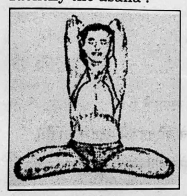
Identify the asana:
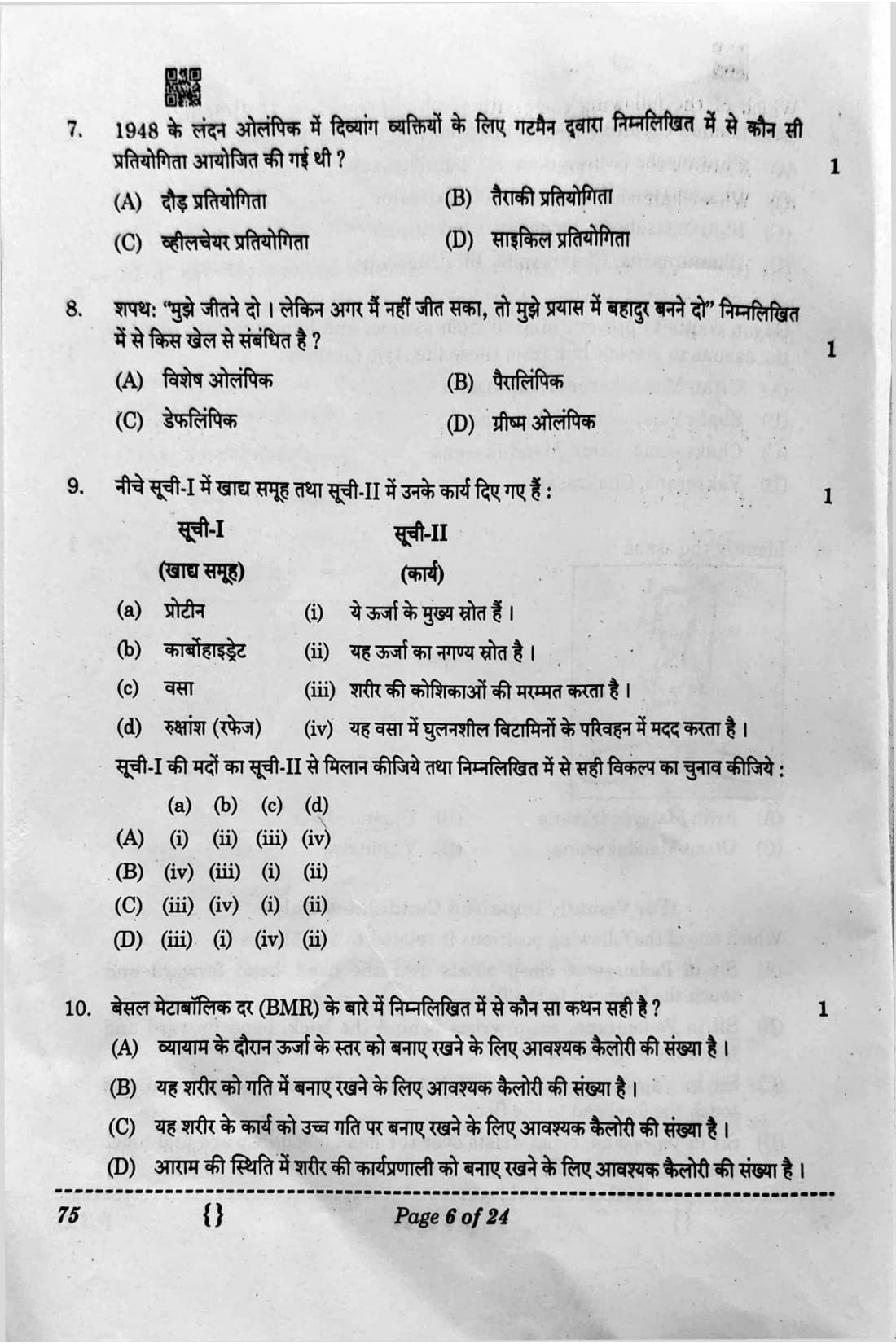
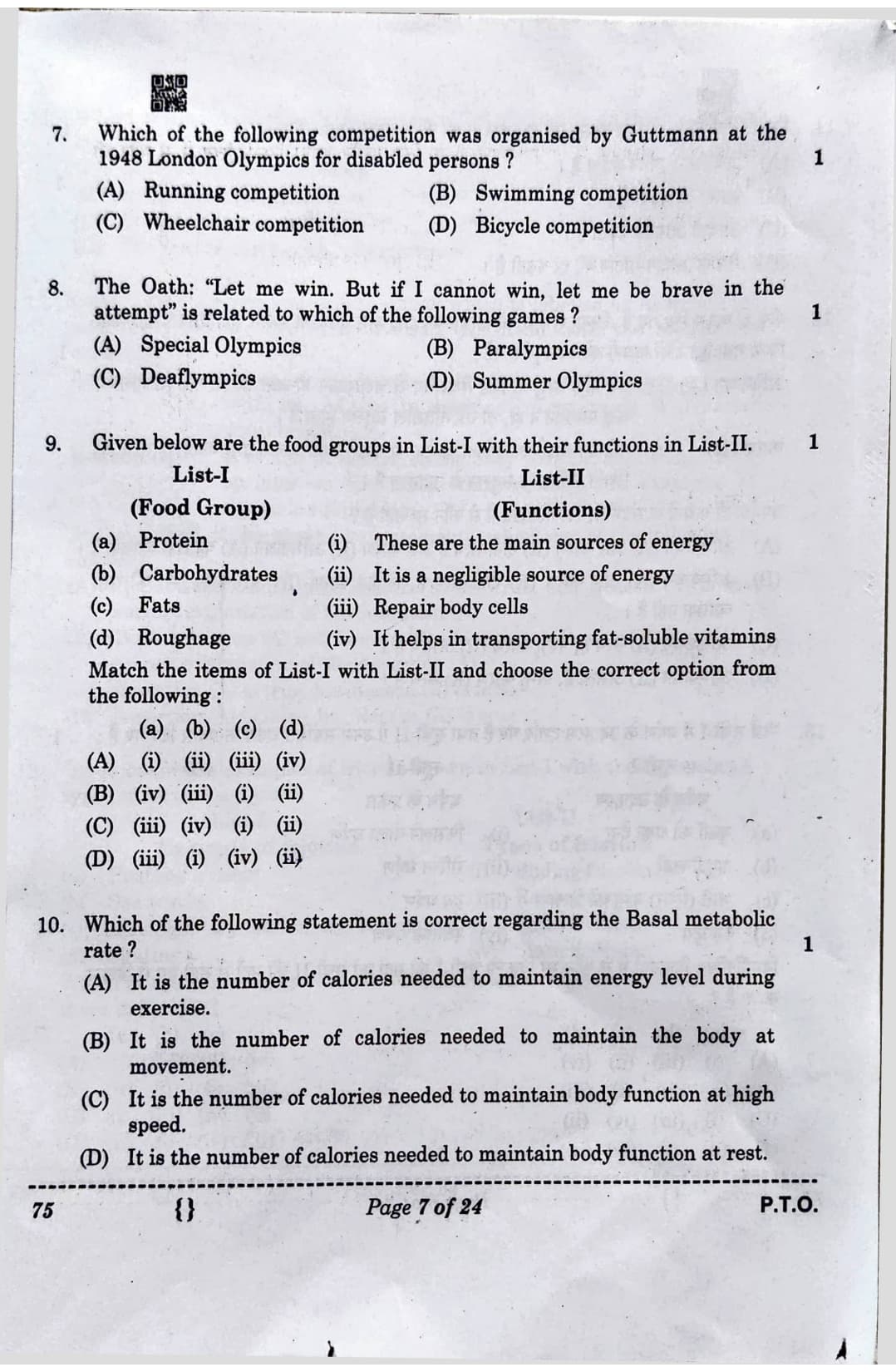
Which of the following competition was organised by Guttmann at the 1948 London Olympics for disabled persons?
The Oath: “Let me win. But if I cannot win, let me be brave in the attempt” is related to which of the following games?
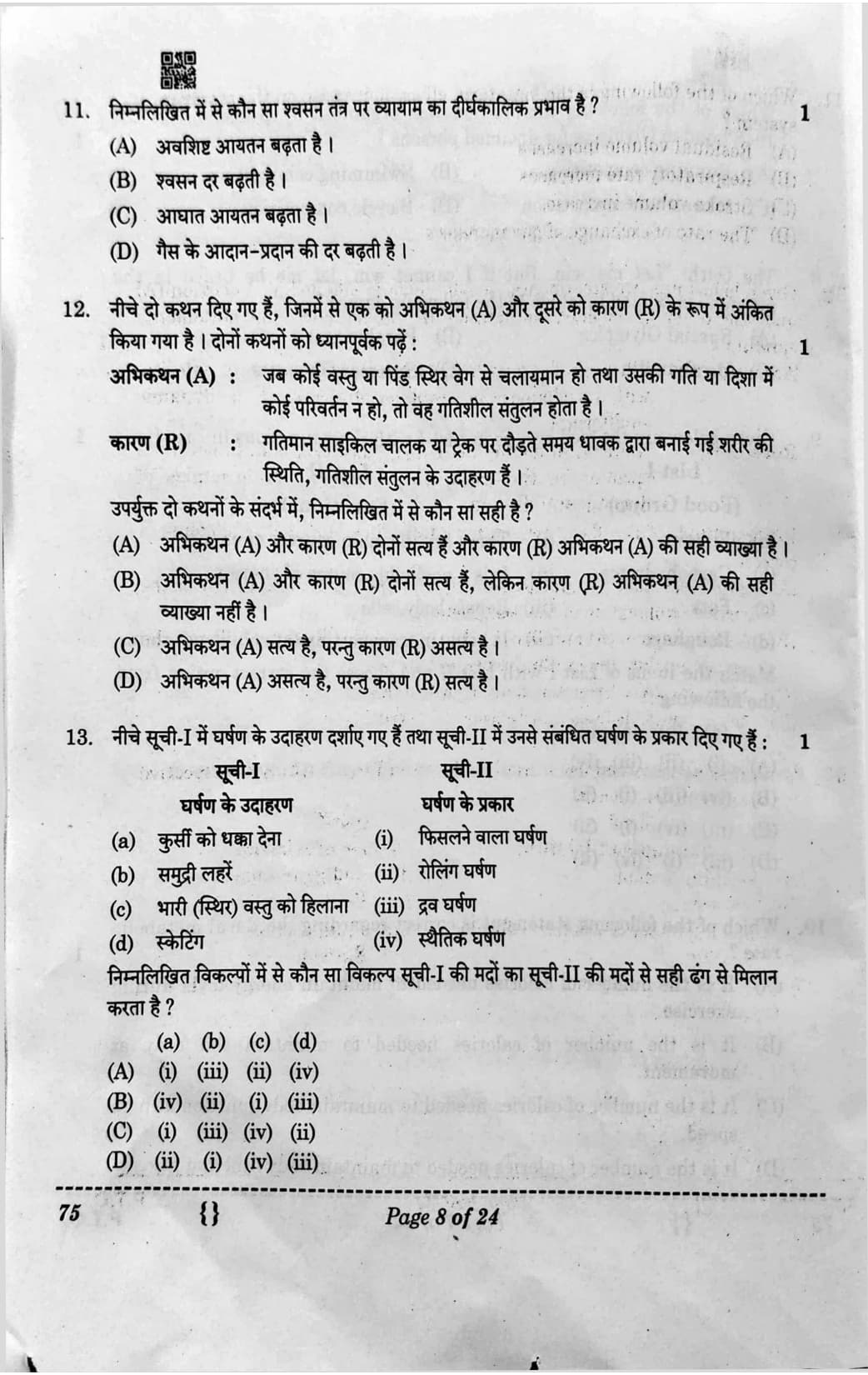
Given below are the food groups in List-I with their functions in List-II. Match the items and choose the correct option.
List-I (Food Group)
(a) Protein
(b) Carbohydrates
(c) Fats
(d) Roughage
List-II (Functions)
(i) These are the main sources of energy
(ii) It is a negligible source of energy
(iii) Repair body cells
(iv) It helps in transporting fat-soluble vitamins
Which of the following statement is correct regarding the Basal Metabolic Rate?
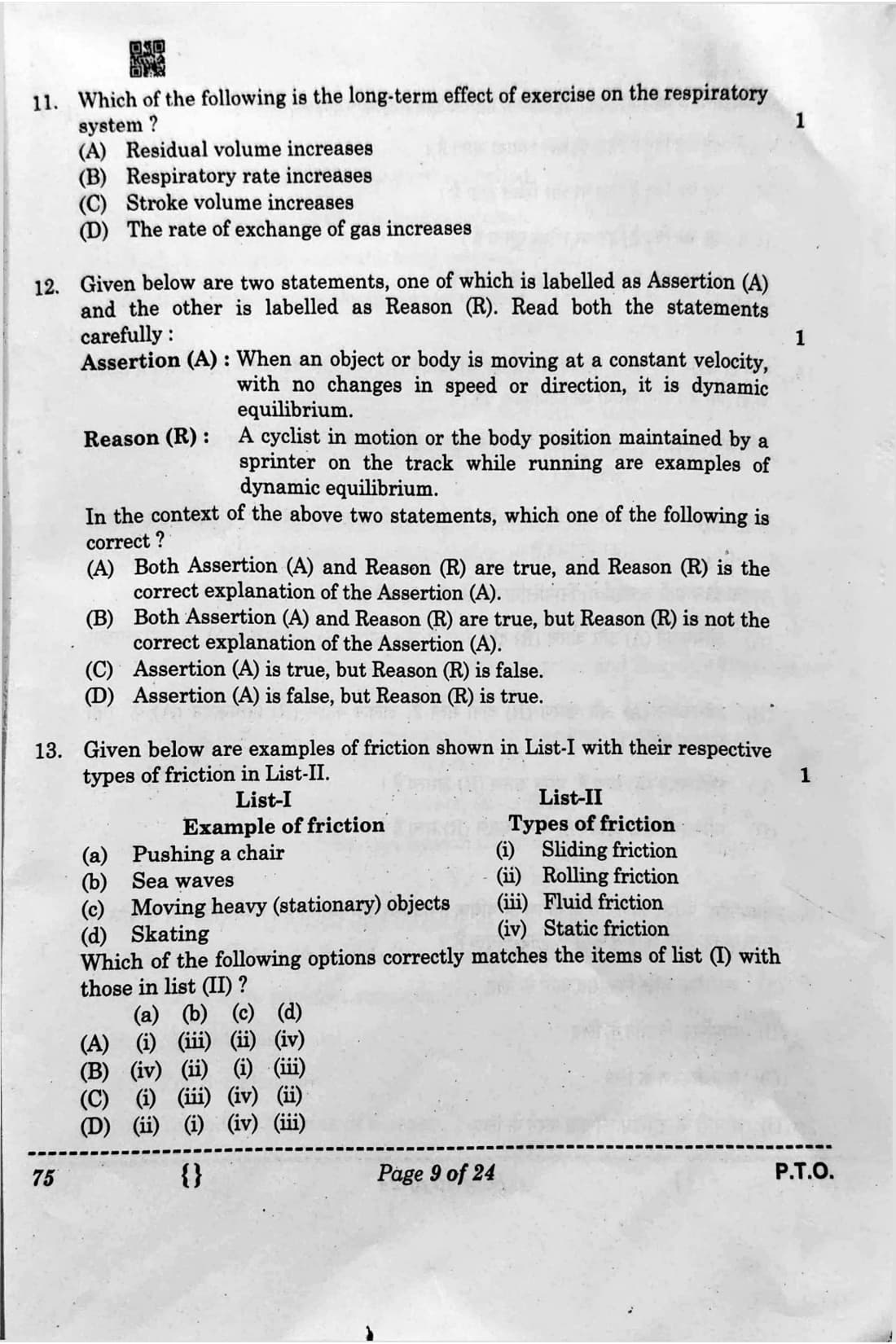
Which of the following is the long-term effect of exercise on the respiratory system?
Given below are two statements, one labelled as Assertion (A) and the other as Reason (R). Read both statements carefully and choose the correct option.
Assertion (A): When an object or body is moving at a constant velocity, with no change in speed or direction, it is in dynamic equilibrium.
Reason (R): A cyclist in motion or the body position maintained by a sprinter on the track while running are examples of dynamic equilibrium.
Given below are examples of friction shown in List-I with their respective types of friction in List-II. Match the items correctly.
List-I (Example of friction)
(a) Pushing a chair
(b) Sea waves
(c) Moving heavy (stationary) objects
(d) Skating
List-II (Types of friction)
(i) Sliding friction
(ii) Rolling friction
(iii) Fluid friction
(iv) Static friction
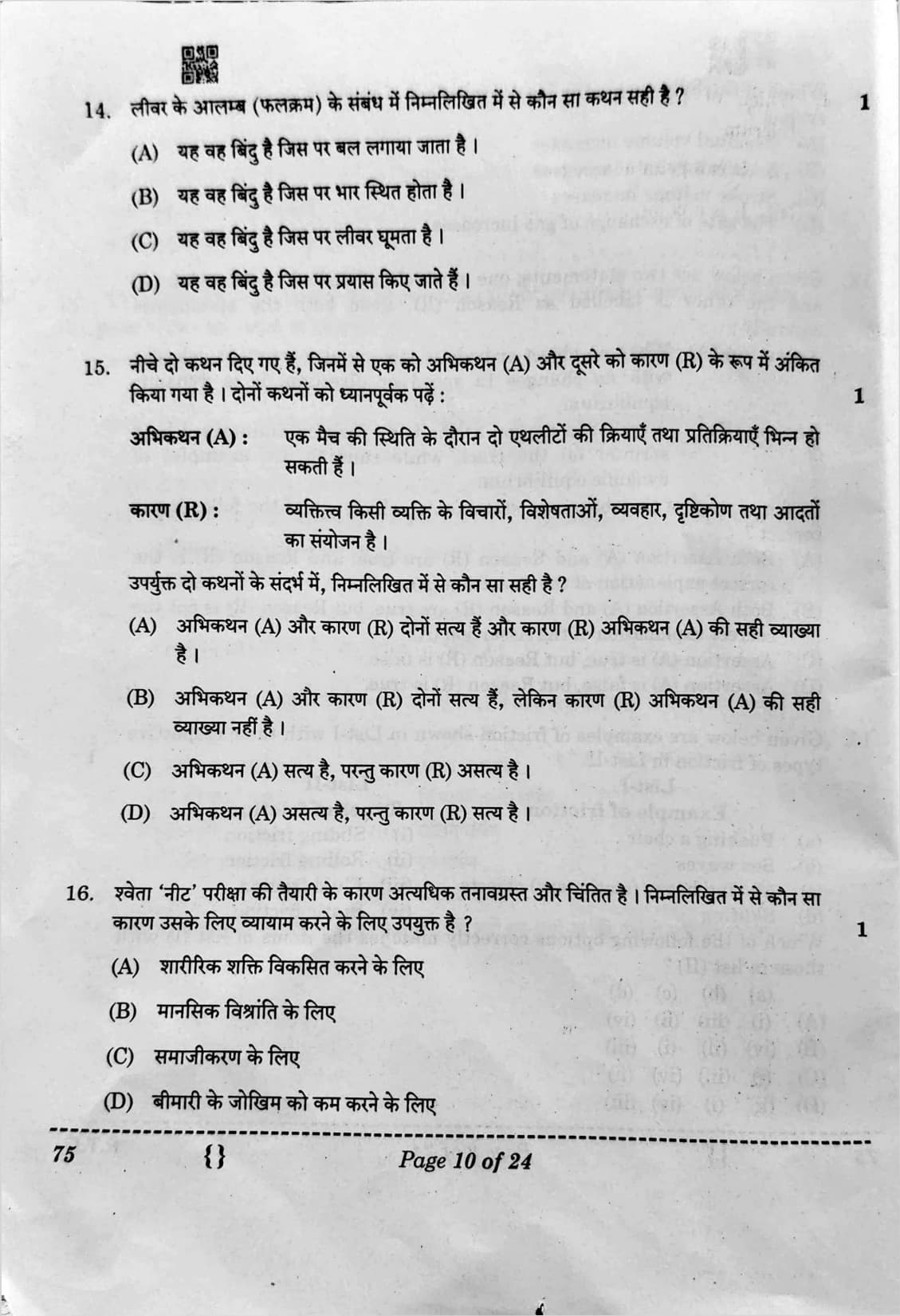
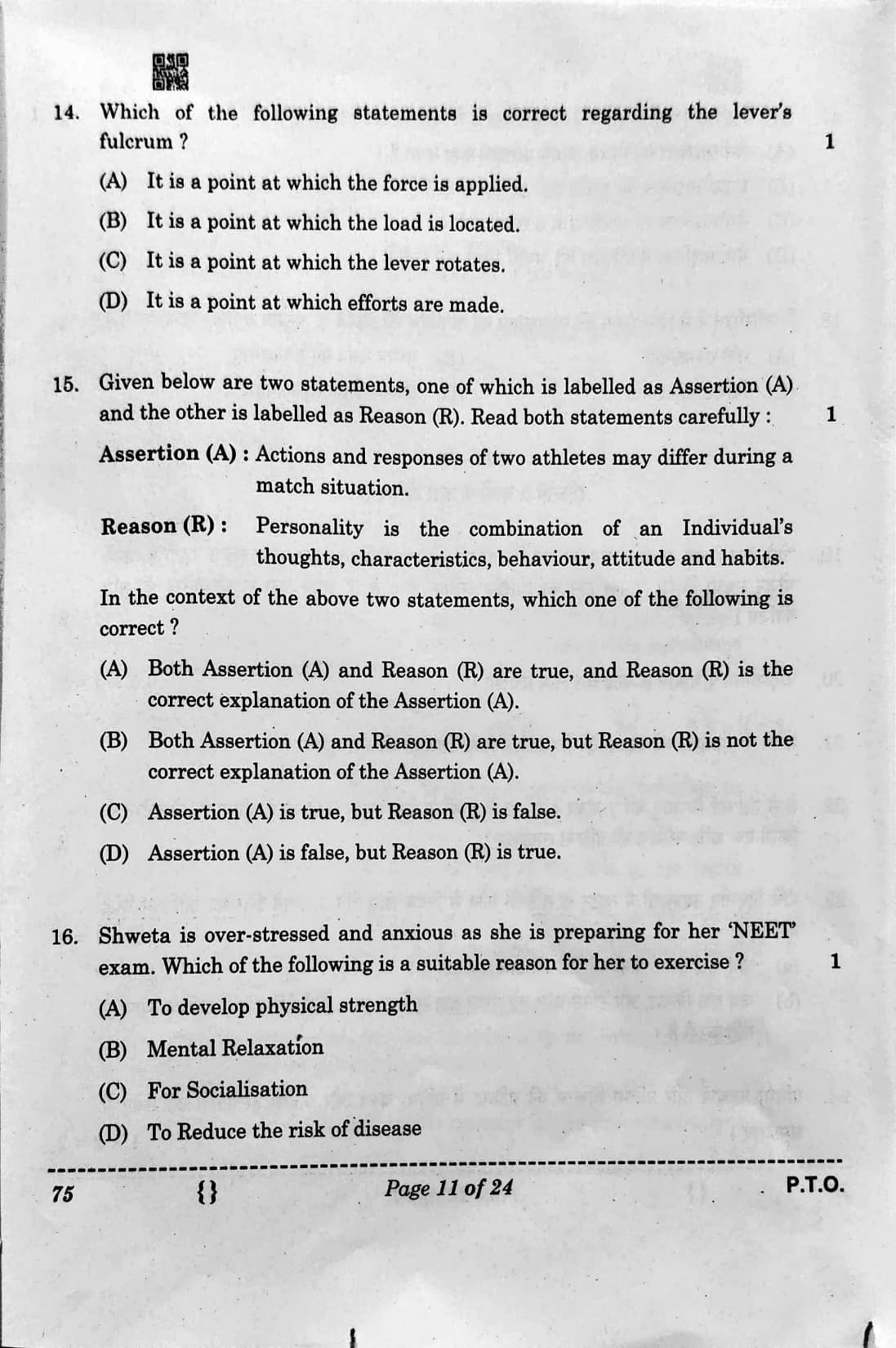
Which of the following statements is correct regarding the lever’s fulcrum?
Given below are two statements, one labelled as Assertion (A) and the other as Reason (R). Read both statements carefully and choose the correct option.
Assertion (A): Actions and responses of two athletes may differ during a match situation.
Reason (R): Personality is the combination of an individual’s thoughts, characteristics, behaviour, attitude and habits.
Shweta is over-stressed and anxious as she is preparing for her ‘NEET’ exam. Which of the following is a suitable reason for her to exercise?
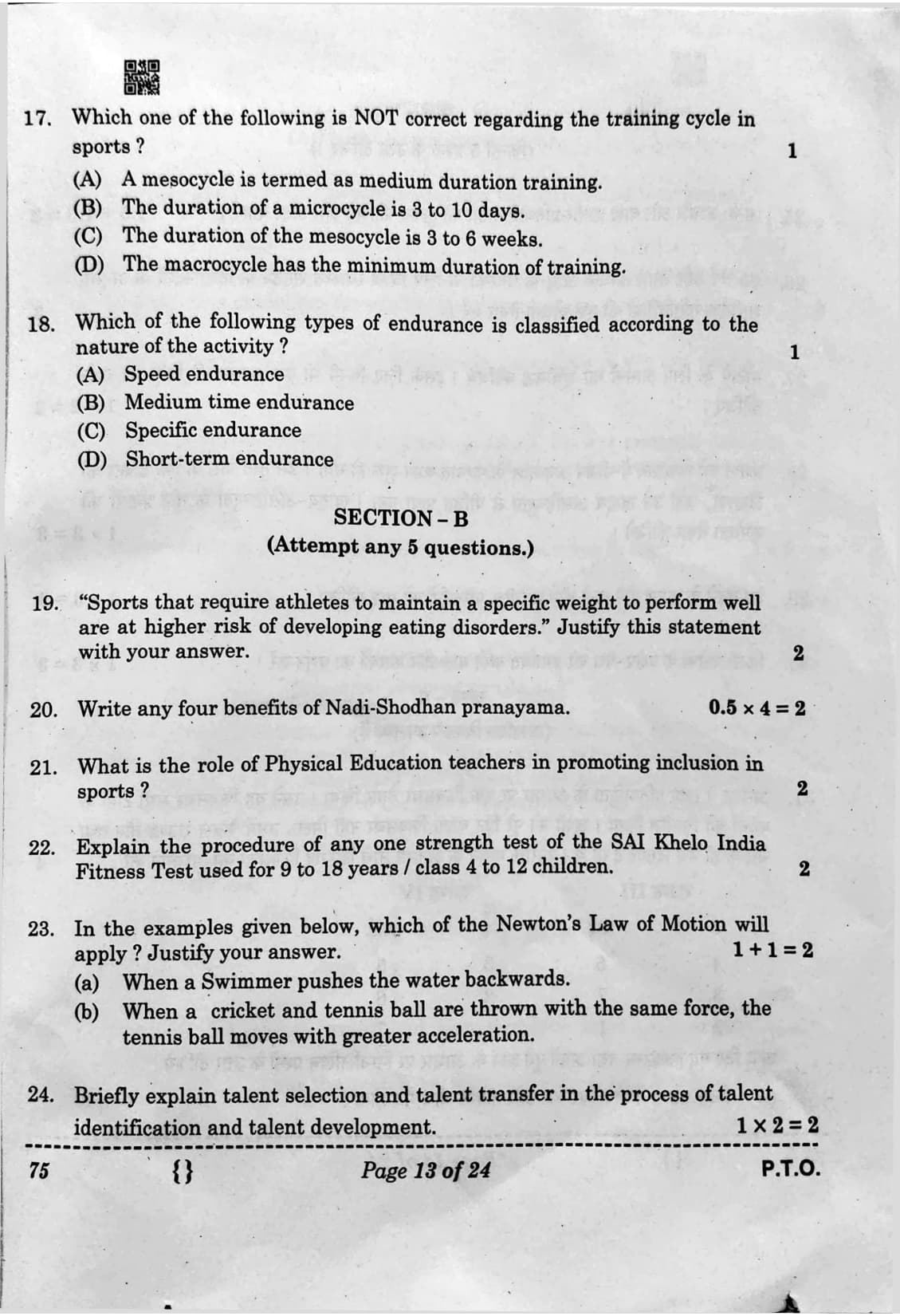
Which one of the following is NOT correct regarding the training cycle in sports?
Which of the following types of endurance is classified according to the nature of the activity?
“Sports that require athletes to maintain a specific weight to perform well are at higher risk of developing eating disorders.” Justify this statement.
Write any four benefits of Nadi-Shodhan Pranayama.
What is the role of Physical Education teachers in promoting inclusion in sports?
Explain the procedure of any one strength test of the SAI Khelo India Fitness Test used for 9 to 18 years / class 4 to 12 children.
In the examples given below, which of the Newton’s Law of Motion will apply? Justify your answer.
(a) When a swimmer pushes the water backwards.
(b) When a cricket and tennis ball are thrown with the same force, the tennis ball moves with greater acceleration.
Briefly explain talent selection and talent transfer in the process of talent identification and talent development.
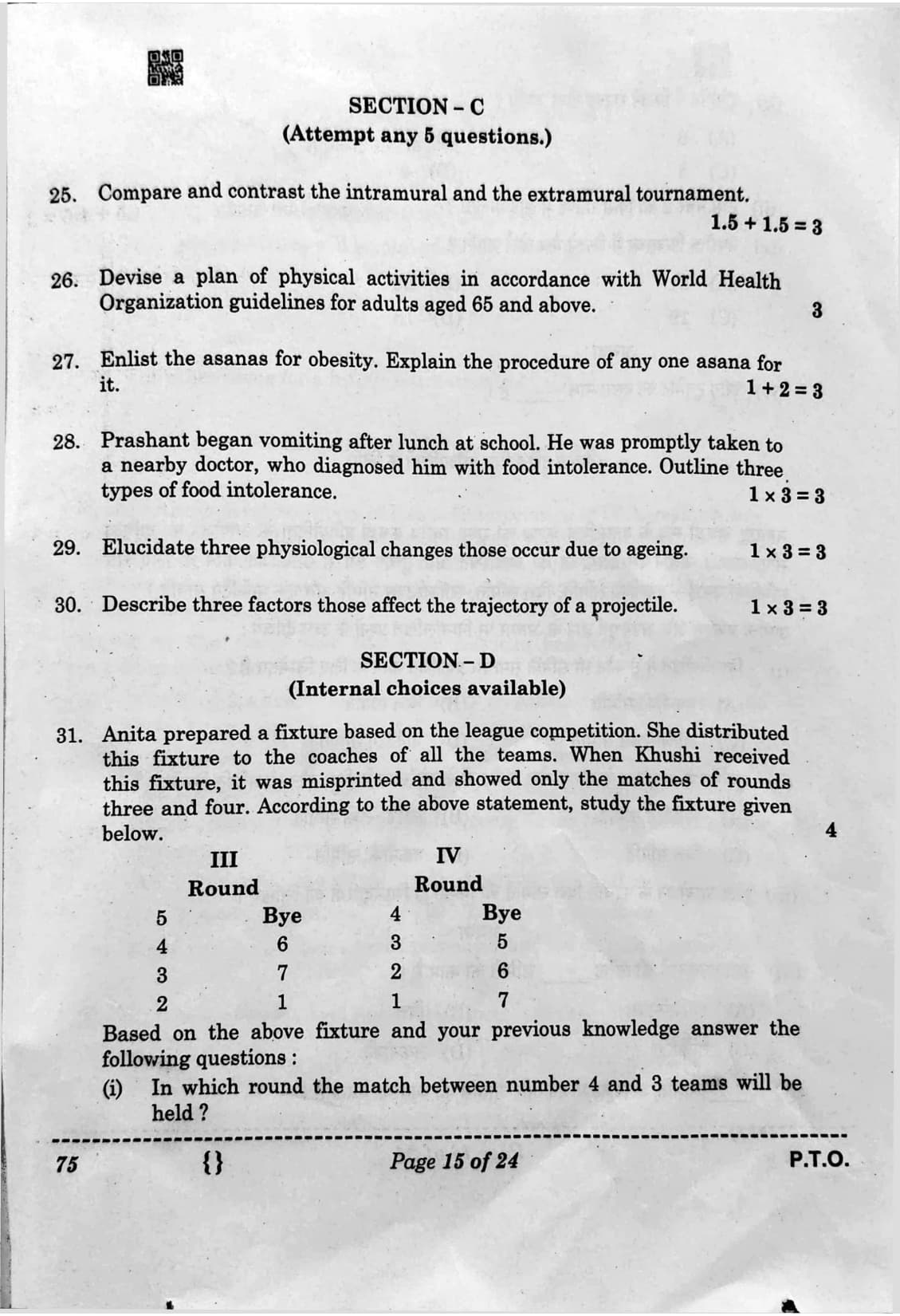
Compare and contrast the intramural and the extramural tournament.
Devise a plan of physical activities in accordance with World Health Organization guidelines for adults aged 65 and above.
Enlist the asanas for obesity. Explain the procedure of any one asana for it.
Prashant began vomiting after lunch at school. He was promptly taken to a nearby doctor, who diagnosed him with food intolerance. Outline three types of food intolerance.
Elucidate three physiological changes that occur due to ageing.
Describe three factors that affect the trajectory of a projectile.
Question 31:
Anita prepared a fixture based on the league competition. She distributed this fixture to the coaches of all the teams. When Khushi received this fixture, it was misprinted and showed only the matches of rounds three and four. According to the above statement, study the fixture given
below.
III IV
Round Round
5 Bye 4 Bye
4 6 3 5
3 7 2 6
2 1 1 7
Based on the above fixture and your previous knowledge answer the following questions:
(i) In which round will the match between team 4 and team 3 be held?
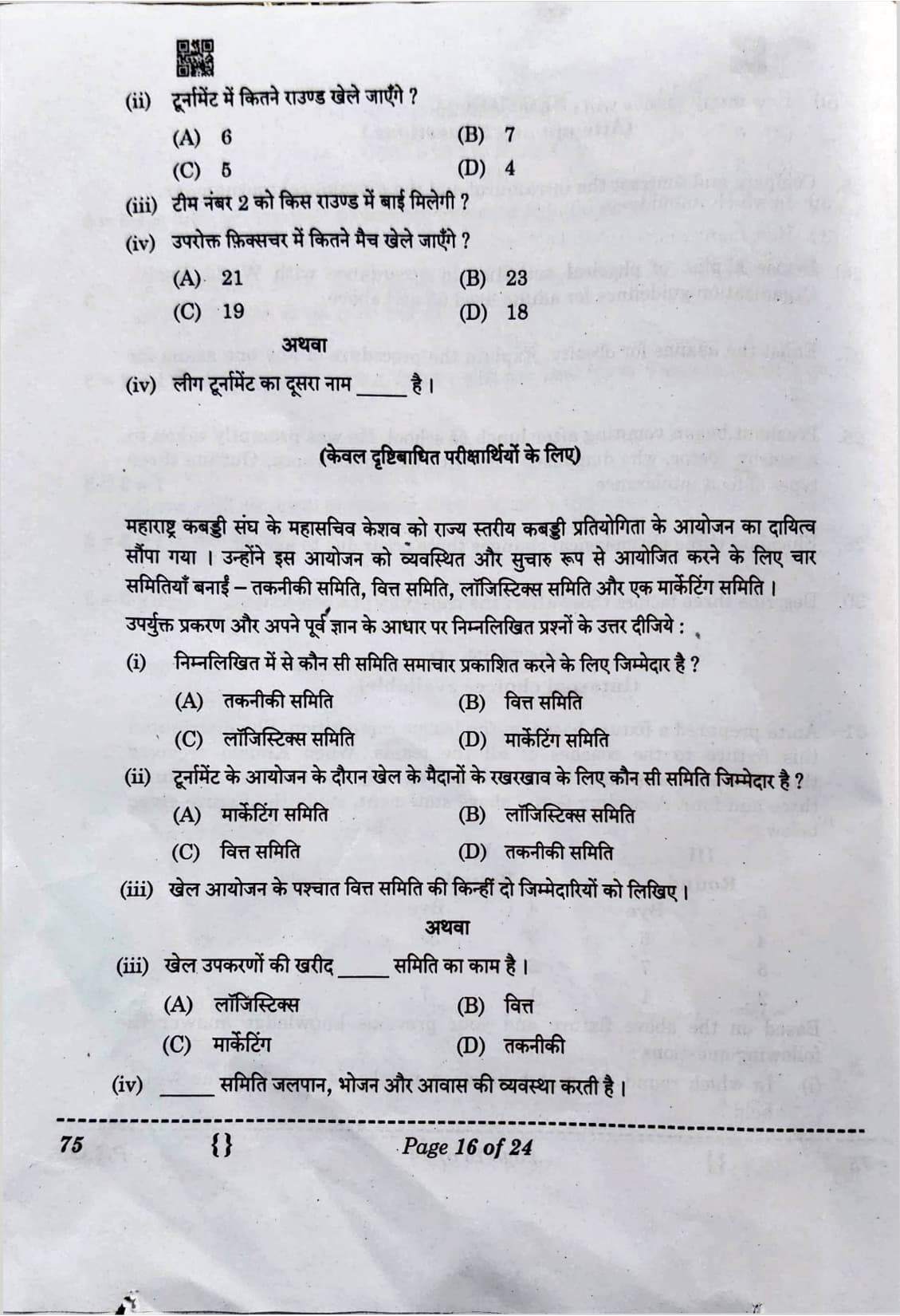
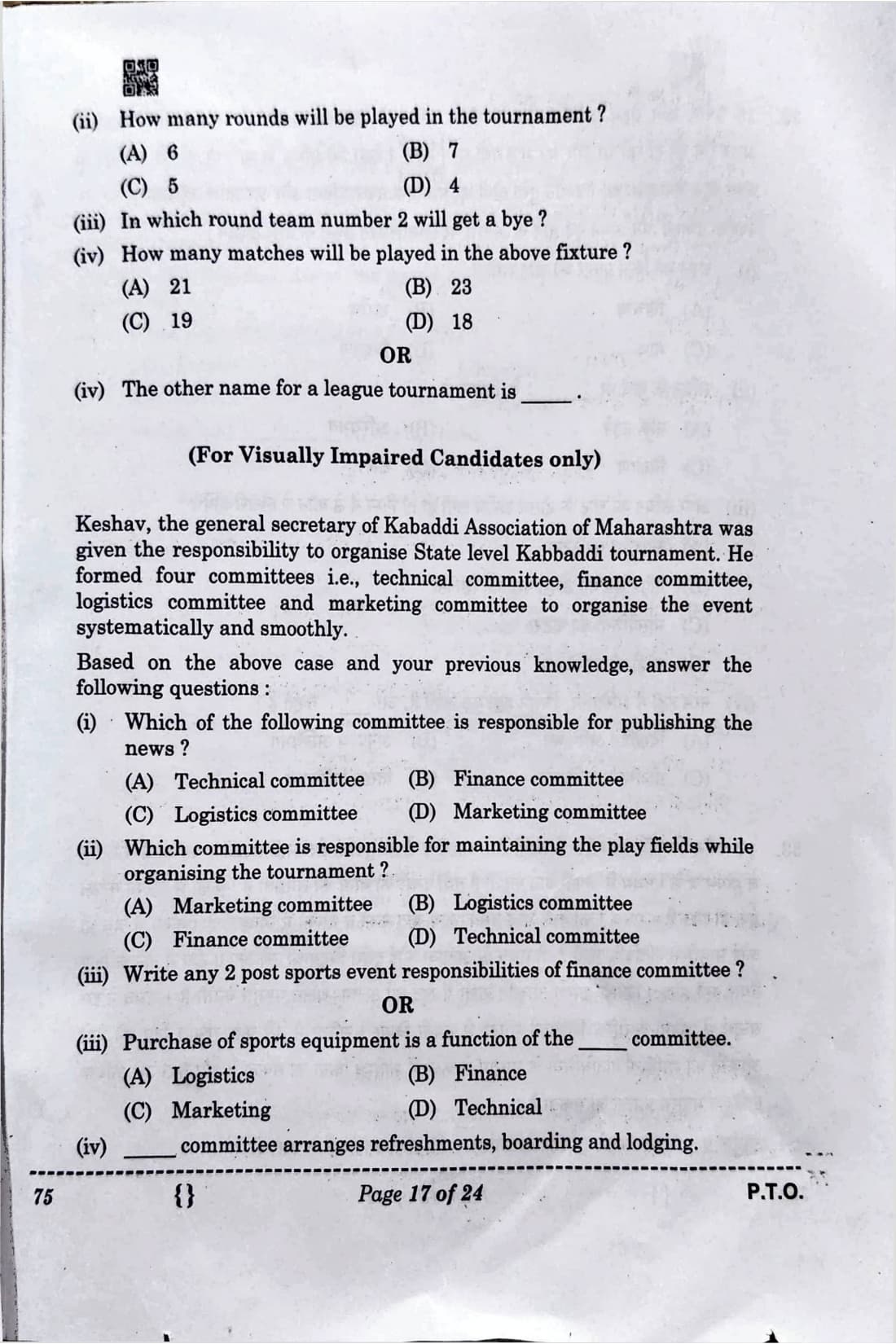
(ii) How many rounds will be played in the tournament?
(iii) In which round will team number 2 get a bye?
(iv) How many matches will be played in the above fixture?
(iv) The other name for a league tournament is:
Question 32:
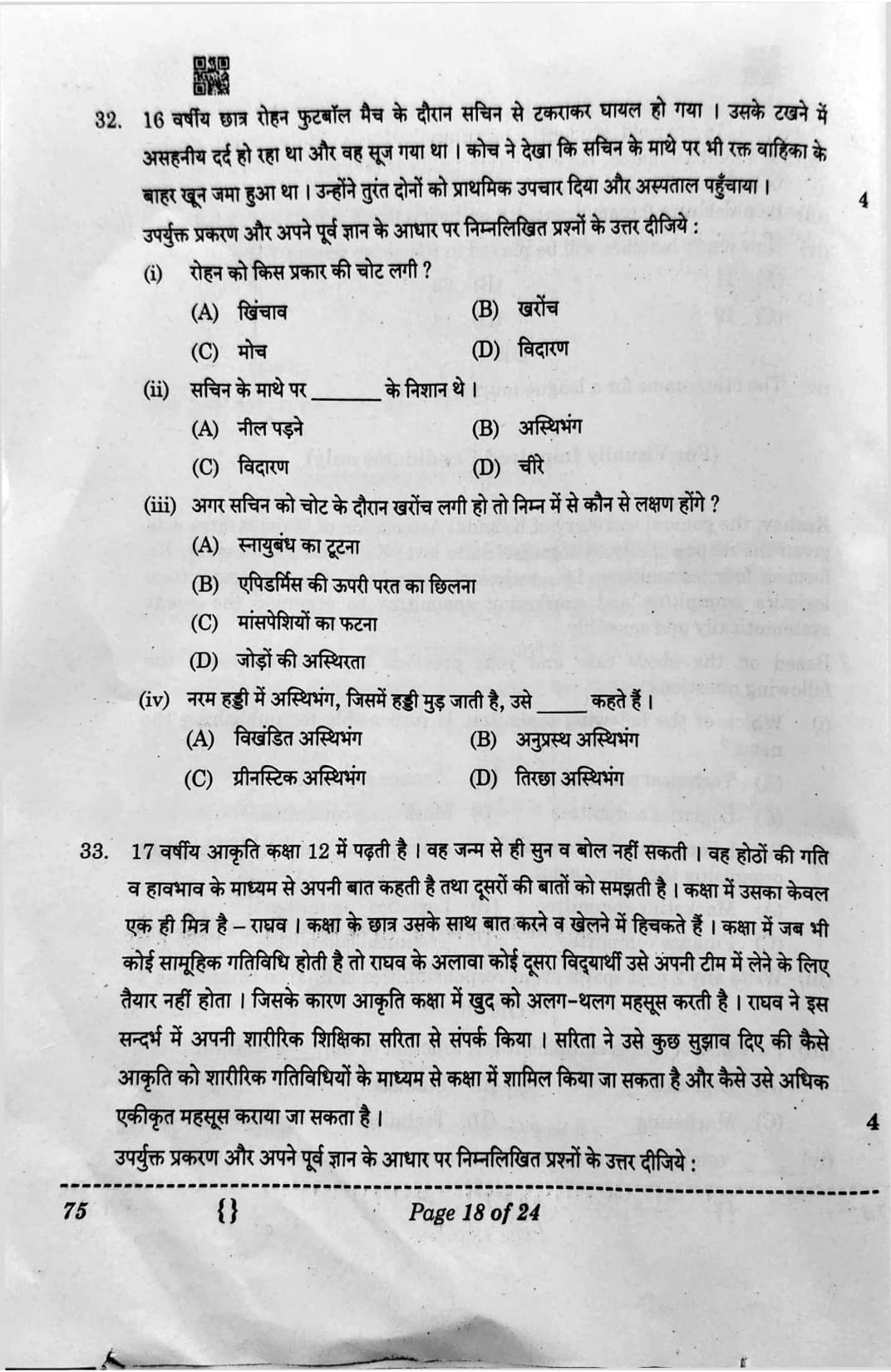
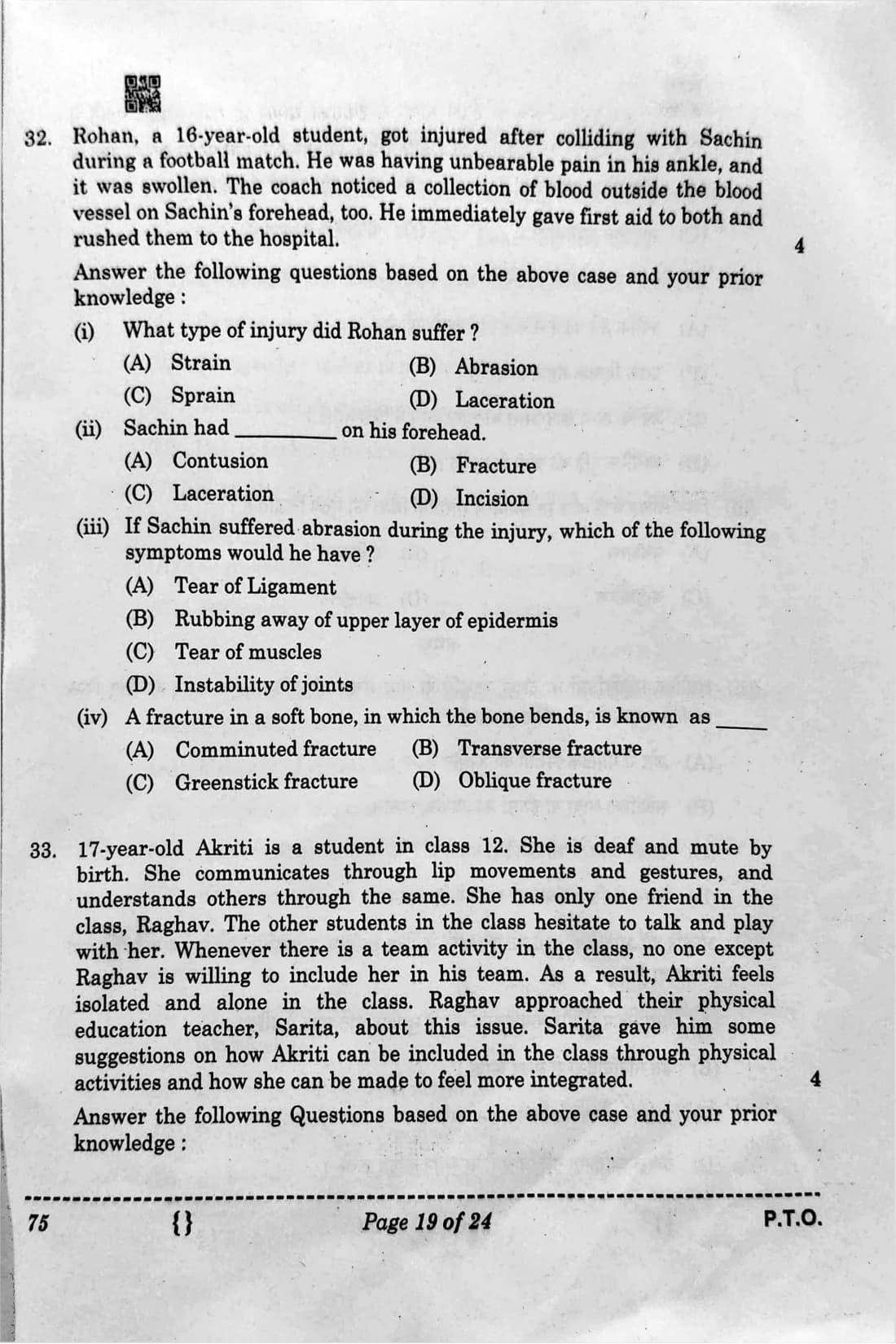
Rohan, a 16-year-old student, got injured after colliding with Sachin during a football match. He was having unbearable pain in his ankle, and it was swollen. The coach noticed a collection of blood outside the blood vessel on Sachin’s forehead, too. He immediately gave first aid to both and
rushed them to the hospital.
Answer the following questions based on the above case and your prior knowledge:
(i) What type of injury did Rohan suffer?
(ii) Sachin had ______ on his forehead.
(iii) If Sachin suffered abrasion during the injury, which symptom would he have?
(iv) A fracture in a soft bone in which the bone bends is known as:
Question 33:
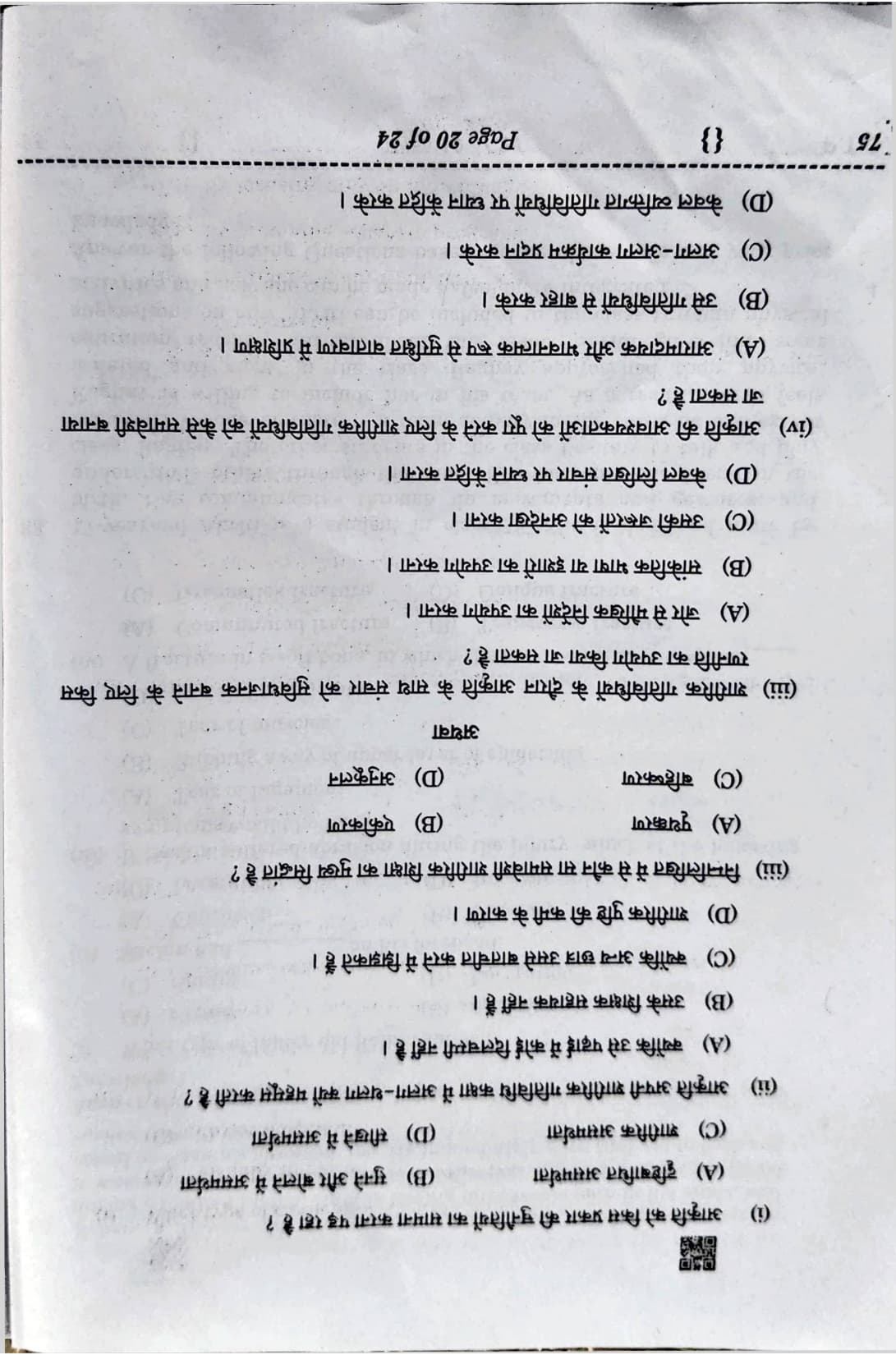
17-year-old Akriti is a student in class 12. She is deaf and mute by birth. She communicates through lip movements and gestures, and understands others through the same. She has only one friend in the class, Raghav. The other students in the class hesitate to talk and play with her. Whenever there is a team activity in the class, no one except Raghav is willing to include her in his team. As a result, Akriti feels isolated and alone in the class. Raghav approached their physical education teacher, Sarita, about this issue. Sarita gave him some suggestions on how Akriti can be included in the class through physical activities and how she can be made to feel more integrated.
Answer the following Questions based on the above case and your prior knowledge:
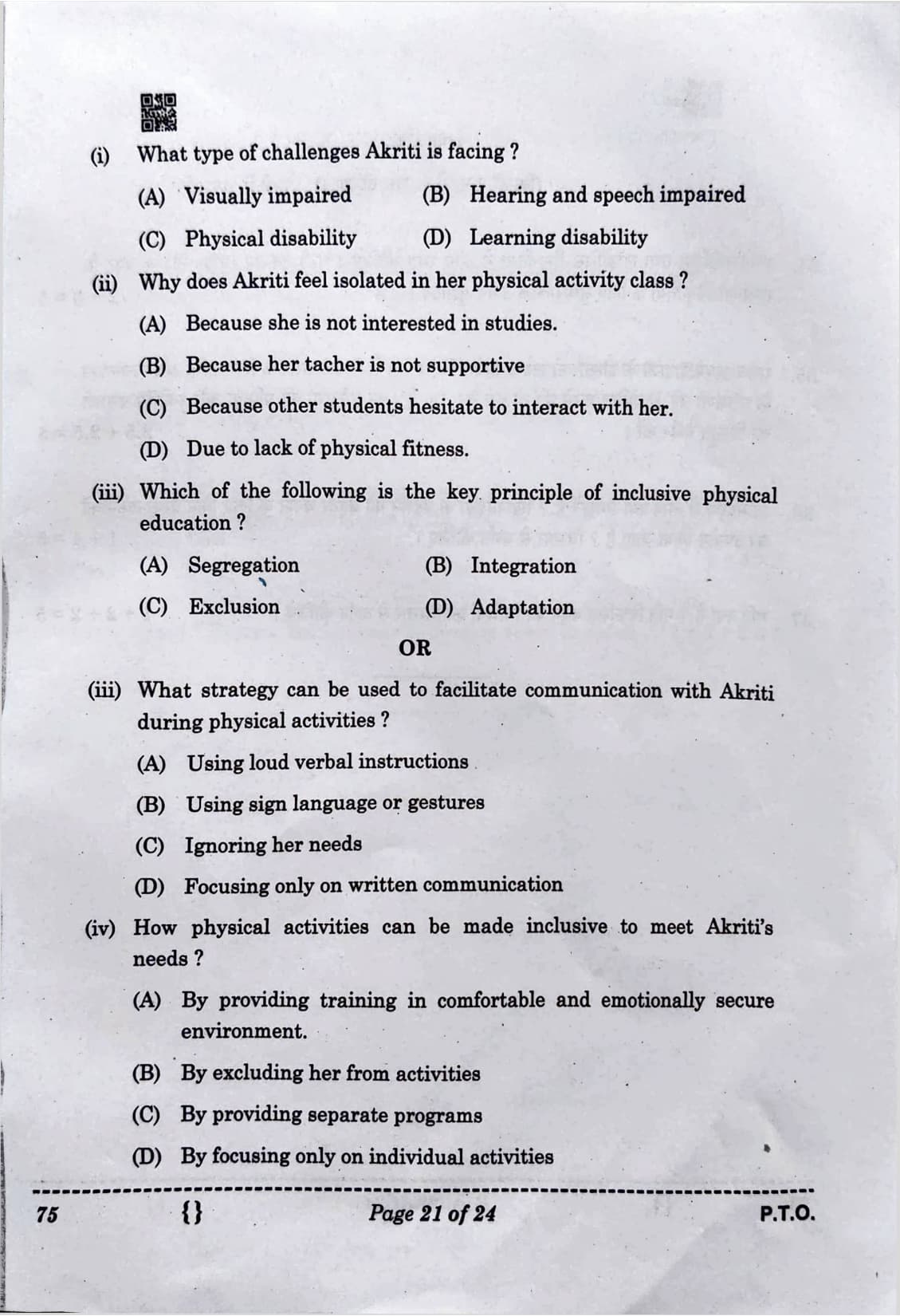
(i) What type of challenges Akriti is facing?
(ii) Why does Akriti feel isolated in her physical activity class?
(iii) Which of the following is the key principle of inclusive physical education?
(iii) What strategy can be used to facilitate communication with Akriti during physical activities?
(iv) How can physical activities be made inclusive to meet Akriti’s needs?
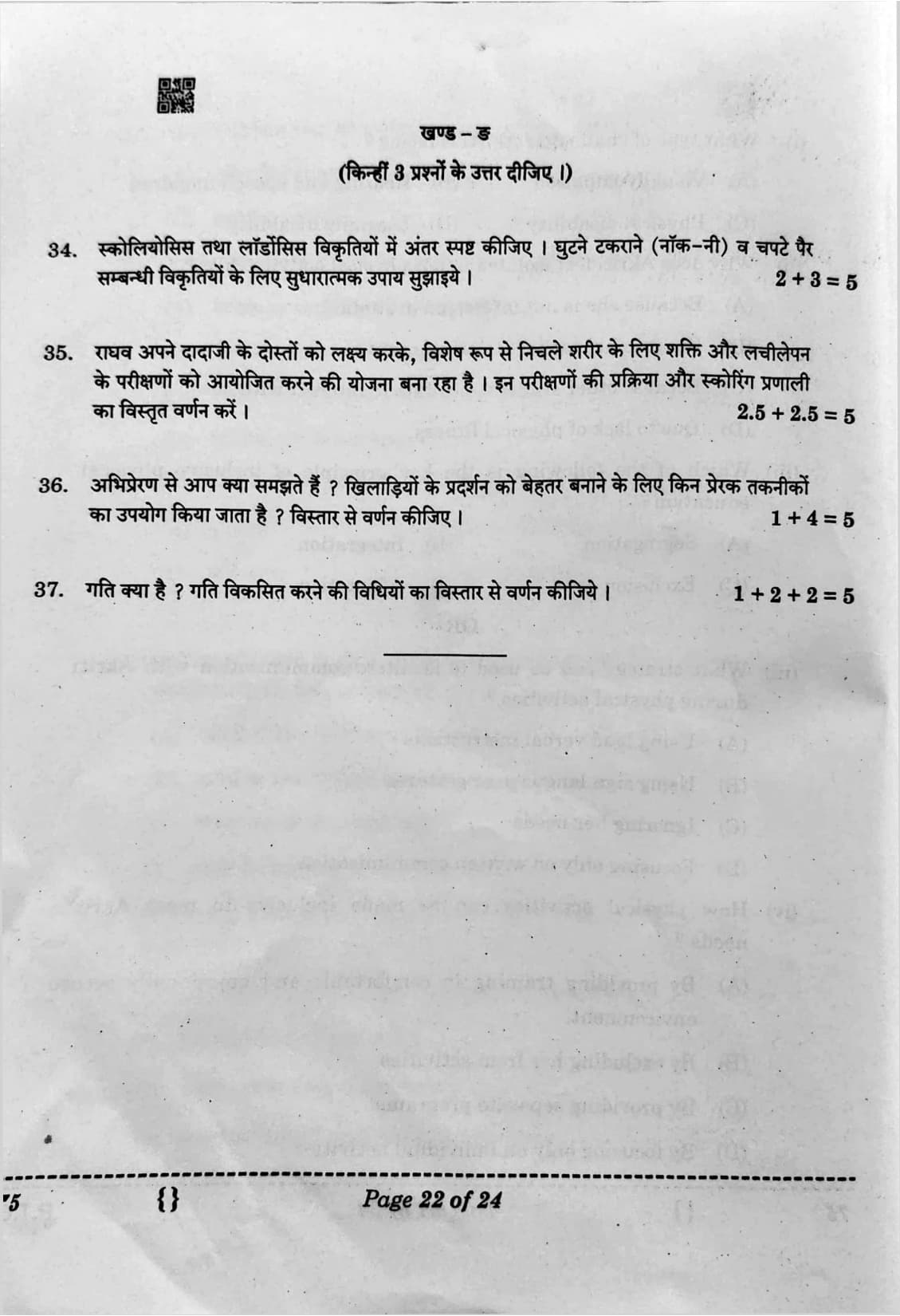
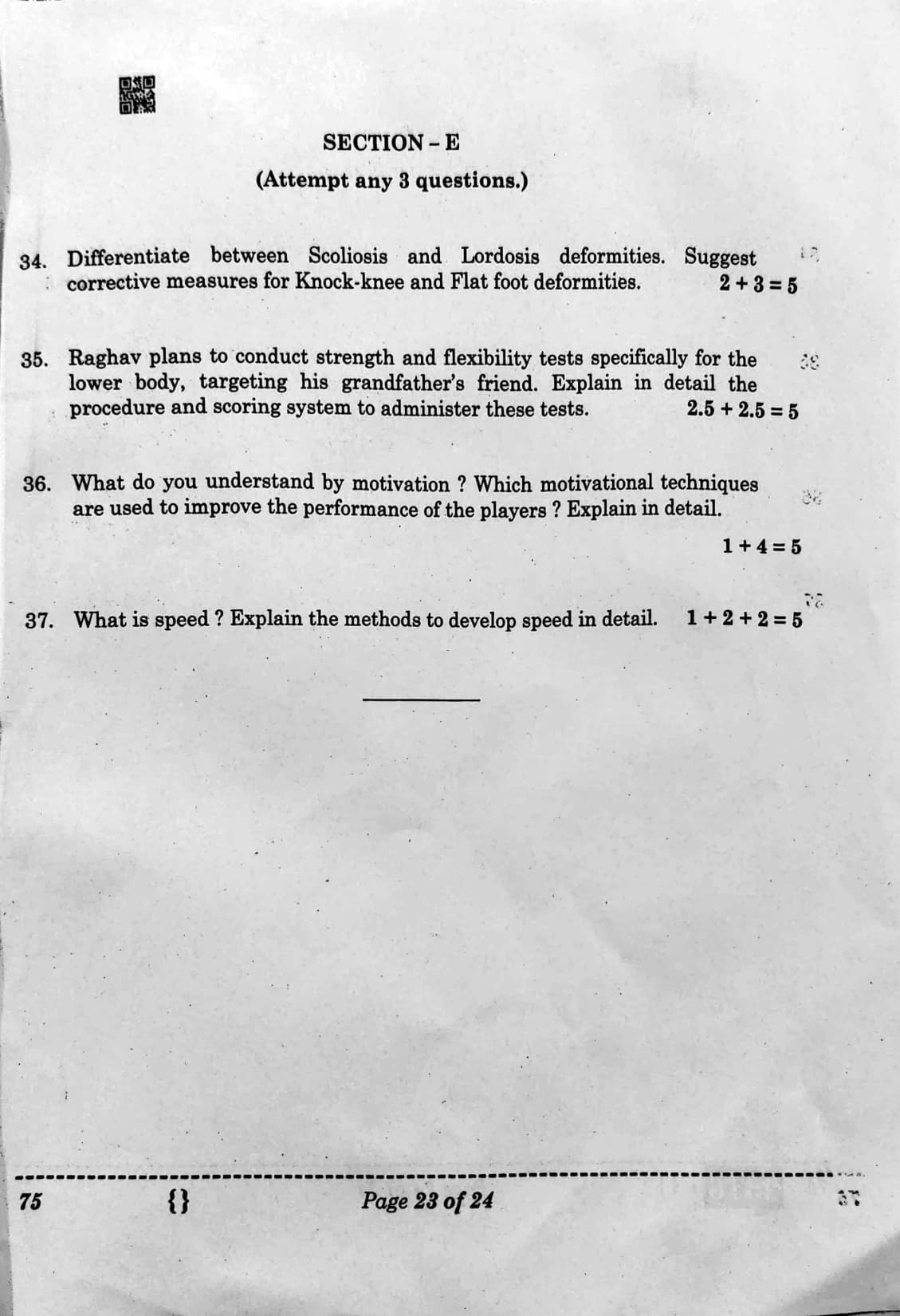
Differentiate between Scoliosis and Lordosis deformities. Suggest corrective measures for Knock-knee and Flat foot deformities.
Raghav plans to conduct strength and flexibility tests specifically for the lower body, targeting his grandfather’s friend. Explain in detail the procedure and scoring system to administer these tests.
What do you understand by motivation? Which motivational techniques are used to improve the performance of the players? Explain in detail.
CBSE Class 12 Physical Education Exam Pattern 2025-26
The division of total marks for theory and practical as per the updated CBSE Class 12 Physical Education Exam Pattern 2025-26 is provided below:
| Component | Marks |
| Theory Examination | 70 |
| Practical Examination | 30 |
| Total | 100 |



Comments