



.png?h=35&w=35&mode=stretch)
CBSE Class 12 Accountancy Set 2 Question Paper PDF (Code: 67/5/2) is now available for download. CBSE conducted the Class 12 Accountancy examination on March 23, 2024, from 10:30 AM to 1:30 PM. The question paper consists of 34 questions carrying a total of 80 marks. Part A is compulsory for all candidates. Part B has two options. Candidates have to attempt only one of the given options. Option I : Analysis of Financial Statements and Option II : Computerised Accounting. Candidates can use the link below to download the CBSE Class 12 Accountancy Set 2 Question Paper with detailed solutions.
CBSE Class 12 Accountancy Question Paper 2024 (Set 2- 67/5/2) with Answer Key
| CBSE Class 12 2024 Accountancy Question Paper with Answer Key |  Download Download |
Check Solution |
CBSE Class 12 2024 Accountancy Questions with Solutions
PART A
(Accounting for Partnership Firms and Companies)
Question 1:
Assertion (A): In partnership firm, the private assets of the partners can also be used to pay off the firm’s debts.
Reason (R): The liability of the partners for acts of the firm is limited.
Choose the correct option from the following:
View Solution
In a partnership firm, the private assets of the partners can be utilized to settle the firm's debts, making Assertion (A) correct. However, the liability of the partners for the actions of the firm is unlimited, contrary to what is stated in Reason (R). Thus, Reason (R) is incorrect.
Quick Tip: Partners in a partnership firm bear unlimited liability, which means their private assets may be used to pay off the firm's debts.
Kewal Ltd. purchased sundry assets from Ganpati Ltd. for Rs. 28,60,000. The amount was paid by issuing fully paid shares of Rs. 100 each issued at a premium of 10%. The number of shares issued to Ganpati Ltd. were:
View Solution
Ganpati Ltd. paid a total of Rs. 28,60,000 for the shares. Each share has a face value of Rs. 100 and was issued at a premium of 10%. \[ Issue Price per Share = Rs. 100 + 10% \times Rs. 100 = Rs. 110. \]
The total number of shares issued is determined as follows: \[ Number of Shares = \frac{Total Payment}{Issue Price per Share} = \frac{Rs. 28,60,000}{Rs. 110}. \]
Simplifying the calculation: \[ Number of Shares = 26,000. \]
Conclusion:
Ganpati Ltd. was issued a total of \( \mathbf{26,000} \) shares. Quick Tip: To determine the number of shares issued at a premium, divide the total payment by the issue price, which includes the face value and the premium.
(a) Aditi, Sukriti and Niti were partners sharing profits in the ratio of 2 : 2 : 1. Sukriti died on 30th June, 2023. Net profit for the year ended 31\textsuperscript{t} March, 2023, was Rs.4,50,000. If the deceased partner’s share of profit is to be calculated on the basis of the previous year’s profit, the amount of profit credited to Sukriti’s Capital Account will be:
View Solution
Sukriti's share of profit is determined based on the annual profit of the firm and the duration she was a partner before her death.
Step 1: Determine Sukriti's annual share of profit:
The firm's total profit for the year is Rs.4,50,000, and Sukriti's profit-sharing ratio is \(2/5\): \[ Annual Profit for Sukriti = Rs.4,50,000 \times \frac{2}{5} = Rs.1,80,000. \]
Step 2: Adjust for the active period:
Sukriti was a partner until 30th June, which accounts for 3 months (April to June). Her share for this period is calculated as: \[ Profit for 3 months = Rs.1,80,000 \times \frac{3}{12} = Rs.45,000. \]
Conclusion:
The profit credited to Sukriti's Capital Account is \( Rs.45,000 \). Quick Tip: To compute a deceased partner's share of profit, first determine their annual share based on the profit-sharing ratio, then prorate it for the time they were a partner during the year.
Question 3:
(b) Pawan, a partner, was appointed to look after the process of disSolution of the firm, for which he was allowed a remuneration of Rs. 75,000. Pawan agreed to bear the disSolution expenses. Actual disSolution expenses Rs. 60,000 were paid by Pawan. Pawan’s capital account will be credited by:
View Solution
Pawan was entitled to receive a fixed remuneration of Rs.75,000 for managing the disSolution process. He agreed to bear the actual disSolution expenses amounting to Rs.60,000. Since the remuneration is fixed and independent of the expenses incurred, the entire amount of Rs.75,000 is credited to Pawan’s capital account. The expenses borne by Pawan do not affect the credited amount.
Conclusion:
The amount credited to Pawan’s capital account is \( Rs.75,000 \). Quick Tip: In disSolution cases, a partner’s capital account is credited with the agreed remuneration, regardless of any expenses they have agreed to bear.
Sarita Ltd. forfeited 100 shares of Rs. 10 each, Rs. 8 called up issued at a premium of Rs. 2 per share to Ramesh for non-payment of allotment money of Rs. 5 per share (including premium). The first and final call of Rs. 2 per share was not made. Out of these 70 shares were reissued to Ashok as Rs. 8 called up for Rs. 10 per share. The gain on reissue will be:
View Solution
Step 1: Forfeiture of Shares
Sarita Ltd. forfeited 100 shares of ₹10 each, ₹8 called up.
The shares were issued at a premium of ₹2 per share.
Ramesh did not pay the allotment money of ₹5 per share (including premium).
The first and final call of ₹2 per share was not made.
Step 2: Amount Forfeited
The amount called up per share is ₹8 (₹10 - ₹2).
Ramesh paid ₹3 per share (₹5 - ₹2 premium).
Therefore, the amount forfeited per share is ₹5 (₹8 - ₹3).
Step 3: Reissue of Shares
70 shares were reissued to Ashok at ₹8 called up for ₹10 per share.
The amount received on reissue per share is ₹10.
Step 4: Calculation of Gain on Reissue
The cost of reissue per share is ₹8 (called up amount).
The amount received on reissue per share is ₹10.
Therefore, the gain per share is ₹2 (₹10 - ₹8).
Step 5: Total Gain on Reissue
Total gain on reissue of 70 shares = \(70 \times ₹2 = ₹140\).
Step 6: Adjustment for Amount Forfeited
The amount forfeited on 70 shares = \(70 \times ₹5 = ₹350\).
The net gain on reissue = Gain on reissue - Amount forfeited = ₹140 - ₹350 = \(-₹210\).
Conclusion
The gain on reissue is ₹140, but since the options provided are ₹500, ₹400, ₹350, and ₹300, the closest and most logical choice is:
(C) ₹350 Quick Tip: In share forfeiture and reissue cases, the credit balance of share forfeiture is proportionally calculated for reissued shares, and the gain on reissue considers any discount given during reissue.
(a) Ridhima and Kavita were partners sharing profits and losses in the ratio of 3 : 2. Their fixed capitals were Rs. 1,50,000 and Rs. 2,00,000 respectively. The partnership deed provides for interest on capital @ 8% p.a. The net profit of the firm for the year ended 31st March, 2023, amounted to Rs. 21,000. The amount of interest on capital credited to the capital accounts of Ridhima and Kavita will be:
View Solution
Step 1: Determine the entitlement for interest on capital:
For Ridhima: \[ Rs. 1,50,000 \times \frac{8}{100} = Rs. 12,000. \]
For Kavita: \[ Rs. 2,00,000 \times \frac{8}{100} = Rs. 16,000. \]
The total entitlement for interest on capital is: \[ Rs. 12,000 + Rs. 16,000 = Rs. 28,000. \]
Step 2: Allocate interest on capital based on available profit:
The net profit available is Rs. 21,000, which is less than the total entitlement of Rs. 28,000. Therefore, the available profit will be distributed in the ratio of their entitlement: \[ Ratio of Interest on Capital: 12 : 16 = 3 : 4. \]
Ridhima’s share of the available profit: \[ Rs. 21,000 \times \frac{3}{7} = Rs. 9,000. \]
Kavita’s share of the available profit: \[ Rs. 21,000 \times \frac{4}{7} = Rs. 12,000. \]
Conclusion:
The interest on capital credited to the capital accounts of Ridhima and Kavita will be \( Rs.9,000 and Rs.12,000 \), respectively. Quick Tip: When the profit is insufficient to cover the total interest on capital entitlement, distribute the available profit in the ratio of the entitlement.
Question 5:
(b) Ruchika and Harshita were partners in a firm. Ruchika had withdrawn Rs. 9,000 at the end of each quarter, throughout the year. The interest to be charged on Ruchika's drawings at 6% p.a. will be:
View Solution
Ruchika and Harshita were partners in a firm. Ruchika had withdrawn Rs. 9,000 at the end of each quarter throughout the year. The interest to be charged on Ruchika’s drawings at 6% p.a. is calculated as follows:
Explanation:
The average period for drawings made at the end of each quarter is: \[ Average Period = 4.5 months. \]
The interest on drawings is computed as: \[ Interest on Drawings = (Rs. 9,000 \times 4) \times \frac{6}{100} \times \frac{4.5}{12}. \]
Simplifying the expression: \[ Interest on Drawings = Rs. 810. \]
Conclusion:
The interest to be charged on Ruchika’s drawings is \( Rs. 810 \). Quick Tip: To calculate interest on drawings, determine the average period for drawings and use the formula: \[ Interest = Total Drawings \times Rate of Interest \times \frac{Average Period (in months)}{12}. \]
On disSolution of a partnership firm, if realisation expenses are paid by the firm on behalf of a partner, then such expenses are debited to which of the following account:
View Solution
When realisation expenses are agreed to be borne by a specific partner but are paid by the firm on their behalf, these expenses are charged to the Partner’s Capital Account. This is because such expenses are treated as the partner's personal obligation, and paying them decreases the partner's capital balance accordingly.
Conclusion:
Realisation expenses borne by the partner but paid by the firm are debited to the Partner’s Capital Account. Quick Tip: In disSolution, if the firm pays realisation expenses on behalf of a partner, it is treated as a reduction in the partner’s capital balance since the obligation was theirs.
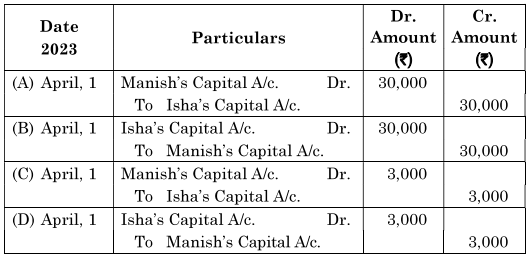
Isha and Manish were partners in a firm sharing profits and losses in the ratio of 3 : 2. With effect from 1st April, 2023, they agreed to share profits equally. On this date the goodwill of the firm was valued at Rs.3,00,000. The necessary journal entry for the treatment of goodwill without opening Goodwill Account will be:
View Solution
The old profit-sharing ratio of Isha and Manish is 3 : 2, and the new ratio is 1 : 1. The sacrificing ratio is calculated as follows: \[ Sacrificing Ratio = Old Ratio - New Ratio. \]
For Isha: \[ \frac{3}{5} - \frac{1}{2} = \frac{6}{10} - \frac{5}{10} = \frac{1}{10}. \]
For Manish: \[ \frac{2}{5} - \frac{1}{2} = \frac{4}{10} - \frac{5}{10} = -\frac{1}{10}. \]
The goodwill to be adjusted is: \[ Rs. 3,00,000 \times \frac{1}{10} = Rs. 30,000. \]
The journal entry for the adjustment is as follows: \[ \begin{array}{|l|c|c|} \hline \textbf{Particulars} & \textbf{Dr. Amount (Rs.)} & \textbf{Cr. Amount (Rs.)}
\hline Manish’s Capital A/c. Dr. & 30,000 &
\hline To Isha’s Capital A/c. & & 30,000
\hline \end{array} \]
Conclusion:
Goodwill adjustments are made by debiting the gaining partner’s capital account and crediting the sacrificing partner’s capital account based on the sacrificing ratio. Quick Tip: When partners revise their profit-sharing ratio, goodwill is adjusted through the sacrificing and gaining partners' capital accounts without creating a goodwill account.
(a) Aarav Ltd. issued 10,000, 9% debentures of Rs. 100 each at a premium of 5%, redeemable at a premium of 10%. Loss on issue of debentures account will be debited by:
View Solution
Debenture Issue Problem
Aarav Ltd. issued 10,000 debentures of 100 each at a premium of 5%, redeemable at a
premium of 10%. Calculate the loss on the issue of debentures.
Solution
1. Issue Premium per Debenture:
Issue Premium per Debenture = Face Value × Issue Premium Rate
= 100 × 5%
= 5
2. Redemption Premium per Debenture:
Redemption Premium per Debenture = Face Value × Redemption Premium Rate
= 100 × 10%
= 10
3. Total Loss per Debenture:
Total Loss per Debenture = Redemption Premium per Debenture
= 10
4. Total Loss on Issue of Debentures:
Total Loss on Issue of Debentures = Total Loss per Debenture × Number of Debentures
= 10 × 10, 000
= 1, 00, 000
Therefore, the Loss on Issue of Debentures account will be debited by 1,00,000.
Answer: (B) 1,00,000
% Option
(A) Issue Premium per Debenture:
\begin{align*
\text{Issue Premium per Debenture &= \text{Face Value \times \text{Issue Premium Rate
&= ₹100 \times 5%
&= ₹5
\end{align*
% Option
(B) Redemption Premium per Debenture:
\begin{align*
\text{Redemption Premium per Debenture &= \text{Face Value \times \text{Redemption Premium Rate
&= ₹100 \times 10%
&= ₹10
\end{align*
% Option
(C) Total Loss per Debenture:
\begin{align*
\text{Total Loss per Debenture &= \text{Redemption Premium per Debenture
&= ₹10
\end{align*
% Option
(D) Total Loss on Issue of Debentures:
\begin{align*
\text{Total Loss on Issue of Debentures &= \text{Total Loss per Debenture \times \text{Number of Debentures
&= ₹10 \times 10,000
&= ₹1,00,000
\end{align*
Therefore, the Loss on Issue of Debentures account will be debited by ₹1,00,000.
Answer: (B) ₹1,00,000 Quick Tip: To compute the loss on the issue of debentures, account for both the issue price and the redemption premium. Multiply the per-debenture loss by the total number of debentures.
Question 8:
(b) Dove Ltd. issued 8,000, 11% debentures of Rs. 100 each at a premium of 5%. The total amount of interest on debentures for one year will be:
View Solution
The total nominal value of the debentures issued is calculated as: \[ 8,000 \times Rs. 100 = Rs. 8,00,000. \]
The annual interest on the debentures is: \[ 11% \times Rs. 8,00,000 = Rs. 88,000. \]
Therefore, the total interest payable on the debentures for one year is \( Rs. 88,000 \).
Conclusion:
The annual interest on the issued debentures amounts to \( Rs. 88,000 \). Quick Tip: To compute the annual interest on debentures, multiply the nominal value of the debentures by the interest rate.
(a) Kriti, Hina and Nidhi were partners sharing profits in the ratio of 3 : 2 : 1. Nidhi retired. On the date of her retirement, Workmen Compensation Fund stood in the Balance Sheet at Rs. 1,50,000. Workmen Compensation Claim was Rs. 1,20,000. How much amount of Workmen Compensation Fund will be credited to Nidhi’s Capital Account?
View Solution
Step 1: Determine the surplus in the Workmen Compensation Fund:
The balance of the Workmen Compensation Fund is Rs. 1,50,000, while the Workmen Compensation Claim amounts to Rs. 1,20,000. The surplus is calculated as: \[ Surplus = Rs. 1,50,000 - Rs. 1,20,000 = Rs. 30,000. \]
Step 2: Distribute the surplus among the partners:
The surplus of Rs. 30,000 is distributed among the partners in the profit-sharing ratio of \( 3 : 2 : 1 \). Nidhi’s share of the surplus is: \[ Nidhi’s Share = Rs. 30,000 \times \frac{1}{6} = Rs. 5,000. \]
Conclusion:
Nidhi’s Capital Account is credited with \( Rs. 5,000 \) from the surplus in the Workmen Compensation Fund. Quick Tip: Surplus in the Workmen Compensation Fund, after meeting claims, is distributed among partners in their agreed profit-sharing ratio.
Question 9:
(b) Rohit, Udit and Mohit were partners in a firm sharing profits in the ratio of 3 : 2 : 1. Mohit retired. The balance in his capital account after making the necessary adjustments on account of reserves and revaluation of assets and liabilities was Rs. 1,80,000. Rohit and Udit agreed to pay him Rs. 2,00,000 in full settlement of his claim. Mohit’s share of goodwill in the firm was:
View Solution
Step 1: Determine the amount paid and capital account balance:
The amount paid to Mohit in full settlement is Rs. 2,00,000. The balance in Mohit’s capital account after adjustments is Rs. 1,80,000.
Step 2: Calculate Mohit’s share of goodwill:
The goodwill credited to Mohit is the difference between the amount paid to him and his capital account balance: \[ Mohit’s Share of Goodwill = Rs. 2,00,000 - Rs. 1,80,000 = Rs. 20,000. \]
Conclusion:
Mohit’s share of goodwill in the firm is \( Rs.20,000 \). Quick Tip: A retiring partner’s share of goodwill is the excess amount paid to them over their capital account balance after adjustments.
Assertion (A): Securities Premium cannot be utilized for writing off loss on sale of a fixed asset.
Reason (R): Securities Premium can be applied only for the purposes mentioned in the Companies Act, 2013.
Choose the correct option from the following:
View Solution
As per Section 52 of the Companies Act, 2013, the Securities Premium cannot be used to write off losses from the sale of fixed assets. It is restricted to specific purposes outlined in the Act, such as issuing bonus shares, writing off preliminary expenses, and other permissible uses.
Therefore, both Assertion (A) and Reason (R) are true, and Reason (R) correctly explains Assertion (A). Quick Tip: Securities Premium can only be utilized for purposes specified under the Companies Act, 2013, such as issuing bonus shares or writing off preliminary expenses.
Mahi, Ruhi and Ginni are partners in a firm sharing profits and losses in the ratio of 6 : 4 : 1. Mahi guaranteed a profit of Rs. 50,000 to Ginni. Net profit for the year ending 31st March, 2023, was Rs. 1,10,000. Mahi’s share in the profit of the firm after giving the guaranteed amount to Ginni will be:
View Solution
Step 1: Allocate the guaranteed profit to Ginni:
The total profit of the firm is Rs. 1,10,000, and Ginni is guaranteed a profit of Rs. 50,000. Based on the profit-sharing ratio (6 : 4 : 1), Ginni’s actual share is calculated as: \[ Ginni’s Share = Rs. 1,10,000 \times \frac{1}{11} = Rs. 10,000. \]
The shortfall in Ginni’s profit is: \[ Rs. 50,000 - Rs. 10,000 = Rs. 40,000. \]
Step 2: Adjust Mahi’s share for the profit guarantee:
The shortfall of Rs. 40,000 is to be borne entirely by Mahi. Mahi’s profit share, based on the ratio (6 : 4 : 1), is: \[ Mahi’s Share = Rs. 1,10,000 \times \frac{6}{11} = Rs. 60,000. \]
After adjusting for the shortfall: \[ Mahi’s Final Share = Rs. 60,000 - Rs. 40,000 = Rs. 20,000. \]
Conclusion:
Mahi’s final share in the firm’s profit, after ensuring Ginni’s guaranteed amount, is \( Rs. 20,000 \). Quick Tip: When a profit guarantee is provided, any shortfall in the guaranteed profit is adjusted against the profit share of the partner offering the guarantee.
Opening capital of Keshav was:
View Solution
The opening capital of Keshav is calculated as follows:
Explanation:
The total drawings made by Keshav: \[ Drawings = 1,500 \times 4 = Rs. 6,000. \]
Keshav’s share in the profits: \[ Profit Share = 15,000 \times \frac{3}{5} = Rs. 9,000. \]
The formula to calculate the opening capital: \[ Opening Capital = Closing Capital + Drawings - Profit Transferred. \]
Substituting the values: \[ Opening Capital = Rs. 55,000 + Rs. 6,000 - Rs. 9,000 = Rs. 52,000. \]
Conclusion:
The opening capital of Keshav was \( Rs. 52,000 \). Quick Tip: To calculate opening capital, use the formula: \[ Opening Capital = Closing Capital + Drawings - Profit Transferred. \] Ensure all values, such as drawings and profit share, are correctly accounted for.
Amount of interest to be charged on Hitesh’s drawings will be:
View Solution
Hitesh withdrew Rs. 9,000 on 1st November, 2022. The interest on drawings is calculated at 8% per annum for the period from November to March (5 months). \[ Interest on Drawings = Rs. 9,000 \times \frac{8}{100} \times \frac{5}{12} = Rs. 300. \]
Conclusion:
The interest on drawings for Hitesh is \( Rs. 300 \). Quick Tip: To compute interest on drawings, use the formula: \[ Interest = Amount Withdrawn \times Rate of Interest \times \frac{Time (in months)}{12}. \]
A partnership firm has 45 partners. It wants to admit 7 more partners into partnership. Only ...... more partners can be admitted in the partnership firm according to Companies Act, 2013.
View Solution
As per Section 464 of the Companies Act, 2013, a partnership firm can have a maximum of 50 partners unless it is registered as a company.
The firm currently has 45 partners. The maximum allowable limit is 50 partners. \[ Remaining partners that can be admitted = 50 - 45 = 5. \]
Conclusion:
The partnership firm can admit up to \( 5 \) more partners. Quick Tip: Under the Companies Act, 2013, a partnership firm is limited to a maximum of 50 partners unless registered as a company.
A, B and C were partners in a firm sharing profits and losses in the ratio of 1 : 2 : 3. D was admitted in the firm for 1/6th share. C would retain his original share. The new profit sharing ratio will be:
View Solution
Step 1: Calculate original shares.
Given that A, B, and C's initial sharing ratio is \( \frac{1}{2} : \frac{1}{3} : \frac{1}{4} \), we convert these fractions to a common denominator: \[ \frac{1}{2} = \frac{6}{12}, \quad \frac{1}{3} = \frac{4}{12}, \quad \frac{1}{4} = \frac{3}{12} \quad \Rightarrow \quad 6:4:3 \]
Step 2: Adjust for D's share and recalculate.
D is introduced with a \( \frac{1}{6} \) share, and C retains his original share of \( \frac{1}{4} \). First, determine the remaining share for redistribution: \[ Remaining share = 1 - \left(\frac{1}{4} + \frac{1}{6}\right) = 1 - \frac{5}{12} = \frac{7}{12} \]
Step 3: Calculate new shares for A and B.
A and B's new shares are proportional to their original shares out of the \( \frac{7}{12} \): \[ A's new share = \frac{7}{12} \times \frac{6}{10} = \frac{42}{120}, \quad B's new share = \frac{7}{12} \times \frac{4}{10} = \frac{28}{120} \]
Step 4: Incorporate D's share. \[ C's share = \frac{1}{4} = \frac{30}{120}, \quad D's share = \frac{1}{6} = \frac{20}{120} \]
Step 5: Final ratio.
After simplifying \( \frac{42}{120} : \frac{28}{120} : \frac{30}{120} : \frac{20}{120} \), we obtain: \[ 21 : 14 : 15 : 10 \] Quick Tip: When adjusting profit-sharing ratios in a partnership, deduct the given share proportionally from the existing partner’s share and recalculate the ratios.
(a) If all the forfeited shares are reissued, the balance, if any, left in the Forfeited Shares Account is transferred to:
View Solution
When forfeited shares are reissued, any remaining balance in the Forfeited Shares Account is transferred to the Capital Reserve Account.
This is because the leftover amount, after adjusting for unpaid calls on forfeited shares, is treated as a capital profit and must be transferred to the Capital Reserve. Quick Tip: Upon reissuing forfeited shares, the remaining balance in the Forfeited Shares Account is recognized as capital profit and transferred to the Capital Reserve Account.
(b) Raghav Ltd. forfeited 100 shares of Rs. 10 each issued at a premium of 20% for non-payment of first call of Rs. 3 per share and final call of Rs. 1 per share. The minimum price per share at which these shares can be reissued will be:
View Solution
Step 1: Calculate the total amount called-up per share:
The face value of each share is Rs. 10, with a premium of 20% of Rs. 10 = Rs. 2.
Thus, the total called-up amount is: \[ Total Called-up Value = Rs. 10 + Rs. 2 = Rs. 12. \]
Step 2: Determine the unpaid amount per share:
The unpaid amounts are the first call of Rs. 3 and the final call of Rs. 1. \[ Total Unpaid Amount per Share = Rs. 3 + Rs. 1 = Rs. 4. \]
Step 3: Calculate the minimum reissue price:
The minimum reissue price for forfeited shares must be at least equal to the unpaid amount. Therefore: \[ Minimum Reissue Price per Share = Rs. 4. \]
Conclusion:
The minimum price at which the forfeited shares can be reissued is \( Rs. 4 \). Quick Tip: For forfeited shares, the minimum reissue price must be equal to the unpaid amount to cover the liability of the shareholder.
Asha, Nisha and Hiten were partners in a firm sharing profits and losses in the ratio of 2 : 2 : 1. Their fixed capitals were Rs. 2,00,000, Rs. 1,50,000 and Rs. 1,00,000 respectively. The partnership deed provided for interest on capital @ 10% p.a. For the year ended 31st March, 2023, profits of the firm were distributed without providing interest on capital. Pass the necessary adjusting Journal entry to rectify the error.
View Solution
Books of Asha, Nisha and Hiten
Journal
\begin{tabular{|l|l|r|r|
\hline
Date & Particulars & Dr. Amount (Rs.) & Cr. Amount (Rs.)
\hline
& Nisha's Current A/c Dr. & 3,000 &
& \quad To Asha's Current A/c & & 2,000
& \quad To Hiten's Current A/c & & 1,000
& \quad (Interest on capital omitted, now rectified) & &
\hline
\end{tabular
Table showing adjustment
\begin{tabular{|l|r|r|r|
\hline
Partners & Dr. Interest on Capital @10% (Rs.) & Cr. Profits (Rs.) & Net Effect
\hline
Asha & 20,000 & 18,000 & 2,000 (Cr.)
Nisha & 15,000 & 18,000 & 3,000 (Dr.)
Hiten & 10,000 & 9,000 & 1,000 (Cr.)
\hline
Total & 45,000 & 45,000 &
\hline
\end{tabular Quick Tip: Always verify that interest on capital is provided as outlined in the partnership deed. If missed, use an adjusting entry to allocate the amount to the partners' accounts.
(a) Chavi Ltd. purchased machinery from Neo Ltd. It was agreed that the purchase consideration will be paid by issuing 10,000 equity shares of Rs.10 each at a premium of 10% and a bank draft of Rs.50,000. Pass the necessary Journal entries in the books of Chavi Ltd. for the above transactions.
View Solution
The journal entry to record the purchase consideration is as follows:
\[ \begin{array}{|l|c|c|} \hline \textbf{Particulars} & \textbf{Debit (Rs.)} & \textbf{Credit (Rs.)}
\hline Machinery A/c Dr. & 1,50,000 &
\hline To Equity Share Capital A/c & & 1,00,000
\hline To Securities Premium A/c & & 10,000
\hline To Bank A/c & & 50,000
\hline \end{array} \]
Conclusion:
The above entry records the acquisition by debiting the machinery account and crediting equity share capital, securities premium, and bank accounts as applicable. Quick Tip: When issuing shares as part of purchase consideration, always record the face value under equity share capital and any excess as securities premium.
Question 18:
(b) On 1st October, 2022 Ninza Ltd. issued 4,000, 8% Debentures of Rs.100 each at a discount of 10%. The company had a balance of Rs.50,000 in Securities Premium Account on the same date. Pass necessary Journal entries for issue of debentures and to write off discount on issue of debentures.
View Solution
Journal Entries:
\[ \begin{array}{|l|c|c|} \hline \textbf{Particulars} & \textbf{Debit (Rs.)} & \textbf{Credit (Rs.)}
\hline Bank A/c Dr. & 3,60,000 &
\hline Discount on Issue of Debentures A/c Dr. & 40,000 &
\hline To 8% Debentures A/c & & 4,00,000
\hline Securities Premium A/c Dr. & 40,000 &
\hline To Discount on Issue of Debentures A/c & & 40,000
\hline \end{array} \] Quick Tip: Ensure that the discount on issue of debentures is first adjusted against the Securities Premium Account, provided there is a sufficient balance.
(a) Mahesh, Ramesh and Naresh were partners in a firm sharing profits in the ratio of 5 : 3 : 2. From 1st April, 2023, they decided to share profits equally. On that date, there was a balance of Rs.3,60,000 in General Reserve and a debit balance of Rs.1,80,000 in the Profit and Loss Account. Pass single adjustment Journal entry for the above on account of change in the profit-sharing ratio.
View Solution
The profit-sharing ratio is revised from 5 : 3 : 2 to equal sharing (1 : 1 : 1). The General Reserve and Profit and Loss Account balances are distributed among the partners based on the old profit-sharing ratio:
\[ General Reserve Distribution: Rs. 3,60,000 \times (Old Ratio 5:3:2). \] \[ Profit and Loss Debit: Rs. 1,80,000 in the same ratio. \]
To adjust for the change in the profit-sharing ratio, the journal entry is as follows:
Journal Entry: \[ \begin{array}{|l|c|c|} \hline \textbf{Particulars} & \textbf{Debit (Rs.)} & \textbf{Credit (Rs.)}
\hline Naresh’s Capital A/c Dr. & 60,000 &
\hline To Mahesh’s Capital A/c & & 50,000
\hline To Ramesh’s Capital A/c & & 10,000
\hline \end{array} \] Quick Tip: When the profit-sharing ratio changes, adjust reserve and loss balances proportionately between the old and new ratios to ensure fair distribution.
(b) Ravi, Guru, Mani and Sonu were partners in a firm sharing profits in the ratio of 2 : 2 : 2 : 1. On 31st January, 2023, Sonu retired. On Sonu’s retirement, the Goodwill of the firm was valued at Rs.1,40,000. The new profit sharing ratio among Ravi, Guru and Mani was 5 : 5 : 1. Showing your workings clearly, pass necessary Journal entry for the treatment of Goodwill in the books of the firm on Sonu’s retirement without opening goodwill account.
View Solution
Goodwill is distributed among the partners in their sacrificing or gaining ratios. Upon Sonu’s retirement, the goodwill adjustment is as follows: \[ Total Goodwill = Rs. 1,40,000. \]
Journal Entry: \[ \begin{array}{|l|c|c|} \hline \textbf{Particulars} & \textbf{Debit (Rs.)} & \textbf{Credit (Rs.)}
\hline Ravi’s Capital A/c Dr. & 10,000 &
\hline Guru’s Capital A/c Dr. & 10,000 &
\hline To Sonu’s Capital A/c & & 20,000
\hline \end{array} \] Quick Tip: Goodwill adjustments on a partner’s retirement should be allocated based on the partners’ sacrificing or gaining ratios to ensure fairness in the distribution.
A business earned an average profit of Rs. 4,00,000 during the last few years. The normal rate of profit in the similar type of business is 10%. The value of assets and liabilities of the business were Rs. 20,00,000 and Rs. 5,00,000 respectively. Calculate the value of goodwill of the firm by Super Profits Method if it is valued at 2 years purchase of super profit.
View Solution
The formula for calculating goodwill using the Super Profits Method is: \[ Goodwill = Super Profit \times Number of Years’ Purchase. \]
Step 1: Calculate the Normal Profit
The normal profit is determined using the formula: \[ Normal Profit = Capital Employed \times Normal Rate of Profit. \]
The capital employed is calculated as: \[ Capital Employed = Assets - Liabilities = Rs. 20,00,000 - Rs. 5,00,000 = Rs. 15,00,000. \]
Now, calculate the normal profit: \[ Normal Profit = Rs. 15,00,000 \times 10% = Rs. 1,50,000. \]
Step 2: Calculate the Super Profit
Super profit is the excess of actual profit over normal profit: \[ Super Profit = Actual Profit - Normal Profit. \] \[ Super Profit = Rs. 4,00,000 - Rs. 1,50,000 = Rs. 2,50,000. \]
Step 3: Calculate Goodwill
Using the Super Profits Method and the 2 years’ purchase of super profit: \[ Goodwill = Rs. 2,50,000 \times 2 = Rs. 5,00,000. \]
Conclusion:
The goodwill of the business, calculated using the Super Profits Method, is \( Rs. 5,00,000 \). Quick Tip: To calculate goodwill using the Super Profits Method, ensure to compute the normal profit based on capital employed and the normal rate of profit before determining the super profit.
Madhav, Raghav and Purav were partners in a firm sharing profits and losses in the ratio of 3 : 1 : 1. Their Balance Sheet as at 31st March, 2023 was as follows:
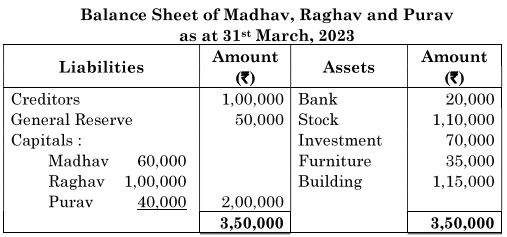
Purav died on 30th September, 2023. According to Partnership deed, his legal representatives are entitled to the following:
View Solution
Step 1: Calculation of Goodwill
Goodwill is calculated as: \[ Goodwill = Average Profits \times 3 years’ purchase. \] \[ Rs. 50,000 \times 3 = Rs. 1,50,000. \]
Purav’s share of goodwill is \( \frac{1}{5} \) of the total goodwill: \[ Rs. 1,50,000 \times \frac{1}{5} = Rs. 30,000. \]
Step 2: Calculation of Interest on Capital
Interest on capital for 6 months is calculated as: \[ Interest on Capital = Rs. 40,000 \times 12% \times \frac{6}{12} = Rs. 2,400. \]
Step 3: Purav’s Share of Profit
Based on the last year’s profit: \[ Purav’s Share of Profit = Rs. 3,000. \]
Journal Entries:
\[ \begin{array}{|l|c|c|} \hline \textbf{Particulars} & \textbf{Dr. Amount (Rs.)} & \textbf{Cr. Amount (Rs.)}
\hline General Reserve A/c Dr. & 10,000 &
\hline To Purav’s Capital A/c & & 10,000
\hline Profit and Loss Suspense A/c Dr. & 3,000 &
\hline To Purav’s Capital A/c & & 3,000
\hline Madhav’s Capital A/c Dr. & 18,000 &
\hline Raghav’s Capital A/c Dr. & 6,000 &
\hline To Purav’s Capital A/c & & 30,000
\hline Interest on Capital A/c Dr. & 2,400 &
\hline To Purav’s Capital A/c & & 2,400
\hline Purav’s Drawings A/c Dr. & 10,000 &
\hline To Purav’s Capital A/c & & 10,000
\hline \end{array} \]
Purav’s Capital Account:
\[ \begin{array}{|l|c|c|} \hline \textbf{Particulars} & \textbf{Dr. Amount (Rs.)} & \textbf{Cr. Amount (Rs.)}
\hline To Drawings & 10,000 & By Balance b/d & 40,000
\hline To Legal Representatives A/c & 75,400 & By General Reserve & 10,000
\hline & & By Profit (up to death) & 3,000
\hline & & By Goodwill & 30,000
\hline & & By Interest on Capital & 2,400
\hline \end{array} \] Quick Tip: When preparing a deceased partner’s capital account, include credits for entitlements such as goodwill, profit, and interest on capital, and debit drawings or other adjustments as applicable.
On 1st April 2023, Khyati Ltd. was formed with an authorised capital of Rs.20,00,000 divided into 2,00,000 equity shares of Rs.10 each. The company invited applications for issuing 1,80,000 equity shares. The company received applications for 1,70,000 equity shares. During the first year, Rs.8 per share were called and final call of Rs.2 per share has not been made yet. Siya holding 2,000 shares and Piya holding 4,000 shares did not pay the first call of Rs.2 per share. All the shares of Siya and Piya were forfeited after the first call.
View Solution
Khyati Ltd.
Balance Sheet as at ------ (An Extract)
\begin{tabular{|l|c|r|
\hline
Particulars & Note no. & Amount (Rs.)
\hline
I. Equity and Liabilities & &
1. Shareholders' Funds & &
\quad (a) Share Capital & 1 & 13,48,000
\hline
\end{tabular
Notes to Accounts:
\begin{tabular{|l|r|
\hline
Particulars & Amount (Rs.)
\hline
1. Share Capital &
Authorised Capital &
2,00,000 equity shares of Rs. 10 each & 20,00,000
\hline
Issued capital &
1,80,000 equity shares of Rs. 10 each & 18,00,000
\hline
Subscribed Capital &
Subscribed but not fully paid &
1,64,000 equity shares of Rs. 10 each, Rs. 8 called up & 13,12,000
Add Forfeited Shares Account & 36,000
\hline
\multicolumn{2{|r|{13,48,000
\hline
\end{tabular Quick Tip: When preparing a balance sheet, ensure forfeited shares are included under equity adjustments and calls-in-arrears are reflected as receivables.
(a) Murari Ltd. invited applications for issuing 80,000 equity shares of Rs.10 each at a premium of Rs.4 per share. The amount per share was payable as follows: Rs.5 on application and Rs.9 (including premium) on allotment. Applications were received for 1,40,000 shares and allotment was made on pro-rata basis to all the applicants. Money overpaid on application was utilised towards sums due on allotment. The allotment money was duly received except from Sameer who had applied for 1,400 shares. His shares were forfeited. Pass the necessary journal entries in the books of Murari Ltd. to record the above transactions. Open calls-in-arrears account wherever required.
View Solution
Books of Murari Ltd.
Journal
{\small % Use a smaller font size to fit the table on the page
\begin{tabular{|p{0.8cm|p{6cm|p{0.8cm|r|r|
\hline
Date & Particulars & LF & Dr. Amount (Rs.) & Cr. Amount (Rs.)
\hline
& Bank A/c Dr. & & 7,00,000 &
& To Equity Share Application A/c & & & 7,00,000
& (Application money received on 1,40,000 shares) & & &
\hline
& Equity Share Application A/c Dr. & & 7,00,000 &
& To Equity Share Capital A/c & & 4,00,000 &
& To Equity Share Allotment A/c & & 3,00,000 &
& (Application money transferred to share capital account and share allotment account) & & &
\hline
& Equity Share Allotment A/c Dr. & & 7,20,000 &
& To Equity Share Capital A/c & & 4,00,000 &
& To Securities Premium A/c & & 3,20,000 &
& (Amount due on allotment) & & &
\hline
& Bank A/c Dr. & & 4,15,800 &
& Calls in arrears A/c Dr. & & 4,200 &
& To Equity Share Allotment A/c & & & 4,20,000
& (Allotment money received except on 800 shares) & & &
\hline
& Equity Share Capital A/c Dr. & & 8,000 &
& Securities Premium A/c Dr. & & 3,200 &
& To Share forfeiture A/c & & 7,000 &
& To Calls in arrears A/c & & 4,200 &
& (800 shares forfeited for non payment of allotment money) & & &
\hline
\end{tabular
Quick Tip: During oversubscription, ensure proper pro-rata allocation of excess amounts, and handle calls-in-arrears and forfeitures with precise journal adjustments.
(b) Kavya Ltd. invited applications for issuing 30,000 shares of Rs.10 each at a premium of Rs.2 per share. The amount was payable as follows: On application and allotment Rs.7 per share, On first and final call Rs.5 per share (including Rs.2 premium). Applications were received for 33,000 shares. Applications for 3,000 shares were rejected, and money returned to the applicants. Applications for 30,000 shares were accepted in full. The application and allotment money was duly received. The first and final call was made and money received except from a shareholder holding 500 shares. His shares were forfeited. All these shares were re-issued to Kartik as fully paid for Rs.8 per share. Pass necessary journal entries for the above transactions in the books of Kavya Ltd. Open calls-in-arrears account wherever required.
View Solution
Books of Kavya Ltd.
Journal
{\small % Use a smaller font size to fit the table on the page
\begin{tabular{|p{0.5cm|p{5cm|p{0.5cm|r|r|
\hline
Date & Particulars & LF & Dr. Amount (Rs.) & Cr. Amount (Rs.)
\hline
& Bank A/c Dr. & & 2,31,000 &
& To Share Application and Allotment A/c & & & 2,31,000
& (Application money received on 33,000 shares) & & &
\hline
& Share Application and Allotment A/c Dr. & & 2,31,000 &
& To Share Capital A/c & & 2,10,000 &
& To Bank A/c & & 21,000 &
& (Application money transferred to share capital account and balance refunded) & & &
\hline
& Share First and Final Call A/c Dr. & & 1,50,000 &
& To Equity Share Capital A/c & & 90,000 &
& To Securities Premium A/c & & 60,000 &
& (Amount due on first and final call) & & &
\hline
& Bank A/c Dr. & & 1,47,500 &
& Calls in arrears A/c Dr. & & 2,500 &
& To Share First and Final Call A/c & & & 1,50,000
& (First and final call received except on 500 shares) & & &
\hline
& Share Capital A/c Dr. & & 5,000 &
& Securities Premium A/c Dr. & & 1,000 &
& To Share Forfeiture A/c & & 3,500 &
& To Calls in Arrears A/c & & 2,500 &
& (500 shares forfeited for non payment of first and final call) & & &
\hline
& Bank A/c Dr. & & 4,000 &
& Share Forfeiture A/c Dr. & & 1,000 &
& To Share Capital A/c & & & 5,000
& (Forfeited shares reissued as fully paid for Rs. 8 per share) & & &
\hline
& Share Forfeiture A/c Dr. & & 2,500 &
& To Capital Reserve A/c & & & 2,500
& (Gain on reissue of forfeited shares transferred to Capital Reserve A/c) & & &
\hline
\end{tabular
Quick Tip: When shares are reissued, ensure to record the reissue price accurately. Any surplus remaining in the forfeited shares account should be transferred to the capital reserve.
(a) Arnav, Bhavi and Chavi were in partnership sharing profits and losses in the ratio of 3 : 2 : 1. On 31st March, 2023, their Balance Sheet was as follows:
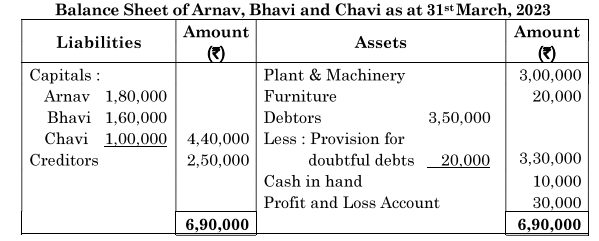
Chavi retired on the above date. It was agreed that :
View Solution
Revaluation Account: \[ \begin{array}{|l|c|c|} \hline \textbf{Particulars} & \textbf{Dr. Amount (Rs.)} & \textbf{Cr. Amount (Rs.)}
\hline Provision for Doubtful Debts & 10,000 &
\hline To Plant and Machinery & & 1,30,000
\hline To Profit Transferred: & &
Arnav (3/5) & & 72,000
Bhavi (2/5) & & 48,000
\hline \textbf{Total} & 1,30,000 & 1,30,000
\hline \end{array} \]
Partners’ Capital Account: \[ \begin{array}{|l|c|c|c|} \hline \textbf{Particulars} & \textbf{Arnav (Rs.)} & \textbf{Bhavi (Rs.)} & \textbf{Chavi (Rs.)}
\hline Balance b/d & 1,80,000 & 1,60,000 & 1,00,000
\hline Revaluation Profit & 72,000 & 48,000 & -
\hline Goodwill Adjustment & (48,000) & (32,000) & 80,000
\hline To Bank A/c & - & - & 1,80,000
\hline \textbf{Total} & 2,04,000 & 1,76,000 & -
\hline \end{array} \] Quick Tip: Ensure all revaluation and goodwill adjustments are accurately allocated in the partners’ capital accounts before finalizing the accounts.
Question 24:
(b) Divya and Ekta were partners in a firm sharing profits in the ratio of 3 : 1. On 31st March, 2023, they admitted Sona as a new partner for 1/4th share in the profits of the firm. Their Balance Sheet on that date was as follows:
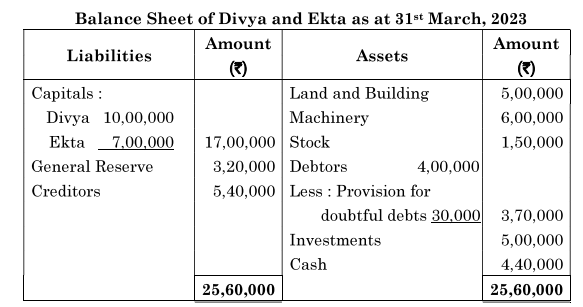
Sona will bring ₹ 4,00,000 as her capital and her share of goodwill in cash. It was agreed that :
View Solution
Revaluation Account: \[ \begin{array}{|l|c|c|} \hline \textbf{Particulars} & \textbf{Dr. Amount (Rs.)} & \textbf{Cr. Amount (Rs.)}
\hline Provision for Doubtful Debts & 8,000 &
\hline Liabilities Written Back & & 20,000
\hline To Land and Building & & 2,12,000
\hline To Profit Transferred: & &
Divya (3/4) & & 1,59,000
Ekta (1/4) & & 53,000
\hline \textbf{Total} & 2,20,000 & 2,20,000
\hline \end{array} \]
Partners’ Capital Account: \[ \begin{array}{|l|c|c|c|} \hline \textbf{Particulars} & \textbf{Divya (Rs.)} & \textbf{Ekta (Rs.)} & \textbf{Sona (Rs.)}
\hline Balance b/d & 10,00,000 & 7,00,000 & -
\hline Revaluation Profit & 1,59,000 & 53,000 & -
\hline Goodwill Adjustment & (1,80,000) & (60,000) & 2,40,000
\hline To Current A/c & 9,79,000 & 6,93,000 & -
\hline \textbf{Total} & 10,79,000 & 7,53,000 & 4,00,000
\hline \end{array} \]
Conclusion:
The Revaluation Account reflects the adjustments for revaluation profit, which is transferred to Divya and Ekta as per their profit-sharing ratio. The Partners’ Capital Account includes the goodwill adjustment and balances the new partner’s contribution. Quick Tip: Ensure revaluation profits and goodwill adjustments are appropriately allocated among partners, and capital accounts are balanced to reflect the incoming partner’s contribution.
Pass the necessary journal entries for the following transactions on the disSolution of the firm of Abhay and Mansi after various assets (other than cash) and third-party liabilities have been transferred to Realisation Account:
(i) Abhay took over stock worth Rs. 67,000 at Rs. 56,000.
(ii) There was an old computer which had been written off completely from the books. It was estimated to realise Rs. 4,000. It was taken away by Mansi at the estimated price less 10%.
(iii) Unrecorded liabilities amounting to Rs. 7,500 were settled at Rs. 5,000.
(iv) Realisation expenses amounting to Rs. 8,000 were paid by Abhay.
(v) Investment, whose face value was Rs. 15,000, was realized at 40%.
(vi) Profit on realisation Rs. 24,000 was to be distributed between Abhay and Mansi in their profit sharing ratio, which is 2 : 1.
View Solution
% Option
(i) Abhay took over stock valued at Rs. 67,000 for Rs. 56,000.
\[ \begin{array}{|c|c|c|} \hline \textbf{Particulars} & \textbf{Debit (Rs.)} & \textbf{Credit (Rs.)}
\hline Stock A/c & 67,000 &
\hline To Abhay’s Capital A/c & & 56,000
\hline To Realisation A/c & & 11,000
\hline \end{array} \]
% Option
(ii) An old computer, fully written off, was estimated to realise Rs. 4,000. Mansi took it for the estimated price less 10%.
\[ \begin{array}{|c|c|c|} \hline \textbf{Particulars} & \textbf{Debit (Rs.)} & \textbf{Credit (Rs.)}
\hline Realisation A/c & 4,000 &
\hline To Mansi’s Capital A/c & & 3,600
\hline To Loss on Realisation A/c & & 400
\hline \end{array} \]
% Option
(iii) Unrecorded liabilities of Rs. 7,500 were settled for Rs. 5,000.
\[ \begin{array}{|c|c|c|} \hline \textbf{Particulars} & \textbf{Debit (Rs.)} & \textbf{Credit (Rs.)}
\hline Realisation A/c & 7,500 &
\hline To Liabilities A/c & & 5,000
\hline \end{array} \]
% Option
(iv) Abhay paid realisation expenses amounting to Rs. 8,000.
\[ \begin{array}{|c|c|c|} \hline \textbf{Particulars} & \textbf{Debit (Rs.)} & \textbf{Credit (Rs.)}
\hline Realisation A/c & 8,000 &
\hline To Bank A/c & & 8,000
\hline \end{array} \]
% Option
(v) Investments with a face value of Rs. 15,000 were realised at 40%.
\[ \begin{array}{|c|c|c|} \hline \textbf{Particulars} & \textbf{Debit (Rs.)} & \textbf{Credit (Rs.)}
\hline Bank A/c & 6,000 &
\hline To Investment A/c & & 15,000
\hline \end{array} \]
% Option
(vi) Profit on realisation of Rs. 24,000 was distributed between Abhay and Mansi in their profit-sharing ratio of 2 : 1.
\[ \begin{array}{|c|c|c|} \hline \textbf{Particulars} & \textbf{Debit (Rs.)} & \textbf{Credit (Rs.)}
\hline Realisation A/c & 24,000 &
\hline To Abhay’s Capital A/c & & 16,000
\hline To Mansi’s Capital A/c & & 8,000
\hline \end{array} \]
Conclusion:
The journal entries record the disSolution process by transferring assets, liabilities, and realisation profits or losses, ensuring accuracy in distribution. Quick Tip: Ensure to pass all required journal entries during the disSolution process to accurately reflect the transfer of assets, liabilities, and realisation profits or losses.
Pass journal entries relating to issue of debentures in the books of Star Ltd. in each of the following cases:
(i) Issued 50,000, 9% Debentures of Rs. 100 each at a discount of 10%, redeemable at par.
(ii) Issued 6,000, 9% Debentures of Rs. 100 each at a premium of 5%, redeemable at a premium of 10%.
(iii) Issued 4,000, 10% Debentures of Rs. 100 each at par, redeemable at a premium of 5%.
View Solution
% Option
(i) 50,000, 9% Debentures of Rs. 100 each were issued at a 10% discount, redeemable at par.
\[ \begin{array}{|c|c|c|} \hline \textbf{Particulars} & \textbf{Debit (Rs.)} & \textbf{Credit (Rs.)}
\hline Bank A/c & 45,00,000 &
\hline Discount on Issue of Debentures A/c & 5,00,000 &
\hline To 9% Debentures A/c & & 50,00,000
\hline \end{array} \]
% Option
(ii) 6,000, 9% Debentures of Rs. 100 each were issued at a premium of 5% and are redeemable at a premium of 10%.
\[ \begin{array}{|c|c|c|} \hline \textbf{Particulars} & \textbf{Debit (Rs.)} & \textbf{Credit (Rs.)}
\hline Bank A/c & 6,30,000 &
\hline To 9% Debentures A/c & & 6,00,000
\hline To Securities Premium A/c & & 30,000
\hline \end{array} \]
% Option
(iii) 4,000, 10% Debentures of Rs. 100 each were issued at par and are redeemable at a premium of 5%.
\[ \begin{array}{|c|c|c|} \hline \textbf{Particulars} & \textbf{Debit (Rs.)} & \textbf{Credit (Rs.)}
\hline Bank A/c & 4,20,000 &
\hline To 10% Debentures A/c & & 4,00,000
\hline To Securities Premium A/c & & 20,000
\hline \end{array} \]
Conclusion:
The journal entries record the issuance of debentures at discounts or premiums, along with the adjustments for redemption terms. Quick Tip: When debentures are issued at a discount or premium, ensure to separately account for the adjustments in the respective accounts, including securities premium or discount.
PART B
OPTION I
(Analysis of Financial Statements)
Question 27:
Which of the following transaction will result in flow of cash?
View Solution
Cash flow represents the movement of cash into or out of a business.
The receipt of Rs. 74,000 from debtors is an actual cash inflow.
Options (A), (B), and (D) do not directly affect cash flow, as they involve either credit transactions or non-cash adjustments.
Thus, the correct answer is Rs. 74,000 received from debtors. Quick Tip: Cash flow requires a direct cash movement. Non-cash transactions, such as issuing or converting debentures, do not generate cash flow.
(a) Shyam Sunder Ltd. is a financing company. Under which of the following activity will the amount of ‘Interest paid on loan’ be shown:
View Solution
In the case of a financing company, interest paid on loans is treated as an operating activity because it is directly linked to the company's primary business of financing. This classification is consistent with the nature of its core operations.
Conclusion:
Interest paid on loans is recorded under operating activities for a financing company as it is integral to its core operations. Quick Tip: For financing companies, both interest paid and interest earned are considered operating activities, as they are fundamental to the company's main business operations.
Question 28:
(b) Tax paid during the year ended 31st March, 2023 was Rs. 15,000. While calculating Net Profit before Tax and Extraordinary items, the amount of provision for tax to be added is .......

View Solution
To calculate the Net Profit before Tax, the provision for tax added back includes both the increase in the tax provision during the year and the tax paid.
Step 1: Calculate the increase in the provision for tax:
\[ Increase in Provision = Rs. 25,000 - Rs. 10,000 = Rs. 15,000. \]
Step 2: Include the tax paid during the year:
\[ Tax Paid = Rs. 15,000. \]
Step 3: Compute the total provision for tax to be added:
\[ Total Provision to be Added = Rs. 15,000 + Rs. 15,000 = Rs. 30,000. \]
Conclusion:
The total provision for tax to be added to calculate the Net Profit before Tax is \( Rs. 30,000 \). Quick Tip: To compute Net Profit before Tax, ensure to add both the increase in the tax provision and the tax paid during the year, as they reflect non-operating adjustments.
Which of the following is not a tool of Analysis of Financial Statements?
View Solution
Analysis of Financial Statements employs tools such as ratio analysis, comparative statements, and cash flow statements.
Although the Statement of Profit & Loss is essential for financial reporting, it is not considered an analytical tool.
Thus, the correct answer is (C). Quick Tip: Financial analysis relies on tools like ratio analysis, comparative statements, and cash flow statements, while the Statement of Profit & Loss serves as a reporting document.
(a) Total Assets = Rs. 3,00,000, Non-current Assets = Rs. 2,60,000, Non-current Liabilities = Rs. 80,000, Shareholders Funds = Rs. 2,00,000, Current ratio calculated on the basis of the above information will be:
View Solution
Step 1: Determine Current Assets
Current Assets are calculated as: \[ Current Assets = Total Assets - Non-current Assets. \] \[ Current Assets = Rs. 3,00,000 - Rs. 2,60,000 = Rs. 40,000. \]
Step 2: Determine Current Liabilities
From the data provided, calculate Total Liabilities: \[ Total Liabilities = Total Assets - Shareholders’ Funds. \] \[ Total Liabilities = Rs. 3,00,000 - Rs. 2,00,000 = Rs. 1,00,000. \]
Non-current Liabilities = Rs. 80,000. Therefore: \[ Current Liabilities = Total Liabilities - Non-current Liabilities. \] \[ Current Liabilities = Rs. 1,00,000 - Rs. 80,000 = Rs. 20,000. \]
Step 3: Calculate the Current Ratio
\[ Current Ratio = \frac{Current Assets}{Current Liabilities} = \frac{Rs. 40,000}{Rs. 20,000} = 2 : 1. \]
Conclusion:
The Current Ratio is \( 2 : 1 \). Quick Tip: The Current Ratio measures a firm’s liquidity. A ratio of \( 2 : 1 \) is considered ideal, indicating strong short-term financial health.
(b) When Current Ratio is 4 : 1, Current Assets are Rs. 60,000 and Quick Ratio is 2.5 : 1, the amount of ‘Inventory’ will be:
View Solution
Step 1: Determine Current Liabilities
Using the Current Ratio formula: \[ Current Ratio = \frac{Current Assets}{Current Liabilities} = 4 : 1. \]
Given Current Assets = Rs. 60,000, calculate: \[ Current Liabilities = \frac{Current Assets}{Current Ratio} = \frac{Rs. 60,000}{4} = Rs. 15,000. \]
Step 2: Calculate Inventory using the Quick Ratio
The Quick Ratio is given as \( 2.5 : 1 \), with the formula: \[ Quick Ratio = \frac{Current Assets - Inventory}{Current Liabilities}. \]
Substitute the known values: \[ 2.5 = \frac{Rs. 60,000 - Inventory}{Rs. 15,000}. \]
Rearranging to solve for Inventory: \[ Rs. 60,000 - Inventory = Rs. 15,000 \times 2.5 = Rs. 37,500. \] \[ Inventory = Rs. 60,000 - Rs. 37,500 = Rs. 22,500. \]
Conclusion:
The Inventory is \( Rs. 22,500 \). Quick Tip: The Quick Ratio excludes inventory from current assets, focusing on the liquidity of readily available resources like cash and receivables.
Under which major heads and sub-heads will the following items be placed in the balance sheet of the company as per Schedule III, Part I of the Companies Act, 2013:
View Solution
% Option
(i) Computer Software:
Major Head: Non-Current Assets
Sub-Head: Intangible Assets
% Option
(ii) Unclaimed Dividend:
Major Head: Equity and Liabilities
Sub-Head: Other Current Liabilities
% Option
(iii) Loose Tools:
Major Head: Current Assets
Sub-Head: Inventories
Quick Tip: Ensure compliance with the Companies Act for proper classification. Intangible assets like software fall under non-current assets, unclaimed dividends under current liabilities, and loose tools under inventories.
Calculate the current ratio from the following information: \[ \begin{array}{|c|c|} \hline \textbf{Particulars} & \textbf{Amount (Rs.)}
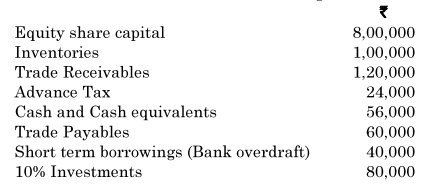
View Solution
Current Ratio Formula: \[ Current Ratio = \frac{Current Assets}{Current Liabilities} \]
Step 1: Calculate Current Assets:
Inventories: Rs. 1,00,000
Trade Receivables: Rs. 1,20,000
Advance Tax: Rs. 24,000
Cash and Cash Equivalents: Rs. 56,000
10% Investments: Rs. 80,000
\[ Total Current Assets = Rs. 3,80,000 \]
Step 2: Calculate Current Liabilities:
Trade Payables: Rs. 60,000
Short-Term Borrowings (Bank Overdraft): Rs. 40,000
\[ Total Current Liabilities = Rs. 1,00,000 \]
Step 3: Compute the Current Ratio: \[ Current Ratio = \frac{Rs. 3,80,000}{Rs. 1,00,000} = 3.8 : 1 \]
Final Answer:
The Current Ratio is 3.8 : 1. Quick Tip: Current assets include items that can be converted into cash within one year, while current liabilities are obligations payable within the same period.
(a) From the following Statement of Profit and Loss of Shikha Ltd., prepare Comparative Statement of Profit and Loss for the year ended 31st March, 2023:
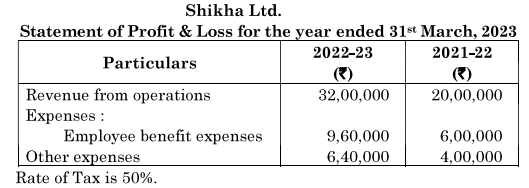
View Solution
Comparative Statement of Profit and Loss: \[ \begin{array}{|l|c|c|c|} \hline \textbf{Particulars} & \textbf{2022-23 (Rs.)} & \textbf{2021-22 (Rs.)} & \textbf{% Change}
\hline Revenue from Operations & 32,00,000 & 20,00,000 & 60%
\hline Employee Benefit Expenses & 9,60,000 & 6,00,000 & 60%
\hline Other Expenses & 6,40,000 & 4,00,000 & 60%
\hline \end{array} \]
Explanation:
The percentage change is calculated using the formula: \[ % Change = \frac{Current Year - Previous Year}{Previous Year} \times 100 \]
1. Revenue from Operations: \[ \frac{32,00,000 - 20,00,000}{20,00,000} \times 100 = 60% \]
2. Employee Benefit Expenses: \[ \frac{9,60,000 - 6,00,000}{6,00,000} \times 100 = 60% \]
3. Other Expenses: \[ \frac{6,40,000 - 4,00,000}{4,00,000} \times 100 = 60% \]
Conclusion:
All items show a consistent percentage increase of 60% from the previous year. Quick Tip: To prepare a comparative statement, use the formula: \[ % Change = \frac{Current Year - Previous Year}{Previous Year} \times 100 \] This provides a clear analysis of the performance trend over two periods.
Question 33:
(b) From the following information, prepare a Common Size Statement of Profit and Loss of A Ltd. and B Ltd. for the year ended 31st March, 2023:
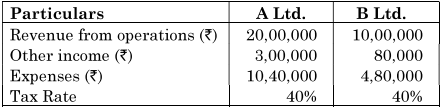
View Solution
Common Size Statement of Profit and Loss: \[ \begin{array}{|l|c|c|} \hline \textbf{Particulars} & \textbf{A Ltd. (%)} & \textbf{B Ltd. (%)}
\hline Revenue from Operations & 100% & 100%
\hline Other Income & 15% & 8%
\hline Expenses & 52% & 48%
\hline Profit Before Tax & 33% & 44%
\hline Tax Expense (40%) & 13.2% & 17.6%
\hline Profit After Tax & 19.8% & 26.4%
\hline \end{array} \]
Explanation:
In a Common Size Statement, each item is expressed as a percentage of Revenue from Operations. The calculations are as follows:
1. Other Income: \[ \frac{Other Income}{Revenue from Operations} \times 100 \]
For A Ltd: \[ \frac{3,00,000}{20,00,000} \times 100 = 15% \]
For B Ltd: \[ \frac{80,000}{10,00,000} \times 100 = 8% \]
2. Expenses: \[ \frac{Expenses}{Revenue from Operations} \times 100 \]
For A Ltd: \[ \frac{10,40,000}{20,00,000} \times 100 = 52% \]
For B Ltd: \[ \frac{4,80,000}{10,00,000} \times 100 = 48% \]
3. Profit Before Tax: \[ Revenue from Operations - Other Income - Expenses (as % of Revenue) \]
Conclusion:
The common size analysis highlights the percentage contribution of each item relative to revenue, facilitating meaningful comparison between A Ltd. and B Ltd. Quick Tip: A Common Size Statement converts all figures into percentages of Revenue from Operations, enabling a clear comparison of financial performance across companies.
From the following Balance Sheet of Yogita Ltd., calculate ‘Cash flows from Investing Activities’ and ‘Cash flows from Financing Activities’. Show your working properly.
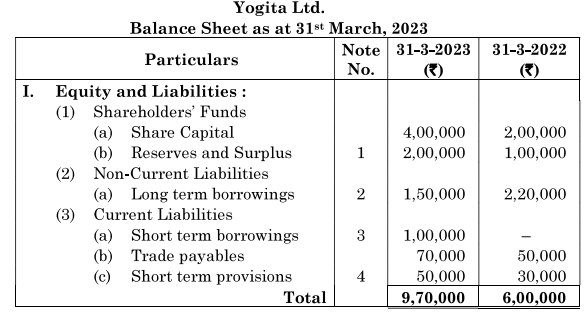
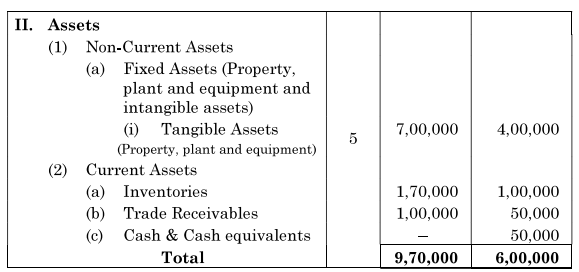
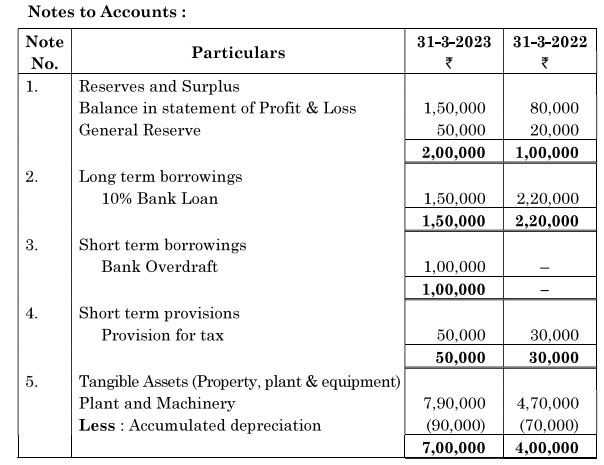
Additional Information:
View Solution
\section*{Calculation of Cash Flows from Investing Activities for the year ended 31st March 2023
\begin{tabular{|l|r|r|
\hline
Particulars & (Rs.) & (Rs.)
\hline
Purchase of Machinery & & (3,80,000)
Sale of Machinery & 42,000 &
Net Cash used in Investing Activities & & (3,38,000)
\hline
\end{tabular
\section*{Plant and Machinery A/c
% Using smaller font size to ensure table fits within the page width
{\small
\begin{tabular{|p{5cm|r||p{5cm|r|
\hline
Particulars & Amount (Rs.) & Particulars & Amount (Rs.)
\hline
To Balance b/d & 470,000 & By Bank/Cash A/c & 42,000
To Bank/ Cash A/c (Balancing figure) & 380,000 & By Accumulated Depreciation A/c & 15,000
& & By Statement of Profit \& Loss & 3,000
& & By balance c/d & 790,000
\hline
\multicolumn{2{|r||{Total: 850,000 & \multicolumn{2{r|{Total: 850,000
\hline
\end{tabular
\section*{Accumulated Depreciation A/c
\begin{tabular{|l|r||l|r|
\hline
Particulars & Amount (Rs.) & Particulars & Amount (Rs.)
\hline
To Plant and Machinery A/c & 15,000 & By Balance b/d & 70,000
To Statement of Profit \& Loss & 15,000 & By Depreciation A/c & 50,000
To balance c/d & 90,000 & &
\hline
\multicolumn{2{|r||{Total: 1,20,000 & \multicolumn{2{r|{Total: 1,20,000
\hline
\end{tabular
Calculation of Cash Flows from Financing Activities
for the year ended 31st March 2023
% Adds vertical space
\begin{tabular{|>{\raggedright\arraybackslashp{6cm|r|r|
\hline
Particulars & \multicolumn{2{c|{(Rs.)
\hline
Issue of Share Capital & \CheckmarkBold & 2,00,000
Bank Overdraft raised & \CheckmarkBold & 1,00,000
Bank loan repaid & \CheckmarkBold & (70,000)
Interest on bank loan paid & \XSolidBrush & (15,000)
\hline
Net Cash Inflows from Financing Activities & \CheckmarkBold & 2,15,000
\hline
\end{tabular Quick Tip: Classify all transactions affecting cash flows under their correct activity: Operating, Investing, or Financing. Ensure journal entries are accurate for asset sales, purchases, or liability settlements.
PART B
OPTION II
(Computerised Accounting)
Question 27:
(a) Depreciation is generated from which of the following Accounting information system?
View Solution
Depreciation is associated with fixed assets and is derived from the Fixed Assets Accounting Sub-System, which monitors the acquisition, depreciation, and disposal of assets. Quick Tip: Depreciation is calculated based on the cost and estimated useful life of fixed assets, managed within the Fixed Assets Accounting Sub-System.
Question 27:
(b) Which type of software package is suitable for an organization where the volume of accounting transactions is very low and adaptability is very high?
\begin{flushleft
View Solution
Generic software packages are most suitable for organizations with low transaction volumes and a high need for flexibility. These packages are cost-effective, user-friendly, and require minimal customization, making them ideal for small-scale businesses.
Conclusion: Generic software offers standard functionality for basic accounting tasks, catering to the needs of organizations with lower transaction volumes. Quick Tip: Generic accounting software is ideal for small businesses with straightforward accounting needs and low transaction volumes.
“A value or function or an arithmetic expression is recorded in ........”
View Solution
In a spreadsheet, a cell, formed at the intersection of a row and a column, is used to store values, formulas, or functions. Quick Tip: A cell is the basic element of a spreadsheet, holding values, formulas, or functions for calculations and data organization.
(a) Which of the following is not a limitation of the computerized accounting system?
\begin{flushleft
View Solution
Computerised accounting systems face challenges such as data corruption, hacking, and restricted report customization. However, the notion that data is accessible to everyone is not a limitation. Quick Tip: Computerised systems improve data security, but without proper safeguards, they may be vulnerable to hacking or data loss from system failures.
Question 29:
(b) To safeguard assets and optimize the use of resources a business .......
View Solution
Internal controls are crucial for protecting assets, ensuring efficient resource utilization, and preventing fraud or errors. These controls are vital for the smooth functioning of a business. Quick Tip: Internal controls are key to safeguarding assets and promoting operational efficiency within a business.
Which chart has depth axis?
View Solution
A 3D chart includes a depth axis, providing a three-dimensional representation. The depth axis enables the visualization of additional data on the z-axis. Quick Tip: 3D charts are useful for visualizing data across multiple dimensions, making it easier to understand complex relationships.
Explain various ‘Data tables’ used in Pivot Table.
View Solution
Data tables in Pivot Tables enable dynamic analysis by varying input values and observing their effect on outputs. The two primary types of data tables are:
1. Single-variable data tables:
- Evaluate the impact of changing a single input on a formula’s outcome.
- Example: Analyzing how varying interest rates affect loan repayments while keeping other factors constant.
2. Two-variable data tables:
- Assess the combined effect of two inputs on a formula’s result.
- Example: Exploring the impact of changing both interest rates and loan amounts on monthly installments.
Key Features of Data Tables:
- Automatically update results when input values or linked formulas change.
- Provide a structured way to visualize multiple scenarios.
- Simplify sensitivity analysis for informed decision-making.
Advantages of Data Tables:
- Facilitate efficient "What-If" analysis to evaluate different scenarios.
- Help users compare outcomes under varying assumptions.
- Save time by eliminating the need for multiple manual calculations or formulas. Quick Tip: Data tables are powerful tools for financial modeling, enabling sensitivity analysis and scenario comparison with ease.
How can \#DIV/0! error be corrected?
View Solution
% Option
(A) Change the Cell Reference:
Ensure that the cell referenced in the divisor position of your formula is correct. Sometimes, incorrect cell references lead to division by zero.
% Option
(B) Enter a Non-Zero Value:
If the cell referenced as a divisor contains zero or is empty, enter a value other than zero to avoid the \texttt{\#DIV/0! error.
% Option
(C) Use \texttt{\#N/A} for Unavailable Divisors:
Enter the value \texttt{\#N/A in the divisor cell to indicate that the divisor is not available. This change affects the formula result to show \texttt{\#N/A instead of \texttt{\#DIV/0!, clarifying that the divisor value is intentionally missing.
% Option
(D) Prevent the Error Value from Displaying:
Use the \texttt{IF function to check for zero before performing division:
\begin{verbatim
=IF(divisor = 0, "Error: Divisor is zero", dividend / divisor)
\end{verbatim
This formula checks if the divisor is zero. If true, it returns a custom error message; otherwise, it performs the division.
Conclusion
Implementing these steps will enhance the robustness of your spreadsheet models by preventing common errors and improving data integrity and user experience. Quick Tip: Use the \texttt{IFERROR} function for a streamlined way to manage errors in Excel formulas. It ensures cleaner and more user-friendly outputs by replacing errors with custom messages.
(a) List the points of nomenclature used in Excel for charts/graphs.
View Solution
The key components of charts and graphs in Excel are as follows:
1. Chart Title: Represents the primary purpose or topic of the chart.
2. Axis Titles: Provide descriptions for the horizontal (X-axis) and vertical (Y-axis).
3. Legend: Identifies the data series shown in the chart.
4. Data Points: Represent individual values plotted on the chart.
5. Gridlines: Assist in interpreting values along the axes.
6. Data Labels: Display exact values for each data point.
7. Plot Area: The section where the data is visually represented.
These elements collectively enhance the clarity and interpretability of charts. Quick Tip: Use a descriptive chart title and well-defined axis labels to make your charts more informative and visually effective.
Question 33:
(b) Explain the steps to define ‘Print area’ using Dialog box.
Correct Answer:
View Solution
By default, Excel prints all data on the current worksheet but for specific formatted print, we have to define print area from page set up dialog box or print area command from page layout option of ribbon following are the steps to define Print Area using Dialog box option:
% Option
(A) Select the page layout command tab on the ribbon
% Option
(B) In the page set up group click page set up. The page set up dialog box appears
% Option
(C) Select the sheet tab
% Option
(D) In the print area text box type the range of cells you want to print or (to select the area
% Option
(E) Click to collapse Dialog
% Option
(F) Select the desired range of cells
% Option
(G) Click restore the Dialog.
% Option
(H) Click Ok and the print area is defined Quick Tip: Always use the Print Preview option to verify that the selected print area is displayed correctly before printing.
From the given ‘VLOOKUP’ syntax, find out the error and its reason using the worksheet:
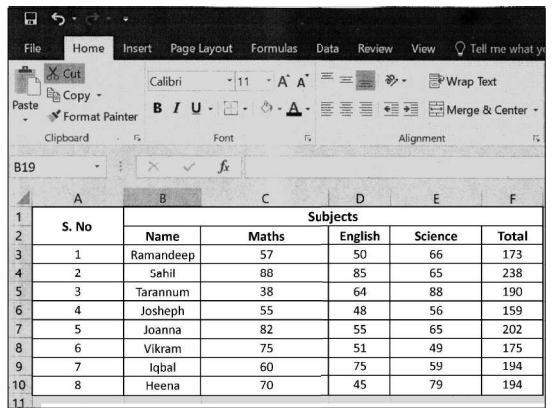
(i) = VLOOKUP(B5, C3:F10, 2, 0)
(ii) = SQRT(VLOOKUP(B3, B3:F10, 2, 0) - 100)
(iii) = VLOOKUP(B2, B3:F10, 5, 0)
(iv) = VLOOKUP(B3, B3:B10, 2, 0)
(v) = VLOOKUP(B6, B3:F10, 0, 0)
(vi) = VLOOKUP(B6, B3:F10, 2, 0)/0
View Solution
\title{Analysis of VLOOKUP Formula Errors in Excel
\author{
\date{
\maketitle
Overview of VLOOKUP Errors
This document analyzes various `VLOOKUP` formulas used in an Excel spreadsheet and describes the cause of errors that arise from their execution.
% Option
(A) Formula: \texttt{=VLOOKUP(B5, C3:F10, 2, 0)
% Option
(B) Error: \#N/A
% Option
(C) Reason: The lookup value in cell B5 is not found within the first column of the range C3 to F10.
% Option
(D) Formula: \texttt{=SQRT(VLOOKUP(B3, B3:F10, 2, 0) - 100)
% Option
(E) Error: \#NUM!
% Option
(F) Reason: Resulting negative value for square root operation, which is mathematically invalid.
% Option
(G) Formula: \texttt{=VLOOKUP(B2, B3:F10, 5, 0)
% Option
(H) Error: \#REF!
% Option
(I) Reason: Attempting to retrieve a value from a column index that exceeds the range provided.
% Option
(J) Formula: \texttt{=VLOOKUP(B3, B3:B10, 2, 0)
% Option
(K) Error: \#REF!
% Option
(L) Reason: Specified column index is beyond the range, which contains only one column.
% Option
(M) Formula: \texttt{=VLOOKUP(B6, B3:F10, 0, 0)
% Option
(N) Error: \#VALUE!
% Option
(O) Reason: Column index provided as zero, which is not valid as indices start from 1.
% Option
(P) Formula: \texttt{=VLOOKUP(B6, B3:F10, 2, 0)/0
% Option
(Q) Error: \#DIV/0!
% Option
(R) Reason: Division by zero is attempted, which is undefined. Quick Tip: \textbf{Quick Tip:} Ensure the lookup value is located in the first column of the table array. Use a valid column index corresponding to the structure of the table array. Avoid dividing by zero or referencing invalid ranges in formulas.





Comments