



.png?h=35&w=35&mode=stretch)
CBSE Class 12 Accountancy Set 3 Question Paper PDF (Code: 67/4/3) is now available for download. CBSE conducted the Class 12 Accountancy examination on March 23, 2024, from 10:30 AM to 1:30 PM. The question paper consists of 34 questions carrying a total of 80 marks. Part A is compulsory for all candidates. Part B has two options. Candidates have to attempt only one of the given options. Option I : Analysis of Financial Statements and Option II : Computerised Accounting. Candidates can use the link below to download the CBSE Class 12 Accountancy Set 3 Question Paper with detailed solutions.
CBSE Class 12 Accountancy Question Paper 2024 (Set 3- 67/4/3) with Answer Key
| CBSE Class 12 2024 Accountancy Question Paper with Answer Key |  Download Download |
Check Solution |
CBSE Class 12 2024 Accountancy Questions with Solutions
PART A
(Accounting for Partnership Firms and Companies)
(a) Arnav Ltd. purchased assets worth Rs 24,00,000. It issued 9% debentures of Rs 100 each at a discount of 4% for payment of the purchase consideration. The number of debentures issued to the vendor were:
View Solution
The total purchase consideration amounts to Rs 24,00,000. Given that the debentures are issued at a 4% discount, the issue price of each debenture is calculated as follows: \[ Issue Price = Rs 100 - (4% of Rs 100) = Rs 96 \]
The total number of debentures issued is determined by: \[ Number of Debentures = \frac{Purchase Consideration}{Issue Price} = \frac{Rs 24,00,000}{Rs 96} = 25,000 \]
Therefore, 25,000 debentures were issued to the vendor. Quick Tip: To find the number of debentures issued, divide the purchase consideration by the effective issue price per debenture, factoring in any discounts or premiums.
(b) On 1st May, 2023, Amrit Ltd. issued 10,000, 10% debentures of Rs 100 each at a premium of 10% redeemable at a premium of 10%. Loss on issue of debentures will be:
View Solution
Step 1: Calculate the Issue Price:
The issue price for each debenture is calculated as: \[ Issue Price = Rs 100 + 10% of Rs 100 = Rs 110 \]
Step 2: Calculate the Redemption Value:
The redemption value for each debenture is: \[ Redemption Value = Rs 100 + 10% of Rs 100 = Rs 110 \]
Step 3: Calculate the Loss on Issue of Debentures:
The loss on the issue of debentures arises from the premium on redemption. This loss is calculated as: \[ Loss on Issue = Number of Debentures \times Premium on Redemption \] \[ Loss on Issue = 10,000 \times Rs 10 = Rs 1,00,000 \]
Conclusion:
The total loss on the issue of debentures amounts to \( Rs 1,00,000 \). Quick Tip: A loss on the issue of debentures occurs when debentures are redeemed at a premium. This loss is treated as a capital expense and is typically amortized over the life of the debentures.
Gupta and Sharma are partners in a firm sharing profit in the ratio of 4:1. They admitted Preeti as a new partner for 1/4th share in the profits, which she acquired wholly from Gupta. New profit sharing ratio of Gupta, Sharma, and Preeti will be:
View Solution
Gupta's share after giving 1/4th to Preeti is calculated as: \[ Gupta's New Share = \frac{4}{5} - \frac{1}{4} = \frac{16}{20} - \frac{5}{20} = \frac{11}{20} \]
Sharma's share remains unchanged: \[ Sharma's Share = \frac{1}{5} = \frac{4}{20} \]
Preeti's share is: \[ Preeti's Share = \frac{1}{4} = \frac{5}{20} \]
Thus, the new profit-sharing ratio is: \[ 11:4:5 \] Quick Tip: When making partnership adjustments, always recalculate the new ratios by proportionately reducing the existing partners' shares based on the given distribution.
On the disSolutions of a partnership firm there were debtors of Rs 34,000. Debtors of Rs 1,000 became bad and 60% was realized from the remaining debtors. Which account will be debited and by how much amount on the realization from debtors?
View Solution
The amount to be realized from debtors is calculated as: \[ Total Debtors - Bad Debts = Rs 34,000 - Rs 1,000 = Rs 33,000 \]
The amount realized is 60% of Rs 33,000: \[ Amount Realized = 60% \times Rs 33,000 = Rs 19,800 \]
Therefore, the Cash Account will be debited by Rs 19,800. Quick Tip: In dissolution accounts, bad debts are written off, and the amount realized is credited to the Cash Account according to the recovery percentage.
If vendors are issued fully paid shares of Rs. 1,25,000 in purchase consideration of net assets of Rs. 1,50,000, the balance of Rs. 25,000 will be credited to:
View Solution
N/A Quick Tip: If the purchase consideration is less than the net assets acquired, the difference is transferred to the Capital Reserve Account, indicating the firm's gain from the purchase.
(a). Riya, Rita, and Renu were partners in a firm. On 31st March, 2023, Renu retired. The amount payable to Renu Rs. 2,17,000 was transferred to her loan account. Renu agreed to receive interest on this amount as per the provisions of the Partnership Act, 1932. The rate at which interest would be paid to Renu is:
View Solution
N/A Quick Tip: Section 37 of the Indian Partnership Act, 1932, stipulates that the interest on amounts due to a retiring partner is 6% p.a., unless an alternative rate is agreed upon.
Question 5:
(b). Ravi, Vani, and Toni were equal partners in a firm. After the retirement of Vani, the capital balances of Ravi and Toni were Rs. 1,56,000 and Rs. 1,08,000 respectively. The new capital of the firm was determined at Rs. 2,80,000. It was decided that the capital will be in proportion to the profit-sharing ratio of the remaining partners. Toni will bring ...... for deficiency of his new capital.
View Solution
N/A Quick Tip: When adjusting partners' capitals, first calculate the total new capital and divide it according to the profit-sharing ratio. Then, determine if each partner has an excess or deficiency in their capital.
As per the provisions of Companies Act, 2013 Securities Premium cannot be utilized for:
View Solution
N/A Quick Tip: Keep in mind the permissible uses of the Securities Premium Account under Section 52 of the Companies Act, 2013, as they are essential for ensuring accounting compliance.
(a). Vishant Ltd. invited applications for issuing 6,000 equity shares of Rs. 10 each at 10% premium. The issue was fully subscribed. The amount per share was payable as follows:
On application - Rs. 3, on allotment - Rs. 3 (including premium), on first call - Rs. 3, and on final call - Rs. 2. Ashish, the holder of 200 shares paid the entire money along with allotment. The total amount received on allotment was:
View Solution
N/A Quick Tip: When calculating the total amount received on allotment, always include any advance payments made by shareholders.
Question 7:
(b). M Ltd. forfeited 5,000 equity shares of Rs. 10 each issued at a premium of 10% for non-payment of final call of Rs. 2 per share. The minimum amount at which these shares can be reissued as fully paid up will be:
View Solution
N/A Quick Tip: Forfeited shares should be reissued at a price that at least covers the unpaid amount, ensuring no financial loss on the reissue.
(a). Which one of the following items is not dealt through Profit and Loss Appropriation Account?
View Solution
N/A Quick Tip: Know the distinction between appropriation items (related to profit distribution) and expense items (which are recorded in the Profit and Loss Account).
(b). At the time of admission of a partner, the Balance Sheet of the firm showed a workmen compensation reserve of Rs. 80,000. The claim for workmen compensation was estimated at Rs. 1,00,000. The shortfall of Rs. 20,000 will be:
View Solution
N/A Quick Tip: Any shortfall or surplus in reserves during a partner’s admission is adjusted through the revaluation account to reflect changes in liabilities or assets.
Vishnu and Mishu are partners in a firm. Mishu draws a fixed amount at the end of every quarter. Interest on drawings is charged @ 15% p.a. At the end of the year, interest on Mishu’s drawings amounted to Rs. 9,000. Interest on drawings was charged on drawings of Mishu for:
View Solution
N/A Quick Tip: Always verify the actual interest charged to determine the average period, especially if it differs from the standard assumption.
Read the following hypothetical situation and answer questions 10 and 11:
Aditi and Saurabh were partners in a firm sharing profits and losses in the ratio of 2:1. On 1st April, 2022 their capitals were ₹ 5,00,000 and ₹ 4,00,000 respectively. Before any appropriation, the firm earned a Net profit of ₹ 81,000 for the year ended 31st March, 2023. According to the partnership deed, interest on capital was to be provided @ 10% p.a.
Question 10:
Interest on Aditi’s capital will be:
View Solution
N/A Quick Tip: When calculating interest on capital, always account for the specific time period (e.g., full year or certain months) to ensure accurate calculation.
Interest on capital will be provided to Aditi and Saurabh in which of the following ratio?
View Solution
N/A Quick Tip: Interest on capital is generally distributed in proportion to the partners' capital contributions unless the partnership agreement specifies a different arrangement.
(a). Vanya and Aanya were partners in a firm sharing profits and losses in the ratio of 3:2. Their capitals were Rs. 5,00,000 and Rs. 1,00,000 respectively. Vanya was entitled to interest on capital @ 8% p.a., and Aanya was entitled to salary @ Rs. 5,000 per month. The net profit before any appropriation was Rs. 1,75,000. Vanya’s share in divisible profit will be:
View Solution
N/A Quick Tip: First, calculate appropriations such as interest on capital and salary, then distribute the remaining profit according to the agreed ratio.
Question 12:
(b). Omkar and Shiva were partners in a firm. Omkar was entitled to a salary of Rs. 20,000 p.a. while Shiva was entitled to a salary of Rs. 50,000 p.a. Net profit for the year ended 31st March, 2023, after charging the salaries of Omkar and Shiva, was Rs. 5,60,000. The total amount credited to Omkar’s capital account will be:
View Solution
N/A Quick Tip: When calculating the amount credited to a partner’s capital account, be sure to include fixed entitlements such as salary along with their share of the divisible profit.
Kanha, Resham, and Nisha were partners in a firm. Nisha had given a loan of Rs. 1,00,000 to the firm @ 10% p.a. The accountant of the firm is emphasizing that interest on loan will be paid @ 6% p.a. At what rate the interest on loan will be paid to Nisha?
View Solution
According to the Indian Partnership Act, 1932, in the absence of a partnership deed or if the deed is silent, interest on a partner’s loan is paid at the rate of 6% per annum.
However, if the partnership deed specifies a different rate (as mentioned in the question: 10% p.a.), then the interest on the loan must be paid at that agreed-upon rate. Since Nisha had given the loan at 10% p.a., and if the partnership deed allows it, she is entitled to receive interest at this rate. Quick Tip: Keep in mind that under the Indian Partnership Act, 1932, the default interest rate on a partner's loan is 6% per annum unless otherwise agreed in the partnership deed.
Assertion (A): Interest on bearer debentures is paid to a person who produces the interest coupon attached to such debentures.
Reason (R): Bearer debentures are transferred by way of delivery and the company does not keep any record of these debenture holders.
View Solution
N/A Quick Tip: Bearer debentures are negotiable instruments and differ from registered debentures, as they do not have recorded holders.
Aditya, Vishesh, and Nimesh were partners in a firm sharing profits and losses equally. Aditya died on 1st July, 2023. The remaining partners decided to continue the business of the firm and decided to share future profits in the ratio of 4:3. The gaining ratio of Vishesh and Nimesh will be:
View Solution
N/A Quick Tip: To determine the gaining ratio, subtract the old ratio from the new ratio of the remaining partners.
Assertion (A): Under the fixed capital method, partners’ capital accounts always show a credit balance.
Reason (R): Under the fixed capital method, all items like share of profit or loss, interest on capital, drawings, interest on drawings are recorded in a separate account called partners’ current account.
View Solution
N/A Quick Tip: In the fixed capital method, all adjustments are recorded in the current accounts, while the capital accounts remain unchanged.
Nita, Mita, and Karan were partners in a firm sharing profits and losses in the ratio of 4:3:3. With effect from 1st April, 2023, they agreed to share profits and losses in the ratio of 1:2:2. On that date, there was a General Reserve of Rs. 70,000 in the books of the firm. It was agreed that:
(i) Goodwill of the firm be valued at Rs. 1,00,000.
(ii) Loss on revaluation of assets and re-assessment of liabilities amounted to Rs. 40,000.
Pass necessary journal entries for the above transactions in the books of the firm.
View Solution
N/A Quick Tip: Distribute goodwill and reserves in accordance with both the old and new profit-sharing ratios. Ensure that revaluation losses are allocated based on the old ratio.
(a). Aayush and Krish are partners sharing profits and losses equally. They decided to admit Vansh for an equal share in the profits. For this purpose, the goodwill of the firm was to be valued at four years' purchase of super profits.
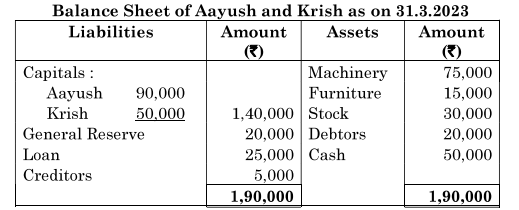
The normal rate of return is 12% per annum. Average profit of the firm for the last four years was Rs. 30,000. Calculate Vansh’s share of Goodwill.
View Solution
N/A Quick Tip: Goodwill is allocated based on the new partner’s share in the firm. Super profits represent the excess of actual profits over the normal expected profits.
(b). Varun, Tarun, Arun, and Barun were partners in a firm sharing profits in the ratio of 5:3:2:2. Arun retired on 31st March, 2023. Varun, Tarun, and Barun decided to share future profits equally. On Arun’s retirement, goodwill of the firm was valued at Rs. 9,00,000. Showing your workings clearly, pass the necessary Journal Entry for treatment of Goodwill on Arun’s retirement without opening a goodwill account.
View Solution
N/A Quick Tip: The retiring partner’s share of goodwill should be adjusted in the capital accounts of the remaining partners according to the gaining ratio, without opening a goodwill account.
(a). Mahesh Ltd. purchased Plant and Machinery from Ish Ltd. for Rs. 4,50,000. Rs. 50,000 was paid by cheque to Ish Ltd. and the balance by issuing 6% debentures of Rs. 100 each at a discount of 20%. Pass the necessary Journal Entries for the above transactions in the books of Mahesh Ltd.
View Solution
N/A Quick Tip: The number of debentures issued is calculated by dividing the balance amount by the issue price (face value minus discount). Record the discount separately for later amortization.
Question 19:
(b). Manika Ltd. forfeited 500 shares of Rs. 100 each for non-payment of first call of Rs. 20 per share and second and final call of Rs. 25 per share. 250 of these shares were reissued at Rs. 50 per share fully paid up. Pass the Journal Entries for forfeiture and reissue of shares.
View Solution
N/A Quick Tip: Forfeited shares reissued at a discount should be adjusted in the Share Forfeiture Account. Any remaining balance in the forfeiture account is transferred to the Capital Reserve.
Rajesh and Anu were partners in a firm sharing profits and losses in the ratio of 1:2. Their fixed capitals were Rs. 6,00,000 and Rs. 3,00,000 respectively. After the accounts for the year were prepared, it was noticed that interest on capital @ 12% p.a., as provided in the partnership deed, was not credited to the capital accounts of partners before distribution of profits. Pass the necessary adjusting journal entry. Show your workings clearly.
View Solution
N/A Quick Tip: If interest on capital is omitted, make the necessary adjustments to ensure that the partner's balances align with the partnership deed.
Ram, Ravi, and Rohan were partners sharing profits in the ratio of 2:3:1. On 31st March 2023, their Balance Sheet was as follows:
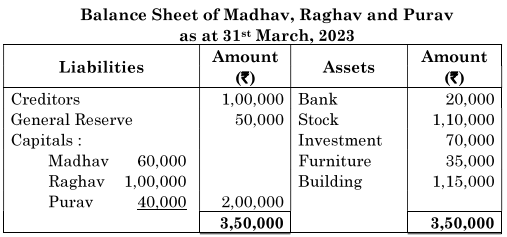
Rohan died on 30th September 2023. The partnership deed provided for the following adjustments:
View Solution
Step 1: Calculation of Average Profit \[ Average Profit = \frac{45,000 + 90,000 + 1,35,000}{3} = \frac{2,70,000}{3} = 90,000. \]
Step 2: Calculation of Goodwill \[ Goodwill = 2 \times Average Profit = 2 \times 90,000 = 1,80,000. \]
Rohan’s share of goodwill (1/6th share): \[ \frac{1,80,000}{6} = 30,000. \]
Step 3: Calculation of Rohan’s Share of Profit till his Death
Rohan’s share in profits = \( \frac{1}{6} \)
Profit for 6 months (April to September): \[ Profit till death = \left(\frac{90,000}{12} \times 6\right) \times \frac{1}{6} = 7,500. \]
Step 4: Final Amount Payable to Rohan’s Executors
\[ Capital (as per balance sheet) = 3,00,000 \] \[ Add: Goodwill share = 30,000 \] \[ Add: Profit share till death = 7,500 \] \[ Total amount payable = 3,37,500. \] Quick Tip: \textbf{Key Rule:} - Goodwill is calculated based on the agreed years' purchase of average profit. - The deceased partner’s profit share is calculated on a time basis if nothing else is mentioned.
Ronit Ltd. was registered with an authorised capital of Rs. 75,00,000 divided into 75,000 equity shares of Rs. 100 each. The company invited applications for issuing 45,000 shares.
The amount was payable as follows: Rs. 30 per share on application, Rs. 30 per share on allotment, Rs. 25 per share on first call, and balance on final call. Applications were received for 42,000 shares and allotment was made to all the applicants. Charvi, to whom 3,300 shares were allotted, failed to pay both the calls. Her shares were forfeited. Present the share capital in the Balance Sheet of the company as per Schedule III, Part I of the Companies Act, 2013. Also prepare notes to accounts.
View Solution
N/A Quick Tip: Ensure proper classification of share capital according to Schedule III, detailing authorised, issued, and subscribed capital.
(a). Anikesh and Bhavesh are partners in a firm sharing profits in the ratio of 7:3. Their Balance Sheet as on 31st March, 2023 was as follows:
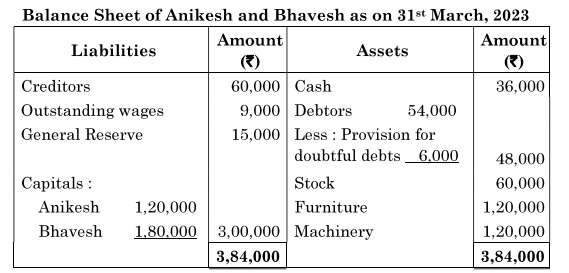
On 1st April, 2023, Chahat was admitted for 1/4th share in the profits on the following terms:
(i) Chahat will bring Rs. 90,000 as her capital and Rs. 30,000 as her share of Goodwill premium.
(ii) Outstanding wages will be paid.
(iii) Stock will be reduced by 10%.
(iv) creditor of Rs. 6,300, not recorded in the books, was to be taken into account.
Pass necessary Journal Entries for the above transactions in the books of the firm.
View Solution
Step 1: Journal Entries
\resizebox{\textwidth{!{
\begin{tabular{|c|l|r|r|
\hline
Date & Particulars & Debit (₹) & Credit (₹)
\hline
& \text{General Reserve A/c \quad \text{Dr. & 15,000 &
& \quad \text{To Anikesh’s Capital A/c & & 10,500
& \quad \text{To Bhavesh’s Capital A/c & & 4,500
& \multicolumn{3{l|{\textit{(General Reserve balance transferred to partners' capital account in old ratio)
\hline
& \text{Cash/ Bank A/c \quad \text{Dr. & 1,20,000 &
& \quad \text{To Chahat’s Capital A/c & & 90,000
& \quad \text{To Premium for Goodwill A/c & & 30,000
& \multicolumn{3{l|{\textit{(Amount brought in by Chahat as her capital and her share of goodwill)
\hline
& \text{Premium for Goodwill A/c \quad \text{Dr. & 30,000 &
& \quad \text{To Anikesh’s Capital A/c & & 21,000
& \quad \text{To Bhavesh’s Capital A/c & & 9,000
& \multicolumn{3{l|{\textit{(Goodwill premium brought in by new partner shared by old partners in their sacrificing ratio)
\hline
& \text{Outstanding Wages A/c \quad \text{Dr. & 9,000 &
& \quad \text{To Cash/ Bank A/c & & 9,000
& \multicolumn{3{l|{\textit{(Outstanding wages paid)
\hline
& \text{Revaluation A/c \quad \text{Dr. & 12,300 &
& \quad \text{To Stock A/c \quad (\text{10% reduction) & & 6,000
& \quad \text{To Creditors A/c \quad (\text{New liability recorded) & & 6,300
& \multicolumn{3{l|{\textit{(Decrease in stock value and increase in value of creditors on revaluation recorded)
\hline
& \text{Anikesh’s Capital A/c \quad \text{Dr. & 8,610 &
& \text{Bhavesh’s Capital A/c \quad \text{Dr. & 3,690 &
& \quad \text{To Revaluation A/c & & 12,300
& \multicolumn{3{l|{\textit{(Loss on revaluation of assets and reassessment of liabilities transferred to partners' capital account in old ratio)
\hline
\end{tabular
Quick Tip: When admitting a new partner, ensure goodwill is allocated according to the old profit-sharing ratio and assets and liabilities are revalued.
Question 23:
(b). Prina, Qadir, and Kian were partners in a firm sharing profits in the ratio of 7:2:1. On 31st March, 2023, their Balance Sheet was as follows:
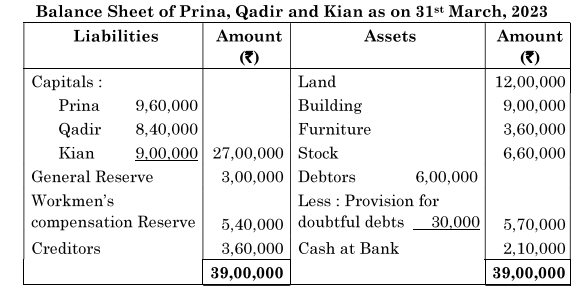
Adjustments on Qadir’s Retirement:
(i) Goodwill of the firm valued at Rs. 12,00,000.
(ii) Land appreciated by 30%, and building depreciated by Rs. 3,54,000.
(iii) A provision of 6% maintained on debtors.
(iv) Workmen’s compensation liability determined at Rs. 1,40,000.
(v) Qadir’s amount transferred to loan account.
(vi) Total capital fixed at Rs. 16,00,000, adjusted in the new profit ratio.
View Solution
N/A Quick Tip: Distribute goodwill and reserves in the existing profit-sharing ratio, apply revaluation adjustments, and allocate the retiring partner’s share as a loan.
(a). Lazal Ltd. invited applications for issuing 2,00,000 equity shares of Rs. 10 each, at 20% premium. Amount per share was payable as follows: Rs. 5 on application; Rs. 4 (including premium) on allotment; and balance on final call. Public applied for 3,20,000 shares, out of which applications for 20,000 shares were rejected and shares were allotted on pro-rata basis to the remaining applicants. Kavita, an applicant of 15,000 shares, failed to pay allotment and call money. Her shares were forfeited. Pass necessary Journal Entries for the above transactions in the books of the company.
View Solution
N/A Quick Tip: Ensure accurate pro-rata adjustments for oversubscription and properly account for forfeited shares with corresponding calls-in-arrears.
Question 24:
(b). Chand Ltd. invited applications for issuing 1,00,000 equity shares of Rs. 10 each at a premium of Rs. 2 per share. The amount per share was payable as follows: Rs. 4 (including premium) on application, Rs. 5 on allotment, and balance on first and final call. Applications were received for 1,80,000 shares of which applications for 30,000 shares were rejected, and remaining applicants were allotted shares on a pro-rata basis. Mansi, holding 5,000 shares, failed to pay first and final call money, and her shares were forfeited. Pass necessary Journal entries for the above transactions in the books of the company.
View Solution
N/A Quick Tip: Ensure careful handling of pro-rata allocation for oversubscription. Forfeited shares and their unpaid amounts are adjusted under the Calls in Arrears account.
Pass the necessary journal entries for the following transactions on the disSolutions of the partnership firm of Mohit and Rohit after the various assets (other than cash and bank) and the third-party liabilities have been transferred to the realisation account:
(i)A machine, not recorded in the books, was taken over by Mohit at Rs. 7,000, whereas its expected value was Rs. 10,000.
(ii)Rohit’s loan of Rs. 15,000 was settled at Rs. 13,500.
(iii)The firm had investments of Rs. 1,00,000. Mohit took over 50% of the investments at a discount of 10%, while the remaining investments were sold off for Rs. 60,000.
(iv)Realisation expenses amounted to Rs. 23,000.
(v)Sundry creditors amounting to Rs. 45,000 were settled at a discount of Rs. 2,000.
(vi)Loss on realisation of Rs. 12,000 was divided between the partners in their profit-sharing ratio.
View Solution
N/A Quick Tip: Ensure that all liabilities and assets are transferred to the Realisation Account before making any adjustments for partner settlements.
Pass necessary journal entries relating to the issue of debentures and to write off discount/loss on issue of debentures in the books of Srijan Ltd. in the following cases:
(i)900, 6% debentures of Rs. 1,000 each are issued at 5% discount and redeemable at par. Balance in Securities Premium account is Rs. 50,000.
(ii)700, 8% debentures of Rs. 1,000 each are issued at 10% discount and redeemable at a premium of 10%. Balance in Securities Premium account is Rs. 1,00,000.
View Solution
N/A Quick Tip: The discount on the debenture issue and the premium on redemption are recorded separately. Make sure to adjust the balances in the Securities Premium account accordingly.
PART B
OPTION I
(Analysis of Financial Statements)
Question 27:
(a). Statement I: Financing activities relate to long-term funds or capital of an enterprise.
Statement II: Separate disclosure of cash flows arising from financing activities is important because they represent the extent to which expenditures have been made for resources intended to generate future income and cash flows.
Choose the correct option from the following:
View Solution
N/A Quick Tip: Financing activities involve raising or repaying long-term capital, while investing activities focus on acquiring or disposing of long-term assets.
(b). What will be the effect of transaction ‘Payment of employee benefit expenses’ on the cash flow statement?
View Solution
N/A Quick Tip: Operating activities encompass transactions related to a company's primary business functions, including employee payments.

From the above information, ‘Cash flows from investing activities’ will be:
View Solution
N/A Quick Tip: Investing activities involve cash flows arising from the acquisition and disposal of long-term assets, such as investments and goodwill.
(a). The tool of ‘Analysis of Financial Statements’ which helps to assess the profitability, solvency, and efficiency of an enterprise is known as:
View Solution
N/A Quick Tip: Utilize ratio analysis to assess financial performance over time or against industry benchmarks.
Question 29:
(b). ...... is also known as the Acid Test Ratio.
View Solution
N/A Quick Tip: The quick ratio is calculated using the formula: \(Quick Assets \div Current Liabilities\).
Quick ratio of Megamart Ltd. is 1.5:1. Which of the following transactions will result in a decrease in this ratio?
View Solution
N/A Quick Tip: Quick assets are current assets excluding inventory and prepaid expenses. Any transactions that affect these assets or current liabilities will influence the quick ratio.
Under which Major Heads and Sub-Heads (if any) will the following items be presented in the Balance Sheet of a company as per Schedule III, Part I of the Companies Act, 2013?
(i) Capital Advances
(ii)] Income received in Advance
(iii)] Stores and Spare Parts
View Solution
[(i)] Capital Advances: Major Head - Non-Current Assets, Sub-Head - Other Non-Current Assets. [(ii)] Income received in Advance: Major Head - Current Liabilities, Sub-Head - Other Current Liabilities. [(iii)] Stores and Spare Parts: Major Head - Current Assets, Sub-Head - Inventories. Quick Tip: For accurate classification of assets and liabilities in the Balance Sheet, always refer to Schedule III of the Companies Act, 2013.
The average inventory of AB Ltd. is Rs. 1,00,000 and the inventory turnover ratio is 6 times. Calculate the amount of revenue from operations if goods are sold at a profit of 25% on revenue from operations.
View Solution
N/A Quick Tip: Use the inventory turnover ratio to determine COGS and calculate revenue when the profit margin is provided.
(a) Prepare a Common Size Balance Sheet of X Ltd. from the following information:
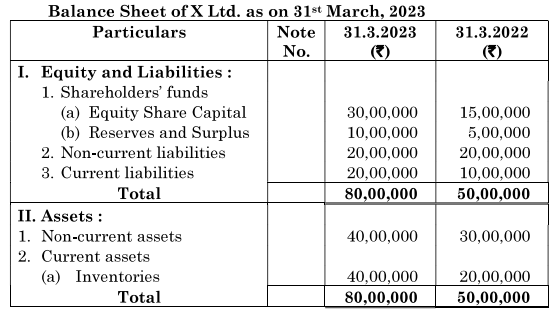
View Solution
N/A Quick Tip: In a common size balance sheet, each item is shown as a percentage of the total assets or liabilities to evaluate their relative significance.
Question 33:
(b) From the following information prepare a Comparative Statement of Profit and Loss of Y Ltd.:
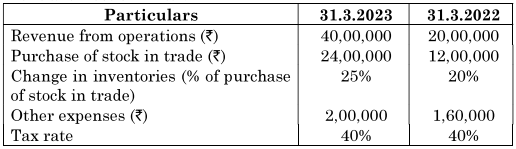
View Solution
N/A Quick Tip: To calculate percentage change in a comparative statement, use the formula: \[ Percentage Change = \frac{Current Year - Previous Year}{Previous Year} \times 100 \]
Following is the Balance Sheet of Bharat Gas Ltd. as at 31.3.2023:
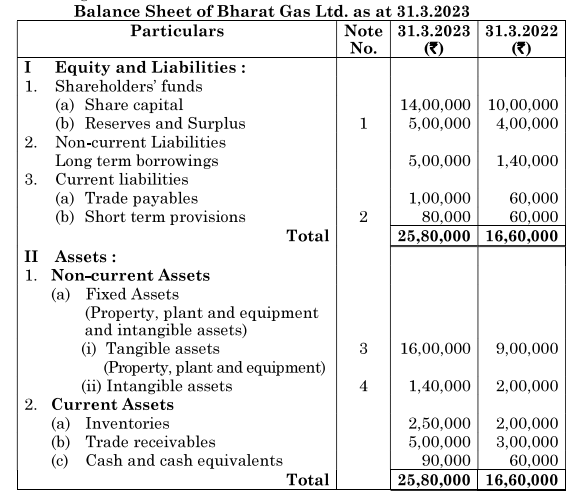
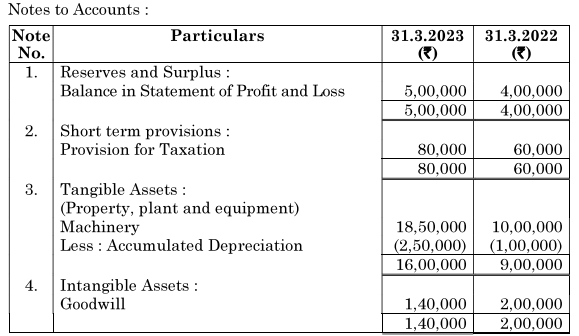
Adjustments:
During the year, a machine costing Rs. 3,00,000 on which accumulated depreciation was Rs. 45,000 was sold for Rs. 1,35,000. Calculate ‘Cash Flows from Operating Activities’
View Solution
N/A Quick Tip: Operating activities include adjustments for non-cash items, changes in working capital, and tax provisions to calculate the net cash flow.
PART B
OPTION II
(Computerised Accounting)
Question 47:
(a). Excel considers which of the following group of mathematical operations of equal importance?
View Solution
N/A Quick Tip: Keep in mind the BODMAS rule for Excel operations: Division and Multiplication are treated equally in terms of precedence.
Question 27:
(b). How many rows are available in Excel 2007?
View Solution
N/A Quick Tip: Excel 2007 allows for up to 65,536 rows and 16,384 columns (extending to column XFD).
How are ‘absolute cell references’ and ‘mixed references’ identified in Excel?
View Solution
N/A Quick Tip: Press the F4 key to quickly switch between absolute, mixed, and relative references in Excel.
(a). ‘A piece of information shown in a graph which is assigned to the data series’ is known as:
View Solution
N/A Quick Tip: Legends are essential for distinguishing between multiple data series in charts, enhancing clarity and understanding.
Question 29:
(b). ‘LABELS’ in Excel means:
View Solution
N/A Quick Tip: Labels help improve the clarity of your Excel worksheets, making them more user-friendly and easier to interpret.
Which of the following type of software suffers from the limitation of low secrecy level and software being prone to data frauds?
View Solution
N/A Quick Tip: While generic software is more affordable, it may not offer the advanced security features needed for organizations handling sensitive information.
Explain ‘Sequential Codes’ and ‘Block Codes’ with examples.
View Solution
Quick Tip: Use sequential codes for straightforward identification and block codes for organizing related items into categories for efficient management.
How to use ‘Mark Common Formula Error’ in Excel? Explain.
View Solution
N/A Quick Tip: Common errors in formulas include \#DIV/0!, \#REF!, and \#NAME?. Always ensure that cell references are correct and formulas are free of typographical errors.
(a) State why do you need to change a chart? How can it be changed? Why is it said that changing a column chart to a pie chart is easy? Give reasons.
View Solution
Quick Tip: Choose chart types that align with your goal: Pie charts for showing proportions, column charts for comparisons, and line charts for illustrating trends.
Question 33:
(b) State the advantages of a computerized accounting system.
View Solution
Quick Tip: A computerized accounting system is indispensable for businesses seeking greater efficiency, accuracy, and adaptability to modern challenges.
Using the worksheet below, find out the error and its reason for the given ‘VLOOKUP’ syntax:
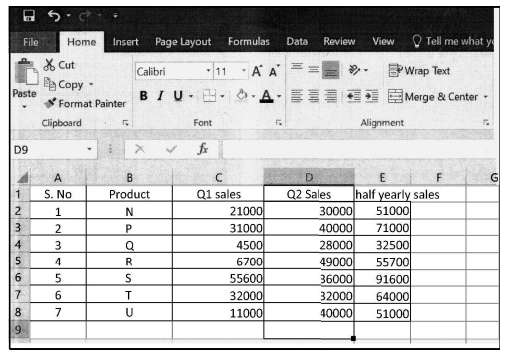
% VLOOKUP Syntax
(i) = VLOOKUP(B1, B2 : E8, 2, 0)
(ii) = SQRT(VLOOKUP(B5, B8 : E8, 2, 0) - 100000)
(iii) = VLOOKUP(A2, A2 : A8, 2, 0)
(iv) = VLOOKUP(B2, B3 : E4, 5, 0)
(v) = VLOOKUP(B2, A2 : E8, 0, 0)
(vi) = VLOOKUP(B2, B2 : E8, 2, 0)/0
View Solution
Quick Tip: \textbf{Quick Tip:} Ensure the lookup value is always in the first column of the table array. The column index number should correspond to the actual structure of the table. Avoid division by zero and make sure all referenced ranges are correct.





Comments