



.png?h=35&w=35&mode=stretch)
CBSE Class 12 Accountancy Set 3 Question Paper PDF (Code: 67/5/3) is now available for download. CBSE conducted the Class 12 Accountancy examination on March 23, 2024, from 10:30 AM to 1:30 PM. The question paper consists of 34 questions carrying a total of 80 marks. Part A is compulsory for all candidates. Part B has two options. Candidates have to attempt only one of the given options. Option I : Analysis of Financial Statements and Option II : Computerised Accounting. Candidates can use the link below to download the CBSE Class 12 Accountancy Set 3 Question Paper with detailed solutions.
CBSE Class 12 Accountancy Question Paper 2024 (Set 3- 67/5/3) with Answer Key
| CBSE Class 12 2024 Accountancy Question Paper with Answer Key |  Download Download |
Check Solution |
CBSE Class 12 2024 Accountancy Questions with Solutions
PART A
(Accounting for Partnership Firms and Companies)
Question 1:
(a) Ridhima and Kavita were partners sharing profits and losses in the ratio of 3:2. Their fixed capitals were Rs. 1,50,000 and Rs. 2,00,000 respectively. The partnership deed provides for interest on capital @ 8% p.a. The net profit of the firm for the year ended 31st March, 2023 amounted to Rs. 21,000. The amount of interest on capital credited to the capital accounts of Ridhima and Kavita will be:
View Solution
Ridhima's and Kavita's fixed capitals are Rs. 1,50,000 and Rs. 2,00,000, respectively.
According to their partnership agreement, they receive an annual interest of 8% on their capital. \[ Calculated interest for Ridhima = Rs. 1,50,000 \times \frac{8}{100} = Rs. 12,000 \] \[ Calculated interest for Kavita = Rs. 2,00,000 \times \frac{8}{100} = Rs. 16,000 \]
The total profit of the firm is Rs. 21,000, which is not enough to cover the total interest on capital, amounting to Rs. 28,000.
Therefore, the profit is apportioned based on their respective interest entitlements: \[ Proportion of interest entitlements = Rs. 12,000 : Rs. 16,000 = 3 : 4 \] \[ Proportional interest for Ridhima = Rs. 21,000 \times \frac{3}{7} = Rs. 9,000 \] \[ Proportional interest for Kavita = Rs. 21,000 \times \frac{4}{7} = Rs. 12,000 \] Quick Tip: Allocate profit according to the interest entitlement ratio when the available profit does not suffice for the total interest on the capital.
Question 1:
(b) Ruchika and Harshita were partners in a firm. Ruchika had withdrawn Rs. 9,000 at the end of each quarter throughout the year. The interest to be charged on Ruchika’s drawings at 6% p.a. will be:
View Solution
% Option
(A) Calculate Total Drawings:
\begin{align*
\text{Total Drawings &= \text{Drawings per Quarter \times \text{Number of Quarters
&= Rs.9,000 \times 4
&= Rs.36,000
\end{align*
% Option
(B) Determine the Average Period:
Since Ruchika withdrew at the end of each quarter, the average period is:
\begin{align*
\text{Average Period &= \frac{\text{Time left after first withdrawal + \text{Time left after last withdrawal{2
&= \frac{9 \text{ months + 0 \text{ months{2
&= 4.5 \text{ months
\end{align*
% Option
(C) Convert Average Period to Years:
\begin{align*
\text{Average Period in Years &= \frac{4.5 \text{ months{12 \text{ months/year
&= 0.375 \text{ years
\end{align*
% Option
(D) Calculate Interest on Drawings:
\begin{align*
\text{Interest on Drawings &= \text{Total Drawings \times \text{Interest Rate \times \text{Average Period (Years)
&= Rs.36,000 \times 0.06 \times 0.375
&= Rs.810
\end{align*
Therefore, the interest to be charged on Ruchika's drawings is Rs.810.
Answer: (D) Rs.810 Quick Tip: To determine the interest on periodic drawings, it's crucial to apply the average time span accurately. For withdrawals made at each quarter's end, this timeframe is typically 7.5 months.
Assertion (A): Securities Premium cannot be utilized for writing off loss on sale of a fixed asset.
Reason (R): Securities Premium can be applied only for the purposes mentioned in the Companies Act, 2013.
Choose the correct option from the following:
View Solution
According to the Companies Act, 2013, the Securities Premium Account may be used for specific purposes including issuing bonus shares, offsetting preliminary expenses, and covering premiums on the redemption of preference shares and debentures. It does not permit the utilization of these funds for losses incurred from the sale of fixed assets. Quick Tip: For detailed guidance on the allowable uses of the Securities Premium Account, consult Section 52 of the Companies Act, 2013.
Kewal Ltd. purchased sundry assets from Ganpati Ltd. for Rs. 28,60,000. The amount was paid by issuing fully paid shares of Rs. 100 each issued at a premium of 10%. The number of shares issued to Ganpati Ltd. were:
View Solution
Ganpati Ltd. received a payment of Rs. 28,60,000, with each share having a face value of Rs. 100.
The selling price per share = Rs. 100 + 10% of Rs. 100 = Rs. 110. \[ Number of shares issued = \frac{Total Payment Received}{Selling Price per Share} = \frac{Rs. 28,60,000}{Rs. 110} = 26,000 shares. \] Quick Tip: When calculating the issue price for shares sold at a premium, include both the face value and the additional premium in the total.
(a) Aarav Ltd. issued 10,000, 9% debentures of Rs. 100 each at a premium of 5%, redeemable at a premium of 10%. Loss on issue of debentures account will be debited by:
View Solution
The loss on the issuance of debentures is mainly attributed to the premium required for redemption. This amount is recorded in the Loss on Issue of Debentures account.
\[ Loss on Issue of Debentures = Redemption Premium - Issue Premium \]
\[ = (10,000 \times 10) - (10,000 \times 5) \]
\[ = 1,00,000 - 0 \]
\[ = Rs. 1,00,000 \]
Consequently, the Loss on Issue of Debentures account will be charged with Rs.1,00,000. Quick Tip: Consider the premium on redemption as an additional borrowing cost that gets debited to the Loss on Issue of Debentures account, whereas the premium on issue serves as a financial gain.
OR
Question 4:
(b) Dove Ltd. issued 8,000, 11% debentures of Rs. 100 each at a premium of 5%. The total amount of interest on Debentures for one year will be:
View Solution
Solution:
A total of 8,000 debentures were issued, each with a face value of Rs. 100.
The annual interest rate is set at 11%.
Total Interest Expense = Aggregate Face Value of Debentures × Annual Interest Rate
Total Interest Expense = Rs. (8,000 × 100) × 11⁄100 = Rs. 88,000
Read the following hypothetical situation and answer question numbers 5 and 6:
Keshav and Hitesh are partners sharing profits and losses in the ratio of 3:2. On 31st March, 2023 after division of profit of Rs. 15,000, their capitals were Rs. 55,000 and Rs. 45,000 respectively. During the year, Keshav’s drawings were Rs. 1,500 at the beginning of each quarter and Hitesh withdrew Rs. 9,000 on 1st November, 2022. After the final accounts have been prepared, it was discovered that interest on capital @ 5% p.a. and interest on drawings @ 8% p.a. have not been taken into consideration.
Question 5:
Opening capital of Keshav was:
View Solution
% Option
(A) Calculate Keshav's Share of Profit:
\begin{align*
\text{Keshav's Share of Profit &= \frac{\text{Keshav's Ratio{\text{Total Ratio \times \text{Total Profit
&= \frac{3{3+2 \times Rs.15,000
&= \frac{3{5 \times Rs.15,000
&= Rs.9,000
\end{align*
% Option
(B) Calculate Keshav's Total Drawings:
\begin{align*
\text{Total Drawings &= \text{Drawings per Quarter \times \text{Number of Quarters
&= Rs.1,500 \times 4
&= Rs.6,000
\end{align*
% Option
(C) Calculate Keshav's Opening Capital:
\begin{align*
\text{Opening Capital &= \text{Closing Capital + \text{Drawings - \text{Profit Share
&= Rs.55,000 + Rs.6,000 - Rs.9,000
&= Rs.61,000 - Rs.9,000
&= Rs.52,000
\end{align*
Therefore, Keshav's opening capital was Rs.52,000.
Answer: (D) Rs.52,000 Quick Tip: To determine the opening capital in partnership accounts, always account for profit sharing, drawings, and any accrued interests on these drawings.
Amount of interest to be charged on Hitesh’s drawings will be:
View Solution
Interest on Hitesh's drawing of Rs.9,000 made on 1st November 2022 is calculated for the period until 31st March 2023 (5 months), using the 8% annual interest rate: \[ \frac{8}{100} \times \frac{5}{12} \times 9,000 = Rs.300. \] Quick Tip: When calculating interest on drawings, remember to adjust the calculation based on the period the money was withdrawn and the annual interest rate. Timing of withdrawals significantly affects the interest calculation in partnership accounts.
Isha and Manish were partners in a firm sharing profits and losses in the ratio of 3:2. With effect from 1st April, 2023, they agreed to share profits equally. On this date the goodwill of the firm was valued at Rs.3,00,000. The necessary journal entry for the treatment of goodwill without opening Goodwill Account will be:

\end{figure
View Solution
The initial sharing ratio of Isha and Manish was 3 : 2, which has been altered to 1 : 1. To calculate the ratio of sacrifice: \[ Sacrificing Ratio = Old Ratio - New Ratio \]
For Isha: \[ \frac{3}{5} - \frac{1}{2} = \frac{6}{10} - \frac{5}{10} = \frac{1}{10} \]
For Manish: \[ \frac{2}{5} - \frac{1}{2} = \frac{4}{10} - \frac{5}{10} = -\frac{1}{10} \]
Adjustment for goodwill is calculated as: \[ Rs.3,00,000 \times \frac{1}{10} = Rs.30,000 \]
The corresponding journal entry to record this adjustment is: \[ \begin{array}{|l|c|c|} \hline \textbf{Particulars} & \textbf{Dr. Amount (Rs.)} & \textbf{Cr. Amount (Rs.)}
\hline Manish’s Capital A/c Dr. & 30,000 &
\hline To Isha’s Capital A/c & & 30,000
\hline \end{array} \] Quick Tip: Adjustments for changes in partnership profit-sharing ratios, such as goodwill, are handled directly through partners' capital accounts, often bypassing the need for a separate goodwill account.
Mahi, Ruhi and Ginni are partners in a firm sharing profits and losses in the ratio of 6 : 4 : 1. Mahi guaranteed a profit of Rs. 50,000 to Ginni. Net profit for the year ending 31st March, 2023 was Rs. 1,10,000. Mahi’s share in the profit of the firm after giving the guaranteed amount to Ginni will be:
View Solution
1. Overall profit for the partnership = Rs. 1,10,000
2. Profit distribution ratio among Mahi, Ruhi, and Ginni = 6:4:1
3. Profit allocated according to the ratio:
\[ Mahi's portion = \frac{6}{11} \times 1,10,000 = Rs. 60,000 \]
\[ Ruhi's portion = \frac{4}{11} \times 1,10,000 = Rs. 40,000 \]
\[ Ginni's portion = \frac{1}{11} \times 1,10,000 = Rs. 10,000 \]
4. Guaranteed minimum profit for Ginni = Rs. 50,000. Ginni's calculated share is Rs. 10,000.
- Mahi needs to cover the shortfall = \( 50,000 - 10,000 = 40,000 \).
- This amount will be subtracted from Mahi’s initial share.
5. Adjusted profit share for Mahi after fulfilling the guarantee:
\[ Adjusted share for Mahi = Rs. 60,000 - Rs. 40,000 = Rs. 20,000. \]
Therefore, Mahi's final share amounts to Rs. 20,000 (Option A). Quick Tip: When a partner guarantees another's profit, any deficit under the guaranteed amount is compensated by the guaranteeing partner prior to any remaining profit distribution.
Sarita Ltd. forfeited 100 shares of Rs. 10 each, Rs. 8 called up issued at a premium of Rs. 2 per share to Ramesh for non-payment of allotment money of Rs. 5 per share (including premium). The first and final call of Rs. 2 per share was not made. Out of these, 70 shares were reissued to Ashok as Rs. 8 called up for Rs. 10 per share. The gain on reissue will be:
\begin{flushleft
View Solution
1. Revenue from reissuing 70 shares:
\[ = 70 \times Rs. 10 = Rs. 700 \]
2. Original total called-up amount before reissue:
\[ = 70 \times Rs. 8 = Rs. 560 \]
3. Calculating gain on reissue:
\[ Profit on Reissue = Amount Received from Reissue - Original Called-Up Amount \]
\[ = Rs. 700 - Rs. 560 = Rs. 140 \]
4. Forfeiture details per share before reissue:
- Called-up amount per share = Rs. 8 (excluding final call)
- Amount paid initially by Ramesh = Application fee (Rs. 3)
- Outstanding balance = Allotment fee (Rs. 5)
- Included but unpaid premium amount (Rs. 2) from the allotment (not considered in forfeiture)
- Forfeited amount per share = Rs. 3
- Total forfeiture for 70 shares = \( 70 \times 3 = Rs. 210 \)
5. Comprehensive gain on reissue:
\[ Overall Profit = Profit on Reissue + Total Forfeited Amount \]
\[ = Rs. 140 + Rs. 210 = Rs. 350 \]
Consequently, the correct response is Rs. 350 (Option C). Quick Tip: To compute the gain from reissuing forfeited shares, subtract the original called-up value from the reissue proceeds and add any forfeitures retained.
Assertion (A): In a partnership firm, the private assets of the partners can also be used to pay off the firm’s debts.
Reason (R): The liability of the partners for acts of the firm is limited.
Choose the correct option from the following:
View Solution
Within a partnership, partners bear unlimited liability, meaning if the firm's assets are inadequate for covering its debts, partners' personal assets may be utilized to meet the outstanding liabilities. The assertion in Reason (R) is inaccurate because it suggests that partners in a partnership have limited liability, whereas their liability is actually unlimited. Quick Tip: Remember, partners in a partnership are subject to unlimited liability, which contrasts with the limited liability extended to company shareholders based on their investment.
(a) Aditi, Sukriti, and Niti were partners sharing profits in the ratio of 2 : 2 : 1. Sukriti died on 30th June, 2023. Net profit for the year ended 31st March, 2023, was Rs. 4,50,000. If the deceased partner’s share of profit is to be calculated on the basis of the previous year’s profit, the amount of profit credited to Sukriti’s Capital Account will be:
\begin{flushleft
View Solution
1. Total Annual Profit of the Firm = Rs. 4,50,000
2. Profit Sharing Ratio for Sukriti = \( \frac{2}{5} \)
\[ Sukriti's Share of Annual Profit = 4,50,000 \times \frac{2}{5} = Rs. 1,80,000 \]
3. Profit Allocation for the Quarter (1st April to 30th June 2023):
The profit calculated reflects a full year's earnings; thus, we compute Sukriti’s share for the three-month period of April to June:
\[ Quarterly Share for Sukriti = 1,80,000 \times \frac{3}{12} \]
\[ = 1,80,000 \times \frac{1}{4} = Rs. 45,000 \]
Hence, the amount to be credited to Sukriti’s Capital Account totals Rs. 45,000 (Option B). Quick Tip: Pro-rate a deceased partner’s profit share according to their active participation duration within the fiscal year.
Question 11:
(b) Pawan, a partner, was appointed to look after the process of dissolution of the firm for which he was allowed a remuneration of Rs. 75,000. Pawan agreed to bear the dissolution expenses. Actual dissolution expenses Rs. 60,000 were paid by Pawan. Pawan’s capital account will be credited by:
\begin{flushleft
View Solution
1. Fixed remuneration approved for Pawan = Rs. 75,000
2. Pawan consented to cover the dissolution costs.
3. Total dissolution expenses paid by Pawan = Rs. 60,000
4. Impact on Pawan’s Capital Account:
- Pawan’s capital account should be credited with the agreed remuneration of Rs. 75,000 for managing the dissolution, regardless of the actual expenses.
- The expenses of Rs. 60,000 that Pawan paid are his responsibility and do not alter the remuneration amount credited to him.
Therefore, Pawan’s capital account will receive a credit of Rs. 75,000 (Option A). Quick Tip: A partner assigned a fixed compensation for dissolution tasks is credited that full amount in their capital account, irrespective of the actual dissolution costs.
A partnership firm has 45 partners. It wants to admit 7 more partners into partnership. Only ...... more partners can be admitted in the partnership firm according to Companies Act, 2013.
View Solution
Section 464 of the Companies Act, 2013, stipulates that a partnership firm can include no more than 50 partners unless it converts into a registered company.
Currently, the firm comprises 45 partners.
The limit set by law is 50 partners. \[ Capacity for additional partners = 50 - 45 = 5 \]
Thus, the firm can admit only 5 more partners. Quick Tip: Under the Companies Act, 2013, the upper limit for partners in a non-registered partnership firm is 50.
(a) Kriti, Hina, and Nidhi were partners sharing profits in the ratio of 3 : 2 : 1. Nidhi retired. On the date of her retirement, Workmen Compensation Fund stood in the Balance Sheet at Rs. 1,50,000. Workmen Compensation Claim was Rs. 1,20,000. How much amount of Workmen Compensation Fund will be credited to Nidhi’s Capital Account?
\begin{flushleft
View Solution
1. Workmen Compensation Fund as per the Balance Sheet = Rs. 1,50,000
2. Workmen Compensation Claim = Rs. 1,20,000
3. Surplus Available for Distribution
\[ = Rs. 1,50,000 - Rs. 1,20,000 = Rs. 30,000 \]
4. Nidhi’s Share of the Surplus (Profit Sharing Ratio: 3:2:1)
\[ Nidhi’s Share = \frac{1}{6} \times Rs. 30,000 = Rs. 5,000 \]
Thus, the amount to be credited to Nidhi’s Capital Account is Rs. 5,000 (Option C). Quick Tip: When distributing the Workmen Compensation Fund after a partner’s retirement, subtract the compensation claim first, then divide the remaining amount based on the partners’ profit-sharing ratio.
Question 13:
(b) Rohit, Udit, and Mohit were partners in a firm sharing profits in the ratio of 3 : 2 : 1. Mohit retired. The balance in his capital account after making the necessary adjustments on account of reserves and revaluation of assets and liabilities was Rs. 1,80,000. Rohit and Udit agreed to pay him Rs. 2,00,000 in full settlement of his claim. Mohit’s share of goodwill in the firm was:
\begin{flushleft
View Solution
1. Balance in Mohit’s Capital Account after adjustments = Rs. 1,80,000
2. Total amount agreed to be paid in full settlement = Rs. 2,00,000
3. Mohit’s Share of Goodwill Calculation:
\[ Mohit’s Share of Goodwill = Final Settlement Amount - Capital Account Balance \]
\[ = Rs. 2,00,000 - Rs. 1,80,000 = Rs. 20,000 \]
Thus, Mohit’s share of goodwill in the firm is Rs.20,000 (Option D). Quick Tip: When a partner retires and receives an amount higher than their capital account balance, the difference represents their share of goodwill.
A, B and C were partners in a firm sharing profits and losses in the ratio of 1 : 2 : 3. D was admitted in the firm for 1/6th share. C would retain his original share. The new profit sharing ratio will be:
View Solution
% Option
(A) Find a Common Denominator for Initial Ratio:
% Option
(B) The denominators are 2, 3, and 4. The least common multiple (LCM) is 12.
% Option
(C) A's share: (1/2) * (6/6) = 6/12
% Option
(D) B's share: (1/3) * (4/4) = 4/12
% Option
(E) C's share: (1/4) * (3/3) = 3/12
% Option
(F) Simplified initial ratio: 6 : 4 : 3
% Option
(G) Calculate C's Original Share as a Fraction of the Whole:
% Option
(H) Total ratio parts: 6 + 4 + 3 = 13
% Option
(I) C's original share: 3/13
% Option
(J) Calculate D's Share:
% Option
(K) D's share: 1/6
% Option
(L) Calculate the Remaining Share After D's Admission:
% Option
(M) Remaining share: 1 - 1/6 = 5/6
% Option
(N) Calculate C's New Share:
% Option
(O) C retains his original share of 3/13 of the whole.
% Option
(P) Calculate the Remaining Share After D and C's Shares:
% Option
(Q) Remaining share: 5/6 - 3/13 = (65 - 18) / 78 = 47/78
% Option
(R) Distribute the Remaining Share Between A and B:
% Option
(S) A and B share the remaining share (47/78) in their original ratio of 6:4, which simplifies to 3:2.
% Option
(T) A's share of the remaining: (3/5) * (47/78) = 141/390
% Option
(U) B's share of the remaining: (2/5) * (47/78) = 94/390
% Option
(V) Calculate C's New Share as a Fraction with Denominator 390:
% Option
(W) C's share: 3/13 = (3/13) * (30/30) = 90/390
% Option
(X) Calculate D's Share as a Fraction with Denominator 390:
% Option
(Y) D's share: 1/6 = (1/6) * (65/65) = 65/390
% Option
(Z) Write the New Profit Sharing Ratio:
% Option
([) A : B : C : D = 141/390 : 94/390 : 90/390 : 65/390
% Option
(\) Simplify the Ratio:
% Option
(]) Multiply by 390 to get rid of the denominators: 141 : 94 : 90 : 65
% Option
(^) Divide all parts by 13: 21 : 14 : 15 : 10
Therefore, the new profit-sharing ratio is 21:14:15:10.
Answer: (C) 21:14:15:10 Quick Tip: In partnership adjustments, always calculate the new ratios by proportionately deducting the given share from the existing partners' shares.
(a) If all the forfeited shares are reissued, the balance, if any, left in the Forfeited Shares Account is transferred to:
View Solution
When forfeited shares are reissued, the remaining balance in the Forfeited Shares Account is transferred to the Capital Reserve Account.
This balance represents a capital profit, which arises from the difference between the calls not paid on forfeited shares and the amount reissued, thus being recorded as capital profit in the Capital Reserve.
Hence, the balance remaining in the Forfeited Shares Account is moved to the Capital Reserve Account. Quick Tip: When reissuing forfeited shares, any remaining balance in the Forfeited Shares Account is typically credited to the Capital Reserve Account as capital profit.
Question 15:
(b) Raghav Ltd. forfeited 100 shares of Rs. 10 each issued at a premium of 20% for non-payment of first call of Rs. 3 per share and final call of Rs. 1 per share. The minimum price per share at which these shares can be reissued will be:
\begin{flushleft
View Solution
1. The face value of each share = Rs. 10
2. The premium on issue = Rs. 2
3. Total amount due per share (Face Value + Premium)
\[ = Rs. 10 + Rs. 2 = Rs. 12 \]
4. Total unpaid amount per share
\[ = Rs. 3 (First Call) + Rs. 1 (Final Call) = Rs. 4 \]
5. Forfeited amount per share
\[ = Total Due - Unpaid Amount = Rs. 12 - Rs. 4 = Rs. 8 \]
6. Minimum price at which forfeited shares can be reissued
- The reissue price for forfeited shares must be at least equal to the forfeited amount per share.
- The maximum discount on reissue is the forfeited amount of Rs. 8.
- Therefore, the minimum price per share:
\[ = Face Value - Maximum Discount = Rs. 10 - Rs. 6 = Rs. 4 \]
Thus, the minimum reissue price per share is Rs. 4 (Option A). Quick Tip: The minimum reissue price for forfeited shares is calculated by subtracting the maximum discount (which equals the forfeited amount) from the face value.
On dissolution of a partnership firm, if realisation expenses are paid by the firm on behalf of a partner, then such expenses are debited to which of the following account:
View Solution
1. Realisation expenses are generally paid from the Realisation Account when the firm bears the cost.
2. However, if a partner has agreed to cover the realisation expenses and the firm pays them on their behalf, these expenses are debited to the Partner’s Capital Account, reducing the partner's capital balance.
3. This ensures that the financial responsibility for the expenses remains with the designated partner, rather than impacting the firm’s accounts.
Therefore, the correct answer is (B) Partner’s Capital Account. Quick Tip: When a partner agrees to pay realisation expenses but the firm settles them, the amount is debited to the partner’s capital account.
Anvi, Vani, and Karan were partners in a firm sharing profits in the ratio of 2:2:1. Their fixed capitals were Rs. 4,00,000, Rs. 5,00,000, and Rs. 6,00,000 respectively. For the year ended 31st March, 2023, interest on capital was credited to the partners' capital accounts @ 6% p.a. instead of 10% p.a. Pass the necessary adjusting journal entry.
View Solution
\section*{Books of Anvi, Vani, and Karan
\subsection*{Journal
\begin{tabular{|l|l|r|r|
\hline
Date & Particulars & Dr. Amount (Rs.) & Cr. Amount (Rs.)
\hline
& Anvi’s Current A/c Dr. & 8,000 &
& Vani’s Current A/c Dr. & 4,000 &
& To Karan’s Current A/c & & 12,000
& (Interest on capital credited less, now rectified) & &
\hline
\end{tabular
\section*{Table showing adjustment
\begin{tabular{|l|r|r|r|r|
\hline
Partners & Cr. Interest on Capital @4% (Rs.) & Cr. Profits (Rs.) & Dr. (Rs.)(net effect) & Cr. (Rs.)(net effect)
\hline
Anvi & 16,000 & 24,000 & 8,000 & -
Vani & 20,000 & 24,000 & 4,000 & -
Karan & 24,000 & 12,000 & - & 12,000
\hline
Total & 60,000 & 60,000 & 12,000 & 12,000
\hline
\end{tabular Quick Tip: In adjustments for interest on capital, the difference is debited to the Profit and Loss Adjustment Account and credited to the respective partners' capital accounts.
(a) Mahesh, Ramesh and Naresh were partners in a firm sharing profits in the ratio of 5 : 3 : 2. From 1st April, 2023, they decided to share profits equally. On that date, there was a balance of Rs.3,60,000 in General Reserve and a debit balance of Rs.1,80,000 in the Profit and Loss Account. Pass single adjustment Journal entry for the above on account of change in the profit-sharing ratio.
View Solution
The profit-sharing ratio has been altered from 5 : 3 : 2 to an equal sharing ratio of 1 : 1 : 1. As a result, the balances in the General Reserve and Profit and Loss Account need to be adjusted in the partners' capital accounts:
\[ General Reserve Distribution: Rs.3,60,000 \times (Old Ratio 5:3:2) \] \[ Profit and Loss Debit: Rs.1,80,000 distributed in the same ratio. \]
\section*{Books of Mahesh, Ramesh and Naresh
\subsection*{Journal
\begin{tabular{|l|l|r|r|
\hline
Date & Particulars & Dr. Amount (Rs.) & Cr. Amount (Rs.)
\hline
2023 Apr. 1 & Ramesh’s Capital A/c Dr. & 6,000 &
& Naresh’s Capital A/c Dr. & 24,000 &
& To Mahesh’s Capital A/c & & 30,000
& \multicolumn{3{l|{(Adjustment made for General Reserve and debit balance
& \multicolumn{3{l|{of Profit and loss Account on account of change in profit
& \multicolumn{3{l|{sharing ratio among partners)
\hline
\end{tabular
Working Notes:
% Option
(A) [(i)] Items to be adjusted:
\begin{tabular{lr
General reserve & 3,60,000
Profit and Loss Account (Dr.) & (1,80,000)
& 1,80,000
\end{tabular
% Option
(B) [(ii)] Calculation of sacrifice/gain:
Sacrificing share = Old share - new share
Mahesh: \( \frac{5{10} - \frac{1}{3} = \frac{5}{30} \) (sacrifice)
Ramesh: \( \frac{3}{10} - \frac{1}{3} = -\frac{1}{30} \) (gain)
Naresh: \( \frac{2}{10} - \frac{1}{3} = -\frac{4}{30} \) (gain) Quick Tip: When a profit-sharing ratio changes, adjust the reserves and losses according to both the old and new ratios.
Question 18:
(b) Ravi, Guru, Mani and Sonu were partners in a firm sharing profits in the ratio of 2 : 2 : 2 : 1. On 31st January, 2023, Sonu retired. On Sonu’s retirement, the Goodwill of the firm was valued at Rs.1,40,000. The new profit sharing ratio among Ravi, Guru and Mani was 5 : 5 : 1. Showing your workings clearly, pass necessary Journal entry for the treatment of Goodwill in the books of the firm on Sonu’s retirement without opening goodwill account.
View Solution
\section*{Books of Ravi, Guru, Mani and Sonu
\subsection*{Journal
\begin{tabular{|l|l|r|r|
\hline
Date & Particulars & Dr.Amount (Rs.) & Cr.Amount (Rs.)
\hline
2023 Jan. 31 & Ravi’s Capital A/c Dr. & 60,000 &
& To Sonu’s Capital A/c & & 20,000
& To Guru’s Capital A/c & & 20,000
& To Mani’s Capital A/c & & 20,000
& \multicolumn{3{l|{(Ravi compensated Sonu for his share of goodwill
& \multicolumn{3{l|{and to Guru and Mani for the sacrifice made by them
& \multicolumn{3{l|{on Sonu’s retirement)
\hline
\end{tabular
\subsection*{Working Notes:
\subsubsection*{Calculation of gaining share:
Gaining share = New share - Old share
\begin{tabular{ll
Ravi: & \( \frac{5}{7} - \frac{2}{7} = \frac{3}{7} \) (gain)
Guru: & \( \frac{1}{7} - \frac{2}{7} = -\frac{1}{7} \) (sacrifice)
Mani: & \( \frac{1}{7} - \frac{2}{7} = -\frac{1}{7} \) (sacrifice)
\end{tabular Quick Tip: When adjusting goodwill, calculate the proportionate share for each partner based on the profit-sharing ratio before and after the change.
(a) Chavi Ltd. purchased machinery from Neo Ltd. It was agreed that the purchase consideration will be paid by issuing 10,000 equity shares of Rs.10 each at a premium of 10% and a bank draft of Rs.50,000. Pass the necessary Journal entries in the books of Chavi Ltd. for the above transactions.Correct Answer:
View Solution
\section*{Books of Chavi Ltd.
\subsection*{Journal
\begin{tabular{|p{1cm|p{6cm|p{1cm|r|r|
\hline
Date & Particulars & LF & Dr. Amount (Rs.) & Cr. Amount (Rs.)
\hline
% Option
(i) & Machinery A/C Dr. \newline To Neo Ltd.A/C \newline \textit{(Machinery purchased from Neo Ltd.) & & 1,60,000 & 1,60,000
\hline
% Option
(ii) & Neo Ltd. A/C Dr. \newline To Equity Share Capital A/C \newline To Securities Premium A/C \newline To Bank A/C \newline \textit{(Issued 10,000 equity shares of Rs. 10 each at a premium of 10% and bank draft in favour of Neo Ltd.) & & 1,60,000 & \begin{tabular[c]{@{r@{1,00,000
\cline{1-1 10,000
\cline{1-1 50,000\end{tabular
\hline
\multicolumn{5{|l|{Alternatively:
\hline
% Option
(ii) (a) & Neo Ltd. A/C Dr. \newline To Equity Share Capital A/C \newline To Securities Premium A/C \newline \textit{(Issued 10,000 equity shares of Rs. 10 each at a premium of 10% to Neo Ltd.) & & 1,10,000 & \begin{tabular[c]{@{r@{1,00,000
\cline{1-1 10,000\end{tabular
\hline
% Option
(b) & Neo Ltd. A/C Dr. \newline To Bank A/C \newline \textit{(Payment made to Neo Ltd. by a bank draft) & & 50,000 & 50,000
\hline
\end{tabular Quick Tip: When issuing shares, make sure to record the face value and securities premium separately in the journal entry.
Question 19:
(b) On 1st October, 2022 Ninza Ltd. issued 4,000, 8% Debentures of Rs.100 each at a discount of 10%. The company had a balance of Rs.50,000 in Securities Premium Account on the same date. Pass necessary Journal entries for issue of debentures and to write off discount on issue of debentures.
View Solution
Journal Entries:
\begin{tabular{|l|c|c|
\hline
Particulars & Dr. Amount (Rs.) & Cr. Amount (Rs.)
\hline
Bank A/c. Dr. & 3,60,000 &
\hline
Discount on Issue of Debentures A/c. Dr. & 40,000 &
\hline
To 8% Debentures A/c. & & 4,00,000
\hline
Securities Premium A/c. Dr. & 40,000 &
\hline
To Discount on Issue of Debentures A/c. & & 40,000
\hline
\end{tabular Quick Tip: When debentures are issued at a discount, offset the discount against the Securities Premium Account, if it has a balance.
Maira and Shreya were partners in a firm. They earned an average profit of Rs. 2,00,000 during the last few years. The normal rate of profit in the similar type of business is 10%. The value of assets and liabilities of the business were Rs. 18,00,000 and Rs. 3,00,000 respectively. Calculate the value of goodwill of the firm by super profit method if it is valued at 3 years purchase of super profit.
View Solution
To determine goodwill using the super profit method, undertake the following steps:
1. Determine the capital employed: \[ Capital Employed = Total Assets - External Liabilities = Rs. 18,00,000 - Rs. 3,00,000 = Rs. 15,00,000 \]
2. Compute the normal profit: \[ Normal Profit = Capital Employed \times Expected Rate of Profit \] \[ Normal Profit = Rs. 15,00,000 \times 10% = Rs. 1,50,000 \]
3. Determine the super profit: \[ Super Profit = Actual Profit - Normal Profit \] \[ Super Profit = Rs. 2,00,000 - Rs. 1,50,000 = Rs. 50,000 \]
4. Estimate the goodwill: \[ Goodwill = Super Profit \times Years of Purchase \] \[ Goodwill = Rs. 50,000 \times 3 = Rs. 1,50,000 \]
% Final Answer
The goodwill of the firm is valued at Rs. 1,50,000. Quick Tip: When using the super profit method for goodwill calculation, it's calculated by multiplying the super profit (the excess profit over the expected normal profit) by the agreed number of years of purchase.
On 1st April 2023, Khyati Ltd. was formed with an authorised capital of Rs.20,00,000 divided into 2,00,000 equity shares of Rs.10 each. The company invited applications for issuing 1,80,000 equity shares. The company received applications for 1,70,000 equity shares. During the first year, Rs.8 per share were called and final call of Rs.2 per share has not been made yet. Siya holding 2,000 shares and Piya holding 4,000 shares did not pay the first call of Rs.2 per share. All the shares of Siya and Piya were forfeited after the first call.
Prepare the share capital in Balance Sheet of Khyati Ltd. as per Schedule III, Part I of Companies Act, 2013 and also prepare 'Notes to Accounts' for the same.
View Solution
N/A
Madhav, Raghav and Purav were partners in a firm sharing profits and losses in the ratio of 3 : 1 : 1. Their Balance Sheet as at 31st March, 2023 was as follows:
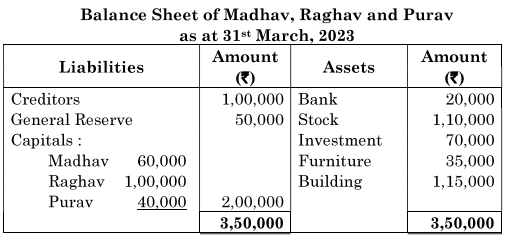
Purav died on 30th September, 2023. According to Partnership deed, his legal representatives are entitled to the following:
View Solution
Step 1: Calculate Goodwill
Goodwill = Average Profits × Years of Purchase \[ Rs.50,000 \times 3 = Rs.1,50,000 \]
Purav’s entitlement to goodwill (1/5 of the total): \[ Rs.1,50,000 \times \frac{1}{5} = Rs.30,000 \]
Step 2: Compute Interest on Capital
Interest on capital for a six-month period: \[ Rs.40,000 \times 12% \times \frac{6}{12} = Rs.2,400 \]
Step 3: Determine Purav’s Profit Share
Based on last year's profits: \[ Purav’s Entitled Profit = Rs.3,000 \]
Journal Entries:
\begin{tabular{|l|c|c|
\hline
Particulars & Dr. Amount (Rs.) & Cr. Amount (Rs.)
\hline
General Reserve A/c. Dr. & 10,000 &
\hline
To Purav’s Capital A/c. & & 10,000
\hline
Profit and Loss Suspense A/c. Dr. & 3,000 &
\hline
To Purav’s Capital A/c. & & 3,000
\hline
Madhav’s Capital A/c. Dr. & 18,000 &
\hline
Raghav’s Capital A/c. Dr. & 6,000 &
\hline
To Purav’s Capital A/c. & & 30,000
\hline
Interest on Capital A/c. Dr. & 2,400 &
\hline
To Purav’s Capital A/c. & & 2,400
\hline
Purav’s Drawings A/c. Dr. & 10,000 &
\hline
To Purav’s Capital A/c. & & 10,000
\hline
\end{tabular
Purav’s Capital Account:
\begin{tabular{|l|c|c|
\hline
Particulars & Dr. Amount (Rs.) & Cr. Amount (Rs.)
\hline
To Drawings & 10,000 & By Balance b/d & 40,000
\hline
To Legal Representatives A/c. & 75,400 & By General Reserve & 10,000
\hline
& & By Profit (up to death) & 3,000
\hline
& & By Goodwill & 30,000
\hline
& & By Interest on Capital & 2,400
\hline
\end{tabular Quick Tip: In managing a deceased partner's capital account, accurately credit all due amounts such as profit, goodwill, and interest on capital, while debiting withdrawals and other deductions.
(a) Arnav, Bhavi and Chavi were in partnership sharing profits and losses in the ratio of 3 : 2 : 1. On 31st March, 2023, their Balance Sheet was as follows:
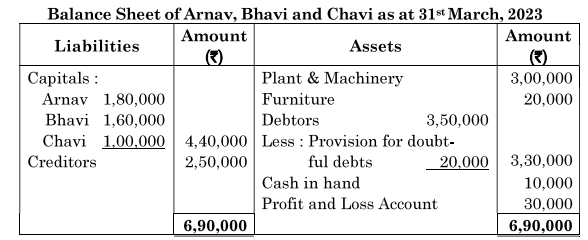
Chavi retired on the above date. It was agreed that :
(i) Plant and Machinery to be valued at Rs.4,30,000.
(ii) Provision for Bad Debts to be increased by 50%.
(iii) Chavi’s share of Goodwill valued at 80,000, treated without opening goodwill account.
(iv) Total amount payable to Chavi brought in by Arnav and Bhavi in their new profit-sharing ratio.
Prepare Revaluation Account and Partner’s Capital Accounts.
View Solution
\section*{Financial Tables
\subsection*{Revaluation A/c
{\small % Using a smaller font size to fit the table on the page
\begin{tabular{|p{3.5cm|r||p{3.5cm|r|
\hline
\multicolumn{2{|c||{Dr. & \multicolumn{2{c|{Cr.
\hline
Particulars & Amount (Rs.) & Particulars & Amount (Rs.)
\hline
To Provision for doubtful debts A/c & 10,000 & By Plant and Machinery A/c & 1,30,000
To Profit transferred to Partners' Capital A/c's: & & &
\quad Arnav & 60,000 & &
\quad Bhavi & 40,000 & &
\quad Chavi & 20,000 & &
\hline
\multicolumn{1{|r|{Total & 1,30,000 & \multicolumn{1{r|{Total & 1,30,000
\hline
\end{tabular
\subsection*{Partners' Capital Accounts
{\small % Smaller font for complex table to fit
\begin{tabular{|p{3cm|r|r|r||p{3cm|r|r|r|
\hline
& \multicolumn{3{c||{Dr. & & \multicolumn{3{c|{Cr.
\hline
Particulars & Arnav & Bhavi & Chavi & Particulars & Arnav & Bhavi & Chavi
\hline
To Chavi’s Capital A/c & 48,000 & 32,000 & - & By Balance b/d & 1,80,000 & 1,60,000 & 1,00,000
To Profit and Loss A/c & 15,000 & 10,000 & 5,000 & By Revaluation A/c & 60,000 & 40,000 & 20,000
To Cash A/c & - & - & - & By Arnav’s Capital A/c & - & - & 48,000
To Balance c/d & 3,18,000 & 2,12,000 & 2,00,000 & By Bhavi’s Capital A/c & - & - & 32,000
\hline
\multicolumn{1{|r|{Total & 3,81,000 & 2,54,000 & 2,00,000 & \multicolumn{1{r|{Total & 3,81,000 & 2,54,000 & 2,00,000
\hline
\end{tabular
Quick Tip: When adjusting for revaluation and goodwill, ensure these amounts are accurately reflected in the partners’ capital accounts to maintain balanced final accounts.
(b) Divya and Ekta were partners in a firm sharing profits in the ratio of 3 : 1. On 31st March, 2023, they admitted Sona as a new partner for 1/4th share in the profits of the firm. Their Balance Sheet on that date was as follows:
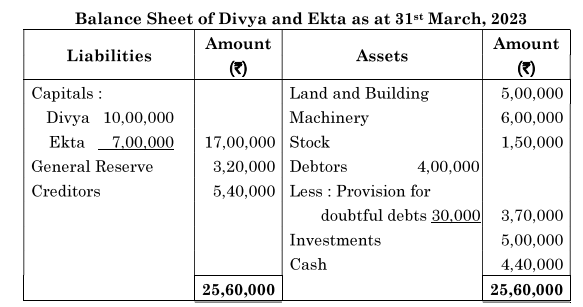
Sona will bring ₹ 4,00,000 as her capital and her share of goodwill in cash. It was agreed that :
(i) Goodwill of the firm valued at Rs.2,40,000.
(ii) Land and Building valued at 7,12,000.
(iii) Provision for doubtful debts excess by 8,000.
(iv) Liability of 20,000 included in Creditors not likely to arise.
(v) Capitals of Divya and Ekta adjusted on the basis of Sona’s capital by opening current accounts
Prepare Revaluation Account and Partner's Capital Accounts.
View Solution
\section*{Revaluation A/c
% Using smaller font size throughout the document
\small
\begin{tabular{|l|r||l|r|
\hline
\multicolumn{2{|c||{Dr. & \multicolumn{2{c|{Cr.
\hline
Particulars & Amount (Rs.) & Particulars & Amount (Rs.)
\hline
To Profit transferred to Partners' Capital A/c's: & & &
Divya & 180,000 & By Land and Building A/c & 212,000
Ekta & 60,000 & By Provision for doubtful debts A/c & 8,000
& & By Creditors A/c & 20,000
\hline
Total & 240,000 & Total & 240,000
\hline
\end{tabular
\section*{Partners’ Capital Accounts
\begin{tabular{|l|r|r|r||l|r|r|r|
\hline
& \multicolumn{3{c||{Dr. & & \multicolumn{3{c|{Cr.
\hline
Particulars & Divya & Ekta & Sona & Particulars & Divya & Ekta & Sona
\hline
To Partners Current A/c's & 565,000 & 555,000 & - & By Balance b/d & 1,000,000 & 700,000 & -
To Balance c/d & 900,000 & 300,000 & 400,000 & By Cash A/c & - & - & 400,000
\hline
Total & 1,465,000 & 855,000 & 400,000 & Total & 1,000,000 & 700,000 & 400,000
\hline
\end{tabular Quick Tip: Ensure that adjustments for revaluation and goodwill accurately reflect the revised values, and balance the capital accounts according to the contributions and shares of the existing and new partners.
(a) Murari Ltd. invited applications for issuing 80,000 equity shares of Rs.10 each at a premium of Rs.4 per share. The amount per share was payable as follows: Rs.5 on application and Rs.9 (including premium) on allotment. Applications were received for 1,40,000 shares and allotment was made on pro-rata basis to all the applicants. Money overpaid on application was utilised towards sums due on allotment. The allotment money was duly received except from Sameer who had applied for 1,400 shares. His shares were forfeited. Pass the necessary journal entries in the books of Murari Ltd. to record the above transactions. Open calls-in-arrears account wherever required.
View Solution
\section*{Books of Murari Ltd.
\subsection*{Journal
\begin{tabular{|l|l|r|r|
\hline
Date & Particulars & Dr. Amount (Rs.) & Cr. Amount (Rs.)
\hline
& Bank A/c Dr. & 7,00,000 &
& \quad To Equity Share Application A/c & & 7,00,000
& \quad (Application money received on 1,40,000 shares) & &
\hline
& Equity Share Application A/c Dr. & 7,00,000 &
& \quad To Equity Share Capital A/c & & 4,00,000
& \quad To Equity Share Allotment A/c & & 3,00,000
& \quad (Application money transferred to share capital account & &
& \quad and share allotment account) & &
\hline
& Equity Share Allotment A/c Dr. & 7,20,000 &
& \quad To Equity Share Capital A/c & & 4,00,000
& \quad To Securities Premium A/c & & 3,20,000
& \quad (Amount due on allotment) & &
\hline
& Bank A/c Dr. & 4,15,800 &
& Calls in arrears A/c Dr. & 4,200 &
& \quad To Equity Share Allotment A/c & & 4,20,000
& \quad (Allotment money received except on 800 shares) & &
\hline
& Equity Share Capital A/c Dr. & 8,000 &
& Securities Premium A/c Dr. & 3,200 &
& \quad To Share forfeiture A/c & & 7,000
& \quad To Calls in arrears A/c & & 4,200
& \quad (800 shares forfeited for non payment of allotment money) & &
\hline
\end{tabular Quick Tip: When adjusting for oversubscriptions, it's important to allocate any excess application money accurately to subsequent share allotments or calls.
(b) Kavya Ltd. invited applications for issuing 30,000 shares of Rs.10 each at a premium of Rs.2 per share. The amount was payable as follows: On application and allotment Rs.7 per share, On first and final call Rs.5 per share (including Rs.2 premium). Applications were received for 33,000 shares. Applications for 3,000 shares were rejected, and money returned to the applicants. Applications for 30,000 shares were accepted in full. The application and allotment money was duly received. The first and final call was made and money received except from a shareholder holding 500 shares. His shares were forfeited. All these shares were re-issued to Kartik as fully paid for Rs.8 per share. Pass necessary journal entries for the above transactions in the books of Kavya Ltd. Open calls-in-arrears account wherever required.
View Solution

Quick Tip: Ensure to accurately record the reissue of shares at the actual transaction price. Any excess from the forfeited shares account should be transferred to the capital reserve.
Question 25: Pass the necessary journal entries for the following transactions on the dissolution of the firm of Radha and Sudha after various assets (other than cash) and third-party liabilities have been transferred to Realisation Account:
(i) Nitish, an old customer, whose account for Rs. 11,000 was written off as bad debt in the previous year, paid 70% of the amount.
(ii) Sundry creditors amounting to Rs. 40,000 were settled at a discount of 20%.
(iii) Radha took over investments worth Rs. 23,000 at Rs. 20,000.
(iv) Profit and Loss Account showed a debit balance of Rs. 18,000.
(v) Sudha’s loan amounting to Rs. 15,000 was paid.
(vi) Machinery of the book value of Rs. 1,00,000 was given to a creditor of Rs. 85,000 in full settlement.
View Solution
% Journal Entries
\begin{tabular{|c|l|c|c|
\hline
Date & Particulars & Dr. (Rs.) & Cr. (Rs.)
\hline
& Bank A/c Dr. & 7,700 & --
& To Realisation A/c & -- & 7,700
& \textit{(Recovered 70% of bad debts from Nitish) & &
\hline
& Realisation A/c Dr. & 40,000 & --
& To Sundry Creditors A/c & -- & 40,000
& \textit{(Settled creditors at 80% of the amount due) & &
\hline
& Radha’s Capital A/c Dr. & 20,000 & --
& To Realisation A/c & -- & 20,000
& \textit{(Radha assumed investments at a predetermined value) & &
\hline
& Partners’ Capital A/c Dr. & 18,000 & --
& To Profit and Loss A/c & -- & 18,000
& \textit{(Loss balance transferred to partners’ capital accounts) & &
\hline
& Realisation A/c Dr. & 15,000 & --
& To Bank A/c & -- & 15,000
& \textit{(Cleared Sudha’s loan) & &
\hline
& Realisation A/c Dr. & 85,000 & --
& To Machinery A/c & 1,00,000 & --
& To Bank A/c & -- & 85,000
& \textit{(Used machinery to settle creditor accounts fully) & &
\hline
\end{tabular Quick Tip: When handling dissolution, ensure that transactions involving the settlement of liabilities and realization of assets are properly recorded through the Realisation Account. This account facilitates the clear documentation of all disposals, settlements, and recoveries.
Question 26:
Pass Journal entries relating to the issue of debentures in the books of Unicorn Ltd. in each of the following cases:
(i) Issued 20,000, 8% Debentures of Rs. 100 each at a premium of 10%, redeemable at a premium of 5%.
(ii) Issued 8,000, 8% Debentures of Rs. 100 each at a discount of 10%, redeemable at a premium of 10%.
(iii) Issued 3,000, 8% Debentures of Rs. 100 each at par, redeemable at a premium of 10%.
View Solution
Journal Entries
% Journal Entries
\begin{tabular{|p{2.5cm|p{8cm|p{2.5cm|p{2.5cm|
\hline
Date & Particulars & Dr. (Rs.) & Cr. (Rs.)
\hline
-- & Bank A/c Dr. & 22,00,000 & --
& Loss on Issue of Debentures A/c Dr. & 1,00,000 & --
& To 8% Debentures A/c & -- & 20,00,000
& To Securities Premium A/c & -- & 2,00,000
& \textit{(Issued debentures at 10% premium, redeemable at 5% premium) & &
\hline
-- & Bank A/c Dr. & 7,20,000 & --
& Loss on Issue of Debentures A/c Dr. & 1,60,000 & --
& To 8% Debentures A/c & -- & 8,00,000
& To Securities Premium A/c & -- & 80,000
& \textit{(Issued debentures at 10% discount, redeemable at 10% premium) & &
\hline
-- & Bank A/c Dr. & 3,00,000 & --
& Loss on Issue of Debentures A/c Dr. & 30,000 & --
& To 8% Debentures A/c & -- & 3,00,000
& To Securities Premium A/c & -- & 30,000
& \textit{(Issued debentures at par, redeemable at 10% premium) & &
\hline
\end{tabular Quick Tip: It's important to properly account for the financial differences when debentures are issued at a discount or premium and redeemable at a premium. These differences should be recognized in the "Loss on Issue of Debentures" account and amortized over the term of the debentures.
PART B
OPTION I
(Analysis of Financial Statements)
Question 27:
(a) Shyam Sunder Ltd. is a financing company. Under which of the following activity will the amount of ‘Interest paid on loan’ be shown:
View Solution
1. The classification of interest paid on loans varies between financing and non-financing companies.
2. For financing companies, such as Shyam Sunder Ltd., interest expenses are considered part of operating expenses because these are central to their primary business activities of earning and managing interest.
3. According to Accounting Standard AS-3 (Cash Flow Statements), interest paid is categorized as:
- An operating activity for financial institutions and banks.
- A financing activity for non-financial companies.
4. Therefore, for Shyam Sunder Ltd., which operates as a financing company, the interest paid on loans should be recorded under operating activities in its cash flow statement.
Thus, the correct answer is:
(D) Operating activity. Quick Tip: Remember, in financial companies, interest paid and received is typically classified under Operating Activities, while in non-financial companies, interest paid is usually classified under Financing Activities.
Question 27:
(b) Tax paid during the year ended 31st March, 2023 was Rs. 15,000. While calculating Net Profit before Tax and Extraordinary items, the amount of provision for tax to be added is .......

View Solution
1. Relevant Data:
- Provision for tax as of April 1, 2022 = Rs. 10,000
- Provision for tax as of March 31, 2023 = Rs. 25,000
- Tax payments made during the year = Rs. 15,000
2. Method to Determine the Tax Provision to be Added:
\[ Provision to be added = Tax payments during the year + Increase in provision \]
3. Calculation of Increase in Provision:
\[ = Rs. 25,000 - Rs. 10,000 = Rs. 15,000 \]
4. Calculation of Total Provision to be Added:
\[ = Rs. 15,000 + Rs. 15,000 = Rs. 30,000 \]
Therefore, the tax provision to be added totals Rs. 30,000 (Option A). Quick Tip: To accurately calculate Net Profit Before Tax, add the tax paid during the year to the increase in the tax provision.
Which of the following is not a tool of Analysis of Financial Statements?
\begin{flushleft
View Solution
Analysis of Financial Statements typically employs techniques such as ratio analysis, comparative statements, and cash flow analysis.
The Statement of Profit \& Loss is crucial for financial reporting but does not serve as an analytical tool in itself.
Hence, the correct answer is (C). Quick Tip: In financial analysis, employ methods like ratio analysis, comparative and cash flow statements, whereas the Statement of Profit \& Loss serves as a reporting document rather than an analytical tool.
(a) Total Assets: Rs. 3,00,000
Non-current Assets: Rs. 2,60,000
Non-current Liabilities: Rs. 80,000
Shareholders' Funds: Rs. 2,00,000
Current ratio calculated on the basis of the above information will be:
View Solution
1. Determine Current Assets
\[ Current Assets = Total Assets - Non-current Assets \]
\[ = Rs. 3,00,000 - Rs. 2,60,000 = Rs. 40,000 \]
2. Determine Current Liabilities
\[ Current Liabilities = Total Liabilities - Non-current Liabilities \]
\[ = (Total Assets - Shareholders' Equity) - Non-current Liabilities \]
\[ = (Rs. 3,00,000 - Rs. 2,00,000) - Rs. 80,000 = Rs. 20,000 \]
3. Compute Current Ratio
\[ Current Ratio = \frac{Current Assets}{Current Liabilities} \]
\[ = \frac{Rs. 40,000}{Rs. 20,000} = 2 : 1 \]
Therefore, the current ratio is \( 2 : 1 \) (Option B). Quick Tip: To calculate the current ratio, first find the current assets by subtracting non-current assets from total assets, and then calculate current liabilities by subtracting non-current liabilities from total liabilities minus shareholders' equity.
Question 28:
(b) When Current Ratio is 4 : 1, Current Assets are Rs. 60,000 and Quick Ratio is 2.5 : 1, the amount of ‘Inventory’ will be:
View Solution
Step 1: Determine Current Liabilities
Using the Current Ratio formula: \[ Current Ratio = \frac{Current Assets}{Current Liabilities} = 4 : 1. \]
Given Current Assets = Rs. 60,000, calculate: \[ Current Liabilities = \frac{Current Assets}{Current Ratio} = \frac{Rs. 60,000}{4} = Rs. 15,000. \]
Step 2: Calculate Inventory using the Quick Ratio
The Quick Ratio is given as \( 2.5 : 1 \), with the formula: \[ Quick Ratio = \frac{Current Assets - Inventory}{Current Liabilities}. \]
Substitute the known values: \[ 2.5 = \frac{Rs. 60,000 - Inventory}{Rs. 15,000}. \]
Rearranging to solve for Inventory: \[ Rs. 60,000 - Inventory = Rs. 15,000 \times 2.5 = Rs. 37,500. \] \[ Inventory = Rs. 60,000 - Rs. 37,500 = Rs. 22,500. \]
Conclusion:
The Inventory is \( Rs. 22,500 \). Quick Tip: The Quick Ratio excludes inventory from current assets, focusing on the liquidity of readily available resources like cash and receivables.
Which of the following transactions will result in a flow of cash?
View Solution
Withdrawing cash from the bank is merely an internal transfer and does not constitute an actual cash flow.
The issuance of debentures to vendors in exchange for machinery is a non-cash financing activity.
Receiving payments from debtors represents a true cash inflow and therefore is considered a cash flow.
Converting debentures into equity shares does not involve cash and is categorized as a non-cash transaction. Quick Tip: Only activities that involve the physical inflow or outflow of cash from the business are considered as cash flows.
Under which major heads and sub-heads will the following items be placed in the Balance Sheet of the company as per Schedule III, Part I of the Companies Act, 2013?
(i) Patents
View Solution

Quick Tip: Cash flows are only recognized for transactions that involve actual movements of cash either into or out of the business.
From the following information, calculate the Working Capital Turnover Ratio:
Gross Profit Ratio - 25%
Gross Profit - Rs. 5,00,000
Shareholders' Funds - Rs. 25,00,000
Non-current Liabilities - Rs. 8,00,000
Non-current Assets - Rs. 23,00,000
View Solution
Calculate Sales:
Using the Gross Profit Ratio:
\[ Sales = \frac{Gross Profit}{Gross Profit Ratio} = \frac{5,00,000}{0.25} = 20,00,000 \]
Determine Working Capital:
Working Capital calculation:
\[ Working Capital = Current Assets - Current Liabilities \]
\[ Current Assets = Shareholders' Funds + Non-current Liabilities - Non-current Assets \]
\[ Working Capital = (25,00,000 + 8,00,000) - 23,00,000 = 10,00,000 \]
Compute Working Capital Turnover Ratio:
\[ Working Capital Turnover Ratio = \frac{Sales}{Working Capital} = \frac{20,00,000}{10,00,000} = 2 times \] Quick Tip: The Working Capital Turnover Ratio is an indicator of the efficiency with which a company manages its working capital to generate sales. It's calculated by dividing Sales by Working Capital.
(a) From the following Statement of Profit and Loss of Shikha Ltd., prepare Comparative Statement of Profit and Loss for the year ended 31st March, 2023:
Particulars & 2022-23 (Rs.) & 2021-22 (Rs.)
Revenue from Operations & 32,00,000 & 20,00,000
Employee Benefit Expenses & 9,60,000 & 6,00,000
Other Expenses & 6,40,000 & 4,00,000
View Solution
Comparative Statement of Profit and Loss:
\begin{tabular{|l|c|c|c|
\hline
Particulars & 2022-23 (Rs.) & 2021-22 (Rs.) & % Change
\hline
Revenue from Operations & 32,00,000 & 20,00,000 & 60%
\hline
Employee Benefit Expenses & 9,60,000 & 6,00,000 & 60%
\hline
Other Expenses & 6,40,000 & 4,00,000 & 60%
\hline
\end{tabular
Methodology:
Calculate the percentage change for each financial line item as follows: \[ % Change = \frac{Current Year - Previous Year}{Previous Year} \times 100 \]
Specifically:
1. Revenue from Operations: \[ \frac{32,00,000 - 20,00,000}{20,00,000} \times 100 = 60% \]
2. Employee Benefit Expenses: \[ \frac{9,60,000 - 6,00,000}{6,00,000} \times 100 = 60% \]
3. Other Expenses: \[ \frac{6,40,000 - 4,00,000}{4,00,000} \times 100 = 60% \] Quick Tip: To effectively analyze year-over-year performance in a comparative statement of profit and loss, compute the percentage change for each account by using the formula: \[ % Change = \frac{Current Year - Previous Year}{Previous Year} \times 100 \] This helps in quickly identifying trends and variances in financial performance.
(b) From the following information, prepare a Common Size Statement of Profit and Loss of A Ltd. and B Ltd. for the year ended 31st March, 2023:
Particulars & A Ltd. (Rs.) & B Ltd. (Rs.)
Revenue from Operations & 20,00,000 & 10,00,000
Other Income & 3,00,000 & 80,000
Expenses & 10,40,000 & 4,80,000
Tax Rate & 40% & 40%
View Solution

Methodology for Calculating Common Size Percentages:
Each financial line item is expressed as a percentage of Revenue from Operations:
1. Other Income: \[ Other Income % = \left( \frac{Other Income}{Revenue from Operations} \right) \times 100 \]
For A Ltd: \[ \frac{3,00,000}{20,00,000} \times 100 = 15% \]
For B Ltd: \[ \frac{80,000}{10,00,000} \times 100 = 8% \]
2. Expenses: \[ Expenses % = \left( \frac{Expenses}{Revenue from Operations} \right) \times 100 \]
For A Ltd: \[ \frac{10,40,000}{20,00,000} \times 100 = 52% \]
For B Ltd: \[ \frac{4,80,000}{10,00,000} \times 100 = 48% \]
3. Profit Before Tax: \[ PBT % = \left( Revenue from Operations - Other Income - Expenses \right) as a % of Revenue \] Quick Tip: To effectively compare financial performance between companies, use Common Size Statements where all items are represented as a percentage of total revenue, facilitating straightforward comparisons.
From the following Balance Sheet of Yogita Ltd., calculate ‘Cash flows from Investing Activities’ and ‘Cash flows from Financing Activities’. Show your working properly.

\end{figure

Additional Information:
View Solution


Quick Tip: When preparing cash flow statements, accurately classify and document all transactions related to investing and financing activities to reflect true cash movements. Ensure that sales, acquisitions, or financing activities are recorded correctly in journal entries.
“A value or function or an arithmetic expression is recorded in ........”
View Solution
In spreadsheets, each cell—which is found at the crossing of a row and a column—can contain values, functions, or arithmetic expressions. Quick Tip: In spreadsheets, cells act as the basic units for storing values, functions, or formulas.
PART B
OPTION II
(Computerised Accounting)
Question 27:
(a) Depreciation is generated from which of the following Accounting information system?
View Solution
Depreciation pertains exclusively to fixed assets and arises from the fixed assets accounting subsystem. This subsystem is responsible for monitoring the asset's procurement, its depreciation over time, and eventual disposal. Quick Tip: Depreciation, reflecting the cost and lifespan of fixed assets, is systematically processed within the Fixed Assets Accounting Subsystem.
(b) Which type of software package is suitable for an organization where the volume of accounting transactions is very low and adaptability is very high?
View Solution
1. Generic software fits organizations that have fewer transactions and require flexible solutions.
2. It comes pre-configured, is simple to deploy, and is economical, making it a perfect choice for small enterprises or new ventures.
3. Custom software is typically designed for enterprises with particular operational requirements and may be excessive for those with minimal transactional needs.
4. ERP systems are intended for larger organizations that handle a vast number of transactions, which makes them inappropriate for this scenario.
Therefore, the appropriate selection is (D) Generic. Quick Tip: Generic software is best suited for smaller businesses that need ready-to-use functionalities with minimal customization expenses, due to its low transaction volumes and high adaptability.
Which chart has depth axis?
View Solution
A 3D chart includes a depth axis, which contributes to its three-dimensional look. This depth axis enables the depiction of extra data along the z-axis, enhancing the chart's ability to convey information. Quick Tip: 3D charts excel in displaying data across three dimensions, aiding in the visualization of complex data interrelations.
(a) Which of the following is not a limitation of the computerized accounting system?
View Solution
Although computerized accounting systems face challenges like data corruption, susceptibility to hacking, and constraints in report generation, the claim that data becomes universally accessible is not considered a drawback. Quick Tip: While computerized systems generally bolster data security, exposed data may be vulnerable to unauthorized access, and interruptions in the system could lead to data loss.
(b) To safeguard assets and optimize the use of resources a business .......
View Solution
It is crucial for a business to implement internal controls to protect its assets, enhance resource utilization, and guard against fraud or mistakes. These controls are vital for the effective management and security of assets. Quick Tip: Internal controls are instrumental in safeguarding assets and maintaining operational efficiency within a business.
How can \#DIV/0! error be corrected?
View Solution
The \#DIV/0! error in Excel is triggered when a formula tries to divide by zero or a cell in the denominator is empty. It can be resolved through several strategies:
1. Check Input Data: Verify that the denominator cell holds a valid number and is not empty.
2. Employ IF Function: Incorporate a condition to avoid division by zero: \[ =IF(B1=0, "Error", A1/B1) \]
This expression yields "Error" if the denominator is zero or empty.
3. Apply IFERROR Function: Implement the \texttt{IFERROR function to gracefully manage errors: \[ =IFERROR(A1/B1, "Invalid Operation") \]
This substitutes the error with a predefined message or an alternative response.
4. Implement Conditional Formatting: Use conditional formatting to mark cells that could pose issues (e.g., cells with zero which could be denominators) to aid in their quick identification and adjustment.
5. Utilize Data Validation: Apply Excel's Data Validation tool to limit inputs to only acceptable values, preventing zero or empty entries in critical cells.
6. Review Formula References: Make sure all cells referenced in the formula are accurately linked and carry suitable values.
With careful input management, application of error-handling functions, and rigorous data validation, you can significantly reduce the frequency of \#DIV/0! errors. Quick Tip: Consider using the \texttt{IFERROR} function to efficiently handle errors in Excel calculations, ensuring outputs remain clear and professional without visible errors.
Explain various ‘Data tables’ used in Pivot Table.
View Solution
Data tables in Pivot Tables facilitate the dynamic examination of data by altering input variables and monitoring the effects on the results. There are two primary types of data tables:
1. Single-variable data tables:
- Allow exploration of changes in one variable and its effect on a formula’s output.
- For example, observing how different interest rates influence loan repayment amounts, while other factors remain the same.
2. Two-variable data tables:
- Enable analysis of the effects of two variables simultaneously on a formula.
- For instance, assessing how changes in both interest rates and loan amounts affect monthly payments.
Principal Characteristics of Data Tables:
- They update outcomes automatically when any input variables or the associated formula are altered.
- Offer a systematic way to represent various scenarios visually.
- Streamline the process of sensitivity analysis for making strategic decisions.
Benefits of Data Tables:
- Ideal for conducting "What-If" analyses to effectively simulate different financial scenarios.
- Aid in making well-informed decisions by allowing comparison of results across different assumptions.
- Save time on repetitive tasks by obviating the need for numerous separate calculations.
Quick Tip: Leverage data tables in financial modeling to carry out sensitivity analyses and evaluate various scenarios efficiently.
(a) List the points of nomenclature used in Excel for charts/graphs.
View Solution
The terminology associated with Excel charts/graphs encompasses the elements listed below:
1. Chart Title: Indicates the main objective of the chart.
2. Axis Titles: Labels the X-axis (horizontal) and Y-axis (vertical).
3. Legend: Identifies the different data series shown in the chart.
4. Data Points: Represents the individual values displayed on the chart.
5. Gridlines: Facilitate the reading of values from the axes.
6. Data Labels: Provide exact values for each point on the chart.
7. Plot Area: The area within the chart where data points are visualized.
These elements are critical for ensuring that the chart is easy to understand and interpret. Quick Tip: It's essential to use a relevant chart title and distinct axis labels to make sure your charts effectively communicate the desired information.
(b) Explain the steps to define ‘Print area’ using Dialog box.
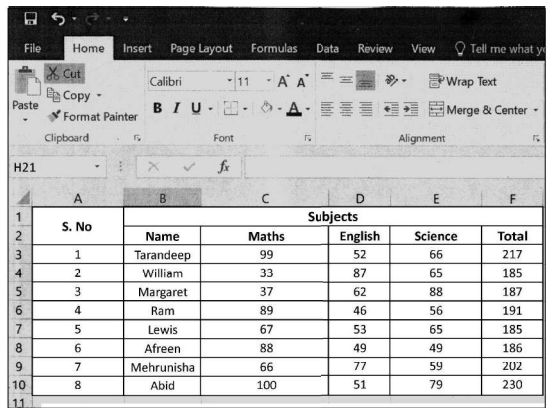
View Solution
To set the 'Print Area' in Excel via the dialog box, proceed with these instructions:
Step 1. Highlight the cell range you wish to designate as the print area.
Step 2. Navigate to the Page Layout tab on the Ribbon.
Step 3. Select the Print Area option from the Page Setup group's dropdown menu.
Step 4. Click on Set Print Area to specify the selected cells as the print area.
Step 5. If you need to expand the print area, highlight additional cells and choose Add to Print Area.
Step 6. To clear the existing print area, select Clear Print Area from the dropdown menu.
Following these steps helps to print only the necessary data, which conserves paper and enhances document clarity. Quick Tip: Utilize the Print Preview feature to check how the print area looks on the page, confirming that the layout meets your requirements before printing.





Comments