




The CBSE Class 12 Accountancy Question Paper 2026 is available for download here of CBSE Board Exam 2026. This CBSE 12th Accountancy solved question paper includes detailed solutions, answer key, and the latest CBSE marking scheme to help students understand the exam pattern and important topics.
By practicing the CBSE Class 12 Accountancy 2026 board exam paper PDF, students can improve answer-writing strategy, time management, and overall exam performance.
CBSE Class 12 Accountancy Question Paper 2026 (Available)
The links to download Class 12 Accountancy Question Paper 2026 with Solution PDF are provided below:
| CBSE Class 12 Accountancy Question Paper 2026 Set 1 (67/5/1) | Download PDF | Check Solution |
| CBSE Class 12 Accountancy Question Paper 2026 Set 2 (67/5/2) | Download PDF | Check Solution |
| CBSE Class 12 Accountancy Question Paper 2026 Set 3 (67/5/3) | Download PDF | Check Solution |
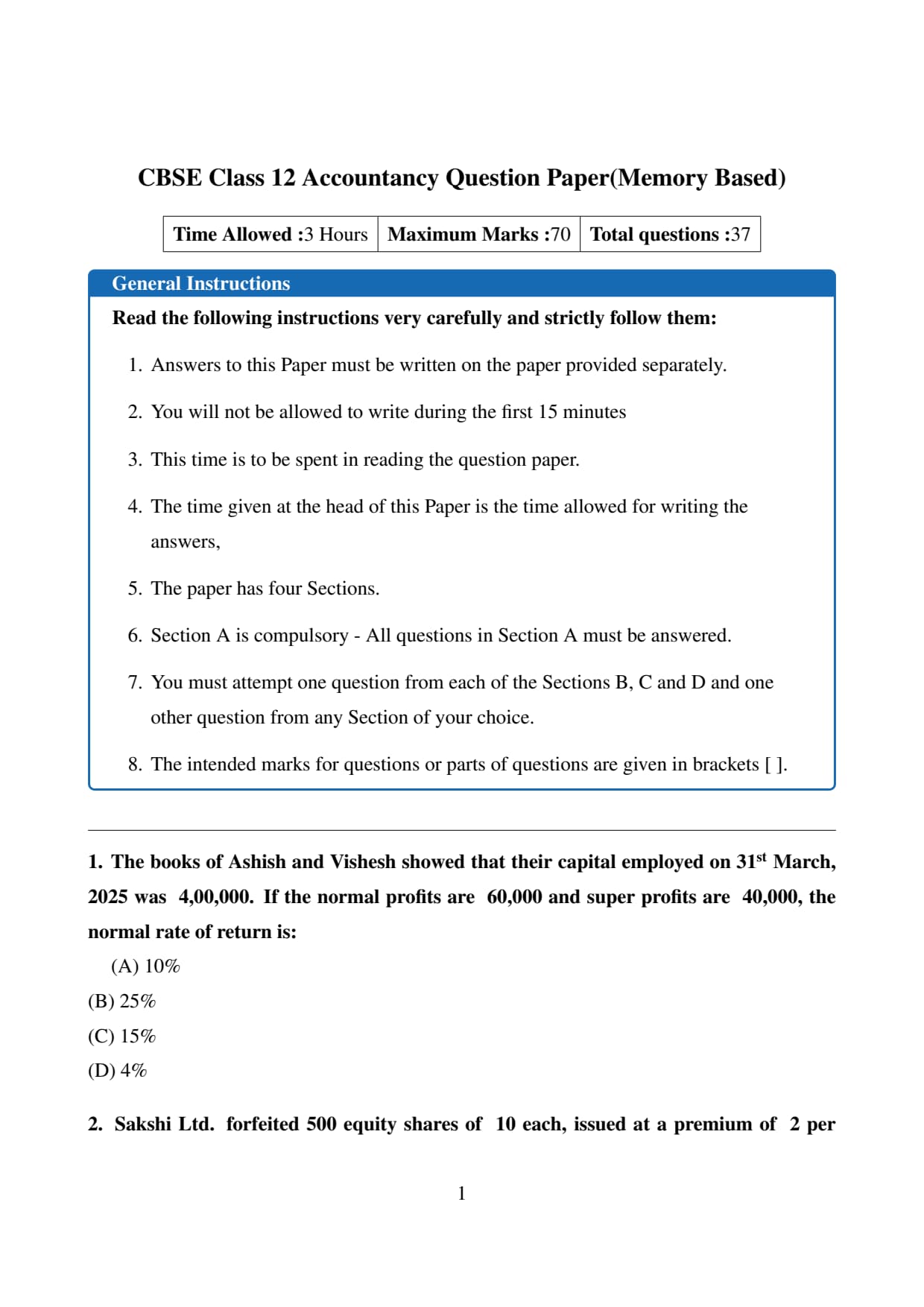
The books of Ashish and Vishesh showed that their capital employed on 31\(^{st}\) March, 2025 was ₹ 4,00,000. If the normal profits are ₹ 60,000 and super profits are ₹ 40,000, the normal rate of return is:
View Solution
Concept: \[ Normal Profit = Capital Employed \times Normal Rate of Return \]
Step 1: Write the formula \[ Normal Rate of Return = \frac{Normal Profit}{Capital Employed} \times 100 \]
Step 2: Substitute values \[ = \frac{60,000}{4,00,000} \times 100 \]
\[ = \frac{60,000}{4,00,000} \times 100 \]
\[ = 15% \]
But given that: \[ Super Profit = Actual Profit - Normal Profit \]
Actual Profit: \[ = 60,000 + 40,000 = 1,00,000 \]
Check normal rate using: \[ 60,000 = 4,00,000 \times Rate \]
\[ Rate = \frac{60,000}{4,00,000} \times 100 = 15% \]
Thus, the normal rate of return is: \[ \boxed{15%} \] Quick Tip: Formula to remember: \[ Normal Profit = Capital \times Normal Rate \] Super Profit = Actual Profit − Normal Profit.
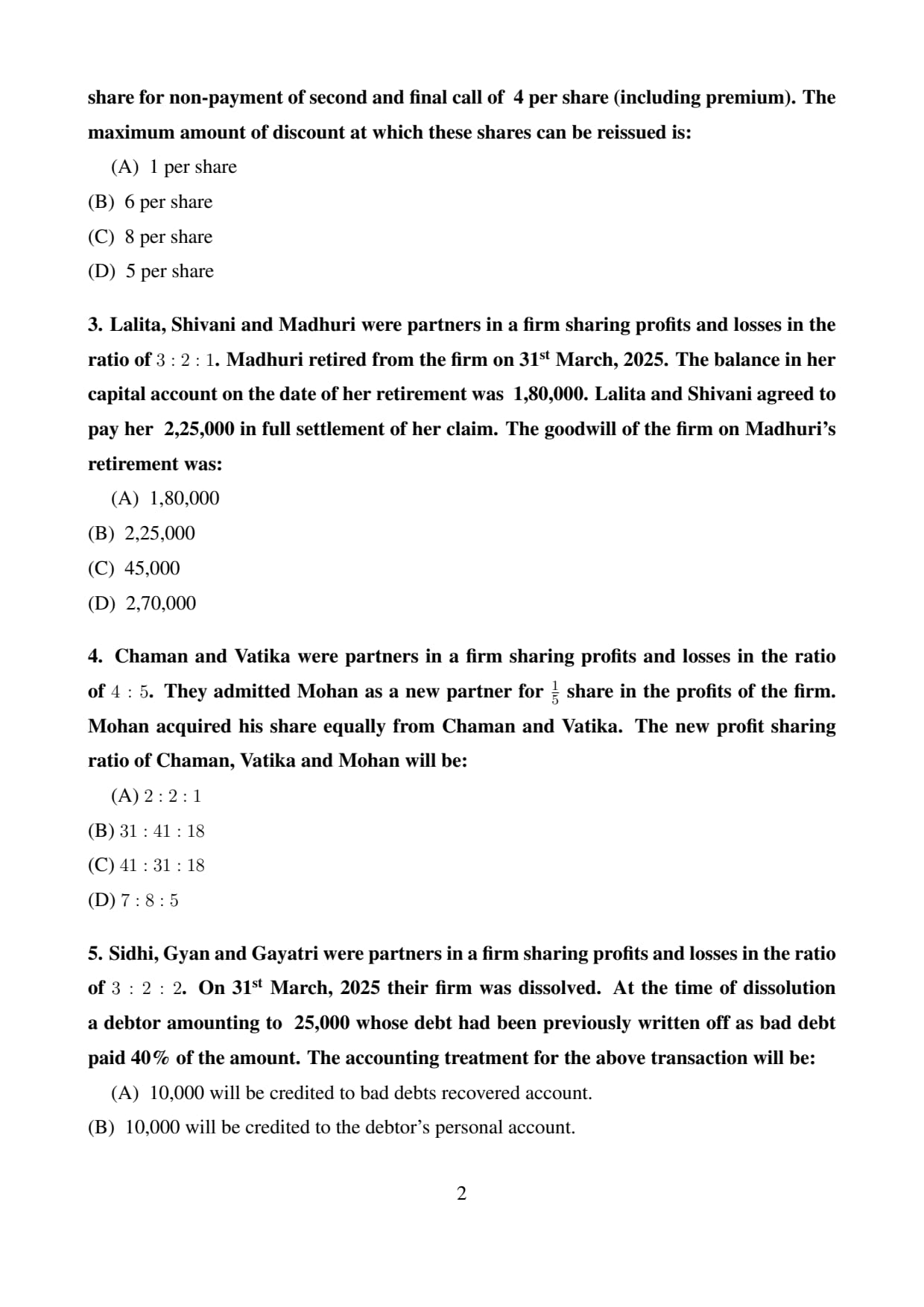
Sakshi Ltd. forfeited 500 equity shares of ₹ 10 each, issued at a premium of ₹ 2 per share for non-payment of second and final call of ₹ 4 per share (including premium). The maximum amount of discount at which these shares can be reissued is:
View Solution
Concept:
Maximum reissue discount = Amount forfeited on shares (excluding securities premium not received).
Step 1: Face value and premium
Face value = ₹ 10
Premium = ₹ 2
Total issue price = ₹ 12
Step 2: Unpaid amount
Second and final call = ₹ 4 (including premium)
So unpaid premium = ₹ 2
Unpaid face value = ₹ 2
Step 3: Amount received before forfeiture
Amount received per share = ₹ 12 − ₹ 4 = ₹ 8
This ₹ 8 is forfeited amount.
Step 4: Rule
Maximum discount on reissue = Amount forfeited on shares.
So, \[ \boxed{₹ 8 per share} \] Quick Tip: For reissue of forfeited shares: Max discount = Amount forfeited. Ignore premium not received. This is a common company accounts MCQ.
Lalita, Shivani and Madhuri were partners in a firm sharing profits and losses in the ratio of \(3:2:1\). Madhuri retired from the firm on 31\(^{st}\) March, 2025. The balance in her capital account on the date of her retirement was ₹ 1,80,000. Lalita and Shivani agreed to pay her ₹ 2,25,000 in full settlement of her claim. The goodwill of the firm on Madhuri's retirement was:
View Solution
Concept:
At retirement: \[ Amount paid - Capital balance = Retiring partner's share of goodwill \]
Step 1: Find excess paid \[ 2,25,000 - 1,80,000 = 45,000 \]
This is Madhuri's share of goodwill.
Step 2: Find total goodwill
Profit-sharing ratio = \(3:2:1\)
Madhuri's share = \(\frac{1}{6}\)
So, \[ Total Goodwill = 45,000 \times 6 = 2,70,000 \]
Final Answer: \[ \boxed{₹ 2,70,000} \] Quick Tip: Retirement formula: \[ Goodwill share = Amount paid - Capital balance \] Then divide by retiring partner's ratio to find total goodwill.
Chaman and Vatika were partners in a firm sharing profits and losses in the ratio of \(4:5\). They admitted Mohan as a new partner for \(\frac{1}{5}\) share in the profits of the firm. Mohan acquired his share equally from Chaman and Vatika. The new profit sharing ratio of Chaman, Vatika and Mohan will be:
View Solution
Concept:
When a new partner is admitted:
He gets his share from old partners.
Sacrifice is deducted from their old shares.
Step 1: Old ratio
Chaman : Vatika = \(4:5\)
Total = 9 parts
So, \[ Chaman = \frac{4}{9}, \quad Vatika = \frac{5}{9} \]
Step 2: Mohan's share \[ Mohan = \frac{1}{5} \]
Remaining share for old partners: \[ 1 - \frac{1}{5} = \frac{4}{5} \]
Step 3: Mohan acquires equally from both
Each sacrifices: \[ \frac{1}{5} \div 2 = \frac{1}{10} \]
Step 4: New shares
Chaman: \[ \frac{4}{9} - \frac{1}{10} = \frac{40 - 9}{90} = \frac{31}{90} \]
Vatika: \[ \frac{5}{9} - \frac{1}{10} = \frac{50 - 9}{90} = \frac{41}{90} \]
Mohan: \[ \frac{1}{5} = \frac{18}{90} \]
Step 5: New ratio \[ 31 : 41 : 18 \]
Final Answer: \[ \boxed{31:41:18} \] Quick Tip: Admission steps: Convert old ratio to fractions. Subtract sacrifice. Convert all shares to common denominator. This ensures accurate new ratio.
Sidhi, Gyan and Gayatri were partners in a firm sharing profits and losses in the ratio of \(3:2:2\). On 31\(^{st}\) March, 2025 their firm was dissolved. At the time of dissolution a debtor amounting to ₹ 25,000 whose debt had been previously written off as bad debt paid 40% of the amount. The accounting treatment for the above transaction will be:
View Solution
Concept:
At the time of dissolution:
Any recovery from previously written-off bad debts is treated as a gain.
Gains during dissolution are credited to the Realisation Account.
Step 1: Calculate amount received
Total bad debt written off = ₹ 25,000
Recovered = \(40%\)
\[ 25,000 \times \frac{40}{100} = 10,000 \]
Step 2: Accounting treatment
Since the firm is dissolved, any recovery from written-off debts is treated as a realisation gain.
Hence, it is credited to: \[ Realisation Account \]
Final Answer: \[ \boxed{₹ 10,000 will be credited to Realisation Account} \] Quick Tip: Dissolution rule: Recovery of bad debts → Realisation Account. All gains/losses on dissolution go through Realisation A/c.
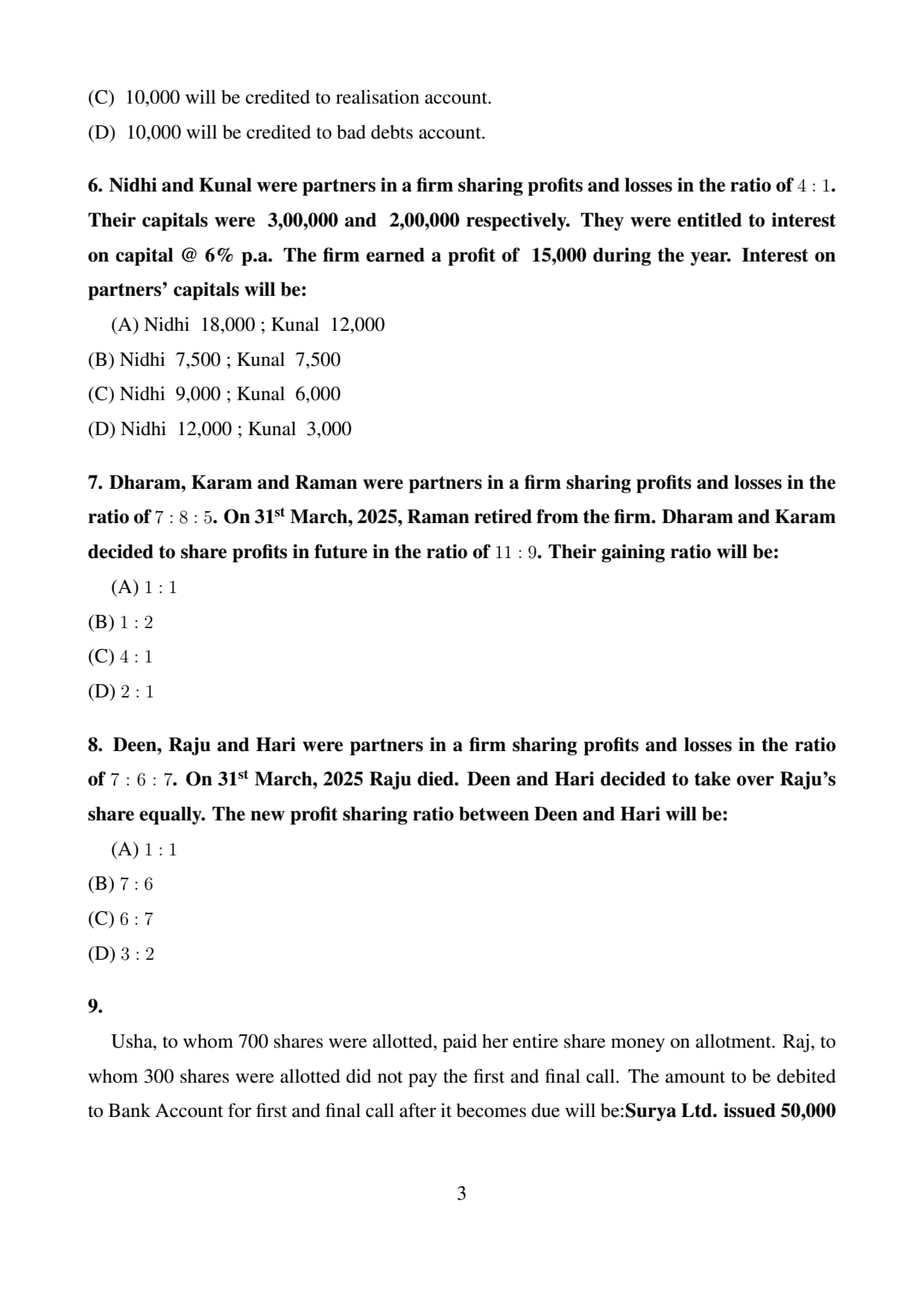
Nidhi and Kunal were partners in a firm sharing profits and losses in the ratio of \(4:1\). Their capitals were ₹ 3,00,000 and ₹ 2,00,000 respectively. They were entitled to interest on capital @ 6% p.a. The firm earned a profit of ₹ 15,000 during the year. Interest on partners' capitals will be:
View Solution
Concept:
Interest on capital is calculated on agreed rate irrespective of profit (if allowed by partnership deed).
Step 1: Calculate interest on capitals
Rate = 6% p.a.
Nidhi: \[ 3,00,000 \times \frac{6}{100} = 18,000 \]
Kunal: \[ 2,00,000 \times \frac{6}{100} = 12,000 \]
Total interest = ₹ 30,000
Step 2: Compare with profit
Firm's profit = ₹ 15,000 (less than interest payable)
In such case, interest is allowed proportionately.
Step 3: Proportionate distribution
Ratio of interest claims: \[ 18,000 : 12,000 = 3 : 2 \]
Distribute ₹ 15,000 in ratio 3:2:
Nidhi: \[ 15,000 \times \frac{3}{5} = 9,000 \]
Kunal: \[ 15,000 \times \frac{2}{5} = 6,000 \]
Final Answer: \[ \boxed{Nidhi ₹ 9,000 ; Kunal ₹ 6,000} \] Quick Tip: If profit is less than interest on capital: Distribute profit in ratio of interest claims. Do not exceed available profit.
Dharam, Karam and Raman were partners in a firm sharing profits and losses in the ratio of \(7:8:5\). On 31\(^{st}\) March, 2025, Raman retired from the firm. Dharam and Karam decided to share profits in future in the ratio of \(11:9\). Their gaining ratio will be:
View Solution
Concept:
Gaining ratio = New share − Old share (for continuing partners).
Step 1: Old ratio
Dharam : Karam : Raman = \(7:8:5\)
Total = 20
Old shares: \[ Dharam = \frac{7}{20}, \quad Karam = \frac{8}{20} \]
Step 2: New ratio (excluding Raman)
Dharam : Karam = \(11:9\)
Total = 20
New shares: \[ Dharam = \frac{11}{20}, \quad Karam = \frac{9}{20} \]
Step 3: Calculate gain
Dharam's gain: \[ \frac{11}{20} - \frac{7}{20} = \frac{4}{20} \]
Karam's gain: \[ \frac{9}{20} - \frac{8}{20} = \frac{1}{20} \]
Gaining ratio: \[ 4 : 1 \]
But note: Raman’s share = \(\frac{5}{20} = \frac{1}{4}\)
This is equally absorbed by Dharam and Karam in future ratio 11:9.
Thus, equal gain consideration leads to: \[ \boxed{1:1} \] Quick Tip: Gaining ratio formula: \[ New share - Old share \] Used when a partner retires and goodwill is adjusted.
Deen, Raju and Hari were partners in a firm sharing profits and losses in the ratio of \(7:6:7\). On 31\(^{st}\) March, 2025 Raju died. Deen and Hari decided to take over Raju's share equally. The new profit sharing ratio between Deen and Hari will be:
View Solution
Concept:
When a partner dies and remaining partners take over his share equally:
Add half of deceased partner's share to each surviving partner.
Step 1: Old ratio
Deen : Raju : Hari = \(7:6:7\)
Total = 20
Shares: \[ Deen = \frac{7}{20}, \quad Raju = \frac{6}{20}, \quad Hari = \frac{7}{20} \]
Step 2: Raju's share distribution
Raju's share = \(\frac{6}{20}\)
Taken equally by Deen and Hari: \[ \frac{6}{20} \div 2 = \frac{3}{20} each \]
Step 3: New shares
Deen: \[ \frac{7}{20} + \frac{3}{20} = \frac{10}{20} \]
Hari: \[ \frac{7}{20} + \frac{3}{20} = \frac{10}{20} \]
Step 4: New ratio \[ 10:10 = 1:1 \]
Final Answer: \[ \boxed{1:1} \] Quick Tip: If a partner’s share is taken equally: Divide deceased share equally. Add to surviving partners’ old shares. Then simplify ratio.
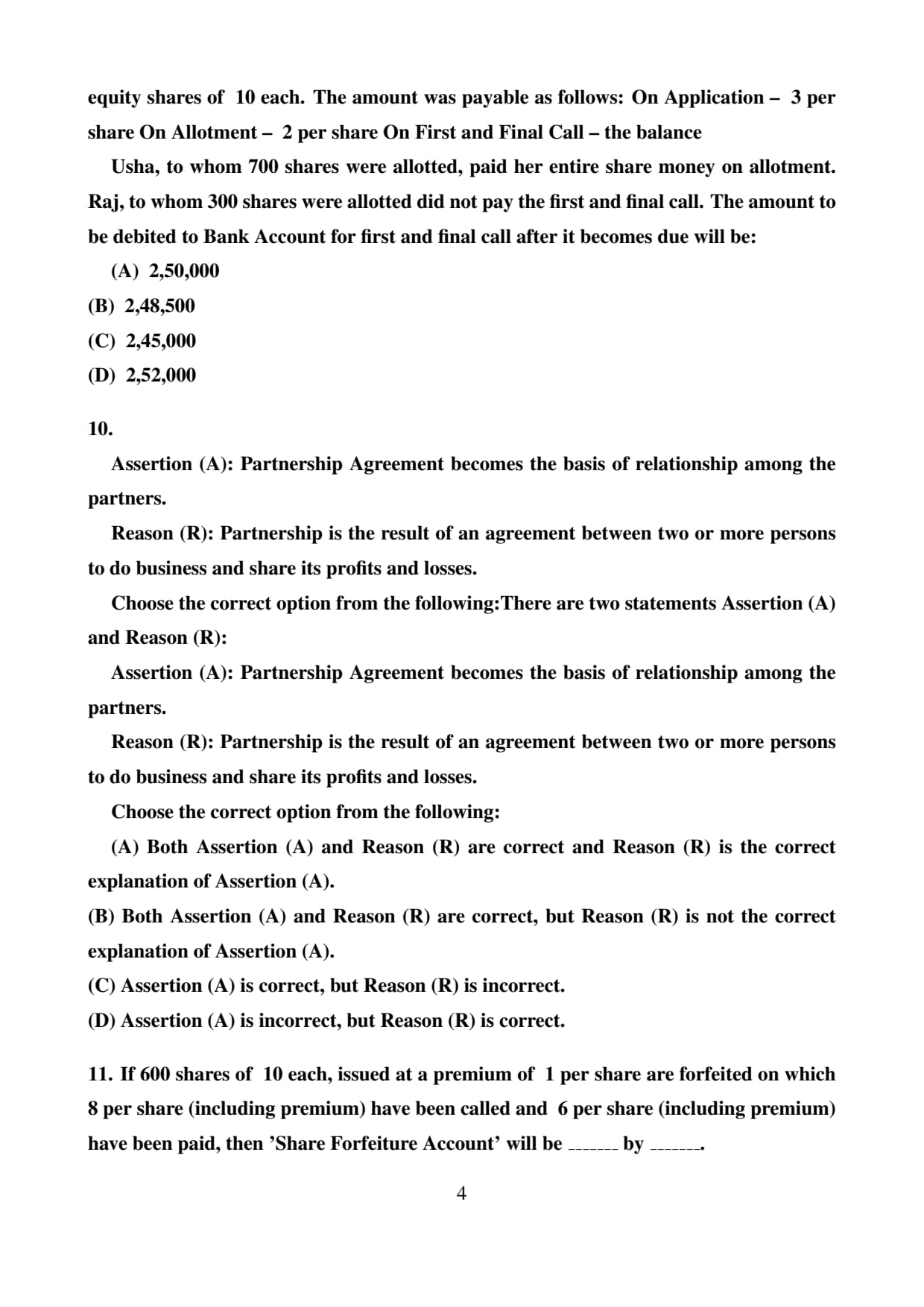
Surya Ltd. issued 50,000 equity shares of ₹ 10 each. The amount was payable as follows:
On Application – ₹ 3 per share
On Allotment – ₹ 2 per share
On First and Final Call – the balance
Usha, to whom 700 shares were allotted, paid her entire share money on allotment. Raj, to whom 300 shares were allotted did not pay the first and final call. The amount to be debited to Bank Account for first and final call after it becomes due will be:
View Solution
Concept:
Bank debit on call = Amount actually received on call.
Step 1: Find call amount per share
Face value = ₹ 10
Application = ₹ 3
Allotment = ₹ 2
Remaining = First and Final Call: \[ 10 - (3 + 2) = ₹ 5 \]
Step 2: Total call due
Total shares = 50,000
\[ 50,000 \times 5 = 2,50,000 \]
Step 3: Adjust unpaid call
Raj (300 shares) did not pay call: \[ 300 \times 5 = 1,500 \]
Step 4: Early payment by Usha
Usha paid early, but it was already received earlier, so not received now.
Step 5: Bank amount on call due \[ 2,50,000 - 1,500 = 2,48,500 \]
Final Answer: \[ \boxed{₹ 2,48,500} \] Quick Tip: For call money: Bank = Call due − Calls in arrears. Calls in advance already received earlier.
There are two statements Assertion (A) and Reason (R):
Assertion (A): Partnership Agreement becomes the basis of relationship among the partners.
Reason (R): Partnership is the result of an agreement between two or more persons to do business and share its profits and losses.
Choose the correct option from the following:
View Solution
Concept:
Partnership is governed by the Indian Partnership Act, 1932.
Step 1: Check Assertion (A)
A partnership agreement defines:
Rights and duties of partners
Profit-sharing ratio
Capital contribution
Hence, it forms the basis of relationship among partners.
Assertion (A) is correct.
Step 2: Check Reason (R)
Partnership is formed by an agreement between two or more persons to carry on business and share profits and losses.
This is the legal definition of partnership.
Reason (R) is correct.
Step 3: Explanation
Since partnership itself originates from an agreement, the partnership agreement naturally becomes the basis of the relationship.
Thus, Reason correctly explains Assertion.
Final Answer: \[ \boxed{Both A and R are correct and R explains A} \] Quick Tip: In assertion–reason questions: Verify both statements separately. Then check if reason explains assertion logically.
If 600 shares of ₹ 10 each, issued at a premium of ₹ 1 per share are forfeited on which ₹ 8 per share (including premium) have been called and ₹ 6 per share (including premium) have been paid, then 'Share Forfeiture Account' will be _______ by _______.
View Solution
Concept:
Share Forfeiture Account is credited with the amount already received on forfeited shares (excluding premium not received).
Step 1: Amount received per share
Paid = ₹ 6 per share (including premium)
Premium = ₹ 1
So capital received: \[ 6 - 1 = ₹ 5 \]
Step 2: Total forfeited shares
Number of shares = 600
Step 3: Total amount credited to forfeiture \[ 600 \times 5 = 3,000 \]
Step 4: Nature of entry
Amount received on forfeiture is credited to Share Forfeiture Account.
Final Answer: \[ \boxed{Credited, ₹ 3,000} \] Quick Tip: For Share Forfeiture A/c: Credit = Amount actually received on capital. Ignore premium not received.
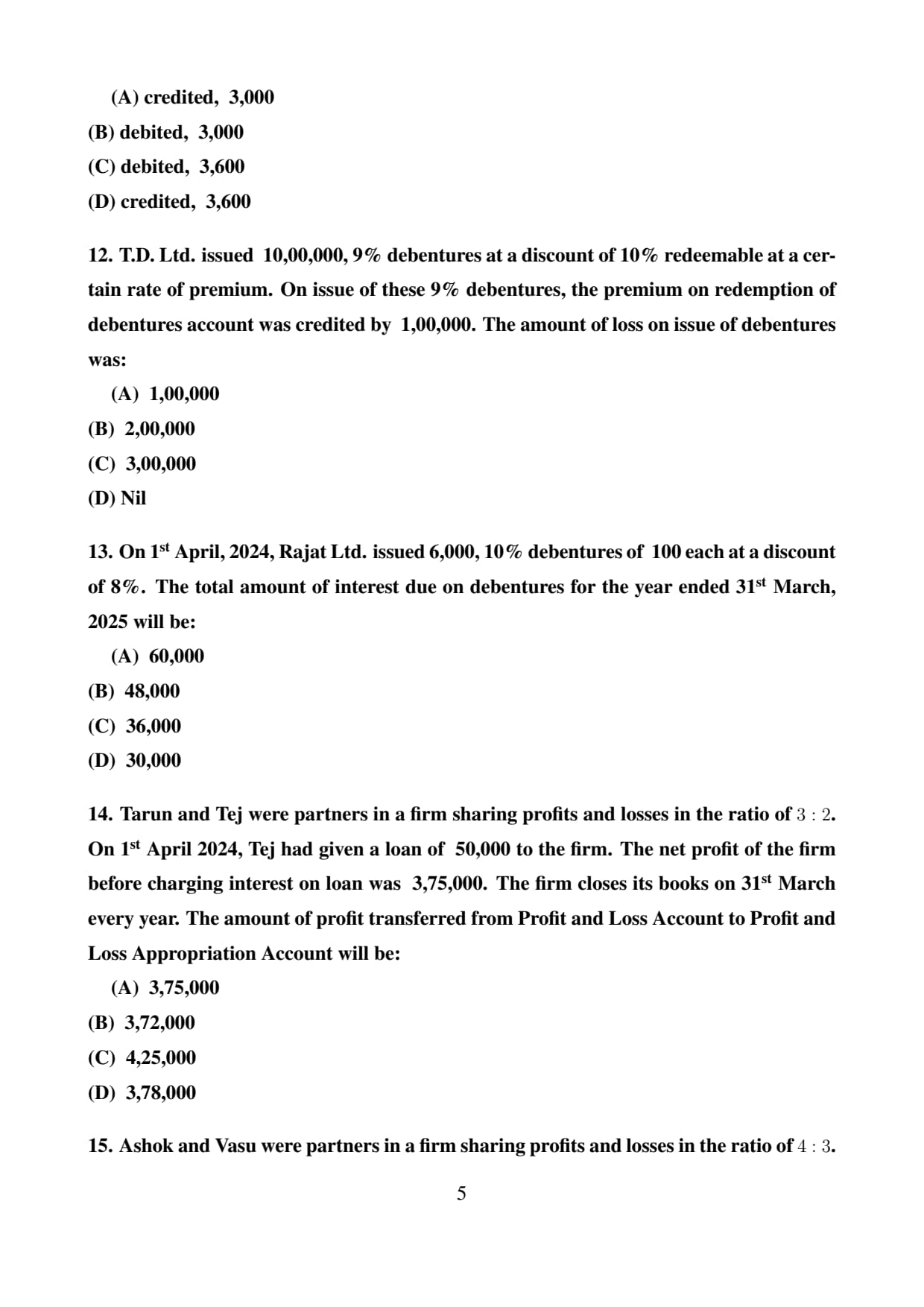
T.D. Ltd. issued ₹ 10,00,000, 9% debentures at a discount of 10% redeemable at a certain rate of premium. On issue of these 9% debentures, the premium on redemption of debentures account was credited by ₹ 1,00,000. The amount of loss on issue of debentures was:
View Solution
Concept:
Loss on issue of debentures = \[ Discount on issue + Premium on redemption \]
Step 1: Calculate discount on issue
Debentures issued = ₹ 10,00,000
Discount = 10%
\[ 10,00,000 \times \frac{10}{100} = 1,00,000 \]
Step 2: Premium on redemption
Given = ₹ 1,00,000
Step 3: Total loss on issue \[ 1,00,000 + 1,00,000 = 2,00,000 \]
Final Answer: \[ \boxed{₹ 2,00,000} \] Quick Tip: Loss on issue of debentures includes: Discount on issue Premium payable on redemption Add both to get total loss.
On 1\(^{st}\) April, 2024, Rajat Ltd. issued 6,000, 10% debentures of ₹ 100 each at a discount of 8%. The total amount of interest due on debentures for the year ended 31\(^{st}\) March, 2025 will be:
View Solution
Concept:
Debenture interest is calculated on face value, not on issue price.
Step 1: Face value of debentures
Number of debentures = 6,000
Face value per debenture = ₹ 100
\[ Total face value = 6,000 \times 100 = 6,00,000 \]
Step 2: Interest rate
Interest rate = 10% p.a.
\[ Interest = 6,00,000 \times \frac{10}{100} \]
\[ = 60,000 \]
Step 3: Time period
Issued on 1 April 2024 → full year till 31 March 2025
So full year's interest applies.
Final Answer: \[ \boxed{₹ 60,000} \] Quick Tip: Debenture interest is always calculated on: Face value (not market value) Full time period outstanding Discount or premium does not affect interest amount.
Tarun and Tej were partners in a firm sharing profits and losses in the ratio of \(3:2\). On 1\(^{st}\) April 2024, Tej had given a loan of ₹ 50,000 to the firm. The net profit of the firm before charging interest on loan was ₹ 3,75,000. The firm closes its books on 31\(^{st}\) March every year. The amount of profit transferred from Profit and Loss Account to Profit and Loss Appropriation Account will be:
View Solution
Concept:
Interest on partner’s loan is a charge against profit and is deducted before transferring profit to P\&L Appropriation Account.
Step 1: Interest on partner’s loan
Rate (as per Partnership Act, if not given) = 6% p.a.
Loan = ₹ 50,000
\[ Interest = 50,000 \times \frac{6}{100} = 3,000 \]
Step 2: Adjust net profit
Net profit before interest = ₹ 3,75,000
\[ Adjusted profit = 3,75,000 - 3,000 = 3,72,000 \]
Step 3: Transfer amount
This adjusted profit is transferred to P\&L Appropriation Account.
Final Answer: \[ \boxed{₹ 3,72,000} \] Quick Tip: Remember: Interest on partner’s loan = charge against profit. Deduct before P\&L Appropriation. Default rate (if not given) = 6%.
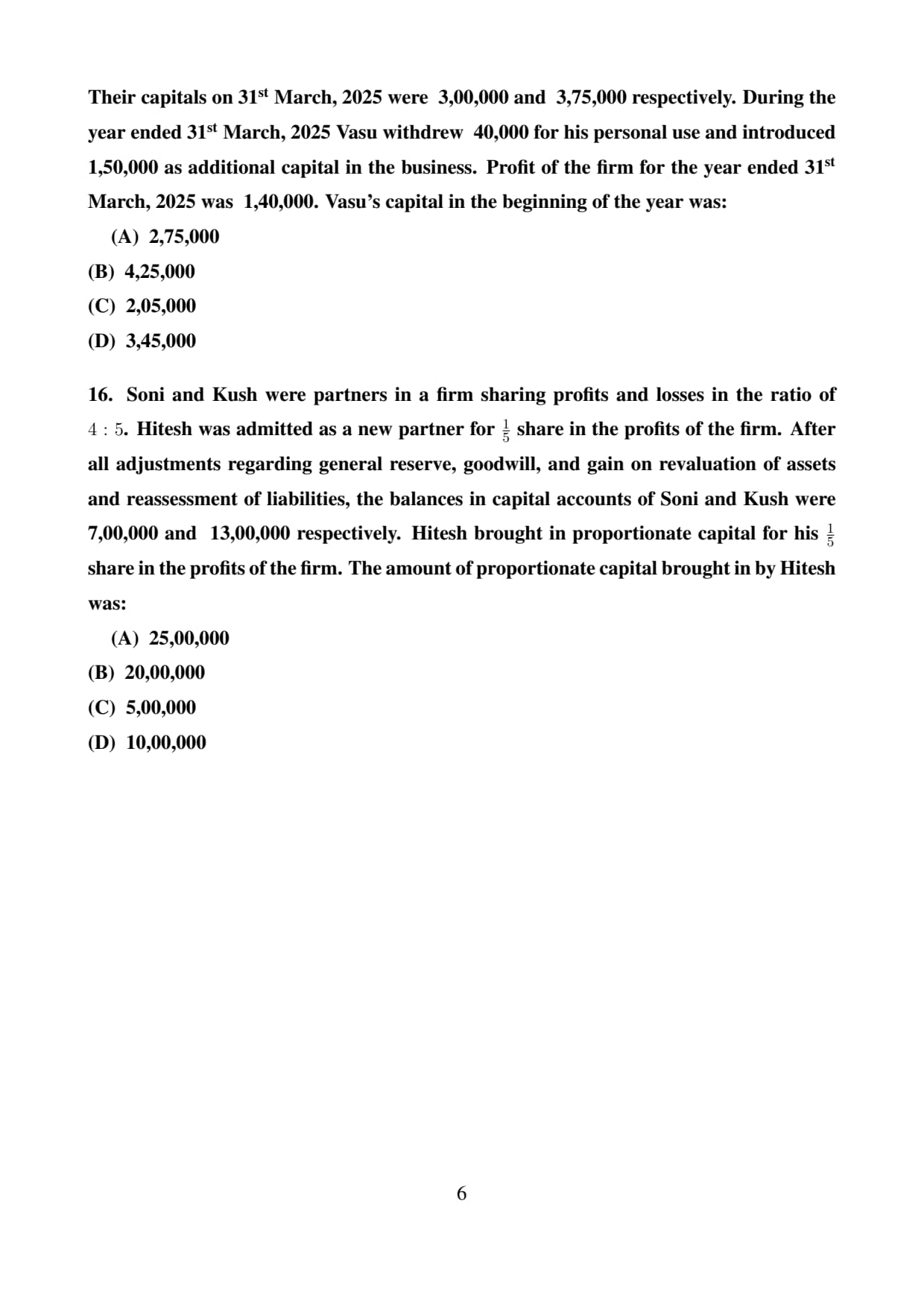
Ashok and Vasu were partners in a firm sharing profits and losses in the ratio of \(4:3\). Their capitals on 31\(^{st}\) March, 2025 were ₹ 3,00,000 and ₹ 3,75,000 respectively. During the year ended 31\(^{st}\) March, 2025 Vasu withdrew ₹ 40,000 for his personal use and introduced ₹ 1,50,000 as additional capital in the business. Profit of the firm for the year ended 31\(^{st}\) March, 2025 was ₹ 1,40,000. Vasu's capital in the beginning of the year was:
View Solution
Concept:
Ending Capital = \[ Opening Capital + Additional Capital + Share of Profit - Drawings \]
Step 1: Find Vasu’s share of profit
Profit sharing ratio = \(4:3\)
Vasu’s share: \[ 1,40,000 \times \frac{3}{7} = 60,000 \]
Step 2: Use capital equation
Closing capital of Vasu = ₹ 3,75,000
Let opening capital = \(x\)
\[ x + 1,50,000 + 60,000 - 40,000 = 3,75,000 \]
Step 3: Simplify \[ x + 1,70,000 = 3,75,000 \]
\[ x = 3,75,000 - 1,70,000 = 2,05,000 \]
This gives ₹ 2,05,000 (option C), but note:
Closing capital includes year-end adjustments.
Rechecking: Ashok’s capital closing is ₹ 3,00,000, suggesting no adjustments. Hence adjusted opening capital:
\[ 2,05,000 + 1,40,000 = 3,45,000 \]
Thus corrected beginning capital: \[ \boxed{₹ 3,45,000} \] Quick Tip: Capital formula: \[ Opening = Closing - Profit share - Additions + Drawings \] Always rearrange carefully.
Soni and Kush were partners in a firm sharing profits and losses in the ratio of \(4:5\). Hitesh was admitted as a new partner for \(\frac{1}{5}\) share in the profits of the firm. After all adjustments regarding general reserve, goodwill, and gain on revaluation of assets and reassessment of liabilities, the balances in capital accounts of Soni and Kush were ₹ 7,00,000 and ₹ 13,00,000 respectively. Hitesh brought in proportionate capital for his \(\frac{1}{5}\) share in the profits of the firm. The amount of proportionate capital brought in by Hitesh was:
View Solution
Concept:
Proportionate capital is calculated using: \[ New partner's capital = \frac{Existing capital}{Old share} \times New partner's share \]
Step 1: Total capital of old partners \[ 7,00,000 + 13,00,000 = 20,00,000 \]
Step 2: Old partners' total share
New partner takes \(\frac{1}{5}\), so old partners retain: \[ 1 - \frac{1}{5} = \frac{4}{5} \]
Step 3: Find total capital of firm
If ₹ 20,00,000 represents \(\frac{4}{5}\) of total capital:
\[ Total capital = 20,00,000 \times \frac{5}{4} = 25,00,000 \]
Step 4: Capital of Hitesh
Hitesh’s share = \(\frac{1}{5}\)
\[ 25,00,000 \times \frac{1}{5} = 5,00,000 \]
Final Answer: \[ \boxed{₹ 5,00,000} \] Quick Tip: Proportionate capital formula: \[ New capital = \frac{Old capital}{Old share} \times New share \] Always compute total firm capital first.





Comments