




CBSE Class 12 Artificial Intelligence Set 4 Question Paper PDF (364) is now available for download. CBSE conducted the Class 12 Artificial Intelligence examination on February 26, 2024 from 10:30 AM to 1:30 PM. The question paper consists of 21 questions carrying a total of 50 marks. Section – A has objective type questions whereas Section – B contains subjective type questions.
Candidates can use the link below to download the CBSE Class 12 Artificial Intelligence Question Paper with detailed solutions.
CBSE Class 12 Artificial Intelligence Question Paper 2024 Set 4 (364) with Answer Key
| CBSE Class 12 2024 Artificial Intelligence Question Paper with Answer Key |  Download Download |
Check Solution |
CBSE Class 12 2024 Artificial Intelligence Questions with Solutions
SECTION A
Question 1:
Answer any 4 out of the given 6 questions on Employability Skills.
(i) _________ is a form of communication that allows students to put their feelings and ideas on paper, to organize their knowledge and beliefs into convincing arguments, and to convey meaning through well-constructed text.
View Solution
Solution:
• Writing is a form of communication that involves the organization of ideas, knowledge and beliefs into text. It allows for well constructed arguments and to convey information in a structured manner. It uses written words to articulate complex thoughts and arguments.
• Active Listening is a communication technique where one pays close attention to what others are saying.
• Absolute Phrase is a grammatical term that represents a phrase that modifies a noun or clause, but has no grammatical connection to the main clause.
• Speeches are a form of oral communication where one conveys their ideas through spoken words.
Question 1(ii):
The term OCPD stands for _________.
View Solution
Solution:
• Obsessive Compulsive Personality Disorder (OCPD) is a specific personality disorder characterized by a need for orderliness, perfectionism, and control. It is also often accompanied with an excessive focus on details. It is one of the many types of personality disorders which can affect interpersonal skills and can lead to difficulties in personal and professional settings.
Question 1(iii):
Identify the incorrect statement from the following:
View Solution
Solution:
• Option (b) is the incorrect statement, as motivation helps in facing our challenges and fulfilling responsibilities, not in ignoring them. Motivation is a driving force that pushes us to act and take steps to reach our goals, and it is always aimed at being positive.
• Other options are correct: Motivation and positive thinking can lead to overcoming of challenges, can come from within or from outside, and they are the basic principles required for setting goals.
Question 1(iv):
Which of the following statements is NOT true for spreadsheet?
View Solution
Solution:
• The statement that is not true is option (c), as spreadsheets are often used to represent data pictorially with the help of graphs and charts. The graphical representation helps in a better understanding of the data.
• Other statements are correct: A spreadsheet program consists of workbooks, which have many worksheets within them. They can handle large volumes of data and have in-built tools and functions that help in making calculations faster and with great precision.
Question 1(v):
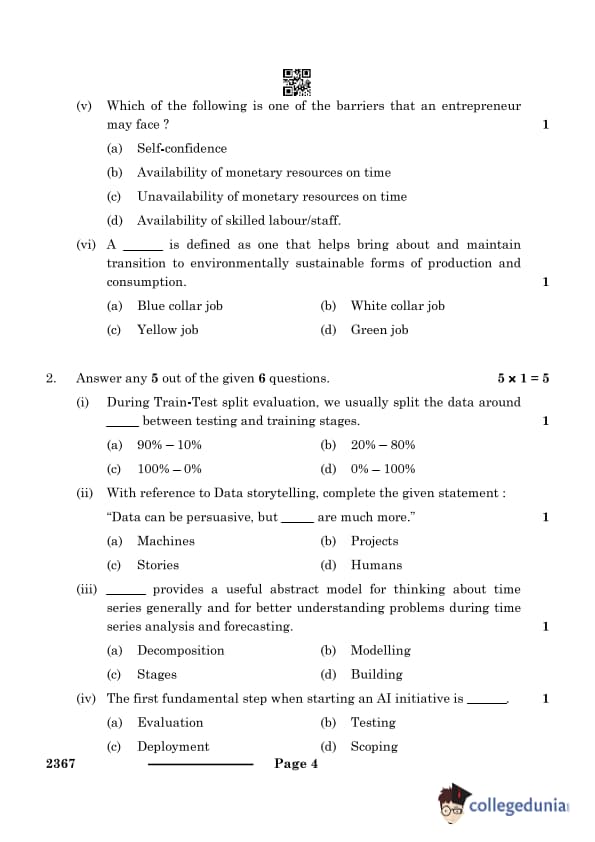
Which of the following is one of the barriers that an entrepreneur may face?
View Solution
Solution:
• Unavailability of monetary resources on time is one of the key barriers that an entrepreneur may face as it can stop them from running their business effectively, and also impacts growth and operational efficiency.
• Self-confidence and skilled labour or staff are assets for an entrepreneur, not barriers. Availability of monetary resources will enable the entrepreneur to perform better.
Question 1(vi):
A _________ is defined as one that helps bring about and maintain transition to environmentally sustainable forms of production and consumption.
View Solution
Solution:
• A Green job is one that promotes environmentally sustainable forms of production and consumption. It focuses on sustainability and environmental responsibility, which are not included in other types of jobs.
• A blue-collar job generally involves manual labor or work in the manufacturing and production sectors.
• A white-collar job is related to jobs which involve administrative, managerial and professional responsibilities.
• A yellow-collar job refers to the entertainment and recreation sectors.
Question 2:
Answer any 5 out of the given 6 questions.
Question 2(i):
During Train-Test split evaluation, we usually split the data around ________ between testing and training stages.
View Solution
Solution:
• The data is generally split between training and testing datasets, with the training dataset often making up the larger part of the data (around 80%) and the testing dataset the smaller part (around 20%). The training data is used to train the model, and the testing dataset is used to assess its performance.
• Other options are not standard formats for a train test split.
Question 2(ii):
With reference to Data storytelling, complete the given statement : “Data can be persuasive, but _________ are much more.”
View Solution
Solution:
• This refers to the importance of storytelling along with data to make it more effective. Data on its own can be persuasive, but data presented with the use of an interesting story becomes much more impactful.
Question 2(iii):
_________ provides a useful abstract model for thinking about time series generally and for better understanding problems during time series analysis and forecasting.
View Solution
Solution:
• Decomposition is a method that breaks down a time series into several parts such as trends, seasonality, and residual elements. This helps in understanding and analyzing the nature of time series data to better predict future trends.
• Other options are not necessarily related to the abstract model for understanding time series data.
Question 2(iv):
The first fundamental step when starting an AI initiative is _________.
View Solution
Solution:
• Scoping is the fundamental step when starting an AI initiative. It involves clearly defining the problem to be solved, the goals of the AI initiative, and the boundaries of the project, and it provides a foundation for all the other steps to follow.
• Evaluation, testing and deployment all follow a well-defined scope for a project.
Question 2(v):
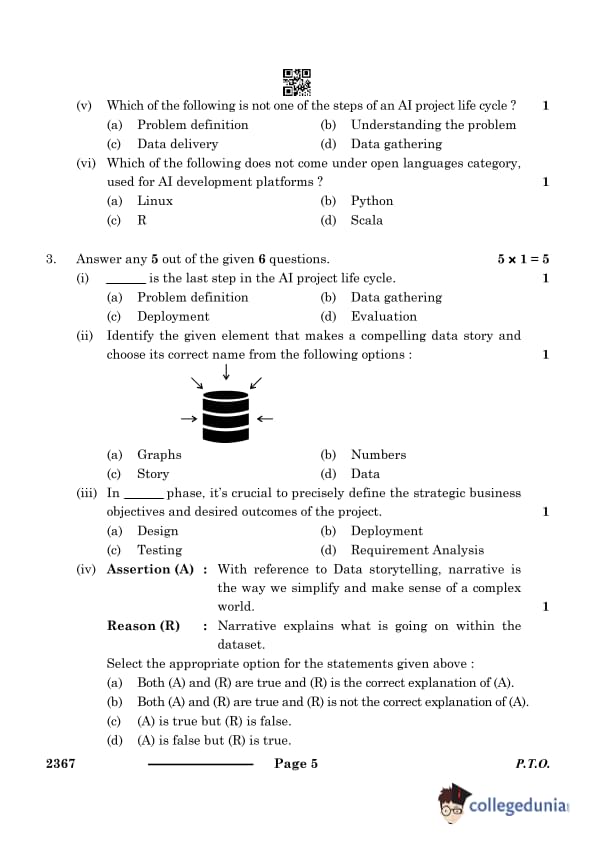
Which of the following is not one of the steps of an AI project life cycle?
View Solution
Solution:
• The AI project life cycle involves several steps, which start with understanding the problem and collecting data. Data delivery is not a step in the AI project life cycle.
• The AI project starts with problem definition, where the scope of the project is decided. Data gathering comes after the problem is defined, where relevant data is collected for the project. Understanding of the problem involves in analyzing different aspects of the problem.
Question 2(vi):
Which of the following does not come under open languages category, used for AI development platforms?
View Solution
Solution:
• Linux is an open-source operating system and not a programming language and hence is not used as a platform for AI development.
• Python, R, and Scala are all popular open-source programming languages often used for AI development.
Question 3:
Answer any 5 out of the given 6 questions.
Question 3(i):
_________ is the last step in the AI project life cycle.
View Solution
Solution:
• Deployment is the last step of AI project lifecycle, where the model is implemented and integrated with the user.
• Problem definition and data gathering are initial steps in the AI project life cycle. Evaluation is a stage where the model is assessed, and is before the deployment phase.
Question 3(ii):
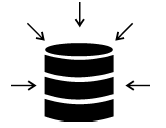
Identify the given element that makes a compelling data story and choose its correct name from the following options:
View Solution
Solution:
• The given image indicates an attempt to indicate a narrative, or a story, which is an important element to convert data into information that people can understand. A compelling data story involves a series of events or elements that help guide the audience, and is often represented through connecting different pieces of data.
• Other options, like data, graphs or numbers are important parts of the process, but not the connecting element for building a data story.
Question 3(iii):
In _________ phase, it's crucial to precisely define the strategic business objectives and desired outcomes of the project.
View Solution
Solution:
• Requirement Analysis is the phase where the strategic business objectives and desired outcomes are clearly defined. It is an important stage for a successful project.
• Other phases like design, deployment and testing are later stages in the project.
Question 3(iv):
Assertion (A): With reference to Data storytelling, narrative is the way we simplify and make sense of a complex world.
Reason (R): Narrative explains what is going on within the dataset.
Select the appropriate option for the statements given above:
View Solution
Solution:
• Both Assertion (A) and Reason (R) are true. Narratives, used in data storytelling, simplify complex data and help in making sense of a complex world. And the narrative also helps explain what is happening with the dataset by connecting the different variables.
• So, Reason (R) is a valid explanation for the Assertion (A).
Question 3(v):
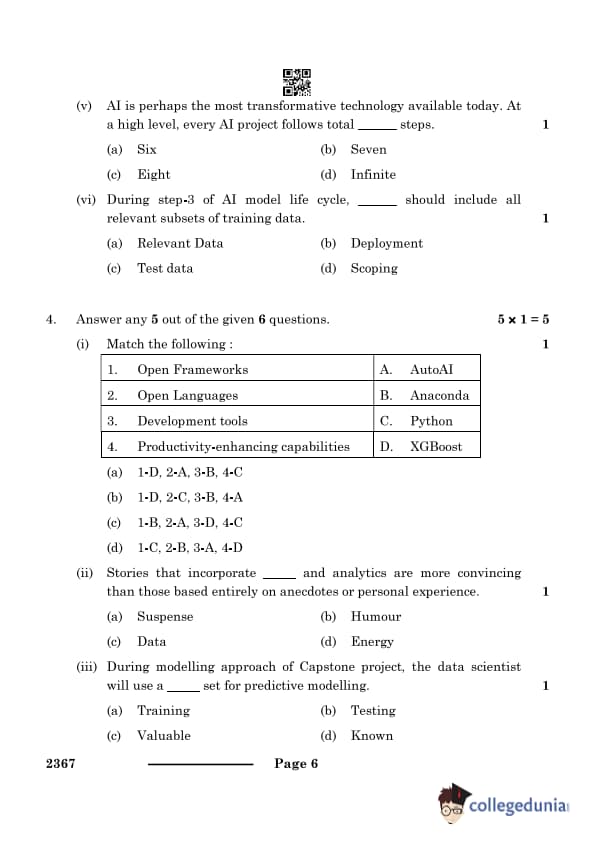
AI is perhaps the most transformative technology available today. At a high level, every AI project follows total ______ steps.
View Solution
Solution:
• At a high level, the AI project lifecycle is often presented as having six key steps: problem definition, data gathering, data preparation, model building, testing and evaluation, and deployment.
Question 3(vi):
During step-3 of AI model life cycle, _________ should include all relevant subsets of training data.
View Solution
Solution:
• During the data preparation step of the AI model life cycle (which is the third step), the dataset should include all the relevant data to train the model effectively and which avoids bias.
• Deployment, test data and scoping are other stages of AI project lifecycle.
Question 4:
Answer any 5 out of the given 6 questions.
Question 4(i):
Match the following:
| 1. Open Frameworks | A. AutoAI | |
| 2. Open Languages | B. Anaconda | |
| 3. Development tools | C. Python | |
| 4. Productivity-enhancing capabilities | D. XGBoost |
View Solution
Solution:
• Open Frameworks: The correct match is XGBoost. XGBoost is an open-source machine learning framework used for implementing ML algorithms.
• Open Languages: The correct match is Python. It is a high-level, general-purpose programming language used for different applications, including AI development.
• Development Tools: The correct match is Anaconda. Anaconda is an open-source distribution of Python and R, used for scientific and data analysis and modeling.
• Productivity-enhancing capabilities: The correct match is AutoAI. AutoAI refers to automated AI tools used for various applications.
Question 4(ii):
Stories that incorporate _________ and analytics are more convincing than those based entirely on anecdotes or personal experience.
View Solution
Solution:
• Stories that include data and analytics are more convincing, which can be used to back up claims and statements. The use of relevant and verified data adds credibility and validity to the stories.
Question 4(iii):
During the modeling approach of the Capstone project, the data scientist will use a _________ set for predictive modeling.
View Solution
Solution:
• During the modeling phase of the project, the data scientist will use the training set to build predictive models and learn from the patterns and features of the available data. The trained model is later assessed using the testing dataset.
Question 4(iv):
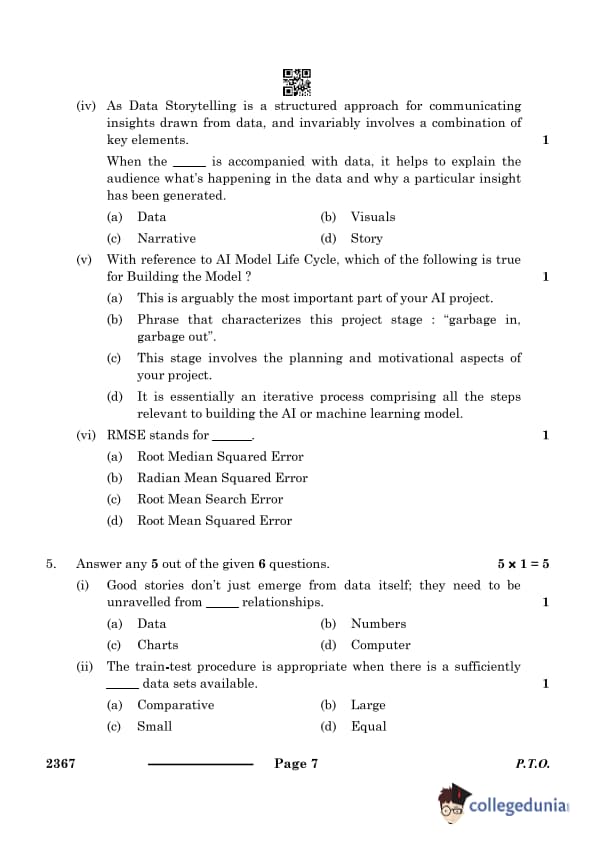
As Data Storytelling is a structured approach for communicating insights drawn from data, and invariably involves a combination of key elements. When the _________ is accompanied with data, it helps to explain to the audience what's happening in the data and why a particular insight has been generated.
View Solution
Solution:
• A strong data story requires data along with a narrative that helps to interpret and contextualize that data. The narrative helps explain to the audience what is happening in the data and present any specific insight. Data without narratives will often remain abstract and difficult to grasp.
Question 4(v):
With reference to AI Model Life Cycle, which of the following is true for Building the Model?
View Solution
Solution: Building the AI model is an iterative process that includes:
• Data preprocessing
• Feature engineering
• Model selection
• Training and validation
• Hyperparameter tuning
The process requires multiple iterations to optimize model performance and improve accuracy.
Question 4(vi):
RMSE stands for _________.
View Solution
Solution:
• RMSE stands for Root Mean Squared Error, which is a common metric for measuring the error of a regression model by taking the square root of the mean of the squares of the errors.
Question 5:
Answer any 5 out of the given 6 questions.
Question 5(i):
Good stories don't just emerge from data itself; they need to be unravelled from _________ relationships.
View Solution
Solution:
• Data needs to be carefully examined to find the relationships between different elements, which helps in creating good stories. These relationships help in explaining the patterns and key information that can be gleaned from the data.
Question 5(ii):
The train-test procedure is appropriate when there is a sufficiently _________ data sets available.
View Solution
Solution:
• The train-test procedure requires a sufficiently large dataset to enable an effective evaluation of model performance. Larger datasets allow for better and more accurate evaluation of the model.
Question 5(iii):
During the third step of the AI Model Life Cycle, the volume of test data can be large, which presents _________.
View Solution
Solution:
• During the third phase (data preparation and pre-processing) of the AI Model Life Cycle, the volume of test data can often be very large. This large dataset leads to more complexities in data management and analysis.
Question 5(iv):
In _________, we run our modeling process on different subsets of the data to get multiple measures of model quality.
View Solution
Solution:
• Cross-validation is a technique where the modeling process is run on different subsets of the data to get multiple measures of model quality. This makes the model more robust and reliable by using multiple subsets of data, instead of depending on just one.
• Train-test split, regression, and machine learning are different techniques and methods but not related to running models on different data subsets.
Question 5(v):
The machine learning life cycle is the _________ process that AI or machine learning projects follow.
View Solution
Solution:
• The machine learning life cycle is described as a cyclic process because the steps are repeated or iterated upon for continuous improvement. It is an iterative process.
Question 5(vi):
Data Modeling focuses on developing models that are either descriptive or _________.
View Solution
Solution:
• Data modeling generally involves developing two types of models: descriptive, which explains what has happened, and predictive, which predicts what will happen in the future. It helps in making data-driven decisions.
SECTION B
Answer any 3 out of the given 5 questions on Employability Skills. Answer each question in 20-30 words:
Question 6:
Differentiate between ‘sentence’ and ‘phrase’ with the help of a suitable example.
View Solution
Solution:
• Sentence: A sentence is a group of words that expresses a complete thought. It contains a subject and a predicate, expressing a complete idea with a clear meaning. Example: "The cat sat on the mat."
• Phrase: A phrase is a group of words that does not contain a subject and a verb, and usually does not express a complete thought. It is just a part of a larger sentence. Example: "on the mat".
Question 7:
Briefly explain the following terms:
(a) Personality
(b) Personality disorders
View Solution
Solution:
• (a) Personality: Personality refers to the unique pattern of thoughts, feelings, and behaviors that define an individual, forming a unique identity. It is shaped by environmental and genetic factors and determines one's way of interacting with the world.
• (b) Personality disorders: Personality disorders are a category of mental disorders causing individuals to exhibit maladaptive and inflexible traits, creating difficulty in maintaining interpersonal relationships and healthy functioning.
Question 8:
Mr. Chowdhary wants to explain the working of a product to his clients. To make an impact on their audience, either he can use homemade charts or make a digital presentation using a computer and presentation software. Which out of the two options is more advantageous and why? Give any three points to support your answer.
View Solution
Solution:
• A digital presentation using a computer and presentation software is more advantageous than using homemade charts for explaining the product.
• Reasons:
– Enhanced Visuals: Digital presentations can incorporate high-quality images, videos, and animations, making them more visually appealing and engaging than basic homemade charts.
– Greater Interactivity: Digital presentations can include interactive elements, making them more engaging and personalized for the audience.
– Flexibility and Ease of Use: Digital presentations can be easily modified, updated, and customized, making them more adaptable and easy to present.
Question 9:
What do you mean by interpersonal skills? Why is it important for an entrepreneur to possess it? Briefly discuss.
View Solution
Solution:
• Interpersonal Skills: Interpersonal skills are the abilities to communicate and interact effectively with others. This includes active listening, non-verbal communication, negotiation skills, and conflict management.
• Importance for an Entrepreneur:
– Effective Communication: Entrepreneurs need to communicate their vision effectively to employees, customers, and stakeholders.
– Networking: Entrepreneurs require effective networking skills to build alliances and forge lasting relationships with clients, partners, and suppliers.
– Team Building: To build a strong and productive team, an entrepreneur should be able to effectively manage, guide, and motivate their employees.
Question 10:
Mention any four advantages of Green jobs.
View Solution
Solution:
• Environmental Sustainability: Green jobs help transition to sustainable production and consumption patterns, conserving natural resources and building a healthier planet.
• Economic Growth: Green jobs drive innovation and economic growth through investment in environmentally sustainable technologies and products.
• Improved Public Health: Green jobs create healthier environments, improving overall quality of life by reducing pollution and environmental hazards.
• New Job Opportunities: Green jobs create opportunities in sectors like renewable energy, waste management, and sustainable agriculture.
Answer any 4 out of the given 6 questions in 20-30 words each.
Question 11:
What is a training set?
View Solution
Solution:
A training set is a subset of a dataset used to train a machine learning or AI model. It allows the model to learn from the data's patterns, features, and relationships. A good training set is essential for building accurate and reliable models.
Question 12:
Name the two categories of loss functions.
View Solution
Solution:
The two main categories of loss functions are:
- Regression Loss Functions: These functions measure errors in regression-type predictive models when the target variable is numerical (e.g., Mean Squared Error and Mean Absolute Error).
- Classification Loss Functions: These functions measure errors in classification models when the target variable is categorical (e.g., Binary Cross Entropy and Categorical Cross-Entropy).
Question 13:
“Stories create engaging experiences that transport the audience to another space and time". Justify this statement.
View Solution
Solution:
Stories engage our emotions and imagination, grabbing and holding the audience's attention. They transport the audience to a different time and space by painting a mental picture using vivid details and compelling narratives, creating a powerful connection between the story and its audience.
Question 14:
What is a Capstone project? Give any two examples.
View Solution
Solution:
A capstone project is a multi-faceted culminating academic experience. It allows students to apply the skills and knowledge gained during a program.
Examples:
- Developing a new AI-based product or tool.
- Designing and implementing a data analysis and visualization report based on a given dataset.
Question 15:
Name the two techniques that can be used to validate AI model quality.
View Solution
Solution:
Two techniques used to validate AI model quality are:
- Cross-validation: Dividing data into subsets and running model training on them to ensure accurate predictions on unseen data.
- Performance Metrics: Metrics like F1 Score, Precision, Recall, and AUC measure a model's accuracy on evaluation datasets.
Question 16:
Name any two open frameworks and two development tools that can be used to build an AI model.
View Solution
Solution:
Open Frameworks:
- TensorFlow: A powerful and flexible open-source machine learning framework for building various AI models. It provides tools and libraries for implementing machine learning algorithms.
- PyTorch: A popular open-source deep learning framework known for flexibility and ease of use in AI research and development. It supports dynamic computational graphs.
Development Tools:
- Jupyter Notebook: An open-source interactive coding environment for writing, documenting, and sharing code with visualizations and outputs.
- Anaconda: An open-source distribution of Python and R, providing data scientists with necessary packages and tools to develop AI models.
Answer any 3 out of the given 5 questions in 50-80 words each.
Question 17:
List any four importance of Data Storytelling.
View Solution
Solution:
• Clarity and Comprehension: Data storytelling simplifies complex data, making it easier for everyone to understand key insights, trends, and patterns.
• Engaging the Audience: It creates a connection with the audience by incorporating elements of human drama and emotions, making data presentations more engaging.
• Retention and Recall: Presenting data as a story makes it more memorable than just numbers or graphs, improving audience retention and recall.
• Actionable Insights: Data storytelling helps convert insights into actionable strategies, making the data more relevant and usable for stakeholders.
Question 18:
What is Design Thinking? List its main stages.
View Solution
Solution:
• Design Thinking: A human-centered, iterative problem-solving approach focusing on understanding user needs and creating innovative solutions. It emphasizes a user-centric approach for building products and services.
• Main Stages of Design Thinking:
– Empathize: Understand the user and their needs from different perspectives.
– Define: Clearly define the problem based on the understanding gained.
– Ideate: Generate potential ideas and solutions for the problem.
– Prototype: Create a tangible representation of the solutions.
– Test: Analyze, refine, and improve the prototype based on user feedback.
Question 19:
Explain the “Design/Building the Model” step of the AI Model lifecycle in detail.
View Solution
Solution:
• “Design/Building the Model” Step: This stage uses data to build the AI or machine learning model. It's a crucial, iterative phase with multiple sub-steps:
– Algorithm Selection: Choosing the right machine learning algorithm for the problem, considering complexity and performance.
– Model Training: Training the algorithm on the training dataset to learn patterns and relationships between inputs and outputs. Model parameters are adjusted based on performance.
– Hyperparameter Tuning: Adjusting model settings (hyperparameters) to improve performance, efficiency, and accuracy.
– Model Evaluation: Assessing the trained model using test data (different from training data) and performance metrics. If metrics are inadequate, steps are repeated.
– Iterative Process: Model building involves multiple rounds of tuning, experimentation, and testing for an optimal model.
Question 20:
Expand and explain the term MSE. Give the mathematical formula to calculate MSE. Why use MSE? Briefly discuss.
View Solution
Solution:
• Expansion of MSE: MSE stands for Mean Squared Error.
• Explanation of MSE: A loss function measuring the average squared difference between predicted and actual values. Predictions are made by the model.
• Formula for MSE: MSE = (1/n) * Σ(Yi - Y′)²
Where:
n is the number of data points
Yi is the actual value
Y′ is the predicted value
• Why Use MSE:
– Sensitivity to Errors: Penalizes larger errors more.
– Differentiability: Has good mathematical properties for optimization.
– Commonly used: Provides an overall assessment of model performance.
Question 21(a):
Why is Storytelling so powerful and cross-cultural? Explain.
View Solution
Solution:
• Emotional Connection: Stories create a deep emotional bond with the audience through events and characters, enhancing connection.
• Enhanced Memorability: Stories are easier to remember than facts and data due to plot, characters, and narrative structure.
• Relatability: Customizable to relatable themes, increasing impact and cross-cultural accessibility.
• Universal Language: Storytelling transcends language and cultural barriers; the power of a good narrative is universally understood.
• Simplification of Complex Ideas: Stories simplify complex issues and data, making information accessible to wider audiences.
Question 21(b):
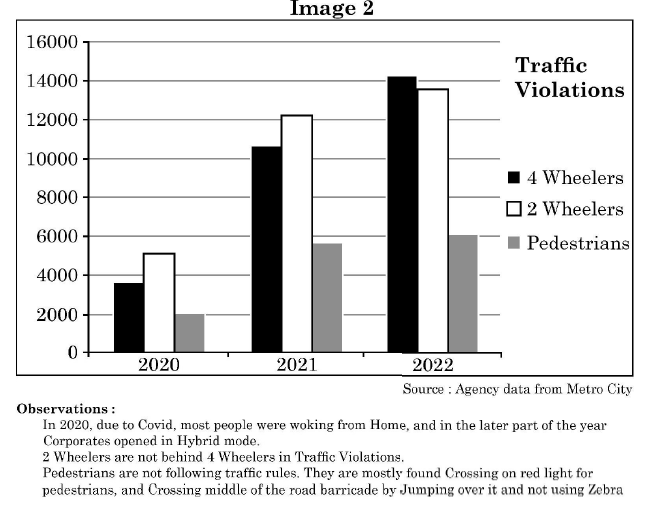
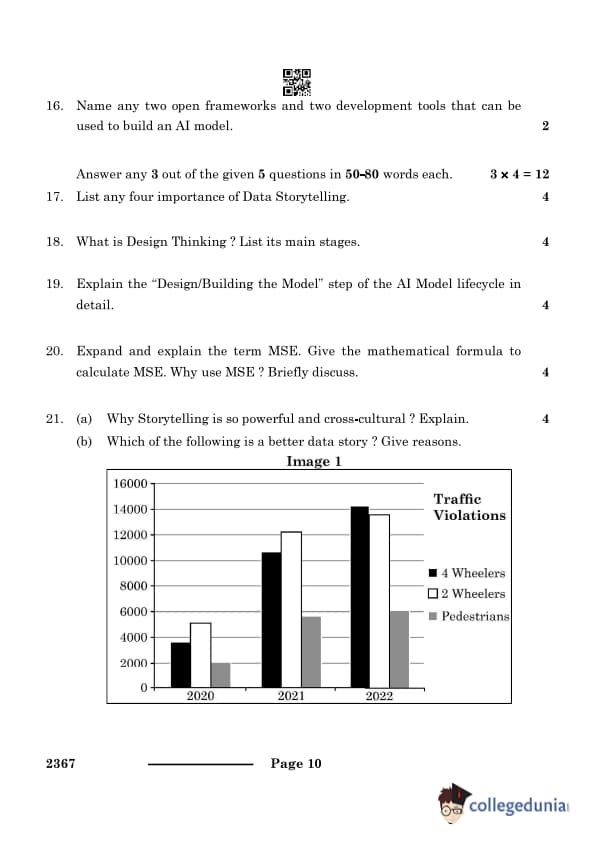
Which of the following is a better data story? Give reasons.
Image 1
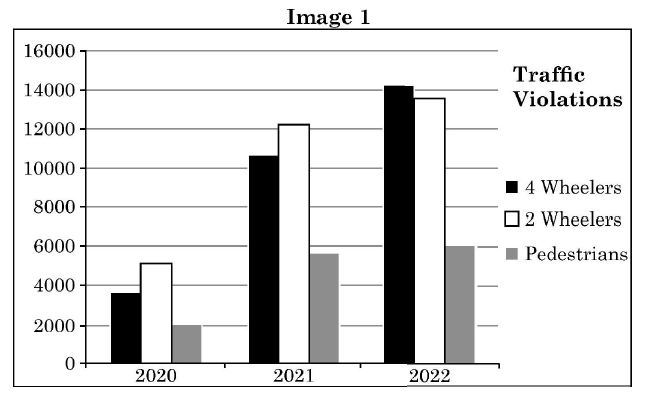
Image 2
View Solution
Solution:
Image 2 is a better data story.
• Image 2 provides context: Along with visual data representation, Image 2 offers explanations for the trends, like the impact of COVID and hybrid work models in 2020. This added context helps in understanding the "why" behind the data.
• Image 1 lacks narrative: Image 1 only shows numbers and categories without interpretation. It lacks the narrative element crucial for a compelling data story.
• Observations add meaning: The observations in Image 2 connect the data to real-world events, enhancing understanding and making the data more meaningful.







Comments