




CBSE Class 12 Biology Set 1 Question Paper PDF (57/2/1) is now available for download. CBSE conducted the Class 12 Biology examination on March 19, 2024, from 10:30 AM to 1:30 PM. The question paper consists of 33 questions carrying a total of 70 marks. Section A includes 16 MCQs for 1 mark each, Section B contains 5 very short-answer questions for 2 marks each, Section C comprises 7 short-answer questions for 3 marks each, Section D comprises 2 Case-based questions carries 4 marks each and Section E comprises 3 long-answer questions carries 5 marks each.
Candidates can use the link below to download the CBSE Class 12 Biology Set 1 Question Paper with detailed solutions.
CBSE Class 12 Biology Question Paper 2024 (Set 1- 57/2/1) with Answer Key
| CBSE Class 12 2024 Biology Question Paper with Answer Key |  Download Download |
Check Solution |
CBSE Class 12 2024 Biology Questions with Solutions
An angiosperm embryo sac is located within the:
View Solution
In angiosperms (flowering plants), the embryo sac, which is the female gametophyte, is located within the nucellus, a tissue found inside the ovule. The ovule is the structure that houses the female reproductive cells and is found within the ovary of the flower. The nucellus serves as the central part of the ovule, providing nourishment to the developing embryo sac.
The embryo sac contains the egg cell and other cells involved in fertilization. Fertilization occurs when a sperm cell from the pollen grain fuses with the egg cell inside the embryo sac. This process is essential for the formation of the zygote, which will develop into the embryo of the seed. The surrounding tissue of the ovule, including the nucellus, plays a supportive role in ensuring the proper development of the embryo sac and the fertilization process.
Thus, the nucellus and the embryo sac are critical components of the reproductive process in angiosperms, facilitating the fusion of male and female gametes and the development of the seed. Quick Tip: In angiosperms, the embryo sac is located within the nucellus, the part of the ovule where fertilization occurs, leading to seed formation.
Match the items in Column I with those in Column II and select the correctly matched option from those given below:
| Column I | Column II |
|---|---|
| Cross | Phenotypic Ratio |
| 1. Mendelian monohybrid | (i) 1 : 2 : 1 (F2) |
| 2. Mendelian dihybrid | (ii) 1 : 1 |
| 3. Incomplete dominance | (iii) 3 : 1 (F2) |
| 4. Test cross (monohybrid) | (iii) 3 : 1 (F2)(iv) 9 : 3 : 3 : 1 (F2) |
View Solution
Various genetic crosses yield different phenotypic ratios in the offspring, depending on the type of inheritance and genetic interaction involved. Below are the details of several key crosses:
Mendelian Monohybrid Cross (1): This cross involves the inheritance of a single trait, where one allele is dominant and the other is recessive. When crossed, the F1 generation typically shows the dominant phenotype, and the F2 generation exhibits a phenotypic ratio of 3:1, with three offspring showing the dominant trait and one showing the recessive trait. This is due to the segregation of alleles during gamete formation.
Mendelian Dihybrid Cross (2): A dihybrid cross involves two traits, each with a dominant and recessive allele. In the F2 generation, the phenotypic ratio of the offspring is 9:3:3:1. This occurs because the genes for the two traits assort independently, as stated by Mendel’s Law of Independent Assortment. The 9:3:3:1 ratio reflects the different combinations of the two traits inherited together.
Incomplete Dominance (3): In cases of incomplete dominance, neither allele is completely dominant over the other, leading to a blending of the traits in the heterozygote. For example, crossing red-flowered plants with white-flowered plants results in offspring with pink flowers. The phenotypic ratio in the F2 generation is 1:2:1, as both homozygous types (red and white) and the heterozygous intermediate (pink) appear.
Test Cross (4): A test cross is used to determine the genotype of an individual exhibiting the dominant phenotype. By crossing the individual with a homozygous recessive individual, the resulting offspring’s phenotypic ratio helps reveal whether the parent is heterozygous or homozygous dominant. If the parent is heterozygous, the F2 generation will show a 1:1 phenotypic ratio of dominant and recessive traits.
These genetic crosses illustrate key patterns in inheritance and help in understanding how traits are passed from one generation to the next. Quick Tip: Mendel’s laws of inheritance form the basis for genetic ratios in offspring. Incomplete dominance results in a 1:2:1 phenotypic ratio, while test crosses reveal a 1:1 ratio for heterozygous individuals.
In humans, the secondary oocyte completes meiotic division when:
View Solution
In humans, the secondary oocyte completes its second meiotic division only after it is penetrated by a sperm cell during fertilization. This step is critical for the oocyte to proceed to form a mature ovum. Quick Tip: The completion of the secondary oocyte’s meiotic division occurs during fertilization when the sperm enters the egg.
Which one of the following statements is not true?
View Solution
Homologous structures are similar because they share a common evolutionary origin, meaning they are inherited from a common ancestor. These structures may serve different functions in different species but have a similar underlying structure due to shared ancestry. In contrast, analogous structures arise from convergent evolution, where species independently evolve similar traits or functions despite having different evolutionary origins. Quick Tip: Homologous structures originate from common ancestry, whereas analogous structures emerge through convergent evolution, leading to similar functions despite different origins.
A population is in genetic equilibrium/Hardy-Weinberg equilibrium for a gene with 2 alleles (dominant allele is ‘A’ and recessive allele ‘a’). If the frequency of allele ‘A’ is 0.6, then the frequency of genotype ‘Aa’ is:
View Solution
According to Hardy-Weinberg equilibrium, the frequency of heterozygotes (Aa) is given by \( 2pq \), where:
- \( p \) is the frequency of allele A (\( p = 0.6 \))
- \( q \) is the frequency of allele a (\( q = 1 - p = 0.4 \))
The frequency of genotype Aa is: \[ 2pq = 2(0.6)(0.4) = 0.48 \] Quick Tip: In Hardy-Weinberg equilibrium, the frequency of heterozygotes is calculated by \( 2pq \), where \( p \) is the frequency of the dominant allele and \( q \) is the frequency of the recessive allele.
In the double helical structure of DNA molecule, the strands are:
View Solution
In the double helix structure of DNA, the two strands are complementary, meaning adenine pairs with thymine and cytosine pairs with guanine. The strands run in opposite directions (anti-parallel), with one strand oriented in the 5' to 3' direction and the other in the 3' to 5' direction. Quick Tip: DNA strands are complementary (A with T, C with G) and anti-parallel, meaning one strand runs in the opposite direction of the other.
In a 'transcription unit', the 'terminator' is located towards the:
View Solution
In transcription, the 'terminator' sequence is located at the 3' end of the coding strand. This is where the transcription process stops, and the newly synthesized RNA transcript is released. Quick Tip: The terminator in transcription is located at the 3' end of the coding strand, signaling the end of RNA synthesis.
A woman with normal vision has a colour blind father. She marries a man with normal vision. The percentage chance of their progeny being colour blind is:
View Solution
Since the woman has a colour-blind father, she is a carrier of the colour-blind allele. The genotype of the woman is \( X^N X^c \), where \( X^N \) represents the normal vision allele, and \( X^c \) represents the colour-blind allele. Her husband, who has normal vision, has the genotype \( X^N Y \), where \( Y \) represents the Y chromosome. Their offspring will inherit a combination of these alleles as follows:
Sons inherit their father's Y chromosome and one X chromosome from their mother. Since the mother is a carrier, they will inherit either \( X^N \) or \( X^c \). However, the Y chromosome does not carry the colour-blind allele, so all sons will have normal vision regardless of the X chromosome they inherit.
Daughters inherit one X chromosome from each parent. The father can only pass on \( X^N \), so daughters will inherit \( X^N \) from their father. Since the mother is a carrier, she can pass on either \( X^N \) or \( X^c \) to her daughters. If a daughter inherits \( X^c \) from her mother, she will be a carrier (with genotype \( X^N X^c \)) but will not be colour-blind. If she inherits \( X^N \) from her mother, she will have normal vision (with genotype \( X^N X^N \)).
Thus, for each daughter, there is a 50% chance that she will inherit the colour-blind allele \( X^c \) from her mother, making her a carrier. Therefore, the probability of a daughter being a carrier is 50%. Quick Tip: Colour blindness is an X-linked recessive trait. A carrier female has a 50% chance of passing the allele to her offspring.
The vector for dengue fever is:
View Solution
The main carrier of the dengue virus is the Aedes mosquito, especially the female. The mosquito becomes infected by biting an individual already carrying the virus and can then spread the infection to others through subsequent bites. Quick Tip: The female \textit{Aedes mosquito plays a key role in transmitting dengue fever, as it feeds on human blood and carries the virus.
Which one of the following pairs is not correctly matched?
View Solution
Clostridium butylicum is correctly linked to the production of Butyric acid.
Trichoderma polysporum is accurately associated with the production of Cyclosporin A.
Monascus purpureus is not correctly paired with Citric acid. This microorganism produces Monacolin K, which is used in the production of cholesterol-lowering drugs, not citric acid.
Streptococcus is correctly connected to the production of Streptokinase, an enzyme that helps dissolve blood clots.
Quick Tip: Certain microorganisms are utilized in the production of industrial products, such as antibiotics, enzymes, and acids. It is essential to match the correct microorganism with its respective product.
Which one of the following is not a feature of plasmids?
View Solution
Plasmids are generally circular and extra-chromosomal, meaning they exist outside of the chromosome and have the ability to replicate independently. They are typically double-stranded, rather than single-stranded. Quick Tip: Plasmids are circular, double-stranded DNA molecules that replicate independently from chromosomal DNA and can carry genes, such as those responsible for antibiotic resistance.
The pyramid of biomass in the sea is generally inverted because in the sea:
View Solution
In the marine ecosystem, the biomass of fish (which occupy higher trophic levels) can surpass the biomass of phytoplankton (the primary producers) due to the high turnover rate of phytoplankton. This creates an inverted biomass pyramid, where the primary producers have a lower biomass than the consumers. Quick Tip: In ecosystems like the ocean, the biomass pyramid can be inverted because the rapid turnover of small producers (phytoplankton) sustains a larger biomass of consumers (fishes).
Assertion (A): RNA is unstable and can mutate at a faster rate.
Reason (R): The presence of 2'-OH group in every nucleotide of RNA makes it labile and easily degradable.
View Solution
Assertion (A): RNA is indeed more unstable compared to DNA due to the 2'-OH group in its sugar molecule, which makes it more prone to hydrolysis and degradation.
Reason (R): The presence of the 2'-OH group in RNA makes it more reactive, contributing to its instability and higher mutation rate. Quick Tip: The 2'-OH group in RNA makes it more reactive and prone to degradation, which explains its instability and higher mutation rate compared to DNA.
Assertion (A): Virus-infected cells produce interferons.
Reason (R): Interferons can cause inflammation of virus-infected cells.
View Solution
Assertion (A): Virus-infected cells do produce interferons as part of the antiviral defense response to help neighboring cells resist viral infection.
Reason (R): Although interferons play a role in the immune response, they do not directly induce inflammation in infected cells. Instead, they boost the immune system's capacity to fight off viruses. Quick Tip: Interferons are cytokines released by virus-infected cells, but they do not directly trigger inflammation. They aid in protecting nearby cells from viral infections.
Assertion (A): Specific enzymes are used to degrade the cell wall in organisms to isolate the DNA from the cell.
Reason (R): Fungal cell wall is degraded by the enzyme cellulase.
View Solution
Assertion (A): Specific enzymes like lysozyme and cellulase are indeed used to break down the cell walls to release DNA, particularly in plant and fungal cells.
Reason (R): While cellulase breaks down cellulose in plant cell walls, fungal cell walls are primarily made of chitin, not cellulose. Therefore, chitinase is the enzyme that would degrade fungal cell walls, not cellulase. Quick Tip: For plant cells, cellulase is used to degrade the cell wall, while for fungi, chitinase is the enzyme used to break down the chitin-based cell wall.
Assertion (A): Loss of biodiversity can occur due to overexploitation of resources.
Reason (R): Introduction of Clarias gariepinus in Indian rivers has led to a decline in native Indian fishes.
View Solution
Assertion (A): "Loss of biodiversity can occur due to overexploitation of resources."
This is true. Overexploitation of natural resources, such as overfishing, deforestation, and excessive hunting, can lead to the loss of biodiversity. When species are exploited faster than they can reproduce, their populations decline, leading to a decrease in biodiversity. Therefore, the assertion is correct.
Reason (R): "Introduction of *Clarias gariepinus* in Indian rivers has led to a decline in native Indian fishes."
This is also true. *Clarias gariepinus*, also known as the African catfish, was introduced into Indian rivers for aquaculture purposes. However, it became an invasive species and outcompeted native fish species for food and space, leading to a decline in the populations of native Indian fishes. While this is true, it does not directly explain the assertion about the overexploitation of resources leading to biodiversity loss. The introduction of an invasive species is a different factor that contributes to biodiversity loss, but it is not a direct consequence of overexploitation of resources.
Thus, both the assertion and reason are true, but the reason is not a direct explanation of the assertion. The correct answer is (B). Quick Tip: Biodiversity loss can result from multiple factors, including overexploitation of resources and the introduction of invasive species. The introduction of *Clarias gariepinus* is an example of an invasive species that led to the decline of native fish populations in India.
(a) Name any two copper releasing intra-uterine devices. State two reasons that make them effective contraceptives.
View Solution
Two copper-releasing intra-uterine devices (IUDs) include:
1. Copper-T
2. Multiload Cu375
These IUDs are effective as contraceptives because:
1. They release copper ions, which create an unfavorable environment in the uterus, preventing sperm from fertilizing the egg.
2. They alter the cervical mucus, making it thicker and more difficult for sperm to penetrate.
Quick Tip: Copper-releasing IUDs are highly effective as they not only block fertilization but also modify the uterine environment to impair sperm mobility.
(b) Name any two outbreeding devices that flowering plants have developed and explain how they help in encouraging cross-pollination.
View Solution
Two outbreeding mechanisms developed by flowering plants to promote cross-pollination are:
1. Vividly colored flowers: The bright colors attract pollinators such as bees, birds, and butterflies, facilitating the transfer of pollen between flowers.
2. Staggered flowering times: Plants may flower at different times to prevent self-pollination, ensuring cross-pollination when different species or individuals bloom at different periods.
Quick Tip: Outbreeding mechanisms, such as vibrant flowers and varied flowering times, promote cross-pollination, which enhances genetic diversity in plants.
Although Hemophilia and sickle cell anemia are two blood-related Mendelian disorders, yet they differ in their pattern of inheritance. State any two differences.
View Solution
The two differences in inheritance patterns between Hemophilia and Sickle Cell Anemia are:
1. Hemophilia is X-linked recessive, meaning it is carried on the X chromosome and primarily affects males, while Sickle Cell Anemia is autosomal recessive, meaning it is inherited through non-sex chromosomes.
2. In Hemophilia, a single X chromosome carrying the defective gene is enough to express the disorder in males, but in Sickle Cell Anemia, both alleles must be defective (homozygous) for the disorder to be expressed in an individual.
Quick Tip: Hemophilia is X-linked, while Sickle Cell Anemia is autosomal. This difference affects the inheritance patterns, especially with regard to sex-linked transmission.
Identify A, B, C, and D in the following table:
| Scientific name of the plant | Drug | Effect on the human body/human system |
|---|---|---|
| (a) Papaver somniferum | A | Depressant/slows down body function |
| (b) Cannabis sativa | Cannabinoids | B |
| (c) Erythroxylum coca | C | D |
View Solution
1. Papaver somniferum produces Morphine, which is a depressant that slows down body functions.
2. Cannabis sativa produces Cannabinoids, which cause euphoria and relaxation.
3. Erythroxylum coca produces Cocaine, a stimulant that increases alertness and energy.
Quick Tip: Plants like Papaver somniferum, Cannabis sativa, and Erythroxylum coca produce substances that have significant effects on the human body, including depressants and stimulants.
Write the role of 'ori' and restriction site in the cloning vector pBR322.
View Solution
Ori (Origin of replication): The ori site in pBR322 enables the plasmid to replicate within the host cell, ensuring that the vector is preserved and amplified.
Restriction site: The restriction sites in pBR322 provide locations where specific restriction enzymes can cleave the plasmid, allowing for the insertion of foreign DNA for cloning purposes. Quick Tip: The ori site is crucial for plasmid replication, while the restriction sites facilitate the insertion of foreign DNA for genetic manipulation.
How is the rate of decomposition affected by the nature of detritus and temperature?
View Solution
Nature of detritus: Decomposition is faster when detritus (dead organic matter) is rich in easily degradable materials like proteins and sugars. Lignin and cellulose-rich materials decompose more slowly.
Temperature: Higher temperatures generally increase the rate of decomposition by accelerating the activity of decomposers (bacteria and fungi), while lower temperatures slow down the process.
Quick Tip: Decomposition is influenced by both the chemical composition of detritus and environmental factors like temperature. Warmer temperatures and nutrient-rich materials promote faster decay.
(a) Why is “in vitro fertilization (IVF)” so named? State its importance.
View Solution
In vitro fertilization (IVF) is so named because it involves fertilization outside the body (in vitro), typically in a laboratory dish. The sperm and egg are combined in a petri dish for fertilization, and the resulting zygote is then transferred into the woman's uterus.
Importance:
IVF provides a solution for infertility in cases where other treatments have not been successful. It is especially helpful for women with blocked fallopian tubes, male infertility, or cases of unexplained infertility. Quick Tip: In vitro fertilization (IVF) is a revolutionary technique in reproductive medicine, enabling fertilization to take place outside the body before the embryo is implanted.
(b) Distinguish between GIFT and ZIFT.
View Solution
GIFT (Gamete Intra-Fallopian Transfer): In GIFT, both eggs and sperm are introduced directly into the fallopian tubes, where fertilization happens naturally inside the body.
ZIFT (Zygote Intra-Fallopian Transfer): In ZIFT, fertilization occurs outside the body (in vitro), and the resulting zygote is then placed into the fallopian tube. Quick Tip: While both GIFT and ZIFT involve the transfer of gametes or embryos into the fallopian tubes, GIFT involves placing the gametes, whereas ZIFT places the zygote after fertilization.
(a) (i) Write the karyotype and the genetic disorder of an individual who has developed from a zygote formed from an ‘XX’ egg fertilized by a ‘Y’ sperm.
View Solution
Karyotype:
The karyotype of this individual will be XY, as the X chromosome is provided by the egg and the Y chromosome comes from the sperm.
Genetic Disorder:
The individual may have Klinefelter syndrome, a condition characterized by the presence of an additional X chromosome (XXY), which can result in male infertility along with other physical and developmental characteristics.
Quick Tip: Klinefelter syndrome occurs when a male has an extra X chromosome. The usual karyotype in this case is XXY, rather than XY.
(a) (ii) Mention any two symptoms of this genetic disorder.
View Solution
Two common symptoms of Klinefelter syndrome are:
1. Infertility: Resulting from underdeveloped testes and decreased sperm production.
2. Increased height and long limbs: Individuals with this condition are often taller than average, with longer arms and legs.
Quick Tip: Klinefelter syndrome causes infertility and characteristic physical traits, such as increased height and longer limbs, due to the presence of an extra X chromosome.
(a) (iii) Write the possible reason that leads to the formation of this ‘XX’ egg.
View Solution
The creation of an XX egg can happen due to a mistake in meiosis, particularly during oogenesis. This mistake, referred to as non-disjunction, results in an egg containing two X chromosomes instead of one. Quick Tip: Non-disjunction during meiosis can cause gametes to have an incorrect number of chromosomes, which may lead to genetic disorders such as Klinefelter syndrome.
(b) In case of any dispute, a very small sample of tissue or even a drop of blood can help us to determine the paternity of a child. Provide a scientific explanation to substantiate the statement.
View Solution
The DNA in a small sample of tissue or blood contains unique genetic markers (alleles) inherited from both parents. By comparing the DNA of the child with the DNA of the alleged father, we can identify matching markers that confirm or rule out paternity. This process is called DNA fingerprinting. Quick Tip: DNA fingerprinting is a powerful tool for paternity testing, as it compares genetic markers to establish biological relationships.
(a) Explain the process by which amino acid gets attached to the tRNA molecule during translation process.
View Solution
The amino acid is attached to the tRNA molecule by the enzyme aminoacyl-tRNA synthetase. The enzyme binds the appropriate amino acid to the corresponding tRNA molecule, ensuring that the tRNA carries the correct amino acid for protein synthesis. This process requires ATP. Quick Tip: Aminoacyl-tRNA synthetase ensures that each tRNA molecule is charged with the correct amino acid before protein synthesis begins.
(b) How does the translation process get terminated?
View Solution
Translation terminates when a stop codon (UAA, UAG, or UGA) is encountered in the mRNA sequence. Release factors bind to the stop codon, causing the ribosome to release the newly synthesized polypeptide and dissociate from the mRNA. Quick Tip: The presence of a stop codon signals the end of translation, leading to the release of the polypeptide and termination of protein synthesis.
(c) Expand ‘UTR’. Where are they located?
View Solution
UTR stands for Untranslated Region. UTRs are regions in the mRNA that are transcribed but not translated into proteins. There are two types:
1. 5' UTR: Located before the start codon.
2. 3' UTR: Located after the stop codon.
Quick Tip: The UTRs play a role in regulating translation efficiency and mRNA stability, but they are not translated into proteins.
(a) Differentiate between humoral immune response and cell-mediated immune response.
View Solution
Humoral immune response: This response involves the production of antibodies by B cells to neutralize pathogens and prevent infections. It is primarily mediated by the action of antibodies in bodily fluids.
Cell-mediated immune response: This response is carried out by T cells, particularly cytotoxic T cells, which target and destroy infected cells or cancerous cells. It does not involve antibodies.
Quick Tip: Humoral immunity is antibody-based and targets pathogens in bodily fluids, while cell-mediated immunity involves T cells attacking infected or cancerous cells directly.
(b) Draw a schematic diagram of an antibody molecule and label any four parts.
View Solution

An antibody molecule has a "Y" shaped structure with two heavy chains and two light chains.
Variable region: Located at the tips of the Y, it binds to the antigen.
Constant region: The stem of the Y, which determines the class of antibody (IgG, IgM, etc.).
Hinge region: Located between the arms of the Y, allows flexibility.
Disulfide bonds: Hold the heavy and light chains together.
Quick Tip: The antibody's variable region binds to antigens, and its constant region helps in immune cell recognition and activation.
The picture given below shows:

(A) (a) Roots of a typical control tobacco crop plant (infected).
(B) (b) Transgenic tobacco plant showing healthy roots even after deliberate infection by nematode.
Explain how this transformation was achieved in the tobacco plant.
View Solution
The transformation in the tobacco plant was likely achieved by genetic modification using the bacterium Agrobacterium tumefaciens. This bacterium transfers a part of its DNA (T-DNA) into the plant's genome, conferring resistance to nematode infection. The transgenic plants were engineered to express genes that provide resistance to nematode damage, allowing them to grow healthy roots even after infection. Quick Tip: Genetic engineering using \textit{Agrobacterium tumefaciens is commonly used to introduce resistance genes into plants, providing resistance to various pests and diseases.
Question 27:
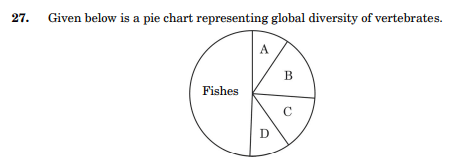
(a) Redraw the pie chart identifying the groups 'A', 'B', 'C', and 'D' in their respective positions.
(b) Mention two examples of recently extinct animals.
View Solution

(a) The pie chart represents the global diversity of vertebrates. Based on the typical representation:
A: Amphibians
B: Reptiles
C: Birds
D: Mammals
The largest section corresponds to Fishes, as they represent the most diverse group among vertebrates.
Redrawn Pie Chart:
(Diagram description or reference to external tools can be used for drawing the chart.)
(b) Two examples of recently extinct animals:
1. Passenger Pigeon (Ectopistes migratorius): Went extinct in 1914 due to overhunting and habitat destruction.
2. Western Black Rhinoceros (Diceros bicornis longipes): Declared extinct in 2011 due to poaching. Quick Tip: Fishes are the most diverse group of vertebrates globally. Recent extinctions often result from human activities like habitat destruction and poaching.
Predation is referred to as a detrimental interaction. Explain any three positive roles, supported by an example each, that a predator plays in an ecosystem.
View Solution
Although predation is considered a detrimental interaction for prey, predators play several positive roles in an ecosystem, such as:
1. Maintaining Population Control:
Predators prevent overpopulation of prey species, ensuring a balance in the ecosystem.
Example: Wolves in Yellowstone National Park control the population of deer, preventing overgrazing of vegetation.
2. Promoting Biodiversity:
Predators help maintain species diversity by preventing the dominance of any single prey species.
Example: Starfish predation on mussels allows other species to thrive in intertidal zones.
3. Regulating Food Web Dynamics:
Predators play a key role in regulating food web dynamics, preventing the collapse of ecosystems.
Example: Tigers regulate the populations of herbivores like deer in forests, ensuring the sustainability of vegetation. Quick Tip: Predators maintain ecosystem balance by controlling prey populations, promoting biodiversity, and ensuring the stability of food webs.
Read the following passage and answer the questions that follow.
Spermatogenesis is an important primary sex characteristic in humans and all other vertebrates. The process is coordinated and controlled under the influence of hormones. It starts with the onset of puberty in humans and thereafter continues. The primordial cells within the embryonic testis which differentiate into spermatogonia are the precursors of the sperms. These are located at the outer walls of the seminiferous tubules where the process of spermatogenesis proceeds.
(a) State the site of action of FSH in the testes and describe its action thereafter.
View Solution
Site of action of FSH: FSH (Follicle-Stimulating Hormone) acts on the Sertoli
cells in the seminiferous tubules of the testes.
Action of FSH: It stimulates Sertoli cells to secrete androgen-binding protein (ABP).
ABP maintains a high concentration of testosterone in the seminiferous tubules, which is es-
sential for the progression of spermatogenesis.
(a) Describe the role of LH in the process of spermatogenesis.
View Solution
Role of LH in spermatogenesis:
LH (Luteinizing Hormone) acts on the Leydig cells located in the interstitial space of the testes.
It stimulates the Leydig cells to secrete testosterone, which plays a crucial role in the initiation and maintenance of spermatogenesis. Quick Tip: FSH acts on Sertoli cells to enhance testosterone concentration in the seminiferous tubules, while LH acts on Leydig cells to produce testosterone.
(b) Name the cells and their products which undergo:
(i) Mitosis and Differentiation
(ii) Meiosis I and Meiosis II
during the process of spermatogenesis.
View Solution
(A) [(i)] Mitosis and Differentiation:
Cells: Spermatogonia
Product: Primary Spermatocytes
(B) [(ii)] Meiosis I and Meiosis II:
Meiosis I:
Cells: Primary Spermatocytes
Product: Secondary Spermatocytes
Meiosis II:
Cells: Secondary Spermatocytes
Product: Spermatids Quick Tip: Mitosis leads to the formation of primary spermatocytes, while meiosis results in secondary spermatocytes and spermatids.
(c) Name the accessory ducts that the sperms travel through from seminiferous tubules to reach the epididymis.
View Solution
The sperms travel through the following accessory ducts:
1. Rete testis
2. Vasa efferentia
3. Epididymis
Quick Tip: Sperms travel through rete testis, vasa efferentia, and epididymis before reaching the vas deferens.
Read the following passage and answer the questions that follow.
In 1981, the health workers of United States of America had become aware of the increased frequency of Kaposi's sarcoma, cancer of the skin. and blood vessels and another disease pneumocystis pneumonia, a respiratory infection caused by a protozoan. Both these diseases were very rare in the general population, but occurred frequently in more. severely "immunosuppressed" individuals. This led to the recognition of the immune system disorder that was named Acquired Immune Deficiency Syndrome (AIDS). In 1983, virologists working in the USA and France had identified a causative agent for 'AIDS', now known as Human Immunodeficiency Virus (HIV). "HIV" follows a set path to attack the human body to cause the disease.
(a) Name the group of cells the HIV attacks after gaining entry into the human body and write the various events that occur within this cell.
View Solution
HIV primarily targets CD4+ T-helper cells.
After entering the cell:
1. The viral RNA is converted into DNA by reverse transcriptase.
2. The viral DNA integrates into the host cell’s genome using the enzyme integrase.
3. The host cell machinery is hijacked to produce viral particles, leading to the destruction of CD4+ cells.
Quick Tip: HIV attacks CD4+ T-cells, weakening the immune system and making the body vulnerable to opportunistic infections.
(b) Write the expanded form of the diagnostic test used for detecting AIDS. Write the possible treatment available for the disease at present.
View Solution
The expanded form of the diagnostic test is Enzyme-Linked Immunosorbent Assay (ELISA).
Possible treatments:
The current treatment involves Antiretroviral Therapy (ART). This therapy uses a combination of antiretroviral drugs to suppress viral replication, improve immune function, and prevent progression to AIDS.
Quick Tip: ART does not cure HIV but helps manage the infection and prolong the patient’s life by suppressing the virus.
(c) Mention any two steps suggested by WHO for preventing the spread of this disease.
View Solution
Two steps suggested by WHO for preventing the spread of HIV are:
1. Safe sexual practices: Use of condoms to prevent transmission through sexual contact.
2. Screening of blood: Ensuring all blood and blood products are screened for HIV before transfusion. Quick Tip: Preventive measures like safe sexual practices and proper blood screening significantly reduce the risk of HIV transmission.
(c) "A patient suffering from AIDS does not die of this disease but from some other infection." Justify the statement.
View Solution
AIDS weakens the immune system by destroying CD4+ T-cells, making the body unable to fight opportunistic infections.
Common infections include:
Pneumonia (caused by Pneumocystis jirovecii).
Tuberculosis (caused by Mycobacterium tuberculosis).
These infections, rather than HIV itself, lead to the death of the patient. Quick Tip: AIDS compromises the immune system, allowing opportunistic infections to thrive, which ultimately leads to the patient’s death.
(i) Explain the process of double fertilization in an angiosperm starting from the germination of pollen grains on the stigma, mentioning the ploidy of the end products formed at the end. State the role of synergids during the course of the process.
View Solution
Process of Double Fertilization:
1. Pollen germination: Pollen grain germinates on the stigma, forming a pollen tube that grows through the style and enters the ovule via the micropyle.
2. Synergids: One synergid guides the pollen tube into the embryo sac.
3. Fertilization I (Syngamy): One male gamete fuses with the egg cell, forming a diploid zygote (\(2n\)).
4. Fertilization II (Triple Fusion): The second male gamete fuses with two polar nuclei in the central cell to form a triploid primary endosperm nucleus (\(3n\)).
Ploidy of end products:
Zygote: Diploid (\(2n\)).
Endosperm: Triploid (\(3n\)). Quick Tip: Double fertilization is unique to angiosperms and ensures the formation of both the zygote and nutritive endosperm in the same reproductive cycle.
(ii) Why does the development of endosperm precede that of the embryo?
View Solution
The endosperm develops before the embryo because it provides essential nutrients for the developing embryo, supporting its early growth and establishment. Quick Tip: The endosperm acts as a nutritive tissue, ensuring that the embryo has sufficient resources during its development.
(i) Mention the site where fertilisation of the ovum occurs in a human female. Explain the process of fertilisation and mention how polyspermy is prevented.
View Solution
Site of fertilisation: The ampullary region of the fallopian tube.
Process of fertilisation:
1. The sperm reaches the ovum in the fallopian tube.
2. The sperm penetrates the zona pellucida layer of the ovum using acrosomal enzymes.
3. The sperm nucleus fuses with the egg nucleus, forming a diploid zygote.
- Prevention of polyspermy:
- Cortical reaction: Once the sperm enters the ovum, cortical granules are released, altering the zona pellucida structure and preventing other sperms from entering.
Quick Tip: Polyspermy is prevented by changes in the zona pellucida after the entry of one sperm, ensuring a single fertilisation event.
(ii) Name the embryonic stage that gets implanted in the uterus. Explain the process of implantation in a human female.
View Solution
Embryonic stage: The blastocyst.
Process of implantation:
1. The blastocyst reaches the uterus and attaches to the endometrial lining.
2. The trophoblast cells of the blastocyst invade the endometrium.
3. The endometrium grows around the blastocyst, anchoring it securely.
Quick Tip: Implantation ensures the embryo is securely attached to the uterus, allowing it to receive nutrients from the maternal blood supply.
Compare the pattern of inheritance of flower colour in garden pea plant (violet/white) with snapdragon plant (red/white) on the basis of the following:
(A) F\(_1\) phenotypic expression.
(B) Expected phenotypic and genotypic expression of F\(_2\) generation.
(C) Conclusion you reached at the end of the comparison.
View Solution
1. F\(_1\) phenotypic expression:
- Garden pea: All F\(_1\) plants are violet (dominant trait).
- Snapdragon: All F\(_1\) plants are pink (incomplete dominance).
2. F\(_2\) generation:
- Garden pea:
- Phenotypic ratio: 3:1 (violet: white).
- Genotypic ratio: 1:2:1 (VV:Vv:vv).
- Snapdragon:
- Phenotypic ratio: 1:2:1 (red: pink: white).
- Genotypic ratio: 1:2:1 (RR:Rr:rr).
3. Conclusion:
- In garden pea, flower colour inheritance follows complete dominance.
- In snapdragon, flower colour inheritance follows incomplete dominance.
Quick Tip: Inheritance patterns can vary between traits, with some showing complete dominance (pea plant) and others incomplete dominance (snapdragon).
List any two characteristics of pattern of inheritance of human blood group ABO.
View Solution
1. The ABO blood group exhibits codominance, where both A and B alleles are expressed equally in the AB blood group.
2. The blood group also shows multiple allelism, as there are three alleles (\(I^A, I^B, i\)) for a single gene. Quick Tip: The ABO blood group system is an example of codominance and multiple allelism, unique among genetic traits.
Draw a schematic, self-explanatory labelled diagram of lac operon in a ‘switched on’ condition.
View Solution

(Provided a diagram description for lac operon in ‘switched on’ condition.) Quick Tip: The lac operon is switched on in the presence of lactose, enabling the expression of genes involved in lactose metabolism.
Why is regulation of lac operon referred to as negative regulation?
View Solution
The lac operon is referred to as negative regulation because the operon is switched off by the binding of a repressor protein to the operator region in the absence of lactose. Lactose acts as an inducer by removing the repressor. Quick Tip: Negative regulation involves the prevention of gene expression by a repressor protein in the absence of an inducer.
Why should a cell be made competent to take up an alien DNA? How can a bacterial cell be made competent using calcium ions? Explain.
View Solution
Why should a cell be made competent?
A cell needs to be made competent to allow the uptake of foreign DNA into its cytoplasm during genetic transformation.
Competence using calcium ions:
Bacterial cells are treated with a solution of calcium chloride (CaCl\(_2\)).
Calcium ions create pores in the bacterial cell wall, allowing DNA to enter.
A heat-shock step (at \(42^\circC\)) further facilitates DNA uptake by the bacterial cells.
Quick Tip: Competent cells are crucial in biotechnology to introduce plasmids or foreign DNA for genetic manipulation.
(1) State the importance of gel electrophoresis in biotechnology.
(2) Explain the principle on which this technique works.
(3) Mention why ethidium bromide is used in this technique.
View Solution
(1) Gel electrophoresis is used to separate DNA fragments based on their size, allowing analysis, purification, or further genetic manipulations.
(2) DNA fragments are negatively charged due to their phosphate backbone.
When an electric current is applied, DNA fragments move towards the positive electrode.
Smaller fragments move faster, while larger fragments move slower through the gel matrix.
(3) Ethidium bromide is an intercalating dye that binds to DNA, fluorescing under UV light, which helps visualize DNA bands.
Quick Tip: Gel electrophoresis is a fundamental technique for DNA analysis, with ethidium bromide aiding in DNA visualization.
How was Bt cotton the genetically modified crop, has greatly helped the cotton framers to increase their crop yield
View Solution
Bt cotton was genetically modified by introducing a gene from the bacterium Bacillus thuringiensis (Bt).
The Bt gene produces a protein toxic to bollworms but safe for other organisms.
When expressed in cotton plants, this protein provides resistance to bollworms. Quick Tip: Bt cotton is an example of genetic engineering used in agriculture to combat pests without using excessive chemical pesticides.
Describe the mechanism that leads to the death of bollworms feeding on Bt cotton plants.
View Solution
1. Bollworms ingest the Bt toxin while feeding on cotton plants.
2. In the insect’s alkaline gut, the toxin is activated and binds to specific receptors in the gut lining.
3. This binding creates pores in the gut wall, leading to leakage of gut contents and eventual death of the insect.
Quick Tip: The Bt toxin is highly specific to certain insects, ensuring minimal harm to non-target organisms and the environment.





Comments