




CBSE Class 12 Biology Set 3 Question Paper PDF (57/2/3) is now available for download. CBSE conducted the Class 12 Biology examination on March 25, 2025. The question paper consists of 33 questions carrying a total of 70 marks. Section A includes 16 MCQs for 1 mark each, Section B contains 5 very short-answer questions for 2 marks each, Section C comprises 7 short-answer questions for 3 marks each, Section D comprises 2 Case-based questions carries 4 marks each and Section E comprises 3 long-answer questions carries 5 marks each.
CBSE Class 12 Biology Question Paper 2025 (Set 3- 57/2/3) with Answer Key
| CBSE Class 12 202 Biology Question Paper with Answer Key | Download PDF | Check Solution |
CBSE Class 12 2025 Biology Questions with Solutions
Question 1:
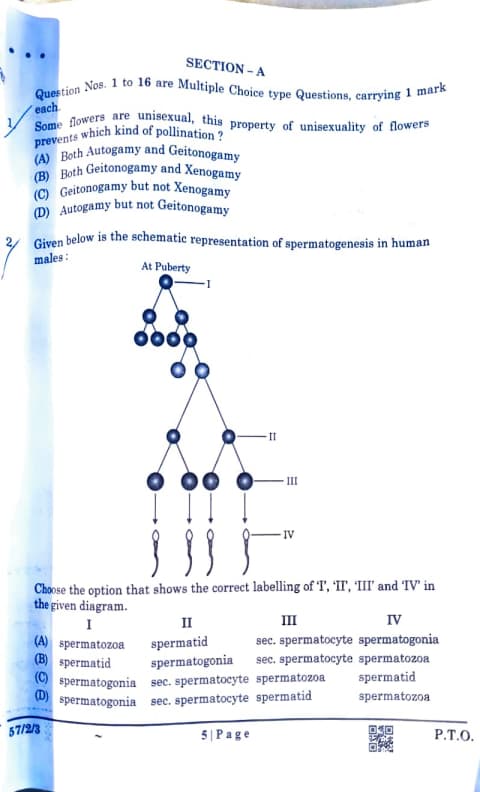
Some flowers are unisexual, this property of unisexuality of flowers prevents which kind of pollination?
(A) Both Autogamy and Geitonogamy
(B) Both Geitonogamy and Xenogamy
(C) Geitonogamy but not Xenogamy
(D) Autogamy but not Geitonogamy
View Solution
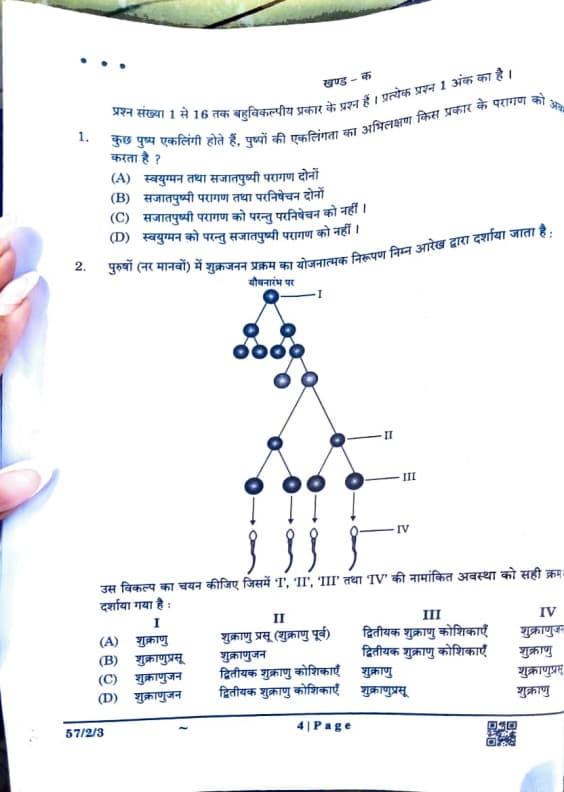
Given below is the schematic representation of spermatogenesis in human males:

Choose the option that shows the correct labelling of ‘I’, ‘II’, ‘III’ and ‘IV’ in the given diagram.
View Solution
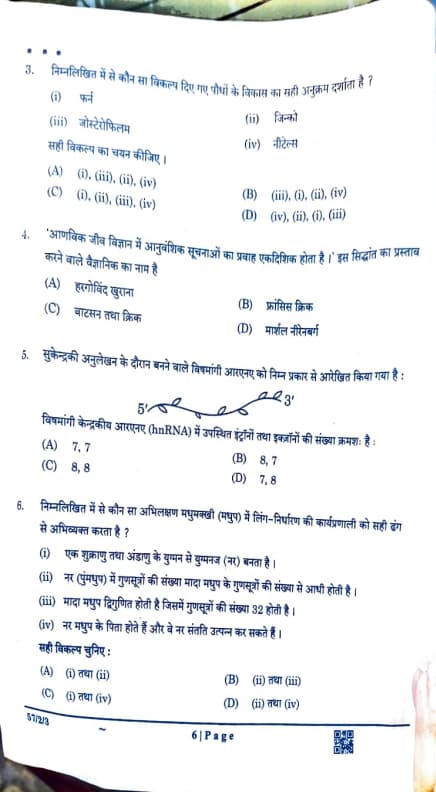
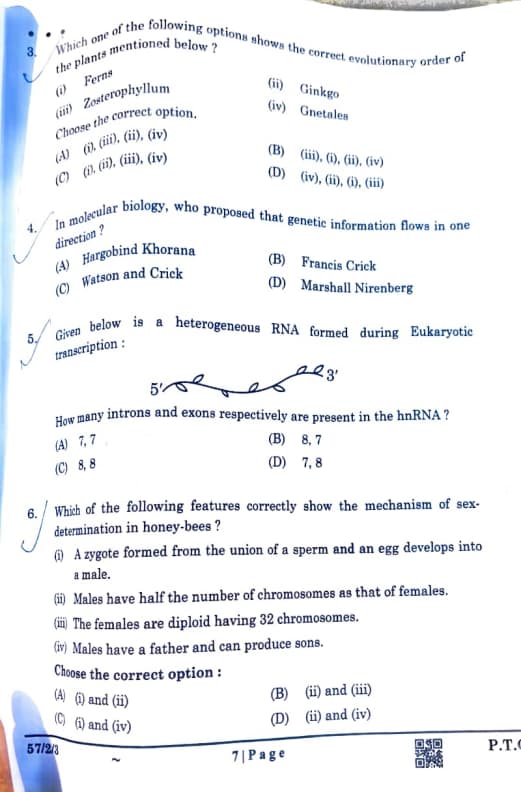
Which one of the following options shows the correct evolutionary order of the plants mentioned below?
(i) Ferns
(ii) Ginkgo
(iii) Zosterophyllum
(iv) Gnetales
Choose the correct option.
View Solution
In molecular biology, who proposed that genetic information flows in one direction?
(A) Hargobind Khorana
View Solution
Given below is a heterogeneous RNA formed during Eukaryotic transcription:

How many introns and exons respectively are present in the hnRNA?
View Solution
Which of the following features correctly show the mechanism of sex-determination in honey-bees?
(i) A zygote formed from the union of a sperm and an egg develops into a male.
(ii) Males have half the number of chromosomes as that of females.
(iii) The females are diploid having 32 chromosomes.
(iv) Males have a father and can produce sons.
Choose the correct option:
View Solution
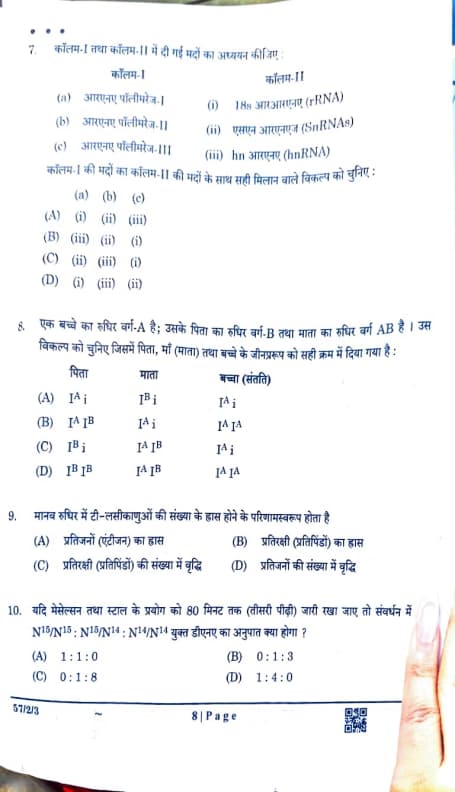
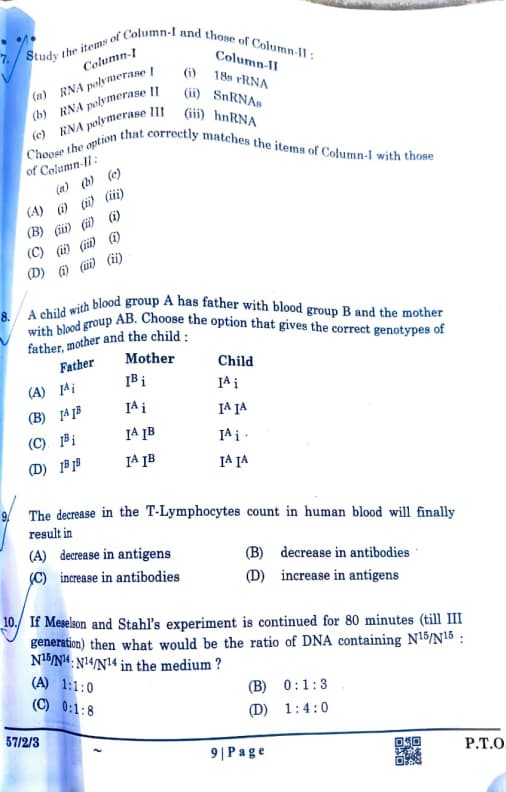
Study the items of Column-I and those of Column-II:
(a) RNA polymerase I & (i) 18s rRNA
(b) RNA polymerase II & (ii) SnRNAs
(c) RNA polymerase III & (iii) hnRNA
Choose the option that correctly matches the items of Column-I with those of Column-II:
View Solution
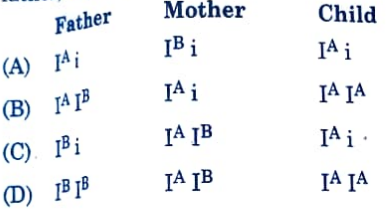
A child with blood group A has father with blood group B and the mother with blood group AB. Choose the option that gives the correct genotypes of father, mother, and the child:
View Solution
The decrease in the T-Lymphocytes count in human blood will finally result in
(A) decrease in antigens
View Solution
If Meselson and Stahl’s experiment is continued for 80 minutes (till III generation), then what would be the ratio of DNA containing \( N^{15}/N^{15} : N^{15}/N^{14} : N^{14}/N^{14} \) in the medium?
(A) 1:1:0
View Solution
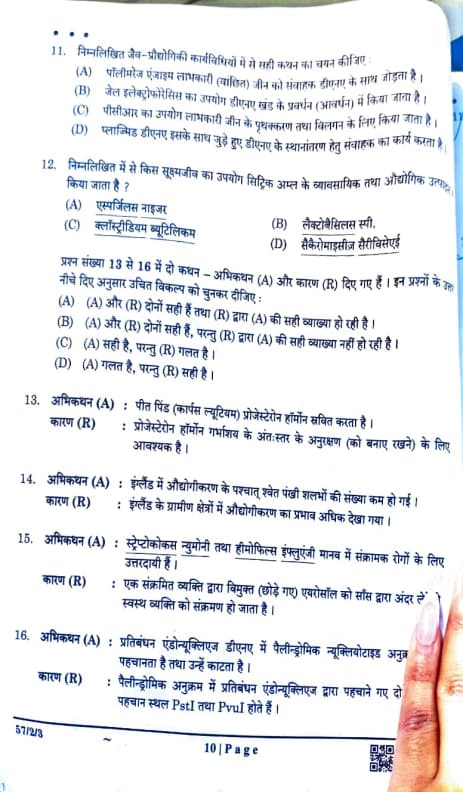
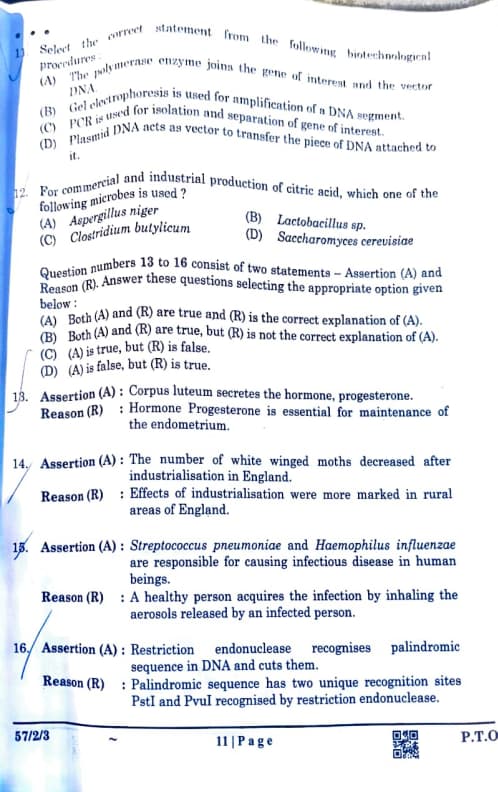
Select the correct statement from the following biotechnological procedures:
(A) The polymerase enzyme joins the gene of interest and the vector DNA.
View Solution
For commercial and industrial production of citric acid, which one of the following microbes is used?
(A) Aspergillus niger
View Solution
Assertion (A): Corpus luteum secretes the hormone, progesterone.
Reason (R): Hormone Progesterone is essential for maintenance of the endometrium.
(A) Both (A) and (R) are true and (R) is the correct explanation of (A).
View Solution
Assertion (A): The number of white winged moths decreased after industrialisation in England.
Reason (R): Effects of industrialisation were more marked in rural areas of England.
(A) Both (A) and (R) are true and (R) is the correct explanation of (A).
View Solution
Assertion (A): Streptococcus pneumoniae and \textit{Haemophilus influenzae are responsible for causing infectious disease in human beings.
Reason (R): A healthy person acquires the infection by inhaling the aerosols released by an infected person.
View Solution
Assertion (A): Restriction endonuclease recognises palindromic sequence in DNA and cuts them.
Reason (R): Palindromic sequence has two unique recognition sites PstI and PvuI recognised by restriction endonuclease.
(A) Both (A) and (R) are true and (R) is the correct explanation of (A).
View Solution
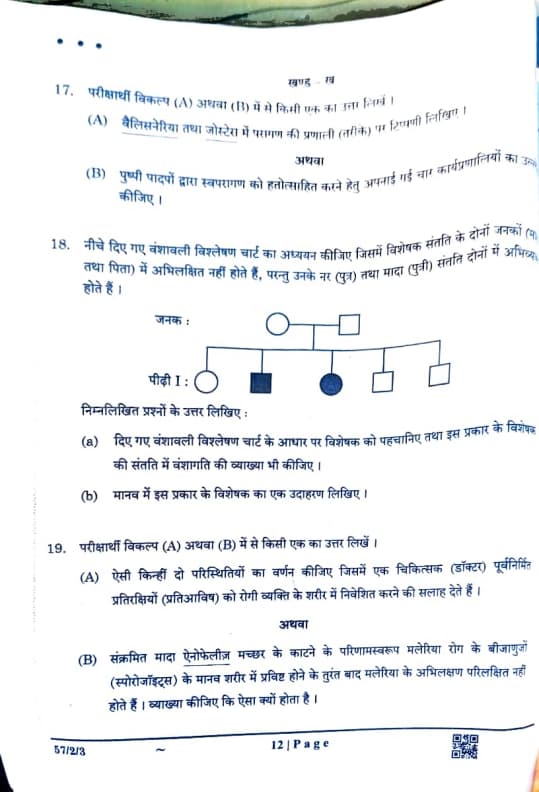
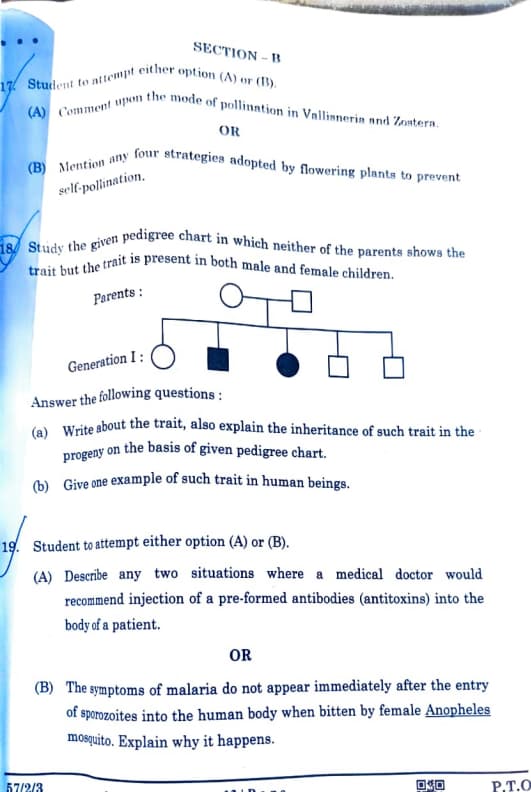
(A) Comment upon the mode of pollination in Vallisneria and Zostera.
OR
(B) Mention any four strategies adopted by flowering plants to prevent self-pollination.
Student to attempt either option (A) or (B).
(A) Describe any two situations where a medical doctor would recommend injection of pre-formed antibodies (antitoxins) into the body of a patient.
OR
(B) The symptoms of malaria do not appear immediately after the entry of sporozoites into the human body when bitten by female Anopheles mosquito. Explain why it happens.
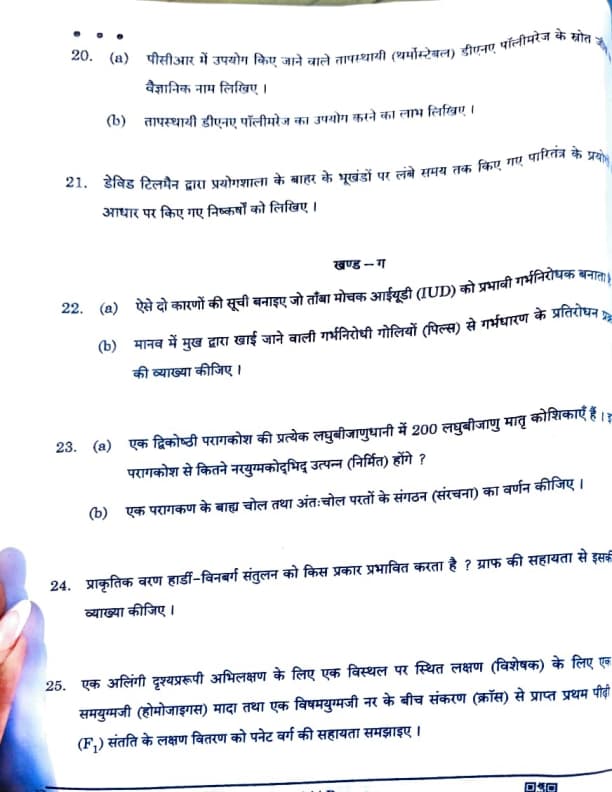
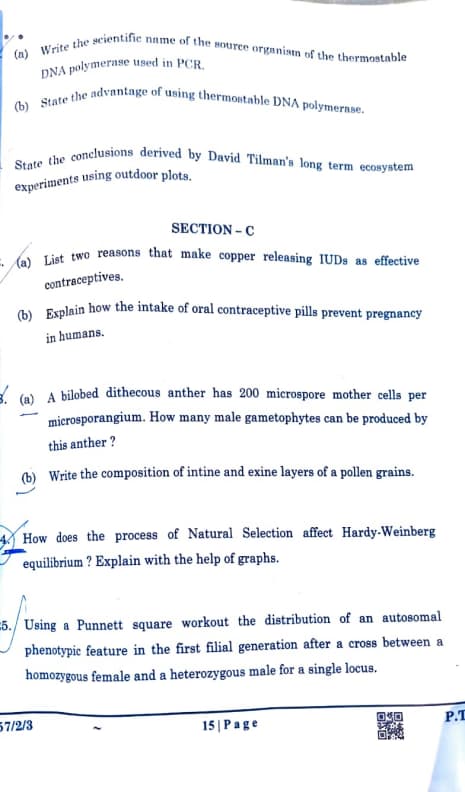
(a) Write the scientific name of the source organism of the thermostable DNA polymerase used in PCR.
(b) State the advantage of using thermostable DNA polymerase.
State the conclusions derived by David Tilman’s long-term ecosystem experiments using outdoor plots.
(a) List two reasons that make copper releasing IUDs as effective contraceptives.
(b) Explain how the intake of oral contraceptive pills prevent pregnancy in humans.
(a) A bilobed dithecous anther has 200 microspore mother cells per microsporangium. How many male gametophytes can be produced by this anther?
(b) Write the composition of intine and exine layers of a pollen grain.
How does the process of Natural Selection affect Hardy-Weinberg equilibrium? Explain with the help of graphs.
Using a Punnett square, work out the distribution of an autosomal phenotypic feature in the first filial generation after a cross between a homozygous female and a heterozygous male for a single locus.
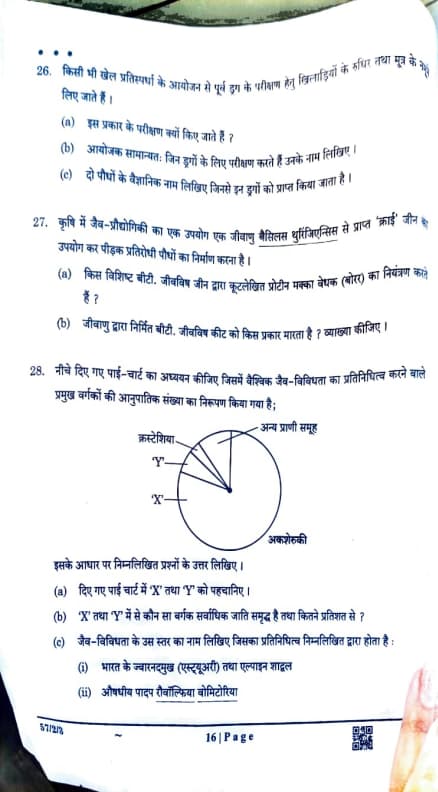
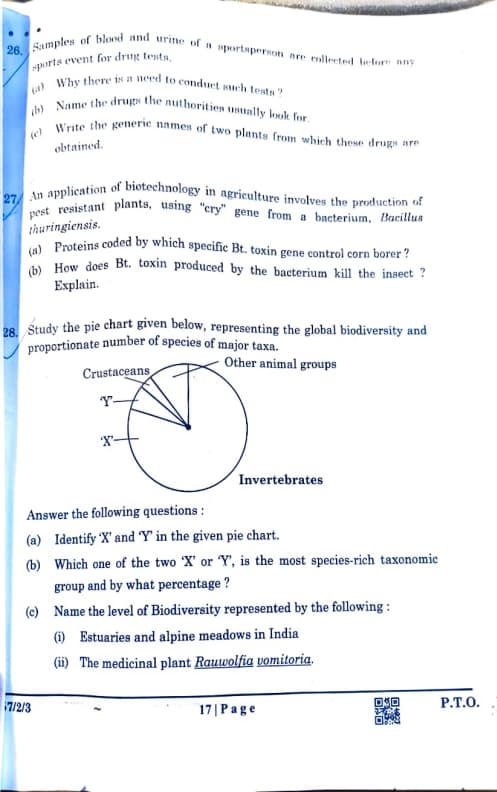
Samples of blood and urine of a sports person are collected before any sports event for drug tests.
(a) Why is there a need to conduct such tests?
(b) Name the drugs the authorities usually look for.
(c) Write the generic names of two plants from which these drugs are obtained.
An application of biotechnology in agriculture involves the production of pest-resistant plants, using "cry" gene from a bacterium, Bacillus thuringiensis.
(a) Proteins coded by which specific Bt. toxin gene control corn borer?
(b) How does Bt. toxin produced by the bacterium kill the insect? Explain.
Study the pie chart given below, representing the global biodiversity and proportionate number of species of major taxa.

Answer the following questions:
[(a)] Identify 'X' and 'Y' in the given pie chart.
[(b)] Which one of the two 'X' or 'Y' is the most species-rich taxonomic group and by what percentage?
[(c)] Name the level of Biodiversity represented by the following:
[(i)] Estuaries and alpine meadows in India.
[(ii)] The medicinal plant \textit{Rauwolfia vomitoria.
Immunity in our body is of two types: (i) Innate immunity and (ii) acquired immunity. Innate immunity is a non-specific defence mechanism, whereas acquired immunity is pathogen-specific; it is called specific immunity too. Acquired immunity is characterised by memory. Antibodies are specific to antigens and there are different types of antibodies produced in our body: they are IgA, IgE, IgG, IgC, and IgM. It shows primary response when it encounters the pathogen for the first time and secondary response during the subsequent encounters with the same antigen/pathogen.
(a) Name the two types of specialised cells which carry out the primary and secondary immune response.
(b) Why is the antibody-mediated immunity also called humoral immune response?
Attempt either sub-part (c) or (d):
(c) The organ transplants are often rejected if not taken from suitable compatible persons.
[(i)] Mention the characteristic of our immune system that is responsible for the graft rejection.
[(ii)] Name the type of immune response and the cell involved in it.
OR
(d) How is active immunity different from passive immunity?
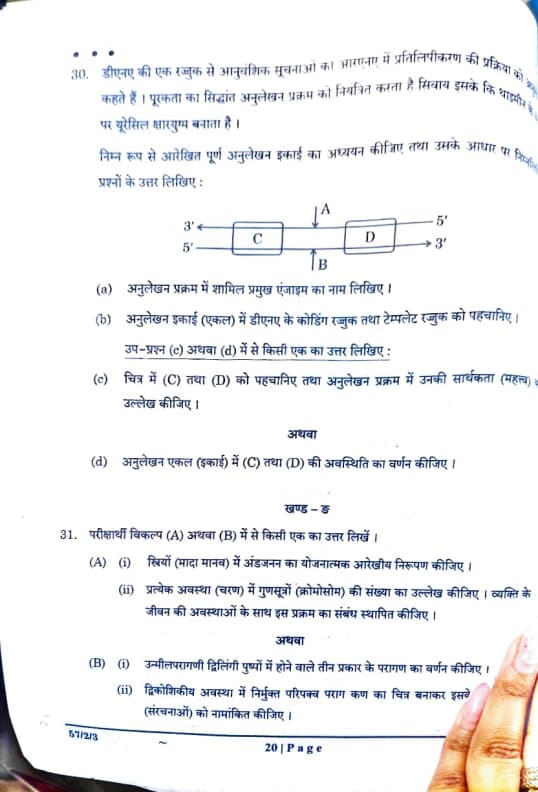
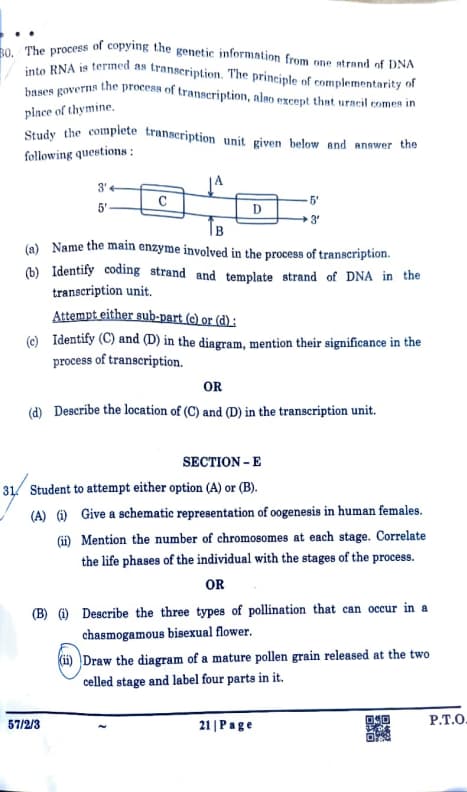
The process of copying the genetic information from one strand of DNA into RNA is termed as transcription. The principle of complementarity of bases governs the process of transcription, also except that uracil comes in place of thymine.
Study the complete transcription unit given below and answer the following questions:

[(a)] Name the main enzyme involved in the process of transcription.
[(b)] Identify coding strand and template strand of DNA in the transcription unit.
[(c)] Identify (C) and (D) in the diagram, mention their significance in the process of transcription.
[(d)] Describe the location of (C) and (D) in the transcription unit.
Student to attempt either option (A) or (B).
(A) [(i)] Give a schematic representation of oogenesis in human females.
[(ii)] Mention the number of chromosomes at each stage. Correlate the life phases of the individual with the stages of the process.
OR
(B) [(i)] Describe the three types of pollination that can occur in a chasmogamous bisexual flower.
[(ii)] Draw the diagram of a mature pollen grain released at the two-celled stage and label four parts in it.
Student to attempt either option (A) or (B).
(A) [(i)] Explain how is a bacterial cell made 'competent' to take up recombinant DNA from the medium.
[(ii)] Explain the steps of amplification of gene of interest using PCR technique.
OR
(B) [(i)] What are transgenic animals?
[(ii)] Why are these animals being produced? Explain any four reasons.
Student to attempt either option (A) or (B).
(A) [(i)] Explain giving three reasons why tropics show greatest levels of species diversity.
[(ii)] Draw a graph showing species-area relationship. Name the naturalist who studied such relationship. Write the observation made by him.
OR
(B)
[(i)] The world is facing the accelerated rate of species extinctions due to human activities. Explain any three major causes of biodiversity losses.
[(ii)] Describe ‘Ex situ’ approach for conserving biodiversity. Give any two examples.



Comments