




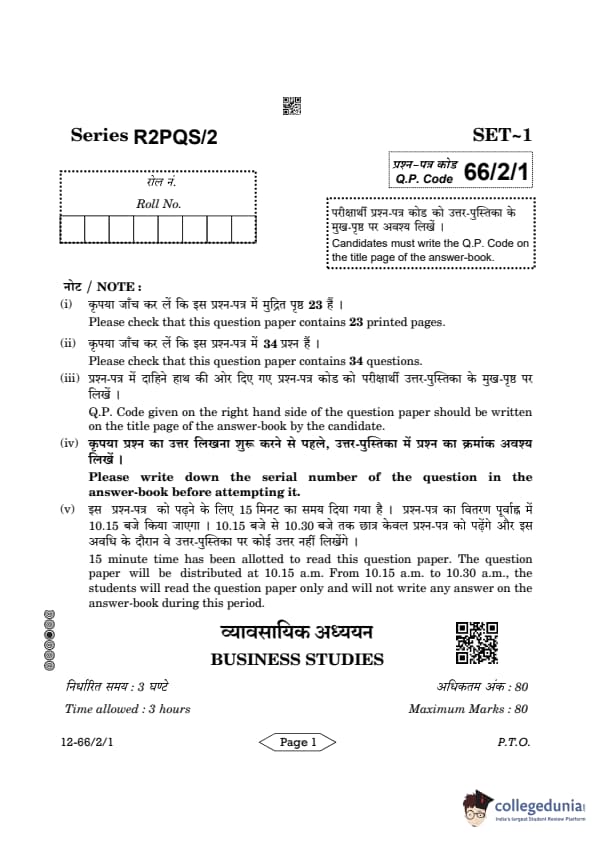
CBSE Class 12 Business Studies Question Paper 2024 PDF (Set 1- 66/2/1) is available for download here. CBSE conducted the Business Studies exam on March 27, 2024 from 10:30 AM to 1:30 PM. The total marks for the theory paper are 80. The question paper will contain 20% MCQ-based questions, 40% competency-based questions, and 40% short and long answer type questions.Candidates can use the link below to download the CBSE Class 12 Business Studies Set 1 Question Paper with detailed solutions.
CBSE Class 12 Business Studies Question Paper 2024 (Set 1- 66/2/1) with Answer Key
| CBSE Class 12 2024 Business Studies Question Paper with Answer Key |  Download Download |
Check Solution |
CBSE Class 12 2024 Business Studies Questions with Solutions
Question 1:
‘Vishesh Constructions', a construction company, decided to strictly implement 'No Helmet, No Entry' and put the following sign at their construction sites:

Identify the type of plan indicated by the above sign:
View Solution
Solution: This is a rule because it is a clear and direct instruction that needs to be followed. A rule is a regulation that must be obeyed, and in this case, it ensures safety at the construction site.
Question 2:
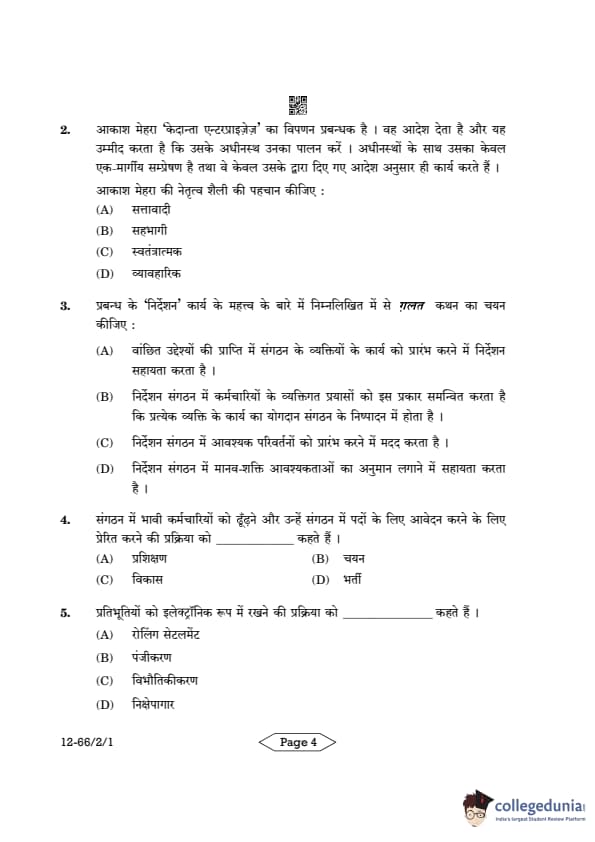
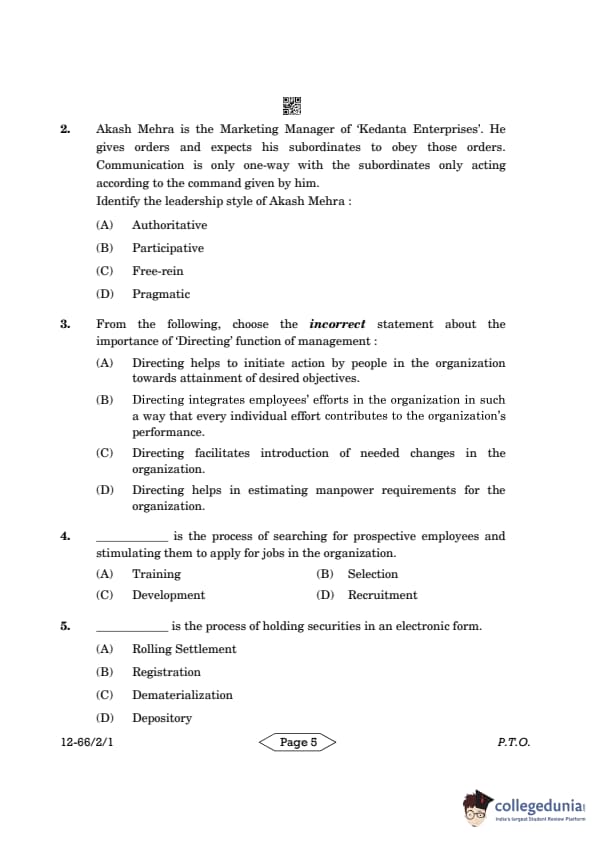
Akash Mehra is the Marketing Manager of 'Kedanta Enterprises'. He gives orders and expects his subordinates to obey those orders. Communication is only one-way with the subordinates only acting according to the command given by him.
Identify the leadership style of Akash Mehra:
View Solution
Solution: Akash Mehra follows an authoritative leadership style, where the leader gives clear instructions and expects compliance from subordinates with little input from them. The communication is one-way, with the manager issuing commands.
Question 3:
From the following, choose the incorrect statement about the importance of 'Directing' function of management:
View Solution
Solution: Directing involves guiding and supervising employees to ensure that they are working towards organizational goals. However, estimating manpower requirements is part of the planning function, not directing.
Question 4:
__________ is the process of searching for prospective employees and stimulating them to apply for jobs in the organization.
View Solution
Solution:Recruitment is the process of attracting potential employees to apply for job openings. It involves advertising vacancies, sourcing candidates, and encouraging qualified individuals to apply.
Question 5:
__________ is the process of holding securities in an electronic form.
View Solution
Solution: Dematerialization refers to the process of converting physical securities into electronic form. This enables faster and more secure transactions.
Question 6:
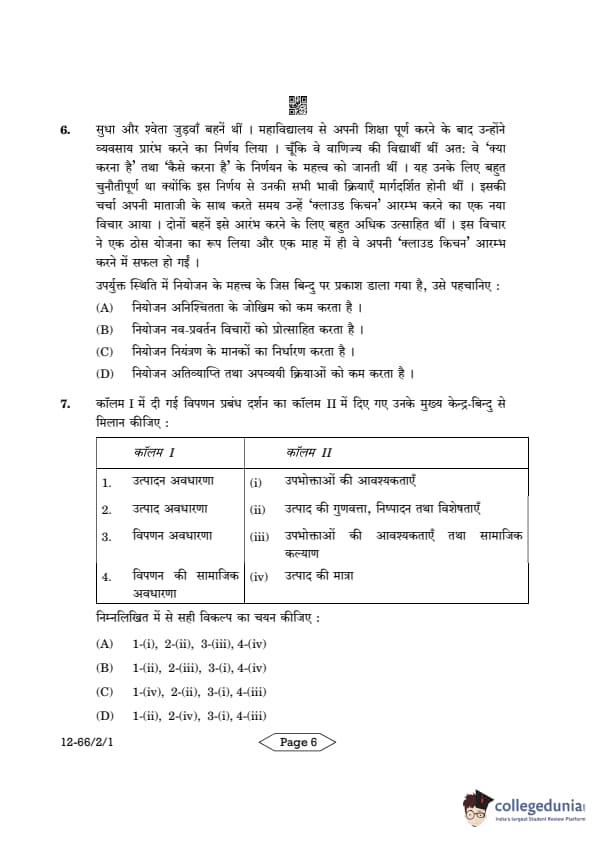
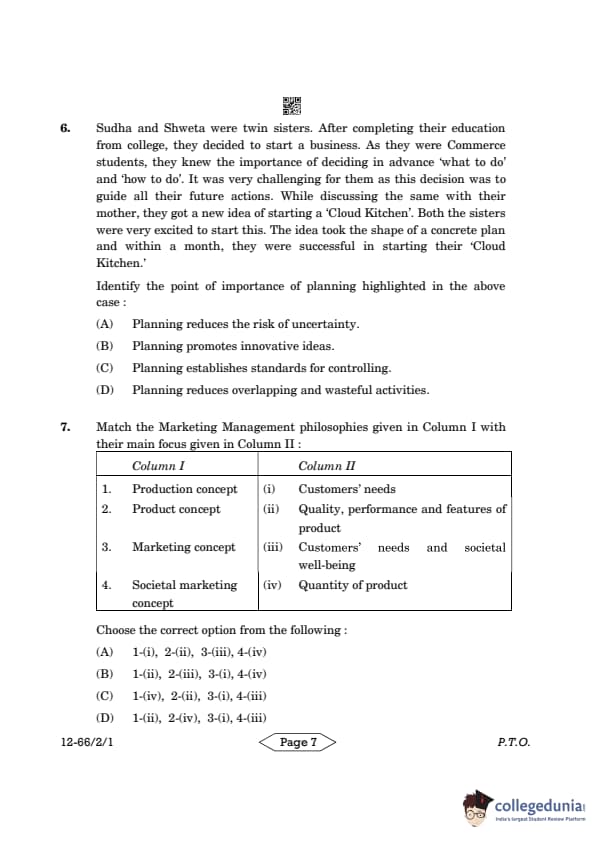
Sudha and Shweta were twin sisters. After completing their education from college, they decided to start a business. As they were Commerce students, they knew the importance of deciding in advance 'what to do' and 'how to do'. It was very challenging for them as this decision was to guide all their future actions. While discussing the same with their mother, they got a new idea of starting a 'Cloud Kitchen'. Both the sisters were very excited to start this. The idea took the shape of a concrete plan and within a month, they were successful in starting their 'Cloud Kitchen.'
Identify the point of importance of planning highlighted in the above case:
View Solution
Solution: The case demonstrates how planning encouraged Sudha and Shweta to transform their innovative idea into a successful business. Planning promotes new ideas and helps convert them into concrete actions.
Question 7:
Match the Marketing Management philosophies given in Column I with their main focus given in Column II:
| Column I | Column II |
|---|---|
| 1. Production concept | i) Customers' needs |
| 2. Product concept | ii) Quality, performance and features of product. |
| 3. Marketing concept | iii) Customers' needs and societal well-being. |
| 4. Societal Marketing concept | iv) Quantity of product |
View Solution
Solution: The correct matching of marketing philosophies to their main focus is as follows:
1. Production concept: iv) Quantity of product
2. Product concept: ii) Quality, performance and features of product.
3. Marketing concept: i) Customers' needs
4. Societal Marketing concept: iii) Customers' needs and societal well-being.
Question 8:
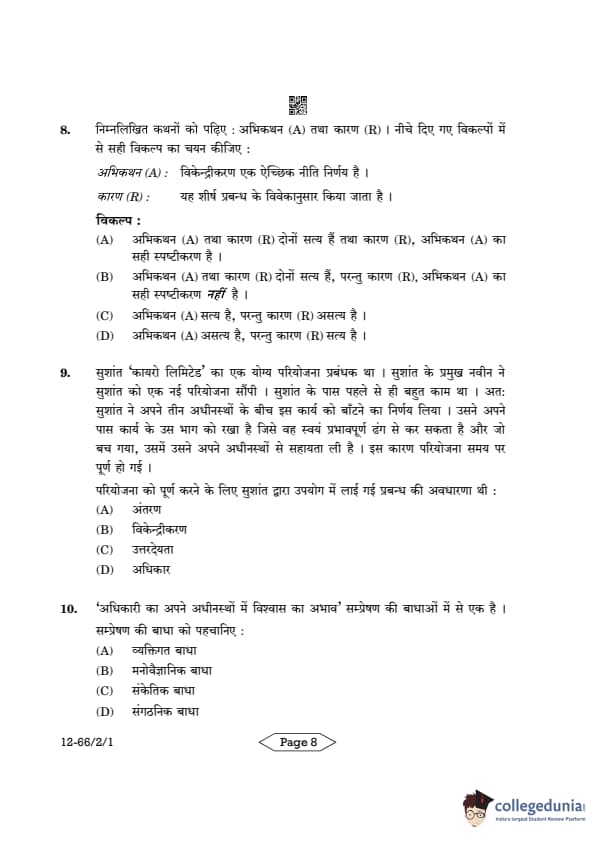
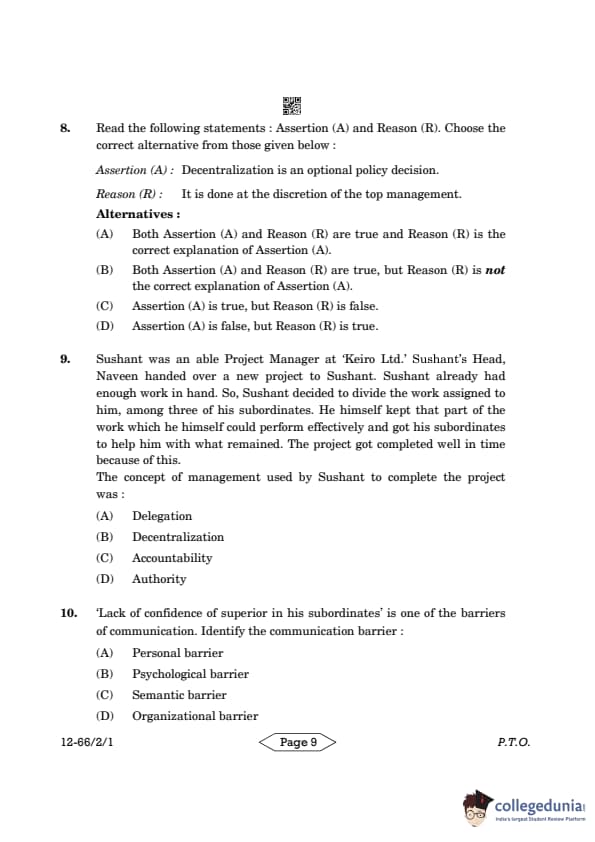
Read the following statements: Assertion (A) and Reason (R). Choose the correct alternative from those given below:
Assertion (A): Decentralization is an optional policy decision.
Reason (R): It is done at the discretion of the top management.
View Solution
Solution: Decentralization is an optional decision made at the discretion of the top management. Top management has the authority to decide whether decentralization should be implemented in the organization based on factors like its size, complexity, and goals. Assertion (A) is correct, and Reason (R) explains this concept by stating that decentralization is a decision taken by top management. Hence, both are true, and Reason (R) explains Assertion (A).
Question 9:
Sushant was an able Project Manager at 'Keiro Ltd.” Sushant's Head, Naveen handed over a new project to Sushant. Sushant already had enough work in hand. So, Sushant decided to divide the work assigned to him, among three of his subordinates. He himself kept that part of the work which he could perform effectively and got his subordinates to help him with the remaining tasks. The project got completed well in time because of this.
The concept of management used by Sushant to complete the project was:
View Solution
Solution: Sushant demonstrated delegation by assigning specific tasks to his subordinates while retaining the responsibility for the overall project. Delegation involves transferring authority and responsibility for specific tasks to others while the manager maintains accountability. This allowed Sushant to effectively manage his workload and complete the project on time with the help of his subordinates.
Question 10:
‘Lack of confidence of superior in his subordinates' is one of the barriers of communication. Identify the communication barrier:
View Solution
Solution: The communication barrier described here is a personal barrier, which arises due to individual attitudes, emotions, or biases. In this case, the superior's lack of confidence in their subordinates is a personal perception that hampers effective communication. Personal barriers can lead to miscommunication, misunderstanding, and inefficiency in the workplace.
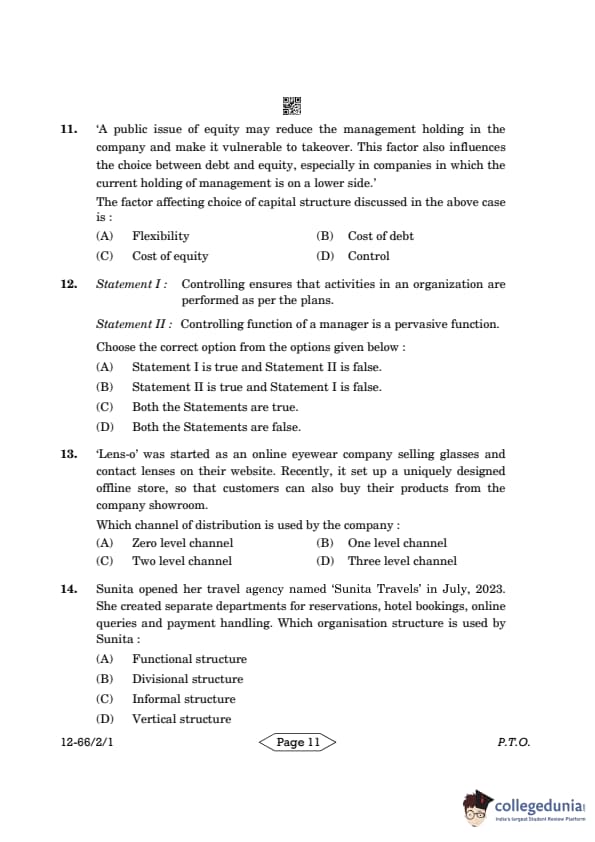
Question 11:
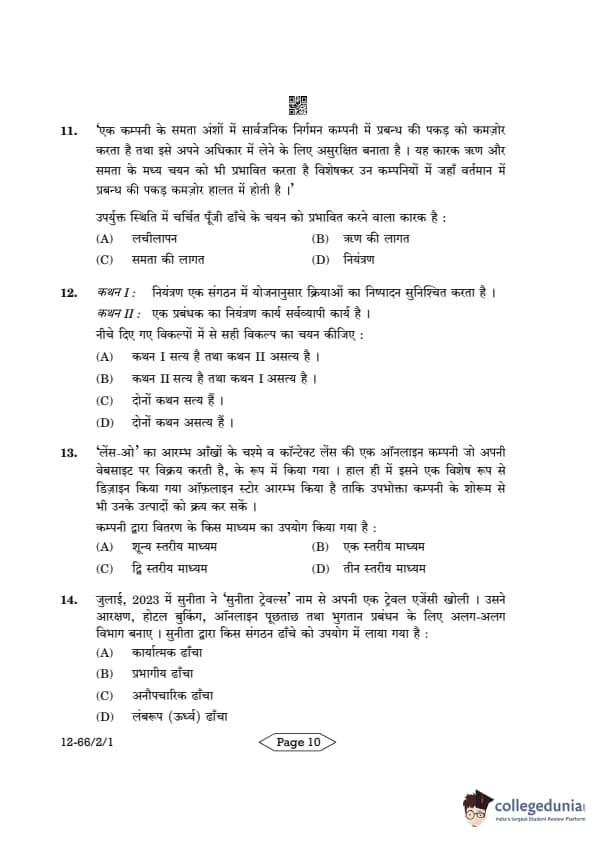
'A public issue of equity may reduce the management holding in the company and make it vulnerable to takeover. This factor also influences the choice between debt and equity, especially in companies in which the current holding of management is on a lower side.'
The factor affecting the choice of capital structure discussed in the above case is:
View Solution
Solution: The factor affecting capital structure in this case is control. Issuing equity to the public can dilute the ownership of management, making it vulnerable to a takeover. Companies prefer to maintain control, especially when their current stake in the company is low. Hence, control is an important factor in determining the choice between debt and equity financing.
Question 12:
Statement I: Controlling ensures that activities in an organization are performed as per the plans.
Statement II: Controlling function of a manager is a pervasive function.
Choose the correct option from the options given below:
View Solution
Solution: Statement I is true because controlling is the function of ensuring that activities are aligned with the plans and objectives set by the organization. Statement II is also true as controlling is a pervasive function, meaning it is required at all levels of management, from top to operational levels. Therefore, both statements are correct.
Question 13:
'Lens-o' was started as an online eyewear company selling glasses and contact lenses on their website. Recently, it set up a uniquely designed offline store, so that customers can also buy their products from the company showroom.
Which channel of distribution is used by the company:
View Solution
Solution: The company, 'Lens-o,' uses a zero level channel of distribution. This type of distribution channel is direct, where the company sells its products directly to customers without intermediaries. Initially, 'Lens-o' operated online, and with the introduction of an offline store, the company continues to use a direct distribution model.
Question 14:
Sunita opened her travel agency named 'Sunita Travels' in July, 2023. She created separate departments for reservations, hotel bookings, online queries and payment handling. Which organisation structure is used by Sunita:
View Solution
Solution: Sunita has used a functional structure for her travel agency. In this structure, the organization is divided into different departments based on specialized functions like reservations, hotel bookings, and payment handling. Each department focuses on a specific function, which enhances efficiency and specialization.
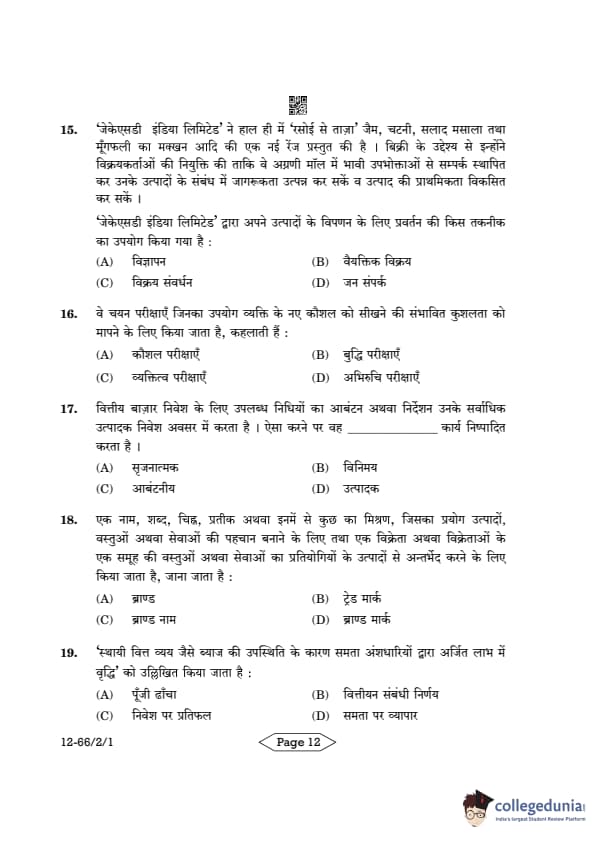
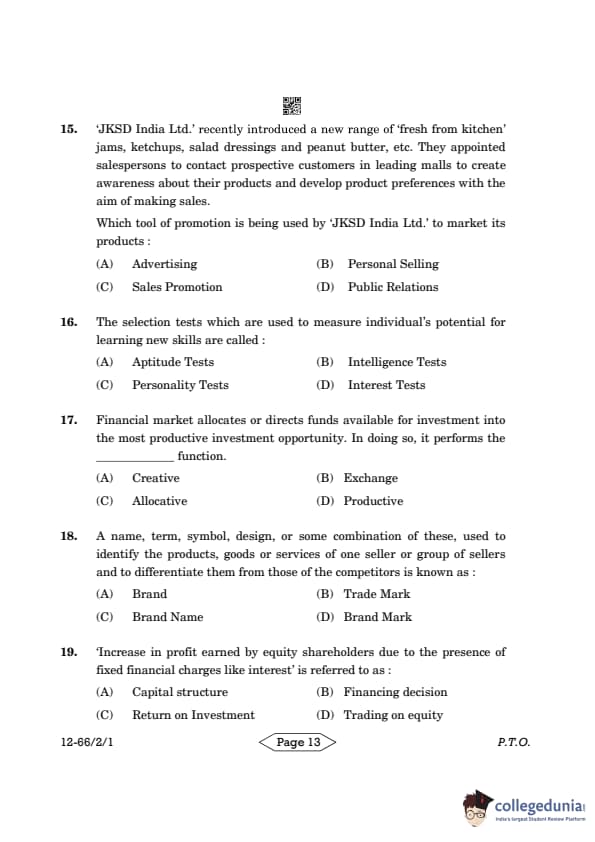
Question 15:
‘JKSD India Ltd.' recently introduced a new range of 'fresh from kitchen' jams, ketchups, salad dressings and peanut butter, etc. They appointed salespersons to contact prospective customers in leading malls to create awareness about their products and develop product preferences with the aim of making sales.
Which tool of promotion is being used by 'JKSD India Ltd.' to market its products:
View Solution
Solution: The tool of promotion used by 'JKSD India Ltd.' is Personal Selling. In this case, salespersons are directly interacting with potential customers in malls to promote the products and persuade them to buy. Personal selling involves face-to-face communication where a sales representative helps in persuading the customer to purchase a product.
Question 16:
The selection tests which are used to measure individual's potential for learning new skills are called:
View Solution
Solution: The tests used to measure an individual's potential for learning new skills are Aptitude Tests. These tests assess the ability of an individual to learn or develop new skills and are commonly used in the selection process for jobs that require specific competencies.
Question 17:
Financial market allocates or directs funds available for investment into the most productive investment opportunity. In doing so, it performs the __________ function.
View Solution
Solution: The correct answer is Allocative. In financial markets, funds are allocated or directed to the most productive investment opportunities. This allocation function ensures that capital is distributed efficiently to support economic growth and investment in productive ventures.
Question 18:
A name, term, symbol, design, or some combination of these, used to identify the products, goods or services of one seller or group of sellers and to differentiate them from those of the competitors is known as:
View Solution
Solution: The correct answer is Brand. A brand is a unique name, term, symbol, or design that identifies and differentiates a company's products or services from others in the market. It is used to create a unique identity and recognition in the marketplace.
Question 19:
‘Increase in profit earned by equity shareholders due to the presence of fixed financial charges like interest' is referred to as:
View Solution
Solution: The correct answer is Trading on equity. Trading on equity occurs when a company uses fixed financial charges, such as interest on debt, to increase the return for its equity shareholders. The presence of debt can amplify the profits for equity shareholders due to the leverage effect.
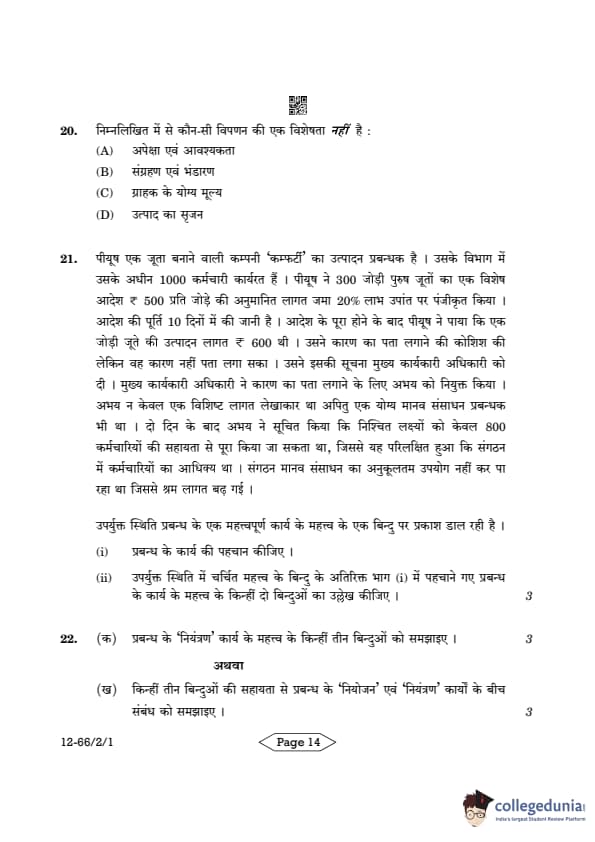
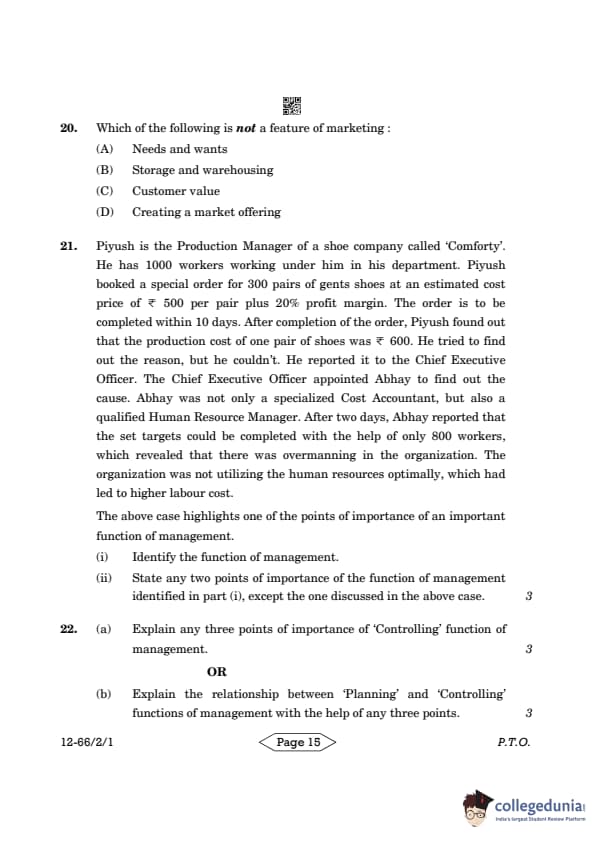
Question 20:
Which of the following is not a feature of marketing:
View Solution
Solution: The correct answer is Storage and warehousing. While storage and warehousing are important aspects of logistics and supply chain management, they are not core features of marketing. Marketing primarily focuses on understanding and meeting customer needs and wants, creating value, and offering products and services that appeal to the target market.
Question 21:
Piyush is the Production Manager of a shoe company 'Comforty'. He has 1000 workers under him in his department. Piyush booked a special order for 300 pairs of gents shoes at an estimated cost price of ₹500 per pair plus a 20% profit margin. This order is to be completed within 10 days. After completion of the order, Piyush found out that the production cost of one pair of shoes was ₹700. He tried to find out the reason but he couldn't. He reported it to the Chief Executive Officer. For this the Chief Executive Officer appointed Abhay, who was not only a specialized Cost Accountant, but also a qualified Human Resource Manager. After two days, Abhay reported that the set target could have been completed by only 800 workers. This revealed that there was overmanning in the organization, The organization was not utilizing the human resources optimally which had led to high labour cost.
The above case highlights an important function of management.
(i) Identify the function of management discussed above.
View Solution
Solution:(i) The function of management discussed in this case is Controlling.
Controlling is a key function of management that involves monitoring and evaluating the progress of activities to ensure that the organization is on track to meet its objectives. It includes the processes of setting performance standards, measuring actual performance, identifying deviations from the standards, and taking corrective actions.
In this case, Piyush, the Production Manager, noticed that the production cost for one pair of shoes exceeded the estimated cost. Upon investigation by Abhay, it was found that there was overmanning in the production process, meaning that more workers were involved than necessary to complete the task. The result was higher labor costs and inefficiency in resource utilization.
The controlling function is crucial in identifying such discrepancies and providing a foundation for corrective actions. By using controlling techniques, Abhay was able to identify the problem, allowing the organization to adjust its labor usage, thereby reducing costs and improving efficiency in future projects.
The key steps in controlling include:
1. Setting performance standards: In this case, the initial cost estimation and labor requirements would have been set as the performance standard.
2. Measuring actual performance: The actual labor used and the cost of production were monitored, revealing discrepancies between the expected and actual performance.
3. Identifying deviations: It was identified that the production process was using more workers than necessary, leading to higher labor costs.
4. Taking corrective action: After the issue was identified, the corrective action would involve optimizing the number of workers required and making the necessary adjustments to ensure that future production is more efficient.
Controlling is a fundamental part of the management process because it ensures that resources are used efficiently, performance is aligned with objectives, and the organization can quickly address any inefficiencies or issues that arise.
(ii) State any three points of importance of the function identified in (i) above.
View Solution
Solution: (ii) Importance of Controlling:
(1) It helps in accomplishing organisational goals by bringing to light the deviations, if any, and indicating corrective action.
(2) It helps in judging accuracy of standards in the light of changes taking place in the organization and environment.
(3) It helps in making efficient use of resources by ensuring that each activity is performed in accordance with predetermined standards.
(4) It improves employee motivation as the employees know well in advance the standards of performance on the basis of which they will be appraised.
(5) It ensures order and discipline among employees by keeping a close check on their activities.
(6) It facilitates coordination in action as each department is governed by pre-determined standards which are well coordinated with one another.
Question 22(a):
Explain any three points of importance of 'Controlling' function of management.
View Solution
Solution:
The importance of controlling in management includes:
(i) Accomplishing organisational goals: Controlling ensures that activities are aligned with the set objectives of the organization, helping in achieving the overall goals.
(ii) Making efficient use of resources: It helps in monitoring the utilization of resources effectively and optimally.
(iii) Ensuring order and discipline: By keeping a check on performance, controlling ensures that the employees work in an organized and disciplined manner, maintaining a smooth workflow.
Question 22(b):
Explain the relationship between 'Planning' and 'Controlling' functions of management with the help of any three points.
View Solution
Solution:
Planning and controlling are inseparable twins of management. They are interdependent and work together to ensure the achievement of organizational goals.
1. Planning is a prerequisite for controlling: Planning sets the goals, and controlling helps to ensure that those goals are achieved. Without a plan, there is no standard to measure against.
2. Planning is prescriptive, controlling is evaluative: Planning involves deciding on a course of action for the future, while controlling assesses whether the actions taken are in line with the plan.
3. Planning is forward-looking, controlling is backward-looking: Planning sets future goals, whereas controlling evaluates past activities to correct any deviations and ensure goals are achieved.
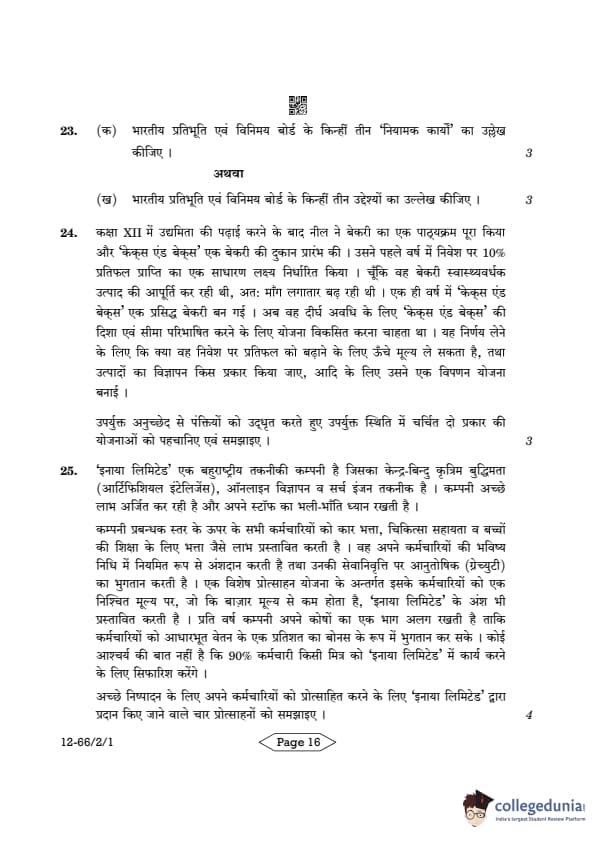
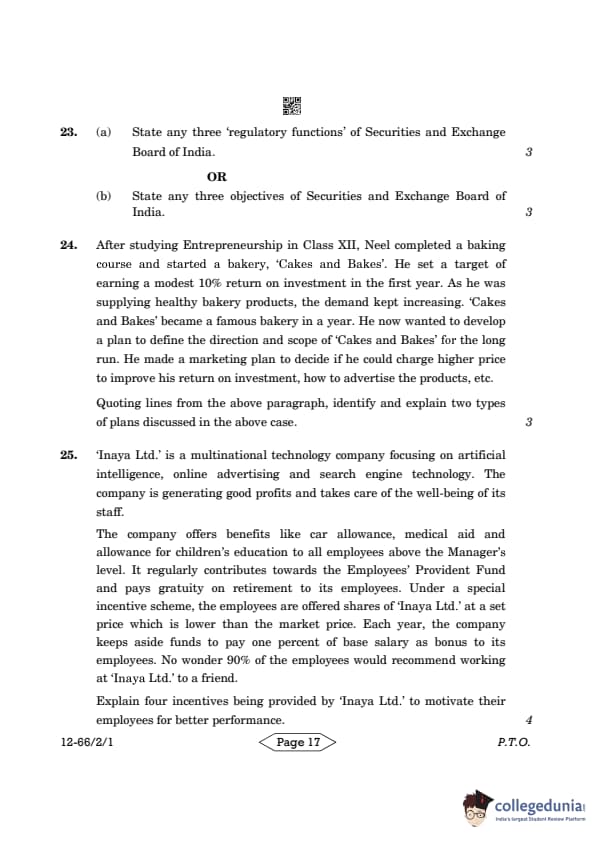
Question 23(a):
State any three 'regulatory functions' of Securities and Exchange Board of India.
View Solution
Solution: 1. Registration of brokers and sub-brokers and other players in the market.
2. Registration of collective investment schemes and Mutual Funds.
3. Regulation of stock brokers, portfolio exchanges, underwriters, and merchant bankers and the business in stock exchanges and any other securities market.
4. Regulation of takeover bids by companies.
5. Calling for information by undertaking inspection, conducting enquiries, and audits of stock exchanges and intermediaries.
Question 23(b):
State any three objectives of the Securities and Exchange Board of India (SEBI).
View Solution
Solution: Objectives of SEBI:
(i) Regulation of Stock Exchanges:
SEBI aims to regulate stock exchanges and the securities market to ensure their smooth and orderly functioning.
(ii) Investor Protection and Awareness:
SEBI works to protect the rights and interests of investors, particularly individual investors, by guiding and educating them about securities trading.
(iii) Prevention of Trading Malpractices:
SEBI ensures that unethical and fraudulent activities such as insider trading, price manipulation, and unfair trade practices are prevented.
(iv) Regulation of Intermediaries:
SEBI formulates a code of conduct and fair practices for intermediaries like brokers, merchant bankers, and investment advisors, ensuring professionalism and competitiveness.
Question 24:
After studying Entrepreneurship in Class XII, Neel completed a baking course and started a bakery, 'Cakes and Bakes'. He set a target of earning a modest 10% return on investment in the first year. As he was supplying healthy bakery products, the demand kept increasing. 'Cakes and Bakes' became a famous bakery in a year. He now wanted to develop a plan to define the direction and scope of 'Cakes and Bakes' for the long run. He made a marketing plan to decide if he could charge higher price to improve his return on investment, how to advertise the products, etc.
Quoting lines from the above paragraph, identify and explain two types of plans discussed in the above case.
View Solution
Solution:
Two types of plans discussed in the case:
(i) Objective:
"He set a target of earning a modest 10An objective is a specific goal set by the organization to be achieved within a set time period. In this case, the target return on investment is a clear objective.
(ii) Strategy:
"He now wanted to develop a plan to define the direction and scope of 'Cakes and Bakes' for the long run."
A strategy outlines a broad course of action that is designed to achieve long-term goals and objectives, such as improving ROI and advertising products effectively.
Question 25:
'Inaya Ltd.' is a multinational technology company focusing on artificial intelligence, online advertising and search engine technology. The company is generating good profits and takes care of the well-being of its staff. The company offers benefits like car allowance, medical aid, and allowance for children's education to all employees above the Manager's level. It regularly contributes towards the Employees' Provident Fund and pays gratuity on retirement to its employees. Under a special incentive scheme, the employees are offered shares of 'Inaya Ltd.' at a set price which is lower than the market price. Each year, the company keeps aside funds to pay one percent of base salary as bonus to its employees. No wonder 90% of the employees would recommend working at 'Inaya Ltd.' to a friend.
Explain four incentives being provided by 'Inaya Ltd.' to motivate their employees for better performance.
View Solution
Solution:
The incentives provided by 'Inaya Ltd.' include:
(i) Perquisites:
Perquisites such as car allowance, housing, and medical aid provide motivation to employees over and above their salary.
(ii) Retirement benefits:
Retirement benefits like provident fund and gratuity provide financial security to employees after retirement, motivating them to stay in the organization.
(iii) Stock option/Co-partnership:
Employees are offered company shares at a set price lower than the market price, creating a sense of ownership and encouraging them to contribute to the growth of the company.
(iv) Bonus:
Bonuses are provided over and above salaries as a reward for good performance, motivating employees to achieve higher results.
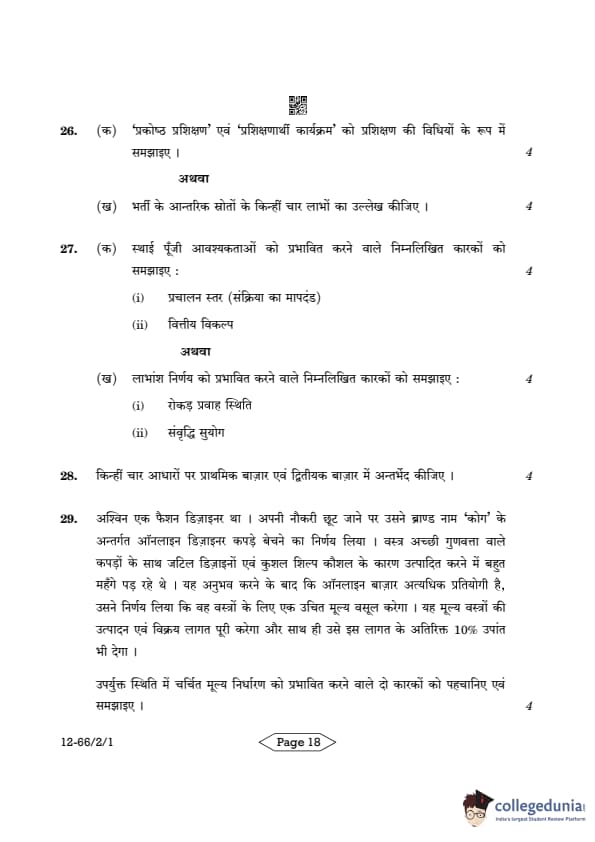
Question 26(a):
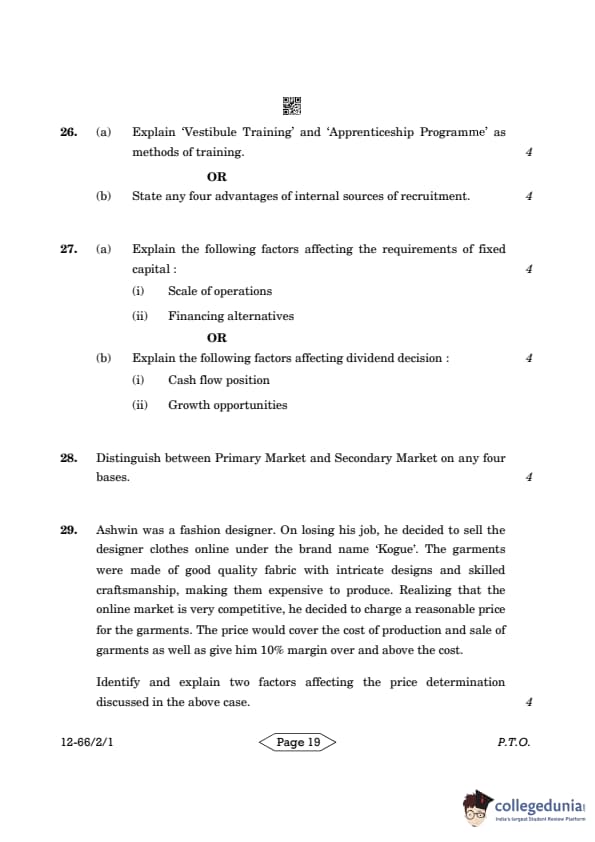
Explain ‘Vestibule Training' and 'Apprenticeship Programme' as methods of training.
View Solution
Solution:
Vestibule Training:
Employees learn their jobs on the equipment they will be using, but the training is conducted away from the actual work floor.
Actual work environments are created in a classroom, and this is usually done when employees are required to handle sophisticated machines and equipment.
Apprenticeship Programme:
Apprenticeship programmes put the trainee under the guidance of a master worker. These are designed to acquire a higher level of skill.
A uniform period of training is offered to trainees, in which both fast and slow learners are placed together. Slow learners may require additional training.
Question 26(b):
State any four advantages of internal sources of recruitment.
View Solution
Solution:
The advantages of internal sources of recruitment are:
(i) Employees are motivated to improve their performance as a promotion at a higher level may lead to a chain of promotion at lower levels in the organisation.
(ii) Internal recruitment also simplifies the process of selection and placement as the candidates are already known to the organisation.
(iii) People recruited from within the organisation do not need induction training.
(iv) Transfer has the benefit of shifting the workforce from the surplus departments to those where there is a shortage of staff.
Question 27(a):
Explain the following factors affecting the requirements of fixed capital:
(i) Scale of operations
(ii) Financing alternatives
View Solution
Solution:
(i) Scale of operations:
A larger organisation operating at a higher scale needs bigger plants, more space, etc., and therefore requires higher investment in fixed assets when compared with a small organisation.
(ii) Financing alternatives:
The availability of leasing facilities may reduce the funds required to be invested in fixed assets, thereby reducing the fixed capital requirements. When an asset is taken on lease, the firm pays lease rentals and uses it, avoiding the huge sum required for purchasing it.
Question 27(b):
Explain the following factors affecting dividend decision:
(i) Cash flow position
(ii) Growth opportunities
View Solution
Solution:
(i) Cash flow position:
The payment of dividend involves an outflow of cash. A company may be earning profit but may be short on cash. Availability of enough cash in the company is necessary for the declaration of dividend.
(ii) Growth opportunities:
Companies having good growth opportunities retain more money out of their earnings to finance the required investment. The dividend in growth companies is, therefore, smaller than that in non-growth companies.
Question 28:
Distinguish between Primary Market and Secondary Market on any four bases.
View Solution
Solution:
Primary Market:
(i) It involves the sale of securities by new companies or new issues of securities by existing companies to investors.
(ii) Securities are sold by the company to the investors directly.
(iii) It directly promotes capital formation.
(iv) Only buying of securities takes place.
Secondary Market:
(i) There is trading of existing shares only.
(ii) Ownership of securities is exchanged between investors.
(iii) It indirectly promotes capital formation.
(iv) Both buying and selling of securities takes place.
Question 29:
Ashwin was a fashion designer. On losing his job, he decided to sell the designer clothes online under the brand name 'Kogue.' The garments were made of good quality fabric with intricate designs and skilled craftsmanship, making them expensive to produce. Realizing that the online market is very competitive, he decided to charge a reasonable price for the garments. The price would cover the cost of production and sale of garments as well as give him a 10% margin over and above the cost.
Identify and explain two factors affecting the price determination discussed in the above case.
View Solution
Solution:
The two factors affecting price determination are:
(i) Product cost:
The cost sets the minimum level or the floor price at which the product may be sold. Generally, all marketing firms strive to cover all their costs, at least in the long run, and aim to earn a profit margin over the costs.
(ii) Extent of competition in the market:
The price will tend to reach the upper limit when there is lesser competition. However, under conditions of free competition, the price will be set at the lowest level. Competitors' prices, their anticipated reactions, quality, and features of the competitive products must be considered before fixing the price of a product.
Question 30:
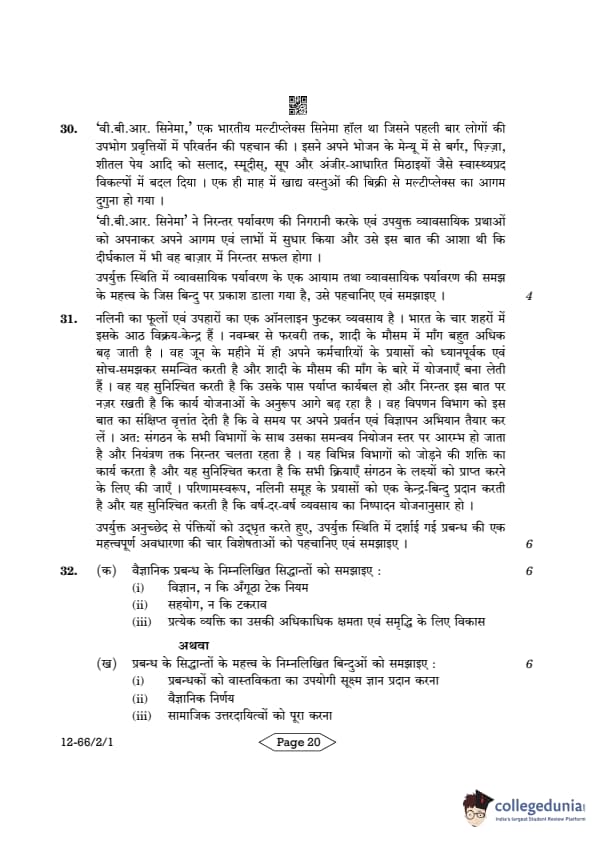
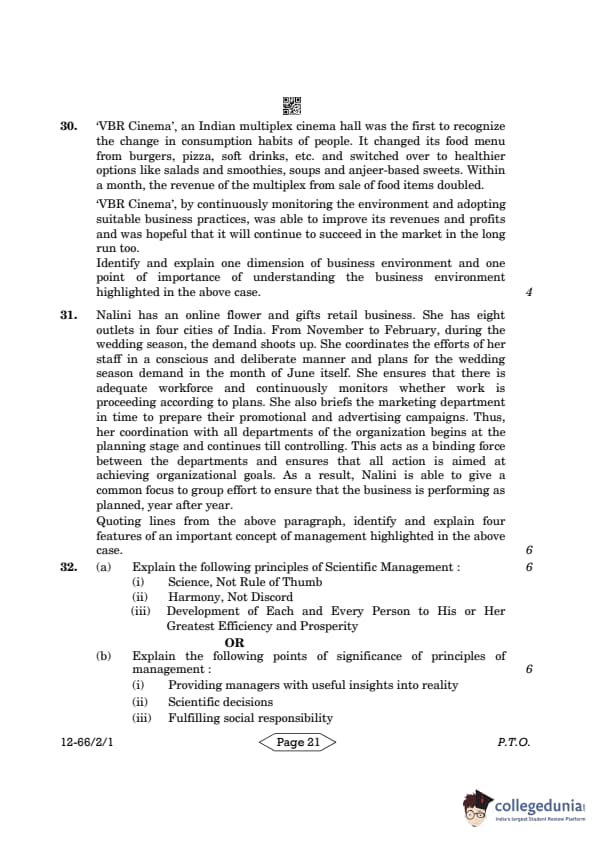
'VBR Cinema', an Indian multiplex cinema hall was the first to recognize the change in consumption habits of people. It changed its food menu from burgers, pizza, soft drinks, etc., and switched over to healthier options like salads and smoothies, soups, and anjeer-based sweets. Within a month, the revenue of the multiplex from sale of food items doubled.
'VBR Cinema', by continuously monitoring the environment and adopting suitable business practices, was able to improve its revenues and profits and was hopeful that it will continue to succeed in the market in the long run too.
Identify and explain one dimension of business environment and one point of importance of understanding the business environment highlighted in the above case.
View Solution
Solution:
Dimension of Business Environment:
Social Environment:
The social environment of business includes social forces like customs, traditions, values, social trends, and society's expectations from business.
Importance of Understanding the Business Environment:
It helps to improve performance:
Enterprises that continuously monitor their environment and adopt suitable business practices not only improve their current performance but also continue to succeed in the market for a longer period.
Question 31:
Nalini has an online flower and gifts retail business. She has eight outlets in four cities of India. From November to February, during the wedding season, the demand shoots up. She coordinates the efforts of her staff in a conscious and deliberate manner and plans for the wedding season demand in the month of June itself. She ensures that there is adequate workforce and continuously monitors whether work is proceeding according to plans. She also briefs the marketing department in time to prepare their promotional and advertising campaigns. Thus, her coordination with all departments of the organization begins at the planning stage and continues till controlling. This acts as a binding force between the departments and ensures that all action is aimed at achieving organizational goals. As a result, Nalini is able to give a common focus to group effort to ensure that the business is performing as planned, year after year.
Quoting lines from the above paragraph, identify and explain four features of an important concept of management highlighted in the above case.
View Solution
Solution: The features of coordination highlighted in the above case are:
(i) Coordination is a deliberate function:
‘She coordinates the efforts of her staff in a conscious and deliberate manner and plans for the wedding season demand in the month of June itself.'
A manager has to coordinate the efforts of different people in a conscious and deliberate manner.
(ii) Coordination is a continuous process:
'Thus, her coordination with all departments of the organization begins at the planning stage and continues till controlling.'
Coordination is not a one-time function but a continuous process that begins at the planning stage and continues till controlling.
(iii) Coordination ensures unity of action:
‘This acts as a binding force between the departments and ensures that all action is aimed at achieving organizational goals.' The purpose of coordination is to secure unity of action in the realization of a common purpose.
(iv) Coordination integrates group efforts:
‘Nalini is able to give a common focus to group effort to ensure that the business is performing as planned, year after year.' Coordination unifies unrelated or diverse interests into purposeful work activity.
Question 32(a):
Explain the following principles of Scientific Management:
(i) Science, Not Rule of Thumb
(ii) Harmony, Not Discord
(iii) Development of Each and Every Person to His or Her Greatest Efficiency and Prosperity
View Solution
Solution:
(i) Science, Not Rule of Thumb:
It states that there is only one best method to maximize efficiency. This method can be developed through scientific study and analysis of each element of a job and should substitute the 'Rule of Thumb'. The standard method should be followed throughout the organization.
(ii) Harmony, Not Discord:
This principle emphasizes that there should be complete harmony between management and workers. This requires ‘Mental revolution' on the part of both management and workers. Both management and workers should transform their thinking. Management should share the gains of the company with the workers, and workers should work hard and be willing to embrace change for the good of the company.
(iii) Development of Each and Every Person to His or Her Greatest Efficiency and Prosperity:
This principle is concerned with the efficiency of employees, which could be built right from the process of employee selection. The work assigned to employees should suit their capabilities. They should be given the required training to increase their efficiency. Efficient employees would produce more and earn more, which ensures their greatest efficiency and prosperity for both the company and the workers.
Question 32(b):
Explain the following points of significance of principles of management:
(i) Providing Managers with Useful Insights into Reality
(ii) Scientific Decisions
(iii) Fulfilling Social Responsibility
View Solution
Solution:
(i) Providing Managers with Useful Insights into Reality:
Principles of management provide valuable insights by helping managers learn from past mistakes and solve recurring problems quickly. Adherence to these principles enhances managerial knowledge, ability, and understanding of complex business situations. This leads to better decision-making and efficient problem-solving in organizations.
(ii) Scientific Decisions:
Management principles ensure that decisions are made scientifically rather than arbitrarily. Decisions based on these principles are free from bias and rely on objective assessment of business situations. This enhances accuracy, consistency, and effectiveness in managerial decision-making.
(iii) Fulfilling Social Responsibility:
Modern businesses operate in an environment where public awareness and expectations regarding corporate social responsibility are high. Principles of management emphasize ethical practices and social responsibility, ensuring businesses contribute to societal well-being. Management theories continue to evolve in response to social and environmental demands.
Question 33(a):
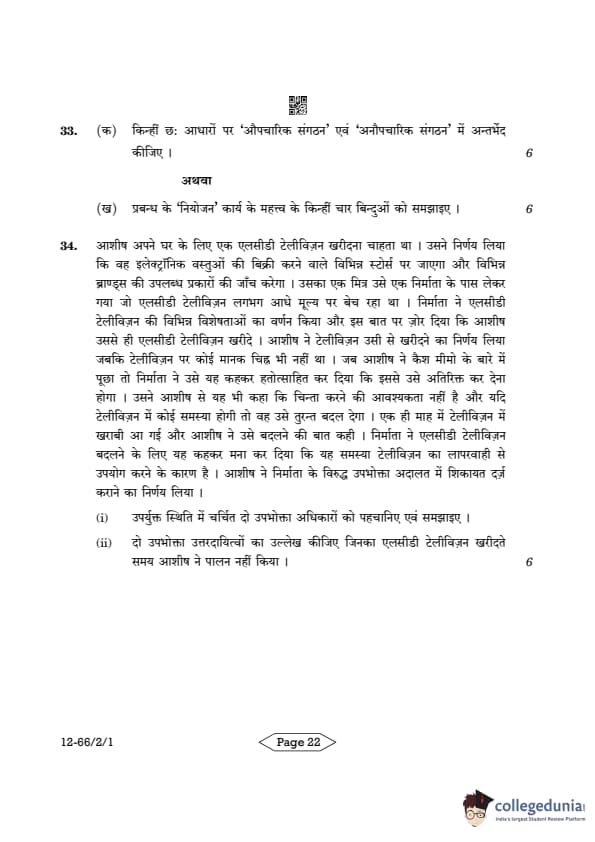
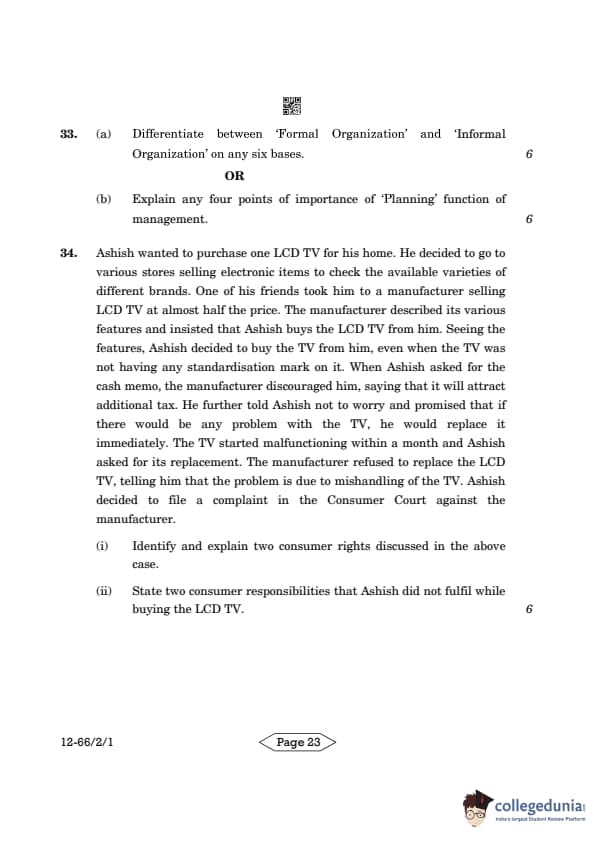
Differentiate between 'Formal Organization' and 'Informal Organization' on any six bases.
View Solution
Solution: The differences between Formal Organization and Informal Organization are:
Formal Organization:
(i) Meaning: It is a structure of authority relationships created by management.
(ii) Origin: It arises as a result of company rules and policies.
(iii) Authority: It arises out of position in management.
(iv) Behavior: It is directed by rules.
(v) Nature: It is rigid in nature.
(vi) Leadership: Managers are leaders.
(vii) Flow of Communication: Communication takes place through the scalar chain.
Informal Organization:
(i) Meaning: It is a network of social relationships arising out of interaction among employees.
(ii) Origin: It arises as a result of social interaction.
(iii) Authority: It arises out of personal qualities.
(iv) Behavior: There is no set behavior pattern.
(v) Nature: It is flexible in nature.
(vi) Leadership: Leaders may or may not be managers. They are selected by the group.
(vii) Flow of Communication: Flow of communication is not through a planned route. It can take place in any direction.
Question 33(b):
Explain any four points of importance of Planning function of management.
View Solution
Solution: The importance of the Planning function of management are:
(i) Planning provides direction: Planning gives a clear direction to the activities of the organization and helps to avoid unnecessary efforts.
(ii) Planning reduces the risk of uncertainty: Through forecasting and preparing for future contingencies, planning helps minimize risks associated with uncertainty.
(iii) Planning reduces overlapping and wasteful activities: By clearly defining objectives and procedures, planning ensures resources are utilized effectively, preventing duplication of work.
(iv) Planning promotes innovative ideas: Planning encourages creativity and innovation, as it often involves assessing new possibilities and alternative courses of action.
(v) Planning facilitates decision making: By setting objectives and strategies, planning helps managers make informed and well-guided decisions.
(vi) Planning establishes standards for controlling: It provides benchmarks for performance evaluation, ensuring that organizational activities are in line with set goals.
Question 34:
Ashish wanted to purchase one LCD TV for his home. He decided to go to various stores selling electronic items to check the available varieties of different brands. One of his friends took him to a manufacturer selling LCD TV at almost half the price. The manufacturer described its various features and insisted that Ashish buys the LCD TV from him. Seeing the features, Ashish decided to buy the TV from him, even when the TV was not having any standardisation mark on it. When Ashish asked for the cash memo, the manufacturer discouraged him, saying that it will attract additional tax. He further told Ashish not to worry and promised that if there would be any problem with the TV, he would replace it immediately. The TV started malfunctioning within a month and Ashish asked for its replacement. The manufacturer refused to replace the LCD TV, telling him that the problem is due to mishandling of the TV. Ashish decided to file a complaint in the Consumer Court against the manufacturer.
(i) Identify and explain two consumer rights discussed in the above case
View Solution
Solution:
Right to choose/Right to be assured: The consumer has the freedom to access a variety of products at competitive prices. This implies that the marketers should offer a wide variety of products in terms of quality, brand, prices, size, etc., and allow the consumer to make a choice from among these.
Right to be heard: The consumer has a right to file a complaint and to be heard in case of dissatisfaction with a good or a service. It is because of this reason that many enlightened business firms have set up their own consumer service and grievance cells.
Right to safety: The consumer has a right to be protected against goods and services that are hazardous to life, health, and property. Thus, consumers are educated that they should use electrical appliances that are ISI marked, as this would be an assurance of such products meeting quality specifications.
(ii) State two consumer responsibilities that Ashish did not fulfil while buying the LCD TV.
View Solution
Solution:
Buy only standardised goods: Ashish did not ensure that the product was standardised and lacked quality assurance, which is essential to guarantee its safety and reliability.
Ask for a cash memo on purchase of goods or services: Ashish did not ask for a proper cash memo, which is a basic consumer responsibility when purchasing goods to ensure that transactions are documented and transparent.
Be honest in your dealings: Ashish did not confirm whether the TV was as per the standard specifications, which could have helped him in avoiding faulty purchases or misleading deals.





Comments