




CBSE Class 12 Business Studies Question Paper 2024 PDF (Set 2- 66/1/2) is available for download here. CBSE conducted the Business Studies exam on March 27, 2024 from 10:30 AM to 1:30 PM. The total marks for the theory paper are 80. The question paper will contain 20% MCQ-based questions, 40% competency-based questions, and 40% short and long answer type questions. Candidates can use the link below to download the CBSE Class 12 Business Studies Set 2 Question Paper with detailed solutions.
CBSE Class 12 Business Studies Question Paper 2024 (Set 2- 66/1/2) with Answer Key
| CBSE Class 12 2024 Business Studies Question Paper with Answer Key |  Download Download |
Check Solution |
CBSE Class 12 2024 Business Studies Questions with Solutions
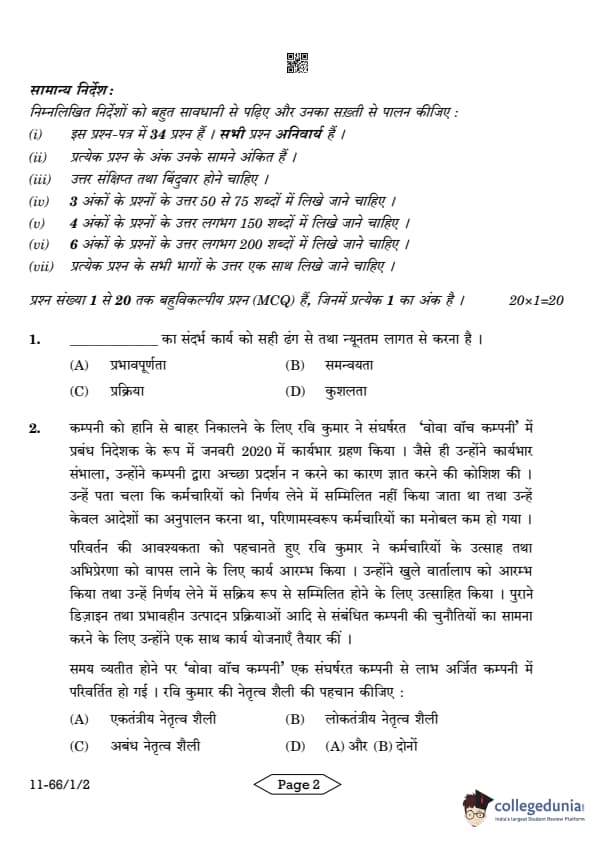
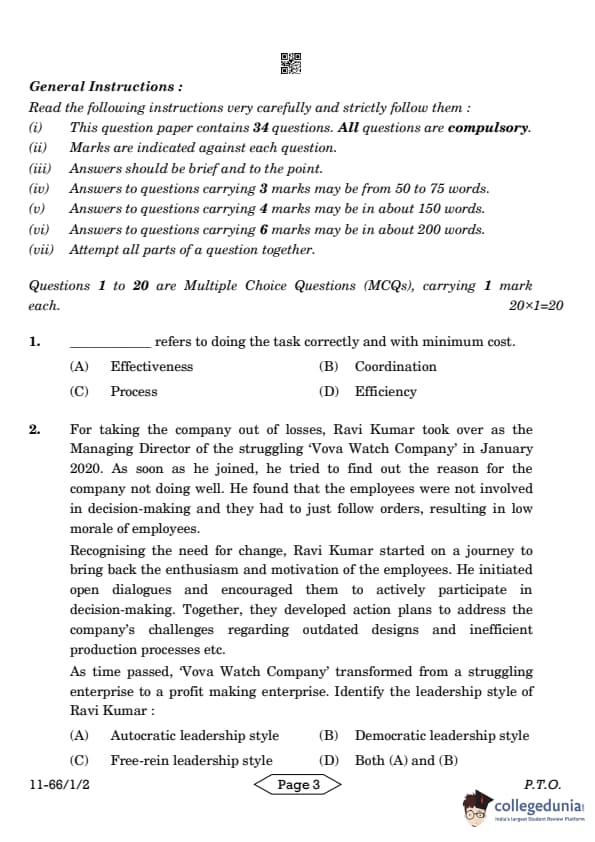
Question 1:
__________ refers to doing the task correctly and with minimum cost.
View Solution
Solution:
Step 1: Efficiency is defined as performing a task correctly with minimal resource utilization and cost. It focuses on the input-output ratio.
Step 2: In contrast, effectiveness is about achieving goals, whereas efficiency is about optimizing resources to achieve the best results at minimal cost.
Thus, the correct answer is option D.
Question 2:
For taking the company out of losses, Ravi Kumar took over as the Managing Director of the struggling ‘Vova Watch Company' in January 2020. As soon as he joined, he tried to find out the reason for the company not doing well. He found that the employees were not involved in decision-making and they had to just follow orders, resulting in low morale of employees. Recognising the need for change, Ravi Kumar started on a journey to bring back the enthusiasm and motivation of the employees. He initiated open dialogues and encouraged them to actively participate in decision-making. Together, they developed action plans to address the company's challenges regarding outdated designs and inefficient production processes etc. As time passed, ‘Vova Watch Company' transformed from a struggling enterprise to a profit-making enterprise. Identify the leadership style of Ravi Kumar:
View Solution
Solution:
Step 1: Understanding Leadership Styles:
Autocratic leadership is characterized by individual control over all decisions with little input from team members. In contrast, democratic leadership involves collaboration and encourages employee participation in decision-making.
Step 2: Applying to the given case:
Ravi Kumar encouraged employees to actively participate in decision-making, promoting enthusiasm and motivation. This aligns with democratic leadership, where employees are given a voice in business decisions, fostering a sense of ownership and commitment.
Therefore, the correct answer is option B.
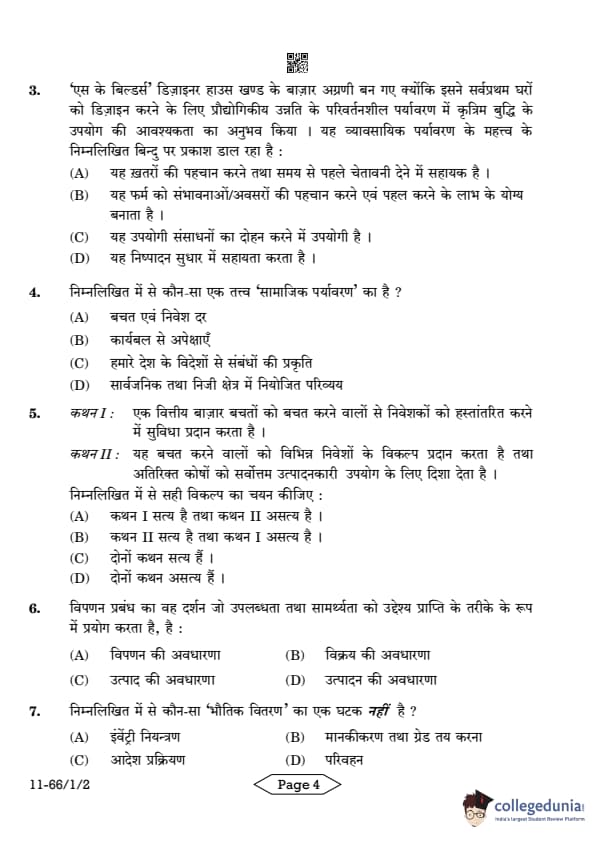
Question 3:
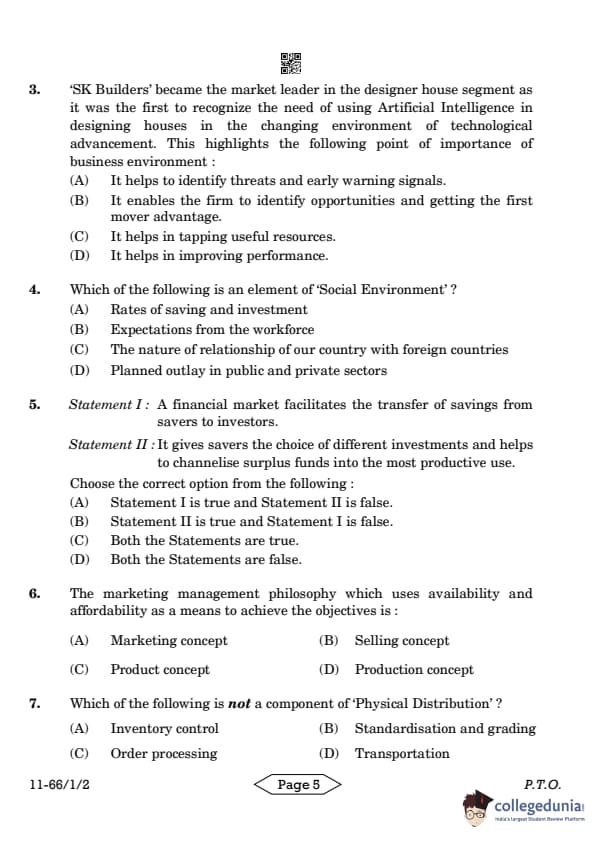
'SK Builders' became the market leader in the designer house segment as it was the first to recognize the need of using Artificial Intelligence in designing houses in the changing environment of technological advancement. This highlights the following point of importance of business environment:
View Solution
Solution:
Step 1: Business environment analysis helps firms identify emerging opportunities. By leveraging technological advancements, businesses can gain a competitive edge.
Step 2: In this case, ‘SK Builders' recognized an opportunity early, giving them the first-mover advantage in the market.
Thus, the correct answer is option B.
Question 4:
Which of the following is an element of ‘Social Environment'?
View Solution
Solution:
Step 1: Understanding Social Environment:
The social environment refers to the cultural and societal aspects that influence businesses, such as social values, work ethics, lifestyle changes, and expectations from the workforce.
Step 2: Analyzing the options:
- Option (A) relates to economic factors rather than social factors.
- Option (B) aligns with social expectations, reflecting the workforce's changing attitudes and aspirations.
- Option (C) pertains to political or economic environment.
- Option (D) refers to economic planning and development, not social environment.
Thus, the correct answer is option B.
Question 5:
Statement I: A financial market facilitates the transfer of savings from savers to investors.
Statement II: It gives savers the choice of different investments and helps to channelize surplus funds into the most productive use.
Choose the correct option from the following:
View Solution
Solution:
Step 1: Financial markets play a crucial role in mobilizing savings and channeling them to productive investments.
Step 2: They offer various investment choices and enable investors to allocate resources efficiently.
Thus, both statements are true, and the correct answer is option C.
Question 6:
The marketing management philosophy which uses availability and affordability as a means to achieve the objectives is:
View Solution
Solution:
Step 1: The production concept emphasizes mass production, availability, and affordability of products to maximize profits.
Step 2: Businesses focus on producing goods efficiently to cater to demand.
Thus, the correct answer is option D.
Question 7:
Which of the following is not a component of 'Physical Distribution'?
View Solution
Solution:
Step 1: Physical distribution involves logistics activities such as transportation, warehousing, and order processing.
Step 2: Standardisation and grading relate to product quality, not physical movement of goods.
Thus, the correct answer is option B.
Question 8:
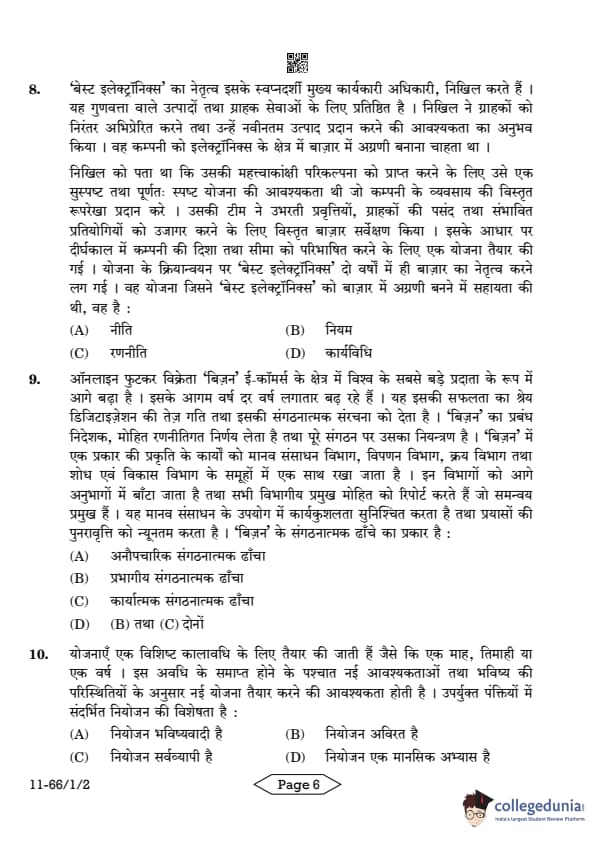
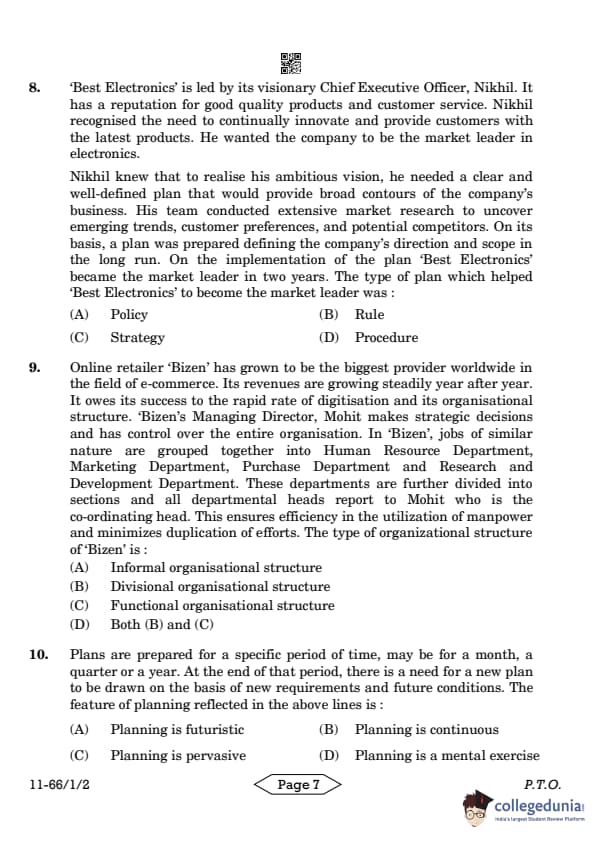
'Best Electronics' is led by its visionary Chief Executive Officer, Nikhil. It has a reputation for good quality products and customer service. Nikhil recognised the need to continually innovate and provide customers with the latest products. He wanted the company to be the market leader in electronics. Nikhil knew that to realise his ambitious vision, he needed a clear and well-defined plan that would provide broad contours of the company's business. His team conducted extensive market research to uncover emerging trends, customer preferences, and potential competitors. On its basis, a plan was prepared defining the company's direction and scope in the long run. On the implementation of the plan, 'Best Electronics' became the market leader in two years. The type of plan which helped 'Best Electronics' to become the market leader was:
View Solution
Solution:
Step 1: A strategy is a long-term plan designed to achieve specific goals and overcome challenges by utilizing available resources.
Step 2: Nikhil's vision and the extensive market research guided the preparation of a clear, long-term plan, which is characteristic of strategic planning.
Thus, the correct answer is option C.
Question 9:
Online retailer ‘Bizen' has grown to be the biggest provider worldwide in the field of e-commerce. Its revenues are growing steadily year after year. It owes its success to the rapid rate of digitisation and its organisational structure. ‘Bizen's Managing Director, Mohit makes strategic decisions and has control over the entire organisation. In 'Bizen', jobs of similar nature are grouped together into Human Resource Department, Marketing Department, Purchase Department and Research and Development Department. These departments are further divided into sections and all departmental heads report to Mohit who is the co-ordinating head. This ensures efficiency in the utilization of manpower and minimizes duplication of efforts. The type of organizational structure of ‘Bizen' is:
View Solution
Solution:
Step 1: A functional organisational structure groups similar jobs into departments based on their functions, such as HR, marketing, and finance.
Step 2: In the case of ‘Bizen,' jobs have been grouped based on their nature (HR, marketing, etc.), indicating a functional structure where departmental heads report to a single managing director.
Thus, the correct answer is option C.
Question 10:
Plans are prepared for a specific period of time, may be for a month, a quarter or a year. At the end of that period, there is a need for a new plan to be drawn on the basis of new requirements and future conditions. The feature of planning reflected in the above lines is:
View Solution
Solution:
Step 1: Planning is a continuous process as it requires constant monitoring and revision according to new conditions and requirements.
Step 2: Since new plans are created after evaluating past plans, it reflects the continuous nature of planning.
Thus, the correct answer is option B.
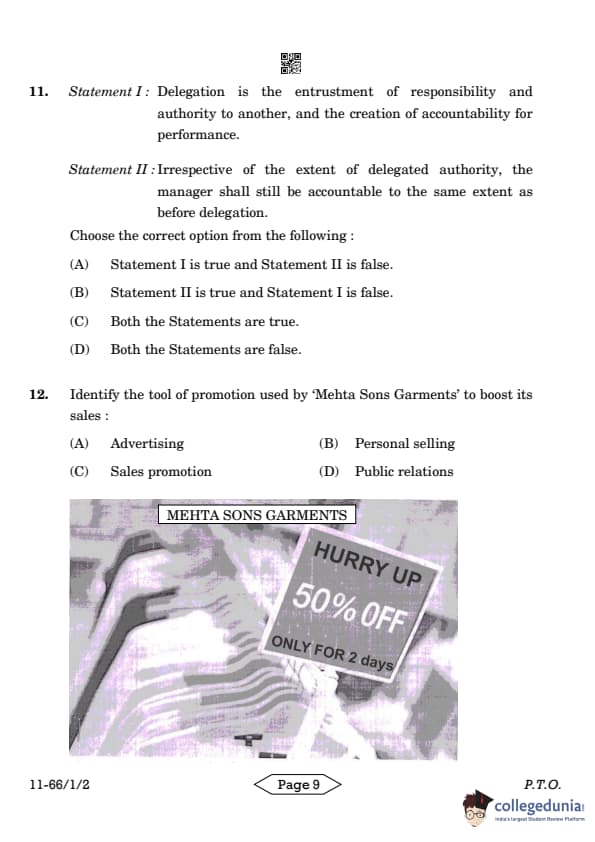
Question 11:
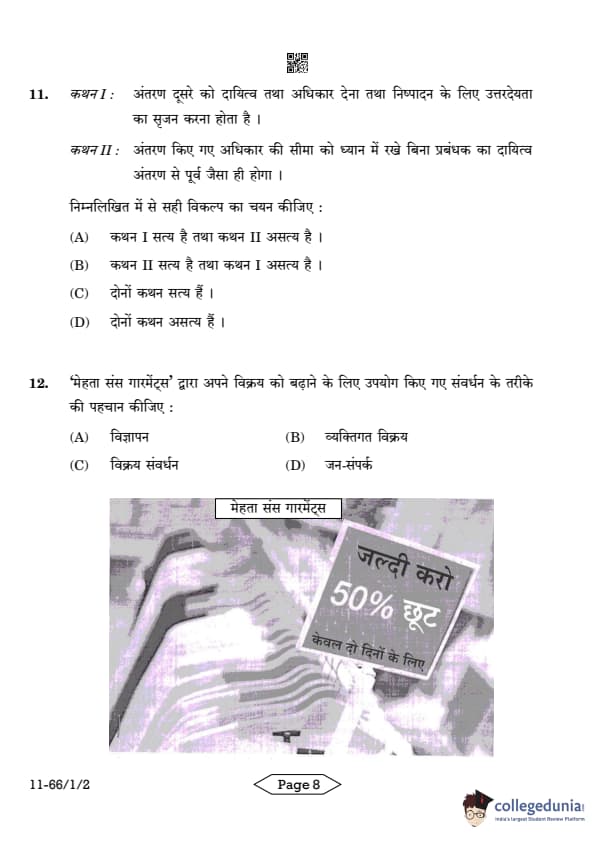
Statement I: Delegation is the entrustment of responsibility and authority to another, and the creation of accountability for performance.
Statement II: Irrespective of the extent of delegated authority, the manager shall still be accountable to the same extent as before delegation.
Choose the correct option from the following:
View Solution
Solution:
Step 1: Delegation involves the transfer of authority and responsibility, but accountability remains with the manager. Delegation enhances efficiency by distributing workload without relieving the manager of ultimate responsibility.
Step 2: As a principle of delegation, while responsibility and authority can be shared, accountability cannot be delegated, meaning the manager remains answerable.
Therefore, both statements are true.
Question 12:
Identify the tool of promotion used by 'Mehta Sons Garments' to boost its sales:

View Solution
Solution:
Step 1: Sales promotion includes short-term incentives to encourage purchases and boost sales.
Step 2: Examples include discounts, coupons, and special offers.
Thus, the correct answer is option C.
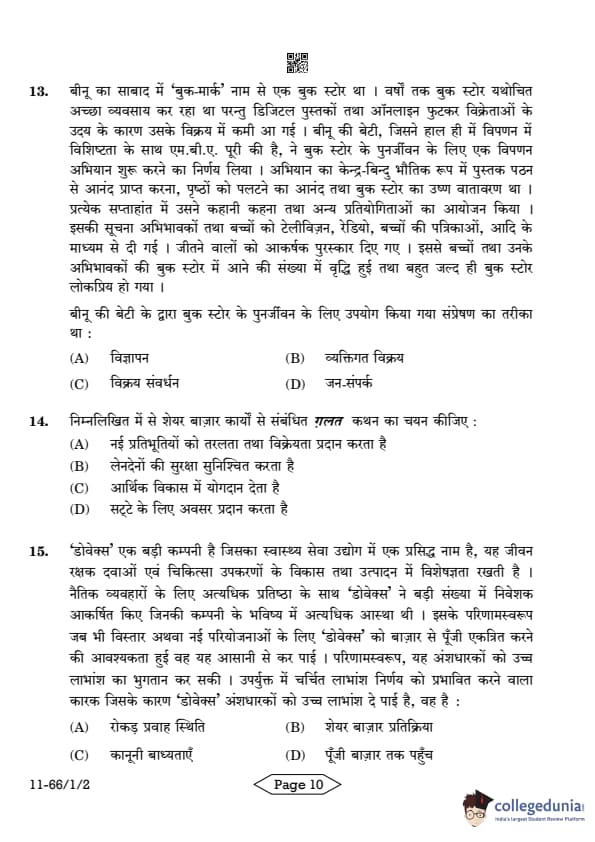
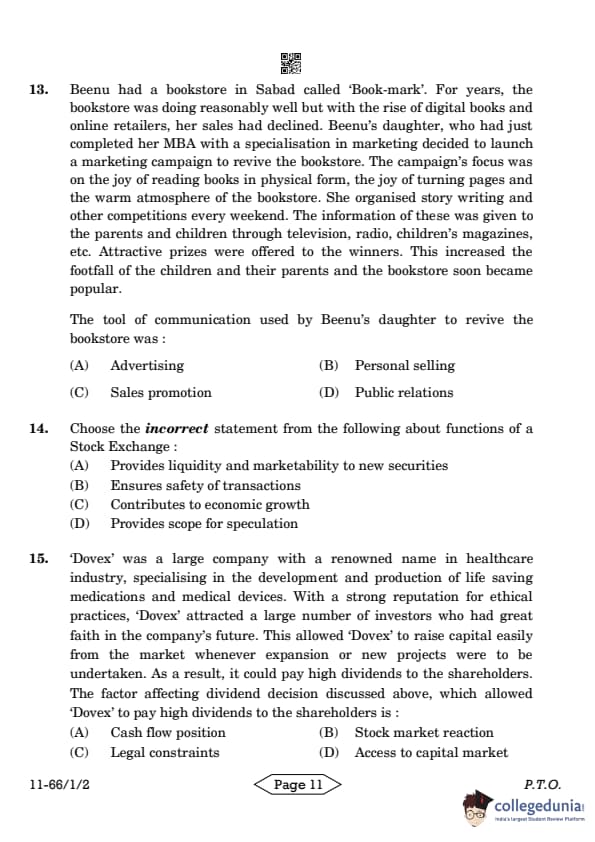
Question 13:
Beenu had a bookstore in Sabad called 'Book-mark'. For years, the bookstore was doing reasonably well but with the rise of digital books and online retailers, her sales had declined. Beenu's daughter, who had just completed her MBA with a specialisation in marketing, decided to launch a marketing campaign to revive the bookstore. The campaign's focus was on the joy of reading books in physical form, the joy of turning pages, and the warm atmosphere of the bookstore. She organised story writing and other competitions every weekend. The information of these was given to the parents and children through television, radio, children's magazines, etc. Attractive prizes were offered to the winners. This increased the footfall of the children and their parents and the bookstore soon became popular.
The tool of communication used by Beenu's daughter to revive the bookstore was:
View Solution
Solution:
Step 1: Public relations focuses on building and maintaining positive relationships with the public through various communication channels.
Step 2: Beenu's daughter used media channels like TV, radio, and magazines to communicate the joy of physical books and engage the community, which is characteristic of public relations efforts.
Thus, the correct answer is option D.
Question 14:
Choose the incorrect statement from the following about functions of a Stock Exchange:
View Solution
Solution:
Step 1: Stock exchanges provide liquidity and marketability to existing securities, not new securities. New securities are introduced in the primary market.
Step 2: Thus, the statement that stock exchanges provide liquidity to new securities is incorrect.
Thus, the correct answer is option A.
Question 15:
‘Dovex' was a large company with a renowned name in healthcare industry, specializing in the development and production of life-saving medications and medical devices. With a strong reputation for ethical practices, ‘Dovex' attracted a large number of investors who had great faith in the company's future. This allowed ‘Dovex’ to raise capital easily from the market whenever expansion or new projects were to be undertaken. As a result, it could pay high dividends to the shareholders.
The factor affecting dividend decision discussed above, which allowed ‘Dovex' to pay high dividends to the shareholders is:
View Solution
Solution:
Step 1: A company's ability to access capital from the market plays a crucial role in dividend decisions. If a company can raise funds easily, it has the flexibility to pay higher dividends.
Step 2: Since 'Dovex' had a strong reputation and could attract investors easily, it could afford to pay higher dividends without compromising its financial stability.
Thus, the correct answer is option D.
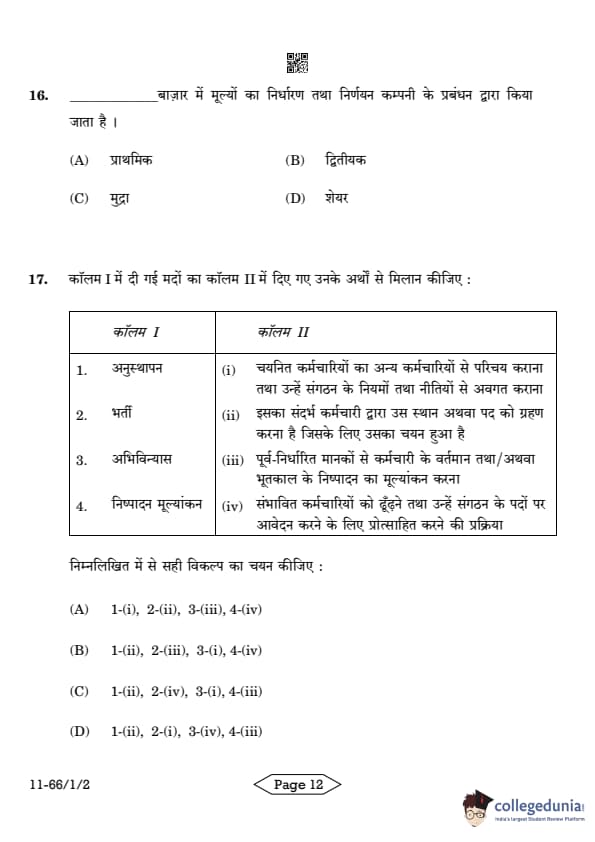
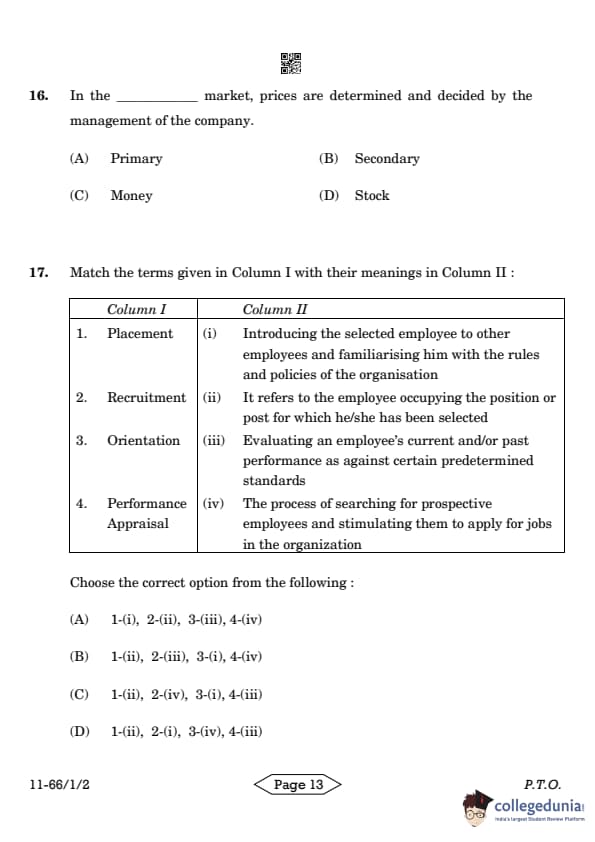
Question 16:
In the ___________ market, prices are determined and decided by the management of the company.
View Solution
Solution:
Step 1: In the primary market, securities are issued directly by the company, and the prices are set by the issuing company.
Step 2: The primary market facilitates the raising of capital through initial public offerings (IPOs) and other means.
Thus, the correct answer is option A.
Question 17:
Match the terms given in Column I with their meanings in Column II:
| Column I | Column II |
|---|---|
| 1. Placement | (i) Introducing the selected employee to other employees and familiarising him with the rules and policies of the organisation |
| 2. Recruitment | (ii) It refers to the employee occupying the position or post for which he/she has been selected |
| 3. Orientation | (iii) Evaluating an employee's current and/or past performance as against certain predetermined standards |
| 4. Performance Appraisal | (iv) The process of searching for prospective employees and stimulating them to apply for jobs in the organization |
Choose the correct option from the following:
View Solution
Solution:
Step 1: Understanding the terms:
- Placement: Refers to the employee occupying the assigned position.
- Recruitment: The process of attracting prospective employees to apply for jobs.
- Orientation: Introducing the new employee to the work environment and policies.
- Performance Appraisal: Evaluating employee performance based on set standards.
Thus, the correct answer is option C.
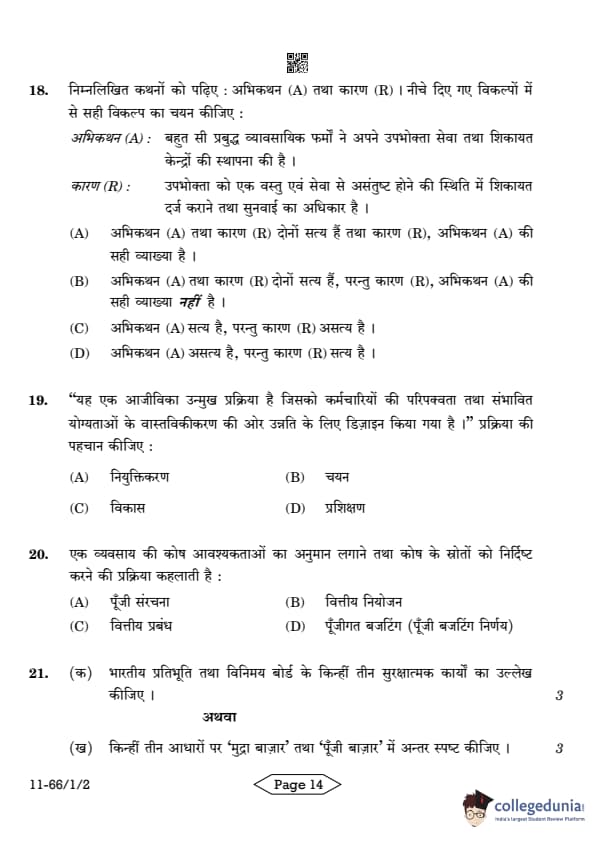
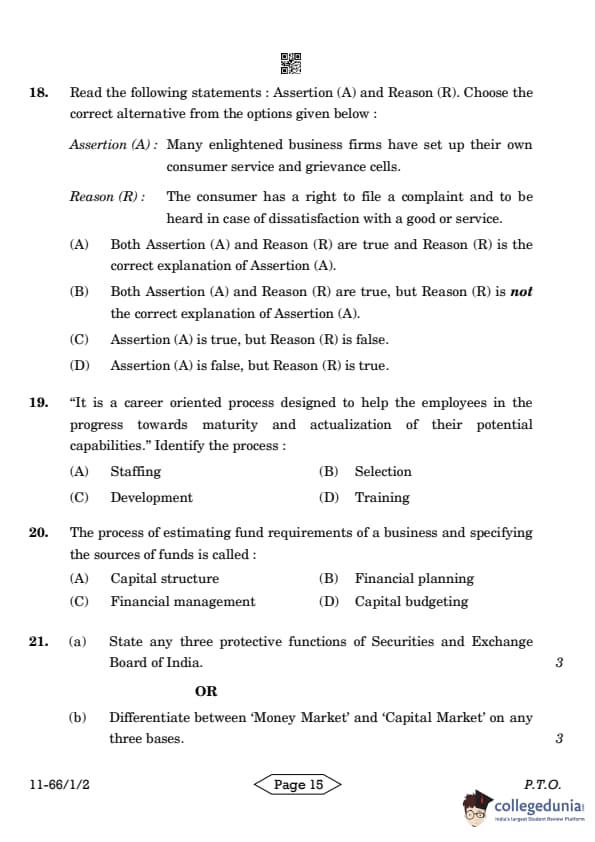
Question 18:
Read the following statements: Assertion (A) and Reason (R). Choose the correct alternative from the options given below:
Assertion (A): Many enlightened business firms have set up their own consumer service and grievance cells.
Reason (R): The consumer has a right to file a complaint and to be heard in case of dissatisfaction with a good or service.
View Solution
Solution:
Step 1: Businesses establish consumer service cells to address grievances and enhance customer satisfaction.
Step 2: The right to file a complaint is a fundamental consumer right, making it necessary for businesses to have grievance handling mechanisms.
Thus, the correct answer is option A.
Question 19:
“It is a career-oriented process designed to help the employees in the progress towards maturity and actualization of their potential capabilities.” Identify the process:
View Solution
Solution:
Step 1: Employee development is a continuous process aimed at enhancing an individual's knowledge, skills, and abilities to prepare them for future roles and responsibilities.
Step 2: Unlike training, which is job-specific, development focuses on overall career progression and potential realization.
Thus, the correct answer is option C.
Question 20:
The process of estimating fund requirements of a business and specifying the sources of funds is called:
View Solution
Solution:
Step 1: Financial planning involves determining the financial resources required for achieving business goals.
Step 2: It includes estimating the amount of funds required and identifying sources for obtaining these funds.
Thus, the correct answer is option B.
Question 21 (a):
State any three protective functions of Securities and Exchange Board of India.
View Solution
Solution:
Protective functions of Securities and Exchange Board of India (SEBI) are:
(i) It prohibits fraudulent and unfair trade practices like making misleading statements, manipulations, price rigging etc.
(ii) It controls insider trading and imposing penalties for such practices.
(iii) It undertakes steps for investor protection.
(iv) It promotes fair practices and code of conduct in securities market.
Question 21 (b):
Differentiate between 'Money Market' and 'Capital Market' on any three bases.
View Solution
Solution:
Difference between 'Money Market' and 'Capital Market':
| Basis | Money Market | Capital Market |
|---|---|---|
| Participants | Institutional participants such as RBI, banks, financial institutions | Financial institutions, banks, corporate entities, foreign investors, retail investors |
| Instruments | Short-term debt instruments like T-bills, trade bills, commercial paper, CDs | Long-term instruments like equity shares, debentures, bonds, preference shares |
| Investment outlay | Requires large sums of money, as instruments are expensive | Doesn't necessarily require huge investment, accessible to small investors |
| Duration | Deals with instruments with a maximum tenure of one year | Deals with medium and long-term securities |
| Liquidity | Higher liquidity due to short-term nature | Liquid, but may not always be actively traded |
| Safety | Safer with lower risk of default | Riskier with respect to returns and principal repayment |
| Expected return | Relatively lower returns | Higher returns for investors |
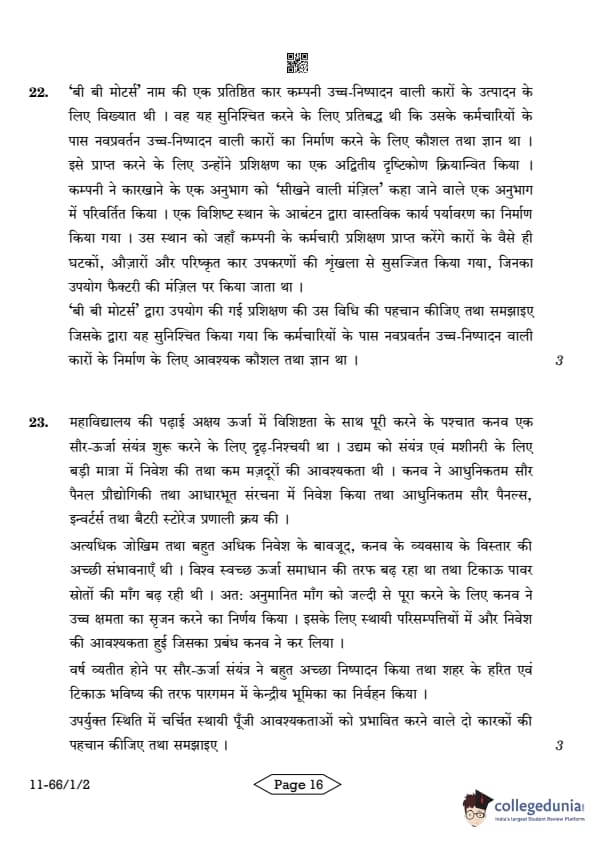
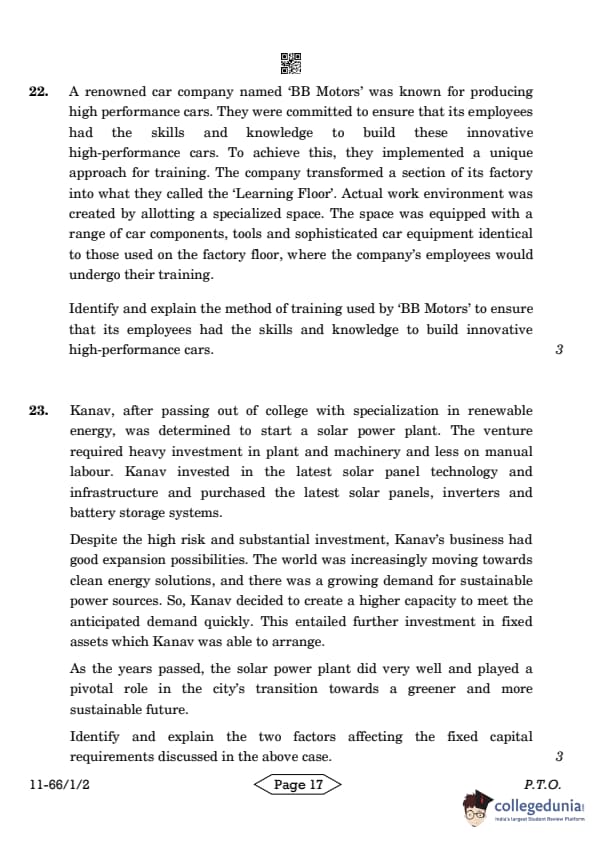
Question 22:
A renowned car company named 'BB Motors' was known for producing high performance cars. They were committed to ensure that its employees had the skills and knowledge to build these innovative high-performance cars. To achieve this, they implemented a unique approach for training. The company transformed a section of its factory into what they called the 'Learning Floor'. Actual work environment was created by allotting a specialized space. The space was equipped with a range of car components, tools and sophisticated car equipment identical to those used on the factory floor, where the company's employees would undergo their training. Identify and explain the method of training used by 'BB Motors' to ensure that its employees had the skills and knowledge to build innovative high-performance cars.
View Solution
Solution:
Method: Vestibule training
- Vestibule training is a method of training where employees learn their jobs on the equipment they will be using, but the training is conducted away from the actual work floor.
- This method is used when employees need to handle sophisticated machinery and equipment.
Question 23:
Kanav, after passing out of college with specialization in renewable energy, was determined to start a solar power plant. The venture required heavy investment in plant and machinery and less on manual labour. Kanav invested in the latest solar panel technology and infrastructure and purchased the latest solar panels, inverters and battery storage systems. Despite the high risk and substantial investment, Kanav's business had good expansion possibilities. The world was increasingly moving towards clean energy solutions, and there was a growing demand for sustainable power sources. So, Kanav decided to create a higher capacity to meet the anticipated demand quickly. This entailed further investment in fixed assets which Kanav was able to arrange. As the years passed, the solar power plant did very well and played a pivotal role in the city's transition towards a greener and more sustainable future. Identify and explain the two factors affecting the fixed capital requirements discussed in the above case.
View Solution
Solution:
The factors affecting the fixed capital requirements in the case are:
(i) Choice of technique:
- A capital-intensive organization requires higher investment in plant and machinery as it relies less on manual labour, thus higher fixed capital.
- Labour-intensive organisations require less investment in fixed assets. Hence, their fixed capital requirement is lower.
(ii) Growth prospects:
- When growth is expected, a company may choose to create higher capacity in order to meet anticipated higher demand quicker.
- This entails larger investment in fixed assets and consequently larger fixed capital.
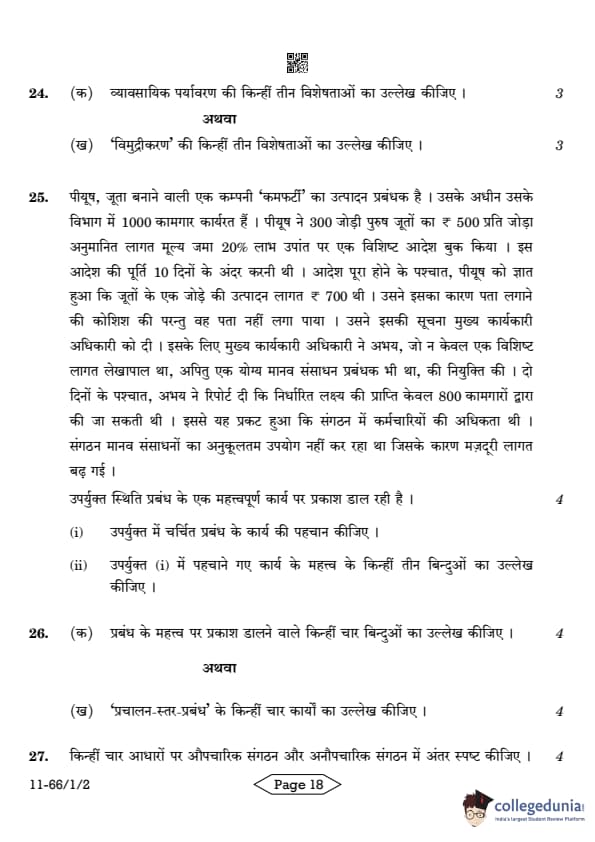
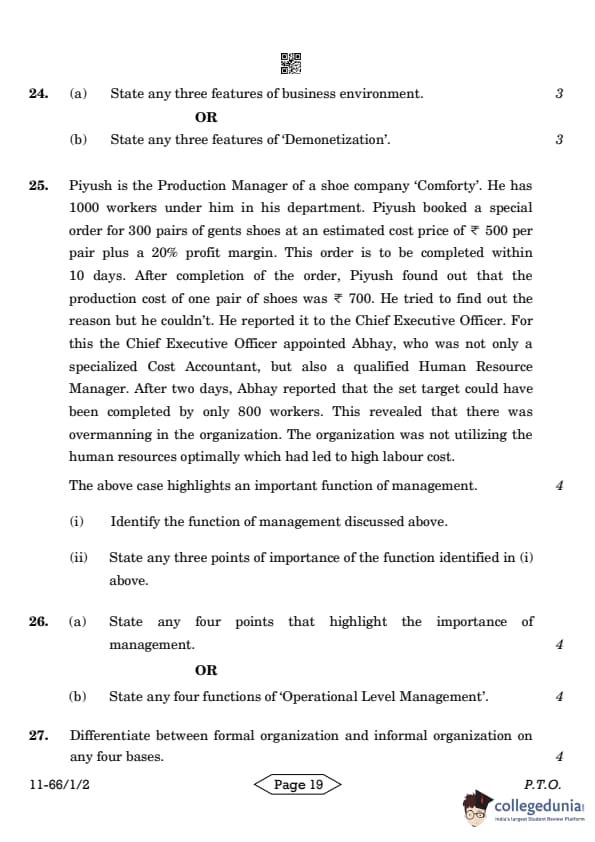
Question 24 (a):
State any three features of business environment.
View Solution
Solution:
Features of business environment are:
(i) Business environment is the sum total of all factors/things external to business firms and, as such, is aggregative in nature.
(ii) Business environment includes both specific such as customers, investors, etc and general forces such as political, social, etc.
(iii) Different elements or parts of business environment are closely inter-related.
(iv) Dynamic nature: Business environment is dynamic and keeps on changing whether in terms of technological improvement, shifts in consumer preferences, etc.
(v) Business environment is uncertain as it is very difficult to predict future happenings, especially when environment changes are taking place too frequently.
(vi) Business environment is complex as it consists of numerous interrelated and dynamic conditions or forces that are relatively easier to understand in parts but difficult to grasp in its totality.
(vii) Business environment is a relative concept since it differs from country to country and even region to region.
Question 24 (b):
State any three features of 'Demonetization'.
View Solution
Solution:
Features of demonetization are:
(i) Demonetisation is viewed as a tax administration measure and people with black money had to declare their unaccounted wealth and pay taxes at a penalty rate.
(ii) Demonetisation is also interpreted as a shift on the part of the government indicating that tax evasion will no longer be tolerated or accepted.
(iii) Demonetisation led to tax administration channelizing savings into the formal financial system, to enable banks with deposits to provide a base for loans, at lower interest rates.
(iv) It creates a less-cash or cash-lite economy, i.e., channelizing more savings through the formal financial system and improving tax compliance.
Question 25:
Piyush is the Production Manager of a shoe company 'Comforty'. He has 1000 workers under him in his department. Piyush booked a special order for 300 pairs of gents shoes at an estimated cost price of ₹500 per pair plus a 20% profit margin. This order is to be completed within 10 days. After completion of the order, Piyush found out that the production cost of one pair of shoes was ₹700. He tried to find out the reason but he couldn't. He reported it to the Chief Executive Officer. For this the Chief Executive Officer appointed Abhay, who was not only a specialized Cost Accountant, but also a qualified Human Resource Manager. After two days, Abhay reported that the set target could have been completed by only 800 workers. This revealed that there was overmanning in the organization, The organization was not utilizing the human resources optimally which had led to high labour cost. The above case highlights an important function of management.
(i) Identify the function of management discussed above.
View Solution
Solution:
(i) The function of management discussed in this case is Controlling.
Controlling is a key function of management that involves monitoring and evaluating the progress of activities to ensure that the organization is on track to meet its objectives. It includes the processes of setting performance standards, measuring actual performance, identifying deviations from the standards, and taking corrective actions.
In this case, Piyush, the Production Manager, noticed that the production cost for one pair of shoes exceeded the estimated cost. Upon investigation by Abhay, it was found that there was overmanning in the production process, meaning that more workers were involved than necessary to complete the task. The result was higher labor costs and inefficiency in resource utilization.
The controlling function is crucial in identifying such discrepancies and providing a foundation for corrective actions. By using controlling techniques, Abhay was able to identify the problem, allowing the organization to adjust its labor usage, thereby reducing costs and improving efficiency in future projects.
The key steps in controlling include:
1. Setting performance standards: In this case, the initial cost estimation and labor requirements would have been set as the performance standard.
2. Measuring actual performance: The actual labor used and the cost of production were monitored, revealing discrepancies between the expected and actual performance.
3. Identifying deviations: It was identified that the production process was using more workers than necessary, leading to higher labor costs.
4. Taking corrective action: After the issue was identified, the corrective action would involve optimizing the number of workers required and making the necessary adjustments to ensure that future production is more efficient.
Controlling is a fundamental part of the management process because it ensures that resources are used efficiently, performance is aligned with objectives, and the organization can quickly address any inefficiencies or issues that arise.
(ii) State any three points of importance of the function identified in (i) above.
View Solution
Solution:
(ii) Importance of Controlling:
(1) It helps in accomplishing organisational goals by bringing to light the deviations, if any, and indicating corrective action.
(2) It helps in judging accuracy of standards in the light of changes taking place in the organization and environment.
(3) It helps in making efficient use of resources by ensuring that each activity is performed in accordance with predetermined standards.
(4) It improves employee motivation as the employees know well in advance the standards of performance on the basis of which they will be appraised.
(5) It ensures order and discipline among employees by keeping a close check on their activities.
(6) It facilitates coordination in action as each department is governed by pre-determined standards which are well coordinated with one another.
Question 26 (a):
State any four points that highlight the importance of management.
View Solution
Solution:
Importance of management are:
(i) Management helps in achieving group goals by giving common direction to the individual effort in achieving the overall goal of the organisation.
(ii) Management increases efficiency by reducing costs and increases productivity through better planning, organising, directing, staffing and controlling the activities of the organisation.
(iii) Management creates a dynamic organisation by helping people adapt to changes taking place in the environment, so that the organisation is able to maintain its competitive edge.
(iv) Management helps in achieving personal objectives as the manager motivates and leads his team in such a manner that individual members are able to achieve personal goals while contributing to the overall organisational objective.
(v) Management helps in the development of the organisation and through that it helps in the development of society by providing good quality products and services, creating employment opportunities, etc.
Question 26 (b):
State any four functions of ‘Operational Level Management'.
View Solution
Solution:
Functions of Operational Level Management are:
(i) Supervisors directly oversee the efforts of the workforce.
(ii) They interact with the actual workforce and pass on instructions of the middle management to the workers.
(iii) Quality of output is maintained.
(iv) Wastage of materials is minimized.
(v) Safety standards are maintained.
Question 27:
Differentiate between formal organization and informal organization on any four bases.
View Solution
Solution:
Differences between formal organization and informal organization are:
| Basis | Formal Organization | Informal Organization |
|---|---|---|
| Meaning | It is a structure of authority relationships created by the management. | It is a network of social relationships arising out of interaction among employees. |
| Origin | It arises as a result of company rules and policies. | It arises as a result of social interaction. |
| Authority | It arises by virtue of position in management. | It arises out of personal qualities. |
| Behaviour | It is directed by rules. | There is no set behaviour pattern. |
| Flow of Communication | Communication takes place through the scalar chain. | Flow of communication is not through a planned route. It can take place in any direction. |
| Nature | It is rigid. | It is flexible. |
| Leadership | Managers are leaders. | Leaders may or may not be managers. They are chosen by the group. |
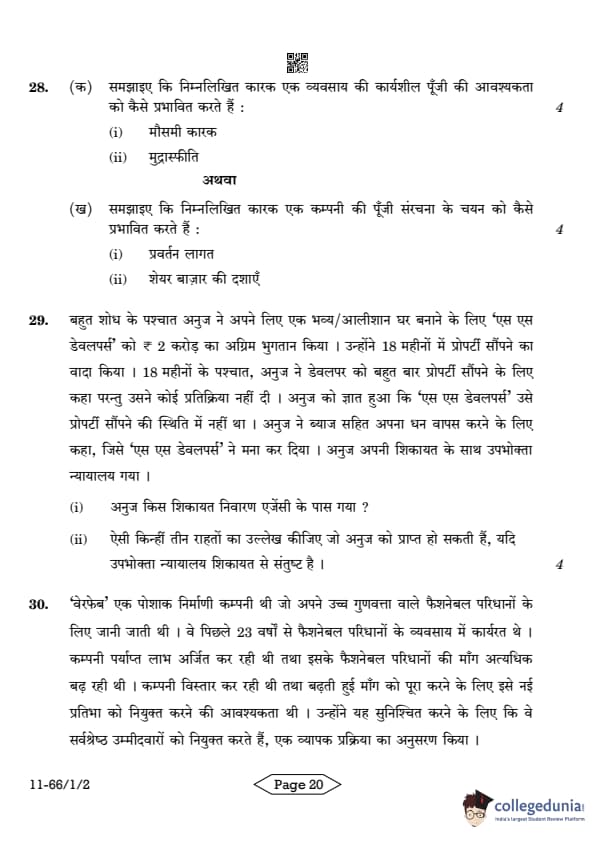
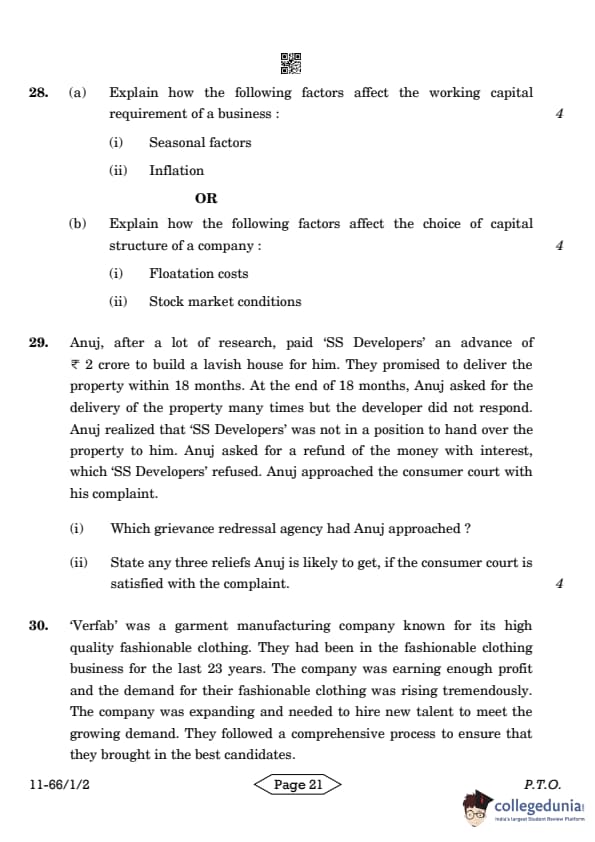
Question 28 (a):
Explain how the following factors affect the working capital requirement of a business:
(i) Seasonal factors
(ii) Inflation
View Solution
Solution:
Factors affecting the working capital requirement of a business are:
(i) Seasonal factors:
- In peak season, larger amounts of working capital are required because of higher levels of activity.
- During the lean season, the level of activity as well as the requirement for working capital is lower.
(ii) Inflation:
- With rising prices, larger amounts are required even to maintain a constant volume of production and sales.
- Working capital requirement of a business thus becomes higher with a higher rate of inflation.
Question 28 (b):
Explain how the following factors affect the choice of capital structure of a company:
(i) Floatation costs
(ii) Stock market conditions
View Solution
Solution:
Factors affecting the choice of capital structure of a company are:
(i) Floatation costs:
- Public issue of shares and debentures requires considerable expenditure.
- Getting a loan from a financial institution may not cost as much.
(ii) Stock market conditions:
- Use of equity is preferred by companies when the stock markets are bullish, as equity shares are more easily sold even at a higher price.
- However, during a bearish phase, a company may opt for debt.
Question 29:
Anuj, after a lot of research, paid 'SS Developers' an advance of 2 crore to build a lavish house for him. They promised to deliver the property within 18 months. At the end of 18 months, Anuj asked for the delivery of the property many times but the developer did not respond. Anuj realized that 'SS Developers' was not in a position to hand over the property to him. Anuj asked for a refund of the money with interest, which 'SS Developers' refused. Anuj approached the consumer court with his complaint.
(i) Which grievance redressal agency had Anuj approached?
View Solution
Solution:
(i) Anuj had approached the State Commission.
The State Commission is one of the key levels in the consumer grievance redressal mechanism. It is a quasi-judicial body that resolves consumer disputes in cases where the claim amount exceeds 20 lakhs but is below 1 crore. The State Commission handles complaints related to unfair trade practices, deficient services, and defective goods, and provides relief to consumers.
In this case, Anuj's complaint against 'SS Developers' for not delivering the property as promised and refusing to refund the advance payment comes under the jurisdiction of the State Commission because it involves a substantial amount of money and a clear violation of consumer rights. The commission would examine the complaint, evaluate the facts, and pass an appropriate judgment to provide relief to Anuj.
(ii) State any three reliefs Anuj is likely to get, if the consumer court is satisfied with the complaint.
View Solution
Solution:
Reliefs Anuj is likely to get, if the consumer court is satisfied with the complaint are:
- (a) To refund the price paid for the product, or the charges paid for the service.
- (b) To pay a reasonable amount of compensation for any loss or injury suffered by the consumer due to the negligence of the opposite party.
- (c) To pay punitive damages in appropriate circumstances.
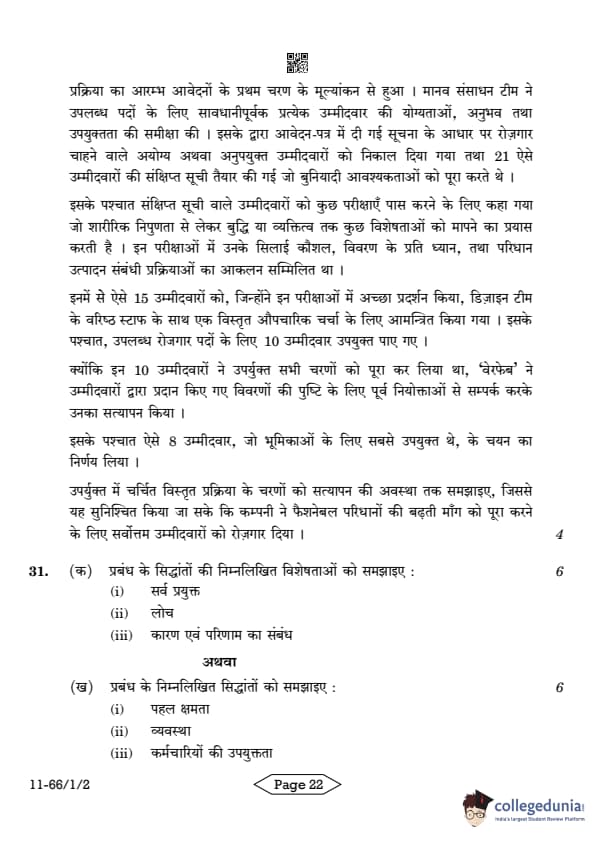
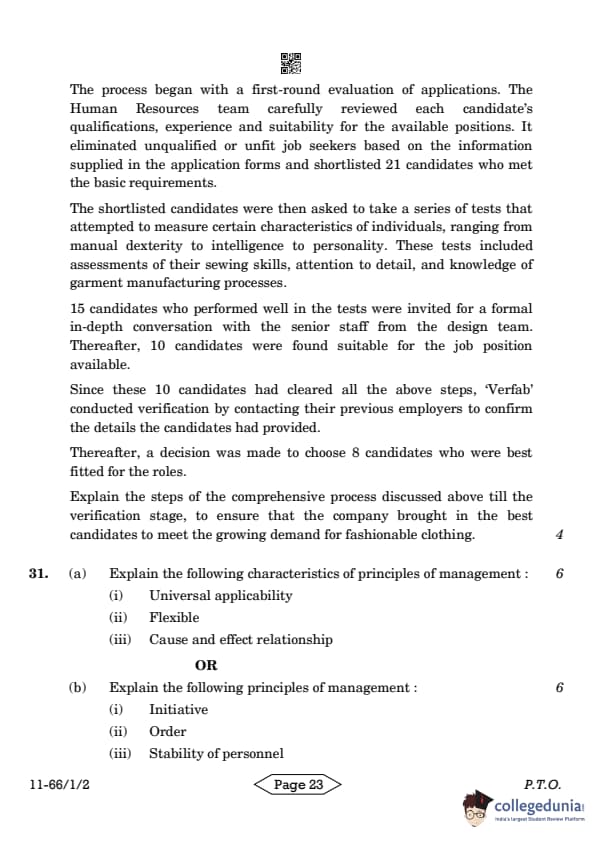
Question 30:
‘Verfab' was a garment manufacturing company known for its high-quality fashionable clothing. They had been in the fashionable clothing business for the last 23 years. The company was earning enough profit and the demand for their fashionable clothing was rising tremendously. The company was expanding and needed to hire new talent to meet the growing demand. They followed a comprehensive process to ensure that they brought in the best candidates. The process began with a first-round evaluation of applications. The Human Resources team carefully reviewed each candidate's qualifications, experience and suitability for the available positions. It eliminated unqualified or unfit job seekers based on the information supplied in the application forms and shortlisted 21 candidates who met the basic requirements. The shortlisted candidates were then asked to take a series of tests that attempted to measure certain characteristics of individuals, ranging from manual dexterity to intelligence to personality. These tests included assessments of their sewing skills, attention to detail, and knowledge of garment manufacturing processes. 15 candidates who performed well in the tests were invited for a formal in-depth conversation with the senior staff from the design team. Thereafter, 10 candidates were found suitable for the job position available. Since these 10 candidates had cleared all the above steps, 'Verfab' conducted verification by contacting their previous employers to confirm the details the candidates had provided. Thereafter, a decision was made to choose 8 candidates who were best fitted for the roles. Explain the steps of the comprehensive process discussed above till the verification stage, to ensure that the company brought in the best candidates to meet the growing demand for fashionable clothing.
View Solution
Solution:
The steps of the comprehensive process discussed above are:
(i) Preliminary screening: It helps the manager to eliminate unqualified or unfit job seekers based on the information supplied in the application forms.
(ii) Selection tests: These tests attempt to measure certain characteristics of individuals, ranging from aptitudes, manual dexterity, intelligence to personality.
(iii) Employment interview: A formal, in-depth conversation is conducted to evaluate the applicant's suitability for the job, and interviewees may also seek information from the interviewer.
(iv) Reference and background checks: References are used for verifying information and gaining additional information on an applicant from previous employers, known persons, teachers, university professors, etc.
Question 31 (a):
Explain the characteristics of principles of management:
(i) Universal applicability
(ii) Flexible
(iii) Cause and effect relationship
View Solution
Solution:
(i) Universal applicability:
- The principles of management are intended to apply to all types of organisations, business as well as non-business, small as well as large, public sector as well as private sector, manufacturing as well as the services sectors.
- However, the extent of their applicability would vary with the nature of the organisation, business activity, scale of operations, etc.
(ii) Flexible:
- The principles of management are not rigid prescriptions, which have to be followed absolutely.
- They are flexible and can be modified by the manager when the situation so demands. They give the manager enough discretion to do so.
(iii) Cause and effect relationship:
- The principles of management are intended to establish relationships between cause and effect so that they can be used in similar situations in a large number of cases. They tell us if a particular principle was applied in a particular situation, what would be its likely effect.
- In real life, situations are not identical. So, accurate cause and effect relationships may be difficult to establish.
Question 31 (b):
Explain the following principles of management:
(i) Initiative
(ii) Order
(iii) Stability of personnel
View Solution
Solution:
(i) Initiative:
- Workers should be encouraged to develop and carry out their plans for improvements.
- A good company should have an employee suggestion system whereby initiative/suggestions which result in substantial cost/time reduction should be rewarded.
(ii) Order:
- The principle of order states that "A place for everything (everyone) and everything (everyone) in its (her/his) place."
- If there is a fixed place for everything and it is present there, then there will be no hindrance in the activities of business/factory. This will lead to increased productivity and efficiency.
(iii) Stability of personnel:
- Personnel once selected, should be kept at their post/position for a minimum fixed tenure.
- They should be given reasonable time to show results, otherwise it will create instability/insecurity among employees.
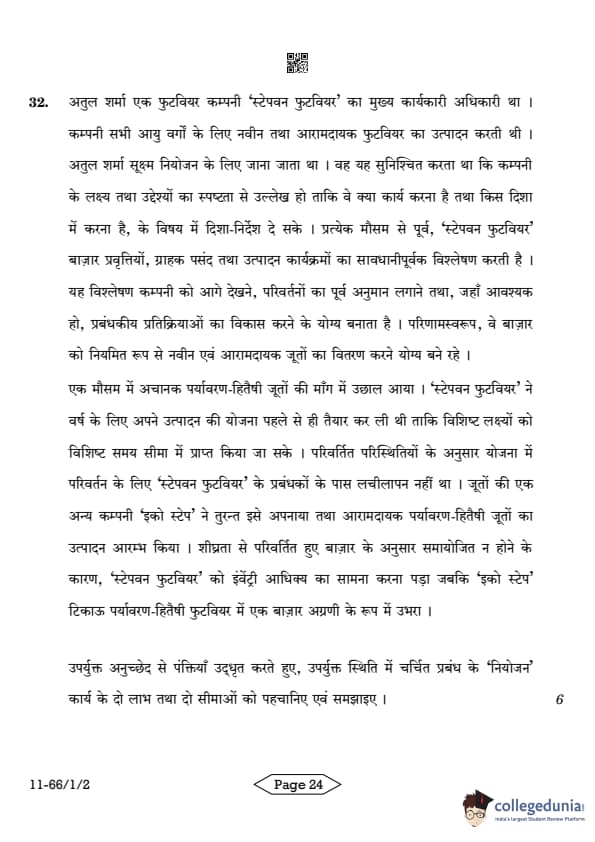
Question 32:
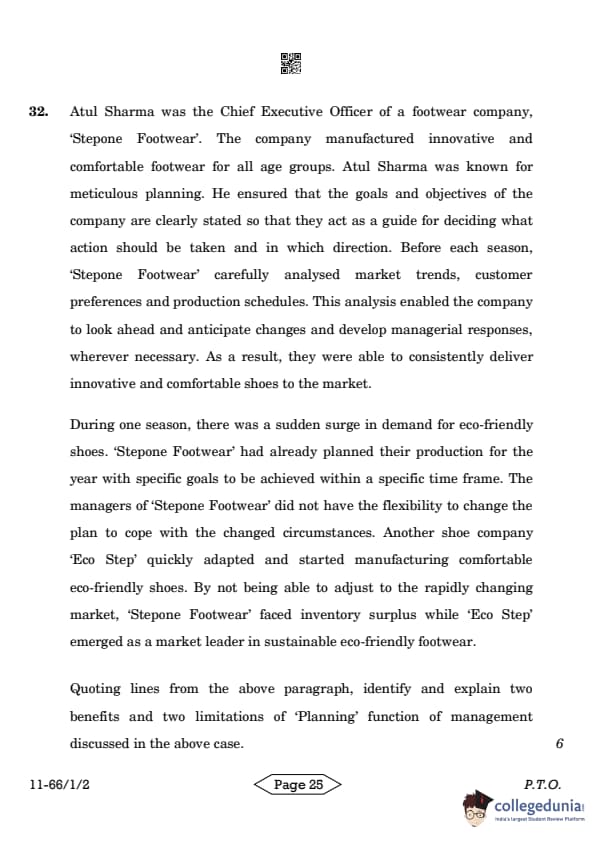
Atul Sharma was the Chief Executive Officer of a footwear company, 'Stepone Footwear'. The company manufactured innovative and comfortable footwear for all age groups. Atul Sharma was known for meticulous planning. He ensured that the goals and objectives of the company are clearly stated so that they act as a guide for deciding what action should be taken and in which direction. Before each season, 'Stepone Footwear' carefully analysed market trends, customer preferences and production schedules. This analysis enabled the company to look ahead and anticipate changes and develop managerial responses, wherever necessary. As a result, they were able to consistently deliver innovative and comfortable shoes to the market. During one season, there was a sudden surge in demand for eco-friendly shoes. 'Stepone Footwear' had already planned their production for the year with specific goals to be achieved within a specific time frame. The managers of 'Stepone Footwear' did not have the flexibility to change the plan to cope with the changed circumstances. Another shoe company 'Eco Step' quickly adapted and started manufacturing comfortable eco-friendly shoes. By not being able to adjust to the rapidly changing market, 'Stepone Footwear' faced inventory surplus while 'Eco Step' emerged as a market leader in sustainable eco-friendly footwear. Quoting lines from the above paragraph, identify and explain two benefits and two limitations of 'Planning function of management discussed in the above case.
View Solution
Solution:
Benefits of planning:
(i) Planning provides directions:
- Planning provides direction for action by stating in advance how work is to be done.
- "He ensured that the goals and objectives of the company are clearly stated so that they act as a guide for deciding what action should be taken and in which direction.”
(ii) Planning reduces the risks of uncertainty:
- By deciding in advance the tasks to be performed, planning shows the way to deal with changes and uncertain events.
- “This analysis enabled the company to look ahead and anticipate changes and develop managerial responses, wherever necessary."
Limitations of planning:
(i) Planning leads to rigidity:
- In an organisation, a well-defined plan is drawn up with specific goals to be achieved within a specific time frame, these plans then decide the future course of action and managers may not be in a position to change it.
- "The managers of 'Stepone Footwear' did not have the flexibility to change the plan to cope with the changed circumstances.”
(ii) Planning may not work in a dynamic environment:
- The organisation has to constantly adapt itself to changes taking place in the dynamic environment. However, planning cannot foresee everything and thus, there may be obstacles to effective planning.
- "By not being able to adjust to the rapidly changing market, 'Stepone Footwear' faced inventory surplus while 'Eco Step' emerged as a market leader in sustainable eco-friendly footwear."
Question 33:
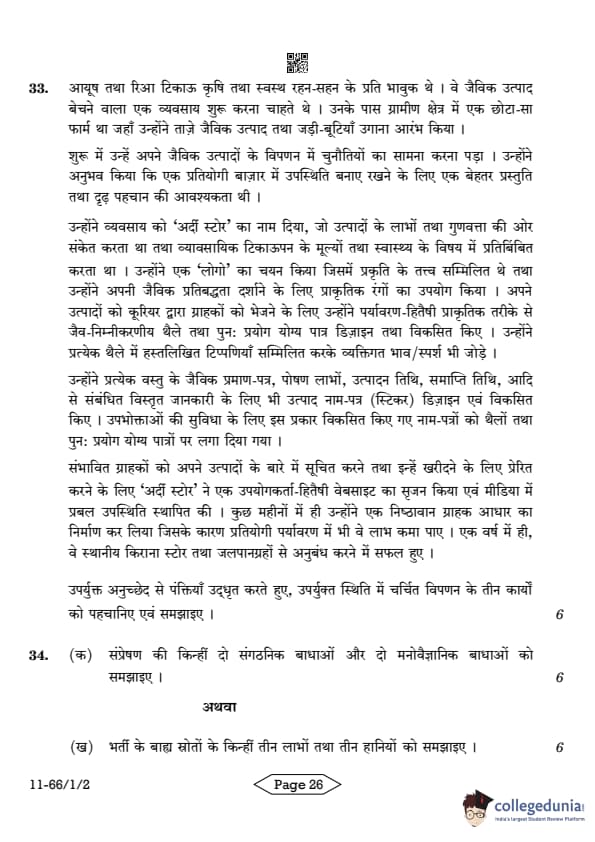
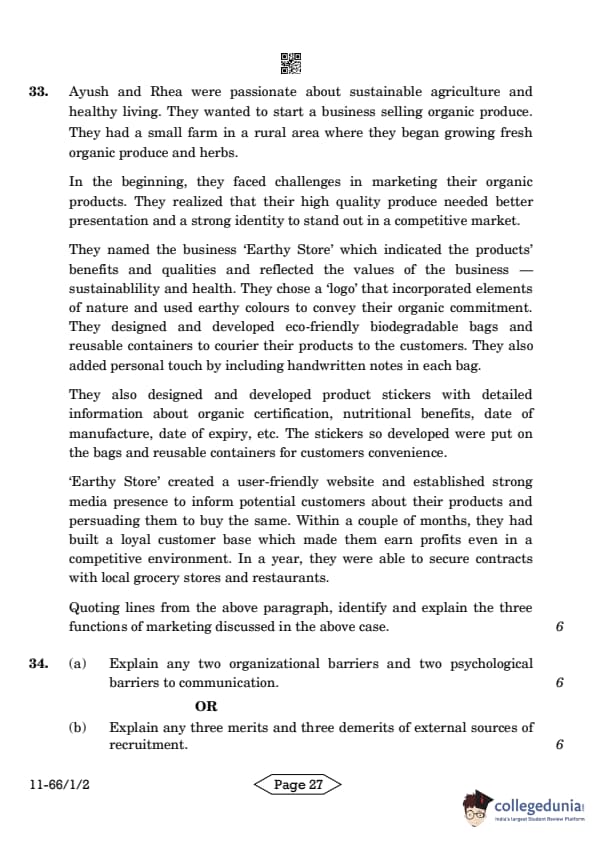
Ayush and Rhea were passionate about sustainable agriculture and healthy living. They wanted to start a business selling organic produce. They had a small farm in a rural area where they began growing fresh organic produce and herbs. In the beginning, they faced challenges in marketing their organic products. They realized that their high quality produce needed better presentation and a strong identity to stand out in a competitive market. They named the business ‘Earthy Store' which indicated the products' benefits and qualities and reflected the values of the business - sustainability and health. They chose a 'logo' that incorporated elements of nature and used earthy colours to convey their organic commitment. They designed and developed eco-friendly biodegradable bags and reusable containers to courier their products to the customers. They also added a personal touch by including handwritten notes in each bag. They also designed and developed product stickers with detailed information about organic certification, nutritional benefits, date of manufacture, date of expiry, etc. The stickers so developed were put on the bags and reusable containers for customers' convenience. 'Earthy Store' created a user-friendly website and established a strong media presence to inform potential customers about their products and persuade them to buy the same. Within a couple of months, they had built a loyal customer base which made them earn profits even in a competitive environment. In a year, they were able to secure contracts with local grocery stores and restaurants. Quoting lines from the above paragraph, identify and explain the three functions of marketing discussed in the above case.
View Solution
Solution:
Functions of marketing:
(i) Branding: - Branding is the process of giving a name, term, sign, symbol, design, or some combination of them, to the product.
- "They chose a 'logo' that incorporated elements of nature and used earthy colours to convey their organic commitment."
OR "They named the business ‘Earthy Store' which indicated the products' benefits and qualities and reflected the values of the business - sustainability and health.”
(ii) Packaging and Labelling:
- Packaging refers to the act of designing and producing the container or wrapper of a product.
- Labelling refers to designing and developing the label to be put on the package. It may vary from a simple tag to complex graphics.
- "They designed and developed eco-friendly biodegradable bags and reusable containers to courier their products to the customers”
OR "They also designed and developed product stickers with detailed information about organic certification, nutritional benefits, date of manufacture, date of expiry, etc."
(iii) Promotion:
- Promotion refers to informing the customers about the firm's product, its features, etc., and persuading them to purchase these products.
- ""Earthy Store' created a user-friendly website and established a strong media presence to inform potential customers about their products and persuading them to buy the same."
Question 34 (a):
Explain any two organizational barriers and two psychological barriers to communication.
View Solution
Solution:
Organizational barriers are:
(i) Organisational policy:
- Organisational policies can create barriers to communication as they may limit the free flow of information. Policies that are too rigid or restrictive can prevent employees from sharing information openly.
(ii) Rules and regulations:
- Excessive rules and regulations can stifle communication. When employees are overly concerned with following strict procedures, they may not feel encouraged to communicate effectively or may fear breaking rules.
(iii) Status:
- The status difference between communication participants can create a barrier. Higher-status individuals may dominate conversations, while lower-status individuals may feel reluctant to speak up, leading to one-way communication.
(iv) Complexity in organisation structure:
- A highly complex organizational structure with many layers of hierarchy can impede communication. Information may become distorted or delayed as it passes through multiple levels.
(v) Organisational facilities:
- Lack of proper communication facilities, such as poor office infrastructure or insufficient technology, can create communication barriers by making it difficult to convey messages effectively.
Psychological barriers are: (i) Premature evaluation:
- Premature evaluation occurs when a listener forms an opinion about the message before fully understanding it. This can lead to misunderstanding and a lack of effective communication.
(ii) Lack of attention:
- A lack of attention or focus from the receiver can act as a psychological barrier. If the receiver is distracted or uninterested, they may miss key points of the communication.
(iii) Loss by transmission and poor retention:
- Information can be lost in the process of transmitting or receiving messages, especially if it is complicated or if the listener does not retain the information properly.
(iv) Distrust:
- Distrust between the sender and receiver can hinder communication. If either party does not believe in the sincerity or intent of the other, they may be unwilling to share information openly.
Question 34 (b):
Explain any three merits and three demerits of external sources of recruitment.
View Solution
Solution:
Merits of external recruitment are:
(i) Qualified Personnel:
- External recruitment allows the organization to attract qualified candidates with specific skills and experience, which may not be available internally.
(ii) Wider Choice:
- External recruitment opens up a broader pool of candidates from different backgrounds and organizations, providing more options for the company to choose the best fit.
(iii) Fresh Talent:
- External recruitment brings in fresh perspectives and new ideas, which can stimulate innovation and drive change within the organization.
(iv) Competitive Spirit:
- Hiring externally can introduce a competitive spirit, as candidates from outside the organization may be more eager to prove their worth and contribute to the company's success.
Limitations of External Sources are: (Points with explanation)
(i) Dissatisfaction among existing staff:
- External recruitment can cause dissatisfaction among existing employees who may feel overlooked or demotivated, leading to reduced morale.
(ii) Lengthy process:
- The process of recruiting externally is typically longer and more complex compared to internal recruitment, as it involves advertising, screening, and interviews.
(iii) Costly process:
- External recruitment can be more expensive due to advertising costs, recruitment agency fees, and the time spent on the selection process.



Comments