




CBSE Class 12 Business Studies Question Paper 2024 PDF (Set 2- 66/3/2) is available for download here. CBSE conducted the Business Studies exam on March 27, 2024 from 10:30 AM to 1:30 PM. The total marks for the theory paper are 80. The question paper contains 20% MCQ-based questions, 40% competency-based questions, and 40% short and long answer type questions. Candidates can use the link below to download the CBSE Class 12 Business Studies Set 2 Question Paper with detailed solutions.
CBSE Class 12 Business Studies Question Paper 2024 (Set 2- 66/3/2) with Answer Key
| CBSE Class 12 2024 Business Studies Question Paper with Answer Key |  Download Download |
Check Solution |
CBSE Class 12 2024 Business Studies Questions with Solutions
Question 1:
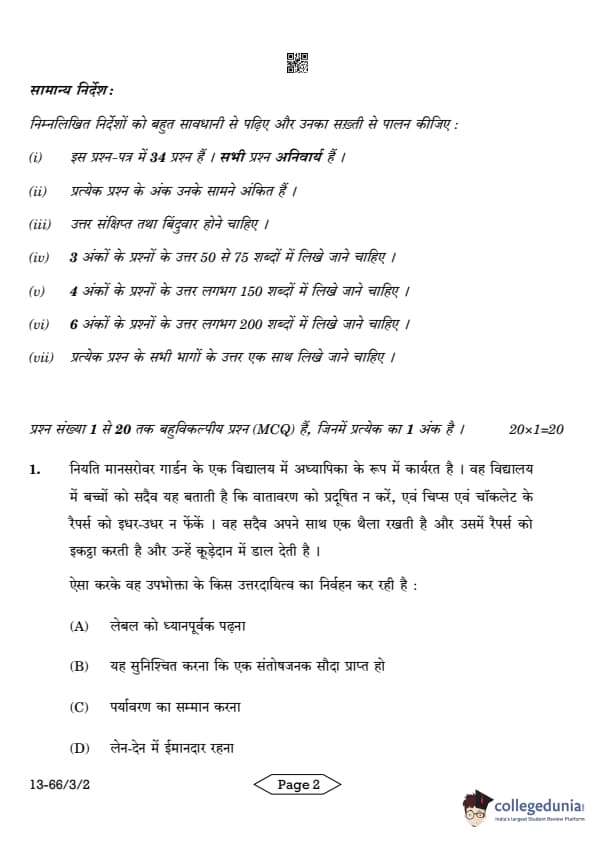
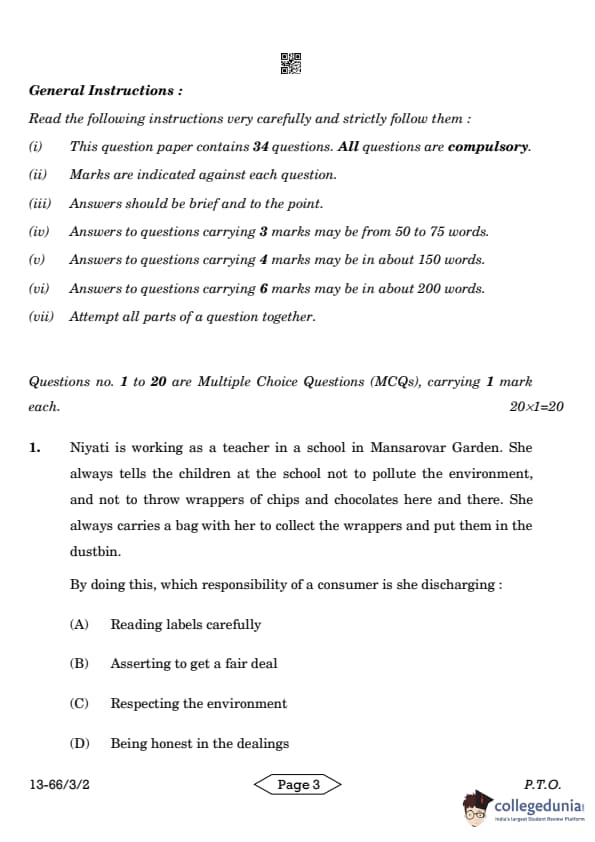
Niyati is working as a teacher in a school in Mansarovar Garden. She always tells the children at the school not to pollute the environment and not to throw wrappers of chips and chocolates here and there. She always carries a bag with her to collect the wrappers and put them in the dustbin. By doing this, which responsibility of a consumer is she discharging?
View Solution
Solution:
Step 1: Understanding Consumer Responsibilities
Consumers have responsibilities such as being aware of product information, making ethical purchasing decisions, and contributing to environmental sustainability.
Step 2: Identifying the Relevant Responsibility
Niyati is actively promoting environmental cleanliness and responsible waste disposal. This aligns with the responsibility of Respecting the environment, ensuring that consumer actions do not harm nature.
Conclusion: The correct answer is (C), as Niyati's actions contribute to environmental responsibility.
Question 2:
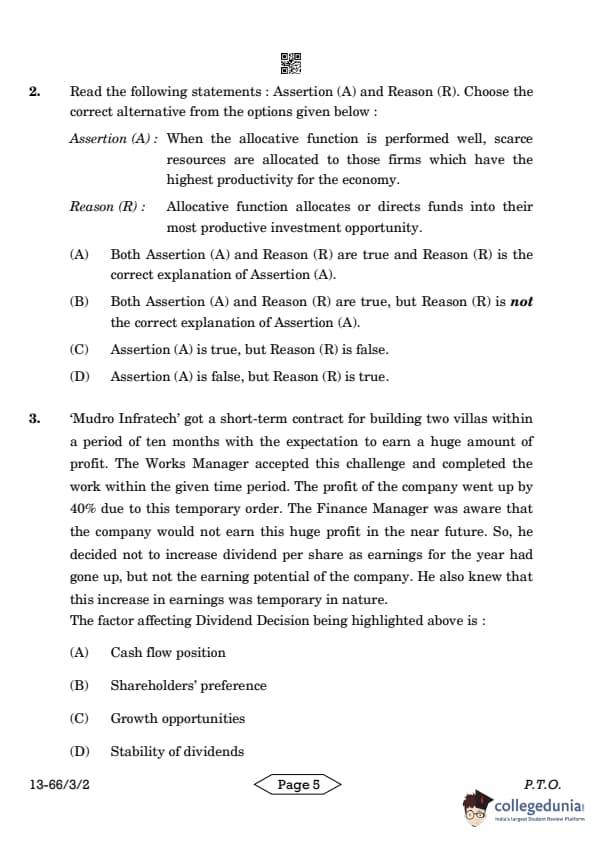
Read the following statements: Assertion (A) and Reason (R). Choose the correct alternative from the options given below:
Assertion (A): When the allocative function is performed well, scarce resources are allocated to those firms which have the highest productivity for the economy.
Reason (R): Allocative function allocates or directs funds into their most productive investment opportunity.
View Solution
Solution:
Step 1: Understanding the Allocative Function
The allocative function of financial markets ensures that scarce financial resources are directed towards the most productive economic activities.
Step 2: Evaluating the Statements
The assertion states that well-performed allocation directs resources to highly productive firms, which is true. The reason explains that the allocative function guides funds to the best investment opportunities, making it a valid explanation. Since the reason accurately supports the assertion, option (A) is correct.
Conclusion: The correct answer is (A), as the explanation correctly justifies the assertion.
Question 3:
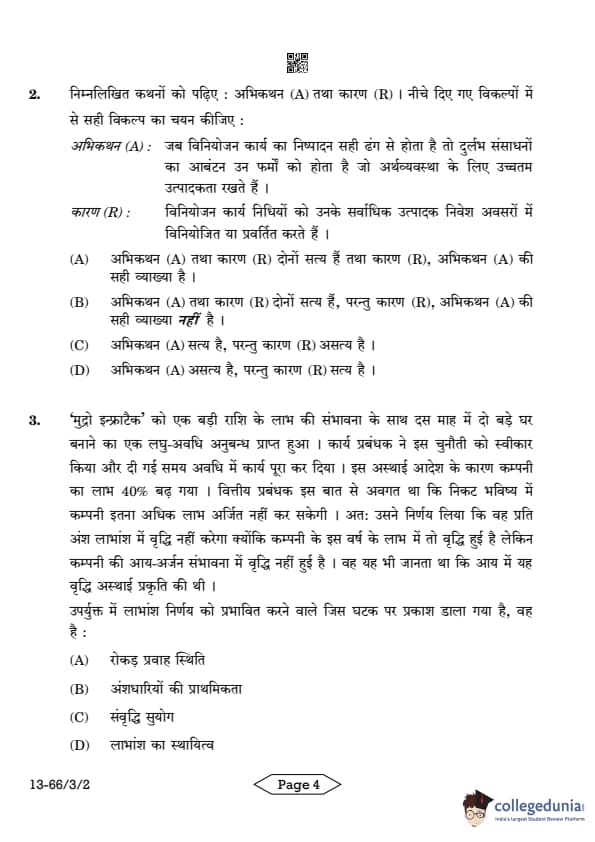
'Mudro Infratech' got a short-term contract for building two villas within a period of ten months with the expectation to earn a huge amount of profit. The Works Manager accepted this challenge and completed the work within the given time period. The profit of the company went up by 40% due to this temporary order. The Finance Manager was aware that the company would not earn this huge profit in the near future. So, he decided not to increase dividend per share as earnings for the year had gone up, but not the earning potential of the company. The factor affecting Dividend Decision being highlighted above is:
View Solution
Solution:
Step 1: Understanding Dividend Decisions
Dividend decisions depend on various factors, including company earnings, financial stability, and long-term growth prospects.
Step 2: Identifying the Relevant Factor
The Finance Manager decided against increasing dividends because the higher earnings were temporary. Stability of dividends means that companies prefer maintaining a consistent dividend policy rather than increasing dividends due to temporary earnings.
Conclusion: The correct answer is (D), as the company prioritized stable dividend payouts over short-term profits.
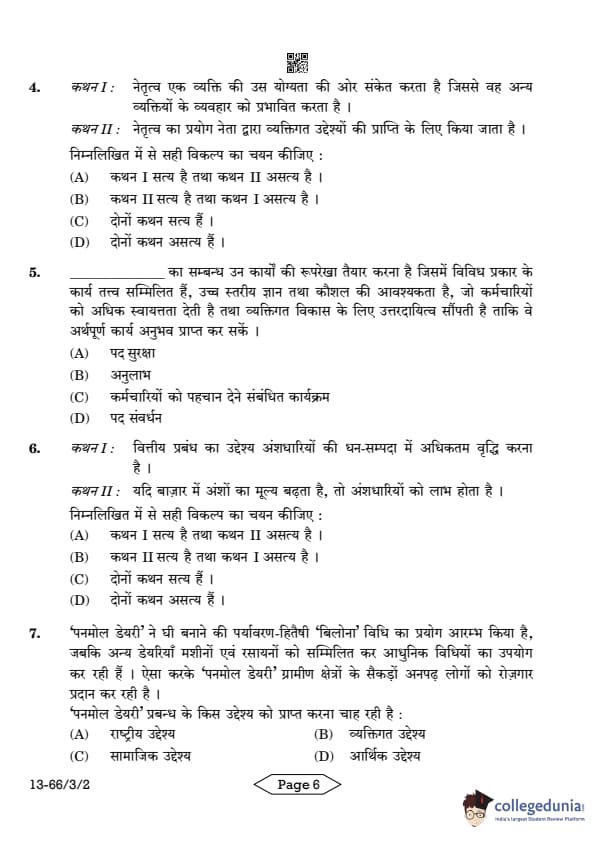
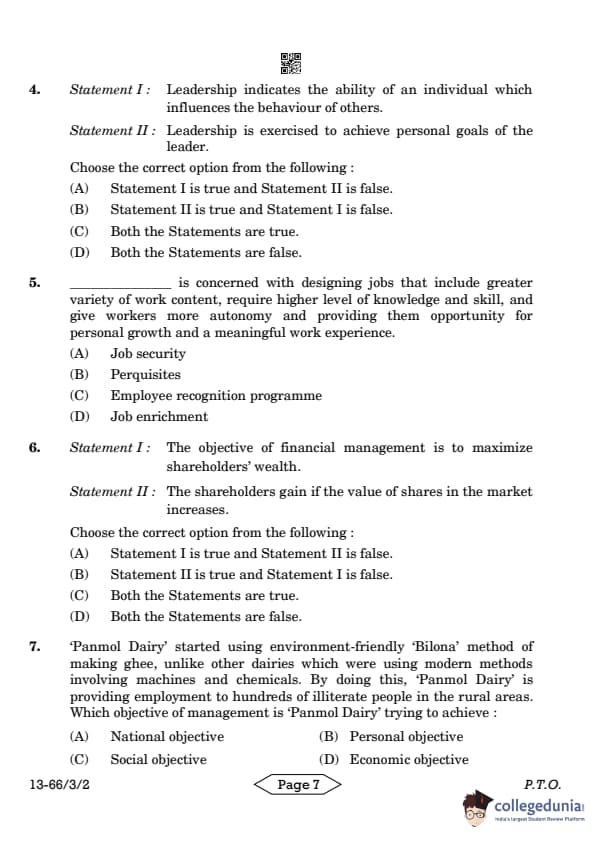
Question 4:
Statement 1: Leadership indicates the ability of an individual which influences the behavior of others.
Statement 2: Leadership is exercised to achieve personal goals of the leader. Choose the correct option from the following:
View Solution
Solution:
Step 1: Understanding Leadership
Leadership is the ability to guide and influence others towards achieving common goals. It is not solely for personal benefit.
Step 2: Evaluating the Statements
Statement I is true, as leadership involves influencing others' behavior. Statement II is false, as leadership is focused on organizational and team goals, not just personal goals.
Conclusion: The correct answer is (A), as leadership is about guiding teams toward shared objectives rather than self-interest.
Question 5:
________ is concerned with designing jobs that include greater variety of work content, require a higher level of knowledge and skill, and give workers more autonomy while providing them the opportunity for personal growth and a meaningful work experience.
View Solution
Solution:
Step 1: Understanding Job Enrichment
Job enrichment is a motivational strategy that aims to increase employee satisfaction and performance by making jobs more engaging and fulfilling.
Step 2: Characteristics of Job Enrichment
Provides employees with meaningful work experiences. Involves greater responsibility and autonomy in decision-making. Requires higher knowledge and skills. Helps employees grow and advance professionally.
Step 3: Identifying the Correct Answer
Job security (A) refers to the assurance of employment, which is unrelated to job design. Perquisites (B) are additional benefits like bonuses or incentives. Employee recognition programmes (C) reward performance but do not involve work redesign. Job enrichment (D) aligns with the given description.
Conclusion: The correct answer is (D), as job enrichment focuses on redesigning jobs to enhance work experience.
Question 6:
Statement 1: The objective of financial management is to maximize shareholders' wealth.
Statement 2: The shareholders gain if the value of shares in the market increases. Choose the correct option from the following:
View Solution
Solution:
Step 1: Understanding Financial Management Objectives
The primary goal of financial management is to maximize shareholders' wealth by increasing the company's market value.
Step 2: Evaluating the Statements
Statement I is true because financial management focuses on wealth maximization through optimal financial decisions. Statement II is also true as an increase in market share price directly benefits shareholders by raising their investment value.
Conclusion: The correct answer is (C), as both statements accurately describe financial management objectives.
Question 7:
'Panmol Dairy' started using environment-friendly 'Bilona' method of making ghee, unlike other dairies which were using modern methods involving machines and chemicals. By doing this, Panmol Dairy is providing employment to hundreds of illiterate people in the rural areas. Which objective of management is Panmol Dairy' trying to achieve?
View Solution
Solution:
Step 1: Understanding Management Objectives
Management objectives can be categorized into economic, social, and national objectives.
Step 2: Identifying the Relevant Objective
By using traditional methods and providing employment to rural workers, Panmol Dairy focuses on Social Objectives. Social objectives emphasize ethical business practices, employment generation, and environmental responsibility.
Conclusion: The correct answer is (C), as Panmol Dairy prioritizes social welfare through
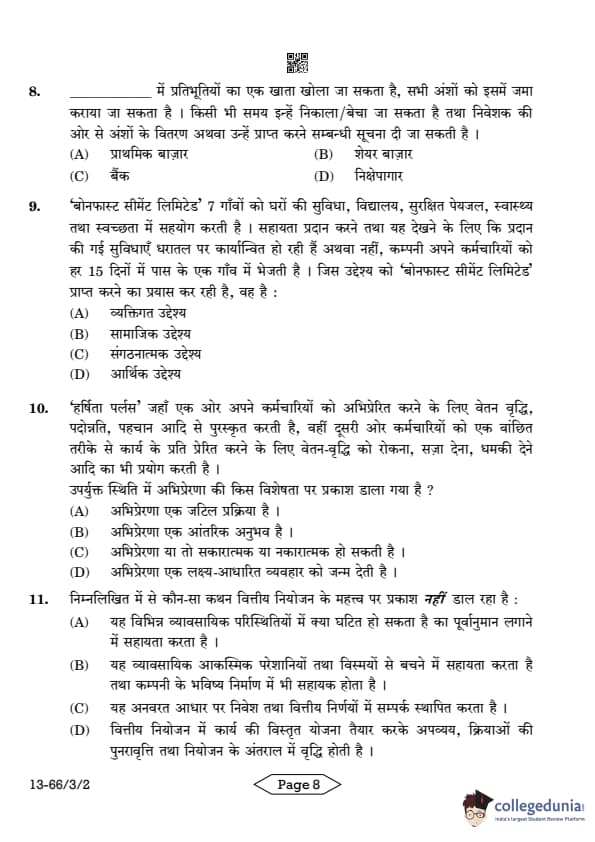
Question 8:
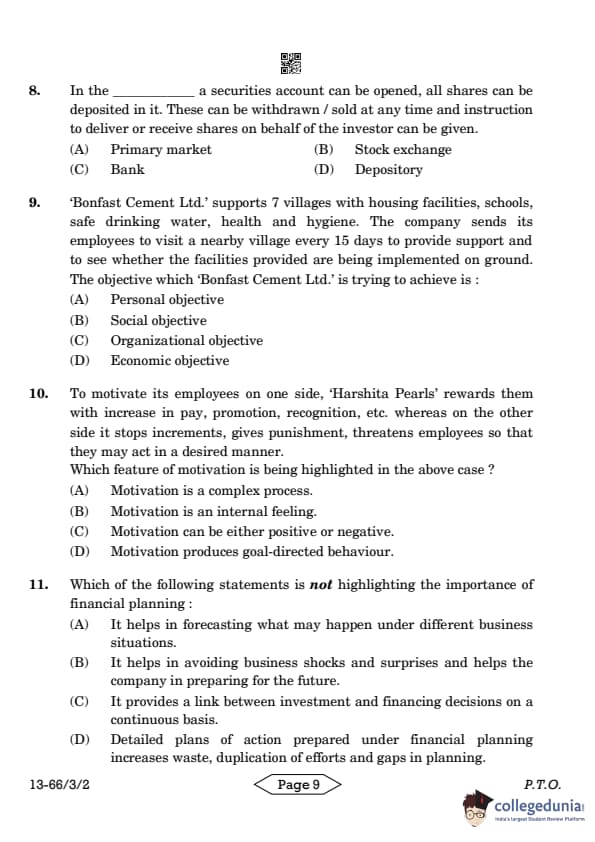
In the _________, a securities account can be opened, all shares can be deposited in it. These can be withdrawn/sold at any time, and instruction to deliver or receive shares on behalf of the investor can be given.
View Solution
Solution:
Step 1: Understanding the Role of a Depository
A depository is a financial institution that holds securities (shares, bonds) in electronic form, facilitating trading and investment.
Step 2: Identifying the Correct Option
The primary market (A) deals with new securities issuance. The stock exchange (B) is a marketplace for buying and selling securities. A bank (C) manages financial transactions but does not handle securities in the described manner. A depository (D) allows investors to store, sell, and transfer securities electronically.
Conclusion: The correct answer is (D), as a depository enables secure storage and management of securities.
Question 9:
'Bonfast Cement Ltd.' supports seven villages with housing facilities, schools, safe drinking water, health, and hygiene. The company sends its employees to visit a nearby village every 15 days to provide support and to see whether the facilities provided are being implemented on the ground. The objective which 'Bonfast Cement Ltd.' is trying to achieve is:
View Solution
Solution:
Step 1: Understanding Business Objectives
Organizations operate with multiple objectives, including social responsibilities. These objectives include providing welfare to society, ensuring sustainable practices, and contributing to social development.
Step 2: Identifying Social Responsibility
Bonfast Cement Ltd. is actively supporting villages by providing housing, education, healthcare, and drinking water. They also send employees for periodic checks to ensure the facilities are implemented effectively. These actions align with the company's Social Objectives, which focus on contributing to the betterment of society rather than just profit-making.
Conclusion: The correct answer is (B), as the company is fulfilling its social objective.
Question 10:
To motivate its employees on one side, 'Harshita Pearls' rewards them with an increase in pay, promotion, recognition, etc., whereas, on the other side, it stops increments, gives punishment, and threatens employees so that they may act in a desired manner. Which feature of motivation is being highlighted in the above case?
View Solution
Solution:
Step 1: Understanding Motivation
Motivation is the process of stimulating an individual to take action to achieve a desired goal. It drives behavior and influences individuals to work towards organizational and personal objectives.
Step 2: Identifying Positive and Negative Motivation
Positive Motivation: Employees are encouraged through incentives such as salary hikes, promotions, and recognition.
Negative Motivation: Employees are controlled using measures like salary cuts, demotions, and punishments.
In the given scenario, both positive (rewards) and negative (threats) motivation are being used to influence employees. Hence, the feature being highlighted is that Motivation can be either positive or negative.
Conclusion: The correct answer is (C), as motivation can be either positive or negative.
Question 11:
Which of the following statements is not highlighting the importance of financial planning:
View Solution
Solution:
Step 1: Understanding Financial Planning
Financial planning ensures the effective allocation of resources and minimizes risks associated with uncertainties.
Step 2: Identifying the Incorrect Statement
(A) Financial planning helps businesses predict future scenarios.
(B) It reduces financial uncertainties and business shocks.
(C) It links investment and financing decisions for long-term stability.
(D) The claim that financial planning increases waste and inefficiency is incorrect.
Conclusion: The correct answer is (D), as financial planning enhances efficiency rather than increasing waste.
Question 12:
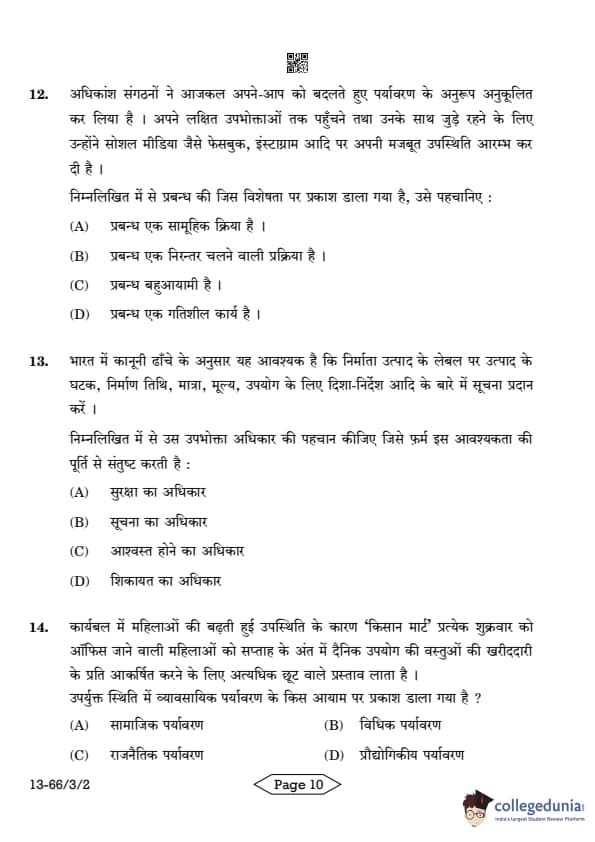
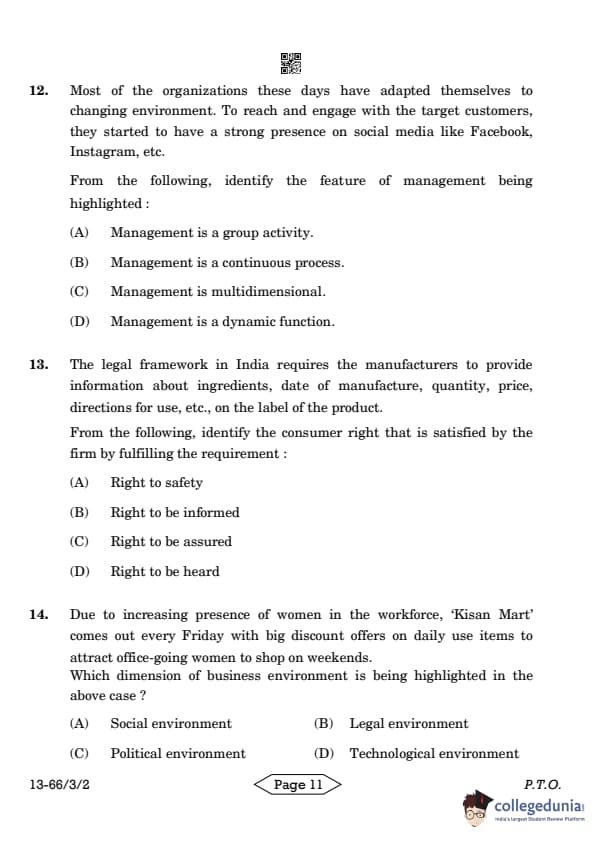
Most organizations these days have adapted themselves to changing environments. To reach and engage with target customers, they started to have a strong presence on social media like Facebook, Instagram, etc. From the following, identify the feature of management being highlighted:
View Solution
Solution:
Step 1: Understanding the Nature of Management
Management adapts to changes in external environments, including technology, social trends, and economic conditions.
Step 2: Identifying the Relevant Feature
The case highlights how businesses adjust strategies to align with digital trends. This adaptability demonstrates that Management is a dynamic function.
Conclusion: The correct answer is (D), as management continuously evolves to meet changing market demands.
Question 13:
The legal framework in India requires manufacturers to provide information about ingredients, date of manufacture, quantity, price, directions for use, etc., on the label of the product. From the following, identify the consumer right that is satisfied by the firm by fulfilling the requirement:
View Solution
Solution:
Step 1: Understanding Consumer Rights
Consumer rights ensure that buyers are protected from unfair trade practices and have access to necessary product information.
Step 2: Identifying the Relevant Consumer Right
The requirement to provide product details aligns with the Right to be Informed. This right ensures that consumers make informed purchasing decisions based on transparent product information.
Conclusion: The correct answer is (B), as the legal framework supports consumers' right to know product details.
Question 14:
Due to increasing presence of women in the workforce, 'Kisan Mart' comes out every Friday with big discount offers on daily use items to attract office-going women to shop on weekends. Which dimension of business environment is being highlighted in the above case?
View Solution
Solution:
Step 1: Understanding Business Environment Dimensions
The business environment consists of various dimensions, including social, legal, political, and technological factors that influence business decisions.
Step 2: Identifying the Relevant Dimension
The case highlights a change in societal trends where more women are joining the workforce. 'Kisan Mart' adapts to this trend by offering discounts tailored to office-going women. This aligns with the Social Environment, which includes demographic changes, consumer behavior, and societal preferences.
Conclusion: The correct answer is (A), as the scenario reflects a social change impacting business strategy.
Question 15:
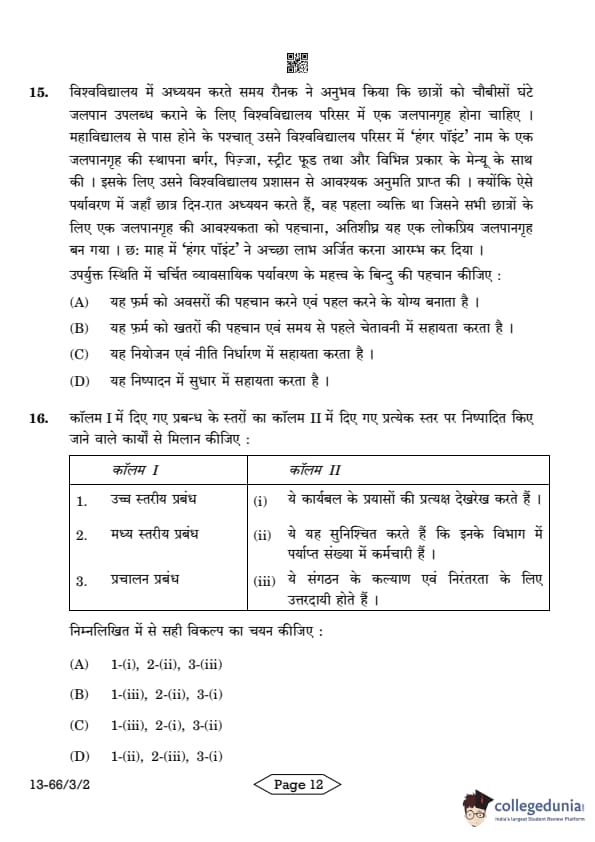
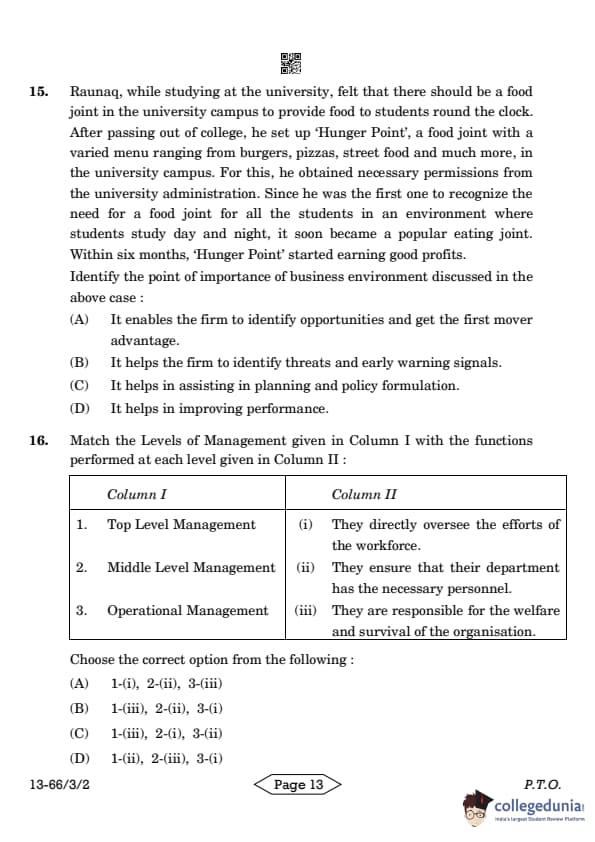
Raunaq, while studying at the university, felt that there should be a food joint in the university campus to provide food to students round the clock. After passing out of college, he set up 'Hunger Point,' a food joint with a varied menu ranging from burgers, pizzas, street food, and much more, in the university campus. For this, he obtained necessary permissions from the university administration. Since he was the first one to recognize the need for a food joint for all the students in an environment where students study day and night, it soon became a popular eating joint. Within six months, 'Hunger Point' started earning good profits.
Identify the point of importance of business environment discussed in the above case:
View Solution
Solution:
Step 1: Understanding Business Environment
The business environment consists of external factors that influence decision-making and strategy formulation. Recognizing market needs and acting upon them promptly provides a competitive edge.
Step 2: Identifying the Relevant Point
Raunaq identified a gap in the market—students needed a round-the-clock food joint. By acting on this opportunity first, he gained an early advantage, making 'Hunger Point' successful.
This aligns with Identifying opportunities and getting the first mover advantage.
Conclusion: The correct answer is (A), as Raunaq capitalized on an emerging business opportunity.
Question 16:
Match the Levels of Management given in Column I with the functions performed at each level given in Column II:
Column I
1. Top Level Management
2. Middle Level Management
3. Operational Management
Column II
(i) They directly oversee the efforts of the work-force.
(ii) They ensure that their department has the necessary personnel.
(iii) They are responsible for the welfare and survival of the organisation.
View Solution
Solution:
Step 1: Understanding Levels of Management
Management is structured in three levels:
Top-level management: Makes strategic decisions for the organization's survival and growth.
Middle-level management: Ensures the department functions efficiently by managing personnel.
Operational-level management: Directly oversees employees' daily tasks.
Step 2: Matching Functions
Top-level management (iii) is responsible for organizational survival.
Middle-level management (ii) ensures departmental efficiency.
Operational management (i) supervises workers directly.
Conclusion: The correct answer is (B), as the functions correctly match their respective management levels.
Question 17:
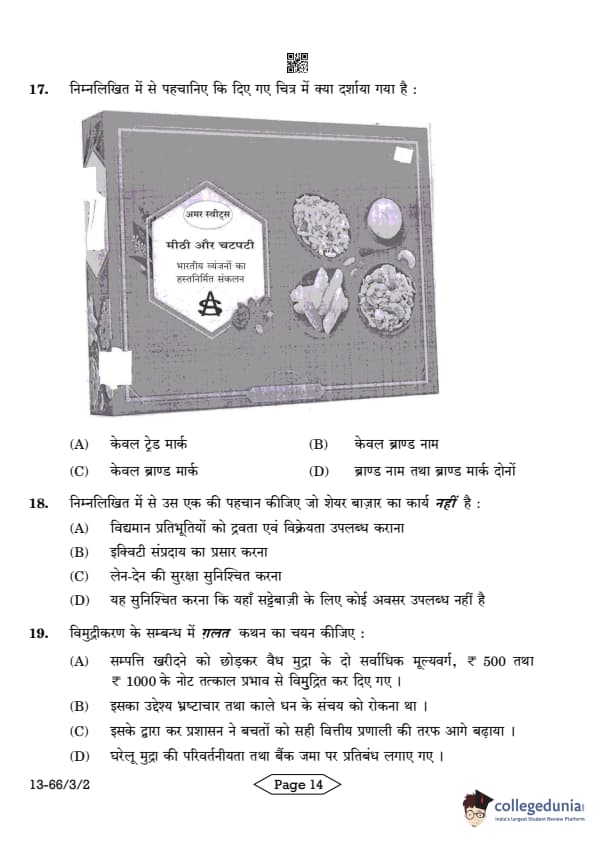
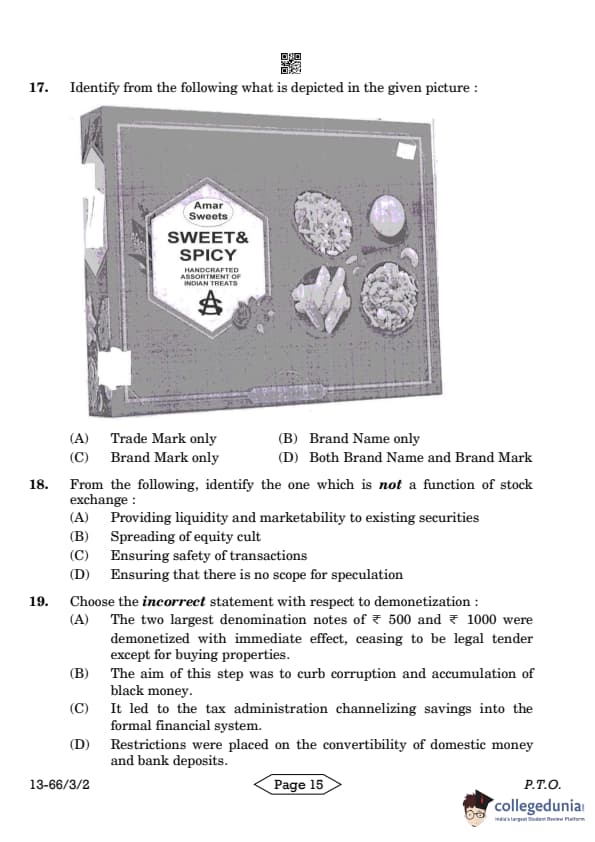
Identify from the following what is depicted in the given picture:

View Solution
Solution:
Step 1: Understanding Branding Elements
A brand consists of both a Brand Name and a Brand Mark.
Brand Name: The verbal part of branding (e.g., Nike, Apple).
Brand Mark: The visual symbol associated with a brand (e.g., the Nike Swoosh logo).
Step 2: Identifying the Depicted Elements
If the image contains only text, it represents a Brand Name.
If it shows only a symbol, it represents a Brand Mark.
If it includes both, it represents both the Brand Name and Brand Mark.
Conclusion: The correct answer is (D), as both the brand name and brand mark are depicted.
Question 18:
From the following, identify the one which is not a function of the stock exchange:
View Solution
Solution:
Step 1: Understanding Functions of a Stock Exchange
A stock exchange facilitates trading by providing liquidity, ensuring safety, and promoting investments.
Step 2: Evaluating the Given Statements
(A) Liquidity and marketability of securities are key functions of stock exchanges.
(B) Stock exchanges encourage public participation in equity investment.
(C) Transactions are regulated for safety.
(D) Stock exchanges cannot entirely eliminate speculation, as it is a part of market operations.
Conclusion: The correct answer is (D), as speculation exists in every financial market.
Question 19:
Choose the incorrect statement with respect to demonetization:
View Solution
Solution:
Step 1: Understanding Demonetization
Demonetization refers to the withdrawal of specific currency notes from circulation to curb corruption, promote digital transactions, and bring black money into the formal economy.
Step 2: Identifying the Incorrect Statement
(A) is incorrect because demonetized notes were no longer legal tender for any transactions, including property purchases.
(B) is correct as demonetization aimed at reducing corruption and black money.
(C) is correct since it encouraged formal financial transactions.
(D) is correct as temporary restrictions were placed on cash withdrawals and deposits.
Conclusion: The correct answer is (A), as the demonetized notes were not valid for purchasing properties.
Question 20:
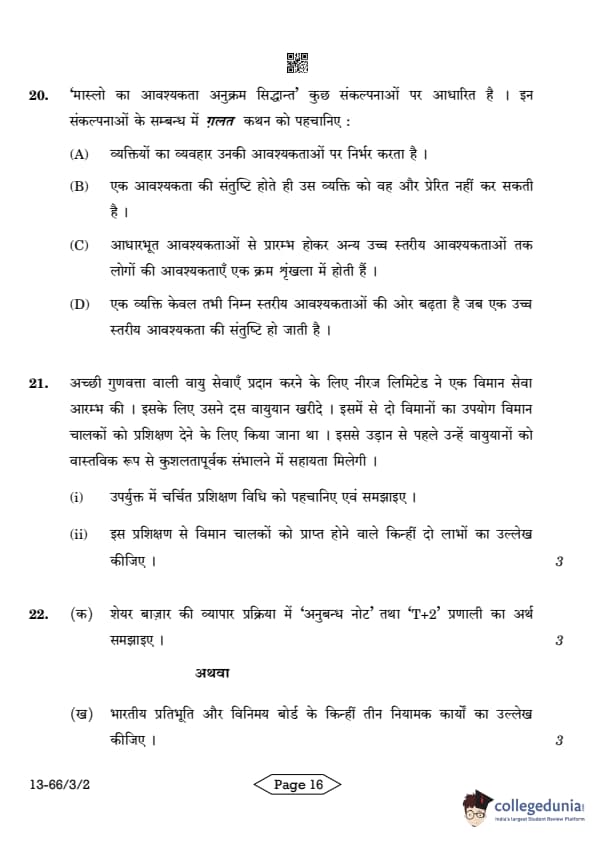
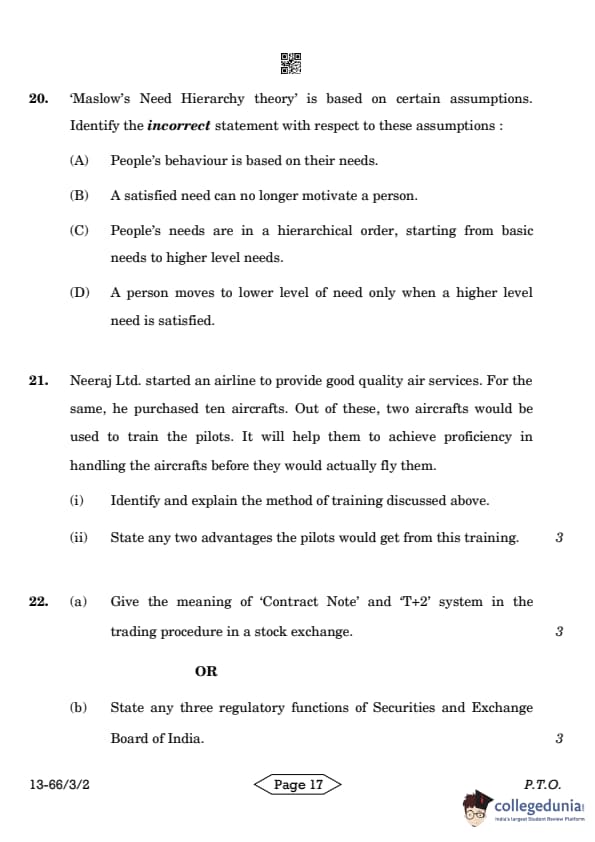
'Maslow's Need Hierarchy Theory' is based on certain assumptions. Identify the incorrect statement with respect to these assumptions:
View Solution
Solution:
Step 1: Understanding Maslow's Need Hierarchy Theory
Maslow proposed a five-level hierarchy of needs that influence human motivation:
1. Physiological Needs (food, water, shelter).
2. Safety Needs (security, stability).
3. Social Needs (relationships, belonging).
4. Esteem Needs (recognition, respect).
5. Self-Actualization (personal growth, creativity).
Step 2: Identifying the Incorrect Statement
The hierarchy assumes that people satisfy lower-level needs before progressing to higher-level needs.
A satisfied need no longer serves as motivation.
Needs are structured from basic to complex.
However, a person does not move to a lower level of need when a higher-level need is satisfied, making option (D) incorrect.
Conclusion: The correct answer is (D), as Maslow's theory does not suggest moving down the hierarchy.
Question 21:
Neeraj Ltd. started an airline to provide good quality air services. For the same, he purchased ten aircrafts. Out of these, two aircrafts would be used to train the pilots. It will help them to achieve proficiency in handling the aircrafts before they would actually fly them.
(i) Identify and explain the method of training discussed above.
(ii) State any two advantages the pilots would get from this training.
View Solution
Solution:
(i) Vestibule Training
Employees learn their jobs using actual equipment but in a controlled training environment away from the actual work floor.
This method is used when employees are required to handle sophisticated machinery and equipment.
In this case, Neeraj Ltd. has dedicated two aircrafts for training pilots before they fly commercially, ensuring they gain hands-on experience.
(ii) Advantages:
(i) Improved Skills and Career Growth:
Training enhances the pilots' skills and knowledge, improving their career prospects.
(ii) Increased Performance and Earnings:
Higher performance resulting from training enables pilots to earn more through better job opportunities and incentives.
(iii) Reduction in Accidents:
Proper training makes pilots more proficient in handling aircrafts, making them less prone to accidents.
(iv) Increased Job Satisfaction and Morale:
Training enhances confidence and efficiency, leading to greater job satisfaction and morale among pilots.
Question 22:
(a) Give the meaning of 'Contract Note' and "T+2' system in the trading procedure in a stock exchange.
(b) State any three regulatory functions of the Securities and Exchange Board of India (SEBI).
View Solution
Solution:
(a) Contract Note:
A contract note is a document containing details of the number of shares bought or sold, the price, the date and time of the deal, and the brokerage charges.
Each transaction is assigned a unique order code.
The broker issues a contract note within 24 hours after the trade has been executed.
T+2 System:
All trading transactions are settled within 2 days.
The pay-in day is when cash is paid or securities are delivered (before T+2 day).
On T+2 day (the pay-out day), the exchange delivers the shares or makes payment to the broker.
(b) Regulatory Functions of SEBI:
1. Registration of Market Participants: SEBI registers brokers, sub-brokers, mutual funds, and other players in the securities market to ensure compliance with regulations.
2. Regulation of Takeover Bids: SEBI regulates mergers, acquisitions, and takeovers to protect investors' interests.
3. Inspection and Audits: SEBI inspects and audits stock exchanges and market intermediaries to maintain transparency and integrity.
4. Levying Fees: SEBI collects fees and charges to regulate the securities market effectively.
Question 23:
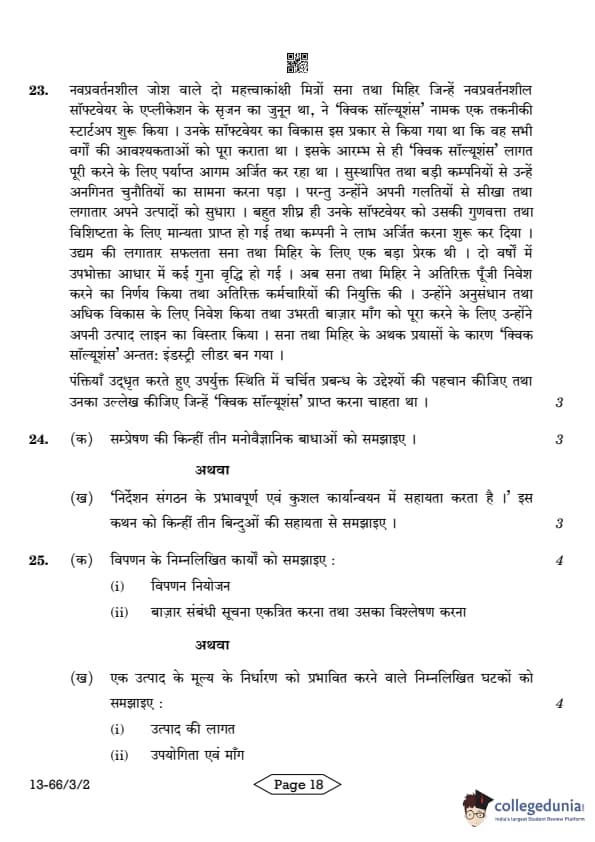
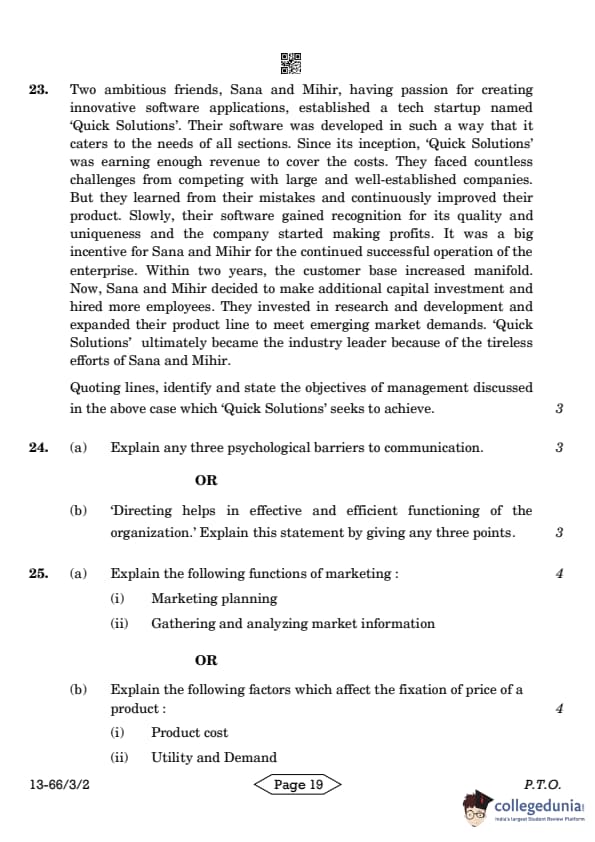
Two ambitious friends, Sana and Mihir, having a passion for creating innovative software applications, established a tech startup named ‘Quick Solutions'. Their software was developed in such a way that it caters to the needs of all sections. Since its inception, 'Quick Solutions' was earning enough revenue to cover the costs. They faced countless challenges from competing with large and well-established companies. But they learned from their mistakes and continuously improved their product. Slowly, their software gained recognition for its quality and uniqueness, and the company started making profits. It was a big incentive for Sana and Mihir for the continued successful operation of the enterprise. Within two years, the customer base increased manifold. Now, Sana and Mihir decided to make additional capital investment and hired more employees. They invested in research and development and expanded their product line to meet emerging market demands. ‘Quick Solutions' ultimately became the industry leader because of the tireless efforts of Sana and Mihir.
Quoting lines, identify and state the objectives of management discussed in the above case which 'Quick Solutions' seeks to achieve.
View Solution
Solution:
Organizational Objectives:
1. Survival:
“Since its inception, 'Quick Solutions' was earning enough revenue to cover the costs.”
Survival ensures that the organization earns enough revenue to continue operating and existing in the competitive market.
2. Profit:
“Slowly, their software gained recognition for its quality and uniqueness, and the company started making profits."
Profit provides a vital incentive for continued operations and helps in covering costs and risks. It is essential for financial stability.
3. Growth:
“Now, Sana and Mihir decided to make additional capital investment and hired more employees."
“They invested in research and development and expanded their product line to meet emerging market demands.”
Growth ensures that the organization expands its market share, invests in innovation, and sustains itself in the long term.
Question 24:
(a) Explain any three psychological barriers to communication.
(b) 'Directing helps in effective and efficient functioning of the organization.' Explain this statement by giving any three points.
View Solution
Solution:
(a) Psychological Barriers to Communication:
1. Premature Evaluation: The receiver may form an opinion before the complete message is conveyed, leading to miscommunication.
2. Lack of Attention: The receiver may be distracted, causing key details to be missed during communication.
3. Distrust: If there is a lack of trust between the sender and receiver, the message may not be accepted or acted upon.
(b) Importance of Directing:
1. Initiates Action: Directing ensures that employees take action towards achieving organizational goals.
2. Integrates Efforts: Directing integrates employees' efforts, ensuring every individual contributes to organizational performance.
3. Guides Potential: Directing helps employees realize their full potential through motivation and leadership.
Question 25:
(a). Explain the following functions of marketing:
(i) Marketing Planning
(ii) Gathering and Analysing Market Information
25(b). Explain the following factors affecting the fixation of the price of a product:
(i) Product Cost
(ii) Utility and Demand
View Solution
Solution:
(a) Marketing Planning:
Marketers develop appropriate marketing plans to achieve the organization's marketing objectives.
Marketing planning includes formulating strategies for increasing production levels, product promotion, and market expansion.
A well-structured marketing plan ensures effective resource utilization and alignment with business goals.
(ii) Gathering and Analysing Market Information
Identifying consumer needs and preferences is essential for successful marketing decisions.
Marketers must analyse opportunities and threats in the market, as well as assess the strengths and weaknesses of the organization.
Data-driven market analysis helps businesses develop customer-centric strategies and improve product offerings.
(b) Product Cost:
The cost of a product includes production, distribution, and selling expenses.
Product cost sets the minimum price (floor price) at which a product may be sold.
Businesses aim to cover all costs in the long run and generate a profit margin.
(ii) Utility and Demand:
The perceived utility and demand intensity influence the maximum price a consumer is willing to pay.
If demand is elastic, businesses set a lower price to attract more customers.
If demand is inelastic, companies can charge a higher price, as customers are willing to pay more.
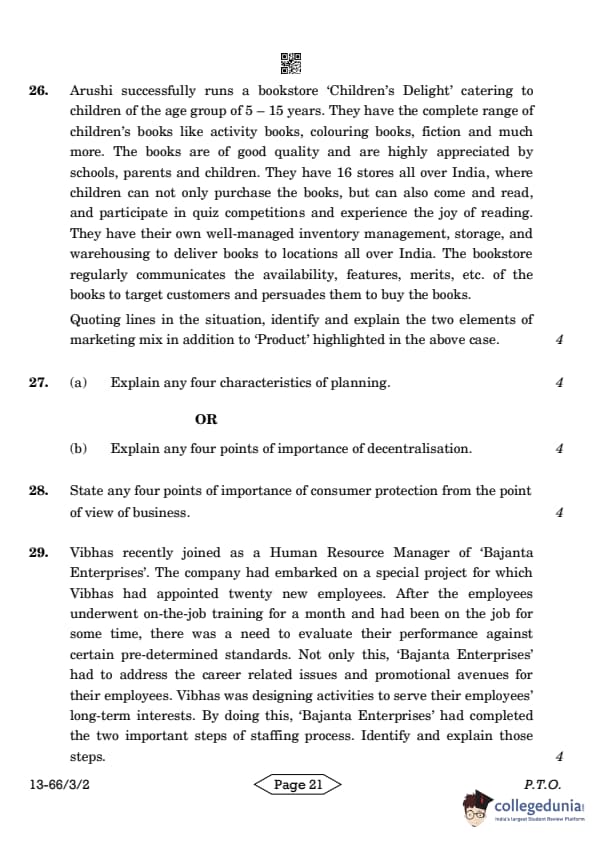
Question 26:
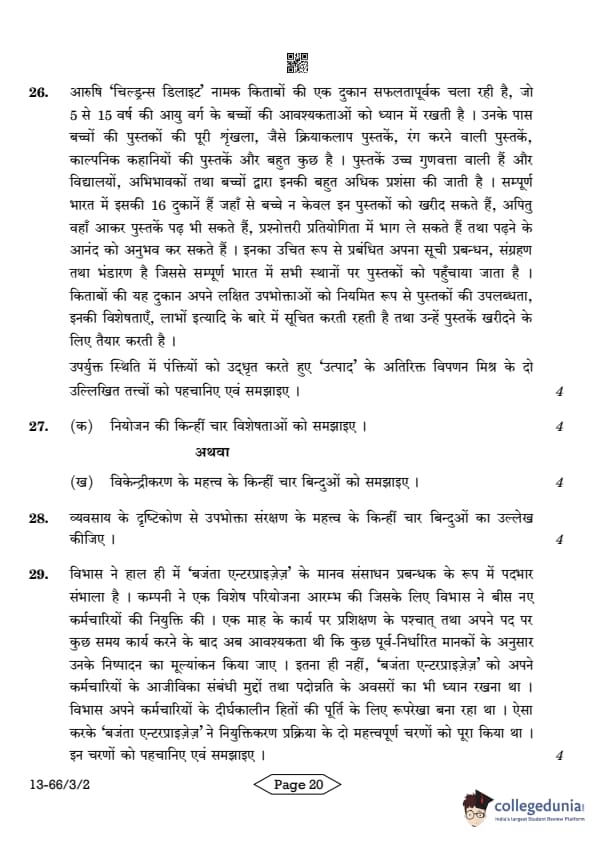
Arushi successfully runs a bookstore 'Children's Delight' catering to children of the age group 5-15 years. They have the complete range of children's books like activity books, colouring books, fiction and much more. The books are of good quality and are highly appreciated by schools, parents and children. They have 16 stores all over India, where children can not only purchase the books, but can also come and read, and participate in quiz competitions and experience the joy of reading. They have their own wellmanaged inventory management, storage, and warehousing to deliver books to locations all over India. The bookstore regularly communicates the availability, features, merits, etc. of the books to target customers and persuades them to buy the books.
Quoting lines in the situation, identify and explain the two elements of marketing mix in addition to 'Product' highlighted in the above case.
View Solution
Solution:
(i) Place:
"They have 16 stores all over India.” OR "They have their own well-managed inventory management, storage, and warehousing to deliver books to locations all over India.”
Place refers to making products available to target customers through efficient distribution systems, including inventory management and transportation.
(ii) Promotion:
"The bookstore regularly communicates the availability, features, merits, etc., of the books to target customers and persuades them to buy the books.”
Promotion involves communicating with customers to inform and persuade them to purchase the product, using tools like advertising and sales promotion.
Question 27:
(a). Explain any four characteristics of Planning.
27(b). Explain any four points of importance of decentralization.
View Solution
Solution:
(a) Characteristics of Planning: (Any four)
(i) Planning Focuses on Achieving Objectives:
Planning is goal-oriented and aims at achieving organizational objectives efficiently. It defines the desired outcomes and strategies to reach them.
(ii) Planning is a Primary Function of Management:
Planning lays the foundation for all other managerial functions, such as organizing, staffing, directing, and controlling. It provides a structured framework for decision-making.
(iii) Planning is Pervasive:
Planning is required at all levels of management (top, middle, and operational). It applies to all departments and business functions.
(iv) Planning is Continuous:
Since business environments change, planning is a never-ending process. It requires constant review and modifications to remain effective.
(v) Planning is Futuristic:
Planning is forward-looking and helps in anticipating future events, opportunities, and risks. It enables businesses to prepare for uncertainties effectively.
(vi) Planning Involves Decision Making:
It involves selecting the best course of action from multiple alternatives. Effective planning ensures optimal resource utilization.
(vii) Planning is a Mental Exercise:
Planning requires intellectual thinking, analysis, and forecasting. It is based on facts, logical reasoning, and evaluation rather than guesswork.
(b) Importance of Decentralization: (Any four)
(i) Develops Initiative Among Subordinates:
Decentralization empowers employees at different levels to take responsibility. It encourages self-reliance and independent decision-making.
(ii) Develops Managerial Talent for the Future:
It helps in grooming future leaders by providing practical experience in decision-making. Subordinates get exposure to higher responsibilities, preparing them for managerial roles.
(iii) Quick Decision Making:
Decision-making is faster as it occurs at the point of action rather than waiting for approval from top management. This increases efficiency and responsiveness to business challenges.
(iv) Relief to Top Management:
Top management can focus on strategic decisions while routine decisions are handled at lower levels. This enhances overall productivity and efficiency.
(v) Facilitates Growth:
Decentralization allows organizations to expand operations effectively. It helps in managing larger geographical areas by delegating authority.
(vi) Better Control:
When decision-making is spread across different levels, control becomes more effective. Managers at different levels monitor performance and ensure accountability.
Question 28:
State any four points of importance of consumer protection from the point of view of business.
View Solution
Solution:
Consumer protection is essential for businesses as it helps build trust and ensures long-term growth. The following are four important points of consumer protection from a business perspective:
1. Builds Trust and Loyalty: Consumer protection ensures that businesses treat customers fairly, which helps in building trust. A loyal customer base is crucial for the sustainability of any business.
2. Enhances Business Reputation: By adhering to consumer protection laws, businesses establish a positive reputation in the market. This enhances brand value and attracts more customers, leading to increased sales.
3. Promotes Fair Competition: Consumer protection promotes fairness by ensuring that businesses do not engage in deceptive practices. This encourages healthy competition in the market and leads to the overall development of the industry.
4. Reduces Legal Risks: Complying with consumer protection laws helps businesses avoid legal penalties. It ensures that the business operates within the legal framework, minimizing the risk of lawsuits and claims from consumers.
Question 29:
Vibhas recently joined as a Human Resource Manager of 'Bajanta Enterprises'. The company had embarked on a special project for which Vibhas had appointed twenty new employees. After the employees underwent on-the-job training for a month and had been on the job for some time, there was a need to evaluate their performance against certain pre-determined standards. Not only this, 'Bajanta Enterprises' had to address the career-related issues and promotional avenues for their employees. Vibhas was designing activities to serve their employees' long-term interests. By doing this, 'Bajanta Enterprises' had completed the two important steps of the staffing process. Identify and explain those steps.
View Solution
Solution:
Two Steps of the Staffing Process:
(i) Performance Appraisal:
Performance appraisal refers to evaluating an employee's current and past performance against certain predetermined standards. Employees should be aware of these standards, and managers should provide feedback to help them improve. This step helps in identifying strengths, weaknesses, and training needs for further growth.
(ii) Promotion and Career Planning:
Organizations must design activities that serve employees' long-term career growth and encourage them to realize their full potential. Promotions play a key role in career development, providing employees with greater responsibility, status, and financial benefits. Career planning helps in identifying future leaders, ensuring a strong pipeline of talented individuals for senior positions.
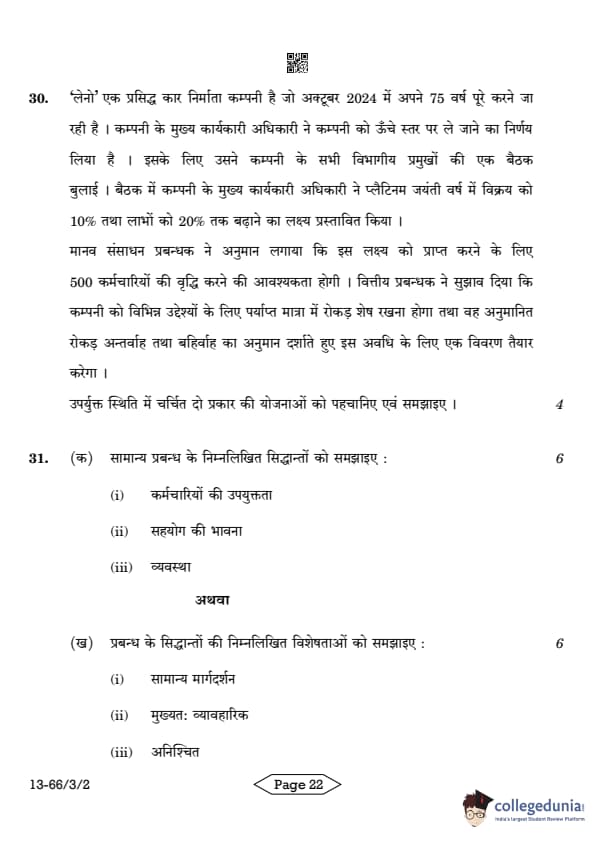
Question 30:
'Leno' is a reputed car manufacturing company, which is going to complete its 75 years in October 2024. The Chief Executive Officer of the company decided to take the company to a higher level. For this, he called a meeting of all departmental heads of the company. In the meeting, the Chief Executive Officer proposed a target to increase sales by 10% and profits by 20% in its Platinum Jubilee year. The Human Resource Manager estimated that an increase of 500 workers would be required to achieve the target. The Finance Manager suggested that the company must hold adequate cash balances for various purposes, and he will prepare a statement showing the cash inflows and outflows for this particular period. Identify and explain two types of plans discussed in the above case.
View Solution
Solution:
(i) Objectives:
Objectives define the desired future position or end goals that management wants to achieve. In this case, the objective is to increase sales by 10- Objectives are measurable and provide direction to all organizational efforts.
(ii) Budget:
A budget is a financial plan that quantifies future revenue, expenditure, and cash flow. The Finance Manager proposed preparing a budget to manage cash inflows and outflows for achieving the target. Budgets act as a control device by comparing actual results with planned figures.
Question 31:
31(a). Explain the following principles of general management:
(i) Stability of Personnel
(ii) Esprit de Corps
(iii) Order
31(b). Explain the following features of principles of management:
(i) General Guidelines
(ii) Mainly Behavioural
(iii) Contingent
View Solution
Solution:
(a) (i) Stability of Personnel:
Employees should be retained at their positions for a fixed tenure to ensure organizational stability. High employee turnover leads to instability, insecurity, and reduced efficiency. Stability of personnel ensures continuity in operations and better workforce morale.
(ii) Esprit de Corps:
Managers should foster team spirit, unity, and harmony among employees. A manager should replace 'I' with ‘We' in all communications to promote teamwork. A sense of mutual trust and belongingness boosts employee motivation and organizational success.
(iii) Order:
This principle states “A place for everything (everyone) and everything (everyone) in its (her/his) place.” Proper organization and orderliness lead to increased productivity and efficiency. Ensuring systematic placement of resources and personnel helps in smooth operations.
(b) (i) General Guidelines:
Management principles act as guidelines for managerial decision-making. They do not provide ready-made solutions, as business environments are dynamic and complex. Even a small guideline can help managers solve a given problem efficiently.
(ii) Mainly Behavioural:
Management principles focus on influencing human behaviour within an organization. They aim to establish a balance between human and material resources to achieve organizational goals. Understanding employee motivation, teamwork, and leadership helps improve performance.
(iii) Contingent:
The application of management principles depends on the situation and is not rigid. Different business scenarios require modifications in the implementation of principles. Managers must adapt and modify principles based on organizational needs and market conditions.
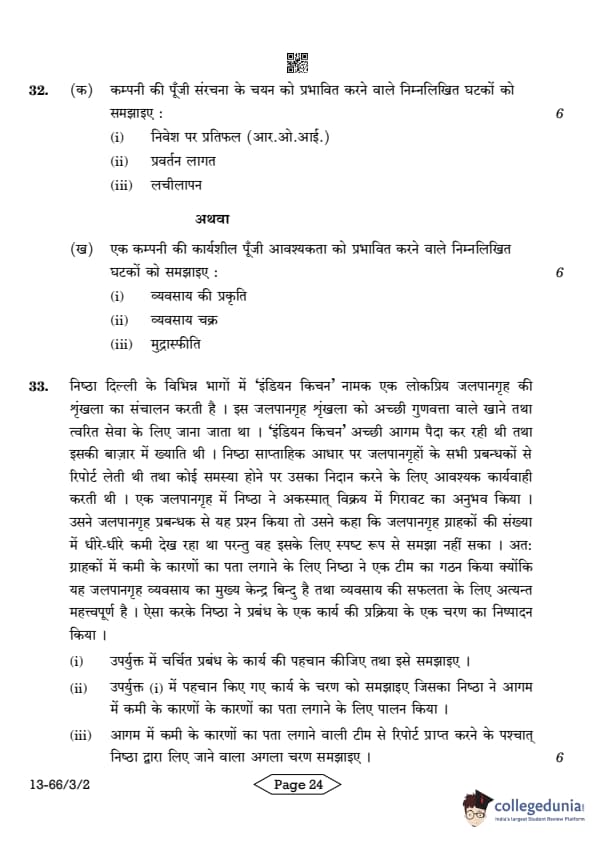
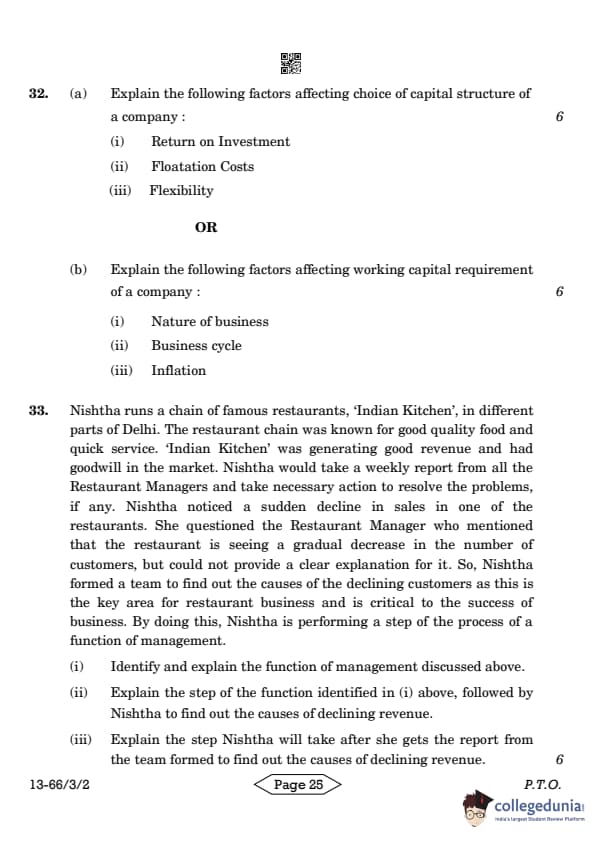
Question 32:
32(a). Explain the following factors affecting the choice of capital structure of a company:
(i) Return on Investment
(ii) Floatation Costs
(iii) Flexibility
32(b). Explain the following factors affecting the working capital requirement of a company:
(i) Nature of Business
(ii) Business Cycle
(iii) Inflation
View Solution
Solution:
(a) (i) Return on Investment:
Return on Investment (ROI) is a key determinant of a company's ability to use trading on equity in its capital structure. If a company's ROI is higher than the cost of debt, it can use more debt to increase its earnings per share (EPS). A company with strong profitability can afford a higher proportion of debt financing.
(ii) Floatation Costs:
Raising funds through equity shares or debentures involves floatation costs, such as underwriting fees, brokerage, and legal expenses. Debt financing (such as loans from banks) may have lower floatation costs than issuing shares. The company must compare the cost of raising capital before deciding on its capital structure.
(iii) Flexibility:
A firm should maintain flexibility in its capital structure by keeping some borrowing power in reserve. If a company has already maximized its debt capacity, it loses the ability to take additional loans during financial emergencies. A well-balanced capital structure should allow for future financing needs.
(b) (i) Nature of Business:
The type of business directly affects working capital needs. Trading firms require less working capital as they do not engage in production or processing. Manufacturing firms require higher working capital to maintain raw materials, production processes, and finished goods inventory. Service industries need the least working capital, as they do not deal with physical goods.
(ii) Business Cycle:
During a boom period, sales and production increase, leading to higher working capital requirements. In a recession (or depression), sales and production decline, so lower working capital is needed. Companies must adjust their working capital according to economic conditions.
(iii) Inflation:
A higher rate of inflation increases the cost of raw materials, wages, and other inputs, leading to higher working capital requirements. Businesses must maintain additional working capital to cope with rising prices and ensure smooth operations. The impact of inflation varies based on the rate of price changes in different components (e.g., raw materials, finished goods, labor costs).
Question 33:
Nishtha runs a chain of famous restaurants, 'Indian Kitchen', in different parts of Delhi. The restaurant chain was known for good quality food and quick service. 'Indian Kitchen' was generating good revenue and had goodwill in the market. Nishtha would take a weekly report from all the Restaurant Managers and take necessary action to resolve the problems, if any. Nishtha noticed a sudden decline in sales in one of the restaurants. She questioned the Restaurant Manager who mentioned that the restaurant is seeing a gradual decrease in the number of customers, but could not provide a clear explanation for it. So, Nishtha formed a team to find out the causes of the declining customers as this is the key area for restaurant business and is critical to the success of business. By doing this, Nishtha is performing a step of the process of a function of management.
(i) Identify and explain the function of management discussed above.
(ii) Explain the step of the function identified in (i) above, followed by Nishtha to find out the causes of declining revenue.
(iii) Explain the step Nishtha will take after she gets the report from the team formed to find out the causes of declining revenue.
View Solution
Solution:
Function of Management: Controlling:
Controlling is a management function that ensures that all activities are performed as planned and in accordance with organizational objectives. It involves comparing actual performance with established standards, identifying deviations, and taking corrective measures to address these deviations.
(ii) Step: Analyzing Deviations:
Analyzing deviations involves comparing actual performance with the standards to identify significant differences. Nishtha focused on a key area (customer footfall) that is critical to the restaurant business. This is referred to as Critical Point Control, where deviations in vital areas are given immediate attention. Management by Exception was applied as only significant deviations were escalated for detailed investigation.
(iii) Step: Taking Corrective Action:
Taking corrective action involves addressing the root causes of the identified deviations to ensure that performance aligns with the planned standards. Nishtha will implement solutions based on the findings of the team, such as improving service quality, introducing new promotions, or addressing operational inefficiencies. Corrective actions ensure that similar deviations do not recur in the future.
Question 34:
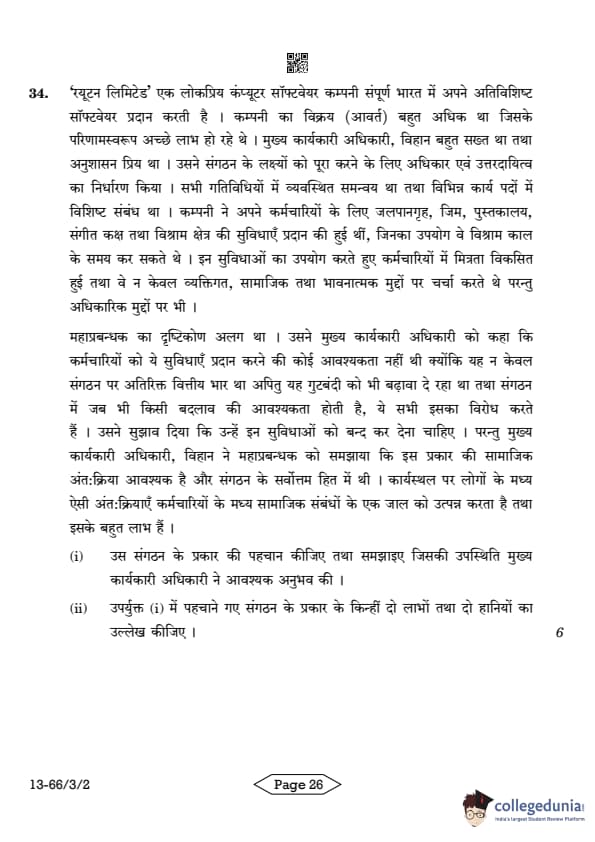
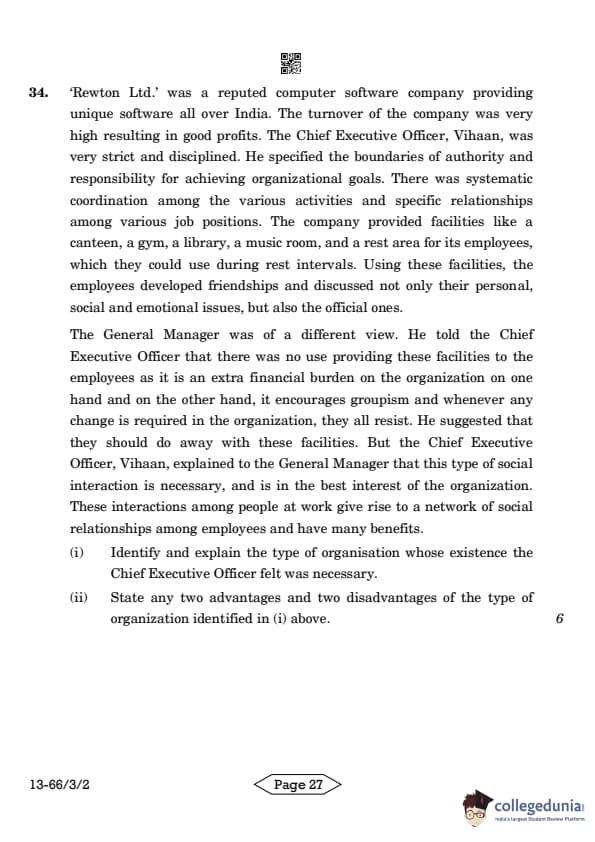
Rewton Ltd. was a reputed computer software company providing unique software all over India. The turnover of the company was very high resulting in good profits. The Chief Executive Officer, Vihaan, was very strict and disciplined. He specified the boundaries of authority and responsibility for achieving organizational goals. There was systematic coordination among the various activities and specific relationships among various job positions. The company provided facilities like a canteen, a gym, a library, a music room, and a rest area for its employees, which they could use during rest intervals. Using these facilities, the employees developed friendships and discussed not only their personal, social, and emotional issues, but also the official ones. The General Manager was of a different view. He told the Chief Executive Officer that there was no use providing these facilities to the employees as it is an extra financial burden on the organization on one hand and on the other hand, it encourages groupism and whenever any change is required in the organization, they all resist. He suggested that they should do away with these facilities. But the Chief Executive Officer, Vihaan, explained to the General Manager that this type of social interaction is necessary, and is in the best interest of the organization. These interactions among people at work give rise to a network of social relationships among employees and have many benefits
(i) Identify and explain the type of organization whose existence the Chief Executive Officer felt was necessary.
(ii) State any two advantages and two disadvantages of the type of organization identified in (i) above.
View Solution
Solution:
(i) Informal Organization:
Informal organization refers to the network of social relationships that develops naturally among employees beyond their official roles. It emerges from interactions among people and plays a crucial role in fulfilling their social needs.
(ii) Advantages:
1. Faster communication: As informal channels bypass official protocols, information spreads quickly, allowing quick feedback.
2. Fulfills social needs: It creates a sense of belongingness and enhances employee morale by fulfilling their social and emotional needs.
Disadvantages:
1. Spreads rumors: Informal communication can lead to rumors, creating misunderstandings.
2. Resistance to change: Informal groups may resist organizational changes, hindering progress.




Comments