




CBSE Class 12 Business Studies Question Paper 2024 PDF (Set 2- 66/4/2) is available for download here. CBSE conducted the Business Studies exam on March 27, 2024 from 10:30 AM to 1:30 PM. The total marks for the theory paper are 80. The question paper will contain 20% MCQ-based questions, 40% competency-based questions, and 40% short and long answer type questions. Candidates can use the link below to download the CBSE Class 12 Business Studies Set 2 Question Paper with detailed solutions.
CBSE Class 12 Business Studies Question Paper 2024 (Set 2- 66/4/2) with Answer Key
| CBSE Class 12 2024 Business Studies Question Paper with Answer Key |  Download Download |
Check Solution |
CBSE Class 12 2024 Business Studies Questions with Solutions
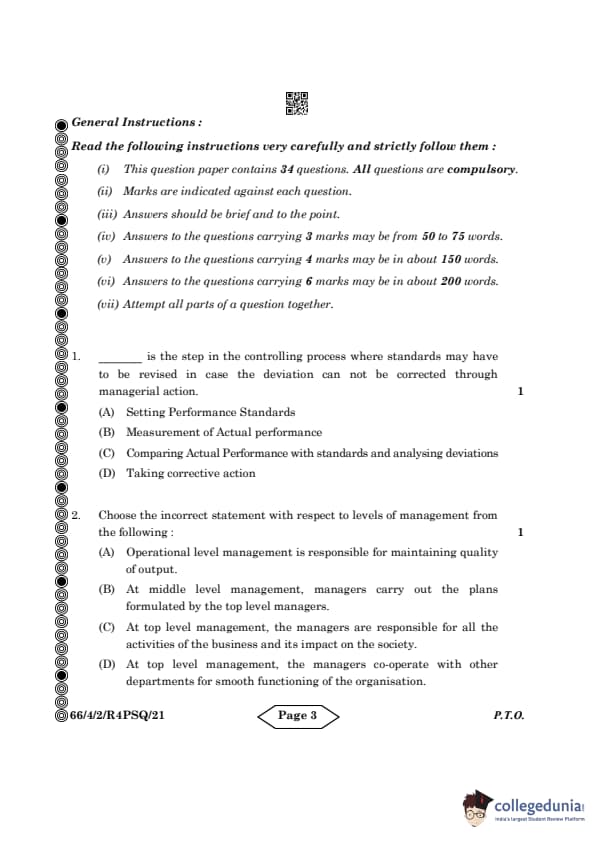
__________ is the step in the controlling process where standards may have to be revised in case the deviation cannot be corrected through managerial action.
View Solution
- Taking corrective action involves making necessary adjustments when significant deviations occur and cannot be corrected by other managerial actions.
- This step ensures that performance standards are achieved and prevents similar deviations in the future.
Quick Tip: Effective corrective action focuses on identifying root causes and implementing solutions to align performance with standards.
Choose the incorrect statement with respect to levels of management from the following:
View Solution
Top-level management refers to the highest tier of management in an organization. This includes roles such as the Chief Executive Officer (CEO), President, and other senior executives. The primary responsibility of top-level management is to set the overall strategic direction, goals, and vision for the organization. They make high-level decisions that affect the future of the company, including long-term planning and resource allocation.
While top-level management is responsible for the organization as a whole and must ensure that the company operates ethically and in a manner that considers its impact on society, they are not directly responsible for overseeing all the activities at lower management levels. First-line managers, who are part of operational management, oversee daily activities and direct the work of employees at the operational level. It is the responsibility of middle management to ensure that the appropriate personnel and resources are allocated within departments, and it is not the direct responsibility of top-level management to manage every operational aspect.
Thus, the statement that top-level management is responsible for all activities of the business, including first-line managers, is incorrect. Top-level management's responsibility is to guide the organization and establish policies, while delegating the responsibility for day-to-day activities and employee management to middle and first-line managers.
\section*{Correct Statements
(A) Operational level management is responsible for maintaining safety standards in the organization.
This is correct because operational management is directly involved in ensuring the safety of employees and the organization.
(B) At middle level management, managers ensure that their department has the necessary personnel.
This is correct because middle-level management is tasked with organizing and coordinating various resources, including human resources, within their respective departments.
(C) Chief Executive Officer at Top Level management is responsible for all activities of first-line managers.
This is incorrect because, as mentioned earlier, top-level management sets the strategic direction but does not directly manage first-line managers. First-line managers report to middle management, not the CEO.
Quick Tip: A quick and effective way to stay focused and boost productivity is by using the \textbf{Pomodoro Technique}. Here's how it works: Set a timer for \textbf{25 minutes} to focus solely on one task. After 25 minutes, take a \textbf{5-minute break}. Repeat this process for \textbf{four sessions}, then take a longer break of \textbf{15-30 minutes}. This technique helps you stay focused, reduces burnout, and increases your overall productivity.
‘Merely allocating work is not enough. Each individual should also know who he has to take orders from and to whom he is accountable.’
The above statement is related to one of the steps of the organising process. Identify the step from the following:
View Solution
- Establishing authority and reporting relationship is an essential step in the organizing process.
- It ensures that each employee knows their reporting authority and who they are accountable to.
- This step creates a structured hierarchy, ensuring clarity in decision-making and accountability.
Quick Tip: Clear authority and reporting relationships enhance efficiency by minimizing confusion and duplication of efforts.
A multinational sweets and snacks company had been into catering business for the last many years. To add to its prospects and to grow in the long run, it wants to increase its sales volume, the number of products, and capital investment.
The organisational objective of management it seeks to achieve is:
View Solution
- The organizational objective of growth focuses on increasing the scale of operations, including sales volume, product range, and capital investment.
- In this case, the company seeks to expand its business to ensure long-term sustainability and market leadership.
Quick Tip: Growth ensures that the organization capitalizes on opportunities and remains competitive in the long run.
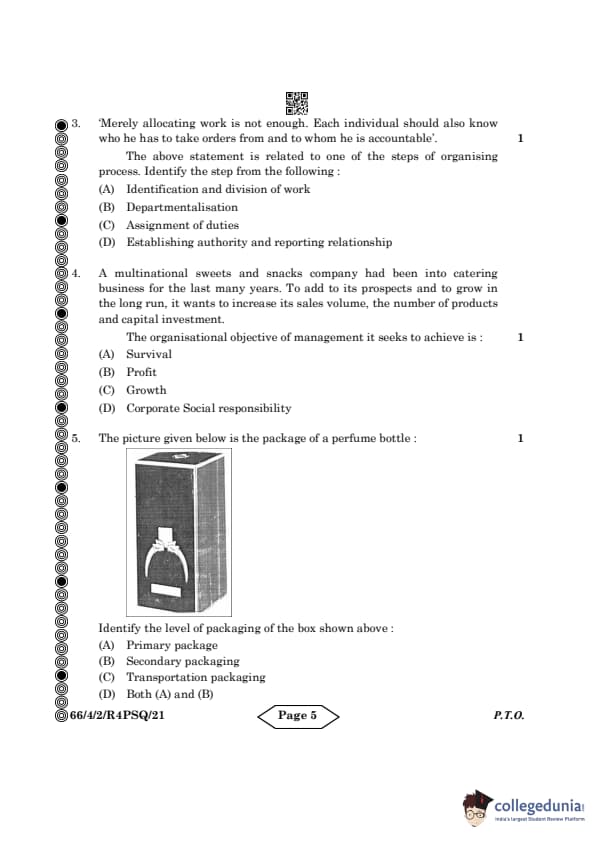
The picture given below is the package of a perfume bottle:
Identify the level of packaging of the box shown above:

View Solution
- Primary packaging refers to the immediate container that holds the product, such as the perfume bottle itself.
- Secondary packaging is the outer box or wrapping that provides additional protection, helps in branding, and makes the product ready for display on retail shelves. The box shown in the image is an example of secondary packaging.
- Transportation packaging refers to bulk packaging used to transport goods securely. This is not relevant to the given question.
Quick Tip: Secondary packaging enhances product appeal and provides additional protection, while primary packaging directly contains the product.
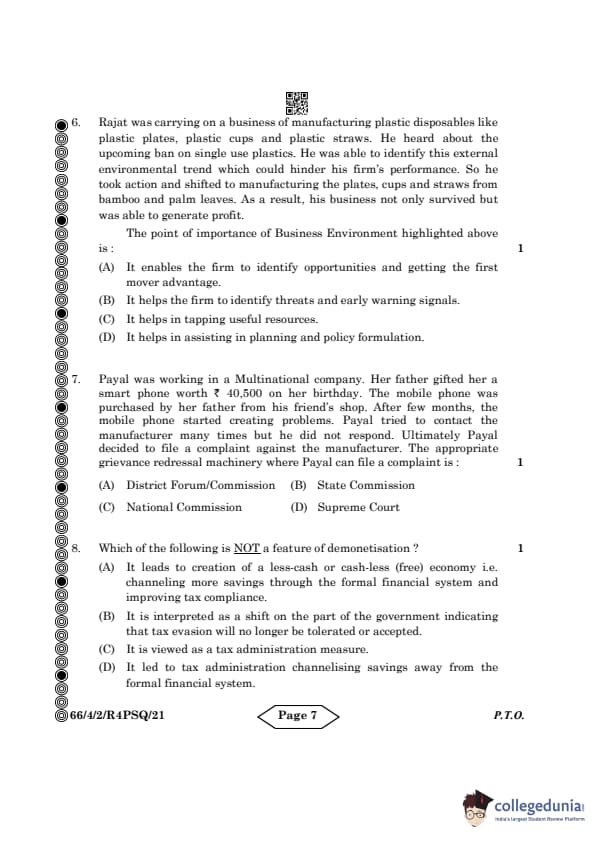
Rajat was carrying on a business of manufacturing plastic disposables like plastic plates, plastic cups, and plastic straws. He heard about the upcoming ban on single-use plastics. He was able to identify this external environmental trend which could hinder his firm's performance. So, he took action and shifted to manufacturing the plates, cups, and straws from bamboo and palm leaves. As a result, his business not only survived but was able to generate profit.
The point of importance of Business Environment highlighted above is:
View Solution
- The business environment helps firms recognize potential threats and take corrective action to mitigate risks.
- Rajat identified the ban on single-use plastics as a threat and took proactive measures to shift to eco-friendly alternatives like bamboo and palm leaves.
- Early identification of threats enabled him to sustain and grow his business despite regulatory changes.
Quick Tip: Analyzing the business environment helps firms identify both opportunities and threats, enabling timely and strategic decisions.
Payal was working in a Multinational Company. Her father gifted her a smartphone worth ₹40,500 on her birthday. The mobile phone was purchased by her father from his friend's shop. After a few months, the mobile phone started creating problems. Payal tried to contact the manufacturer many times, but he did not respond. Ultimately, Payal decided to file a complaint against the manufacturer.
The appropriate grievance redressal machinery where Payal can file a complaint is:
View Solution
- Complaints under the Consumer Protection Act are filed based on the value of goods and compensation claimed.
- Since the value of the phone is ₹40,500, Payal can approach the District Forum/Commission, which handles cases where the compensation value is up to ₹50,00,000.
- Higher-value complaints would require filing at the State or National Commission, depending on the amount.
Quick Tip: Choose the grievance redressal forum based on the value of the claim: District Forum (up to ₹50,00,000), State Commission (₹50,00,001 to ₹2 Crore), and National Commission (above ₹2 Crore).
Which of the following is NOT a feature of demonetisation?
View Solution
- Demonetisation was aimed at reducing reliance on cash transactions and promoting digital payments, which strengthens the formal financial system.
- Option % Option
(D) contradicts this objective, as demonetisation encouraged savings to be directed towards the formal economy rather than away from it.
- It also aimed to improve tax compliance by reducing tax evasion and discouraging the circulation of black money.
Quick Tip: Demonetisation encourages digital transactions and formalizes the economy, leading to better tax compliance and transparency.
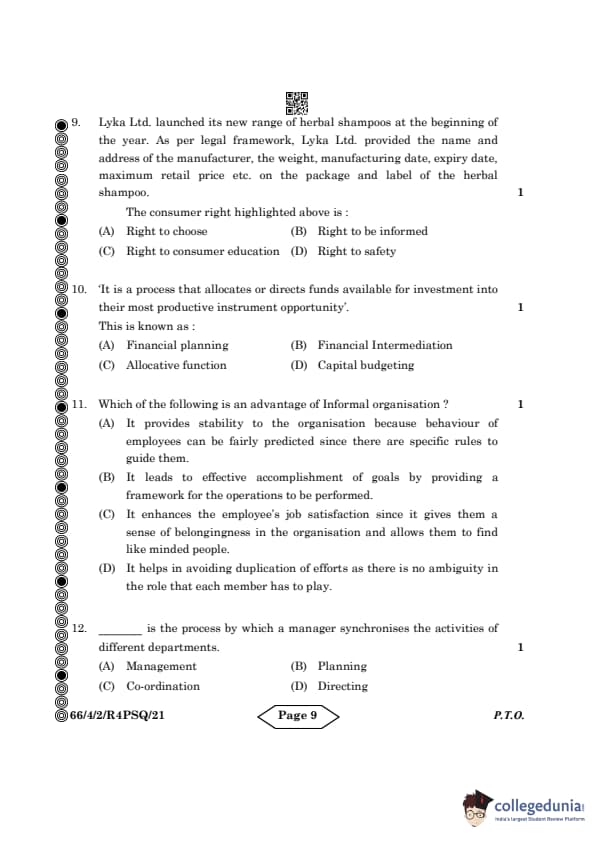
Lyka Ltd. launched its new range of herbal shampoos at the beginning of the year. As per legal framework, Lyka Ltd. provided the name and address of the manufacturer, the weight, manufacturing date, expiry date, maximum retail price, etc., on the package and label of the herbal shampoo.
The consumer right highlighted above is:
View Solution
- Right to be informed: This right ensures that consumers are provided with complete and accurate information about the product they are purchasing.
- In this case, Lyka Ltd. adhered to the legal framework by providing details such as the manufacturer’s name and address, product weight, manufacturing and expiry dates, and maximum retail price. This helps consumers make an informed choice about the product.
- Providing such information fosters trust and transparency between the manufacturer and the consumer.
Quick Tip: Always check product labels for key details such as expiry date, price, and manufacturing information to make informed purchases.
‘It is a process that allocates or directs funds available for investment into their most productive instrument opportunity.’ This is known as:
View Solution
- Financial intermediation refers to the process of transferring funds from savers to borrowers or investors.
- It ensures that the funds are directed toward the most productive investment opportunities in the economy.
- Examples include banks, mutual funds, and insurance companies, which facilitate the allocation of resources efficiently.
Quick Tip: Financial intermediation bridges the gap between surplus and deficit sectors, promoting economic growth and productivity.
Which of the following is an advantage of Informal Organisation?
View Solution
- Informal organisations help employees form social relationships, which improve their sense of belongingness and job satisfaction.
- These networks complement the formal organisation by fostering communication and cooperation among employees.
Quick Tip: Informal organisations improve morale and communication but must be managed carefully to avoid disruptions.
_________ is the process by which a manager synchronises the activities of different departments.
View Solution
- Co-ordination is the process of aligning the activities of various departments and individuals to ensure they work towards common objectives.
- It ensures that efforts across the organisation are integrated to avoid duplication and conflicts.
Quick Tip: Co-ordination is a key function of management that ensures harmony among different departments for effective performance.
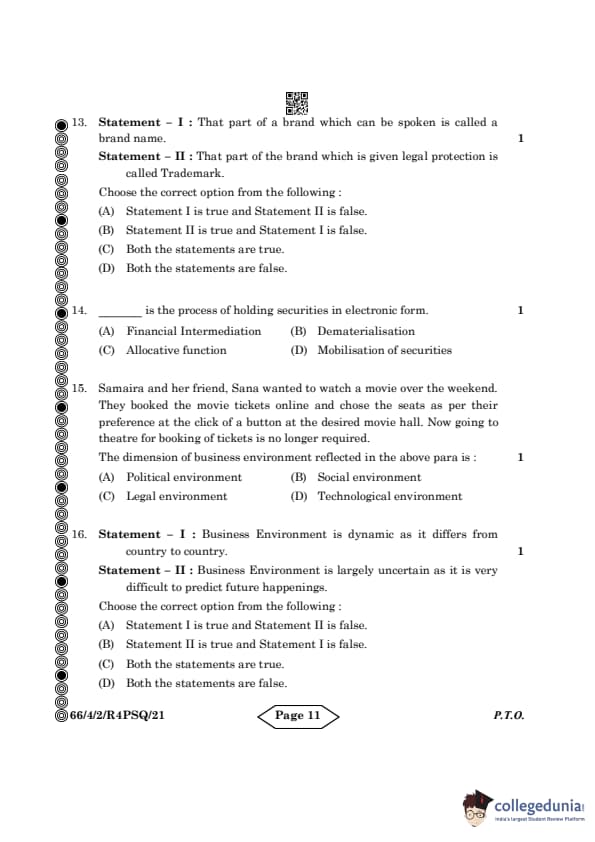
Statement-I: That part of a brand which can be spoken is called a brand name.
Statement-II: That part of the brand which is given legal protection is called Trademark.
Choose the correct option from the following:
View Solution
- Statement-I: A brand name refers to the part of a brand that can be spoken, such as the name of a product or service. For example, "Nike" or "Apple" are brand names. This statement is true.
- Statement-II: A trademark is a part of the brand that is legally protected. It includes symbols, designs, or words that distinguish a product or service. For example, the Nike swoosh is a trademark. This statement is also true.
Quick Tip: A brand name is verbal and easy to identify, while a trademark provides legal protection to the brand's unique identity.
_____________ is the process of holding securities in electronic form.
View Solution
- Dematerialisation refers to converting physical securities into electronic form for easier storage and trading.
- This process reduces the risks associated with physical certificates, such as loss, theft, or forgery, and enhances the efficiency of securities transactions.
Quick Tip: Dematerialisation simplifies securities trading, making it secure and efficient by eliminating the need for physical certificates.
Samaira and her friend, Sana wanted to watch a movie over the weekend. They booked the movie tickets online and chose the seats as per their preference at the click of a button at the desired movie hall. Now going to the theatre for booking of tickets is no longer required.
The dimension of business environment reflected in the above para is:
View Solution
- The technological environment refers to the influence of advancements in technology on business operations.
- In this case, the availability of online booking systems for movie tickets demonstrates how technology has simplified the process for consumers.
- Businesses that adapt to technological advancements can improve customer convenience, enhance efficiency, and remain competitive.
Quick Tip: The technological environment constantly evolves, and businesses should leverage advancements like online platforms to enhance customer experience.
Statement - I: Business Environment is dynamic as it differs from country to country.
Statement II: Business Environment is largely uncertain as it is very difficult to predict future happenings.
Choose the correct option from the following:
View Solution
- Statement I: The business environment is dynamic due to the constantly changing political, economic, social, and technological factors. However, its characteristics remain consistent across countries, making this statement false.
- Statement II: The business environment is uncertain because external changes like economic shifts or political decisions are often unpredictable. This makes the statement true.
Quick Tip: The business environment is dynamic and uncertain, requiring businesses to be adaptive and proactive in their planning.
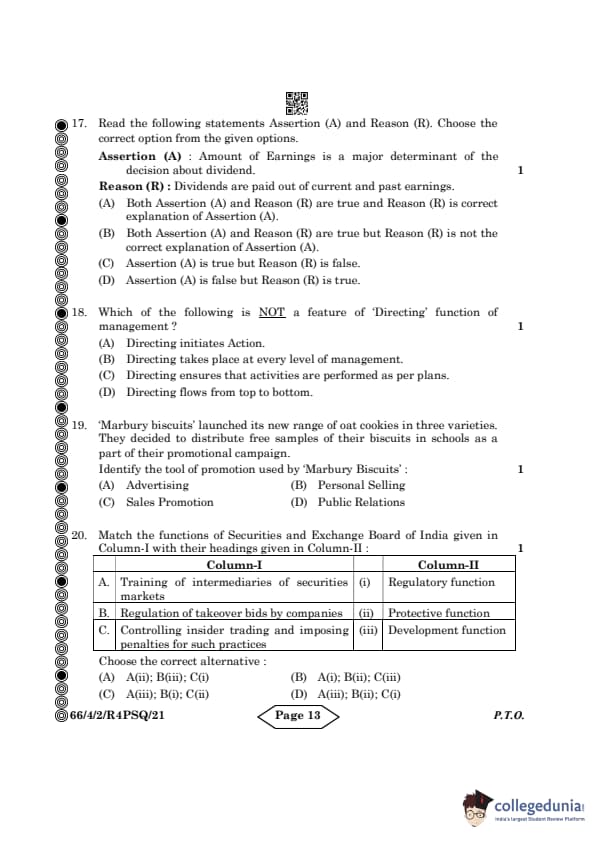
Read the following statements Assertion (A) and Reason (R). Choose the correct option from the given options.
Assertion (A): Amount of Earnings is a major determinant of the decision about dividend.
Reason (R): Dividends are paid out of current and past earnings.
View Solution
- Earnings are the primary source for paying dividends, as dividends are distributed from current or retained earnings.
- The amount of earnings available determines whether a company can pay dividends while retaining enough for future investments.
Quick Tip: Earnings play a crucial role in determining dividend policies, balancing shareholder returns and reinvestment needs.
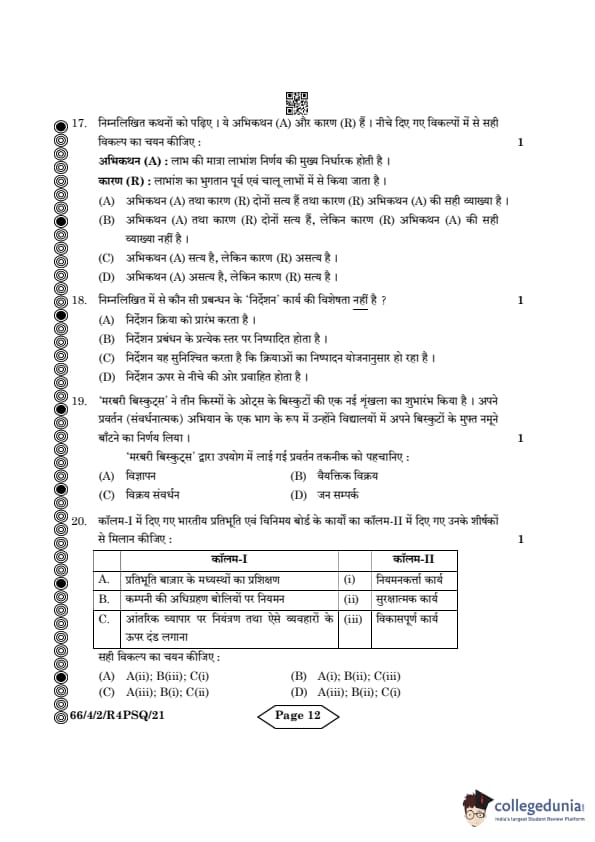
Which of the following is NOT a feature of Directing function of management?
View Solution
- While directing ensures that employees perform their tasks, it does not explicitly focus on ensuring activities are performed as per plans. This is part of the controlling function.
- Directing involves guiding, supervising, and motivating employees to achieve organizational objectives.
Quick Tip: Directing focuses on motivating and guiding employees, while controlling ensures that activities align with organizational plans.
‘Marbury Biscuits’ launched its new range of oat cookies in three varieties. They decided to distribute free samples of their biscuits in schools as a part of their promotional campaign.
Identify the tool of promotion used by 'Marbury Biscuits':
View Solution
- Sales promotion includes short-term incentives like free samples, discounts, or offers to boost immediate sales.
- In this case, free samples distributed in schools aim to introduce the product and encourage customers to try it.
Quick Tip: Sales promotion is an effective tool for creating awareness and encouraging trial purchases in new product launches.
Match the functions of Securities and Exchange Board of India given in Column-I with their headings given in Column-II:
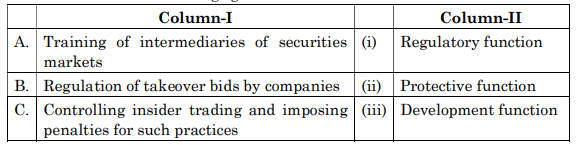
A. Training of intermediaries of securities markets & (i) Regulatory function
B. Regulation of takeover bids by companies & (ii) Protective function
C. Controlling insider trading and imposing penalties for such practices & (iii) Development function
\hline
\end{tabular
View Solution
- A (iii): Training of intermediaries falls under the Development function as it aims to enhance the efficiency of market participants by providing them with the necessary skills.
- B (i): Regulation of takeover bids is a Regulatory function since SEBI ensures fair and transparent market practices to protect investors and maintain order.
- C (ii): Controlling insider trading and imposing penalties for such practices is a Protective function as it safeguards investors from fraudulent and unfair practices in the securities market.
Quick Tip: SEBI’s primary functions include regulation (to ensure market fairness), development (to enhance skills), and protection (to safeguard investors).
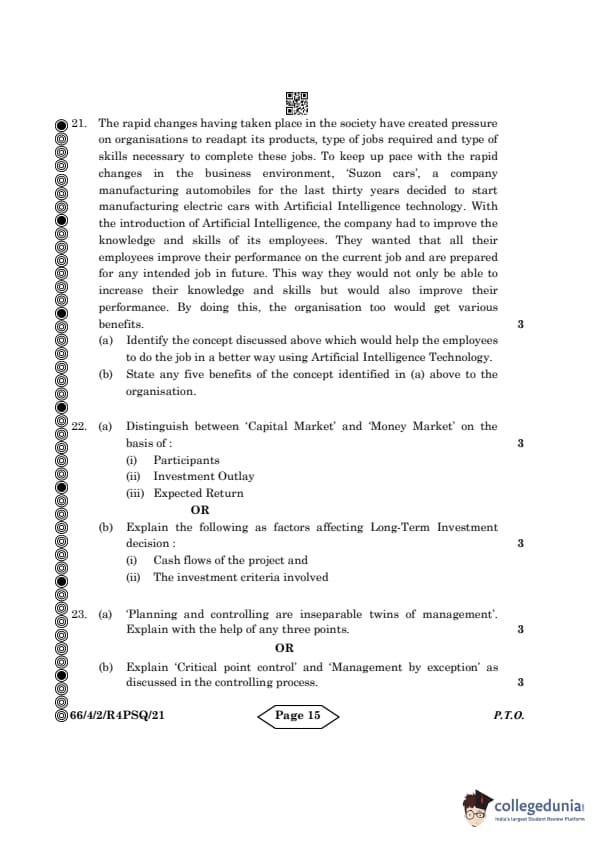
21. The rapid changes having taken place in the society have created pressure on organisations to readapt its products, type of jobs required and type of skills necessary to complete these jobs. To keep up pace with the rapid changes in the business environment, ‘Suzon cars’, a company manufacturing automobiles for the last thirty years decided to start manufacturing electric cars with Artificial Intelligence technology. With the introduction of Artificial Intelligence, the company had to improve the knowledge and skills of its employees. They wanted that all their employees improve their performance on the current job and are prepared for any intended job in future. This way they would not only be able to increase their knowledge and skills but would also improve their performance. By doing this, the organisation too would get various benefits.
Question 21:
(a) Identify the concept discussed above which would help the employees to do the job in a better way using Artificial Intelligence Technology.
View Solution
The concept discussed is Training, which helps employees improve their performance and prepare for future challenges.
Quick Tip: Training is key to enhancing employee skills and adapting to technological advancements, such as Artificial Intelligence.
(b) State any five benefits of the concept identified in (a) above to the organisation.
View Solution
The benefits of training to an organisation are:
1. Training provides systematic learning, reducing wastage of time, effort, and resources compared to trial-and-error methods.
2. It enhances employee productivity in terms of quality and quantity, leading to higher profits.
3. Training equips employees to handle future managerial roles effectively during emergencies.
4. It boosts employee morale, reducing absenteeism and turnover rates.
5. It helps the organisation adapt to technological and economic changes efficiently.
Quick Tip: Invest in training programs to boost productivity, improve employee retention, and future-proof your organisation.
(a) Distinguish between ‘Capital Market’ and ‘Money Market’ on the basis of:
(i) Participants
(ii) Investment Outlay
(iii) Expected Return
View Solution
The distinction between Capital Market and Money Market is as follows:
\begin{tabular{|c|p{6cm|p{6cm|
\hline
Basis & Capital Market & Money Market
\hline
Participants & The participants are financial institutions, banks, corporate entities, foreign investors, and ordinary retail investors from members of the public. & The participants are institutional participants such as the RBI, banks, financial institutions, and finance companies.
\hline
Investment Outlay & Securities do not necessarily require a huge financial outlay. & Transactions entail huge sums of money as the instruments are quite expensive.
\hline
Expected Return & Generally yields a higher return for investors than the money market. & Generally yields a lower return for investors than the capital market.
\hline
\end{tabular Quick Tip: The capital market is for long-term investments with higher returns, while the money market is for short-term liquidity with lower returns.
(OR)
Question 22:
(b) Explain the following as factors affecting 'Long-term Investment Decision':
(i) Cash flows of the project
(ii) The investment criteria involved
View Solution
(i) Cash Flows of the Project
When a company makes an investment decision involving a significant amount, it expects to generate cash flows over a period of time.
These cash flows consist of a series of cash receipts and payments occurring over the life of the investment.
(ii) The Investment Criteria Involved
Investment decisions involve several calculations regarding the amount of investment, interest rate, expected cash flows, and rate of return.
Various techniques, known as capital budgeting techniques, are used to evaluate these investment proposals.
Quick Tip: Evaluate long-term investments by analysing expected cash flows and using capital budgeting techniques like NPV or IRR.
Question 23:
(a) ‘Planning and controlling are inseparable twins of management’. Explain with the help of any three points.
View Solution
Planning and controlling are closely related functions of management. The relationship can be explained as follows:
1. Planning without controlling is meaningless, and controlling is blind without planning:
Once a plan is operational, controlling ensures monitoring progress, measuring deviations, and initiating corrective actions. Controlling depends on the standards set by planning. Thus, planning and controlling complement each other.
2. Planning is a prerequisite for controlling:
Controlling ensures that events conform to the plan. Without planning, there are no benchmarks to measure or evaluate performance.
3. Planning is forward-looking, while controlling is both backward and forward-looking:
Planning involves looking ahead, forecasting future conditions, and setting objectives. Controlling evaluates past performance to improve future outcomes.
Quick Tip: Planning sets the foundation for goals, while controlling ensures adherence to plans and continuous improvement.
(OR)
Question 23:
(b) Explain 'Critical Point Control' and 'Management by Exception' as discussed in the controlling process.
View Solution
1. Critical Point Control:
Control should focus on key result areas (KRAs) that are critical to the success of an organisation. These KRAs are identified as critical points. If anything goes wrong at these critical points, the entire organisation may suffer. Focusing on KRAs ensures that the organisation's resources are directed toward achieving the most significant objectives.
2. Management by Exception:
Management by exception, also known as control by exception, is based on the belief that trying to control everything results in controlling nothing. Instead, only significant deviations that go beyond the permissible limits should be brought to the management's notice. This approach allows managers to focus on critical issues rather than routine matters, improving efficiency and decision-making.
Quick Tip: Both 'Critical Point Control' and 'Management by Exception' help organisations prioritize key areas and avoid wasting resources on minor or non-essential issues.
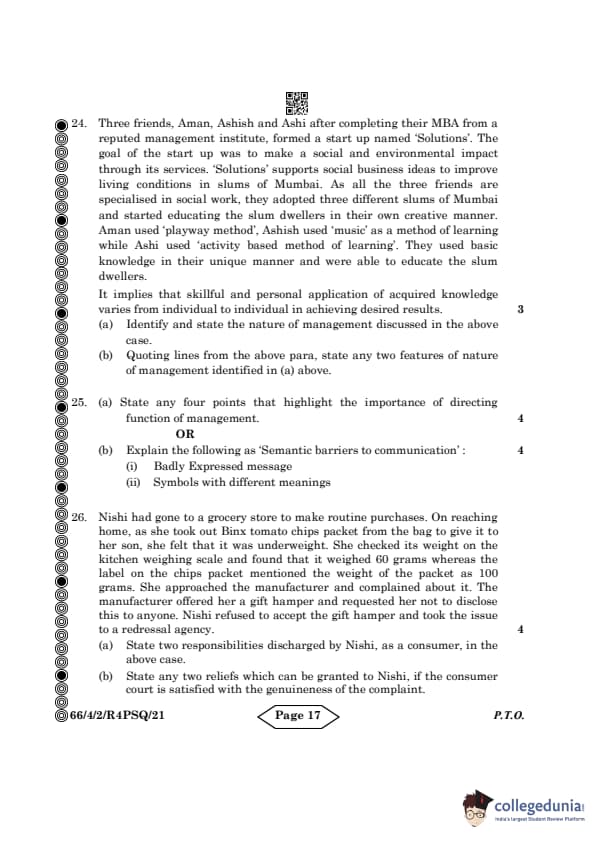
24. Three friends, Aman, Ashish and Ashi after completing their MBA from a reputed management institute, formed a start up named ‘Solutions’. The goal of the start up was to make a social and environmental impact through its services. ‘Solutions’ supports social business ideas to improve living conditions in slums of Mumbai. As all the three friends are specialised in social work, they adopted three different slums of Mumbai and started educating the slum dwellers in their own creative manner. Aman used ‘playway method’, Ashish used ‘music’ as a method of learning while Ashi used ‘activity based method of learning’. They used basic knowledge in their unique manner and were able to educate the slum dwellers. It implies that skillful and personal application of acquired knowledge varies from individual to individual in achieving desired results.
Question 24:
(a) Identify and state the nature of management discussed in the above case.
View Solution
The nature of management discussed in the case is Management as an Art.
Management as an art involves the skillful and personalized application of knowledge to achieve desired results. In this case, Aman, Ashish, and Ashi used their creative methods to educate slum dwellers, showcasing the artistic aspect of management. Quick Tip: Management as an art is about personalizing acquired knowledge with creativity and skill to solve real-world problems effectively.
(b) Quoting lines from the above paragraph, state any two features of the nature of management identified in (a) above.
View Solution
Feature 1: Personalised Application
“They used basic knowledge in their unique manner and were able to educate the slum dwellers.”
This shows that managers apply their knowledge and skills based on individual situations and requirements.
Feature 2: Based on Practice and Creativity
“They adopted three different slums of Mumbai and started educating the slum dwellers in their own creative manner.”
This highlights that management as an art requires creativity and practice to address specific challenges effectively. Quick Tip: When discussing features of management as an art, focus on creativity, personalized application, and practical execution in diverse situations.
(a) State any four points that highlight the importance of directing function of management.
View Solution
The importance of the directing function of management includes:
1. Initiates Action: Directing helps to initiate action by people in the organisation towards the attainment of desired objectives.
2. Integrates Efforts: Directing integrates employees’ efforts in the organisation such that every individual effort contributes to organisational performance.
3. Guides Employees: Directing guides employees to fully realise their potential and capabilities through motivation and effective leadership.
4. Facilitates Change: Directing facilitates the introduction of necessary changes in the organisation through motivation, communication, and leadership.
5. Promotes Stability: Effective directing helps bring stability and balance to the organisation by fostering cooperation and commitment among employees.
Quick Tip: Directing ensures that employees are motivated, guided, and aligned with organisational goals, enhancing overall performance and stability.
(OR)
Question 25:
(b) Explain the following 'Semantic Barriers' to communication:
(i) Badly expressed message
(ii) Symbols with different meanings
View Solution
(i) Badly Expressed Message:
Sometimes, the intended meaning may not be effectively conveyed by a manager to subordinates.
This can occur due to inadequate vocabulary, the usage of incorrect words, or the omission of necessary words, resulting in miscommunication.
(ii) Symbols with Different Meanings:
A single word can have multiple meanings, and the receiver has to interpret one of these meanings based on the communicator’s intent.
Misinterpretation or wrong perception of the symbols used can lead to communication problems.
Quick Tip: To avoid semantic barriers, ensure clarity in messages by using precise language and avoiding ambiguous symbols or words.
26. Nishi had gone to a grocery store to make routine purchases. On reaching home, as she took out Binx tomato chips packet from the bag to give it to her son, she felt that it was underweight. She checked its weight on the kitchen weighing scale and found that it weighed 60 grams whereas the label on the chips packet mentioned the weight of the packet as 100 grams. She approached the manufacturer and complained about it. The manufacturer offered her a gift hamper and requested her not to disclose this to anyone. Nishi refused to accept the gift hamper and took the issue to a redressal agency.
Question 26:
(a) State two responsibilities discharged by Nishi, as a consumer, in the above case.
View Solution
N/A
(b) State any two reliefs that can be granted to Nishi, if the consumer court is satisfied with the genuineness of the complaint.
View Solution
1. Replacement of the Product: The defective packet can be replaced with a new one that is free from defects.
2. Refund of the Price Paid: Nishi may be refunded the amount paid for the defective product.
Quick Tip: As a consumer, always check product details and act promptly by filing a complaint if goods are found defective or misleading.
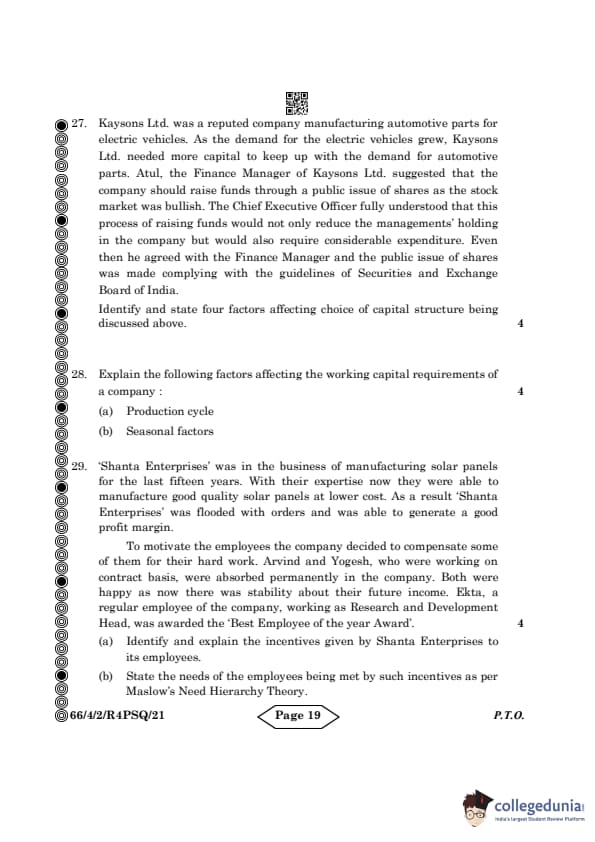
Kaysons Ltd. was a reputed company manufacturing automotive parts for electric vehicles. With growing demand for electric vehicles, Kaysons Ltd. required more capital to meet the increased demand for automotive parts. Atul, the Finance Manager, suggested raising funds through a public issue of shares as the stock market was bullish. Although this process would reduce the management's holding and involve significant expenditure, the Chief Executive Officer agreed. The public issue of shares was made in compliance with Securities and Exchange Board of India (SEBI) guidelines.
Identify and state four factors affecting the choice of capital structure being discussed above.
View Solution
1. Stock Market Conditions:
If the stock market is bullish, companies prefer raising equity capital as shares can be sold more easily, often at a higher price. This is why Kaysons Ltd. opted for a public issue of shares.
2. Control:
Issuing additional equity reduces the existing management's holding in the company, potentially diluting control over business decisions.
3. Floatation Costs:
Raising funds through equity involves significant costs such as underwriting fees, advertising, and compliance expenses, which influence the decision.
4. Regulatory Framework:
The company had to ensure compliance with SEBI guidelines while issuing shares, highlighting the importance of considering the regulatory framework when deciding the capital structure.
Quick Tip: Factors like stock market conditions, control, cost, and regulatory compliance are critical when deciding on a capital structure.
Explain the following factors affecting the working capital requirements of a company:
(a) Production Cycle
(b) Seasonal Factors
View Solution
(a) Production Cycle:
The production cycle refers to the time span between the receipt of raw materials and their conversion into finished goods.
Companies with a longer processing cycle require a higher amount of working capital, whereas firms with a shorter processing cycle require less working capital.
(b) Seasonal Factors:
During the peak season, when there is a higher level of activity, a larger amount of working capital is required to manage increased operations.
Conversely, during the lean season, when the level of activity is lower, the working capital requirement decreases.
Quick Tip: Factors like production cycles and seasonal variations significantly influence a company's working capital needs. Longer cycles and peak seasons increase working capital requirements.
29. ‘Shanta Enterprises’ was in the business of manufacturing solar panels for the last fifteen years. With their expertise now they were able to manufacture good quality solar panels at lower cost. As a result ‘Shanta Enterprises’ was flooded with orders and was able to generate a good profit margin. To motivate the employees the company decided to compensate some of them for their hard work. Arvind and Yogesh, who were working on contract basis, were absorbed permanently in the company. Both were happy as now there was stability about their future income. Ekta, a regular employee of the company, working as Research and Development Head, was awarded the ‘Best Employee of the year Award’.
Question 29:
(a) Identify and explain the incentives given by Shanta Enterprises to its employees.
View Solution
N/A
(b) State the needs of the employees being met by such incentives as per Maslow's Need Hierarchy Theory.
View Solution
1. Safety/Security Needs: These include security and protection from physical and emotional harm, as provided by job stability.
2. Esteem Needs: These include self-respect, status, and recognition, which were fulfilled by the appreciation shown through the award given to Ekta.
Quick Tip: Job security meets employees’ safety needs, while recognition boosts their esteem, enhancing overall motivation and productivity.
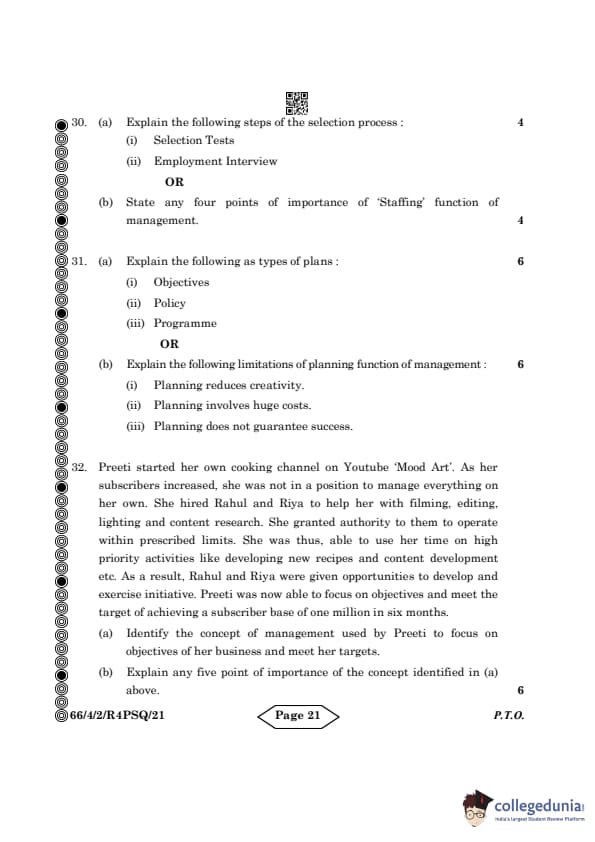
(a) Explain the following steps of the selection process:
(i) Selection Tests
(ii) Employment Interview
View Solution
(i) Selection Tests
Selection tests are mechanisms that attempt to measure certain characteristics of individuals.
These characteristics may include aptitudes, such as manual dexterity, intelligence, or personality traits, which are critical for determining job suitability.
(ii) Employment Interview
An employment interview is a formal, in-depth conversation conducted to evaluate the applicant’s suitability for the job.
The role of the interviewer is to seek relevant information, while the interviewee provides responses to demonstrate their capabilities and alignment with the job requirements.
Quick Tip: Selection tests help measure specific skills or traits, while interviews assess overall suitability, communication, and personality.
Question 30:
(b) State any four points of importance of the 'Staffing' function of management.
View Solution
The importance of the 'Staffing' function of management includes:
1. Discovery and Recruitment of Competent Personnel: Staffing helps in discovering and obtaining qualified and competent individuals for various positions within the organisation.
2. Higher Performance: By placing the right person in the right job, staffing ensures higher efficiency and improved performance across the organisation.
3. Continuous Survival and Growth: Through effective succession planning for managerial roles, staffing ensures the organisation's continuous survival and growth in the long term.
4. Optimum Utilisation of Human Resources: Staffing helps avoid over-manning or shortages by ensuring the right balance of personnel, which leads to optimal utilisation of human resources.
5. Improved Job Satisfaction and Employee Morale: By providing fair assessment and rewards for employees' contributions, staffing enhances job satisfaction and morale.
Quick Tip: Staffing is critical for discovering talent, placing employees efficiently, and maintaining organisational growth and employee satisfaction.
(a) Explain the following types of plans:
(i) Strategy
(ii) Method
(iii) Budget
View Solution
(i) Strategy
A strategy is a comprehensive plan designed to accomplish an organisation's objectives.
Taking into account the business environment, it provides the broad contours of an organisation’s business and includes:
- Determining long-term objectives
- Adopting a particular course of action
- Allocating resources necessary to achieve the objectives
(ii) Method
Methods refer to the prescribed ways or manners in which tasks are to be performed to achieve objectives.
The methods may vary depending on the nature of the task, ensuring uniformity and efficiency in execution.
(iii) Budget
A budget is a statement of expected results expressed in numerical terms.
It quantifies future facts and figures, serving as a financial plan for efficient resource allocation.
Quick Tip: Types of plans like strategy, methods, and budgets ensure structured planning and resource optimisation in organisations.
Question 31:
Explain the following limitations of the planning function of management:
(i) Planning may not work in a dynamic environment.
(ii) Planning leads to rigidity.
(iii) Planning is time-consuming.
View Solution
(i) Planning may not work in a dynamic environment:
The business environment is dynamic, and organisations must constantly adapt to changes.
It becomes difficult to accurately assess future trends due to the unpredictable nature of the environment, making planning less effective in such situations.
(ii) Planning leads to rigidity:
In an organisation, a well-defined plan is drawn up with specific goals to be achieved.
This can lead to rigidity as managers may not have the flexibility to adapt to changing circumstances. Flexibility is essential for coping with unexpected situations.
(iii) Planning is a time-consuming process:
Planning requires significant time to gather information, analyse options, and make decisions.
As a result, there may be little time left for the actual implementation of the plans, especially in fast-changing environments.
Quick Tip: While planning is essential, organisations should incorporate flexibility and efficiency in the planning process to adapt to dynamic environments and reduce delays.
Preeti started her own cooking channel on ‘Youtube Mood Art’. As her subscribers increased, she was not in a position to manage everything on her own. She hired Rahul and Riya to help her with filming editing, lighting and content research. She granted authority to them to opeгate within prescribed limits. She was thus, able to use her time on high priority activities like developing new recipes and content development etc. As a result, Rahul and Riya were given opportunities to develop and exercise initiative. Preeti was now able to focus on objectives and meet the target of achieving a subscriber base of one million in six months.
(a) Identify the concept of management used by Preeti.
(b) Explain any five points of importance of the concept identified in (a).
View Solution
(a) Concept Identified: Delegation
Delegation is the process of granting authority to subordinates to carry out specific tasks within defined limits.
(b) Importance of Delegation:
1. Effective Management: Delegation allows managers to focus on higher-priority tasks by assigning routine work to subordinates.
2. Employee Development: It provides subordinates with opportunities to develop skills and gain experience.
3. Motivation of Employees: Delegation enhances employee morale and motivation by providing authority and responsibility.
4. Facilitation of Growth: It ensures efficient operations and enables the organisation to expand.
5. Better Coordination: Delegation ensures clarity in roles and responsibilities, improving coordination.
Quick Tip: Delegation empowers employees, enhances management efficiency, and facilitates organisational growth.
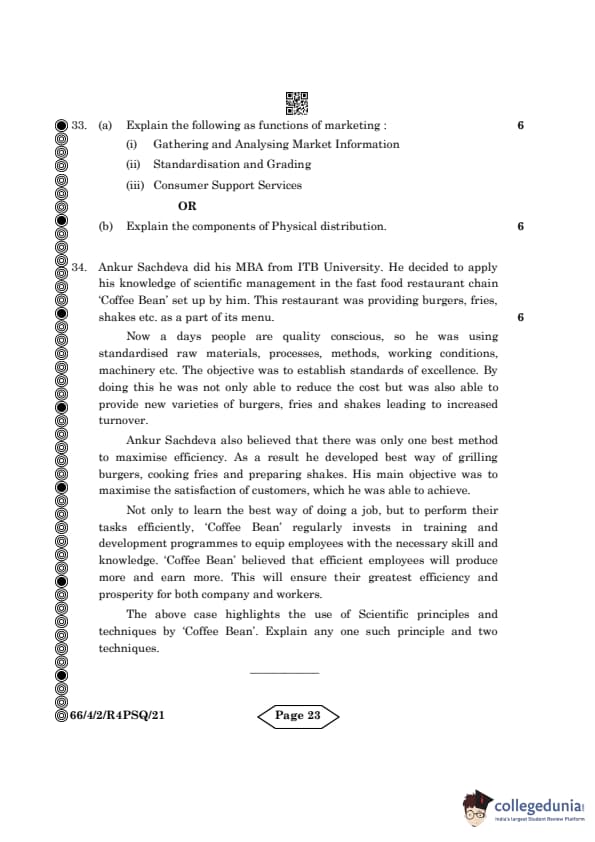
(a) Explain the following as functions of marketing:
(i) Gathering and Analysing Market Information
(ii) Standardisation and Grading
(iii) Consumer Support Services
View Solution
(i) Gathering and Analysing Market Information:
This function is essential to identify the needs and preferences of customers and make informed decisions for the successful marketing of products and services.
It helps analyse the opportunities and threats in the market and assess the organisation's strengths and weaknesses.
(ii) Standardisation and Grading:
Standardisation: It refers to producing goods of predetermined specifications, which ensures uniformity and consistency in the output.
Grading: It is the process of classifying products into different groups based on key characteristics such as quality, size, or other factors. Grading helps in improving the quality and marketability of products.
(iii) Consumer Support Services:
Consumer support services include activities such as after-sales services, handling customer complaints and adjustments, providing credit services, maintenance services, and technical support.
These services aim to provide maximum customer satisfaction, encourage repeat purchases, and build brand loyalty for the product.
Quick Tip: Functions like gathering market information, standardisation, and consumer support services ensure product quality, customer satisfaction, and market success.
Question 33:
(b) Explain the components of Physical Distribution.
View Solution
The components of physical distribution are as follows:
(i) Order Processing:
This involves activities related to receiving, recording, and fulfilling customer orders. Efficient order processing ensures that products reach customers on time, which enhances customer satisfaction and builds loyalty.
(ii) Transportation:
Transportation is the process of moving goods from the place of production to the place of consumption. It ensures that products are delivered safely and efficiently to customers, contributing to market expansion and accessibility.
(iii) Warehousing:
Warehousing refers to storing goods until they are needed for sale. Proper storage ensures that goods are available in adequate quantities when required, reducing delays in supply.
(iv) Inventory Control:
Inventory control involves maintaining an optimum level of stock to meet customer demands without overstocking or understocking. It reduces wastage, lowers costs, and ensures timely availability of products.
Quick Tip: Effective physical distribution ensures that products are delivered to customers in the right quantity, at the right place, and at the right time, enhancing efficiency and customer satisfaction.
Ankur Sachdeva did his MBA from ITB University. He decided
to apply his knowledge of scientific management in the fast food
restaurant chain 'Coffee Bean' set up by him. This restaurant was
providing burgers, fries, shakes etc, as a part of its menu.
Now a days people are quality conscious, so he was using
standardised raw materials, processes, methods, working
conditions, machinery etc. The objective was to establish standards
of excellence. By doing this he was not only able to reduce the cost
but was also able to provide new varieties of burgers, fries and
shakes leading to increased turnover.
Ankur Sachdeva also believed that there was only one best method
to maximise efficiency. As a result he developed best way of grilling
burgers, cooking fries and preparing shakes. His main objective
was to maximise the satisfaction of customers, which he was able to
achieve.
Not only to learn the best way of doing a job, but to perform their
tasks efficiently, 'Coffee Bean' regularly invests in training and
development programmes to equip employees with the necessary
skill and knowledge. 'Coffee Bean' believed that efficient employees
will produce more and earn more. This will ensure their greatest
efficiency and prosperity for both company and workers.
The above case highlights the use of Scientific principles and
techniques by 'Coffee Bean'. Explain any one such principle and
two techniques.
View Solution
Principle of Scientific Management: Development of Each and Every Person to His or Her Greatest Efficiency and Prosperity
Taylor believed that each individual should be scientifically selected and assigned tasks suited to their physical, mental, and intellectual capabilities.
To enhance efficiency, employees should be given proper training, which would ensure their growth as well as the prosperity of the organisation.
Techniques of Scientific Management:
1. Method Study:
The objective of method study is to find the one best way of performing a task.
This helps minimise production costs while maximising quality and customer satisfaction. Techniques like process charts and operations research are used for this purpose.
2. Standardisation:
Standardisation involves setting benchmarks for business activities, such as processes, raw materials, machinery, or working conditions.
Adherence to these standards ensures uniformity and consistency in production.
Quick Tip: Scientific management focuses on maximising efficiency through principles like method study, standardisation, and employee development.













Comments