




CBSE Class 12 Business Studies Question Paper 2024 PDF (Set 3- 66/5/3) is available for download here. CBSE conducted the Business Studies exam on March 27, 2024 from 10:30 AM to 1:30 PM. The total marks for the theory paper are 80. The question paper will contain 20% MCQ-based questions, 40% competency-based questions, and 40% short and long answer type questions.
Candidates can use the link below to download the CBSE Class 12 Business Studies Set 1 Question Paper with detailed solutions.
CBSE Class 12 Business Studies Question Paper 2024 (Set 3- 66/5/3) with Answer Key
| CBSE Class 12 2024 Business Studies Question Paper with Answer Key |  Download Download |
Check Solution |
CBSE Class 12 2024 Business Studies Questions with Solutions
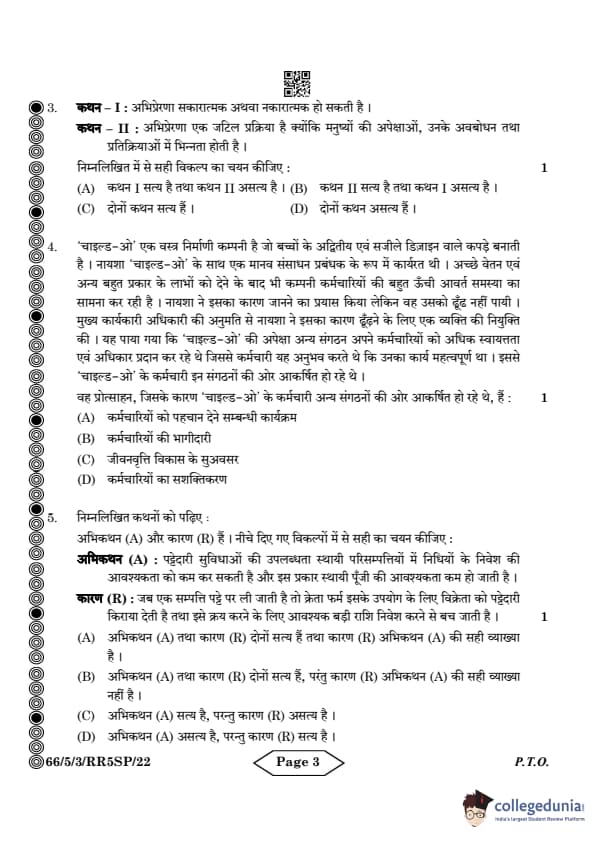
Naman and Vineet were childhood friends and both were working in 'Sunshine Crockery'. Naman was the Chief Executive Officer while Vineet was the Production Manager. They generally discussed company-related issues during lunch or while traveling together. Recently, the company received an order for 5,000 dinner sets from Shaurya Hotel. It was an unexpected order that would increase the company's revenue. Naman communicated this order to Vineet over intercom, and Vineet executed it within the given time period.
The type of communication used by Naman to communicate the order to Vineet was:
View Solution
Step 1: Understanding communication types.
Formal communication is defined as the official, structured method used within an organization, often documented for record-keeping. It adheres to organizational hierarchy and protocols.
Step 2: Interpreting the scenario.
Naman, being the CEO, used the intercom—a formal communication channel—to instruct Vineet. Hence, this was a formal communication.
Conclusion: The correct answer is (A) Formal Communication. Quick Tip: Formal communication is used for official purposes, adheres to protocols, and ensures clarity and accountability.
'Vanguard Inc.', a company manufacturing footwear for men, women and children has been earning consistent profits for the last many years. It has a democratic style of working. Workers are encouraged to develop and carry out plans for improvement in the organisation. Varun who is working in the production department gave a suggestion which resulted in 10% reduction in the cost of production of shoes. He was rewarded for his suggestion.
Identify the principle of management followed by 'Vanguard Inc.' in the above case:
View Solution
The principle of Initiative encourages employees to provide suggestions and take actions for the betterment of the organisation. It motivates employees to contribute creatively and rewards their efforts for better organisational performance.
Quick Tip: Encouraging initiative helps foster creativity, improves morale, and enhances productivity in an organisation.
Statement-I: Motivation can be either positive or negative.
Statement-II: Motivation is a complex process as individuals are heterogeneous in their expectations, perceptions, and reactions.
View Solution
Step 1: Understanding Motivation
Motivation can be positive (incentives, rewards) or negative (fear of penalties, job insecurity), which makes Statement-I true.
Step 2: Motivation as a Complex Process
Individuals have different perceptions, expectations, and reactions, making motivation complex. Thus, Statement-II is also true.
Quick Tip: Motivation can be intrinsic (internal drive) or extrinsic (external rewards/punishments). A mix of both is effective in organizations.
'Child-O' is a garment manufacturing company which makes clothes with unique and stylish designs for children. Naisha was working as the Human Resource Manager with 'Child-O'. Despite good pay and many other benefits offered, the company is facing the problem of high turnover of its employees. Naisha tried to find out the reason but could not. She appointed a person with the permission of the Chief Executive Officer to find out the reason. It was found that other organisations were giving more autonomy and authority to their employees, which made them feel that their jobs were important. This was attracting the employees of 'Child-O' to other organisations.
The incentive which attracted the employees of 'Child-O' to other organisations is:
View Solution
Employee Empowerment refers to providing employees with autonomy, authority, and responsibility in their work. This creates a sense of importance and ownership, which motivates employees to stay and perform better. Organisations offering such incentives attract and retain talented employees.
Quick Tip: Providing autonomy and authority increases employee satisfaction, reduces turnover, and builds loyalty towards the organisation.
Read the following statements: Assertion (A) and Reason (R). Choose the correct alternative from the options given below:
Assertion (A): Availability of leasing facilities may reduce the funds required to be invested in fixed assets, thereby reducing the fixed capital requirements.
Reason (R): When an asset is taken on lease, the firm pays lease rentals to use it and avoids investing huge sums required for its purchase.
View Solution
Step 1: Understanding Leasing and Fixed Capital
Leasing allows businesses to use assets without making large capital investments, reducing fixed capital requirements.
Step 2: Explaining the Relationship
Since leasing involves periodic lease rentals instead of a lump sum payment, it directly reduces the need for upfront funds, supporting Assertion (A) and Reason (R) as correct and interconnected.
Quick Tip: Leasing is an effective financial strategy that reduces capital investment risks while ensuring access to required assets.
Which of the following is NOT a factor affecting 'financing decision'?
View Solution
Step 1: Understanding financing decisions.
- Financing decisions are influenced by factors like cash flow position, control considerations, and fixed operating costs, which determine the proportion of debt and equity.
- Diversification pertains to expansion into new markets or products and is not directly related to financing decisions.
Step 2: Analyzing the options.
Among the given options, diversification is unrelated to financing decisions.
Conclusion: The correct answer is
(D) Diversification.
Quick Tip: Financing decisions depend on factors like risk, cost of capital, and control but not on diversification strategies.
Which of the following is the function of Top-level management?
View Solution
Step 1: Understanding the roles of top-level management.
- Top-level management is responsible for defining organizational goals, formulating policies, and analyzing the external business environment to ensure long-term survival.
Step 2: Analyzing the options.
Among the given options, only
(D) aligns with the responsibilities of top-level management, which includes strategic decision-making and environment analysis.
Conclusion: The correct answer is
(D) They analyse the business environment and its implications for the survival of the firm.
Quick Tip: Top-level management focuses on strategic planning and external environment analysis, while middle and lower levels handle operational tasks.
Choose the incorrect statement about 'Money Market':
View Solution
Step 1: Understanding the money market.
- The money market deals with short-term financial instruments such as Treasury bills and Commercial paper, with a maturity period of up to one year.
- Medium and long-term securities are traded in the capital market, not the money market.
Step 2: Analyzing the options.
Option
(D) incorrectly states that the money market deals in medium and long-term securities, which is false.
Conclusion: The incorrect statement is
(D) It deals in medium and long-term securities.
Quick Tip: The money market focuses on short-term instruments like Treasury bills and is primarily used by institutional participants for liquidity management.
‘Kanand Ltd.’ is an automobile manufacturing company started in 2014 under the 'Make in India' initiative of the Government of India. Expecting higher growth in the future, it developed higher capacity in the current year, taking advantage of the subsidies provided by the government. This would enable ‘Kanand Ltd.’ to meet anticipated higher demand quickly. For this, ‘Kanand Ltd.’ invested large amounts in fixed assets, leading to higher requirements of fixed capital.
Identify the factor affecting fixed capital requirements that 'Kanand Ltd.' kept in mind to meet higher anticipated demand quickly.
View Solution
Step 1: Understand the factors affecting fixed capital requirements.
- Fixed capital requirements depend on the scale of operations, nature of the business, growth prospects, and diversification.
- Growth prospects refer to the anticipated increase in demand and the company’s preparations to meet it.
Step 2: Analyzing the scenario.
‘Kanand Ltd.’ anticipated higher growth and took steps to increase its capacity by investing in fixed assets. This decision was driven by the growth prospects of the company.
Conclusion: The factor affecting fixed capital requirements is
(D) Growth prospects.
Quick Tip: Fixed capital requirements increase with higher anticipated demand, diversification, or expansion plans.
Identify from the following what is shown in the picture of a refrigerator given below:

View Solution
Step 1: Understanding the terms.
- A label provides information about the product, such as its features, usage, price, and manufacturing details.
- A brand name, brand mark, and trademark are used to identify and differentiate a product but do not convey additional product-specific information like a label does.
Step 2: Analyzing the given scenario.
The picture of the refrigerator highlights the information provided about the product, which aligns with the definition of a label.
Conclusion: The correct answer is
(D) Label.
Quick Tip: A label provides critical information about a product and helps consumers make informed purchasing decisions.
‘Since business environment consists of numerous interrelated and dynamic conditions or forces which arise from different sources, it becomes difficult to comprehend at once what exactly constitutes a given environment'. Thus, it is relatively easier to understand the environment in parts but difficult to grasp in its totality.
Identify the feature of business environment highlighted above:
View Solution
The feature Complexity highlights the interrelated and dynamic nature of various forces in the business environment, making it difficult to fully comprehend in its entirety. Managers often analyse specific parts to understand the environment better.
Quick Tip: Understanding the complexity of the business environment helps organisations adapt effectively and make informed decisions.
For holding securities in an electronic form, the investor has to open a demat account with an organisation called:
View Solution
Step 1: Understanding demat accounts.
- A demat account is used to hold securities in electronic form, eliminating the need for physical certificates.
- Depositories are organizations responsible for providing demat services, ensuring secure and efficient handling of securities.
Step 2: Analyzing the options.
The depository acts as the custodian of securities in electronic form, making it the correct answer.
Conclusion: The correct organization is (A) Depository.
Quick Tip: A depository like NSDL or CDSL provides electronic storage for securities, ensuring safety and convenience for investors.
The activities involved in managing the enterprise are common to all organisations whether economic, political, or social. Identify the feature of management:
View Solution
Step 1: Understanding the feature of "all-pervasive."
- Management is all-pervasive as it applies to all types of organizations, whether business, government, or social, regardless of size or objective.
Step 2: Analyzing the options.
The given statement highlights the universal applicability of management, which matches the feature of being all-pervasive.
Conclusion: The correct answer is
(B) Management is all-pervasive.
Quick Tip: Management is applicable to all types of organizations and sectors, ensuring coordination and goal achievement universally.
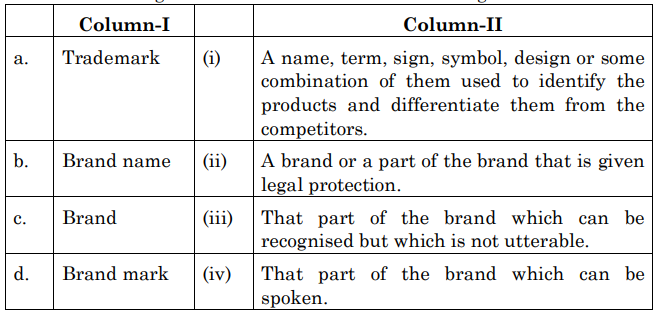
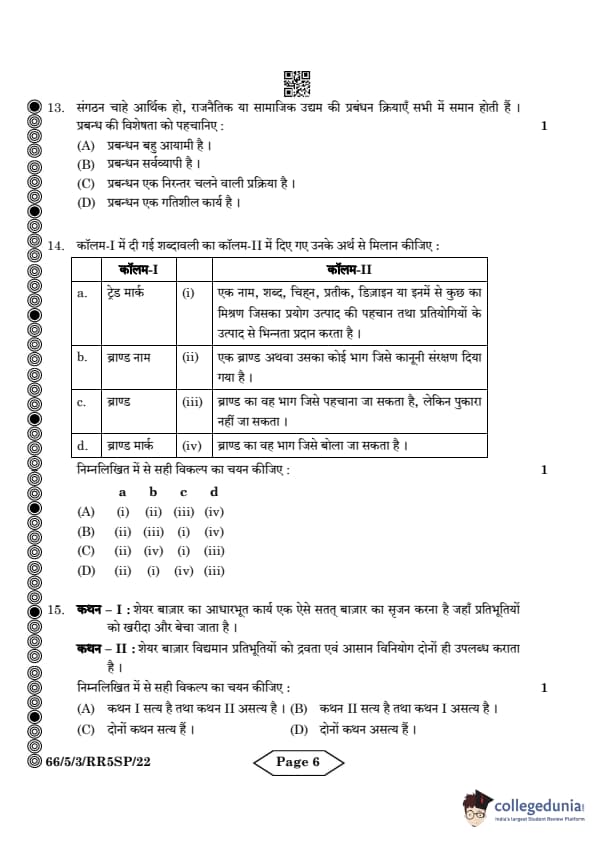
Match the terms given in Column I with their meaning in Column II:
Choose the correct option from the following:
View Solution
Step 1: Understand the meanings of the terms.
- Trademark: Legal protection of a brand or a part of a brand.
- Brand name: The part of the brand that can be spoken.
- Brand: A name, term, symbol, or design used to differentiate a product.
- Brand mark: The part of the brand that can be recognised but is not utterable.
Step 2: Match Column I with Column II based on the definitions.
\[ a. Trademark - (ii), b. Brand name - (iv), c. Brand - (i), d. Brand mark - (iii) \]
Conclusion: The correct option is
(C). Quick Tip: When matching columns, carefully read the definitions in Column II and pair them with the terms in Column I based on their meanings.
Statement-I: The basic function of a Stock Exchange is the creation of a continuous market where securities are bought and sold.
Statement-II: The Stock Exchange provides both liquidity and easy marketability to already existing securities in the market.
View Solution
Step 1: Interpreting Statement-I.
The creation of a continuous market is a fundamental function of stock exchanges. It ensures regular trading of securities, providing opportunities for buying and selling.
Step 2: Interpreting Statement-II.
Liquidity and marketability are crucial for stock exchanges, allowing investors to easily convert securities into cash. This is achieved by maintaining an active market for securities.
Conclusion: Both statements correctly describe the functions of a stock exchange, making
(C) the correct answer. Quick Tip: Stock exchanges play a critical role in ensuring liquidity, price discovery, and continuous trading for securities.
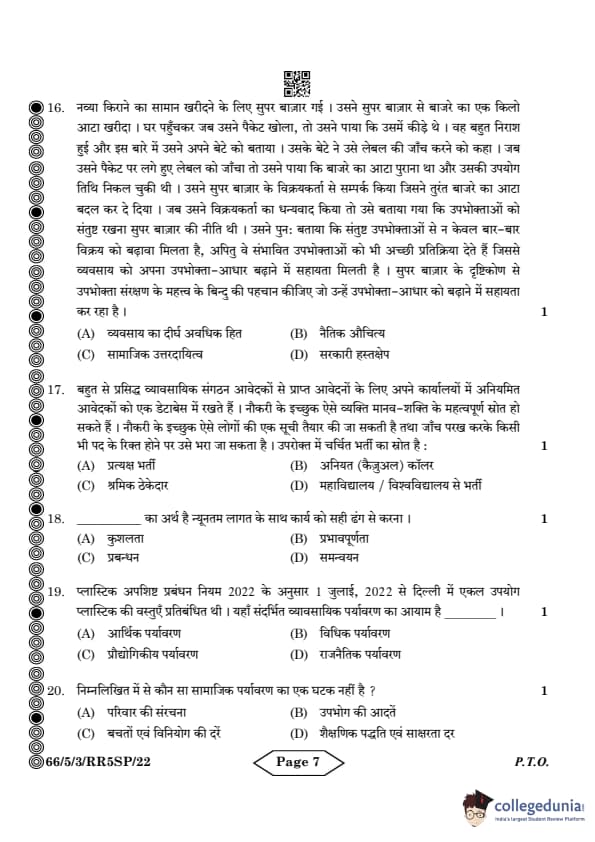
Navya went to a supermarket for grocery shopping. She bought one kg of bajra flour from the supermarket. On reaching home when she opened the packet she found worms inside it. She was disappointed and told her son about the same. Her son asked her to check the label. When she checked the label of the packet, she found that bajra flour was stale and beyond the expiry date. She approached the sales-person at the supermarket who replaced the bajra flour immediately. When she thanked the sales-person, she was told that it was the policy of the supermarket to satisfy the customers. He further told that satisfied customers not only lead to repeat sales but they also provide good feedback to prospective customers which helps in increasing the customer base of business.
Identify the point of importance of consumer protection from the point of view of the supermarket which is helping them to increase the customer base:
View Solution
Step 1: Consumer Protection and Business Growth
Ensuring customer satisfaction leads to repeat purchases and positive word-of-mouth marketing. This strengthens brand reputation and business growth.
Step 2: Business Perspective
A company that prioritizes consumer protection fosters trust and loyalty, reducing the risk of losing customers to competitors.
Quick Tip: Consumer protection benefits businesses by ensuring customer trust, loyalty, and positive market reputation, leading to long-term success.
Many reputed business organisations keep a database of unsolicited applicants in their offices. Such job seekers can be a valuable source of manpower. A list of such job seekers can be prepared and can be screened to fill the vacancies as they arise.
The source of recruitment discussed above is:
View Solution
Step 1: Understanding casual callers as a recruitment source.
- Casual callers refer to individuals who submit unsolicited applications for jobs. These applications can be stored and reviewed later to fill vacancies.
Step 2: Analyzing the scenario.
The description highlights the practice of storing and screening unsolicited applications, which aligns with casual callers as a recruitment source.
Conclusion: The correct source of recruitment is
(B) Casual callers.
Quick Tip: Maintaining a database of unsolicited applications can help businesses quickly fill vacancies without incurring additional recruitment costs.
_________ means doing the task correctly and with minimum cost.
View Solution
Step 1: Understanding efficiency.
- Efficiency refers to completing tasks with minimum resources and cost, while achieving the desired outcome.
- Effectiveness focuses on achieving objectives but does not necessarily consider resource optimization.
Step 2: Analyzing the definition.
The term "doing the task correctly and with minimum cost" clearly defines efficiency.
Conclusion: The correct answer is (A) Efficiency.
Quick Tip: Efficiency focuses on resource optimization, while effectiveness emphasizes goal achievement. Both are essential for successful management.
As per the Plastic Waste Management Rule 2022, single-use plastic items were prohibited in Delhi from 1 July, 2022. The dimension of the business environment referred to here is:
View Solution
Step 1: Understanding business environment dimensions.
The legal environment consists of laws, regulations, and rules that businesses must comply with.
Step 2: Analyzing the given scenario.
The Plastic Waste Management Rule 2022 imposes a legal obligation on businesses to stop using single-use plastics. This is clearly a part of the legal environment.
Conclusion: The correct answer is
(B) Legal Environment. Quick Tip: The legal environment includes laws, acts, and government regulations that impact business operations directly.
Which of the following is not an element of the social environment?
View Solution
Step 1: Understanding the Social Environment
The social environment includes cultural and social factors such as family structure, lifestyle, consumption patterns, and education.
Step 2: Excluding an Economic Factor
Rates of saving and investment belong to the economic environment, as they relate to financial trends rather than social structures.
Quick Tip: The social environment shapes business strategies by influencing consumer behavior, cultural trends, and lifestyle choices.
State any three protective functions of the Securities and Exchange Board of India (SEBI).
View Solution
SEBI plays a crucial role in regulating and protecting investors in the securities market. Below are three key protective functions:
(i) Prohibiting fraudulent and unfair trade practices: SEBI prevents unethical activities such as price rigging, misleading statements, and insider trading to ensure market transparency.
(ii) Controlling insider trading: SEBI monitors and penalizes individuals who use privileged information to manipulate stock prices, thereby ensuring a level playing field for all investors.
(iii) Ensuring investor protection: SEBI enforces regulations that safeguard investors’ interests, promoting fair dealing in the securities market.
Quick Tip: SEBI’s regulatory framework ensures transparency, fairness, and efficiency in financial markets, fostering investor confidence.
Question 22:
‘Caro’, a car manufacturing company was manufacturing high cost, good quality luxury cars. For the last few years, the company was not earning good profits as the demand for the cars was very low. Chief Executive Officer of the company, Piyush had a meeting with the Production and Sales Managers to discuss how to increase the revenue of the company. They found that nowadays instead of purchasing luxury cars people prefer to have such cars on rental basis. So they decided to start ’Car rental service’. The Production Manager also suggested that as these cars were sophisticated and each spare part was very costly it would be better to provide these cars for rental service along with trained drivers so that there would be less wear and tear. Piyush agreed and a training unit was started. Two of the available cars were used for training the drivers. People were very happy as they were getting these cars on rental basis with trained drivers. The idea was a big hit and the company was able to surpass its profit targets of the last 20 years.
(a) Identify and explain the method of training given by ‘Caro’ to its drivers.
View Solution
Identifying the Training Method
The training method used in the given scenario is Vestibule Training.
Vestibule training is an off-the-job training technique where employees are trained in an environment that simulates the actual workplace but away from the production area. This method is particularly useful for jobs requiring specialized skills and the handling of sophisticated equipment, such as luxury cars.
In this case, Caro created a separate training unit where drivers were trained before being assigned rental vehicles. This approach ensured that they developed the necessary driving and vehicle-handling skills without risking damage to customer vehicles.
Quick Tip: Vestibule training is highly effective for roles involving \textbf{complex machinery or precision work}, as it allows employees to develop skills in a controlled environment. It reduces the risk of costly errors and ensures higher proficiency before engaging in real-world tasks.
(b) State any two advantages the drivers will gain from this training.
View Solution
Advantages of Vestibule Training
(i) Career Growth: Drivers gain specialized skills that increase their employability and provide opportunities for career advancement.
(ii) Higher Earnings: Well-trained drivers are more efficient and capable, leading to better job performance, incentives, and higher wages.
Quick Tip: Vestibule training reduces workplace risks and enhances employee confidence by providing hands-on experience in a controlled environment.
State any three points of importance of the staffing function of management.
View Solution
Staffing is a crucial function of management that focuses on acquiring, developing, and retaining the right personnel to ensure smooth business operations. Below are three key points highlighting its importance:
(i) Discovering and obtaining competent personnel: Staffing helps in identifying and hiring skilled individuals who meet the specific job requirements of the organization. The right employees contribute significantly to business growth and efficiency.
(ii) Enhancing performance: By placing employees in roles suited to their skills and expertise, staffing ensures that individuals perform at their highest potential, leading to improved productivity and effectiveness.
(iii) Ensuring organizational survival and growth: Proper staffing allows for succession planning, ensuring that key positions are filled with capable individuals who can lead the organization towards long-term sustainability.
Quick Tip: Effective staffing not only fills positions with the right talent but also fosters a positive work environment, leading to higher job satisfaction and reduced employee turnover.
Question 24:
‘Cortico Fabrics’ was started by Ashish in 2001 to sell bedsheets, towels, comforters, pillows, cushions,bathmats etc.It is now a famous name and its branches are across India.To manage the workall over India, it has eight teams-two each for North, South, East and West India. Ashish spends a considerable amount of time to develop an orderly pattern of group efforts among different teams and to secure unity of action in pursuit of a common purpose. To ensure suitable allocation of tasks to the various members of the teams and to see that the tasks are performed with harmony among the members,he tries to balance the different teams at different locations.
(a) Identify and explain the concept of management discussed in the above paragraph.
View Solution
Identifying the Concept of Management
The concept of management discussed in the given scenario is Coordination.
Coordination refers to the orderly arrangement of group efforts to ensure unity of action in the pursuit of a common goal. It is essential for synchronizing various functions of an organization and ensuring that all departments work together efficiently.
In the given case, Ashish ensures smooth functioning across all eight teams by creating a system where tasks are allocated properly and performed in a harmonious manner. This reflects the essence of coordination in management.
Quick Tip: Coordination is considered the \textbf{essence of management}, as it integrates the efforts of individuals and departments to achieve organizational goals efficiently. A well-coordinated organization minimizes duplication of work, reduces conflicts, and enhances productivity.
(b) Also, Explain any one point of importance of the concept identified in (a).
View Solution
Importance of Coordination
One significant importance of coordination is:
Growth in Size: As an organization expands, it becomes increasingly complex with multiple departments and teams. Coordination ensures that efforts are aligned with organizational objectives, preventing duplication of work and inefficiencies.
Quick Tip: Coordination is the essence of management that minimizes conflicts, enhances teamwork, and ensures goal achievement by integrating various departments effectively.
A Business Process Outsourcing centre, 'Chromosome' which deals in conversion of voice reports dictated by physicians and other healthcare providers into text format has 40 employees. They ensure that their employees are well versed in at least one foreign language and one Indian language. The employees are also given the required training to ensure that the reports are processed correctly as they are the backbone of the patients' medical history. On frequent complaints about some of its employees, it was observed that they were facing problems in decoding the message as they were not very proficient with the language in which the voice message was received. As a result, they would make mistakes causing different meaning to the message. Not only this, sometimes there were technical words used in voice reports, the actual meaning of which was also not understood by the employees. Due to this, 'Chromosome' was slowly losing its business to competitors.
The above case highlights two communication barriers. Identify and explain these barriers.
View Solution
Faulty Translations
- When communication is originally drafted in one language but needs to be translated into another, errors may arise if the translator is not proficient in both languages.
- In this case, employees at 'Chromosome' were not well-trained in the language of the voice reports, leading to mistakes in transcription and incorrect messages.
Technical Jargon
- Specialists often use complex technical terms that are difficult for non-specialists to understand.
- At 'Chromosome', employees struggled to comprehend medical terminology used by physicians, which led to errors in transcriptions.
Quick Tip: Effective communication requires \textbf{clarity, language proficiency, and familiarity with technical terms}. Organizations must provide adequate training to employees handling specialized content.
Question 26:
Inspired by the success of Chandrayaan-3, the Chief Scientist at ’Space Rover’ a private research group, decided to send some innovative ideas regarding the mission to the Chief Scientist of Chandrayaan-3. The Chief Scientist at ’Space Rover’ formed four groups for the same. As it was an intellectual activity of thinking rather than doing, these four groups started interacting with each other and friendships developed. On the basis of their interaction and friendship, some members from each group formed ‘Entertainment Through Reading’ group which showed conformity in terms of their interest. ’Entertainment Through Reading’ group had no written rules, was unstable in form and scope and had no fixed lines of communication. The members of this group enhanced the morale of each other, enjoyed drinking coffee together, read books, served different issues of their work areas and provided support to each other. Ultimately this group developed some innovative ideas which were sent by ’Space Rover’ to the Chief Scientist of Chandrayaan-3. Though this group was formed for recreation but it contributed towards fulfillment of organisational objectives.
(a) Identify and explain the type of organization which emerged as 'Entertainment Through Reading'.
View Solution
N/A
(b) State any three advantages of the type of organization identified in (a).
View Solution
(i) Faster Communication: Informal groups help in the rapid exchange of information, bypassing bureaucratic delays.
(ii) Social Fulfillment: Employees build friendships, leading to a positive work environment and improved morale.
(iii) Support for Organizational Goals: Informal groups can complement the formal structure by helping employees share ideas and solve problems collaboratively.
Quick Tip: Informal organizations can significantly enhance workplace culture by providing social support, reducing stress, and fostering innovation.
(a) State any four characteristics of planning.
View Solution
Characteristics of Planning: (Any four)
(i) Focus on Achieving Organisational Objectives:
- Planning is aimed at setting goals and objectives that the organization strives to achieve.
(ii) Primary Function of Management:
- Planning serves as the foundation for all other managerial functions such as organizing, staffing, directing, and controlling.
(iii) Pervasive:
- Planning is required at all levels of management and across all departments of an organization.
(iv) Continuous Process:
- A plan is framed, implemented, and followed by another plan, making planning a continuous cycle.
(v) Futuristic:
- Planning involves looking ahead and preparing for future uncertainties and challenges.
(vi) Involves Decision Making:
- Planning requires managers to evaluate various alternatives and select the best course of action.
(vii) Intellectual Activity (Mental Exercise):
- Planning is a thinking-based function that involves logic, analysis, and foresight rather than physical execution.
(viii) Basis for Controlling:
- Planning provides standards for performance evaluation, which helps in measuring and controlling deviations.
Quick Tip: Effective planning provides clarity, direction, and preparedness, ensuring better decision-making and goal achievement in organizations.
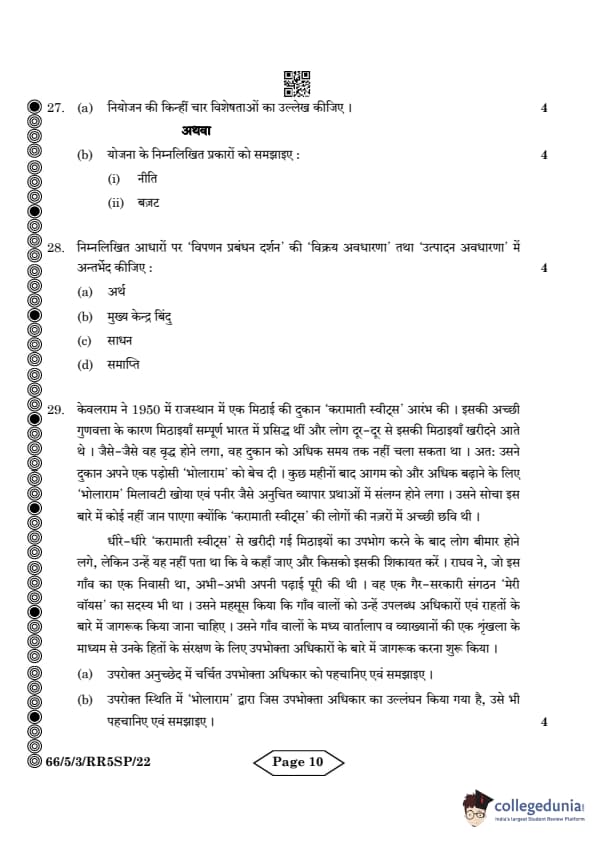
Question 27:
(b) Explain the following types of plans:
(i) Policy
(ii) Budget
View Solution
(i) Policy
- A policy is a general statement that guides decision-making and directs efforts towards achieving organizational goals.
- Policies provide broad guidelines within which managers can function and make discretionary decisions.
- Example: A company’s policy on customer returns allows managers to decide when refunds or replacements are applicable.
(ii) Budget
- A budget is a numerical plan that outlines expected results for a future period in terms of money, time, or physical units.
- It serves as both a planning and control tool, as actual performance can be compared with budgeted figures, and necessary corrections can be made.
- Example: A marketing department may prepare an advertising budget specifying the estimated cost for promotions in a financial year.
Quick Tip: Policies provide direction for decision-making, while budgets serve as financial and performance planning tools that help in resource allocation.
Differentiate between ‘Selling Concept’ and 'Production Concept' of marketing management philosophies on the basis of:
(a) Meaning
(b) Main Focus
(c) Means
(d) Ends
View Solution
Difference Between Selling Concept and Production Concept
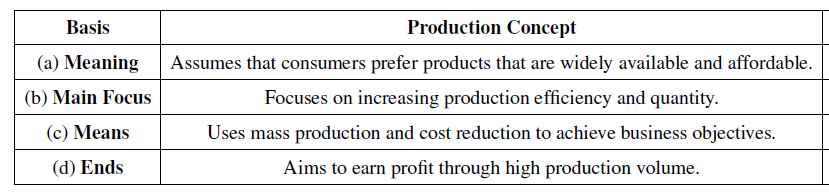 Quick Tip: The \textbf{Selling Concept} focuses on aggressive promotion and convincing consumers, while the \textbf{Production Concept} emphasizes mass production and affordability to drive sales.
Question 29:
Kewalram started a sweets shop ’Karamati Sweets’ in 1950. The sweets were famous all over India for their good quality and people would come from far and wide to purchase sweets from him. As he grew old, he could no longer run the shop. So, he sold the shop to one of his neighbours Bholaram’. After a few months, to further increase the revenue, Bholaram’ started engaging in unfair trade practices like using adulterated khoya and paneer. He thought that no one would know about it as ‘Karamati Sweets’ had a good image in the eyes of the people. Slowly, people started falling sick after consuming sweets purchased from ‘Karamati Sweets’ but they did not know where to go and to whom to complain. Raghav, a resident of the village had recently completed his studies. He was also a member of a non-governmental organisation. ‘Meri Voice’. He felt that the villagers should be made aware about the rights and reliefs available to them. He started creating awareness about consumer rights among the villagers to protect their interest through a series of talks and presentations in the village.
(a) Identify and explain the consumer right discussed in the above case.
View Solution
Consumer Right Discussed
The consumer right emphasized in this case is the Right to Consumer Education.
The Right to Consumer Education ensures that consumers are well-informed about their rights, responsibilities, and available reliefs when faced with defective or hazardous products or services. This right empowers consumers to make informed decisions and take necessary actions if they experience unfair trade practices.
In the given case, Raghav, an educated villager, understood the importance of spreading awareness about consumer rights. By conducting awareness campaigns through talks and presentations, he enabled villagers to understand their rights and how they could protect themselves against unethical business practices.
Quick Tip: The \textbf{Right to Consumer Education} helps consumers make informed choices and take legal action when necessary. Organizations, NGOs, and government initiatives play a vital role in educating consumers to prevent exploitation and ensure fair trade practices.
Question 29:
(b) Identify and explain the consumer right violated by ‘Bholaram’.
View Solution
Consumer Right Violated
The consumer right violated in this case is the Right to Safety.
The Right to Safety ensures that consumers are protected from goods and services that pose health hazards or risk their well-being. It emphasizes the importance of quality control, regulatory compliance, and standardization of products to ensure consumer protection.
In this scenario, Bholaram started using adulterated ingredients in the sweets sold under the well-reputed brand ‘Karamati Sweets’. This adulteration led to health issues among consumers, thereby violating their Right to Safety.
Consumers should always check for quality assurance symbols such as ISI, AGMARK, and FSSAI certification while purchasing food products to ensure safety.
Quick Tip: Consumer rights safeguard individuals against unfair trade practices. Staying informed about these rights enables consumers to make better purchasing decisions and take appropriate action when needed.
(a) Explain the following functions of marketing:
(i) Gathering and Analysing Market Information
(ii) Marketing Planning
View Solution
(i) Gathering and Analysing Market Information
- This function involves analyzing market opportunities and threats while assessing the organization's strengths and weaknesses.
- It helps businesses decide which opportunities should be pursued based on data and trends.
- With the advancement of technology, companies increasingly use interactive websites and online surveys to gather customer opinions before making key business decisions.
(ii) Marketing Planning
- Marketing planning involves developing strategies to achieve the organization’s marketing objectives.
- It includes formulating plans for activities such as increasing production levels, advertising, and product promotions.
- A well-structured marketing plan ensures efficient resource allocation and targeted market strategies.
Quick Tip: Market analysis provides valuable insights for decision-making, while effective marketing planning ensures goal-oriented strategies for business growth.
(Or)
Question 30:
(b) State the four major components of physical distribution.
View Solution
Four Major Components of Physical Distribution:
(i) Order Processing:
- Ensures accurate and speedy processing of customer orders.
- Delays or errors in order processing may lead to late deliveries or incorrect quantities, affecting customer satisfaction.
(ii) Transportation:
- Refers to the movement of goods from production points to retail or end consumers.
- Effective transportation ensures timely product availability, crucial for completing sales.
(iii) Warehousing:
- Involves storing and assorting products to create time utility.
- Proper warehousing ensures goods are readily available for market demand, reducing shortages and overstocking.
(iv) Inventory Control:
- Balances cost management and customer satisfaction.
- Higher inventory levels improve service efficiency but increase storage costs, requiring a strategic balance.
Quick Tip: An efficient physical distribution system minimizes costs, ensures timely delivery, and enhances customer satisfaction, driving business success.
(a) Explain the following points of significance of principles of management:
(i) Providing Managers with Useful Insights into Reality
(ii) Meeting Changing Environment Requirements
(iii) Scientific Decisions
View Solution
(i) Providing Managers with Useful Insights into Reality
- Principles of management provide valuable insights by helping managers learn from past experiences and mistakes.
- These principles allow managers to solve recurring problems efficiently, conserving time and effort.
- Following these principles enhances their knowledge, decision-making ability, and understanding of complex managerial situations.
(ii) Meeting Changing Environment Requirements
- Management principles are flexible and can be adapted to evolving business environments.
- They help managers respond effectively to changes in market trends, government policies, and technological advancements.
- By following these principles, managers can ensure their businesses remain competitive and sustainable.
(iii) Scientific Decisions
- Management principles help in making logical and unbiased decisions.
- These principles are based on objective analysis rather than personal preferences, ensuring fairness and consistency in managerial decisions.
- Following scientific decision-making methods reduces risks and improves business efficiency.
Quick Tip: Management principles enhance efficiency, adaptability, and scientific decision-making, helping businesses operate smoothly in dynamic environments.
Question 31:
(b) Explain the following principles of management:
(i) Unity of Direction
(ii) Remuneration to Employees
(iii) Equity
View Solution
(i) Unity of Direction
- This principle states that all organizational units should work towards a common objective.
- Each group of activities with the same objective must have one head and one plan, ensuring coordination and efficiency.
- This principle ensures clarity, consistency, and better communication among employees and departments.
(ii) Remuneration to Employees
- Employees should receive fair and just compensation for their work.
- The overall remuneration should ensure employees maintain a reasonable standard of living while being within the company’s financial capacity.
- Fair remuneration enhances employee satisfaction, motivation, and productivity.
(iii) Equity
- This principle advocates fair treatment of all employees, without discrimination based on gender, religion, caste, nationality, or beliefs.
- Managers should treat employees with kindness and justice, fostering loyalty and dedication to the organization.
Quick Tip: \textbf{Unity of direction} ensures coordinated efforts, fair remuneration enhances employee motivation, and equity fosters a respectful workplace.
(a) Explain the following factors affecting the working capital requirements of a business:
(i) Credit Allowed
(ii) Production Cycle
(iii) Availability of Raw Material
View Solution
(i) Credit Allowed
- Different firms allow varying credit terms to their customers, influenced by market competition and customer creditworthiness.
- A liberal credit policy leads to a higher amount of debtors, increasing the requirement for working capital.
- Conversely, stricter credit terms reduce the number of debtors, thereby lowering working capital needs.
(ii) Production Cycle
- The production cycle is the time span between acquiring raw materials and converting them into finished goods.
- A longer production cycle requires higher working capital since capital remains tied up for a longer period.
- A shorter production cycle minimizes working capital needs by ensuring quicker turnover.
(iii) Availability of Raw Material
- If raw materials are easily and continuously available, firms can operate with lower stock levels, reducing working capital needs.
- If raw materials face supply disruptions, firms may need to maintain higher inventory levels, increasing working capital requirements.
Quick Tip: A firm's credit policy, production cycle, and raw material availability significantly impact its working capital management, influencing liquidity and operational efficiency.
Question 32:
(b) Explain the following factors affecting the dividend decision of a company:
(i) Growth Opportunities
(ii) Cash Flow Position
(iii) Shareholders’ Preference
View Solution
(i) Growth Opportunities
- Companies with high growth potential prefer to retain earnings rather than distribute dividends, ensuring funds for future investments.
- As a result, dividends are generally lower in growth-oriented companies compared to firms with fewer expansion plans.
(ii) Cash Flow Position
- Dividend payments involve cash outflows, making a strong cash flow position crucial for dividend declaration.
- A firm may have profits on paper but lack sufficient cash, making it difficult to distribute dividends despite good earnings.
(iii) Shareholders’ Preference
- Some shareholders rely on dividends for regular income, influencing the company’s decision to declare consistent dividends.
- If the majority of shareholders prefer stable dividend payments, firms are more likely to declare dividends, even if growth investments are available.
Quick Tip: A company’s dividend policy is influenced by its growth prospects, cash reserves, and shareholder expectations, balancing reinvestment and income distribution.
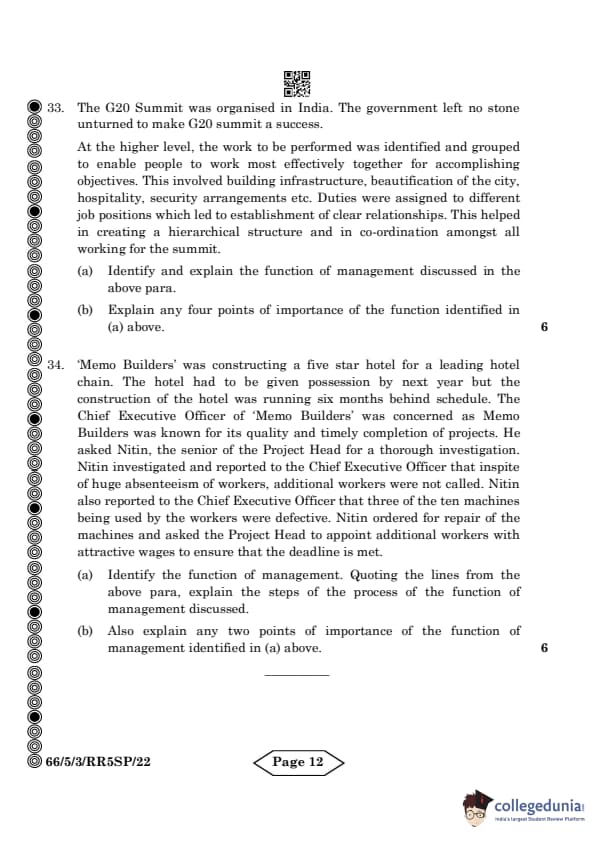
Question 33:
The G20 Summit was organised in India. The government left no stone unturned to make G20 summit a success. At the higher level, the work to be performed was identified and grouped to enable people to work most effectively together for accomplishing 27 objectives. This involved building infrastructure, beautification of the city. hospitality, security arrangements etc. Duties were assigned to different job positions which led to establishment of clear relationships. This helped in creating a hierarchical structure and in co-ordination amongst all working for the summit.
(a) Identify and explain the function of management discussed in the given case.
View Solution
Function of Management: Organising
- Organising involves identifying and grouping tasks, assigning responsibilities, and establishing a clear hierarchical structure.
- In the given case, duties such as infrastructure development, security, and hospitality were assigned systematically, ensuring smooth coordination.
Quick Tip: \textbf{Organising} ensures clarity in job roles, smooth workflow, and efficient coordination among different units of an organization.
(b) Explain any four points of importance of the function identified in (a).
View Solution
Importance of Organising:
(i) Benefits of Specialisation: Work is divided among employees based on expertise, leading to increased efficiency and productivity.
(ii) Clarity in Working Relationships: Clearly defined roles and responsibilities reduce conflicts and improve coordination.
(iii) Optimum Utilization of Resources: Ensures the best use of available resources, minimizing wastage and redundancy.
(iv) Adaptation to Change: A well-structured organization can respond effectively to changes in the business environment.
Quick Tip: A well-organized business structure enables smooth decision-making, better coordination, and overall efficiency.
Question 34:
‘Memo Builders’ was constructing a five star hotel for a leading hotel chain. The hotel had to be given possession by next year but the construction of the hotel was running six months behind schedule. The Chief Executive Officer of ’Memo Builders’ was concerned as Memo Builders was known for its quality and timely completion of projects. He asked Nitin, the senior of the Project Head for a thorough investigation. Nitin investigated and reported to the Chief Executive Officer that inspite of huge absenteeism of workers, additional workers were not called. Nitin also reported to the Chief Executive Officer that three of the ten machines being used by the workers were defective. Nitin ordered for repair of the machines and asked the Project Head to appoint additional workers with attractive wages to ensure that the deadline is met.
(a) Identify the function of management discussed in the given case. Quoting the lines from the case, explain the steps of the process of this function.
View Solution
Function of Management: Controlling
- Controlling involves monitoring performance, comparing it with standards, analyzing deviations, and taking corrective actions.
Steps of Controlling Process Discussed in the Case:
(i) Comparison of Actual Performance with Standards:
- Performance is measured against set benchmarks to identify deviations.
- Quoted Line: "The hotel had to be given possession by next year but the construction of the hotel was running six months behind schedule."
(ii) Analyzing Deviations:
- Causes of performance gaps are examined through techniques like Critical Point Control.
- Quoted Line: "Nitin investigated and reported that despite huge absenteeism, additional workers were not called."
(iii) Taking Corrective Actions:
- Corrective measures are taken to resolve performance deficiencies.
- Quoted Line: "Nitin ordered for machine repairs and asked to appoint additional workers."
Quick Tip: \textbf{Controlling} ensures that organizational activities remain aligned with planned objectives, reducing inefficiencies and maximizing performance.
(b) Explain any two points of importance of the function of management identified in (a).
View Solution
Importance of Controlling:
(i) Accomplishing Organisational Goals:
- Controlling ensures that actual performance aligns with planned objectives.
- By identifying deviations and taking corrective actions, organizations can stay on track to achieve their goals efficiently.
(ii) Making Efficient Use of Resources:
- Controlling helps in optimizing the use of financial, human, and material resources.
- It minimizes wastage and ensures that resources are allocated efficiently to maximize productivity.
Quick Tip: \textbf{Controlling} is essential for measuring performance, identifying deviations, and taking corrective actions to ensure efficiency and goal achievement.












Comments