




CBSE Class 12 Chemistry Compartment Question Paper 2024 with Answer Key pdf (Set 3 - 56/S/3) is available for download here. The exam was conducted by Central Board of Secondary Education on July 15, 2024 in the Morning Session 10:30 AM to 1:30 PM. The question paper consists a total of 33 questions divided among 5 sections.
CBSE Class 12 Chemistry (Set 3 - 56/S/3) Compartment Question Paper 2024 with Answer Key
| CBSE Class 12 Chemistry Question Paper 2024 PDF | CBSE Class 12 Chemistry Solution 2024 PDF |
|---|---|
| Download PDF | Download PDF |
CBSE Class 12 Chemistry Compartment Question Paper With Solutions
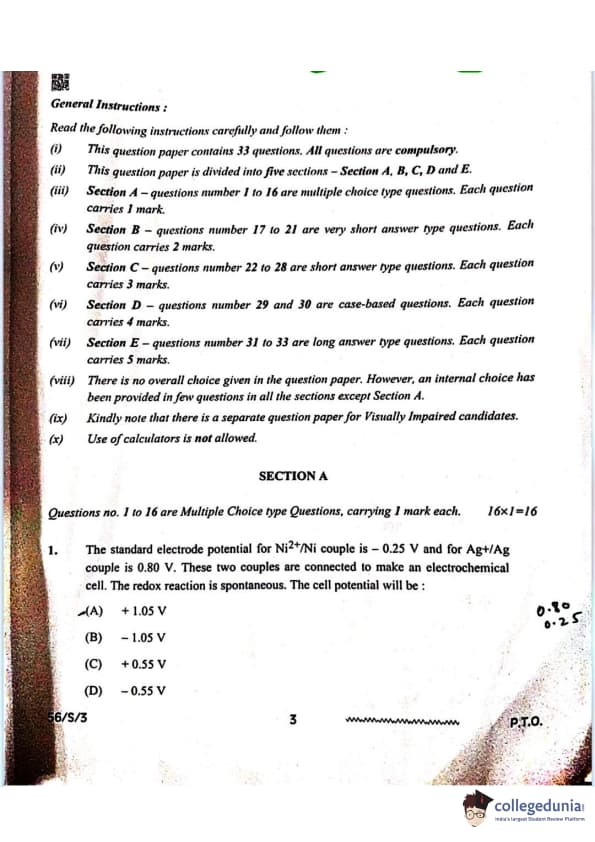
The standard electrode potential for Ni²⁺/Ni couple is -0.25 V and for Ag⁺/Ag couple is 0.80 V. These two couples are connected to make an electrochemical cell. The redox reaction is spontaneous. The cell potential will be:
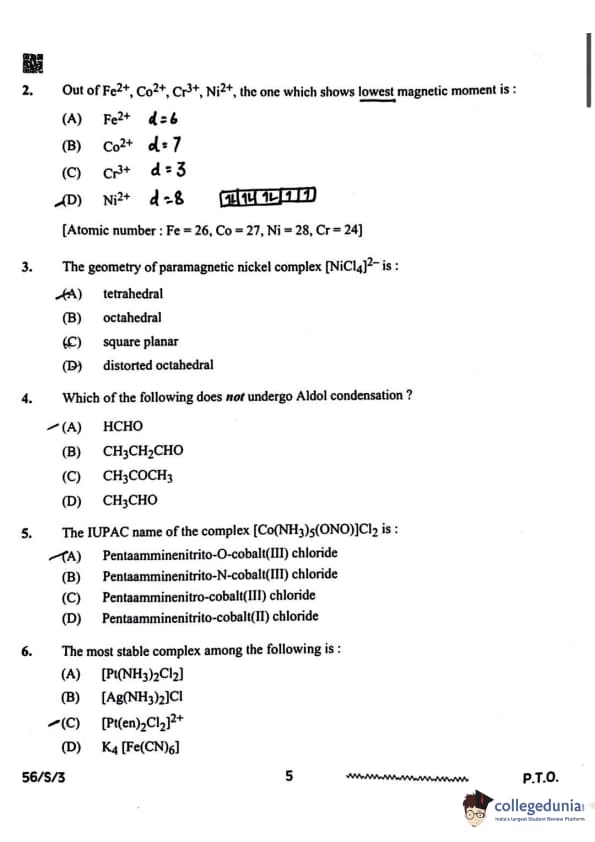
Out of Fe²⁺, Co²⁺, Cr³⁺, Ni²⁺, the one which shows the lowest magnetic moment is:
[Atomic number: Fe = 26, Co = 27, Ni = 28, Cr = 24]
The geometry of paramagnetic nickel complex [NiCl₄]²⁻ is:
Which of the following does not undergo Aldol condensation?
The IUPAC name of the complex [Co(NH₃)₅(ONO)]Cl₂ is:
The most stable complex among the following is:
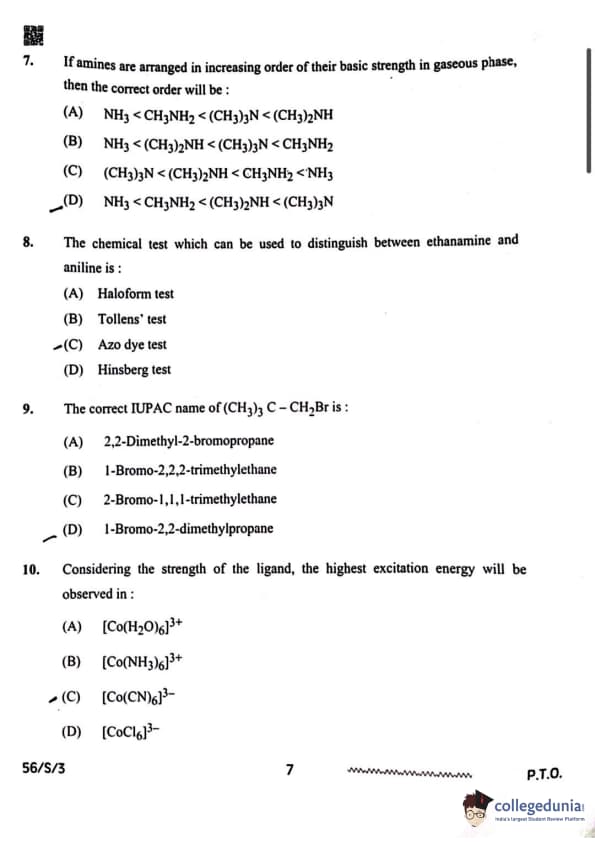
If amines are arranged in increasing order of their basic strength in gaseous phase, the correct order will be:
The chemical test which can be used to distinguish between ethanamine and aniline is:
The correct IUPAC name of (CH₃)₃C-CH₂Br is:
Considering the strength of the ligand, the highest excitation energy will be observed in:
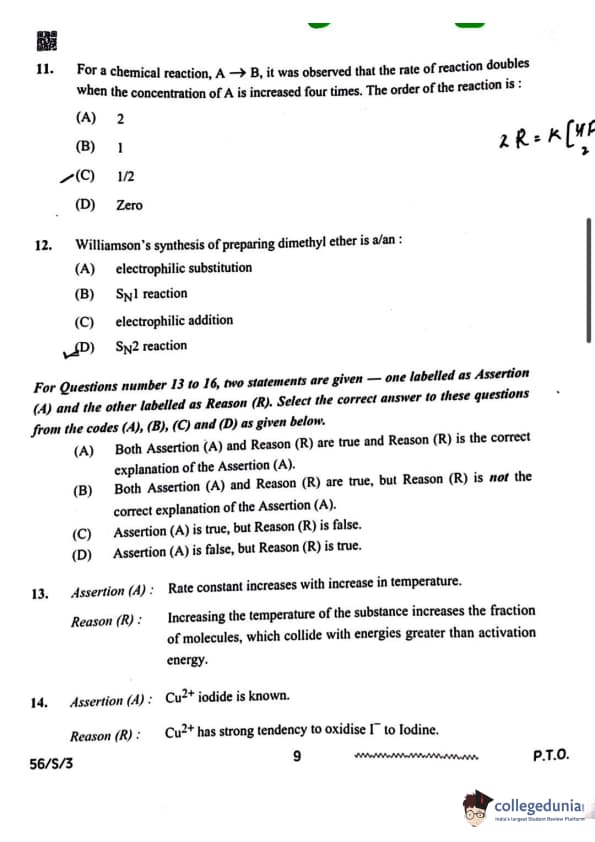
For a chemical reaction A → B, the rate doubles when the concentration of A is increased four times. The order of reaction is:
Williamson's synthesis of preparing dimethyl ether is a/an:
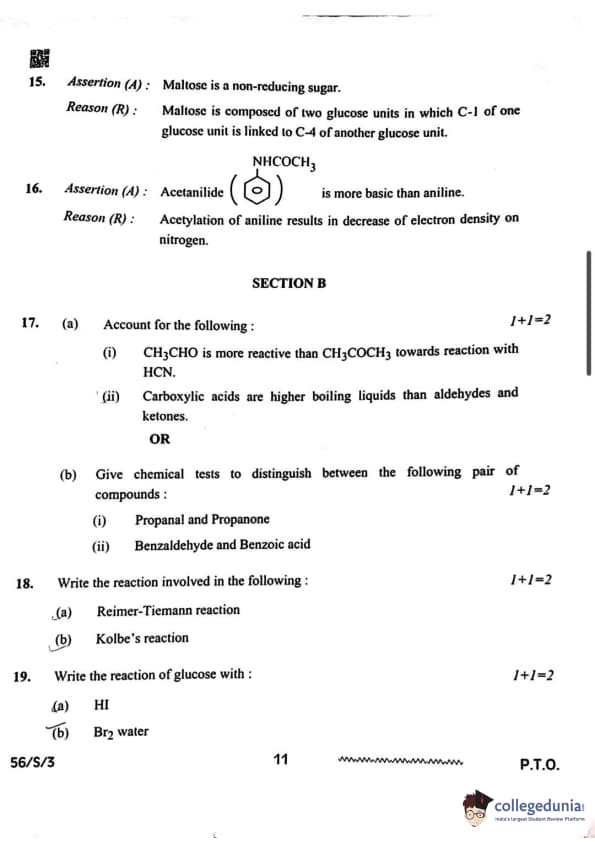
Write the reaction involved in:
(a) Reimer-Tiemann reaction
(b) Kolbe's reaction
Write the reaction of glucose with:
(a) HI
(b) Br₂ water
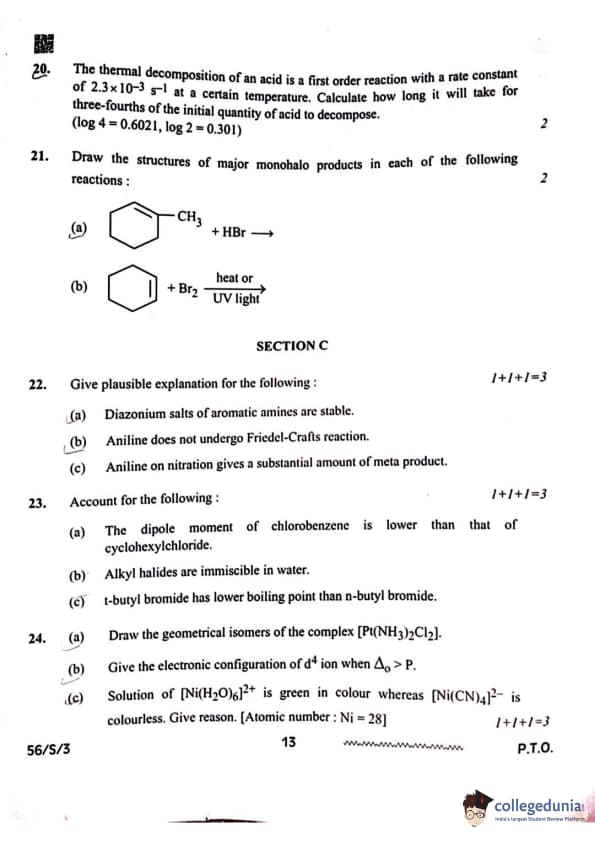
Give plausible explanation for:
(a) Diazonium salts of aromatic amines are stable.
(b) Aniline does not undergo Friedel-Crafts reaction.
(c) Aniline on nitration gives substantial meta product.




Comments