




CBSE Class 12 Chemistry Question Paper 2024 PDF (Set 1 - 56/4/1) is available for download here. CBSE conducted the Chemistry exam on February 27, 2024, from 10:30 AM to 1:30 PM. The total marks for the theory paper are 70. The question paper contains 20% MCQ-based questions, 40% competency-based questions, and 40% short and long answer type questions.
CBSE Class 12 Chemistry Question Paper 2024 (Set 1 - 56/4/1) with Answer Key
| CBSE Class 12 2024 Chemistry Question Paper with Answer Key |  Download Download |
Check Solution |
CBSE Class 12 Chemistry Question Paper 2024 with Solution
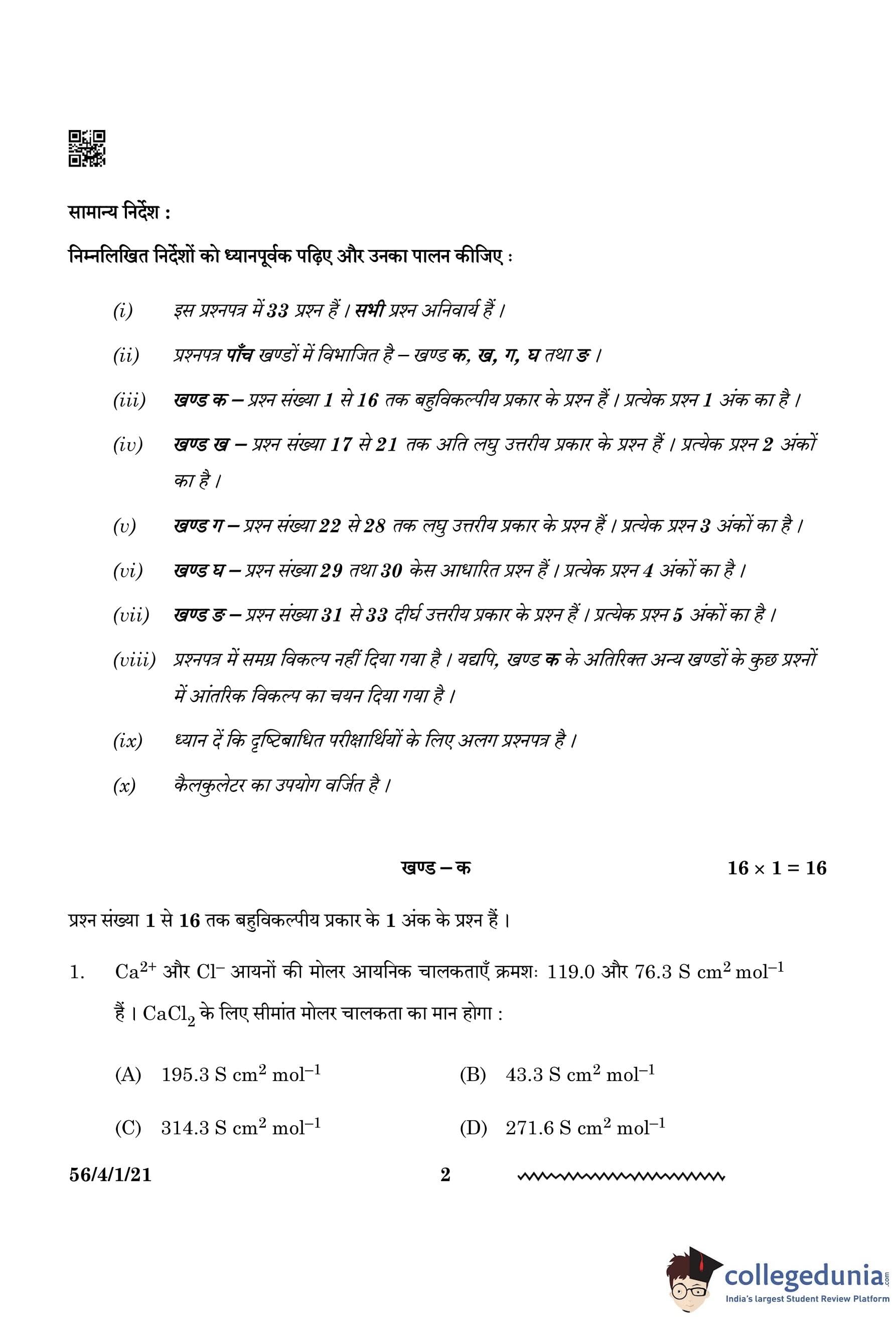
The molar ionic conductivities of Ca\(^{2+}\) and Cl\(^{-}\) are 119.0 and 76.3 S cm\(^{-1}\) mol\(^{-1}\) respectively. The value of limiting molar conductivity of CaCl\(_2\) will be:
View Solution
Step 1: The limiting molar conductivity of CaCl\(_2\) is the sum of the molar ionic conductivities of its ions: \[ \lambda_{m}(CaCl_2) = \lambda_{m}(Ca^{2+}) + \lambda_{m}(Cl^{-}) \]
Given: \[ \lambda_{m}(Ca^{2+}) = 119.0 \, S cm^{-1} mol^{-1}, \quad \lambda_{m}(Cl^{-}) = 76.3 \, S cm^{-1} mol^{-1} \] \[ \lambda_{m}(CaCl_2) = 119.0 + 2 \times 76.3 = 271.6 \, S cm^{-1} mol^{-1} \]
Step 2: Thus, the correct limiting molar conductivity value for CaCl\(_2\) is 271.6 S cm\(^{-1}\) mol\(^{-1}\). Quick Tip: The limiting molar conductivity of an ionic compound is the sum of the molar ionic conductivities of the constituent ions.
Consider the following reaction:

Identify A and B from the given options:
View Solution
The reaction described is a typical decarboxylation reaction where formic acid (\( HCOOH \)) undergoes reduction in the presence of concentrated KOH. When heated, formic acid decarboxylates, resulting in methanol (CH\(_3\)OH) and potassium formate (HCOOK). The reaction proceeds as follows:
1. The formic acid is treated with concentrated KOH.
2. The hydroxide ion attacks the carbonyl group of the formic acid, leading to the formation of potassium formate and the liberation of carbon dioxide.
3. The remaining product after decarboxylation is methanol.
Decarboxylation of formic acid yields methanol and potassium formate. Quick Tip: In decarboxylation reactions, heating in the presence of a strong base often results in the formation of alcohols and formates.
Which of the following acids represents Vitamin C?
View Solution
Vitamin C is also known as Ascorbic acid. It is a water-soluble vitamin that is important for the growth and repair of tissues in the body. It plays a key role in the synthesis of collagen, the absorption of iron, and the immune system. Ascorbic acid is involved in the reduction of free radicals and helps in preventing scurvy. It is commonly found in citrus fruits, tomatoes, and green leafy vegetables.
Ascorbic acid is essential for collagen synthesis and immune health. Quick Tip: Ascorbic acid, also known as Vitamin C, is crucial for immune function and collagen formation.
Rosenmund reduction is used for the preparation of Aldehydes. The catalyst used in this reaction is:
View Solution
Rosenmund reduction is a selective reduction of acyl chlorides to aldehydes. The catalyst used in this reaction is palladium on barium sulfate (Pd-BaSO\(_4\)), which is partially poisoned to prevent the further reduction of the aldehyde to an alcohol. This allows the selective formation of aldehydes from acyl chlorides. In the presence of hydrogen gas, the acyl chloride is reduced to the corresponding aldehyde.
Pd-BaSO\(_4\) is used as a catalyst for the selective reduction of acyl chlorides to aldehydes. Quick Tip: Rosenmund reduction uses Pd-BaSO\(_4\) to selectively reduce acyl chlorides to aldehydes, avoiding further reduction to alcohols.
Which alkyl halide from the given options will undergo S\(_N\)1 reaction faster?
View Solution
The S\(_N\)1 mechanism involves a two-step process:
1. The leaving group (in this case, Br\(^-\)) departs, forming a carbocation.
2. The nucleophile (in this case, the solvent or other reactant) attacks the carbocation, resulting in the product.
The rate-determining step in an S\(_N\)1 reaction is the formation of the carbocation. The more stable the carbocation, the faster the reaction. Carbocation stability increases with the number of alkyl groups attached to the positively charged carbon, as these groups provide inductive stabilization and hyperconjugation.
- Tertiary carbocations are the most stable due to the electron-donating effects of the three alkyl groups.
- Secondary carbocations are less stable.
- Primary carbocations are highly unstable and do not readily form.
In this case, the alkyl halide (CH\(_3\))\(_3\)C–Br (option A) forms a tertiary carbocation, making it the most likely to undergo an S\(_N\)1 reaction fastest.
Step 1: The reaction mechanism for S\(_N\)1 involves the formation of a carbocation.
Step 2: Tertiary carbocations are the most stable and form the fastest, which is why (CH\(_3\))\(_3\)C–Br undergoes the reaction faster. Quick Tip: In S\(_N\)1 reactions, the more stable the carbocation, the faster the reaction. Tertiary carbocations are the most stable and hence react the fastest.
From the elements of 3d series below, which element shows the maximum number of oxidation states?
View Solution
The oxidation states of transition metals are determined by the number of electrons they can lose from their valence shell. The maximum oxidation state is influenced by the number of available d-electrons.
- Scandium (Sc) can only exhibit oxidation states of +3 because it has only one electron in its 4s orbital and readily loses that electron.
- Titanium (Ti) can exhibit oxidation states of +2, +3, and +4, as it has more electrons available for bonding.
- Chromium (Cr) can show oxidation states of +2, +3, +6, but it doesn't reach as many oxidation states as manganese.
- Manganese (Mn) exhibits the maximum number of oxidation states, ranging from +2 to +7. This is because it has five electrons in its 3d orbitals, which can participate in bonding and give rise to a variety of oxidation states.
Manganese is unique because it can easily form multiple oxidation states due to its electron configuration, allowing it to exhibit a broad range of oxidation states.
Step 1: Manganese has a large number of available electrons in its 3d orbitals.
Step 2: The multiple oxidation states of manganese, ranging from +2 to +7, allow it to form various compounds in different oxidation states. Quick Tip: Manganese is the only element in the 3d series that can exhibit oxidation states from +2 to +7, making it the element with the maximum number of oxidation states in this series.
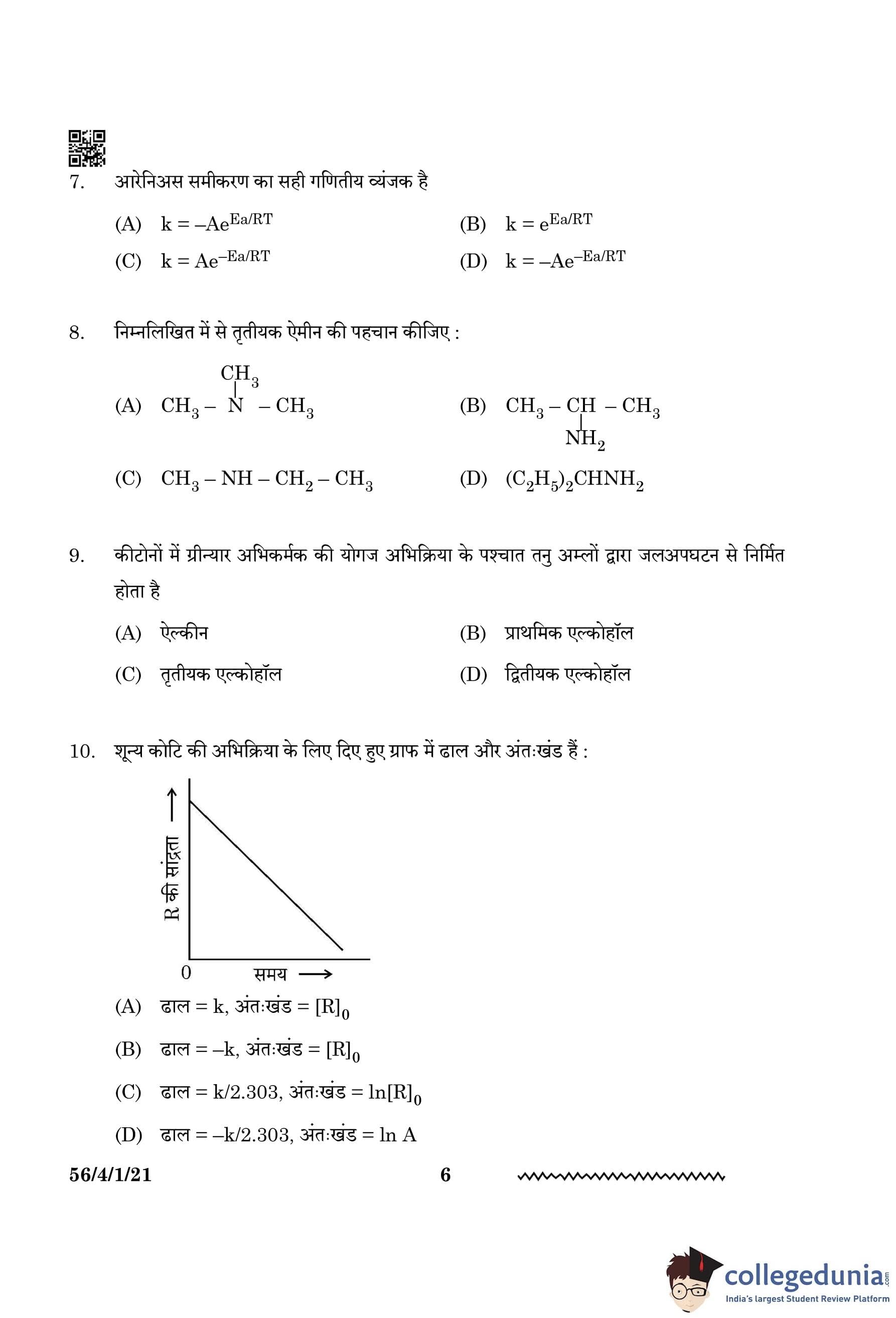
The correct Mathematical expression of Arrhenius equation is:
View Solution
The Arrhenius equation describes the temperature dependence of the rate constant (\(k\)) of a reaction. The correct mathematical expression is: \[ k = Ae^{-\frac{E_a}{RT}} \]
Where:
- \(k\) is the rate constant,
- \(A\) is the pre-exponential factor (frequency factor),
- \(E_a\) is the activation energy,
- \(R\) is the universal gas constant,
- \(T\) is the temperature in Kelvin.
Step 1: The equation shows that the rate constant increases with temperature, as the exponential factor becomes larger at higher temperatures. Quick Tip: The Arrhenius equation provides insight into how the rate of a reaction depends on temperature and activation energy.
Identify the tertiary amine from the following:

View Solution
A tertiary amine is one where the nitrogen atom is bonded to three carbon atoms. In the given options:
- Option (A), CH\(_3\)–N–CH\(_3\), is a tertiary amine because the nitrogen is bonded to two methyl groups.
- Option (B) is a primary amine (NH\(_2\) group), option (C) is a secondary amine (one nitrogen-carbon bond), and option (D) is also a secondary amine.
Step 1: Identify the nitrogen bonded to three carbon atoms to determine the tertiary amine. Quick Tip: A tertiary amine has three carbon atoms bonded to the nitrogen atom, while primary and secondary amines have fewer carbon bonds.
Nucleophilic addition of Grignard reagent to ketones followed by hydrolysis with dilute acids forms:
View Solution
N/A
In a given graph of zero order reaction, the slope and intercept are:

View Solution
For a zero-order reaction, the integrated rate law is given by: \[ [R] = [R]_0 - kt \]
Where:
- \([R]\) is the concentration of reactant at time \(t\),
- \([R]_0\) is the initial concentration,
- \(k\) is the rate constant,
- \(t\) is time.
When plotted as \([R]\) vs. \(t\), the slope of the graph is \(-k\), and the y-intercept is \([R]_0\).
Step 1: The slope of the line is equal to \(-k\) because of the negative relationship between concentration and time.
Step 2: The y-intercept is the initial concentration of the reactant. Quick Tip: In zero-order reactions, a plot of concentration vs. time gives a straight line with a slope of \(-k\) and an intercept of \([R]_0\).
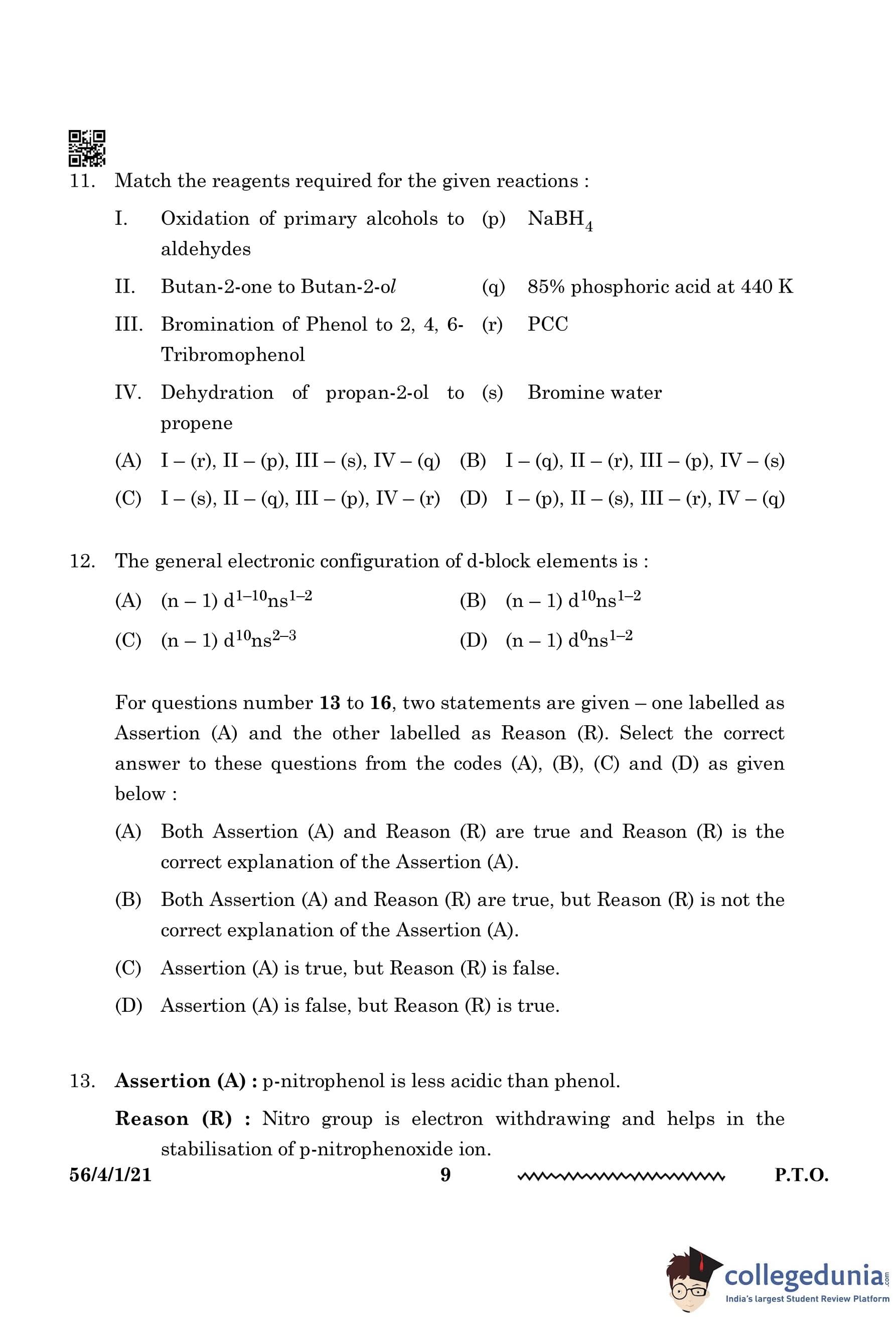
Match the reagents required for the given reactions:
I. Oxidation of primary alcohols to aldehydes (p) \(NaBH_4\)
II. Butan-2-one to Butan-2-ol (q) 85% phosphoric acid at 440 K
III. Bromination of Phenol to 2, 4, 6- (r) PCC Tribromophenol
IV. Dehydration of propan-2-ol to (s) Bromine water propene
View Solution
- The oxidation of primary alcohols to aldehydes is done using PCC Tribromophenol.
- Butan-2-one is reduced to Butan-2-ol using \(NaBH_4\).
- Bromination of Phenol to 2, 4, 6-tribromophenol is done using Bromine water propene.
- Dehydration of propan-2-ol leads to propene when treated with 85% phosphoric acid at 440 K Quick Tip: For oxidation reactions, NaBH\(_4\) is commonly used, and for reduction reactions, phosphoric acid is often the reagent.
The general electronic configuration of d-block elements is:
View Solution
The general electronic configuration of d-block elements (transition metals) is given by \( (n - 1) d^{10}ns^1 \), where \(n\) represents the principal quantum number of the valence shell. This configuration reflects the filling of the d-orbitals followed by the s-orbital.
Step 1: In the d-block, the d-orbitals are filled first, followed by the s-orbital. Quick Tip: In d-block elements, the d-orbitals are filled first, and the final configuration involves the \(ns^1\) orbital for the transition elements.
Assertion (A): p-nitrophenol is less acidic than phenol.
Reason (R): Nitro group is electron-withdrawing and helps in the stabilization of p-nitrophenoxide ion.
View Solution
- Assertion (A) is incorrect because p-nitrophenol is actually more acidic than phenol, due to the electron-withdrawing nature of the nitro group, which stabilizes the conjugate base (p-nitrophenoxide ion).
- Reason (R) is true because the nitro group, being electron-withdrawing, helps in the stabilization of the conjugate base, thereby increasing the acidity of p-nitrophenol.
Step 1: The electron-withdrawing nitro group stabilizes the conjugate base, making p-nitrophenol more acidic than phenol. Quick Tip: The presence of an electron-withdrawing group like nitro increases the acidity of phenols by stabilizing the conjugate base.
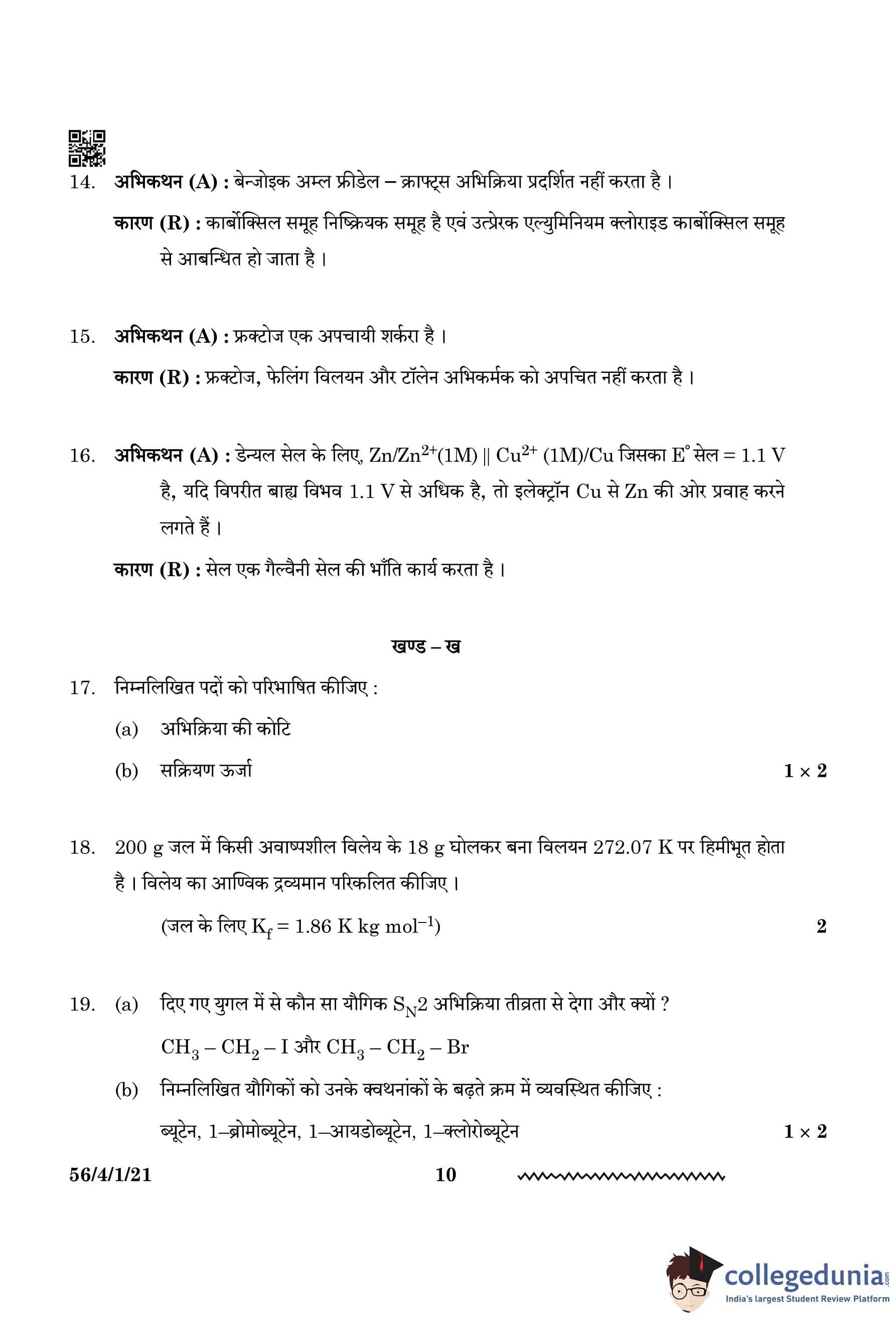
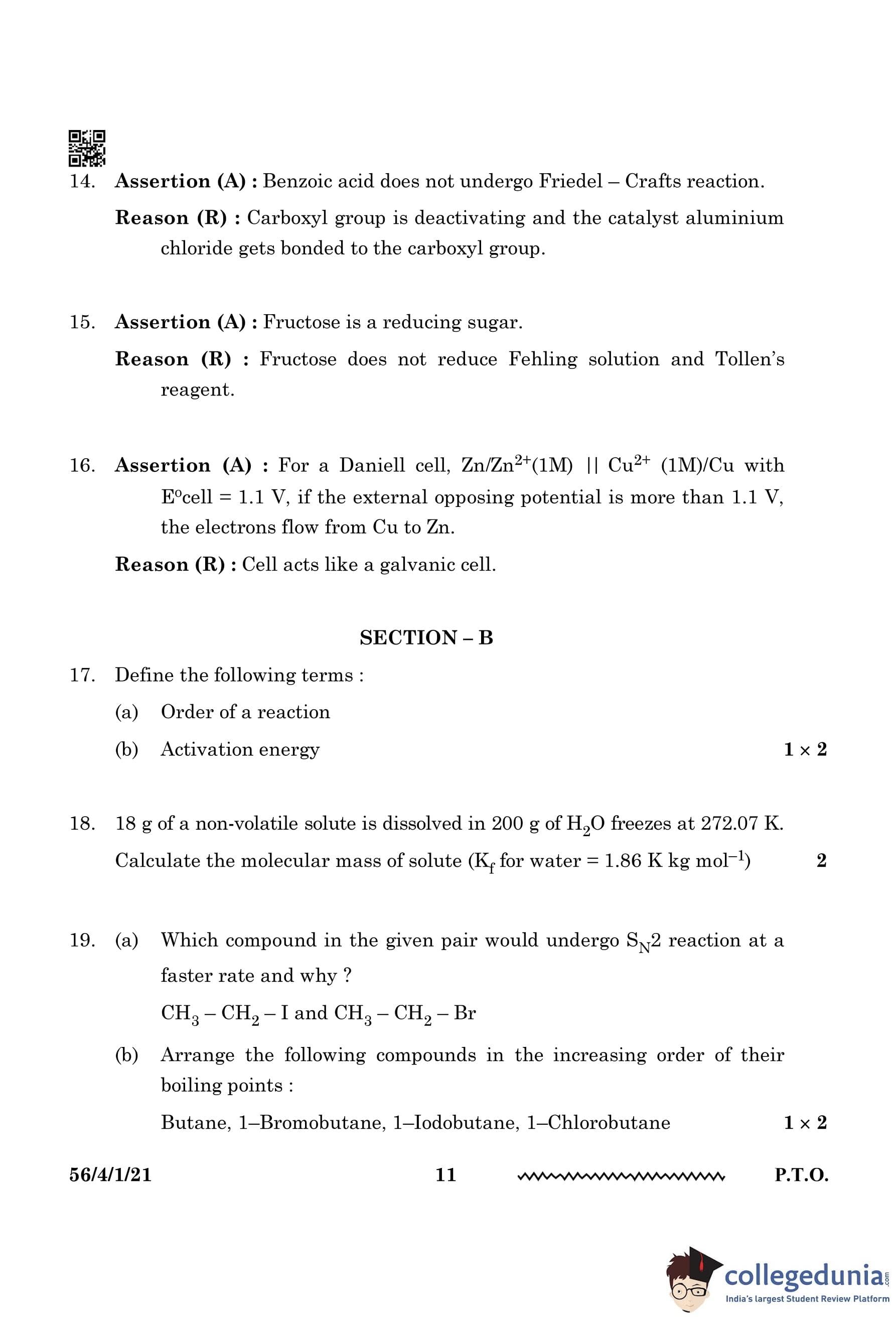
Assertion (A): Benzoic acid does not undergo Friedel – Crafts reaction.
Reason (R): Carboxyl group is deactivating and the catalyst aluminium chloride gets bonded to the carboxyl group.
View Solution
- Assertion (A) is correct because benzoic acid does not undergo Friedel – Crafts reactions due to the deactivating effect of the carboxyl group.
- Reason (R) is also true. The carboxyl group (-COOH) is electron-withdrawing, which deactivates the aromatic ring, making it less reactive towards electrophilic substitution reactions, including Friedel – Crafts reactions.
Step 1: The carboxyl group in benzoic acid deactivates the aromatic ring and prevents the reaction with electrophiles.
Step 2: The catalyst, AlCl\(_3\), is unable to bond with the deactivated ring for the Friedel – Crafts reaction to occur.
Quick Tip: Electron-withdrawing groups such as carboxyl groups deactivate the aromatic ring, preventing Friedel – Crafts reactions.
Assertion (A): Fructose is a reducing sugar.
Reason (R): Fructose does not reduce Fehling solution and Tollen’s reagent.
View Solution
- Assertion (A) is true because fructose is a reducing sugar. It contains a carbonyl group in the form of a ketone, which can reduce Fehling's solution and Tollen's reagent under certain conditions.
- Reason (R) is false because fructose, being a reducing sugar, can reduce Tollen’s reagent and Fehling’s solution. The statement that fructose does not reduce these reagents is incorrect.
Step 1: Fructose, though a ketose, has reducing properties due to its ability to undergo isomerization into an aldose form.
Step 2: Fructose is a reducing sugar and can reduce Fehling’s solution and Tollen’s reagent.
Quick Tip: Fructose is a reducing sugar because it can isomerize to an aldose form, which is capable of reducing Tollen's and Fehling's solutions.
Assertion (A): For a Daniell cell, Zn/Zn\(^{2+}\)(1M) || Cu\(^{2+}\)(1M)/Cu with \( E_{cell} = 1.1 \, V \), if the external opposing potential is more than 1.1 V, the electrons flow from Cu to Zn.
Reason (R): Cell acts like a galvanic cell.
View Solution
- Assertion (A) is correct because, in a Daniell cell, when the external opposing potential exceeds 1.1 V, the electron flow is reversed, causing electrons to flow from Cu to Zn.
- Reason (R) is false because a galvanic cell operates without an external opposing potential. A Daniell cell is a type of galvanic cell, but the external potential in this case is artificially introduced, which is not a typical condition for a galvanic cell.
Step 1: In a Daniell cell, electron flow is from the anode (Zn) to the cathode (Cu), but if an external voltage is applied, it can reverse the flow of electrons.
Step 2: A galvanic cell generates electrical energy spontaneously, but external voltages disrupt the normal flow.
Quick Tip: In a Daniell cell, if the external potential is greater than the cell potential, the direction of electron flow is reversed.
Define the following terms:
View Solution
(a) Order of Reaction: The order of a reaction refers to the sum of the exponents of the concentration terms in the rate law expression. It is determined experimentally and tells us how the rate of reaction depends on the concentration of reactants. For example, for a reaction with rate law \( rate = k[A]^m[B]^n \), the order is \( m + n \).
(b) Activation Energy: The energy required to form activated complex / The minimum amount of extra energy required by reacting molecules to get converted into a product. This refers to the activation energy, which is the minimum amount of energy that reacting molecules must possess to form an activated complex. The energy required is needed for molecules to reach the transition state and proceed to form the products. Quick Tip: Order of reaction gives insight into how concentration affects the rate, while activation energy defines the energy threshold for a reaction to occur.
Activation energy is the energy required to form the activated complex. Catalysts lower this energy, making reactions proceed faster.
18 g of a non-volatile solute is dissolved in 200 g of H\(_2\)O, and it freezes at 272.07 K. Calculate the molecular mass of the solute (K\(_f\) for water = 1.86 K kg mol\(^{-1}\)).
View Solution
We are given:
- Mass of solute, \( w_B = 18 \, g \)
- Mass of solvent, \( w_A = 200 \, g \)
- Freezing point depression, \( \Delta T_f = T^\circ_f - T_f = 273.15 \, K - 272.07 \, K = 1.08 \, K \)
- Freezing point depression constant for water, \( K_f = 1.86 \, K kg mol^{-1} \)
Using the formula for freezing point depression:
\[ \Delta T_f = K_f \cdot m \]
Where \( m \) is the molality, defined as \( m = \frac{w_B \times 1000}{M_B \times w_A} \), and \( M_B \) is the molar mass of the solute. Replacing values:
\[ 1.08 = 1.86 \times \frac{18 \times 1000}{M_B \times 200} \]
Solving for \( M_B \):
\[ M_B = \frac{1.86 \times 18 \times 1000}{200 \times 1.08} = 155 \, g mol^{-1} \] Quick Tip: Freezing point depression is a colligative property that helps determine the molecular mass of solutes by observing changes in freezing point.
(a) Which compound in the given pair will undergo S\(_N\)2 reaction at a faster rate and why?
CH\(_3\)–CH\(_2\)–I and CH\(_3\)–CH\(_2\)–Br
View Solution
CH\(_3\)–CH\(_2\)–I will undergo the S\(_N\)2 reaction at a faster rate than CH\(_3\)–CH\(_2\)–Br. This is because iodine is a better leaving group than bromine due to the larger size of the iodine atom, which makes it easier for the bond to break in the S\(_N\)2 mechanism. Iodine forms a more stable anion, and its bond with carbon is weaker, allowing for a faster nucleophilic substitution.
Step 1: In S\(_N\)2 reactions, the leaving group plays a significant role. Iodide (I\(^-\)) is a better leaving group than bromide (Br\(^-\)).
Step 2: The larger the leaving group, the faster it will leave, resulting in a faster S\(_N\)2 reaction. Quick Tip: In S\(_N\)2 reactions, the better the leaving group, the faster the reaction. Iodine is a better leaving group than bromine, making it react faster.
(b) Arrange the following compounds in the increasing order of their boiling points:
Butane, 1-Bromobutane, 1-Iodobutane, 1-Chlorobutane
View Solution
The increasing order of boiling points is:
Butane \(<\) 1-Chlorobutane \(<\) 1-Bromobutane \(<\) 1-Iodobutane.
- The boiling point increases as the size of the halogen increases because larger atoms form stronger van der Waals forces, which increase the boiling point.
- Iodine, being the largest halogen, results in the highest boiling point, followed by bromine, chlorine, and then butane, which lacks halogen atoms.
Step 1: The halogen's atomic size increases in the order Cl \(<\) Br \(<\) I, and this correlates with increasing boiling points.
Step 2: Butane has no halogen, so it has the lowest boiling point, followed by chlorobutane, bromobutane, and iodobutane. Quick Tip: In halogen-substituted alkanes, boiling points increase as the size of the halogen increases due to stronger intermolecular forces.
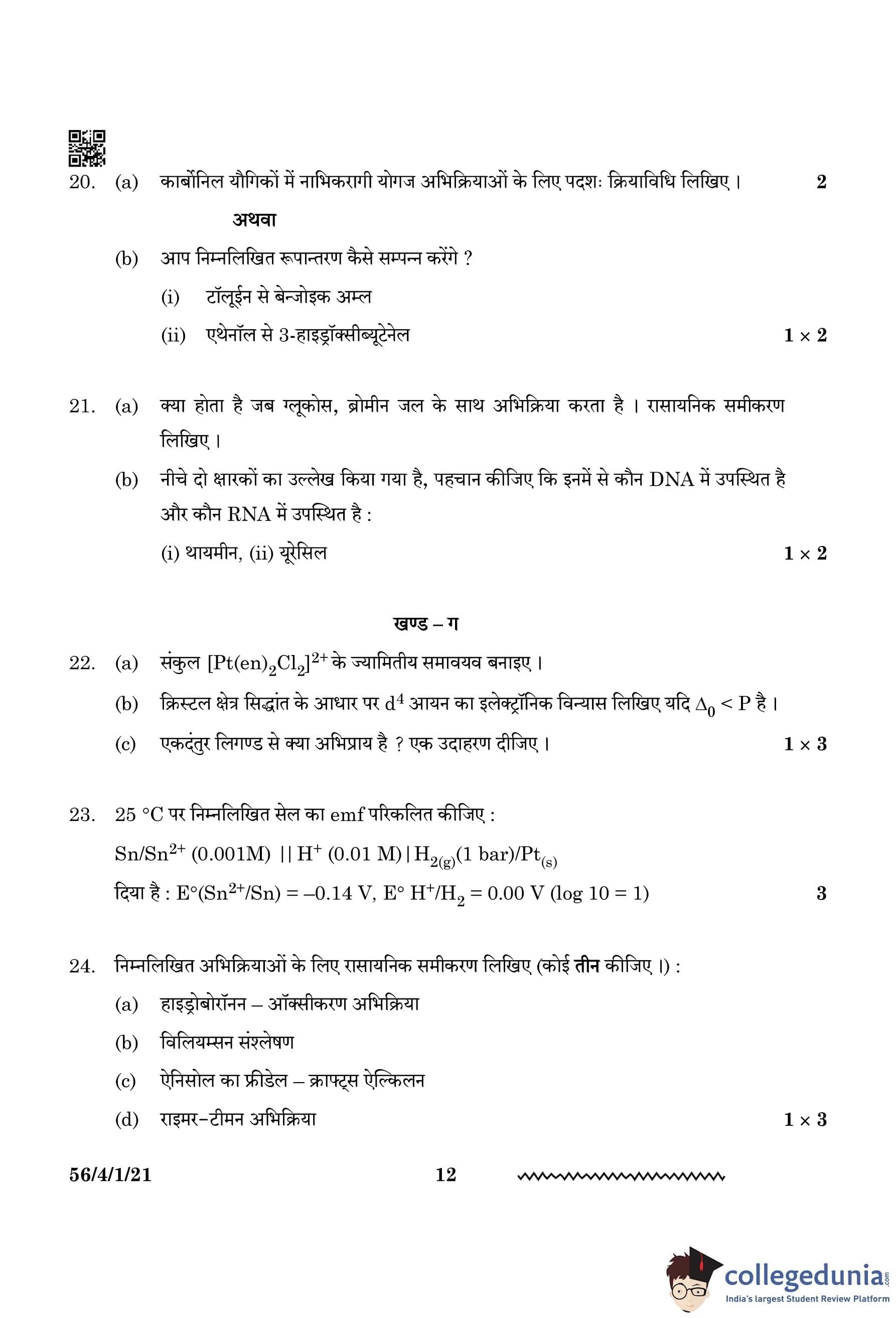
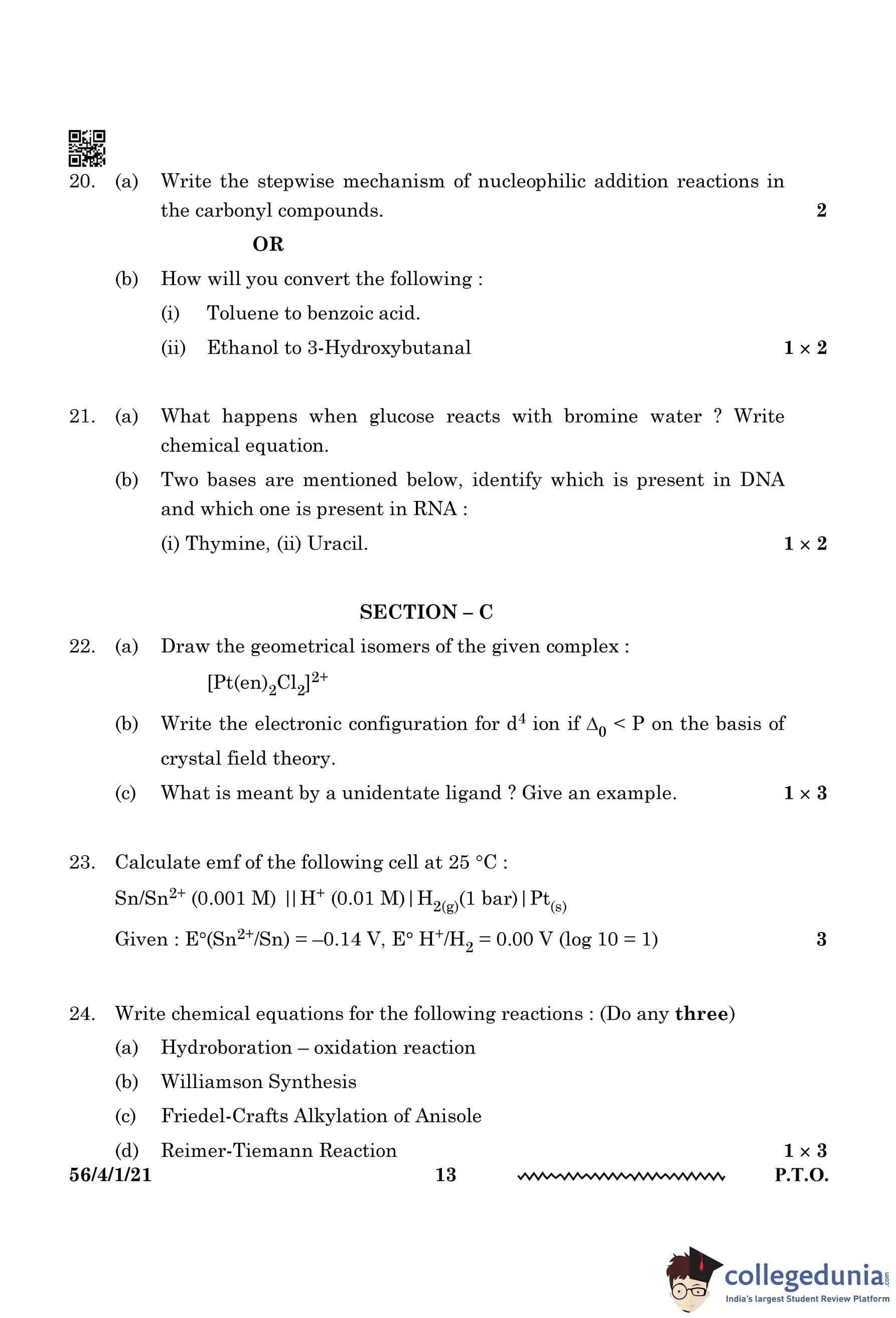
(a) Write the stepwise mechanism of nucleophilic addition reactions in the carbonyl compounds.
View Solution
Nucleophilic addition reactions occur when a nucleophile attacks the electrophilic carbonyl carbon in aldehydes or ketones. The general mechanism is as follows:
Step 1: The nucleophile (e.g., a hydride ion, alkoxide, or Grignard reagent) attacks the carbonyl carbon of the aldehyde or ketone, breaking the double bond and forming a tetrahedral intermediate.
Step 2: The intermediate is protonated (usually by a water molecule or proton donor) to form the final addition product. For example, if the nucleophile is a hydride (H\(^-\)), the product will be an alcohol.
Step 3: The product after protonation is a carbonyl addition product, such as an alcohol.
 Quick Tip: In nucleophilic addition reactions, the nucleophile adds to the electrophilic carbonyl carbon, forming a tetrahedral intermediate that is protonated to yield the product.
(b)How will you convert the following?
View Solution
(i) Toluene to Benzoic acid:
Toluene (C\(_6\)H\(_5\)CH\(_3\)) can be oxidized to benzoic acid (C\(_6\)H\(_5\)COOH) using strong oxidizing agents such as potassium permanganate (KMnO\(_4\)) or chromic acid (H\(_2\)CrO\(_4\)). These reagents will oxidize the methyl group (-CH\(_3\)) into a carboxyl group (-COOH), converting toluene into benzoic acid.

(ii) Ethanol to 3-Hydroxybutanal:
Ethanol (CH\(_3\)CH\(_2\)OH) can be oxidized to acetaldehyde (CH\(_3\)CHO) by using an oxidizing agent like PCC (Pyridinium chlorochromate) or mild oxidizers. The acetaldehyde then undergoes a nucleophilic addition with a Grignard reagent (like CH\(_3\)MgBr) to form the intermediate 3-hydroxybutanal.
 Quick Tip: Toluene can be oxidized using strong oxidizing agents to form benzoic acid, while ethanol can be oxidized to acetaldehyde, which then reacts to form 3-hydroxybutanal.
(a) What happens when glucose reacts with bromine water? Write the chemical equation.
View Solution
When glucose (C\(_6\)H\(_{12}\)O\(_6\)) reacts with bromine water, the bromine (Br\(_2\)) oxidizes the glucose, particularly the aldehyde group. The reaction results in the formation of a carboxylic acid (gluconic acid). The balanced chemical equation for this reaction is:

Here, glucose is oxidized to gluconic acid, and bromine is reduced to bromide ion.
Quick Tip: Glucose is oxidized to gluconic acid in the presence of bromine water, and this reaction is a typical oxidation of the aldehyde group in sugars.
(b) Two bases are mentioned below, identify which is present in DNA and which one is present in RNA:
View Solution
- Thymine is present in DNA, where it pairs with adenine in double-stranded DNA.
- Uracil is present in RNA, where it pairs with adenine in RNA during transcription. Thymine is replaced by uracil in RNA.
Step 1: Thymine is part of the nucleotide structure in DNA, whereas uracil is found in RNA.
Step 2: Both thymine and uracil are pyrimidine bases, but uracil is unique to RNA.
Quick Tip: Thymine is found in DNA, while uracil is found in RNA. Both are pyrimidines, but thymine is replaced by uracil in RNA.
(a) Draw the geometrical isomers of the given complex:
\([Pt(en)\(_2\)Cl\(_2\)]\(^{2+}\)\)
View Solution
The complex [Pt(en)\(_2\)Cl\(_2\)]\(^{2+}\) can have two geometrical isomers:
- Cis isomer: Both chloride ions are adjacent to each other.
- Trans isomer: The chloride ions are opposite to each other, across the platinum center.

The en (ethylenediamine) ligands are bidentate, meaning they form a chelate, and the two chloride ions can be either adjacent (cis) or opposite (trans). Quick Tip: The geometrical isomers of square planar complexes depend on the arrangement of the ligands around the metal center. In this case, en is bidentate, creating cis and trans isomers with chloride ions.
(b) Write the electronic configuration for d\(^4\) ion if \( \Delta_0 \(<\) P \) on the basis of crystal field theory.
View Solution
For a d\(^4\) ion, if \( \Delta_0 \(<\) P \) (weak field ligand), the electronic configuration will be as follows:
- The four electrons will be placed in the \( e_g \) and \( t_{2g} \) orbitals, but due to the weak field, electrons will occupy the \( t_{2g} \) orbitals first and then move to the \( e_g \) orbitals.
- The configuration will be \( t_{2g}^3 e_g^1 \), meaning three electrons in the lower-energy \( t_{2g} \) orbitals and one in the higher-energy \( e_g \) orbital.
Step 1: In weak field complexes, electrons are spread out in the available orbitals to minimize pairing.
Step 2: The \( t_{2g} \) orbitals are filled first, and the \( e_g \) orbitals are filled next. Quick Tip: In weak field ligands (\( \Delta_0 \(<\) P \)), electrons occupy the higher energy \( e_g \) orbitals after filling the lower-energy \( t_{2g} \) orbitals.
(c) What is meant by a unidentate ligand? Give an example.
View Solution
A unidentate ligand is a ligand that can form only one coordinate bond with the central metal ion. This type of ligand donates only one lone pair of electrons to the metal center.
An example of a unidentate ligand is chloride ion (Cl\(^-\)), which donates one lone pair of electrons to form a bond with the metal ion. Quick Tip: A unidentate ligand forms only one bond with the central metal atom, such as chloride (Cl\(^-\)), water (H\(_2\)O), or ammonia (NH\(_3\)).
Calculate emf of the following cell at 25°C:
Sn/Sn\(^{2+}\)(0.001 M) || H\(^+\)(0.01 M) | H\(_2\)(g)(1 bar) | Pt(s)
Given: E°(Sn\(^{2+}\)/Sn) = -0.14 V, E° H\(^+\)/H\(_2\) = 0.00 V (log 10 = 1)
View Solution
We are given the following data:
- The cell consists of two half-reactions:
1. \( Sn^{2+} + 2e^- \rightarrow Sn \) with \( E^\circ = -0.14 \, V \)
2. \( 2H^+ + 2e^- \rightarrow H_2 \) with \( E^\circ = 0.00 \, V \)
- Concentration of Sn\(^{2+}\) = 0.001 M
- Concentration of H\(^+\) = 0.01 M
- Standard pressure for H\(_2\) = 1 bar
Step 1: Write the Nernst equation for the cell:
\[ E_{cell} = E^\circ_{cell} - \frac{0.0592}{n} \log Q \]
Where:
- \( E^\circ_{cell} = E^\circ_{cathode} - E^\circ_{anode} \)
- \( n \) is the number of electrons transferred (in this case, \( n = 2 \)).
- \( Q \) is the reaction quotient, which is calculated as:
\[ Q = \frac{[Sn^{2+}]}{[H^+]^2} \]
Substitute the given values:
\[ Q = \frac{0.001}{(0.01)^2} = \frac{0.001}{0.0001} = 10 \]
Step 2: Calculate the standard cell potential \( E^\circ_{cell} \):
\[ E^\circ_{cell} = E^\circ_{cathode} - E^\circ_{anode} = 0.00 \, V - (-0.14 \, V) = 0.14 \, V \]
Step 3: Apply the values to the Nernst equation:
\[ E_{cell} = 0.14 \, V - \frac{0.0592}{2} \log 10 \]
Since \( \log 10 = 1 \), we get:
\[ E_{cell} = 0.14 \, V - \frac{0.0592}{2} \times 1 \] \[ E_{cell} = 0.14 \, V - 0.0296 \, V = 0.1104 \, V \]
Final Answer: The emf of the cell at 25°C is \( E_{cell} = 0.1104 \, V \).
Quick Tip: Use the Nernst equation to calculate the emf of electrochemical cells, considering concentrations and standard electrode potentials.
Write chemical equations for the following reactions: (Do any three)
View Solution
(a) Hydroboration – Oxidation reaction:
The hydroboration-oxidation of an alkene results in an alcohol. In this reaction, alkene (CH\(_3\)CH=CH\(_2\)) undergoes hydroboration with diborane (B\(_2\)H\(_6\)), followed by oxidation with hydrogen peroxide to form an alcohol. The reaction is as follows: \[ CH_3CH= CH_2 + B_2H_6 \xrightarrow{H_2O_2} CH_3CH_2OH \]
Here, the alkene is converted to the alcohol with anti-Markovnikov addition.
(b) Williamson Synthesis:
The Williamson synthesis involves the reaction of an alkoxide ion with an alkyl halide to form an ether. The general reaction is: \[ R-X + R'O^- \rightarrow R-R' + NaX \]
Where \( R \)-X is the alkyl halide, \( R' \)-O\(^-\) is the alkoxide ion, and \( R \)-R' is the ether product.
(c) Friedel-Crafts Alkylation of Anisole:
In Friedel-Crafts alkylation, anisole (C\(_6\)H\(_5\)OCH\(_3\)) reacts with an alkyl halide (CH\(_3\)Cl) in the presence of AlCl\(_3\) catalyst to form an alkylated product. The reaction is as follows:

Here, the methyl group is added to the aromatic ring, forming methyl anisole.
(d) Reimer-Tiemann Reaction:
The Reimer-Tiemann reaction involves the reaction of phenol (C\(_6\)H\(_5\)OH) with chloroform (CHCl\(_3\)) in the presence of aqueous NaOH, followed by acidification to form salicylaldehyde (C\(_7\)H\(_6\)O\(_2\)). The reaction is as follows:

Here, the formyl group (-CHO) is introduced to the phenol to form salicylaldehyde.
Quick Tip: These reactions are classic organic transformations. Hydroboration-oxidation adds alcohol across alkenes, Williamson synthesis forms ethers, Friedel-Crafts alkylation alkylates aromatic rings, and Reimer-Tiemann introduces a formyl group to phenol.
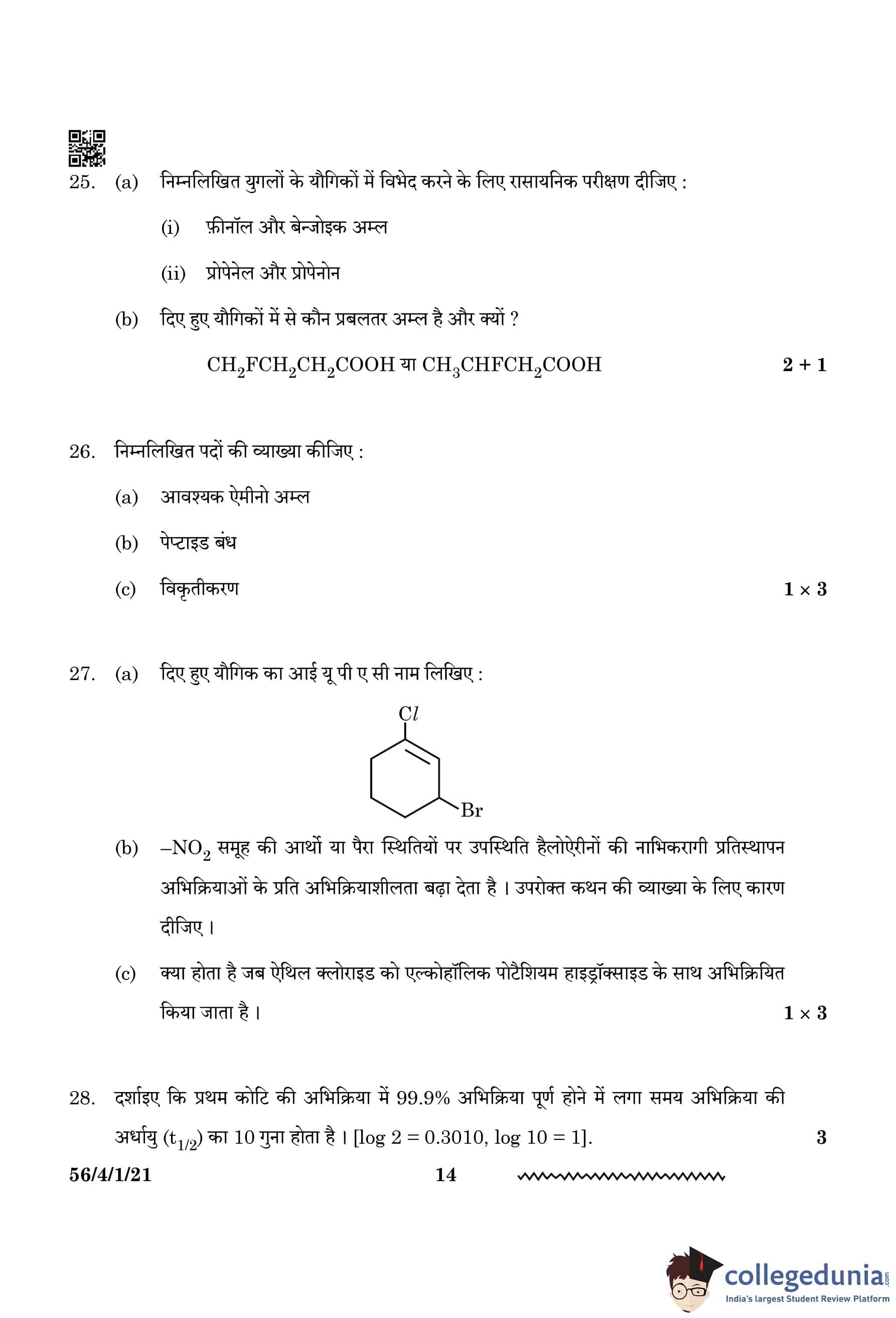
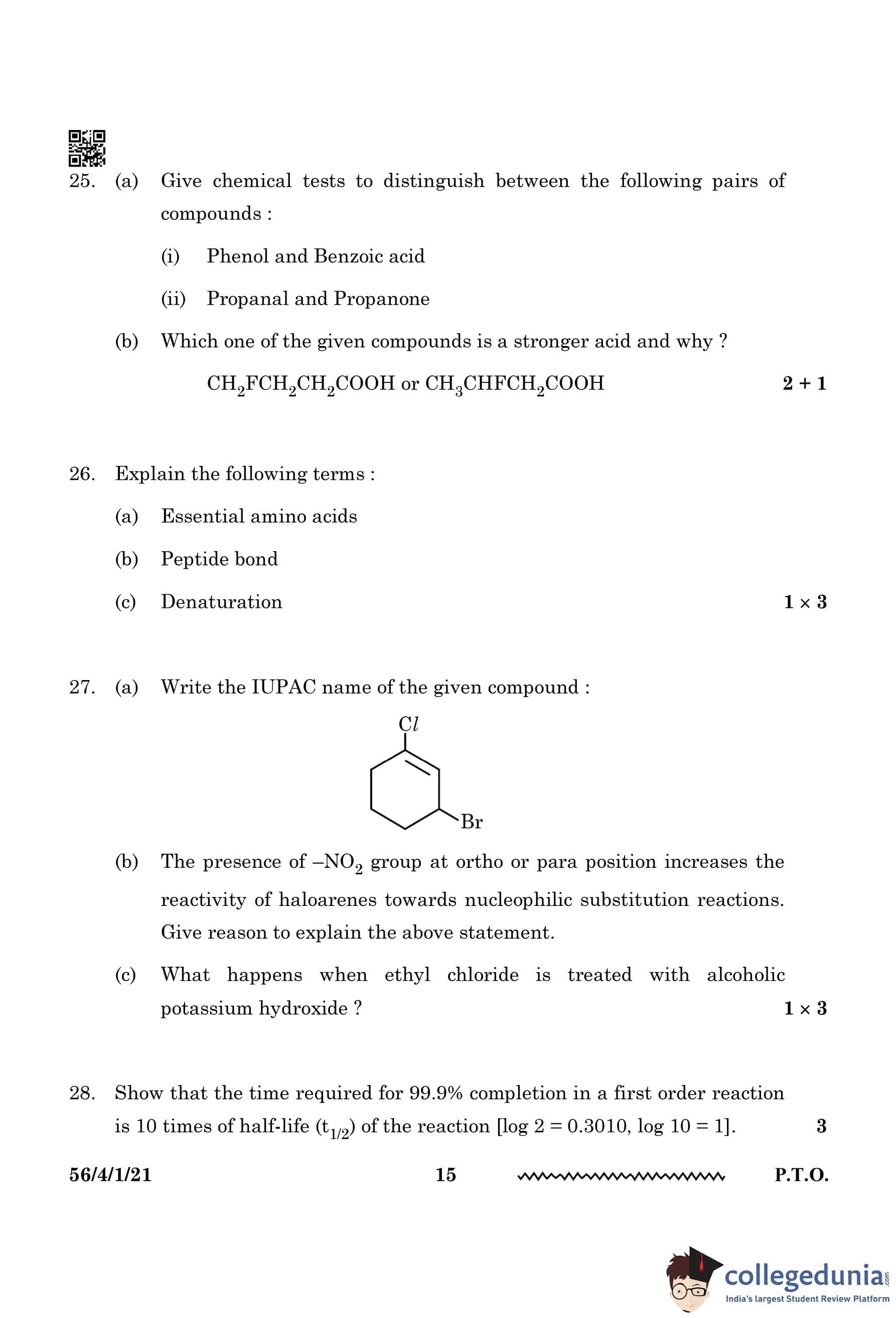
(a) Give chemical tests to distinguish between the following pairs of compounds:
View Solution
(i) Phenol and Benzoic acid:
- To distinguish phenol and benzoic acid, add neutral FeCl\(_3\).
- Phenol: When neutral FeCl\(_3\) is added to phenol, a violet color complex is formed due to the coordination of the Fe\(^{3+}\) ion with the oxygen of the phenol's hydroxyl group.
- Benzoic acid: Benzoic acid, which is a carboxylic acid, does not form a complex with FeCl\(_3\), hence no color change is observed.
- Alternatively, you can add bromine water to each compound:
- Phenol: Phenol reacts with bromine water to form 2,4,6-tribromophenol, a white precipitate.
- Benzoic acid: Benzoic acid does not react with bromine water.
(ii) Propanal and Propanone:
- Tollens' reagent: This reagent is a mild oxidizer used to distinguish aldehydes from ketones. Propanal, being an aldehyde, will reduce Tollens' reagent to silver metal, which forms a silver mirror.
- Propanone: Propanone, a ketone, does not react with Tollens' reagent. Hence, no silver mirror will form.
- Fehling’s solution: This is another test to distinguish between aldehydes and ketones.
- Propanal: It will reduce Fehling’s solution, which contains Cu\(^{2+}\) ions, to a red precipitate of Cu\(_2\)O.
- Propanone: Being a ketone, it will not reduce Fehling’s solution, and no precipitate will form.
Quick Tip: For distinguishing phenol and benzoic acid, FeCl\(_3\) is used to form a violet color with phenol. For distinguishing aldehydes from ketones, Tollens' and Fehling's reagents are useful.
(b) Which one of the given compounds is a stronger acid and why?
CH\(_2\)FCH\(_2\)COOH or CH\(_3\)CHFCH\(_2\)COOH
View Solution
The compound CH\(_3\)CHFCH\(_2\)COOH is the stronger acid. This is because:
- The fluorine atom in CH\(_3\)CHFCH\(_2\)COOH is more electronegative than hydrogen and pulls electron density away from the carboxyl group (-COOH) through the inductive effect. This results in the stabilization of the conjugate base (carboxylate anion, RCOO\(^-\)), making the release of a proton (H\(^+\)) easier, thus increasing the acidity.
- In contrast, CH\(_2\)FCH\(_2\)COOH has the fluorine atom further from the carboxyl group, resulting in a weaker electron-withdrawing effect. Therefore, the carboxyl group is less stabilized, making CH\(_2\)FCH\(_2\)COOH a weaker acid than CH\(_3\)CHFCH\(_2\)COOH.
Quick Tip: Fluorine is a highly electronegative element. The closer it is to the carboxyl group, the stronger the acid due to the electron-withdrawing inductive effect.
Explain the following terms:
View Solution
(a) Essential amino acids:
Essential amino acids are amino acids that cannot be synthesized by the body. As a result, they must be obtained from the diet. Examples of essential amino acids include leucine, lysine, and tryptophan. These amino acids are crucial for protein synthesis and other metabolic functions but must be consumed in the diet because the body lacks the necessary enzymes to synthesize them.
(b) Peptide bond:
A peptide bond is a covalent bond formed between two amino acids. It occurs when the carboxyl group (-COOH) of one amino acid reacts with the amino group (-NH\(_2\)) of another amino acid, releasing a molecule of water (dehydration synthesis). This results in the formation of a dipeptide and a peptide bond between the two amino acids. Peptide bonds are the linkages that hold amino acids together in proteins.
(c) Denaturation:
Denaturation refers to the process by which a protein loses its native, functional conformation due to external factors such as heat, pH changes, or chemical agents. Denaturation disrupts the secondary and tertiary structures of the protein, causing it to lose its biological activity. For example, when an egg is boiled, the proteins in the egg white denature and solidify, which changes the texture and properties of the egg.
Quick Tip: Essential amino acids must be obtained from food. Peptide bonds link amino acids to form proteins, and denaturation disrupts protein structure and function.
(a) Write the IUPAC name of the given compound:

View Solution
The given compound is a halogen-substituted benzene. The IUPAC name is 3 – Bromo– 1 – chlorocyclohexene.
- The first step is to number the positions of the substituents on the benzene ring. We begin by numbering the ring to give the lowest possible numbers to the substituents.
- Chlorine (Cl) is at position 1, and bromine (Br) is at position 3. The substituents are located at the 1 and 3 positions on the benzene ring.
Step 1: Number the positions of the substituents on the benzene ring starting from the substituent that provides the lowest numbering.
Step 2: Name the compound according to the position of the substituents.
Quick Tip: In halogen-substituted benzene compounds, the positions of the substituents are numbered to give the lowest possible numbers to the substituents.
(b) The presence of –NO\(_2\) group at ortho or para position increases the reactivity of haloarenes towards nucleophilic substitution reactions. Give reason to explain the above statement.
View Solution
The presence of the electron-withdrawing –NO\(_2\) group at the ortho or para positions of a halogenated benzene ring increases the reactivity of haloarenes towards nucleophilic substitution reactions. This is because:
- The –NO\(_2\) group is electron-withdrawing, meaning it pulls electron density away from the benzene ring through the inductive effect.
- This increases the partial positive charge on the carbon atom attached to the halogen (which is the site of nucleophilic attack).
- The increased positive charge on the carbon makes it more electrophilic, thus more susceptible to attack by nucleophiles, thereby increasing the rate of nucleophilic substitution reactions.
Step 1: The electron-withdrawing nature of the –NO\(_2\) group enhances the electrophilicity of the carbon bonded to the halogen.
Step 2: The nucleophile can more easily attack this carbon, especially at the ortho and para positions, where the electron-withdrawing effect of the NO\(_2\) group is strongest.
Quick Tip: The electron-withdrawing –NO\(_2\) group makes the carbon attached to the halogen more electrophilic, thus facilitating nucleophilic substitution at the ortho and para positions.
(c) What happens when ethyl chloride is treated with alcoholic potassium hydroxide?
View Solution
When ethyl chloride (C\(_2\)H\(_5\)Cl) is treated with alcoholic potassium hydroxide (KOH), it undergoes an elimination reaction. The result is the formation of ethene (C\(_2\)H\(_4\)). The reaction follows the E2 mechanism, where the base abstracts a proton from a carbon atom adjacent to the one bonded to the halogen (chlorine), resulting in the elimination of HCl and the formation of a double bond.
Step 1: The KOH deprotonates the β-carbon (carbon adjacent to the one with the chlorine), leading to the formation of a double bond between the \alpha and \beta carbons.
Step 2: The product formed is ethene (C\(_2\)H\(_4\)), and HCl is eliminated.
Reaction: \[ C_2H_5Cl + KOH \xrightarrow{alcoholic} C_2H_4 + KCl + H_2O \] Quick Tip: In alcoholic KOH, ethyl chloride undergoes an elimination reaction (E2 mechanism) to form ethene by the removal of HCl.
Show that the time required for 99.9% completion in a first-order reaction is 10 times of half-life (t\(_{1/2}\)) of the reaction.
View Solution
The integrated rate law for a first-order reaction is: \[ \ln \left( \frac{[R_0]}{[R]} \right) = kt \]
Where:
- \( [R_0] \) is the initial concentration,
- \( [R] \) is the concentration at time \( t \),
- \( k \) is the rate constant,
- \( t \) is the time.
Step 1: For 99.9% completion, \( [R] = 0.1 \times [R_0] \), so: \[ \ln \left( \frac{[R_0]}{0.1 [R_0]} \right) = kt_{99.9%} \] \[ \ln 10 = kt_{99.9%} \] \[ t_{99.9%} = \frac{2.303}{k} \log 10 = \frac{2.303}{k} \]
Step 2: For half-life \( t_{1/2} \), \( [R] = 0.5 [R_0] \), so: \[ \ln \left( \frac{[R_0]}{0.5 [R_0]} \right) = kt_{1/2} \] \[ \ln 2 = kt_{1/2} \] \[ t_{1/2} = \frac{2.303}{k} \log 2 = \frac{2.303}{k} \times 0.3010 = \frac{2.303}{k} \times 0.3010 \]
Step 3: Now, dividing the two expressions: \[ \frac{t_{99.9%}}{t_{1/2}} = \frac{\frac{2.303}{k}}{\frac{2.303 \times 0.3010}{k}} = \frac{1}{0.3010} = 10 \]
Final Answer: The time required for 99.9% completion is 10 times the half-life of the reaction.
Quick Tip: For first-order reactions, the time for 99.9% completion is approximately 10 times the half-life (t\(_{1/2}\)).
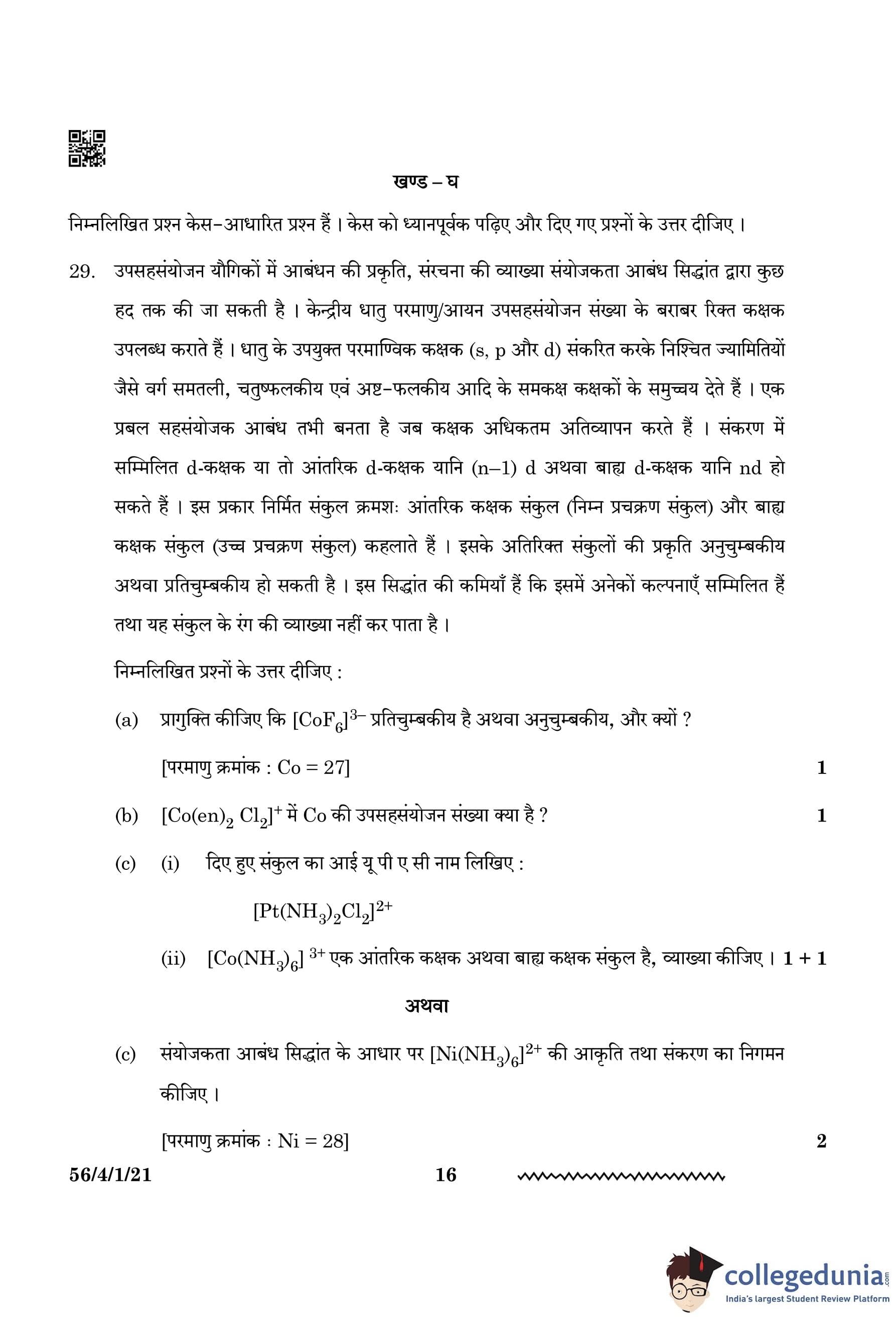
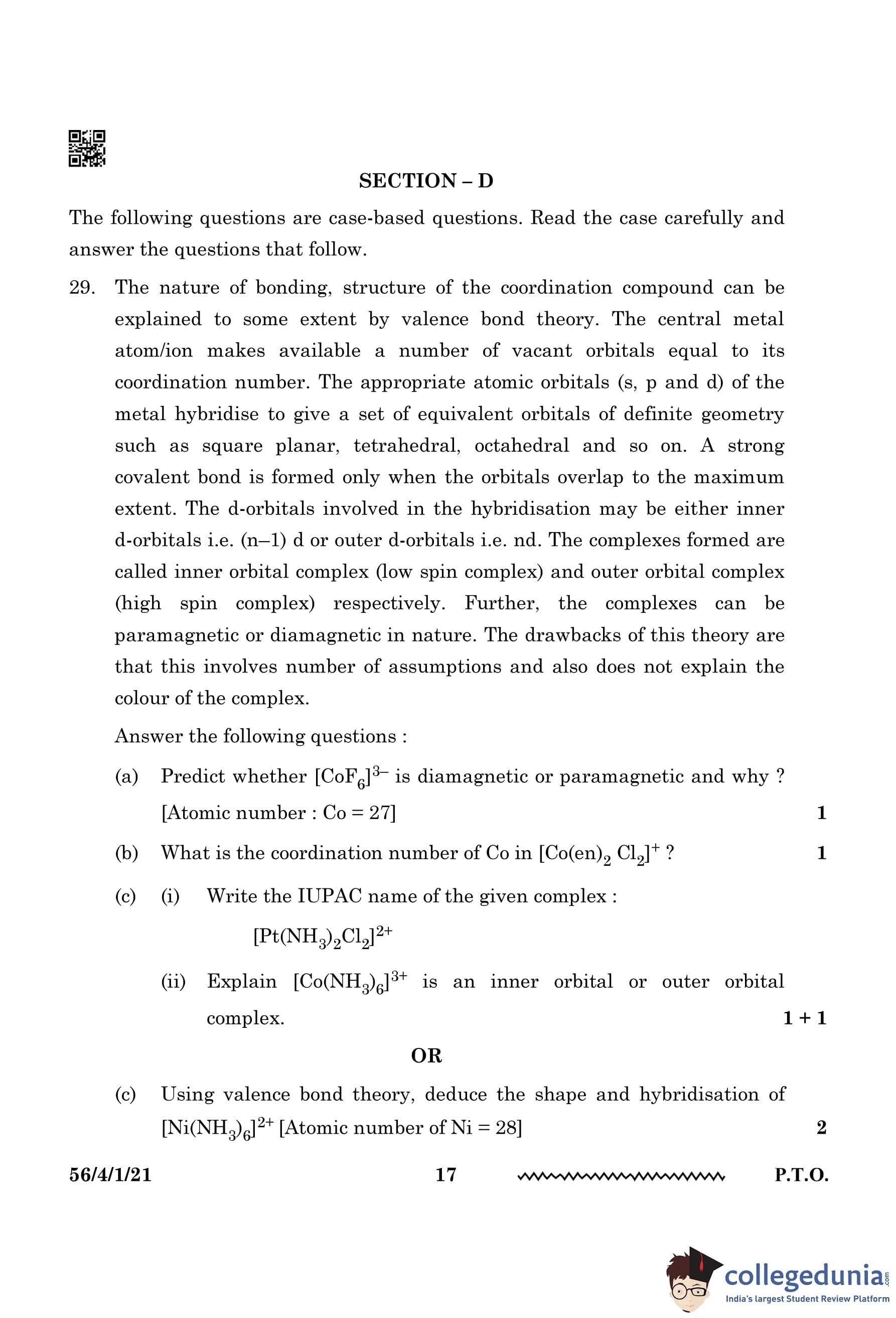
Question 29:
The nature of bonding, structure of the coordination compound can be explained to some extent by valence bond theory. The central metal atom/ion makes available a number of vacant orbitals equal to its coordination number. The appropriate atomic orbitals (s, p and d) of the metal hybridize to give a set of equivalent orbitals of definite geometry such as square planar, tetrahedral, octahedral and so on. A strong covalent bond is formed only when the orbitals overlap to the maximum extent. The d-orbitals involved in the hybridisation may be either inner d-orbitals i.e. (n−1) d or outer d-orbitals i.e. nd. The complexes formed are called inner orbital complex (low spin complex) and outer orbital complex (high spin complex) respectively. Further, the complexes can be paramagnetic or diamagnetic in nature. The drawbacks of this theory are that this involves number of assumptions and also does not explain the colour of the complex.
Question 29:
(a) Predict whether \([CoF_6]^{3-}\) is diamagnetic or paramagnetic and why?
\([Atomic \ \ number : Co = 27]\)
View Solution
Paramagnetic or Diamagnetic Nature of \([CoF_6]^{3-}\):
To predict whether \([CoF_6]^{3-}\) is paramagnetic or diamagnetic, let's look at the electronic configuration of \(Co^{3+}\). The electronic configuration of \(Co\) is \([Ar]\, 3d^7\, 4s^2\). For \(Co^{3+}\), the electrons are removed from the 4s and 3d orbitals, leaving the configuration \(3d^6\). In the case of \([CoF_6]^{3-}\), fluorine is a weak field ligand and does not cause pairing of the electrons. Therefore, the 6 electrons in the \(3d\) orbitals remain unpaired, making \([CoF_6]^{3-}\) paramagnetic.
Step 1: Determine the electron configuration of \(Co^{3+}\)
\[ Co^{3+} : 3d^6 \]
Step 2: The presence of unpaired electrons in the \(3d\) orbitals means that the complex is paramagnetic.
Quick Tip: A complex is paramagnetic if it contains unpaired electrons in its metal's d-orbitals. If all electrons are paired, it is diamagnetic.
(b) What is the coordination number of Co in \([Co(en)_2Cl_2]^+\)?
View Solution
The coordination number of a metal in a coordination complex is determined by the number of ligand atoms directly bonded to the metal ion. In \([Co(en)_2Cl_2]^+\), ethylenediamine (en) is a bidentate ligand, meaning each en ligand forms two bonds with the metal. Chloride (Cl) is a monodentate ligand, forming one bond with the metal. Therefore, the total coordination number is: \[ Coordination number = 2 \times 2 \, (from two en ligands) + 2 \, (from two Cl ligands) = 6 \] Quick Tip: The coordination number is determined by counting the number of bonds formed between the metal and the ligands. Bidentate ligands contribute two bonds.
(c) (i) Write the IUPAC name of the given complex:
\([Pt(NH_3)_2Cl_2]^{2+}\)
View Solution
In this complex, platinum (Pt) is the central metal ion, and it is surrounded by two ammonia (NH\(_3\)) ligands and two chloride (Cl\(^-\)) ligands. According to IUPAC nomenclature:
- Ammonia is a neutral ligand and is named as "ammine."
- Chloride is an anionic ligand and is named as "chloro."
- The metal ion (platinum) is named first, followed by the ligands in alphabetical order.
The IUPAC name of the complex is: \[ Diamminedichloroplatinum(II) \, ion \]
Step 1: Identify the ligands and their names (ammine and chloro).
Step 2: Name the metal and its oxidation state (Pt(II)).
Step 3: Put the ligands and metal together following IUPAC naming rules.
Quick Tip: In IUPAC naming, the ligands are named alphabetically before the metal, and the oxidation state of the metal is indicated in parentheses.
(c) (ii) Explain \([Co(NH_3)_6]^{3+}\) is an inner orbital or outer orbital complex.
View Solution
The complex \([Co(NH_3)_6]^{3+}\) involves the coordination of six ammine (NH\(_3\)) ligands to a \(Co^{3+}\) ion. For \(Co^{3+}\) (with electron configuration \(3d^6\)), the hybridization occurs using the inner \(3d\), \(4s\), and \(4p\) orbitals, as \(NH_3\) is a weak field ligand and does not cause significant pairing of electrons. Therefore, the complex uses the inner \(d\)-orbitals for hybridization and is considered an inner orbital complex.
Step 1: Consider the electron configuration of \(Co^{3+}\) and the ligands involved.
Step 2: Since \(NH_3\) is a weak field ligand, \(Co^{3+}\) does not undergo pairing, and the metal uses its inner orbitals for hybridization.
Quick Tip: Inner orbital complexes form when the metal ion uses lower energy \(d\)-orbitals for bonding. Outer orbital complexes use higher energy \(d\)-orbitals.
OR
(c) Using valence bond theory, deduce the shape and hybridisation of \([Ni(NH_3)_6]^{2+}\)
\([Atomic \ \ number \ of \ Ni = 28]\)
View Solution
For \([Ni(NH_3)_6]^{2+}\), the coordination number is 6, and the ligand is ammine (NH\(_3\)), which is a weak field ligand. Thus, the metal ion, \(Ni^{2+}\), will undergo octahedral hybridization using \(3d\), \(4s\), and \(4p\) orbitals. Since the coordination number is 6, the complex must have an octahedral shape.

Step 1: The \(Ni^{2+}\) ion has the electron configuration \(3d^8 4s^2\), and upon losing two electrons, it forms \(Ni^{2+}\) with \(3d^8\).
Step 2: The \(Ni^{2+}\) ion uses its \(3d\), \(4s\), and \(4p\) orbitals to form six hybrid orbitals, leading to an octahedral shape.
Step 3: The hybridization of the \(Ni^{2+}\) ion is sp\(^3\)d\(^2\), and the complex adopts an octahedral shape.
Quick Tip: For a coordination number of 6, the complex adopts an octahedral shape with sp\(^3\)d\(^2\) hybridization.
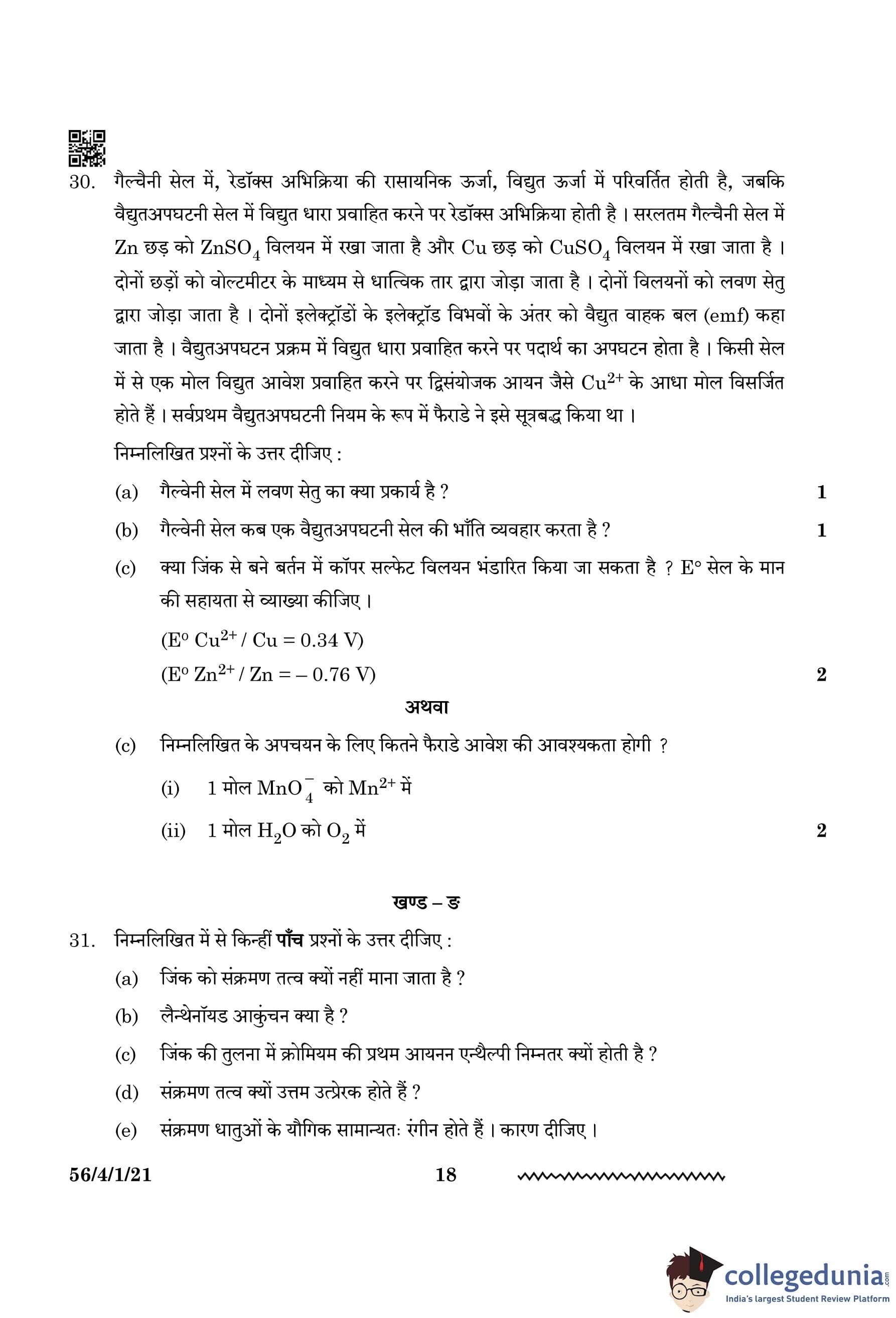
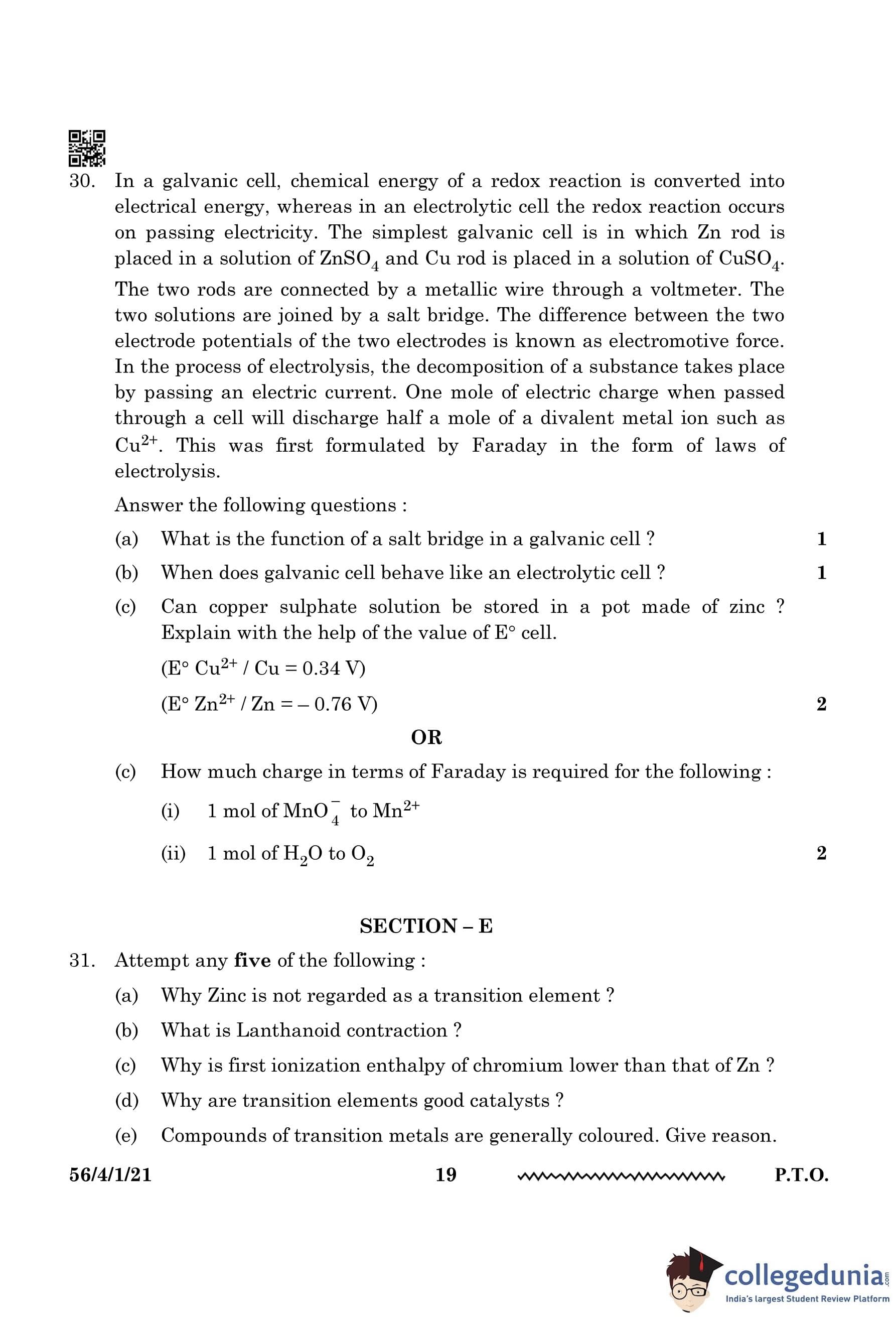
In a galvanic cell, chemical energy of a redox reaction is converted into electrical
energy, whereas in an electrolytic cell the redox reaction occurs on passing electricity.
The simplest galvanic cell is in which Zn rod is placed in a solution of ZnSO4 and Cu
rod is placed in a solution of CuSO4. The two rods are connected by a metallic wire
through a voltmeter. The two solutions are joined by a salt bridge. The difference
between the two electrode potentials of the two electrodes is known as electromotive
force. In the process of electrolysis, the decomposition of a substance takes place by
passing an electric current. One mole of electric charge when passed through a cell will
discharge half a mole of a divalent metal ion such as Cu2+. This was first formulated by
Faraday in the form of laws of electrolysis.
Question 30:
(a) What is the function of a salt bridge in a galvanic cell?
View Solution
(a) Function of a salt bridge in a galvanic cell:
The salt bridge allows the flow of ions between the two half-cells, which maintains electrical neutrality. Without the salt bridge, the flow of electrons in the external circuit would stop as the charges would accumulate in the solutions, thus preventing the redox reactions from continuing. It completes the circuit and ensures the flow of charge, allowing the electrochemical reactions to continue.
Quick Tip: A salt bridge maintains electrical neutrality in the galvanic cell by allowing ions to flow between the two half-cells.
(b) When does a galvanic cell behave like an electrolytic cell?
View Solution
A galvanic cell behaves like an electrolytic cell when an external potential greater than the emf (\( E_{cell} \)) is applied to the system. This causes the reverse of the natural spontaneous reaction, i.e., a non-spontaneous reaction occurs. In this situation, the cell starts to consume electrical energy rather than produce it. The external voltage must exceed the cell's electromotive force (\( E_{ext} > E_{cell} \)) for the reaction to reverse.
Quick Tip: When \( E_{ext} > E_{cell} \), a galvanic cell behaves like an electrolytic cell, and the electrochemical reaction is driven in reverse.
(c) Can copper sulphate solution be stored in a pot made of zinc? Explain with the help of the value of \( E^\circ_{cell} \):
View Solution
To determine if copper sulphate solution can be stored in a pot made of zinc, we need to calculate the \( E^\circ_{cell} \) for the cell. The \( E^\circ_{cell} \) is given by: \[ E^\circ_{cell} = E^\circ_{Cu^{2+}/Cu} - E^\circ_{Zn^{2+}/Zn} \]
Substituting the given values: \[ E^\circ_{cell} = 0.34 \, V - (-0.76 \, V) = 1.10 \, V \]
Since \( E^\circ_{cell} \) is positive (\(+1.10 \, V\)), the reaction will proceed spontaneously, with zinc being oxidized and copper being reduced. This means that copper sulphate solution cannot be stored in a pot made of zinc because zinc will react with the copper ions in the solution, causing zinc to dissolve and copper to deposit on the surface.
Quick Tip: A positive \( E^\circ_{cell} \) indicates that the reaction is spontaneous, so zinc will be oxidized in the presence of copper ions, making copper sulphate unsuitable for storage in a zinc pot.
Question 30:
(c) How much charge in terms of Faraday is required for the following reactions:
View Solution
To calculate the charge required, we use Faraday's first law of electrolysis, which states that one mole of electrons corresponds to 1 Faraday (F) of charge, and the amount of charge required for a reaction depends on the number of moles of electrons involved in the reaction.
(i) 1 mol of \( MnO_4^- \) to \( Mn^{2+} \):
The reaction for the reduction of \( MnO_4^- \) to \( Mn^{2+} \) involves 5 electrons, so the charge required is: \[ Charge = 5 \times F = 5F \]
(ii) 1 mol of \( H_2O \) to \( O_2 \):
The reaction for the oxidation of \( H_2O \) to \( O_2 \) involves 4 electrons, so the charge required is: \[ Charge = 4 \times F = 4F \] Quick Tip: Faraday's law relates the charge passed through a solution to the amount of substance decomposed or deposited. The number of electrons involved in a reaction determines the total charge required.
(a) Why Zinc is not regarded as a transition element?
View Solution
Zinc is not regarded as a transition element because it does not have an incomplete d-orbital in its ground state or any of its common oxidation states. The electronic configuration of zinc is \( [Ar]\, 3d^{10}4s^2 \), and in its most stable oxidation state of \( +2 \), the configuration becomes \( [Ar]\, 3d^{10} \), which is a fully filled d-orbital. For an element to be considered a transition metal, it must have at least one incomplete d-orbital in either its ground state or common oxidation states. Zinc, therefore, does not exhibit the typical characteristics of transition metals such as variable oxidation states and colored complexes.
Quick Tip: Transition metals typically have an incomplete d-orbital in their ground or common oxidation states, which is not the case for zinc.
(b) What is Lanthanoid contraction?
View Solution
Lanthanoid contraction refers to the gradual decrease in the size of the lanthanoid ions (from La\(^{3+}\) to Lu\(^{3+}\)) across the lanthanide series. Despite the increasing nuclear charge, the addition of electrons occurs mainly in the 4f orbitals, which do not effectively shield the increased positive charge. As a result, the effective nuclear charge experienced by the electrons increases, leading to a gradual contraction of the ionic radius. This contraction is particularly significant between elements such as La and Lu and affects the properties of the elements and their compounds, including the stability of their coordination complexes and their atomic size.
Quick Tip: Lanthanoid contraction occurs due to poor shielding by the 4f-electrons, causing a decrease in the size of the ions across the series.
(c) Why is first ionization enthalpy of chromium lower than that of Zn?
View Solution
The first ionization enthalpy of chromium is lower than that of zinc because of the electron configuration and the stability of the orbitals. Chromium has an electron configuration of \( [Ar]\, 3d^5 4s^1 \), where one electron from the 4s orbital is promoted to the 3d orbital, leading to a half-filled stable d-subshell. This arrangement provides extra stability to chromium, making it easier to lose an electron compared to zinc, which has a completely filled \( 3d^{10} 4s^2 \) configuration. The completely filled d-subshell in zinc results in higher stability, which makes it harder to ionize. Hence, chromium’s first ionization enthalpy is lower.
Quick Tip: Half-filled d-subshells, like in chromium, provide extra stability, making ionization easier compared to elements with completely filled orbitals like zinc.
(d) Why are transition elements good catalysts?
View Solution
Transition elements are good catalysts due to several reasons:
1. Variable oxidation states: Transition metals can easily change oxidation states, which helps in facilitating redox reactions by acting as both electron donors and acceptors.
2. Ability to form complexes: Transition metals can coordinate with various ligands, forming complexes that are essential intermediates in catalytic processes.
3. Partial filling of d-orbitals: The presence of partially filled d-orbitals allows transition metals to interact with reactant molecules, lowering activation energies.
4. Surface area: Many transition metals have high surface area, providing more active sites for reactions to occur.
These factors combined make transition metals effective in speeding up reactions without being consumed in the process.
Quick Tip: Transition metals are good catalysts due to their variable oxidation states, ability to form complexes, and partially filled d-orbitals that facilitate reaction mechanisms.
(e) Compounds of transition metals are generally coloured. Give reason.
View Solution
Compounds of transition metals are generally colored because of d-d transitions. In these compounds, the d-orbitals are split into two energy levels due to the ligand field. When electrons in the lower energy d-orbitals absorb visible light, they get excited to the higher energy d-orbitals. The wavelength of light absorbed corresponds to the energy difference between the split d-orbitals, and the remaining transmitted light gives the color of the compound. This phenomenon is common in transition metal complexes, particularly when the metal has an incomplete d-orbital configuration. The presence of ligands and the metal’s oxidation state also affect the color.
Quick Tip: Transition metal compounds are colored because of d-d transitions, where electrons absorb visible light and move between split d-orbitals.
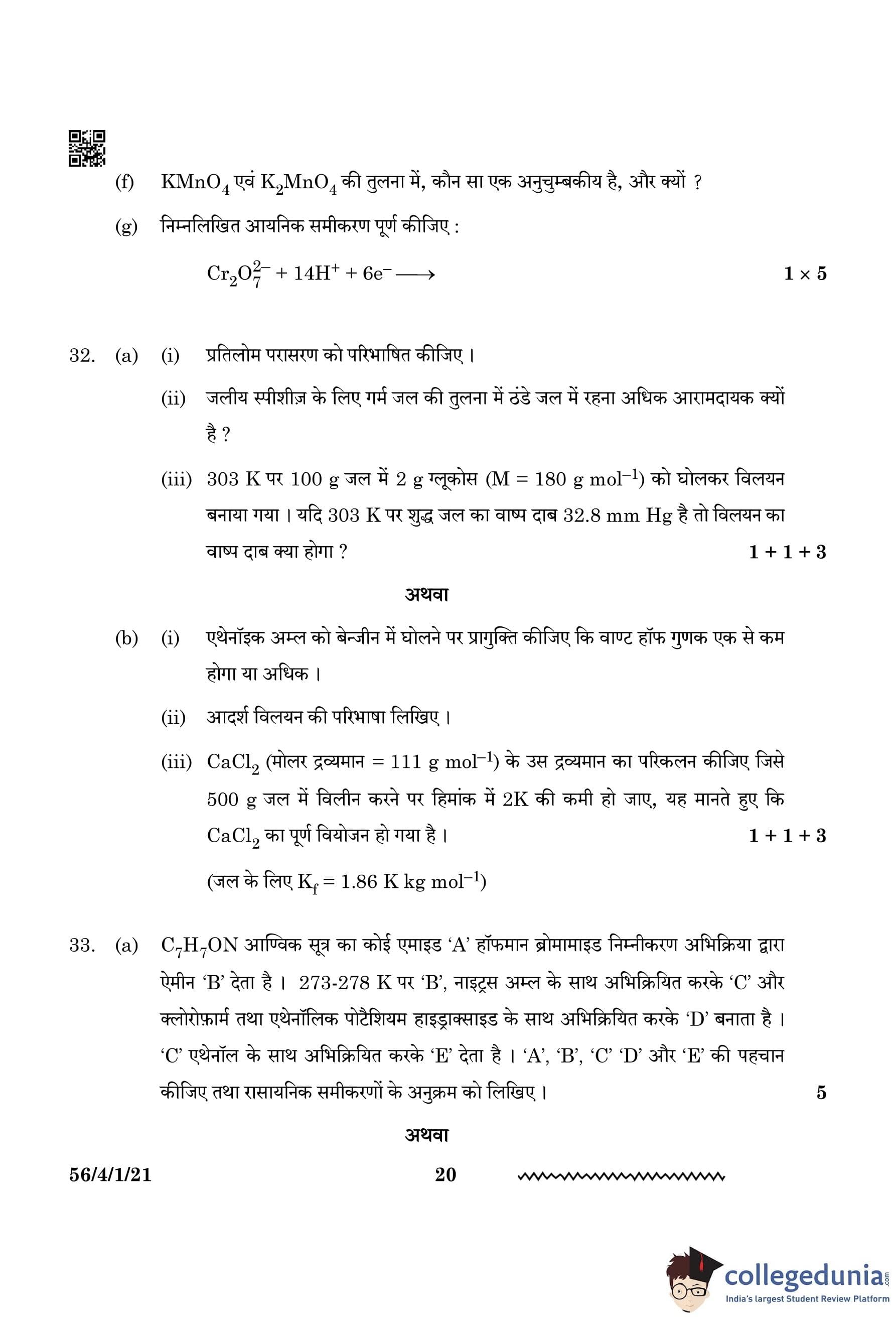
(f) Out of KMnO4 and K2MnO4, which one is paramagnetic and why?
View Solution
To determine which compound is paramagnetic, we need to examine the oxidation state of manganese and the electron configuration of the manganese ion in each compound.
- KMnO\(_4\) (Potassium permanganate): In KMnO\(_4\), the manganese ion exists in the \(+7\) oxidation state (Mn\(^{7+}\)). The electron configuration of Mn\(^{7+}\) is \( 3d^0 4s^0 \), meaning that all d-orbitals are empty. Since there are no unpaired electrons, KMnO\(_4\) is diamagnetic.
- K\(_2\)MnO\(_4\) (Potassium manganate): In K\(_2\)MnO\(_4\), the manganese ion exists in the \(+6\) oxidation state (Mn\(^{6+}\)). The electron configuration of Mn\(^{6+}\) is \( 3d^1 4s^0 \), meaning there is one unpaired electron in the d-orbital. Since there is at least one unpaired electron, K\(_2\)MnO\(_4\) is paramagnetic.
Step 1: Examine the oxidation state of manganese in each compound.
Step 2: Check the number of unpaired electrons in the electron configuration of the manganese ion.
Quick Tip: Paramagnetic substances have unpaired electrons, while diamagnetic substances have all electrons paired.
(g) Complete the following ionic equation:
Cr\(_2\)O\(_7^{2-}\) + 14 H\(^+\) + 6 e\(^-\) \(\rightarrow\)
View Solution
This is a half-reaction for the reduction of dichromate ions (\( Cr_2O_7^{2-} \)) to chromium(III) ions. The oxidation states of chromium change from \( +6 \) in \( Cr_2O_7^{2-} \) to \( +3 \) in \( Cr^{3+} \).
The ionic equation is as follows:
\[ Cr_2O_7^{2-} + 14 \, H^+ + 6 \, e^- \rightarrow 2 \, Cr^{3+} + 7 \, H_2O \]
Step 1: Balance the chromium atoms. In \( Cr_2O_7^{2-} \), there are two chromium atoms, so we need to produce two \( Cr^{3+} \) ions on the right side of the equation.
Step 2: Balance the oxygen atoms. In \( Cr_2O_7^{2-} \), there are 7 oxygen atoms, so we add 7 molecules of water (H\(_2\)O) on the right side to balance the oxygens.
Step 3: Balance the hydrogen atoms. Since there are 7 water molecules, there are 14 hydrogen atoms on the right side, so we add 14 \( H^+ \) ions on the left side.
Step 4: Finally, balance the charges by adding 6 electrons on the left side, as the total positive charge on the left side (from the \( H^+ \) ions) needs to be balanced by the electrons.
Quick Tip: When balancing redox reactions, start by balancing the atoms, then the charges, and use electrons to balance the charge.
(a) (i) Define reverse osmosis.
View Solution
Step 1: Reverse osmosis is the process in which solvent molecules pass through a semipermeable membrane from a region of low solute concentration to a region of high solute concentration when pressure greater than the osmotic pressure is applied. The solvent moves against the natural osmotic gradient.
Step 2: This process is widely used in water purification and desalination, where solvent (typically water) is purified by removing solutes like salts and other impurities. Quick Tip: In reverse osmosis, pressure is applied to push the solvent from low concentration to high concentration across a semipermeable membrane.
(a) (ii) Why are aquatic species more comfortable in cold water in comparison to warm water?
View Solution
Step 1: Cold water has a higher solubility for gases such as oxygen. Since oxygen is crucial for respiration in aquatic species, cold water allows more oxygen to dissolve, making it more available for aquatic species.
Step 2: As temperature increases, the solubility of gases in water decreases. Therefore, warmer water contains less dissolved oxygen, making it less suitable for aquatic life. Quick Tip: Cold water can hold more dissolved oxygen, making it more suitable for aquatic species, as they rely on dissolved oxygen for respiration.
(a) (iii) A solution containing 2 g of glucose (M = 180 g mol\(^{-1}\)) in 100 g of water is prepared at 303 K. If the vapour pressure of pure water at 303 K is 32.8 mm Hg, what would be the vapour pressure of the solution?
View Solution
We can calculate the vapour pressure of the solution using Raoult’s Law, which states that the vapour pressure of the solvent in the solution is proportional to the mole fraction of the solvent.
\[ P = P_0 \times X_{solvent} \]
Where:
- \( P_0 = 32.8 \, mm Hg \) is the vapour pressure of pure water,
- \( X_{solvent} \) is the mole fraction of water.
Step 1: Calculate the moles of glucose: \[ Moles of glucose = \frac{2}{180} = 0.0111 \, mol \]
Step 2: Calculate the moles of water: \[ Moles of water = \frac{100}{18} = 5.56 \, mol \]
Step 3: Calculate the mole fraction of water: \[ X_{water} = \frac{moles of water}{moles of water + moles of glucose} = \frac{5.56}{5.56 + 0.0111} = 0.998 \]
Step 4: Calculate the vapour pressure of the solution: \[ P = 32.8 \times 0.998 = 32.734 \, mm Hg \]
Thus, the vapour pressure of the solution is 32.734 mm Hg. Quick Tip: Raoult's Law states that the vapour pressure of a solvent in a solution is proportional to the mole fraction of the solvent. The presence of a solute lowers the vapour pressure.
(b) (i) Predict whether Van’t Hoff factor will be less or greater than one when Ethanoic acid is dissolved in benzene.
View Solution
Ethanoic acid (CH\(_3\)COOH) is a weak acid and it forms dimers in benzene due to hydrogen bonding between two molecules of ethanoic acid. The formation of dimers reduces the number of particles in the solution. Since Van’t Hoff factor \(i\) represents the number of particles in solution, for ethanoic acid in benzene, \( i \) will be less than 1 due to the dimerization process.
Step 1: Ethanoic acid dissociates into dimers, reducing the total number of particles in the solution.
Step 2: Therefore, the Van’t Hoff factor \( i \) will be less than 1. Quick Tip: Van’t Hoff factor (\(i\)) is less than 1 when solute molecules form complexes or dimers in solution.
(b) (ii) Define ideal solution.
View Solution
An ideal solution is one that obeys Raoult’s Law completely over the entire range of concentrations. In an ideal solution, the enthalpy of mixing is zero, and the intermolecular forces between the components (solvent-solvent, solute-solute, and solvent-solute) are similar. There is no excess enthalpy change upon mixing, and the vapor pressure of the solution is proportional to the mole fraction of each component. Real solutions that do not follow Raoult's law due to differences in intermolecular interactions are termed non-ideal solutions. Quick Tip: Ideal solutions obey Raoult’s law at all concentrations and have no enthalpy change during mixing, implying similar intermolecular forces between components.
(b) (iii) Calculate the mass of CaCl\(_2\) (molar mass = 111 g mol\(^{-1}\)) to be dissolved in 500 g of water to lower its freezing point by 2K, assuming that CaCl\(_2\) undergoes complete dissociation.
View Solution
We can use the formula for freezing point depression:
\[ \Delta T_f = i \times K_f \times m \]
Where:
- \( \Delta T_f = 2 \, K \),
- \( K_f = 1.86 \, K kg mol^{-1} \) (given),
- \( i = 3 \) (for CaCl\(_2\) as it dissociates into 3 ions: Ca\(^{2+}\) and 2 Cl\(^{-}\)),
- \( m \) is the molality of the solution.
Step 1: Rearrange the equation to solve for molality: \[ m = \frac{\Delta T_f}{i \times K_f} = \frac{2}{3 \times 1.86} = 0.358 \, mol/kg \]
Step 2: Calculate the moles of CaCl\(_2\): \[ moles of CaCl_2 = m \times mass of solvent = 0.358 \times 0.5 = 0.179 \, mol \]
Step 3: Calculate the mass of CaCl\(_2\): \[ mass of CaCl_2 = moles \times molar mass = 0.179 \times 111 = 19.89 \, g \]
Thus, the mass of CaCl\(_2\) required is 19.89 g. Quick Tip: Freezing point depression depends on the molality and the Van’t Hoff factor. For ionic compounds like CaCl\(_2\), dissociation increases the number of particles and the effect on the freezing point.
(a) An amide ‘A’ with molecular formula C\(_7\)H\(_7\)ON undergoes Hoffmann Bromamide degradation reaction to give amine ‘B’. ‘B’ on treatment with nitrous acid at 273-278 K forms ‘C’ and on treatment with chloroform and ethanolic potassium hydroxide forms ‘D’. ‘C’ on treatment with ethanol gives ‘E’. Identify ‘A’, ‘B’, ‘C’, ‘D’ and ‘E’ and write the sequence of chemical equations.
View Solution
Step 1: Identify the structure of ‘A’ (C\(_7\)H\(_7\)ON):
The molecular formula C\(_7\)H\(_7\)ON suggests the compound is a derivative of an amide. A common structure that fits this molecular formula is benzamide (C\(_6\)H\(_5\)CONH\(_2\)), which contains a benzene ring attached to a carboxamide group.
Step 2: Hoffmann Bromamide degradation reaction:
In this reaction, benzamide (A) undergoes a degradation when treated with bromine in the presence of alkali (usually NaOH) to give a primary amine. The reaction leads to the loss of one carbon atom from the amide.
- The product ‘B’ is aniline (C\(_6\)H\(_5\)NH\(_2\)), formed after the elimination of CO\(_2\) from the amide group.
\[ C_6H_5CONH_2 \xrightarrow{Br_2/NaOH} C_6H_5NH_2 \quad (Aniline) \]
Step 3: Reaction of ‘B’ with nitrous acid:
When aniline (B) reacts with nitrous acid (HNO\(_2\)) at 273-278 K, it undergoes diazotization followed by deamination to form a phenol derivative.
- The product ‘C’ is phenol (C\(_6\)H\(_5\)OH).
\[ C_6H_5NH_2 + HNO_2 \rightarrow C_6H_5OH + N_2 (gas) \]
Step 4: Reaction of ‘B’ with chloroform and ethanolic potassium hydroxide:
When aniline (B) is treated with chloroform (CHCl\(_3\)) and ethanolic potassium hydroxide (KOH), it undergoes the Carbylamine reaction, which produces an isocyanide (or isothiocyanate).
- The product ‘D’ is phenyl isocyanide (C\(_6\)H\(_5\)NC).
\[ C_6H_5NH_2 + CHCl_3 + KOH \rightarrow C_6H_5NC + KCl + H_2O \]
Step 5: Reaction of ‘C’ with ethanol:
When phenol (C) reacts with ethanol, it undergoes etherification to form an ethoxy group attached to the benzene ring.
- The product ‘E’ is ethyl phenyl ether (C\(_6\)H\(_5\)OCH\(_2\)CH\(_3\)).
\[ C_6H_5OH + C_2H_5OH \xrightarrow{HCl} C_6H_5OCH_2CH_3 \] Quick Tip: Hoffmann Bromamide degradation removes the carbonyl group from amides, forming amines. Diazotization of amines with nitrous acid yields phenol derivatives. Carbylamine reaction with chloroform forms isocyanides.
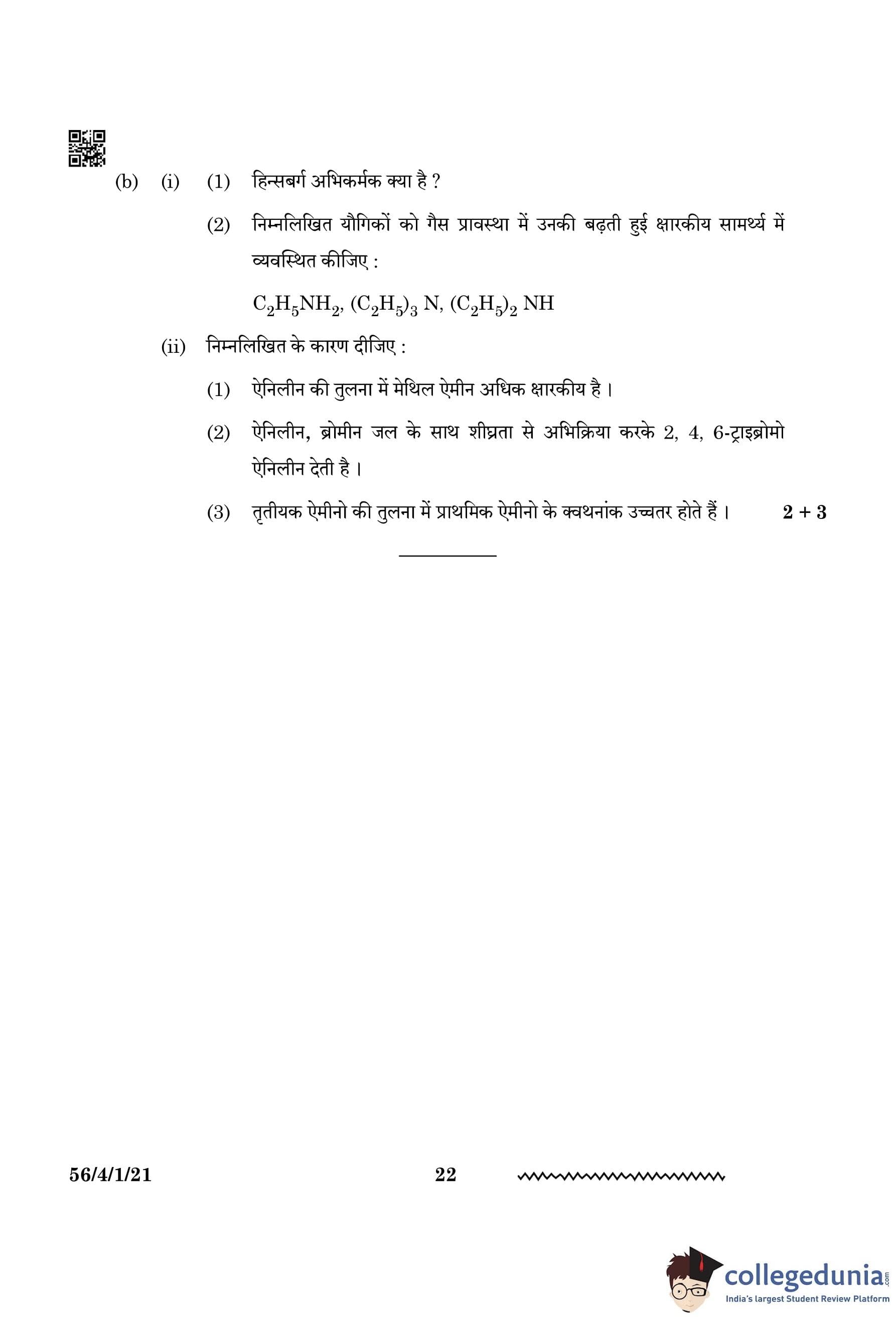
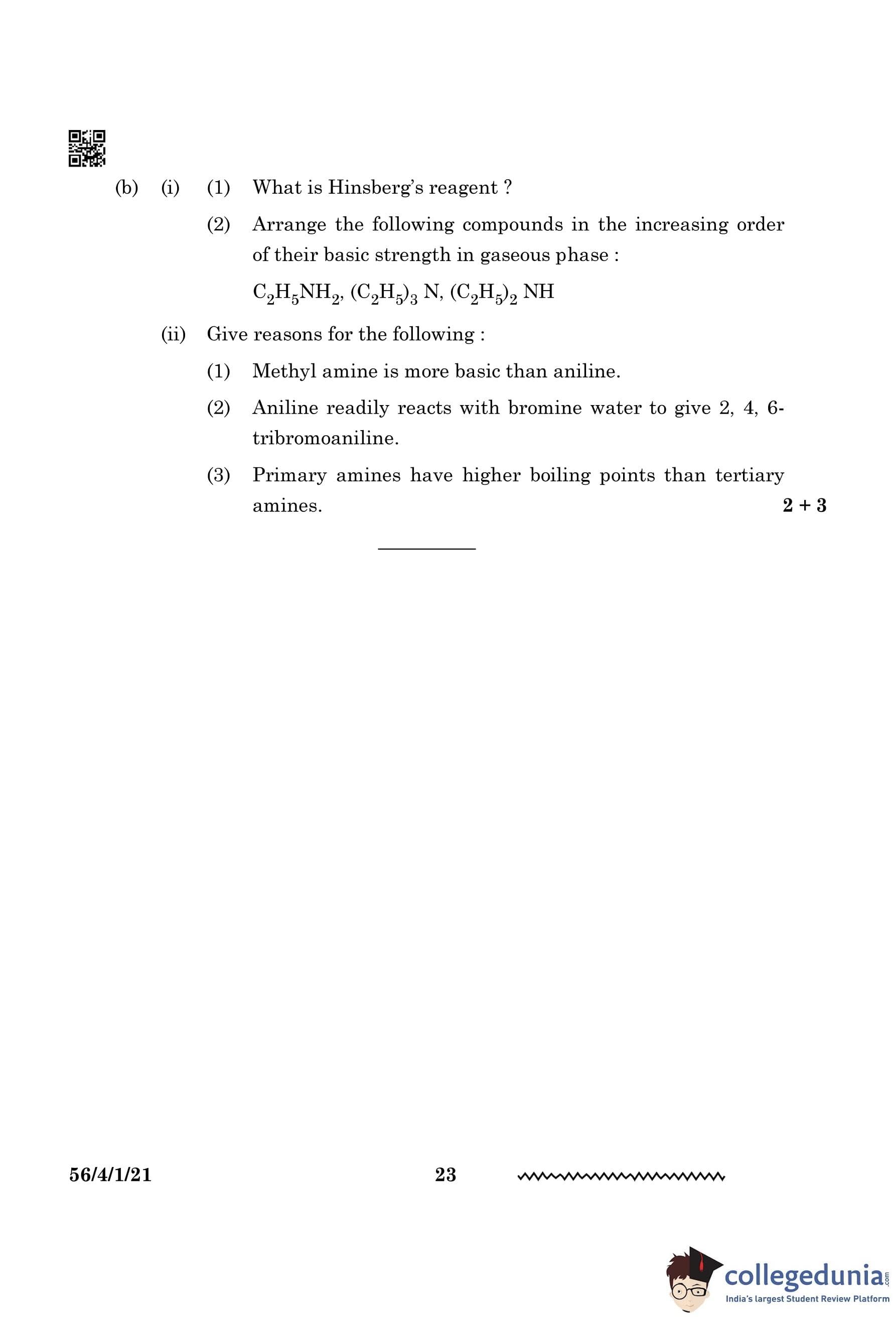
(b) (i) (1) What is Hinsberg’s reagent?
View Solution
Hinsberg’s reagent is benzenesulfonyl chloride (C\(_6\)H\(_5\)SO\(_2\)Cl), which is used to differentiate between primary, secondary, and tertiary amines. The reagent reacts with primary amines to form sulfonamides, with secondary amines to form N-alkyl sulfonamides, and with tertiary amines, no reaction occurs due to the lack of an available hydrogen atom for reaction. This test helps distinguish between the different classes of amines. Quick Tip: Hinsberg’s reagent is used to differentiate between primary, secondary, and tertiary amines based on their reactions with the sulfonyl chloride group.
(b) (i) (2) Arrange the following compounds in the increasing order of their basic strength in the gaseous phase:
C\(_6\)H\(_5\)NH\(_2\), (C\(_2\)H\(_5\))\(_3\)N, (C\(_2\)H\(_5\))\(_2\)NH
View Solution
Basic strength of amines is influenced by the electron-donating or electron-withdrawing nature of their substituents. Alkyl groups are electron-donating, which increases the basicity of the amine, whereas an aromatic group (like in aniline) is electron-withdrawing and decreases the basicity.
Order of basicity in the gaseous phase:
\(C_6H_5NH_2\) \(<\) \((C_2H_5)_2NH\) \(<\) \((C_2H_5)_3N\)
- C\(_6\)H\(_5\)NH\(_2\) (Aniline) has the lowest basicity because the phenyl group withdraws electron density from the nitrogen.
- (C\(_2\)H\(_5\))\(_2\)NH (Diethylamine) has higher basicity because two ethyl groups donate electron density to the nitrogen.
- (C\(_2\)H\(_5\))\(_3\)N (Triethylamine) has the highest basicity due to the three electron-donating ethyl groups. Quick Tip: Aromatic groups withdraw electron density, reducing basicity, while alkyl groups donate electron density, increasing basicity.
(b) (ii) Give reasons for the following:
(1) Methyl amine is more basic than aniline.
View Solution
Methylamine (CH\(_3\)NH\(_2\)) is more basic than aniline (C\(_6\)H\(_5\)NH\(_2\)) because the methyl group is an electron-donating group. It increases the electron density on the nitrogen atom, making it more available to accept a proton. In contrast, the phenyl group in aniline is electron-withdrawing through resonance, decreasing the electron density on the nitrogen atom and thus reducing its basicity.
Step 1: Methyl group donates electrons, increasing basicity.
Step 2: Phenyl group withdraws electrons, decreasing basicity. Quick Tip: Electron-donating groups (like methyl) increase basicity, while electron-withdrawing groups (like phenyl) decrease basicity.
(b) (ii) (2) Aniline readily reacts with bromine water to give 2, 4, 6-tribromoaniline.
View Solution
Aniline reacts with bromine water in an electrophilic aromatic substitution reaction. The amino group (-NH\(_2\)) in aniline is an electron-donating group, which activates the benzene ring towards electrophilic substitution. The bromine molecules attack the ortho and para positions relative to the amino group, resulting in the formation of 2, 4, 6-tribromoaniline.
Step 1: Amino group donates electrons to the ring, making it more reactive.
Step 2: Bromine undergoes electrophilic substitution at the activated positions. Quick Tip: Electron-donating groups like -NH\(_2\) activate the aromatic ring towards electrophilic substitution, leading to products like 2, 4, 6-tribromoaniline.
(b) (ii) (3) Primary amines have higher boiling points than tertiary amines.
View Solution
Primary amines have higher boiling points than tertiary amines due to the ability to form hydrogen bonds. In primary amines, the nitrogen atom has a hydrogen atom attached, allowing for hydrogen bonding between molecules. Tertiary amines, on the other hand, do not have a hydrogen atom on the nitrogen, so they cannot form hydrogen bonds as efficiently, leading to lower boiling points.
Step 1: Primary amines form hydrogen bonds, increasing boiling point.
Step 2: Tertiary amines cannot form hydrogen bonds, leading to lower boiling points. Quick Tip: Hydrogen bonding increases boiling point. Primary amines have higher boiling points than tertiary amines due to the presence of hydrogen atoms on the nitrogen.





CBSE Class 12 Chemistry Exam Analysis
The Chemistry paper conducted today, i.e. February 27, 2024, was reported to be of moderate difficulty level. Students found the MCQ part to be tricky but Section B was easy. Most of the questions were NCERT-based.



Comments