




The CBSE Class 12 Cost Accounting Question Paper 2026 is available for download here of CBSE Board Exam 2026. This CBSE 12th Cost Accounting solved question paper includes detailed solutions, answer key, and the latest CBSE marking scheme to help students understand the exam pattern and important topics.
By practicing the CBSE Class 12 Cost Accounting 2026 board exam paper PDF, students can improve answer-writing strategy, time management, and overall exam performance.
CBSE Class 12 Cost Accounting Question Paper 2026 with Solution PDF
| CBSE Class 12 Cost Accounting Question Paper 2026 with Solution PDF | Download PDF | Check Solutions |
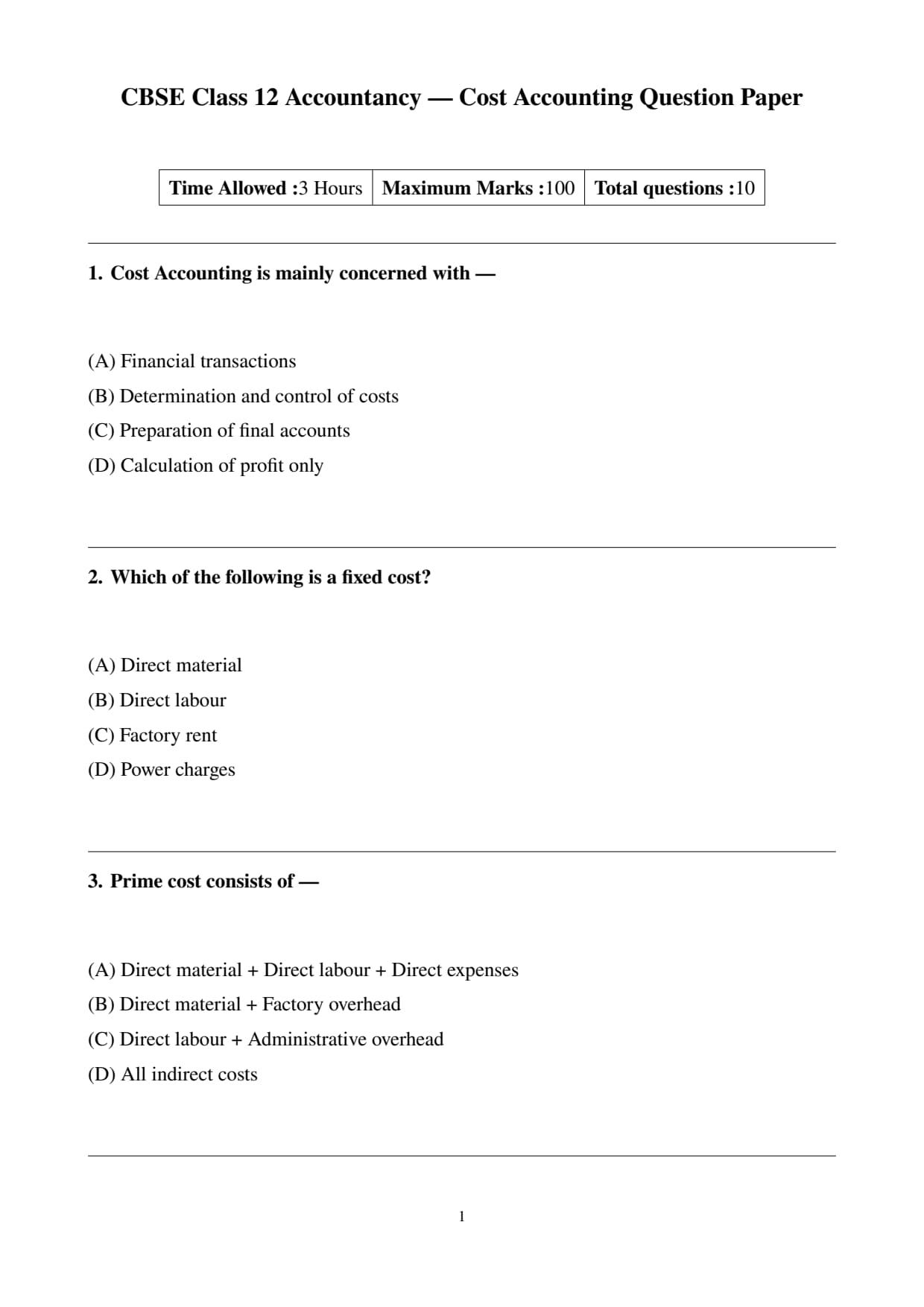
Cost Accounting is mainly concerned with —
View Solution
Cost Accounting focuses on determining, recording, and controlling costs of production to improve efficiency and profitability.
Step 1: Analyze the options.
- Financial transactions — Financial Accounting
- Determination and control of costs — Correct ✔
- Preparation of final accounts — Financial Accounting
- Profit calculation only — Too limited
Step 2: Conclusion.
Thus option (B) is correct.
Final Answer: \[ \boxed{(B)} \] Quick Tip: Cost Accounting = Cost control + Efficiency
Which of the following is a fixed cost?
View Solution
Fixed costs remain constant regardless of production level. Factory rent does not change with output.
Final Answer: \[ \boxed{(C)} \] Quick Tip: Fixed cost = Constant total cost
Prime cost consists of —
View Solution
Prime cost includes all direct costs of production.
\[ Prime Cost = Direct Material + Direct Labour + Direct Expenses \]
Final Answer: \[ \boxed{(A)} \] Quick Tip: Prime Cost = Direct Costs only
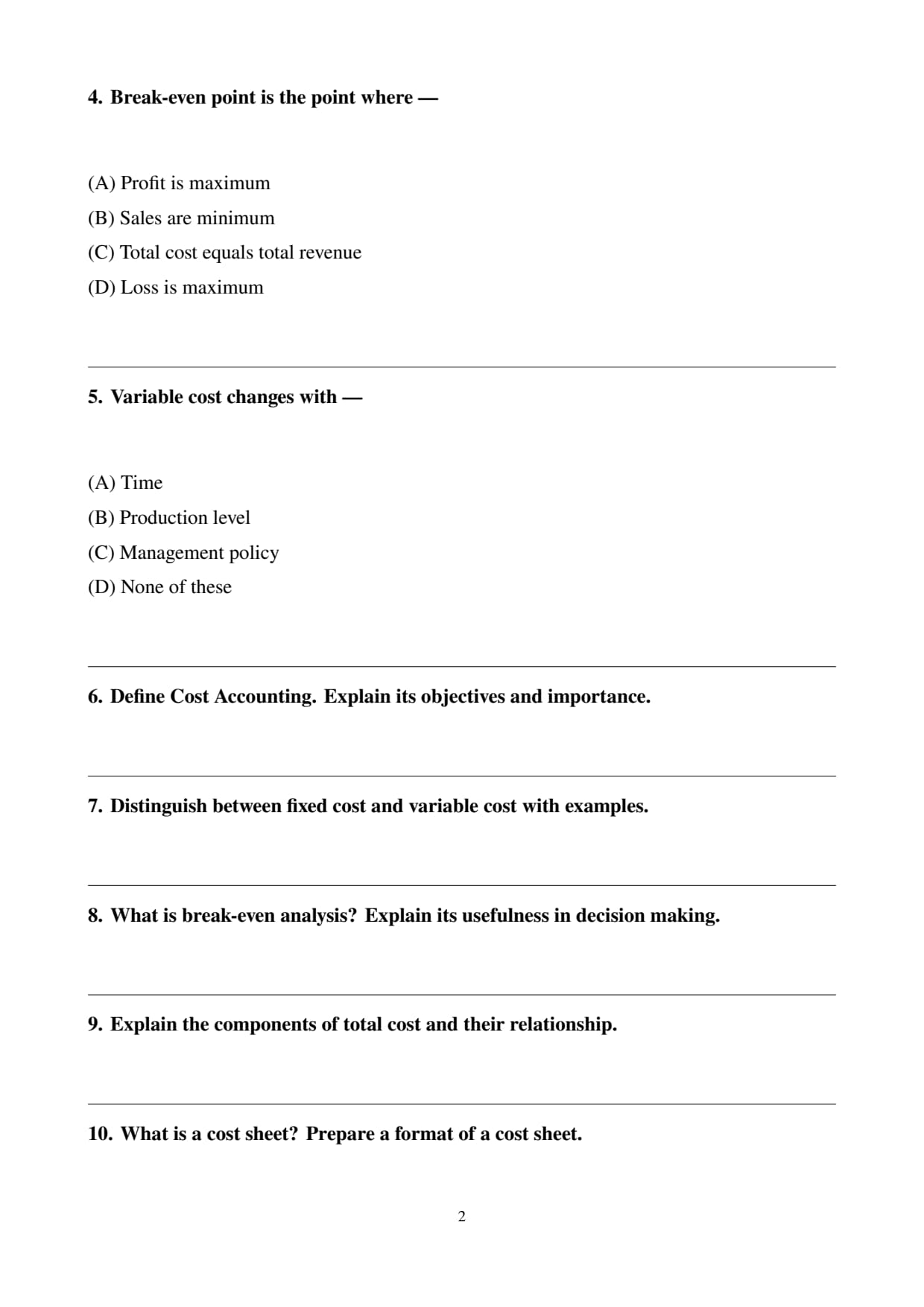
Break-even point is the point where —
View Solution
At break-even point, there is neither profit nor loss because total cost equals total revenue.
Final Answer: \[ \boxed{(C)} \] Quick Tip: Break-even = No profit, No loss
Variable cost changes with —
View Solution
Variable costs increase or decrease in direct proportion to the level of output.
Final Answer: \[ \boxed{(B)} \] Quick Tip: Production ↑ ⇒ Variable Cost ↑
Define Cost Accounting. Explain its objectives and importance.
View Solution
Cost Accounting is the process of recording, analyzing, and controlling costs associated with production. It helps management in planning, controlling expenses, fixing prices, and improving efficiency.
It is important because it assists in cost reduction, profit maximization, decision making, and proper utilization of resources. Quick Tip: Cost Accounting supports managerial planning
Distinguish between fixed cost and variable cost with examples.
View Solution
Fixed costs remain constant irrespective of production (e.g., rent, salaries). Variable costs change with output (e.g., raw materials, direct labour). Quick Tip: Fixed = Constant total, Variable = Changes with output
What is break-even analysis? Explain its usefulness in decision making.
View Solution
Break-even analysis determines the level of sales at which total revenue equals total cost. It helps management plan production, pricing, and profitability. Quick Tip: BEP helps determine minimum sales required
Explain the components of total cost and their relationship.
View Solution
Total cost consists of fixed cost and variable cost.
\[ Total Cost = Fixed Cost + Variable Cost \]
Fixed costs remain constant while variable costs change with production. Quick Tip: Total Cost = Fixed + Variable
What is a cost sheet? Prepare a format of a cost sheet.
View Solution
A cost sheet is a statement showing the detailed cost of production at different stages.
Format:
\begin{tabular{|p{8cm|p{3cm|
\hline
Direct Material & xxx
Direct Labour & xxx
Direct Expenses & xxx
\hline
Prime Cost & xxx
Factory Overheads & xxx
\hline
Factory Cost & xxx
Administrative Overheads & xxx
\hline
Cost of Production & xxx
Selling Overheads & xxx
\hline
Total Cost & xxx
\hline
\end{tabular Quick Tip: Cost sheet shows cost at each stage of production






Comments