




CBSE Class 12 Economics Question Paper 2024 PDF (Set 1- 58/5/1) is available for download here. CBSE conducted the Economics exam on March 18, 2024 from 10:30 AM to 1:30 PM. The total marks for the theory paper are 80. The question paper contains 20% MCQ-based questions, 40% competency-based questions, and 40% short and long answer type questions. Candidates can use the link below to download the CBSE Class 12 Economics Set 1 Question Paper with detailed solutions.
CBSE Class 12 Economics Question Paper 2024 (Set 1- 58/5/1) with Answer Key
| CBSE Class 12 2024 Economics Question Paper with Answer Key |  Download Download |
Check Solution |
CBSE Class 12 2024 Economics Questions with Solutions
SECTION A
Macro Economics
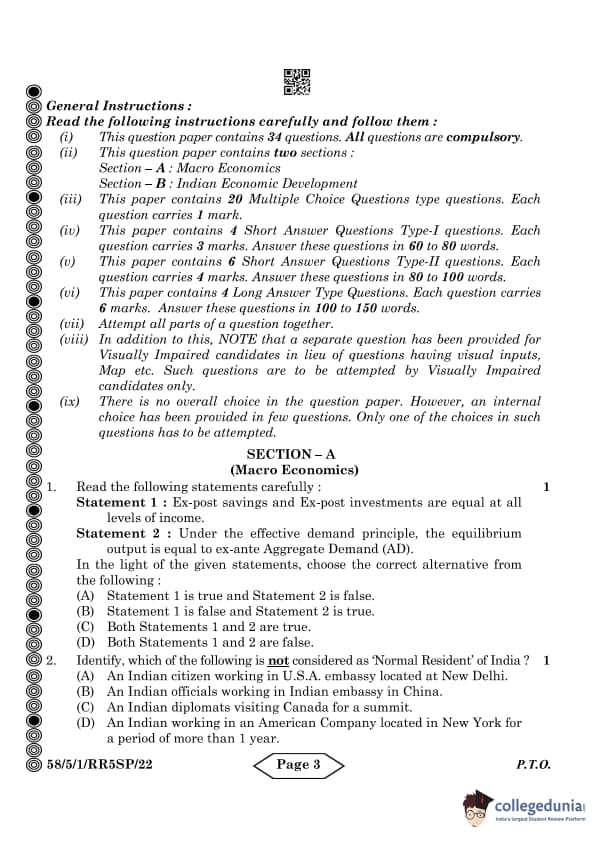
Question 1:
Read the following statements carefully:
Statement 1: Ex-post savings and Ex-post investments are equal at all levels of income.
Statement 2: Under the effective demand principle, the equilibrium output is equal to ex-ante Aggregate Demand (AD).
In the light of the given statements, choose the correct alternative from the following:
View Solution
Solution:
- Statement 1 is true: Ex-post savings and investments are equal because savings always equal investment in an economy when accounting for all income. The total savings will be used for investments.
- Statement 2 is true: Under the effective demand principle, the equilibrium output is determined when ex-ante Aggregate Demand (AD) equals actual output, i.e., the economy is at full employment.
Conclusion: Both statements are correct: Ex-post savings and investment are equal, and the equilibrium output is determined by ex-ante Aggregate Demand.
Question 2:
Identify which of the following is not considered as ‘Normal Resident' of India?
View Solution
Solution:
- Normal Resident:
A normal resident of India is defined as someone who resides in India for at least 182 days during the last financial year.
- Option (D): An Indian citizen working abroad for more than 1 year is not considered a normal resident of India, as they are considered a non-resident for tax and other economic purposes.
Conclusion: Option (D) is the correct answer as it represents someone working abroad for an extended period, thus not a "normal resident” of India.
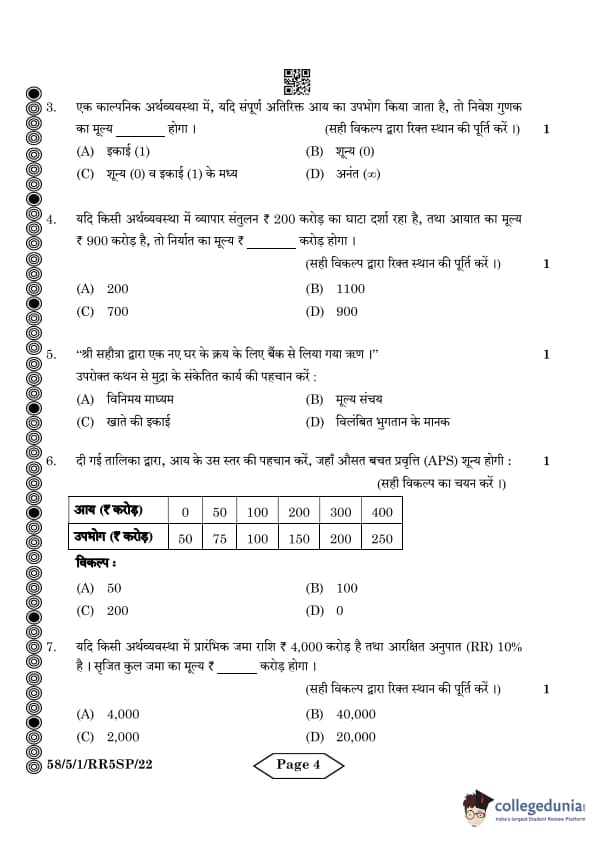
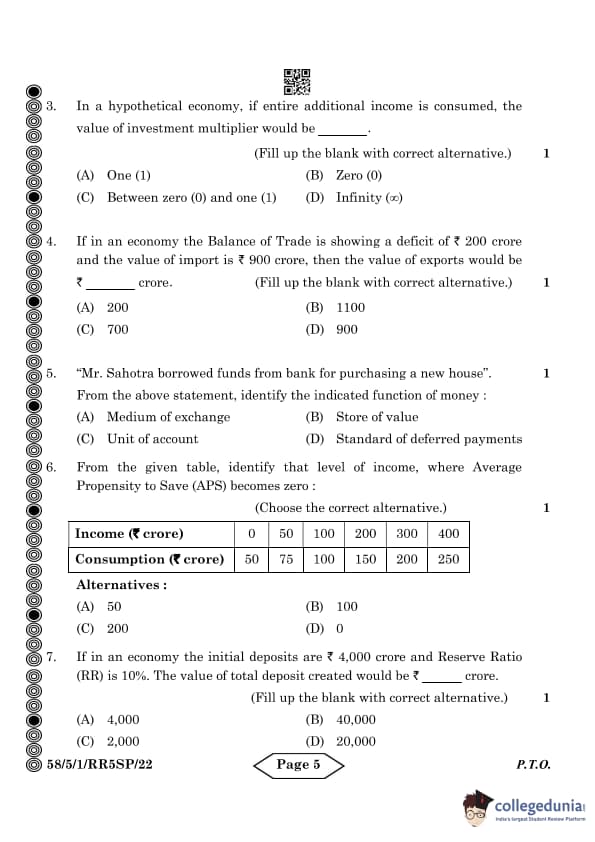
Question 3:
In a hypothetical economy, if entire additional income is consumed, the value of investment multiplier would be _______ . (Fill up the blank with the correct alternative.)
View Solution
Solution:
- The investment multiplier is calculated as 1⁄1-MPC, where MPC is the marginal propensity to consume.
- If the entire income is consumed, the MPC = 1, leading to an infinite multiplier because 1⁄1-1 = ∞.
- Hence, the value of the investment multiplier in this case is infinity.
Conclusion: When all additional income is consumed, the investment multiplier becomes infinite because every increase in income leads to an equivalent increase in consumption, stimulating constant economic growth.
Question 4:
If in an economy the Balance of Trade is showing a deficit of Rs.200 crore and the value of import is Rs.900 crore, then the value of exports would be Rs.__________crore. (Fill up the blank with the correct alternative.)
View Solution
Solution:
- The Balance of Trade (BOT) is calculated as Exports - Imports.
- Given that BOT = Rs.-200 crore and Imports = Rs.900 crore, we can use the formula:
Exports - Imports = BOT
Substituting the values:
Exports - 900 = -200
Solving for Exports:
Exports = 700
Conclusion: The value of exports required to maintain a balance of trade deficit of Rs.200 crore is Rs.700 crore.
Question 5:
“Mr. Sahotra borrowed funds from bank for purchasing a new house.” From the above statement, identify the indicated function of money:
View Solution
Solution:
The function of money in this context is the Standard of deferred payments, as Mr. Sahotra is borrowing funds for a future purchase. Money is being used as a means to make payments over time rather than immediately, which is the essence of deferred payments.
Conclusion: In this case, money serves the function of deferred payments, allowing Mr. Sahotra to repay the loan over time for his house.
Question 6:
From the given table, identify that level of income, where Average Propensity to Save (APS) becomes zero:
| Income (Rs. crore) | Consumption (Rs. crore) |
|---|---|
| 0 | 50 |
| 50 | 75 |
| 100 | 100 |
| 200 | 150 |
| 300 | 200 |
| 400 | 250 |
View Solution
Solution:
The Average Propensity to Save (APS) is calculated as:
APS = Savings⁄Income = Income – Consumption⁄Income
At Income = 100 crore, consumption is also 100 crore. Hence, savings will be zero:
Savings = Income – Consumption = 100 – 100 = 0
Thus, APS = 0 when income is 100 crore.
Conclusion: The APS becomes zero at 100 crore income because savings equal zero when consumption is equal to income.
Question 7:
If in an economy the initial deposits are Rs.4,000 crore and Reserve Ratio (RR) is 10 percent. The value of total deposit created would be Rs.__________ crore.
View Solution
Solution:
The total deposit created in the banking system is given by the formula:
Total Deposits = Initial Deposits⁄Reserve Ratio
Substituting the given values:
Total Deposits = 4000⁄0.10 = 40,000
Conclusion: The total deposit created would be Rs.40,000 crore due to the 10 percent reserve ratio.
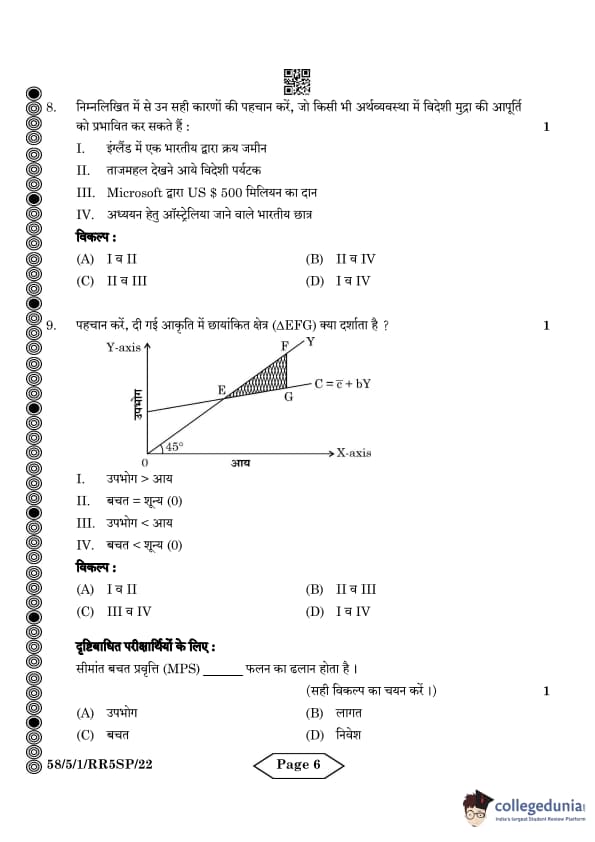
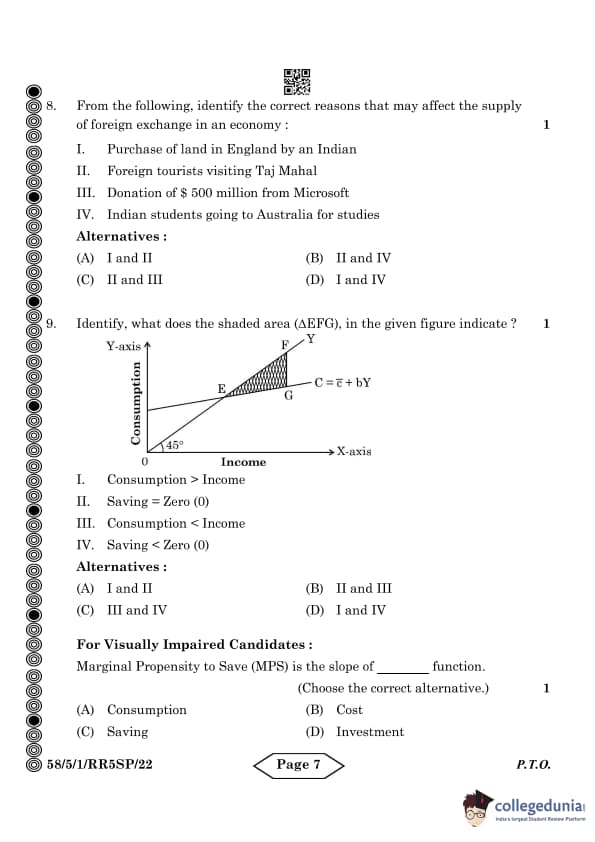
Question 8:
From the following, identify the correct reasons that may affect the supply of foreign exchange in an economy:
I. Purchase of land in England by an Indian
II. Foreign tourists visiting Taj Mahal
III. Donation of 500 million dollars from Microsoft
IV. Indian students going to Australia for studies
View Solution
Solution:
- Reason II (Foreign tourists visiting Taj Mahal) will bring foreign exchange into India as they spend money during their visit.
- Reason III (Donation of 500 million dollars from Microsoft) will also increase foreign exchange supply as it is an inflow of funds into the economy.
Conclusion: The correct answer is (C), as foreign tourists and donations will directly impact the supply of foreign exchange.
Question 9:
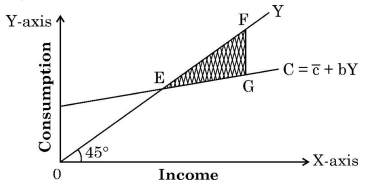
Identify, what does the shaded area (change in EFG), in the given figure indicate?
View Solution
Solution:
The shaded area (EFG) typically represents a situation where savings are zero or negative, and consumption is either greater than or less than income:
- II: Saving = Zero (0): At the equilibrium point where consumption equals income, savings are zero.
- III: Consumption < Income: When the shaded area shows consumption below income, it indicates that savings are positive (but might be in a negative savings area in other sections).
Therefore, the correct options are (B) II and III or (C) III and IV.
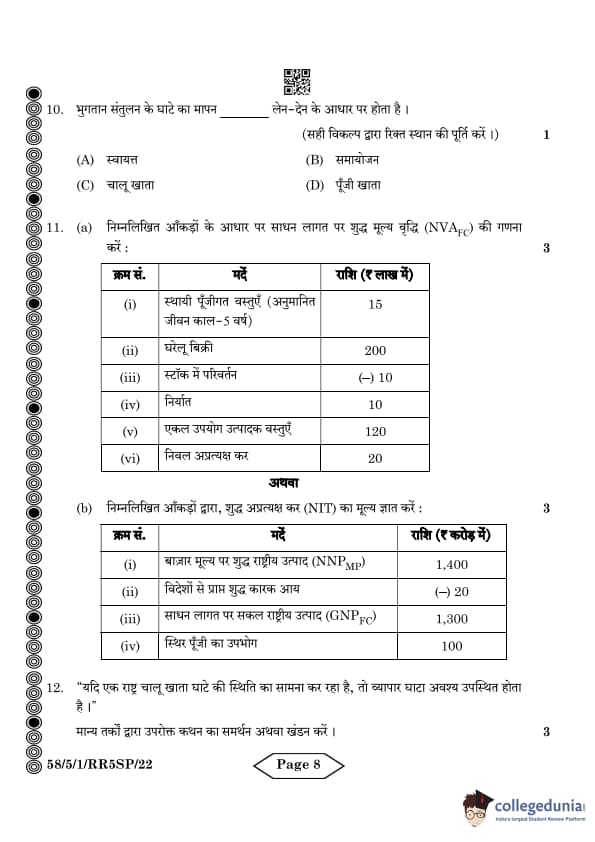
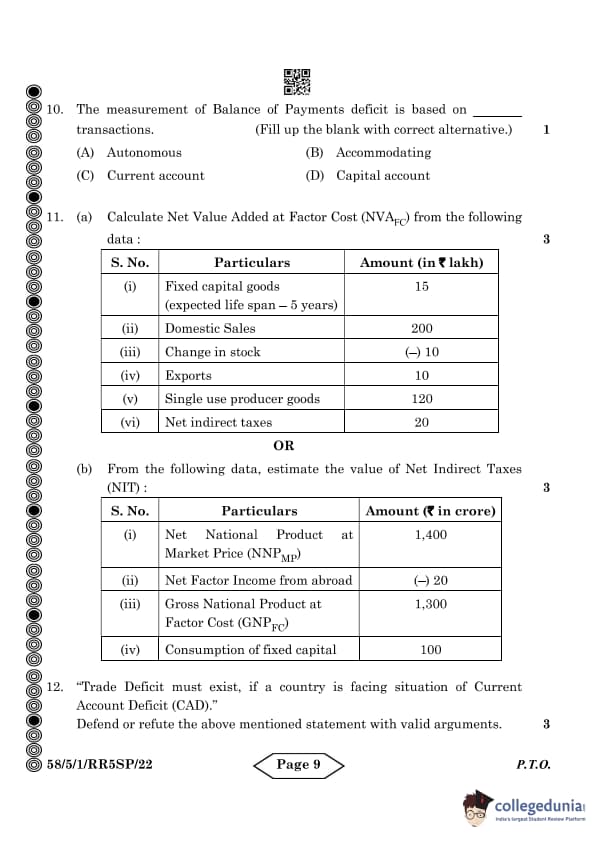
Question 10:
The measurement of Balance of Payments deficit is based on _____ transactions.
View Solution
Solution:
The Balance of Payments (BOP) deficit is primarily measured based on autonomous transactions, which are transactions conducted due to economic motives and not influenced by the country's monetary policies. Autonomous transactions include trade in goods and services, income payments, and capital movements.
Conclusion: The correct answer is (A), as BOP deficit is based on autonomous transactions.
Question 11:
Calculate Net Value Added at Factor Cost (NVAfc) from the following data:
| S.No. | Particulars | Amount (in Rs. lakh) |
|---|---|---|
| (i) | Fixed capital goods (expected life span - 5 years) | 15 |
| (ii) | Domestic Sales | 200 |
| (iii) | Change in stock | (-) 10 |
| (iv) | Exports | 10 |
| (v) | Single use producer goods | 120 |
| (vi) | Net indirect taxes | 20 |
View Solution
Solution:
Depreciation on fixed capital goods = 15⁄5 = 3
Net Value Added at Factor Cost (NVAfc):
NVAfc = (ii) + (iii) + (iv) – (v) – Depreciation – (vi)
NVAfc = 200 + (-10) + 10 – 120 – 3 – 20 = Rs.57 lakh
(b) From the following data, estimate the value of Net Indirect Taxes (NIT):
| S.No. | Particulars | Amount (in Rs. crore) |
|---|---|---|
| (i) | Net National Product at Market Price (NNPmp) | 1,400 |
| (ii) | Net Factor Income from abroad | 100 |
| (iii) | Gross National Product at Factor Cost (GNPfc) | 1,300 |
| (iv) | Consumption of Fixed Capital | 100 |
View Solution
Solution:
Net Indirect Taxes = (i) + (iv) – (iii)
Net Indirect Taxes = 1,400 + 100 - 1,300 = Rs.200 crore
Question 12:
"Trade Deficit must exist, if a country is facing situation of Current Account Deficit (CAD).” Defend or refute the above mentioned statement with valid arguments.
View Solution
Solution:
The statement is refuted.
- A Current Account Deficit (CAD) occurs when the total value of a country's imports of goods, services, and transfers exceeds the value of its exports. However, it does not necessarily imply that there is a trade deficit.
- A trade deficit specifically refers to a situation where the value of imports of goods exceeds the value of exports of goods.
- It is possible for a country to have a CAD but not a trade deficit, especially if the country is earning more income from its services or from foreign investments, which can offset a goods trade deficit.
- For instance, a country may have a surplus in services and income transfers, leading to a CAD without having a trade deficit.
Conclusion: Therefore, a CAD does not automatically imply the existence of a trade deficit, as the current account includes services, income, and transfers, not just trade in goods.
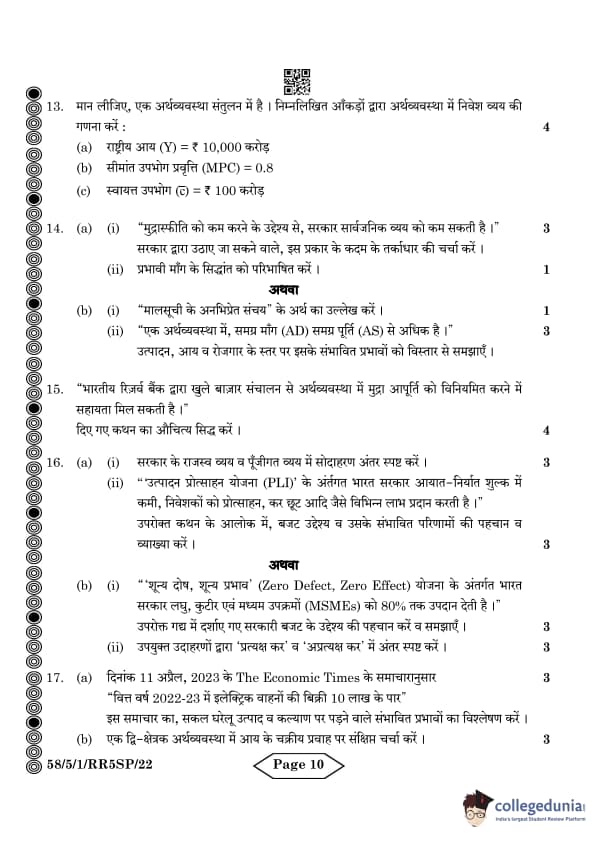
Question 13:
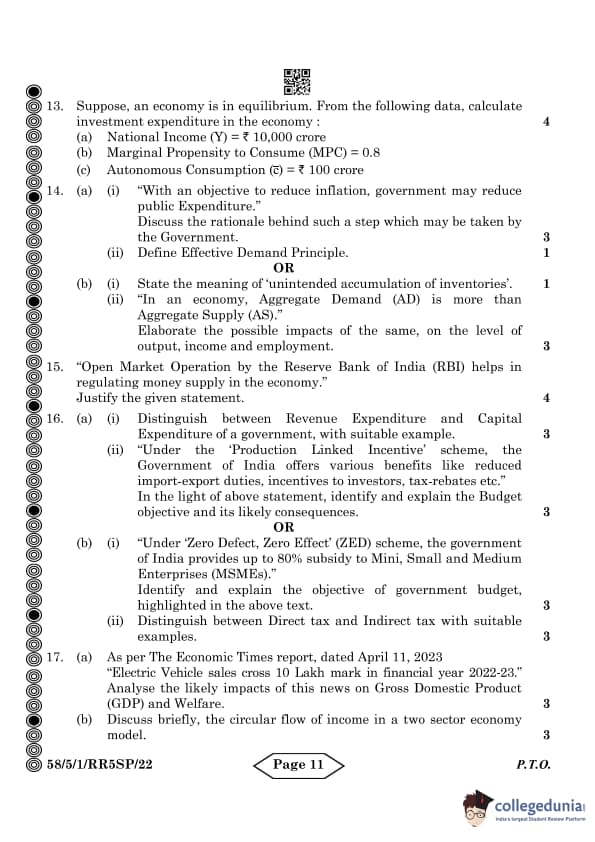
Suppose, an economy is in equilibrium. From the following data, calculate investment expenditure in the economy:
Given:
• National Income (Y) = 10,000 crore
• Marginal Propensity to Consume (MPC) = 0.8
• Autonomous Consumption (C) = 100 crore
View Solution
Solution:
- In equilibrium, National Income (Y) is equal to the total expenditure, which includes consumption and investment. Hence,
Y = C + I
- Consumption (C) can be expressed as:
C = C0 + MPC × Y
where C0 is autonomous consumption.
C = 100 + 0.8 × 10,000 = 100 + 8,000 = 8,100 crore
- Now, substitute into the equilibrium equation:
Y = C + I
10,000 = 8,100 + I
Solving for investment:
I = 10,000 - 8,100 = 1,900 crore
Conclusion: The investment expenditure in the economy is Rs. 1,900 crore.
Question 14:
(a) (i) "With an objective to reduce inflation, government may reduce public Expenditure.” Discuss the rationale behind such a step which may be taken by the Government.
View Solution
Solution:
- When inflation rises, the government may reduce public expenditure to control inflationary pressures in the economy.
- Government spending, particularly on public services and welfare programs, contributes to higher aggregate demand (AD).
- By reducing expenditure, the government can lower AD, which in turn reduces pressure on prices, thereby curbing inflation.
- This step is especially important when inflation is demand-driven, i.e., when too much money is chasing too few goods.
- A reduction in public expenditure can also lead to lower consumption and investment, slowing down the economy, and stabilizing price levels.
Conclusion: Reducing public expenditure is a contractionary fiscal policy aimed at reducing demand-pull inflation, by decreasing overall demand in the economy.
(ii) Define Effective Demand Principle.
View Solution
Solution:
The Effective Demand Principle states that the total level of employment in an economy is determined by the level of aggregate demand (AD) for goods and services.
- If the aggregate demand is insufficient to purchase all the goods produced in the economy, there will be unemployment.
- The principle suggests that employment will adjust to the level where aggregate demand is sufficient to purchase all output.
- In simple terms, the level of demand in an economy dictates the quantity of goods and services produced, which in turn determines the amount of labor employed.
Conclusion: The Effective Demand Principle highlights the relationship between the total demand for goods and services and the level of employment in an economy.
OR
(b) (i) State the meaning of 'unintended accumulation of inventories'.
View Solution
Solution:
Unintended accumulation of inventories refers to the situation where the actual sales of goods fall short of the expected sales. As a result, businesses end up holding unsold goods or stocks.
- This typically occurs when aggregate demand is lower than expected, leading to excess production and accumulation of unsold goods.
- It is a sign that the economy is experiencing weak demand, and businesses may respond by reducing production or laying off workers.
Conclusion: Unintended accumulation of inventories is an indicator of underperformance in the economy, signaling that demand is insufficient to absorb the supply of goods.
(ii) "In an economy, Aggregate Demand (AD) is more than Aggregate Supply (AS).” Elaborate the possible impacts of the same, on the level of output, income and employment.
View Solution
Solution:
When aggregate demand (AD) exceeds aggregate supply (AS), the following impacts can occur:
1. Increased output and income:
- Firms will try to meet the excess demand by increasing production, which will lead to higher output and income levels.
- The increase in income leads to higher consumption, further boosting demand, creating a cycle of growth.
2. Higher employment:
- Increased production requires more labor, which will lead to higher employment levels.
- As firms expand output to meet demand, they will need to hire additional workers.
3. Price inflation:
- As AD exceeds AS, firms may raise prices due to higher demand. This can lead to inflationary pressures in the economy.
4. Potential overuse of resources:
- If AD continues to outstrip AS for a prolonged period, the economy may face resource shortages, leading to inefficiencies and higher costs in the long run.
Conclusion: When AD exceeds AS, the economy initially experiences higher output, income, and employment, but sustained imbalances may lead to inflationary pressures.
Question 15:
‘Open Market Operation by the Reserve Bank of India (RBI) helps in regulating money supply in the economy.” Justify the given statement.
View Solution
Solution:
Open Market Operations (OMO) are one of the key tools used by the Reserve Bank of India (RBI) to regulate the money supply in the economy.
- Buying securities (OMO Purchase):
When the RBI buys government securities from the market, it injects money into the banking system. This increases the reserves of commercial banks, encouraging them to lend more, thereby increasing the money supply.
- Selling securities (OMO Sale):
When the RBI sells government securities, it pulls money out of the banking system. This reduces the reserves of commercial banks, restricting their lending capacity and thereby decreasing the money supply.
- Through OMOs, the RBI can control liquidity in the economy, manage inflation, and stabilize the financial system.
Conclusion: Open Market Operations are an effective tool for managing the money supply in the economy, influencing interest rates, and ensuring economic stability.
Question 16:
(a) (i) Distinguish between Revenue Expenditure and Capital Expenditure of a government, with suitable example.
View Solution
Solution:
- Revenue Expenditure refers to the government's expenditure on items that do not result in the creation of assets or reduction of liabilities. These are typically incurred to meet day-to-day expenses of the government. Examples include:
- Salaries of government employees
- Interest payments on loans
- Subsidies and grants given to individuals or organizations
- Capital Expenditure refers to the expenditure that is incurred to create physical or financial assets or to reduce liabilities. It typically involves the purchase of assets or investment in projects that lead to future economic benefits. Examples include:
- Expenditure on infrastructure like roads, bridges, and buildings
- Investment in machinery or technology
- Government investment in public sector enterprises
Conclusion: Revenue expenditure is meant for routine operational costs, while capital expenditure is aimed at creating long-term assets that improve the nation's productive capacity.
(ii) "Under the 'Production Linked Incentive' scheme, the Government of India offers various benefits like reduced import-export duties, incentives to investors, tax-rebates etc." In the light of the above statement, identify and explain the Budget objective and its likely consequences.
View Solution
Solution:
- The Budget objective highlighted in this statement is to boost domestic manufacturing and attract investment by providing financial incentives. The scheme is aimed at encouraging firms to increase production, reduce reliance on imports, and enhance competitiveness in the global market.
- Likely Consequences of the scheme:
- Increased Production:
By offering tax rebates and other incentives, the government encourages companies to scale up production and make India a more attractive destination for manufacturing.
- Employment Generation:
Increased production capacity and foreign investment can lead to higher employment in the manufacturing sector, which benefits the economy.
- Improved Trade Balance:
By promoting local manufacturing, the country could reduce imports, improve its trade balance, and boost exports, leading to a more sustainable economic growth model.
Conclusion: The scheme aims to foster industrial growth, attract foreign investment, and create jobs, ultimately contributing to economic growth.
OR
(b) (i) "Under 'Zero Defect, Zero Effect' (ZED) scheme, the government of India provides up to 80% subsidy to Mini, Small and Medium Enterprises (MSMEs).” Identify and explain the objective of government budget, highlighted in the above text.
View Solution
Solution:
- The objective of the government budget highlighted here is to promote the growth and development of MSMEs in India. The ZED scheme aims at improving the quality of products made by MSMEs by encouraging zero defect production (defect-free products) and zero effect on the environment (sustainable production).
- The government offers up to 80 percent subsidy to help MSMEs upgrade their processes, adopt new technologies, and improve the quality of their products. This helps increase the competitiveness of Indian MSMEs in both domestic and international markets.
- Likely Consequences:
- Improved Quality:
MSMEs will improve product quality, reducing defects and enhancing customer satisfaction.
- Sustainability:
Zero effect production practices will make industries more environmentally sustainable, aligning with global environmental standards.
- Boost to Employment:
Supporting MSMEs will create more job opportunities in small industries, contributing to higher employment levels.
Conclusion: The ZED scheme aims to improve product quality, environmental sustainability, and create a more competitive MSME sector, which will ultimately contribute to economic growth and job creation.
(ii) Distinguish between Direct tax and Indirect tax with suitable examples.
View Solution
Solution:
- Direct Tax: A direct tax is levied directly on individuals or organizations and is paid directly to the government. Examples include:
- Income Tax: Levied on the income earned by individuals or organizations.
- Corporate Tax: Paid by corporations on their profits.
- Indirect Tax: An indirect tax is levied on goods and services and is collected by an intermediary (e.g., a retailer) from the consumer. Examples include:
- Goods and Services Tax (GST): Levied on the sale of goods and services.
- Excise Duty: Paid on the manufacture of goods.
Conclusion: Direct taxes are based on the taxpayer's income or profits, while indirect taxes are levied on consumption and are passed on to consumers.
Question 17:
(a) As per The Economic Times report, dated April 11, 2023: "Electric Vehicle sales cross 10 Lakh mark in financial year 2022-23.” Analyse the likely impacts of this news on Gross Domestic Product (GDP) and Welfare.
View Solution
Solution:
- Impact on GDP:
The sale of Electric Vehicles (EVs) contributes to an increase in consumption expenditure, which is a component of GDP. With the surge in EV sales, the output in the automobile sector will rise, contributing positively to the Gross Domestic Product (GDP). Additionally, related industries, such as battery manufacturing, charging infrastructure, and renewable energy, will experience growth, further increasing the value of GDP.
- Impact on Welfare:
- The transition to Electric Vehicles is expected to improve environmental quality, as EVs produce less pollution compared to traditional vehicles. This contributes to higher social welfare by reducing air pollution, improving health outcomes, and promoting cleaner air. Furthermore, this shift may lead to reduced dependency on fossil fuels, improving energy security and reducing the impact of global oil price fluctuations on the economy.
- Job Creation: The increasing demand for EVs may create jobs in manufacturing, charging infrastructure, and research and development.
- Improved Health Outcomes: Reduced emissions may lead to fewer respiratory diseases, contributing to better public health.
Conclusion: The growth in EV sales will positively affect GDP by increasing consumption and production, while enhancing welfare through environmental benefits and potential job creation.
(b) Discuss briefly, the circular flow of income in a two sector economy model.
View Solution
Solution:
In a two-sector economy model, the economy is simplified to two main sectors: households and firms.
1. Households:
- Households own the factors of production, such as land, labor, capital, and entrepreneurship. They provide these factors to firms in exchange for income, which includes wages, rents, interests, and profits.
2. Firms:
- Firms are the producers of goods and services. They use the factors of production from households to produce goods and services, which are sold to households. In return, firms pay income to households for their factors of production.
- Flow of Income and Expenditure:
- Households spend their income on the goods and services produced by firms (Consumption Expenditure).
- Firms, in turn, provide goods and services to households in exchange for payment, which is their revenue.
- Circular Flow:
The flow of goods and services from firms to households and the flow of income from households to firms forms a continuous cycle, known as the circular flow of income.
- Equilibrium in the Circular Flow:
The economy reaches equilibrium when total income generated in the economy (from the sale of goods and services) is equal to the total expenditure (households' consumption expenditure).
Conclusion: In a two-sector model, the economy functions as a closed loop where households provide factors of production to firms, and firms return income to households in exchange for goods and services.
SECTION B
Indian Economic Development
Question 18:
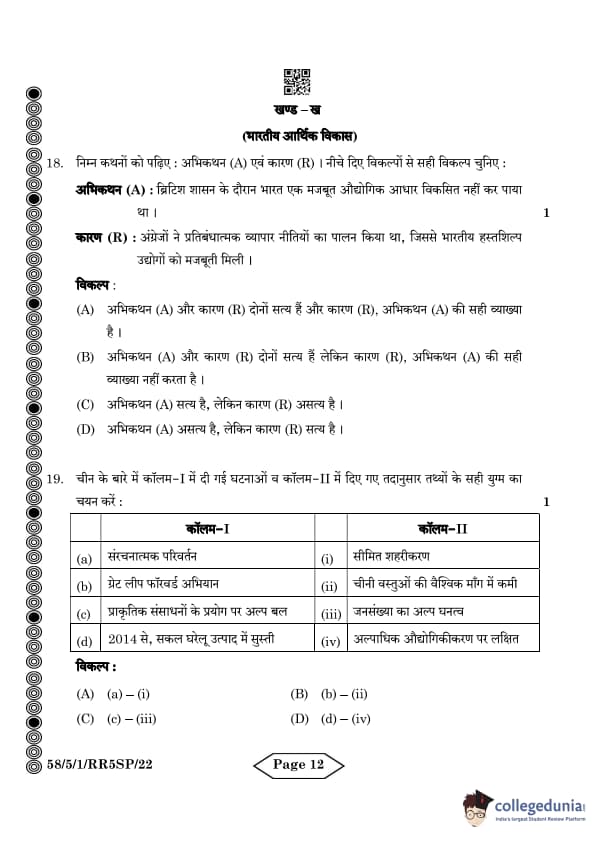
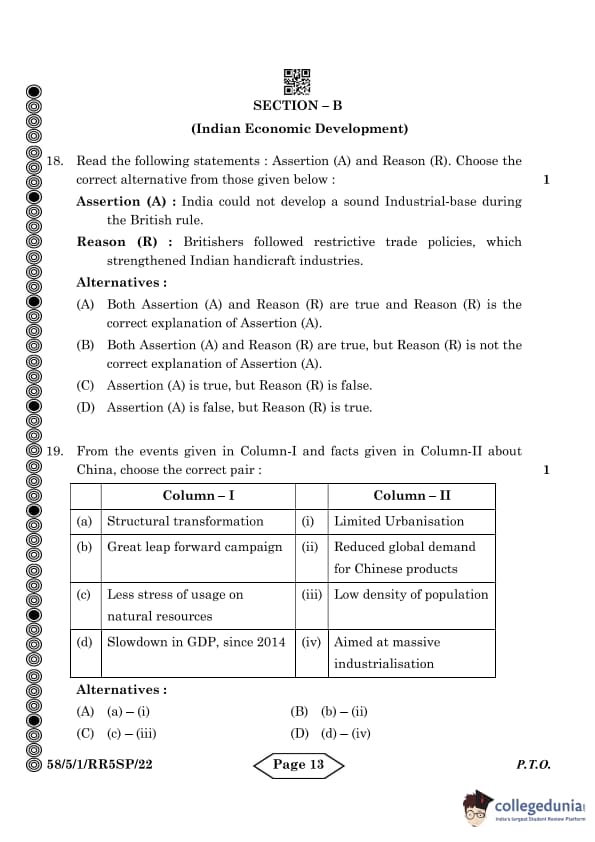
Read the following statements: Assertion (A) and Reason (R). Choose the correct alternative from those given below:
Assertion (A): India could not develop a sound Industrial-base during the British rule.
Reason (R): Britishers followed restrictive trade policies, which strengthened Indian handicraft industries.
View Solution
Solution:
- Assertion (A) is true: During the British rule, India could not develop a strong industrial base. The British focused on extracting resources from India and promoting industries that benefited Britain rather than India.
- Reason (R) is false: The British followed restrictive policies that actually undermined India's handicraft industries rather than strengthening them. Policies such as heavy tariffs on Indian goods and the promotion of British manufactured goods led to the decline of India's traditional industries.
Conclusion: Since Assertion (A) is correct but Reason (R) is false, option (C) is the correct answer.
Question 19:
From the events given in Column-I and facts given in Column-II about China, choose the correct pair:
| Column - I | Column - II |
|---|---|
| (a) Structural transformation | (i) Limited Urbanisation |
| (b) Great leap forward campaign | (ii) Reduced global demand for Chinese products |
| (c) Less stress of usage on natural resources | (iii) Low density of population |
| (d) Slowdown in GDP, since 2014 | (iv) Aimed at massive industrialisation |
View Solution
Solution:
- (a) Structural transformation refers to the shift from agriculture to industry and services in China, which did not result in limited urbanization, making option (A) incorrect.
- (b) The Great Leap Forward campaign aimed at massive industrialization but failed to meet expectations due to reduced global demand, which makes (B) incorrect.
- (c) The less stress on natural resources in China correlates with the low density of population, making (C) correct.
- (d) The slowdown in GDP from 2014 was due to the massive industrialization drive under the Great Leap Forward, not directly to the cause of slowdown in GDP itself, making (D) incorrect.
Conclusion: Option (C) is correct as the low population density is associated with less stress on natural resources.
Question 20:
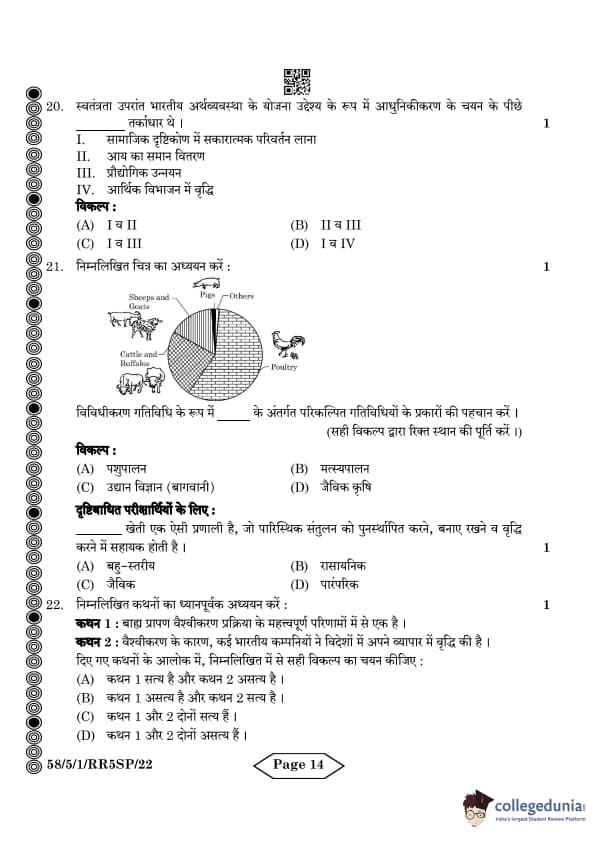
After independence, the rationale behind choosing Modernization as a planning objective for the Indian economy were —.
I. To bring positive changes in the social outlook
II. Equitable distribution of income
III. Technological Upgradation
IV. Increase in Economic Divide
Alternatives:
View Solution
Solution:
- I: To bring positive changes in the social outlook, India wanted to modernize agriculture, industry, and services to improve quality of life for its citizens.
- III: Technological upgradation was crucial for India's industrialization and modernization to ensure long-term growth.
- II: While equitable distribution of income is important, it was not the primary rationale behind choosing modernization as the main goal in India's early planning stages.
- IV: Increasing the economic divide was not a goal of modernization but rather reducing it.
Conclusion: Option (C) is the correct answer because both improving social outlook and technological upgradation were the key goals.
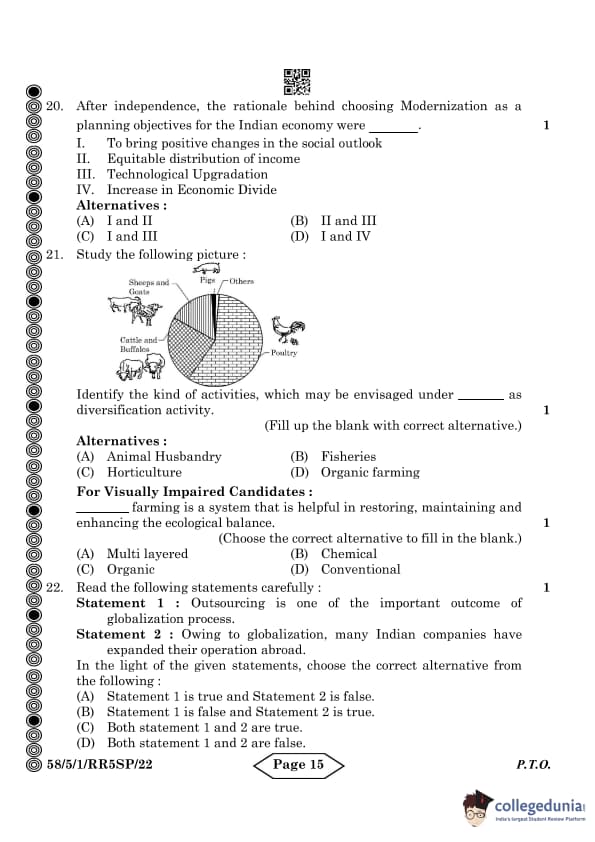
Question 21:
Study the following picture:
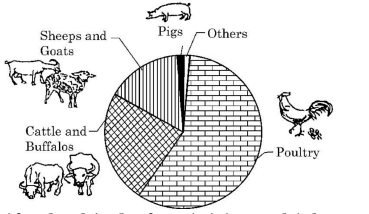
Identify the kind of activities, which may be envisaged under __________ as diversification activity.
View Solution
Solution:
- Animal husbandry is an agricultural activity related to the breeding and raising of livestock. This is often considered a diversification activity in farming because it supplements income from crop production and helps in managing resources more effectively.
- The other alternatives (B) Fisheries, (C) Horticulture, and (D) Organic farming may also be forms of diversification, but Animal Husbandry is the most fitting answer given the context of the question and image.
Conclusion: Option (A) is correct as it directly relates to diversification in agriculture.
Question 22:
Read the following statements carefully: Statement 1: Outsourcing is one of the important outcomes of the globalization process. Statement 2: Owing to globalization, many Indian companies have expanded their operation abroad.
View Solution
Solution:
- Statement 1 is true: Outsourcing, a key feature of globalization, involves contracting out services or jobs to other countries. This is a common practice in industries such as IT, customer service, and manufacturing.
- Statement 2 is true: Globalization has allowed Indian companies, particularly in the IT and service sectors, to expand their operations abroad, taking advantage of lower production costs and accessing new markets.
Conclusion: Both statements are true, as outsourcing and international expansion of Indian companies are direct results of globalization.
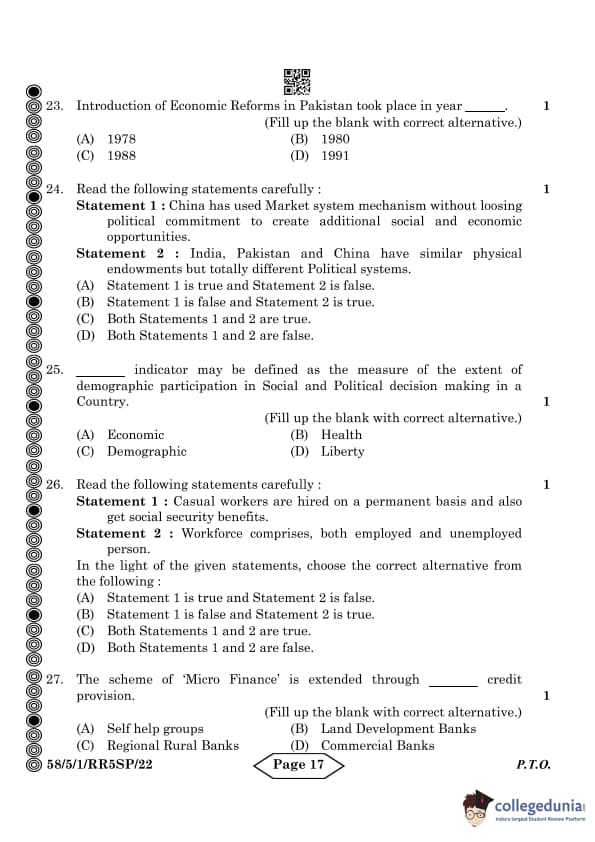
Question 23:
Introduction of Economic Reforms in Pakistan took place in the year _______.
View Solution
Solution:
- Pakistan introduced significant economic reforms in 1988 under the leadership of Prime Minister Benazir Bhutto, aiming to liberalize the economy, reduce the role of state-owned enterprises, and promote private sector growth.
- The other dates do not correspond to the major economic reforms in Pakistan.
Question 24:
Read the following statements carefully: Statement 1: China has used the Market system mechanism without losing political commitment to create additional social and economic opportunities. Statement 2: India, Pakistan, and China have similar physical endowments but totally different Political systems.
View Solution
Solution:
- Statement 1 is true: China has adopted a market-oriented approach since its economic reforms, while still maintaining strict political control. This approach has created additional social and economic opportunities for its citizens.
- Statement 2 is true: While India, Pakistan, and China have similar geographical endowments, their political systems differ significantly. India is a democracy, Pakistan has had military interventions, and China is a one-party communist state.
Conclusion: Both statements are true, reflecting the economic and political differences between these countries.
Question 25:
_______ indicator may be defined as the measure of the extent of demographic participation in Social and Political decision making in a Country.
View Solution
Solution:
- Liberty indicators measure the degree of freedom and participation in a society, particularly in social and political decision-making processes.
- Economic, health, and demographic indicators are important for measuring the quality of life, but liberty indicators focus specifically on the rights and freedoms of individuals within society.
Conclusion: Option (D) is correct as liberty indicators measure democratic participation.
Question 26:
Read the following statements carefully: Statement 1: Casual workers are hired on a permanent basis and also get social security benefits. Statement 2: Workforce comprises, both employed and unemployed persons.
View Solution
Solution:
- Statement 1 is false: Casual workers are typically employed on a temporary basis without the guarantee of social security benefits.
- Statement 2 is false: The workforce comprises only employed individuals; unemployed persons are considered part of the labor force but are not part of the employed workforce.
Conclusion: Both statements are false, so the correct answer is option (D).
Question 27:
The scheme of ‘Micro Finance' is extended through __________ credit provision.
View Solution
Solution:
- Microfinance is typically extended through self-help groups (SHGs), which are community-based organizations that provide credit to low-income households.
- SHGs play a vital role in providing small loans without requiring collateral, thereby helping individuals who are not served by traditional financial institutions.
Conclusion: Option (A) is correct, as SHGs are the primary providers of microfinance.
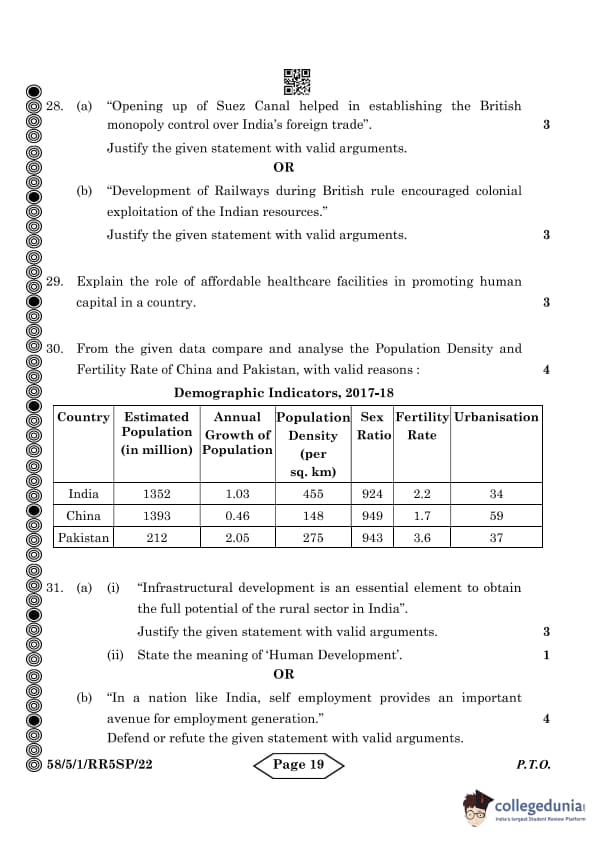
Question 28:
(a) "Opening up of Suez Canal helped in establishing the British monopoly control over India's foreign trade.” Justify the given statement with valid arguments.
View Solution
Solution:
- The opening of the Suez Canal in 1869 significantly reduced the time it took to travel between Europe and India, from several months to a matter of weeks.
- This enhanced the British monopoly over India's foreign trade by making it easier and faster to move goods such as cotton, tea, and opium from India to Britain.
- It further entrenched British economic dominance by facilitating the movement of raw materials from India and finished goods from Britain.
Conclusion: The opening of the Suez Canal was crucial in strengthening British control over India's foreign trade by reducing transportation costs and time, reinforcing their economic monopoly.
OR
(b) "Development of Railways during British rule encouraged colonial exploitation of the Indian resources.” Justify the given statement with valid arguments.
View Solution
Solution:
- The British developed railways in India primarily to transport raw materials such as cotton, indigo, and minerals to ports for shipment to Britain.
- This transportation network was designed to extract India's resources efficiently for the benefit of Britain, rather than to foster economic development within India itself.
- While it enabled faster movement of goods, it also facilitated the extraction of wealth, with limited focus on benefiting the Indian economy or improving local infrastructure.
Conclusion: The development of railways under British rule primarily served the interests of colonial exploitation by facilitating the extraction of resources rather than benefiting India's economic development.
Question 29:
Explain the role of affordable healthcare facilities in promoting human capital in a country.
View Solution
Solution:
- Affordable healthcare is crucial for human capital development as it improves the health and well-being of the population, leading to a more productive workforce.
- Access to healthcare ensures that individuals are healthier, live longer, and are more able to contribute effectively to the economy.
- It also reduces absenteeism in workplaces and increases efficiency by minimizing the burden of disease and illness on the economy.
Conclusion: Affordable healthcare plays a vital role in promoting human capital by improving health outcomes, thereby enhancing productivity and contributing to overall economic growth.
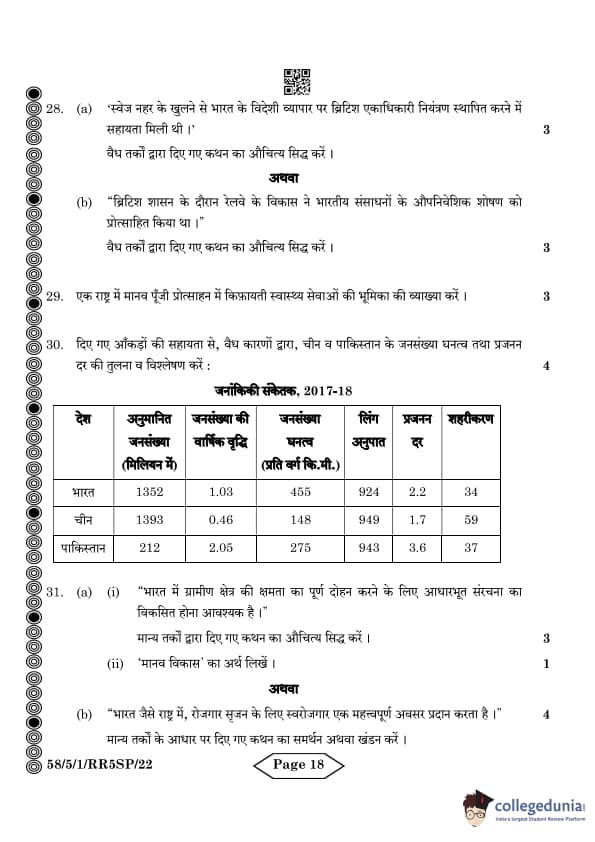
Question 30:
From the given data compare and analyse the Population Density and Fertility Rate of China and Pakistan, with valid reasons:
Demographic Indicators, 2017-18
| Country | Estimated Population (in million) | Annual Growth of Population | Population Density (per sq. km) | Sex Ratio | Fertility Rate | Urbanisation |
|---|---|---|---|---|---|---|
| India | 1352 | 1.03 | 455 | 924 | 2.2 | 34 |
| China | 1393 | 0.46 | 148 | 949 | 1.7 | 59 |
| Pakistan | 212 | 2.05 | 275 | 943 | 3.6 | 37 |
View Solution
Solution:
- Population Density:
- China, despite having a larger population (1.393 billion), has a significantly lower population density of 148 per square kilometer compared to Pakistan's 275 per square kilometer. This can be attributed to China's vast land area and relatively lower population concentration in certain regions.
- Pakistan, on the other hand, has a higher population density, indicating a more concentrated population within its smaller geographic area.
- Fertility Rate:
- The fertility rate in Pakistan stands at 3.6, which is more than double China's rate of 1.7. This can be attributed to China's long-standing one-child policy (which has been relaxed in recent years), leading to a significant decline in its fertility rate.
- Pakistan's higher fertility rate reflects the relatively higher birth rate, which can be linked to factors like cultural norms, lower access to family planning, and socio-economic conditions.
Conclusion: China has a lower population density and fertility rate compared to Pakistan, owing to its larger landmass, policy interventions like the one-child policy, and different socio-economic conditions.
Question 31:
(a) (i) "Infrastructural development is an essential element to obtain the full potential of the rural sector in India.” Justify the given statement with valid arguments.
View Solution
Solution:
Infrastructural development plays a vital role in unlocking the full potential of rural sectors in India. Some key arguments include:
- Improved Connectivity:
Infrastructure such as roads, bridges, and communication networks connects rural areas to urban markets, allowing farmers and entrepreneurs to access wider markets and increasing productivity.
- Access to Basic Services:
Development in areas like electricity, water supply, healthcare, and education enhances the quality of life and economic participation for rural populations.
- Rural Industrialization:
Infrastructure development supports small industries and cottage industries, which can thrive in rural settings, creating employment and reducing migration to urban areas.
- Agricultural Productivity:
Investment in irrigation, storage, and transportation infrastructure significantly boosts agricultural output, making rural economies more productive and resilient to external shocks.
Conclusion: Infrastructure is crucial in ensuring that the rural sector in India reaches its potential in terms of economic development, employment generation, and poverty alleviation.
(ii) State the meaning of 'Human Development'.
View Solution
Solution:
Human development refers to the process of enlarging people's freedoms and opportunities, improving their well-being, and ensuring they have access to the resources necessary to lead a fulfilling life. It includes:
- Improvement in Health: Access to healthcare services that enhance life expectancy and reduce mortality rates.
- Educational Advancement: Ensuring access to quality education that empowers individuals with knowledge and skills to improve their livelihoods.
- Economic Security: Creating economic opportunities through employment, social security, and income equality.
Thus, human development is a holistic concept that aims to improve the overall quality of life by expanding the choices available to people.
OR
(b) "In a nation like India, self employment provides an important avenue for employment generation.” Defend or refute the given statement with valid arguments.
View Solution
Solution:
The given statement is defended. In a nation like India, self-employment is a major source of livelihood for both men and women. Self-employment is a key avenue for employment generation in India, and here's why:
- High Employment Potential:
India, with its large rural population and limited job opportunities in the formal sector, has seen self-employment emerge as a crucial way for individuals to earn their livelihoods. Agriculture, handicrafts, and small businesses are common forms of self-employment.
- Entrepreneurship and Innovation:
Self-employment fosters entrepreneurship and innovation, as individuals take the initiative to create businesses and services that cater to local and regional needs.
- Lower Barriers to Entry:
Unlike formal employment that requires certain qualifications or skills, self-employment offers flexibility and lower barriers to entry, allowing many individuals, particularly in rural areas, to enter the workforce.
- Government Initiatives:
Various government schemes like PMEGP (Prime Minister's Employment Generation Programme) and MUDRA Yojana support the self-employment sector by providing loans, training, and other resources.
Therefore, self-employment is crucial in India's economic context, providing a valuable route to employment for a large section of the population.
Question 32:
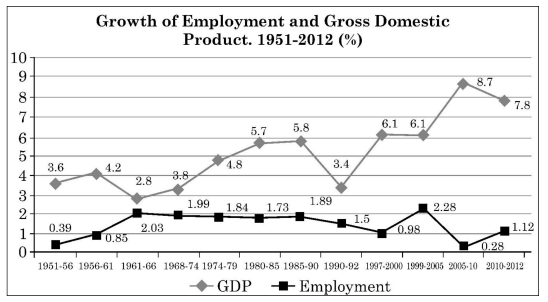
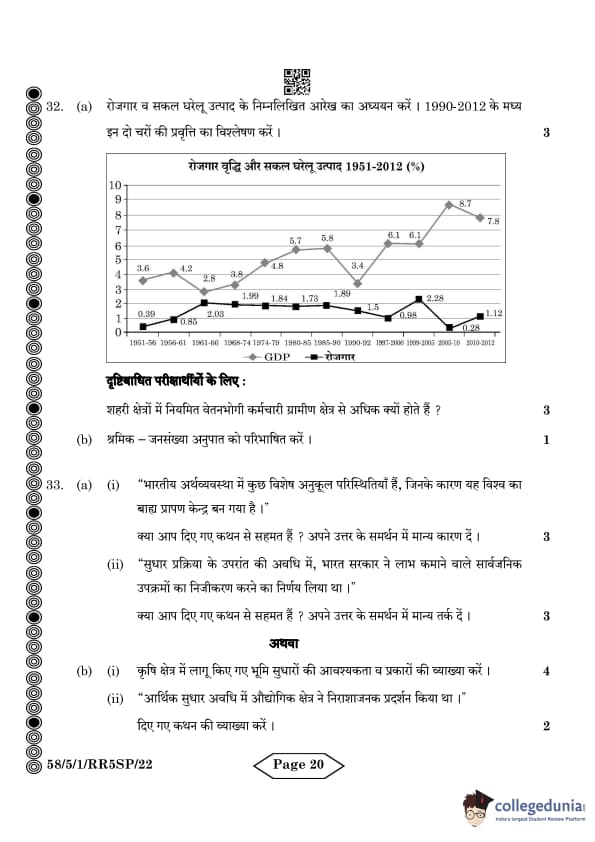
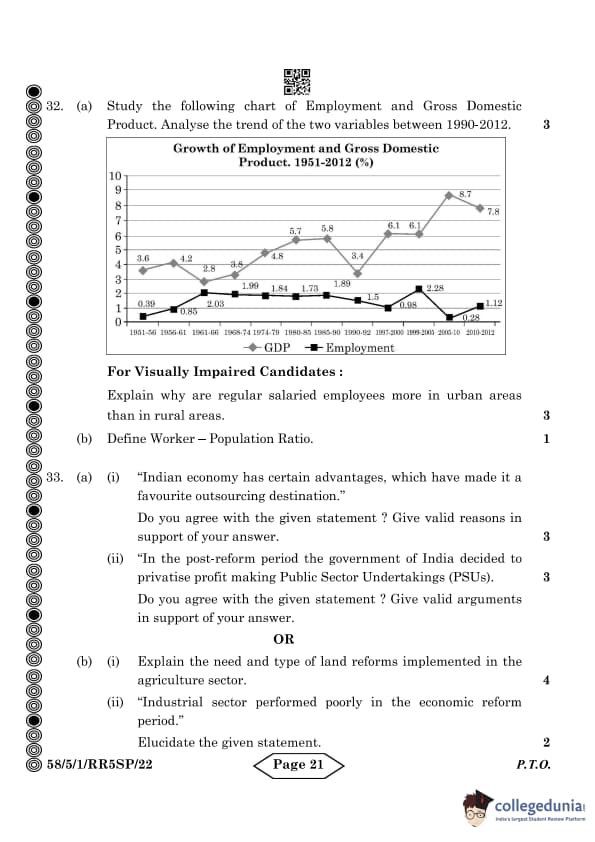
(a) (i) Study the following chart of Employment and Gross Domestic Product. Analyse the trend of the two variables between 1990-2012.
Analysis of the trend between 1990-2012:
View Solution
Solution:
The chart shows the growth rates of Employment and GDP over the period 1951-2012. Focusing on the period between 1990-2012:
- GDP Growth: The GDP growth rate shows a fluctuating pattern. It started low in the early 1990s, but from 1995 to 2005, there was a rapid increase, peaking at over 8 percent. This period represents strong economic growth. However, after 2005, the GDP growth rate started to moderate.
- Employment Growth: Employment growth has been consistently lower than GDP growth. In the early 1990s, employment growth was quite low, and although it improved over time, the increase was modest compared to the rapid GDP growth.
- Jobless Growth: Between 2000 and 2012, the GDP growth rate surpassed the employment growth rate significantly, indicating a "jobless growth" situation where economic output increased, but the creation of jobs did not keep pace.
Conclusion: Between 1990-2012, the trend highlights a period of high economic growth, especially in the 2000s, but employment did not grow at a similar pace. This suggests that while the economy grew, it was not accompanied by a proportional increase in jobs, a situation that is often referred to as jobless growth.
(a) (ii) Define Worker-Population Ratio.
View Solution
Solution:
- Worker-Population Ratio:
The worker-population ratio is the proportion of the working-age population that is actively engaged in work or seeking employment. It is calculated as the number of workers divided by the total working-age population.
Question 33:
(a) (i) "Indian economy has certain advantages, which have made it a favourite outsourcing destination.” Do you agree with the given statement? Give valid reasons in support of your answer.
View Solution
Solution:
Yes, In the recent times, India has emerged as a favourite outsourcing destination because of the growth of fast modes of communication, particularly the growth of Information Technology (IT). India's economy has several advantages that have made it a popular outsourcing destination:
- Skilled Labor Force: India has a large pool of skilled workers, particularly in IT, customer service, and back-office operations. The country's proficiency in English, coupled with a growing educated workforce, makes it an attractive destination for outsourcing.
- Cost Advantage: Labor in India is significantly cheaper compared to developed countries, making outsourcing cost-effective for companies looking to reduce operational expenses. This cost efficiency drives businesses to outsource manufacturing, IT services, and customer support to India.
- Government Policies: Over the years, the Indian government has implemented policies to support the outsourcing industry, including tax incentives, setting up Special Economic Zones (SEZs), and easing foreign investment norms.
- Technological Infrastructure: India's growing technological infrastructure, including access to the internet, advanced communication systems, and tech hubs in cities like Bengaluru, has contributed to its success as an outsourcing hub.
Thus, India has the right mix of skills, cost advantages, and infrastructure to make it a preferred outsourcing destination.
(ii) "In the post-reform period the government of India decided to privatise profit making Public Sector Undertakings (PSUs).” Do you agree with the given statement? Give valid arguments in support of your answer.
View Solution
Solution:
No, In the post-reform period, the government of India did not privatize its profitmaking Public Sector Undertakings (PSUs) as they were adding to the government's revenue. The decision to privatise profit-making PSUs in India post-reforms had several justifications:
- Efficiency and Competitiveness: By transferring ownership to the private sector, the government aimed to improve the efficiency of PSUs and make them more competitive in the global market. The private sector is generally seen as more agile and focused on profitability, which helps in achieving better management practices.
- Reducing Fiscal Deficit: Selling off profitable PSUs helps raise revenue for the government, which can then be used to reduce fiscal deficits or fund welfare programs. The proceeds from privatisation were expected to ease the pressure on public finances.
- Liberalisation of the Economy: The privatisation of PSUs was part of the broader economic reforms of 1991, which sought to liberalise and open up the Indian economy to more market-driven forces, leading to growth in various sectors.
- Encouraging Foreign Investments: The privatisation of PSUs created opportunities for foreign investors to enter the Indian market, boosting FDI and fostering a more vibrant economy.
Thus, privatising profit-making PSUs was seen as an essential step towards improving economic efficiency and facilitating growth in a liberalised environment.
OR
(b) (i) Explain the need and type of land reforms implemented in the agriculture sector.
View Solution
Solution:
Land reforms in India were essential to address inequalities in land ownership and improve agricultural productivity. The key types of land reforms included:
- Abolition of Zamindari System:
The Zamindari system led to the exploitation of peasants and small farmers. By abolishing this system, the government aimed to distribute land directly to the tillers, ensuring fairer ownership and access to land.
- Land Ceiling Act:
This reform sought to limit the maximum amount of land that one individual could own. The aim was to reduce land concentration in the hands of a few and distribute land more equally among small and marginal farmers.
- Tenancy Reforms:
These reforms sought to improve the rights of tenants, ensuring that landowners could not exploit them and that tenants would have more stable and secure tenancy arrangements.
- Consolidation of Holdings:
This reform aimed to consolidate fragmented land holdings into more viable and efficient units, improving productivity and making it easier to cultivate.
(ii) "Industrial sector performed poorly in the economic reform period.” Elucidate the given statement.
View Solution
Solution:
Industrial Sector's Poor Performance in the Reform Period:
While India's economic reforms from 1991 onwards led to significant growth in many sectors, the industrial sector faced challenges:
- Slow Growth in Industrial Output:
Despite liberalisation, industrial growth remained slow for certain industries, especially traditional sectors that were not competitive globally.
- Infrastructure Constraints:
The lack of proper infrastructure such as power supply, transport, and technology hindered the growth of the industrial sector. Inadequate infrastructure increased costs and made Indian products less competitive in the global market.
- Lack of Investment in Manufacturing:
While services grew rapidly, the manufacturing sector struggled to attract investment. The focus on IT and services meant that manufacturing took a backseat in the post-reform period.
- Global Competition:
The opening up of the economy exposed Indian industries to international competition. Many Indian industries were not well-prepared to compete with cheap imports, leading to a decline in their market share.
Thus, the industrial sector's performance was constrained by multiple factors during the reform period, preventing it from achieving the desired growth rates.
Question 34:
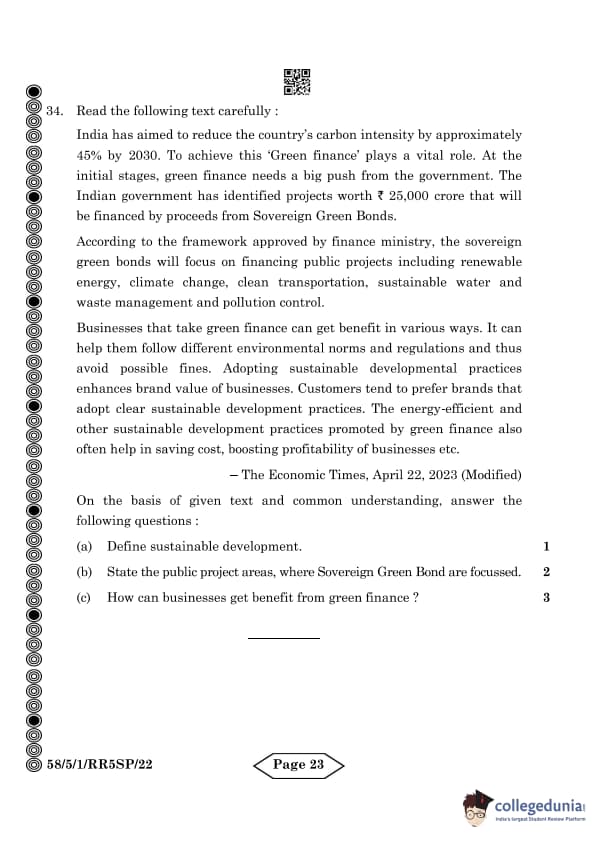
Read the following text carefully: India has aimed to reduce the country's carbon intensity by approximately 45 percent by 2030. To achieve this ‘Green finance' plays a vital role. At the initial stages, green finance needs a big push from the government. The Indian government has identified projects worth Rs. 25,000 crore that will be financed by proceeds from Sovereign Green Bonds.
According to the framework approved by finance ministry, the sovereign green bonds will focus on financing public projects including renewable energy, climate change, clean transportation, sustainable water and waste management and pollution control. Businesses that take green finance can get benefit in various ways. It can help them follow different environmental norms and regulations and thus avoid possible fines. Adopting sustainable developmental practices enhances brand value of businesses. Customers tend to prefer brands that adopt clear sustainable development practices. The energy-efficient and other sustainable development practices promoted by green finance also often help in saving cost, boosting profitability of businesses etc.
-The Economic Times, April 22, 2023 (Modified) On the basis of given text and common understanding, answer the following questions:
(a) Define sustainable development.
View Solution
Solution: Sustainable development is a development process that meets the needs of the present without compromising the ability of future generations to meet their own needs. It focuses on balancing economic growth, social inclusion, and environmental protection.
(b) State the public project areas where Sovereign Green Bonds are focused.
View Solution
Solution:
Sovereign Green Bonds finance projects with positive environmental impacts. Key areas of focus include:
• Renewable energy (solar, wind, and hydroelectric projects)
• Energy-efficient infrastructure (green buildings)
• Public transport systems to reduce carbon emissions
• Sustainable agriculture and land management
• Climate adaptation and mitigation measures
• Biodiversity and ecosystem conservation
(c) How can businesses get benefit from green finance?
View Solution
Solution:
Businesses can benefit from green finance in the following ways:
• Access to Capital: Funds for environmentally sustainable projects
• Lower Financing Costs: Reduced interest rates on green bonds
• Enhanced Brand Image: Improved reputation as a socially responsible entity
• Regulatory Compliance: Better alignment with environmental regulations
• Long-term Resilience: Improved ability to manage environmental risks
(d) State the significance of ‘green finance' for India in achieving the target of reduced carbon intensity.
View Solution
Solution:
Green finance is crucial for India to achieve its target of reducing carbon intensity by approximately 45 percent by 2030. Its significance includes:
- Funding Sustainable Projects: Green finance provides the necessary capital for projects that reduce carbon emissions, such as renewable energy, energy efficiency, and sustainable transport.
- Accelerating Green Growth: By directing investments towards environmentally friendly initiatives, green finance helps in transitioning to a low-carbon economy.
- Meeting Climate Goals: It supports India’s commitment under the Paris Agreement to combat climate change by promoting projects that lower greenhouse gas emissions.
- Enhancing Resource Efficiency: Green finance encourages the adoption of technologies and practices that use resources more efficiently, reducing waste and pollution.
Conclusion: Green finance is essential for funding sustainable development projects, supporting India’s climate goals, and fostering a transition to a more environmentally sustainable economy.








Comments