




CBSE Class 12 Economics Question Paper 2024 PDF (Set 2- 58/2/2) is available for download here. CBSE conducted the Economics exam on March 18, 2024 from 10:30 AM to 1:30 PM. The total marks for the theory paper are 80. The question paper contains 20% MCQ-based questions, 40% competency-based questions, and 40% short and long answer type questions. Candidates can use the link below to download the CBSE Class 12 Economics Set 2 Question Paper with detailed solutions.
CBSE Class 12 Economics Question Paper 2024 (Set 2- 58/2/2) with Answer Key
| CBSE Class 12 2024 Economics Question Paper with Answer Key |  Download Download |
Check Solution |
CBSE Class 12 2024 Economics Questions with Solutions
SECTION A
Macro Economics
Question 1:
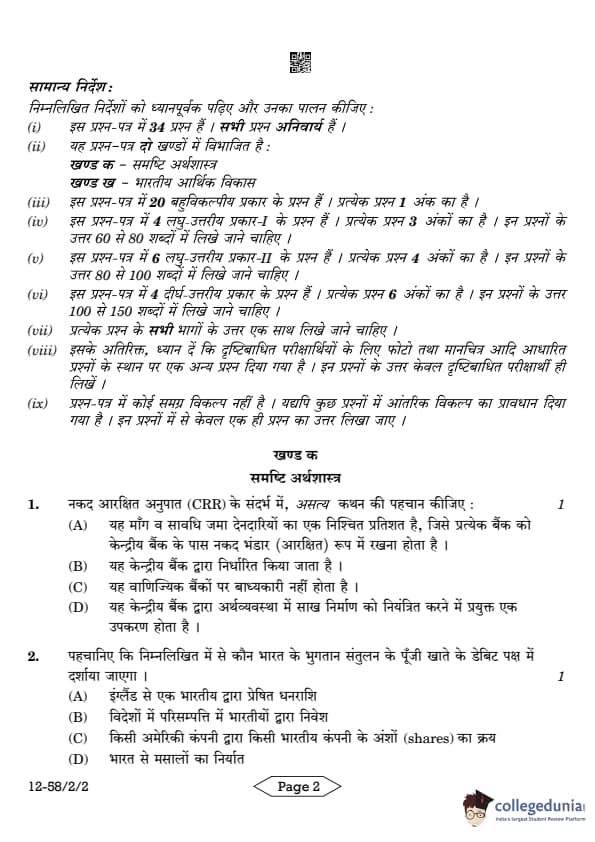
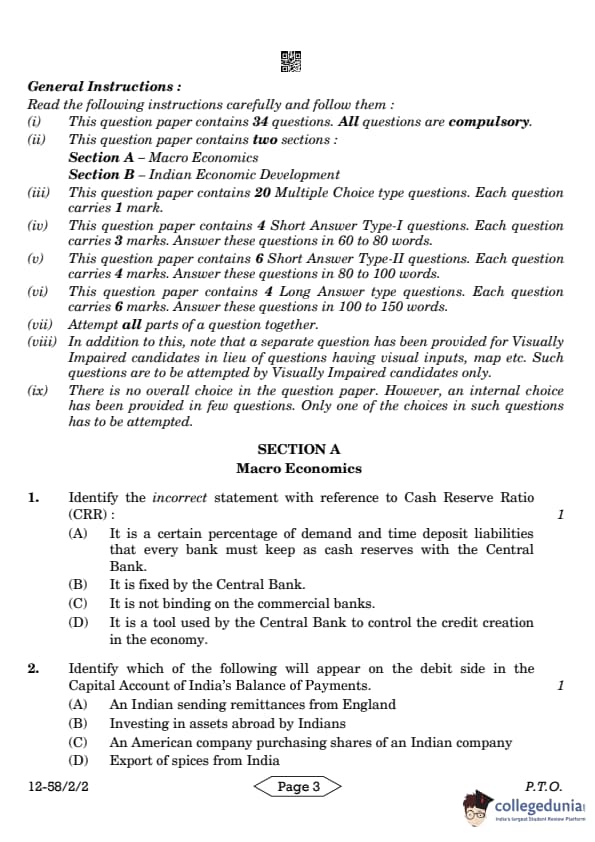
Identify the incorrect statement with reference to Cash Reserve Ratio (CRR):
View Solution
Solution:
Understanding Cash Reserve Ratio (CRR):
- CRR is the percentage of a bank's total deposits that must be held as reserves with the central bank.
- It is a mandatory requirement for all commercial banks.
Evaluating the Statements:
- (A) True: CRR is a percentage of demand and time liabilities held with the central bank.
- (B) True: The central bank determines and revises CRR as a monetary policy tool.
- (C) False: CRR is binding on all commercial banks, making this statement incorrect.
- (D) True: CRR controls money supply and credit creation by regulating bank reserves.
Conclusion: Option (C) is incorrect, as CRR is a mandatory reserve requirement for commercial banks.
Question 2:
Identify which of the following will appear on the debit side in the Capital Account of India's Balance of Payments.
View Solution
Solution:
Understanding Capital Account Transactions:
- The capital account records transactions related to foreign investments, loans, and asset purchases.
Identifying the Debit Entry:
- (A) Remittances from England: Falls under the current account, not the capital account.
- (B) Investing in assets abroad: Outflow of capital, recorded as a debit in the capital account.
- (C) Foreign investments in India: Recorded as a credit in the capital account.
- (D) Export of spices: A trade transaction under the current account.
Conclusion: (B) Investing in assets abroad by Indians leads to a capital outflow, making it a debit entry in the capital account.
Question 3:
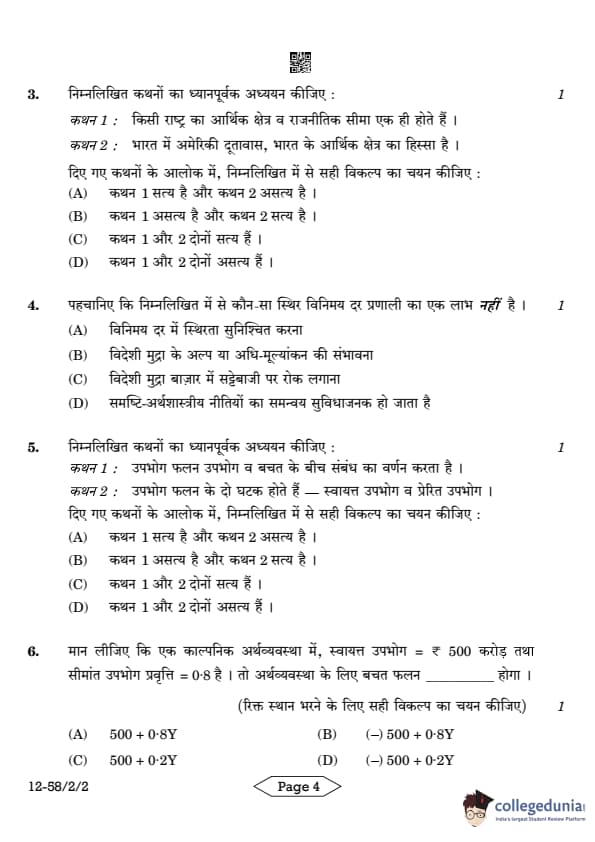
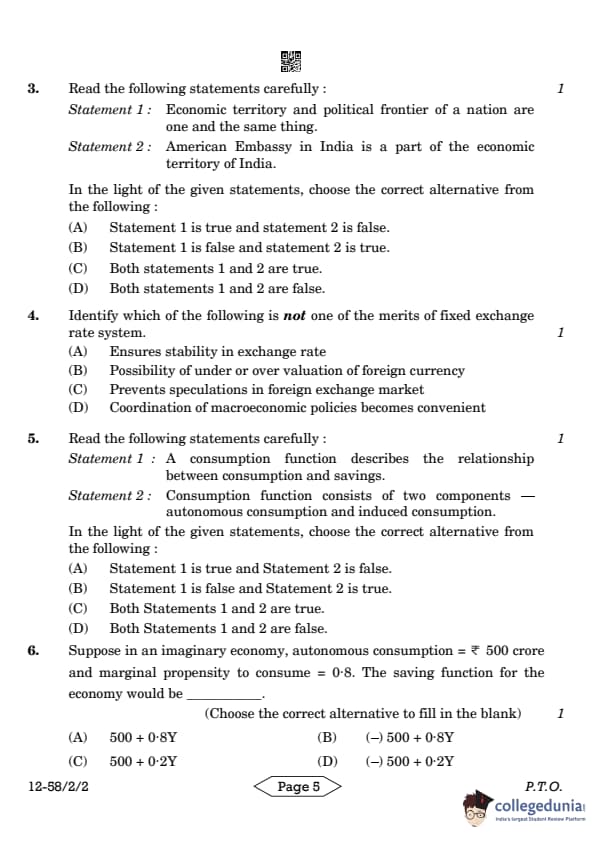
Read the following statements carefully:
Statement 1: Economic territory and political frontier of a nation are one and the same thing.
Statement 2: American Embassy in India is a part of the economic territory of India.
In the light of the given statements, choose the correct alternative from the following:
View Solution
Solution:
Understanding Economic Territory vs. Political Territory:
- Economic territory refers to the geographical area under the jurisdiction of a country's economic activities, including embassies abroad.
- Political frontier refers to the sovereign boundary of a nation, including embassies within the country.
Evaluating the Statements:
- Statement 1 is false: Economic territory and political frontier are not the same, as economic territory includes embassies abroad.
- Statement 2 is false: The American Embassy in India is part of the economic territory of the USA, not India.
Conclusion: Both statements are false, making option (D) the correct choice.
Question 4:
Identify which of the following is not one of the merits of a fixed exchange rate system.
View Solution
Solution:
Understanding Fixed Exchange Rate System:
- A fixed exchange rate system ensures currency stability and facilitates international trade.
Identifying the Incorrect Merit:
- (A) Stability in exchange rate: A major advantage as it removes exchange rate fluctuations.
- (C) Prevention of speculation: Reduces uncertainty, minimizing speculative activities.
- (D) Macroeconomic coordination: Easier for governments to plan policies due to stable exchange rates.
- (B) Possibility of under or overvaluation: This is a disadvantage as the fixed rate may not reflect actual market conditions.
Conclusion: The incorrect merit is (B) since under or overvaluation of currency can distort trade and economic balance.
Question 5:
Read the following statements carefully:
Statement 1: A consumption function describes the relationship between consumption and savings.
Statement 2: Consumption function consists of two components - autonomous consumption and induced consumption.
In the light of the given statements, choose the correct alternative from the following:
View Solution
Solution:
Understanding the Consumption Function:
- The consumption function represents the relationship between income and consumption, not between consumption and savings (Statement 1 is false).
- The consumption function consists of autonomous consumption (minimum consumption even with zero income) and induced consumption (which changes with income) (Statement 2 is true).
Conclusion: Statement 1 is incorrect as it misinterprets the consumption function, while Statement 2 correctly defines its components.
Question 6:
Suppose in an imaginary economy, autonomous consumption = Rs.500 crore and marginal propensity to consume = 0.8. The saving function for the economy would be ________. (Choose the correct alternative to fill in the blank)
View Solution
Solution:
Understanding the Saving Function:
- The saving function is derived from the consumption function using:
S = Y - C
- The consumption function is given by:
C = 500 + 0.8Y
- Since S = Y - C, substituting values:
S = Y - (500 + 0.8Y) = -500 + 0.2Y
Conclusion: The correct option is (-) 500 + 0.2Y, making option (D) the right answer.
Question 7:
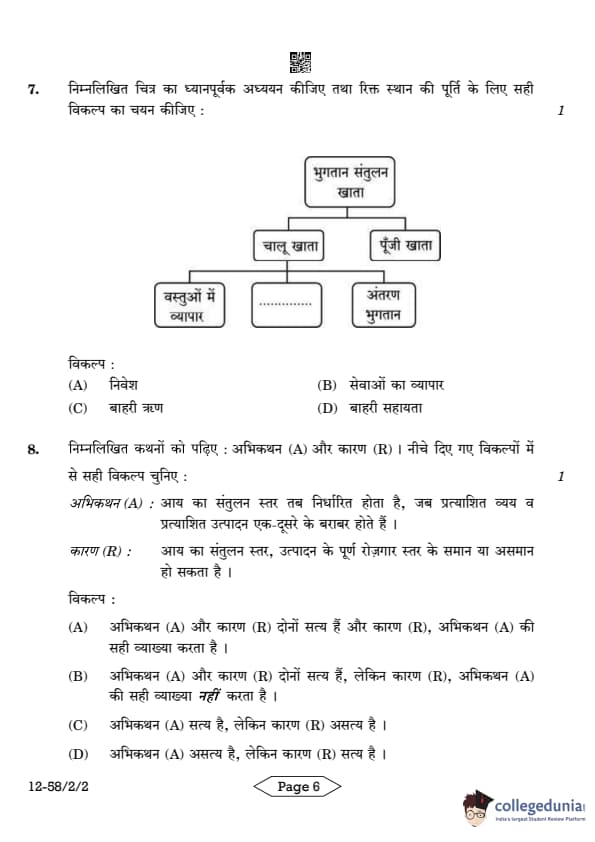
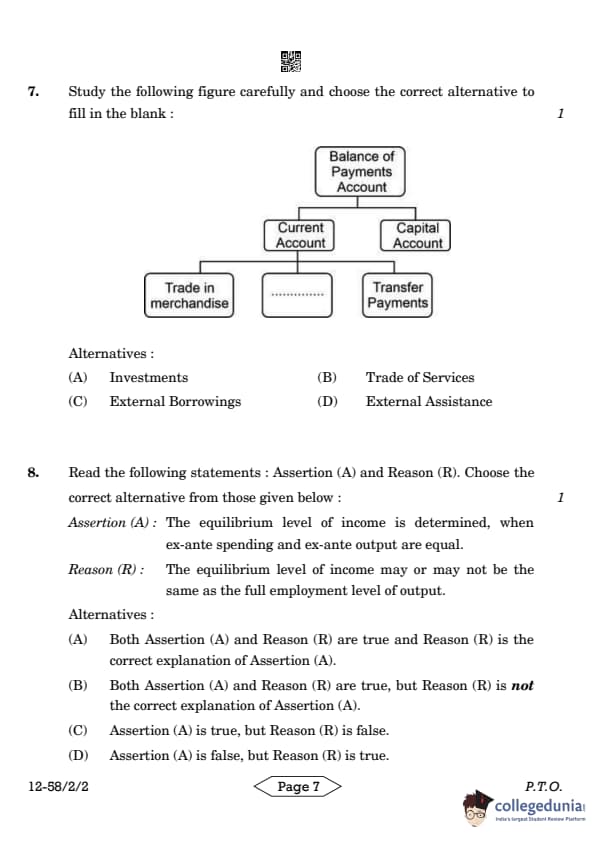
Study the following figure carefully and choose the correct alternative to fill in the blank:
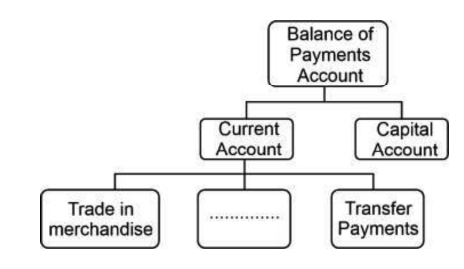
Alternatives:
View Solution
Solution:
Understanding the Context:
- The missing term in the given figure represents a transaction related to international trade.
Identifying the Correct Option:
- Investments: Relates to capital inflows, not directly part of trade.
- Trade of Services: Covers exports and imports of services, including IT, tourism, and consulting.
- External Borrowings: Refers to government or private loans, not trade-related.
- External Assistance: Involves financial aid, not trade.
Conclusion: The correct option is Trade of Services, as it best fits the given economic transaction.
Question 8:
Read the following statements: Assertion (A) and Reason (R). Choose the correct alternative from those given below:
Assertion (A): The equilibrium level of income is determined when ex-ante spending and ex-ante output are equal.
Reason (R): The equilibrium level of income may or may not be the same as the full employment level of output.
View Solution
Solution:
Understanding Equilibrium Level of Income:
- Equilibrium income is where aggregate demand (ex-ante spending) equals aggregate supply (ex-ante output).
Evaluating the Statements:
- Assertion (A) is true: Equilibrium is reached when planned spending matches planned production.
- Reason (R) is also true: Equilibrium income may not always correspond to full employment output, leading to underemployment or inflation.
- However, R does not directly explain A, as equilibrium income is determined by aggregate demand and supply, not employment levels.
Conclusion: Both A and R are true, but R is not the direct explanation of A, making option (B) the correct choice.
Question 9:
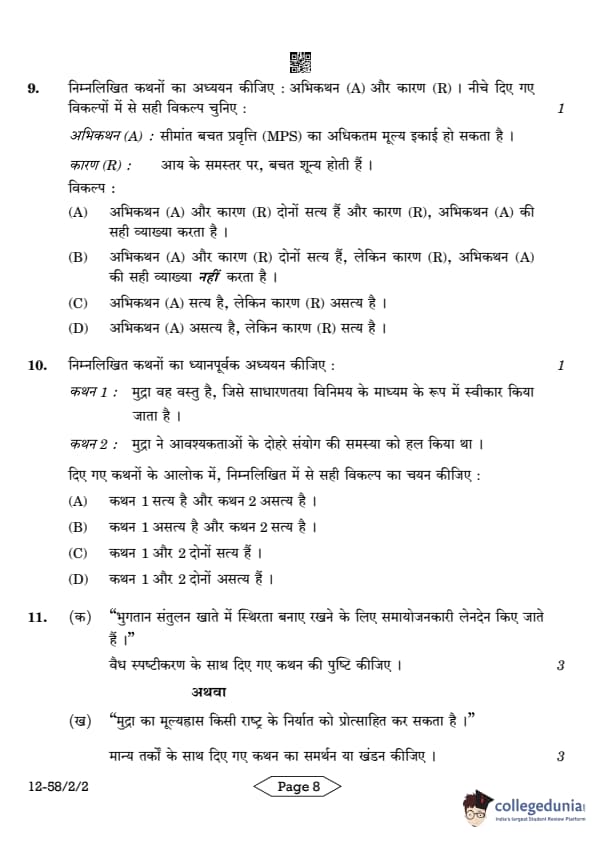
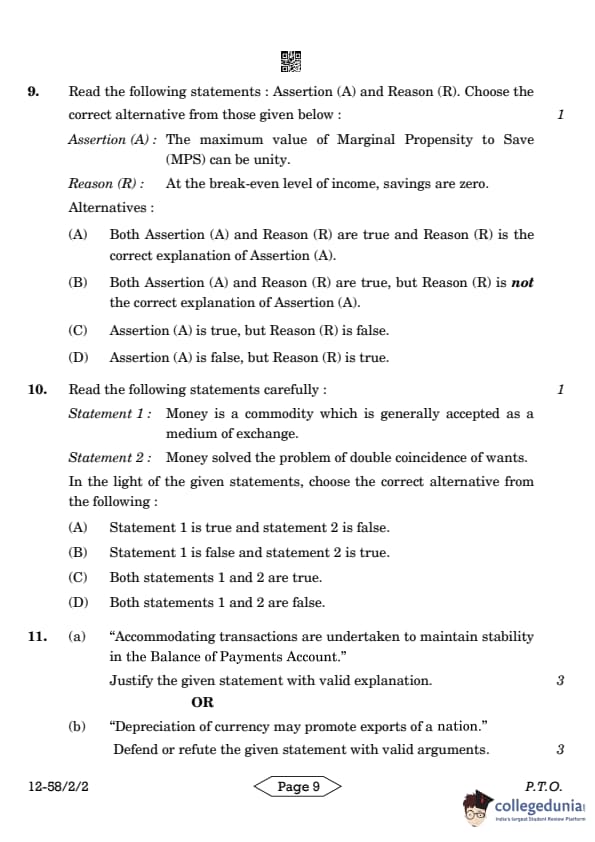
Read the following statements: Assertion (A) and Reason (R). Choose the correct alternative from those given below:
Assertion (A): The maximum value of Marginal Propensity to Save (MPS) can be unity.
Reason (R): At the break-even level of income, savings are zero.
View Solution
Solution:
Understanding Marginal Propensity to Save (MPS):
- MPS represents the fraction of additional income that is saved.
- The maximum value of MPS can be 1, meaning all additional income is saved.
Evaluating the Statements:
- Assertion (A) is true: MPS can range from 0 to 1, where 1 means all income is saved.
- Reason (R) is also true: At break-even income, consumption equals income, leaving savings at zero.
- However, R does not explain A, since MPS refers to changes in savings, not its absolute level at break-even income.
Conclusion: Both A and R are true, but R does not directly explain A, making option (B) the correct choice.
Question 10:
Read the following statements carefully:
Statement 1: Money is a commodity which is generally accepted as a medium of exchange.
Statement 2: Money solved the problem of double coincidence of wants.
In the light of the given statements, choose the correct alternative from the following:
View Solution
Solution:
Understanding the Functions of Money:
- Money is a widely accepted medium of exchange, replacing the barter system.
Evaluating the Statements:
- Statement 1 is true: Money serves as a commonly accepted medium of exchange, facilitating transactions.
- Statement 2 is true: The introduction of money eliminated the double coincidence of wants problem in barter exchange, allowing smooth trade.
Conclusion: Both statements are true, making option (C) the correct choice.
Question 11(a):
“Accommodating transactions are undertaken to maintain stability in the Balance of Payments Account.”
Justify the given statement with a valid explanation.
View Solution
Solution:
Accommodating transactions are commonly undertaken to maintain stability in the Balance of Payments (BOP) account. These transactions are carried out to correct imbalances in international payments, ensuring economic stability.
Unlike autonomous transactions, which are driven by economic motives, accommodating transactions are determined by the overall BOP status, such as a surplus or deficit. When a country faces a BOP deficit, it may engage in measures like borrowing from international institutions, using foreign exchange reserves, or receiving financial assistance to balance international transactions. Similarly, in the case of a surplus, the country may invest in foreign assets or accumulate reserves. Since these transactions are not driven by trade or investment decisions but are aimed at correcting imbalances, they are crucial for maintaining equilibrium in international financial flows.
Thus, accommodating transactions help restore stability in the Balance of Payments by ensuring that deficits and surpluses do not disrupt economic functioning.
Question 11(b):
“Depreciation of currency may promote exports of a nation.”
Defend or refute the given statement with valid arguments.
View Solution
Solution:
Depreciation of a currency refers to a fall in its value relative to foreign currencies under a floating exchange rate system. This makes the country's exports cheaper in the international market, increasing their demand. As foreign buyers find goods and services more affordable, export volumes tend to rise, leading to an improvement in trade balance.
Additionally, depreciation encourages domestic industries by making imports relatively expensive, which may boost local production and employment. However, the effectiveness of currency depreciation in promoting exports depends on the price elasticity of demand for exported goods. If exports are price-inelastic, demand may not significantly increase. Furthermore, depreciation can lead to imported inflation, increasing the cost of production for domestic firms reliant on foreign inputs. Despite these challenges, in general, depreciation of a currency is considered beneficial for export competitiveness and economic growth, making this statement largely valid.
Question 12:
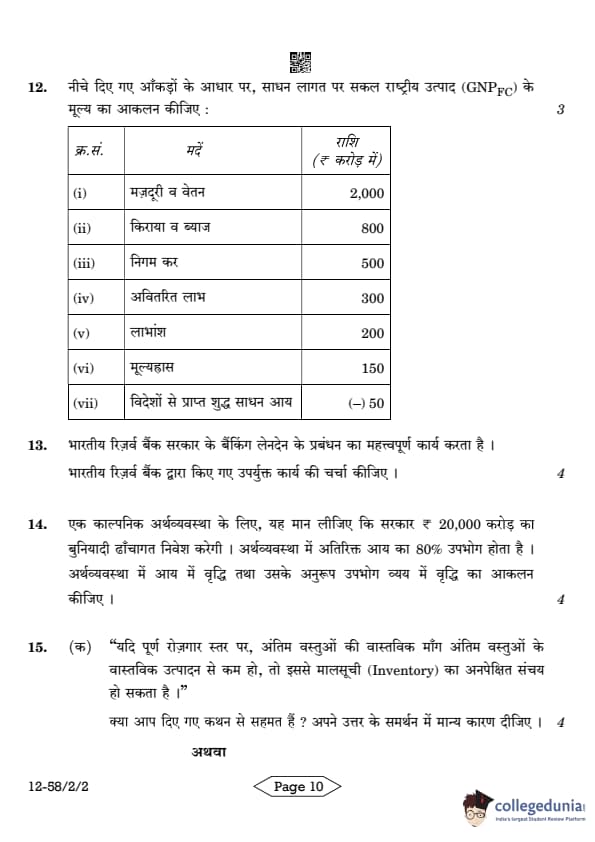
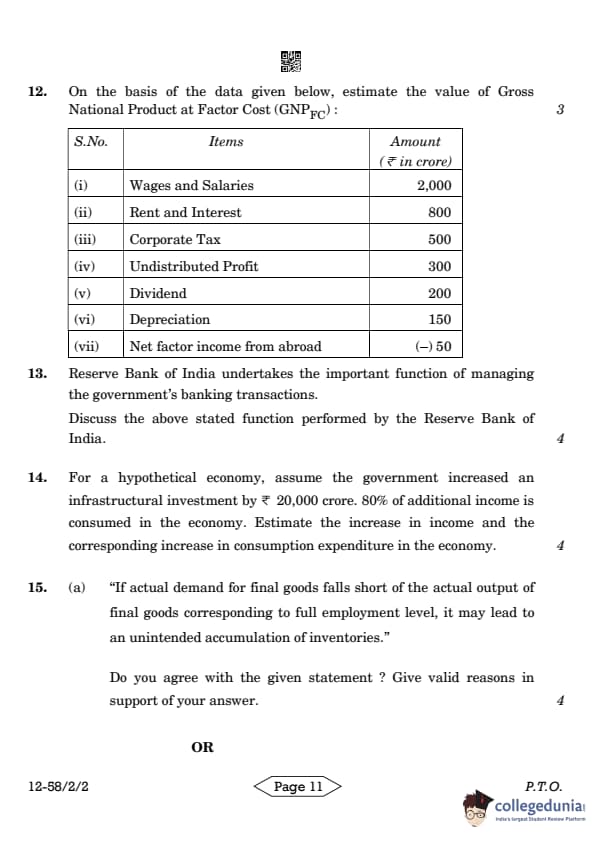
On the basis of the data given below, estimate the value of Gross National Product at Factor Cost (GNPFC):
| S. No. | Items | Amount (in Rs. crore) |
|---|---|---|
| (i) | Wages and Salaries | 2,000 |
| (ii) | Rent and Interest | 700 |
| (iii) | Corporate Tax | 500 |
| (iv) | Undistributed Profit | 300 |
| (v) | Consumption of Fixed Capital | 200 |
| (vi) | Dividend | 150 |
| (vii) | Net Factor Income from Abroad | (-) 50 |
View Solution
Solution:
Gross National Product at Factor Cost (GNPFC) is calculated as follows:
GNPFC = Wages and Salaries + Rent and Interest + Corporate Tax + Undistributed Profit + Dividend + Consumption of Fixed Capital + Net Factor Income from Abroad
= 2,000 + 700 + 500 + 300 + 150 + 200 + (-50)
= 3,800 crore
Final Answer:
GNPFC = Rs. 3,800 crore
Question 13:
Reserve Bank of India undertakes the important function of managing the government's banking transactions.
Discuss the above-stated function performed by the Reserve Bank of India.
View Solution
Solution:
The Reserve Bank of India (RBI) acts as the banker to the central and state governments by managing their financial transactions. It performs the following key functions in this regard:
1. Maintaining Government Accounts:
- The RBI holds accounts for the central and state governments and manages their receipts and payments.
2. Public Debt Management:
- It manages the issuance of government bonds and securities to finance budget deficits.
3. Monetary Transactions and Borrowings:
- The RBI facilitates domestic and international transactions for the government, including loan repayments and borrowings.
4. Implementation of Fiscal Policy:
- It ensures smooth execution of government fiscal policies by regulating money supply and inflation.
5. Lender to the Government:
- In case of financial shortfalls, the RBI provides short-term loans to the government through Ways and Means Advances (WMA).
Thus, the RBI plays a crucial role in ensuring financial stability by managing the government's transactions efficiently.
Question 14:
For a hypothetical economy, assume the government increased infrastructural investment by Rs. 20,000 crore. 80% of additional income is consumed in the economy. Estimate the increase in income and the corresponding increase in consumption expenditure in the economy.
Given:
ΔI = Rs. 20,000 crore
Marginal Propensity to Consume (MPC) = 0.8
View Solution
Solution:
Step 1: Understanding the Investment Multiplier Formula
The investment multiplier (K) is given by:
K = 1⁄(1 - MPC)
Step 2: Calculating the Multiplier
K = 1⁄(1 - 0.8) = 1⁄0.2 = 5
Step 3: Estimating the Increase in Income
ΔY = K × ΔI
= 5 × 20,000 = Rs. 1,00,000 crore
Step 4: Estimating the Increase in Consumption Expenditure
ΔC = MPC × ΔY
= 0.8 × 1,00,000 = Rs. 80,000 crore
Final Answer:
- The increase in income in the economy is Rs. 1,00,000 crore.
- The corresponding increase in consumption expenditure is Rs. 80,000 crore.
Question 15(a):
“If actual demand for final goods falls short of the actual output of final goods corresponding to full employment level, it may lead to an unintended accumulation of inventories.”
Do you agree with the given statement? Give valid reasons in support of your answer.
View Solution
Solution:
Yes, I agree with the given statement. If the actual demand for final goods falls short of the actual output corresponding to the full employment level, it indicates that the demand by all consumers and firms is lower than the total level of production at full employment. This situation leads to an unintended accumulation of inventories as firms produce more than what is being demanded in the market. As a result, businesses may experience an unsold stockpile of goods, leading to excess supply. If this trend continues, firms may be forced to cut down production, leading to reduced economic activity and potential unemployment. Thus, a decline in aggregate demand below full employment output causes unintended inventory accumulation, which affects overall economic equilibrium.
OR
Question 15(b):
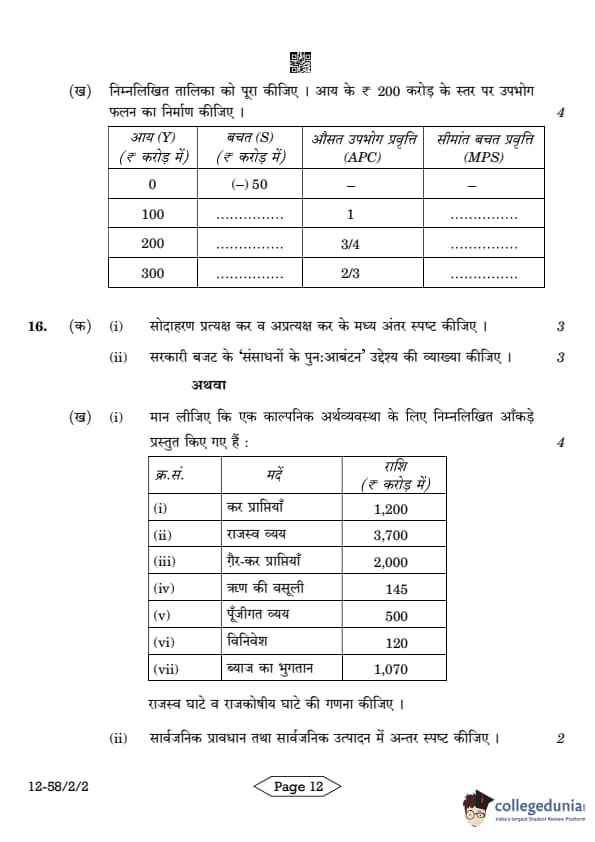
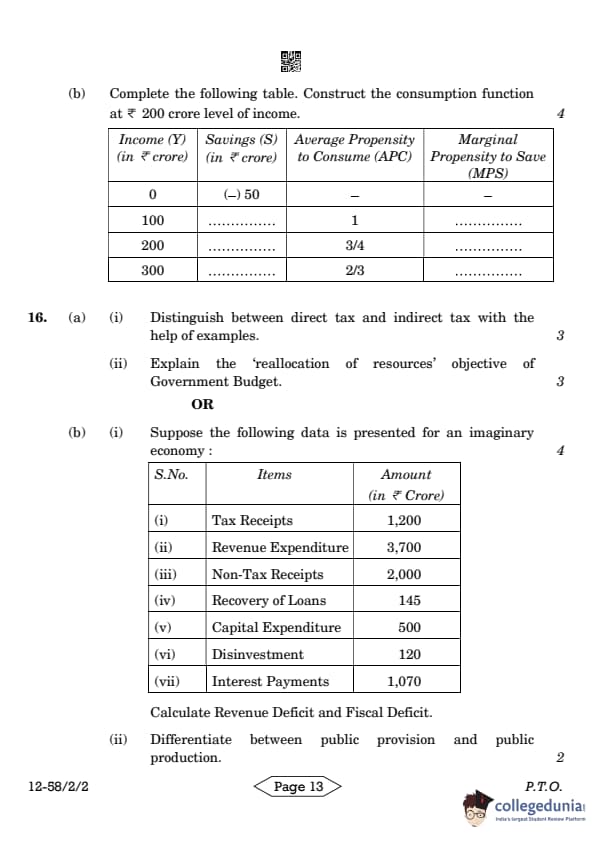
Complete the following table. Construct the Consumption function at Rs. 200 crore level of income.
| Income (Y) (in Rs. Crore) | Savings (in Rs. Crore) | (APC) | (MPS) |
|---|---|---|---|
| 0 | (-) 50 | ||
| 100 | 1 | ||
| 200 | 3⁄4 | ||
| 300 | 2⁄3 |
View Solution
Solution:
To complete the table, we use the following formulas:
1. Consumption (C) Formula:
C = Y - S
2. Average Propensity to Consume (APC):
APC = C⁄Y
3. Marginal Propensity to Save (MPS):
MPS = 1 - MPC
Using these calculations, we get:
| Income (Y) (in Rs. Crore) | Savings (in Rs. Crore) | (APC) | (MPS) |
|---|---|---|---|
| 0 | (-) 50 | - | - |
| 100 | (-) 30 | 1 | 0.5 |
| 200 | 10 | 0.85 | 0.5 |
| 300 | 40 | 2⁄3 | 0.5 |
- The savings function is completed using the formula S = Y - C.
- The Marginal Propensity to Save (MPS) is calculated as 0.5 throughout.
Question 16(a)(i):
Distinguish between direct tax and indirect tax with the help of suitable examples.
View Solution
Solution:
| Basis | Direct Tax | Indirect Tax |
|---|---|---|
| Define | Tax imposed directly on individuals or entities. | Tax imposed on goods and services. |
| Incidence | Paid directly by the taxpayer to the government. | Collected by intermediaries and paid by consumers. |
| Examples | Income Tax, Corporate Tax, Wealth Tax | GST, Excise Duty, Customs Duty |
| Burden of Tax | Cannot be shifted to another party. | Passed on to the final consumer. |
Question 16(a)(ii):
Explain the ‘Reallocation of Resources' objective of Government Budget.
View Solution
Solution:
The reallocation of resources is a key objective of the Government Budget, aimed at ensuring an efficient and equitable distribution of resources to promote economic growth, social welfare, and sustainable development.
Need for Resource Reallocation:
- The private sector primarily focuses on profit maximization, often neglecting essential public goods such as healthcare, education, and infrastructure.
- The government intervenes through taxation, subsidies, and public expenditure to correct these imbalances and allocate resources efficiently.
Methods of Resource Reallocation:
1. Encouraging Socially Desirable Goods and Services:
- The government increases expenditure on public goods like schools, hospitals, roads, and clean energy projects to promote welfare.
- Subsidies and incentives are provided to industries engaged in renewable energy, rural development, and small-scale industries.
2. Discouraging Harmful Goods and Practices:
- The government imposes high taxes on tobacco, alcohol, and environmentally harmful industries to discourage their consumption and production.
- Regulatory policies and environmental standards ensure that resources are not wasted on activities that harm society.
3. Balancing Regional Development:
- Government allocates funds to underdeveloped and rural regions to promote balanced economic growth.
- Special incentives, tax benefits, and infrastructure projects are launched to attract industries to backward areas.
Conclusion: The reallocation of resources through the government budget helps in correcting market failures, ensuring social justice, and promoting long-term economic stability by directing resources towards productive and welfare-oriented sectors.
OR
Question 16(b)(i):
Suppose the following data is presented for an imaginary economy:
| S.No. | Items | Amount (in Crore) |
|---|---|---|
| (i) | Tax Receipts | 1,200 |
| (ii) | Revenue Expenditure | 3,700 |
| (iii) | Non-Tax Receipts | 2,000 |
| (iv) | Recovery of Loans | 145 |
| (v) | Capital Expenditure | 500 |
| (vi) | Disinvestment | 120 |
| (vii) | Interest Payments | 1,070 |
Calculate Revenue Deficit and Fiscal Deficit.
View Solution
Solution:
Step 1: Formula for Revenue Deficit
Revenue Deficit = Revenue Expenditure – Revenue Receipts
Revenue Receipts = Tax Receipts + Non-Tax Receipts = 1,200 + 2,000 = 3,200
Revenue Deficit = 3,700 – 3,200 = 500 crore
Step 2: Formula for Fiscal Deficit
Fiscal Deficit = Total Expenditure – Total Receipts (excluding borrowings)
Total Expenditure = Revenue Expenditure + Capital Expenditure = 3,700 + 500 = 4,200
Total Receipts = Tax Receipts + Non-Tax Receipts + Recovery of Loans + Disinvestment = 1,200 + 2,000 + 145 + 120 = 3,465
Fiscal Deficit = 4,200 – 3,465 = 735 crore
Final Answer: - Revenue Deficit = Rs. 500 crore - Fiscal Deficit = Rs. 735 crore
Question 16(b)(ii):
Differentiate between Public Provision and Public Production.
View Solution
Solution:
| Basis | Public Provision | Public Production |
|---|---|---|
| Definition | Government provides goods and services but does not produce them. | Government directly produces and supplies goods and services. |
| Mode of Delivery | Provided through private firms or contractors. | Managed and produced by government-owned firms. |
| Example | Free textbooks in schools | Railways, Public Sector Banks |
Question 17:
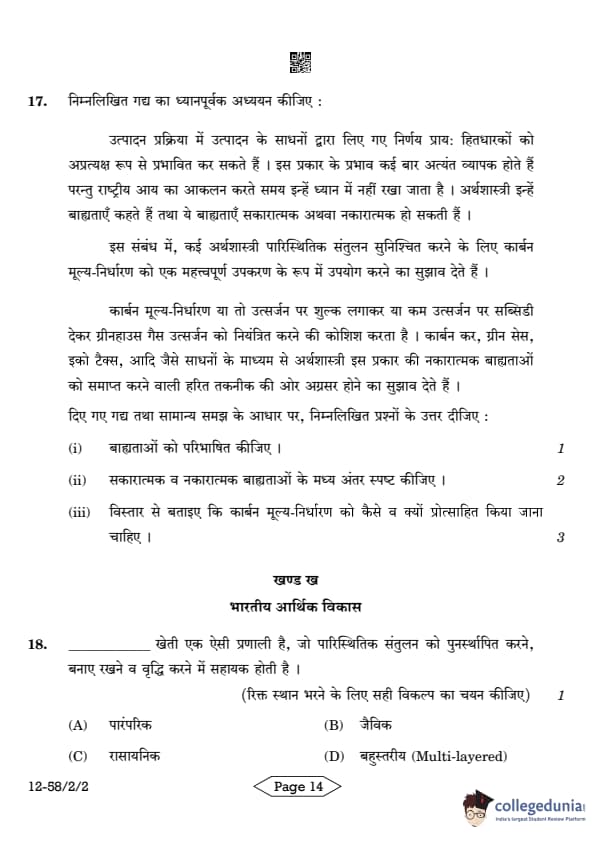
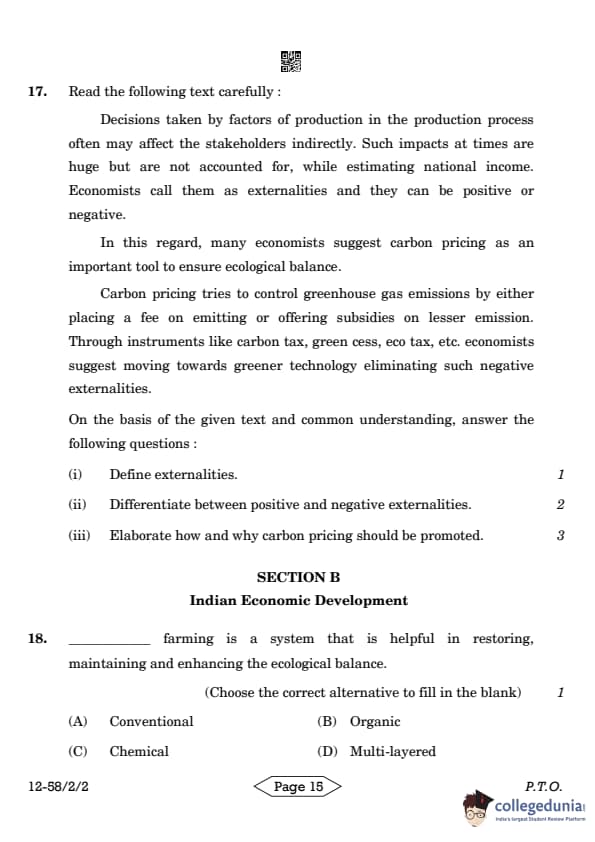
Read the following text carefully :
Decisions taken by factors of production in the production process often may affect the stakeholders indirectly. Such impacts at times are huge but are not accounted for, while estimating national income. Economists call them as externalities and they can be positive or negative.
In this regard, many economists suggest carbon pricing as an important tool to ensure ecological balance.
Carbon pricing tries to control greenhouse gas emissions by either placing a fee on emitting or offering subsidies on lesser emission. Through instruments like carbon tax, green cess, eco tax, etc. economists suggest moving towards greener technology eliminating such negative externalities.
On the basis of the given text and common understanding, answer the following questions:
(i) Define Externalities.
View Solution
Solution:
Externalities refer to the unintended positive or negative effects of economic activities on third parties who are not directly involved in the transaction. These effects are not reflected in market prices. Externalities can be positive in market prices. Externalities can be positive, where they benefit society, or negative, where they impose costs on others without compensation.
Example:
- A factory polluting a river negatively affects nearby residents (Negative Externality).
- Vaccination programs reduce disease spread, benefiting the entire community (Positive Externality).
Question 17(ii):
Differentiate between Positive and Negative Externalities.
View Solution
Solution:
| Basis | Positive Externalities | Negative Externalities |
|---|---|---|
| Definition | Benefits third parties without compensation. | Harms third parties without compensation. |
| Effect on Society | Enhances overall social welfare. | Reduces social welfare and leads to market failures. |
| Examples | Education, Public Parks, Vaccinations. | Air pollution, Traffic congestion, Industrial waste. |
| Government Intervention | Subsidies or incentives to encourage positive externalities. | Taxes, regulations, or fines to reduce negative externalities. |
Question 17(iii):
Elaborate how and why carbon pricing should be promoted.
View Solution
Solution:
Understanding Carbon Pricing: Carbon pricing is a market-based approach to controlling greenhouse gas emissions by assigning a cost to carbon emissions. It is implemented through carbon taxes or cap-and-trade systems, incentivizing businesses and consumers to reduce emissions.
Reasons to Promote Carbon Pricing:
1. Encourages Emission Reduction:
- By increasing the cost of carbon-intensive activities, firms and individuals are motivated to adopt cleaner technologies.
2. Promotes Green Innovation:
- Carbon pricing encourages research and development in renewable energy and sustainable production methods.
3. Generates Government Revenue for Climate Action:
- Funds collected from carbon taxes can be invested in renewable energy projects and climate adaptation measures.
4. Corrects Negative Externalities:
- Since pollution imposes costs on society, carbon pricing internalizes these costs, ensuring that polluters pay for environmental damage.
5. Aligns with International Climate Agreements:
- Countries implementing carbon pricing comply with global initiatives like the Paris Agreement, promoting international cooperation.
Conclusion: Carbon pricing is an effective tool for reducing emissions and addressing climate change. Governments worldwide should promote and implement it to encourage sustainable economic growth while mitigating environmental damage.
SECTION B
Indian Economic Development
Question 18:
__________ farming is a system that is helpful in restoring, maintaining, and enhancing the ecological balance. (Choose the correct alternative to fill in the blank)
View Solution
Solution:
Organic farming is a method of agriculture that focuses on sustainable practices to restore and maintain ecological balance. It avoids the use of synthetic fertilizers, pesticides, and genetically modified organisms (GMOs). Instead, it promotes natural fertilizers, crop rotation, biological pest control, and sustainable soil management.
Organic Farming reason:
- It enhances soil fertility and biodiversity.
- Reduces pollution and conserves water.
- Ensures healthier produce without harmful chemicals.
Conclusion: Among the given options, organic farming (B) is the most suitable method for maintaining ecological balance by using environmentally friendly techniques.
Question 19:
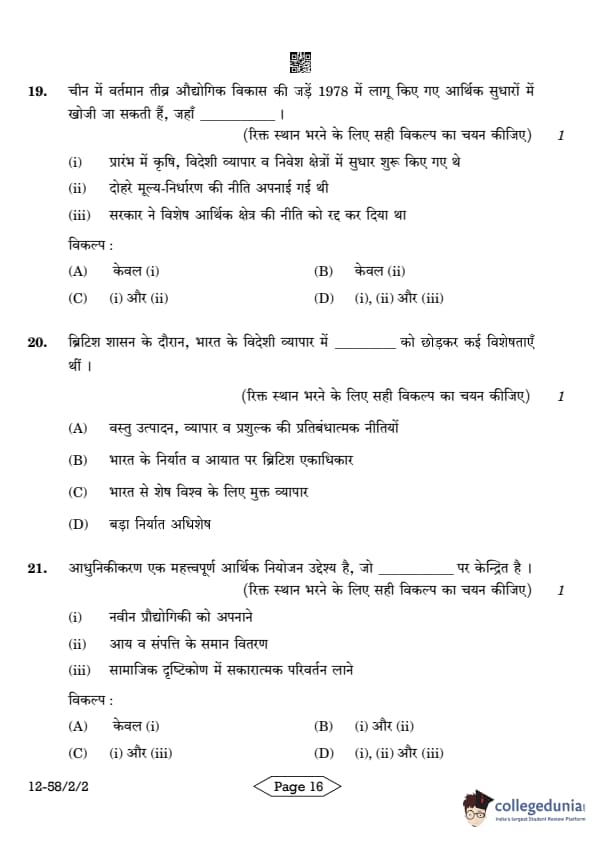
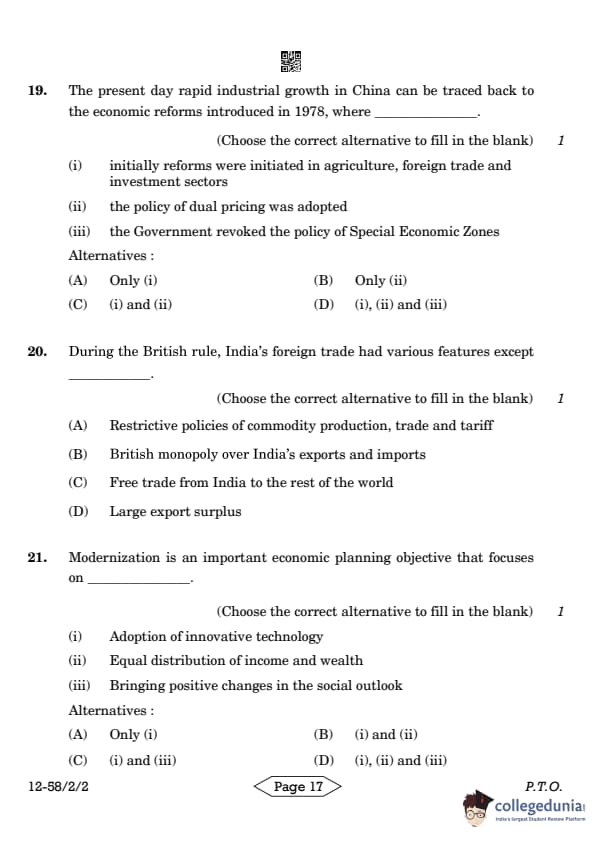
The present-day rapid industrial growth in China can be traced back to the economic reforms introduced in 1978, where __________. (Choose the correct alternative to fill in the blank)
(i) Initially, reforms were initiated in agriculture, foreign trade, and investment sectors
(ii) The policy of dual pricing was adopted
(iii) The Government revoked the policy of Special Economic Zones
Alternatives:
View Solution
Solution:
China's rapid industrial growth began with economic reforms in 1978, led by Deng Xiaoping. These reforms initially focused on:
1. Agricultural Reforms: - The introduction of the Household Responsibility System replaced collective farming, allowing farmers to sell surplus produce in markets.
2. Foreign Trade and Investment Reforms: - China opened up to foreign direct investment (FDI) and set up Special Economic Zones (SEZs) to attract global businesses.
3. Dual Pricing Policy: - Under this system, goods were priced differently in state-controlled markets and free markets, allowing gradual transition to a market economy.
The statement (iii) is incorrect as the government did not revoke SEZs; instead, they played a crucial role in China's industrial growth.
Question 20:
During the British rule, India's foreign trade had various features except __________. (Choose the correct alternative to fill in the blank)
View Solution
Solution:
Under British rule, India's foreign trade was highly restricted and controlled by the colonial administration. The British imposed restrictive trade policies that favored British industries while limiting India's industrial and economic growth. India was primarily used as a raw material supplier to Britain and a market for British manufactured goods. The trade policies ensured a British monopoly over Indian exports and imports.
Additionally, India experienced a large export surplus, but this did not benefit the Indian economy as the profits were drained out of the country. The claim that there was "free trade from India to the rest of the world" is incorrect, as trade was controlled and restricted by British policies.
Question 21:
Modernization is an important economic planning objective that focuses on __________. (Choose the correct alternative to fill in the blank)
(i) Adoption of innovative technology
(ii) Equal distribution of income and wealth
(iii) Bringing positive changes in the social outlook
Alternatives:
View Solution
Solution:
Modernization in economic planning refers to the adoption of advanced technologies and innovations to improve productivity and efficiency in various sectors. It also includes bringing positive social changes, such as gender equality, education, and changes in traditional mindsets to align with modern societal values.
However, equal distribution of income and wealth (ii) is more closely related to economic equity rather than modernization. While modernization may indirectly contribute to economic equality, its primary focus remains on technological advancements and social transformation.
Question 22:
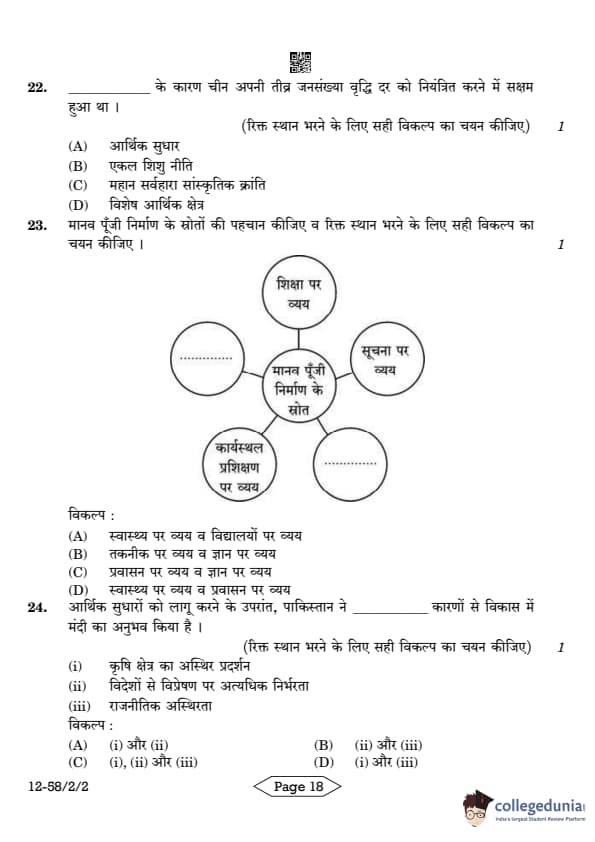
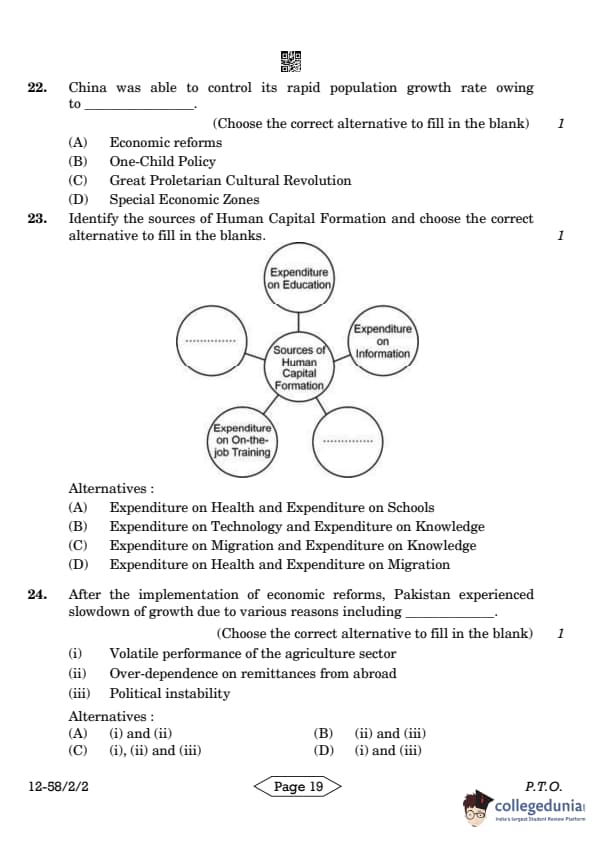
China was able to control its rapid population growth rate owing to __________. (Choose the correct alternative to fill in the blank)
View Solution
Solution:
China implemented the One-Child Policy in 1979 to curb its rapidly growing population. This policy restricted most families to having only one child, with some exceptions for ethnic minorities and rural families. The government enforced the policy through incentives for compliance and penalties for violations.
While the policy successfully slowed down population growth, it also led to unintended consequences such as aging population, gender imbalance, and labor shortages in later years. The policy was eventually relaxed in 2015 and replaced with a two-child policy, followed by a three-child policy in 2021.
Question 23:
Identify the sources of Human Capital Formation and choose the correct alternative to fill in the blanks.
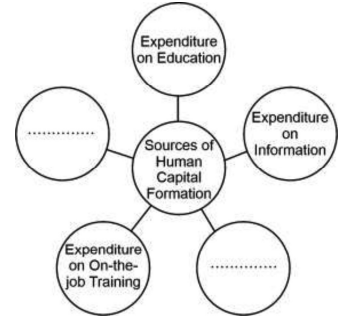
(Choose the correct alternative to fill in the blanks)
View Solution
Solution:
Understanding Human Capital Formation: Human Capital Formation refers to the process of improving the productive capacities of individuals through investment in education, health, and skills development.
Key Sources of Human Capital Formation:
1. Expenditure on Health:
- A healthy workforce is more productive and efficient.
- Investments in nutrition, medical care, sanitation, and disease control enhance human capital.
2. Expenditure on Migration:
- Migration for better education and job opportunities improves skills and productivity.
- Skilled workers moving to economically advanced regions can contribute to national economic growth.
Conclusion: Among the given options, Expenditure on Health and Expenditure on Migration are major contributors to Human Capital Formation, making option (D) the correct answer.
Question 24:
After the implementation of economic reforms, Pakistan experienced a slowdown of growth due to various reasons including __________. (Choose the correct alternative to fill in the blank)
(i) Volatile performance of the agriculture sector
(ii) Over-dependence on remittances from abroad
(iii) Political instability
Alternatives:
View Solution
Solution:
Pakistan's economic slowdown after economic reforms was caused by several factors:
1. Volatile Agriculture Sector (i):
- Dependence on agriculture led to fluctuating growth rates due to climatic and market conditions.
2. Over-dependence on Remittances (ii):
- The economy relied heavily on foreign remittances, making it vulnerable to global economic shifts.
3. Political Instability (iii):
- Frequent changes in government and policy uncertainty discouraged investment and economic stability.
Conclusion: All three factors contributed to Pakistan's economic struggles, making option (C) the correct answer.
Question 25:
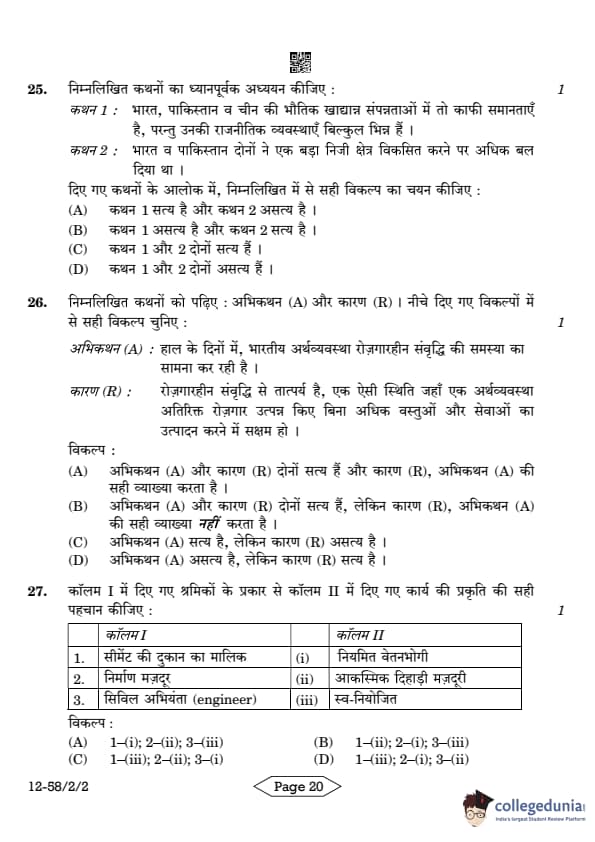
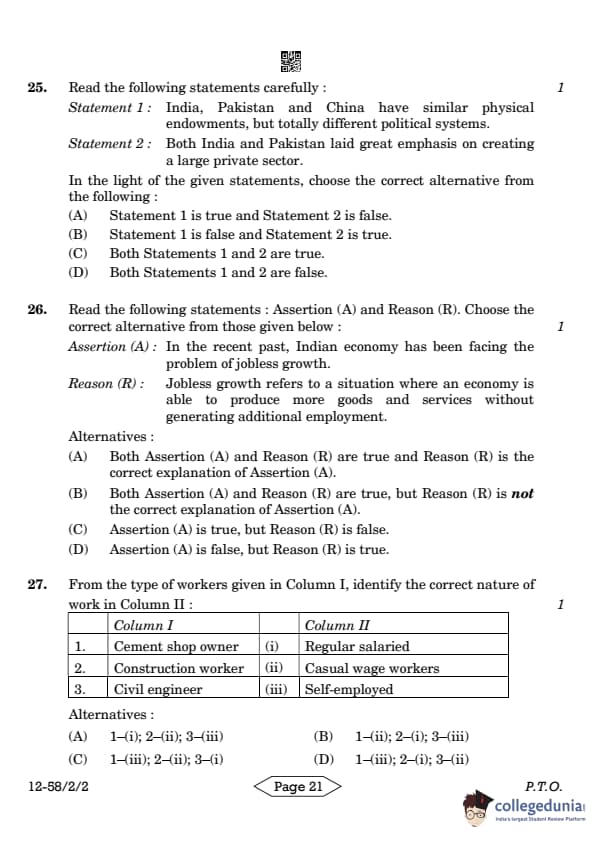
Read the following statements carefully:
Statement 1: India, Pakistan, and China have similar physical endowments, but totally different political systems.
Statement 2: Both India and Pakistan laid great emphasis on creating a large private sector.
In the light of the given statements, choose the correct alternative from the following:
View Solution
Solution:
Evaluating Statement 1:
- India, Pakistan, and China have similar geographical and climatic conditions but have entirely different political systems.
- India follows a democratic system, Pakistan has had a mix of military and civilian rule, while China follows a one-party communist system.
- Since these countries have developed under different political and economic ideologies, Statement 1 is true.
Evaluating Statement 2:
- Unlike Pakistan, India initially emphasized the public sector in its economic policies post-independence.
- India followed a socialist-inspired mixed economy, with a dominant public sector and regulated private sector.
- Pakistan, on the other hand, had a relatively more open private sector, but it still did not emphasize a large private sector like Western economies.
- Therefore, Statement 2 is false.
Conclusion: Since Statement 1 is true and Statement 2 is false, option (A) is the correct answer.
Question 26:
Read the following statements: Assertion (A) and Reason (R). Choose the correct alternative from those given below:
Assertion (A): In the recent past, the Indian economy has been facing the problem of jobless growth.
Reason (R): Jobless growth refers to a situation where an economy is able to produce more goods and services without generating additional employment.
Alternatives:
View Solution
Solution:
Understanding Jobless Growth: Jobless growth refers to an economic scenario where output increases but employment does not grow proportionately. This is due to: - Increased automation and technology replacing human labor. - Growth being concentrated in capital-intensive industries rather than labor-intensive sectors.
Evaluating the Statements:
- Assertion (A) is true: The Indian economy has witnessed jobless growth, with rising GDP but slow employment generation.
- Reason (R) is also true: Jobless growth occurs when economic expansion does not lead to sufficient job creation.
- However, R does not fully explain A, as factors like automation, labor market inefficiencies, and sectoral shifts also contribute to jobless growth.
Conclusion: Both A and R are true, but R does not fully explain A, making option (B) the correct answer.
Question 27:
From the type of workers given in Column I, identify the correct nature of work in Column II:
| Column I (Type of Worker) | Column II (Nature of Work) |
|---|---|
| 1. Cement shop owner | (i) Regular salaried |
| 2. Construction worker | (ii) Casual wage workers |
| 3. Civil engineer | (iii) Self-employed |
Alternatives:
View Solution
Solution:
1. Cement Shop Owner (Self-employed - iii):
- Owns and runs a business independently, making them self-employed.
2. Construction Worker (Casual wage worker - ii):
- Engaged in temporary work, earning daily or weekly wages without long-term job security.
3. Civil Engineer (Regular salaried - i):
- Employed on a permanent basis in a company or government institution, earning a fixed salary.
Conclusion: The correct match is 1-(iii), 2-(ii), and 3-(i), making option (C) the correct choice.
Question 28(a):
“Recently the Government of India launched Jan-Dhan Yojana.”
In the light of the given statement, discuss briefly the objectives of this scheme.
View Solution
Solution:
The Government of India launched the Pradhan Mantri Jan-Dhan Yojana (PMJDY) to promote financial inclusion by providing access to financial services for all households, especially the underprivileged sections of society.
Objectives of Jan-Dhan Yojana:
1. Financial Inclusion and Access to Banking:
- Provide universal access to banking facilities for all citizens, especially in rural and semi-urban areas.
2. Encouraging Savings and Financial Awareness:
- Promote thrift habits among low-income households, encouraging them to save and build financial security.
3. Efficient Allocation of Financial Resources:
- Ensure that government subsidies and welfare benefits reach the intended beneficiaries directly through Direct Benefit Transfer (DBT).
4. Providing Basic Financial Services:
- Facilitate zero-balance bank accounts, debit cards, overdraft facilities, and micro-insurance benefits for account holders.
5. Empowering the Underprivileged and Women:
- Financial access enables marginalized sections, particularly women and rural workers, to participate in economic activities and entrepreneurship.
Conclusion: Jan-Dhan Yojana has played a pivotal role in financial empowerment, poverty reduction, and economic development, bringing millions into the formal banking system.
OR
Question 28(b):
“The Government of India has taken various measures to align the agricultural marketing system with the growing production activities in the rural areas.”
Do you agree with the given statement? Give any two valid reasons in support of your answer.
View Solution
Solution:
Yes, I agree with the given statement. The Government of India has implemented multiple initiatives to modernize and strengthen the agricultural marketing system, ensuring better price realization for farmers and efficient distribution of agricultural produce.
Two Key Measures Taken:
1. Market Regulations for Transparency and Fair Pricing:
- The government implemented Agricultural Produce Market Committees (APMCs) to create orderly, transparent, and competitive market conditions for both farmers and consumers.
2. Infrastructure Development for Efficient Agricultural Trade:
- Investments in rural infrastructure such as roads, railways, warehouses, cold storage facilities, and processing units have been made to improve market access, reduce post-harvest losses, and meet growing production demands.
Conclusion: By enhancing market regulations and infrastructure facilities, the government has successfully aligned the agricultural marketing system with increasing rural production activities, benefiting both farmers and consumers.
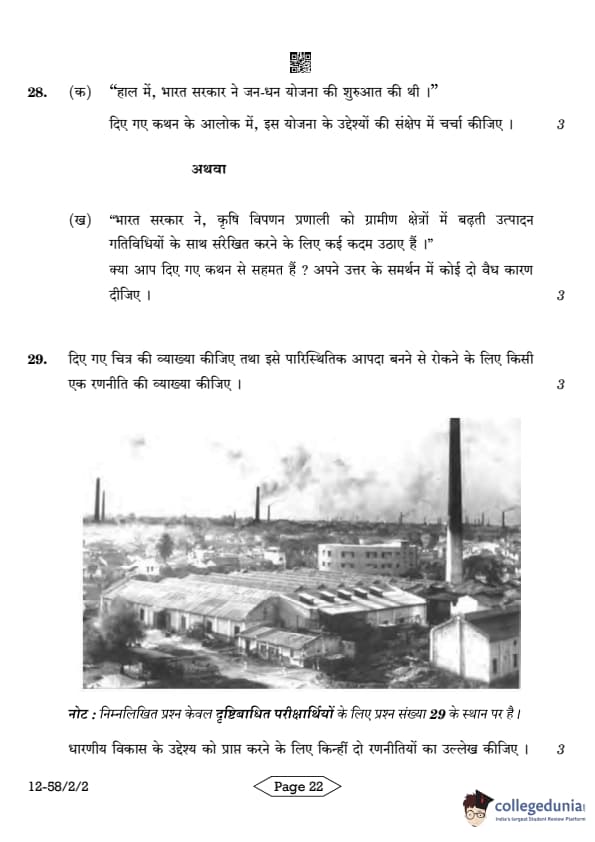
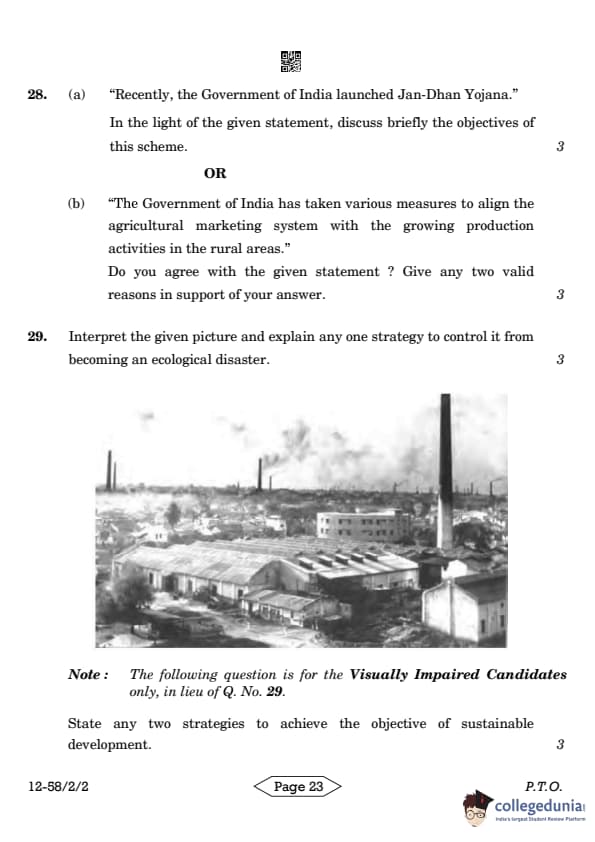
Question 29:
Interpret the given picture and explain any one strategy to control it from becoming an ecological disaster.
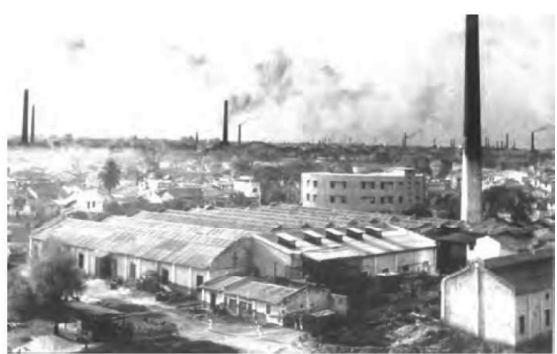
View Solution
Solution:
The given image depicts industrial pollution, characterized by smoke-emitting chimneys, dense industrial structures, and an overall degraded environmental condition. This indicates high levels of air pollution, which can contribute to climate change, respiratory diseases, and environmental degradation.
One Strategy to Control Industrial Pollution:
Adoption of Green Technologies and Cleaner Production Methods:
- Industries should shift towards eco-friendly technologies, such as renewable energy sources, energy-efficient machinery, and low-emission production processes.
- Implementation of pollution control equipment, such as electrostatic precipitators, scrubbers, and catalytic converters, can help reduce air pollution.
- Encouraging industries to adopt zero waste production techniques and circular economy models can minimize environmental impact.
Conclusion: By adopting green technologies and cleaner production, industries can significantly reduce pollution levels and prevent irreversible ecological damage, ensuring sustainable industrial growth.
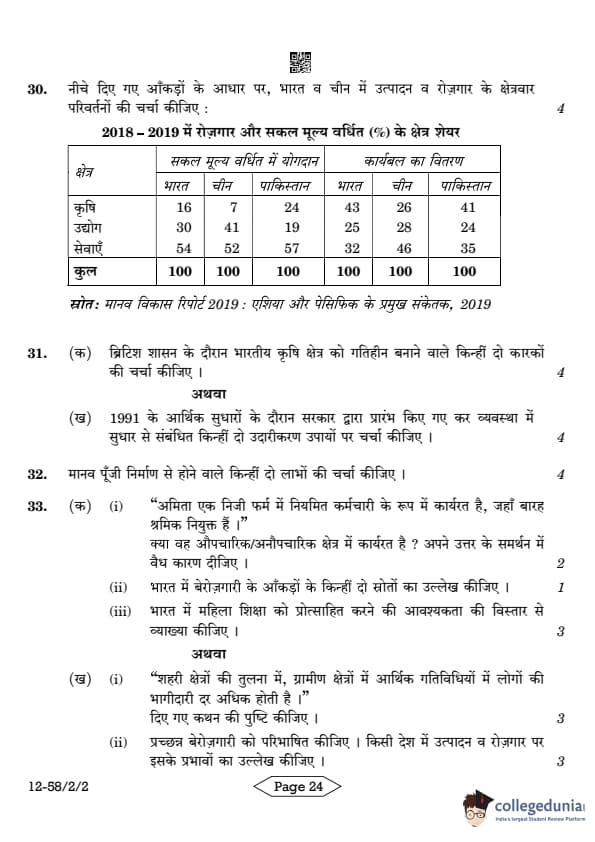
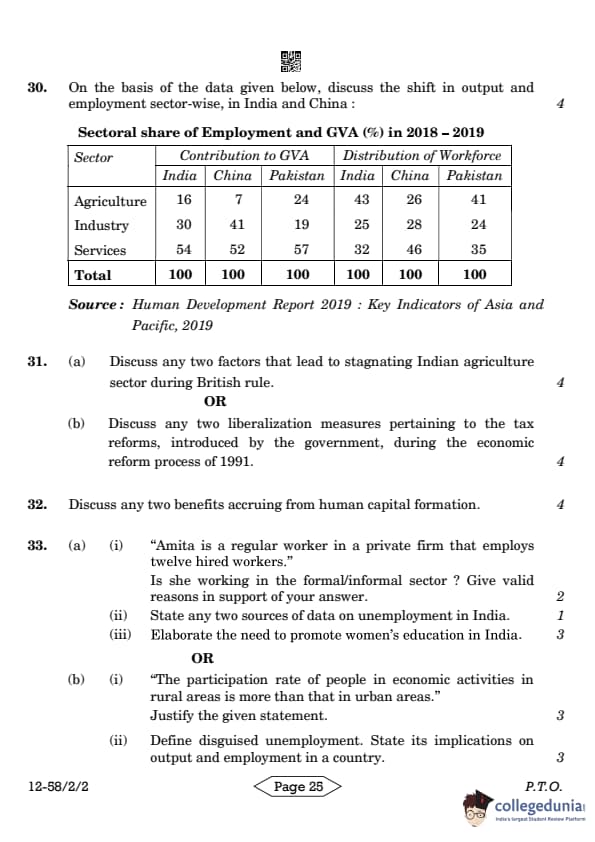
Question 30:
On the basis of the data given below, discuss the shift in output and employment sector-wise, in India and China:
| Sector | Contribution to GVA | Distribution of Workforce | ||||
|---|---|---|---|---|---|---|
| India | China | Pakistan | India | China | Pakistan | |
| Agriculture | 16 | 7 | 24 | 43 | 26 | 41 |
| Industry | 30 | 41 | 19 | 25 | 28 | 24 |
| Service | 54 | 52 | 57 | 32 | 46 | 35 |
| Total | 100 | 100 | 100 | 100 | 100 | 100 |
View Solution
Solution:
Key Observations on Sectoral Shifts in India and China:
1. The given data shows the data pertaining to the sectoral share of employment and Gross Value Added (GVA). Due to topographic and climatic conditions, the cultivable area in China is relatively smaller than that of India. Hence, the contribution of the agricultural sector to the GVA in China is 7 percent employing 26 percent of its workforce, whereas in India it is 16 percent employing 43 percent of its workforce.
2. Owing to rapid industrialisation in China, the contribution of the industrial sector to GVA stands at 41 percent with 28 percent of the workforce as against corresponding figures of 30 percent and 25 percent in India.
3. Both the nations have similar contribution of the Service sector to GVA standing at 54 percent and 52 percent with corresponding 32 percent and 46 percent to the workforce, respectively in India and China.
Conclusion: - China's shift towards industrial and service sectors has driven its rapid economic growth. - India still has a high dependence on agriculture, and further efforts are needed to transition its workforce to high-productivity sectors.
Question 31(a):
Discuss any two factors that lead to stagnating Indian agriculture.
View Solution
Solution:
Indian agriculture has faced stagnation due to various structural and environmental challenges. The two key factors contributing to this stagnation are:
1. Dependence on Monsoons:
- A significant portion of Indian agriculture relies on rainfall rather than irrigation infrastructure.
- Irregular monsoons, droughts, and climate change affect agricultural output, leading to production fluctuations.
2. Fragmentation of Landholdings:
- Due to increasing population and inheritance laws, agricultural land has been divided into smaller, less productive units.
- Small landholdings make it difficult to adopt modern mechanization and lead to lower productivity and profitability.
Conclusion: To overcome stagnation, technological advancements, better irrigation facilities, and land reform policies are necessary to enhance agricultural productivity.
Question 31(b):
Discuss any two liberalization measures pertaining to tax reforms introduced during the economic reform process of 1991.
View Solution
Solution:
The economic reforms of 1991 aimed at liberalizing the Indian economy and reducing government control. Two key tax-related liberalization measures introduced were:
1. Reduction in Direct Tax Rates:
- The government lowered personal income tax and corporate tax rates to improve compliance and encourage economic growth.
- Lower tax rates aimed to increase disposable income, promote investment, and boost overall economic productivity.
2. Introduction of Value-Added Tax (VAT) and Rationalization of Indirect Taxes:
- The complicated multi-tier tax structure was streamlined by introducing VAT at the state level.
- This reform helped reduce cascading effects, simplify taxation, and improve transparency in the tax system.
Conclusion: These reforms enhanced tax compliance, improved revenue collection, and contributed to India's economic liberalization and globalization.
Question 32:
Discuss any two benefits accruing from human capital formation.
View Solution
Solution:
Human capital formation refers to the process of enhancing the knowledge, skills, and health of individuals through education, training, and healthcare investments. It plays a vital role in economic growth and social development.
Two Key Benefits of Human Capital Formation:
1. Increased Productivity and Economic Growth:
- Investment in education and skill development enhances workers' efficiency, enabling them to produce higher output with better quality.
- A skilled workforce attracts higher investment and innovation, leading to economic expansion and technological progress.
2. Long-Term Sustainable Development and Better Quality of Life:
- A healthy and educated population ensures an uninterrupted supply of skilled labor, contributing to a stable workforce.
- Increased earnings and better job opportunities improve the overall standard of living, reducing poverty and social inequalities.
Conclusion: By fostering higher productivity, economic stability, and improved quality of life, human capital formation plays a pivotal role in national development.
Question 33(a)(i):
“Amita is a regular worker in a private firm that employs twelve hired workers."
Is she working in the formal/informal sector? Give valid reasons in support of your answer.
View Solution
Solution:
Amita is working in the formal sector.
Reason:
- The formal sector includes both public and private sector establishments that employ 10 or more hired workers and are registered under government regulations.
- Since Amita's firm has twelve hired workers, it falls under the formal sector, ensuring compliance with labour laws, job security, and social benefits such as provident funds and health insurance.
Question 33(a)(ii):
State any two sources of data on unemployment in India.
View Solution
Solution:
Two major sources of unemployment data in India are:
1. Reports of Census of India:
- The census provides comprehensive employment and unemployment statistics, covering rural and urban workforce participation.
2. National Statistical Office (NSO) Reports on Employment and Unemployment Situation:
- The NSO conducts Periodic Labour Force Surveys (PLFS) to track employment trends, workforce participation, and unemployment rates.
Other valid sources may include:
- Employment Exchanges
- Economic Surveys
- Labour Bureau Reports
Question 33(a)(iii):
Elaborate the need to promote women's education in India.
View Solution
Solution:
Promoting women's education in India is crucial for social and economic progress. It plays a key role in empowering women, reducing gender inequality, and enhancing overall national development.
Key Benefits of Women's Education:
1. Economic Empowerment:
- Educated women participate in the workforce, contributing to economic growth and financial independence.
2. Improved Health Outcomes:
- Education leads to better health awareness, lower maternal mortality, and improved child healthcare.
3. Reduction in Fertility Rate:
- Educated women tend to have fewer children, leading to better resource allocation and family welfare.
4. Social Upliftment and Gender Equality:
- Women's education enhances decision-making power, social mobility, and reduced gender disparities.
Conclusion: Investing in women's education uplifts communities, boosts economic development, and ensures a more equitable society in India.
OR
Question 33(b)(i):
“The participation rate of people in economic activities in rural areas is more than that in urban areas.”
Justify the given statement.
View Solution
Solution:
Yes, the participation rate in economic activities is higher in rural areas than in urban areas due to limited resources and fewer employment alternatives.
Reasons:
1. Need-Based Employment in Rural Areas:
- Rural households have limited landholdings and financial resources, pushing individuals to work in farming, daily wage labor, and informal jobs.
2. Job-Preference in Urban Areas:
- In urban regions, people seek jobs aligned with their skills and education, leading to a lower immediate workforce participation rate.
- Urban residents have better access to education and skill-based employment, delaying entry into the workforce.
Conclusion: Due to economic necessity, rural populations participate in employment more actively than urban populations, where job selection and skill alignment affect workforce participation.
Question 33(b)(ii):
Define disguised unemployment. State its implications on output and employment in a country.
View Solution
Solution:
Definition of Disguised Unemployment:
Disguised unemployment occurs when more workers are employed than required, leading to zero marginal productivity—i.e., their removal from the workforce does not affect total output.
Implications on Output and Employment:
1. No Additional Contribution to Output:
- Since excess workers do not contribute productively, their employment does not increase total production.
2. Underutilization of Workforce:
- A large section of the rural population remains engaged in low-productivity agriculture, reducing overall economic efficiency.
3. Reduced Economic Growth:
- Since disguised unemployment does not contribute to productivity, it hampers GDP growth and labor efficiency.
4. Poverty and Low Incomes:
- Many workers remain trapped in subsistence-level occupations, preventing upward economic mobility.
Conclusion: Disguised unemployment leads to inefficient labor allocation and reduced economic growth, necessitating policies that promote skill development, rural employment diversification, and industrial expansion.
Question 34:
Read the following text carefully :
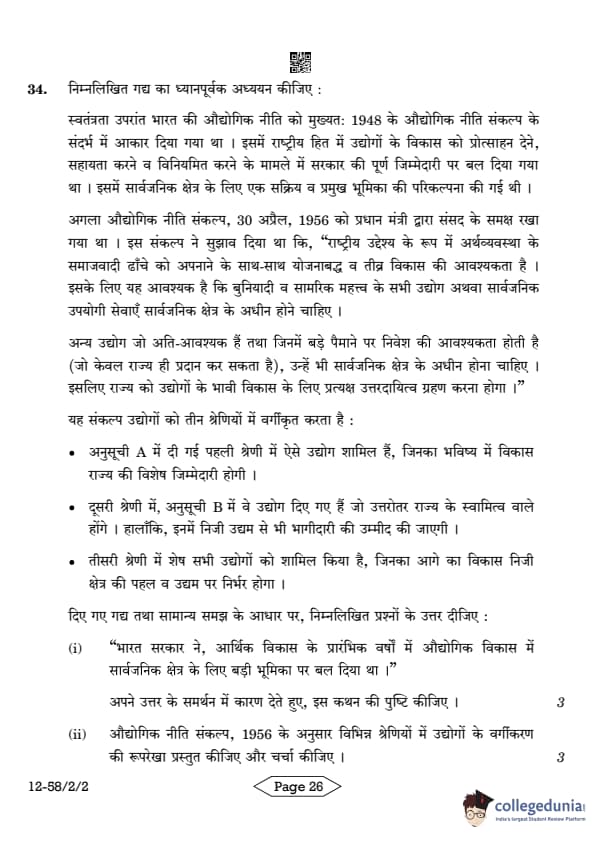
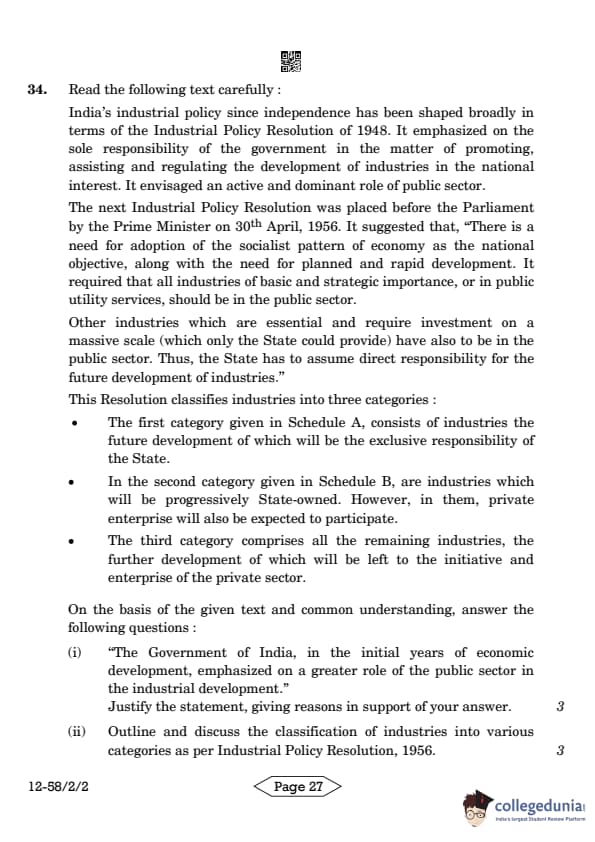
India s industrial policy since independence has been shaped broadly in terms of the Industrial Policy Resolution of 1948. It emphasized on the sole responsibility of the government in the matter of promoting, assisting and regulating the development of industries in the national interest. It envisaged an active and dominant role of public sector.
The next Industrial Policy Resolution was placed before the Parliament by the Prime Minister on 30th April, 1956. It suggested that, There is a need for adoption of the socialist pattern of economy as the national objective, along with the need for planned and rapid development. It required that all industries of basic and strategic importance, or in public utility services, should be in the public sector.
Other industries which are essential and require investment on a massive scale (which only the State could provide) have also to be in the public sector. Thus, the State has to assume direct responsibility for the future development of industries. This Resolution classifies industries into three categories :
The first category given in Schedule A, consists of industries the future development of which will be the exclusive responsibility of the State.
In the second category given in Schedule B, are industries which will be progressively State-owned. However, in them, private enterprise will also be expected to participate.
The third category comprises all the remaining industries, the further development of which will be left to the initiative and enterprise of the private sector.
On the basis of the given text and common understanding, answer the following questions :
(i) "The Government of India, in the initial years of economic development, emphasized a greater role of the public sector in industrial development."
Justify the statement, giving reasons in support of your answer.
View Solution
Solution:
In the initial years after independence, India faced several economic challenges, including low industrialization, lack of infrastructure, and weak private sector participation. To overcome these challenges, the government adopted a socialist-inspired economic model, giving a dominant role to the public sector in industrial development.
Reasons for Emphasizing the Public Sector:
1. Capital-Intensive Industrialization:
- Private sector lacked financial resources to invest in heavy industries, steel plants, and energy sectors.
- The public sector played a crucial role in developing basic and heavy industries necessary for economic self-sufficiency.
2. Control Over Strategic and Key Sectors:
- Industries related to defense, power generation, and transportation were considered critical and placed under state control to ensure national security and stability.
3. Promoting Social Welfare and Equity:
- Government-led industrialization aimed at reducing regional disparities and promoting balanced economic growth across different states.
Conclusion: By emphasizing state-led industrialization, India aimed to build a strong industrial base, achieve self-reliance, and ensure equitable economic development, laying the foundation for long-term growth.
Question 34(ii):
Outline and discuss the classification of industries into various categories as per the Industrial Policy Resolution, 1956.
View Solution
Solution:
The Industrial Policy Resolution (IPR) of 1956 categorized industries into three sectors, defining the role of the public and private sectors in industrial development. The classification aimed to establish a socialist pattern of economy and promote balanced industrial growth.
Classification of Industries under IPR 1956:
1. Category I - Exclusively Public Sector Industries:
- Industries of national importance, requiring government control for strategic reasons.
- Examples: Defense, Atomic Energy, Railways, Air Transport, Oil Exploration.
2. Category II - Mixed Sector (Public and Private Ownership):
- Industries in which private sector participation was allowed, but the government played a leading role.
- The government could start new units or nationalize existing ones if required. - Examples: Iron and Steel, Heavy Machinery, Coal, Fertilizers, Power Generation.
3. Category III - Private Sector Industries:
- Industries in which the private sector was given freedom to operate with minimal government intervention.
- The government encouraged private investment, but regulations ensured fair competition and social responsibility. - Examples: Consumer Goods, Automobiles, Textiles, Food Processing.
Conclusion: The IPR 1956 established a clear framework for industrial development, ensuring that strategic industries remained under public control while promoting private sector participation in non-core sectors.



Comments