




CBSE Class 12 Economics Question Paper 2024 PDF (Set 2- 58/3/2) is available for download here. CBSE conducted the Economics exam on March 18, 2024 from 10:30 AM to 1:30 PM. The total marks for the theory paper are 80. The question paper contains 20% MCQ-based questions, 40% competency-based questions, and 40% short and long answer type questions. Candidates can use the link below to download the CBSE Class 12 Economics Set 2 Question Paper with detailed solutions.
CBSE Class 12 Economics Question Paper 2024 (Set 2- 58/3/2) with Answer Key
| CBSE Class 12 2024 Economics Question Paper with Answer Key |  Download Download |
Check Solution |
CBSE Class 12 2024 Economics Questions with Solutions
SECTION A
Macro Economics
Question 1:
Inflationary gap in an economy may exist when — at full employment level.
Alternatives: (A) Actual Aggregate Demand > Potential Aggregate Demand
(B) Actual Aggregate Demand < Potential Aggregate Demand
(C) Actual Aggregate Demand < Potential Aggregate Demand
(D) Actual Aggregate Demand = Potential Aggregate Demand
View Solution
Solution:
An inflationary gap arises when Aggregate Demand (AD) exceeds Aggregate Supply (AS) at full employment level. This results in demand-pull inflation, where excess demand drives prices upward.
Key Characteristics of Inflationary Gap:
1. Occurs when actual AD surpasses the productive capacity of an economy.
2. Leads to rising prices and inflation due to excess demand.
3. Creates pressure on wages and resources, pushing costs higher.
Conclusion: An inflationary gap is a sign of an overheating economy, requiring contractionary fiscal and monetary policies to control inflation. Thus, option (A) is correct.
Question 2:
According to the Reserve Bank of India's (RBI's) Statistical Supplement released on 19th May 2023:
"India's foreign exchange reserves grew for the third straight week and reached near an approximate level of $600 billion.”
The above situation will — the — side of the Balance of Payments account of India.
(Choose the correct alternative to fill in the blanks)
View Solution
Solution:
Foreign exchange reserves increase when the Reserve Bank of India (RBI) purchases foreign currency, leading to an outflow of domestic currency. This transaction is recorded as a debit entry in the Balance of Payments (BoP) under the financial account.
Conclusion: Since an increase in forex reserves is a debit transaction in the BoP, option (D) is correct.
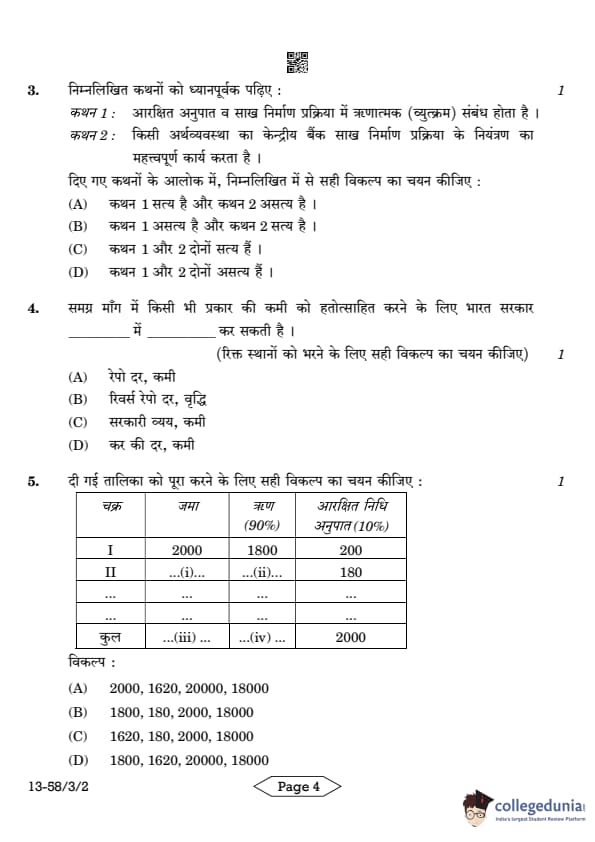
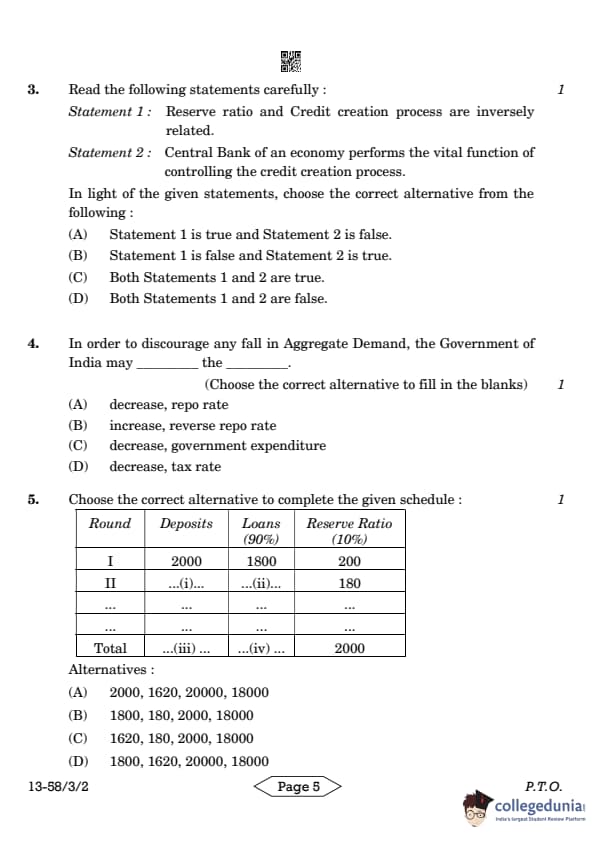
Question 3:
Read the following statements carefully:
Statement 1: Reserve ratio and Credit creation process are inversely related.
Statement 2: Central Bank of an economy performs the vital function of controlling the credit creation process.
(Choose the correct alternative)
View Solution
Solution:
1. Reserve Ratio and Credit Creation:
- A higher reserve ratio means banks have less money to lend, reducing credit creation.
- A lower reserve ratio allows banks to lend more, increasing credit creation. - Thus, they are inversely related.
2. Central Bank's Role in Credit Control:
- The Central Bank (RBI) controls credit creation by adjusting monetary policy tools like CRR (Cash Reserve Ratio), SLR (Statutory Liquidity Ratio), and repo rate.
Conclusion: Since both statements are true, option (C) is correct.
Question 4:
In order to discourage any fall in Aggregate Demand, the Government of India may ____ the ____.
(Choose the correct alternative to fill in the blanks)
View Solution
Solution:
To prevent a fall in Aggregate Demand, the government can implement expansionary fiscal policies, such as:
1. Decreasing tax rates:
- Lower taxes increase disposable income, encouraging higher consumption and investment, thereby increasing Aggregate Demand.
2. Increasing government spending:
- More public expenditure stimulates demand, creating jobs and boosting the economy.
Conclusion: Since reducing tax rates increases Aggregate Demand, option (D) is correct.
Question 5:
Choose the correct alternative to complete the given schedule:
Round | Deposits | Loans (90%) | Reserve Ratio (10%)
I | 2000 | 1800 | 200
II | ...(i)... | ...(ii)... | 180
Total | ...(iii)... | ...(iv)... | 2000
Alternatives:
View Solution
Solution:
This question relates to the credit creation process where:
1. Deposits in Round II = 1800 (from Loans of Round I)
2. Loans in Round II = 90% of Deposits in Round II = 1620
3. Total Deposits = Initial Deposit × Money Multiplier
- Money Multiplier = 1⁄Reserve Ratio = 1⁄0.10 = 10
- Total Deposits = 2000 × 10 = 20000
- Total Loans = Total Deposits - Reserves = 20000 – 2000 = 18000
Conclusion: Thus, the correct values are (i) 1800, (ii) 1620, (iii) 20000, (iv) 18000, making option (D) correct.
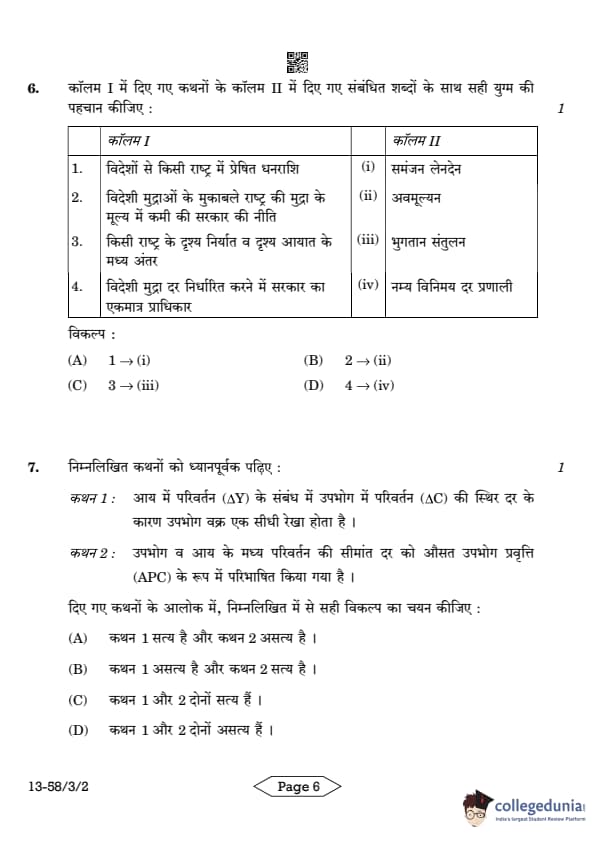
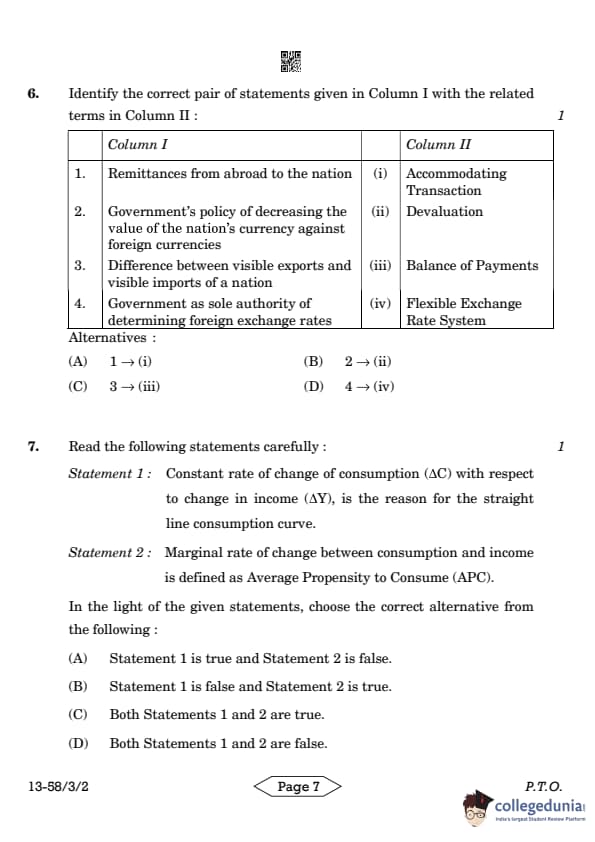
Question 6:
Identify the correct pair of statements given in Column I with the related terms in Column II:
Column I | Column II
1. Remittances from abroad to the nation | (i) Accommodating Transaction
2. Government's policy of decreasing the value of the nation's currency against foreign currencies | (ii) Devaluation
3. Difference between visible exports and visible imports of a nation | (iii) Balance of Payments
4. Government as sole authority of determining foreign exchange rates | (iv) Flexible Exchange Rate System
Correct Answer: (B) 2 → (ii)
View Solution
Solution:
- Statement 2 correctly matches with "Devaluation” because devaluation refers to the government's deliberate reduction of the currency's value against foreign currencies under a fixed exchange rate system.
- The other options do not correctly match, making option (B) correct.
Question 7:
Read the following statements carefully:
Statement 1: Constant rate of change of consumption (AC) with respect to change in income (∆Y), is the reason for the straight-line consumption curve.
Statement 2: Marginal rate of change between consumption and income is defined as Average Propensity to Consume (APC).
(Choose the correct alternative)
View Solution
Solution:
1. Statement 1 is true
- The straight-line consumption curve exists because the Marginal Propensity to Consume (MPC) remains constant, meaning AC/AY is unchanged.
2. Statement 2 is false
- The marginal rate of change between consumption and income is known as Marginal Propensity to Consume (MPC), not Average Propensity to Consume (APC).
- APC is calculated as C/Y, which measures the proportion of total income spent on consumption.
Conclusion: Since Statement 1 is correct but Statement 2 is incorrect, option (A) is correct.
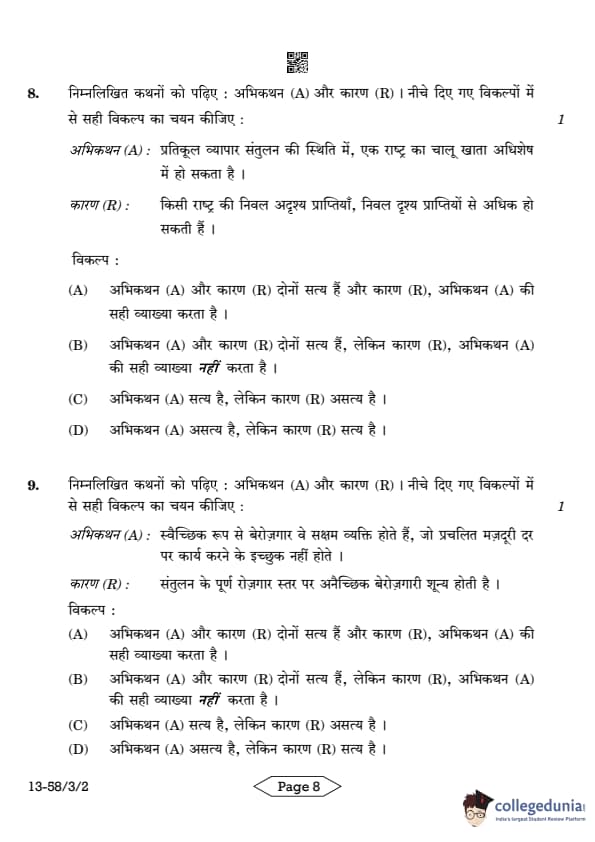
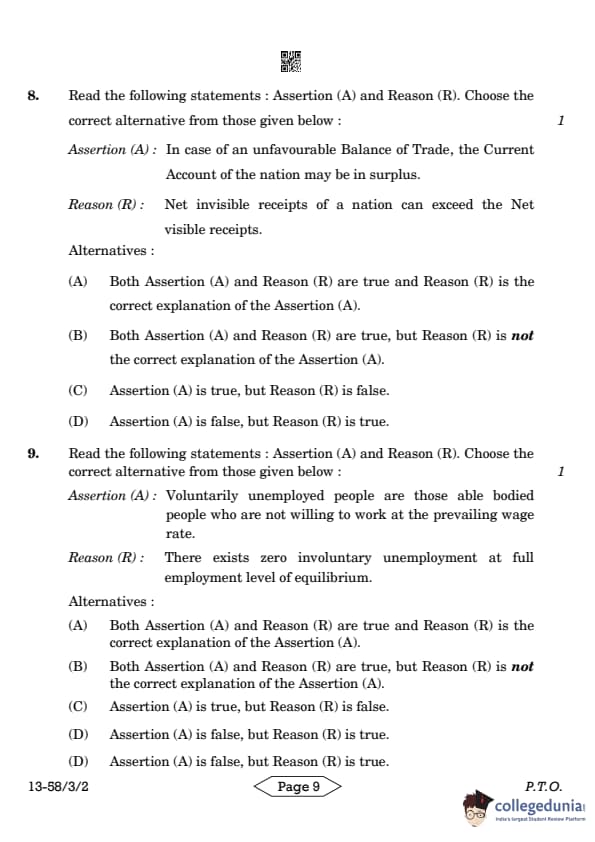
Question 8:
Read the following statements: Assertion (A) and Reason (R). Choose the correct alternative from those given below:
Assertion (A): In case of an unfavourable Balance of Trade, the Current Account of the nation may be in surplus.
Reason (R): Net invisible receipts of a nation can exceed the Net visible receipts.
(Choose the correct alternative:)
(A) Both Assertion (A) and Reason (R) are true and Reason (R) is the correct explanation of Assertion (A).
(B) Both Assertion (A) and Reason (R) are true, but Reason (R) is not the correct explanation of Assertion (A).
(C) Assertion (A) is true, but Reason (R) is false.
(D) Assertion (A) is false, but Reason (R) is true.
View Solution
Solution:
1. Assertion (A) is true:
- A nation's Balance of Trade (BoT) may be negative if visible imports exceed visible exports.
- However, the Current Account can still be in surplus if net invisible receipts (services, remittances, and transfers) exceed net visible receipts.
2. Reason (R) is also true and explains Assertion (A):
- Invisible receipts include earnings from tourism, IT services, remittances, and financial transfers, which may offset the deficit in visible trade.
- If these invisible receipts are high enough, the Current Account may remain in surplus despite a trade deficit.
Conclusion: Since both the assertion and reason are correct, and the reason explains the assertion, option (A) is correct.
Question 9:
Read the following statements: Assertion (A) and Reason (R). Choose the correct alternative from those given below:
Assertion (A): Voluntarily unemployed people are those able-bodied people who are not willing to work at the prevailing wage rate.
Reason (R): There exists zero involuntary unemployment at full employment level of equilibrium.
Alternatives: (A) Both Assertion (A) and Reason (R) are true and Reason (R) is the correct explanation of Assertion (A).
(B) Both Assertion (A) and Reason (R) are true, but Reason (R) is not the correct explanation of Assertion (A).
(C) Assertion (A) is true, but Reason (R) is false.
(D) Assertion (A) is false, but Reason (R) is true.
View Solution
Solution:
Voluntary unemployment occurs when individuals choose not to work at the prevailing wage rate, even though they are capable of working. This could be due to personal preferences, job dissatisfaction, or expectations of higher wages.
Full employment equilibrium refers to a state where all willing and able workers are employed, and only voluntary unemployment exists. Involuntary unemployment is absent at this stage, meaning anyone who wants a job at the prevailing wage rate can find one.
Conclusion: While both statements are true, the Reason (R) does not directly explain Assertion (A), hence option (B) is correct.
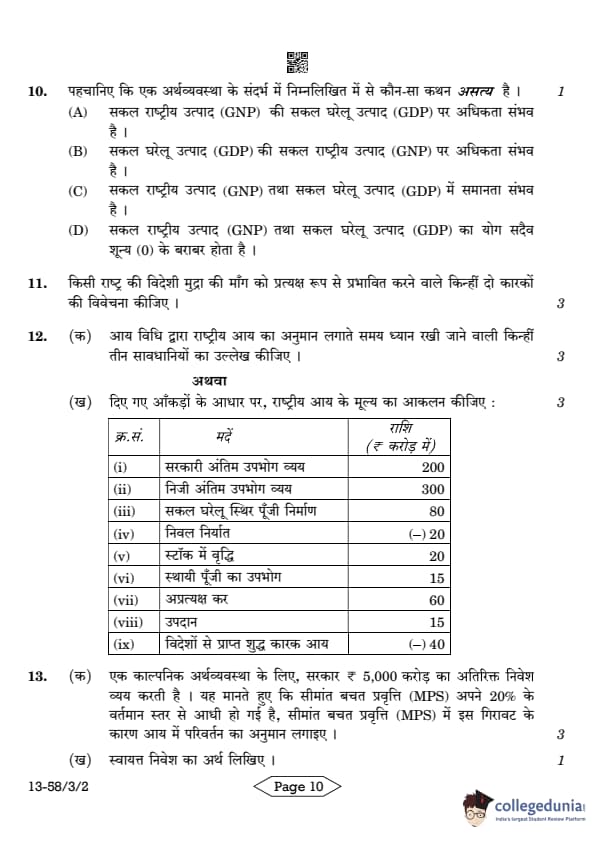
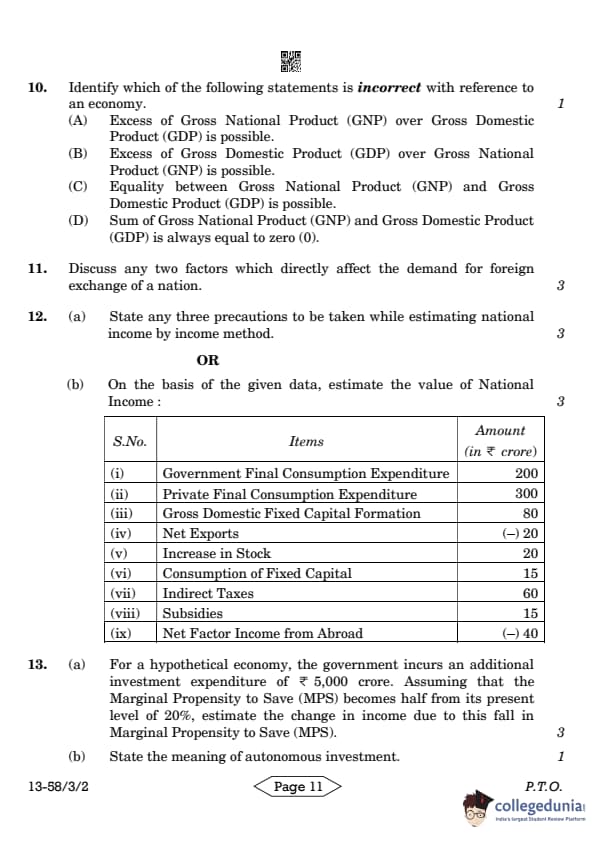
Question 10:
Identify which of the following statements is incorrect with reference to an economy.
View Solution
Solution:
Gross National Product (GNP) and Gross Domestic Product (GDP) are related, but their sum cannot be zero.
Key Difference:
GNP = GDP + Net Factor Income from Abroad (NFIA)
- If NFIA is positive, GNP will be greater than GDP. - If NFIA is negative, GNP will be less than GDP. - If NFIA is zero, GNP will be equal to GDP.
Thus, option (D) is incorrect, as the sum of GDP and GNP is not necessarily zero but depends on NFIA.
Question 11:
Discuss any two factors which directly affect the demand for foreign exchange of a nation.
View Solution
Solution:
The demand for foreign exchange in a nation is influenced by several economic factors. Two key factors are:
1. Imports of Goods and Services:
- When residents import foreign goods, they need to exchange domestic currency for foreign currency, increasing demand for foreign exchange.
2. Tourism and Foreign Travel:
- When individuals or businesses travel abroad, they require foreign currency for expenses, accommodation, and business activities, increasing demand for foreign exchange.
Conclusion: The demand for foreign exchange rises when international transactions require payments in foreign currency.
Question 12: (a)
State any three precautions to be taken while estimating national income by income method.
View Solution
Solution:
1. Transfer Payments Exclusion:
- Transfer payments such as pensions, scholarships, and unemployment benefits should not be included in national income as they do not reflect productive activity.
2. Exclusion of Capital Gains:
- Gains from sale of assets like land, buildings, or shares should be excluded as they do not result from current economic production.
3. Avoiding Double Counting:
- Only final incomes earned by factors of production should be included, and intermediate transactions should be excluded to prevent inflated values.
Question 12: (b)
On the basis of the given data, estimate the value of National Income.
| S.No. | Items | Amount (in Rs. crore) |
|---|---|---|
| (i) | Government Final Consumption Expenditure | 200 |
| (ii) | Private Final Consumption Expenditure | 300 |
| (iii) | Gross Domestic Fixed Capital Formation | 80 |
| (iv) | Net Exports | (-) 20 |
| (v) | Increase in Stock | 20 |
| (vi) | Consumption of Fixed Capital | 15 |
| (vii) | Indirect Taxes | 60 |
| (viii) | Subsidies | 15 |
| (ix) | Net Factor Income from Abroad | (-) 40 |
View Solution
Solution:
NI (NNP at FC) = GDP at MP - Depreciation - Net Indirect Taxes + Net Factor Income from Abroad
= (200 + 300 + 80 + (-20) + 20) - 15 - (60 - 15) + (-40)
= 580 - 15 - 45 - 40
= 480 crore
Question 13: (a)
For a hypothetical economy, the government incurs an additional investment expenditure of Rs.5,000 crore. Assuming that the Marginal Propensity to Save (MPS) becomes half from its present level of 20 percent, estimate the change in income due to this fall in MPS.
View Solution
Solution:
The change in income is determined using the investment multiplier formula:
Multiplier(K) = 1⁄MPS
Step 1: Initial Multiplier Calculation Given: Initial MPS = 20% = 0.20
K1 = 1⁄0.20 = 5
Step 2: New Multiplier Calculation (MPS Reduced by Half) New MPS = 10% = 0.10
K2 = 1⁄0.10 = 10
Step 3: Change in Income Calculation Change in income (ΔY) due to additional investment:
ΔY1 = K1 × ΔI = 5 × 5000 = 25000
ΔY2 = K2 × ΔI = 10 × 5000 = 50000
Final Answer: The increase in income due to the reduction in MPS is:
ΔY = 50000 - 25000 = 25,000 crore
Question 13: (b)
State the meaning of autonomous investment.
View Solution
Solution:
Autonomous investment refers to investment that is independent of changes in income levels. It is primarily influenced by government policies, technological advancements, infrastructure development, and strategic economic decisions.
Examples:
- Investment in public infrastructure (roads, railways, power plants).
- Research and development investments.
- Defense and space-related investments.
Conclusion: Autonomous investment remains constant regardless of economic fluctuations and plays a key role in long-term economic stability.
Question 14:
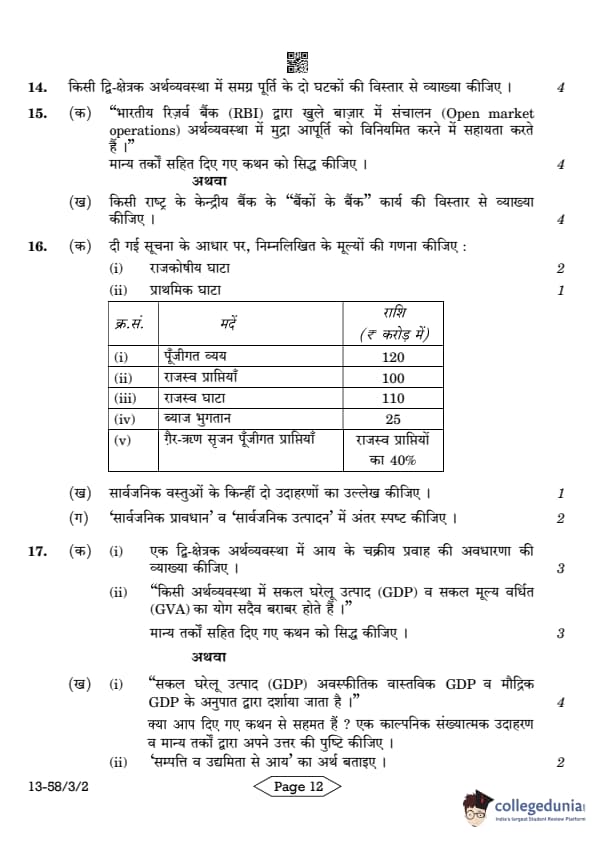
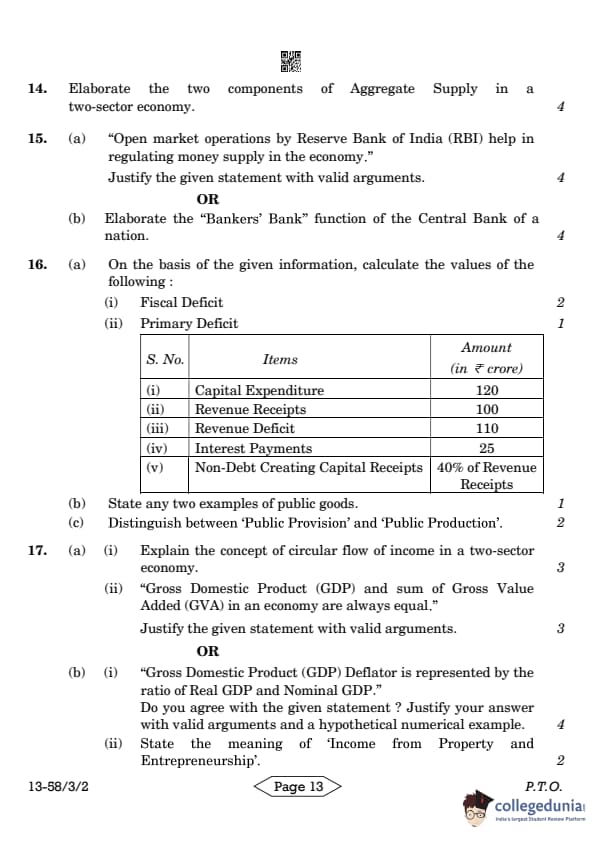
Elaborate the two components of Aggregate Supply in a two-sector economy.
View Solution
Solution:
In a two-sector economy (comprising only households and firms), Aggregate Supply (AS) represents the total output produced in an economy. The two main components of Aggregate Supply (AS) are:
1. Consumption (C):
- Households spend a part of their income on consumption of goods and services.
- This is known as induced consumption, as it varies with the level of income.
- It is represented as:
C = C0 + MPC × Y
where C0 is autonomous consumption, and MPC is the Marginal Propensity to Consume.
2. Saving (S):
- The part of income that is not consumed is saved for future needs.
- Saving is an essential component of aggregate supply as it provides funds for investment in the economy.
- It is represented as:
S = Y - C
Conclusion: In a two-sector economy, aggregate supply (AS) is equal to national income (Y) and consists of Consumption (C) and Savings (S):
AS = C + S
Question 15: (a)
"Open market operations by the Reserve Bank of India (RBI) help in regulating money supply in the economy."
Justify the given statement with valid arguments.
View Solution
Solution:
Open Market Operations (OMO) refer to the buying and selling of government securities (bonds, treasury bills, etc.) in the open market by the Reserve Bank of India (RBI) to regulate money supply and liquidity in the economy.
How Open Market Operations Help Regulate Money Supply:
1. When RBI Buys Government Securities (Expansionary Policy):
- RBI purchases securities from banks and the public.
- This injects money into the banking system, increasing liquidity and encouraging lending and investment.
- This is used to stimulate economic growth during a recession.
2. When RBI Sells Government Securities (Contractionary Policy):
- RBI sells government securities to banks and the public.
- This absorbs excess liquidity, reducing money supply and curbing inflationary pressures.
- This is used to control inflation in an overheated economy.
Conclusion: Open Market Operations (OMO) are an essential tool for controlling liquidity and stabilizing economic conditions in an economy.
Question 15: (b)
Elaborate the "Banker's Bank” function of the Central Bank of a nation.
View Solution
Solution:
The Central Bank, such as the Reserve Bank of India (RBI), plays a crucial role in managing the financial system and regulating monetary policies. Two of its key functions are:
Banker's Bank:
- The Central Bank regulates and supervises commercial banks.
- It provides liquidity support by acting as a lender of last resort.
- It ensures banks maintain the required Cash Reserve Ratio (CRR) and Statutory Liquidity Ratio (SLR).
Conclusion: The Central Bank ensures financial stability, supports the banking system, and provides critical policy advice to the government.
Question 16: (a)
On the basis of the given information, calculate the values of the following:
(i) Fiscal Deficit
(ii) Primary Deficit
| S.No. | Items | Amount (in crore) |
|---|---|---|
| (i) | Capital Expenditure | 120 |
| (ii) | Revenue Receipts | 100 |
| (iii) | Revenue Deficit | 110 |
| (iv) | Interest Payments | 25 |
| (v) | Non-Debt Creating Capital Receipts | 40% of Revenue Receipts |
View Solution
Solution:
Step 1: Calculate Primary Deficit
Primary Deficit = Fiscal Deficit – Interest Payments
Step 2: Calculate Fiscal Deficit
Fiscal Deficit = Total Expenditure – (Revenue Receipts + Non-Debt Capital Receipts)
Given Data: - Revenue Deficit = Rs. 110 crore - Interest Payments = Rs. 25 crore - Revenue Receipts = Rs. 100 crore - Non-Debt Capital Receipts = 40% of 100 crore = 40 crore - Capital Expenditure = Rs. 120 crore
Step 3: Compute Values - Fiscal Deficit = (Revenue Deficit + Capital Expenditure) - (Revenue Receipts + Non-Debt Capital Receipts)
= 110 + 120 - (100 + 40) = Rs. 90 crore
Primary Deficit = Fiscal Deficit - Interest Payments
= 90 - 25 = Rs. 65 crore
Final Answers: - Fiscal Deficit: Rs. 90 crore - Primary Deficit: Rs. 65 crore
Question 16: (b)
State any two examples of private goods.
View Solution
Solution:
Private goods are rivalrous and excludable, meaning their consumption by one person reduces availability for others, and only paying consumers can access them.
Examples:
1. Automobiles: Cars, bikes, and other vehicles are privately owned and used by individuals.
2. Clothing: Apparel like shirts, shoes, and accessories are purchased for personal use and cannot be used simultaneously by others.
Question 16: (c)
Distinguish between ‘Public Provision' and ‘Public Production'.
View Solution
Solution:
Public Provision: - Goods and services provided by the government but produced either by private firms or public enterprises. - Example: Government-funded education, health services, and subsidies.
Public Production: - Goods and services both provided and produced by the government using public resources. - Example: Public sector undertakings (PSUs) like Indian Railways and BSNL.
Key Differences:
| Basis | Public Provision | Public Production |
|---|---|---|
| Production Entity | Private/Public firms | Government itself |
| Funding | Government-funded | Government-funded and produced |
| Examples | Free education, subsidies | Indian Railways, BSNL |
Question 17: (a) (i)
Explain the concept of circular flow of income in a two-sector economy.
View Solution
Solution:
The circular flow of income in a two-sector economy refers to the continuous movement of goods, services, and money between households and firms.
Key Components:
1. Households: Own the factors of production (land, labor, capital, and entrepreneurship) and provide them to firms.
2. Firms: Use these factors to produce goods and services, generating income in the form of wages, rent, interest, and profit.
Flow of Income:
- Households receive factor payments from firms and use their income to purchase goods and services.
- Firms receive revenue from sales, which they use to pay for factor inputs.
Conclusion: In a two-sector economy, the income generated by production is fully circulated between households and firms, ensuring a balanced economic system.
Question 17: (a) (ii)
“Gross Domestic Product (GDP) and sum of Gross Value Added (GVA) in an economy are always equal."
Justify the given statement with valid arguments.
View Solution
Solution:
Gross Domestic Product (GDP) measures the total monetary value of all final goods and services produced within a country during a given period.
Gross Value Added (GVA) refers to the value of output minus the value of intermediate consumption across all economic sectors.
Justification:
GDP = ΣGVA + Net Indirect Taxes
- If Net Indirect Taxes (Taxes - Subsidies) = 0, then GDP and sum of GVA are equal.
- GDP represents the total economy, while GVA measures the contribution of different sectors.
Conclusion: GDP and sum of GVA are equal only if Net Indirect Taxes are zero; otherwise, they differ by the tax component.
Question 17: (b) (i)
“Gross Domestic Product (GDP) Deflator is represented by the ratio of Nominal GDP and Real GDP."
Do you agree with the given statement? Justify your answer with valid arguments and a hypothetical numerical example.
View Solution
Solution:
Yes, GDP deflator is used to measure the effect of price changes on GDP by comparing Nominal GDP and Real GDP.
Formula:
GDP Deflator = Nominal GDP⁄Real GDP × 100
Example:
| Year | Price (Rs.) | Output (Units) | Real GDP | Nominal GDP | GDP Deflator |
|---|---|---|---|---|---|
| 2010 | 10 | 100 | 1,000 | 1,000 | 1,000⁄1,000 × 100 = 100 |
| 2015 | 15 | 100 | 1,000 | 1,500 | 1,500⁄1,000 × 100 = 150 |
- In 2010, the GDP deflator is 100, meaning the base year price level.
- In 2015, the GDP deflator rises to 150, indicating a 50 percent increase in price level, despite no change in output.
Question 17: (b) (ii)
State the meaning of ‘Income from Property and Entrepreneurship'.
View Solution
Solution:
- Income from Property: Earnings from ownership of assets such as rent from land, interest on capital, and royalties. - Income from Entrepreneurship: Profits earned by business owners after paying all costs, including wages, rent, and interest.
SECTION B
Indian Economic Development
Question 18:
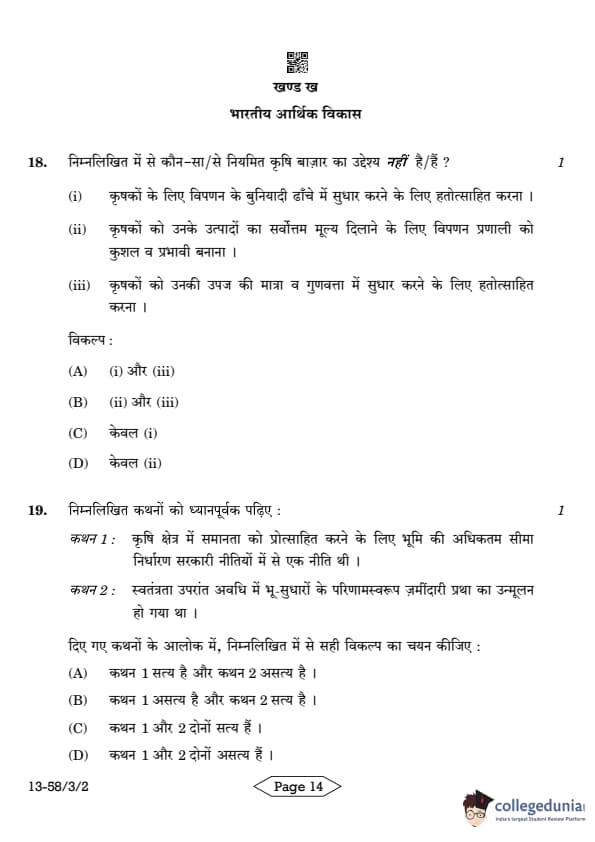
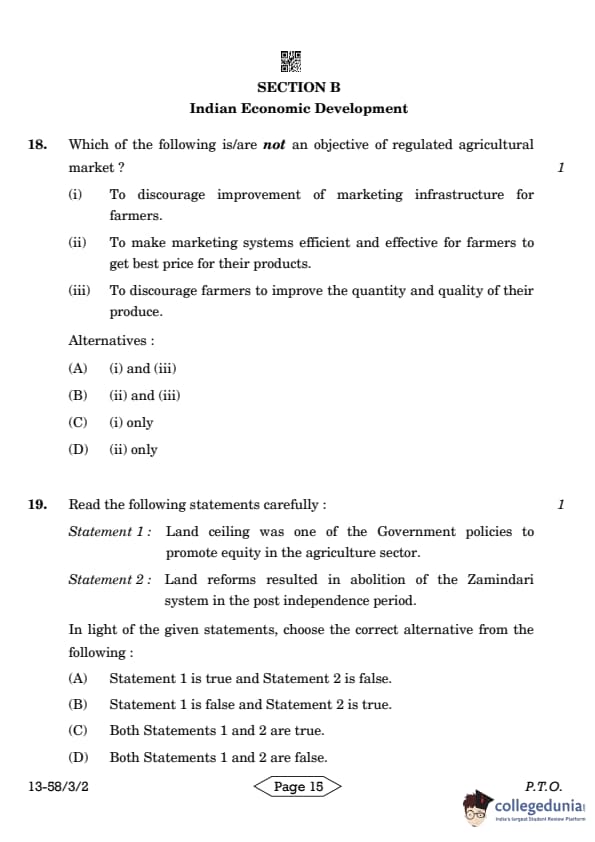
Which of the following is/are not an objective of regulated agricultural markets?
| Statement No. | Objective |
|---|---|
| (i) | To discourage improvement of marketing infrastructure for farmers. |
| (ii) | To make marketing systems efficient for farmers to get the best price for their products. |
| (iii) | To discourage farmers from improving the quantity and quality of their produce. |
(Choose the incorrect objectives)
View Solution
Solution:
The main objectives of a regulated agricultural market include:
1. Ensuring fair prices for farmers.
2. Preventing exploitation by middlemen.
3. Promoting infrastructure development like storage and transportation.
Incorrect objectives:
- (i) is incorrect: Agricultural marketing aims to improve infrastructure, not discourage it.
- (iii) is incorrect: The focus is on encouraging farmers to enhance production quality, not discouraging it.
Conclusion: Since statements (i) and (iii) are incorrect, option (A) is the right answer.
Question 19:
Read the following statements carefully:
Statement 1: Land ceiling was one of the Government policies to promote equity in the agriculture sector.
Statement 2: Land reforms resulted in the abolition of the Zamindari system in the post-independence period.
(Choose the correct alternative)
View Solution
Solution:
- Statement 1 is true: Land ceiling was introduced to limit the maximum land holdings by individuals to reduce inequality in land distribution.
- Statement 2 is true: Post-independence, Zamindari abolition was a major land reform policy that ended the feudal land ownership system.
Conclusion: Both statements are correct, making option (C) the correct answer.
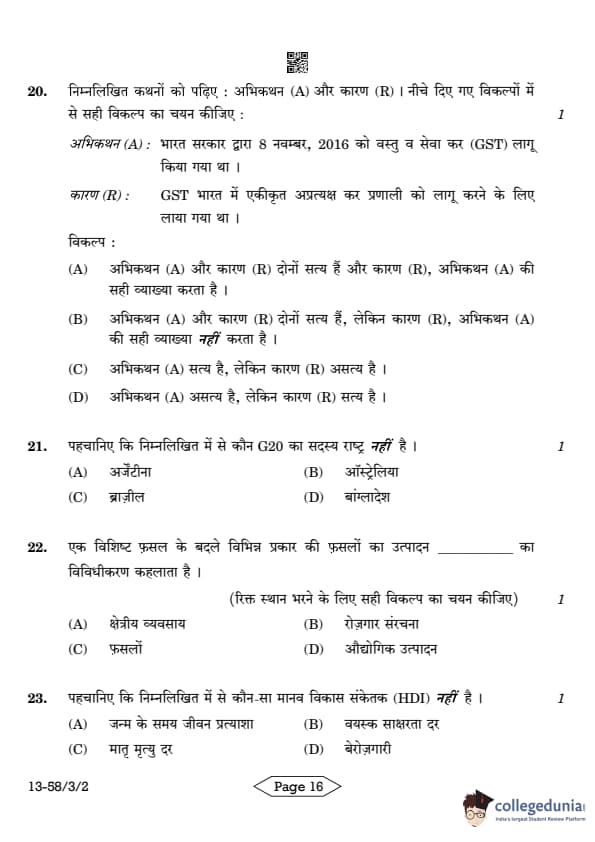
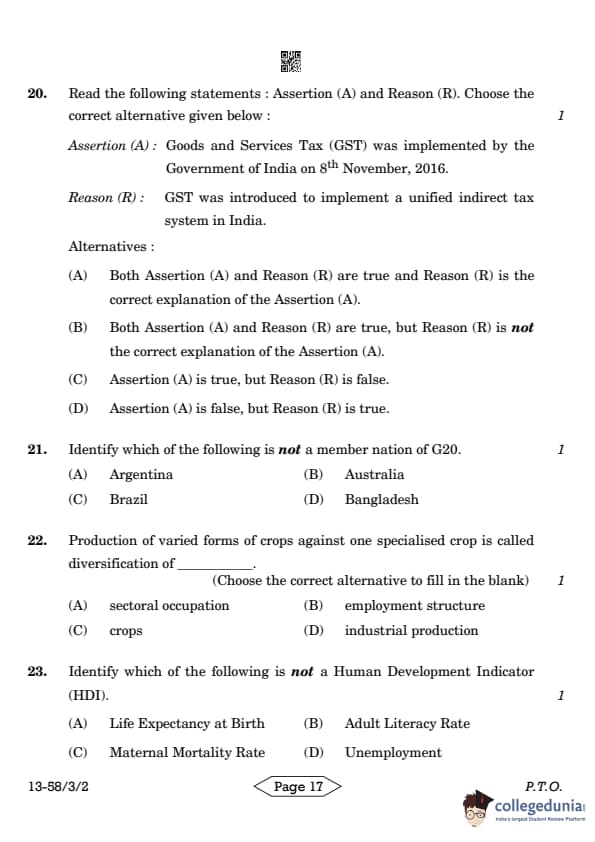
Question 20:
Read the following statements: Assertion (A) and Reason (R). Choose the correct alternative given below:
Assertion (A): Goods and Services Tax (GST) was implemented by the Government of India on 8th November, 2016.
Reason (R): GST was introduced to implement a unified indirect tax system in India.
(Choose the correct alternative)
View Solution
Solution:
- Assertion (A) is false: GST was implemented on 1st July 2017, not 8th November 2016.
- Reason (R) is true: GST was introduced to replace multiple indirect taxes and create a unified tax system in India.
Conclusion: Since the date mentioned in Assertion (A) is incorrect but Reason (R) is valid, option (D) is the correct answer.
Question 21:
Identify which of the following is not a member nation of G20.
View Solution
Solution:
- The G20 (Group of Twenty) is an international forum of 19 countries and the European Union that discusses global economic policies.
- Argentina, Australia, and Brazil are members of the G20.
- Bangladesh is not a G20 member.
Conclusion: Since Bangladesh is not part of the G20, option (D) is correct.
Question 22:
Production of varied forms of crops against one specialized crop is called diversification of __________. (Choose the correct alternative)
View Solution
Solution:
- Crop diversification refers to growing different types of crops instead of focusing on a single specialized crop.
- This reduces the risk of crop failure and increases soil fertility.
Conclusion: Since the question refers to agriculture, the correct answer is option (C) crops.
Question 23:
Identify which of the following is not a Human Development Indicator (HDI).
View Solution
Solution:
- The Human Development Index (HDI) is a measure of life expectancy, education, and standard of living.
- Life Expectancy at Birth, Adult Literacy Rate, and Maternal Mortality Rate are indicators of health and education, which are part of HDI.
- Unemployment is not directly included in HDI, though it affects economic conditions.
Conclusion: Since unemployment is not a direct HDI measure, option (D) is correct.
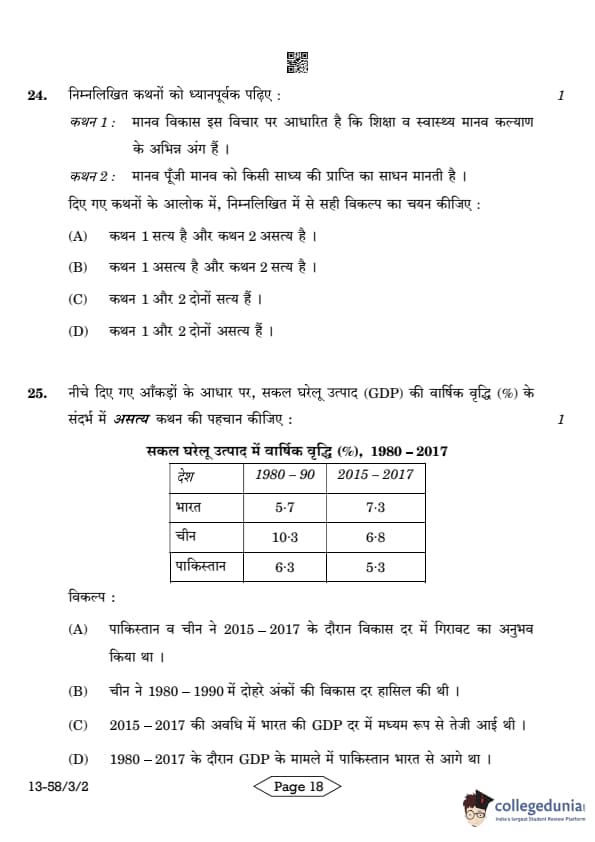
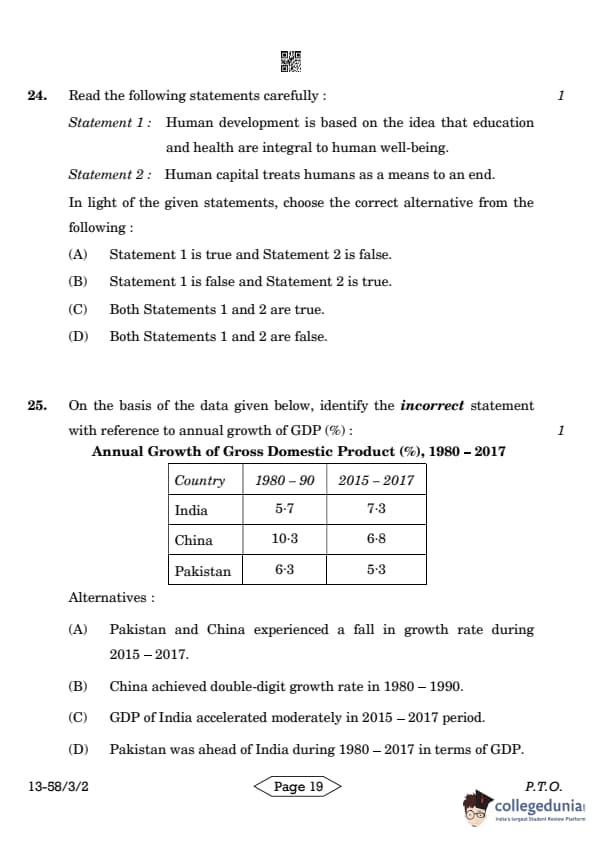
Question 24:
Read the following statements carefully:
Statement 1: Human development is based on the idea that education and health are integral to human well-being.
Statement 2: Human capital treats humans as a means to an end.
(Choose the correct alternative)
View Solution
Solution:
- Statement 1 is true:
- Human development focuses on improving education and healthcare as they are fundamental to well-being and enhance quality of life.
- Statement 2 is true:
- Human capital views education and health as investments that increase productivity and economic output, treating individuals as resources for economic gains.
Conclusion: Both statements are correct, making option (C) the right choice.
Question 25:
On the basis of the data given below, identify the incorrect statement with reference to the annual growth of GDP (%):
| Country | 1980 - 90 | 2015 - 2017 |
|---|---|---|
| India | 5.7% | 7.3% |
| China | 10.3% | 6.8% |
| Pakistan | 6.3% | 5.3% |
(Choose the incorrect statement)
View Solution
Solution:
- Statement (A) is correct:
- Both Pakistan (6.3% to 5.3%) and China (10.3% to 6.8%) experienced a decline in GDP growth rates from 1980-90 to 2015-17.
- Statement (B) is correct:
- China achieved double-digit GDP growth (10.3%) in 1980-90, making this statement accurate.
- Statement (C) is correct:
- India's GDP increased from 5.7% to 7.3%, indicating moderate acceleration in 2015-17.
- Statement (D) is incorrect:
- Pakistan's growth rate (6.3%) was higher than India's (5.7%) in 1980-90, but in 2015-17, India's GDP (7.3%) surpassed Pakistan's (5.3%), making this statement false.
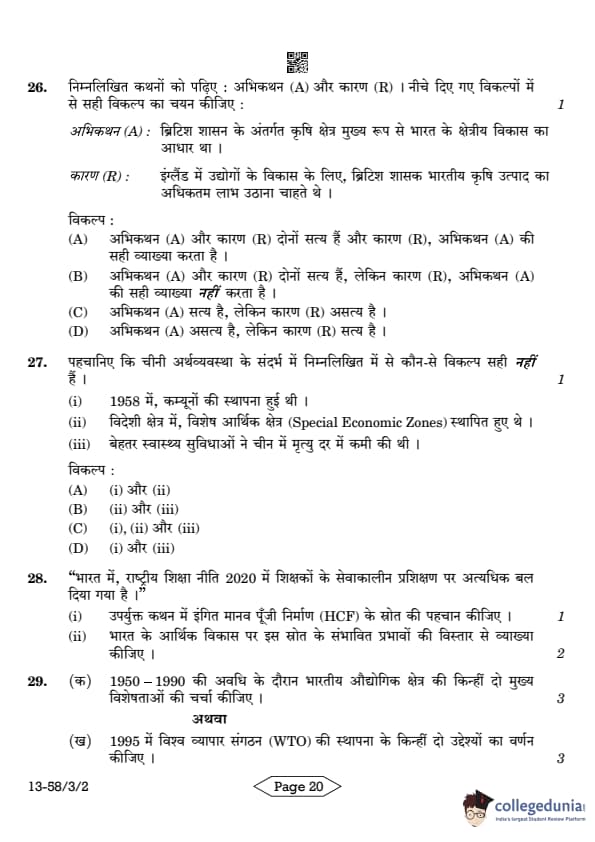
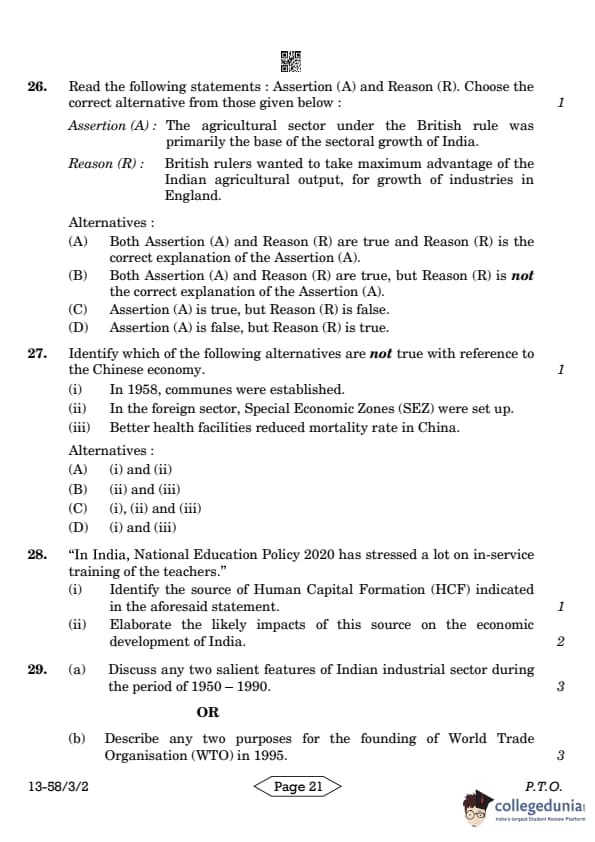
Question 26:
Read the following statements: Assertion (A) and Reason (R). Choose the correct alternative from those given below:
Assertion (A): The agricultural sector under British rule was primarily the base of the sectoral growth of India.
Reason (R): British rulers wanted to take maximum advantage of the Indian agricultural output for the growth of industries in England.
(Choose the correct alternative)
View Solution
Solution:
1. Assertion (A) is true:
- During British rule, the agricultural sector dominated the Indian economy, providing employment to a majority of the population.
2. Reason (R) is also true:
- The British exploited Indian agriculture to procure raw materials (like cotton, jute, and indigo) for their industries in England.
3. Why Reason (R) is not the correct explanation for Assertion (A):
- While British policies did exploit Indian agriculture for their industries, this did not contribute to sectoral growth in India.
- Instead, it led to stagnation and commercialization of agriculture, harming Indian farmers.
Conclusion: Both Assertion (A) and Reason (R) are true, but Reason (R) does not fully explain Assertion (A), making option (B) correct.
Question 27:
Identify which of the following alternatives are not true with reference to the Chinese economy.
| Statement No. | Statement |
|---|---|
| (i) | In 1958, communes were established. |
| (ii) | In the foreign sector, Special Economic Zones (SEZs) were set up. |
| (iii) | Better health facilities reduced the mortality rate in China. |
(Choose the incorrect alternatives)
View Solution
Solution:
- Statement (i) is true: The Chinese government established communes in 1958 as part of the Great Leap Forward to promote collective farming.
- Statement (ii) is true: China introduced Special Economic Zones (SEZs) in 1980 to attract foreign investments.
- Statement (iii) is true: The introduction of better healthcare policies led to lower mortality rates in China.
Conclusion: Since all statements are true, awarding one mark to all candidates is justified.
Question 28:
In India, National Education Policy 2020 has stressed a lot on in-service training of teachers.
(i) Identify the source of Human Capital Formation (HCF) indicated in the aforesaid statement.
View Solution
Solution:
(ii) Elaborate the likely impacts of this source on the economic development of India.
1. Enhancement in Quality of Education:
- Training programs for teachers improve the quality of teaching, which enhances student learning outcomes and skill development.
2. Economic Growth and Productivity:
- Well-trained teachers produce a skilled workforce, leading to higher labor productivity and economic development.
Conclusion: Investment in teacher training is a crucial aspect of Human Capital Formation, which leads to long-term economic growth and skill enhancement.
Question 29: (a)
Discuss any two salient features of the Indian industrial sector during the period of 1950-1990.
View Solution
Solution:
During 1950–1990, India's industrial sector was shaped by government intervention and planned economic policies.
Key Features:
1. Dominance of Public Sector:
- Industries were classified into public and private sectors, with major industries like steel, coal, and energy controlled by the government.
2. Industrial Licensing Policy:
- Industrial licensing (License Raj) required businesses to seek government approval for setting up or expanding industries, limiting private sector growth.
Conclusion: This period was characterized by state-led industrialization, focusing on self-reliance but leading to inefficiencies and slow growth.
Question 29: (b)
Describe any two purposes for the founding of the World Trade Organisation (WTO) in 1995.
View Solution
Solution:
The World Trade Organisation (WTO) was established in 1995 to regulate and liberalize international trade.
Main Purposes:
1. Promotion of Free Trade:
- WTO aims to reduce trade barriers like tariffs and quotas, ensuring smooth international trade among member nations.
2. Dispute Resolution Mechanism:
- It provides a legal framework for resolving trade disputes between countries, ensuring fair and transparent global trade practices.
Conclusion: WTO plays a crucial role in global economic integration, fostering free and fair trade among nations.
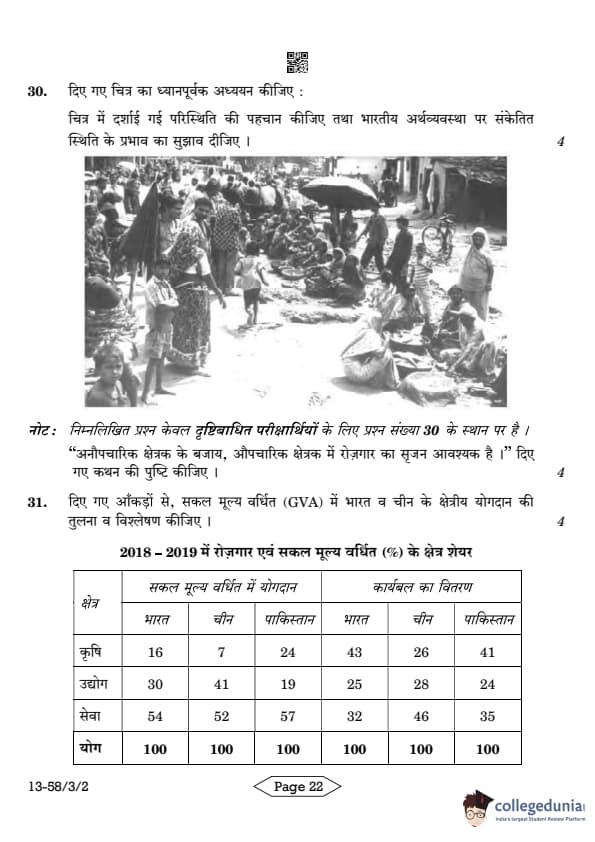
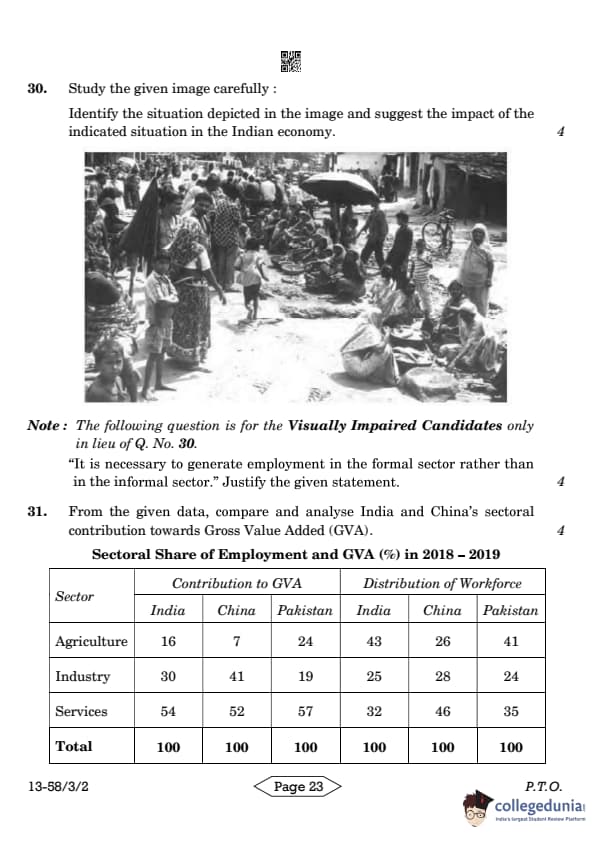
Question 30:
Study the given image carefully:
Identify the situation depicted in the image and suggest the impact of the indicated situation on the Indian economy.
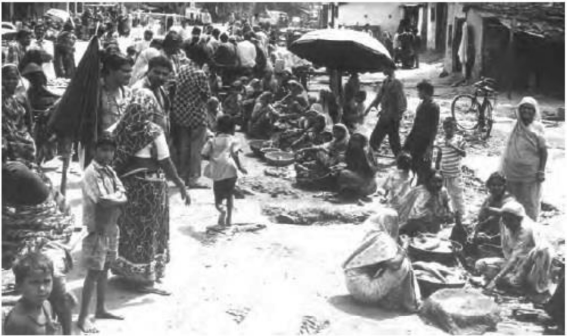
View Solution
Solution:
Identification of the Situation:
- The image likely depicts situation of employment in the formal sector.
Possible Economic Impacts:
1. In the formal sector, workers can form trade unions and are entitled to fair wages and other social security measures. Whereas, workers in the informal sector do not get regular income.
2. Also, they do not have any protection or regulation from the government. Many a time, workers may be dismissed without any compensation.
3.Hence, formal sector employees are generally in a better position as compared to informal sector employees. Therefore, it is essential to generate employment in the formal sector rather than the informal sector.
Conclusion: The depicted situation in the image plays a critical role in shaping India's economic stability. Government interventions such as policy reforms, financial support, and sustainable development measures are necessary to mitigate the negative effects.
Question 31:
From the given data, compare and analyze the sectoral contribution towards Gross Value Added (GVA).
| Sector | Contribution to GVA (%) | Distribution of Workforce (%) | ||||
|---|---|---|---|---|---|---|
| India | China | Pakistan | India | China | Pakistan | |
| Agriculture | 16 | 7 | 24 | 43 | 26 | 41 |
| Industry | 30 | 41 | 19 | 25 | 28 | 24 |
| Services | 54 | 52 | 57 | 32 | 46 | 35 |
| Total | 100 | 100 | 100 | 100 | 100 | 100 |
View Solution
Solution:
1. Agriculture Sector:
- India and Pakistan have a high workforce dependency on agriculture (43% and 41% respectively) but contribute only 16% and 24% to GVA.
- China has low employment in agriculture (26%) but an even lower GVA contribution (7%), showing greater productivity in industry and services.
2. Industry Sector:
- China's industrial sector contributes 41% to GVA with 28% workforce participation, showing high industrial productivity.
- India's industrial sector contributes 30% GVA with 25% workforce, while Pakistan lags behind (19% GVA with 24% workforce).
3. Services Sector:
- The service sector is the highest contributor to GVA in all three nations:
- India: 54%, China: 52%, and Pakistan: 57%.
- China employs 46% in services, showing a strong transition from agriculture to services.
- India's workforce in services (32%) is lower than its GVA share (54%), indicating potential for growth.
Conclusion:
- China leads in industrial productivity, while India and Pakistan still rely on agriculture for employment but have a low GVA contribution.
- India's service sector dominates its economy, but there is a need for more industrial growth to enhance employment.
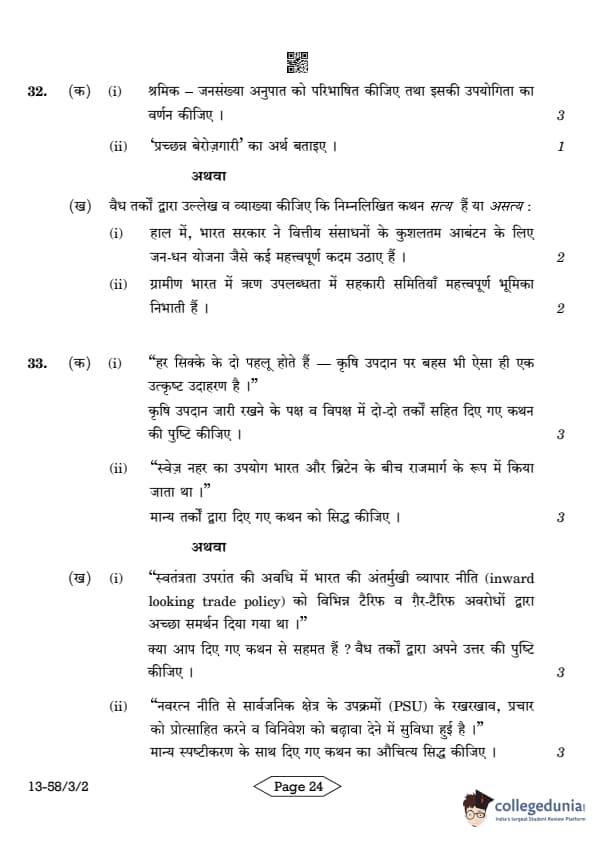
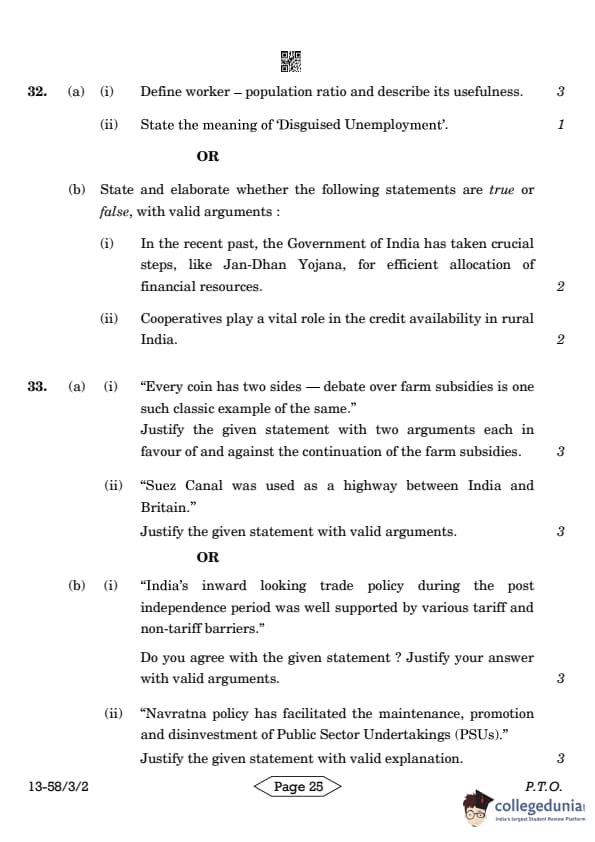
Question 32: (a) (i)
Define worker-population ratio and describe its usefulness.
View Solution
Definition: The worker-population ratio (WPR) is the percentage of the working population in relation to the total population of a country.
WPR = Total Workers⁄Total Population × 100
Usefulness:
- It helps in analyzing the employment scenario in a country.
- A high WPR indicates better labor force participation, while a low WPR may suggest unemployment or economic dependence.
- Policymakers use it to design employment generation programs and measure economic development.
Question 32: (a) (ii)
Define Disguised Unemployment.
View Solution
Definition:
Disguised unemployment refers to a situation where more people are engaged in work than required, leading to zero marginal productivity.
Example:
- In agriculture, if a farm requires four workers but employs six, the extra two workers are disguisedly unemployed, meaning their removal wouldn't affect total output.
Implications:
- Reduces per capita productivity and economic efficiency.
- Hinders economic growth as excess labor is not utilized effectively.
- Common in developing economies, especially in rural and agricultural sectors.
Question 32: (b)
State and elaborate whether the following statements are true or false, with valid arguments:
(i) In the recent past, the Government of India has taken crucial steps, like Jan-Dhan Yojana, for efficient allocation of financial resources.
View Solution
Solution:
True. The Pradhan Mantri Jan-Dhan Yojana (PMJDY) was launched to provide financial inclusion for all sections of society.
Justification:
- It enables banking access for unbanked individuals, promoting savings and credit availability.
- Helps in direct benefit transfers (DBT), ensuring efficient and transparent allocation of resources.
Conclusion: By integrating underprivileged sections into the formal banking system, the scheme enhances financial inclusion and resource allocation.
Question 32: (b) (ii)
Cooperatives play a vital role in the credit availability in rural India.
View Solution
Solution:
True. Cooperative credit institutions play a key role in providing affordable financial assistance to farmers and rural households.
Justification:
- Primary Agricultural Credit Societies (PACS) and Cooperative Banks provide low-interest loans to farmers.
- They help in reducing dependence on informal moneylenders, ensuring fair lending practices in rural areas.
Conclusion: Cooperatives improve credit accessibility for rural populations, supporting agriculture and rural development.
Question 33: (a) (i)
Every coin has two sides – debate over farm subsidies is one such classic example of the same.
Justify the given statement with two arguments each in favour of and against the continuation of the farm subsidies.
View Solution
Solution:
Arguments in favour of farm subsidies:
1. Support for Small Farmers:
- Farm subsidies help small and marginal farmers afford agricultural inputs like seeds, fertilizers, and irrigation.
2. Ensures Food Security:
- Subsidies encourage higher agricultural production, ensuring an adequate supply of food grains at stable prices.
Arguments against farm subsidies:
1. Encourages Overuse of Resources:
- Excessive subsidies can lead to inefficient resource utilization, causing problems like groundwater depletion.
2. Fiscal Burden on Government:
- A large portion of the budget is spent on subsidies, increasing fiscal deficit and reducing funds for infrastructure and social welfare.
Question 33: (a) (ii)
"The Suez Canal was used as a highway between India and Britain."
Justify the given statement with valid arguments.
View Solution
Solution:
- The Suez Canal was a crucial trade route for British colonial rule, allowing direct and faster access between India and Britain.
- Opened in 1869, it significantly reduced the time and cost of transporting goods and raw materials, strengthening British control over Indian trade.
- It facilitated the export of raw materials from India (cotton, spices, and tea) and the import of British manufactured goods, deepening India's economic dependence on Britain.
Conclusion: The Suez Canal enhanced British colonial trade, ensuring their economic dominance over Indian markets.
Question 33: (b) (i)
India's inward-looking trade policy during the post-independence period was well supported by various tariff and non-tariff barriers.
Do you agree with the given statement? Justify your answer with valid arguments.
View Solution
Solution:
Yes, India's inward-looking trade policy aimed at self-reliance and protection of domestic industries through import restrictions.
Justification:
1. Use of Tariff Barriers:
- High import duties and quotas were imposed to discourage foreign goods, boosting local industries.
2. Non-Tariff Restrictions:
- Licensing, government control over foreign exchange, and restrictions on foreign investments ensured that domestic industries thrived without competition.
Conclusion: Though this policy helped domestic industry grow, it also led to inefficiencies and lack of competitiveness in global markets.
Question 33: (b) (ii)
"Navratna policy has facilitated the maintenance, promotion, and disinvestment of Public Sector Undertakings."
Justify the given statement with valid explanation.
View Solution
Solution:
- The Navratna Policy was introduced to give operational freedom to high-performing Public Sector Undertakings (PSUs), enabling them to compete globally.
- It allowed financial and managerial autonomy, helping PSUs expand, invest in R and D, and enter joint ventures without government interference.
- Additionally, it facilitated disinvestment, allowing private investment in PSUs while ensuring the government retained strategic control.
Conclusion: The Navratna Policy enhanced efficiency and competitiveness of major PSUs, contributing to economic growth.
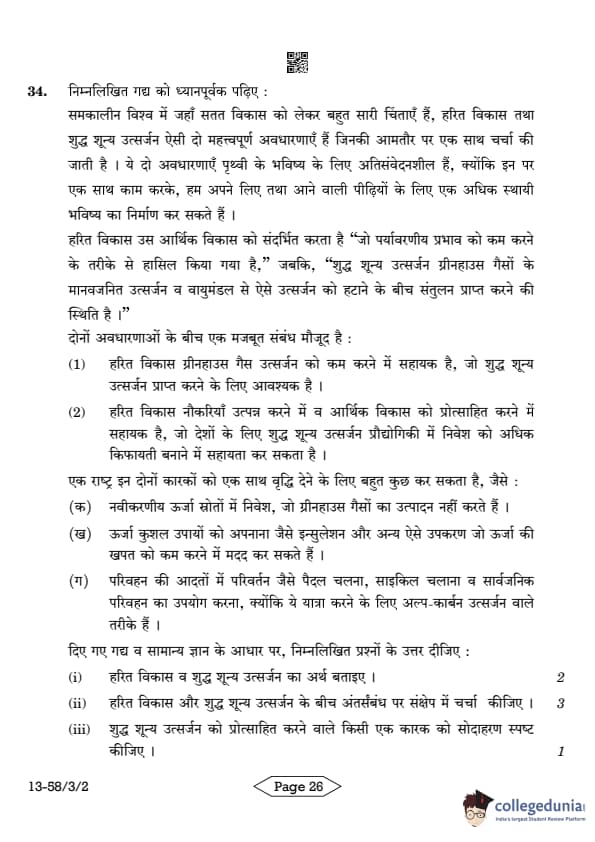
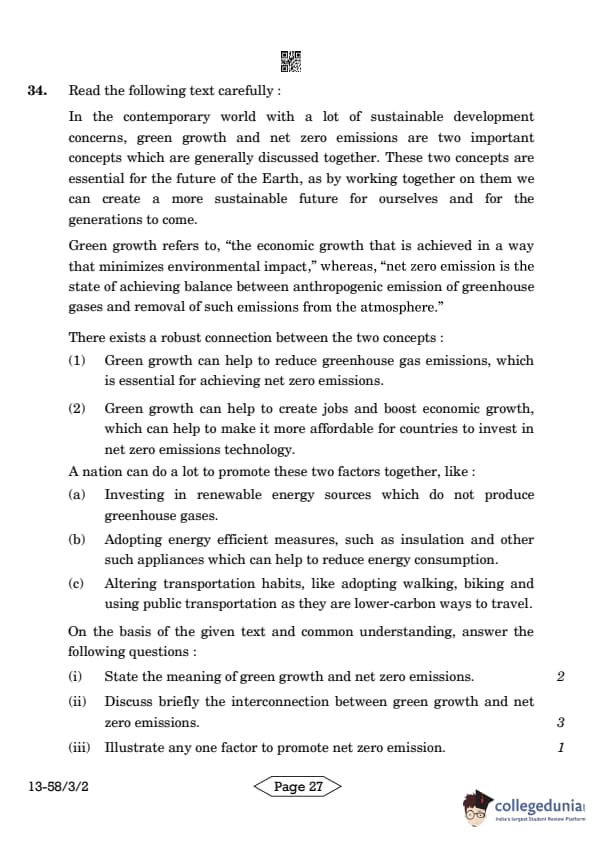
Question 34:
Read the following text carefully :
In the contemporary world with a lot of sustainable development concerns, green growth, and net zero emissions are two important concepts which are generally discussed together. These two concepts are essential for the future of the Earth, as by working together on them we can create a more sustainable future for ourselves and for the generations to come.
Green growth refers to, “the economic growth that is achieved in a way that minimizes environmental impact”, whereas, “net zero emission is the state of achieving balance between anthropogenic emission of greenhouse gases and removal of such emissions from the atmosphere."
There exists a robust connection between the two concepts:
(1) Green growth can help to reduce greenhouse gas emissions, which is essential for achieving net zero emissions.
(2) Green growth can help to create jobs and boost economic growth, which can help to make it more affordable for countries to invest in net zero emissions technology.
A nation can do a lot to promote these two factors together, like:
(a) Investing in renewable energy sources which do not produce greenhouse gases.
(b) Adopting energy efficient measures, such as insulation and other such appliances which can help to reduce energy consumption.
(c) Altering transportation habits, like adopting walking, biking and using public transportation as they are lower-carbon ways to travel.
On the basis of the given text and common understanding, answer the following questions:
(i) State the meaning of green growth and net zero emissions.
View Solution
Solution:
- Green Growth: Refers to economic development that ensures environmental sustainability, promoting clean energy, resource efficiency, and reducing pollution.
- Net Zero Emissions: A state where the amount of greenhouse gases emitted is equal to the amount removed, achieved through carbon reduction and offsetting measures.
Question 34: (ii)
Discuss briefly the interconnection between green growth and net zero emissions.
View Solution
Solution:
- Green growth focuses on reducing dependence on fossil fuels and adopting renewable energy sources.
- It promotes energy efficiency and sustainable industrial practices, helping achieve net zero emissions.
- Policies supporting green technology, carbon pricing, and afforestation contribute to both economic growth and climate action.
Question 34: (iii)
Illustrate any one factor to promote net zero emission.
View Solution
Solution:
- Renewable Energy Transition:
- Shifting from coal and oil to solar, wind, and hydropower reduces carbon emissions.
- Encouraging investment in green energy projects accelerates sustainability efforts.



Comments