




CBSE Class 12 Economics Question Paper 2024 PDF (Set 3- 58/4/3) is available for download here. CBSE conducted the Economics exam on March 18, 2024 from 10:30 AM to 1:30 PM. The total marks for the theory paper are 80. The question paper contains 20% MCQ-based questions, 40% competency-based questions, and 40% short and long answer type questions. Candidates can use the link below to download the CBSE Class 12 Economics Set 3 Question Paper with detailed solutions.
CBSE Class 12 Economics Question Paper 2024 (Set 3- 58/4/3) with Answer Key
| CBSE Class 12 2024 Economics Question Paper with Answer Key |  Download Download |
Check Solution |
CBSE Class 12 2024 Economics Questions with Solutions
SECTION A
Macro Economics
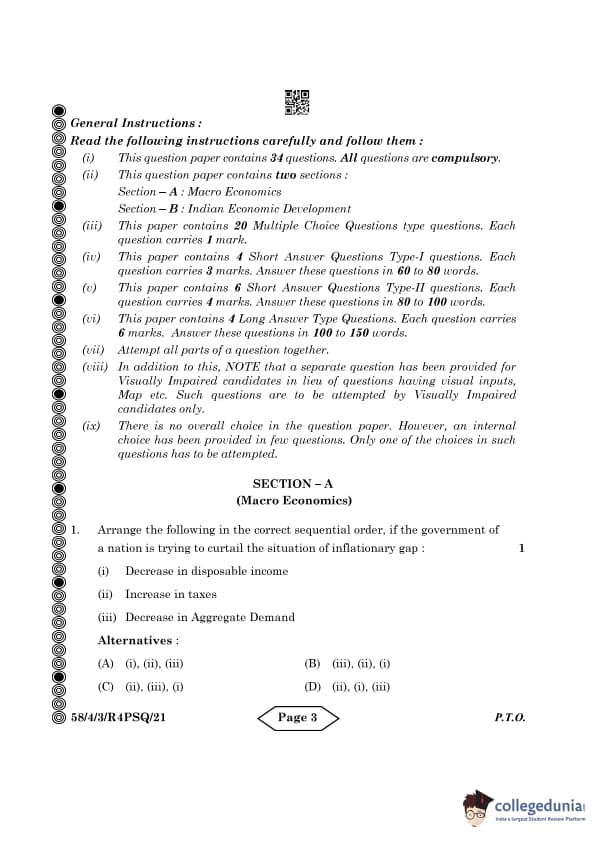
Question 1:
Arrange the following in the correct sequential order, if the government of a nation is trying to curtail the situation of inflationary gap:
(i) Decrease in disposable income
(ii) Increase in taxes
(iii) Decrease in Aggregate Demand
Alternatives:
View Solution
Solution: In the case of an inflationary gap, the government needs to reduce the aggregate demand to bring the economy back to full employment. The correct sequence of steps is:
1. Increase in Taxes (ii): The government raises taxes, which reduces disposable income and consumption expenditure.
2. Decrease in Disposable Income (i): As taxes increase, people have less disposable income to spend, thus curbing their consumption.
3. Decrease in Aggregate Demand (iii): The reduction in disposable income leads to a decrease in consumption, which subsequently lowers aggregate demand, helping to control inflation.
Conclusion: The proper sequence to reduce an inflationary gap involves first increasing taxes, then decreasing disposable income, followed by a decrease in aggregate demand.
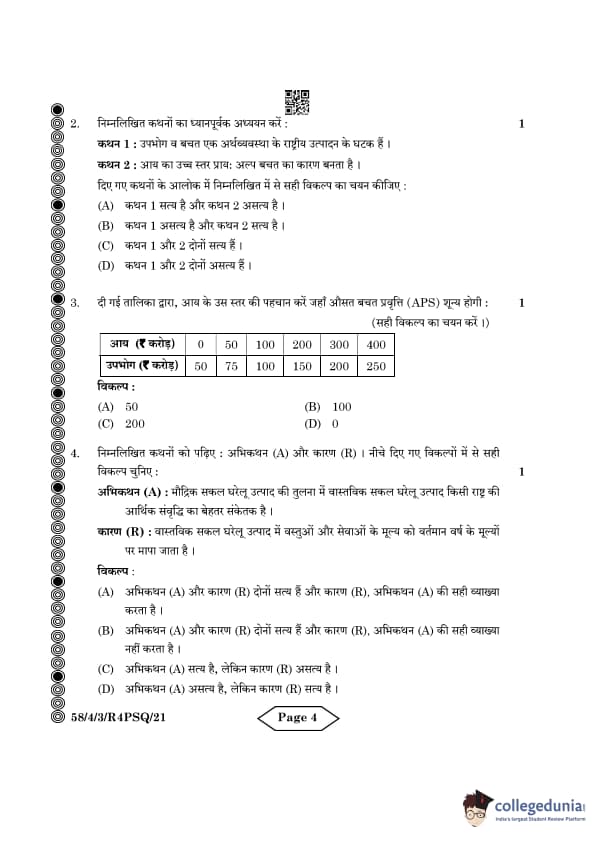
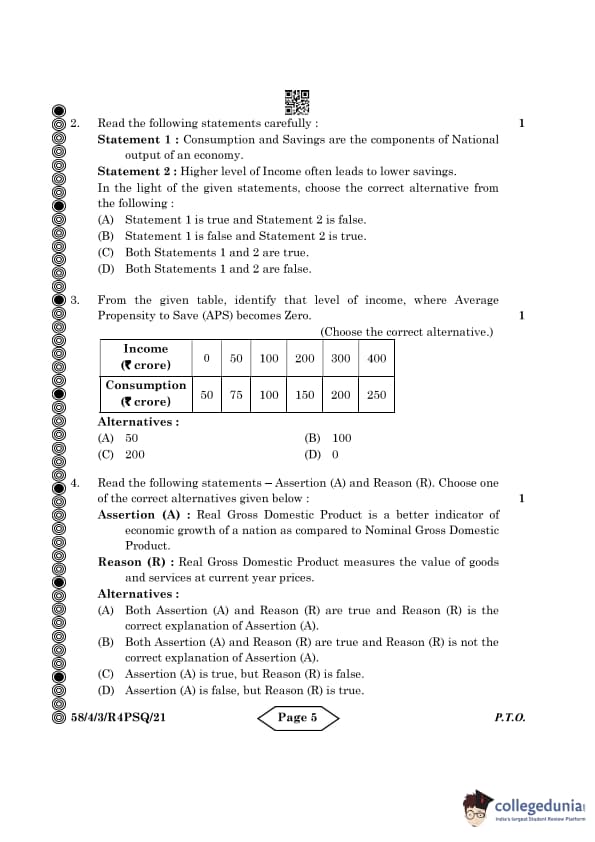
Question 2:
Read the following statements carefully
Statement 1: Consumption and Savings are the components of National output of an economy. Statement 2: Higher level of Income often leads to lower savings.
In the light of the given statements, choose the correct alternative from the following:
View Solution
Solution: - Statement 1 is true: Consumption and savings are indeed the components of national output. They represent how the income of an economy is either spent (consumed) or saved, both of which are part of the overall aggregate demand in the economy.
- Statement 2 is false: Higher levels of income typically lead to higher savings, not lower. As income rises, people often save a greater proportion of their income, although the marginal propensity to save (MPS) might vary across income levels.
Conclusion: Consumption and savings are important components of national output, and higher income usually leads to higher savings, not lower.
Question 3:
From the given table, identify the level of income, where Average Propensity to Save (APS) becomes zero.
Income and Consumption Table:
| Income (Rs. crore) | Consumption (Rs. crore) |
|---|---|
| 0 | 50 |
| 50 | 75 |
| 100 | 100 |
| 200 | 150 |
| 300 | 200 |
| 400 | 250 |
(Choose the correct alternative)
View Solution
Solution:
- APS becomes zero when savings are zero.
- At income = Rs.100 crore, consumption = Rs.100 crore. Since savings = income - consumption, savings = 100 - 100 = 0.
Conclusion: APS = 0 at an income of Rs.100 crore.
Question 4:
Read the following statements - Assertion (A) and Reason (R). Choose one of the correct alternatives given below:
Assertion (A): Real Gross Domestic Product is a better indicator of economic growth of a nation as compared to Nominal Gross Domestic Product.
Reason (R): Real Gross Domestic Product measures the value of goods and services at current year prices.
(Choose the correct alternative)
View Solution
Solution:
- Assertion (A) is true: Real GDP adjusts for inflation, making it a better indicator of true economic growth compared to nominal GDP, which is affected by price changes.
- Reason (R) is false: Real GDP is calculated using constant prices, not current year prices. Nominal GDP uses current year prices, which include inflation effects.
Conclusion: Real GDP is a better measure of economic growth because it is inflation-adjusted, while Reason (R) incorrectly defines Real GDP.
Question 5:
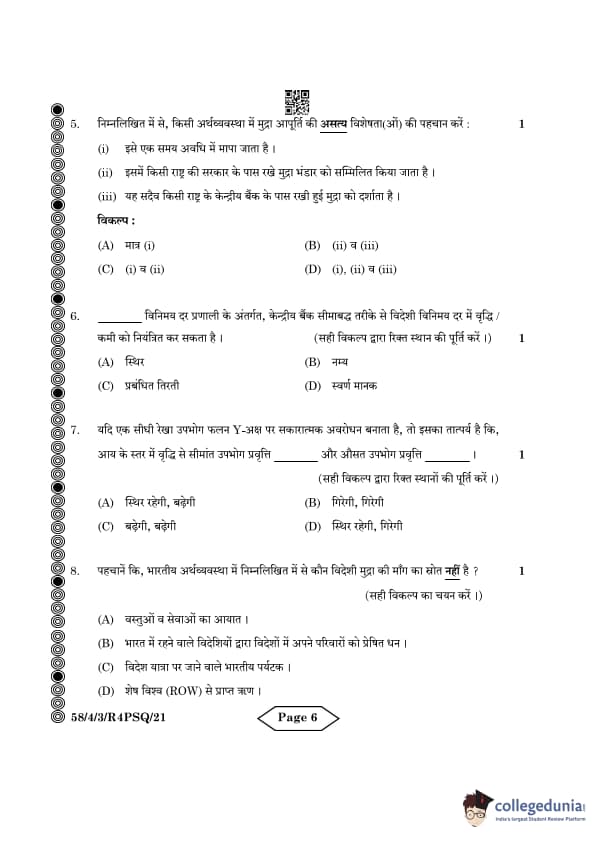
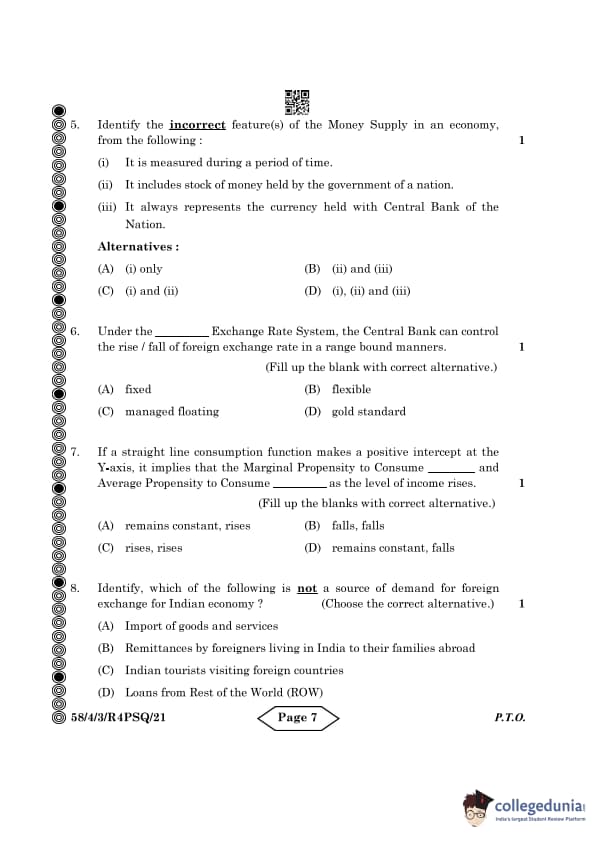
Identify the incorrect feature(s) of the Money Supply in an economy, from the following:
(i) It is measured during a period of time. (ii) It includes stock of money held by the government of a nation. (iii) It always represents the currency held with the Central Bank of the nation.
(Choose the correct alternative)
View Solution
Solution:
- Money supply is measured at a point in time and does not include the money held by the government or exclusively held by the central bank.
- Money supply includes all money in circulation in the economy, not just with the central bank.
Conclusion: All three statements are incorrect because money supply is defined based on the circulating money in the economy and not just the central bank's reserves.
Question 6:
Under the _______ Exchange Rate System, the Central Bank can control the rise/fall of foreign exchange rate in a range-bound manner.
(Choose the correct alternative.)
View Solution
Solution:
- In a Managed Floating Exchange Rate System, exchange rates fluctuate based on market forces, but the central bank intervenes to stabilize extreme fluctuations.
- This differs from a Fixed Exchange Rate System, where the currency value is strictly controlled.
Conclusion: Since the central bank manages fluctuations within a range in a managed floating system, option (C) is correct.
Question 7:
If a straight-line consumption function makes a positive intercept at the Y-axis, it implies that the Marginal Propensity to Consume (MPC) _______ and the Average Propensity to Consume (APC) _______ as the level of income rises.
(Choose the correct alternative.)
View Solution
Solution:
- MPC remains constant because it is the slope of the consumption function.
- APC falls as income increases since fixed autonomous consumption makes a smaller proportion of income at higher levels.
Conclusion: Since the MPC is constant and the APC falls with rising income, option (D) is correct.
Question 8:
Identify which of the following is not a source of demand for foreign exchange for the Indian economy?
(Choose the correct alternative.)
View Solution
Solution:
- Demand for foreign exchange arises when India makes payments abroad (imports, remittances, foreign travel).
- Loans from ROW are an inflow, increasing the foreign exchange supply, not demand.
Conclusion: Since foreign loans bring money into the economy rather than increasing demand for foreign currency, option (D) is correct.
Question 9:
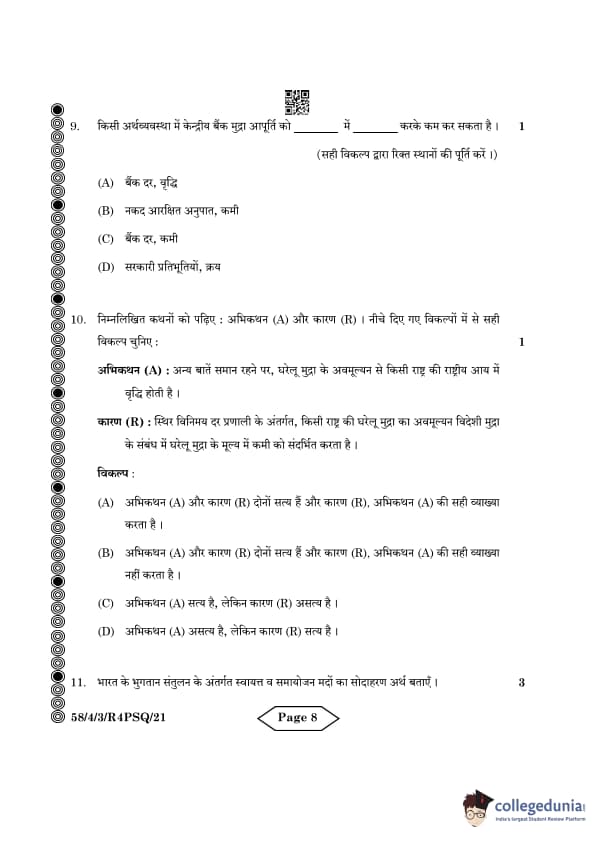
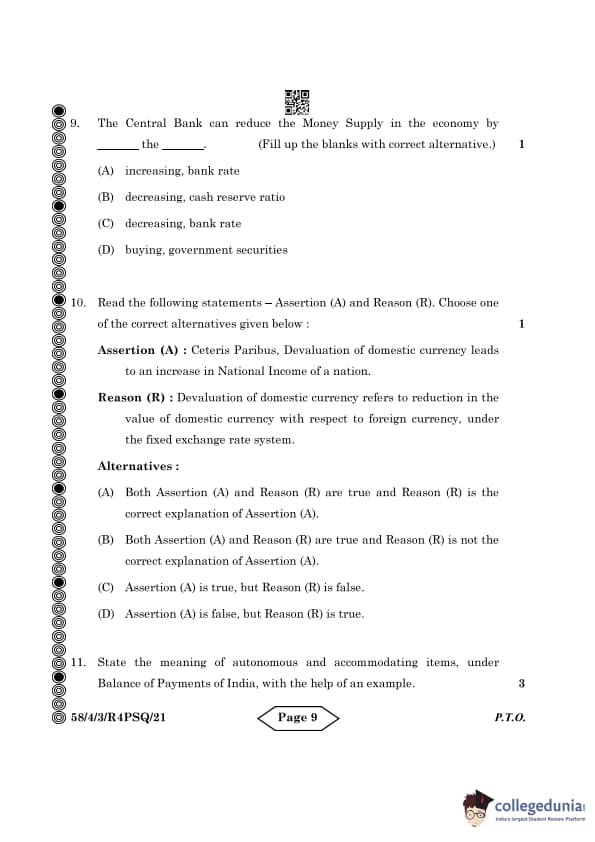
The Central Bank can reduce the Money Supply in the economy by _______ the _______. (Fill up the blanks with the correct alternative.)
View Solution
Solution:
- Bank Rate refers to the rate at which the central bank lends money to commercial banks.
- When the central bank increases the bank rate, borrowing becomes expensive, reducing the money supply in the economy.
Conclusion: A higher bank rate discourages borrowing, reducing liquidity, which helps control inflation.
Question 10:
Read the following statements - Assertion (A) and Reason (R). Choose the correct alternative given below: Assertion (A): Ceteris Paribus, Devaluation of domestic currency leads to an increase in National Income of a nation. Reason (R): Devaluation of domestic currency refers to a reduction in the value of domestic currency with respect to foreign currency, under the fixed exchange rate system.
(Choose the correct alternative)
View Solution
Solution:
- Devaluation makes exports cheaper and imports costlier, leading to an increase in net exports, which contributes to National Income.
- However, Reason (R) only defines devaluation and does not directly explain how it impacts National Income.
Conclusion: Since both statements are true but Reason (R) does not directly explain Assertion (A), option (B) is correct.
Question 11:
State the meaning of autonomous and accommodating items, under Balance of Payments of India, with the help of an example.
View Solution
Solution:
1. Autonomous Items: These are economic transactions in the Balance of Payments (BoP) that are driven by economic motives such as trade and investment. They occur due to private sector decisions and are independent of a nation's foreign exchange reserves.
- Example: Foreign Direct Investment (FDI) in India by a multinational corporation.
2. Accommodating Items: These transactions are undertaken by the government or central bank to balance the BoP when there is a deficit or surplus. They ensure equilibrium in international transactions.
- Example: Borrowing from the International Monetary Fund (IMF) to cover a BoP deficit.
Conclusion: Autonomous items occur naturally through economic activities, while accommodating items are introduced to correct imbalances in the BoP.
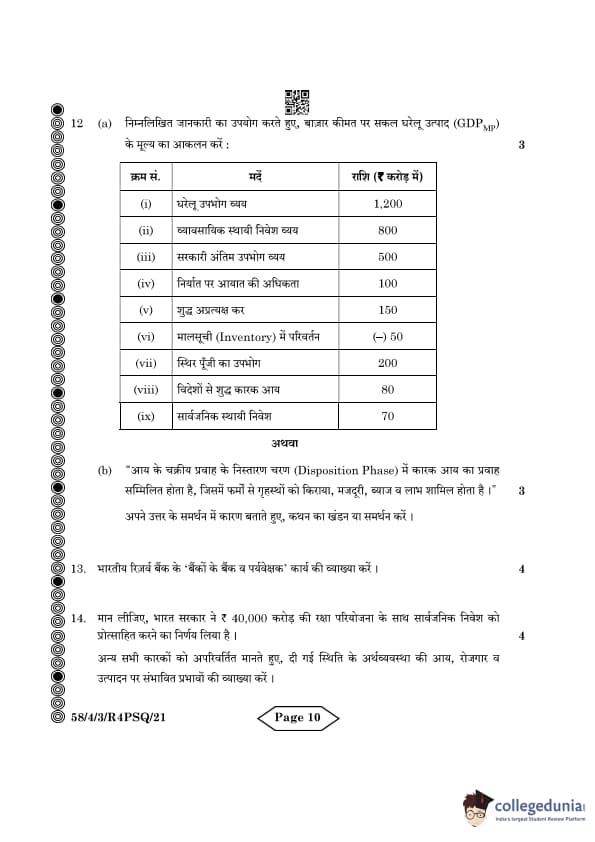
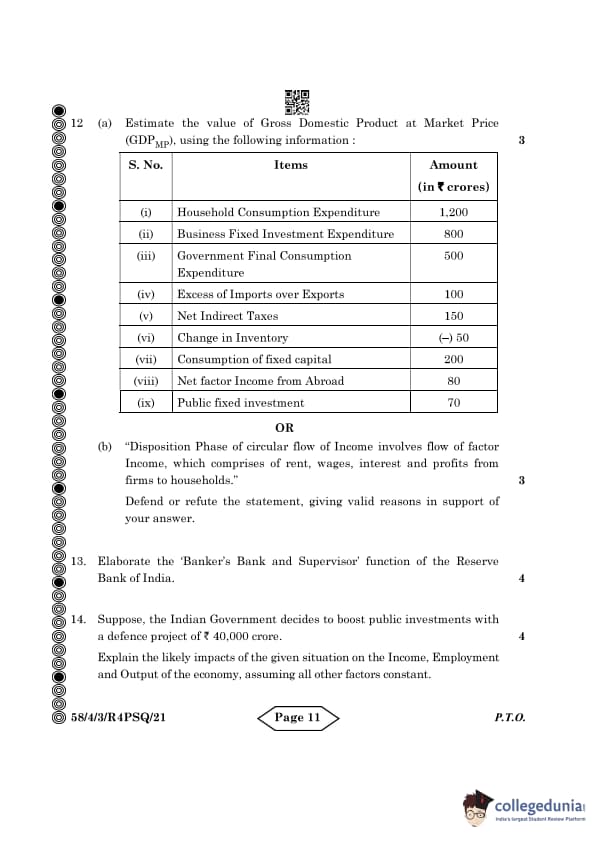
Question 12(a):
Estimate the value of Net National Product at Factor Cost (NNPFC), using the following information:
| S. No. | Items | Amount (in Rs. crores) |
|---|---|---|
| (i) | Household Consumption Expenditure | 1,200 |
| (ii) | Business Fixed Investment Expenditure | 800 |
| (iii) | Government Final Consumption Expenditure | 500 |
| (iv) | Excess of Imports over Exports | 100 |
| (v) | Net Indirect Taxes | 150 |
| (vi) | Change in Inventory | (-)50 |
| (vii) | Consumption of Fixed Capital | 200 |
| (viii) | Net Factor Income from Abroad | 80 |
| (ix) | Public Fixed Investment | 70 |
Formula: Net National Product at Factor Cost (NNPFC) = (i) + (ii) + (iii) + (iv) + (vi) + (viii) - (v)
View Solution
Solution:
Calculation:
NNPFC = 1,200 + 500 + 800 + 70 + (-50) - 100 - 150 + 80
NNPFC = 2,420 - 100 -150 +80-50
NNPFC = 2,250 - 50 = 2,200 crores
Question 12(b):
"Disposition Phase of circular flow of Income involves flow of factor Income, which comprises of rent, wages, interest, and profits from firms to households." Defend or refute the statement, giving valid reasons in support of your answer.
View Solution
Solution: The given statement is refuted.
Disposition phase of circular flow of income indicates the flow of spending by the households on the purchase of goods and services produced by firms.
Whereas, the aforesaid statement depicts the distribution phase which involves the flow of factor incomes, which comprises of rent, wages, interest, and profits from firms to households.
Conclusion: Since the disposition phase deals with how national income is utilized by households after being received as factor payments, the statement is valid and well-supported by economic theory.
Question 13:
Elaborate the 'Banker's Bank and Supervisor' function of the Reserve Bank of India.
View Solution
Solution:
The Reserve Bank of India (RBI) performs the crucial function of being the "Banker's Bank and Supervisor” by:
1. Regulating Commercial Banks: RBI monitors and enforces banking norms, ensuring financial stability.
2. Lender of Last Resort: It provides emergency liquidity to banks facing financial distress.
3. Monetary Policy Implementation: RBI controls credit supply through policy tools like repo rate and cash reserve ratio (CRR).
4. Supervision of Banking Operations: It ensures compliance with financial laws and protects depositor interests.
Conclusion: RBI's role as the "Banker's Bank and Supervisor” safeguards the stability of the banking system and ensures smooth financial operations.
Question 14:
Suppose, the Indian Government decides to boost public investments with a defence project of ₹40,000 crore. Explain the likely impacts of the given situation on the Income, Employment and Output of the economy, assuming all other factors constant.
View Solution
Solution:
The announcement of a ₹40,000 crore defence project is likely to have a significant impact on the economy due to the multiplier effect.
Impact on Income, Employment, and Output:
1. Increase in Income:
- Public investment in defence projects leads to increased spending on resources and infrastructure.
- This creates income for workers, suppliers, and other stakeholders involved in the project.
- Higher disposable incomes will further stimulate demand for goods and services.
2. Rise in Employment:
- Defence projects require a substantial workforce, directly generating jobs in construction, engineering, and manufacturing.
- Indirect employment is created in industries supplying raw materials and services.
3. Boost to Output:
- Increased demand for resources, machinery, and raw materials enhances industrial production.
- The multiplier effect ensures that initial public investment leads to a much larger overall increase in economic output.
Conclusion: The ₹40,000 crore investment in the defence project will positively impact income, employment, and output, contributing to overall economic growth through the multiplier effect.
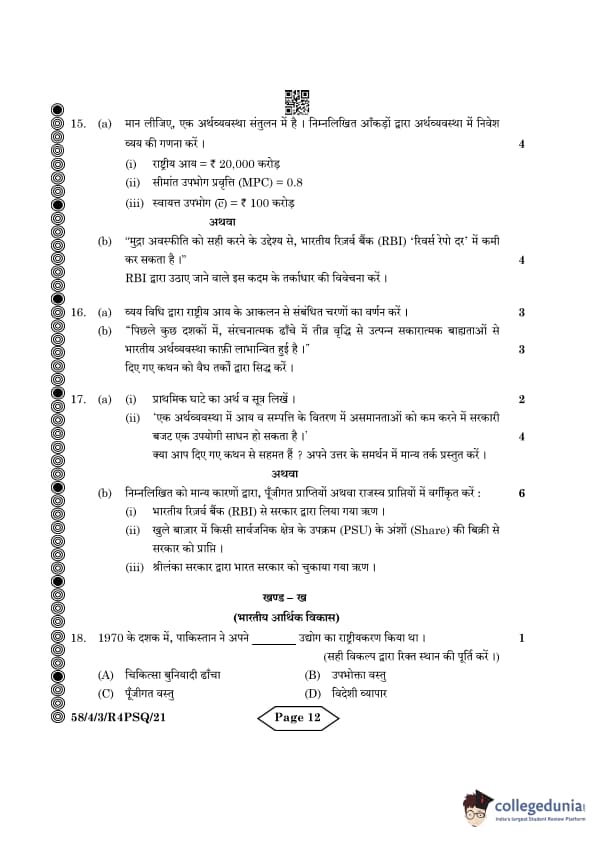
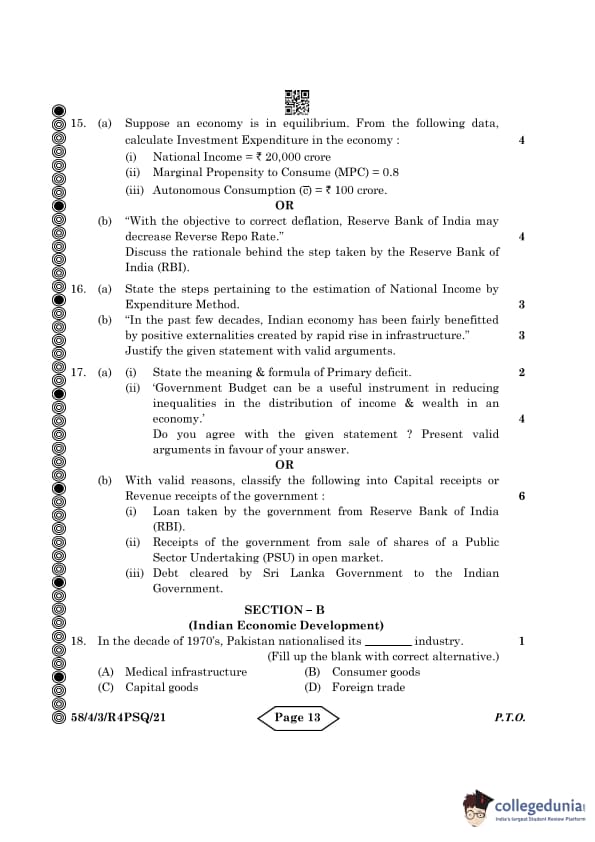
Question 15(a):
Suppose an economy is in equilibrium. From the following data, calculate Investment Expenditure in the economy:
(i) National Income = ₹20,000 crore
(ii) Marginal Propensity to Consume (MPC) = 0.8
(iii) Autonomous Consumption (C) = ₹100 crore
View Solution
Solution:
Formula:
Y = C + I
C = Co + MPC × Y
I = Y - C
Calculation:
C = 100 + 0.8 × 20,000
= 100 + 16,000
= 16,100
I = 20,000 - 16,100
I = 3,900
Final Answer: ₹3,900 crore
Question 15(b) (OR):
"With the objective to correct deflation, Reserve Bank of India may decrease the Bank rate.” Discuss the rationale behind the step taken by the Reserve Bank of India (RBI).
View Solution
Solution:
- A decrease in the Bank Rate reduces the cost of borrowing for commercial banks, encouraging them to lend more to businesses and consumers. - Increased credit availability leads to higher investment and consumption spending, boosting Aggregate Demand in the economy. - This rise in demand helps in correcting deflationary pressures, bringing the economy back to stability.
Conclusion: Lowering the Bank Rate makes borrowing cheaper, increasing liquidity, investment, and consumer spending, thus combating deflation.
Question 16(a):
State the steps pertaining to the estimation of National Income by Value Added Method.
View Solution
Solution:
The Value Added Method (or Product Method) is used to estimate National Income by summing up the value added by different sectors of the economy. The key steps are:
1. Identifying Production Units:
- The economy is divided into Primary (agriculture), Secondary (manufacturing), and Tertiary (services) sectors.
2. Calculating Gross Value Added (GVA):
- Value Added = Value of Output - Value of Intermediate Consumption
3. Summing Up GVA Across Sectors:
- The GVA of all sectors is summed to obtain Gross Domestic Product at Market Price (GDPMP).
4. Adjusting for Net Indirect Taxes (NIT):
- GDP at Factor Cost = GDPMP - Net Indirect Taxes (NIT)
5. Adding Net Factor Income from Abroad (NFIA):
- Net National Product at Factor Cost (NNPFC) = GDP at Factor Cost + NFIA
Conclusion: By following these steps, we ensure accurate estimation of National Income, eliminating double counting and considering only final value addition.
Question 16(b):
"In the past few decades, the Indian economy has been fairly benefitted by positive externalities created by a rapid rise in infrastructure.” Justify the given statement with valid arguments.
View Solution
Solution:
Positive externalities refer to the spillover benefits that arise from investments, particularly in infrastructure. The rapid development of infrastructure in India has significantly contributed to economic growth in the following ways:
1. Enhanced Productivity and Efficiency:
- Improved transportation networks (roads, railways, and airports) have reduced logistics costs, increasing industrial efficiency.
2. Attracting Foreign Investment:
- Better infrastructure fosters a favorable business environment, attracting both domestic and foreign investments.
3. Employment Generation:
- Infrastructure projects like highways, metro systems, and smart cities have created millions of jobs, boosting income levels.
4. Expansion of Markets:
- Rural infrastructure development, including electrification and internet connectivity, has facilitated rural-urban trade and digital economy expansion.
Conclusion: Infrastructure development creates long-term economic benefits, leading to higher productivity, investment, employment, and economic expansion.
Question 17(a)(i):
State the meaning and formula of Primary Deficit.
View Solution
Solution:
Meaning:
The primary deficit refers to the difference between the fiscal deficit and interest payments on previous borrowings. It reflects the government's borrowing requirements to meet its current expenditures, excluding the interest burden.
Formula:
Primary Deficit = Fiscal Deficit – Interest Payments
Explanation:
- A positive primary deficit indicates that the government is borrowing not only to pay interest but also to cover part of its current expenditure.
- A negative primary deficit (primary surplus) suggests that the government is generating enough revenue to meet current expenses, excluding interest payments.
Question 17(a)(ii):
'Government Budget can be a useful instrument in reducing inequalities in the distribution of income and wealth in an economy.' Present valid arguments in favor of your answer.
View Solution
Solution: Yes, The government budget objective of ‘Redistribution of Income' aims to bring about equality in the distribution of income. Government can reduce inequalities of income through taxes and public expenditure. It may impose high taxes on the rich to reduce their disposable income.
1. Progressive Taxation:
- Higher taxes on the wealthy and lower taxes on the poor help in redistributing wealth.
2. Welfare Expenditure:
- Government spends on subsidies, education, healthcare, and social security, benefiting lower-income groups.
3. Public Employment Programs:
- Schemes like MGNREGA create jobs and income opportunities, reducing economic disparity.
Conclusion: The government budget serves as a powerful tool to promote economic equity by using taxation and welfare policies.
Question 17(b) (OR):
With valid reasons, classify the following into Capital receipts or Revenue receipts of the government:
(i) Loans taken by the government from Reserve Bank of India (RBI).
(ii) Receipts of the government from sale of shares of a Public Sector Undertaking (PSU) in open market.
(iii) Debt cleared by Sri Lanka Government to the Indian Government.
View Solution
Solution:
Classification:
(i) It is a capital receipt as it increases the liabilities of the government.
(ii) It is a capital receipt as it reduces the assets of the government.
(iii) It is a capital receipt as it reduces the assets of the government.
SECTION B
Indian Economic Development
Question 18:
In the decade of the 1970's, Pakistan nationalized its _____ industry. (Fill up the blank with the correct alternative.)
View Solution
Solution:
- In the 1970s, Pakistan nationalized several key sectors, especially in the capital goods sector. This was part of an effort to control major industries and increase state control over the economy.
- The nationalization was aimed at boosting industrial growth by placing strategic sectors under government ownership.
Conclusion: The capital goods sector was the focus of Pakistan's nationalization policy during the 1970s, making option (C) the correct choice.
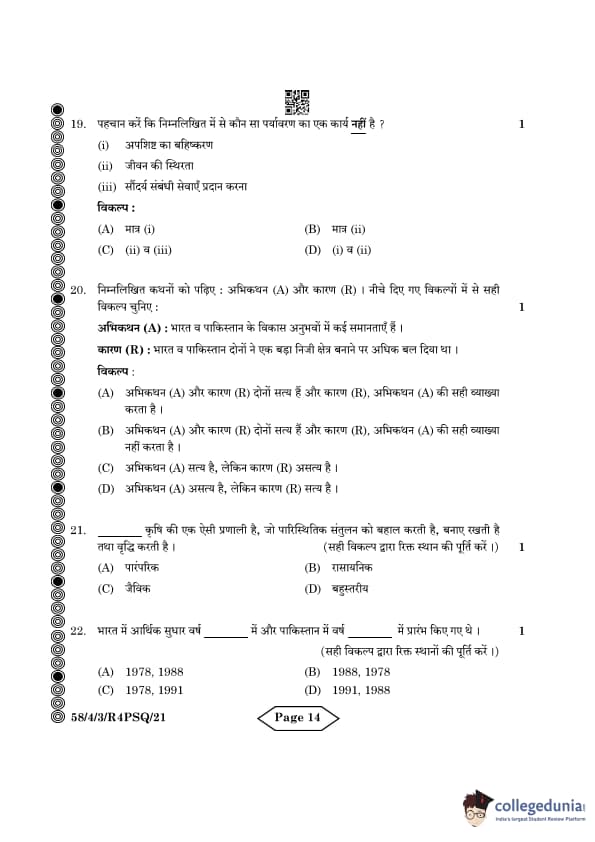
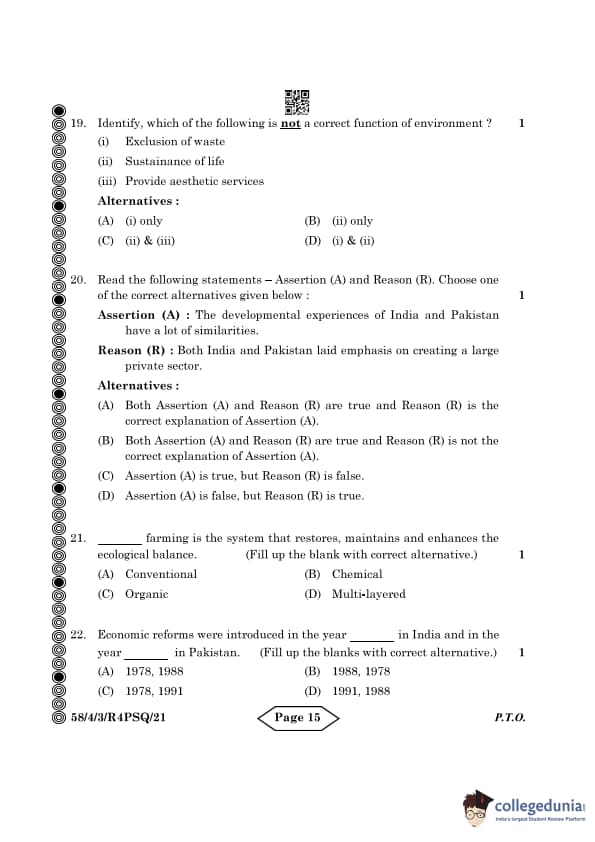
Question 19:
Identify, which of the following is not a correct function of the environment?
View Solution
Solution:
- Option (i), exclusion of waste, is not a direct function of the environment. Instead, waste management is typically a human responsibility.
- (ii) Sustainance of life and (iii) Providing aesthetic services are both core functions of the environment, as it provides the necessary conditions for life and contributes to the beauty of natural landscapes.
Conclusion: Waste exclusion is not an inherent function of the environment, but rather a process managed by humans, making option (A) the correct choice.
Question 20:
Read the following statements - Assertion (A) and Reason (R). Choose one of the correct alternatives given below: Assertion (A): The developmental experiences of India and Pakistan have a lot of similarities. Reason (R): Both India and Pakistan laid emphasis on creating a large private sector.
(Choose the correct alternative)
View Solution
Solution:
- Assertion (A) is true: India and Pakistan, despite their differences, have had many similar developmental experiences post-independence, including challenges of poverty, economic inequality, and reliance on agriculture.
- Reason (R) is false: While both countries did promote industrialization, Pakistan focused more on state-led industrialization and emphasized the public sector, whereas India focused more on the public sector and did not prioritize creating a large private sector.
Conclusion: While both nations have had similar developmental experiences, Pakistan's focus on the private sector is incorrect in this context, making Reason (R) false.
Question 21:
__________ farming is the system that restores, maintains and enhances the ecological balance.
(Fill up the blank with the correct alternative.)
View Solution
Solution:
- Organic farming is a method of farming that focuses on sustainable practices, avoids synthetic chemicals, and restores and maintains ecological balance by promoting biodiversity and soil health.
- It is an environmentally friendly approach that enhances the sustainability of agricultural production.
Conclusion: Organic farming helps maintain ecological balance by avoiding chemical inputs and focusing on sustainable agricultural practices.
Question 22:
Economic reforms were introduced in the year _______ in India and in the year _______ in Pakistan.
(Fill up the blanks with the correct alternative.)
View Solution
Solution:
- India introduced major economic reforms in 1991 under the leadership of Prime Minister P.V. Narasimha Rao and Finance Minister Dr. Manmohan Singh.
- Pakistan began its economic reforms in 1988, focusing on liberalization and privatization under Prime Minister Benazir Bhutto.
Conclusion: India's major economic reforms were introduced in 1991, while Pakistan's were initiated in 1988.
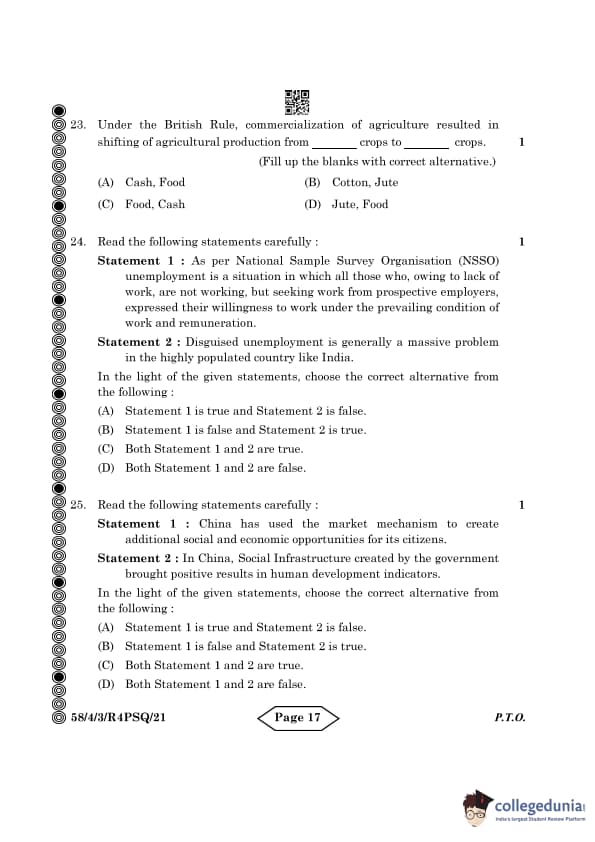
Question 23:
Under the British Rule, commercialization of agriculture resulted in shifting of agricultural production from _______ crops to _______ crops.
(Fill up the blanks with the correct alternative.)
View Solution
Solution:
- During British rule, agriculture was commercialized to cater to the demands of the colonial economy, leading to a shift from growing food crops to cash crops such as cotton, jute, and indigo.
- This shift was driven by the need to export raw materials for British industries.
Conclusion: The British colonial economic policies led to a shift in agricultural production from food crops to cash crops.
Question 24:
Read the following statements carefully:
Statement 1: As per National Sample Survey Organisation (NSSO) unemployment is a situation in which all those who, owing to lack of work, are not working, but seeking work from prospective employers, expressed their willingness to work under the prevailing condition of work and remuneration.
Statement 2: Disguised unemployment is generally a massive problem in a highly populated country like India.
In the light of the given statements, choose the correct alternative from the following:
View Solution
Solution:
- Statement 1 is true: The NSSO defines unemployment as people who are not working but are willing and seeking employment at the prevailing wage rate.
- Statement 2 is true: Disguised unemployment occurs when people appear to be employed but their marginal productivity is zero. It is particularly prevalent in highly populated countries like India, where labor is abundant.
Question 25:
Read the following statements carefully:
Statement 1: China has used the market mechanism to create additional social and economic opportunities for its citizens. Statement 2: In China, Social Infrastructure created by the government brought positive results in human development indicators.
In the light of the given statements, choose the correct alternative from the following:
View Solution
Solution:
- Statement 1 is true: China has utilized market mechanisms, such as opening up markets and encouraging private enterprise, to foster economic growth.
- Statement 2 is true: China's government investments in social infrastructure, such as healthcare and education, have contributed to improved human development indicators, like life expectancy and literacy rates.
Conclusion: Both statements are true as China's economic growth and social infrastructure development have led to improvements in citizens' welfare.
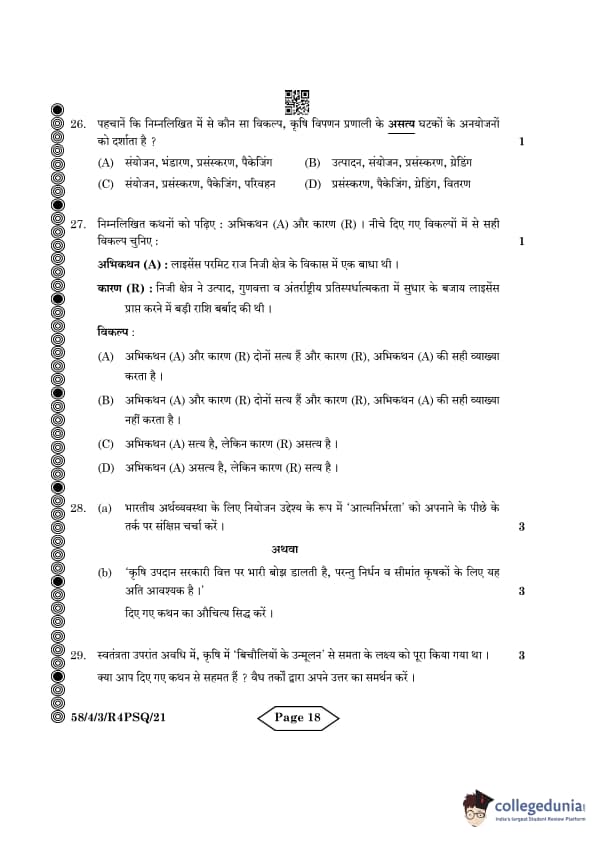
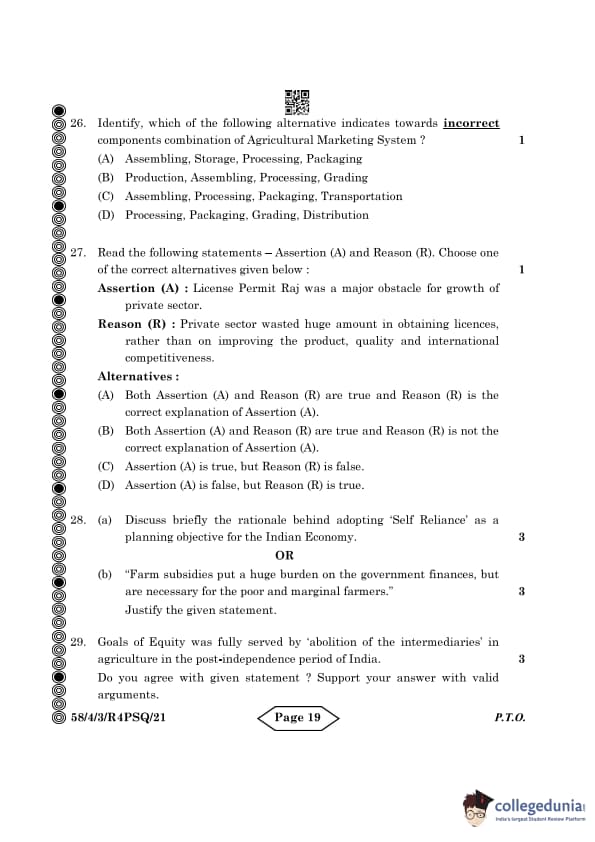
Question 26:
Identify which of the following alternative indicates towards incorrect components combination of Agricultural Marketing System?
View Solution
Solution:
- The Agricultural Marketing System includes activities that focus on the post-production process.
- Incorrect combination (B): Production refers to the primary agricultural activity, which is not part of the marketing system. The marketing system starts after production.
- Correct components: Assembling, storage, processing, packaging, and distribution are part of the agricultural marketing system.
Conclusion: Option (B) is incorrect as it includes Production, which is not part of the Agricultural Marketing System.
Question 27:
Read the following statements - Assertion (A) and Reason (R). Choose one of the correct alternatives given below: Assertion (A): License Permit Raj was a major obstacle for growth of private sector. Reason (R): Private sector wasted huge amounts in obtaining licenses, rather than on improving the product, quality, and international competitiveness.
(Choose the correct alternative)
View Solution
Solution:
- Assertion (A) is true: License Permit Raj, introduced by the government, severely restricted the growth of the private sector by imposing bureaucratic controls.
- Reason (R) is true: Private firms had to spend significant time and resources obtaining licenses instead of focusing on improving product quality or enhancing international competitiveness.
Conclusion: Reason (R) directly explains why the License Permit Raj hindered the growth of the private sector, making option (A) the correct choice.
Question 28(a):
Discuss briefly the rationale behind choosing ‘Self-reliance' as a planning objective for the Indian economy.
View Solution
Solution:
The rationale behind choosing ‘Self-reliance' as a planning objective for the Indian economy was based on two primary reasons:
• To Reduce Foreign Dependence: - The early Five-Year Plans emphasized the use of domestic resources to promote economic growth and modernization. - This aimed to reduce India's dependence on foreign countries for food supplies, technology, and capital.
• To Avoid Foreign Interference: - Post-independence, there was a concern that heavy reliance on foreign resources could lead to increased foreign influence on India's policy-making. - By focusing on self-reliance, India sought to safeguard its economic and political sovereignty.
Question 28(b) (OR):
“Farm subsidies put a huge burden on the government finances, but are necessary for the poor and marginal farmers.” Justify the given statement.
View Solution
Solution:
Farm subsidies are essential despite being a significant financial burden on the government due to the following reasons:
• Support for Small and Marginal Farmers: - In India, a majority of farmers are small and marginal, who cannot afford expensive agricultural inputs such as seeds, fertilizers, and irrigation systems. - Farm subsidies help make these inputs accessible, ensuring continued agricultural production.
• Reduction of Income Inequalities: - Eliminating subsidies would widen the income gap between rich and poor farmers. - Providing subsidies encourages the adoption of modern farming techniques and supports equitable growth in the agricultural sector.
Conclusion: To ensure food security and rural development, it is crucial to continue farm subsidies while striving for efficient financial management.
Question 29:
Goals of Equity was fully served by ‘abolition of the intermediaries' in agriculture in the post-independence period of India. Do you agree with the given statement? Support your answer with valid arguments.
View Solution
Solution:
No, The goal of equity was not fully served by abolition of intermediaries, as in some areas the erstwhile zamindars continued to own large areas of land by making use of the loopholes in the legislation. There were cases where tenants were evicted and the landowners claimed to be self-cultivators.
Positive Impact:
• Redistribution of Land Ownership: - The abolition of intermediaries transferred land rights to actual cultivators, reducing the exploitation of farmers by zamindars.
• Reduction in Land Revenue Exploitation: - Farmers no longer had to pay excessive taxes to intermediaries, leading to improved financial stability and agricultural productivity.
Limitations:
• Incomplete Land Reforms: - Large landowners often found ways to retain their holdings by transferring land to family members or manipulating land records.
• Persistence of Inequality: - Many small and marginal farmers continued to face challenges due to limited access to credit, irrigation, and modern technology.
• Regional Disparities: - The implementation of land reforms was uneven across different states, leading to disparities in agricultural equity.
Conclusion: While the abolition of intermediaries was a landmark reform, it only partially achieved the goal of equity. Comprehensive land reforms and improved agricultural support systems were necessary to fully realize equitable growth in the agricultural sector.
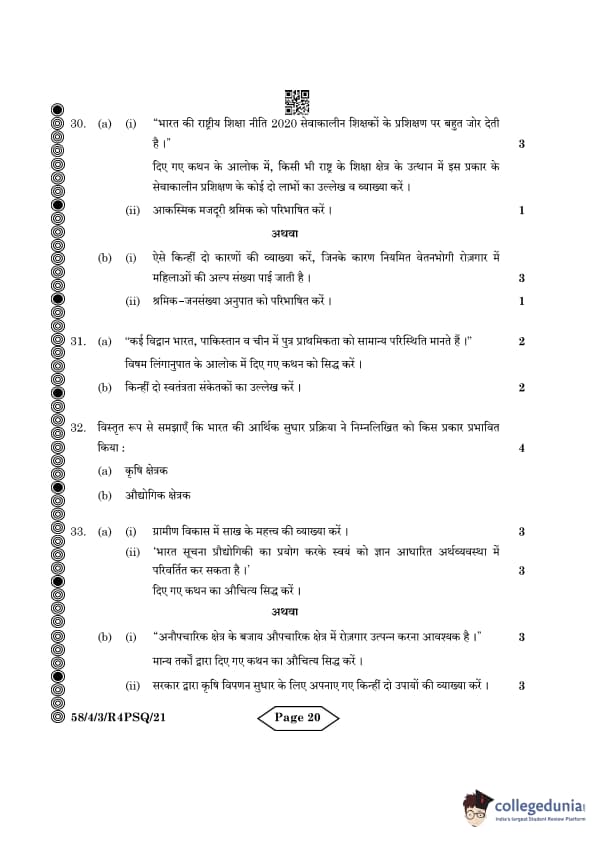
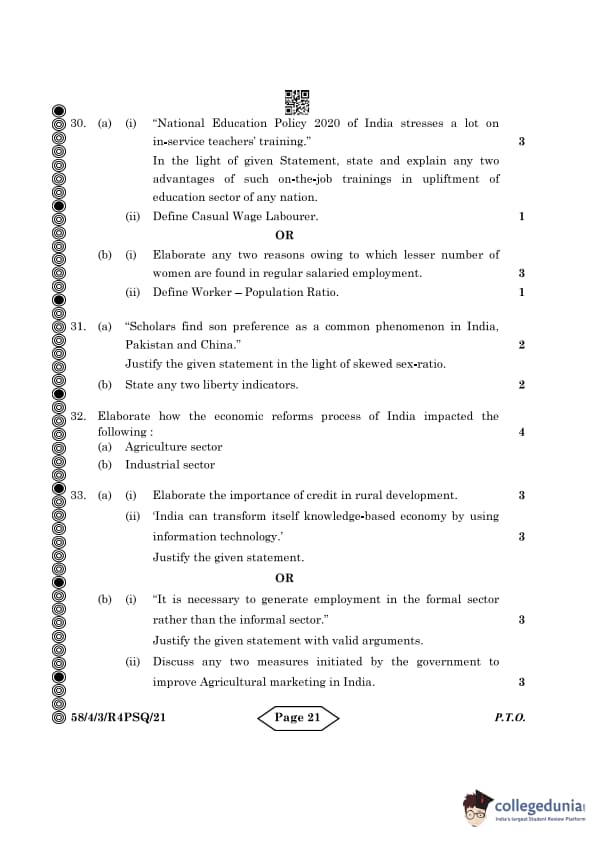
Question 30(a)(i):
'National Education Policy 2020 of India stresses a lot on in-service teachers' training.' In the light of the given statement, state and explain any two advantages of such on-the-job training in the upliftment of the education sector of any nation.
View Solution
Solution:
Advantages of In-service Teacher Training:
- Improves Teaching Quality: Regular in-service training equips teachers with updated knowledge and skills, improving their ability to deliver quality education and adapt to new teaching methods.
- Empowers Teachers: On-the-job training fosters a culture of continuous learning and professional growth, boosting teacher confidence and motivation.
Conclusion: In-service teacher training plays a critical role in improving teaching quality and empowering educators, ultimately benefiting students and the education system.
Question 30(a)(ii):
Define Casual Wage Labourer.
View Solution
Solution: - Casual Wage Labourer: A casual wage labourer is someone who is hired for short-term work or temporary employment, often without a fixed contract or long-term commitment, and receives wages based on the hours worked.
Question 30(b)(i) (OR):
Elaborate any two reasons owing to which lesser number of women are found in regular salaried employment.
View Solution
Solution:
Reasons for Fewer Women in Regular Salaried Employment:
- Cultural : In many societies, cultural norms and gender roles discourage women from pursuing formal employment or prioritize them for domestic duties.
- Workplace Discrimination: Women face challenges in terms of lower wages, limited job opportunities, and gender bias, which restrict their entry into regular salaried positions.
Question 30(b)(ii) (OR):
Define worker-population ratio.
View Solution
Solution: - Worker-Population Ratio: The worker-population ratio is the proportion of the working-age population that is actively engaged in work or seeking employment. It is calculated as the number of workers divided by the total working-age population.
Question 31(a):
"Scholars find son preference as a common phenomenon in India, Pakistan, and China." Justify the given statement in the light of skewed sex-ratio.
View Solution
Solution:
Son Preference and Skewed Sex Ratio:
- Cultural and Socio-Economic Factors: In India, Pakistan, and China, son preference has been historically ingrained due to traditional beliefs and socio-economic factors. Sons are often considered the breadwinners who will continue the family name, support parents in old age, and inherit family wealth.
- Skewed Sex Ratio: This preference for sons has contributed to a distorted sex ratio, where the number of males significantly outweighs the number of females. In India, the sex ratio has been biased against females with higher female mortality, lower female births, and female feticide practices.
- Similar Patterns in Pakistan and China: The gender imbalance is also observed in Pakistan and China, where the preference for male children is evident in both birth ratios and social expectations.
Conclusion: The skewed sex ratio in India, Pakistan, and China is a direct consequence of cultural son preference, which has resulted in the marginalization and disempowerment of females in these countries.
Question 31(b):
State any two liberty indicators.
View Solution
Solution:
Liberty Indicators:
1. Extent of Constitutional Protection of Rights: The protection of citizens' rights through the Constitution is a significant indicator of liberty. For instance, the Bill of Rights in many constitutions ensures that individuals' freedom of speech, expression, and privacy are safeguarded.
2. Protection of Judicial Independence and Rule of Law: The independence of the judiciary ensures that there is no government interference in legal matters, allowing citizens to enjoy fair trials and the rule of law. A robust legal system ensures individual liberties are not violated by the state.
Question 32:
Elaborate how the economic reforms process of India impacted the following: (a) Agriculture sector (b) Industrial sector
View Solution
Solution:
(a) Impact on the Agriculture Sector:
- Adverse Effects: The economic reforms in India, particularly in the 1990s, led to a reduction in public investment in agriculture. Government focus shifted towards liberalization and privatization, leaving the agriculture sector underfunded. - Cost of Production: The partial removal of subsidies, such as those on fertilizers, led to an increase in input costs, which adversely impacted small and marginal farmers who lacked access to credit and modern farming technologies.
- Shift to Export-Oriented Agriculture: Policies favored export-oriented agriculture, which benefitted large farmers but often neglected small-scale farmers.
(b) Impact on the Industrial Sector:
- Increased Competition: The liberalization led to a rise in imports, as foreign goods became cheaper due to lower tariffs. Indian industries faced stiff competition from foreign products, which reduced the demand for domestic goods.
- Infrastructure Constraints: While reforms aimed to promote private investment, the lack of investment in essential infrastructure like power supply, transportation, and communication continued to hinder the industrial growth.
- Growth of Services Over Manufacturing: The focus shifted more towards the services sector, while the industrial sector did not perform as expected due to infrastructure bottlenecks and an imbalance in the reform policies.
Conclusion: The economic reforms of India brought some positive changes to the industrial sector but adversely affected the agriculture sector, which needed more support for inclusive growth.
Question 33(a)(i):
Elaborate the importance of credit in rural development.
View Solution
Solution:
Credit plays a crucial role in rural development by facilitating investments in agriculture, small-scale industries, and other rural activities.
Importance of Credit in Rural Development:
1. Agricultural Investment: - Farmers require credit to purchase seeds, fertilizers, machinery, and other essential inputs. - It helps in adopting modern farming techniques and improving agricultural productivity.
2. Promotion of Rural Enterprises: - Credit allows the establishment and expansion of small-scale rural businesses, generating employment opportunities.
3. Mitigating Income Fluctuations: - Rural households often face irregular income flows. Credit provides a buffer to meet consumption needs and emergencies.
Question 33(a)(ii):
'India can transform itself into a knowledge-based economy by using information technology.' Justify the given statement.
View Solution
Solution:
Justification:
1. Enhanced Access to Knowledge: - Information technology enables widespread dissemination of information, facilitating access to educational resources, research, and innovation. - Digital platforms support online learning and skill development programs.
2. Boost to Innovation and Start-ups: - IT supports the development of start-ups by providing tools for innovation and global market reach. - Technology-driven solutions can revolutionize sectors like healthcare, education, and agriculture.
Question 33(b)(i) (OR):
"It is necessary to generate employment in the formal sector rather than the informal sector.” Justify the given statement with valid arguments.
View Solution
Solution:
Justification:
1. Income Security and Benefits: - The formal sector offers job security, regular wages, and benefits like healthcare and pensions. - It ensures better working conditions compared to the informal sector.
2. Economic Stability and Tax Revenue: - Formal sector jobs contribute to government revenue through taxation, supporting public welfare programs. - It leads to a more stable and inclusive economy.
Question 33(b)(ii) (OR):
Discuss any two measures initiated by the government to improve Agricultural marketing in India.
View Solution
Solution:
Two Measures to Improve Agricultural Marketing:
1. Electronic National Agriculture Market (e-NAM): - e-NAM is an online trading platform that connects various agricultural markets across the country. - It facilitates better price discovery and eliminates middlemen.
2. Grading and Standardization: - The government has encouraged grading and standardization of agricultural produce to ensure better pricing and marketability. - This helps farmers get fair prices for high-quality produce.
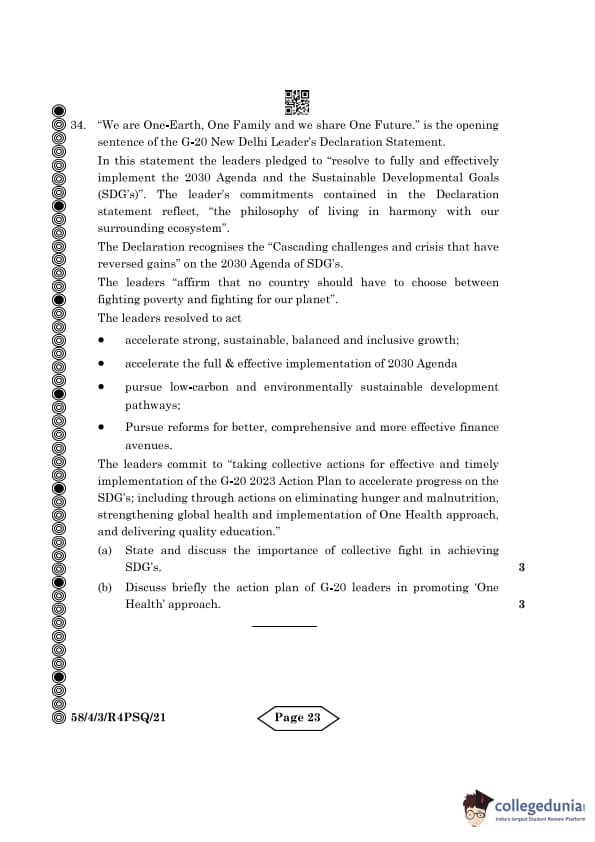
Question 34:
'We are One-Earth, One Family and we share One Future.” is the opening sentence of the G-20 New Delhi Leader's Declaration Statement.
In this statement the leaders pledged to "resolve to fully and effectively implement the 2030 Agenda and the Sustainable Developmental Goals (SDG's)”. The leader's commitments contained in the Declaration statement reflect, "the philosophy of living in harmony with our surrounding ecosystem”. The Declaration recognises the "Cascading challenges and crisis that have reversed gains” on the 2030 Agenda of SDG's.
The leaders "affirm that no country should have to choose between fighting poverty and fighting for our planet”.
The leaders resolved to act accelerate strong, sustainable, balanced and inclusive growth; accelerate the full effective implementation of 2030 Agenda pursue low-carbon and environmentally sustainable development pathways; e Pursue reforms for better, comprehensive and more effective finance avenues.
The leaders commit to "taking collective actions for effective and timely implementation of the G-20 2023 Action Plan to accelerate progress on the SDG's; including through actions on eliminating hunger and malnutrition, strengthening global health and implementation of One Health approach, and delivering quality education."
(a) State and discuss the importance of collective fight in achieving SDG's.
View Solution
Solution:
- Importance of Collective Fight in Achieving SDGs:
The Sustainable Development Goals (SDGs), set by the United Nations, are global in nature and require collective action from all countries, sectors, and individuals. Achieving these goals requires a concerted effort as global challenges, such as climate change, poverty, inequality, and health crises, transcend national boundaries.
- Global Collaboration: Countries, regardless of their size or wealth, must work together, pooling resources and sharing knowledge, technology, and best practices to tackle global problems like climate change and pandemics.
- Inclusivity: Collective action ensures that no one is left behind, as it involves collaboration across sectors, governments, organizations, and individuals. This inclusivity is vital in addressing inequality and ensuring that the benefits of development reach the most vulnerable populations.
- Shared Responsibility: The SDGs demand that all nations recognize their shared responsibility for the global environment and prosperity. By uniting efforts, we can make significant progress towards common goals, from reducing carbon emissions to ensuring access to quality education.
Question 34(b):
Discuss briefly the action plan of G-20 leaders in promoting the 'One Health' approach.
View Solution
Solution:
- The 'One Health' Approach:
The One Health approach is an integrated approach to human health, animal health, and the environment, emphasizing the interconnection between these three domains. This approach is critical in tackling health issues that span across species, such as zoonotic diseases, antimicrobial resistance, and environmental health threats.
- G-20 Action Plan for One Health: The G-20 leaders have acknowledged the importance of a holistic approach to global health through the One Health approach. Their action plan includes several key initiatives:
- Strengthening Global Health Systems: The G-20 aims to enhance health surveillance and data sharing between countries to better detect and respond to emerging infectious diseases.
- Addressing Zoonotic Diseases: The G-20 action plan calls for better coordination between animal health authorities and public health sectors to monitor and mitigate risks from diseases that cross over from animals to humans.
- One Health Financing: The plan also includes commitments to increase funding for One Health programs, supporting the infrastructure, research, and interventions needed for effective implementation globally.






Comments