




CBSE Class 12 Geography Question Paper 2024 PDF (Set 1 - 64/2/1) is available for download here. CBSE conducted the Geography exam on February 29, 2024 from 10:30 AM to 1:30 PM. The total marks for the theory paper are 70. The question paper contains 20% MCQ-based questions, 40% competency-based questions, and 40% short and long answer type questions.
CBSE Class 12 Geography Question Paper 2024 (Set 1 - 64/2/1) with Answer Key
| CBSE Class 12 Geography Question Paper 2024 PDF | CBSE Class 12 Geography Answer Key 2024 PDF |
|---|---|
| Download PDF | Download PDF |
Two statements are given below. They are Assertion (A) and Reason (R).
Read both statements carefully and choose the correct option.
Assertion (A): There is a strong dichotomy between physical environment and human beings.
Reason (R): Nature and humans are intimately connected.
View Solution
Concept:
In human geography, the relationship between humans and the physical environment is viewed as interconnected rather than completely separate.
Modern geographical thought emphasizes interaction, adaptation, and mutual influence between nature and humans.
Step 1: Examine the Assertion (A).
The assertion states that there is a strong dichotomy (complete separation) between the physical environment and human beings.
This is incorrect because humans depend on, adapt to, and modify their environment. Hence, there is interaction rather than strict separation.
Step 2: Examine the Reason (R).
The reason states that nature and humans are intimately connected.
This statement is correct, as human survival, development, and activities are closely linked with environmental conditions.
Step 3: Final Conclusion.
Since Assertion (A) is incorrect and Reason (R) is correct, the correct option is:
\[ \boxed{(D) (A) is incorrect but (R) is correct.} \] Quick Tip: Exam Strategy:
If the assertion contradicts basic geographical principles but the reason reflects human-environment interaction,
then Assertion is false and Reason is true.
"Neither there is absolute necessity nor there is absolute freedom.''
The given statement is related to which one of the following concepts?
View Solution
Concept:
The statement reflects a balanced view of the relationship between humans and the environment.
It rejects both extremes:
Absolute environmental control (determinism)
Complete human freedom (possibilism)
This balanced approach is known as Neo-determinism or the middle path.
Step 1: Understanding the statement.
The phrase “neither absolute necessity nor absolute freedom” implies that:
Humans are not completely controlled by nature.
Humans also do not have unlimited freedom over nature.
Step 2: Linking with geographical concepts.
Determinism: Nature completely controls humans — rejected by the statement.
Possibilism: Humans have total freedom — also rejected.
Neo-determinism: A middle path where nature guides and humans act within limits.
Step 3: Conclusion.
The statement clearly supports the idea of a balanced interaction between humans and nature, which is the core idea of Neo-determinism.
\[ \boxed{(B)\ Neo-determinism} \] Quick Tip: Memory Trick:
Determinism = Only Nature
Possibilism = Only Humans
Neo-determinism = Balance of Both
Read the following sub-fields of social geography carefully and choose the correct option:
I. Resource Geography II. Leisure Geography
III. Gender Geography IV. Marketing Geography
View Solution
Concept:
Social geography focuses on the spatial aspects of human society, including social groups, inequalities, lifestyles, and cultural patterns.
It studies how social relations vary across space.
Step 1: Evaluate each sub-field.
I. Resource Geography:
This belongs to economic geography, as it deals with the distribution and use of natural resources.
Hence, not a sub-field of social geography.
II. Leisure Geography:
This studies recreational activities, tourism, and lifestyle patterns of people.
It is a recognised sub-field of social geography.
III. Gender Geography:
This examines spatial inequalities based on gender roles and relations.
It is an important branch of social geography.
IV. Marketing Geography:
This relates to business and economic geography, focusing on market distribution and trade patterns.
Not a sub-field of social geography.
Step 2: Final Selection.
The correct sub-fields of social geography are Leisure Geography and Gender Geography.
\[ \boxed{(C)\ II and III are correct} \] Quick Tip: Shortcut:
If it studies society, lifestyle, or inequality → Social Geography.
If it studies resources or markets → Economic Geography.
Which one of the following types of farming is most labour intensive?
View Solution
Concept:
Labour-intensive farming refers to agricultural systems that require a large amount of human labour relative to land size and capital use.
Such farming is usually practiced in developing regions with limited mechanisation.
Step 1: Understanding labour-intensive farming.
Labour-intensive agriculture depends more on manual work than machines.
It is commonly found in areas with high population density and small landholdings.
Step 2: Evaluating the options.
Horticulture:
Requires skill but not always the most labour-intensive compared to traditional farming.
Subsistence Agriculture:
Practised mainly by small farmers using traditional tools and family labour.
Minimal mechanisation makes it highly labour intensive.
Co-operative Farming:
Organised farming with shared resources; may involve machinery, reducing labour intensity.
Collective Farming:
Usually large-scale and mechanised (e.g., socialist economies), hence less labour intensive.
Step 3: Conclusion.
Subsistence agriculture relies heavily on manual labour and traditional techniques, making it the most labour-intensive type.
\[ \boxed{(B)\ Subsistence agriculture} \] Quick Tip: Exam Tip:
Traditional farming + small land + manual work = Subsistence = Labour intensive.
Define brain drain and give one reason for its occurrence between developed and developing nations.
View Solution
Concept:
Brain drain refers to the migration of highly educated, skilled, and talented individuals from their home country (usually developing nations) to more developed countries in search of better opportunities.
This movement leads to a loss of human capital in the country of origin and a gain for the destination country.
Definition:
Brain drain is the large-scale emigration of qualified professionals such as doctors, engineers, scientists, and researchers from developing countries to developed countries.
Reason for Brain Drain Between Developed and Developing Nations:
Better Employment Opportunities:
Developed countries offer higher salaries, advanced infrastructure, research facilities, and better working conditions.
Professionals move to maximise career growth and financial stability.
Lack of similar opportunities in developing countries encourages migration.
Impact:
Brain drain can slow the development of the home country by reducing its skilled workforce, while benefiting developed nations through talent inflow. Quick Tip: Memory Aid:
Brain Drain = Talent moving from poor nations to rich nations
Which one of the following is an example of non-metallic mineral based industry?
View Solution
Concept:
Industries are often classified based on the type of raw material they use.
Metallic mineral-based industries use metal ores, while non-metallic mineral-based industries use minerals that do not contain metals.
Step 1: Understanding non-metallic mineral industries.
Non-metallic minerals include limestone, gypsum, mica, and clay.
Industries using these minerals fall under non-metallic mineral-based industries.
Step 2: Evaluating the options.
Aluminium industry:
Uses bauxite (a metallic ore) → Metallic industry.
Iron and Steel industry:
Uses iron ore → Metallic industry.
Copper industry:
Uses copper ore → Metallic industry.
Cement industry:
Uses limestone, gypsum, and clay → Non-metallic minerals.
Step 3: Conclusion.
Since cement is produced from non-metallic minerals, it is a non-metallic mineral-based industry.
\[ \boxed{(D)\ Cement industry} \] Quick Tip: Shortcut:
Metal ore → Metallic industry
Limestone / clay → Non-metallic → Cement
Two statements are given below. They are Assertion (A) and Reason (R).
Read both the statements carefully and choose the correct option.
Assertion (A): The concept of sustainable development emerged in the 1980s.
Reason (R): General awareness about environmental issues originated during the 1960s in the western world.
View Solution
Concept:
The idea of sustainable development evolved gradually as environmental concerns gained global attention.
While awareness began earlier, the formal concept became prominent later.
Step 1: Evaluate Assertion (A).
The concept of sustainable development gained global recognition in the 1980s, especially after the Brundtland Report (1987).
Hence, Assertion (A) is correct.
Step 2: Evaluate Reason (R).
Environmental awareness started growing in the 1960s in Western countries due to issues like pollution, industrialisation, and ecological damage.
Hence, Reason (R) is also correct.
Step 3: Check explanation.
The rise of environmental awareness in the 1960s laid the foundation for the emergence of sustainable development in the 1980s.
Thus, the reason correctly explains the assertion.
Final Conclusion: \[ \boxed{(A)\ Both (A) and (R) are true and (R) is the correct explanation of (A).} \] Quick Tip: Timeline Trick:
1960s → Environmental awareness
1980s → Sustainable development concept
If you were asked to prepare a hill area development programme, which of the following should be kept in mind? Choose the correct option.
I. Establishing heavy industry
II. Ecosystem
III. National Highway construction
IV. Topography
View Solution
Concept:
Hill area development requires careful planning due to fragile environments, steep slopes, and ecological sensitivity.
Sustainable development in such areas must prioritise environmental balance and terrain characteristics.
Step 1: Evaluate each factor.
I. Establishing heavy industry:
Not suitable for hill areas due to environmental damage, land instability, and infrastructure limitations.
II. Ecosystem:
Very important, as hill regions have fragile ecosystems that must be protected.
III. National Highway construction:
Large-scale construction may cause landslides, deforestation, and ecological imbalance if not carefully planned.
Not a primary consideration in basic hill development planning.
IV. Topography:
Crucial factor because slope, altitude, and terrain influence settlement, agriculture, and infrastructure.
Step 2: Conclusion.
The most important considerations in hill area development are ecosystem protection and topography.
\[ \boxed{(D)\ II and IV} \] Quick Tip: Hill Development Rule:
Protect nature + Respect terrain = Sustainable hill planning.
Match the following minerals in Column I with their locations in Column II and choose the correct option.
Column I (Minerals) Column II (Locations)
a. Iron ore i. Khetri
b. Manganese ii. Koraput
c. Bauxite iii. Chandrapur
d. Copper iv. Sundargarh
View Solution
Concept:
Minerals in India are associated with specific geological belts. Matching minerals with their major producing regions is a common geography question.
Step 1: Identify well-known mineral locations.
Copper → Khetri (Rajasthan):
Khetri is one of India’s most important copper mining regions.
Bauxite → Koraput (Odisha):
The Koraput plateau is rich in bauxite deposits.
Manganese → Chandrapur (Maharashtra):
The Chandrapur belt is known for manganese mining.
Iron ore → Sundargarh (Odisha):
Sundargarh lies in the Bonai–Keonjhar iron ore belt.
Step 2: Match accordingly.
\[ \begin{aligned} a.\ Iron ore &\rightarrow iv\ (Sundargarh)
b.\ Manganese &\rightarrow iii\ (Chandrapur)
c.\ Bauxite &\rightarrow ii\ (Koraput)
d.\ Copper &\rightarrow i\ (Khetri) \end{aligned} \]
Step 3: Final mapping:
iv, iii, ii, i → Option (D)
\[ \boxed{(D)\ iv,\ iii,\ ii,\ i} \] Quick Tip: Memory Aid:
Khetri → Copper
Koraput → Bauxite
Sundargarh → Iron ore
Read the information given in the box carefully and identify the mineral.
It is a non-ferrous ore.
Odisha is the largest producer state.
It is used in manufacturing of aluminium.
View Solution
Concept:
Minerals can be identified using clues related to their properties, uses, and leading producing regions.
The question provides three strong hints that help identify the mineral.
Step 1: Non-ferrous ore.
Non-ferrous minerals do not contain iron. Examples include copper, bauxite, and mica.
This eliminates manganese (a ferrous mineral).
Step 2: Largest producer is Odisha.
Odisha is well known for its vast reserves of bauxite, especially in the Koraput and Kalahandi regions.
Step 3: Used in manufacturing aluminium.
Aluminium is extracted from bauxite ore.
This is the strongest identifying clue.
Step 4: Conclusion.
Since bauxite is a non-ferrous ore, Odisha is the largest producer, and it is used to make aluminium, the correct answer is:
\[ \boxed{(C)\ Bauxite} \] Quick Tip: Key Fact:
Aluminium ← Bauxite
Odisha = India's bauxite hub
Which one of the following contributes maximum in India’s export?
View Solution
Concept:
India’s export composition has changed significantly over time.
Earlier dominated by primary products, exports are now led by industrial and manufactured items due to industrialisation and global trade integration.
Step 1: Understanding export categories.
Agriculture and allied products:
Includes tea, coffee, spices, and rice. Important but not the largest share today.
Ores and minerals:
India exports some minerals, but their contribution is relatively small.
Manufactured goods:
Includes machinery, textiles, chemicals, automobiles, and engineering goods.
This category forms the largest share of India’s exports.
Mineral fuels and lubricants:
India is a major importer of petroleum, so this category is not the largest export contributor.
Step 2: Conclusion.
Manufactured goods dominate India’s export basket due to industrial growth and value-added production.
\[ \boxed{(C)\ Manufactured goods} \] Quick Tip: Exam Fact:
India exports more finished products than raw materials today.
Which one of the following organisations regulate the air traffic of major airports of India?
View Solution
Concept:
Air traffic management and airport infrastructure in India are handled by specific statutory organisations under the Government of India.
The main body responsible for regulating air traffic is well-defined.
Step 1: Understanding air traffic regulation.
Air traffic regulation includes:
Air navigation services
Air traffic control (ATC)
Airport management
Step 2: Evaluating the options.
Airport Authority of India (AAI):
A statutory body that manages and regulates civil aviation infrastructure and air traffic control across Indian airspace.
Indian Airport Commission:
Not an official regulatory body.
Indian Air Control Board:
No such recognised organisation in India.
Airport Development Authority:
Not the main body responsible for regulating air traffic.
Step 3: Conclusion.
The Airport Authority of India is responsible for managing and regulating air traffic in major Indian airports.
\[ \boxed{(A)\ Airport Authority of India} \] Quick Tip: Remember:
AAI = Airports + Air Traffic Control in India
Which one of the following ports is situated at Zuari Estuary?
View Solution
Concept:
Major Indian ports are often associated with specific coastal features such as estuaries, lagoons, or natural harbours.
Knowing the location of important ports is essential in transport geography.
Step 1: Understanding Zuari Estuary.
The Zuari River flows through the state of Goa and forms an estuary along the Arabian Sea coast.
Step 2: Identifying the port located there.
New Mangalore: Located in Karnataka at the Gurupura River estuary.
Kochchi: Located in Kerala, associated with a lagoon and backwaters.
Marmagao: Located in Goa on the Zuari estuary.
Ennore: Located near Chennai on the east coast (Bay of Bengal).
Step 3: Conclusion.
Since Marmagao port lies on the Zuari estuary in Goa, it is the correct answer.
\[ \boxed{(C)\ Marmagao} \] Quick Tip: Port Fact:
Marmagao = Goa = Zuari Estuary
Which one of the following inland waterways stretch is correctly matched?
(Waterways) (Stretch)
View Solution
Concept:
India has several National Waterways designated for inland water transport.
Each waterway is defined by a specific river stretch or canal system.
Step 1: Recall major National Waterways.
National Waterway No. 1:
Allahabad (Prayagraj) to Haldia on the Ganga-Bhagirathi-Hooghly river system.
National Waterway No. 2:
Sadiya to Dhubri on the Brahmaputra River in Assam.
National Waterway No. 3:
Kottapuram to Kollam along the West Coast Canal in Kerala.
National Waterway No. 5:
Covers the Brahmani and Mahanadi delta region (not Kakinada–Puducherry).
Step 2: Check the correctly matched pair.
Among the options, the clearly correct and standard textbook match is:
\[ National Waterway No. 2 \rightarrow Sadiya to Dhubri \]
Step 3: Conclusion.
Thus, the correctly matched inland waterway stretch is:
\[ \boxed{(B)\ National Waterways No. 2 -- Sadiya -- Dhubri} \] Quick Tip: Memory Trick:
NW-1 → Ganga
NW-2 → Brahmaputra (Assam)
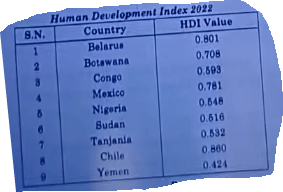
Study the given table (Human Development Index 2022) and answer the question:
How many countries fall under the low category of human development in the given table?
View Solution
Concept:
Human Development Index (HDI) categories:
Very High: 0.800 and above
High: 0.700 -- 0.799
Medium: 0.550 -- 0.699
Low: Below 0.550
Step 1: Identify countries with HDI below 0.550.
From the table:
Sudan -- 0.516
Yemen -- 0.424
Nigeria -- 0.548 (approx. borderline but falls in low category)
Step 2: Count them.
Total countries in the low HDI category = 3
\[ \boxed{(C)\ 3} \] Quick Tip: Low HDI Rule:
HDI below 0.550 → Low development
Congo comes under which one of the following categories of human development?
View Solution
Step 1: Check HDI value of Congo.
From the table, Congo has an HDI of 0.593.
Step 2: Match with HDI categories.
0.800+ → Very High
0.700--0.799 → High
0.550--0.699 → Medium
Below 0.550 → Low
Step 3: Conclusion.
Since 0.593 lies in the range 0.550--0.699, Congo falls under Medium human development.
\[ \boxed{(C)\ Medium} \] Quick Tip: 0.55 to 0.69 → Medium HDI
Which of the following European country falls under very high category of human development?
View Solution
Step 1: Identify the European country in options.
Among the given options:
Chile → South America
Mexico → North America
Botswana → Africa
Belarus → Europe
Step 2: Check HDI value.
From the table, Belarus has an HDI of 0.801, which falls in the very high category (0.800+).
Step 3: Conclusion.
Thus, the European country with very high human development is Belarus.
\[ \boxed{(D)\ Belarus} \] Quick Tip: Very High HDI = 0.800 and above
Read the given passage carefully and answer the questions that follow:
Passage:
The Quaternary Sector along with the Tertiary Sector has replaced most of the primary and secondary sectors on the basis of economic growth. More than half of workers in developed economies are in the services sector. Knowledge-oriented services are growing due to the demand for consumption of information-based services from mutual fund managers to tax consultants, software engineers and statisticians. Personnel working in office buildings, elementary schools and university classrooms, hospitals and doctors’ offices, theatres, accounting and brokerage firms all belong to this category of services.
Like some of the tertiary functions, quaternary activities can also be outsourced. They are not tied to resources, affected by the environment, or necessarily localised by market.
18.1 Define the concept of "outsourcing''.
View Solution
Concept:
Outsourcing is an important feature of modern service economies, especially in tertiary and quaternary sectors.
Answer:
Outsourcing refers to the practice of obtaining services or work from an external source, often from another country or specialised agency, instead of producing them internally.
It is commonly used in knowledge-based and service industries to reduce costs and improve efficiency. Quick Tip: Outsourcing = Work done by external agencies (often global).
More than 50 percent of all workers in developed countries belong to which sector of economy?
View Solution
Step 1: Refer to the passage.
The passage clearly states that more than half of workers in developed economies are employed in the services sector.
Step 2: Conclusion.
This refers to the tertiary (and quaternary) sector collectively known as the service sector.
Answer:
More than 50% of workers in developed countries belong to the service sector (tertiary sector). Quick Tip: Developed countries → Service-dominated economies.
Mutual fund managers are demanding which type of services?
View Solution
Step 1: Locate the relevant line.
The passage mentions that knowledge-oriented services are growing due to the demand for information-based services from mutual fund managers and others.
Step 2: Identify the service type.
These are knowledge-based and information-driven services belonging to the quaternary sector.
Answer:
Mutual fund managers are demanding knowledge-based or information-based (quaternary) services. Quick Tip: Quaternary sector = Knowledge + Information services.
Study the given map carefully and answer the questions that follow:
19.1 Name the easternmost terminal station of the given rail route.
View Solution
Step 1: Identify the rail route.
The map shows the Trans-Siberian Railway stretching across Russia from west to east.
Step 2: Locate the eastern end.
The easternmost terminal station of the Trans-Siberian Railway is Vladivostok, located near the Sea of Japan.
Answer:
Vladivostok Quick Tip: Trans-Siberian Railway: Moscow → Vladivostok
Name the most important agro centre along the rail route.
View Solution
Step 1: Observe major cities along the route.
The map highlights important cities such as Moscow, Kazan, Omsk, Novosibirsk, and others.
Step 2: Identify the agro centre.
Omsk is known as a major agricultural centre in the Siberian region due to fertile lands and grain production.
Answer:
Omsk Quick Tip: Omsk = Major agricultural hub in Siberia.
Name the sea near to the westernmost terminal station.
View Solution
Step 1: Identify the western terminal station.
The western end of the Trans-Siberian Railway is Moscow (or nearby St. Petersburg region in extended mapping).
Step 2: Locate the nearby sea.
The sea near the western terminal region is the Baltic Sea, which lies close to St. Petersburg.
Answer:
Baltic Sea Quick Tip: West Russia → Baltic Sea
East Russia → Pacific Ocean
"International trade is mutually beneficial to nations.'' Support the statement with suitable arguments.
View Solution
Concept:
International trade refers to the exchange of goods and services across national boundaries.
It promotes economic cooperation and interdependence among nations, leading to shared benefits.
Arguments Supporting the Statement:
Efficient Use of Resources:
Countries specialise in producing goods they can make efficiently and import others.
This leads to optimal utilisation of global resources.
Access to Variety of Goods:
Trade enables nations to access products not available domestically, improving consumer choice and living standards.
Economic Growth:
Exports generate income, foreign exchange earnings, and employment opportunities, boosting national economies.
Technological Exchange:
International trade facilitates the transfer of technology, knowledge, and innovation among countries.
Strengthening Global Relations:
Trade promotes cooperation and peaceful relations by increasing interdependence among nations.
Conclusion:
Thus, international trade benefits all participating nations by promoting growth, efficiency, and global integration. Quick Tip: Trade = Specialisation + Exchange = Mutual benefit.
"Global sea ports are the gateways of international trade.'' Support the statement with suitable arguments.
View Solution
Concept:
Seaports play a crucial role in global trade by acting as major nodes of transportation and economic exchange.
A large share of international trade is carried through maritime routes.
Arguments Supporting the Statement:
Major Transport Nodes:
Seaports connect hinterlands with global markets, enabling the movement of bulk goods across continents.
Handling Large Volumes:
Ships can carry heavy and bulky cargo such as crude oil, coal, iron ore, and machinery at low cost.
Trade Facilitation Infrastructure:
Ports provide facilities like warehousing, customs clearance, container terminals, and logistics services.
Economic Development:
Major ports stimulate industrial growth, urbanisation, and employment in coastal regions.
Global Connectivity:
They link national economies to international markets, making them essential gateways for exports and imports.
Conclusion:
Therefore, global seaports act as gateways of international trade by enabling efficient, large-scale, and cost-effective global exchange. Quick Tip: 90% of world trade (by volume) moves via sea routes.
Explain the importance of the Northern Atlantic Sea Route.
View Solution
Concept:
The Northern Atlantic Sea Route is one of the busiest and most important maritime trade routes in the world.
It connects the eastern coast of North America with the western coast of Europe, linking two highly developed regions.
Importance of the Northern Atlantic Sea Route:
World’s Busiest Shipping Route:
It carries a large share of global maritime trade due to dense industrialisation and high economic activity on both sides.
Connects Developed Regions:
The route links major economic centres like the USA, Canada, and Western Europe, which are leading producers and consumers.
High Volume of Trade:
Bulk cargo, manufactured goods, machinery, automobiles, and food products are transported along this route.
Advanced Port Infrastructure:
Ports like New York, London, Rotterdam, and Hamburg have modern facilities that support large-scale trade.
Short and Efficient Route:
Compared to other global routes, it offers relatively shorter distances between major markets, reducing transport time and cost.
Economic Integration:
It strengthens economic ties and cooperation between North America and Europe.
Conclusion:
Due to heavy trade volume, strong economic linkages, and strategic connectivity, the Northern Atlantic Sea Route is considered the most significant maritime trade route globally. Quick Tip: North Atlantic Route = USA ↔ Europe = World’s busiest sea lane.
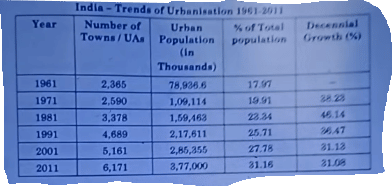
Study the given table carefully and answer the questions that follow.
22.1 During which decade was the net increase in number of towns/ULBs the lowest?
View Solution
Step 1: Observe number of towns in each census year.
1961: 2,365
1971: 2,590
1981: 3,378
1991: 4,689
2001: 5,161
2011: 6,171
Step 2: Calculate net increase by decade.
1961–71: +225
1971–81: +788
1981–91: +1,311
1991–2001: +472
2001–11: +1,010
Step 3: Identify the lowest increase.
The smallest increase is 225 during 1961–1971.
Answer:
1961–1971 Quick Tip: Lowest increase = Smallest difference between two census years.
Mention the net increase in number of towns/ULBs during 1961–91.
View Solution
Step 1: Take values from the table.
1961: 2,365 towns
1991: 4,689 towns
Step 2: Find the increase.
\[ 4,689 - 2,365 = 2,324 \]
Answer:
The net increase in number of towns/ULBs during 1961–1991 is 2,324. Quick Tip: Net increase = Final value − Initial value
Explain the decennial growth rate of urban population.
View Solution
Concept:
Decennial growth rate refers to the percentage increase in population over a period of ten years.
It is commonly used in census studies to measure urbanisation trends.
Explanation:
It measures the growth of urban population between two consecutive census years.
It is calculated as: \[ Decennial Growth Rate = \frac{Population increase in 10 years}{Population at beginning of decade} \times 100 \]
A higher decennial growth rate indicates rapid urbanisation.
It reflects migration, natural population growth, and expansion of urban areas.
Conclusion:
Thus, the decennial growth rate is an important indicator used to understand the pace and pattern of urban growth. Quick Tip: Decennial = 10 years growth percentage.
Explain the need to extend the network of national highways in India.
View Solution
Concept:
National highways are the primary road network connecting major cities, ports, industrial centres, and state capitals.
With rapid economic growth and increasing mobility, expanding this network has become essential.
Need to Extend National Highways in India:
Rising Traffic Demand:
Rapid urbanisation, population growth, and increased vehicle ownership have led to heavy traffic congestion.
Expanding highways helps accommodate higher traffic volumes.
Economic Development:
Efficient road connectivity supports trade, commerce, and industrial growth by enabling faster movement of goods.
Regional Development:
Expanding highways promotes balanced regional development by connecting remote and backward areas with growth centres.
Improved Connectivity:
National highways link major cities, ports, and borders, strengthening domestic and international connectivity.
Boost to Logistics and Transport:
A wider highway network reduces travel time and transport costs, improving supply chain efficiency.
Strategic and Defence Importance:
Highways near border areas are crucial for defence mobility and national security.
Support for Tourism:
Better road infrastructure enhances access to tourist destinations, boosting the tourism sector.
Conclusion:
Extending the national highway network is vital for economic growth, regional integration, strategic security, and improved quality of life. Quick Tip: Highways = Growth corridors of the nation.
How do the "landforms'' and "urbanisation'' influence the distribution of world population? Explain with examples.
View Solution
Concept:
Population distribution across the world is uneven and influenced by both physical and human factors.
Landforms represent a physical factor, while urbanisation is a major human factor shaping population concentration.
Influence of Landforms:
Plains Attract Dense Population:
Flat and fertile plains support agriculture, transport, and settlement.
Example: Indo-Gangetic Plain and North China Plain.
Mountains Discourage Settlement:
Rugged terrain, harsh climate, and limited accessibility result in sparse population.
Example: Himalayas and Andes.
Plateaus and Deserts:
Harsh climatic conditions and poor soil fertility lead to low population density.
Example: Sahara Desert and Australian Plateau.
Influence of Urbanisation:
Employment Opportunities:
Cities attract people due to industries, services, and job prospects.
Example: Tokyo, New York, Mumbai.
Better Infrastructure:
Urban areas provide healthcare, education, transport, and housing facilities, leading to population concentration.
Migration and Urban Growth:
Rural-to-urban migration increases population density in metropolitan regions.
Conclusion:
Favourable landforms like plains and rapid urbanisation lead to dense population clusters, while mountains and deserts remain sparsely populated. Quick Tip: Plains + Cities = Dense population
Mountains + Deserts = Sparse population
How do "water availability'' and "industrialisation'' influence the distribution of world population? Explain with examples.
View Solution
Concept:
Availability of water is a key physical factor, while industrialisation is a major economic factor influencing population distribution globally.
Influence of Water Availability:
Essential for Life:
Water is required for drinking, agriculture, and industry, making it a primary factor for settlement.
River Valleys as Population Hubs:
Fertile river valleys support agriculture and dense settlements.
Example: Nile Valley, Ganga Plain, Yangtze Basin.
Water Scarcity Leads to Sparse Population:
Arid regions with limited water have low population density.
Example: Sahara Desert, Arabian Peninsula.
Influence of Industrialisation:
Job Creation:
Industries generate employment, attracting large populations.
Example: Western Europe, USA, Japan.
Urban Growth:
Industrial centres develop into major urban areas, increasing population density.
Economic Development:
Industrial regions offer better income and living standards, drawing migrants.
Conclusion:
Regions with abundant water and strong industrial bases tend to have dense populations, while dry and non-industrial areas remain sparsely populated. Quick Tip: Water + Industry = Population concentration.
"The earliest human beings depended on their immediate environment for their sustenance.'' Examine the statement with reference to hunting and gathering.
View Solution
Concept:
Early human societies lived as hunter-gatherers and had a close relationship with nature.
Their survival depended directly on the availability of natural resources in their surroundings.
Explanation with Reference to Hunting and Gathering:
Dependence on Natural Resources:
Early humans relied on forests, rivers, and grasslands for food, water, and shelter.
Hunting Animals:
They hunted wild animals for meat, skins, and bones using primitive tools made of stone and wood.
Gathering Edible Plants:
Fruits, roots, nuts, seeds, and berries were collected from the wild for daily consumption.
Nomadic Lifestyle:
Since food sources were seasonal and limited, people moved from place to place in search of resources.
Minimal Environmental Modification:
Early humans had limited technology and did not significantly alter the environment.
Knowledge of Nature:
They developed deep knowledge of animal behaviour, plant types, and seasonal changes.
Conclusion:
Thus, hunting and gathering societies depended entirely on their immediate environment for sustenance, reflecting a strong human–nature relationship. Quick Tip: Hunter-gatherers = Direct dependence on nature.
"Commercial livestock rearing is well organised and capital intensive.'' Examine the statement with comparison to nomadic herding.
View Solution
Concept:
Livestock rearing can be broadly classified into commercial livestock farming and nomadic herding.
The former is modern and market-oriented, while the latter is traditional and subsistence-based.
Commercial Livestock Rearing:
Well Organised Farming:
Practised on large farms with planned breeding, feeding, and veterinary care.
Capital Intensive:
Requires heavy investment in machinery, fodder, refrigeration, and transport.
Use of Technology:
Modern techniques like artificial insemination, scientific breeding, and mechanised dairying are common.
Market-Oriented Production:
Products like meat, milk, and wool are produced mainly for commercial sale.
Regions:
Common in developed countries like USA, Australia, and New Zealand.
Comparison with Nomadic Herding:
Traditional and Subsistence-Based:
Nomadic herding is practised by pastoral communities for survival rather than profit.
Low Capital Requirement:
Minimal investment and dependence on natural grazing lands.
Seasonal Migration:
Herds move in search of pasture and water.
Limited Technology:
Traditional knowledge and simple tools are used.
Conclusion:
Commercial livestock rearing is organised, capital-intensive, and market-driven, whereas nomadic herding is traditional, mobile, and subsistence-oriented. Quick Tip: Commercial = Modern + Capital intensive
Nomadic = Traditional + Mobile
Explain the problem of low productivity of Indian agriculture. Analyse the role of "National Mission for Sustainable Agriculture'' to solve this problem.
View Solution
Concept:
Indian agriculture supports a large population but suffers from low productivity compared to global standards.
This is due to structural, technological, and environmental challenges.
Problems of Low Productivity:
Small and Fragmented Landholdings:
Most farmers operate on small plots, making mechanisation difficult.
Dependence on Monsoon:
Large areas rely on rainfall, leading to uncertainty in production.
Traditional Farming Methods:
Limited use of modern technology, improved seeds, and scientific practices.
Soil Degradation:
Overuse of fertilisers and improper land management reduce soil fertility.
Lack of Irrigation Facilities:
Inadequate irrigation infrastructure affects crop yield.
Limited Access to Credit and Inputs:
Many farmers cannot afford quality seeds, fertilisers, or machinery.
Role of National Mission for Sustainable Agriculture (NMSA):
Promoting Climate-Resilient Farming:
Encourages drought-resistant crops and sustainable practices.
Improved Water Management:
Focuses on rainwater harvesting and efficient irrigation methods.
Soil Health Management:
Promotes balanced fertiliser use and organic farming.
Adoption of Modern Technology:
Supports use of improved seeds, mechanisation, and scientific techniques.
Capacity Building:
Provides training and awareness programmes for farmers.
Resource Conservation:
Encourages sustainable use of land and water resources.
Conclusion:
The National Mission for Sustainable Agriculture aims to enhance productivity while ensuring environmental sustainability and long-term agricultural growth. Quick Tip: NMSA = Productivity + Sustainability + Climate resilience.
Explain the problems of the "indebtedness'' of Indian farmers. Analyse the importance of "Farmer’s Portal'' in helping the farmers.
View Solution
Concept:
Indebtedness refers to the growing burden of loans on farmers due to low income and high agricultural risks.
It is a major socio-economic issue in rural India.
Problems of Farmers’ Indebtedness:
Low Agricultural Income:
Fluctuating crop prices and low yields reduce farmers’ earnings.
High Input Costs:
Rising cost of seeds, fertilisers, and machinery increases dependence on loans.
Dependence on Moneylenders:
Many farmers borrow from informal sources at high interest rates.
Crop Failure Risks:
Droughts, floods, and pests often lead to inability to repay loans.
Lack of Institutional Credit Access:
Small and marginal farmers face difficulties in accessing formal banking services.
Importance of Farmer’s Portal:
Access to Information:
Provides farmers with real-time data on weather, market prices, and crop advisories.
Awareness of Government Schemes:
Helps farmers learn about subsidies, insurance, and welfare programmes.
Better Market Connectivity:
Enables farmers to make informed decisions about selling their produce.
Scientific Farming Guidance:
Offers expert advice on modern agricultural practices.
Reducing Dependence on Middlemen:
Digital access empowers farmers with direct knowledge and opportunities.
Conclusion:
The Farmer’s Portal helps reduce indebtedness by empowering farmers with knowledge, improving decision-making, and enhancing access to institutional support. Quick Tip: Farmer’s Portal = Information empowerment for farmers.
The Government of India’s campaign "Beti Bachao – Beti Padhao'' is an effective step to empower women. Justify the statement.
View Solution
Concept:
The "Beti Bachao – Beti Padhao'' (Save the Daughter, Educate the Daughter) campaign was launched to address gender discrimination and promote the welfare of the girl child.
It aims to improve the status of women through awareness, education, and social reform.
Justification of the Statement:
Improving Child Sex Ratio:
The campaign raises awareness against female foeticide and promotes the value of girl children, helping improve the declining child sex ratio.
Promoting Girl Child Education:
It encourages enrolment and retention of girls in schools, ensuring better literacy and empowerment.
Changing Social Attitudes:
The campaign challenges patriarchal mindsets and promotes gender equality in society.
Awareness Campaigns:
Through media and community programmes, it spreads awareness about women’s rights and importance.
Government Support and Schemes:
It is linked with various schemes like scholarships, financial incentives, and safety initiatives for girls.
Long-term Empowerment:
Educated and valued girls grow into confident women capable of contributing socially and economically.
Conclusion:
By addressing gender bias, promoting education, and improving social awareness, the "Beti Bachao – Beti Padhao'' campaign plays a crucial role in empowering women in India. Quick Tip: Save + Educate + Empower = Beti Bachao Beti Padhao
Explain the causes of air pollution and suggest any three measures to overcome it.
View Solution
Concept:
Air pollution refers to the presence of harmful substances in the atmosphere that adversely affect living beings and the environment.
It is mainly caused by human activities and rapid industrialisation.
Causes of Air Pollution:
Industrial Emissions:
Factories release harmful gases like sulphur dioxide and carbon monoxide into the air.
Vehicular Pollution:
Increasing number of vehicles emit exhaust fumes and particulate matter.
Burning of Fossil Fuels:
Coal and petroleum combustion in power plants and households contributes significantly.
Agricultural Practices:
Stubble burning and excessive use of fertilisers release pollutants.
Construction Activities:
Dust from construction sites increases particulate pollution.
Measures to Control Air Pollution (Any Three):
Promoting Clean Energy:
Use of renewable sources like solar and wind energy instead of fossil fuels.
Improving Public Transport:
Encouraging buses, metros, and carpooling to reduce vehicular emissions.
Afforestation:
Planting more trees helps absorb pollutants and improve air quality.
Strict Industrial Regulations:
Enforcing emission norms and installing pollution control devices.
Conclusion:
Reducing air pollution requires combined efforts from governments, industries, and individuals to ensure a healthier environment. Quick Tip: Less smoke + More green = Cleaner air.
Explain the causes of noise pollution and suggest any three measures to overcome it.
View Solution
Concept:
Noise pollution refers to excessive or unpleasant sound that disturbs human life and ecological balance.
It is common in urban and industrial areas.
Causes of Noise Pollution:
Traffic Noise:
Vehicles, horns, and engines are major contributors in cities.
Industrial Activities:
Machines and heavy equipment generate continuous loud noise.
Construction Work:
Drilling, hammering, and heavy machinery create high noise levels.
Loudspeakers and Social Events:
Festivals, weddings, and public gatherings increase noise pollution.
Air Traffic:
Aircraft take-off and landing produce intense sound.
Measures to Control Noise Pollution (Any Three):
Use of Silent Zones:
Restrict noise near schools, hospitals, and residential areas.
Regulation of Loudspeakers:
Implement strict time and sound limits for public events.
Soundproofing and Barriers:
Use of soundproof materials in buildings and noise barriers along highways.
Maintenance of Vehicles and Machinery:
Regular servicing reduces noise levels.
Conclusion:
Effective planning, strict regulations, and public awareness are essential to control noise pollution and ensure a peaceful environment. Quick Tip: Control sound at source = Reduce noise pollution.
On the given political map of the world, the following geographical features have been marked as A, B, C, D, E, F and G. Identify these features with the help of the following information and write their correct names.
A. A major sea-port
B. A major air-port
C. A major shipping canal
D. A major area of subsistence gathering
E. A major area of nomadic herding
F. A major area of commercial livestock rearing
G. A major area of extensive commercial grain farming
View Solution
Concept:
Such map-based questions require identification of major global regions known for transport hubs and agricultural practices.
Answers:
A. Major Sea-port:
Rotterdam (Netherlands) — One of the busiest ports in Europe.
B. Major Air-port:
Atlanta (USA) — One of the world’s busiest international airports.
C. Major Shipping Canal:
Suez Canal (Egypt) — Connects the Mediterranean Sea with the Red Sea.
D. Subsistence Gathering Region:
Amazon Basin (South America) — Dense forests with primitive subsistence activities.
E. Nomadic Herding Region:
Central Asia (Mongolia region) — Traditional nomadic pastoralism.
F. Commercial Livestock Rearing:
Australia — Large-scale ranching and sheep rearing.
G. Extensive Commercial Grain Farming:
Prairies (USA/Canada) — Wheat belt with mechanised grain farming. Quick Tip: Map Work Rule:
Prairies = Wheat
Australia = Ranching
Suez = Major canal
On the given political outline map of India, locate and label any five of the following geographical features with appropriate symbols:
The state leading in the production of sugarcane
An oil refinery located in Bihar
Important coal mines located in West Bengal
Important iron-ore mines located in Coastal Maharashtra
Important manganese mines located in Madhya Pradesh
A major sea-port located in Odisha
An important international airport in Telangana
View Solution
Concept:
This is a map-based identification question. Students are required to mark any five features correctly on the political map of India.
Correct Locations (Any Five):
Leading sugarcane producing state:
Uttar Pradesh
Oil refinery in Bihar:
Barauni Refinery
Coal mines in West Bengal:
Raniganj Coalfield
Iron-ore mines in Coastal Maharashtra:
Ratnagiri district
Manganese mines in Madhya Pradesh:
Balaghat
Major sea-port in Odisha:
Paradip Port
International airport in Telangana:
Rajiv Gandhi International Airport, Hyderabad
Note:
Students need to correctly locate and label any five features with appropriate symbols to score full marks. Quick Tip: UP = Sugarcane
Paradip = Odisha port
Hyderabad = Telangana airport




Comments