




CBSE Class 12 Geography Question Paper 2024 PDF (Set 1 - 64/4/1) is available for download here. CBSE conducts the Geography exam on February 29, 2024 from 10:30 AM to 1:30 PM. The total marks for the theory paper are 70. The question paper contains 20% MCQ-based questions, 40% competency-based questions, and 40% short and long answer type questions.
CBSE Class 12 Geography Question Paper 2024 (Set 1 - 64/4/1) with Answer Key
| CBSE Class 12 2024 Geography Question Paper with Answer Key |  Download Download |
Check Solution |
CBSE Class 12 2024 Geography Questions with Solutions
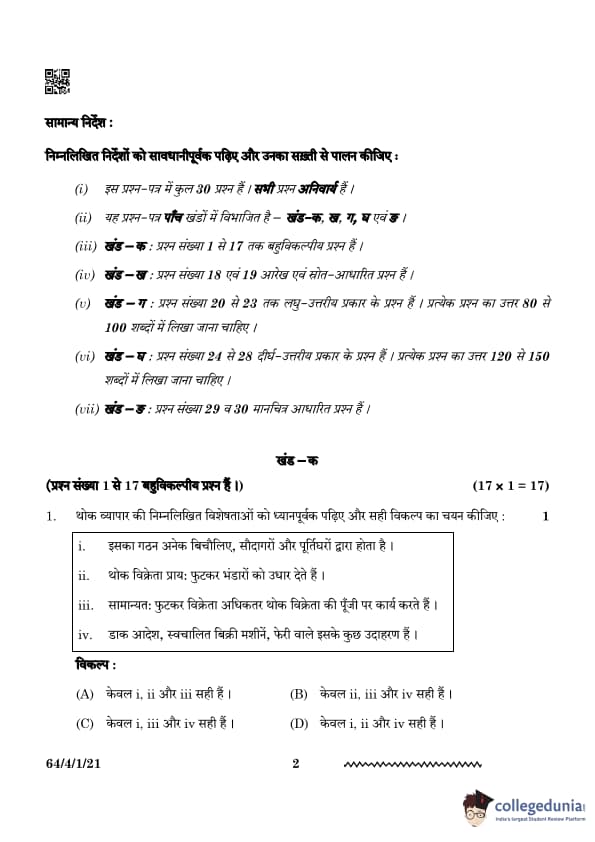
Read the following characteristics of wholesale trading carefully and choose the correct option:
It is constituted by numerous intermediaries, merchants, and supply houses.
Wholesalers often extend credit to retail stores.
Generally, retailers operate very largely on the wholesaler’s capital.
Mail order, automatic vending machines, street vendors are some of its examples.
View Solution
Step 1: Understanding wholesale trade
Wholesale trade refers to the business of selling goods in large quantities to retailers, industries, and businesses rather than directly to consumers. This type of trade involves intermediaries who facilitate the bulk supply of goods and services.
Step 2: Evaluating the statements
Statement (i) is correct: Wholesale trading functions through a network of intermediaries, merchants, and supply houses, ensuring smooth distribution from manufacturers to retailers.
Statement (ii) is correct: Wholesalers often provide credit facilities to retailers, allowing them to purchase goods on credit and pay later, easing their financial burden.
Statement (iii) is correct: Wholesalers support retailers by extending financial backing, helping them sustain inventory without immediate capital investment.
Statement (iv) is incorrect: Mail orders, automatic vending machines, and street vendors fall under retail trade, as they involve direct selling to consumers.
Step 3: Conclusion
Since only statements (i), (ii), and (iii) are correct, the correct answer is option (1).
Quick Tip: Understanding the distinction between wholesale and retail trade is crucial. Wholesale trade focuses on bulk selling to retailers, while retail trade deals with direct sales to consumers.
Which one of the following is the headquarters of the ‘World Trade Organization’?
View Solution
Step 1: Understanding the WTO
The World Trade Organization (WTO) is an international entity responsible for regulating global trade. It facilitates trade negotiations, monitors agreements, and resolves disputes among member nations.
Step 2: Identifying the headquarters
The WTO's headquarters is located in Geneva, Switzerland, where it conducts its core operations, including trade facilitation and international dispute resolution.
Step 3: Conclusion
Since Geneva serves as the central hub of the WTO’s activities, the correct answer is option (C) Geneva. Quick Tip: The WTO plays a crucial role in ensuring smooth and fair trade among nations, with Geneva as its central hub for operations.
Two statements are given below. They are Assertion (A) and Reason (R). Read both the statements carefully and choose the correct option.
Assertion (A): Industries based on ores are located close to the sources of raw material.
Reason (R): Industries maximize profits by reducing transportation costs.
View Solution
Step 1: Understanding the assertion (A)
Industries that rely on raw materials such as ores, particularly steel and aluminum plants, are typically located near their sources. This is because transporting bulky raw materials over long distances increases costs.
Step 2: Evaluating the reason (R)
Minimizing transportation costs is a key strategy for maximizing industrial profitability. By situating plants close to raw material sources, industries reduce logistical expenses, leading to cost-effective production.
Step 3: Establishing the logical connection
Since (R) correctly explains (A) by providing a valid economic reason for the location of ore-based industries, the correct answer is option (C). Quick Tip: Assertion-Reason questions often require understanding the connection between cause and effect. Read both statements carefully for logical relationships.
Which one of the following is the \textbf{false reason} of high growth rate of urban population in India?
View Solution
Step 1: Understanding urbanization
Urbanization refers to the increasing population in cities due to economic opportunities, improved infrastructure, and better living standards. It is driven by factors such as industrialization, migration, and advancements in healthcare and education.
Step 2: Distinguishing causes and effects
While urban growth leads to an increase in city populations, rapid expansion of urban areas is an effect of urbanization rather than its cause. People move to cities for jobs, better healthcare, and higher living standards, which then results in urban sprawl and infrastructural development.
Step 3: Conclusion
Since the rapid expansion of urban areas is a consequence rather than a cause of urban growth, the correct answer is option (C). Quick Tip: Understand the distinction between causes and effects of urbanization for clarity in such questions.
Which one of the following states has the highest percentage of urban population?
View Solution
Step 1: Understanding urban population distribution
Urbanization refers to the percentage of people residing in urban areas compared to the total population of a state. States with higher industrialization, tourism, and service sectors generally have a higher urban population.
Step 2: Identifying the state with the highest urban population percentage
Among Indian states, Goa has the highest proportion of its population living in urban areas. This is due to:
A thriving tourism industry, attracting businesses and settlements in cities.
A strong industrial and service sector, leading to urban job opportunities.
Infrastructure development, promoting urban lifestyle and growth.
Step 3: Conclusion
Since Goa has the highest percentage of urban population among Indian states, the correct answer is option (B). Quick Tip: Focus on specific demographic trends and economic activities to answer such questions.
The characteristics of an agricultural crop in India are given below. Read them carefully and identify the crop.
It is a crop of tropical humid area.
West Bengal farmers grow it three times in a year.
It is grown as a Kharif crop in north-western parts.
West Bengal, Uttar Pradesh and Punjab are major producing states.
View Solution
Step 1: Understanding rice cultivation
Rice is a staple food crop of tropical and humid regions. It requires high temperature (above 25°C), high humidity, and abundant rainfall (100-200 cm annually).
Step 2: Identifying the leading producer
Among Indian states, West Bengal is the largest producer of rice. This is because:
The state has alluvial soil, highly suitable for rice cultivation.
It receives ample rainfall from the monsoon.
Farmers practice multiple cropping due to favorable climatic conditions.
Step 3: Conclusion
Since rice is the primary crop grown extensively in tropical humid areas, the correct answer is option (D). Quick Tip: Remember the geographical and climatic preferences of crops for such questions.
Two statements are given below. They are Assertion (A) and Reason (R). Read both the statements carefully and choose the correct option.
Assertion (A): The economic development of a region depends upon its resource base.
Reason (R): Economic development requires technologies as well as investment.
View Solution
Step 1: Understanding the assertion (A)
Economic development is driven by natural resources and infrastructure. Countries with abundant resources have the potential for rapid industrialization and economic expansion if utilized efficiently.
Step 2: Evaluating the reason (R)
Technologies and investments play a crucial role in harnessing natural resources effectively. Without proper technological advancements and financial support:
- Resources remain underutilized.
- Infrastructure development is slowed down.
- Economic productivity and growth are hindered.
Step 3: Establishing the logical connection
Since (R) correctly explains (A) by highlighting the role of technology and investment in utilizing resources for economic development, the correct answer is option (C). Quick Tip: Connect assertions and reasons logically to find the correct explanation.
Match the Column-I with Column-II and choose the correct option:
| Column-I (National Waterway) | Column-II (River) |
|---|---|
| (a) National Waterway No. 1 | (i) Matai |
| (b) National Waterway No. 2 | (ii) Godavari |
| (c) National Waterway No. 4 | (iii) Ganga |
| (d) National Waterway No. 5 | (iv) Brahmaputra |
View Solution
The correct match between National Waterways and their corresponding rivers is:
National Waterway No. 1: Ganga (iii)
National Waterway No. 2: Brahmaputra (iv)
National Waterway No. 4: Godavari (ii)
National Waterway No. 5: Matai (i)
Thus, the correct option is (D) (iii), (iv), (ii), (i)
Quick Tip: When matching items, it helps to recall the geographical locations and names of major rivers associated with National Waterways in India. National Waterway No. 1 is on the Ganga, No. 2 on Brahmaputra, and so on.
Which of the following is an example of a ‘Modern City’?
View Solution
Step 1: Understanding modern urban development
A modern city is characterized by rapid industrial growth, advanced infrastructure, and a high standard of living. These cities serve as economic hubs with well-developed transport systems and business-friendly environments.
Step 2: Evaluating Surat’s industrial growth
Surat is one of India’s fastest-growing cities due to:
A booming textile industry, making it the hub of synthetic fabric production.
A dominant diamond processing sector, responsible for cutting and polishing over 90% of the world's diamonds.
Well-planned infrastructure and efficient transport systems, facilitating trade and commerce.
Step 3: Conclusion
Due to its industrial expansion, economic strength, and modern infrastructure, Surat is considered a modern city, making option (A) the correct answer. Quick Tip: Modern cities often feature well-developed transport systems, technological hubs, and mixed-use urban spaces.
Choose the correct option related to Garrison towns in India:
View Solution
Step 1: Understanding garrison towns
Garrison towns are urban settlements primarily established for military purposes.
They serve as bases for the armed forces, military training facilities, and cantonments to ensure national defense readiness.
Step 2: Identifying major garrison towns in India
Mhow (Madhya Pradesh): A well-known military cantonment and home to the Infantry School of the Indian Army.
Babina (Uttar Pradesh): Hosts a major armored division of the Indian Army.
Udhampur (Jammu \& Kashmir): Headquarters of Northern Command, responsible for defense operations in the region.
Step 3: Conclusion
Since Mhow, Babina, and Udhampur are strategically important military towns, the correct answer is option (B). Quick Tip: Garrison towns are strategically located to ensure military readiness and national security.
Read the following characteristics of settlements carefully and identify its type:
It is seen in the form of isolated huts in the forest.
It is visible on the slopes of small hills.
This kind of settlements are found in different parts of Meghalaya, Uttarakhand and Himachal Pradesh.
View Solution
Step 1: Understanding settlement patterns
Settlements can be classified into compact, semi-compact, and dispersed based on their spatial arrangement. Dispersed settlements consist of scattered homes and small clusters spread over a large area, often separated by fields, forests, or rugged terrain.
Step 2: Characteristics of dispersed settlements
Commonly found in hilly, forested, or remote rural areas.
Inhabitants rely on agriculture, forestry, or pastoralism.
Low population density due to difficult terrain and lack of infrastructure.
Step 3: Examples of dispersed settlements
Himalayan villages in India.
Tribal settlements in central India.
Forest settlements in Northeastern states.
Step 4: Conclusion
Since dispersed settlements are characterized by scattered dwellings, the correct answer is option (D). Quick Tip: Dispersed settlements are common in rural areas with challenging terrain and lack of infrastructure.
Choose the correct option to fill the blanks:
Indian Railway was introduced in 1853 and a railway line was constructed from ____ to ____ covering a distance of 34 km.
View Solution
Step 1: Introduction to Indian Railways
The first railway line in India was inaugurated on April 16, 1853, marking a significant milestone in the country's transportation history. The British introduced the railway system to enhance trade and administration across India.
Step 2: Route and Details of the First Train
The inaugural journey took place between Mumbai (Bombay) and Thane, covering a distance of 34 km. The train was pulled by three steam locomotives: Sahib, Sultan, and Sindh, carrying 400 passengers in 14 carriages. The journey commenced from the Boree Bunder station in Mumbai.
Step 3: Importance of the First Railway Line
The launch of this railway line played a crucial role in India's economic development. It facilitated:
Faster transportation of goods and passengers.
Industrial growth by improving connectivity.
Strengthening British control over administrative regions.
Quick Tip: Indian Railways, one of the largest railway networks globally, spans over \textbf{68,000 km, connecting remote areas to major cities. It is the \textbf{fourth-largest railway system in the world} and a major employer with over \textbf{1.2 million employees}.
Which one of the following human body system gets affected the most by water pollution?
View Solution
Step 1: Understanding the Impact of Contaminated Water
Contaminated water contains harmful microorganisms, chemicals, and pollutants that can severely affect human health, primarily targeting the digestive system.
Step 2: Diseases Caused by Contaminated Water
Drinking polluted water can lead to several digestive disorders, including:
Cholera: Caused by the bacterium
\textit{Vibrio cholerae, leading to severe dehydration and diarrhea.
Dysentery: An infection of the intestines resulting in bloody diarrhea and abdominal pain.
Diarrhea: A common symptom of waterborne diseases that can cause dehydration if untreated.
Step 3: Importance of Clean Drinking Water
Ensuring access to safe drinking water is crucial for preventing these diseases. Effective measures include:
Boiling or filtering water before consumption.
Improving sanitation and hygiene practices.
Avoiding sources of stagnant or polluted water.
Quick Tip: Ensure access to clean drinking water to prevent waterborne diseases affecting the digestive system.
Which of the following tribes is in majority in Jhabua district of Madhya Pradesh?
View Solution
Step 1: Introduction to the Bhil Tribe
The Bhil tribe is one of the largest tribal communities in India. They are predominantly found in the states of Madhya Pradesh, Rajasthan, Gujarat, and Maharashtra.
Step 2: Bhil Tribe in Jhabua District
Jhabua district, located in Madhya Pradesh, has a majority population of the Bhil tribe. The community has historically been associated with agriculture, hunting, and traditional art forms such as \textit{Pithora painting.
Step 3: Cultural and Social Significance
The Bhils have a rich cultural heritage with unique traditions, folk music, and dance forms. They celebrate festivals such as \textit{Bhagoria, which signifies the arrival of the harvest season. Quick Tip: Tribal communities in India play a vital role in preserving cultural diversity and traditional knowledge.
Read the given passage and answer the Q. Nos. 15 to 17:
Demographic Transition Theory
The first stage has high fertility and high mortality because people reproduce more to
compensate for the deaths due to epidemics and variable food supply. The population growth
is slow and most of the people are engaged in agriculture where large families are an asset.
Life expectancy is low, people are mostly illiterate and have low levels of technology. Two
hundred years ago all the countries of the world were in this stage.
Fertility remains high in the beginning of the second stage but it declines with time. This is
accompanied by reduced mortality rate. Improvements in sanitation and health conditions
lead to a decline in mortality. Because of this gap the net addition to the population is high.
In the last stage, both fertility and mortality decline considerably. The population is either
stable or grows slowly. The population becomes urbanised, literate and has high technical
know-how and deliberately controls the family size.
This shows that human beings are extremely flexible and are able to adjust their fertility.
Question 15:
In which of the following stage/stages, the natural growth of population was/were almost stagnant?
View Solution
Step 1: Understanding Population Growth Stages
The demographic transition model consists of multiple stages that describe changes in population growth over time. The first stage is characterized by high birth and death rates, leading to stagnant population growth. The last stage reflects low birth and death rates, resulting in population stability.
Step 2: High Mortality in the First Stage
In the first stage, high mortality offsets high fertility, preventing significant population growth. Factors contributing to high mortality include poor medical facilities, lack of sanitation, and widespread diseases.
Step 3: Population Stability in the Last Stage
In the last stage, both birth and death rates are low, leading to a stable population. This is due to advancements in healthcare, improved living conditions, and changes in societal behavior regarding family planning. Quick Tip: In the first stage, high mortality offsets high fertility, leading to slow population growth. In the last stage, fertility and mortality rates balance out.
In which of the following stage/stages, the death rate declined the most?
View Solution
Step 1: Understanding the Second Stage of Demographic Transition
The second stage of the demographic transition model is characterized by a rapid decline in death rates while birth rates remain high. This leads to a sharp increase in population growth.
Step 2: Reasons for Declining Death Rates
During this stage, advancements in medical science, improved public health measures, and better sanitation significantly reduce mortality. Widespread immunization, access to clean drinking water, and improvements in hygiene contribute to longer life expectancy.
Step 3: Impact on Population Growth
Due to declining mortality and sustained high birth rates, population growth accelerates during this stage. This phase is often associated with industrialization and urbanization, where better living standards and food security further improve survival rates. Quick Tip: The second stage is marked by significant improvements in health and sanitation, which drastically reduce mortality rates.
Which one among the following countries is an example of second stage?
View Solution
Step 1: Understanding the Second Stage of Demographic Transition
The second stage of the demographic transition model is characterized by high birth rates and a significant decline in death rates. This occurs due to improvements in healthcare, sanitation, and nutrition, leading to increased life expectancy.
Step 2: Kenya's Demographic Characteristics
Kenya is currently in the second stage of demographic transition. The country has a high fertility rate, resulting in rapid population growth. However, advancements in medical care and public health measures have led to a decline in mortality, particularly among infants and children.
Step 3: Impact of Rapid Population Growth
With a rapidly growing population, Kenya faces challenges such as increased demand for resources, pressure on education and healthcare systems, and the need for economic development to support its young population. Governments often implement family planning programs and economic policies to manage this phase effectively. Quick Tip: Countries in the second stage have a high birth rate and declining death rate due to advancements in healthcare and sanitation.
18. Read the given passage carefully and answer the questions that follow:
Tertiary Sector
When you fall ill you go to your family doctor or you call a doctor. Sometimes your parents
take you to a hospital for treatment. While in school, you are taught by your teachers. In the
event of any dispute, legal opinion is obtained from a lawyer. Likewise, there are many
professionals who provide their services against payment of their fee. Thus, all types of
services are special skills provided in exchange of payments. Health, education, law,
governance and recreation etc. require professional skills. These services require other
theoretical knowledge and practical training. Tertiary activities are related to the service
sector. Manpower is an important component of the service sector as most of the tertiary
activities are performed by skilled labour, professionally trained experts and consultants.
In the initial stages of economic development, a larger proportion of people worked in the
primary sector. In a developed economy, the majority of workers get employment in tertiary
activity and a moderate proportion is employed in the secondary sector.
Question 18.1:
Why is ‘manpower’ an important factor of service sector? Explain.
View Solution
Step 1: Importance of Manpower in the Service Sector
Manpower is the foundation of the service sector as it relies on human expertise rather than machines. Unlike manufacturing, where automation can replace labor, services require skilled professionals to perform tasks efficiently.
Step 2: Key Professions in the Service Industry
Doctors provide healthcare, teachers impart education, lawyers offer legal services, and other professionals such as engineers and consultants contribute significantly to economic development. These professions require specialized skills and cannot be replaced by machines.
Step 3: Role of Skilled Workforce in Economic Growth
A highly skilled workforce enhances productivity and quality in service industries. Countries with well-trained professionals in healthcare, education, finance, and IT experience higher economic growth and improved living standards. Quick Tip: Service sectors like healthcare and education thrive on skilled manpower, making it a crucial component.
Explain the difference between the activities of secondary and tertiary sectors.
View Solution
Step 1: Understanding the Secondary Sector
The secondary sector involves manufacturing and industrial processes where raw materials are converted into finished products. This sector is essential for economic development as it adds value to natural resources. Examples include textile production, automobile manufacturing, and construction.
Step 2: Understanding the Tertiary Sector
The tertiary sector focuses on providing services rather than producing tangible goods. It includes industries such as healthcare, education, banking, retail, and entertainment. These services support the economy by facilitating business operations and improving quality of life.
Step 3: Key Difference Between the Two Sectors
The primary difference is that the secondary sector is engaged in the \textit{production of goods, whereas the tertiary sector is involved in \textit{service delivery. The two sectors are interdependent, as manufactured goods require distribution and support services, while service industries depend on industrial products. Quick Tip: [colback=white, colframe=black, title=Quick Tips] Think of the secondary sector as “making things” and the tertiary sector as “helping people.”
“Tertiary activities include both production and exchange.” Support the statement.
View Solution
Step 1: Understanding Tertiary Activities
The tertiary sector involves economic activities that do not produce tangible goods but instead provide services. These services can be categorized into two main types: direct service production and facilitation of goods exchange.
Step 2: Service Production in the Tertiary Sector
Services such as education, healthcare, finance, and entertainment fall under direct service production. These industries contribute to economic growth by improving human capital and enhancing the quality of life.
Step 3: Exchange of Goods and Services
Retailing, transportation, and communication facilitate the movement of goods and services from producers to consumers. These activities ensure that manufactured products reach markets efficiently, thereby supporting industrial and commercial growth. Quick Tip: Remember: Production in the tertiary sector focuses on services, while exchange connects producers to consumers.
Study the given diagram carefully and answer the questions that follow:
India - Occupational Structure, 2011

Write the names of two states with the highest percentage of cultivators.
View Solution
Step 1: Identifying States with a High Proportion of Cultivators
Himachal Pradesh and Nagaland have a significant portion of their workforce engaged in cultivation. This is evident from the occupational structure diagram, which shows a predominance of agricultural employment in these states.
Step 2: Agrarian Economy and Workforce Distribution
In states where agriculture is the primary economic activity, a large section of the population depends on farming for livelihood. Factors such as fertile land, favorable climate, and traditional agricultural practices contribute to the high proportion of cultivators in these regions.
Step 3: Impact of Agriculture on Employment Patterns
A strong dependence on agriculture influences employment trends, limiting opportunities in secondary and tertiary sectors. However, sustainable agricultural practices and diversification into allied activities such as horticulture and animal husbandry can improve economic stability in these regions. Quick Tip: In regions with agrarian economies, a majority of the workforce is employed as cultivators.
Write the names of two Union Territories having the highest percentage of other workers.
View Solution
Union Territories with the Highest Percentage of Other Workers:
Chandigarh: Chandigarh, the capital of both Haryana and Punjab, has a high percentage of "other workers." This is primarily due to the fact that Chandigarh has a well-developed economy that includes a significant proportion of government employees and individuals working in non-agricultural informal sectors. The presence of various administrative and service-related occupations contributes to the high percentage of workers in this category.
Lakshadweep: Lakshadweep, an archipelago of islands off the southwestern coast of India, also has a high percentage of "other workers." Many of the local population are involved in non-agricultural work, including services related to the tourism industry, fishing, and other informal sectors. The limited scope for industrial or agricultural work on the islands makes the category of "other workers" more prominent in Lakshadweep compared to other regions.
Conclusion:
The two Union Territories in India with the highest percentage of "other workers" are Chandigarh and Lakshadweep. The economic structure of these regions, with a focus on services, government employment, and informal labor, contributes to this high percentage. Quick Tip: Urban centers like Delhi and Chandigarh exhibit higher percentages of non-agricultural workers.
What is the approximate percentage of cultivators in Tripura?
View Solution
According to the data from the Census of India and various reports from the Ministry of Agriculture, around 20% of the total workforce in Tripura is engaged in agricultural activities, specifically as cultivators. This includes both self-employed cultivators and tenant cultivators.
The percentage of cultivators can vary slightly over time due to changes in agricultural practices, economic development, and urbanization. However, 20% is a reasonable estimate based on the latest available data.
Conclusion:
The approximate percentage of cultivators in Tripura is about 20%. This reflects the state's reliance on agriculture as a key sector, with a large part of its rural population engaged in cultivation activities. Despite challenges, agriculture continues to be a major source of livelihood for a significant portion of Tripura's population. Quick Tip: Northeastern states often have a high percentage of cultivators due to their agrarian economies.
How do differences in national resources become the basis of international trade? Explain with examples.
View Solution
Step 1: Understanding the Role of Resources in International Trade
International trade is driven by differences in the availability of resources such as minerals, agricultural products, and technological advancements. Countries engage in trade to fulfill resource demands that cannot be met domestically.
Step 2: Resource Availability and Trade Patterns
Nations with abundant natural resources often export goods to countries lacking them. For example, oil-rich nations like Saudi Arabia export petroleum to energy-dependent countries like India. Similarly, Brazil exports coffee to countries with high demand but low production capacity.
Step 3: Economic Interdependence Through Trade
The exchange of goods and services fosters global economic interdependence. Trade relationships strengthen international ties, promote economic growth, and provide nations with access to essential resources that contribute to industrial and commercial development. Quick Tip: Resource-rich countries often export goods to meet the demands of resource-deficient nations, fostering international trade.
Explain the differences between the inland and out-ports with examples.
View Solution
Step 1: Understanding Inland and Out-Ports
Ports serve as crucial trade hubs, classified into inland ports and out-ports based on their location and function. Inland ports are located away from the coastline, while out-ports are situated along the coast, facilitating maritime trade.
Step 2: Characteristics and Functions of Inland Ports
Inland ports, such as Kolkata in India, are located in the interior regions of a country. They are connected to major trade routes via rivers, railways, or roadways. These ports primarily handle domestic trade and limited international cargo through multimodal transport systems.
Step 3: Characteristics and Functions of Out-Ports
Out-ports, like Mumbai, are situated along coastlines and serve as major gateways for global commerce. These ports manage large-scale imports and exports, facilitating international trade by connecting nations via sea routes. They play a vital role in global supply chains and economic development. Quick Tip: Inland ports connect trade to the interior regions, whereas out-ports serve as gateways for international commerce.
Analyse any three objectives of ‘Jal Kranti Abhiyan’ in India.
View Solution
Step 1: Understanding Jal Kranti Abhiyan
Jal Kranti Abhiyan is a government initiative aimed at water conservation, equitable distribution, and sustainable water management. It plays a crucial role in addressing water scarcity and ensuring efficient use of water resources.
Step 2: Key Objectives of the Initiative
The program promotes water conservation by adopting efficient techniques such as rainwater harvesting. It ensures equitable water distribution between urban and rural areas to bridge the gap in resource availability. Additionally, the initiative encourages local participation and awareness to promote responsible water usage.
Step 3: Impact on Sustainable Water Management
Jal Kranti Abhiyan contributes to long-term water sustainability by enhancing groundwater recharge, improving irrigation efficiency, and preventing water wastage. By integrating modern and traditional conservation methods, the program strengthens water security and supports sustainable development. Quick Tip: Water conservation programs like Jal Kranti Abhiyan ensure the judicious use of water resources.
Analyse any three key features of ‘Indian National Water Policy’.
View Solution
Step 1: Overview of the Indian National Water Policy
The Indian National Water Policy focuses on integrated water management, equitable distribution, and environmental sustainability. It aims to address water scarcity challenges and promote efficient resource utilization.
Step 2: Key Features of the Policy
The policy emphasizes the integrated management of surface and groundwater resources to enhance efficiency. It prioritizes equitable water distribution among sectors such as drinking water supply, agriculture, and industries. Additionally, it promotes sustainable practices like watershed management to conserve and replenish water resources.
Step 3: Ensuring Sustainable Water Usage
By implementing these measures, the policy aims to meet the growing water demands of the population while ensuring long-term sustainability. It encourages water conservation, efficient irrigation techniques, and pollution control to maintain water quality and availability for future generations. Quick Tip: [colback=white, colframe=black, title=Quick Tips] Policies focusing on integrated and equitable water management are vital for sustainable development.
Explain the concept of ‘Humanisation of Nature’ by giving examples.
View Solution
Step 1: Understanding the Humanisation of Nature
Humanisation of nature refers to the process by which humans modify and adapt natural resources to fulfill their needs. This concept reflects the ability of societies to utilize and transform the environment for their survival and progress.
Step 2: Examples of Human Adaptation and Modification
Terraced farming in hilly regions like Himachal Pradesh is an adaptation to uneven terrain, allowing efficient agricultural practices. Similarly, the construction of dams, such as the Bhakra Nangal Dam, modifies river systems to support irrigation and power generation. These adaptations demonstrate the dynamic interaction between human activities and natural landscapes.
Step 3: The Interdependence of Humans and Nature
The humanisation of nature showcases the balance between utilizing natural resources and maintaining environmental sustainability. While modifications enhance human life, responsible resource management is crucial to prevent ecological imbalances. Quick Tip: Adapting to nature showcases human ingenuity and highlights the harmonious relationship between humans and the environment.
Suggest any three measures to solve the problem of ‘Urban Waste Disposal’ in India and explain them.
View Solution
Urban waste disposal is a significant challenge in many cities across India, with the ever-increasing population and rapid urbanization leading to higher volumes of waste generation. The management of solid waste is becoming increasingly complex and hazardous due to insufficient infrastructure, lack of awareness, and limited recycling practices. In this context, there are several measures that can be implemented to address the growing problem of urban waste disposal.
Here are three effective measures to address this issue:
\section*{1. Wastes Should Be Treated as Resources
One of the most sustainable approaches to waste management is to treat waste as a resource rather than just a burden. In many developed countries, waste is viewed as a valuable resource that can be utilized for multiple purposes. In India, if urban waste is segregated and treated properly, it can be a source of materials like plastic, paper, metals, and even organic waste that can be reused or recycled.
How this measure helps:
It encourages recycling and reduces the need for new raw materials, thereby conserving natural resources.
It helps to minimize landfills, as recyclable materials are not sent to waste dumps.
It reduces pollution and environmental harm, making urban environments cleaner and more sustainable.
The government, along with local authorities, should focus on public awareness campaigns to educate people about the importance of waste segregation and recycling. Strict regulations should be enforced to ensure that urban waste is processed efficiently, and materials that can be recycled are reused.
\section*{2. Utilisation of Waste for Generating Energy
Urban waste, particularly organic waste, can be converted into biogas or other forms of energy. This is an effective method of generating renewable energy while simultaneously managing the waste. Technologies like waste-to-energy (WTE) plants, which use thermal or biochemical processes to convert waste into energy, are gaining popularity worldwide.
How this measure helps:
It reduces the dependence on fossil fuels by generating energy from waste.
It helps in waste reduction, as organic waste can be diverted from landfills and used to produce energy.
It lowers greenhouse gas emissions by reducing methane production from landfills.
This approach not only helps to solve the waste disposal problem but also contributes to addressing energy shortages. Municipalities should invest in waste-to-energy plants and encourage private-public partnerships to create sustainable energy solutions.
\section*{3. Utilisation of Waste for Generating Compost and Organic Manure
Another solution to the urban waste problem is to utilize organic waste for producing compost or organic manure. This organic waste includes food scraps, yard waste, and biodegradable materials that can be transformed into high-quality compost, which can be used in agriculture to enhance soil health and fertility.
How this measure helps:
It reduces the volume of waste that ends up in landfills or incinerators.
It provides a natural, eco-friendly fertilizer alternative to chemical fertilizers.
It supports sustainable agricultural practices and improves soil quality, promoting a circular economy.
Local municipalities should establish composting facilities and provide citizens with the knowledge and tools to compost organic waste at home. This initiative can be combined with community-based waste management programs, allowing urban areas to turn waste into a valuable resource for agricultural use. Quick Tip: Segregating and recycling waste are simple yet effective steps to address urban waste management challenges.
Which organisation publishes the ‘Human Development Report’ every year? Explain the four pillars of ‘human development’.
View Solution
Step 1: Understanding the Human Development Report
The United Nations Development Programme (UNDP) publishes the Human Development Report annually. This report evaluates the Human Development Index (HDI) of nations, measuring progress based on factors such as education, life expectancy, and income levels.
Step 2: The Four Pillars of Human Development
Human development is based on four key pillars. Equity ensures fair opportunities and resources for all individuals, reducing disparities in society. Sustainability focuses on development that meets present needs without compromising future generations. Productivity encourages innovation and efficiency, leading to improved living standards. Empowerment provides individuals with the freedom and capability to make life choices, fostering self-reliance and growth.
Step 3: Importance of These Pillars
These pillars highlight the holistic nature of human development by balancing economic growth with social well-being. By focusing on equity, sustainability, productivity, and empowerment, the Human Development Report emphasizes inclusive progress that benefits all sections of society. Quick Tip: [colback=white, colframe=black, title=Quick Tips] Remember the four pillars of human development with the acronym \textbf{E.S.P.E - Equity, Sustainability, Productivity, Empowerment.
Which country has the highest rank in the world in ‘Human Development Index’ in 2020? Explain four approaches of human development.
View Solution
Step 1: Norway’s HDI Rank in 2020
Norway ranked highest in the Human Development Index (HDI) in 2020 due to its advanced living standards, strong education system, and high-quality healthcare services. The country consistently secures top positions in global human development rankings due to its inclusive policies and robust economic framework.
Step 2: The Four Approaches to Human Development
The welfare approach focuses on improving individuals' well-being through social services and government assistance. The income approach considers income levels as the primary measure of human development, assuming that economic prosperity leads to better living standards. The basic needs approach prioritizes essential requirements such as food, healthcare, and education to ensure a decent quality of life. The capability approach emphasizes enhancing individuals' abilities and opportunities to lead meaningful and fulfilling lives.
Step 3: Significance of These Approaches
Each approach provides a different perspective on human development, contributing to comprehensive policymaking. A balanced integration of these approaches ensures sustainable development and social progress, addressing economic, social, and personal dimensions of human well-being. Quick Tip: Think of human development as addressing needs (Basic Needs), resources (Income), services (Welfare), and opportunities (Capability).
Describe any five features of commercial livestock rearing in the world.
View Solution
Step 1: Understanding Commercial Livestock Rearing
Commercial livestock rearing is a large-scale farming practice focused on raising animals for meat, dairy, and wool production. It is predominantly carried out in developed countries where mechanized techniques and scientific breeding methods enhance productivity.
Step 2: Characteristics of Commercial Livestock Rearing
This farming method requires extensive land use, with large ranches or farms dedicated to animal husbandry. Mechanized practices, including automated feeding systems and veterinary care, improve efficiency. The industry is market-oriented, producing goods for both local and global consumption. Specialized breeding techniques are used to develop high-yield animal breeds that optimize meat and dairy output.
Step 3: Environmental and Economic Implications
Although commercial livestock rearing significantly contributes to global food production, it has notable environmental consequences. Large-scale deforestation for grazing land disrupts ecosystems and contributes to climate change. Implementing sustainable grazing techniques and controlled breeding programs can help mitigate these negative effects while maintaining productivity. Quick Tip: Commercial livestock rearing is efficient but must balance productivity with environmental conservation.
Explain with examples the importance of ‘Satellite Communication’ in the world.
View Solution
Step 1: Importance of Satellite Communication
Satellite communication is essential for global connectivity, navigation, broadcasting, and scientific advancements. It has transformed communication systems, enabling seamless data transfer across vast distances.
Step 2: Key Applications of Satellite Communication
Telecommunication relies on satellites to enable long-distance phone calls and high-speed internet access. Navigation systems, such as GPS, use satellites to provide accurate positioning and route guidance. Broadcasting services, including television and radio, depend on satellites for global content transmission. Additionally, satellite technology plays a crucial role in disaster management by providing real-time data for emergency response and rescue operations. It also supports scientific research by aiding space exploration and improving weather forecasting models.
Step 3: Real-World Examples and Impact
Satellites like INSAT in India and GPS globally enhance communication, navigation, and data transfer capabilities. The integration of satellite-based systems into daily life has significantly improved transportation, weather prediction, and emergency response mechanisms, making them indispensable for modern societies. Quick Tip: Satellite communication bridges distances and supports critical global functions like GPS and disaster management.
Explain any five measures for the conservation of mineral resources in India.
View Solution
Step 1: Importance of Mineral Conservation
Mineral resources are finite and non-renewable, making their conservation essential for sustainable development. Proper utilization and management of minerals help in maintaining ecological balance and ensuring resource availability for future generations.
Step 2: Key Measures for Mineral Conservation
Promoting recycling helps reduce dependency on fresh mineral extraction by reusing metals and minerals. Efficient utilization of resources through advanced technologies minimizes wastage and enhances extraction efficiency. Implementing strict legislation against illegal mining and promoting sustainable mining practices contribute to long-term conservation. Substitution of scarce minerals with alternative materials reduces over-extraction and dependency. Public awareness campaigns educate people about the importance of minerals and encourage their judicious use.
Step 3: Sustainable Future Through Mineral Conservation
By integrating these conservation strategies, India can ensure a balance between economic development and environmental sustainability. Encouraging responsible mining and promoting alternative materials will help reduce pressure on natural resources while supporting industrial growth. Quick Tip: Mineral conservation includes recycling, efficient usage, and awareness to ensure sustainability for future generations.
Explain the importance of solar energy in Indian context.
View Solution
Step 1: Importance of Solar Energy in India
Solar energy is a crucial renewable resource for India due to its vast availability of sunlight and increasing energy demands. It provides a sustainable alternative to fossil fuels, contributing to energy security and environmental conservation.
Step 2: Key Benefits of Solar Energy
As a renewable resource, solar energy is inexhaustible and ensures long-term energy security. Its environmental benefits include a significant reduction in carbon emissions, helping mitigate the impact of climate change. The cost-effectiveness of solar power makes it an attractive energy source, as solar panels provide low-cost electricity once installed. It also reduces dependence on fossil fuels, enhancing India's energy self-sufficiency. Furthermore, solar energy plays a vital role in rural electrification by providing power to remote areas that lack access to conventional electricity grids.
Step 3: Future Prospects of Solar Energy in India
The Indian government has launched initiatives such as the National Solar Mission to expand solar infrastructure and promote large-scale adoption. Investing in solar energy will help India transition towards sustainable energy sources while supporting economic development and reducing environmental impact. Quick Tip: India's solar mission focuses on reducing carbon emissions and improving energy access, especially in rural areas.
“Pipelines are the most convenient and efficient mode of transportation in India.” Examine the statement with examples.
View Solution
The statement, "Pipelines are the most convenient and efficient mode of transportation in India," holds considerable weight, particularly when considering the transportation of liquids, gases, and even solids. The pipeline network in India plays a crucial role in the nation's energy and industrial sectors. Let's examine this statement in detail with examples:
\section*{1. Pipelines for Transportation of Liquids and Gases
Pipelines are the most efficient and convenient mode of transportation for liquids and gases, especially over long distances.
Examples:
Crude Oil and Petroleum Products: India has an extensive network of pipelines for transporting crude oil and refined petroleum products. These pipelines facilitate the smooth movement of crude oil from ports to refineries and finished products from refineries to distribution centers across the country.
Natural Gas: The transportation of natural gas through pipelines is more efficient than road or rail. Gas pipelines connect major cities with industries, allowing for the uninterrupted supply of energy.
Pipelines offer several advantages such as:
Lower transportation costs: Pipelines require less maintenance once built, and the cost of transportation through pipelines is lower than alternatives such as rail or road.
Continuous flow: They offer a continuous and reliable transportation mode, with minimal interruption.
\section*{2. Transportation of Solids in Pipeline Networks
Even solids can be transported through pipelines after converting them into a slurry, a mixture of solid particles and liquids.
Example:
Coal Slurry Pipeline: In some areas, coal is transported in the form of slurry through pipelines to power plants. This method of transportation is efficient and reduces the need for rail transport.
This is particularly useful when transporting bulky and heavy materials over long distances where other transportation methods (road or rail) may not be as effective.
\section*{3. Processing and Marketing of Natural Gas
Pipelines also play a critical role in the processing and marketing of natural gas. They help in the efficient transportation of gas from production sites to various consumption points, including homes, industries, and power plants.
How it helps:
Development of Gas Markets: Pipelines facilitate the development of a gas market in India by providing a reliable infrastructure for natural gas distribution.
Economic Use: Natural gas transported through pipelines supports economic activities in industries like manufacturing, power generation, and residential heating, among others.
The presence of a robust pipeline network is essential for the further development of the natural gas sector and for meeting the growing energy demands of the country.
\section*{4. Linkage of Fertilizer, Power, and Industrial Complexes
Pipelines are also used to link various fertilizer, power, and industrial complexes, particularly in western and northern India. These pipelines enable industries to obtain essential raw materials like gas and petroleum products for their operations.
Example:
Gas Pipelines to Power Plants: Natural gas pipelines supply fuel to power plants, which helps in generating electricity. This energy is essential for supporting industries and residential needs across the country.
Fertilizer Plants: Fertilizer plants in India use natural gas as a raw material for producing fertilizers, and pipeline networks ensure a steady supply to these plants.
This interconnection between pipelines and industrial sectors fosters economic growth, regional development, and industrialization.
\section*{5. Expansion of Gas Infrastructure in India
India’s gas infrastructure has expanded over ten times in recent years, contributing to the country’s economic development and helping in the diversification of its energy sources. The widespread expansion of gas pipelines has allowed the government to meet the energy demands of both urban and rural areas.
Example:
Expansion of the Natural Gas Grid: The ongoing expansion of the natural gas pipeline grid has helped supply clean energy to more than 300 cities, significantly contributing to cleaner energy solutions.
This growth in infrastructure is important for meeting India’s growing energy needs and improving the quality of life for its citizens. Quick Tip: Pipelines are crucial for transporting fuels efficiently, with minimal environmental impact.
“India has the second largest road networks in the world.” Examine the statement with examples.
View Solution
Explanation of the Statement: "India has the second-largest road network in the world."
India is known for having the second-largest road network globally, after the United States. This vast network of roads plays a crucial role in the economic and social development of the country, enabling the movement of goods and people across vast distances. Below are the explanations of the key points mentioned:
1. The Total Length of Roads is 62.16 Lakh km:
India’s road network spans an impressive 62.16 lakh kilometers (approximately 6.2 million kilometers). This makes India’s road network one of the largest in the world. Roads form a vital part of India’s transportation infrastructure, connecting cities, towns, and villages across the country. The road network is an essential tool for economic activities, trade, and daily commuting.
2. About 85% of Passengers Are Carried by Roads:
A large percentage of passenger travel in India is facilitated by road transport. About 85% of passengers use roads for their daily commuting needs, whether it's for short-distance travel within cities or long-distance travel between cities and states. Roads are the most accessible form of transport in India, with buses, cars, motorcycles, and auto-rickshaws providing mobility for millions of people.
3. About 70% of Freight Traffic is Carried by Roads Every Year:
Roads also carry a substantial proportion of India’s freight traffic. Around 70% of freight (goods and cargo) is transported by road annually. This includes the movement of agricultural produce, industrial goods, and raw materials across the country. Road transport plays a key role in the supply chain, connecting producers with markets, distribution centers, and ports.
4. Road Transport is Relatively Suitable for Shorter Distance Travel:
While road transport is crucial for both short and long-distance travel, it is particularly suited for short-distance travel. For distances under 500 kilometers, road transport is often more flexible, faster, and accessible compared to rail or air transport. It allows for direct routes, especially when traveling to areas that are not well-connected by other forms of transportation.
5. National Highways, State Highways, District Roads, and Rural Roads Are Different Types of Roads:
India’s road network is categorized into various types based on their usage and importance:
National Highways (NH): These are major roads that connect important cities, states, and regions across the country. National highways are critical for inter-state transportation and are typically well-maintained.
State Highways (SH): These roads connect various towns and cities within a state and are maintained by the respective state governments.
District Roads (DR): These roads connect smaller towns and villages within a district. They form the local transport backbone of the rural economy.
Rural Roads (RR): These roads connect villages to larger towns and cities. They play a crucial role in rural development by facilitating the movement of people and agricultural products to urban markets.
Conclusion:
The statement "India has the second-largest road network in the world" is supported by the vast extent of the country's road infrastructure. With a total length of 62.16 lakh kilometers, road transport is responsible for carrying the majority of passengers and freight within India. Roads, especially national and state highways, are well-suited for short-distance travel and are essential for economic growth, connecting different regions and facilitating the movement of goods and people. The diversity of roads — from national highways to rural roads — ensures that the entire population has access to transportation options, promoting regional development. Quick Tip: India's road infrastructure is key to its development, connecting diverse regions and supporting the economy.
On the given political outline Map of the World, seven geographical features have been marked as A, B, C, D, E, F, and G. Identify any FIVE correctly with the help of the following information and write their correct names on the lines marked near them:

An area of extensive commercial grain farming
An area of commercial livestock rearing
Easternmost station of ‘Trans-Canadian Railways’
A major seaport of Asia
A major international airport of Europe
A shipping canal
An area of ‘Nomadic Herding’
View Solution
Step 1: Identifying the geographical locations
A. Extensive commercial grain farming - The Prairies region in Canada and the Great Plains in the USA are known for large-scale grain production.
B. Commercial livestock rearing - The Pampas region of Argentina is famous for commercial cattle ranching.
C. Easternmost station of Trans-Canadian Railways - The station is Halifax in Canada.
D. Major seaport of Asia - Shanghai, China is one of the busiest seaports in the world.
E. Major international airport of Europe - Heathrow Airport in London, UK, is a key global aviation hub.
F. A shipping canal - The Suez Canal in Egypt is a crucial waterway connecting the Mediterranean and Red Seas.
G. An area of Nomadic Herding - The Mongolian Plateau is known for traditional nomadic pastoralism.
Step 2: Selecting five correct answers
Based on the given question, any five of the following can be marked:
A - The Prairies region, Canada
B - The Pampas region, Argentina
C - Halifax, Canada
D - Shanghai, China
F - Suez Canal, Egypt Quick Tip: When identifying geographical locations, focus on key economic activities and major global trade routes to make accurate selections.
Question 30: Map Based Question (India)
Locate and label any five of the following geographical features on the given political
outline Map of India with appropriate symbols:
A state with the highest population density

View Solution
The state with the highest population density in India is Bihar. It has a dense population due to fertile lands, high birth rates, and economic migration. Quick Tip: Population density is calculated as the number of people per square kilometer. Bihar leads India with a density above 1,100 persons/km².
State leading in the production of coffee
View Solution
Karnataka is the largest producer of coffee in India, contributing over 70% of the total coffee production due to its ideal climate and soil conditions. Quick Tip: The Western Ghats in Karnataka provide the perfect altitude and climate for coffee cultivation.
Hazaribagh: Copper mines
View Solution
Hazaribagh, located in Jharkhand, is known for copper mining. It plays a vital role in India’s mineral economy. Quick Tip: Copper is an essential metal used in electrical wiring, alloys, and industrial applications.
Neyveli: Coal mines
View Solution
Neyveli, Tamil Nadu, is home to one of India's largest lignite coal mines and supports thermal power generation. Quick Tip: Lignite is a low-grade coal mainly used for electricity generation.
Ratnagiri: Iron ore mines
View Solution
Ratnagiri, Maharashtra, is rich in iron ore deposits, making it an important center for iron extraction and steel production. Quick Tip: Iron ore is a crucial raw material for the steel industry, which is a backbone of industrial development.
Haldia: Major seaport
View Solution
Haldia Port, West Bengal, is a significant riverine seaport handling cargo like coal, chemicals, and petroleum products. Quick Tip: Haldia serves as a crucial trade hub due to its proximity to Kolkata and strategic location.
Ahmedabad: Major international airport
View Solution
Sardar Vallabhbhai Patel International Airport, located in Ahmedabad, Gujarat, is one of India's busiest airports for international and domestic flights. Quick Tip: International airports connect India to global trade, tourism, and business hubs.






Comments