




CBSE Class 12 Geography Question Paper 2025 PDF (64/2/2) is available for download here. CBSE conducted the Geography exam on February 24, 2025, from 10:30 AM to 1:30 PM. The total marks for the theory paper are 70. The question paper contains 20% MCQ-based questions, 40% competency-based questions, and 40% short and long answer type questions. Candidates can download the official CBSE Class 12 Geography Question Paper 2025 with Solution for Set 2 using the link below.
CBSE Class 12 Geography 64-2-2 Question Paper with Answer Key
| CBSE Board Class 12 Geography Question Paper with Answer Key | Download PDF | Check Solutions |

The concept of ‘Neodeterminism’ was introduced by
View Solution
The concept of 'Neodeterminism' was introduced by Humboldt, which emphasizes the relationship between the environment and human activities, recognizing the significant influence of both in shaping human behavior.
Quick Tip: Remember to distinguish between various geographical theories and concepts, as they provide different perspectives on human-environment relationships.
“Human geography is the synthetic study of relationship between human societies and earth’s surface.” This definition of human geography is given by
View Solution
The definition of human geography as the synthetic study of the relationship between human societies and earth’s surface is attributed to Vidal-de-la-Blache.
Quick Tip: Focus on the contributions of key figures in human geography, especially those who shaped its theoretical foundations.
Which one of the following is the core concern of geography as a discipline?
View Solution
Geography primarily focuses on understanding the distribution and utilisation of natural resources, along with how this influences human societies and their activities.
Quick Tip: When studying geography, pay attention to resource distribution and its impacts on society and the environment.
Read the following statements regarding inland ports carefully and choose the correct option:
View Solution
Inland ports are typically located away from the coast, connected to the sea via inland water bodies, and accessible by flat-bottomed ships or barges. Examples of inland ports include Kochchi, Aden, and Honolulu.
Quick Tip: When studying inland ports, focus on their geographical locations and accessibility features.
Two statements are given below. They are Assertion (A) and Reason (R). Read both the statements carefully and choose the correct option:
Assertion (A): ‘International trade may prove to be detrimental to nations.’
Reason (R): ‘It may lead to dependence on other nations causing exploitation.’
View Solution
International trade can lead to dependence on other nations, which may result in exploitation. Hence, both Assertion (A) and Reason (R) are correct, and Reason (R) provides the correct explanation for Assertion (A).
Quick Tip: When studying assertions and reasons, check how closely the reason logically explains the assertion.
Choose the correct option to fill the blank:
“In modern times, trade is the basis of the world’s economic organisation and is related to the ___ of nations.”
View Solution
In modern times, trade is indeed the basis of the world’s economic organisation, and it is primarily related to the foreign trade policy of nations, which governs international trade.
Quick Tip: Focus on the key terms like "global economic organisation" when choosing the right term to fill in such blanks.
Arrange the following towns of India as per their historical evolution from the oldest to the newest order and choose the correct option:
View Solution
The historical evolution of the towns in India from oldest to newest is: Patna (iii), Lucknow (iv), Chennai (i), and Gandhinagar (ii).
Quick Tip: When arranging historical towns, consider their founding history and development stages.
Read the following statements regarding urban settlements of India carefully and choose the correct options:
View Solution
Urban settlements in India are generally compact, larger in size, and are engaged in non-agricultural activities. They also have direct relations with rural settlements. However, not all urban settlements are manufacturing centres.
Quick Tip: Focus on the characteristics of urban settlements, especially their size, functions, and connections with rural areas.
Two statements are given below. They are Assertion (A) and Reason (R). Read both the statements carefully and choose the correct option:
Assertion (A): ‘The agriculturally rich states of Punjab, Haryana and western Uttar Pradesh are facing the crisis of groundwater depletion.’
Reason (R): ‘More groundwater is utilised for irrigation than water-table recharge.’
View Solution
The agriculturally rich states of Punjab, Haryana, and western Uttar Pradesh are indeed facing groundwater depletion, and the main reason for this is the excessive use of groundwater for irrigation, which depletes the water table faster than it can recharge.
Quick Tip: When studying groundwater issues, pay attention to the balance between water usage and natural recharge.
Read the following statements related to Indira Gandhi Canal Project carefully and choose the correct option:
View Solution
The Indira Gandhi Canal project was conceived in 1950 and launched in 1961. It has significantly impacted the agricultural economy by promoting canal irrigation, which has led to an increase in cultivated area and crop intensity, as well as the replacement of traditional crops like jowar and bajra with more water-intensive crops like rice and wheat.
Quick Tip: Focus on the changes brought by irrigation projects and their impact on agriculture and crop patterns.
Read the following statements related to international trade of India carefully and choose the correct option:
View Solution
India has a long coastline and well-developed sea ports. Kandla port does indeed export a significant amount of iron ore, and transportation by water is cheaper for voluminous items. However, not all of the given statements are correct.
Quick Tip: When studying international trade, focus on major ports and transportation costs as key factors.
Why is it that slums are the areas of residence with the least choice? Choose the correct options:
View Solution
Slums are often characterized by poor housing conditions, lack of basic facilities, and improper hygienic conditions, which make them less desirable for residence.
Quick Tip: When studying slum conditions, focus on housing, infrastructure, and health-related issues.
The watershed management programme in Jhabua district of Madhya Pradesh is funded by which one of the following ministries?
View Solution
The watershed management programme in Jhabua district is funded by the Ministry of Rural Development. This ministry supports initiatives aimed at water conservation and rural infrastructure.
Quick Tip: When studying watershed management, focus on the role of ministries in water conservation and rural development.
Local names like Panna, Para, Palli, Nagla, Dhani etc. are examples of which of the following types of rural settlements in India?
View Solution
Local names such as Panna, Para, Palli, Nagla, and Dhani represent dispersed settlements, where houses or structures are spread out over a large area rather than being concentrated in a specific location.
Quick Tip: When studying rural settlements, focus on the distribution patterns and land-use practices.
Under which one of the following categories of commodities, maximum decline in export is recorded from 2015-16 to 2016-17?
View Solution
The maximum decline in export from 2015-16 to 2016-17 is observed in Crude and petroleum products, where the percentage share dropped from 11.9% to 11.7%.
Quick Tip: When analyzing export trends, focus on commodities that show significant changes in their percentage share over the years.
Under which one of the following categories of commodities, the increase in export is observed from 2010-11 to 2016-17?
View Solution
Crude and petroleum products show an increase in export share from 2010-11 (16.8%) to 2016-17 (11.7%).
Quick Tip: Look at trends in different commodities to understand changes in export markets.
Under which one of the following categories of commodities, increase in export is continuously observed?
View Solution
Manufactured goods consistently show an increase in export share from 2009-10 (67.4%) to 2016-17 (73.6%).
Quick Tip: When studying export trends, focus on the continuous increase or decrease in specific categories.
Read the passage carefully and answer the questions that follow:
Hunting and Food Gathering
The earliest human beings depended on their immediate environment for their sustenance. They subsisted on: (a) animals which they hunted; and (b) the edible plants which they gathered from forests in the vicinity.
Primitive societies depended on wild animals. People located in very cold and extremely hot climates survived on hunting. The people in the coastal areas still catch fish though fishing has experienced modernisation due to technological development. Many species, now have become extinct or endangered due to illegal hunting (poaching). The early hunters used primitive tools made of stones, twigs or arrows so the number of animals killed was limited.
Gathering and hunting are the oldest economic activity known. These are carried out at different levels with different orientations.
Gathering is practised in regions with harsh climatic conditions. It often involves primitive societies, who extract, both plants and animals to satisfy their needs for food, shelter, and clothing. This type of activity requires a small amount of capital investment and operates at a very low level of technology. The yield per person is very low and little or no surplus is produced.
(18.1) Examine the impact of poaching on wild animals.
(18.2) Why was hunting of animals limited in early times? Explain.
(18.3) Why did early man depend upon his immediate natural environment? Explain.
View Solution
(18.1)
Solution:
Poaching has led to the extinction or endangerment of many species. The illegal hunting of an-
imals disturbs the ecosystem, reduces biodiversity, and threatens the survival of various animal
species.
Quick Tip
When studying poaching, focus on its effects on ecosystems, biodiversity, and the long-
term survival of species.
(18.2)
Solution:
Hunting of animals was limited in early times due to the lack of advanced tools and technol-
ogy. Early humans used primitive tools made of stones and twigs, which restricted the number
of animals they could hunt. Additionally, there was a need to preserve the environment and
maintain the balance of nature.
Quick Tip
Consider how the development of tools and technology could have impacted the scale
and efficiency of hunting in early human history.
(18.3)
Solution:
Early humans depended on their immediate natural environment for food, shelter, and clothing.
They relied on hunting and gathering to meet their basic needs, as their survival was directly
linked to the resources available in their surroundings.
Quick Tip
Focus on the relationship between early humans and their environment, particularly in
how it shaped their survival strategies.
Study the following table carefully and answer the questions that follow:
Composition of Total Cultivable Land

(19.1) Mention the reason for the decrease in cultivable waste land in 2014-15 as compared to 1950-51.
(19.2) Mention the reason for the increase in current fallow during 2014-15 as compared to 1950-51.
(19.3) Explain the reason of continuous increase in net area sown.
View Solution
(19.1)
Solution:
The decrease in cultivable waste land from 1950-51 to 2014-15 could be attributed to better
land management practices, reforestation efforts, and the conversion of wasteland into cultivable
land due to improved farming techniques.
Quick Tip
Focus on the factors such as technological advancements and land management that
impact land use changes over time.
(19.2)
Solution:
The increase in current fallow land during 2014-15 could be due to factors such as soil ex-
haustion, lack of irrigation facilities, or a shift in farming practices leading to a temporary
abandonment of certain land areas.
Quick Tip
Consider economic, environmental, and technological factors that influence the decision
to leave land fallow.
(19.3)
The continuous increase in net area sown could be due to the expansion of agricultural land,
improvements in irrigation facilities, better crop rotation, and the adoption of new agricultural
technologies. These factors contribute to increased agricultural productivity and the use of
more land for cultivation.
Quick Tip
Look for factors like technological innovation and infrastructure development that can
drive continuous growth in net area sown.
Study the map of Rhine waterways and answer the questions that follow:

(20.1) Name the country in which most of Rhine river lies.
(20.2) Name two countries whose industrial areas are connected by river Rhine.
(20.3) Why is river Rhine world's most heavily used waterway?
Note: The following questions are for the Visually Impaired Candidates only in lieu of Question No. 20:
(20.1) Mention the name of the country from where the Rhine waterway begins in the upstream.
(20.2) Name the major sea port where river Rhine falls into North Sea.
(20.3) Explain the significance of river Rhine as a water highway of commerce.
View Solution
(20.1)
Solution:
Most of the Rhine river lies in Germany.
Quick Tip
When studying major rivers, remember the countries they flow through and their geo-
graphical significance.
(20.2)
The two countries whose industrial areas are connected by the Rhine River are Germany and
the Netherlands.
Quick Tip
Focus on how rivers facilitate trade and industrial connections between countries.
(20.3)
Solution:
The Rhine is the world’s most heavily used waterway due to its strategic location for transport-
ing goods across several European countries, its connection to major industrial regions, and its
navigability for large vessels.
Quick Tip
Consider the historical and economic factors that contribute to the importance of a
waterway like the Rhine.
Note: The following questions are for the Visually Impaired Candidates only in
lieu of Question No. 20:
(20.1) Mention the name of the country from where the Rhine waterway begins in the upstream.
Solution:
The Rhine waterway begins in Switzerland, in the Swiss Alps.
Quick Tip
When studying river origins, focus on the country where the river starts and the geo-
graphic features that contribute to its formation.
(20.2) Name the major sea port where river Rhine falls into the North Sea.
Solution:
The major sea port where the Rhine falls into the North Sea is Rotterdam, located in the
Netherlands.
Quick Tip
When studying river ports, pay attention to the strategic locations where rivers meet
seas, as they are often key centers for trade and commerce.
(20.3) Explain the significance of river Rhine as a water highway of commerce.
Solution:
River Rhine is a vital water highway for European commerce due to its role in transporting
goods such as coal, iron, and chemicals between industrial cities in Germany, the Netherlands,
and other countries. Its navigability has made it crucial for trade and economic development
in the region.
Quick Tip
When studying water highways, focus on their economic importance and the goods
they help transport between regions.
(a) Examine the role of climate, water availability and soil fertility on the distribution of world population.
View Solution
The distribution of the world population is heavily influenced by several environmental factors.
- Climate: Climate plays a significant role in population distribution. People tend to settle in regions with moderate climates, as extreme conditions such as cold, heat, or excessive rainfall can make living conditions harsh. For example, temperate climates, such as those found in parts of Europe and North America, are more conducive to dense populations, while deserts and polar regions are sparsely populated.
- Water Availability: Access to water is another key factor affecting population distribution. Areas with abundant water sources, such as river valleys (e.g., the Nile, the Ganges), are densely populated due to the need for water for drinking, agriculture, and sanitation. In contrast, arid regions with limited water supply, like deserts, often have very low population densities.
- Soil Fertility: Fertile soil supports agriculture, which is a major determinant of human settlement. Regions with fertile soil, such as the plains of the Indo-Gangetic Basin or the Nile Delta, support large populations due to the ease of farming and high agricultural productivity. In contrast, regions with poor soil fertility or mountainous terrain are less conducive to large populations.
Thus, a combination of favorable climate, water resources, and fertile soil contributes significantly to population concentration in certain areas.
Quick Tip: When analyzing population distribution, consider the interplay of various natural factors like climate, water availability, and soil fertility.
Question 21:
(b) Examine three stages of demographic transition theory.
View Solution
The demographic transition theory explains how population growth rates change over time in response to economic development and social changes. The theory is typically divided into four or five stages. Here, we focus on three stages:
- Stage 1: High Stationary (Pre-Industrial Stage): In this stage, both birth rates and death rates are high, leading to a relatively stable population. High birth rates are due to the lack of contraception, high infant mortality, and the need for large families for agricultural labor. High death rates result from poor medical care, disease, and famine. The population grows slowly or remains stable. Examples of Stage 1 societies are rare today but can be seen in historical pre-industrial societies.
- Stage 2: Early Expanding (Transitional Stage): In this stage, birth rates remain high, but death rates begin to fall due to improvements in nutrition, sanitation, and medical care. As a result, the population grows rapidly. This stage often occurs when a country begins to industrialize and urbanize. Examples include countries in sub-Saharan Africa today.
- Stage 3: Late Expanding (Industrial Stage): In this stage, both birth rates and death rates continue to fall, but birth rates decline more rapidly. This is largely due to increased access to contraception, greater urbanization, and changing societal norms regarding family size. The population continues to grow but at a slower rate. Examples include countries like India and Brazil.
These stages reflect the process of societal development and are influenced by factors such as economic development, healthcare, and education.
Quick Tip: When studying demographic transition, focus on the relationship between economic development, healthcare, and changes in birth and death rates.
Explain the main features of State Highways in India.
View Solution
State highways in India are vital components of the transportation network that connect different regions within states and link them to national highways. They play a crucial role in facilitating intra-state travel, commerce, and development. The main features of state highways include:
- Connectivity: State highways connect district headquarters, towns, and cities within a state. They are critical for local transport and connectivity to national highways and rural areas. For example, the state highways in Maharashtra connect Mumbai to rural areas and smaller towns.
- Road Standards: State highways are typically paved roads designed to accommodate traffic between urban and rural areas. While they are of a lower standard than national highways, they are still designed for long-distance travel and freight transport. The width of the roads may vary depending on the region's needs.
- Maintenance: The state governments are responsible for the maintenance and upgrading of state highways. This includes repairing damaged sections, expanding road capacity, and ensuring smooth traffic flow.
- Economic Importance: State highways contribute to the economic development of the state by facilitating the movement of goods and people. They are essential for agriculture, industries, and tourism, providing easier access to markets, resources, and services.
In summary, state highways are key to the internal infrastructure of a state, supporting economic activities and improving accessibility across regions.
Quick Tip: When studying state highways, consider their role in regional connectivity, economic development, and infrastructure.
Suggest the measures to solve the problems of urban waste disposal in India.
View Solution
The problems of urban waste disposal in India can be addressed through the following measures:
- Improved Waste Segregation: Citizens should be educated about the importance of segregating waste into biodegradable and non-biodegradable categories at the source itself. This will facilitate recycling and reduce the burden on landfills.
- Proper Waste Collection and Transportation: Municipal authorities should ensure that there are adequate waste collection points and that waste is collected regularly to prevent pile-up in residential areas. The use of covered bins and proper transportation systems should be prioritized.
- Promoting Recycling and Composting: Encouraging the recycling of waste materials such as plastic, paper, and glass can help reduce waste volume. Similarly, composting of organic waste can be promoted to generate useful fertilizers.
- Setting up Waste-to-Energy Plants: Establishing waste-to-energy plants can help convert waste into energy, which can be used to power cities or industries. This approach addresses both the waste disposal and energy needs.
- Awareness Campaigns: Public awareness campaigns about the harmful effects of improper waste disposal, along with educating people on the benefits of proper waste management, can go a long way in changing public behavior and encouraging participation in waste management programs.
By implementing these measures, urban waste disposal problems can be significantly mitigated in India, contributing to cleaner and healthier cities.
Quick Tip: When addressing waste disposal issues, focus on both public participation and technological solutions to improve efficiency.
Explain the approach suggested by Amartya Sen to increase human development and examine the four major aspects of human development.
View Solution
Amartya Sen's approach to human development focuses on expanding people's capabilities and choices. Rather than merely focusing on income or economic growth, Sen emphasizes the importance of providing individuals with the freedom to lead a life they value. His approach advocates for a more holistic view of development. The four major aspects of human development as suggested by Sen are:
- Income and Resources: Sen stresses that economic resources are essential but not sufficient for human development. Income is important for providing access to basic needs such as education, healthcare, and housing. However, it is the use of these resources that ultimately determines well-being.
- Education: Sen believes that education is a critical factor in human development. It not only provides people with the knowledge and skills to improve their economic opportunities but also enhances their capabilities, empowering them to make informed choices.
- Health and Longevity: The availability of healthcare and the promotion of longevity are key elements of human development. Sen emphasizes that the ability to live a long and healthy life is central to individual freedom and quality of life.
- Political Freedom and Participation: Political freedoms, such as the right to participate in decision-making processes and access to democratic institutions, are also vital components of human development. Sen argues that true human development cannot be achieved without freedom of speech, political participation, and protection of human rights.
Amartya Sen's approach goes beyond traditional economic indicators and incorporates social, political, and personal dimensions of human well-being.
Quick Tip: When studying human development, focus on the multidimensional aspects like education, health, and political freedom, rather than just economic growth.
(a) Assess the growth and significance of service sector in the development of the world economy.
View Solution
The service sector has become a dominant force in the global economy, outpacing the industrial and agricultural sectors in many developed and developing countries. The growth and significance of the service sector can be assessed through the following points:
- Globalization: The rise of globalization has played a key role in expanding the service sector. With increased trade, technology, and communication, businesses can now provide services across borders. This has led to the rise of global service industries like IT, finance, healthcare, and tourism.
- Economic Contribution: Services now contribute a large share of GDP in most developed economies. In countries like the United States, the service sector accounts for over 70% of GDP, contributing to employment and economic stability.
- Technological Advancements: The growth of digital technologies, including the internet, cloud computing, and mobile apps, has revolutionized the service sector, leading to new business models such as e-commerce, fintech, and telemedicine.
- Job Creation: The service sector is a major source of employment, providing millions of jobs in education, healthcare, finance, retail, and many other fields. This is particularly important in post-industrial societies, where manufacturing jobs have declined.
- Innovation and Productivity: Services are at the forefront of innovation, offering solutions that improve productivity across various sectors of the economy. For example, logistics and transportation services enable global supply chains, while financial services support investment and economic growth.
Thus, the service sector is a critical driver of economic growth, job creation, and global connectivity.
Quick Tip: When assessing economic sectors, consider the growing role of services in driving economic transformation and technological innovation.
Question 25:
(b) Assess the growth and significance of transport and communication services in the world economy.
View Solution
Transport and communication services are vital components of the global economy. Their growth and significance can be observed in several key ways:
- Global Connectivity: Improved transport systems, such as airlines, railways, and container shipping, have facilitated the movement of goods and people across the world. This has allowed businesses to access global markets, improving trade and economic integration.
- Efficiency and Cost Reduction: Advancements in communication technologies, such as the internet, mobile networks, and satellite communication, have revolutionized business operations. These advancements allow for faster, cheaper communication, reducing transaction costs and increasing efficiency in trade.
- Access to Information: The development of global communication networks has allowed for the free flow of information, which has enhanced decision-making, enabled market expansion, and fostered innovation. Services such as e-commerce and digital marketing are reliant on these communication technologies.
- Employment Generation: Both the transport and communication sectors contribute to job creation. The expansion of infrastructure in these sectors leads to new employment opportunities in logistics, customer service, and information technology.
- Economic Growth: Transport and communication services support the global economy by enabling supply chains, improving market access, and boosting tourism. These services also play a role in reducing poverty by connecting remote areas to the broader economy.
Thus, transport and communication are critical to the functioning and growth of the world economy, facilitating international trade and contributing to global economic integration.
Quick Tip: Consider the importance of infrastructure in global connectivity and how advancements in transport and communication drive economic growth.
(a) Analyse the rural-urban characteristics of Indian population.
View Solution
India’s population exhibits a significant rural-urban divide, with characteristics unique to each area. The analysis of these characteristics highlights several trends:
- Rural Population Characteristics: India’s rural areas are primarily agricultural, with people dependent on farming for livelihood. Rural populations have lower access to education, healthcare, and other services compared to urban areas. Additionally, rural areas experience high levels of poverty and limited infrastructure development.
- Urban Population Characteristics: The urban population in India is increasingly diverse, with people migrating from rural areas seeking employment and better living conditions. Urban areas have better access to healthcare, education, and employment opportunities, particularly in sectors such as services, manufacturing, and technology. However, urban areas also face challenges such as overcrowding, pollution, and inadequate infrastructure.
- Migration Trends: There has been significant migration from rural to urban areas in search of better job opportunities, better living standards, and improved quality of life. This migration has led to rapid urbanization, with more than 30% of India’s population now living in cities.
In conclusion, while urban areas offer more economic opportunities, the rural-urban divide remains a significant challenge for inclusive development in India.
Quick Tip: Focus on the factors driving migration and how urbanization impacts rural and urban areas differently.
Question 26:
(b) Analyse the main features of the composition of working population in India.
View Solution
The composition of the working population in India can be analyzed based on the following features:
- Agricultural Workforce: A significant proportion of India's working population is engaged in agriculture, particularly in rural areas. Agriculture accounts for around 50% of the total workforce. However, this sector is gradually declining due to mechanization and urban migration.
- Informal Sector: A large section of India’s working population is employed in the informal or unorganized sector. This includes workers in small shops, construction, and domestic work, where job security and social benefits are minimal.
- Industrial and Service Sectors: With economic growth, there has been a shift from agriculture to industry and services. The industrial sector employs around 30% of the workforce, while the service sector is growing rapidly, with sectors such as information technology, finance, and telecommunications offering new employment opportunities.
- Gender Disparity: The participation of women in the workforce is lower compared to men, and much of it is concentrated in low-paying and informal jobs. Gender inequality remains a major challenge in improving the overall composition of the workforce.
- Youth Employment: The working population in India has a significant proportion of young people, with a large number of them seeking employment in urban areas. However, the youth unemployment rate remains a challenge.
The composition of India’s working population reflects the ongoing transition from an agrarian to an industrial and service-based economy, with challenges related to employment quality and equity.
Quick Tip: Consider the shift from traditional agriculture to modern sectors and its impact on employment and economic structure in India.
(a) Explain the main features of large scale manufacturing industries in the world.
View Solution
Large-scale manufacturing industries are key drivers of the global economy. The main features of these industries include:
- Mass Production: Large-scale industries are characterized by the production of goods in large quantities. This often involves the use of assembly lines, automation, and standardization of products. Examples include the automobile, electronics, and textile industries.
- Capital Intensive: Large-scale manufacturing requires significant investment in machinery, technology, and infrastructure. These industries often need substantial capital to set up and run operations efficiently.
- Economies of Scale: One of the key features of large-scale industries is the ability to achieve economies of scale. By producing in bulk, these industries can reduce per unit costs, making their products more affordable and competitive in the global market.
- Global Supply Chains: Large-scale manufacturing industries rely on global supply chains for raw materials, components, and distribution. This interconnectedness allows them to access cheaper resources and reach international markets more efficiently.
- Labor Force: These industries require a large workforce for production, maintenance, and logistics. Labor can be skilled or unskilled, depending on the industry. Countries with abundant labor resources often attract large-scale manufacturing.
These industries are crucial for industrialization, job creation, and economic development in many countries, particularly in the global South.
Quick Tip: When studying manufacturing industries, focus on factors such as production methods, labor, and supply chains.
Question 27:
(b) Explain the main features of ‘High Tech’ industries in the world.
View Solution
‘High Tech’ industries are characterized by their reliance on advanced technology and innovation. The main features of high-tech industries include:
- Innovation and Research: High-tech industries are driven by continuous research and innovation. These industries invest heavily in R&D to develop new products, improve production processes, and stay ahead of competitors.
- Technological Advancements: These industries use cutting-edge technologies, such as artificial intelligence, biotechnology, and nanotechnology, to create high-value products and services. Examples include electronics, aerospace, and pharmaceutical industries.
- Skilled Workforce: High-tech industries require a skilled and educated workforce, including engineers, scientists, and technicians. These industries often offer higher salaries and better working conditions compared to traditional manufacturing sectors.
- Global Reach: High-tech industries are typically global, with companies operating in multiple countries and selling products worldwide. They often rely on global supply chains for raw materials, components, and distribution.
- Capital Intensive: These industries require significant investment in infrastructure, machinery, and skilled labor. High-tech firms often collaborate with universities, research institutes, and governments for funding and knowledge exchange.
High-tech industries are crucial for economic development, innovation, and competitiveness in the modern world economy.
Quick Tip: When studying high-tech industries, focus on their technological advances, research focus, and the role of skilled labor.
(a) “Although India is richly endowed with a variety of mineral resources yet distribution of minerals over space is highly uneven.” Evaluate the statement.
View Solution
India is indeed rich in a variety of mineral resources, including coal, iron ore, bauxite, copper, and limestone, which are essential for the country’s industrial growth. However, the distribution of these resources is highly uneven across the country, which poses challenges for efficient exploitation and utilization. The main points in evaluating this statement are:
- Geographical Disparity: The mineral resources in India are not evenly distributed across the country. The most mineral-rich areas are concentrated in specific regions such as Chhattisgarh, Jharkhand, Odisha, and Rajasthan. For example, coal is primarily found in Jharkhand, Chhattisgarh, and West Bengal, while bauxite is mainly concentrated in Odisha and Gujarat.
- Mining Challenges: Due to the uneven distribution of minerals, some regions of India face difficulties in accessing these resources. Areas that are not rich in minerals must rely on transportation of raw materials from distant locations, which increases costs and impacts industrial efficiency.
- Regional Development Disparities: The uneven distribution of minerals also leads to regional development imbalances. Industrial hubs are often established in mineral-rich areas, leading to better infrastructure, employment opportunities, and economic growth in these regions, while other areas remain underdeveloped.
- Environmental Concerns: The concentrated extraction of minerals in certain regions also raises environmental concerns, including deforestation, land degradation, and water pollution. Efforts to address these environmental issues are crucial in ensuring the sustainable development of mineral-rich areas.
Thus, while India is indeed endowed with significant mineral resources, their uneven distribution creates both opportunities and challenges for the country’s economic development.
Quick Tip: When evaluating the distribution of mineral resources, consider geographical, economic, and environmental factors that influence their utilization.
Question 28:
(b) “For the sustainable development, there is urgent need for the conservation of mineral resources.” Evaluate the statement.
View Solution
The conservation of mineral resources is critical for ensuring the long-term sustainability of industrial development and economic growth. The main points in evaluating the need for mineral conservation are:
- Non-Renewable Nature: Mineral resources are non-renewable, meaning once they are depleted, they cannot be regenerated. As a result, it is essential to manage these resources efficiently and conserve them for future generations.
- Rising Demand and Depletion: With the rapid growth of industrialization and population, the demand for minerals has increased significantly, leading to the depletion of easily accessible resources. This makes it even more urgent to adopt conservation measures, such as recycling and the development of alternative materials.
- Environmental Impact of Mining: The extraction of minerals can have significant environmental consequences, including deforestation, soil erosion, water contamination, and loss of biodiversity. Conservation efforts should include adopting sustainable mining practices that minimize environmental damage and promote the rehabilitation of mined areas.
- Recycling and Efficiency: Conservation can also be achieved through the recycling of minerals, particularly metals like aluminum, copper, and steel. Increased efficiency in the use of minerals in industries and technologies will help extend the lifespan of these resources.
- Economic Considerations: Efficient use of mineral resources through conservation measures can also improve the economic viability of industries that depend on these resources. It can help reduce dependency on imports and provide economic stability in the long run.
In conclusion, mineral conservation is not just an environmental necessity but also an economic imperative for ensuring that future generations can meet their needs while maintaining ecological balance.
Quick Tip: When evaluating the need for conservation, focus on the environmental, economic, and social aspects of sustainable development.
On the outline political map of the world, seven geographical features have been marked as A, B, C, D, E, F, and G. Identify any FIVE of them and write their names on the lines drawn near them:
View Solution
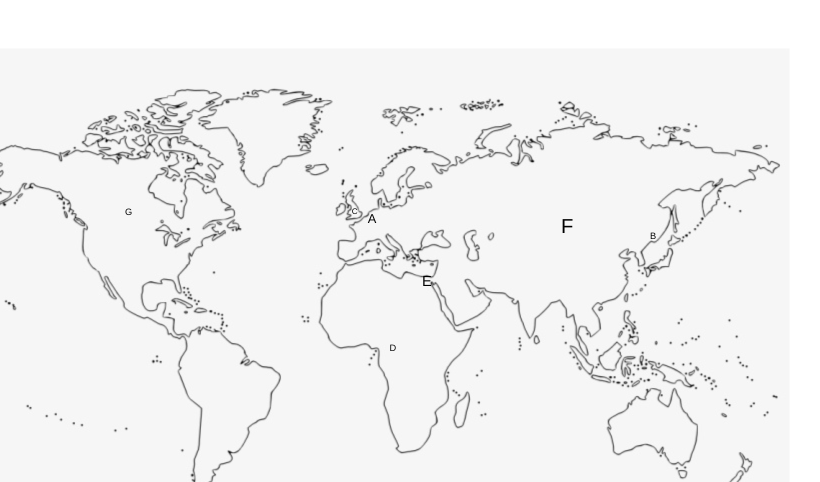
Five of them
A. Germany’s biggest port? Hamburg—on the Elbe River, sends goods worldwide.
B. Trans-Siberian Railway—7,000 km across Russia—ends at Vladivostok, a Pacific port.
C. International airport—tons of options, but Heathrow (London) is iconic, busy, global.
D. Subsistence gathering—people collecting food to survive—Amazon Basin (Brazil) tribes do this.
E. Important waterway—Suez Canal (Egypt) links Asia-Europe trade, saves ship time!
(Visually Impaired):
29.1 Name the major seaport in Germany.
Solution:
The major seaport in Germany is Hamburg. It is one of the busiest ports in Europe and plays
a significant role in international trade.
Quick Tip
When learning about ports, focus on their location, size, and role in international trade
and commerce.
29.2 Name the easternmost terminal station of Trans-Siberian Railway.
Solution:
The easternmost terminal station of the Trans-Siberian Railway is Vladivostok. It serves as
the terminus of the world’s longest railway line, connecting Moscow to the Russian Far East.
Quick Tip
For railway systems, focus on the major routes and their significance in connecting dis-
tant regions.
29.3 Mention an international airport in South Africa.
Solution:
An international airport in South Africa is O.R. Tambo International Airport, located in Jo-
hannesburg. It is the busiest airport in Africa and a major hub for international travel.
Quick Tip
When studying airports, consider their role in connecting global cities and supporting
international trade and tourism.
29.4 Mention an area of subsistence gathering in Canada.
Solution:
An area of subsistence gathering in Canada is the northern territories, including parts of Yukon
and the Northwest Territories. Indigenous populations in these areas rely on hunting, fishing,
and gathering for their livelihood.
Quick Tip
When studying subsistence gathering, focus on indigenous practices and the relation-
ship between people and their environment.
29.5 Name an important waterway of Egypt.
Solution:
An important waterway of Egypt is the Suez Canal. It connects the Mediterranean Sea to the
Red Sea and serves as a major shipping route for international trade.
Quick Tip
When studying waterways, consider their economic and strategic importance in global
trade and transportation.
29.6 Mention an area of nomadic herding in Africa.
Solution:
An area of nomadic herding in Africa is the Sahel region, located just south of the Sahara
Desert. Nomadic herders in this area move with their livestock in search of pasture and water.
Quick Tip
When studying nomadic herding, focus on the environmental challenges and the adapt-
ability of people and animals to changing climates.
29.7 Mention an area of extensive commercial grain farming of Australia.
Solution:
An area of extensive commercial grain farming in Australia is the Wheatbelt region, primarily
located in Western Australia. This area is known for large-scale wheat production.
Quick Tip
When studying commercial farming, focus on regions with optimal climates and soil for
large-scale production of specific crops.
On the given political outline map of India, locate and label any five of the following geographical features with appropriate symbols:
Question 30:
(30.1) Important iron ore mines in Odisha.
(30.2) An important seaport in Kerala.
(30.3) A copper mine in Rajasthan.
(30.4) An oil refinery in Bihar.
(30.5) An international airport in Punjab.
(30.6) A state with highest density of population.
(30.7) A state leading in the production of jute.
View Solution
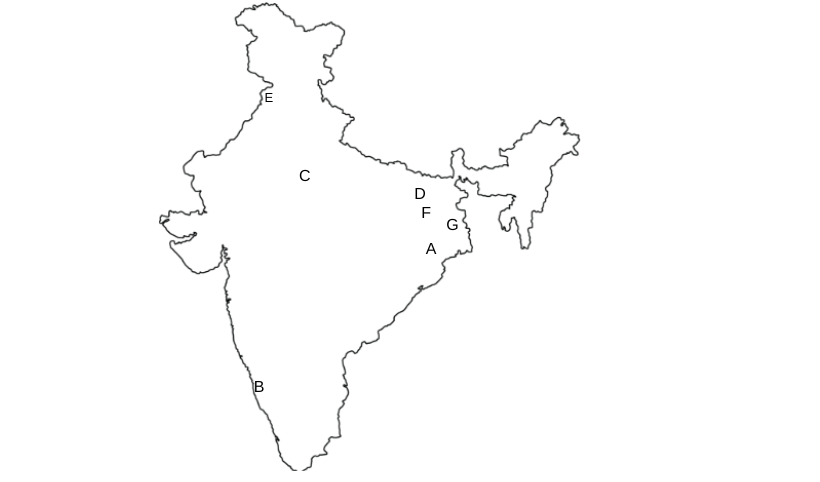
five of them:
(30.1) Odisha’s iron ore—Keonjhar’s a hotspot, tons mined there for steel.
(30.2) Kerala’s port—Kochi, on the coast, ships spices and oil.
(30.3) Rajasthan copper—Khetri, in the north, digs up copper for wires.
(30.4) Bihar oil refinery—Barauni, processes crude into fuel.
(30.5) Punjab airport—Amritsar’s Sri Guru Ram Dass Jee, flies international.
Question 30:
Note: The following questions are for the Visually Impaired Candidates only in lieu of Question No. 30. Attempt any five:
(30.1) Name an important iron ore mining area in Odisha.
View Solution
An important iron ore mining area in Odisha is Keonjhar. It is one of the largest iron ore mining areas in India and plays a crucial role in the country's steel production.
Quick Tip: Focus on major mining areas when studying mineral resources to understand their regional importance and role in industry.
(30.2) Name the main sea port of Kerala.
View Solution
The main sea port of Kerala is Kochi Port. It is one of the busiest ports in India and plays a significant role in the region's maritime trade.
Quick Tip: Ports are key economic hubs; understanding their location and function is essential when studying trade and transportation.
(30.3) Mention the name of a copper mining area in Rajasthan.
View Solution
A well-known copper mining area in Rajasthan is Khetri Nagar. It is one of the oldest and most significant copper mining regions in India.
Quick Tip: When studying mining areas, focus on the minerals extracted and their significance to the regional and national economy.
(30.4) Name the place of an oil refinery in Bihar.
View Solution
An oil refinery in Bihar is located in Barauni. It is one of the major oil refineries in India and is operated by Indian Oil Corporation.
Quick Tip: Study the locations of oil refineries to understand the role of energy infrastructure in regional development.
(30.5) Mention the name of a place where an international airport is located in Punjab.
View Solution
An international airport in Punjab is Sri Guru Ram Dass Jee International Airport, located in Amritsar. It is one of the busiest airports in northern India.
Quick Tip: International airports are key gateways for tourism and trade. Understand their role in connecting regions to the global economy.
(30.6) Name the state with the highest density of population.
View Solution
The state with the highest population density in India is West Bengal. It has a population density of more than 1,000 people per square kilometer.
Quick Tip: Focus on population density to understand how people are distributed across a region and the impacts of urbanization.
(30.7) Which is the leading state in the production of jute?
View Solution
The leading state in the production of jute in India is West Bengal. It produces the majority of India's jute and is home to several jute mills.
Quick Tip: When studying agricultural products, focus on key producing regions and the factors that contribute to their success in production.



Comments