




CBSE Class 12 Geography Question Paper 2025 PDF Set 3 (64/2/3) is available for download here. CBSE conducted the Geography exam on February 24, 2025, from 10:30 AM to 1:30 PM. The total marks for the theory paper are 70. The question paper contains 20% MCQ-based questions, 40% competency-based questions, and 40% short and long answer type questions. Candidates can download the official CBSE Class 12 Geography Question Paper 2025 with Solution for Set 3 using the link below.
CBSE Class 12 2025 Geography 64-2-3 Question Paper with Solution PDF
| CBSE Board Class 12 Geography Question Paper with Answer Key | Download PDF | Check Solutions |
Question 1:
“Human geography is the synthetic study of relationship between human societies and earth’s surface.” This definition of human geography is given by
View Solution
Vidal-de-la-Blache is known for his significant contributions to human geography and is often regarded as one of the founders of the modern field of human geography. His work emphasized the relationship between human societies and their environments.
Quick Tip: When studying human geography, focus on the various definitions and approaches used by key figures to understand the relationship between humans and the environment.
Which one of the following is the core concern of geography as a discipline?
View Solution
Geography as a discipline is primarily concerned with understanding the spatial distribution of populations, how and why people live where they do, and the factors that influence their locations. These factors include climate, resources, political decisions, and social and economic structures.
Quick Tip: When studying geography, focus on how human, physical, and environmental factors influence population distribution and movement.
The concept of ‘Neodeterminism’ was introduced by \hspace{2cm}.
View Solution
C. Semple introduced the concept of Neodeterminism, which stresses that while the physical environment influences human behavior, people still have the capacity to adapt and overcome these environmental challenges. Neodeterminism is seen as a blend of determinism and possibilism.
Quick Tip: When studying theories in geography, focus on the key theorists and their perspectives on human-environment relationships.
Read the following statements regarding outports carefully and choose the correct option:
View Solution
Outports are typically built away from the main ports and are used primarily for ferry services or as auxiliary ports. They are often not deep-water ports, as they serve smaller vessels. Piraeus, located in Greece, is an example of an outport for Athens.
Quick Tip: When studying ports, distinguish between deep-water ports, outports, and ferry ports, and understand their respective functions.
Two statements are given below. They are Assertion (A) and Reason (R). Read both the statements carefully and choose the correct option:
Assertion (A): “The chief gateways of the world are harbours and ports.”
Reason (R): “Cargoes and travellers are transported through them.”
View Solution
Harbours and ports serve as the major entry and exit points for trade and travel. As the assertion indicates, they are the main gateways for global movement. The reason further clarifies that cargoes and travelers depend on ports for transportation, which is a correct explanation of their vital role.
Quick Tip: Ports and harbours are integral to the global economy due to their role in transporting goods and passengers. Understanding their significance helps in appreciating global trade.
Choose the correct option to fill the blank:
\underline{\hspace{2cm were originally developed for refuelling, watering, and collecting food items.
View Solution
Ports of call were established primarily to provide facilities for ships to stop and refuel, resupply, and allow passengers to disembark. These ports serve as temporary halts during longer voyages.
Quick Tip: Focus on the historical development of ports to understand their initial purposes, which later evolved as transportation hubs.
Arrange the following towns of India as per their location from north to south direction and choose the correct option:
(i) Nagpur
(ii) Hyderabad
(iii) Madurai
(iv) Lucknow
View Solution
The towns arranged from north to south are: Nagpur (i), Lucknow (iv), Madurai (iii), and Hyderabad (ii). This order reflects their geographical positions based on latitude and longitude.
Quick Tip: When arranging cities geographically, focus on their latitudes to determine their relative positions from north to south.
Read the following statements regarding medieval towns in India carefully and choose the correct option:
View Solution
Many existing towns have their roots in the medieval period, especially cities like Varanasi, Madurai, and Prayag. These towns were often built as headquarters of the kingdoms and were mostly fort towns constructed on ruins of ancient settlements.
Quick Tip: Study the evolution of towns to understand their historical significance and the way they evolved from ancient settlements to urban centers.
Read the following statements related to international trade of India carefully and choose the correct option:
View Solution
India, being surrounded by the ocean on three sides, has numerous well-developed sea ports along its coasts. Kandla port is one of the main export hubs, particularly for iron-ore. The transportation cost by water is typically cheaper for bulk, voluminous goods like ores.
Quick Tip: When studying international trade, focus on the geographical advantages and port locations that facilitate trade.
Two statements are given below. They are Assertion (A) and Reason (R). Read both the statements carefully and choose the correct option:
Assertion (A): “The agriculturally rich states of Punjab, Haryana, and western Uttar Pradesh are facing the crisis of groundwater depletion.”
Reason (R): “More groundwater is utilized for irrigation than water-table recharge.”
View Solution
The states of Punjab, Haryana, and western Uttar Pradesh, known for their high agricultural productivity, face the issue of groundwater depletion due to excessive irrigation. The reason for this is the over-extraction of groundwater for irrigation purposes, with insufficient recharge of the water table.
Quick Tip: Study the relationship between agriculture and water resources, focusing on the sustainability of water usage and groundwater management.
Read the following statements related to Indira Gandhi Canal Project carefully and choose the correct option:
View Solution
The Indira Gandhi Canal Project was initiated in 1950 and launched in 1961 to provide irrigation to the arid regions of Rajasthan. It has significantly increased the area under irrigation, which has boosted the agricultural economy. The canal irrigation has resulted in a shift in cropping patterns, with rice and wheat replacing traditional crops like jowar and bajra.
Quick Tip: Focus on the historical background and impact of large irrigation projects like the Indira Gandhi Canal on agriculture.
The watershed management programme in Jhabua district of Madhya Pradesh is funded by which one of the following ministries?
View Solution
The watershed management programme in Jhabua district is primarily funded by the Ministry of Rural Development. This initiative focuses on improving land and water management to ensure sustainable agricultural practices and improve the livelihoods of local communities.
Quick Tip: Watershed management projects often aim to improve water conservation, soil health, and agricultural productivity in rural areas.
Local names like Panna, Para, Palli, Nagla, Dhani etc. are examples of which of the following types of rural settlements in India?
View Solution
Local names like Panna, Para, Palli, Nagla, and Dhani are examples of hamleted settlements. These are small rural settlements that consist of a number of dispersed houses grouped together but still retain a level of individual separation.
Quick Tip: Focus on the characteristics of different rural settlement patterns like clustered, hamleted, and dispersed when studying rural geography.
Why is it that slums are the areas of residence with the least choice? Choose the correct options:
View Solution
Slums typically face multiple challenges, including poor housing conditions with inadequate ventilation, lack of basic amenities like electricity and sanitation, and inadequate access to clean drinking water. These conditions contribute to the low quality of life in slums.
Quick Tip: When studying urban poverty, focus on the factors that contribute to poor living conditions in slums, such as inadequate infrastructure and sanitation.
Under which one of the following categories of commodities, the increase in export is observed from 2010-11 to 2016-17?
View Solution
From the data, crude and petroleum products show a consistent increase in export share from 2010-11 to 2016-17. This reflects India's growing export of petroleum-based products, which has risen significantly in recent years.
Quick Tip: When analyzing export data, observe which sectors show consistent growth over time, indicating economic trends.
Under which one of the following categories of commodities, increase in export is continuously observed?
View Solution
Manufactured goods have shown a continuous increase in export over the years, indicating the growing strength of India's manufacturing sector in the global market.
Quick Tip: Manufactured goods are a significant part of global trade. When studying international trade, note the sectors that consistently perform well.
Under which one of the following categories of commodities, maximum decline in export is recorded from 2015-16 to 2016-17?
View Solution
Agriculture and allied products experienced the maximum decline in exports from 2015-16 to 2016-17, indicating a decrease in global demand or production challenges in this sector.
Quick Tip: When studying export declines, focus on sectors with the most significant drop and assess the reasons behind the reduction.
Study the following table carefully and answer the Question No. 18:
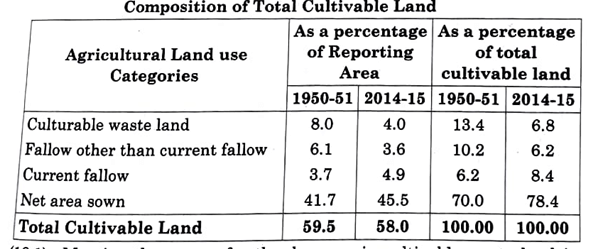
18.1 Mention the reason for the decrease in cultivable waste land in 2014-15 as compared to 1950-51.
18.2 Mention the reason for the increase in current fallow during 2014-15 as compared to 1950-51.
18.3 Explain the reason of continuous increase in net area sown.
Correct Answer:(18.1) Conversion to agricultural land.
(18.2) Dependence on rainfall or soil exhaustion.
(18.3) Agricultural expansion and technology.
View Solution
(18.1) The decrease in cultivable waste land from 1950-51 to 2014-15 is due to the increased efforts of land reclamation, improved agricultural techniques, and better land management practices over the years. This has resulted in a reduction of waste land and an increase in the land under cultivation.
(18.2) Current fallow rises from 6.2 percent to 8.4 percent. This is land left empty for a season to recover. Why more? Many farmers rely on rain (monsoons)—if it fails, they skip planting. Also, intense farming (like in Punjab) tires out soil; leaving it fallow helps it heal. In 1950-51, less pressure meant less fallow. Reason: rainfall issues or soil exhaustion.
(18.3) Net area sown jumps from 70 percent to 78.4 percent. That’s land actually farmed. Why the steady rise? Population pressure demanded more crops—think Green Revolution! Tech like tractors, fertilizers, and canals (e.g., Indira Gandhi Canal) made barren land farmable. More land got water, machines sped up work, and farmers grew two crops yearly. Reason: expansion and technology!
Quick Tip: When studying land use changes, focus on the factors that lead to the reclamation or abandonment of land. Consider agricultural practices, climate, and policy interventions.
Read the passage carefully and answer the questions that follow:
Hunting and Food Gathering
The earliest human beings depended on their immediate environment for their sustenance. They subsisted on: (a) animals which they hunted; and (b) the edible plants which they gathered from forests in the vicinity.
Primitive societies depended on wild animals. People located in very cold and extremely hot climates survived on hunting. The people in the coastal areas still catch fish though fishing has experienced modernisation due to technological development. Many species, now have become extinct or endangered due to illegal hunting (poaching). The early hunters used primitive tools made of stones, twigs or arrows so the number of animals killed was limited.
Gathering and hunting are the oldest economic activity known. These are carried out at different levels with different orientations. Gathering is practised in regions with harsh climatic conditions. It often involves primitive societies, who extract both plants and animals to satisfy their needs for food, shelter and clothing. This type of activity requires a small amount of capital investment and operates at very low levels of technology. The yield per person is very low and little or no surplus is produced.
19.1 Examine the impact of poaching on wild animals.
19.2 Why was hunting of animals limited in early times? Explain.
19.3 Why did early man depend upon his immediate natural environment? Explain.
Correct Answer:(19.1) Poaching leads to extinction and endangerment of species.
(19.2) Limited due to primitive tools.
(19.3) Lack of technology and mobility.
View Solution
(19.1) Poaching has had a detrimental impact on wild animal populations by pushing many species towards extinction. The illegal hunting of animals for their skin, tusks, or other body parts disrupts ecosystems, reduces biodiversity, and threatens the survival of various species. Conservation efforts are needed to combat poaching and protect wildlife.
(19.2) “Why was hunting limited in early times?”—it mentions, “Early hunters used primitive tools made of stones, twigs, or arrows, so the number of animals killed was limited.” Imagine using a stone spear versus a rifle—you couldn’t catch much! These basic tools were weak, and hunting was slow and skill-based. They couldn’t kill many animals like today with modern guns, keeping nature safer back then. Limited tools = limited hunting.
(19.3) “Why did early man depend on his immediate natural environment?”—the passage starts, “Earliest human beings depended on their immediate environment for sustenance.” Why? They had no cars, no stores, no advanced tech! If you lived in a forest, you ate berries nearby or hunted deer you saw—you couldn’t travel far or store food. In cold places, they hunted seals; in hot deserts, lizards—all local. No planes or fridges meant relying on what’s close.
Quick Tip: When studying poaching, focus on the effects on biodiversity, conservation methods, and the importance of wildlife protection laws.
(a) Examine the role of climate, water availability and soil fertility on the distribution of world population.
OR
(b) Examine three stages of demographic transition theory.
(b) High birth/death, declining death, low birth/death.
View Solution
As a student, let’s explore these options!
(a) Where people live worldwide depends on nature. Climate: Mild areas (like Europe’s temperate zones) have more people—too hot (Sahara) or cold (Arctic) have fewer. Water: Rivers and coasts (e.g., Nile, Ganges) attract millions—farming and drinking need water; deserts are empty. Soil fertility: Rich soil (like India’s plains) grows food, so populations boom—rocky hills don’t. Example: 70 percent of people live on 7 percent of land near water and good soil! These shape where we settle globally.
(b) Demographic Transition Theory shows how populations change: Stage 1 (pre-industrial): High birth rates (no birth control) and death rates (no medicine)—e.g., ancient tribes, population steady. Stage 2 (industrializing): Death rates drop (better health, like vaccines), births stay high—e.g., 1800s India, population explodes. Stage 3 (developed): Births drop (education, jobs), deaths low—e.g., modern Japan, population stabilizes. It’s a growth story!
Quick Tip: (a) Link nature to people with examples; (b) Recall birth-death patterns over time.
Study the map of Rhine waterways and answer the questions that follow:

(21.1) Name the country in which most of Rhine river lies.
(21.2) Name two countries whose industrial areas are connected by river Rhine.
(21.3) Why is river Rhine world's most heavily used waterway?
(21.2) Germany and Netherlands.
(21.3) Heavy industrial traffic and connectivity.
View Solution
(21.1) The majority of the Rhine river flows through Germany. It originates in the Swiss Alps and flows through several countries, but most of it runs through Germany.
Quick Tip: Study the geography of rivers and understand how their flow through different countries impacts trade, culture, and geography
(21.2) The river Rhine connects the industrial areas of Germany and the Netherlands. The river serve as a major transport route for goods and is vital for the economies of these countries.
Quick Tip
Familiarize yourself with important trade routes and how rivers have historically
shaped industrial growth in different regions.
(21.3) River Rhine is the most heavily used waterway in the world due to its strategic location and
the ease of transportation of bulk goods like coal, chemicals, and machinery. It connects major
industrial cities across several countries, making it a vital waterway for international trade.
Quick Tip
When studying major waterways, focus on their economic impact, historical signifi-
cance, and role in global trade.
.
Note: The following questions are for the Visually Impaired Candidates only in lieu of Question No. 21:
(21.1) Mention the name of the country from where the Rhine waterway begins in the upstream.
(21.2) Name the major sea port where river Rhine falls into North Sea.
(21.3) Explain the significance of river Rhine as a water highway of commerce.
(21.2) Rotterdam.
(21.3) Links industrial regions to sea for trade.
View Solution
(21.1) The Rhine waterway begins in Switzerland, located in the Swiss Alps, and flows northward through several countries including Germany, France, and the Netherlands.
Quick Tip: When studying rivers, focus on their origins, flow path, and their impact on the countries they traverse.
(21.2)
The major sea port where the river Rhine flows into the North Sea is Rotterdam, located in
the Netherlands. Rotterdam is one of the busiest ports in the world and serves as a major hub
for European trade.
Quick Tip
Understanding the significance of major ports helps in grasping the global trade net-
work and the importance of waterways in transportation.
(21.3)
The river Rhine is a vital waterway for European commerce, connecting major industrial cities
such as Basel, Mannheim, Cologne, and Rotterdam. It facilitates the transport of goods like
coal, chemicals, and machinery, contributing to the economies of Germany, the Netherlands,
and other countries. The Rhine is one of the busiest waterways in the world and plays a critical
role in global trade.
Quick Tip
When studying important waterways, consider how they impact the economy by en-
abling trade and transportation across regions.
Explain the main features of National Highways in India.
View Solution
National Highways in India are the major roads that connect the capitals of different states and important cities across the country. The main features of National Highways include:
1. Network Connectivity: National Highways form the backbone of the road transportation network in India, connecting major cities, ports, and industrial regions. They ensure smooth and fast movement of goods and people.
2. Standardized Construction: These highways are constructed and maintained by the central government and have a standardized design that ensures uniformity across the country. The road quality is generally high, with wide lanes and good signage.
3. Economic Importance: National Highways facilitate the movement of essential goods and commodities across regions, making them crucial for the country’s economy. Many of them are integral to India's trade network.
4. Developmental Focus: Many National Highways pass through remote or underdeveloped areas, thus aiding in the economic development of these regions by enhancing connectivity.
5. Well-maintained: National Highways are well-maintained through a regular process of upgrading and repairs, ensuring that they are durable and reliable for transportation.
Quick Tip: Understanding the National Highways system helps in recognizing its role in regional development, trade, and connectivity in India.
Suggest the measures to solve the problems of slums in India.
View Solution
Slums in India are often characterized by overcrowded living conditions, inadequate sanitation, and poor infrastructure. To solve the problems of slums, the following measures can be implemented:
1. Improved Housing: Government initiatives like the Pradhan Mantri Awas Yojana (PMAY) should be expanded to provide affordable housing for the poor. Building more affordable and durable homes will help in reducing slum populations.
2. Better Infrastructure: The government should focus on improving the infrastructure in slums, including providing better roads, sewage systems, clean water, electricity, and healthcare facilities.
3. Community Involvement: Encouraging the active participation of local communities in improving their living conditions can help in ensuring the long-term sustainability of efforts. Community-driven solutions can be effective in tackling local issues.
4. Slum Rehabilitation Projects: In areas where slums cannot be removed, slum rehabilitation projects should be developed. These projects should include proper sanitation, water, and waste management systems.
5. Economic Empowerment Programs: Providing education, skill training, and employment opportunities for the residents of slums will help break the cycle of poverty. It will enable them to support themselves and improve their living standards.
Quick Tip: Focus on sustainable urban planning and community development efforts to effectively solve the issues faced by slum dwellers in India.
View Solution
(a)
Large scale manufacturing industries play a pivotal role in the global economy. Some of the key features include:
1. Mass Production: These industries are designed for producing large quantities of goods, often using assembly lines and advanced machinery.
2. Technological Advancement: They heavily rely on technology to improve efficiency and reduce production costs.
3. Capital Intensive: These industries require substantial capital investment in machinery, infrastructure, and workforce.
4. Global Reach: Many large scale manufacturing industries operate internationally, with goods exported around the world.
5. Economies of Scale: Large scale manufacturing benefits from economies of scale, reducing per unit cost as production increases.
Quick Tip: Focus on the role of large scale industries in creating jobs, facilitating trade, and driving technological progress in the global economy.
(b)
High-tech industries are characterized by the use of advanced technologies in their production
processes. Some key features include:
1. Innovation-Driven: These industries focus on constant innovation and the development
of cutting-edge technologies.
2. High Skill Requirement: The workforce in high-tech industries is typically highly skilled,
requiring specialized knowledge in fields like IT, engineering, and biotechnology.
3. Research and Development (RD): A significant portion of investment goes into RD to
stay ahead in the technological race.
4. Global Impact: These industries often operate globally, influencing worldwide markets
through innovations such as smartphones, computer chips, and medical devices.
5. Sustainability Focus: Many high-tech industries prioritize sustainability and environmen-
tal considerations in their production processes.
Quick Tip
Understanding high-tech industries requires a focus on the intersection of innovation,
RD, and global market trends that define their success.
Explain the concept of ‘human development’. Examine four approaches to human development.
View Solution
Human development refers to the process of improving people's well-being by expanding their capabilities and providing access to essential resources. The four approaches to human development are:
1. Economic Growth: Economic progress leads to greater availability of resources for improving healthcare, education, and living standards.
2. Social Development: This approach emphasizes the improvement of social structures and systems that support individuals' well-being, such as healthcare and education.
3. Environmental Sustainability: Ensuring that development meets the needs of the present without compromising the ability of future generations to meet their own needs.
4. Equity and Justice: This approach aims to ensure that all individuals have equal opportunities, irrespective of their background, to live a fulfilling life.
Quick Tip: Human development is multi-faceted and emphasizes the importance of a balance between economic, social, and environmental sustainability for long-term well-being.
(a) Assess the growth and significance of service sector in the development of the world economy.
OR
(b) Assess the growth and significance of service sector in the services in the world economy.
View Solution
(a)
The service sector has grown rapidly over the past few decades and plays a vital role in the world economy. Some key aspects include:
1. Economic Contribution: The service sector contributes a significant portion to global GDP, including industries such as finance, healthcare, and IT services.
2. Employment Generation: The sector provides millions of jobs worldwide, especially in developing economies, and offers diverse employment opportunities.
3. Technological Advancements: The service sector is heavily impacted by innovations, particularly in IT and telecommunications, leading to increased productivity.
4. Global Interconnectedness: Services such as tourism, banking, and transport have made the global economy more interconnected.
5. Job Transformation: The rise of service industries has transformed employment patterns, with a significant move from agriculture to services.
Quick Tip: The growth of the service sector highlights the shift towards knowledge-based and service-oriented economies, a key driver of global economic development.
(b)
Transport and communication services are crucial to the global economy, facilitating the move-
ment of goods and people, as well as the flow of information. Key factors include:
1. Global Trade Facilitation: Efficient transport systems help reduce the cost of trade,
ensuring faster movement of goods across borders.
2. Global Connectivity: Communication networks have brought people closer, allowing busi-
nesses and individuals to communicate instantly.
3. Economic Development: Well-developed transport and communication systems support
economic development by improving access to markets and resources.
4. Technological Innovations: The growth of communication technologies, such as the in-
ternet and mobile networks, has drastically transformed the way economies operate.
5. Tourism Industry: The transport sector is vital to the tourism industry, which is a major
source of income for many countries.
Quick Tip
Focus on the interconnectedness between transport, communication, and global
trade. Understanding their role in economic development is key to grasping modern
economies.
(a) Analyse the growth of population in India since 1921.
OR
(b) With respect to adolescent population, analyse the challenges of Indian society.
View Solution
(a)
India has witnessed significant population growth since 1921, driven by various socio-economic factors. Key stages of this growth include:
1. Early Growth (1921-1950): India's population grew slowly due to high mortality rates and lower life expectancy during this period.
2. Post-Independence Growth (1950-1980): After independence, India’s population growth surged due to improved healthcare, nutrition, and sanitation.
3. Modern Growth (1980-Present): The population continued to grow rapidly, although the growth rate has slowed in recent decades due to family planning policies and urbanization.
4. Urbanization and Migration: A significant shift from rural to urban areas has contributed to increased population density in cities.
Quick Tip: Study the factors driving population growth, such as health advancements, migration trends, and government policies, to understand the demographic changes in India.
(b)
India’s adolescent population faces various challenges that impact their social and economic
development. These challenges include:
1. Educational Barriers: Access to quality education remains a challenge, especially for girls
and children in rural areas.
2. Health Issues: Adolescent health concerns, such as malnutrition and lack of proper health-
care services, are widespread.
3. Social Pressures: Adolescents face immense academic pressure and social expectations,
leading to stress and mental health issues.
4. Substance Abuse: Rising rates of substance abuse among adolescents are a growing con-
cern in urban areas.
5. Child Marriage: Child marriage continues to be a significant issue in rural regions, affect-
ing adolescent girls’ education and health.
Quick Tip
Focus on the role of government policies and societal changes in addressing the chal-
lenges faced by India’s adolescent population.
View Solution
(a)
Non-conventional sources of energy, such as solar, wind, and bioenergy, are increasingly being used in India as sustainable alternatives to fossil fuels. Some of the key points include:
1. Renewable Resources: India has abundant sunlight and wind resources, which can be harnessed for solar and wind energy production.
2. Clean Energy Growth: The government is promoting clean energy solutions through various policies and incentives for renewable energy projects.
3. Energy Access: Non-conventional energy sources have the potential to provide electricity to remote rural areas, ensuring better energy access.
4. Environmental Benefits: These energy sources are clean and do not contribute to air pollution or carbon emissions, unlike traditional fossil fuels.
Quick Tip: Study the potential of India’s renewable energy resources and the government’s initiatives to boost their adoption, focusing on long-term sustainability.
(b)
Nuclear energy is becoming an essential part of India’s energy mix for meeting growing demand
while ensuring sustainability. Key points to consider include:
1. Energy Security: Nuclear energy provides a reliable and secure source of electricity for
India’s rapidly growing population.
2. Low Carbon Emissions: As a clean energy source, nuclear power helps India reduce
carbon emissions compared to coal-based power.
3. Government Support: India has made significant investments in nuclear technology, with
new nuclear plants being set up across the country.
4. Safety Concerns: While nuclear power offers several benefits, safety concerns regarding
nuclear accidents and waste disposal remain challenges.
Quick Tip
Nuclear energy has a significant role to play in India’s energy future. Focus on both
the benefits and the challenges of using nuclear power to meet growing energy de-
mands.
On the outline political map of the world, seven geographical features have been marked as A, B, C, D, E, F and G. Identify any FIVE of them and write their names on the lines drawn near them:
A. Major sea port in Germany.
B. Terminal station of Trans-Siberian Railway.
C. An international airport.
D. An area of subsistence gathering.
E. An important waterway.
F. An area of 'Nomadic Herding'.
G. An area of extensive commercial grain farming.
View Solution
29.1
Name the major seaport in Germany.
Solution:
The major seaport in Germany is Hamburg. It is one of the busiest ports in Europe and serves
as a significant hub for international trade.
Quick Tip
Ports like Hamburg are critical for global shipping and trade routes. Focus on their
role in connecting major countries and facilitating international commerce.
29.2
Name the easternmost terminal station of Trans-Siberian Railway.
Solution:
The easternmost terminal station of the Trans-Siberian Railway is Vladivostok. It is a vital
port city in the Russian Far East and the terminus of the Trans-Siberian Railway.
Quick Tip
The Trans-Siberian Railway is one of the longest railways in the world. Focus on how
it connects the European part of Russia with the Russian Far East.
29.3
Mention an international airport in South Africa.
Solution:
The major international airport in South Africa is O.R. Tambo International Airport, located
in Johannesburg. It is the busiest airport in Africa by passenger traffic.
Quick Tip
Airports like O.R. Tambo serve as vital hubs for international travel and commerce in
Africa. Consider how airports impact trade and tourism.
29.4
Mention an area of subsistence gathering in Canada.
Solution:
An area of subsistence gathering in Canada is the northern regions, such as the territories of
Nunavut and the Northwest Territories. Indigenous peoples in these regions still rely on hunt-
ing, fishing, and gathering as their primary means of subsistence.
Quick Tip
Study subsistence gathering in northern regions to understand the relationship between
indigenous cultures and their environment. Focus on the methods they use to survive
in harsh climates.
29.5
Name an important waterway of Egypt.
Solution:
The important waterway of Egypt is the Suez Canal. It is a vital shipping route connecting
the Mediterranean Sea with the Red Sea, providing a direct link between Europe and Asia.
Quick Tip
The Suez Canal is one of the most crucial trade routes in the world. Consider its role
in connecting Europe and Asia for maritime trade.
29.6
Mention an area of nomadic herding in Africa.
Solution:
An area of nomadic herding in Africa is the Sahel region. This region stretches across the
southern edge of the Sahara Desert and is known for traditional nomadic pastoralism, where
people move with their herds of cattle, goats, and camels.
Quick Tip
Focus on the role of nomadic herding in Africa, especially in arid regions like the Sahel.
It is essential to understand how people adapt to harsh environmental conditions.
29.7
Mention an area of extensive commercial grain farming of Australia.
Solution:
An area of extensive commercial grain farming in Australia is the Wheatbelt, primarily located
in Western Australia, South Australia, and parts of New South Wales. The region is known
for its large-scale wheat production.
Quick Tip
The Wheatbelt is one of Australia’s most important agricultural regions. Consider how
the climate, soil, and technology support large-scale farming in this area.
Note: The following questions are for the Visually Impaired Candidates only in lieu of Question No. 29. Answer any five:
(29.1) Name the major seaport in Germany.
(29.2) Name the easternmost terminal station of Trans-Siberian Railway.
(29.3) Mention an international airport in South Africa.
(29.4) Mention an area of subsistence gathering in Canada.
(29.5) Name an important waterway of Egypt.
(29.6) Mention an area of nomadic herding in Africa.
(29.7) Mention an area of extensive commercial grain farming of Australia.
View Solution
(29.1) Hamburg—Germany’s major port on the Elbe, shipping globally.
(29.2) Vladivostok—eastern end of the Trans-Siberian Railway, Pacific port.
(29.3) Johannesburg—O.R. Tambo airport, South Africa’s big hub.
(29.4) Northern Canada—Inuit gather berries, hunt for survival.
(29.5) Suez Canal—Egypt’s trade lifeline, linking Red Sea to Mediterranean.
Pick five—use for key global features!
Quick Tip: Know specific locations—ports, railways, and economic areas from textbooks!
On the given political outline map of India, locate and label any five of the following geographical features with appropriate symbols:
(30.1) Important iron ore mines in Odisha.
(30.2) An important seaport in Kerala.
(30.3) A copper mine in Rajasthan.
(30.4) An oil refinery in Bihar.
(30.5) An international airport in Punjab.
(30.6) A state with highest density of population.
(30.7) A state leading in the production of jute.
View Solution
30.1
Name an important iron ore mining area in Odisha.
Solution:
The important iron ore mining area in Odisha is the Keonjhar region. This area is known for
its vast deposits of iron ore, and it plays a significant role in the mining industry of India.
Quick Tip
Focus on the geographical areas rich in natural resources, as they often form the back-
bone of the industrial economy in the region.
30.2
Name the main sea port of Kerala.
Solution:
The main seaport of Kerala is the Kochi Port. It is an important harbor in the state and plays
a vital role in the international trade of India.
Quick Tip
When studying ports, focus on their connectivity, trade volume, and role in regional
and global commerce.
30.3
Mention the name of a copper mining area of Rajasthan.
Solution:
An important copper mining area in Rajasthan is the Khetri Copper Belt, located in the Jhun-
jhunu district. This region is one of India’s major copper-producing areas.
Quick Tip
Copper mining areas are significant due to their role in the manufacturing of electrical
equipment and infrastructure development.
30.4
Name the place of an oil refinery in Bihar.
Solution:
The place where an oil refinery is located in Bihar is Barauni. The Barauni Refinery is one of
the oldest and most important oil refineries in Eastern India.
Quick Tip
Oil refineries are crucial for the processing of crude oil into valuable products like gaso-
line and diesel. Focus on their role in the energy sector.
30.5
Mention the name of a place where an international airport is located in Punjab.
Solution:
The name of the place with an international airport in Punjab is Amritsar. The Sri Guru Ram
Das Jee International Airport in Amritsar is the major international gateway for the region.
Quick Tip
Airports are key to regional connectivity and international trade. Studying their loca-
tions and traffic can reveal insights into economic activity.
30.6
Name the state with highest density of population.
Solution:
The state with the highest population density in India is Bihar. It has a population density of
over 1,100 people per square kilometer.
Quick Tip
Population density is an important factor in urban planning, resource allocation, and
economic development.
30.7
Which is the leading state in the production of jute?
Solution:
West Bengal is the leading state in the production of jute in India. The state accounts for
about 50% of India’s jute production.
Quick Tip
Jute is a crucial agricultural product for the textile industry, and studying its produc-
tion helps understand agricultural economies in regions like West Bengal.
Note: The following questions are for the Visually Impaired Candidates only in lieu of Question No. 30. Attempt any five:
(30.1) Name an important iron ore mining area in Odisha.
(30.2) Name the main sea port of Kerala.
(30.3) Mention the name of a copper mining area of Rajasthan.
(30.4) Name the place of an oil refinery in Bihar.
(30.5) Mention the name of a place where an international airport is located in Punjab.
(30.6) Name the state with highest density of population.
(30.7) Which is the leading state in the production of jute?
View Solution
(30.1) Keonjhar—Odisha’s major iron ore area for steel.
(30.2) Kochi—Kerala’s main port, shipping spices and oil.
(30.3) Khetri—Rajasthan’s copper mining spot for wires.
(30.4) Barauni—Bihar’s oil refinery, processes crude.
(30.5) Amritsar—Punjab’s international airport, Sri Guru Ram Dass Jee.
Pick five—use for key Indian locations!
Quick Tip: Memorize specific Indian spots—resources, ports, and infrastructure!



Comments