




The CBSE Class 12 Geography Question Paper 2026 is available for download here of CBSE Board Exam 2026. This CBSE 12th Geography solved question paper includes detailed solutions, answer key, and the latest CBSE marking scheme to help students understand the exam pattern and important topics.
By practicing the CBSE Class 12 Geography 2026 board exam paper PDF, students can improve answer-writing strategy, time management, and overall exam performance.
CBSE Class 12 Geography Question Paper 2026 (Set wise)
| CBSE Class 12 Geography Question Paper Set 1 (64-2-1) | Download PDF | Check Solutions |
| CBSE Class 12 Geography Question Paper Set 3 (64-2-3) | Download PDF | Check Solutions |
CBSE Class 12 Geography Question Paper 2026 with Solution PDF
| CBSE Class 12 Geography Question Paper 2026 with Solution PDF | Download PDF | Check Solutions |
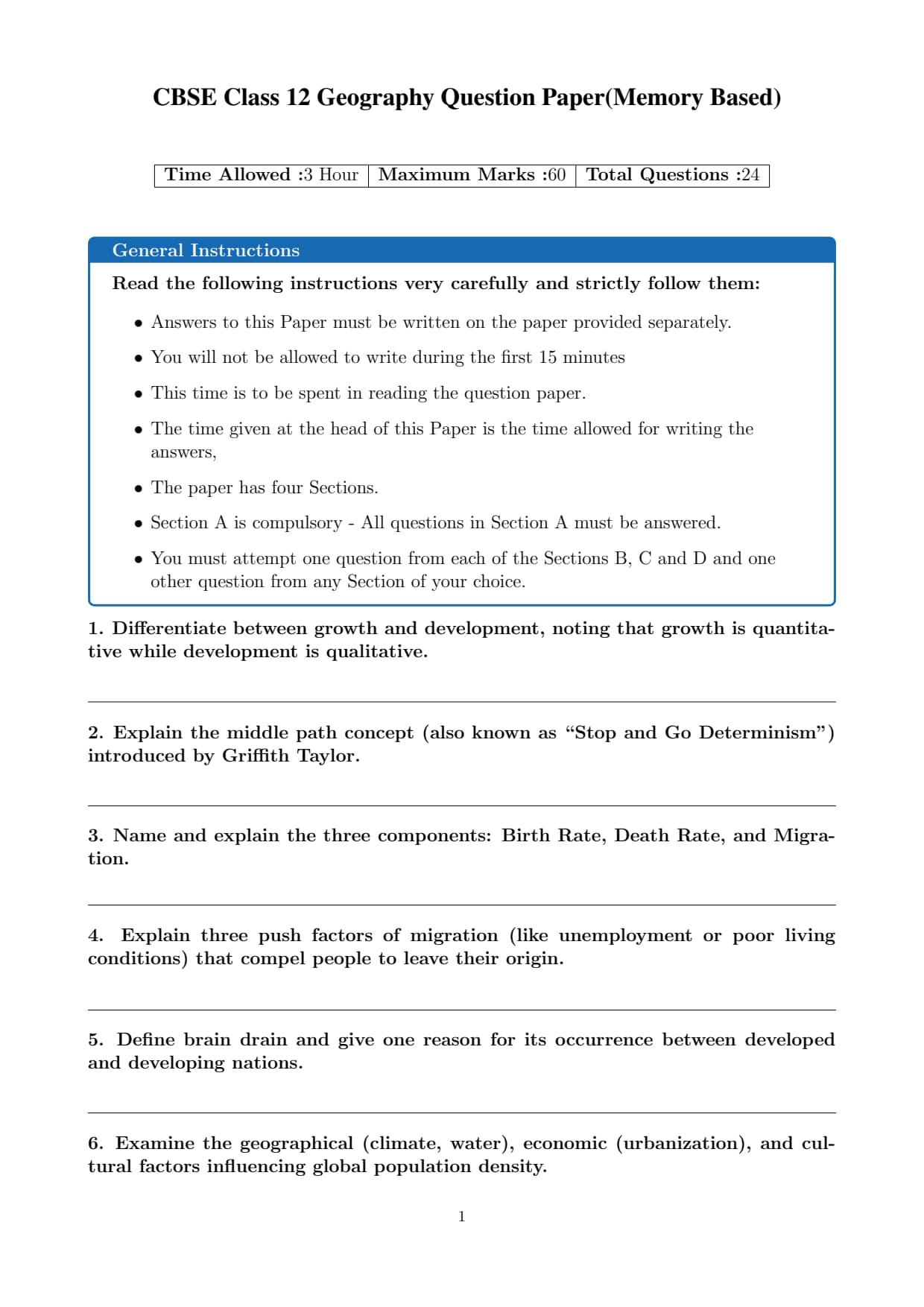
Differentiate between growth and development, noting that growth is quantitative while development is qualitative.
View Solution
Concept:
Growth and development are closely related concepts often used in education, psychology, and human development.
While both describe changes over time, they differ in nature and scope:
Growth refers to measurable and physical changes.
Development refers to overall qualitative changes in abilities, behaviour, and functioning.
Understanding this distinction helps in analysing human progress holistically.
Difference between Growth and Development:
Nature of Change:
Growth is quantitative and involves measurable physical changes such as height, weight, or size.
Development is qualitative and refers to improvements in skills, abilities, and behaviour.
Measurement:
Growth can be measured using numerical data (e.g., centimetres, kilograms).
Development cannot always be measured numerically and is often assessed through observation and evaluation.
Scope:
Growth is limited to physical aspects of the body.
Development is broader and includes emotional, intellectual, social, and moral dimensions.
Continuity:
Growth may stop after a certain age (e.g., physical maturity).
Development is a lifelong process that continues throughout life.
Dependency:
Growth is often a part of development.
Development depends on growth but also includes learning, environment, and experiences.
Example:
Increase in height is growth.
Improvement in problem-solving ability or emotional maturity is development. Quick Tip: \textbf{Quick Memory Trick:}
\textbf{Growth = Quantity (Numbers)}
\textbf{Development = Quality (Abilities)}
Explain the middle path concept (also known as ``Stop and Go Determinism'') introduced by Griffith Taylor.
View Solution
Concept:
The middle path concept, proposed by geographer Griffith Taylor, is a balanced approach between environmental determinism and possibilism.
It suggests that while the environment sets limits on human activities, humans still have the freedom to choose within those limits.
This idea is popularly known as ``Stop and Go Determinism'' because nature acts like a traffic controller — sometimes allowing progress (go) and sometimes restricting it (stop).
Explanation of Stop and Go Determinism:
Balanced Approach:
Taylor rejected extreme environmental determinism (which says nature controls everything) and extreme possibilism (which says humans control everything).
He proposed a middle path between the two.
Role of Environment:
The natural environment sets certain limits on human activities such as agriculture, settlement, and industry.
These limits cannot be completely ignored.
Human Choice:
Within environmental limits, humans have the freedom to make choices using technology, knowledge, and innovation.
``Stop and Go'' Analogy:
Nature works like a traffic signal:
Green Signal (Go): When conditions are favourable, human activities progress easily.
Red Signal (Stop): When conditions are harsh, development is restricted.
Practical Example:
Humans can grow crops in fertile plains (go), but deserts and polar regions restrict agriculture (stop), even with advanced technology.
Significance:
This concept provides a realistic understanding of human-environment interaction by acknowledging both environmental control and human adaptability. Quick Tip: \textbf{Remember:}
\textbf{Determinism = Nature controls}
\textbf{Possibilism = Humans control}
\textbf{Griffith Taylor = Middle Path (Nature guides, humans decide)}
Name and explain the three components: Birth Rate, Death Rate, and Migration.
View Solution
Concept:
Population change in any region is determined by three major components: Birth Rate, Death Rate, and Migration.
These factors help demographers understand whether a population is growing, declining, or remaining stable.
Three Components of Population Change:
Birth Rate (Natality):
Birth rate refers to the number of live births per 1,000 people in a population per year.
It is a major factor contributing to population growth.
High birth rate leads to rapid population increase.
Influenced by factors such as culture, literacy, healthcare, and economic conditions.
Death Rate (Mortality):
Death rate refers to the number of deaths per 1,000 people in a population per year.
It reduces the population size.
Lower death rates usually indicate better healthcare and living standards.
A high death rate may result from disease, poor nutrition, disasters, or conflict.
Migration:
Migration refers to the movement of people from one place to another, either permanently or temporarily.
It affects population distribution and size.
Immigration: Movement into a region (increases population).
Emigration: Movement out of a region (decreases population).
Overall Impact:
Population growth occurs when birth rate exceeds death rate and immigration is high.
Population decline occurs when death rate and emigration are higher than births. Quick Tip: \textbf{Quick Formula:}
\textbf{Population Change = Births – Deaths + Migration}
Explain three push factors of migration (like unemployment or poor living conditions) that compel people to leave their origin.
View Solution
Concept:
Push factors are negative conditions that force people to leave their place of origin and migrate elsewhere.
These factors make living conditions difficult, unsafe, or unsustainable, compelling people to search for better opportunities in other regions.
Three Major Push Factors of Migration:
Unemployment and Lack of Economic Opportunities:
When people cannot find jobs or stable sources of income, they are forced to migrate in search of employment.
Common in rural areas with limited industries.
Leads to migration towards cities or developed countries.
Poor Living Conditions:
Inadequate housing, lack of basic amenities (clean water, sanitation, healthcare), and low quality of life push people to leave their homeland.
Slums or underdeveloped regions often experience high out-migration.
People move to places with better infrastructure and public services.
Political Instability or Conflict:
Wars, violence, persecution, or unstable governments can make life unsafe, forcing people to migrate.
Includes refugees and asylum seekers.
Migration is often sudden and involuntary.
Other Possible Push Factors: Natural disasters, environmental degradation, lack of education, and social discrimination can also force migration. Quick Tip: \textbf{Remember:}
\textbf{Push Factors = Problems that push people away}
Think: Poverty, Problems, Pressure.
Define brain drain and give one reason for its occurrence between developed and developing nations.
Examine the geographical (climate, water), economic (urbanization), and cultural factors influencing global population density.
View Solution
Concept:
Population density refers to the number of people living per unit area of land.
It varies greatly across the world due to differences in natural environment, economic development, and cultural preferences.
The distribution of population is therefore uneven and influenced by multiple interrelated factors.
Factors Influencing Global Population Density:
Geographical Factors:
Climate:
Moderate climates (e.g., temperate and monsoon regions) support dense populations because they are suitable for agriculture and comfortable living.
Extreme climates such as deserts (very hot) and polar regions (very cold) discourage settlement.
Availability of Water:
Access to fresh water is essential for drinking, agriculture, and industry.
River valleys such as the Ganga, Nile, and Yangtze are densely populated due to fertile soil and reliable water supply.
Areas with scarce water resources have low population density.
Economic Factors:
Urbanization and Industrialization:
Cities attract people due to employment opportunities, better infrastructure, and services such as education and healthcare.
Industrial regions and urban centres therefore have high population density.
Rural and underdeveloped areas with limited economic opportunities tend to have sparse populations.
Cultural and Social Factors:
Cultural Traditions and Settlement Patterns:
Historical settlement patterns, family structures, and social norms influence where people live.
For example, regions with strong agricultural traditions often support dense rural populations.
Religious and Historical Significance:
Areas with religious importance or historical cities often attract large populations due to pilgrimage, trade, and long-standing habitation.
Government Policies and Social Stability:
Policies encouraging migration, land use, or development can shape population distribution.
Stable societies attract dense settlements, while conflict-prone areas remain sparsely populated.
Conclusion:
Global population density is shaped by a combination of natural suitability, economic opportunities, and cultural influences.
Regions where favourable geography aligns with strong economic activity tend to be the most densely populated. Quick Tip: \textbf{Easy Recall:}
\textbf{Population Density = Nature + Jobs + Culture}
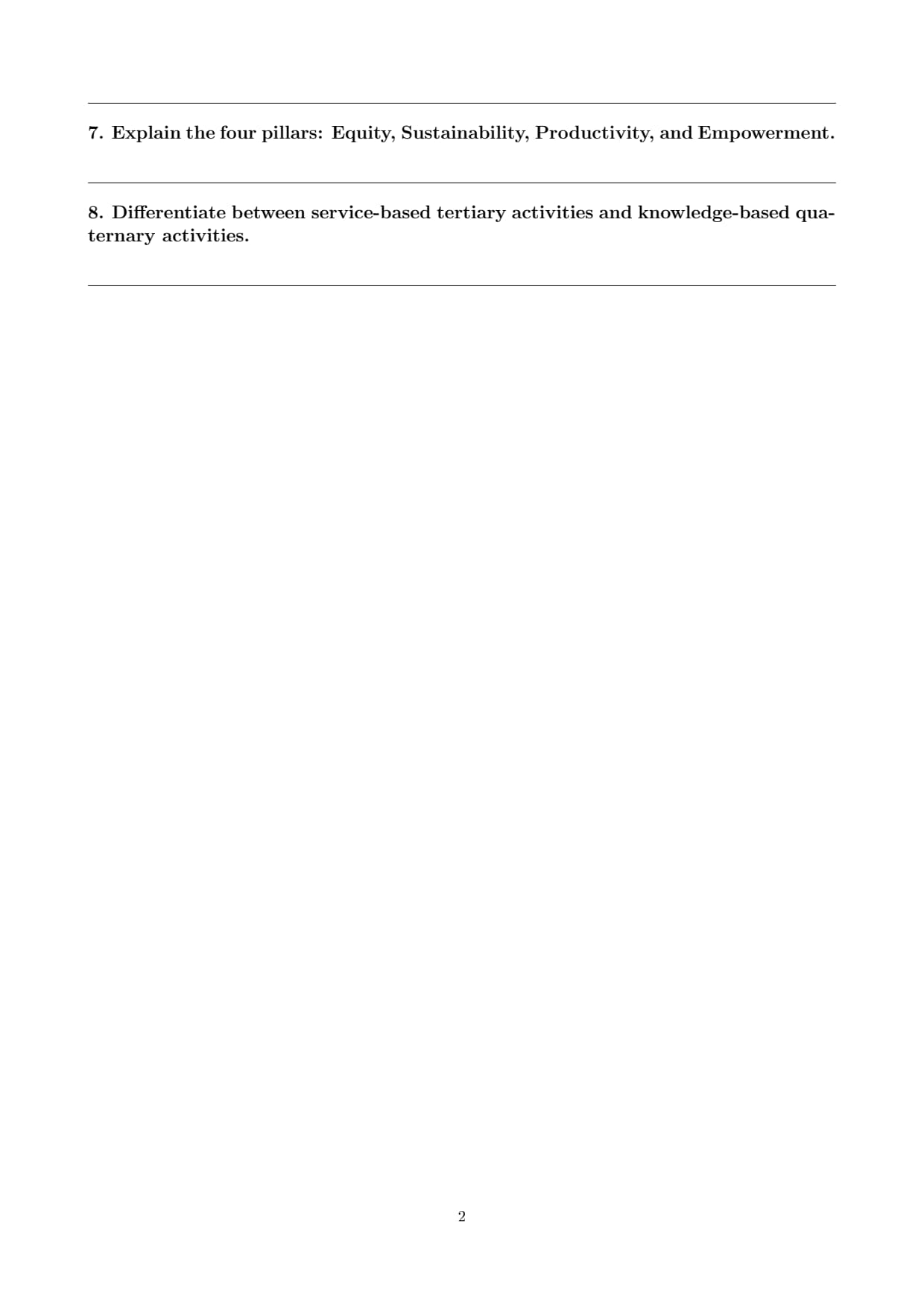
Explain the four pillars: Equity, Sustainability, Productivity, and Empowerment.
View Solution
Concept:
The four pillars — Equity, Sustainability, Productivity, and Empowerment — are key principles of human development and inclusive growth.
They ensure that development is not only about economic progress but also about fairness, long-term stability, efficiency, and people’s participation.
Four Pillars Explained:
Equity:
Equity means fairness and equal access to opportunities for all individuals, regardless of gender, caste, class, or region.
Ensures equal access to education, healthcare, and employment.
Reduces social and economic inequalities.
Promotes inclusive development.
Sustainability:
Sustainability refers to using resources in a way that meets present needs without compromising the ability of future generations to meet their own needs.
Encourages conservation of natural resources.
Promotes environmental protection and balanced growth.
Ensures long-term development.
Productivity:
Productivity focuses on improving the efficiency and output of individuals and economies.
Achieved through education, skill development, and technology.
Leads to higher income and better living standards.
Enhances economic growth and competitiveness.
Empowerment:
Empowerment means giving people the freedom and ability to make choices and participate in decision-making processes.
Encourages participation in political and social activities.
Promotes gender equality and social justice.
Helps individuals control their own lives and futures.
Conclusion:
These four pillars together ensure holistic development by combining fairness, long-term vision, efficiency, and active participation of people. Quick Tip: \textbf{Memory Trick:}
\textbf{ESEP = Equity, Sustainability, Empowerment, Productivity}
Think: Fair + Future + Output + Power to People.
Differentiate between service-based tertiary activities and knowledge-based quaternary activities.




Comments