




CBSE Class 12 History Set 1 Question Paper PDF (Code: 61/1/1) is now available for download. CBSE conducted the Class 12 History examination on March 28, 2024, from 10:30 AM to 1:30 PM. The question paper consists of 34 questions carrying a total of 80 marks. Section A includes 21 MCQs for 1 mark each, Section B contains 6 short-answer questions for 3 marks each, Section C comprises 3 long-answer questions for 8 marks each, Section D comprises 3 Source-based questions having three sub-questions carries 4 marks each and Section E comprises 1 Map-based question that carries 5 marks. Candidates can use the link below to download the CBSE Class 12 History Set 1 Question Paper with detailed solutions.
CBSE Class 12 History Question Paper 2024 (Set 1- 61/1/1) with Answer Key
| CBSE Class 12 2024 History Question Paper with Answer Key |  Download Download |
Check Solution |
CBSE Class 12 2024 History Questions with Solutions
SECTION A
(Multiple Choice Type Questions)
Section A
Question 1:
Which of the following was the best source of lapis lazuli in the Harappan sites?
View Solution
Solution: Understanding Lapis Lazuli:
• Lapis lazuli is a semi-precious stone that was highly valued in ancient times.
• It was used for making jewelry, ornaments and seals.
• The stone was not easily available and needed to be sourced through trade.
1: Analyzing Shortughai:
• Shortughai is a Harappan site located in present-day Afghanistan.
• It was situated near the lapis lazuli mines of Badakhshan, making it the major source for this stone in the Harappan civilization.
2: Analyzing Nageshwar:
• Nageshwar is a Harappan site in Gujarat known for its shell-working industry, not for lapis lazuli.
3: Analyzing Manda:
• Manda is a Harappan site located on the banks of the Chenab River in Jammu, which is not known for the source of lapis lazuli.
4: Analyzing Rakhigarhi:
• Rakhigarhi is a large Harappan site in Haryana.
• Although it is a large site, it is not the source of lapis lazuli.
5: Conclusion
• Based on the above analysis, Shortughai was the major source of Lapis Lazuli in Harappan civilization.
Question 2:
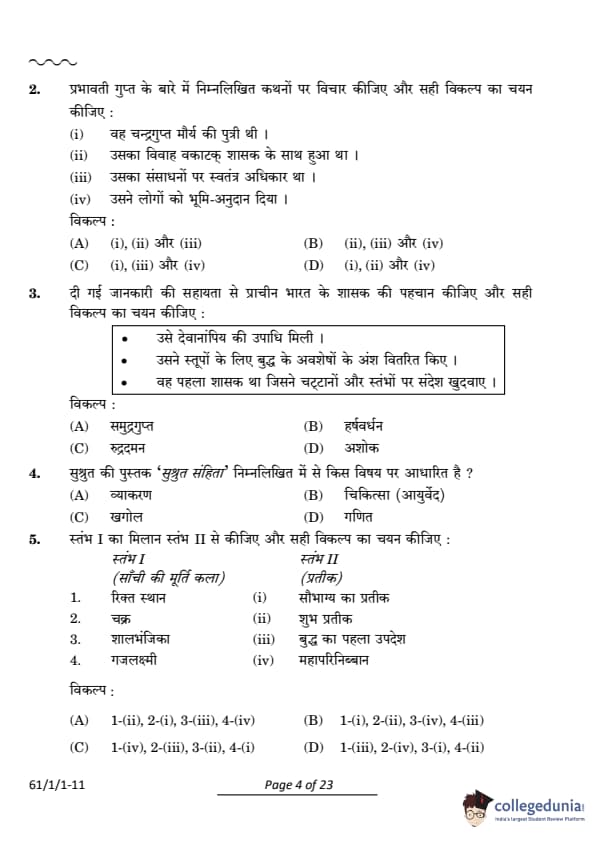
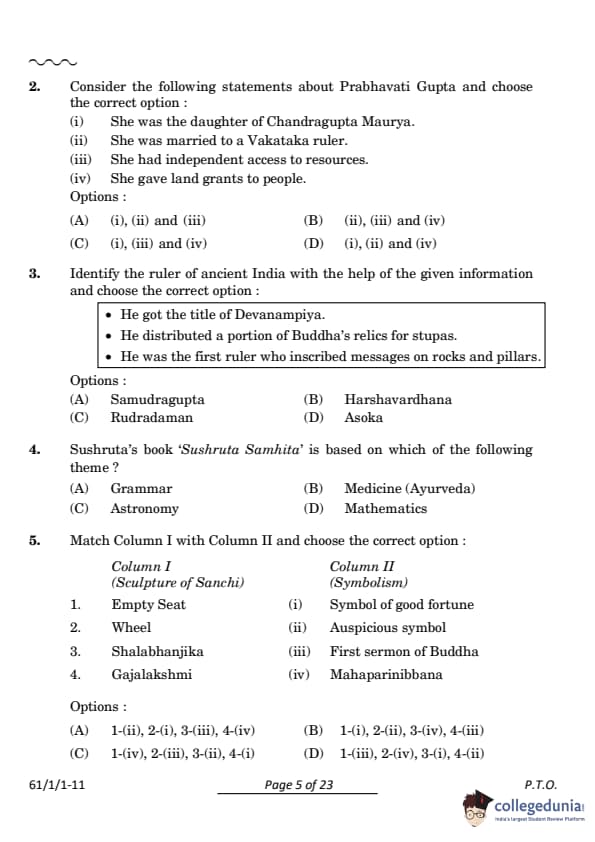
Consider the following statements about Prabhavati Gupta and choose the correct option :
• (i) She was the daughter of Chandragupta Maurya.
• (ii) She was married to a Vakataka ruler.
• (iii) She had independent access to resources.
• (iv) She gave land grants to people.
View Solution
Solution: Understanding Prabhavati Gupta:
• Prabhavati Gupta was an important female ruler of the Vakataka dynasty.
• She was the daughter of Chandragupta II of the Gupta dynasty.
1: Analyzing Statement (i):
• Statement (i) says she was the daughter of Chandragupta Maurya.
• This is incorrect as she was the daughter of Chandragupta II and not Chandragupta Maurya.
2: Analyzing Statement (ii):
• Statement (ii) is correct, as Prabhavati Gupta was married to a Vakataka ruler, Rudrasena II.
3: Analyzing Statement (iii):
• Statement (iii) is also correct, she did have independent access to resources.
• She was a powerful and independent ruler.
4: Analyzing Statement (iv):
• Statement (iv) is correct. She is known to have given land grants.
• This gave her an important political position in the region.
5: Conclusion
• Based on the analysis only (ii), (iii) and (iv) are correct.
Question 3:
Identify the ruler of ancient India with the help of the given information and choose the correct option :
• He got the title of Devanampiya.
• He distributed a portion of Buddha's relics for stupas.
• He was the first ruler who inscribed messages on rocks and pillars.
View Solution
Solution: Understanding the Clues:
• The question presents three clues about an ancient Indian ruler.
• The clues are the title "Devanampiya”, distribution of Buddha's relics for stupas, and inscription on rocks and pillars.
1: Analyzing Asoka:
• Ashoka of the Mauryan dynasty was known by the title ‘Devanampiya', meaning ‘Beloved of the Gods'.
2: Analyzing his contributions to Buddhism:
• Ashoka is known for building stupas and distributing the relics of Buddha.
3: Analyzing his inscriptions:
• Ashoka was the first ruler who used inscriptions on rocks and pillars to spread his messages and policies.
4: Analyzing other options:
• Samudragupta was a ruler of the Gupta dynasty who is known for his military conquests.
• Harshavardhana was an emperor in the 7th century CE known for his patronage of learning.
• Rudradaman was a Saka ruler known for his Junagadh inscription.
5: Conclusion
• Based on the above points, Asoka is the correct answer.
Question 4:
Sushruta's book ‘Sushruta Samhita' is based on which of the following theme?
View Solution
Solution: Understanding Sushruta Samhita:
• The question is asking about the subject of the ancient book ‘Sushruta Samhita'.
• The 'Sushruta Samhita' is an important text in the history of Indian medicine.
1: Identifying the Theme:
• The 'Sushruta Samhita' is a comprehensive text on surgery, medicine and healthcare in ancient India.
• It is a cornerstone text of the Ayurvedic tradition of medicine.
2: Analyzing other options:
• Grammar deals with language and structure and was not the subject of this text.
• Astronomy deals with stars, space and planets and was not the subject of this text.
• Mathematics deals with numbers and calculations and was not the subject of this text.
Question 5:
Match Column I with Column II and choose the correct option :
| Column I (Sculpture of Sanchi) | Column II (Symbolism) |
|---|---|
| 1. Empty Seat | (i) Symbol of good fortune |
| 2. Wheel | (ii) Auspicious symbol |
| 3. Shalabhanjika | (iii) First sermon of Buddha |
| 4. Gajalakshmi | (iv) Mahaparinibbana |
View Solution
Solution: Understanding Symbols at Sanchi:
• The question is about the symbolism of different art forms at Sanchi.
• Understanding Buddhist art and symbolism is important to correctly match the columns.
1: Matching Empty Seat:
• The empty seat in Buddhist art symbolizes the Mahaparinibbana, the final release or passing away of Buddha.
• Therefore, it is matched with (iv).
2: Matching Wheel:
• The wheel or the chakra in Buddhist art represents the first sermon of Buddha at Sarnath.
• Therefore, it is matched with (iii).
3: Matching Shalabhanjika:
• The Shalabhanjika is a yakshi that is considered an auspicious symbol representing fertility and abundance.
• Thus, it is matched with (ii).
4: Matching Gajalakshmi:
• Gajalakshmi is goddess Lakshmi with elephants, and it represents prosperity and good fortune.
• Therefore, it is matched with (i).
5: Conclusion
• Based on the analysis, the correct match is 1-(iv), 2-(iii), 3-(ii), 4-(i)
Question 6:
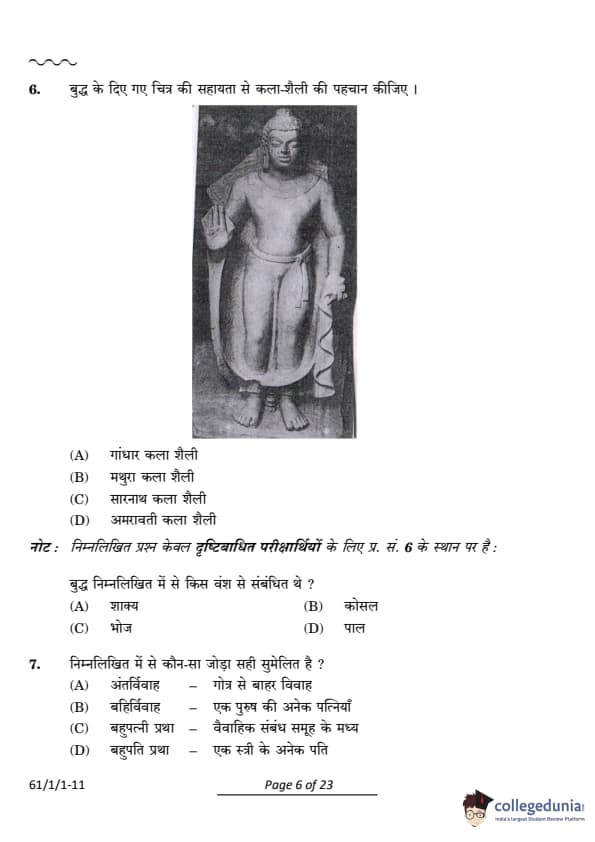
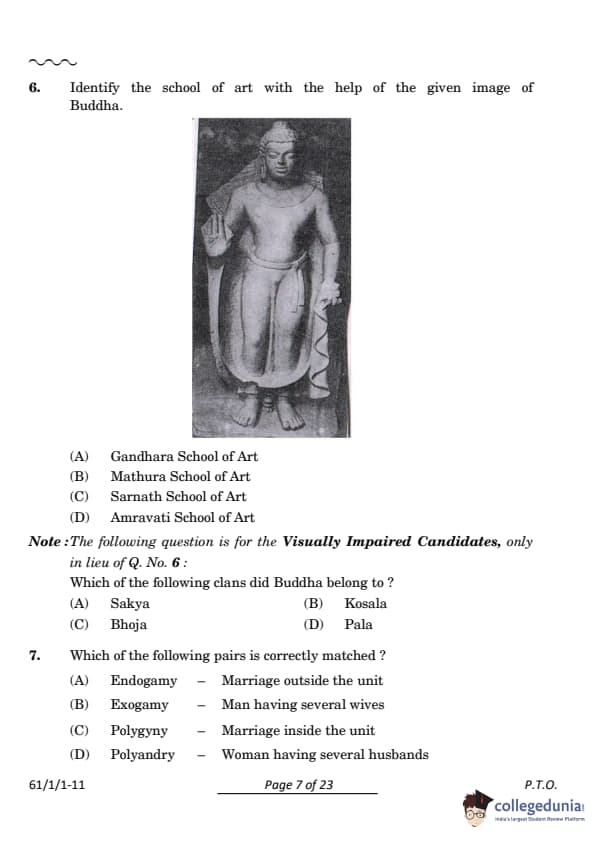
Identify the school of art with the help of the given image of Buddha.
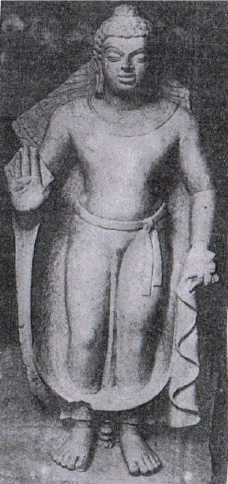
View Solution
Solution: Understanding the Schools of Art:
• This question asks to identify the school of art associated with the image of Buddha.
• We need to be familiar with the different styles to answer this question.
1: Analyzing the Mathura School of Art:
• The Buddha images of the Mathura school are made from red sandstone.
• They usually have a serene look with a bald head.
• The images also have wide eyes, a prominent nose, and a simple robe over the body.
2: Analyzing the Gandhara School of Art:
• The Gandhara style of Buddha's image is influenced by Greco Roman style.
• The images usually feature detailed musculature, wavy hair, and realistic facial features.
3: Analyzing the Sarnath School of Art:
• The images of the Sarnath school have a simple design and smooth drapery of the robe, and are made with buff colored stone.
• The images show more spiritual expression compared to the Mathura style.
4: Analyzing the Amravati School of Art:
• The Amravati School of Art is characterized by intricate carvings with narrative panels of scenes from Buddha's life.
• The images were found in Andhra Pradesh.
5: Conclusion
• From the image given, the features resemble the Mathura School of art.
Question 6 (Visually Impaired):
Which of the following clans did Buddha belong to?
View Solution
Solution: Understanding Buddha's Origin:
• This question for visually impaired candidates is asking about the clan to which Buddha belonged.
• Buddha was born in a clan of the Kshatriya caste.
1: Identifying the Sakya Clan:
• Buddha was born as Siddhartha Gautama in the Sakya clan in Lumbini which is in modern day Nepal.
• His father was the ruler of the Sakya clan.
2: Analyzing other options:
• Kosala was a Mahajanapada and was not related to Buddha's origin.
• Bhoja was a clan known from the ancient kingdoms of India.
• The Palas were a dynasty that came much later and had nothing to do with Buddha.
Question 7:
Which of the following pairs is correctly matched?
View Solution
Solution: Understanding the Terms:
• The question requires matching terms related to marriage practices with their correct definition.
1: Analyzing Endogamy:
• Endogamy is the practice of marrying within a specific social group, caste, or clan, not outside.
• Thus, this option is incorrect.
2: Analyzing Exogamy:
• Exogamy is the practice of marrying outside a specific group or clan.
• Therefore, this option is also incorrect.
3: Analyzing Polygyny:
• Polygyny is the practice of a man having multiple wives, not marriage inside a group.
• Therefore, this option is also incorrect.
4: Analyzing Polyandry:
• Polyandry is the practice of a woman having multiple husbands.
• This option is correctly matched.
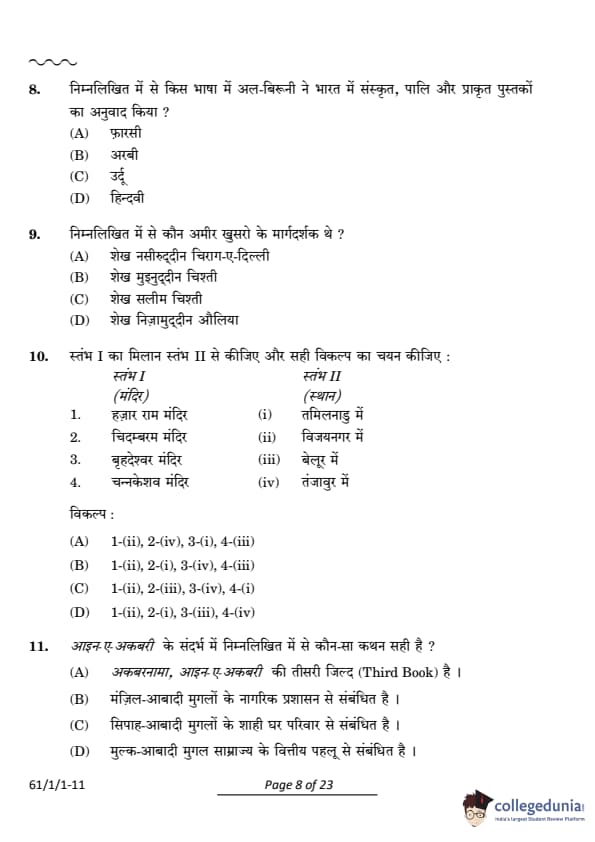
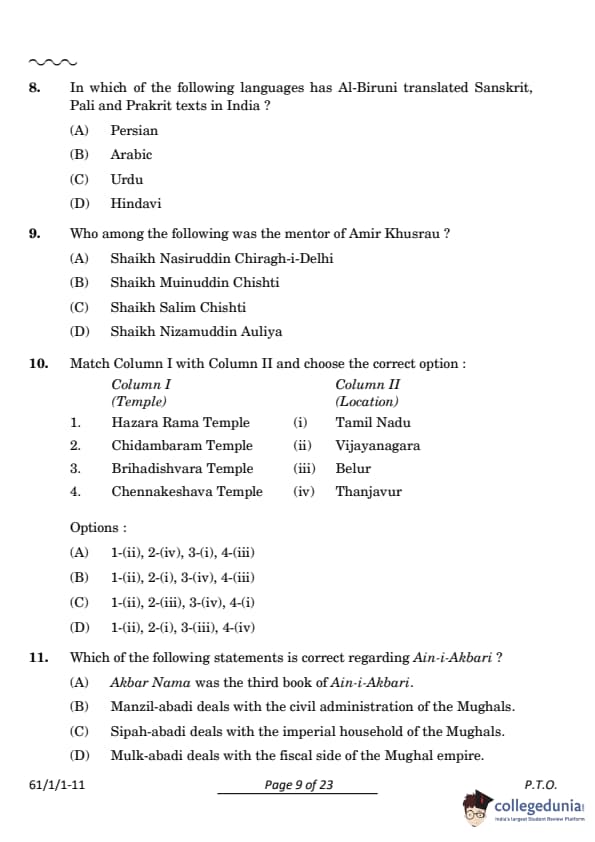
Question 8:
In which of the following languages has Al-Biruni translated Sanskrit, Pali and Prakrit texts in India?
View Solution
Solution: Understanding Al-Biruni:
• Al-Biruni was an 11th century scholar who travelled to India and studied ancient Indian texts and culture.
• He translated many ancient Indian texts into other languages.
1: Analyzing Al-Biruni's Language:
• Al-Biruni was an Arabic scholar.
• He translated the texts into Arabic to reach scholars in the Arabic speaking region.
2: Analyzing other options:
• Al-Biruni was not Persian or Urdu speaking.
• He did not translate the texts in Hindavi as he was an Arab scholar.
3: Conclusion
• Based on these facts, he translated the Indian texts into Arabic.
Question 9:
Who among the following was the mentor of Amir Khusrau?
View Solution
Solution: Understanding Amir Khusrau:
• Amir Khusrau was a 13th-14th century mystic poet and musician.
• He was also a prominent disciple of a famous Sufi Saint.
1: Identifying Shaikh Nizamuddin Auliya:
• Shaikh Nizamuddin Auliya was a Sufi saint of the Chishti order.
• Amir Khusrau was his beloved disciple, and was closely associated with the saint.
2: Analyzing other options:
• Shaikh Nasiruddin Chiragh-i-Delhi was a prominent Sufi saint, but not a mentor of Amir Khusrau.
• Shaikh Muinuddin Chishti was a famous Sufi saint, but he is not the mentor of Khusrau.
• Shaikh Salim Chishti was a famous Sufi saint of the Mughal era, he has no connection to Amir Khusrau.
Question 10:
Match Column I with Column II and choose the correct option :
| Column I (Temple) | Column II (Location) |
|---|---|
| 1. Hazara Rama Temple | (i) Tamil Nadu |
| 2. Chidambaram Temple | (ii) Vijayanagara |
| 3. Brihadishvara Temple | (iii) Belur |
| 4. Chennakeshava Temple | (iv) Thanjavur |
View Solution
Solution: Understanding the Temple Locations:
• The question asks to match well-known temples with their correct location.
• Knowledge of ancient and medieval sites is required for this question.
1: Matching Hazara Rama Temple:
• Hazara Rama Temple is located in Hampi, which was the capital of the Vijayanagara Empire.
• It is matched with (ii) Vijayanagara.
2: Matching Chidambaram Temple:
• Chidambaram temple is in Tamil Nadu.
• So it is matched with (i) Tamil Nadu.
3: Matching Brihadishvara Temple:
• Brihadishvara Temple, also known as the Big Temple, is in Thanjavur in Tamil Nadu.
• Therefore, it is matched with (iv) Thanjavur.
4: Matching Chennakeshava Temple:
• Chennakeshava Temple is located in Belur in Karnataka.
• Therefore it is matched with (iii) Belur.
5: Conclusion
• The correct match is 1-(ii), 2-(i), 3-(iv), 4-(iii)
Question 11:
Which of the following statements is correct regarding Ain-i-Akbari ?
View Solution
Solution: Understanding Ain-i-Akbari:
• The question requires knowledge about Ain-i-Akbari, the important text from the Mughal era.
1: Analyzing Akbar Nama and Ain-i-Akbari:
• The Ain-i-Akbari is the third part of Akbar Nama, not the other way around.
• Thus option (A) is incorrect.
2: Analyzing the sections of Ain-i-Akbari:
• Manzil-abadi in the Ain-i-Akbari refers to the imperial household and the upkeep of the household, not the civil administration.
• Thus, option (B) is incorrect.
3: Analyzing Sipah-abadi:
• Sipah-abadi in the Ain-i-Akbari refers to the military and army and not the imperial household.
• Thus option (C) is incorrect.
4: Analyzing Mulk-abadi:
• Mulk-abadi deals with the fiscal side of the Mughal Empire.
• This part provides details of revenue collection, land measurement, and taxation.
• Therefore, this option is correct.
5: Conclusion
• Based on the analysis, Option D is correct.
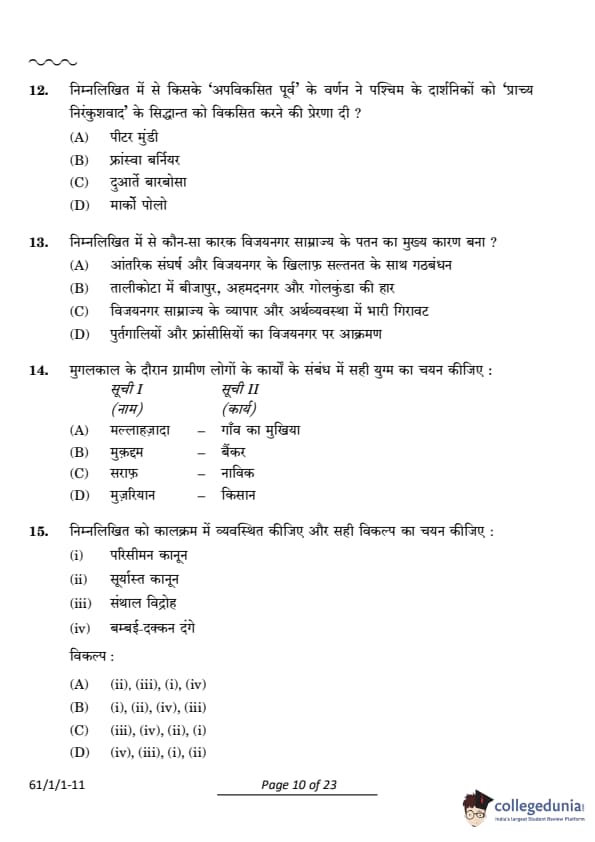
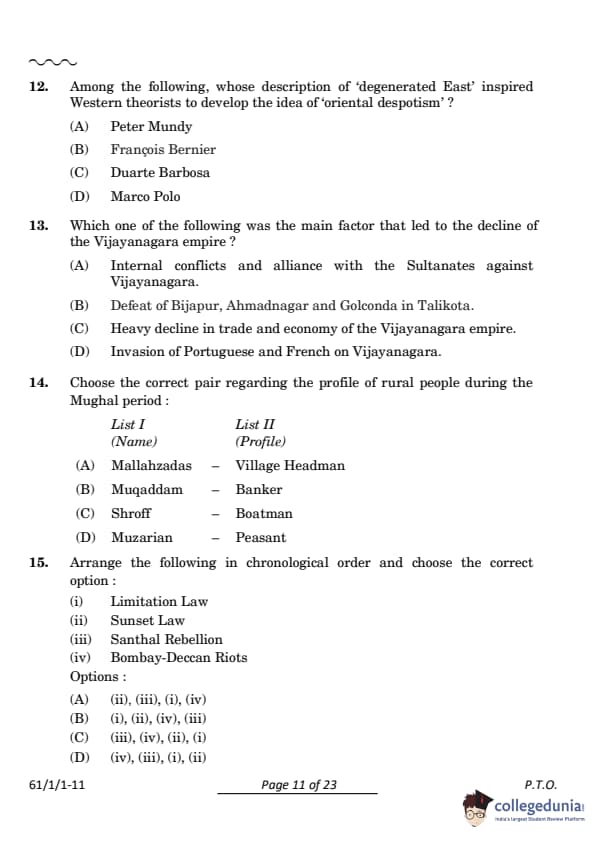
Question 12:
Among the following, whose description of ‘degenerated East' inspired Western theorists to develop the idea of 'oriental despotism'?
View Solution
Solution: Understanding Oriental Despotism:
• The question is about the concept of 'Oriental Despotism' and the traveler who provided descriptions that supported the idea.
• Oriental despotism is a term used in western discourse that refers to a form of absolute or tyrannical rule, which was associated with Asian societies.
1: Analyzing François Bernier:
• François Bernier was a French physician and traveler who visited India during the Mughal era.
• He wrote extensively about Mughal rule and portrayed it as despotic, centralized, and oppressive, which is often called Oriental Despotism.
2: Analyzing other options:
• Peter Mundy was an English traveler, but his writings are not known to be related to Oriental Despotism.
• Duarte Barbosa was a Portuguese writer but did not use the term oriental despotism.
• Marco Polo was a traveler of the earlier period, and not known to use this term.
3: Conclusion
• The descriptions provided by François Bernier have inspired the Western theorists to develop this idea.
Question 13:
Which one of the following was the main factor that led to the decline of the Vijayanagara empire ?
View Solution
Solution: Understanding the Decline of Vijayanagara:
• The question asks about the main reason that caused the decline of the Vijayanagara Empire.
• The Vijayanagara Empire was one of the major empires in medieval India.
1: Analyzing the Battle of Talikota:
• The Battle of Talikota was a major battle that took place in 1565 between the Vijayanagara army and the Deccan Sultanates.
• The defeat of the Vijayanagara army in the battle was a major blow.
2: Analyzing internal conflicts:
• While internal conflicts did weaken the Vijayanagara empire, the battle of Talikota was the main reason for its downfall.
3: Analyzing decline in trade and economy:
• Although the empire may have experienced decline in trade and economy, the defeat in the battle was the immediate cause.
4: Analyzing the invasions:
• Portuguese and French presence in India was in the later period, and they were not a factor in the fall of the Vijayanagara empire.
5: Conclusion
• The defeat of the Vijayanagara Empire in the battle of Talikota was the main reason for its downfall.
Question 14:
Choose the correct pair regarding the profile of rural people during the Mughal period :
| List I (Name) | List II (Profile) |
|---|---|
| (A) Mallahzadas | Village Headman |
| (B) Muqaddam | Banker |
| (C) Shroff | Boatman |
| (D) Muzarian | Peasant |
View Solution
Solution: Understanding Rural Occupations:
• The question requires matching the names of rural people with their occupations during the Mughal period.
1: Analyzing Muzarian:
• Muzarian refers to the peasants or cultivators who were engaged in farming activities in Mughal rural society.
2: Analyzing Mallahzadas:
• Mallahzadas were village headmen, and not boatmen.
• The headmen were important figures in the villages during the Mughal period.
3: Analyzing Muqaddam:
• Muqaddam was a village headman and not a banker.
4: Analyzing Shroff:
• Shroffs were bankers or money lenders.
• Therefore this option is incorrect.
5: Conclusion
• Therefore only option (D) is correct.
Question 15:
Arrange the following in chronological order and choose the correct option :
• (i) Limitation Law
• (ii) Sunset Law
• (iii) Santhal Rebellion
• (iv) Bombay-Deccan Riots
View Solution
Solution: Understanding the Events:
• The question requires arranging laws and rebellions in chronological order.
• Understanding the timelines of events is important to solve this.
1: Establishing the Timeline:
• (ii) Sunset Law: This law was part of the Permanent Settlement introduced by Lord Cornwallis in 1793.
• (iii) Santhal Rebellion: The Santhal Rebellion was in 1855-1856.
• (i) Limitation Law: The Limitation Law was enacted in 1859.
• (iv) Bombay-Deccan Riots: The Bombay-Deccan riots occurred in 1875.
2: Creating the Correct Order:
• Based on these timelines the correct sequence is (ii), (iii), (i), (iv).
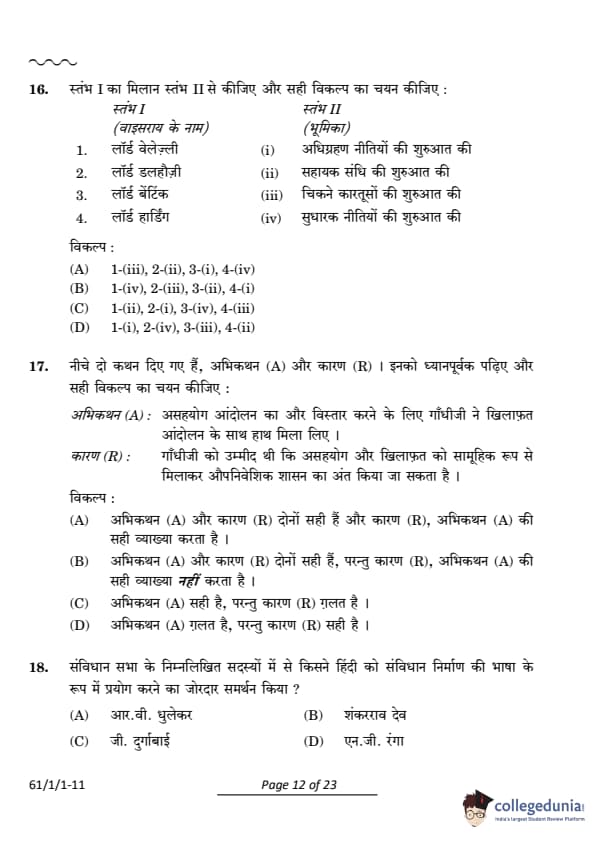
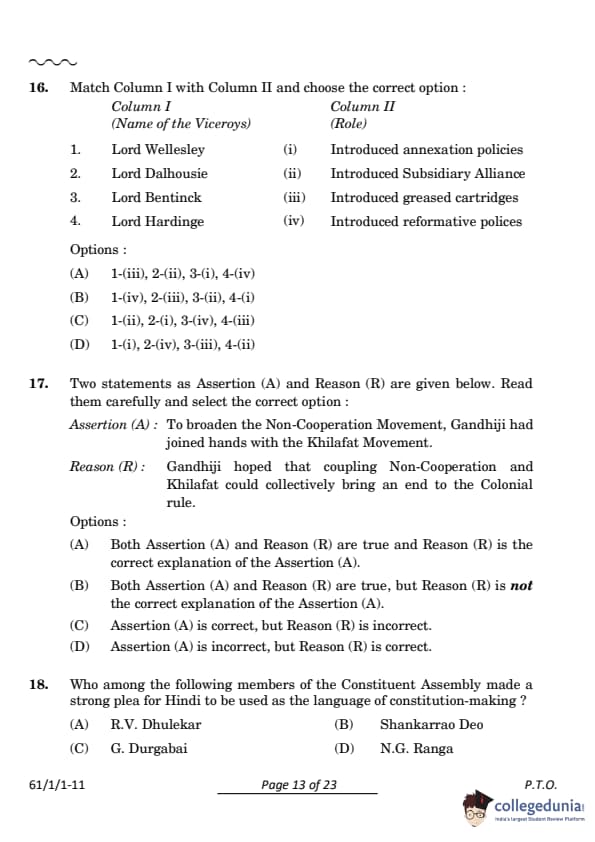
Question 16:
Match Column I with Column II and choose the correct option :
| Column I (Name of the Viceroys) | Column II (Role) |
|---|---|
| 1. Lord Wellesley | (ii) Introduced Subsidiary Alliance |
| 2. Lord Dalhousie | (i) Introduced annexation policies |
| 3. Lord Bentinck | (iv) Introduced reformative polices |
| 4. Lord Hardinge | (iii) Introduced greased cartridges |
View Solution
Solution: Understanding Viceroys and their Policies:
• The question is about matching the Viceroys with their policies during British Rule.
1: Matching Lord Wellesley:
• Lord Wellesley was known for introducing the policy of Subsidiary Alliance.
• Thus, he is matched with (ii).
2: Matching Lord Dalhousie:
• Lord Dalhousie was known for his policy of annexation of princely states.
• Therefore, he is matched with (i).
3: Matching Lord Bentinck:
• Lord Bentinck was known for introducing reformative policies like banning Sati and suppression of Thuggee.
• Therefore, he is matched with (iv).
4: Matching Lord Hardinge:
• Lord Hardinge was associated with the introduction of greased cartridges which were a trigger of the 1857 revolt.
• He is matched with (iii).
5: Conclusion
• The correct match is 1-(ii), 2-(i), 3-(iv), 4-(iii).
Question 17:
Two statements as Assertion (A) and Reason (R) are given below. Read them carefully and select the correct option :
• Assertion (A): To broaden the Non-Cooperation Movement, Gandhiji had joined hands with the Khilafat Movement.
• Reason (R) : Gandhiji hoped that coupling Non-Cooperation and Khilafat could collectively bring an end to the Colonial rule.
View Solution
Solution: Understanding the Statements:
• The question presents an Assertion and a Reason, and we need to establish their validity and relationship.
1: Analyzing Assertion (A):
• Assertion (A) states that Gandhi joined the Khilafat movement to broaden the Non-cooperation movement.
• This is a correct statement, Gandhi did indeed join the Khilafat cause to unite Hindus and Muslims.
2: Analyzing Reason (R):
• Reason (R) states that Gandhiji thought joining Khilafat and Non-cooperation movement would lead to an end to Colonial rule.
• This is also a correct statement, as it was Gandhi's hope.
3: Establishing Connection:
• The Reason correctly explains why Gandhi joined hands with Khilafat movement, to collectively challenge colonial rule by uniting all communities.
• Therefore, the Reason is the correct explanation of the Assertion.
Question 18:
Who among the following members of the Constituent Assembly made a strong plea for Hindi to be used as the language of constitution-making?
View Solution
Solution: Understanding the Question:
• The question asks to identify a member of the Constituent Assembly who strongly advocated for Hindi to be the language of the constitution.
1: Analyzing R.V. Dhulekar:
• R.V. Dhulekar was a strong advocate of Hindi.
• He made a very passionate plea for using Hindi during the constitution making process.
2: Analyzing other options:
• Shankarrao Deo was a freedom fighter and politician but was not known for supporting Hindi in the constituent assembly.
• G. Durgabai was a prominent member of the assembly, who is known for her contribution to social reforms.
• N.G. Ranga was a freedom fighter from Andhra and was not known to be a supporter of Hindi in the constituent assembly.
3: Conclusion
• Based on the information R.V. Dhulekar was a strong supporter of using Hindi for the constitution-making process.
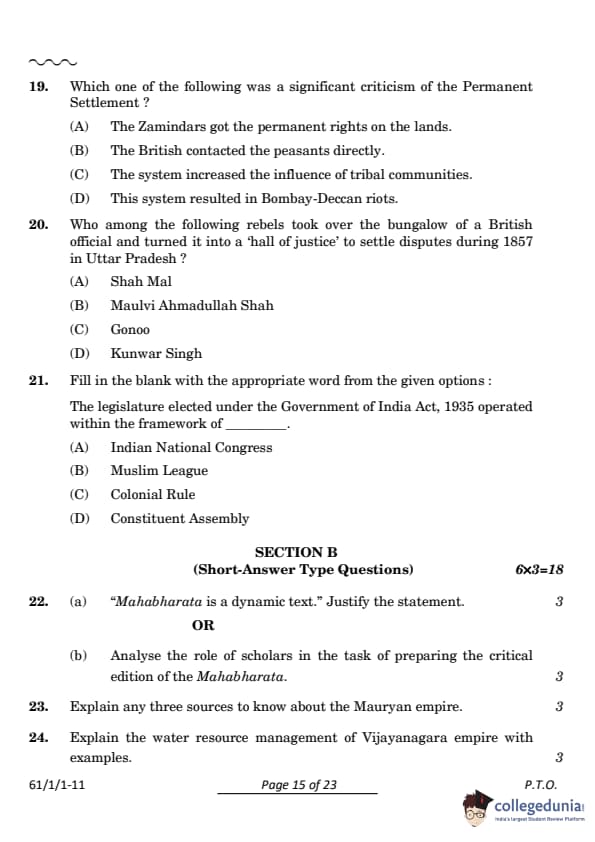
Question 19:
Which one of the following was a significant criticism of the Permanent Settlement ?
View Solution
Solution: Understanding the Permanent Settlement:
• The question asks about a significant criticism of the Permanent Settlement.
• The permanent settlement was introduced by Lord Cornwallis and was a land revenue system that was implemented in Bengal and other parts of India.
1: Analyzing Zamindars' Rights:
• The Permanent Settlement gave zamindars the permanent and hereditary ownership rights over the land.
• This was a main drawback of the system because this made them owners of the land instead of the cultivators.
2: Analyzing other options:
• The British did not contact peasants directly, rather they collected the revenue through the zamindars.
• It did not increase the influence of tribal communities.
• While it did have many negative impacts, the Bombay Deccan riots were a consequence of the Ryotwari system, and not the Permanent Settlement.
3: Conclusion
• Therefore, the correct answer is that Zamindars got permanent rights on the lands.
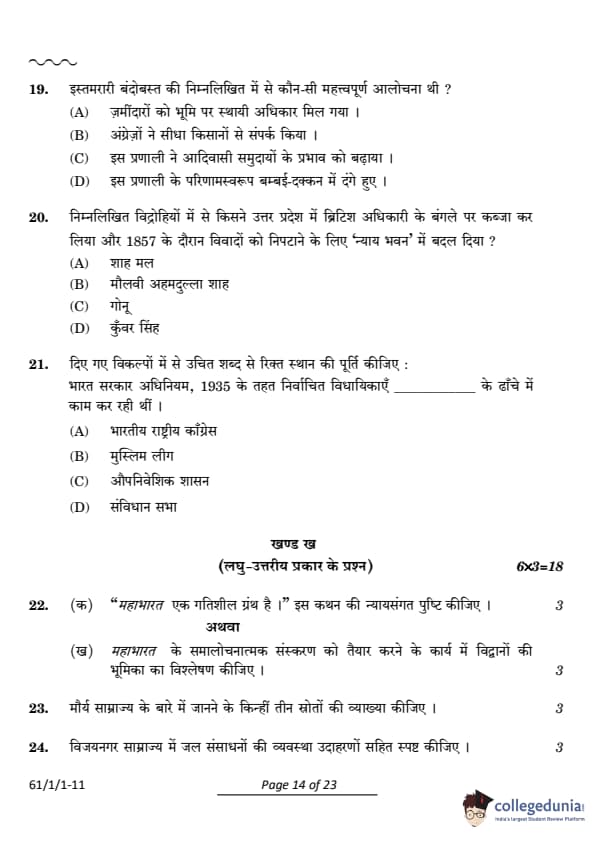
Question 20:
Who among the following rebels took over the bungalow of a British official and turned it into a 'hall of justice' to settle disputes during 1857 in Uttar Pradesh ?
View Solution
Solution: Understanding the Revolt of 1857:
• The question is about a rebel leader of the Revolt of 1857 who established a ‘hall of justice' during the revolt.
1: Identifying Shah Mal:
• Shah Mal was a local rebel leader in Uttar Pradesh.
• He is known to have seized the British official's bungalow and turned it into a hall of justice to settle disputes.
2: Analyzing other options:
• Maulvi Ahmadullah Shah was a well-known leader in the revolt but was not known to have captured bungalows.
• Gonoo was a tribal leader and not from Uttar Pradesh.
• Kunwar Singh was a leader in Bihar, and had no relation to the event in the question.
3: Conclusion
• Therefore, the correct answer is Shah Mal.
Question 21:
Fill in the blank with the appropriate word from the given options : The legislature elected under the Government of India Act, 1935 operated within the framework of __________.
View Solution
Solution: Understanding the Government of India Act 1935:
• The question asks about the framework in which the legislatures operated under the Government of India Act 1935.
1: Analyzing the Context:
• The Government of India Act 1935 was a British act that provided the framework of the Government in India at that time.
• It established provincial and federal structures of administration under colonial rule.
2: Identifying the correct framework:
• The legislatures that were elected under this act operated under the framework of the colonial rule.
• This act was made by the British parliament and not by Indian political parties or Constituent Assembly.
3: Ruling out other options:
• The Indian National Congress was not a framework but an organisation.
• Muslim league was also an organisation and not a framework.
• The constituent assembly came into existence after independence.
4: Conclusion
• Therefore the elected legislatures worked under the framework of Colonial Rule.
SECTION B
(Short-Answer Type Questions)
Section B
Question 22(a):
"Mahabharata is a dynamic text.” Justify the statement.
View Solution
Solution: Understanding Dynamic Text:
• The question asks to justify why the Mahabharata is considered a dynamic text.
• A dynamic text is one that has been interpreted and added to over time.
1: Multiple layers of stories:
• The Mahabharata consists of various interwoven stories and sub-stories.
• These have been continuously added to the original narrative, showing its flexibility and adaptability.
2: Various Languages and Versions:
• The Mahabharata has been written and translated in many different languages.
• Each version highlights the variations of the epic based on region, culture, and language.
3: Different Interpretations and Forms:
• The Mahabharata has various forms and interpretations.
• It is used in performing arts like dance, theatre, sculpting and painting.
4: Including Bhagavad Gita:
• The Bhagavad Gita is also a part of Mahabharata, which gives the text a more spiritual meaning.
• The Gita is also interpreted in many different ways.
5: Conclusion
• The Mahabharata is a dynamic text that has evolved over centuries, has many versions and multiple meanings.
Question 22(b):
Analyse the role of scholars in the task of preparing the critical edition of the Mahabharata.
View Solution
Solution: Understanding the Critical Edition:
• The question is asking to analyze the role of scholars in preparing the critical edition of the Mahabharata.
1: Initiation of the Project:
• The project to create a critical edition of the Mahabharata was initiated by V.S. Sukthankar and other scholars in 1919.
2: Collection of Manuscripts:
• The scholars collected manuscripts in various languages from different regions and analyzed them.
• It was a detailed task to find the manuscripts.
3: Identification of Variations:
• The scholars identified variations in the different manuscripts and decided on the verses based on their analyses.
4: Publication of Critical Edition:
• After long years of research, they published the critical edition of Mahabharata.
• It consisted of more than 13,000 pages.
5: Conclusion
• The scholars did a massive task of gathering, analysing, and publishing the critical edition of the epic.
Question 23:
Explain any three sources to know about the Mauryan Empire.
View Solution
Solution: Understanding the Mauryan Empire:
• The question is asking about any three sources to learn about Mauryan Empire.
1: Kautilya's Arthashastra:
• The Arthashastra is a treatise on statecraft, economy, and military strategy attributed to Kautilya.
• It provides detailed insights into the administration and political life of the Mauryan period.
2: Megasthenes' Indica:
• Megasthenes was a Greek ambassador to the court of Chandragupta Maurya.
• His book 'Indica' describes social, economic and political life during the Mauryan rule, although only fragments survive today.
3: Buddhist and Jain Literature:
• Texts from Buddhism and Jainism such as the Jatakas provide valuable information on social, political, and religious conditions of that time.
4: Analyzing other options:
• Ashokan inscriptions reveal many of the key policies of the emperor.
• Punch-marked coins of the period can tell us about the economy and trade.
• The dhamma and dhamma mahamatras of Asoka provides a lot of information on his policies.
Question 24:
Explain the water resource management of Vijayanagara empire with examples.
View Solution
Solution: Understanding Water Management in Vijayanagara:
• The question asks to explain water management during the Vijayanagara Empire.
• Water was a key resource in this empire, and hence was managed efficiently.
1: Use of the Tungabhadra River:
• The Tungabhadra River flows in a north-easterly direction, and provided the main source of water.
• The empire utilized the river for agriculture and urban use.
2: Building of Tanks and Reservoirs:
• The Kamalapuram tank is the most important tank that collected water and was used to irrigate the land and royal center.
• They also built many other embankments to create more reservoirs.
3: Canal Systems:
• Water was taken from the tanks using channels and canals to irrigate land and provide drinking water.
• The Hiriya canal was one of the most prominent water networks.
Question 25:
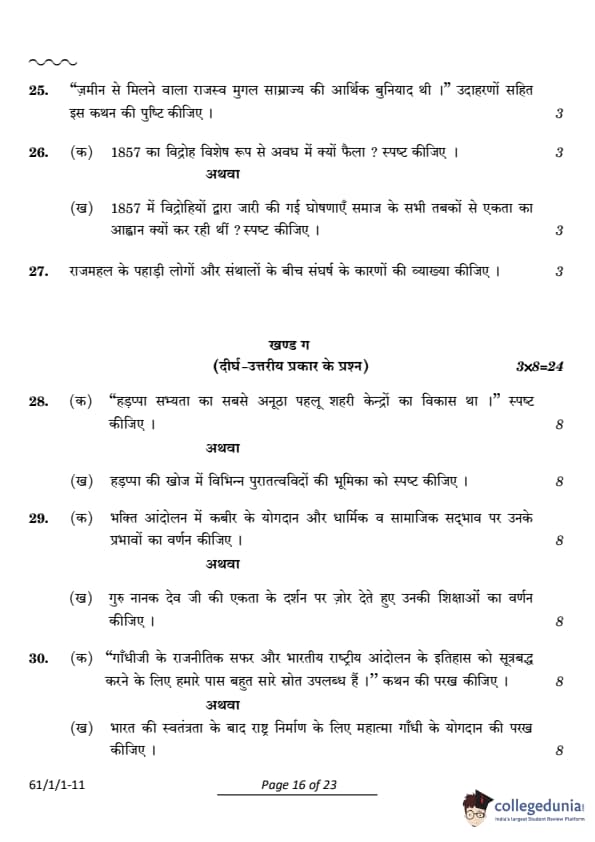
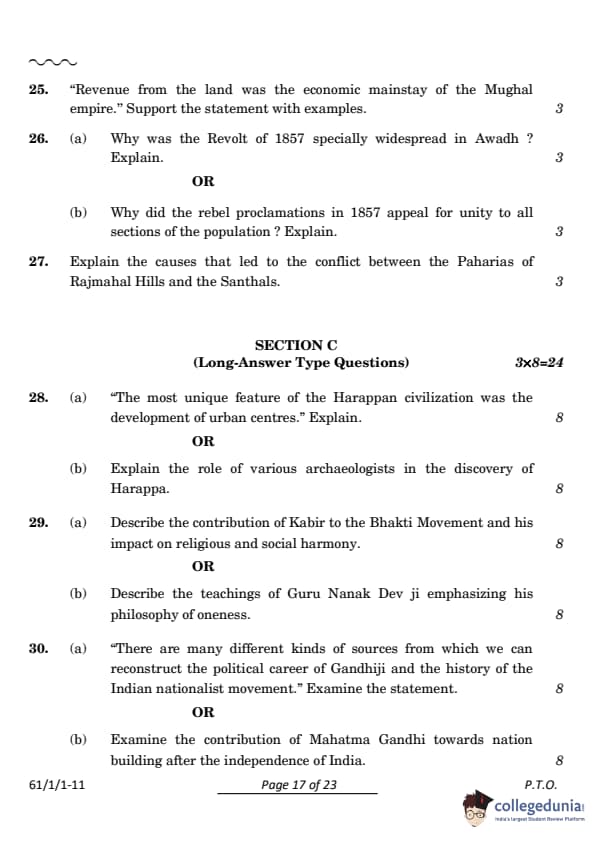
"Revenue from the land was the economic mainstay of the Mughal empire.” Support the statement with examples.
View Solution
Solution: Understanding Land Revenue:
• This question is asking to establish that land revenue was the economic mainstay of the Mughal empire.
• It is important to highlight the importance of agricultural revenue during the Mughal rule.
1: Importance of Agriculture:
• Agriculture was the primary occupation in Mughal India and it was the main source of the empire's income.
2: Administrative Apparatus:
• The Mughals established a structured administrative system to manage land revenue.
• This system collected, fixed and recorded revenue collection.
3: Classification of Land:
• Land was divided into four types Polaj, Parauti, Chachar, and Banjar based on its productivity.
• Land measurement was conducted in each province to assess the correct amount of revenue.
4: Revenue Collection:
• The revenue was collected from the peasants in both cash and kind.
• The total revenue collected is known as Jama, and the revenue that was obtained was called Hasil.
5: Ain-i-Akbari and Amir Guzar:
• The Ain-i-Akbari was a major source to know the details of the land revenue.
• Amir Guzar was the officer responsible for revenue collection.
Question 26(a):
Why was the Revolt of 1857 specially widespread in Awadh ? Explain.
View Solution
Solution: Understanding Awadh's Situation:
• The question asks to explain why the revolt of 1857 was especially widespread in Awadh.
• The revolt was widespread in North India and Awadh was a major center.
1: Subsidiary Alliance:
• The Subsidiary Alliance was imposed in Awadh in 1801, which weakened the Nawab's power.
• This created discontent in the area.
2: Annexation of Awadh:
• The British annexed Awadh in 1856 under the pretext of misrule by the Nawab.
• This angered the local nobility and sepoys.
3: Economic Distress:
• The British policies like the Summary Settlement of 1856 led to economic hardship for the people.
4: Discontent among Sepoys:
• Many of the sepoys in the British army were from Awadh.
• They were upset by the annexation of their homeland.
5: Impact on court culture:
• The removal of the Nawab led to the destruction of court culture and the loss of livelihood of many people related to it.
• All these factors made the revolt especially widespread in Awadh.
Question 26(b):
Why did the rebel proclamations in 1857 appeal for unity to all sections of the population ? Explain.
View Solution
Solution: Understanding the Appeal for Unity:
• The question asks why did the rebel proclamations of the 1857 revolt appeal for unity.
1: Appeal to all communities:
• The proclamations were aimed at uniting all communities irrespective of caste and creed.
• This was a conscious effort on the part of the rebel leaders.
2: Proclamations under Bahadur Shah's name:
• The Proclamations were issued under the name of Bahadur Shah.
• These appealed to people of all communities to join hands.
3: Attempts to incite Hindus and Muslims:
• The British tried to create a divide between Hindus and Muslims but these attempts failed.
4: Call for unity against common enemy:
• The Azamgarh proclamation described how both Hindus and Muslims were being destroyed by the British.
• It emphasized the need for unity against the common oppressor.
5: Participation of social groups:
• Many social groups joined the revolt calling for the unity of the country.
6: Conclusion
• The rebel leaders recognized the need for unity among all people against the British and hence the proclamations had a wide appeal.
Question 27:
Explain the causes that led to the conflict between the Paharias of Rajmahal Hills and the Santhals.
View Solution
Solution: Understanding the Conflict:
• The question asks for the reasons that led to the conflict between the Paharias and Santhals.
• Both were tribes that lived in the Rajmahal Hills region.
1: Paharias and Santhals:
• Paharias were the original inhabitants of the Rajmahal hills.
• The Santhals were brought in by the British and settled in the foothills.
2: Land Disputes:
• The land previously occupied by the Paharias came under the control of Santhals, which created conflict between them.
3: Damin-i-koh:
• In 1832, the British gave the land called Damin-i-koh to the Santhals.
• The Paharias had also earlier lived on this land which led to conflict between them.
4: Conflict over resources:
• The Santhals were mostly into agriculture while the Paharias preferred hunting.
• The change in the land use led to conflict over the resources between the tribes.
5: British Policies:
• The British created a divide between the two tribes by giving land to the Santhals and discriminating against the Paharias.
• This added to the conflict between the two groups.
6: Conclusion
• Due to all these factors, the relationship between the tribes deteriorated and resulted in conflict.
SECTION C
(Long-Answer Type Questions)
Question 28(a):
“The most unique feature of the Harappan civilization was the development of urban centres.” Explain.
View Solution
Solution: Understanding Harappan Urban Centers:
• The question asks to explain why the urban centers were the most unique feature of the Harappan civilization.
1: Planned Cities:
• The Harappan cities were known for their remarkable planning.
• They had a well-planned grid like system of streets, with houses built along the roads.
2: Citadel and Lower Town:
• The cities were divided into two parts; the citadel and lower town.
• The citadel was built on a higher ground and was used by the ruling class, while the lower town was meant for the common people.
3: Drainage System:
• The drainage system was one of the most sophisticated of its time, with covered drains and manholes.
• This provided proper sanitation and cleanliness.
4: Domestic Architecture:
• The cities featured well planned houses, often with multiple rooms, wells, and courtyards.
• Some houses even had stairs leading to a second level.
5: Other Key Features:
• Other key features included a Great Bath, a large warehouse, a dockyard, etc.
6: Conclusion
• The town planning, architecture, drainage system, and other unique structures make it an important civilization.
Question 28(b):
Explain the role of various archaeologists in the discovery of Harappa.
View Solution
Solution: Understanding Harappan Discovery:
• The question asks to explain the role of the different archeologists in the discovery of Harappa.
1: Cunningham's Confusion:
• Alexander Cunningham, the first Director-General of the Archaeological Survey of India (ASI), visited Harappa in the 19th century.
• He did not realize its historical importance.
2: Daya Ram Sahni's Contribution:
• Daya Ram Sahni was a key archaeologist who discovered seals at Harappa in 1921, recognizing its importance.
3: Rakhal Das Banerjee's Contribution:
• Rakhal Das Banerjee discovered seals at Mohenjo-daro in 1922 and helped to discover another urban centre.
4: John Marshall's Announcement:
• John Marshall, who was the Director-General of ASI, announced the discovery of a new civilization in the Indus valley.
5: Other contributions:
• S.N. Roy noted it in his book called "The story of Indian Archeology".
• R.E.M. Wheeler suggested the following of stratigraphy for the surveys in the site.
6: Conclusion
• The discovery was made possible by the contributions of various archaeologists over a period of time.
Question 29(a):
Describe the contribution of Kabir to the Bhakti Movement and his impact on religious and social harmony.
View Solution
Solution: Understanding Kabir's Contribution:
• This question asks about the contribution of Kabir to the Bhakti movement and his impact.
• Kabir was an important figure in the Bhakti tradition.
1: Kabir's life:
• Kabir was an important poet-saint of the 14th-15th centuries.
• He was a weaver by profession and his background is not clearly known.
2: Verses and traditions:
• The verses ascribed to Kabir have been compiled in many different traditions.
• These compilations include Kabir Bijak, Kabir Granthavali, and the Adi Granth.
3: Philosophical Contributions:
• Kabir's poems are a source to understand his philosophies of equality, love and devotion.
• His poems are in many languages.
4: Religious and Social Harmony:
• Kabir drew ideas from multiple traditions such as Vedantic traditions and Sufi traditions.
• He criticized idol worship, polytheism and ritualism.
5: Impact on Society:
• Kabir's teachings were against social inequality and caste system.
6: Conclusion
• Kabir's poems and teachings promoted love, devotion and harmony which have an impact on society and religion even today.
Question 29(b):
Describe the teachings of Guru Nanak Dev ji emphasizing his philosophy of oneness.
View Solution
Solution: Understanding Guru Nanak's Teachings:
• The question asks about the teachings of Guru Nanak Dev, emphasizing his philosophy of oneness.
• Guru Nanak was the founder of Sikhism and his teachings emphasize the concept of one God.
1: Concept of One God:
• Guru Nanak advocated the concept of 'Ek Onkar' - one God that is formless.
• He believed in Nirguna Bhakti (devotion to a formless God).
2: Rejection of Rituals:
• Guru Nanak opposed the practices of idol worship, sacrifices, and rituals.
• He emphasized devotion and truthfulness.
3: Importance of Divine Love:
• He taught to connect with the divine.
• He expressed his ideas through hymns and Shabad.
4: Establishing a congregation:
• He set up rules for congregational worship with the establishment of Sangat, a place for community worship.
• His successor Guru Angad Dev ji compiled the teaching into Adi Granth Sahib and Gurbani.
5: Khalsa Panth:
• Guru Nanak emphasized equality, which was established by the tenth Guru, Guru Govind Singh, who started the Khalsa Panth.
6: Conclusion
• Guru Nanak's philosophy focused on the concept of one God and the importance of living a truthful, honest and compassionate life.
Question 30(a):
“There are many different kinds of sources from which we can reconstruct the political career of Gandhiji and the history of the Indian nationalist movement.” Examine the statement.
View Solution
Solution: Understanding Sources for Gandhiji:
• The question highlights that there are many types of sources to know about Gandhi and the nationalist movement.
• Many of the sources are different from other periods because of the presence of media and large-scale documentation.
1: Private Letters and Writings:
• Gandhi's private letters and writings such as ‘Hind Swaraj' provide insight into his ideology.
2: Public Statements and Speeches:
• Gandhi's public speeches, journals, and statements provide a lot of information on his political career.
3: Journals and Newspaper:
• His journals such as 'Harijan' and the contemporary newspapers provide information on the reactions to his activities.
4: Autobiographical Sources:
• His autobiography, ‘My Experiments with Truth' provides valuable insights into his personal journey.
5: Government and Police Records:
• The government and police records provide details of his movements and activities.
6: Conclusion
• These different types of sources help to reconstruct the political life of Gandhi and the events of the National movement.
Question 30(b):
Examine the contribution of Mahatma Gandhi towards nation building after the independence of India.
View Solution
Solution: Understanding Gandhi's Role Post-Independence:
• The question asks about the contributions of Gandhi in the nation building process after independence.
• His focus was on peace, equality, and social harmony.
1: Promoting Hindu-Muslim Unity:
• Gandhi worked to bring unity between the Hindus and Muslims after the partition of the country.
• He stressed that all religions should be treated equally.
2: Advocating for Minority Rights:
• He advocated for the rights of the minorities.
• He spoke about the rights of the untouchables, who were later called Harijans.
3: Emphasis on Secular State:
• He advocated for a democratic and secular state, where all communities could live equally.
4: Importance of Citizens' Rights:
• He emphasized that the citizens should have all rights, and that they should be respected.
5: Promoting Unity and Ideology:
• He encouraged all classes to live peacefully and with equality.
• He encouraged people to use khadi and follow his path of truth and nonviolence.
6: Conclusion
• Gandhi's ideas continued to influence the nation after independence, and still do.
SECTION D
(Source-Based Questions)
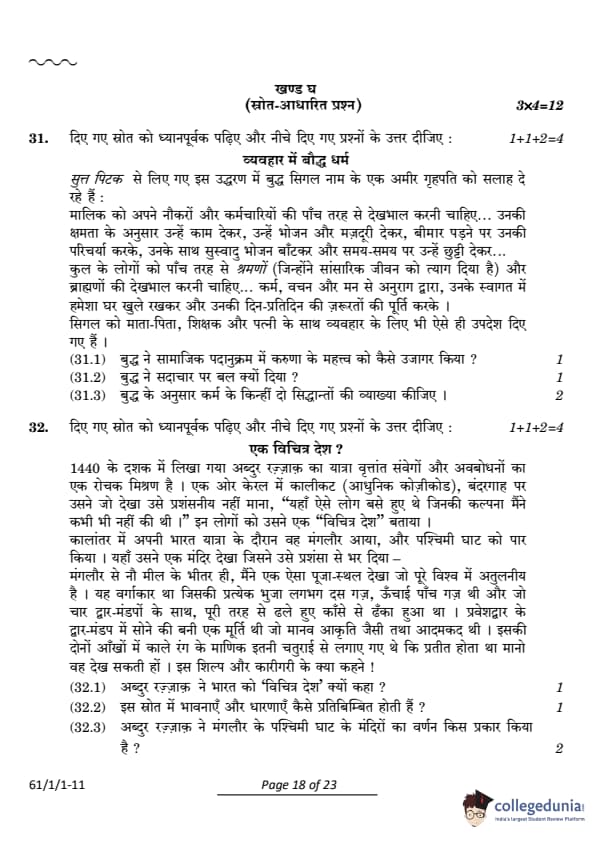
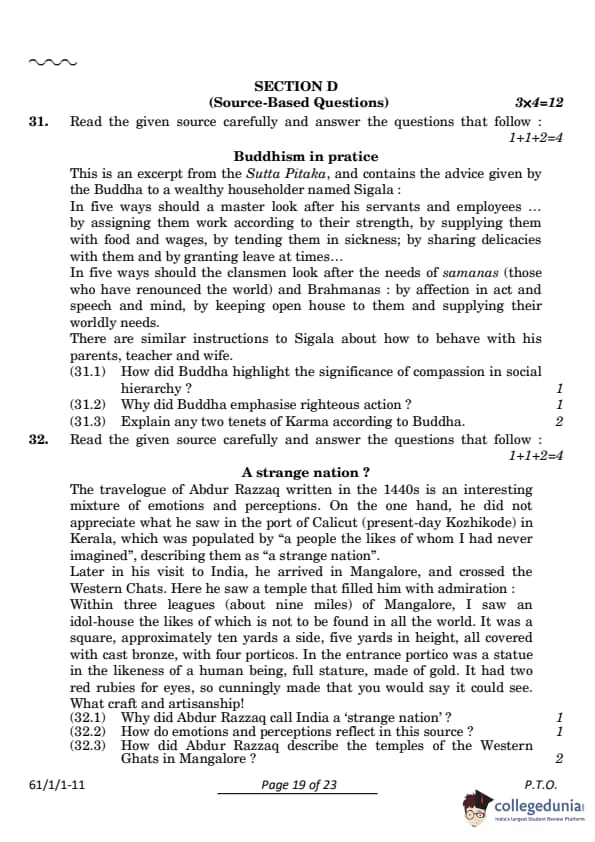
Question 31:
Read the given source carefully and answer the questions that follow :
Buddhism in practice This is an excerpt from the Sutta Pitaka, and contains the advice given by the Buddha to a wealthy householder named Sigala: In five ways should a master look after his servants and employees ...by assigning them work according to their strength, by supplying them with food and wages, by tending them in sickness; by sharing delicacies with them and by granting leave at times... In five ways should the clansmen look after the needs of samanas (those who have renounced the world) and Brahmanas : by affection in act and speech and mind, by keeping open house to them and supplying their worldly needs. There are similar instructions to Sigala about how to behave with his parents, teacher and wife.
View Solution
Solution: Understanding the Source:
• The source is an excerpt from Sutta Pitaka where Buddha is giving advice to Sigala.
• He is advising Sigala on how to deal with his servants, employees, Samanas and Brahmans.
31.1 How did Buddha highlight the significance of compassion in social hierarchy?
• Buddha highlights equality of all beings.
• He advises to treat all with respect.
31.2 Why did Buddha emphasise righteous action?
• Buddha emphasized actions such as kindness and generosity.
• He also talked about purification of the mind for achieving nibbana.
31.3 Explain any two tenets of Karma according to Buddha.
• Buddha emphasized that Karma should generate positive action and harmony.
• He believed that karma leads to peace and cohesiveness.
Question 32:
Read the given source carefully and answer the questions that follow :
A strange nation ? The travelogue of Abdur Razzaq written in the 1440s is an interesting mixture of emotions and perceptions. On the one hand, he did not appreciate what he saw in the port of Calicut (present-day Kozhikode) in Kerala, which was populated by “a people the likes of whom I had never imagined”, describing them as “a strange nation”. Later in his visit to India, he arrived in Mangalore, and crossed the Western Chats. Here he saw a temple that filled him with admiration : Within three leagues (about nine miles) of Mangalore, I saw an idol-house the likes of which is not to be found in all the world. It was a square, approximately ten yards a side, five yards in height, all covered with cast bronze, with four porticos. In the entrance portico was a statue in the likeness of a human being, full stature, made of gold. It had two red rubies for eyes, so cunningly made that you would say it could see. What craft and artisanship!//
View Solution
Solution: Understanding the Source:
• The source is from Abdur Razzaq's travelogue of 1440's.
• It describes the feelings and perceptions of the author as he traveled in different regions.
32.1 Why did Abdur Razzaq call India a ‘strange nation'?
• Abdur Razzaq called India strange as it was unfamiliar to him.
• He also found the cultural practices to be different from what he was used to.
32.2 How do emotions and perceptions reflect in this source ?
• The travelogue shows both admiration and confusion about India.
• He was astonished by what he saw at Calicut and in the temples of Mangalore.
32.3 How did Abdur Razzaq describe the temples of the Western Ghats in Mangalore ?
• Abdur Razzaq described the temples of Mangalore with awe.
• He noted the bronze entrance, and the statue made of gold with rubies for the eyes.
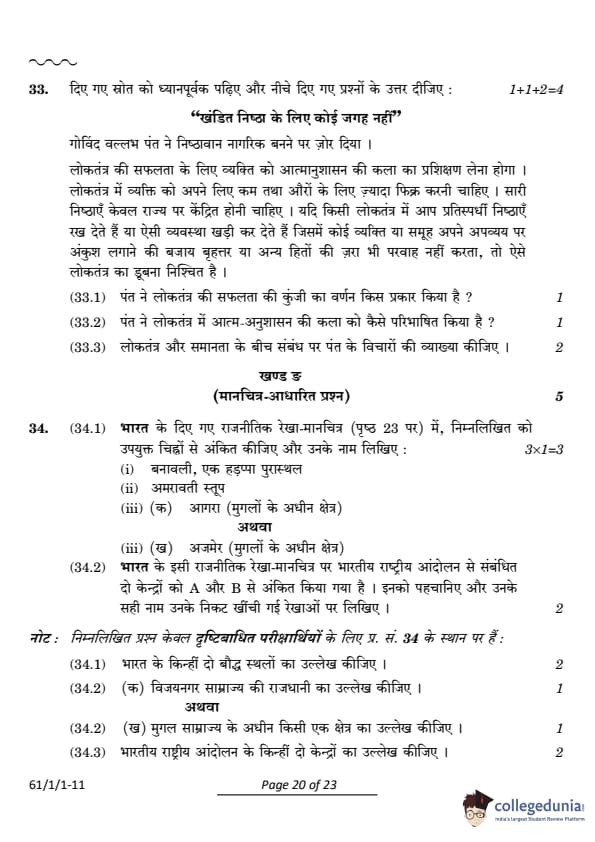
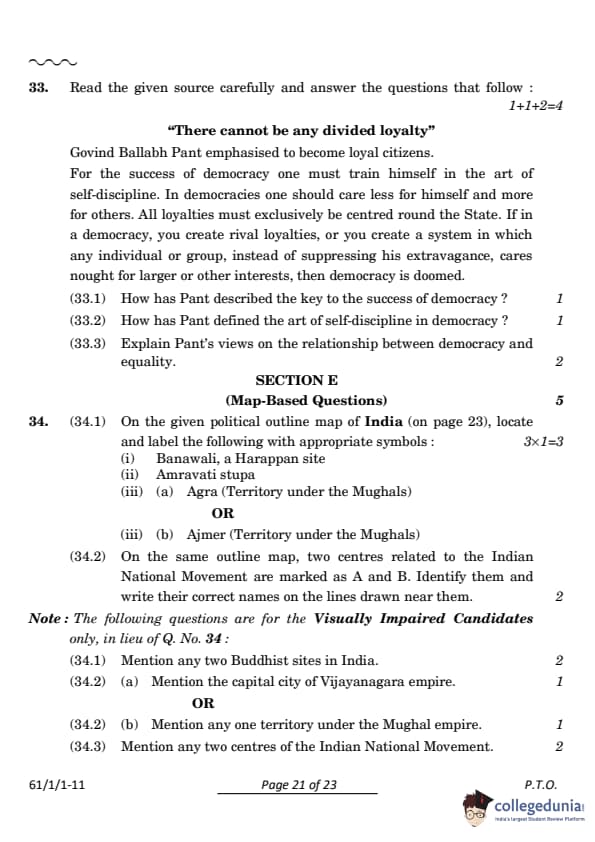
Question 33:
Read the given source carefully and answer the questions that follow :
"There cannot be any divided loyalty" Govind Ballabh Pant emphasised to become loyal citizens. For the success of democracy one must train himself in the art of self-discipline. In democracies one should care less for himself and more for others. All loyalties must exclusively be centred round the State. If in a democracy, you create rival loyalties, or you create a system in which any individual or group, instead of suppressing his extravagance, cares nought for larger or other interests, then democracy is doomed.
View Solution
Solution: Understanding the Source:
• The source is an excerpt where Govind Ballabh Pant is talking about the need for loyal citizens in a democracy.
• He emphasizes the need for self discipline for citizens in a democracy.
33.1 How has Pant described the key to the success of democracy?
• Pant emphasizes that democracy requires self-discipline from its citizens.
• He believed that citizens should prioritize the community over themselves.
33.2 How has Pant defined the art of self-discipline in democracy?
• He says that self-discipline means the ability to control one's actions and desires.
• This helps in the smooth running of democracy.
• It is also suitable for a plural country.
33.3 Explain Pant's views on the relationship between democracy and equality.
• Pant emphasizes that for democracy to be a success all loyalties should be centered around the state.
• He believed that it requires all citizens to prioritize larger goals and equality for all.
SECTION E
(Map-Based Questions)
Question 34(a):
On the given political outline map of India (on page 23), locate and label the following with appropriate symbols :
• (i) Banawali, a Harappan site
• (ii) Amravati stupa
• (iii) (A) Agra (Territory under the Mughals) OR (iii) (b) Ajmer (Territory under the Mughals)
View Solution
Solution: Understanding Map Marking:
• The question requires locating and labeling the given sites on the map of India.
1: Locating Banawali:
• Banawali is a Harappan site located in present day Haryana.
• Mark the site with a symbol and label it "Banawali” on the map.
2: Locating Amravati Stupa:
• Amravati stupa is located in present day Andhra Pradesh.
• Mark the site with a symbol and label it as "Amravati”.
3: Locating Agra or Ajmer:
• Agra: Agra is a city in present-day Uttar Pradesh, and is a territory under the Mughals.
• Mark the site with a symbol and label it as "Agra".
• Ajmer: Ajmer is a city in Rajasthan, and is also a territory under the Mughals.
• If choosing this option then label it "Ajmer”.
Question 34(b):
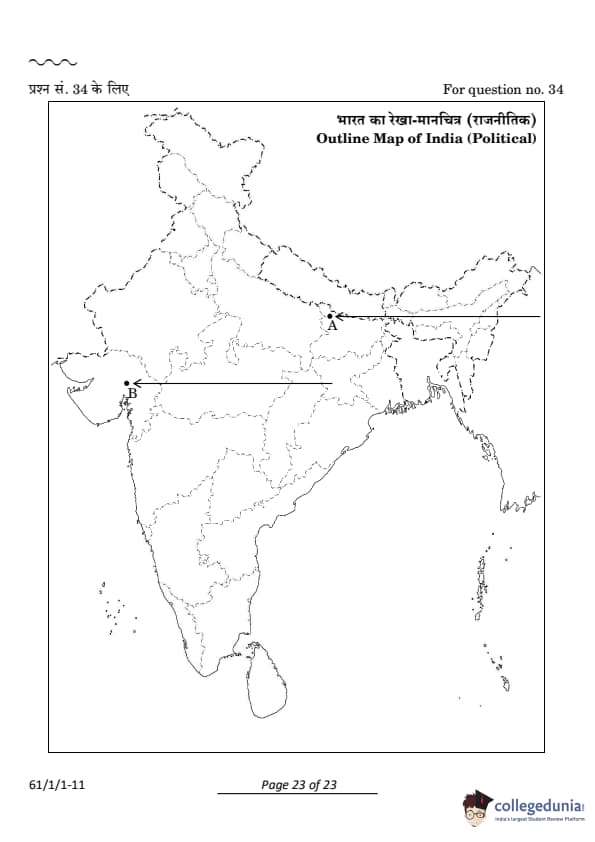
On the same outline map, two centres related to the Indian National Movement are marked as A and B. Identify them and write their correct names on the lines drawn near them.
View Solution
Solution: Understanding the Map:
• The question requires to identify and label the given locations from the Indian National Movement on a map.
1: Identifying Center A:
• If A is marked near Gujarat then it will be the site of Ahmedabad which was an important center in the nationalist movement.
• Label this "Ahmedabad” on the map.
2: Identifying Center B:
• If B is marked near modern day Bihar then it will be the site of Champaran, which is where the Satyagraha took place.
• Label this as "Champaran".
Question 34.1 (Visually Impaired):
Mention any two Buddhist sites in India.
View Solution
Solution: Understanding Buddhist Sites:
• This question for visually impaired candidates asks for any two Buddhist sites in India.
1: Mentioning Buddhist Sites:
• Some of the important Buddhist sites in India are: Sanchi, Amravati, Nagarjunakonda, Lumbini, Barhut, Bodh Gaya, Ajanta, Kusinagara, Nasik.
• Mention any two of the above.
Question 34.2 (a) (Visually Impaired):
Mention the capital city of Vijayanagara empire.
View Solution
Solution: Understanding Vijayanagara:
• This question asks for the capital city of the Vijayanagara empire.
1: Capital of the empire:
• The capital city of the Vijayanagara empire was Hampi, also called Vijaynagara.
Question 34.2 (b) (Visually Impaired):
Mention any one territory under the Mughal empire.
View Solution
Solution: Understanding the Mughal Territories:
• This question asks to mention any one territory under the Mughal rule.
1: Naming a Mughal Territory:
• Some of the territories under the Mughal rule were Delhi, Agra, Panipat, Amber, Ajmer, Lahore, Goa.
• Choose any one territory to mention in your answer.
Question 34.3 (Visually Impaired):
Mention any two centres of the Indian National Movement.
View Solution
Solution: Understanding National Movement Centres:
• The question asks to name two centers of the Indian National Movement.
1: Naming the Centers:
• Some of the important centers of the Indian National Movement are: Champaran, Kheda, Ahmedabad, Benaras, Amritsar, Chauri Chaura, Lahore, Bardoli, Dandi, Bombay, and Karachi.
• Mention any two of the above.




Comments