




CBSE Class 12 History Set 1 Question Paper PDF (Code: 61/2/1) is now available for download. CBSE conducted the Class 12 History examination on March 28, 2024, from 10:30 AM to 1:30 PM. The question paper consists of 34 questions carrying a total of 80 marks. Section A includes 21 MCQs for 1 mark each, Section B contains 6 short-answer questions for 3 marks each, Section C comprises 3 long-answer questions for 8 marks each, Section D comprises 3 Source-based questions having three sub-questions carries 4 marks each and Section E comprises 1 Map-based question that carries 5 marks. Candidates can use the link below to download the CBSE Class 12 History Set 1 Question Paper with detailed solutions.
CBSE Class 12 History Question Paper 2024 (Set 1- 61/2/1) with Answer Key
| CBSE Class 12 2024 History Question Paper with Answer Key |  Download Download |
Check Solution |
CBSE Class 12 2024 History Questions with Solutions
SECTION A
(Multiple Choice Type Questions)
Question 1:
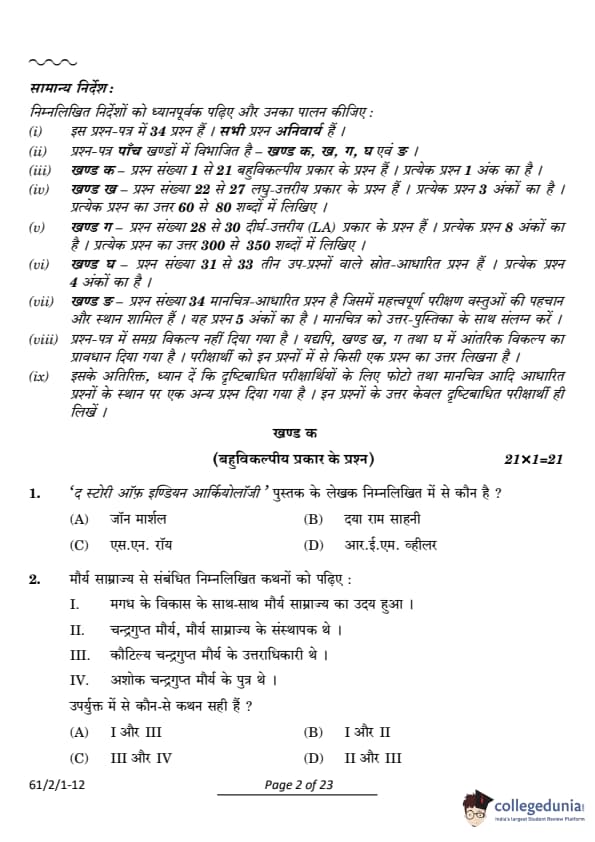
Who among the following is the author of the book 'The Story of Indian Archaeology'?
View Solution
Solution: Understanding the Question:
• The question asks us to identify the author of the book titled "The Story of Indian Archaeology".
• To answer correctly, we need knowledge of prominent figures in Indian archaeology and their associated works.
1: Analyzing the Options:
(A) John Marshall: While John Marshall was a significant figure as the Director-General of the Archaeological Survey of India (ASI) and is known for his work at Mohenjo-daro, he is not the author of the book in question.
(B) Daya Ram Sahni: Daya Ram Sahni was an important archaeologist involved in the discovery of Harappa, but he is not known as the author of "The Story of Indian Archaeology."
(C) S.N. Roy: S.N. Roy is, in fact, the author of "The Story of Indian Archaeology”.
(D) R.E.M. Wheeler: R.E.M. Wheeler was also a Director-General of ASI and contributed to Indian archaeology, but he is not the author of this book.
2: Conclusion
• Based on the analysis, the correct author of "The Story of Indian Archaeology” is S.N. Roy.
Question 2:
Read the following statements about the Mauryan Empire :
• I. The growth of Magadha culminated in the emergence of the Mauryan Empire.
• II. Chandragupta Maurya founded the Mauryan Empire.
• III. Kautilya was the successor of Chandragupta Maurya.
• IV. Asoka was the son of Chandragupta Maurya.
Which of the above statements are correct?
View Solution
Solution: Understanding the Mauryan Empire:
• The question asks to identify the correct statements from a set of statements regarding the Mauryan Empire.
• To do this effectively, we need to have a basic understanding of the Mauryan Empire's history.
1: Analyzing Each Statement:
Statement I: "The growth of Magadha culminated in the emergence of the Mauryan Empire.” This statement is accurate. The Mauryan Empire emerged after Magadha became powerful.
Statement II: "Chandragupta Maurya founded the Mauryan Empire." This is also correct. Chandragupta Maurya is known as the founder of the Mauryan Empire.
Statement III: "Kautilya was the successor of Chandragupta Maurya.” This statement is incorrect. Kautilya (also known as Chanakya) was Chandragupta Maurya's advisor and not his successor.
Statement IV: ”Asoka was the son of Chandragupta Maurya.” This statement is also incorrect. Asoka was the grandson of Chandragupta Maurya, the son of Bindusara.
2: Identifying Correct Statements:
• Based on the analysis, only statements I and II are correct.
Question 3:
Identify the ancient dynasty with the help of the following information :
• They issued spectacular gold coins.
• Their history can be reconstructed through Prashastis.
• Harisena was the court poet of one of its rulers.
View Solution
Solution: Understanding the Clues:
• The prompt provides key characteristics of an ancient Indian dynasty.
• These characteristics are: issuing gold coins, the use of Prashastis for historical reconstruction, and the presence of a court poet named Harisena.
1: Analyzing Gold Coin Issue:
• The Gupta Dynasty is well known for the large scale issuance of gold coins, indicating economic prosperity and a sophisticated empire.
• The gold coins of the Guptas are considered to be the most spectacular and aesthetically pleasing coins of ancient India.
2: Analyzing Prashastis:
• The use of Prashastis (inscriptions praising a ruler and their achievements) is also a significant marker for the Gupta Dynasty.
• These inscriptions often provide detailed accounts of the dynasty's accomplishments and lineage.
3: Analyzing Harisena's Presence:
• The presence of Harisena, a court poet, further confirms that the clues point toward the Gupta dynasty.
• Harisena was the court poet of Samudragupta, a significant ruler of the Gupta dynasty.
4: Conclusion
• Therefore, based on these clues, the dynasty described is the Gupta Dynasty.
Question 4:
Panini's book 'Ashtadhyayi' is based on which of the following themes?
View Solution
Solution: Understanding the Text:
• The question asks for the thematic subject of Panini's book called ‘Ashtadhyayi'.
1: Analyzing 'Ashtadhyayi':
• 'Ashtadhyayi' is a highly sophisticated and complex text in ancient India.
• The word 'Ashtadhyayi' itself translates to 'Eight Chapters', which hints at the structure and subject of the text.
2: Identifying the Theme:
• This text is primarily focused on the rules and structures of Sanskrit Grammar.
• 'Ashtadhyayi' provides detailed explanations on morphology, syntax, and phonetics, essential elements of language.
• Thus, it establishes systematic rules for understanding the Sanskrit language.
3: Ruling out other options:
• While the other options, Puranas, Mathematics, and Medicine (Ayurveda), are important ancient Indian disciplines, they are not related to 'Ashtadhyayi'.
• Hence, the correct answer is grammar.
Question 5:
Which of the following statements is not correct about the subsistence strategy of Harappa?
View Solution
Solution: Understanding the question:
• The question asks to find out the INCORRECT statement about the Harappan subsistence methods.
• Therefore, we must examine all the options and single out the inaccurate one.
1: Analyzing Option (A):
• Terracotta sculptures of oxen are indeed an indicator of agricultural practices like ploughing in the Harappan civilization.
• These figures imply the importance of cattle in agricultural activities.
2: Analyzing Option (B):
• Archaeological evidence shows that Harappan agriculture involved sowing crops in two perpendicular patterns.
• This suggests a sophisticated agricultural system capable of yielding multiple harvests.
3: Analyzing Option (C):
• The site of Shortughai in Afghanistan shows the use of canals for irrigation in the Harappan civilization.
• Therefore this option accurately represents the Harappan system.
4: Analyzing Option (D):
• Although the Harappan people used complex and innovative irrigation systems, deep water reservoirs in Sindh are not typically associated with Harappan irrigation.
• The Harappan irrigation systems were not large-scale deep water reservoirs but instead relied on wells, canals, and smaller collection systems.
5: Conclusion
• Based on the above, Option D is the INCORRECT option.
Question 6:
Match Column I with Column II and choose the correct option :
| Column I (Ancient Temples) | Column II (Locations) |
|---|---|
| 1. Deogarh | (iv) Uttar Pradesh |
| 2. Mahabalipuram | (i) Tamil Nadu |
| 3. Kailashnatha | (ii) Maharashtra |
| 4. Barabar | (iii) Bihar |
View Solution
Solution: Understanding the Matching:
• The question requires matching ancient temples with their respective locations.
1: Matching Deogarh:
• Deogarh, famous for its Gupta period Dashavatara Temple, is located in Uttar Pradesh.
• Therefore, Deogarh is matched with (iv) Uttar Pradesh.
2: Matching Mahabalipuram:
• Mahabalipuram, or Mamallapuram, is renowned for its shore temple and rathas is located in Tamil Nadu.
• Therefore, Mahabalipuram is matched with (i) Tamil Nadu.
3: Matching Kailashnatha:
• Kailashnatha Temple, known for its rock-cut architecture and belonging to the Rashtrakuta dynasty, is located in Maharashtra.
• Therefore, Kailashnatha is matched with (ii) Maharashtra.
4: Matching Barabar:
• The Barabar caves, one of the oldest rock-cut caves in India, are located in Bihar.
• Therefore, Barabar is matched with (iii) Bihar.
5: Conclusion
• So the correct match is 1-(iv), 2-(i), 3-(ii), 4-(iii).
Question 7:
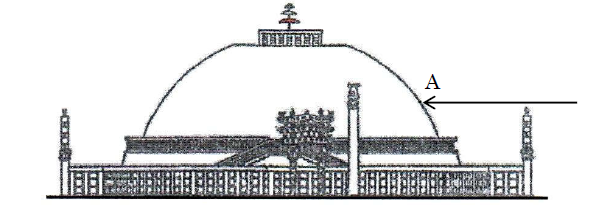
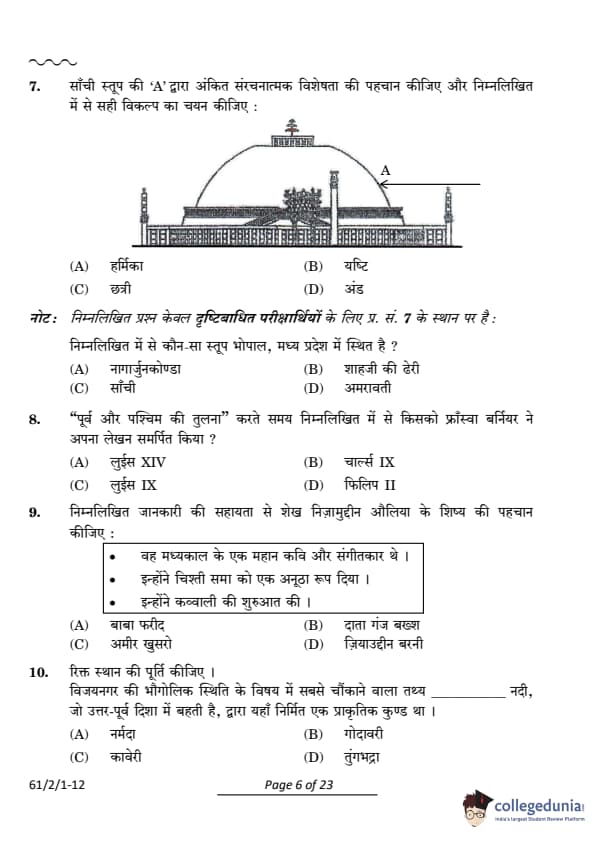
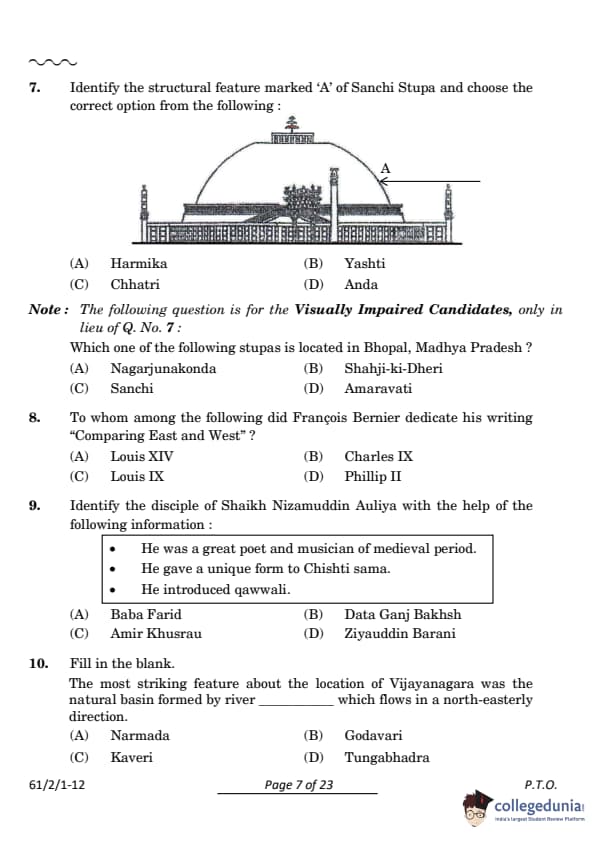
Identify the structural feature marked ‘A' of Sanchi Stupa and choose the correct option from the following :
View Solution
Solution: Understanding the Sanchi Stupa:
• The prompt requires identification of the part marked as 'A' of Sanchi Stupa in the provided image.
• We need to know the structure of Stupa to identify it correctly.
1: Analyzing the Harmika:
• The 'Harmika' is a square railing structure located above the dome of the stupa.
• It represents a sacred enclosure.
• It is placed on the top of the Anda.
2: Analyzing the Yashti:
• The 'Yashti' is a central mast that rises from the center of the 'Harmika'.
• It symbolizes the axis of the cosmos.
3: Analyzing the Chhatri:
• 'Chhatri' is an umbrella-like structure placed at the very top of Yashti.
• There could be single or more chhatris.
4: Analyzing the Anda:
• The Anda is the dome shaped structure of the Stupa.
• It is usually constructed from brick.
5: Identifying 'A' in the Image
• From the image, it's clear that the part marked 'A' is the railing structure directly above the dome, which is called the Harmika.
Question 7 (Visually Impaired):
Which one of the following stupas is located in Bhopal, Madhya Pradesh?
View Solution
Solution: Understanding the question:
• The question is specifically for Visually Impaired Candidates and asks to find the Stupa which is located in Bhopal, Madhya Pradesh.
1: Analyzing Sanchi:
• Sanchi Stupa, a UNESCO World Heritage Site, is indeed located in the Raisen district of Madhya Pradesh, close to Bhopal.
• Sanchi is one of the oldest stone structures in India, originally commissioned by Ashoka in the 3rd century BCE.
2: Analyzing Nagarjunakonda:
• Nagarjunakonda is located in Andhra Pradesh, not in Madhya Pradesh.
3: Analyzing Shahji-ki-Dheri:
• Shahji-ki-Dheri is located near Peshawar in present-day Pakistan.
• This is far from Madhya Pradesh.
4: Analyzing Amaravati:
• Amaravati Stupa is located in Andhra Pradesh.
• This option is also incorrect.
Question 8:
To whom among the following did François Bernier dedicate his writing “Comparing East and West"?
View Solution
Solution: Understanding the Context:
• The question is about François Bernier's work “Comparing East and West” and to whom he dedicated it.
• We need to know the historical context of this book to identify the answer.
1: Analyzing François Bernier:
• François Bernier was a French physician and traveler who visited India during the Mughal era.
• He wrote extensively about his experiences.
2: Analyzing “Comparing East and West":
• “Comparing East and West” is Bernier's work where he discusses and compares the sociopolitical scenario of the east with the west.
• He provides commentary on the differences between the two.
3: Identifying Louis XIV:
• Louis XIV was the king of France during Bernier's time.
• Bernier dedicated his book to King Louis XIV, highlighting the political environment of that time.
4: Analyzing other options:
• Charles IX, Louis IX, and Phillip II were also European rulers but lived at different periods of time.
• They are not the correct answer to the context of the question.
Question 9:
Identify the disciple of Shaikh Nizamuddin Auliya with the help of the following information :
• He was a great poet and musician of medieval period.
• He gave a unique form to Chishti sama.
• He introduced qawwali.
View Solution
Solution: Understanding the Information:
• This question is about identifying a disciple of Shaikh Nizamuddin Auliya based on provided clues: a great poet and musician, who gave unique form to Chishti Sama and introduced Qawwali.
1: Analyzing Amir Khusrau:
• Amir Khusrau, also known as the 'Parrot of India', was a renowned poet, musician, and scholar during the medieval period in India.
• He was a disciple of Shaikh Nizamuddin Auliya.
2: Analyzing his contributions:
• Amir Khusrau is credited with innovating and popularizing the Chishti Sama form.
• He is also recognized for introducing Qawwali, a type of devotional music with Sufi roots.
3: Analyzing other options:
• Baba Farid was a Sufi saint, but he is not known to be the disciple of Shaikh Nizamuddin Auliya.
• Data Ganj Bakhsh was an early Sufi scholar from Lahore and has no connection to Sheikh Nizamuddin Auliya.
• Ziyauddin Barani was a historian and not known as a disciple of Shaikh Nizamuddin Auliya.
Question 10:
Fill in the blank: The most striking feature about the location of Vijayanagara was the natural basin formed by river ________ which flows in a north-easterly direction.
View Solution
Solution: Understanding the Geography:
• The question is asking about the river that formed the natural basin around the Vijayanagara Empire.
• We need to be aware of the geographical location of the empire to answer this question.
1: Analyzing Vijayanagara Location:
• Vijayanagara is located in the central part of South India, in the region of present-day Karnataka.
• The empire was built strategically in a region with a rocky terrain and several river systems.
2: Identifying the Tungabhadra River:
• The Tungabhadra River played a critical role in Vijayanagara's formation as it provided water for agriculture and urban needs.
• The Tungabhadra River flows in a north-easterly direction around the Vijayanagara Empire and creates the natural basin.
3: Ruling Out other options:
• The Narmada river flows through central India but not nearby Vijayanagara.
• Godavari river is in South India but not in the vicinity of Vijayanagara.
• Kaveri river is also in South India but in Tamil Nadu and not in the proximity of Vijayanagara.
4: Conclusion
• Therefore, the correct answer is Tungabhadra.
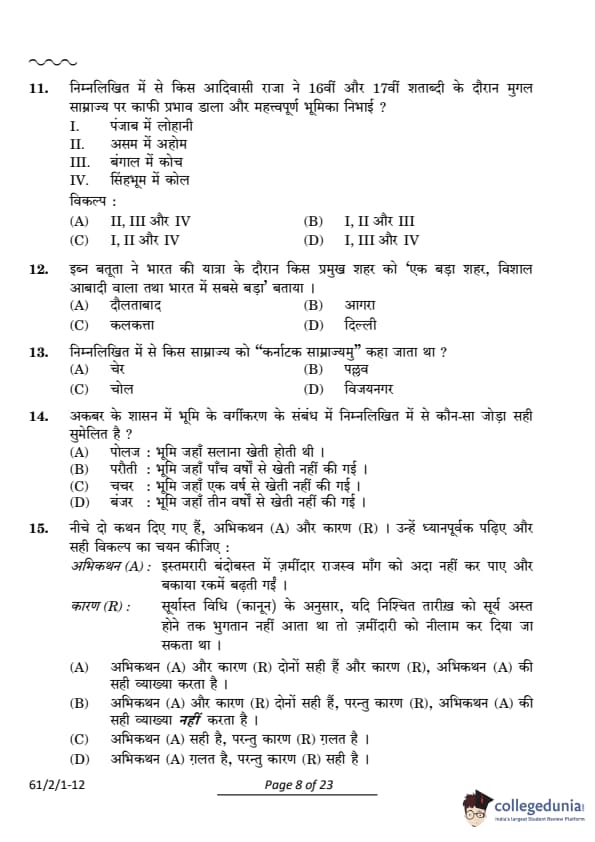
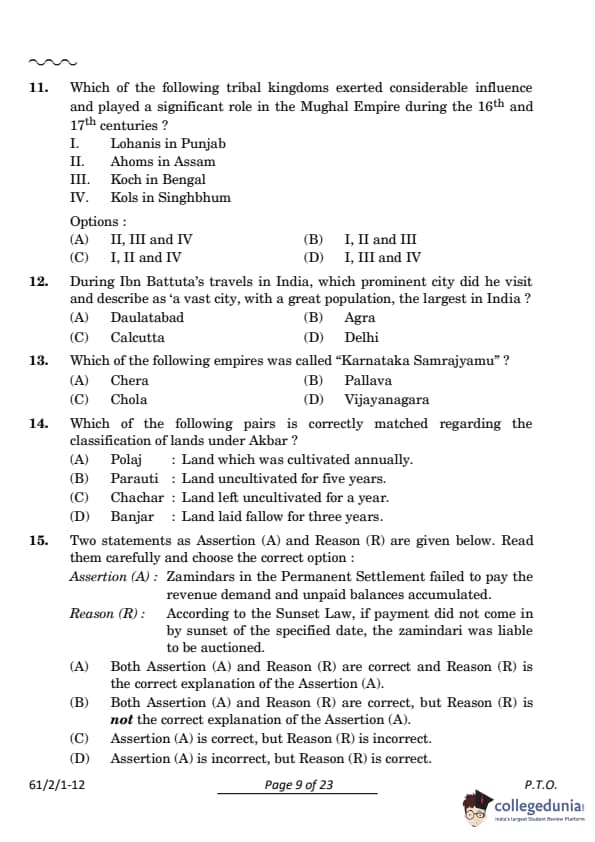
Question 11:
Which of the following tribal kingdoms exerted considerable influence and played a significant role in the Mughal Empire during the 16th and 17th centuries?
• I. Lohanis in Punjab
• II. Ahoms in Assam
• III. Koch in Bengal
• IV. Kols in Singhbhum
View Solution
Solution: Understanding the question:
• This question asks to identify tribal kingdoms that exerted considerable influence during the Mughal Empire during 16th-17th centuries.
1: Analyzing Lohanis in Punjab:
• Lohanis were an important tribal group in the Punjab region and were involved in trade and other activities during the Mughal era.
2: Analyzing Ahoms in Assam:
• Ahoms ruled a significant kingdom in the Assam region and frequently clashed with the Mughals, ultimately managing to maintain their independence.
3: Analyzing Koch in Bengal:
• Koch kingdom of Bengal was a significant power and played a role in Mughal politics and had engagements with the Mughals.
4: Analyzing Kols in Singhbhum:
• Kols in Singhbhum were a tribal group known for their revolts and uprisings against the British later in the 18th century and not the Mughals in the 16-17th century.
• This option is not correct in the context of the prompt.
5: Conclusion
• Therefore the correct option is Lohanis in Punjab, Ahoms in Assam, and Koch in Bengal.
Question 12:
During Ibn Battuta's travels in India, which prominent city did he visit and describe as 'a vast city, with a great population, the largest in India'?
View Solution
Solution: Understanding Ibn Battuta:
• The prompt is asking to identify which city did Ibn Battuta refer to as ‘a vast city, with a great population and the largest in India'.
1: Analyzing Ibn Battuta's Travels:
• Ibn Battuta was a Moroccan traveler who visited India in the 14th century during the rule of Muhammad bin Tughlaq of the Delhi Sultanate.
2: Identifying Delhi:
• In his travelogue, Ibn Battuta describes Delhi as an extremely large and bustling city, which was the capital of the Sultanate at the time.
• It was also an important center of trade, administration, and culture.
3: Ruling Out Other Options:
• While other cities like Daulatabad and Agra were important during medieval India, they were not described by Ibn Battuta as ‘a vast city, with a great population, the largest in India'.
• Calcutta was a city of later period and was not visited by Ibn Battuta.
Question 13:
Which of the following empires was called “Karnataka Samrajyamu”?
View Solution
Solution: Understanding “Karnataka Samrajyamu”:
• The question asks to identify the empire known as “Karnataka Samrajyamu”.
• This name suggests a connection to Karnataka and Kannada-speaking areas.
1: Analyzing Vijayanagara Empire:
• The Vijayanagara Empire was located in the Deccan region, with its capital in Karnataka.
• The empire's official language was Kannada, and it is known for its contributions to Kannada literature and culture.
2: Historical Context:
• Vijayanagara's control extended over parts of the present-day Karnataka, Andhra Pradesh, Tamil Nadu, and Maharashtra regions.
• The term 'Karnataka Samrajyamu' is an accurate description of the Vijayanagara empire.
3: Ruling out other options:
• Chera dynasty ruled the region of present-day Kerala.
• Pallavas dynasty was located in present-day Tamil Nadu.
• Cholas were a Tamil empire centered around the Cauvery delta.
4: Conclusion
• Therefore, Vijayanagara is known by the name “Karnataka Samrajyamu."
Question 14:
Which of the following pairs is correctly matched regarding the classification of lands under Akbar?
View Solution
Solution: Understanding Land Classification:
• The question requires matching land classifications under Akbar with their correct description.
• Land classifications were important for determining taxation.
1: Analyzing Polaj:
• Polaj was indeed the category for lands that were cultivated annually.
• This means that these were the most fertile lands.
2: Analyzing Parauti:
• Parauti refers to the land which was kept fallow or uncultivated for a period of one to two years, to allow it to regain its fertility.
• Therefore, it was not kept uncultivated for 5 years.
3: Analyzing Chachar:
• Chachar was a land that was left fallow for three to four years.
• Therefore, it was not a land left uncultivated for just 1 year.
4: Analyzing Banjar:
• Banjar was classified as barren land, which was not cultivated for more than five years,
• Thus not laid fallow just for 3 years.
5: Conclusion
• Thus only option A matches the correct definition.
Question 15:
Two statements as Assertion (A) and Reason (R) are given below. Read them carefully and choose the correct option:
• Assertion (A): Zamindars in the Permanent Settlement failed to pay the revenue demand and unpaid balances accumulated.
• Reason (R): According to the Sunset Law, if payment did not come in by sunset of the specified date, the zamindari was liable to be auctioned.
View Solution
Solution: Understanding the Statements:
• The question consists of an Assertion and a Reason, and we must determine if both are true and whether the Reason accurately explains the Assertion.
1: Analyzing Assertion (A):
• Assertion (A) states that zamindars failed to pay revenue demand in the Permanent Settlement and the unpaid balances accumulated.
• This is a well-known historical fact. The fixed revenue demand was often too high for zamindars and this led to the accumulation of arrears.
2: Analyzing Reason (R):
• Reason (R) is the explanation of Sunset law, according to which the zamindari could be auctioned if the revenue was not paid by sunset of the last date.
• This law was a key component of the Permanent Settlement
3: Establishing Connection:
• Reason (R), Sunset Law, provides the main reason why the Zamindars failed to pay their revenue. The strict deadline under this law led to the accumulation of arrears.
• Thus the reason directly explains why Zamindars were unable to keep up with their payments.
4: Conclusion
• Both the Assertion and Reason are true and Reason correctly explains the Assertion.
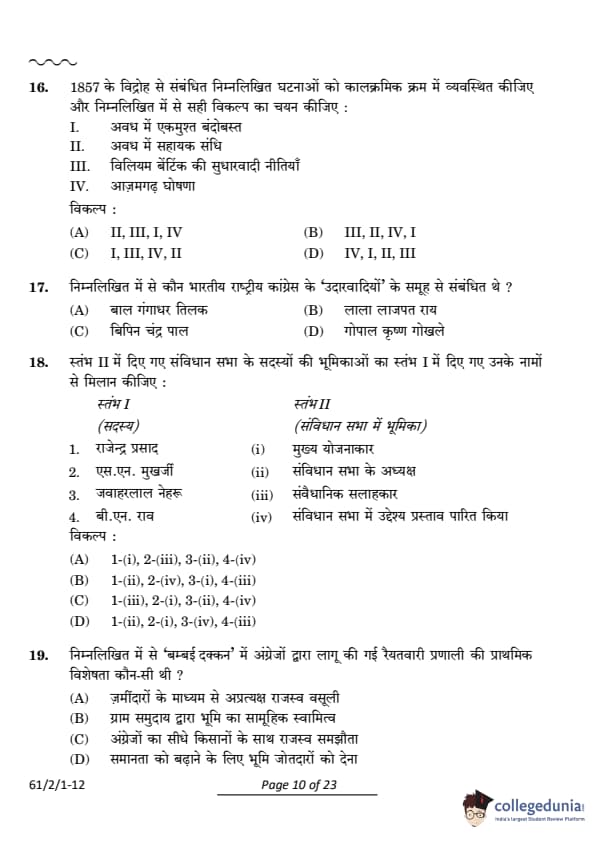
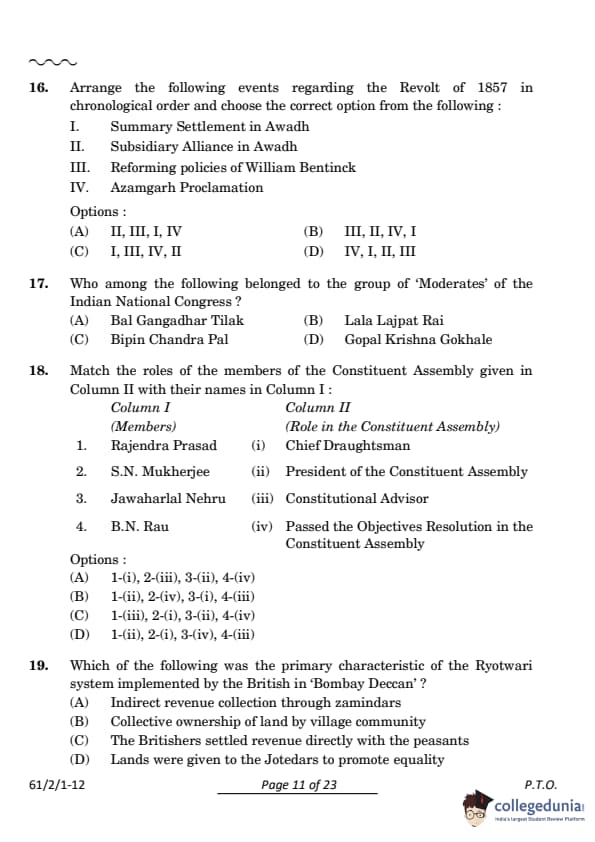
Question 16:
Arrange the following events regarding the Revolt of 1857 in chronological order and choose the correct option from the following :
• I. Summary Settlement in Awadh
• II. Subsidiary Alliance in Awadh
• III. Reforming policies of William Bentinck
• IV. Azamgarh Proclamation
View Solution
Solution: Understanding the Timeline:
• The question asks to arrange specific events related to the Revolt of 1857 in their correct chronological order.
• Knowing the timeline of events is important to determine the correct sequence.
1: Establishing the Sequence:
• II. Subsidiary Alliance in Awadh: This was the earliest event, which took place in 1801. The Subsidiary Alliance is one of the key reasons for the eventual revolt.
• III. Reforming policies of William Bentinck: William Bentinck's reforms, which included banning Sati and other social reforms took place in the 1830s.
• I. Summary Settlement in Awadh: The Summary Settlement was implemented by the British in 1856. This policy greatly upset the traditional land holding system and affected the landowners and sepoys.
• IV. Azamgarh Proclamation: The Azamgarh Proclamation was issued during the Revolt of 1857 and is related to that period.
2: Creating the Order:
• From the above timelines, the correct sequence is II, III, I, IV
Question 17:
Who among the following belonged to the group of 'Moderates' of the Indian National Congress?
View Solution
Solution: Understanding the Moderates and Extremists:
• The question asks to identify a leader from the 'Moderates' group within the Indian National Congress.
• The early INC had two factions: the Moderates and the Extremists.
1: Analyzing Gopal Krishna Gokhale:
• Gopal Krishna Gokhale was a key leader of the moderate faction within the Indian National Congress.
• He believed in constitutional and peaceful means for achieving self-rule.
2: Analyzing Bal Gangadhar Tilak, Lala Lajpat Rai and Bipin Chandra Pal:
• Bal Gangadhar Tilak, Lala Lajpat Rai and Bipin Chandra Pal, were well known leaders of the Extremist faction within the Indian National Congress.
• They advocated for a more assertive and aggressive form of resistance.
Question 18:
Match the roles of the members of the Constituent Assembly given in Column II with their names in Column I :
| Column I (Members) | Column II (Role in the Constituent Assembly) |
|---|---|
| 1. Rajendra Prasad | (ii) President of the Constituent Assembly |
| 2. S.N. Mukherjee | (i) Chief Draughtsman |
| 3. Jawaharlal Nehru | (iv) Passed the Objectives Resolution in the Constituent Assembly |
| 4. B.N. Rau | (iii) Constitutional Advisor |
View Solution
Solution: Understanding the Constituent Assembly:
• This question is about matching the members of the Constituent Assembly with their roles.
• The Constituent Assembly was responsible for creating the Constitution of India.
1: Matching Rajendra Prasad:
• Rajendra Prasad served as the President of the Constituent Assembly.
• Thus, he is matched with (ii).
2: Matching S.N. Mukherjee:
• S.N. Mukherjee was the Chief Draftsman of the Constituent Assembly.
• Thus he is matched with (i)
3: Matching Jawaharlal Nehru:
• Jawaharlal Nehru moved the Objectives Resolution in the Constituent Assembly.
• Thus he is matched with (iv)
4: Matching B.N. Rau:
• B.N. Rau was the Constitutional Advisor to the Constituent Assembly
• Thus he is matched with (iii)
5: Conclusion
• Thus the correct match is: 1-(ii), 2-(i), 3-(iv), 4-(iii).
Question 19:
Which of the following was the primary characteristic of the Ryotwari system implemented by the British in ‘Bombay Deccan'?
View Solution
Solution: Understanding the Ryotwari System:
• The question asks about the main characteristic of the Ryotwari system in the Bombay Deccan.
• Ryotwari system was introduced by the British to collect land revenue.
1: Analyzing Ryotwari System:
• The Ryotwari system was implemented in the Bombay Deccan.
• Under Ryotwari, the British government directly collected land revenue from individual cultivators (Ryots).
• There was no intermediary like Zamindars.
2: Analyzing other options:
• Indirect revenue collection through zamindars was a part of the Zamindari system and not Ryotwari system.
• Collective ownership of land by the village community was a feature of the Mahalwari system but not Ryotwari.
• The Jotedars were intermediaries who were usually big land owners and not given land by the British in Ryotwari system.
3: Conclusion
• The key feature of the Ryotwari system in Bombay Deccan was that the British settled revenue directly with the peasants.
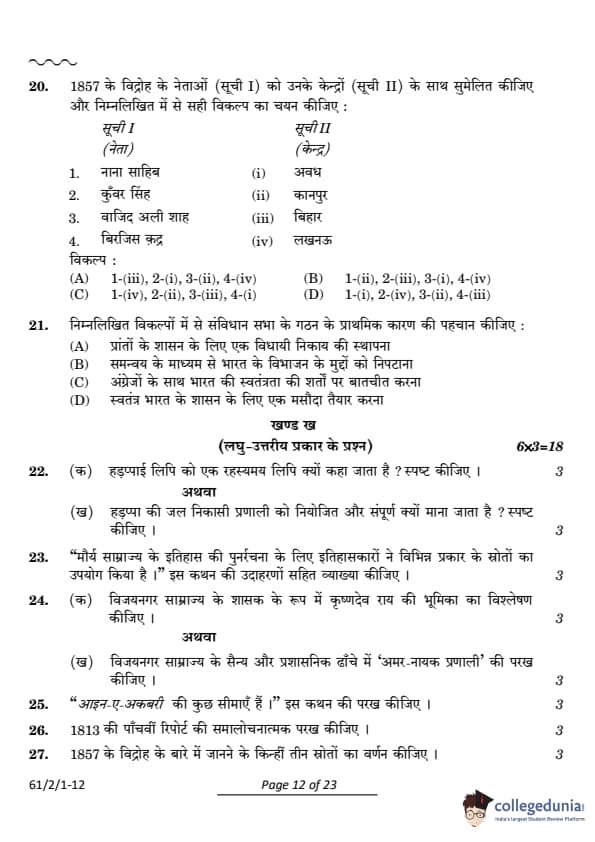
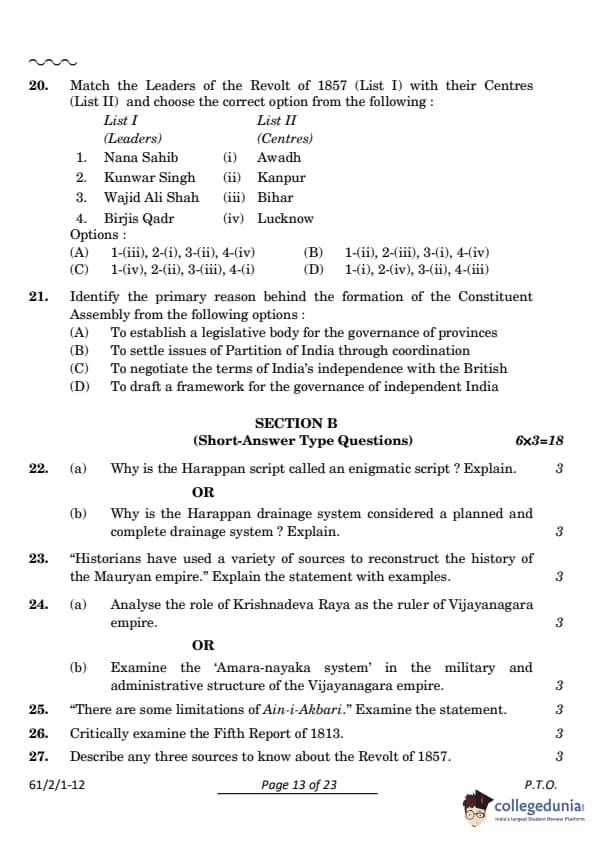
Question 20:
Match the Leaders of the Revolt of 1857 (List I) with their Centres (List II) and choose the correct option from the following :
| List I (Leaders) | List II (Centres) |
|---|---|
| 1. Nana Sahib | (ii) Kanpur |
| 2. Kunwar Singh | (iii) Bihar |
| 3. Wajid Ali Shah | (i) Awadh |
| 4. Birjis Qadr | (iv) Lucknow |
View Solution
Solution: Understanding the Revolt of 1857:
• The question asks to match the leaders of the Revolt of 1857 with the places where they led the revolt.
1: Matching Nana Sahib:
• Nana Sahib was an important leader of the revolt in Kanpur.
• Thus, he is matched with (ii) Kanpur.
2: Matching Kunwar Singh:
• Kunwar Singh led the revolt in the Bihar region.
• Thus, he is matched with (iii) Bihar.
3: Matching Wajid Ali Shah:
• Wajid Ali Shah was the Nawab of Awadh at the time of the revolt, but he was deposed before the revolt started.
• Although he was exiled before the revolt, he is still associated with Awadh.
• Thus, he is matched with (i) Awadh.
4: Matching Birjis Qadr:
• Birjis Qadr was the son of Wajid Ali Shah and was declared as the Nawab of Awadh after the revolt began.
• Thus he is matched with (iv) Lucknow.
5: Conclusion
• Thus, the correct matching is 1-(ii), 2-(iii), 3-(i), 4-(iv).
Question 21:
Identify the primary reason behind the formation of the Constituent Assembly from the following options:
View Solution
Solution: Understanding the Constituent Assembly:
• This question asks about the primary reason behind the formation of the Constituent Assembly.
• The Constituent Assembly was formed to draft the Indian Constitution.
1: Analyzing the Options:
• (A) To establish a legislative body for the governance of provinces: While provinces did have their legislative bodies, the Constituent Assembly was not formed for this.
• (B) To settle issues of Partition of India through coordination: Though the Constituent Assembly played a role in partition, it was not the primary reason for its formation.
• (C) To negotiate the terms of India's independence with the British: Although the assembly was formed in the context of the independence from the British, it was not primarily for negotiating terms.
• (D) To draft a framework for the governance of independent India: This was indeed the primary purpose of the Constituent Assembly.
2: Identifying the Main Purpose:
• The most important function of the assembly was to create a Constitution for independent India.
• Therefore, drafting a framework for governance of independent India was the main aim of forming the Constituent Assembly.
SECTION B
(Short-Answer Type Questions)
Question 22(a):
Why is the Harappan script called an enigmatic script? Explain.
View Solution
Solution: Understanding Enigmatic Scripts:
• An enigmatic script is one that is not yet deciphered.
• The Harappan script is considered enigmatic since it remains undeciphered.
1: Characteristics of the Harappan Script:
• The Harappan script is pictographic and comprises a variety of symbols.
• Most of the inscriptions are very short with very few inscriptions having more than 26 signs.
2: Challenges in Decipherment:
• The lack of a Rosetta Stone-like bilingual text or a substantial corpus of long texts has made its decoding extremely difficult.
• There are no historical parallels available.
• There are different interpretations for the same symbol.
3: Current Status:
• While many attempts have been made, there is no consensus among scholars, and the script is therefore referred to as enigmatic.
• We know that the language used was not any of the Indo-European languages that are in India today.
Question 22(b):
Why is the Harappan drainage system considered a planned and complete drainage system? Explain.
View Solution
Solution: Understanding the Harappan Drainage System:
• The Harappan drainage system is known for being well-planned and complete.
• It was designed to efficiently manage waste water and storm water.
1: Characteristics of the System:
• The Harappan cities had well-planned street grids.
• Each street was connected to the main drains.
2: Advanced Features of the Drainage System:
• Drains were often covered, usually with bricks.
• These drains were laid out along the street grid, which allowed for the easy removal of waste water.
• Manholes were placed at regular intervals for maintenance and cleaning.
3: Public Health:
• The system highlights the high level of importance given to public health.
• The system is one of the most impressive achievements of the civilization.
Question 23:
“Historians have used a variety of sources to reconstruct the history of the Mauryan empire.” Explain the statement with examples.
View Solution
Solution: Understanding the Statement:
• The statement highlights that various types of historical sources were used to understand the Mauryan Empire.
• The Mauryan empire was a significant empire in the Indian subcontinent.
1: Types of Sources:
• The reconstruction of Mauryan history used many types of sources.
• This includes written records, archaeological finds, and literary accounts.
2: Written Records:
• Arthashastra: This treatise by Kautilya provides valuable insights into the Mauryan administration, economy, law, and governance.
• Ashokan edicts: These inscriptions on rocks and pillars shed light on Ashoka's policies, his dhamma, and his efforts to spread Buddhism.
3: Archaeological Finds:
• Excavations have uncovered Mauryan sites that have unearthed city plans, stupas, coins, and other artifacts.
• These finds show the technological and artistic developments of the time.
4: Literary Accounts:
• Megasthenes' Indica: Although only fragments of the text survive, it provides information about the Mauryan administration, social life, and the capital city Pataliputra.
• Buddhist and Jaina texts: These religious texts offer insights into the political and social conditions of the period.
5: Conclusion
• Historians used these diverse sources to get a more rounded and accurate understanding of the Mauryan Empire.
Question 24(a):
Analyse the role of Krishnadeva Raya as the ruler of Vijayanagara empire.
View Solution
Solution: Understanding Krishnadeva Raya:
• Krishnadeva Raya was a prominent ruler of the Vijayanagara empire.
• He ruled during the golden age of the empire.
1: Military Achievements:
• Krishnadeva Raya was an accomplished military leader.
• He led campaigns that expanded the territory of the Vijayanagara Empire.
2: Administrative Skills:
• He improved the administrative structure and revenue systems of the empire.
• He focused on the welfare of his people, undertaking irrigation projects.
3: Patron of Arts and Literature:
• Krishnadeva Raya was a patron of art and literature.
• He supported many poets, writers, musicians, and artists during his reign.
• He was himself a scholar, writing Amuktamalyada in Telugu.
4: Religious Tolerance:
• Krishnadeva Raya was tolerant towards different faiths.
• He respected all the religious traditions present in his empire.
5: Overall Contribution:
• He consolidated the empire, and promoted prosperity, making his reign a golden era for the Vijayanagara Empire.
• He is remembered as one of the greatest rulers of South India.
Question 24(b):
Examine the ‘Amara-nayaka system' in the military and administrative structure of the Vijayanagara empire.
View Solution
Solution: Understanding Amara-Nayaka System:
• The Amara-nayaka system was a crucial component of Vijayanagara's military and administrative structure.
• It involved local military chiefs who were granted territories by the king.
1: Military Aspect:
• Nayakas were military commanders who held and commanded troops.
• These troops were ready to fight on behalf of the Vijayanagara king.
• The system helped in maintaining a large and efficient army.
2: Administrative Aspect:
• Amara Nayakas collected taxes, managed their territories, and maintained law and order.
• They sent annual tribute to the Vijayanagara king.
3: Relationship with the King:
• The Amara Nayakas had close ties with the King.
• The king provided them with land and resources and in return, they provided military support.
4: Impact of the System:
• The Amara-Nayaka system was a unique way to ensure the political control of the empire.
• The system enabled the centralized administration but also paved the way for rebellions due to the power of the Nayakas.
Question 25:
“There are some limitations of Ain-i-Akbari.” Examine the statement.
View Solution
Solution: Understanding Ain-i-Akbari:
• The Ain-i-Akbari is a part of the Akbarnama, written by Abul Fazl, the court historian of Mughal Emperor Akbar.
• It is a comprehensive record of the administrative setup, statistics, traditions, and social life of the empire.
1: Limitations of Data:
• The Ain-i-Akbari has limitations due to the challenges in data collection.
• The data may not be completely accurate or representative of all parts of the vast empire.
2: Elite Perspective:
• The Ain-i-Akbari is written from the point of view of the Mughal court and elite class.
• It focuses on the administrative, economic and religious structures of the empire.
3: Omission of certain aspects:
• The Ain does not provide much information on rural life or the lower classes of the society.
• Also, it tends to portray Akbar in a more favorable manner, glorifying his rule.
4: Problems with figures:
• The numerical data is not always accurate.
• It lacks information on the common people and their economic conditions.
5: Conclusion
• Therefore, despite being valuable, the Ain-i-Akbari has several limitations and needs to be read with these limitations in mind.
Question 26:
Critically examine the Fifth Report of 1813.
View Solution
Solution: Understanding the Fifth Report:
• The Fifth Report was a report of the British Parliament about the administration of the East India Company.
• It is a very voluminous document which was compiled in 1813.
1: Purpose of the Report:
• It was written to address the concerns about the functioning of the East India Company, which was facing criticism for corruption.
• It is an important document for understanding the British rule in India.
2: Contents of the Report:
• The Fifth Report contains a lot of data on revenue administration.
• It has statistical tables on land revenue, military expenses and the civil establishment.
3: Limitations of the Report:
• The report presents a one-sided view of the Company's activities.
• It often justifies actions of the Company.
• It sometimes lacks in-depth investigation and often presents an uncritical view.
4: Bias in Data:
• Many historians have pointed out that the report contains biased data to defend the policies and actions of the East India Company.
• It overlooks many of the negative impacts of British rule.
5: Conclusion
• The Fifth Report is an important source for understanding the British rule, but it must be interpreted critically by understanding the biases present.
Question 27:
Describe any three sources to know about the Revolt of 1857.
View Solution
Solution: Understanding the Revolt of 1857:
• The Revolt of 1857 was an important uprising against the British East India Company's rule in India.
• Understanding the revolt requires looking at various sources that provide differing perspectives.
1: Literary Sources:
• Official British Records: This includes documents from the British administration, such as letters, reports, and official notifications. These records give the perspective of the British.
• Personal Diaries and Letters: Both British and Indian individuals maintained personal diaries and letters, which provide accounts of the events.
• Newspaper articles and pamphlets: These sources provide valuable information on public sentiments.
2: Oral Narratives:
• Oral histories and songs passed down through generations give insight to the common people's experience of the Revolt.
• These accounts help understand how the rebellion was perceived at the local level.
3: Visual Sources:
• Paintings and Sketches: These portray the scenes of revolt, the leaders, and battles that took place.
• Photographs: Early photographs provide visual documentation of places associated with the revolt.
SECTION C
(Long-Answer Type Questions)
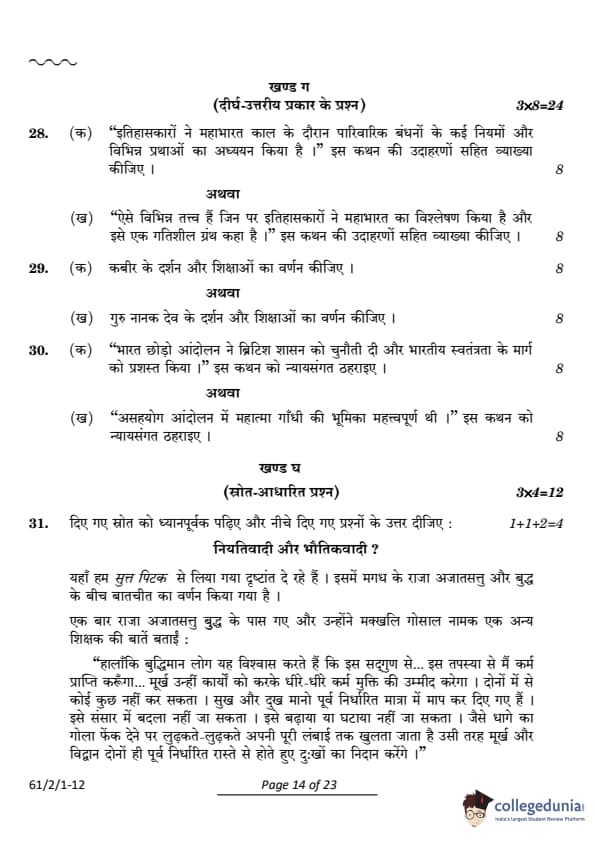
Question 28(a):
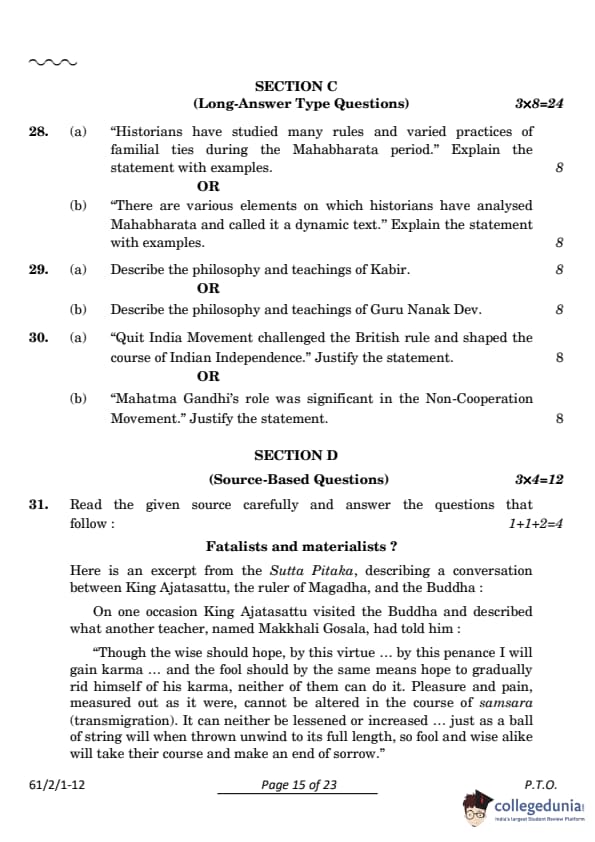
“Historians have studied many rules and varied practices of familial ties during the Mahabharata period.” Explain the statement with examples.
View Solution
Solution: Understanding the Mahabharata:
• The Mahabharata is an epic text that provides information on the social and political practices of its period.
• Family relationships and rules of marriage, inheritance are discussed in the Mahabharata.
1: Rules of Marriage:
• The epic describes practices like monogamy, polygyny (one man with many wives), and polyandry (one woman with many husbands).
• The story of Draupadi, who is married to the five Pandava brothers, illustrates the concept of polyandry.
2: Rules of Inheritance:
• The story highlights the patriarchal system, where sons are the main heirs of the family property and throne.
• However, the epic also shows instances where women have some level of power and property rights.
3: Familial Ties:
• The epic highlights the importance of kinship and loyalty to the family.
• The importance of familial ties is highlighted through the conflict between the Pandavas and the Kauravas.
4: Practices and Customs:
• The epic provides information about the customs, traditions, and rituals surrounding family life.
• The role of elders in a family is also mentioned.
5: Conclusion
• The Mahabharata has many examples of the social practices and rules regarding families of that period.
• Studying these practices has helped the historians understand that period better.
Question 28(b):
“There are various elements on which historians have analysed Mahabharata and called it a dynamic text.” Explain the statement with examples.
View Solution
Solution: Understanding Dynamic Text:
• A dynamic text is one that has been interpreted and reinterpreted over centuries and that has been added to and changed over time.
• The Mahabharata is such a text which has multiple layers.
1: Multiple Layers and Revisions:
• The Mahabharata has evolved over centuries with additions and interpolations being made.
• It is a culmination of many stories and traditions.
2: Varying Interpretations:
• The Mahabharata has various interpretations, both religious and secular.
• The epic has been seen as a socio-political text, a religious text, and a story of relationships.
3: Different Perspectives:
• The interpretations also differ based on the region and the period.
• The narrative and characters are interpreted differently depending on cultural, political, and social contexts.
4: Continuing Relevance:
• The epic is still relevant and a part of popular culture.
• The themes in the epic are still seen in modern times, making it a dynamic and a living text.
5: Conclusion
• The various interpretations and different narratives of the epic, which have evolved and changed over time make the Mahabharata a dynamic text.
Question 29(a):
Describe the philosophy and teachings of Kabir.
View Solution
Solution: Understanding Kabir:
• Kabir was a 15th-century mystic poet and saint, whose teachings form the basis of a unique religious tradition.
• He is an important figure in the Bhakti and Sufi traditions.
1: Monotheism and Formless God:
• Kabir emphasized a belief in one God, who he referred to as 'Ram' or 'Allah.'
• He believed that God is formless and all-pervading.
2: Rejection of Rituals and Dogma:
• Kabir opposed the rigid religious rituals, idol worship, and dogmatic practices of both Hinduism and Islam.
• He advocated a path of love and devotion towards God.
3: Emphasis on Universal Brotherhood:
• Kabir taught about the unity of all human beings regardless of religious and social backgrounds.
• He was a supporter of social equality and harmony.
4: Importance of Inner Experience:
• Kabir emphasized inner reflection and personal spiritual experience.
• He taught that the true path to God is through the understanding of oneself.
5: Conclusion
• Kabir's philosophy focused on universal love, devotion, and inner experience, discarding all rituals and social inequality.
Question 29(b):
Describe the philosophy and teachings of Guru Nanak Dev.
View Solution
Solution: Understanding Guru Nanak Dev:
• Guru Nanak Dev was the founder of Sikhism and the first of the ten Sikh Gurus.
• His teachings are the foundation of Sikh philosophy.
1: Concept of One God:
• Guru Nanak believed in the concept of one formless God, who is referred to as 'Ik Onkar'.
• He promoted the concept of the unity of God.
2: Nam Japna, Kirat Karni, Vand Chakna:
• Guru Nanak emphasized 'Nam Japna' (meditation on God), 'Kirat Karni' (earning an honest living) and 'Vand Chakna' (sharing with others).
• These are the three key pillars of Sikh teachings.
3: Rejection of Ritualism and Caste System:
• Guru Nanak rejected the rigid rituals, idolatry, and caste system prevalent in society.
• He promoted the idea of equality among all humans.
4: Importance of Seva:
• Guru Nanak emphasized the importance of selfless service to humanity.
• He believed that serving others is equal to serving God.
5: Conclusion
• Guru Nanak's teachings are based on the ideas of the oneness of god, selfless service and equality of all.
Question 30(a):
“Quit India Movement challenged the British rule and shaped the course of Indian Independence.” Justify the statement.
View Solution
Solution: Understanding the Quit India Movement:
• The Quit India Movement was launched by Mahatma Gandhi in 1942 against the British Raj.
• The movement is an important phase of India's freedom struggle.
1: Direct Challenge to British Authority:
• The Quit India Movement was the most direct challenge to British rule in India.
• It called for immediate independence with the slogan “Do or Die”.
2: Widespread Participation:
• This was a mass movement where people from all walks of life participated.
• The participation ranged from students and peasants to industrial workers and political leaders.
3: Disruption of British Rule:
• The movement disrupted the functioning of the British government in many parts of the country.
• British communication lines and infrastructure were damaged.
4: Impact on Post War Scenario:
• While the movement was suppressed, it played a key role in weakening the British hold on India.
• After the world war, they realized that it was not possible to sustain their colonial rule any longer.
5: Conclusion
• The Quit India movement, through its widespread participation, direct challenge, and disruption, shaped India's path towards freedom.
Question 30(b):
“Mahatma Gandhi's role was significant in the Non-Cooperation Movement.” Justify the statement.
View Solution
Solution: Understanding the Non-Cooperation Movement:
• The Non-Cooperation Movement was launched by Mahatma Gandhi in 1920 to protest British rule using non-violent methods.
• Gandhi's leadership was significant to the movement.
1: Ideology of Non-Violence:
• Gandhi's leadership was based on the philosophy of non-violent resistance or Satyagraha.
• He advocated for boycotting British institutions, including schools, courts, and elections.
2: Mass Mobilization:
• Gandhi played a key role in the mass mobilization of people from various communities and regions.
• This unified front was a key component of the movement.
3: Emphasis on Swadeshi:
• Gandhi promoted the use of Indian-made products.
• He asked for the boycott of British goods which was an important aspect of the Non-Cooperation movement.
4: Impact on the National Movement:
• The movement shook the foundation of the British rule in India and inspired people to participate in the independence movement.
• It laid the foundation for future mass movements.
SECTION D
(Source-Based Questions)
Question 31:
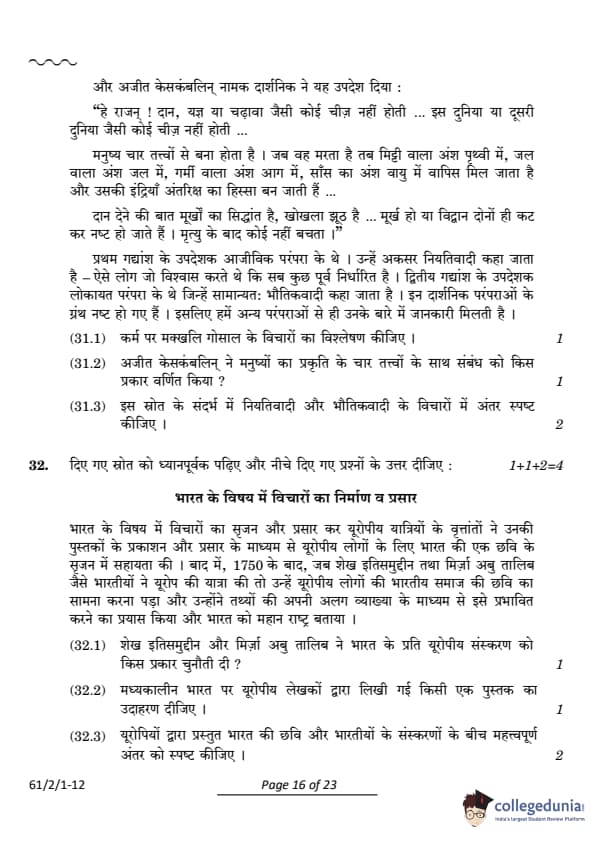
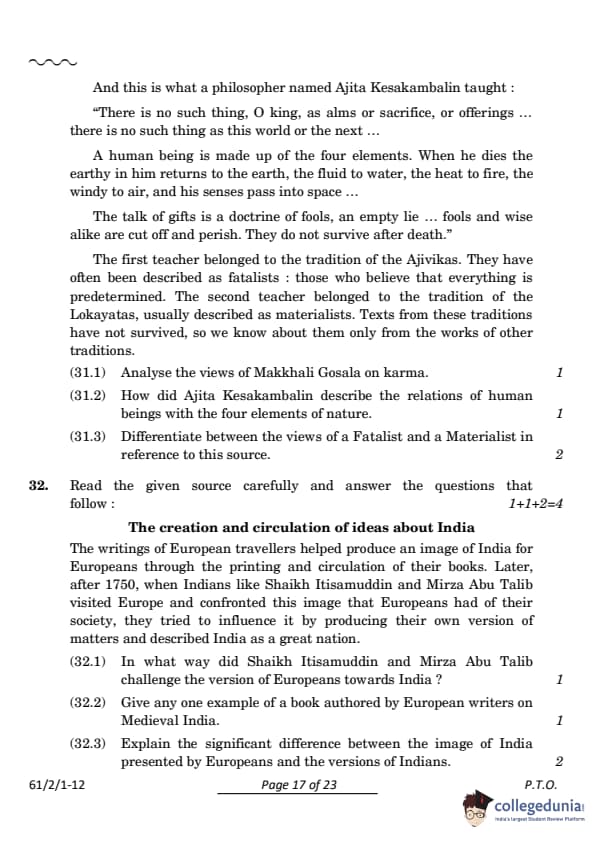
Read the given source carefully and answer the questions that follow : Fatalists and materialists? Here is an excerpt from the Sutta Pitaka, describing a conversation between King Ajatasattu, the ruler of Magadha, and the Buddha : On one occasion King Ajatasattu visited the Buddha and described what another teacher, named Makkhali Gosala, had told him : “Though the wise should hope, by this virtue ... by this penance I will gain karma ... and the fool should by the same means hope to gradually rid himself of his karma, neither of them can do it. Pleasure and pain, measured out as it were, cannot be altered in the course of samsara (transmigration). It can neither be lessened or increased ... just as a ball of string will when thrown unwind to its full length, so fool and wise alike will take their course and make an end of sorrow.”
View Solution
Solution: Understanding the Source:
• This source is a conversation from Sutta Pitaka between King Ajatasattu and the Buddha.
• It discusses the philosophy of Karma and the views of Makkhali Gosala.
31.1 Analyse the views of Makkhali Gosala on karma.
• Makkhali Gosala's view on karma is that it is predetermined.
• He believed that neither wise acts nor foolish acts can alter a person's journey or fate.
31.2 How did Ajita Kesakambalin describe the relations of human beings with the four elements of nature.
• While the source is discussing Makkhali Gosala, it is talking about Ajita Kesa Kambalin in the paragraph before the excerpt.
• The source mentions that he taught that a person is made of four elements- earth, water, fire and wind, and when he dies, the parts return to these elements.
31.3 Differentiate between the views of a Fatalist and a Materialist in reference to this source.
• Fatalist as described in the source refers to those who believe that everything is predetermined and that human actions cannot alter the course of destiny.
• Materialist believes that people are made of material elements and nothing is beyond the material and the physical.
• Unlike fatalists they don't believe in the concept of Karma or fate.
Question 32:
Read the given source carefully and answer the questions that follow : The creation and circulation of ideas about India The writings of European travellers helped produce an image of India for Europeans through the printing and circulation of their books. Later, after 1750, when Indians like Shaikh Itisamuddin and Mirza Abu Talib visited Europe and confronted this image that Europeans had of their society, they tried to influence it by producing their own version of matters and described India as a great nation.
View Solution
Solution: Understanding the Source:
• This source is about how ideas about India were formed and circulated, both by European travelers and later by Indian intellectuals.
32.1 In what way did Shaikh Itisamuddin and Mirza Abu Talib challenge the version of Europeans towards India?
• Shaikh Itisamuddin and Mirza Abu Talib, after visiting Europe and seeing the image formed by European travelers, challenged that image of India.
• They produced their own version where they tried to highlight the greatness of India.
32.2 Give any one example of a book authored by European writers on Medieval India.
• Many European travelers wrote about their experiences in India during the medieval period.
• A book by François Bernier, “Travels in the Mughal Empire" gives a lot of information about India during that period.
32.3 Explain the significant difference between the image of India presented by Europeans and the versions of Indians.
• The European image of India was often based on exoticism and their colonial interests.
• The image created by the Indians themselves highlighted the greatness of their civilization, culture, and history.
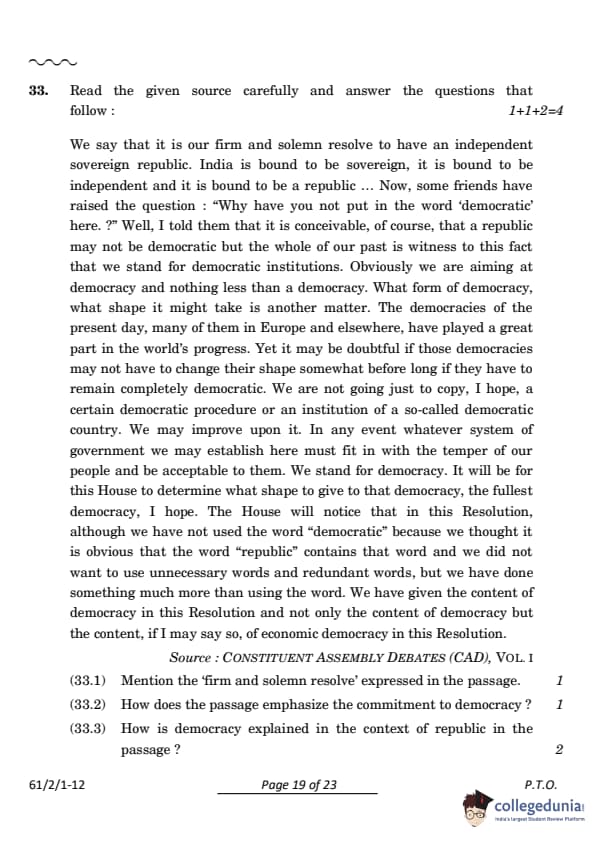
Question 33:
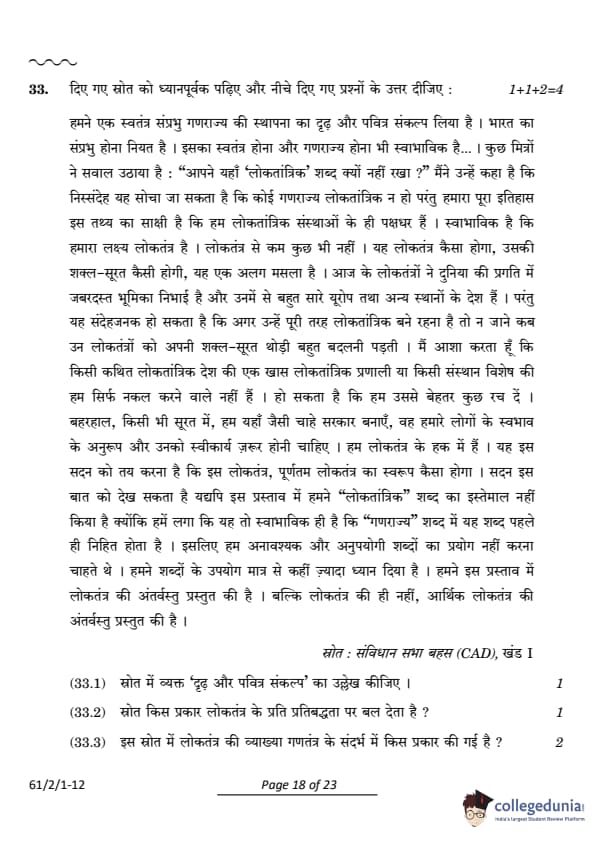
Read the given source carefully and answer the questions that follow : We say that it is our firm and solemn resolve to have an independent sovereign republic. India is bound to be sovereign, it is bound to be independent and it is bound to be a republic ... Now, some friends have raised the question : “Why have you not put in the word 'democratic' here. ?” Well, I told them that it is conceivable, of course, that a republic may not be democratic but the whole of our past is witness to this fact that we stand for democratic institutions. Obviously we are aiming at democracy and nothing less than a democracy. What form of democracy, what shape it might take is another matter. The democracies of the present day, many of them in Europe and elsewhere, have played a great part in the world's progress. Yet it may be doubtful if those democracies may not have to change their shape somewhat before long if they have to remain completely democratic. We are not going just to copy, I hope, a certain democratic procedure or an institution of a so-called democratic country. We may improve upon it. In any event whatever system of government we may establish here must fit in with the temper of our people and be acceptable to them. We stand for democracy. It will be for this House to determine what shape to give to that democracy, the fullest democracy, I hope. The House will notice that in this Resolution, although we have not used the word "democratic" because we thought it is obvious that the word “republic” contains that word and we did not want to use unnecessary words and redundant words, but we have done something much more than using the word. We have given the content of democracy in this Resolution and not only the content of democracy but the content, if I may say so, of economic democracy in this Resolution.
Source : CONSTITUENT ASSEMBLY DEBATES (CAD), VOL. I
View Solution
Solution: Understanding the Source:
• This source is from the Constituent Assembly Debates and describes India's resolve to be a sovereign republic.
• It explains why the word 'democratic' was not included in the initial resolution.
33.1 Mention the 'firm and solemn resolve' expressed in the passage.
• The firm and solemn resolve expressed in the passage is to have an independent sovereign republic.
• The passage emphasizes that India is bound to be a sovereign, independent and a republic.
33.2 How does the passage emphasize the commitment to democracy?
• The passage emphasizes the commitment to democracy by explicitly stating that they are aiming at democracy and nothing less than that.
• It emphasizes the history of India and how the country has always stood for democratic institutions.
33.3 How is democracy explained in the context of republic in the passage?
• The passage explains that the term 'republic' already implies ‘democratic', and hence it was not added separately.
• The speaker also mentions the importance of economic democracy in their resolve to be a republic.
SECTION E
(Map-Based Questions)
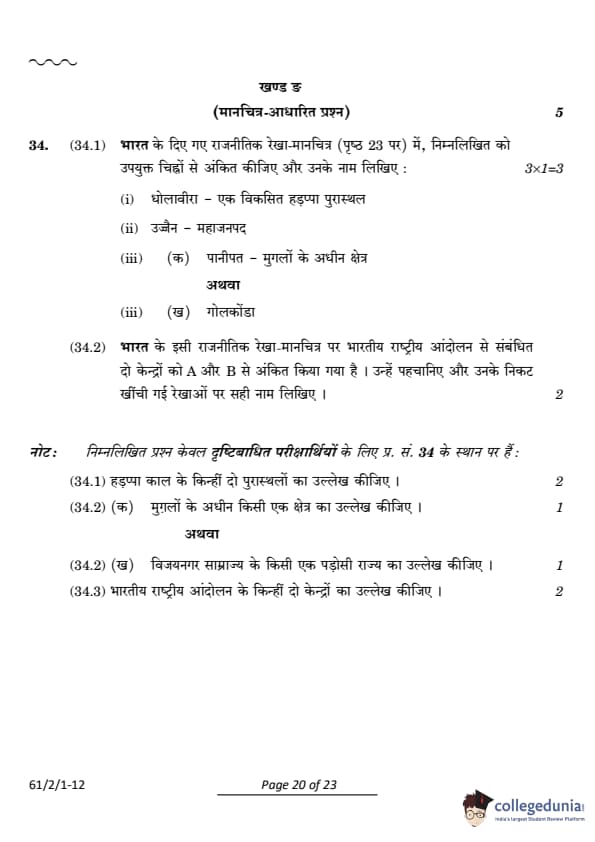
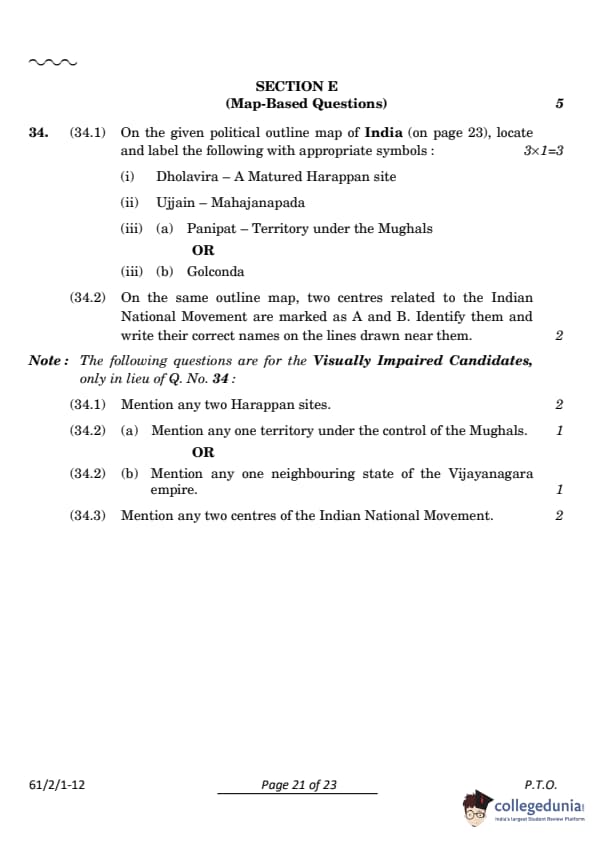
Question 34:
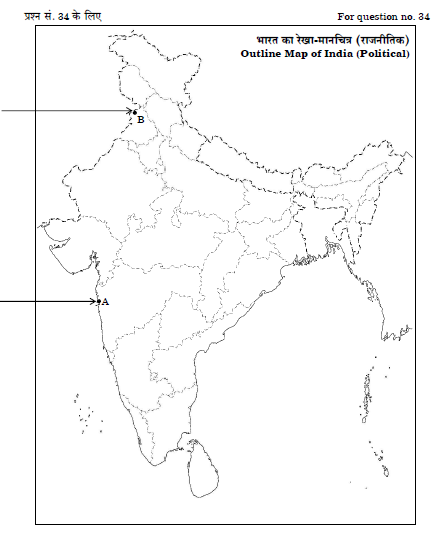
Question 34(a):
On the given political outline map of India (on page 23), locate and label the following with appropriate symbols :
• (i) Dholavira – A Matured Harappan site
• (ii) Ujjain – Mahajanapada
• (iii) (a) Panipat – Territory under the Mughals OR (iii) (b) Golconda
View Solution
Solution: Understanding the question:
• This question involves locating and labeling sites on a map of India.
• We need to be aware of these locations to correctly mark them.
1: Locating Dholavira:
• Dholavira is a significant Harappan site located in Gujarat.
• On the map, mark the site with a suitable symbol and write “Dholavira” next to it.
2: Locating Ujjain:
• Ujjain, a Mahajanapada, is located in Madhya Pradesh.
• Mark the site with a suitable symbol and label it as “Ujjain" on the map.
3: Locating Panipat or Golconda:
• Panipat: Panipat is located in present-day Haryana.
• Mark the region with a symbol and label it as “Panipat”.
• Golconda: Golconda is located near Hyderabad in Telangana.
• Mark the region with a symbol and label it as “Golconda" if you are choosing this option.
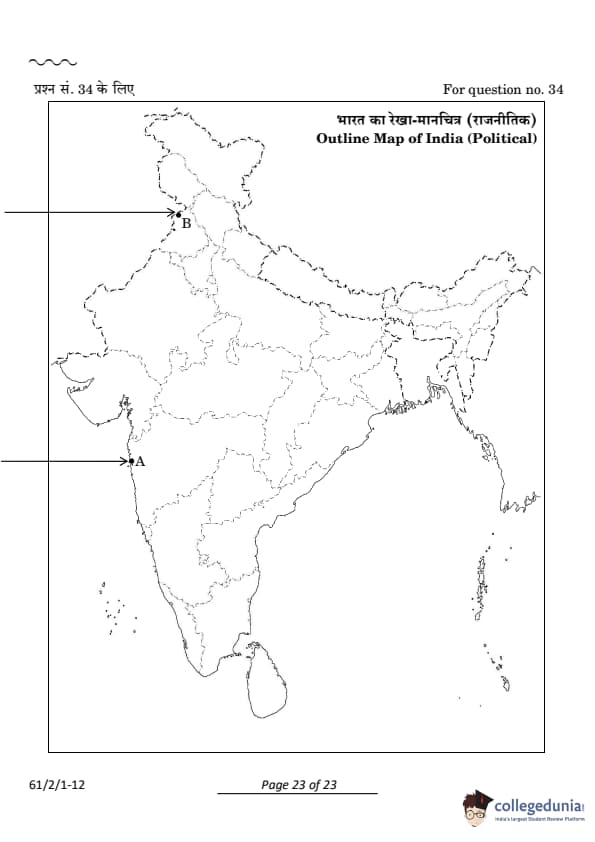
Question 34(b):
On the same outline map, two centres related to the Indian National Movement are marked as A and B. Identify them and write their correct names on the lines drawn near them.
View Solution
Solution: Understanding the question:
• This question asks to identify centers related to the Indian National Movement marked on the map.
• We need to know which centers are associated with the freedom movement.
1: Identifying Center A:
• If A is marked in the Gujarat region, it could be Dandi associated with the Salt Satyagraha.
• Mark the site "Dandi" near it.
2: Identifying Center B:
• If B is marked near modern day Uttar Pradesh, it could be Meerut, which is where the 1857 revolt started.
• Mark the site with the name “Meerut".
Question 34.1 (Visually Impaired):
Mention any two Harappan sites.
View Solution
Solution: Understanding the question:
• This question is specifically for visually impaired candidates and asks for two Harappan sites.
1: Mentioning Harappan Sites
• Some of the major Harappan sites are: Harappa, Mohenjo-daro, Lothal, Kalibangan, Rakhigarhi, Dholavira.
• You can mention any two of these sites.
Question 34.2 (a) (Visually Impaired):
Mention any one territory under the control of the Mughals.
View Solution
Solution: Understanding the question:
• This question is specifically for visually impaired candidates and asks for a territory under Mughal control.
1: Mentioning territory under Mughals
• Some of the territories that were under Mughal control were: Delhi, Agra, Lahore, Bengal, Deccan.
• You can mention any one of these territories.
Question 34.2 (b) (Visually Impaired):
Mention any one neighbouring state of the Vijayanagara empire.
View Solution
Solution: Understanding the question:
• This question is specifically for visually impaired candidates and asks for a state that was a neighbor to Vijayanagara.
1: Mentioning neighbouring states
• Some of the neighbouring states of the Vijayanagara Empire were: Bahmani Kingdom, Madurai Sultanate, and Gajapati Kingdom.
• You can mention any one of these neighbouring states.
Question 34.3 (Visually Impaired):
Mention any two centres of the Indian National Movement.
View Solution
Solution: Understanding the question:
• This question is specifically for visually impaired candidates and asks to mention two centers of the Indian National movement.
1: Mentioning centers of Indian national movement:
• Some of the centers that were important in the Indian National movement were: Delhi, Calcutta, Lucknow, Surat, Madras, Bombay, Lahore.
• You can mention any two of these.




Comments