



.png?h=35&w=35&mode=stretch)
CBSE Class 12 History Set 1 Question Paper PDF (Code: 61/3/1) is now available for download. CBSE conducted the Class 12 History examination on March 28, 2024, from 10:30 AM to 1:30 PM. The question paper consists of 34 questions carrying a total of 80 marks. Section A includes 21 MCQs for 1 mark each, Section B contains 6 short-answer questions for 3 marks each, Section C comprises 3 long-answer questions for 8 marks each, Section D comprises 3 Source-based questions having three sub-questions carries 4 marks each and Section E comprises 1 Map-based question that carries 5 marks.
Candidates can use the link below to download the CBSE Class 12 History Set 1 Question Paper with detailed solutions.
CBSE Class 12 History Question Paper 2024 (Set 1- 61/3/1) with Answer Key
| CBSE Class 12 2024 History Question Paper with Answer Key |  Download Download |
Check Solution |
CBSE Class 12 2024 History Questions with Solutions
SECTION A
(Multiple Choice Type Questions)
Question 1:
Which of the following options are correct regarding Magadha?
(A) I, II and IV are correct
(B) I, II and III are correct
(C) I, III and IV are correct
(D) II, III and IV are correct
View Solution
Solution:
I. Magadha was the most powerful Mahajanapada: The sixteen Mahajanapadas were powerful kingdoms in ancient India during the 6th to 4th centuries BCE. Among them, Magadha rose to prominence due to a combination of factors. Its strategic location provided it with fertile agricultural land in the Ganges plain, which enabled surplus production. This led to a strong economic base and also facilitated the growth of a large army and administrative structure, necessary for territorial expansion and control.
II. Rajagaha was the capital of Magadha: Rajagaha, known today as Rajgir, was indeed the initial capital of the Magadha kingdom. Its location was chosen strategically, surrounded by hills making it secure and defensible. It served as a significant power center during the earlier phase of Magadha's expansion, highlighting the importance of geography in shaping political landscapes. Later on, the capital was shifted to Pataliputra (modern Patna) during the later Mauryan period due to its location on the confluence of major rivers, making trade and transportation easier.
III. Magadha was in a semi-arid area: This statement is incorrect. Magadha was characterized by a highly fertile alluvial plain, courtesy of the Ganges River and its tributaries. This made it agriculturally prosperous, providing the material basis for population growth and state development. The availability of water was a major advantage as it led to better yields.
IV. Magadha was rich in natural resources: The region of Magadha was exceptionally rich in natural resources. The Chota Nagpur plateau provided deposits of iron ore, which were critical for the production of agricultural implements and military equipment. Additionally, the forests provided timber for construction, as well as elephants, which formed a crucial part of their military. The combination of fertile land and valuable resources created an ideal base for economic and military expansion.
Question 2:
Arrange the following in chronological order and choose the correct option :
(A) I, III, IV, II
(B) III, II, I, IV
(C) II, I, IV, III
(D) IV, III, I, II
View Solution
Solution:
II. Rule of Mahapadma Nanda: Mahapadma Nanda, the founder of the Nanda Dynasty, was one of the most powerful rulers of the Magadha region. His rule precedes the Mauryan dynasty. The Nanda Dynasty played a critical role in establishing a centralized kingdom and building up resources in Magadha, which later helped the Mauryas rise to power. Thus, his placement in the timeline is the earliest.
I. Rule of Asoka: Asoka was one of the most famous rulers of the Mauryan Dynasty. The Mauryan Dynasty rose to power after overthrowing the Nanda Dynasty. Asoka's rule was crucial for expansion and the propagation of Buddhism, making him an important ruler to know in Ancient Indian history. He ruled in the 3rd century BCE.
IV. Rule of Samudragupta: Samudragupta belonged to the Gupta Dynasty and ruled in the 4th century CE. The Gupta Dynasty, known as the ‘Golden Age' of India, came centuries after the Mauryan empire and the subsequent dynasties. His military conquests and patronage of arts and literature marks him as a significant Gupta Ruler.
III. Rule of Harshavardhana: Harshavardhana ruled in the 7th century CE. His kingdom was one of the last major Hindu empires of northern India before the early medieval period. His rule was known for its efficient governance and promotion of trade and culture, and represents a later era than the earlier empires. Hence, his placement in the timeline is the last.
Question 3:
Match Column I with Column II and choose the correct option :
| Column I (Characters of Mahabharata) | Column II (Role) |
|---|---|
| 1. Duryodhana | (i) Son of Hidimba |
| 2. Gandhari | (ii) Eldest son of Dhritrashtra |
| 3. Kunti | (iii) Mother of Pandavas |
| 4. Ghatotkacha | (iv) Mother of Duryodhana |
(A) 1-(iv), 2-(iii), 3-(ii), 4-(i)
(B) 1-(ii), 2-(i), 3-(iv), 4-(iii)
(C) 1-(ii), 2-(i), 3-(iii), 4-(iv)
(D) 1-(ii), 2-(iv), 3-(iii), 4-(i)
View Solution
Solution:
1. Duryodhana and (ii) Eldest son of Dhritrashtra: Duryodhana is an important character in the Mahabharata, known as the eldest of the Kaurava princes. His ambition and envy were key instigators of the epic war. The Mahabharata details his story as the main antagonist in the epic. He was the first born among the hundred sons of Dhritarashtra.
2. Gandhari and (iv) Mother of Duryodhana: Gandhari was the princess of Gandhara and is portrayed as a virtuous and devoted wife of Dhritarashtra. She chose to blindfold herself to share her husband's blindness. She is best known for being the mother of the hundred Kauravas, including Duryodhana.
3. Kunti and (iii) Mother of Pandavas: Kunti was the queen of Hastinapur, and mother to the Pandavas (Yudhisthira, Bhima, Arjuna) as well as Karna. The epic portrays her as a noble and virtuous queen, facing many hardships and challenges. Her relationship with the Pandavas is key to the epic.
4. Ghatotkacha and (i) Son of Hidimba: Ghatotkacha was the son of Bhima and the Rakshasi Hidimba. He was a valiant and powerful warrior who played an important role in the Kurukshetra war. He is described to have had supernatural abilities which he used in the great war.
Question 4:
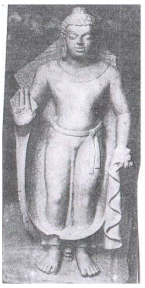
Which of the following schools of art is depicted in the given sculpture image of Buddha?
View Solution
Solution:
Mathura School of Art: The image depicts the Buddha in a style typical of the Mathura School of Art which emerged in the early centuries of the Common Era (roughly between 1st century BCE to 5th century CE). The Buddha figures are characterized by a robust physique and are represented in a human-like form, with a shaved head, a round face and a slightly smiling expression. The drapery is simple, with the robe often covering only one shoulder, and the style is indigenous without much foreign influence. The material often used in this style is reddish sandstone.
Amravati School of Art: The Amravati School of Art flourished in Andhra Pradesh between the 2nd century BCE to 3rd century CE. It was characterized by elaborate narrative panels, with figures shown in dynamic poses, and the use of white marble or limestone. The key feature is its depiction of Jataka Tales.
Gandhara School of Art: The Gandhara School of Art emerged in the northwestern part of the Indian subcontinent during the Kushan period (1st to 5th century CE), where it was exposed to Greco-Roman artistic styles through trade and cultural exchange. This influence is reflected in the Buddha figures, which have wavy hair, a more defined nose, and draped robes. This style used grey schist.
Gothic School of Art: The Gothic style is an artistic style that flourished in Europe during the High and Late Middle Ages, and has no connection with ancient India. It features elements like pointed arches and ribbed vaults in its architecture and is not related to Buddhist art.
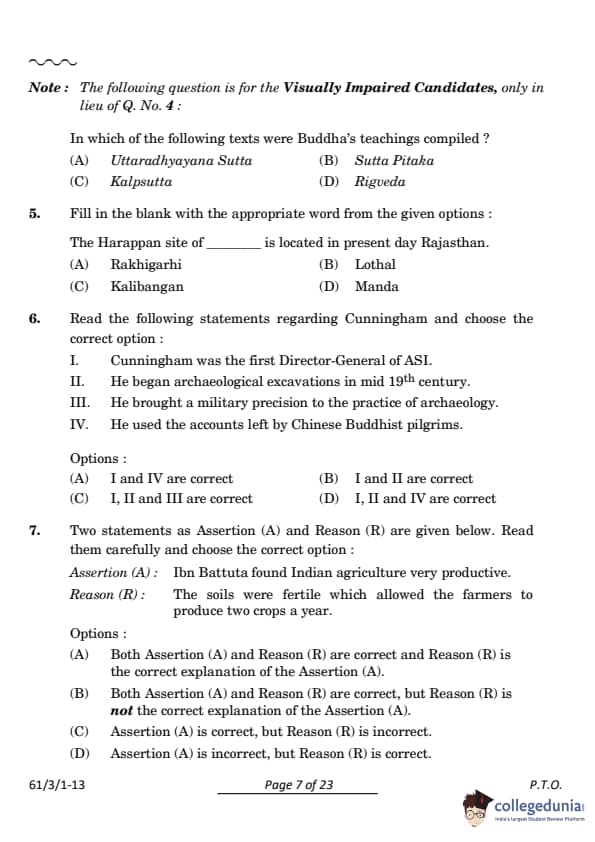
Question 5:
Fill in the blank with the appropriate word from the given options:
The Harappan site of __________ is located in present day Rajasthan.
View Solution
Solution:
Kalibangan: Kalibangan is an important archaeological site of the Indus Valley Civilization located in the Hanumangarh district of Rajasthan. The site has revealed evidence of well-planned settlements, mud brick houses, fire alters, and a ploughed field, which indicate sophisticated agricultural practices. It was discovered by Italian Indologist and linguist Luigi Pio Tessitori.
Rakhigarhi: Rakhigarhi is another significant Indus Valley Civilization site, but it is located in the state of Haryana, not Rajasthan. It is one of the largest Harappan sites and known for its complex urban planning, well-laid drainage system and mud brick structures.
Lothal: Lothal is a Harappan site located in the state of Gujarat. It is known for being a port town, and has revealed evidence of dockyards, which highlights its importance in the maritime trade of the civilization.
Manda: Manda is an Indus Valley site located in the state of Jammu and Kashmir. It is known as the northernmost site of the Harappan civilization, demonstrating the extensive geographical reach of this civilization.
Question 6:
Read the following statements regarding Cunningham and choose the correct option:
(A) I and IV are correct
(B) I and II are correct
(C) I, II and III are correct
(D) I, II and IV are correct
View Solution
Solution:
I. Cunningham was the first Director-General of ASI: This is indeed true. Alexander Cunningham was appointed as the first Director-General of the Archaeological Survey of India (ASI) in 1871. His appointment formalized the process of archaeology in India, and set the standards for later archaeological research.
II. He began archaeological excavations in the mid-19th century: Cunningham's archaeological activities in India began before the establishment of ASI, mostly during the mid-19th century. In the 1830s, Cunningham had already started surveying various historical sites and later started active excavations from the 1860s. He is known for his focus on the historical geography of India.
III. He brought a military precision to the practice of archaeology: While Cunningham was a military engineer by training, his approach is more known for the use of texts and historical accounts, especially Buddhist accounts. His methods were systematic but not defined by military precision.
IV. He used the accounts left by Chinese Buddhist pilgrims: Cunningham often used the accounts left by Chinese Buddhist pilgrims like Xuanzang and Faxian as guidance for locating and identifying historical sites, indicating his focus on textual sources.
Question 7:
Two statements as Assertion (A) and Reason (R) are given below. Read them carefully and choose the correct option:
Assertion (A): Ibn Battuta found Indian agriculture very productive.
Reason (R): The soils were fertile which allowed the farmers to produce two crops a year.
View Solution
Solution:
Assertion (A): Ibn Battuta found Indian agriculture very productive: Ibn Battuta, in his travelogue “Rihla” recorded his extensive observations about India during the 14th century. He was impressed by the agricultural productivity of the regions he visited, particularly in the Gangetic plains, which were known for their abundant crops. His description of the agricultural practices and the diversity of crops reveals a thriving agricultural economy.
Reason (R): The soils were fertile which allowed the farmers to produce two crops a year: The reason provides a solid explanation of why the agricultural system was so productive. The alluvial plains of the Ganges and other rivers deposited highly fertile soil, which was ideal for agriculture. This fertile land, combined with the monsoon climate, allowed farmers to produce multiple crops in a year. This practice of double cropping enhanced the overall productivity of the agricultural system, making it a key economic driver of the Sultanate period.
Explanation: The reason directly supports and explains the assertion; therefore, (A) is the correct answer.
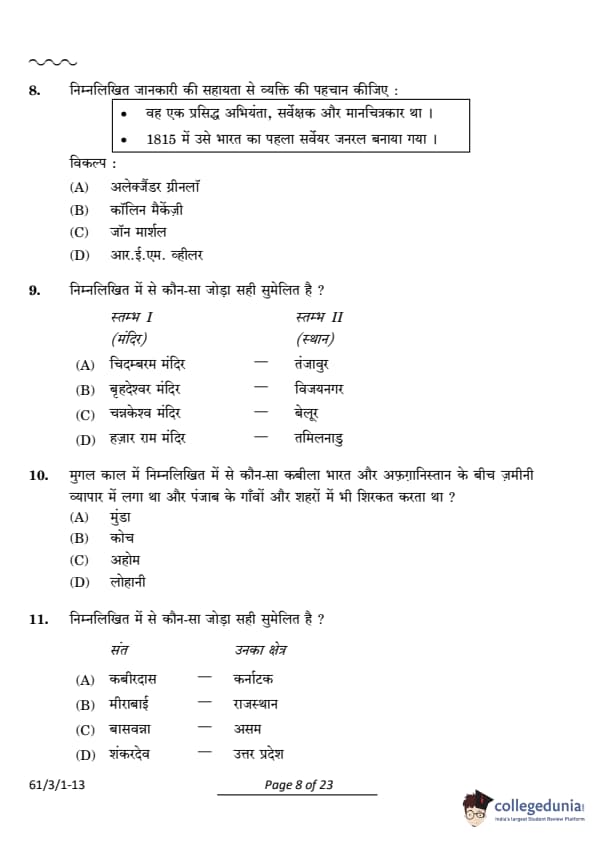
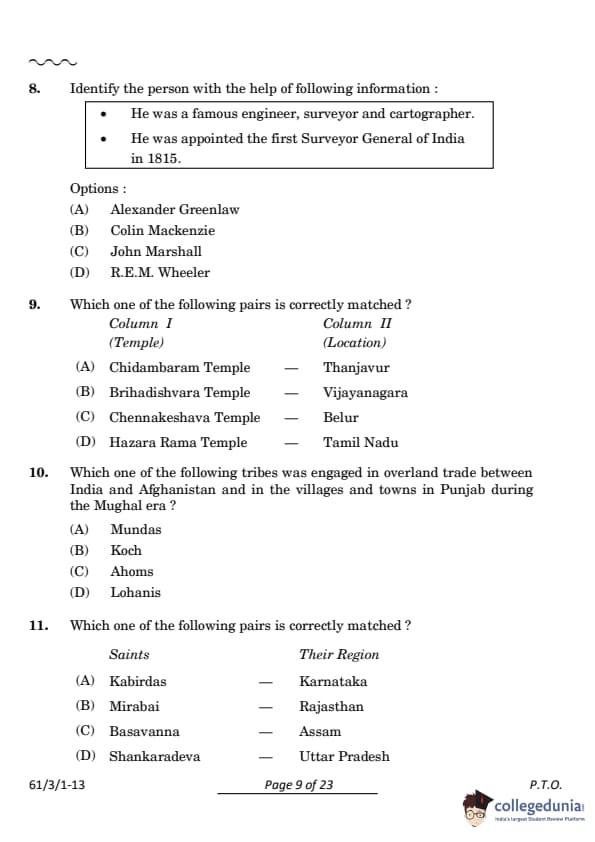
Question 8:
Identify the person with the help of following information:
- He was a famous engineer, surveyor, and cartographer.
- He was appointed the first Surveyor General of India in 1815.
View Solution
Solution:
Colin Mackenzie: Colin Mackenzie was a Scottish army officer in the British East India Company. He was also an accomplished engineer, surveyor, and cartographer. He was appointed as the first Surveyor General of India in 1815, which marks him as a pivotal figure in the mapping and exploration of the Indian subcontinent.
Alexander Greenlaw: Alexander Greenlaw was a prominent photographer and engineer in India, but he was not the first Surveyor General of India, and he is not mainly known for cartography.
John Marshall: John Marshall was a significant figure in the field of Indian archaeology, but he was not a surveyor or a cartographer. He is known for his work at sites such as Harappa and Mohenjo-daro. He served as the Director-General of the Archaeological Survey of India (ASI).
R.E.M. Wheeler: Mortimer Wheeler was a renowned archaeologist who made great contributions in India and Pakistan. He is known for his innovative excavation techniques, and he also served as the Director-General of ASI, but not as surveyor general.
Question 9:
Which one of the following pairs is correctly matched?
| Column I (Temple) | Column II (Location) |
|---|---|
| (A) Chidambaram Temple | Thanjavur |
| (B) Brihadishvara Temple | Vijayanagara |
| (C) Chennakeshava Temple | Belur |
| (D) Hazara Rama Temple | Tamil Nadu |
View Solution
Solution:
(A) Chidambaram Temple - Thanjavur: The Chidambaram Temple is a well-known Shiva temple, but it is actually located in Chidambaram, Tamil Nadu, not Thanjavur. It is famous for its Nataraja iconography and ancient architecture.
(B) Brihadishvara Temple - Vijayanagara: Brihadishvara Temple is a great example of Chola architecture and is located in Thanjavur, Tamil Nadu, not Vijayanagara.
(C) Chennakeshava Temple - Belur: The Chennakeshava Temple is a notable example of Hoysala architecture, and it is indeed located in Belur, Karnataka.
(D) Hazara Rama Temple - Tamil Nadu: Hazara Rama Temple is a significant temple in the Vijayanagara empire, and is located in Hampi (the capital of Vijayanagara), not in Tamil Nadu.
Question 10:
Which one of the following tribes was engaged in overland trade between India and Afghanistan and in the villages and towns in Punjab during the Mughal era?
View Solution
Solution:
Lohanis: The Lohanis were a prominent Pashtun tribal group and were known for their involvement in the overland trade during the Mughal period. Their trade networks connected Afghanistan with India, and they were active in the markets of Punjab. They were primarily involved in trade, transport and sometimes also acted as moneylenders.
Mundas: The Mundas are an ethnic group from Jharkhand and its surrounding regions. They were primarily known for their agricultural activities and their struggles against colonial rule. They did not participate significantly in the overland trade routes between India and Afghanistan.
Koch: The Koch were a tribal group from the region of Assam and its surrounding areas and were primarily known for their control over the Brahmaputra river. They were not known for their participation in overland trade with Afghanistan.
Ahoms: The Ahoms were a Tai-speaking group that ruled the region of Assam for many centuries. They are known for their independent and powerful kingdom and their unique cultural traditions. They did not have a direct role in overland trade between India and Afghanistan.
Question 11:
Which one of the following pairs is correctly matched?
| Saints | Their Region |
|---|---|
| (A) Kabirdas | Karnataka |
| (B) Mirabai | Rajasthan |
| (C) Basavanna | Assam |
| (D) Shankaradeva | Uttar Pradesh |
View Solution
Solution:
(A) Kabirdas - Karnataka: Kabirdas was a 15th-century Indian mystic poet and saint, whose compositions influenced the Bhakti movement in northern India. He was mainly based in Varanasi, Uttar Pradesh.
(B) Mirabai - Rajasthan: Mirabai was a 16th-century Hindu mystic poet and a devotee of Krishna. She was known for her devotional songs and bhajans in the Bhakti tradition. She lived and composed her works mostly in Rajasthan, specifically in Mewar.
(C) Basavanna - Assam: Basavanna was a 12th-century philosopher, poet, and social reformer associated with the Lingayat movement. He was primarily active in Karnataka, not Assam.
(D) Shankaradeva - Uttar Pradesh: Shankaradeva was a 15th-16th century saint who popularized the Vaishnava tradition in Assam. He is not associated with Uttar Pradesh.
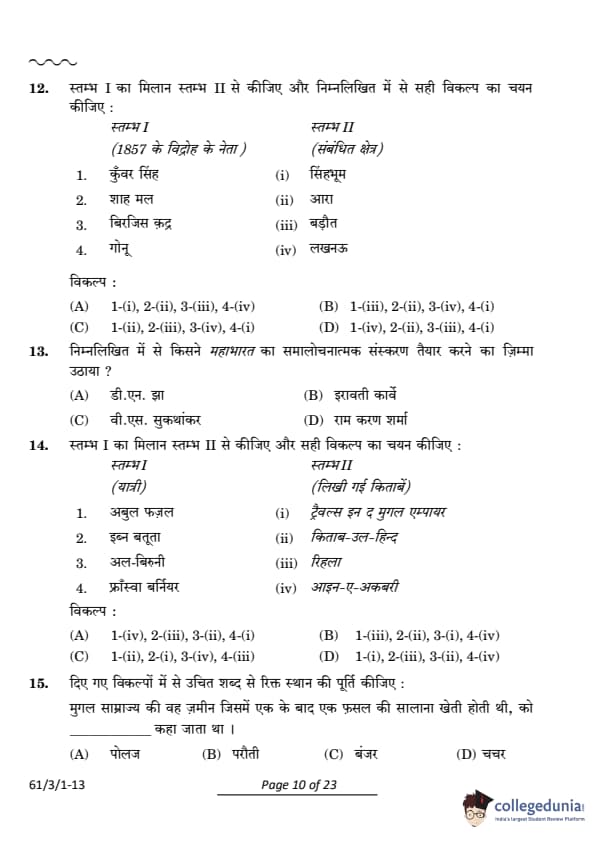
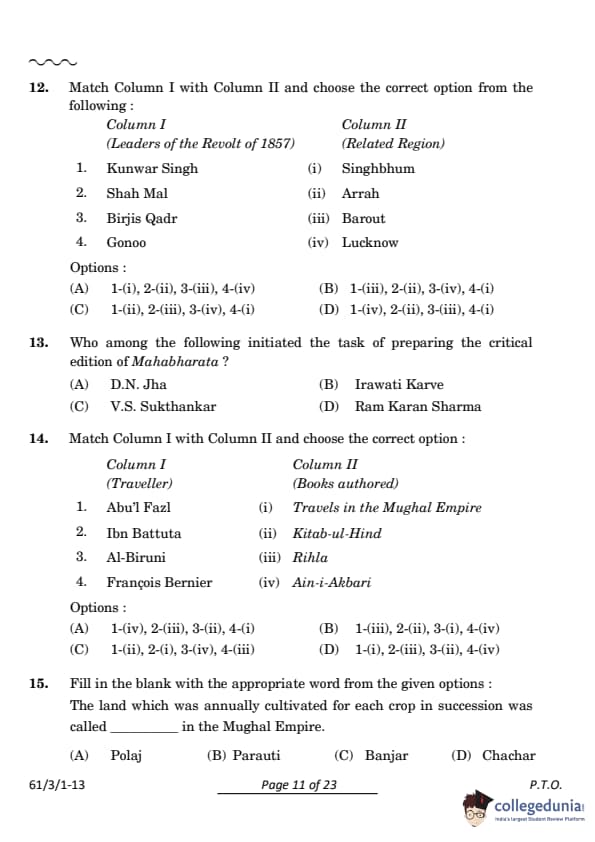
Question 12:
Match Column I with Column II and choose the correct option from the following:
| Column I (Leaders of the Revolt of 1857) | Column II (Related Region) |
|---|---|
| 1. Kunwar Singh | (i) Singhbhum |
| 2. Shah Mal | (ii) Arrah |
| 3. Birjis Qadr | (iii) Barout |
| 4. Gonoo | (iv) Lucknow |
(A) 1-(i), 2-(ii), 3-(iii), 4-(iv)
(B) 1-(iii), 2-(ii), 3-(iv), 4-(i)
(C) 1-(ii), 2-(iii), 3-(iv), 4-(i)
(D) 1-(iv), 2-(ii), 3-(iii), 4-(i)
View Solution
Solution:
1. Kunwar Singh and (ii) Arrah: Kunwar Singh was a prominent leader of the revolt of 1857 from Bihar, and he was active in and around the region of Arrah.
2. Shah Mal and (iii) Barout: Shah Mal was a local leader in the Barout region of Uttar Pradesh during the revolt of 1857.
3. Birjis Qadr and (iv) Lucknow: Birjis Qadr was the son of the deposed Nawab of Awadh, and he led the rebellion in Lucknow.
4. Gonoo and (i) Singhbhum: Gonoo, also known as Geynu, was a tribal leader from Singhbhum (Jharkhand). He had played an active role in the revolt of 1857 in the region.
Question 13:
Who among the following initiated the task of preparing the critical edition of Mahabharata?
View Solution
Solution:
V.S. Sukthankar: Vishnu Sitaram Sukthankar was an Indian scholar and a Sanskritist, and is best known for initiating the critical edition of the Mahabharata. This was a very huge project and was crucial for ensuring an authentic text with scholarly consensus.
D.N. Jha: Dwijendra Narayan Jha was a historian who wrote extensively on ancient India. He has worked on the social and economic history but was not associated with the critical edition of the Mahabharata.
Irawati Karve: Irawati Karve was an anthropologist and a historian known for her work on kinship structures and Indian social history and not for the critical edition of Mahabharata.
Ram Karan Sharma: Ram Karan Sharma was a Sanskrit scholar, known for his translation work of Sanskrit text, but he was not involved in Mahabharata's critical edition.
Question 14:
Match Column I with Column II and choose the correct option:
| Column I (Traveller) | Column II (Books authored) |
|---|---|
| 1. Abu'l Fazl | (i) Travels in the Mughal Empire |
| 2. Ibn Battuta | (ii) Kitab-ul-Hind |
| 3. Al-Biruni | (iii) Rihla |
| 4. Francois Bernier | (iv) Ain-i-Akbari |
(A) 1-(iv), 2-(iii), 3-(ii), 4-(i)
(B) 1-(iii), 2-(ii), 3-(i), 4-(iv)
(C) 1-(ii), 2-(i), 3-(iv), 4-(iii)
(D) 1-(i), 2-(iii), 3-(ii), 4-(iv)
View Solution
Solution:
1. Abu'l Fazl and (iv) Ain-i-Akbari: Abu'l Fazl was an important courtier in the Mughal court, during the reign of Akbar. He was the author of Akbarnama and Ain-i-Akbari, which is a comprehensive record of Mughal administration and culture during Akbar's reign.
2. Ibn Battuta and (iii) Rihla: Ibn Battuta was a Moroccan traveler of the 14th century, and his travel account titled “Rihla" gives us a valuable insight into the social, cultural, and political conditions of the places that he visited, including India.
3. Al-Biruni and (ii) Kitab-ul-Hind: Al-Biruni was an 11th-century scholar who came to India along with Mahmud Ghazni. His book, “Kitab-ul-Hind”, is an extensive study of Indian society, culture, religion and philosophy at that time.
4. Francois Bernier and (i) Travels in the Mughal Empire: Francois Bernier was a French physician and traveler who visited India during the 17th century. His travelogue, “Travels in the Mughal Empire", gives us a firsthand account of the social and political life of the Mughal Empire during that period.
Question 15:
Fill in the blank with the appropriate word from the given options:
The land which was annually cultivated for each crop in succession was called __________ in the Mughal Empire.
View Solution
Solution:
Polaj: In the Mughal land revenue system, “Polaj” referred to land which was annually cultivated for each crop in succession, and which was never left fallow. The focus here is the consistent and continuous nature of cultivation.
Parauti: “Parauti” land was also fertile, but it was left uncultivated for a period of time to regain its fertility. It is different from the Polaj land that was cultivated continuously.
Banjar: "Banjar" land was infertile land which was left uncultivated for a period of five years or more.
Chachar: “Chachar" land was left uncultivated for three to four years.
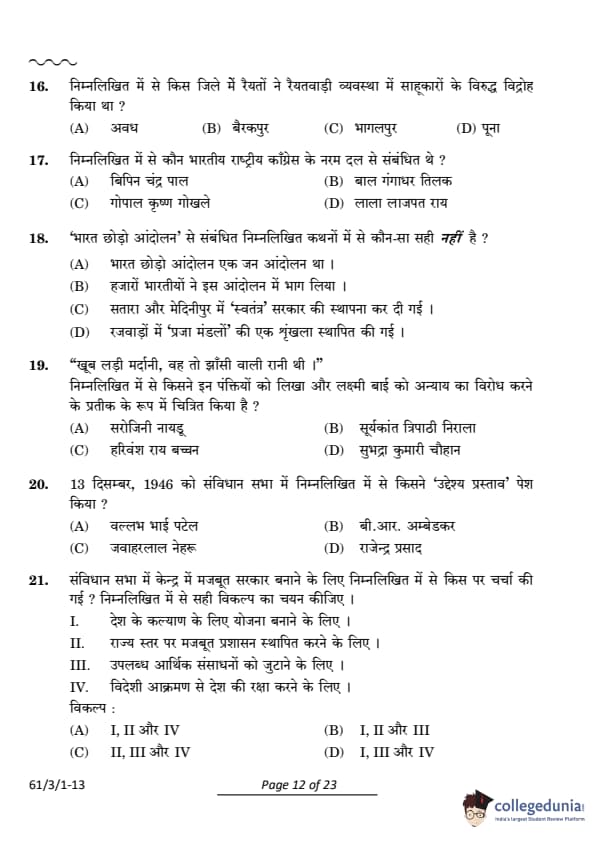
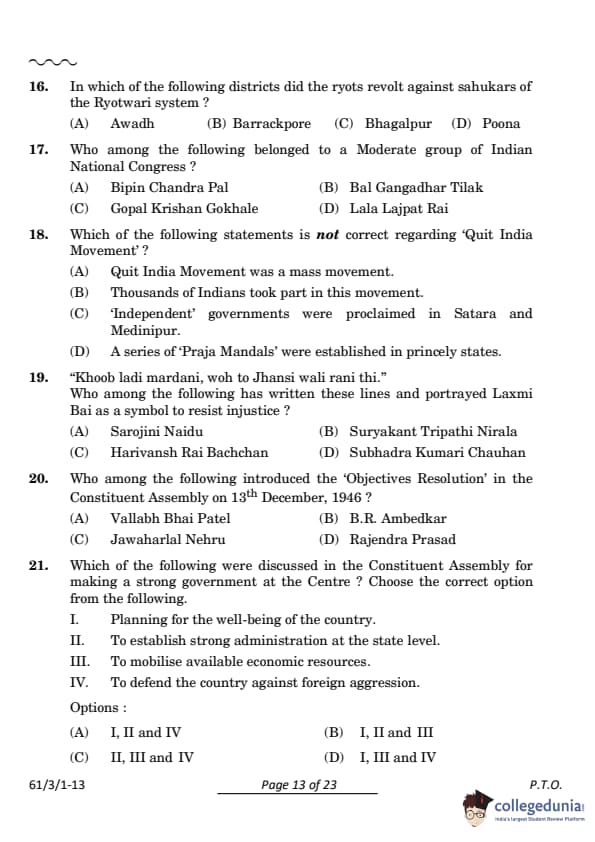
Question 16:
In which of the following districts did the ryots revolt against sahukars of the Ryotwari system?
View Solution
Solution:
Poona: The district of Poona (Pune) in Maharashtra witnessed significant peasant uprisings against moneylenders (sahukars) in the context of the Ryotwari system, which was one of the land revenue policies introduced by the British. The Deccan Riots of 1875 were centered in this region. This was largely because of the high taxes that had to be paid under this system, which led to a great deal of indebtedness of the peasants.
Awadh: Awadh was primarily the centre of the 1857 revolt, and was annexed by the British because of alleged misrule. The region is known for taluqdars who were the main landowners, and the peasants revolted against their authority and the British.
Barrackpore: Barrackpore is more known for its military cantonment and the sepoy mutinies that erupted here, including the initial events of the 1857 Revolt.
Bhagalpur: Bhagalpur is located in Bihar and was associated with the Santal rebellion of 1855–56, and not the Deccan Riots specifically in the context of Ryotwari system.
Question 17:
Who among the following belonged to a Moderate group of Indian National Congress?
View Solution
Solution:
Gopal Krishna Gokhale: Gopal Krishna Gokhale was an important leader of the Indian National Congress (INC) known for his moderate approach towards the British. He believed in constitutional means for attaining self-rule and focused on education, social reform, and gradual political change.
Bipin Chandra Pal: Bipin Chandra Pal was part of the nationalist group called the “Lal-Bal-Pal” trio that adopted a more assertive approach in demanding Swaraj from the British. They were often called extremists.
Bal Gangadhar Tilak: Bal Gangadhar Tilak was another leader of the extremists faction of the Indian National Congress, and advocated a more aggressive strategy for national independence through mass mobilization.
Lala Lajpat Rai: Lala Lajpat Rai was also known as one of the important nationalist leaders who favored a more assertive approach and was a key member of the “Lal-Bal-Pal” trio.
Question 18:
Which of the following statements is not correct regarding ‘Quit India Movement'?
View Solution
Solution:
(A) Quit India Movement was a mass movement: The Quit India Movement was indeed a mass movement with wide-scale participation from various sections of the Indian society, including students, peasants, workers and women.
(B) Thousands of Indians took part in this movement: It is true that thousands of Indians participated in the Quit India Movement, facing widespread arrests and even violence from the British.
(C) 'Independent' governments were proclaimed in Satara and Medinipur: The formation of independent governments in Satara (Maharashtra) and Medinipur (Bengal) were key features of the Quit India movement where protestors established local governments.
(D) A series of ‘Praja Mandals' were established in princely states: While the "Praja Mandal" movement was significant in the context of princely states, it was not directly connected to the Quit India movement. Praja Mandals were local associations and played their role in different time periods.
Question 19:
“Khoob ladi mardani, woh to Jhansi wali rani thi.” Who among the following has written these lines and portrayed Laxmi Bai as a symbol to resist injustice?
View Solution
Solution:
Subhadra Kumari Chauhan: Subhadra Kumari Chauhan was an Indian poet and freedom fighter. She wrote the poem “Jhansi Ki Rani” which includes the line “khoob ladi mardani, woh toh Jhansi wali rani thi”. This poem celebrates the bravery and sacrifice of Rani Lakshmibai and her fight against the British in the revolt of 1857. It has a key role in celebrating nationalism and the contribution of women to the freedom struggle.
Sarojini Naidu: Sarojini Naidu, also known as the ‘Nightingale of India', was a poet and freedom fighter, but she is not known for these specific lines. She has written numerous poems and has also been an active figure in the freedom movement.
Suryakant Tripathi Nirala: Suryakant Tripathi ‘Nirala' was a Hindi poet known for his contribution to the Chhayavaad school of poetry, and for his nationalistic themes. He has not written this specific poem about Lakshmi Bai.
Harivansh Rai Bachchan: Harivansh Rai Bachchan was a renowned Hindi poet best known for his works like Madhushala, and his works do not feature the particular lines about Rani Lakshmi Bai.
Question 20:
Who among the following introduced the ‘Objectives Resolution' in the Constituent Assembly on 13th December, 1946?
View Solution
Solution:
Jawaharlal Nehru: Jawaharlal Nehru was the person who introduced the 'Objectives Resolution' in the Constituent Assembly on December 13, 1946. This resolution laid out the basic principles and objectives of the Indian Constitution. It also served as a blueprint for the Constitution and influenced its subsequent formation.
Vallabh Bhai Patel: Vallabh Bhai Patel was an important leader of the Indian National Congress and is best known for his role in the integration of princely states into the Indian Union. He played a major role in drafting the Indian Constitution but not for introducing the objective resolution.
B.R. Ambedkar: B.R. Ambedkar, as the chairman of the drafting committee, played an important role in drafting the Indian Constitution but not the objective resolution.
Rajendra Prasad: Rajendra Prasad was the first President of India and was the chairman of the Constituent Assembly, but he is not associated with introducing the 'Objectives Resolution'.
Question 21:
Which of the following were discussed in the Constituent Assembly for making a strong government at the Centre? Choose the correct option from the following.
(A) I, II and IV
(B) I, II and III
(C) II, III and IV
(D) I, III and IV
View Solution
Solution:
I. Planning for the well-being of the country: The need to plan for the well-being of the nation, including social and economic development, was an important point of discussion and deliberation in the Constituent Assembly, particularly after independence.
II. To establish strong administration at the state level: While the Constituent Assembly discussed the need for a strong center, they also discussed the importance of decentralized governance and state-level autonomy.
III. To mobilize available economic resources: The need to mobilize available economic resources for development and national progress was a critical objective during the period following independence.
IV. To defend the country against foreign aggression: Defending the nation against any potential external threat, both in the past and future, was a prime concern during the making of constitution.
SECTION B
(Short Answer Type Questions)
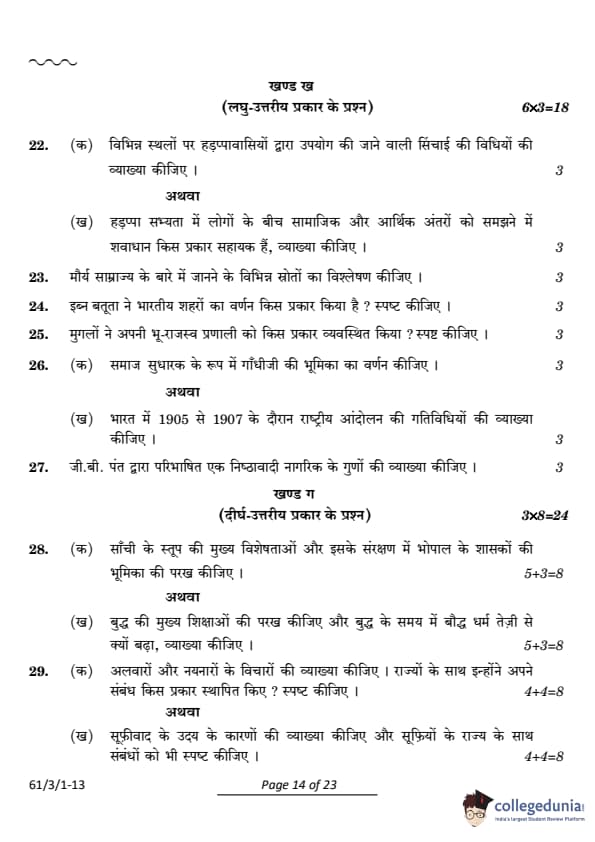
Question 22:
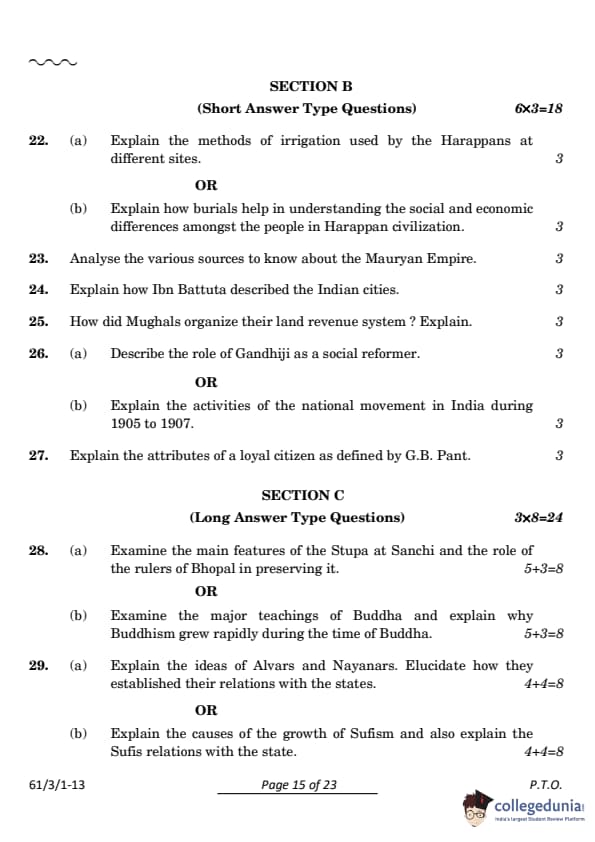
(A) Explain the methods of irrigation used by the Harappans at different sites.
View Solution
Solution:
Location and Need for Irrigation: Most Harappan settlements were located in semi-arid regions where annual rainfall was not sufficient for regular agriculture, making irrigation techniques essential. This made them dependent on human methods to supply water.
Traces of Canals: Archaeological excavations, notably at the site of Shortughai in Afghanistan, revealed the remains of canals. However, similar canals have not been found in the Punjab or Sindh. These canals were primarily designed to take water from rivers to nearby fields.
Water Drawn from Wells: Wells were an important source of irrigation water. Water was lifted from these wells using various techniques. The availability of wells in the region highlights the ingenuity of the Harappans.
Water Reservoirs: The Harappan civilization had reservoirs to store water, especially evident at the site of Dholavira. These reservoirs were used both for irrigation and for storing water for other purposes.
Other possible points: Other points can include small dams, embankments etc.
Question 22:
(b) Explain how burials help in understanding the social and economic differences amongst the people in Harappan civilization.
View Solution
Solution:
Burial Pits: Harappans generally buried the dead in pits which were dug into the soil. Sometimes, pits had different shapes and sizes. This differentiation indicates variations in the social and economic standing of the dead.
Pits Lined with Bricks: Some burial pits were lined with bricks, suggesting that those buried within these pits likely had a higher social or economic status than those in plain pits.
Grave Goods: Some graves contained pottery and ornaments, indicating belief in life after death, and possibly that these were items of daily use or of importance to the deceased. Also, the type of grave goods reveal the socio-economic class of the deceased.
Jewellery in Graves of Both Men and Women: The presence of jewellery in both men and women's graves suggests that both genders held similar social importance. This also indicates the importance of such items in their lives.
Burial With Copper Mirrors and Jasper Beads: Some graves had luxury items like copper mirrors and jasper beads, implying that these individuals had access to luxury goods, and this reflects that not all people were equal in the Harappan society.
Lack of Precious Items: The overall lack of precious metals and other valuables indicates that the Harappans did not focus on burying very valuable things with the dead. The relative absence of very valuable items also indicates that there was no great display of wealth in the graves, which further highlights a more egalitarian society than some other contemporary civilizations.
Other relevant point: Any other valid point from the chapter.
Question 23:
Analyse the various sources to know about the Mauryan Empire.
View Solution
Solution:
Archaeological Findings: The most important archaeological findings include remains of structures, pottery, tools, and other material culture which reveal urban planning, technological advancements, and trade networks of the Mauryan period. The remains of the palace at Kumhrar and the stupas also provide insight into the architecture of the period.
Megasthenes' Indica: Megasthenes, who was a Greek ambassador to the court of Chandragupta Maurya, has detailed his observations of Maurya empire, court life, administration, social classes, and military organization in his work named “Indica”. Though the original text is now lost, many parts of it exist in the accounts of later Greek historians.
Arthashastra by Kautilya: Kautilya's Arthashastra is an important source that provides details about the political, social, and economic policies of the Mauryan empire. It offers insight into the administrative structure, law, taxation, and diplomatic strategies of the kingdom.
Buddhist, Jain, and Puranic Literature: Buddhist texts like the Jatakas and Jain texts also provide details about the social and political life in this era. The Puranas help in building a genealogical record of rulers.
Inscriptions of Ashoka: Ashoka's edicts inscribed on pillars, rocks, and caves throughout his kingdom give insights into his policies, moral code, and religious propagation. These edicts also provide the geographic expanse of the Mauryan kingdom and the reforms that Ashoka undertook.
Sculptures: Mauryan sculpture, especially the Lion Capital at Sarnath, provides insight into their artistic skills and the religious beliefs prevalent during that era. The material they used for sculpting provides a glimpse into their technical know-how.
Other relevant point: Any other relevant point from the chapter.
Question 24:
Explain how Ibn Battuta described the Indian cities.
View Solution
Solution:
Opportunities and Prosperity: Ibn Battuta found Indian cities bustling with life and full of opportunities, highlighting their economic vitality and potential. He mentioned numerous trading routes, bazaars, and ports that facilitated commerce and trade, showcasing the prosperity of the cities.
Densely Populated: Indian cities were densely populated and prosperous according to Ibn Battuta, indicating a thriving economy and a bustling urban life. He noted their large populations and their vibrancy.
Crowded Streets and Markets: Ibn Battuta described streets as being crowded, and the markets as vibrant and colourful which highlights their dynamic character and diversity of goods that were sold there.
Variety of Goods: The market places had a wide variety of goods available for people of all social strata, indicating a well-organized supply chain and a culture of consumption.
Delhi's Grandeur: Ibn Battuta described Delhi as a vast city with a large population. He also called it one of the largest and most magnificent cities in India, reflecting the capital’s power and prestige at that time.
Daulatabad's Rivalry: He also wrote about Daulatabad in Maharashtra, highlighting that it was equally important and comparable to Delhi in size and grandeur. He noted that there was a clear rivalry between the cities.
Bazaars as Economic and Cultural Hubs: According to Ibn Battuta, Bazaars were not just places of economic transactions but also hubs of social and cultural activities, indicating the integration of different aspects of city life.
Daulatabad's Bazaars and Markets: He gave specific mentions of the market place in Daulatabad, highlighting the fact that it had numerous performers like singers.
Question 25:
How did Mughals organize their land revenue system? Explain.
View Solution
Solution:
Two Stages of Land Revenue Arrangement: The land revenue system under the Mughals had two stages, first the assessment (jama) and then the actual collection (hasil). This two-stage process allowed better planning and management of the resources available to the state.
Jama and Hasil: The “jama” was the amount assessed as land revenue, and “hasil” was the actual amount collected. This difference helped the state in keeping accounts and analyzing their income.
Cash Payments: Akbar decreed that the Amil-guzar (revenue collector) should strive to get cultivators to pay their land revenue in cash. This facilitated smoother trade.
Payment in Kind Option: While encouraging cash payment, the option of payment in kind was also kept open, highlighting a more flexible approach.
Maximising State Claims: While fixing revenue the state always tried to maximize its claims to the land revenue, indicating an increasing demand from the state.
Measurement of Cultivated Land: Both cultivated and cultivable lands were measured in each province, which formed the basis of calculating revenue.
Classification of Land: The land was classified according to its fertility into Polaj, Parauti, Chachar, and Banjar lands, which provided a clear definition of the different types of lands and their corresponding value for taxation.
Polaj Land: “Polaj” was the most fertile land and was cultivated annually without any fallow period.
Parauti Land: “Parauti” land was also fertile, yet left uncultivated for some time to regain its fertility.
Chachar Land: “Chachar” land was less fertile and was left fallow for three to four years.
Banjar Land: “Banjar” land was infertile land and left uncultivated for more than five years.
Classification Within Polaj and Parauti: Both “Polaj” and “Parauti” lands had three different classes: good, middling, and bad which were calculated based on the produce of each plot.
Medium Produce for Royal Dues: The medium produce of different classes were calculated, and one-third of it was taken as the royal dues.
Other relevant point: Any other valid point from the chapter.
Question 26(a):
Describe the role of Gandhiji as a social reformer.
View Solution
Solution:
Eradication of Social Evils: Gandhiji actively campaigned against various social evils which he thought were very harmful to society. He focused on achieving freedom not just from British rule but also from social oppression.
Untouchability: Gandhiji strongly condemned the practice of untouchability and worked to bring a change in the mindset of the people. He worked hard to create a more inclusive society.
Against Child Marriage: He spoke out against child marriage, highlighting its detrimental impact on individuals, especially girls. He argued that childhood should be a period of growth and education.
Hindu-Muslim Unity: He worked for Hindu-Muslim unity and saw it as crucial for national development and independence. He encouraged inter-faith harmony and tolerance.
Promotion of Khadi and Swadeshi: Gandhiji promoted Khadi and Swadeshi as a means of self-reliance. He also promoted local economies and crafts.
Tolerance for Other Faiths: He also emphasised that Indians of one faith should have tolerance and respect for other faiths, thus creating a harmonious society.
Self-Reliance: Gandhiji stressed the need for Indians to become self-reliant through individual effort and community action. He focused on self-sufficiency in basic needs.
Other Relevant Point: Any other valid point from the chapter.
Question 26(b):
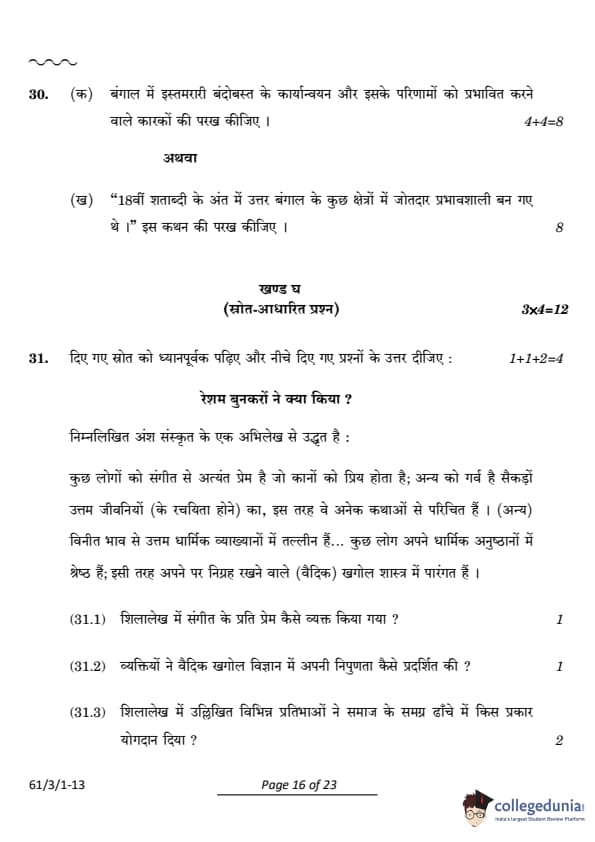
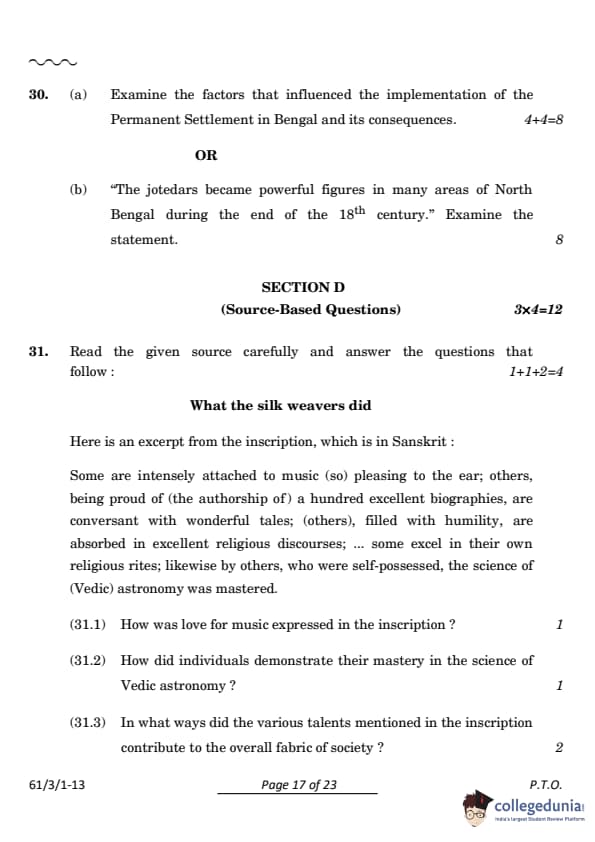
"The jotedars became powerful figures in many areas of North Bengal during the end of the 18th century.” Examine the statement.
View Solution
Solution:
Emergence of Rich Peasants: At the end of the 18th century, a group of rich peasants was consolidating their position in the villages of North Bengal, demonstrating a shift in the agrarian structure.
Large Land Holdings: These jotedars had acquired large amounts of land, sometimes as much as several thousand acres, highlighting their growing economic power.
Control Over Trade and Moneylending: They controlled local trade as well as moneylending, and this also increased their influence over the local population.
Immense Power Over Poor Cultivators: They exercised immense power over the poorer cultivators of the region through a system of sharecropping.
More Effective Power Than Zamindars: In many cases, the power of jotedars was more effective than that of zamindars.
Control Over Poor Villagers: The jotedars were based in the villages and directly controlled the lives of a considerable section of poor villagers.
Resisting Zamindars: They fiercely resisted efforts by zamindars to increase the revenue of the village, highlighting their power and influence.
Preventing Zamindari Officials from Executing Duties: They also prevented zamindari officials from executing their duties in the villages.
Mobilisation of Raiyats: They mobilized the "raiyats" who were dependent on them, and were able to delay revenue payments to the zamindar.
Other relevant point: Any other valid point from the chapter.
Question 27:
Explain the attributes of a loyal citizen as defined by G.B. Pant.
View Solution
Solution:
Community Over Self: According to G.B. Pant, for one to become a loyal citizen, one had to stop focusing on the community and the self, and think about the collective good of the nation.
Self-Discipline: A loyal citizen must train oneself in the art of self-discipline, which was important for a harmonious and responsible society.
Loyalty to the State: All loyalties must be focused on the state, which indicates that individual and community loyalties should be subordinate to national loyalty.
Selflessness: A loyal citizen must focus on the welfare of others rather than focusing on their own well-being. This would build a sense of collectivity.
Undivided Loyalty: There can’t be any divided loyalty, where other aspects of one’s identity would supersede the national identity.
Rival Loyalties in Democracy: If one has rival loyalties, then democracy will be doomed, as he saw the issue of divided loyalties as a threat to the nation.
Other Relevant Point: Any other valid point from the chapter.
SECTION C
(Long Answer Type Questions)
Question 28(a):
Examine the main features of the Stupa at Sanchi and the role of the rulers of Bhopal in preserving it.
View Solution
Solution:
Main Features of the Stupa at Sanchi:
Ancient Building: The Stupa at Sanchi is an ancient Buddhist complex in Madhya Pradesh. It is a UNESCO World Heritage site known for its architectural grandeur and significance.
Stone Sculpture and Gateway: The site consists of a large Stupa, which provides a view of stone sculptures and statues related to Buddha, as well as ancient gateways, highlighting the rich artistic traditions of ancient India.
Plain Structure: The Stupas at Sanchi are plain, with a simple dome-like structure, except for the ornate stone railings and gateways.
Northern Gateway Depictions: The northern gateway of the Stupa at Sanchi displays scenes from the Vessantara Jataka, which is an important collection of Buddhist stories.
Symbols of Worship: The sculptures at Sanchi include various symbols of worship like the Bodhi tree, the wheel of dharma, and the empty seat of Buddha, indicating the core beliefs of Buddhism.
Motifs from Popular Traditions: Motifs like the Shalabhanjika, elephant, Gajalakshmi, and serpents seem to be derived from popular traditions, showing the integration of common beliefs with religious ideas.
Jataka Tales: The Jataka tales with their animal stories are depicted in the carvings at Sanchi, demonstrating their importance in conveying Buddhist teachings in an accessible manner.
Lively Scenes: The carvings are done to make lively scenes, which help attract viewers.
Role of the Rulers of Bhopal in preserving Sanchi Stupa:
European Interest: The Europeans saw ruins and monuments like the Stupa at Sanchi with great interest.
Cunningham's Examination: Cunningham had carefully examined the ruins, which indicates the importance given to it.
French Attempts: The French wanted to take away the eastern gateway of the stupa, which reflects the colonial attempts to appropriate ancient treasures.
English Attempts: The English also wanted to do the same thing, highlighting the widespread desire to take the Stupa's artifacts.
Shahjehan Begum's Efforts: Shahjehan Begum did not allow the French and English to take away the original gateways. Instead, she satisfied them with carefully prepared plaster-cast copies. The originals remained in the site area.
Funding for Preservation: The rulers of Bhopal provided funds for preserving the Stupa.
Museum and Rest House: Sultan Jehan Begum funded the museum and the guest house that were built at the site.
Question 28(b):
Examine the major teachings of Buddha and explain why Buddhism grew rapidly during the time of Buddha.
View Solution
Solution:
Major Teachings of Buddha:
Transient World: According to Buddhist philosophy, the world is constantly changing. Nothing is permanent or eternal.
Soullessness: The world is also soulless (anatta) which means that nothing has a soul or essence.
Intrinsic Sorrow: Sorrow is an intrinsic part of human existence (dukkha) and is a part of human existence.
Middle Path: The way out of this was to follow the 'middle path' between extreme penance and self-indulgence. The middle path was supposed to help people rise above worldly troubles.
Relevance of God: Whether God exists or not is not relevant to the teachings of Buddha.
Individual Effort: Buddha emphasized individual effort in transforming one’s own social interactions. This is one of the most important aspects of his teachings.
Path to Nibbana: The emphasis was on individual agency and righteous action, as the means to escape the cycle of rebirth and achieve self-realization (Nibbana).
Be Your Own Lamp: Buddha’s final words to his followers were to be their own guides, emphasizing the need for self-reliance in one’s spiritual journey.
Reasons for Buddhism’s Rapid Growth during Buddha’s Time:
Appeal to Many People: The simplicity of Buddhism and the accessibility of its teachings appealed to a wide section of the population. It cut across social and economic hierarchies.
Shifting from other religions: Many people who were confused with other religions were drawn to Buddhism.
Role of Literature: Buddhist literature made the ideas accessible and helped in propagating his ideas to different sections of society.
Conduct and Values: The importance given to conduct and values rather than claims of superiority (based on birth) helped Buddhism in attracting more people. The emphasis was on compassion, respect and justice.
Emphasis on Metta and Karuna: Emphasis on Metta (loving-kindness) and Karuna (compassion) drew both men and women to its teachings.
Equality: Buddhism championed equality, which created a more inclusive community and attracted a wide number of followers.
Question 29(a):
Explain the ideas of Alvars and Nayanars. Elucidate how they established their relations with the states.
View Solution
Solution:
Ideas of Alvars and Nayanars:
Against Caste System: Alvars and Nayanars initiated a movement against the rigid caste system. They challenged the dominance of Brahmins and the social hierarchies.
Reform of the System: They attempted to reform the social and religious system, creating a more egalitarian society.
Importance of Compositions: They believed their compositions to be equivalent to the importance of the Vedas, and thus challenged the authority of orthodox teachings.
Tamil Veda: Their anthology, ‘Nalayira Divyaprabandham’ was described as the Tamil Veda. This shows the importance of their verses in the region.
Presence of Women: One of the important aspects of this movement was the inclusion of women, like Andal and Karaikkal Ammaiyar, showcasing a more inclusive spiritual space.
Andal: Andal was an Alvar who saw herself as a beloved of Vishnu.
Karaikkal Ammaiyar: Karaikkal Ammaiyar was a Nayanar who was a devotee of Shiva.
Other Relevant Point: Any other relevant point from the chapter.
Relations with the States:
Cordial Relations: There are multiple instances of cordial relations with the state, which indicates that their approach to state power was very complex.
Royal Patronage: The rulers often patronized the Alvars and the Nayanars by giving grants and funds to them. This made sure that they had enough support.
Temple Grants: The Cholas gave grants for the construction of temples dedicated to Vishnu and Shiva. This demonstrates their recognition and support of these traditions.
Temple Construction: Important temples at Thanjavur and Chidambaram were constructed under the patronage of Chola rulers, highlighting the state’s support for these religious communities.
Divine Support Claim: The Chola rulers also claimed divine support from these religious figures, which highlights the complex intermingling of political and religious power in the region.
Power and Status: The rulers also displayed their own power by building magnificent temples. This shows the use of religious structures to express political power.
Tamil Hymns: The kings also introduced the singing of Tamil hymns which shows the spread of the devotional traditions.
Organized into a text: The hymns were organized into a text called Tevaram.
Metal Images: Chola ruler Prantaka I consecrated metal images of the saints Appar, Sambandar and Sundarar in a Shiva temple, further cementing their political and cultural impact.
Other Relevant Point: Any other valid point from the chapter.
Question 29(b):
Explain the causes of the growth of Sufism and also explain the Sufis relations with the state.
View Solution
Solution:
Causes of the Growth of Sufism:
Protest Against Materialism: Sufism emerged in protest against the growing materialism within the Caliphate, which was now getting focused on wealth accumulation.
Critical of Dogmatic Interpretations: Sufis were also critical of the dogmatic interpretation of the Quran and the Sunna, which had become very rigid. They did not approve of the rigid adherence to traditions and rituals.
Emphasis on Love for God: They emphasized seeking salvation through intense devotion and love for God. This highlighted the personal and emotional aspect of faith.
Following the Prophet’s Command: They followed the Prophet’s commands, but believed in seeking God through one’s personal devotion.
Prophet as a Perfect Human: They considered the Prophet to be the ideal example of the human being. This reflects their emphasis on seeking God through a guide.
Interpretation of Quran Based on Experience: They sought interpretation of the Quran based on their own personal experience, indicating a more inclusive approach to Islam.
Developed Movement: By the eleventh century, Sufism evolved into a well-developed movement.
Other relevant point: Any other valid point from the chapter.
Sufis Relations with the State:
Sufi Practices and Literature: Sufis developed their literature and practices, which became important cultural aspects of this period.
Austerity and Distance from Power: A major feature of the Chishti tradition was austerity, as they maintained a certain distance from worldly power.
Acceptance of Unsolicited Grants: Sufis often accepted unsolicited grants and donations from political elites, which allowed them to exist independent of state support.
Charitable Trusts by Sultans: The Sultans set up charitable trusts for the Sufis, and also gave tax-free land for hospices, which shows the support provided by the sultans.
Demonstration of Association: Kings often showed their association with Sufis because they also needed legitimacy from them.
Resistance to Ulema: The Delhi Sultans resisted the insistence of the Ulema on imposing Shariat as state law, showing differences between state and religious institutions.
Sufis Derive Authority from God: The sultans reached out to Sufis because Sufis were seen to derive their authority directly from God.
Tombs Near Sufi Shrines: Kings wanted their tombs to be near the Sufi shrines and hospices, which highlights the religious importance of these institutions.
Conflict with Sultans: There were instances of conflict between the Sultans and the Sufis, showing that their relationship was not always smooth.
High Sounding Titles: Sufi Shaikhs were addressed with high-sounding titles like “Sultan-ul-mashaikh”, highlighting their importance and authority.
Rituals and Authority: To assert authority, both Sultans and Sufis expected rituals like prostration and kissing of the feet.
Other relevant point: Any other valid point from the chapter.
Question 30(a):
Examine the factors that influenced the implementation of the Permanent Settlement in Bengal and its consequences.
View Solution
Solution:
Factors Influencing the Implementation of the Permanent Settlement in Bengal:
Resolution of Problems: British officials hoped the Permanent Settlement would help to resolve the various administrative and economic problems that they had been facing since the conquest of Bengal, particularly in collecting revenue.
High Initial Demands: The initial revenue demands were very high and the zamindars struggled to pay, which indicates a flaw in the initial design of the settlement.
Development of Agriculture, Trade and Revenue: The officials thought that agriculture, trade, and the state’s revenue could be enhanced by attracting more investments in agriculture, and for this, they needed to give property rights to landlords.
Securing Property Rights: This could only happen by securing the rights of property and permanently fixing the rates of revenue demand. This was the central argument of the settlement.
Regular Flow of Income: They hoped that a fixed revenue demand would ensure a regular flow of income for the company, which was very important for their trade and colonial policies.
Curbing Zamindari Power: Initially, the settlement was meant to curtail the power of zamindars but in reality, it did not reduce their power.
Rise of Yeoman Farmers: The British also expected the emergence of a class of yeoman farmers and rich landowners who would have the capital and enterprise to improve agriculture, which unfortunately did not materialize as per their expectation.
Control and Regulate Zamindars: While recognizing the importance of Zamindars, the company wanted to control and regulate them. They hoped to create a loyal class of landowners, who would support their rule.
Loyal to the Company: They also expected the zamindars to be loyal to the Company because they were essentially nurtured by the British, which was mostly true.
Other Relevant Point: Any other relevant point from the chapter.
Consequences of the Permanent Settlement:
Fixed Revenue: The East India Company had fixed the revenue which each zamindar had to pay, which indicates the fixed nature of the payment system.
Auctioning Estates: The estates of those who failed to pay the revenue were auctioned off to recover the revenue, which often led to loss of land by original landowners.
Loss of Local Justice: The Zamindars lost their traditional power to organize local justice, which removed their traditional roles.
Regular Failure to Pay: The Zamindars regularly failed to pay the revenue, which indicates the unrealistic nature of the fixed revenue system.
Loyal to the Company: The Zamindars were nurtured by the British and they became loyal to them, as expected.
Unpaid Balances Accumulated: Unpaid balances accumulated because of the rigid nature of the system and the inability of farmers to pay high taxes.
Disbanding of Troops: The zamindars' troops were disbanded, taking away their military power.
Abolished Customs Duties: Customs duties were abolished, impacting the traditional collection system in the region.
Collector’s Supervision of Courts: Their ‘cutcheries’ were brought under the supervision of a Collector appointed by the Company, taking away their power in the legal system.
Collectorates Emerge as Authority: Collectorates emerged as an alternative centre of authority, further restricting what the zamindar could do, signifying the British taking greater control of the region.
Other Relevant Point: Any other valid point from the chapter.
SECTION D
(Source-Based Questions)
Question 31:
Read the given source carefully and answer the questions that follow:
What the silk weavers did
Here is an excerpt from the inscription, which is in Sanskrit: Some are intensely attached to music (so) pleasing to the ear; others, being proud of (the authorship of) a hundred excellent biographies, are conversant with wonderful tales; (others), filled with humility, are absorbed in excellent religious discourses; some excel in their own religious rites; likewise by others, who were self-possessed, the science of (Vedic) astronomy was mastered.
31.1 How was love for music expressed in the inscription?
View Solution
Solution: The inscription indicates that some individuals were “intensely attached to music (so) pleasing to the ear”, demonstrating that they had a great love for it. The phrase "pleasing to the ear" also indicates that music was considered something that was pleasant to the human senses.
31.2 How did individuals demonstrate their mastery in the science of Vedic astronomy?
View Solution
Solution: The inscription states that those who were self-possessed were able to master the science of Vedic astronomy. Thus, self-possession was the tool by which they were able to master the field.
31.3 In what ways did the various talents mentioned in the inscription contribute to the overall fabric of society?
View Solution
Solution:
Development of Different Skills: The inscription talks of diverse skills like music, writing, religious discourses and Vedic astronomy. This shows the presence of different kinds of talents and skills in the society, which allowed it to function efficiently.
Development of Different Occupations: The existence of different kinds of talent also points towards the division of labor and development of different occupations in the society.
Intermixture of Traditions and Culture: Various skills like music, religious discourse etc. point towards an intermixture of different types of traditions and culture that existed in society.
Promoting Tolerance and Harmony: The emphasis on self-possession and skill also indicates an environment of tolerance and harmony. The presence of such diversity points towards a society which is tolerant of different cultures.
Development of Social Values: The presence of various talents and their importance in society indicates certain social values which placed importance to skill, knowledge and self-discipline.
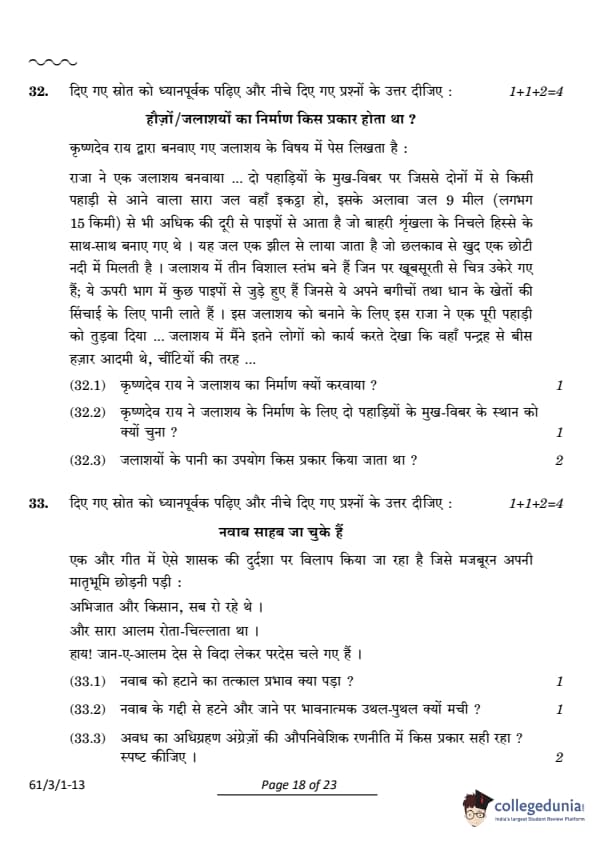
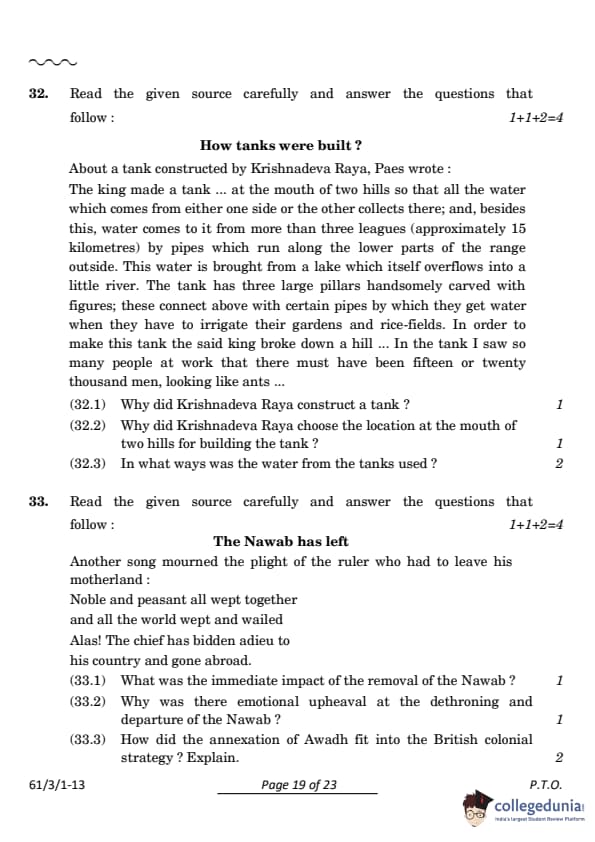
Question 32:
Read the given source carefully and answer the questions that follow:
How tanks were built?
About a tank constructed by Krishnadeva Raya, Paes wrote: The king made a tank at the mouth of two hills so that all the water which comes from either one side or the other collects there; and, besides this, water comes to it from more than three leagues (approximately 15 kilometres) by pipes which run along the lower parts of the range outside. This water is brought from a lake which itself overflows into a little river. The tank has three large pillars handsomely carved with figures; these connect above with certain pipes by which they get water when they have to irrigate their gardens and rice-fields. In order to make this tank the said king broke down a hill … In the tank I saw so many people at work that there must have been fifteen or twenty thousand men, looking like ants…
(32.1) Why did Krishnadeva Raya construct a tank?
View Solution
Solution: Based on the source, it is clear that the tank was primarily created for the collection of water. The description in the source also indicates that it was intended to provide water for irrigation of fields and gardens.
(32.2) Why did Krishnadeva Raya choose the location at the mouth of two hills for building the tank?
View Solution
Solution: The source mentions that the location at the mouth of two hills was chosen because it allowed all the water coming from either side to collect there. It was a natural location which facilitated collection of water.
It also mentions the fact that this location was chosen because it had access to water from the Tungabhadra basin, that came via pipes and filled the lake.
(32.3) In what ways was the water from the tanks used?
View Solution
Solution: As mentioned in the text, water from the tanks was used for the irrigation of gardens and rice fields. It also mentions that the water was supplied to the city, suggesting domestic use.
Question 33:
Read the given source carefully and answer the questions that follow:
The Nawab has left
Another song mourned the plight of the ruler who had to leave his motherland: Noble and peasant all wept together and all the world wept and wailed Alas! The chief has bidden adieu to his country and gone abroad.
(33.1) What was the immediate impact of the removal of the Nawab?
View Solution
Solution: The song reflects that the people of Awadh were deeply saddened by the removal of their ruler, which was indicated by the phrases “wept together”, “all the world wept and wailed” which indicates deep grief, loss and sadness among the people. The phrase "The chief has bidden adieu to his country and gone abroad” indicates that the departure was abrupt, and was accompanied by feelings of shock and dismay among the people.
(33.2) Why was there emotional upheaval at the dethroning and departure of the Nawab?
View Solution
Solution: As mentioned in the text, the source describes the emotional turmoil at the dethroning and departure of the Nawab and points towards an emotional attachment that the people of Awadh had with their ruler. The Nawab was seen as a key figure of the region, whom people regarded as a “chief” and who they thought was the “soul of the body".
(33.3) How did the annexation of Awadh fit into the British colonial strategy? Explain.
View Solution
Solution: While the source does not directly answer this, it is implied that the annexation of Awadh was done by using flimsy reasons and that it was a major step in their colonial policy. It was meant to bring greater control under the company.
SECTION E
(Map-Based Question)
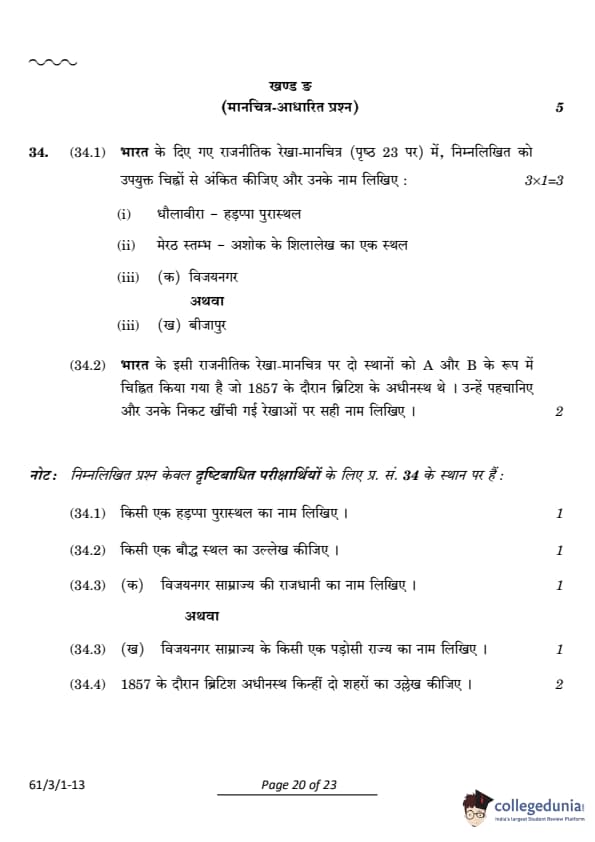
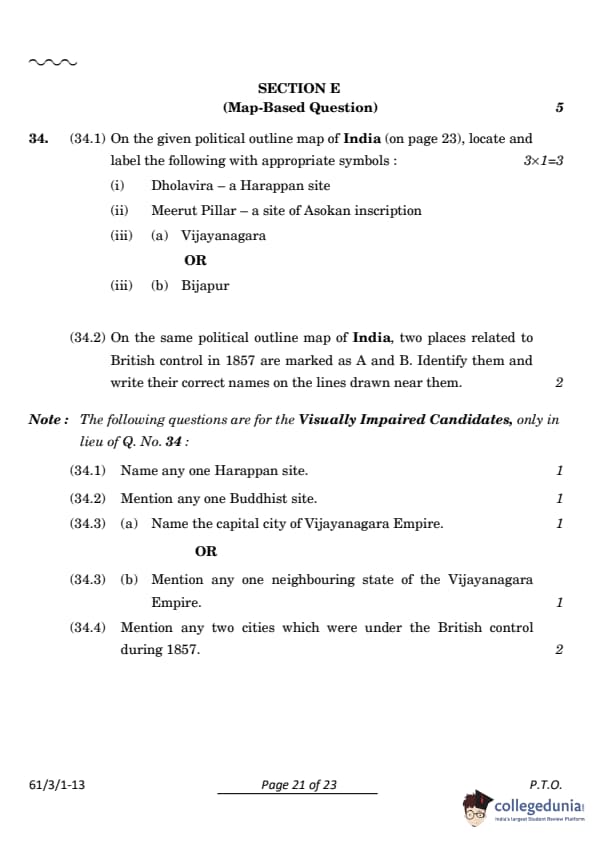
Question 34:
Question 34 (34.1):
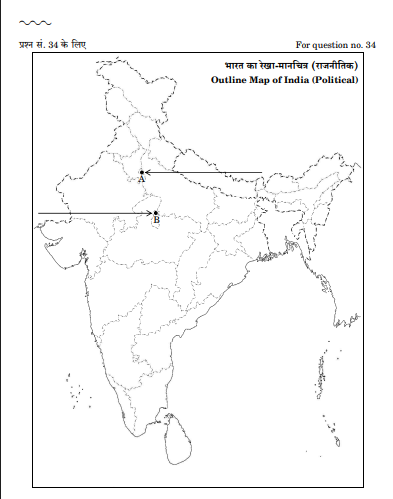
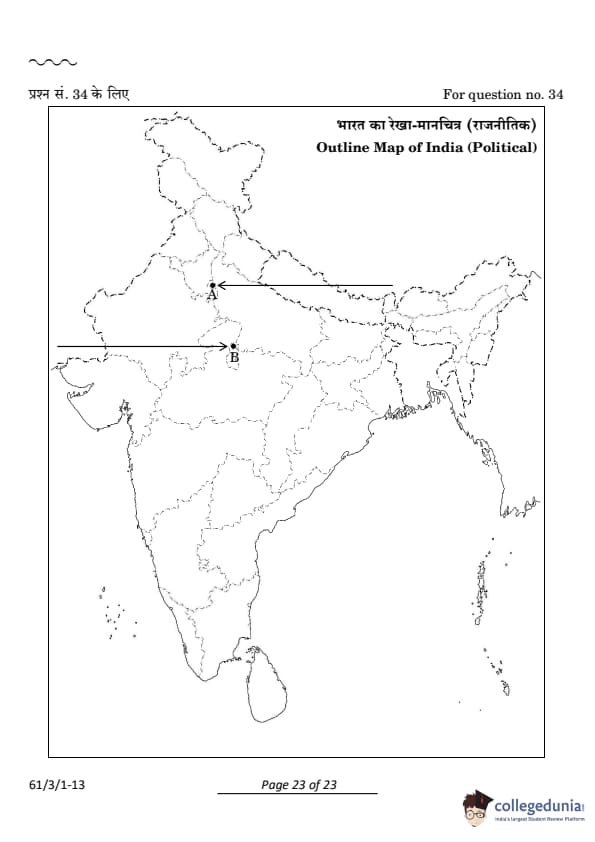
On the given political outline map of India (on page 23), locate and label the following with appropriate symbols:
(i) Dholavira – a Harappan site
(ii) Meerut Pillar – a site of Asokan inscription
(iii) (A) Vijayanagara
OR
(iii) (b) Bijapur
View Solution
Solution:
(i) Dholavira – a Harappan Site: Dholavira is located in the Kutch district of Gujarat. You should mark it in the map in the north-western state of Gujarat using the appropriate symbol. It is a major Indus Valley civilization site, and was one of the five largest sites of the Indus Valley civilization.
(ii) Meerut Pillar – a Site of Asokan Inscription: The Meerut Pillar is located in Meerut, Uttar Pradesh. You should mark this near Delhi in the map using the appropriate symbol. It is one of the many edicts of Ashoka, which provide valuable historical information about his reign.
(iii)(A) Vijayanagara: Vijayanagara, the capital city of the Vijayanagara Empire, is located in present-day Hampi in Karnataka. It should be located in the South-Central portion of the map.
OR
(iii)(b) Bijapur: Bijapur, also known as Vijayapura, is located in Karnataka. You should mark it in the map to the south-west, near the region of Vijayanagar. Bijapur was ruled by the Adil Shahi dynasty which was a significant political power in the region.
Question 34 (34.2):
On the same political outline map of India, two places related to British control in 1857 are marked as A and B. Identify them and write their correct names on the lines drawn near them.
Any two Centers under the control of British from the given list.
(A) Delhi
(B) Jhansi
View Solution
Solution:
(A) Delhi: Delhi was a major center of British control during the revolt of 1857. It was a place where some of the key battles took place, and was also a symbolic centre due to its historical importance. You should label the location marked as A in the map as Delhi.
(B) Jhansi: Jhansi was another important center of the revolt, primarily because of the role of Rani Lakshmi Bai who led the forces against the British. It should be labeled at the location marked as B in the map.
Question 34 for Visually Impaired Candidates (34.1):
Name any one Harappan site.
View Solution
Solution: Any one of the Harappan sites can be mentioned like Kalibangan, Lothal, Mohenjo-Daro, Harappa, Rakhigarhi, Dholavira, etc.
Question 34 for Visually Impaired Candidates (34.2):
Mention any one Buddhist site.
View Solution
Solution: Any important Buddhist sites can be mentioned, like Sanchi, Sarnath, Bodhgaya, Lumbini, etc.
Question 34 for Visually Impaired Candidates (34.3) (A):
Name the capital city of Vijayanagara Empire.
View Solution
Solution: Hampi/Vijayanagara is the capital city of the Vijayanagara Empire.
Question 34 for Visually Impaired Candidates (34.3) (b):
Mention any one neighbouring state of the Vijayanagara Empire.
View Solution
Solution: Any of the important neighboring states of the Vijayanagara Empire can be mentioned, like Bijapur, Golkonda, Bidar, Ahmadnagar, Berar etc.
Question 34 for Visually Impaired Candidates (34.4):
Mention any two cities which were under the British control during 1857.
View Solution
Solution: Any two major cities which were under the British control during the 1857 revolt may be mentioned, like Delhi, Jhansi, Gwalior, Lucknow or Kanpur etc.





Comments