




CBSE Class 12 History Set 1 Question Paper PDF (Code: 61/5/1) is now available for download. CBSE conducted the Class 12 History examination on March 28, 2024, from 10:30 AM to 1:30 PM. The question paper consists of 34 questions carrying a total of 80 marks. Section A includes 21 MCQs for 1 mark each, Section B contains 6 short-answer questions for 3 marks each, Section C comprises 3 long-answer questions for 8 marks each, Section D comprises 3 Source-based questions having three sub-questions carries 4 marks each and Section E comprises 1 Map-based question that carries 5 marks.
Candidates can use the link below to download the CBSE Class 12 History Set 1 Question Paper with detailed solutions.
CBSE Class 12 History Question Paper 2024 (Set 1- 61/5/1) with Answer Key
| CBSE Class 12 2024 History Question Paper with Answer Key |  Download Download |
Check Solution |
CBSE Class 12 2024 History Questions with Solutions
SECTION A
(Multiple Choice Type Questions)
Question 1:
Which one of the following is the correct statement regarding Harappan Culture?
View Solution
Solution:
(A) Most of the Harappan sites were located in semi-arid lands: This is the correct statement. The Harappan civilization flourished in the semi-arid regions of the Indus River Valley, where agriculture relied on effective water management techniques.
(B) Irrigation was probably not required for agriculture at the Harappan sites: This is incorrect. Due to the semi-arid climate, the Harappans relied heavily on various forms of irrigation to sustain agriculture, including canals, wells and reservoirs.
(C) No trace of canals have been found at the Harappan sites: This is also incorrect. Traces of canals have been found at sites like Shortughai in Afghanistan, and also at some other sites, and it indicates the existence of sophisticated water management system for cultivation.
(D) The Iron tipped Ploughshare was used at the Harappan sites: This statement is incorrect because Iron technology was not known to the Harappans. They primarily used stone and bronze tools for cultivation.
Question 2:
Who among the following was an ex-army official and worked as Director General of Archaeological Survey of India (ASI)?
View Solution
Solution:
John Marshall: John Marshall, although a Director-General of the ASI, was not an ex-army official. He was an archaeologist.
Alexander Cunningham: Alexander Cunningham also served as Director-General of the ASI.
R.D. Bannerjee: Rakhaldas Bandyopadhyay (R.D. Bannerjee), was a prominent Indian archaeologist who worked for the ASI.
R.E.M. Wheeler: Sir Robert Eric Mortimer Wheeler was a British archaeologist and officer in the British Army. He served as Director-General of the ASI. His military background and archaeological work make him the correct answer.
Question 3:
Which one of the following is not a true statement regarding Harappan Script?
View Solution
Solution:
(A) This script remains undeciphered till date: This is a true statement as the Harappan script has not yet been fully deciphered. This makes it difficult to know what it meant.
(B) This script was written from left to right: This is the incorrect statement. The Harappan script was written from right to left as well as some instances of bidirectional scripts can be found.
(C) It was not alphabetic: This is also a correct statement as Harappan script was logo-syllabic in nature, which means that they had a combination of signs and syllabic characters. This also means it wasn't an alphabet.
(D) It has too many signs between 375 and 400: This is also a true statement as there are several hundred signs found in the Harappan script, making it difficult to interpret.
Question 4:
Identify the following picture from the given options:
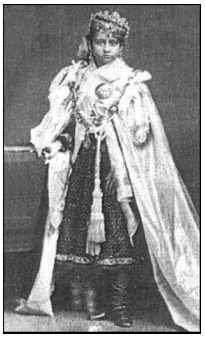
View Solution
Solution:
(B) Shahjahan Begum: The image shows Shahjahan Begum, who was the Begum of Bhopal, India. She was known for her contribution towards the preservation of Sanchi Stupa. She is also known for her administrative abilities and social reform activities.
(A) Sultan Jahan Begum: Sultan Jahan Begum was also the Begum of Bhopal and the successor of Shahjahan Begum. She continued the work of her mother in the preservation of Sanchi Stupa.
(C) Jahanara Begum: Jahanara Begum was the daughter of Mughal emperor Shah Jahan, and she was an important political figure in the court, but this image does not portray her.
(D) Ruksar Begum: Ruksar Begum is not related to this image, and no information regarding her can be found in the given context.
Question 5:
The practice of _____________ means a man having several wives.
View Solution
Solution:
(C) Polygyny: Polygyny refers to the practice of a man having more than one wife. This practice is often related with social and economic status and hierarchies of ancient society.
(A) Exogamy: Exogamy refers to the practice of marrying outside a particular social group.
(B) Endogamy: Endogamy refers to the practice of marrying within a particular social group.
(D) Polyandry: Polyandry refers to the practice of a woman having more than one husband.
Question 6:
Arrange the following in chronological order and choose the correct option from the following:
I. Rule of Ashoka
II. Invasion of Alexander
III. Rule of Gupta dynasty
IV. Rise of Chalukyas in Karnataka
View Solution
Solution:
II. Invasion of Alexander: The invasion of Alexander took place in the 4th century BCE (326 BCE) and is the earliest event among these options.
I. Rule of Ashoka: Ashoka's rule was during the Mauryan empire, which took place after the invasion of Alexander. Therefore, it comes after the invasion of Alexander.
III. Rule of Gupta dynasty: The Gupta Empire flourished during the 4th-6th centuries CE. This means that the Gupta rule took place after the rule of the Mauryas.
IV. Rise of Chalukyas in Karnataka: The Chalukyas rose to power during the 6th century CE in Karnataka, which makes them the last in the order.
Question 7:
Given below are two statements marked as Assertion (A) and Reason (R). Read them carefully and choose the correct option from the given options.
Assertion (A): In the Eighth Century, the Kailashnath Temple was carved out of mountain.
Reason (R): King Ashoka had given the directive to create artificial caves by cutting into the mountains to resemble temples.
View Solution
Solution:
Step 1: Determine the truth of Assertion (A): The Kailasa or Kailasanatha temple at Ellora in Maharashtra, India, is a remarkable monolithic rock-cut temple dating back to the 8th century during the Rashtrakuta dynasty. Thus, Assertion (A) is true.
Step 2: Evaluate the truth of Reason (R): Emperor Ashoka (3rd century BCE) played an important role in the creation of artificial caves. However, these were for the Ajivikas and Buddhists, and these cave temples were typically simple shelters for monks to reside. The cave temples of Ashoka were not the same as temples with elaborate carvings.
Step 3: Determine if Reason explains Assertion: Ashoka's cave building activities were not related to the Kailashnath Temple and were not a reason for building the temple. They were built many centuries apart for different purposes. Therefore Reason (R) is not the correct explanation for Assertion (A), but both the statements are individually true.
Question 8:
Identify the medieval globe-trotter with the help of the following information:
• Before he set-off for India he made pilgrimage trips to Mecca before 1332-33 C.E.
• The Delhi Sultan Muhammad Bin Tughlaq made him Qazi or the judge of Delhi.
View Solution
Solution:
(C) Ibn Batuta: Ibn Battuta was a Moroccan traveler and scholar who visited India in the 14th century. He had made several pilgrimage trips to Mecca before coming to India. He served as the Qazi of Delhi during the rule of Muhammad Bin Tughlaq.
(A) Abd-al-Razzak: Abd-al-Razzaq was a Timurid envoy and traveler who visited the Vijayanagara Empire in the 15th century. His work is a major source to understand the history of the Vijayanagara Empire.
(B) Al-Biruni: Al-Biruni was an 11th-century scholar who came to India along with Mahmud of Ghazni. His book ‘Kitab-ul-Hind' is a detailed description of Indian society, culture, and religion.
(D) Seydi Ali Reis: Seydi Ali Reis was an Ottoman admiral and cartographer who travelled across various regions of India and his books provide valuable information about his experiences.
Question 9:
Who among the following Sikh Gurus compiled ‘Adi Granth Sahib’?
View Solution
Solution:
(B) Guru Arjun Dev ji: Guru Arjun Dev ji, the fifth Sikh Guru, compiled the Adi Granth Sahib, which is now known as the Guru Granth Sahib. This text is the central religious text of Sikhism.
(A) Guru Nanak Dev ji: Guru Nanak Dev Ji was the first Sikh Guru and the founder of Sikhism. While his teachings formed the basis of the Adi Granth, he did not compile it.
(C) Guru Hargobind Sahib ji: Guru Hargobind Sahib ji, the sixth Sikh Guru, was a great warrior who is known for his involvement in militarising the Sikh community and not the compilation of Adi Granth.
(D) Guru Gobind Singh ji: Guru Gobind Singh ji, the tenth Sikh Guru, completed the text of the Guru Granth Sahib. He did not compile the initial text of the Adi Granth.
Question 10:
Choose the correct option regarding Virashaiva tradition from the following:
View Solution
Solution:
(A) This tradition emerged in Karnataka: This is the correct statement. The Virashaiva tradition, also known as Lingayatism, originated in Karnataka in the 12th century.
(B) They are the followers of Vishnu: This is incorrect. Virashaivas are devotees of Shiva, not Vishnu.
(C) They believed in the theory of rebirth: This statement is incorrect. Virashaivas believe in attaining “moksha”, which is not associated with rebirth, but rather with breaking free from the cycles of birth and death.
(D) They practice funerary rites: This is incorrect. They bury their dead rather than perform the traditional Hindu funerary rites like cremation.
Question 11:
Read the following information carefully and choose the correct location for this dargah from the given options.
- It is a dargah of Shaikh Salim Chisti.
- Akbar visited this dargah many a times.
View Solution
Solution:
(D) Fatehpur Sikri: The dargah of Shaikh Salim Chisti is located in Fatehpur Sikri, near Agra. Akbar visited this dargah many times, and built his capital there in honor of the Sufi saint, reflecting his devotion towards him.
(A) Ajmer: Ajmer is associated with the dargah of Khwaja Moinuddin Chishti, not Shaikh Salim Chisti.
(B) Delhi: Delhi is associated with the dargah of Nizamuddin Auliya, and not Sheikh Salim Chisti.
(C) Agra: While Fatehpur Sikri is near Agra, it is located outside the main city.
Question 12:
Which one of the following descriptions of Mughal rural society is correctly matched?
| (Rural - people) | (Profession) |
|---|---|
| (A) Raiyat | Boatsman |
| (B) Mallah | Banker |
| (C) Shroff | Peasant |
| (D) Mansabdar | Military-Bureaucrat |
View Solution
Solution:
(D) Mansabdar - Military-Bureaucrat: Mansabdars were the officials of the Mughal state who served both in the military as well as in the administrative hierarchy of the state, hence this is correctly matched.
(A) Raiyat - Boatsman: Raiyat was a term for peasants or cultivators in the Mughal Empire, not for boatsmen.
(B) Mallah - Banker: Mallah is the word for a boatman or sailor, not a banker.
(C) Shroff - Peasant: Shroff was a moneylender or a banker, and not a peasant.
Question 13:
Match column-I with column-II and choose the correct option:
| Column-I (Temple) | Column-II (Region) |
|---|---|
| I Brihadeswara | A Vijayanagar |
| II Channekeshwar | B Tanjavur |
| III Hazara Ram | C Tamil Nadu |
| IV Chidambaram | D Belur |
View Solution
Solution:
I. Brihadeswara - B. Tanjavur: The Brihadeeswarar Temple, also known as the Thanjavur Temple, is a Hindu temple located in Thanjavur, Tamil Nadu, and it was built by the Cholas.
II. Chennakeshava - D. Belur: The Chennakeshava Temple is located in Belur, Karnataka, and is a prominent example of Hoysala architecture.
III. Hazara Ram - A. Vijayanagar: The Hazara Rama Temple is located in Hampi, which was the capital of the Vijayanagara Empire, making Vijayanagar the correct option.
IV. Chidambaram - C. Tamil Nadu: The Chidambaram Temple, also known as the Thillai Nataraja Temple, is located in Chidambaram, Tamil Nadu, and is dedicated to Lord Nataraja.
Question 14:
Identify the forest tribe during sixteenth and seventeenth century with the help of following information:
- In Assam these Tribal Chiefs became kings.
- They rendered military service in exchange of land.
- They declared their monopoly on catching wild elephants.
View Solution
Solution:
(C) Ahom tribe: The Ahom tribe was located in Assam during the 16th and 17th centuries. Their chiefs became kings, and they had a unique system where tribal chiefs provided military service in exchange for land, and also had monopoly over catching wild elephants, which shows their control over the region and its resources.
(A) Lohani tribe: Lohanis were primarily involved in trade and were not known for becoming kings in the Assam region.
(B) Santhal tribe: The Santhals were mainly concentrated in Bengal and Bihar and are known for their rebellion against the British. They were not linked to the Assam region.
(D) Munda tribe: The Mundas were a tribal community in the Chotanagpur region (Jharkhand) and they also had conflicts with the British during the colonial period.
Question 15:
Identify the primary purpose of Britishers to implement Permanent Settlement in Bengal. Choose the best suitable option from the following:
View Solution
Solution:
(D) To provide financial stability to the British govt.: The primary aim of the Permanent Settlement was to provide a steady and predictable source of revenue for the British government, by fixing the land revenue demand.
(A) To empower peasants of the region: This was definitely not the purpose of the system, as the system ended up disempowering them, and many of them became tenants and agricultural labourers.
(B) To abolish land ownership in the region: The system did not abolish land ownership, rather it gave ownership to the zamindars, who were also responsible for collecting tax from the peasants.
(C) To increase agricultural productivity of Jotedars: While the British hoped that the zamindars would improve cultivation practices, this was not the core intention, as it mainly focused on fixing the revenue demands.
Question 16:
Who among the following was the leader of the revolt of 1857 from Bihar region?
View Solution
Solution:
(B) Kunwar Singh: Kunwar Singh was an important leader of the revolt of 1857 in Bihar, especially in and around the Arrah region. He was a zamindar of Jagdishpur.
(A) Shahmal: Shah Mal was a local leader of the revolt in Baraut, Uttar Pradesh, and not Bihar.
(C) Gonoo: Gonoo was a tribal leader from the Singhbhum area of Jharkhand, and he too was a part of the revolt.
(D) Nana Saheb: Nana Saheb was a prominent leader of the revolt of 1857 from Kanpur, Uttar Pradesh, and he had a major role in the battles of that region.
Question 17:
Who among the following described the following line for Kingdom of Awadh? “A cherry that will fall into our mouth one day.”
View Solution
Solution:
(C) Lord Dalhousie: Lord Dalhousie was the Governor-General of India, who is known for his policy of annexation. He described the kingdom of Awadh using the phrase “a cherry that will fall into our mouth one day,” which reflects the British desire to annex the region.
(A) Lord Cornwallis: Lord Cornwallis is mainly associated with the introduction of the Permanent Settlement, and was the Governor General who was in charge of the British operations before Dalhousie.
(B) Lord Wellesley: Lord Wellesley was the Governor-General who introduced the Subsidiary Alliance system in India.
(D) Lord Canning: Lord Canning was the Governor-General during the 1857 revolt and was also the first viceroy of India.
Question 18:
At which of the following places did the mutiny break out on 10th day of May 1857?
View Solution
Solution:
(C) Meerut Cantt: The mutiny of 1857 broke out on May 10, 1857, in Meerut Cantt. The revolt began with the sepoys revolting against the use of controversial cartridges.
(A) Barrackpore: While Barrackpore was also an important site for army cantonment and had initial incidents of revolt, the major revolt of 1857 began in Meerut.
(B) Delhi: The revolt spread to Delhi after Meerut, and it became a key center of the rebellion, but it did not start from Delhi.
(D) Lucknow: Lucknow was an important region during the revolt and saw major battles, but the revolt did not begin there.
Question 19:
Who among the following moved the resolution in the Constituent Assembly that the Indian National Flag be horizontal tricolour of saffron, white and dark green in equal proportions with a wheel in navy blue in the centre?
View Solution
Solution:
(D) Jawaharlal Nehru: Jawaharlal Nehru was the one who moved the resolution in the Constituent Assembly to adopt the Indian National Flag in its present design.
(A) Vallabhbhai Patel: Vallabhbhai Patel was an important figure in the Congress party, but was not involved in proposing the resolution regarding the flag.
(B) Rajendra Prasad: Rajendra Prasad was the first president of India, but he didn't introduce the resolution regarding the flag.
(C) B.R. Ambedkar: B.R. Ambedkar was the chairman of the Drafting Committee of the Indian Constitution, and was responsible for the constitution's various drafts. However, he was not associated with the resolution of flag.
Question 20:
Identify the member of Constituent Assembly with the help of information given below:
(i) He was a member of drafting committee of constitution.
(ii) He was a lawyer.
(iii) He gave crucial inputs in drafting of constitution.
(iv) He belonged to Madras (Chennai).
View Solution
Solution:
(C) Alladi Krishnaswami Ayyar: Alladi Krishnaswami Ayyar was a prominent lawyer and jurist from Madras. He was a key member of the Drafting Committee of the Constituent Assembly.
(A) B.N. Rau: B.N. Rau was a legal advisor and drafted the initial constitution draft. He was also a judge of the Permanent Court of International Justice, but he was not a member of the drafting committee.
(B) K.M. Munshi: K.M. Munshi was also a member of the drafting committee of the constitution and had played a significant role, but he was not from Madras.
(D) S.N. Mukherjee: S.N. Mukherjee was a prominent lawyer and also the chief draftsman of the constituent assembly, but he was not part of the drafting committee.
Question 21:
Which of the following movements was broadened by ‘Lal-Bal-Pal’ and conveyed it as the all-India character of their struggle from 1905-1907?
View Solution
Solution:
(B) Swadeshi Movement: The Swadeshi movement was broadened by leaders like Bal Gangadhar Tilak, Bipin Chandra Pal, and Lala Lajpat Rai, who emphasized the all-India character of the movement. They popularized the use of swadeshi goods and encouraged the boycott of foreign goods, making it a national movement.
(A) Gadar Movement: The Gadar movement was a revolutionary movement based in North America which focused on overthrowing British rule. It was not led by Lal, Bal, and Pal.
(C) Satyagraha Movement: Satyagraha was a form of non-violent resistance started by Gandhiji. It started much later than the Swadeshi movement.
(D) Peasant Movement: While peasant movements were also significant, they were not specifically broadened by Lal-Bal-Pal and were also mostly regional in their reach.
SECTION–B
(Short Answer type Questions)
Question 22(a):
Explain the strategies adopted by Harappans to procure raw material for their craft production.
View Solution
Solution:
Local Availability: The Harappans obtained locally available materials such as clay for pottery, which were easily accessible near their settlements.
Procurement of Materials from Outside: They had to obtain raw materials like stone, timber, and metals from outside their settlement areas, as these were not locally available in all the regions.
Transportation: They employed both land and sea routes to move raw material from places of origin to their towns. They used bullock carts for land routes and boats for riverine trade. This helped them maintain trade networks with other regions.
Establishment of Settlements Near Sources: They established settlements near the sources of raw materials, like Nageshwar and Balakot for shells, and Shortughai for lapis lazuli. These sites also facilitated trade and cultural exchange.
Expeditions to Resource Areas: Harappans also organized expeditions to areas where important raw materials were available like the Khetri region in Rajasthan for copper and the South India region for gold. This highlights the organizational capacity of the society.
Communication with Local People: They established communication with people who lived in regions rich in resources, which highlights their trade network with interior regions.
Evidence of Trade Networks: Archaeological findings such as Harappan micro-beads have been discovered in distant regions, which shows that long-distance trade networks were in place, for getting these resources.
Contact with Distant Lands: Harappans had contact with places like Oman, which can be found by finding Harappan jars at these sites. Also, Mesopotamian texts mention contact with Dilmun (Bahrain), Magan, and Meluhha, which indicate the distant trade networks that they maintained.
Other Relevant Points: Any other relevant point from the chapter.
Question 22(b):
Explain how archaeologists have been able to reconstruct dietary practices of the Harappans.
View Solution
Solution:
Plant Products: Archaeologists have found a wide variety of plant products, that indicates that the Harappans consumed a large variety of cereals and crops.
Grains: They had a rich repertoire of grains like wheat, barley, lentil, chickpea, and sesame that they consumed. These were found in most of the Harappan sites, which shows the importance of grains in their daily lives.
Millets: Millets were also found in various sites in Gujarat, which highlights the presence of regionally different crop patterns.
Rice: Finds of rice are less common, indicating that rice might not have been a staple crop everywhere.
Study of Charred Remains: The main method of reconstructing their dietary habits was by studying charred grains and seeds recovered from archaeological sites, which provide direct evidence of their food consumption. The study is done by archaeo-botanists.
Animal Products: Harappans also consumed animal products, as bones of animals have also been found at several Harappan sites.
Wild Species: The presence of bones of wild species indicates their involvement in hunting and gathering of resources.
Fish and Fowl: Bones of fish and fowl have also been found, indicating that they were a part of the Harappan diet.
Other Relevant Point: Any other relevant point from the chapter.
Question 23:
How was the patriliny system important among elite families from the sixth century BCE onwards. Explain with examples.
View Solution
Solution:
Meaning of Patriliny: Patriliny refers to the practice of tracing descent from father to son, then to grandson and so on, creating a line of succession and family structures. This system placed importance on male lineage and was prevalent among the elite classes.
Claim to Resources: Under patriliny, sons could claim the resources (including the throne in the case of kings) of their fathers when they died, highlighting its relevance to the system of governance.
Conflict Over Resources: In the conflict between the Pandavas and Kauravas in the epic Mahabharata, it is highlighted that the Pandavas emerged victorious and that the patrilineal succession was proclaimed, making it the most important basis of succession and power.
Claim to Dynasties: Several ruling dynasties from the sixth century BCE onwards also claimed to follow this system, which also indicates its prevalence and growing importance in society.
Mantras in Rig Veda: Mantras in the Rig Veda also show the importance of patriliny, with people praying for the birth of sons, which were more highly regarded than daughters.
Wealthy Men and Brahmanas: The practice of patriliny was also followed by wealthy men and Brahmanas, indicating its acceptance across different social classes.
Question 24:
Baba Guru Nanak Dev ji advocated a form of “Nirguna Bhakti”. Substantiate the statement.
View Solution
Solution:
Nirguna Bhakti: Baba Guru Nanak Dev ji advocated a form of Nirguna Bhakti, where focus is placed on devotion towards a formless God.
Hymns and Teachings: This is evident in his hymns and teachings, where he emphasized the divine qualities of god, instead of their physical forms and manifestations.
Formless God: For Guru Nanak, the absolute or “rab” had no gender or form, which distinguishes it from Saguna forms of worship.
Rejection of Image Worship: He rejected practices like image worship, idol worship, and other external methods of worship.
Rejection of Sacrifices: He was against sacrifices and other ritualistic activities that were prominent in the contemporary religions.
Against Ritual Baths and Caste system: He was against ritual baths and caste system, which indicate his focus on equality and devotion rather than outward displays of piety.
Not in Favour of Scriptures of Both Hindus and Muslims: He did not believe in following the scriptures of both Hindus and Muslims, which indicates his focus on personal devotion and practice.
Repeating the Divine Name: He advocated repeating the Divine name to connect with God, which was different from the rituals.
Hymns in Punjabi: He expressed his ideas through hymns called “shabad” in Punjabi, highlighting the use of regional languages in religious communication.
Compositions in Various Ragas: Guru Nanak sang his compositions in various ragas, which also shows the importance of music and its role in creating devotion.
Sangat: He promoted the idea of ‘Sangat’ where congregational worship or collective recitation was emphasized. This emphasis on community was an important element of his philosophy.
Question 25:
“Ain-i-Akbari is considered a major source for the agrarian history of the sixteenth and seventeenth centuries.” Examine the statement.
View Solution
Solution:
Important Chronicle: Ain-i-Akbari was an important chronicle written by Abul Fazl, who was a court historian of Akbar.
Measures Adopted by the State: The work provides information on various measures adopted by the state to ensure the cultivation of land, including information about the different kinds of land and crops.
Revenue Collection: The text provides details on the procedures involved in revenue collection by state officials. This provides information about state policies and its methods of functioning.
Relationship Between the State and the Local Zamindars: It also highlights the relationship between the state and the local zamindars, which is important to understand the agrarian and administrative system of the Mughal period.
Terms for Peasants: It mentions various terms for the peasants, such as 'raiyat' or 'muzarian', and 'kisan' or ‘asami’.
Types of Peasants: The Ain also mentions two kinds of peasants: khud-kashta and pahi-kashta, which highlights various kinds of agricultural relationships which existed.
Expanded Agriculture: The text provides information that agriculture expanded because of abundant land, labor, and mobility of peasants. It provides a glimpse into their understanding of agriculture.
Mention of Crops: It mentions various crops like rice, wheat, and millets which were cultivated, indicating a complex cropping pattern.
Principle of Individual Ownership: It also talks about how cultivation was based on the principle of individual ownership, indicating the existence of well-defined ownership rights.
Agriculture was Rain Fed: The text highlights the fact that agriculture was largely dependent on rain and mentions various irrigation systems were also being employed.
Irrigation Projects: It also mentions that artificial systems of irrigation were used and various irrigation projects received state support.
Labor-Intensive Agriculture: The Ain tells us that agriculture was labor-intensive and peasants used technologies like cattle harness, wooden plows, etc.
Cropping Cycles: The text also mentions two cropping cycles like kharif and rabi, which reflects seasonal patterns of agricultural production.
Varieties of Crops: The Ain provides us with an idea about the different varieties of crops that were grown, with some provinces having a diverse repertoire of agricultural production.
Cash Crops: It also highlights the fact that the state encouraged peasants to cultivate cash crops (jins-i-kamil) for commercial purposes.
New Crops: During the 17th century, new crops from different parts of the world were introduced into the region, indicating that cross-cultural trade was also impacting the cropping patterns.
Question 26(a):
Under what circumstances did Bahadur Shah Zafar bless the rebellion of 1857? Explain.
View Solution
Solution:
Arrival of Sepoys in Delhi: The sepoys who had rebelled in Meerut arrived at the Red Fort in Delhi on May 11, 1857. They directly came to the Mughal emperor in Delhi.
Sepoys' Demand for Blessing: The sepoys, who had killed the Englishmen, requested the Mughal emperor's blessing. This was the main reason why they approached him.
Use of Greased Cartridges: The sepoys were angered by the British forces who were forcing them to use greased cartridges, which were believed to be greased with animal fat.
Corrupting Faith: The sepoys believed that the British were deliberately trying to corrupt the faith of the Hindus and Muslims by using these cartridges.
Arrival of the City People: The revolt spread from the sepoys to ordinary people of the city, as they too joined them in the Red Fort.
Demanding Support: The sepoys reached the court of Bahadur Shah Zafar and demanded his support.
Emperor was Old and Weak: The emperor, Bahadur Shah Zafar, was old and weak and initially hesitated to support the revolt.
Fear of the Crowd: He feared the crowd that had entered the fort, which were mostly rebellious sepoys, so he had to finally give them his support.
Lack of Choice: Surrounded by the sepoys, Bahadur Shah had no option but to accept the leadership of the revolt. He did not have much autonomy in that situation.
Revolt Became Legitimate: The revolt became legitimate only when it was carried out in the name of the Mughal emperor. This highlights the symbolic importance of the emperor.
Question 26(b):
Explain any three sources to know about the Revolt of 1857.
View Solution
Solution:
Proclamations and Ishtahars: Proclamations and ishtahars (notifications) issued by rebel leaders are useful sources to know about the 1857 revolt. These documents provide information about the aims and objectives of the rebels.
Azamgarh proclamation: A major source for understanding the revolt is the Azamgarh proclamation. This is important as it states the key grievances of the people who were a part of this revolt.
British Records: Official British records reveal the minds of the British officials. These documents often present a biased viewpoint, but they are valuable for historical analysis.
*Other possible sources to mention:*
Charles Ball’s Account: The accounts of Charles Ball give information about how panchayats were held at night during the revolt, which highlights the ways through which the revolt was organized.
Arzis/Petition of Rebel Sepoys: The petitions or applications written by rebel sepoys also give us their point of view and the reasons why they were part of the revolt.
Visual Representations: Both British and Indian visual representations, such as paintings and sketches, can give us information about how the revolt was perceived.
Films and Posters: Films and posters also provide us with visual information about the revolt.
Art and Literature: Art and literature such as poems by Subhadra Kumari Chauhan (“Khoob Ladi Mardani”) are important for understanding the popular perception of the revolt.
Regional Records: Many of the regional records also provide important information about the revolt from different perspectives.
Question 27:
“The draft constitution provided for three lists of subjects on the issue of federalism.” Explain the statement with examples.
View Solution
Solution:
Three Lists of Subjects: The draft constitution of India provided for three lists of subjects to deal with the issue of federalism, with three different lists, namely the Union List, the State List, and the Concurrent List, which aimed to create a balance of power between the centre and the state governments.
Union List: The Union List contains subjects under the exclusive control of the central government. This includes defense, foreign affairs, currency, and other matters of national importance.
State List: The State List contains subjects under the exclusive control of the state governments. These included areas like public health, police, and agriculture, which were considered to be of state concern.
Concurrent List: The Concurrent List contains subjects where both the central and the state governments have jurisdiction, such as education, forests, and electricity.
Union Control Over Many Items: Many more items were placed under exclusive Union control which highlights the strength of the center.
Union Control over Mineral and Key Industries: The Union government also had control over minerals and key industries. This also highlights the centralising tendencies within the political system.
Article 356: Article 356 of the constitution gave the Centre the power to take over a state administration on the recommendation of the Governor.
Preference for Strong Center: Many leaders like Nehru and Dr. Ambedkar favoured a strong central government.
Santhanam’s Views: K. Santhanam favoured more powers to the state, which showcases the debate on power sharing during that time.
SECTION – C
(Long Answer type Questions)
Question 28(a):
“The sixth century BCE was a period of emergence of early states, empires and diverse thoughts in the early Indian history.” Justify the statement.
View Solution
Solution:
Emergence of States and Cities: The sixth century BCE witnessed a period of major transformation in early Indian history, marked by the rise of new states, empires, and varied intellectual traditions, as different types of kingdoms and empires started emerging.
Janapadas and Mahajanapadas: It was during this time that Janapadas started developing, which then gave way to more powerful territorial kingdoms called Mahajanapadas. These were large territorial kingdoms which were based on agricultural output and collection of taxes.
Rulers in Mahajanapadas: Each Mahajanapada was ruled by a king, indicating the rise of hierarchical governance. They had a central figure who was the head of the state, and he was often the source of all authority.
Fortified Capital City: Each Mahajanapada had a fortified capital city, which was meant to protect from external threats. These were also centers of economic and political activities.
Bureaucracy: Each Mahajanapada also had a bureaucracy, with various officials responsible for administration, which reflects a well-developed system of administration.
Rules for Governance: Rules for governance also existed, indicating the codification of different types of rules and norms.
Collection of Taxes: Rulers started to collect taxes, which was a major way through which the state would fund itself. This also gave way to different kinds of social classes.
Development of Trade: Rulers also developed trade and commerce, which allowed their kingdoms to flourish and expand and helped in creating interregional networks.
Armies: To protect their lands and also for expansion purposes, Rulers maintained armies, indicating that warfare was an important feature of this period.
Use of Iron: The widespread use of iron implements and weapons facilitated agricultural expansion and warfare, which was a key element of the era.
Use of Coins: The introduction of coins also promoted trade and commerce, as they acted as standardized currency.
Emergence of Different Schools of Thought: Diverse systems of thought, like Jainism, Buddhism, and Ajivika developed during this period, which challenged established Brahmanical ideologies, indicating a vibrant intellectual life.
Dharmasutras: Brahmans also composed Dharmasutras, in Sanskrit, which were manuals about the responsibilities of different castes and different varna hierarchies, which reflects the effort to codify the religious practices of the period.
Other Relevant Points: Any other relevant point.
Question 28(b):
“Although inscriptions provide strong evidence for reconstructing history yet there are few limitations to these evidences.” Justify the statement.
View Solution
Solution:
Historical Evidence from Inscriptions: Inscriptions are an important source for historians to find information from the past, and a majority of our information from the past is constructed from material remains, like inscriptions.
Study of Statements made in Inscriptions: By studying the statements made in the inscriptions, the historians can reconstruct details of the past, including the political, social, and economic life.
Base for Reconstructing History: Inscriptional evidence forms the base for reconstructing history, as this is a more authentic source compared to many texts that might have been changed over time.
*However, there are limitations:*
Technical Limitations: There are many technical limitations to inscriptional evidence. Letters are very faintly engraved, thus making it difficult to read. This also makes the reconstructions uncertain.
Damage to Inscriptions: Some inscriptions are often found in damaged conditions, and letters might also be missing, or broken, which makes it hard to read them.
Difficulty in Understanding the Meaning: It is not always easy to be sure of the exact meanings of the words that are used in the inscriptions, and different scholars interpret it in different ways.
Many Inscriptions not Deciphered: Many of the inscriptions are not completely deciphered, which prevents us from understanding what the inscription is about.
Not been Published and Translated: Many inscriptions have not been published and translated, thereby depriving many historians of studying them.
Not Survived Ravages of Time: Many inscriptions have not survived the ravages of time, and those that have survived are also often damaged or incomplete, thus limiting the amount of information available to historians.
Fragments: Many inscriptions are available only in fragments, which makes their full interpretation difficult.
Not Recorded Developments: Many important developments and events were also probably not recorded, making them unknown to historians today.
Lives of Ordinary People: Inscriptions mostly do not mention the lives of ordinary people and mostly highlight royal life and the activities and actions of the ruling elite.
Focus on Grand and Unique Events: Inscriptions also focus on grand and unique events, rather than ordinary everyday life, thus giving us a biased viewpoint about the period.
Perspective of the Commissioner: The inscriptions also reflect the perspective of the person/entity that commissioned it, and thus it might be a biased record.
Tedious Process: Interpretation of inscriptions is a tedious process which is also prone to misinterpretation, highlighting the complexity of the source.
Other Relevant Points: Any other relevant point.
Question 29(a):
Examine the main reasons for the rise and decline of the Vijayanagara Empire.
View Solution
Solution:
Reasons for the Rise of the Vijayanagara Empire:
Claimants to Power: Initially, there were too many claimants to power, which led to conflict.
Sangama Dynasty: The first dynasty—Sangamas—was able to exercise control till 1485 and is seen as the dynasty which began the rise of the Vijayanagara empire.
Saluvas Dynasty: They were succeeded by the Saluvas who ruled till 1503. They were powerful chiefs who took control of the region.
Tuluva Dynasty: They were replaced by the Tuluvas, and Krishnadeva Raya belonged to this dynasty.
Krishnadeva Raya’s Rule: Krishnadeva Raya’s rule was characterized by expansion and consolidation of the empire. He is seen as the greatest of the rulers in Vijayanagar.
Land between Tungabhadra and Krishna Rivers: He acquired the land between the Tungabhadra and Krishna rivers.
Subduing the Rulers of Orissa: The rulers of Orissa were subdued during his rule, which brought new regions into the kingdom.
Defeat of Bijapur Sultan: He defeated the Sultan of Bijapur, expanding the empire's political and territorial influence.
Military Preparedness: The kingdom was also in a constant state of military preparedness, showing their investment in keeping the army strong.
Peace and Prosperity: The empire saw peace and prosperity during Krishnadeva Raya’s reign, which is seen as its golden period.
Building of Temples: He built beautiful temples and added gopurams to many South Indian temples, as a sign of his devotion, but also as a sign of royal power and legitimacy.
Nagalapuram: He founded a suburban township near Vijayanagara called Nagalapuram.
Reasons for the Decline of the Vijayanagara Empire:
Successor Problems: After Krishnadeva Raya’s death, his successors were troubled by rebellious nayakas or military chiefs, which shows a lack of centralized authority and control.
Shift to Aravidu Dynasty: In 1542, control shifted to the Aravidu dynasty, indicating political instability and a major power shift.
Clashes with Deccan Sultanates: The clashes between the rulers of Vijayanagara and the Deccan Sultanates resulted in shifting alignments and finally culminated in the defeat of Vijayanagara.
Battle of Talikota: The Sultanates formed an alliance against Vijayanagara and defeated Rama Raya at the Battle of Talikota. This defeat was a major blow to the Vijayanagara empire.
Destruction and Abandonment: The city of Vijayanagara was destroyed and abandoned within a few years of the battle, indicating the loss of political power and state control.
Question 29(b):
Examine the distinctive aspects of the fortification of the Vijayanagara Empire.
View Solution
Solution:
Impressed Abdur Razzaq: Abdur Razzaq was greatly impressed by the fortification, who has described the fortification in detail, highlighting the elaborate architecture of the kingdom.
Seven Lines of Forts: Abdur Razzaq mentions seven lines of forts, highlighting the layered defense system of the kingdom.
Encirclement of Agricultural and Forest Lands: The fortification walls encircled agricultural and forest lands, which means that the forts were not just designed for defense, but also enclosed settlements and natural resources.
Outermost Walls Linked Hills: The outermost wall linked the hills surrounding the city, making use of the natural landscape to create a layered defense system.
Massive Masonry Construction: The massive masonry construction was slightly tapered, reflecting a sophisticated architectural design and planning.
No Mortar or Cementing Agent: No mortar or cementing agent was used, and this shows the unique construction techniques of that period.
Wedge Shaped Stone Blocks: Stone blocks were wedge-shaped, which held them in place. This unique design reveals the technological expertise of the time.
Earthen Walls and Rubble: The inner portion of the walls was of earth packed with rubble, reflecting a unique architectural technique.
Bastions: Square or rectangular bastions projected outwards, allowing for greater control and security of the defense.
Cultivated Land between the walls: Between the first, second, and third walls, there were cultivated fields, gardens, and houses, making the forts self-sufficient.
Usefulness During Siege: The fortification was particularly useful during sieges, allowing the inhabitants to resist foreign invasion.
Prevent Starvation: Even during sieges, agriculture could be practiced and crops could be grown, which helped in preventing starvation, making the forts a unique self-sufficient structure.
Inner Urban Core: The second line of fortification went round the inner core of the urban complex, which highlights the strategic location of important centers within the fort.
Royal Centre: A third line surrounded the royal center, which also highlights the layered approach towards security and how the center was specially protected.
Well Guarded Gates: The fort was entered through well-guarded gates which had influences of Indo-Islamic architecture, which show influence from other cultures.
Road Networks: Roads connected various parts of the city, highlighting the importance of proper planning within the fortifications.
Other Relevant Points: Any other relevant point.
Question 30(a):
Explain the reasons behind Gandhiji’s decision to initiate the Salt Satyagraha and why did this movement become a significant event?
View Solution
Solution:
Reasons Behind Salt Satyagraha:
Unpopular Salt Law: The salt law was unpopular among the people, as it placed restrictions on salt production, distribution, and purchase.
Advance Notice of the March: Gandhiji had given an advance notice of his salt march to the British, highlighting the transparency of his actions.
Breaking the Salt Law: On 12th March 1930, Gandhiji started the march to break the salt law, directly defying British law and authority.
Unpopular British Monopoly: The British monopoly over the manufacture and sale of salt was very unpopular among Indians since it affected the common masses.
Government Control Over Production: The government destroyed the salt that it could not sell profitably, further causing distress among Indians.
No Salt for Domestic Use: People were not allowed to make salt for domestic use, making them dependent on the government-controlled markets.
High Prices: People were forced to buy salt at a high price, and thus this law directly affected the livelihood and economic condition of people.
Salt as a Symbol: Salt was used by one and all and hence became a symbol of protest. This made the movement accessible to a large part of the population.
Protest Against British Rule: Gandhiji decided to launch a Salt Satyagraha to protest against the British rule. It was carefully thought out as a powerful way to mobilize people against colonial rule.
Deprivation of a Village Industry: It deprived the people of a valuable village industry, thus impacting the rural economy.
Destruction of Property by Nature: It also involved the destruction of property that nature produced in abundance, highlighting the injustice of the law.
Salt Tax: The imposition of Salt tax was one of the most unjust forms of taxation, and this was highlighted during the revolt.
Significance of the Salt Satyagraha:
World Attention: The salt march brought Mahatma Gandhi to world attention, making him a global figure.
Widely Covered by Press: The march was widely covered by the European & American press, which indicates that it got a lot of international attention.
Women’s Participation: Women participated in large numbers, which made this a landmark movement. It was one of the first times where large numbers of women actively participated in the national struggle.
Realisation of the British Raj’s End: Salt March made the British realize that their Raj would not last forever, and that Indians were no longer afraid of them.
Need to Share Power: They realized they would have to share some power with the Indians, which marks the beginning of their exit from the subcontinent.
Participation of All Sections: All sections of society participated in the salt march, which also highlighted how the national movement had become a mass movement.
Salt for Protest: People made salt at Dandi to protest against the British, which highlighted the spirit of defying their orders.
Non-Violent Protest: It was an important moment as it showed that resistance could also be non-violent.
Violent Methods of the British: The British used violent methods to control the march, but it further exposed their brutal control.
British Unpopular: As a result of the violent methods they used, the British became unpopular, highlighting the impact of the satyagraha.
Other Relevant Point: Any other relevant point.
Question 30(b):
Explain why the ‘Quit India Movement’ was considered a mass movement.
View Solution
Solution:
Failure of Cripps Mission: The failure of Cripps Mission made it clear that the British were not interested in granting self-rule to India, and this angered a large section of the society.
Beginning of the Movement: The Quit India Movement began in August 1942, and it was a call to the British to leave India immediately. This movement was very widespread and saw participation of all kinds of people.
Do or Die Slogan: The “Do or Die” slogan inspired millions of Indians to join the movement.
Start of Movement after Arrest of Leaders: The movement started when Gandhiji and other top leaders were arrested, which highlighted the people's resolve and determination to carry on without direct leadership.
Young Activists carried on the struggle: Though Gandhiji was jailed, younger activists carried on the struggle, which shows the commitment of youth in the movement.
Emergence of Local Leaders: Leaders like Jayaprakash Narayan kept the struggle alive, which also highlighted their own role as important leaders.
Independent Governments: Independent governments were also proclaimed in many districts like Satara, highlighting local resistance to colonial rule.
Strikes and Acts of Sabotage: People organised strikes and acts of sabotage all over the country, which shows that people from all across the subcontinent were a part of the struggle.
Underground Resistance: Underground resistance was started by socialist leaders of the Congress, which reflects the diversity of the methods used during the revolt.
British Response: The British government responded with force, which further fueled the anger among Indians and also highlights the fact that the British perceived it as a threat to their rule.
Massive Participation: Thousands of Indians joined the movement, which showed that the movement was truly a mass movement.
Involvement of the Youth: The movement energized the young people who left schools and colleges to join the movement, showing generational support for independence.
Genuine Mass Movement: It truly became a genuine mass movement, which included all kinds of sections of society.
Other Relevant Points: Any other relevant point from the chapter.
SECTION–D
(Source Based Questions)
Question 31:
Read the following source carefully and answer the questions that follow:
Buddhism in practice
This is an excerpt from the Sutta Pitaka, and contains the advice given by the Buddha to a wealthy householder named Sigala: In five ways should a master look after his servants and employees.... by assigning them work according to their strength, by supplying them with food and wages, by tending them in sickness; by sharing delicacies with them and by granting leave at times... In five ways should the clansmen look after the needs of samanas (those who have renounced the world) and Brahmanas: by affection in act and speech and mind, by keeping open house to them and supplying their worldly needs. There are similar instructions to Sigala about how to behave with his parents, teacher and wife.
31.1:
Explain the importance of Sutta Pitaka in Buddhism.
View Solution
Solution: The Sutta Pitaka is an important text in Buddhism as it contains the teachings of the Buddha. The source is also an excerpt from the Sutta Pitaka, which highlights how important it is in the Buddhist tradition. It also reveals practical advice on living a moral and ethical life, making it an important guide for the followers.
31.2:
How did Buddha advise the wealthy householders to be humane and ethical?
View Solution
Solution: Buddha advised the wealthy householders to treat their servants and employees humanely and ethically. This was seen as crucial for an ethical society. He suggested they must assign work according to the strength of the servants, which highlights an approach that was more ethical. He also suggested that they provide them with food and wages, which was necessary to sustain the worker and their families. They were to tend to their employees in sickness, showing an approach that was based on empathy. They were advised to share delicacies with them and grant them leave at times, indicating a better working environment for the workers. He also advised clansmen to look after the needs of samanas (ascetics) and brahmanas, by being affectionate in act and speech. They were advised to keep open house for them and supply worldly needs, making them feel welcome in their homes. He emphasized righteous actions, where people did not exploit their workers and treated them well.
31.3:
What was the advice given by Buddha to Sigala on how to behave with his parents and teachers?
View Solution
Solution: Buddha advised Sigala that he should show respect towards his parents and teachers, indicating that those relationships were very important. He also said that he should always listen to the advice of his parents, which was a significant principle of the era. He should also look after them in sickness and old age, showing his emphasis on caring for the elders. He should also be a dedicated student, as a life-long process of learning was a very important principle for him. He advised that one must express gratitude towards their parents and teachers, emphasizing the need to be thankful for their teachings. He also asked him to follow his teacher's instructions with sincerity, showing respect for their knowledge and the tradition they represent.
Question 32:
Read the source given below and answer the questions that follow:
A language with an enormous range
Al-Biruni described Sanskrit as follows: If you want to conquer this difficulty (i.e., to learn Sanskrit), you will not find it easy because the language is of an enormous range, both in words and inflections, something like the Arabic, calling one and the same thing by various names, both original and derivative, and using one and the same word for a variety of subjects, which, in order to be properly understood, must be distinguished from each other by various qualifying epithets.
32.1:
What motivated Al-Biruni to study Sanskrit?
View Solution
Solution: Al-Biruni’s interest in languages motivated him to study Sanskrit. He wanted to learn about the various nuances of Indian culture through Sanskrit texts and also understand their social customs. Al-Biruni wanted to overcome the difficulty of learning Sanskrit, as he was intrigued by the complexity of the language. He had also read Sanskrit works that were translated into Arabic, and he was interested in the original source. He also helped in translating the Greek works into Sanskrit, which made him understand the link between various languages. He also translated Patanjali’s work on grammar into Arabic, which was very important for understanding the Sanskrit language. The Ghaznavid conquest of the Punjab also helped in easier transmission of ideas between Al-Biruni and the Brahmanas. He wanted to know the enormous range of the language, which was considered to be very diverse. He also wanted to know more about how the same words were used in a variety of subjects.
32.2:
How did Al-Biruni’s observations about Sanskrit contribute to cross-cultural understanding?
View Solution
Solution: Al-Biruni’s observations served as a bridge between Arabic and Indian cultures as his analysis of Sanskrit provided a unique perspective on both language and the culture. It promoted an understanding between the Arabic and Indian worlds. His work brought Indian culture and language to a new audience, creating cross-cultural communication. He highlighted the distinct features of Sanskrit and drew a comparison with Arabic, which allowed a more nuanced understanding of the language. Those who were familiar with Arabic could now understand the difficulties of Sanskrit through his observations. This also helped in highlighting various differences between the languages.
32.3:
In what ways does Al-Biruni compare Sanskrit to Arabic?
View Solution
Solution: Al-Biruni described that Sanskrit was different from Arabic, as they had their own unique features. He also noted that Sanskrit texts could not be easily translated into another language, highlighting its complex nature. Sanskrit language has an enormous range, both in words and inflections, showing a vast vocabulary and complex grammar. Both languages use multiple names for the same thing, which indicates a similar feature in both languages. He also noted that both languages use the same word for various subjects, which indicates the complexity of these languages.
Question 33:
Read the source given below and answer the questions that follow:
A ryot petition
This is an example of a petition from a ryot of the village of Mirajgaon, Taluka Karjat, to the Collector, Ahmednagar, Deccan Riots Commission: The sowkars (sahukars).... have of late begun to oppress us. As we cannot earn enough to defray our household expenses, we are actually forced to beg of them to provide us with money, clothes, and grain, which we obtain from them not without great difficulty, nor without their compelling us to enter into hard conditions in the bond. Moreover, the necessary clothes and grain are not sold to us at cash rates. The prices asked from us are generally twenty-five or fifty percent more than demanded from customers making ready money payments... The produce of our fields is also taken by the sowkars, who at the time of removing it assure us that it will be credited to our account, but they do not actually make any mention of it in the accounts. They also refuse to pass us any receipts for the produce so removed by them.
33.1:
In what ways did the money-lenders oppress the ryots?
View Solution
Solution: The moneylenders charged exorbitant interest rates, which added to the burden of the peasants. This made it difficult for them to pay their debts. They also employed ruthless methods of collection, which meant that even for small amounts of debt, they would take harsh actions. In case of non-payment, their land was also taken away by moneylenders. This would lead to them losing a valuable source of income. The ryots were forced to beg from moneylenders for even basic necessities, which shows how indebted they were. The money lenders manipulated laws and forged accounts, thereby putting peasants in a disadvantageous position. The ryots were also compelled to sign bonds, which were used to exploit them further. Clothes and grains were not sold at cash rates to the peasants, meaning that money lenders could control the prices of items and resources for their benefit. Their produce was taken away and not credited to their account, showing the exploitative and dishonest nature of their financial relationships. The money lenders also did not give receipts to the ryots for the grains and other material that they took away, indicating a deliberate attempt to cheat and exploit.
33.2:
Why was the harvest taken away by the money-lenders?
View Solution
Solution: The harvest was taken away by the money-lenders as a way of recovering unpaid debts. This shows that the peasants became vulnerable to debt and exploitation at the hands of money lenders. They also assured the ryots that it would be credited in their accounts, even though that was not the case, showing how they were cheated by them. The money lenders also did not provide receipts, indicating that it was a way to keep their records secret and to cheat the peasants.
33.3:
Explain any two features of the Ryotwari system.
View Solution
Solution:
Revenue Directly Settled with Ryot: One important feature of the Ryotwari system was that the revenue was directly settled with the ryot (the peasant), which was unlike the zamindari system. This also allowed the British to bypass the zamindars in many regions.
Assessment of Soil and Paying Capacity: The average income from different types of soil was estimated, and the revenue-paying capacity of the ryot was assessed. Based on this, a proportion was fixed as the share of the state.
*Other possible features to mention:*
Resurvey of Land: The lands were to be resurveyed every 30 years, which means the amount of taxation could be changed.
Increased Revenue Rates: After the surveys, the revenue rates were often increased, which led to increased burden on peasants, and also created a cycle of debt and exploitation.
SECTION–E
(Map Based Question)
Question 34:
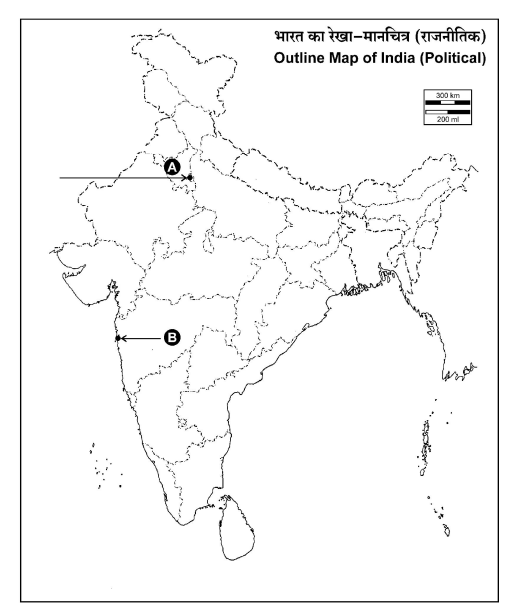
Question 34.1:
On the given political outline map of India, locate and label the following with appropriate signs:
(i) Banawali - A matured Harappan Site
(ii) Bharhut - A Buddhist Site
(iii) (a) Agra – Territory under Mughal’s control
OR
(iii) (b) Delhi - Territory under Mughal’s control
View Solution
Solution:
(i) Banawali - A matured Harappan Site: Banawali is located in the Fatehabad district of Haryana. You should mark this on the map using the appropriate symbol in the north-western state of Haryana.
(ii) Bharhut - A Buddhist Site: Bharhut is located in Madhya Pradesh, known for its ancient Buddhist stupa and its unique style of architecture. You should mark it in the map with the correct symbol in the northern part of Madhya Pradesh.
(iii)(a) Agra - Territory under Mughal’s control: Agra is located in the state of Uttar Pradesh and you should mark this area in the map. It was one of the important capitals of the Mughals.
OR
(iii)(b) Delhi - Territory under Mughal’s control: Delhi is located in the northern part of the country and is still a major city. It was also one of the important capitals of the Mughals and should be marked appropriately on the map.
Question 34.2:
On the same map, two places have been marked as A and B, which are centers of the Indian National Movement. Identify them and write their correct names on the lines drawn near them.
A - __________
B - __________
View Solution
Solution:
A - Delhi: Delhi was a crucial center for the Indian National Movement, as it was the capital, and it was also a place where various protests and movements took place. Delhi is in the northern region of the map, near Uttar Pradesh and Haryana.
B - Bombay: Bombay, also known as Mumbai, was another major center for the Indian National Movement, as it was a commercial hub with various trade unions and other types of organizations. This is located on the western coast of India, and you should mark that location on the map.
Question 34.1 (Visually Impaired):
Mention any two Harappan Sites
View Solution
Solution: Any two Harappan sites can be mentioned: Harappa, Mohenjodaro, Kot Diji, Kalibangan, Ropar, Banawali, Rakhigarhi, Lothal, Dholavira, Nageshwar or Balakot.
Question 34.2(a) (Visually Impaired):
Mention any one territory under Mughal’s control.
View Solution
Solution: Any of the important territories that were under Mughal rule can be mentioned, such as Lahore, Panipat, Delhi, Agra, Ajmer, Amber or Goa.
Question 34.2(b) (Visually Impaired):
Mention the name of the Capital of Vijayanagara Empire.
View Solution
Solution: Hampi/Vijayanagara was the capital city of the Vijayanagara Empire.
Question 34.3 (Visually Impaired):
Name any two centers of the Indian National Movement.
View Solution
Solution: Any two of the important centers of the Indian National Movement can be mentioned such as Champaran, Kheda, Ahmedabad, Dandi, Bardoli, Bombay, Calcutta, Delhi, Madras, Lahore, Amritsar, Surat or Lucknow.





Comments