




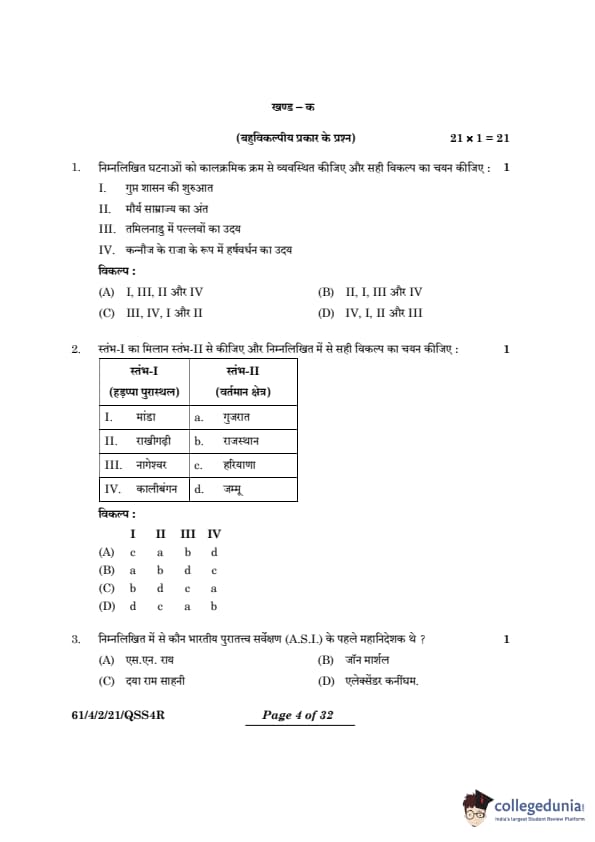
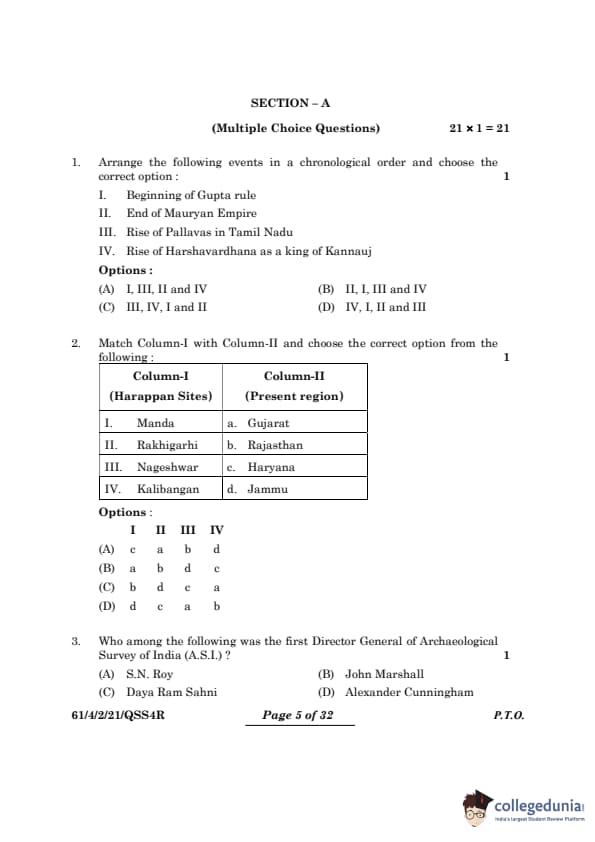
CBSE Class 12 History Set 2 Question Paper PDF (Code: 61/4/2) is now available for download. CBSE conducted the Class 12 History examination on March 28, 2024, from 10:30 AM to 1:30 PM. The question paper consists of 34 questions carrying a total of 80 marks. Section A includes 21 MCQs for 1 mark each, Section B contains 6 short-answer questions for 3 marks each, Section C comprises 3 long-answer questions for 8 marks each, Section D comprises 3 Source-based questions having three sub-questions carries 4 marks each and Section E comprises 1 Map-based question that carries 5 marks.
Candidates can use the link below to download the CBSE Class 12 History Set 2 Question Paper with detailed solutions.
CBSE Class 12 History Question Paper 2024 (Set 2- 61/4/2) with Answer Key
| CBSE Class 12 2024 History Question Paper with Answer Key |  Download Download |
Check Solution |
CBSE Class 12 2024 History Questions with Solutions
SECTION A
(Multiple Choice Type Questions)
Question 1:
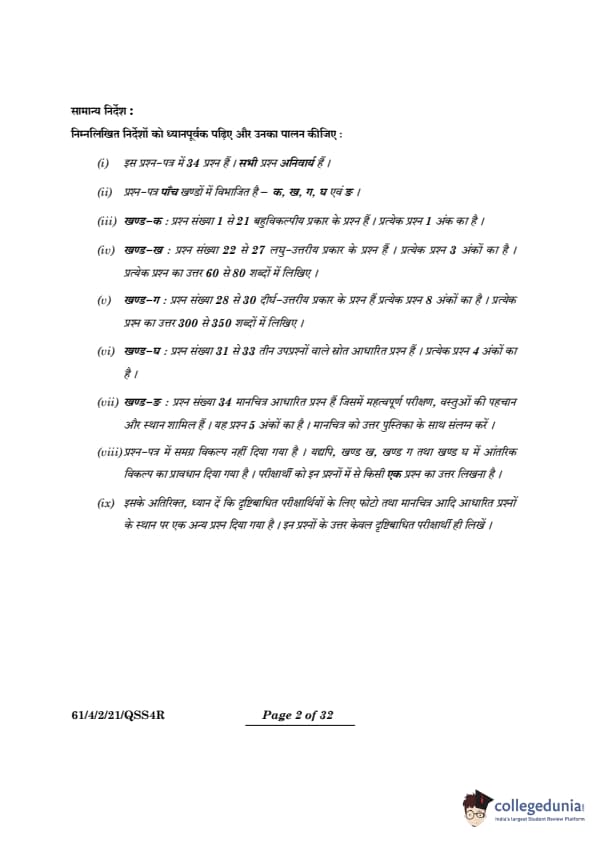
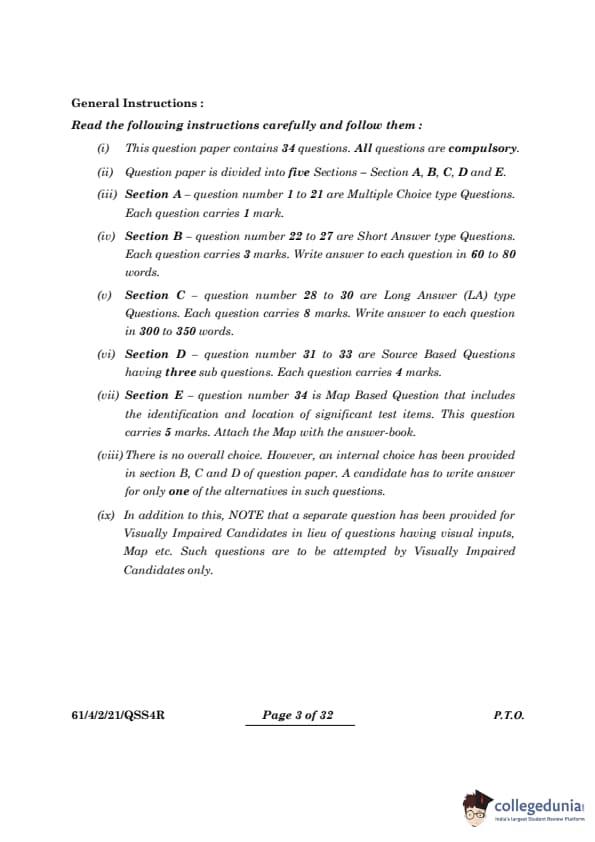
Arrange the following events in a chronological order and choose the correct option:
I. Beginning of Gupta rule
II. End of Mauryan Empire
III. Rise of Pallavas in Tamil Nadu
IV. Rise of Harshavardhana as a king of Kannauj
View Solution
Solution:
II. End of Mauryan Empire: The Mauryan Empire ended around 185 BCE, marking the end of the first major empire in Indian history. This makes it the earliest of the given options.
I. Beginning of Gupta Rule: The Gupta dynasty rose in the early 4th century CE (around 320 CE), thus following the end of the Mauryan empire. The Gupta period is known as the 'Golden Age' of India.
III. Rise of Pallavas in Tamil Nadu: The Pallavas were a major power in South India who rose around the 6th century CE. Their period was known for their contributions to art and architecture.
IV. Rise of Harshavardhana as a king of Kannauj: Harshavardhana's rule began in the early 7th century CE (around 606 CE), making him the latest among the options in this sequence. His rule is considered an important period in the history of north India.
Question 2:
Match Column-I with Column-II and choose the correct option from the following:
| Column-I (Harappan Sites) | Column-II (Present region) |
|---|---|
| I. Manda | a. Gujarat |
| II. Rakhigarhi | b. Rajasthan |
| III. Nageshwar | c. Haryana |
| IV. Kalibangan | d. Jammu |
View Solution
Solution:
I. Manda and d. Jammu: Manda is the northernmost Harappan site, located in the Jammu region.
II. Rakhigarhi and c. Haryana: Rakhigarhi is one of the largest Harappan sites located in the present-day state of Haryana.
III. Nageshwar and a. Gujarat: Nageshwar is a Harappan site located in the state of Gujarat, which was known as a centre for shell processing.
IV. Kalibangan and b. Rajasthan: Kalibangan is another well-known Harappan site in present-day Rajasthan. It is known for the presence of fire altars.
Question 3:
Who among the following was the first Director-General of Archaeological Survey of India (A.S.I.)?
View Solution
Solution:
Alexander Cunningham: Alexander Cunningham was a British archaeologist and army engineer who was appointed as the first Director-General of the Archaeological Survey of India (ASI). He was known for his focus on mapping and surveying historical sites in India.
S.N. Roy: S.N. Roy was an archaeologist and a historian but he was not the first Director General of ASI.
John Marshall: John Marshall was the Director-General of ASI who initiated the excavation of Harappa and Mohenjo-daro. He succeeded Alexander Cunningham as the Director-General of ASI.
Daya Ram Sahni: Daya Ram Sahni was an Indian archaeologist who was known for his work in excavating Harappa and Mohenjo-daro, but he never held the position of Director-General of ASI.
Question 4:
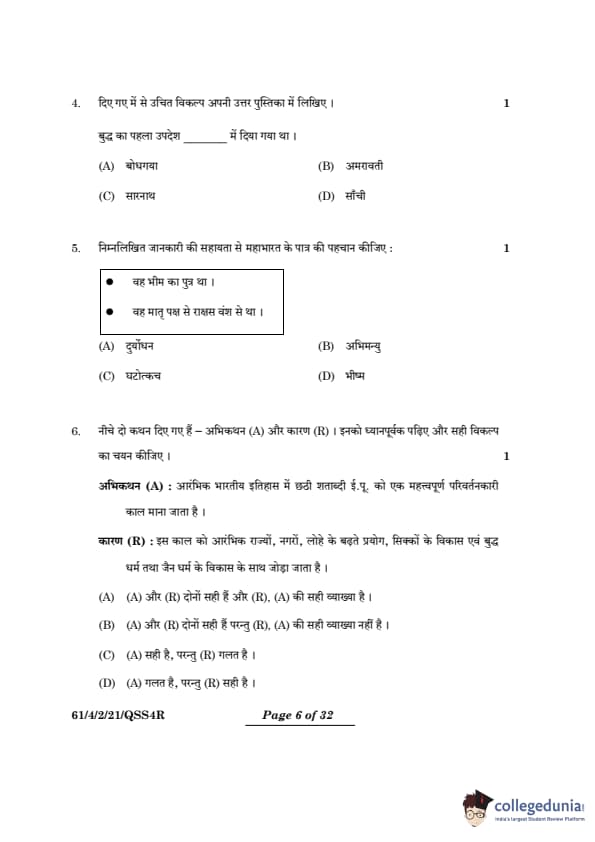
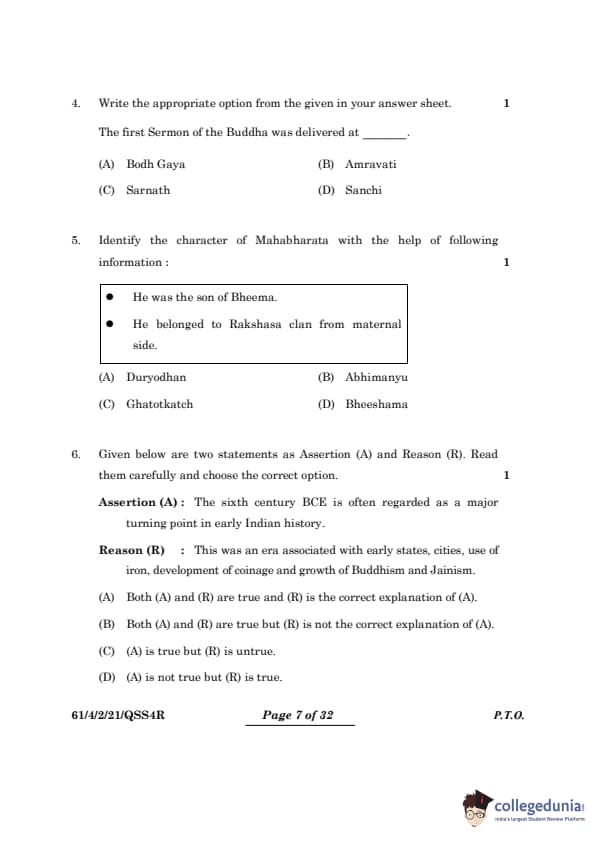
The first Sermon of the Buddha was delivered at
View Solution
Solution:
Sarnath: Sarnath is the place near Varanasi where the Buddha gave his first sermon after achieving enlightenment. This makes it a place of great significance in Buddhism.
Bodh Gaya: Bodh Gaya is where the Buddha attained enlightenment under the Bodhi tree. This is why this place is important to Buddhism.
Amravati: Amravati is known for its Buddhist stupa, which is a site of importance in Buddhist history.
Sanchi: Sanchi is a place known for its well preserved Buddhist stupa, which is a key site in Buddhist history.
Question 5:
Identify the character of Mahabharata with the help of following information:
• He was the son of Bheema.
• He belonged to Rakshasa clan from maternal side.
View Solution
Solution:
Ghatotkacha: Ghatotkacha was a character in the Mahabharata, known for being the son of Bhima and the Rakshasi (demoness) Hidimba. He was a powerful warrior with magical powers, who had an important role to play in the great Kurukshetra war.
Duryodhan: Duryodhana was the eldest of the Kauravas, and the main antagonist in the Mahabharata. He was not related to the Rakshasa clan through his mother.
Abhimanyu: Abhimanyu was the son of Arjuna and Subhadra, and a valiant warrior, but not the son of Bhima.
Bheeshma: Bheeshma was the grand-uncle of both Pandavas and Kauravas and was a key character in the Mahabharata, who had a unique vow.
Question 6:
Given below are two statements as Assertion (A) and Reason (R). Read them carefully and choose the correct option:
Assertion (A): The sixth century BCE is often regarded as a major turning point in early Indian history.
Reason (R): This was an era associated with early states, cities, use of iron, development of coinage and growth of Buddhism and Jainism.
View Solution
Solution:
Assertion (A): The sixth century BCE is often regarded as a major turning point in early Indian history: This is indeed true as the sixth century BCE was a period of major transformations in Indian history. This period was characterised by both social and economic transformations that were widespread in the subcontinent.
Reason (R): This was an era associated with early states, cities, use of iron, development of coinage and growth of Buddhism and Jainism: The reason explains the assertion well, because all these changes took place in this era. The rise of new kingdoms (Mahajanapadas), along with urbanization and trade, are important markers of this period. The use of iron enabled better agricultural practices and trade. There was also the development of coinage and growth of religious movements such as Buddhism and Jainism that greatly influenced this period.
The reason provides a direct explanation for why this period is regarded as a turning point and this makes (A) the correct answer.
Question 7:
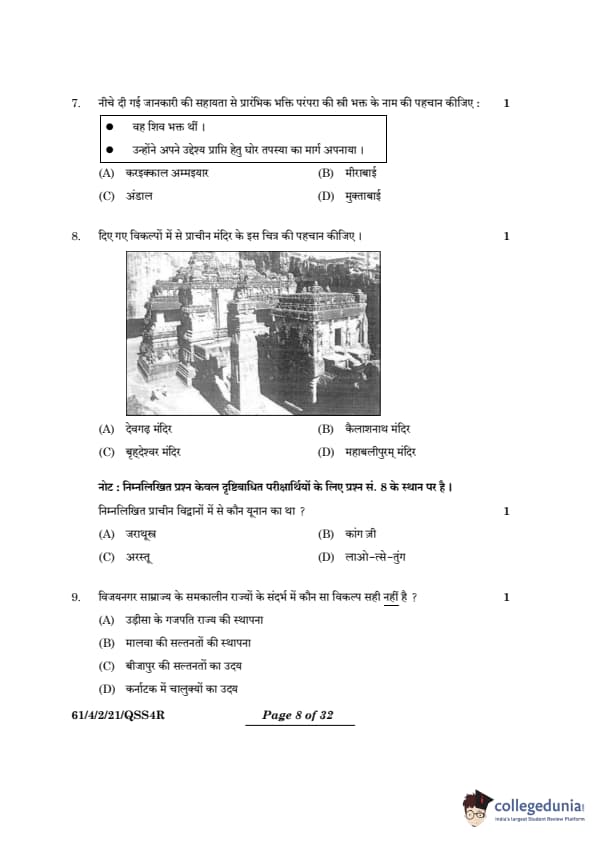
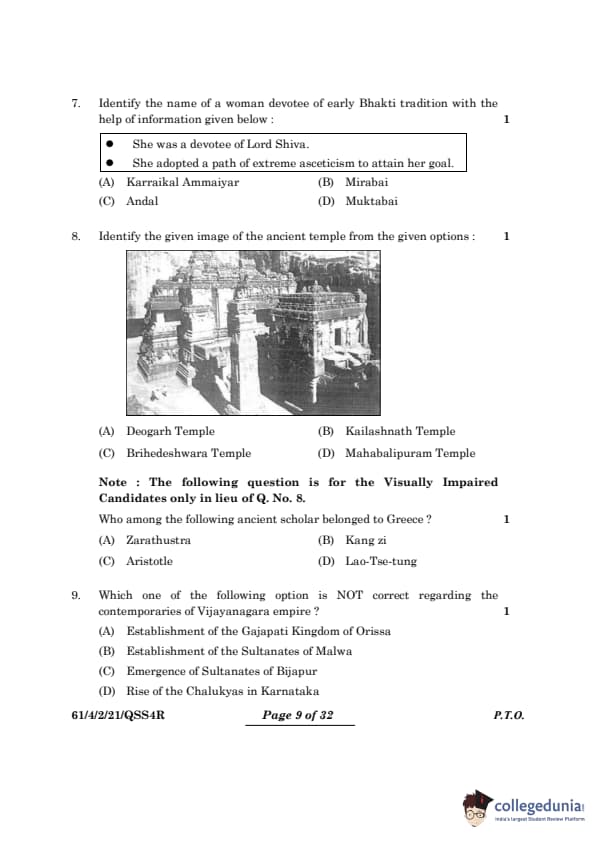
Identify the name of a woman devotee of early Bhakti tradition with the help of information given below :
• She was a devotee of Lord Shiva.
• She adopted a path of extreme asceticism to attain her goal.
View Solution
Solution:
Karraikal Ammaiyar: Karraikal Ammaiyar was one of the 63 Nayanars, who were saints devoted to Lord Shiva. She is known for her intense devotion and for her extreme ascetic lifestyle. She is a powerful example of women's participation in the Bhakti tradition.
Mirabai: Mirabai was a 16th-century Bhakti saint and poet, who was a devotee of Lord Krishna. She is known for her devotional songs and did not adopt extreme asceticism.
Andal: Andal, a Tamil poet and saint from the Bhakti movement, was a devotee of Lord Vishnu. She is known for her devotion to Vishnu and her love poetry, and was not known for adopting extreme asceticism.
Muktabai: Muktabai was a Marathi saint from the Varkari sect. She was a contemporary of Dnyaneshwar and was not primarily a Shiva devotee.
Question 8:
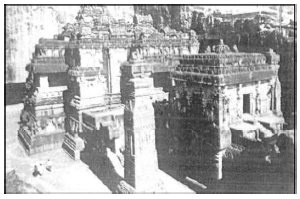
Identify the given image of the ancient temple from the given options:
View Solution
Solution:
Kailashnath Temple: The image is of the Kailashnath Temple at Ellora, Maharashtra, a monolithic rock-cut temple which is dedicated to Lord Shiva. It is an exceptional example of Rashtrakuta architecture.
Deogarh Temple: Deogarh Temple is located in Uttar Pradesh and is known for its intricate carvings of Vishnu and his incarnations, showcasing the Gupta period art.
Brihadeshwara Temple: Brihadeshwara Temple, also known as the Big Temple, is a Chola-era temple located in Thanjavur and is not a rock-cut structure. It is known for its massive tower and grandeur.
Mahabalipuram Temple: The Mahabalipuram temples are located in Tamil Nadu and are known for their shore temples that are carved out of granite, but this one is a rock cut temple.
Question 9:
Which one of the following option is NOT correct regarding the contemporaries of Vijayanagara empire ?
View Solution
Solution:
(A) Establishment of the Gajapati Kingdom of Orissa: The Gajapati kingdom of Orissa was a powerful regional kingdom which was indeed a contemporary of the Vijayanagara empire.
(B) Establishment of the Sultanates of Malwa: The Sultanate of Malwa was another contemporary of the Vijayanagara empire in the medieval period in north India.
(C) Emergence of Sultanates of Bijapur: The Sultanates of Bijapur emerged as one of the successor states in the Deccan and was indeed a contemporary of the Vijayanagara empire.
(D) Rise of the Chalukyas in Karnataka: The Chalukyas were a major dynasty of the early medieval period and were not contemporary to the Vijayanagara Empire.
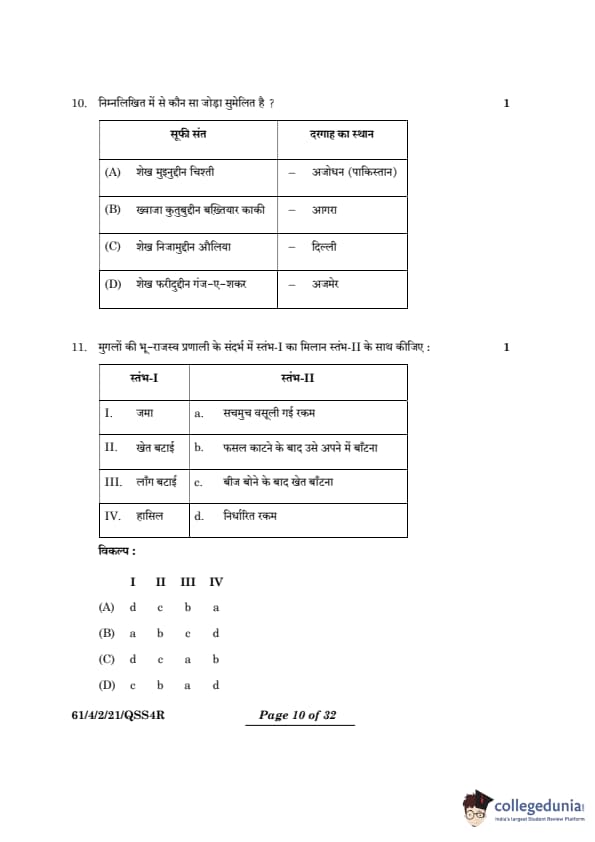
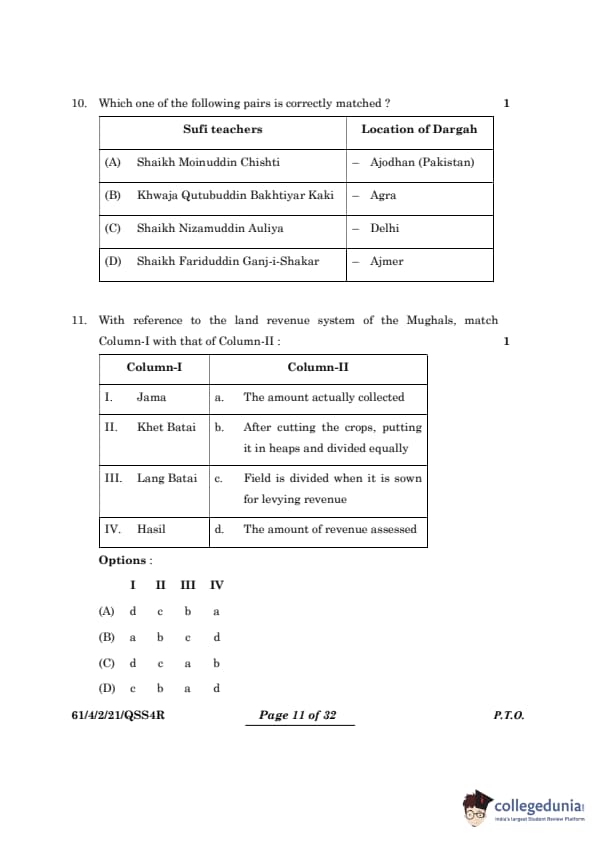
Question 10:
Which one of the following pairs is correctly matched?
| Sufi teachers | Location of Dargah |
|---|---|
| (A) Shaikh Moinuddin Chishti | Ajodhan (Pakistan) |
| (B) Khwaja Qutubuddin Bakhtiyar Kaki | Agra |
| (C) Shaikh Nizamuddin Auliya | Delhi |
| (D) Shaikh Fariduddin Ganj-i-Shakar | Ajmer |
View Solution
Solution:
(A) Shaikh Moinuddin Chishti - Ajodhan (Pakistan): The dargah of Shaikh Muinuddin Chishti is located in Ajmer, Rajasthan, and not in Ajodhan.
(B) Khwaja Qutubuddin Bakhtiyar Kaki - Agra: The dargah of Khwaja Qutbuddin Bakhtiyar Kaki is located in Delhi and not in Agra.
(C) Shaikh Nizamuddin Auliya - Delhi: The dargah of Shaikh Nizamuddin Auliya is located in Delhi and is one of the most significant Sufi shrines in India.
(D) Shaikh Fariduddin Ganj-i-Shakar - Ajmer: The dargah of Shaikh Fariduddin Ganj-i-Shakar is located in Ajodhan (Pakpattan), Pakistan, and not in Ajmer.
Question 11:
With reference to the land revenue system of the Mughals, match Column-I with that of Column-II:
| Column-I | Column-II |
|---|---|
| I. Jama | a. The amount actually collected |
| II. Khet Batai | b. After cutting the crops, putting it in heaps and divided equally |
| III. Lang Batai | c. Field is divided when it is sown for levying revenue |
| IV. Hasil | d. The amount of revenue assessed |
View Solution
Solution:
I. Jama and d. The amount of revenue assessed: The term ‘Jama' in the Mughal land revenue system referred to the amount of revenue that was initially assessed, which was to be collected by the state.
II. Khet Batai and c. Field is divided when it is sown for levying revenue: The term 'Khet Batai' refers to the practice where the fields were divided at the time of sowing for calculation of land revenue.
III. Lang Batai and b. After cutting the crops, putting it in heaps and divided equally: 'Lang Batai' refers to the division of the produce after the harvest.
IV. Hasil and a. The amount actually collected: The term ‘Hasil' was the actual amount of revenue collected from the farmers.
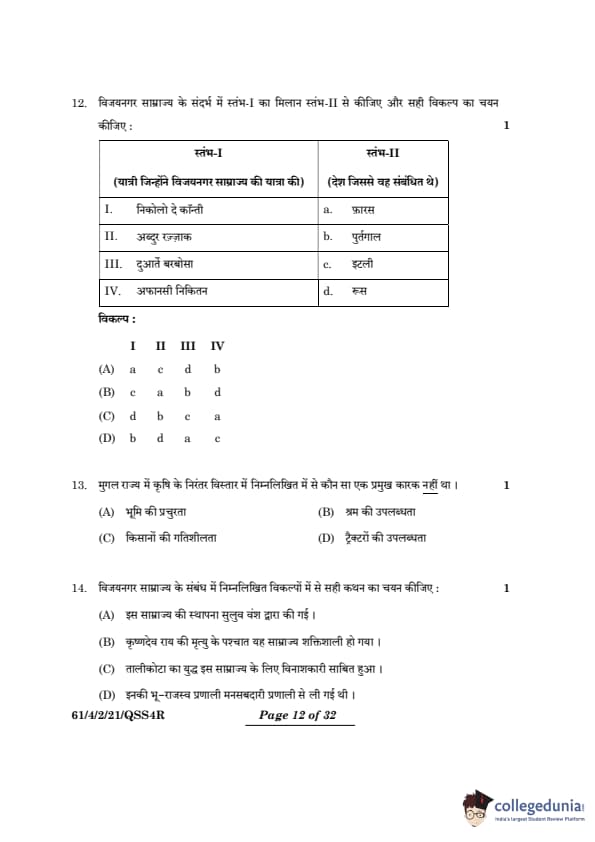
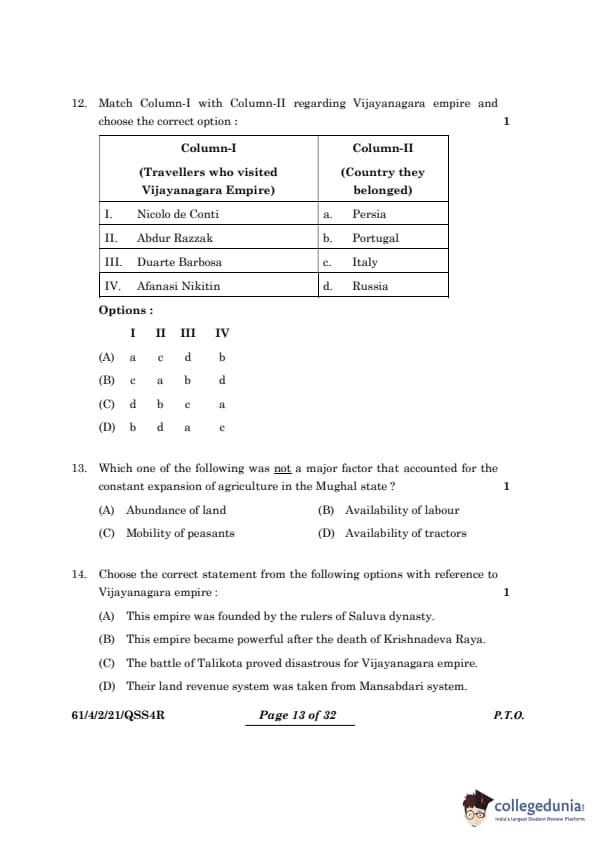
Question 12:
Match Column-I with Column-II regarding Vijayanagara empire and choose the correct option :
| Column-I (Travellers who visited Vijayanagara Empire) | Column-II (Country they belonged) |
|---|---|
| I. Nicolo de Conti | a. Persia |
| II. Abdur Razzak | b. Portugal |
| III. Duarte Barbosa | c. Italy |
| IV. Afanasi Nikitin | d. Russia |
View Solution
Solution:
I. Nicolo de Conti and c. Italy: Nicolo de Conti was an Italian merchant and traveller who visited the Vijayanagara empire in the early 15th century and gave a vivid description of the city.
II. Abdur Razzak and a. Persia: Abdur Razzak was a Persian scholar and ambassador who also visited the Vijayanagara empire in the 15th century. He also wrote about the political and economic system prevalent there.
III. Duarte Barbosa and b. Portugal: Duarte Barbosa was a Portuguese writer and a traveler who visited the Vijayanagara empire in the early 16th century. His writings provide an account of the trade, society and culture of the region.
IV. Afanasi Nikitin and d. Russia: Afanasi Nikitin was a Russian merchant and traveller who visited India and traveled to the Deccan regions in the 15th century. He provides a vivid account of the political and social scenarios of the region.
Question 13:
Which one of the following was not a major factor that accounted for the constant expansion of agriculture in the Mughal state ?
View Solution
Solution:
(D) Availability of tractors: Tractors were not used in the Mughal era. This option is incorrect because the technologies of that time did not include heavy machinery.
(A) Abundance of Land: There was indeed a large abundance of land available for cultivation in the Mughal era, and the state was trying to expand its cultivated area through different policies.
(B) Availability of Labour: There was a high availability of labour due to a large population base, which facilitated the expansion of agriculture.
(C) Mobility of Peasants: The mobility of peasants was also a key factor in the expansion of agriculture as peasants moved to new and fertile regions.
Question 14:
Choose the correct statement from the following options with reference to Vijayanagara empire:
View Solution
Solution:
(A) This empire was founded by the rulers of Saluva dynasty: The Vijayanagara empire was founded by Harihara I and Bukka Raya of the Sangama Dynasty and not by the rulers of the Saluva dynasty.
(B) This empire became powerful after the death of Krishnadeva Raya: The Vijayanagara empire reached the peak of its power during the rule of Krishnadeva Raya, and the empire declined after him.
(C) The battle of Talikota proved disastrous for Vijayanagara empire: The battle of Talikota in 1565 was a major defeat for Vijayanagara, and this led to its eventual decline.
(D) Their land revenue system was taken from Mansabdari system: The land revenue system of the Vijayanagara empire was not taken from the Mansabdari system, which was related to Mughal rule, not Vijayanagara rule.
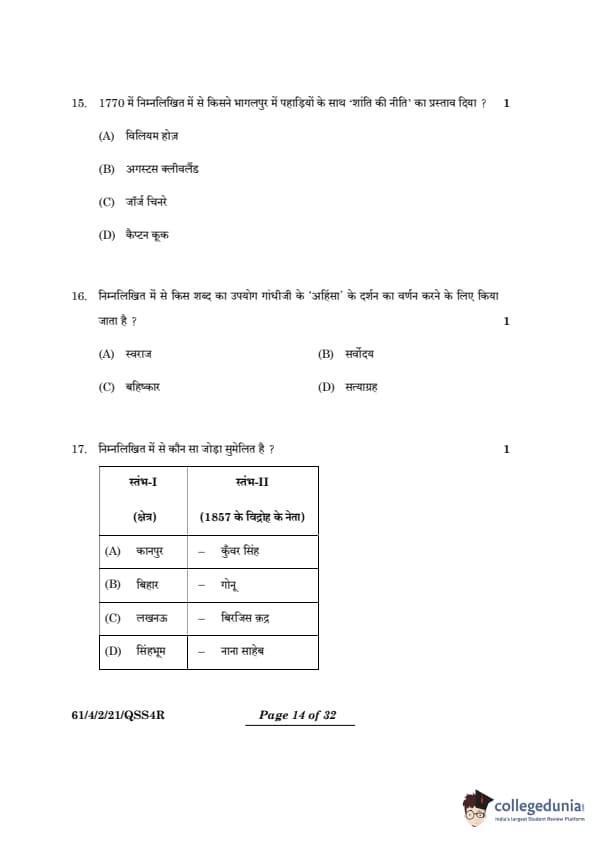
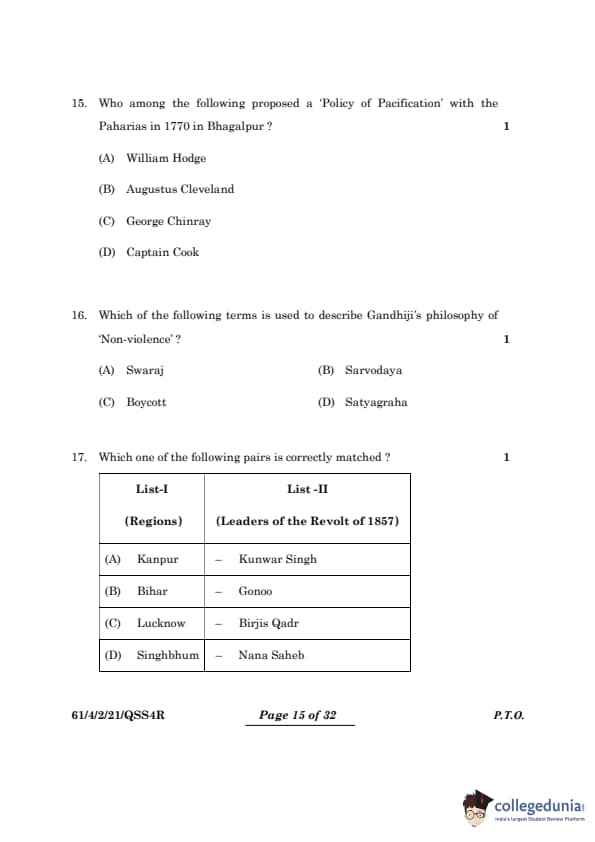
Question 15:
Who among the following proposed a ‘Policy of Pacification' with the Paharias in 1770 in Bhagalpur ?
View Solution
Solution:
Augustus Cleveland: Augustus Cleveland was a British administrator who implemented a 'Policy of Pacification' in 1770 in Bhagalpur to establish peaceful relations with the Paharias. This policy focused on winning over the Paharias through diplomacy rather than war.
William Hodge: William Hodge was a British painter who was known for his paintings of different landscapes and historical settings. He is not connected to the Policy of Pacification in Bhagalpur.
George Chinray: There isn't any record of such British official.
Captain Cook: Captain Cook was a British explorer known for his voyages and explorations, especially in the Pacific Ocean. He is not connected to the Policy of Pacification.
Question 16:
Which of the following terms is used to describe Gandhiji's philosophy of 'Non-violence'?
View Solution
Solution:
Satyagraha: 'Satyagraha' was a key concept of Gandhiji's philosophy, which was based on non-violent resistance. It was a combination of truth and non-violence.
Swaraj: Swaraj is a term which means self rule or independence, and is different from non-violence.
Sarvodaya: Sarvodaya is a concept developed by Gandhiji based on the upliftment of all, including the poorest and most marginalised sections of society.
Boycott: Boycott is an act of protest in which people stop buying goods from particular people or from a specific country. It is different from non-violence.
Question 17:
Which one of the following pairs is correctly matched?
| List-I (Regions) | List-II (Leaders of the Revolt of 1857) |
|---|---|
| (A) Kanpur | Kunwar Singh |
| (B) Bihar | Gonoo |
| (C) Lucknow | Birjis Qadr |
| (D) Singhbhum | Nana Saheb |
View Solution
Solution:
(A) Kanpur - Kunwar Singh: Kunwar Singh was primarily active in Bihar, and was not directly associated with Kanpur. The revolt of 1857 in Kanpur was led by Nana Saheb and Tantya Tope.
(B) Bihar - Gonoo: Gonoo was a tribal leader from Singhbhum, which is in present-day Jharkhand, and not Bihar.
(C) Lucknow - Birjis Qadr: Birjis Qadr was the son of the deposed Nawab of Awadh, and he led the revolt against the British in Lucknow.
(D) Singhbhum - Nana Saheb: Nana Saheb was primarily active in Kanpur and was not related to Singhbhum.
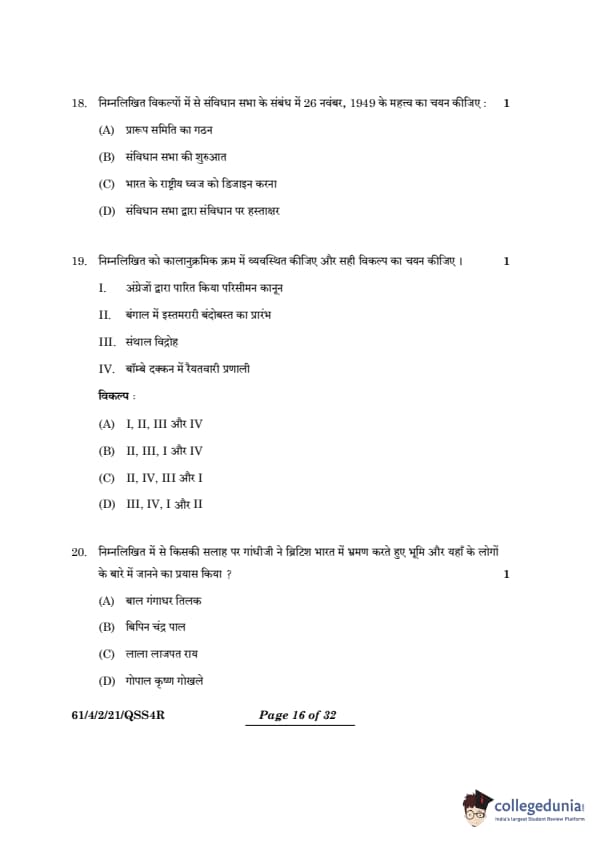
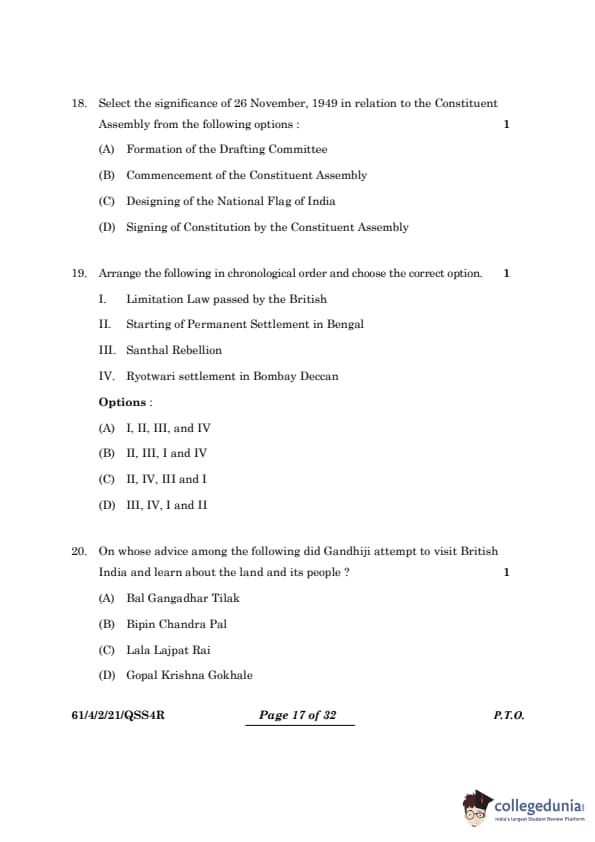
Question 18:
Select the significance of 26 November, 1949 in relation to the Constituent Assembly from the following options:
View Solution
Solution:
(D) Signing of Constitution by the Constituent Assembly: 26 November 1949 is the day on which the Constituent Assembly adopted and signed the Constitution of India, marking a key moment in the nation's history.
(A) Formation of the Drafting Committee: The Drafting Committee was formed earlier than 26th November 1949. This committee was responsible for drafting the constitution.
(B) Commencement of the Constituent Assembly: The Constituent Assembly was formed and commenced its proceedings much earlier, in December 1946.
(C) Designing of the National Flag of India: The Indian National flag was designed and adopted earlier, not on November 26, 1949.
Question 19:
Arrange the following in chronological order and choose the correct option.
I. Limitation Law passed by the British
II. Starting of Permanent Settlement in Bengal
III. Santhal Rebellion
IV. Ryotwari settlement in Bombay Deccan
View Solution
Solution:
II. Starting of Permanent Settlement in Bengal: The Permanent Settlement was introduced by the British in Bengal in 1793, which makes it the earliest of the given options.
IV. Ryotwari settlement in Bombay Deccan: The Ryotwari system was implemented in the Bombay Deccan in the 1820s, which makes it the next in the order.
III. Santhal Rebellion: The Santhal Rebellion broke out in 1855–56, which makes it the next in order.
I. Limitation Law passed by the British: The Limitation Law which was meant to manage debt and usury, was passed by the British in 1859, making it the latest in order.
Question 20:
On whose advice among the following did Gandhiji attempt to visit British India and learn about the land and its people ?
View Solution
Solution:
Gopal Krishna Gokhale: Gopal Krishna Gokhale was Gandhiji's acknowledged political mentor. On his advice, Gandhiji travelled to different regions of British India to understand the land and its people after his arrival from South Africa in 1915.
Bal Gangadhar Tilak: Bal Gangadhar Tilak was an important nationalist leader and was known for adopting an assertive stance against British rule, but he was not known as Gandhiji's mentor, or for advising him to travel around India.
Bipin Chandra Pal: Bipin Chandra Pal was an important nationalist leader and was known for his involvement in the Swadeshi Movement. He was not connected to Gandhi's decision to travel around India.
Lala Lajpat Rai: Lala Lajpat Rai was an important nationalist leader. He is best known as one of the members of Lal-Bal-Pal trio.
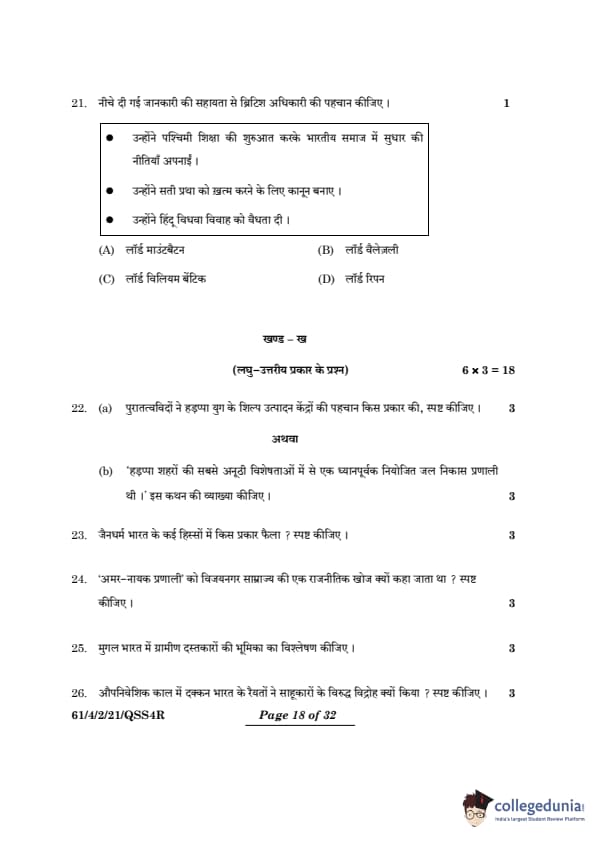
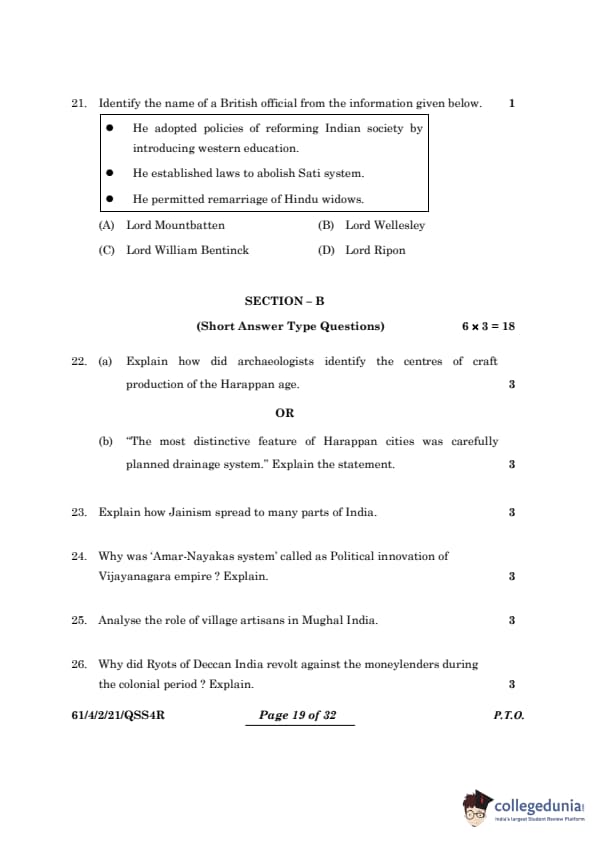
Question 21:
Identify the name of a British official from the information given below.
• He adopted policies of reforming Indian society by introducing western education.
• He established laws to abolish Sati system.
• He permitted remarriage of Hindu widows.
View Solution
Solution:
Lord William Bentinck: Lord William Bentinck was the Governor-General of India during the period when some key social reforms were introduced. He took an active interest in social reforms and is known for policies such as abolishing Sati and promoting western education.
Lord Mountbatten: Lord Mountbatten was the last Viceroy of India who oversaw the partition and independence of India. He is not directly connected to these social reforms.
Lord Wellesley: Lord Wellesley was known for his role in expanding British power and control through policies such as the Subsidiary Alliance, and not for social reforms.
Lord Ripon: Lord Ripon was known for his policies regarding local self-governance and for his liberal approaches. However, he did not pass laws to abolish sati or legalize widow remarriage.
Section B
Short Answer Type Questions
Question 22(a):
Explain how archaeologists identified the centers of craft production of the Harappan age.
View Solution
Solution:
Raw Materials: Archaeologists look for evidence of raw materials like stone nodules, shells, copper ores, and clay, which were essential for various types of craft activities. The presence of such materials often indicates that the site was a source of raw materials or a processing center.
Unfinished Objects and Rejects: The discovery of unfinished objects, rejects, and waste materials near a site is another key indicator. These items show evidence that they were used as production centers where various crafts were manufactured.
Broken Materials: They also check for broken material, as many of the materials were prone to breaking when handled. Such remains are often found near production sites.
Use of Waste: Archaeologists also focus on looking for evidence of waste being used for craft work. This shows a clear practice of reuse of materials.
Other relevant points: Any other relevant point from the chapter.
Question 22(b):
“The most distinctive feature of Harappan cities was Carefully planned drainage system." Explain the statement.
View Solution
Solution:
Grid Pattern: Streets and drains were laid out first and the houses built alongside in a “grid" pattern. This indicates a highly planned and organized urban structure.
Right Angles: Streets and drains intersected at right angles, which allowed for efficient flow of water and for proper planning of the area.
Connection to Street Drains: Each house was connected to the street drains, showcasing an integrated system designed for hygiene.
Brick-lined Main Channels: The main drainage channels were made of bricks set in mortar and covered with loose bricks. This allowed easy cleaning of the drains and also prevented blockages.
Limestone Covers: In some cases, limestone was also used as covers for these drains, which highlights their awareness of materials and their use.
Sumps and Cesspits: Drains from the houses emptied into sumps or cesspits where solid matter settled and waste water flowed into the streets. This clearly shows an understanding of the separation of solid and liquid waste.
Sump at Intervals: Very long drainage channels were provided with sumps at intervals to allow for cleaning and removal of solid waste from the drains.
Debris Beside Channels: Little heaps of sand and material were frequently found along the drainage channels, which show that the debris was not always carted away every time a drain was cleaned.
Other relevant points: Any other valid point from the chapter.
Question 23:
Explain how Jainism spread to many parts of India.
View Solution
Solution:
Teachings of Mahavira: The teachings of Mahavira were recorded by his disciples in the form of stories that were simple enough for ordinary people to understand.
Jaina Literature: There was a wealth of literature produced by Jain scholars in languages like Prakrit, Sanskrit and Tamil, which helped in reaching a wider audience.
Preservation of Texts: Manuscripts of these texts were carefully preserved in the libraries attached to temples. This allowed for the spread and preservation of their religious ideas.
Geographic Reach: Jainism spread to many parts of India, including Maharashtra, Karnataka, and Tamil Nadu, showing the extensive spread of the religion.
Stone Sculptures: The devotees of the Jaina Tirthankaras made many stone sculptures, which were found in several sites across the sub-continent. The images of the Tirthankaras also became a part of their worship.
Gopalchal Rock-cut Jain Mountain: The Gopalchal rock-cut Jain Mountain in Gwalior, Madhya Pradesh, highlights the presence of Jainism across different regions.
Other relevant points: Any other relevant points from the chapter.
Question 24:
Why was ‘Amar-Nayakas system' called as Political innovation of Vijayanagara empire? Explain.
View Solution
Solution:
Military Commanders as Governors: The amara-nayakas were military commanders who were given territories by the raya (king) to govern, showcasing a unique political and military structure. This was a key aspect of their political system.
Revenue Collection: They collected taxes and other dues from peasants, craftspersons, and traders in the areas, indicating a decentralized system of revenue collection.
Personal Use and Maintaining Contingents: They retained a part of the revenue for their personal use and for maintaining a stipulated contingent of horses and elephants, indicating a system of shared responsibility.
Providing Effective Fighting Force: These contingents provided the Vijayanagara kings with a powerful force that enabled them to control the entire southern peninsula. This played a crucial role in their territorial expansion.
Maintenance of Infrastructure: The revenue was also used for the maintenance of temples and irrigation works, signifying the importance given to both religious and public works.
Annual Tribute and Loyalty: The amara-nayakas sent tributes to the king annually, and they were also expected to visit the royal court with gifts to express loyalty. This further cemented the relationship between the king and the nayakas.
Transferring Control: The kings asserted their control by transferring nayakas from one place to another, highlighting the political influence of the king on their military commanders.
Rise of Independent Kingdoms: Over time, many of these nayakas became more powerful and started establishing their own independent kingdoms, which eventually led to the weakening of the Vijayanagara empire.
Other relevant points: Any other relevant points from the chapter.
Question 25:
Analyse the role of village artisans in Mughal India.
View Solution
Solution:
Exchange System: There was an intricate relationship of exchange between different producers in the village system, where the artisans and farmers exchanged their goods and services.
Blurring of Artisan-Peasant Distinction: At times, the lines between artisans and peasants blurred, with many groups performing both tasks. Thus, the distinction between the two was fluid.
Participation in Craft Production: Cultivators and their families also participated in craft production during their free time. This meant that different groups took part in both agriculture and crafting activities.
Variety of Artisanal Work: The artisans were engaged in various activities such as dyeing, textile printing, baking, pottery, and making agricultural tools and their repairs. This indicates the diversity of skills and work within the villages.
Artisanal Work During Lulls in Agriculture: During lulls in agriculture, artisans engaged in specialized production, demonstrating an interplay of agricultural and crafting economies.
Compensation to Artisans: Village artisans like potters, blacksmiths, carpenters, barbers, and even goldsmiths provided their services and in return, were compensated by villagers with a variety of means, reflecting an integrated and interdependent system.
Sharing of Harvest: The most common way of sharing of the harvest was decided by the panchayat, highlighting the importance of the village council in regulating the system.
Hereditary Holdings: In Maharashtra such lands became the artisans' miras or watan — their hereditary holdings, which shows the importance given to their profession.
Negotiated Remuneration: Sometimes artisans and individual peasant households entered into a mutually negotiated system for payment, mostly through exchange of goods for services, emphasizing reciprocal relationships in villages.
Remuneration through Jajmani System: In Bengal, Zamindars remunerated blacksmiths, carpenters, and goldsmiths with a small allowance and diet money through the jajmani system.
Cash Remuneration: Although cash remuneration was not entirely unknown, such type of payments were very few.
Other relevant points: Any other relevant point from the chapter.
Question 26:
Why did Ryots of Deccan India revolt against the moneylenders during the colonial period? Explain.
View Solution
Solution:
Ryotwari System in Deccan: The Ryotwari revenue settlement in the Bombay Deccan in the 1820s led to very high revenue demands on peasants, who were already suffering from issues like poor soil quality and irregular rainfall.
High Revenue Demands and Natural Calamities: Due to the poor soil and varying rainfall, and high revenue demands, they struggled to pay, and it became even more problematic during famines and droughts.
Strict Revenue Collection: The British revenue collectors were harsh and used very strict measures to extract the revenue, even when peasants were having difficulties.
Seizure of Crops and Fines: When peasants failed to pay, their crops were often seized, and also, fines were imposed on entire villages for non-payment.
Sharp Fall in Prices: The prices of agricultural products fell sharply after 1832 and did not recover for more than a decade, which led to a decline in their earnings.
Famine: The countryside was devastated by famines, which caused a decline in their incomes. About one-third of the cattle and half the human population died in the famines, showing the extent of the crisis.
Mounting Debts and Dependence: As the Ryots struggled, unpaid revenue balances increased, which created a cycle of debt and dependence on moneylenders. Peasants increasingly had to borrow money to pay land revenue, and it was almost impossible for them to pay back the loans.
Increased Dependence on Moneylenders: As loans kept mounting and remained unpaid, the dependence of peasants on moneylenders increased. Thus, they had to seek help from the moneylenders just to pay taxes.
Access to Easy Credit for Cotton Cultivation: The ryots of the Deccan suddenly had access to credit to grow cotton, which added to their already existing burden of debt.
Rich Peasants Benefited but Majority Faced Debt: Some rich peasants did gain in this process, but a majority faced an even heavier burden of debt.
Credit Dried Up and Increased Revenue Demand: With time, the credit dried up, while the revenue demand from the British kept increasing, leaving the peasants in a dire situation.
Moneylenders Violated Norms and Manipulated Laws: The moneylenders often violated the existing norms of the countryside. They also manipulated the laws and forged accounts.
Deeds and Bonds as New Symbols of Oppression: Deeds and bonds became symbols of the new oppressive system, creating a new way of exploitation.
Eyewitness Accounts: Eyewitness accounts of ryots and sahukars, provided statistical data on revenue rates, prices, interest rates in different regions, and the reports that were sent by the collectors indicate that they were well aware of their plight.
Other relevant points: Any other relevant points from the chapter.
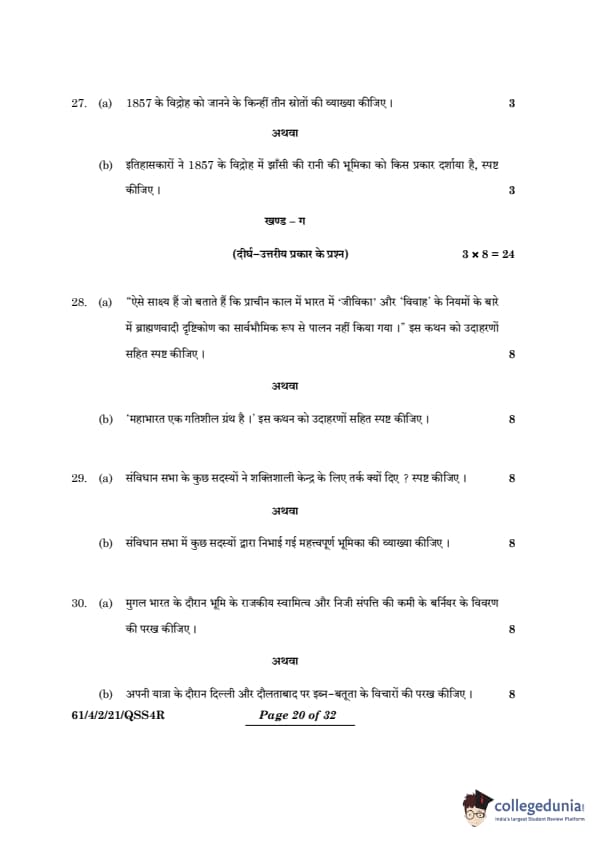
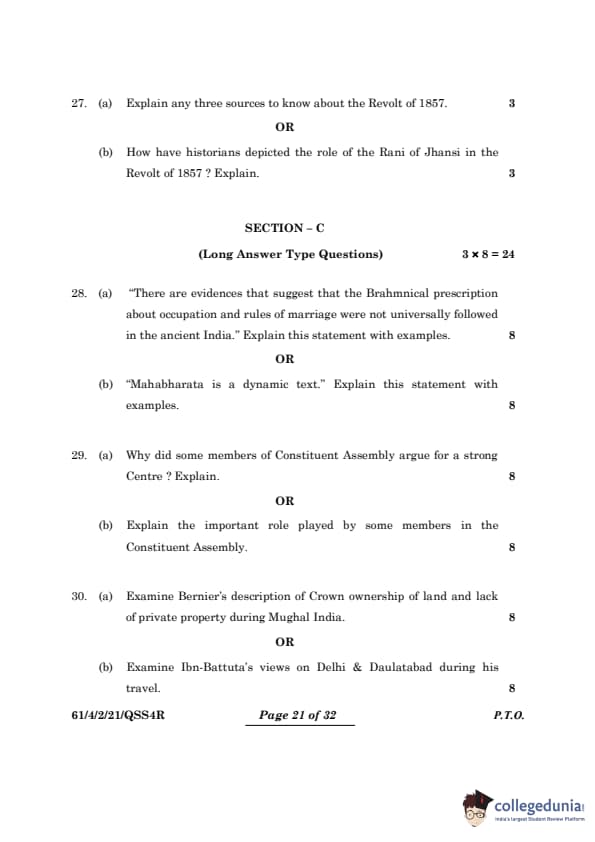
Question 27(a):
Explain any three sources to know about the Revolt of 1857.
View Solution
Solution:
Rebel Records: These include proclamations, and notifications that were issued by the rebel leaders, which provides insight into their goals, strategies and organization during the revolt.
Letters from Rebel Leaders: Letters written by the rebel leaders often reveal their personal motivations, strategies, and the relationships they had with other participants. These documents help in understanding the movement through different points of view.
Accounts written by British: The accounts of the Revolt written by British officials and military personnel provide a different perspective of the events. These accounts help reveal the strategies that the British employed to control and put down the revolt.
Question 27(b):
How have historians depicted the role of the Rani of Jhansi in the Revolt of 1857? Explain.
View Solution
Solution:
Keeping Alive the Memory of 1857: Art, literature, and historical writings have helped keep the memory of 1857 alive in popular consciousness. Rani Lakshmi Bai is an important figure in these narratives.
Rani of Jhansi as a Heroic Figure: Rani of Jhansi is often portrayed as a heroic figure leading the country into battle, which is often used to depict the resistance to colonial rule.
Rousing Righteous Indignation: She is also seen as a figure who roused people to fight against the oppressive rule, highlighting her ability to mobilize people against the colonial rule.
Heroic Poems and Valor: Many heroic poems are written about the valour of the Rani, portraying her as a warrior who is ready to fight for her kingdom. The poems often mention her with a sword in one hand, and reins of the horse in another.
Masculine Figure: She is portrayed as a masculine figure, who was chasing the enemy, and is valiant and courageous. This portrayal also highlights the traditional patriarchal roles within society at that time.
Symbol of Determination: Rani Lakshmi Bai is usually portrayed in battle armour with a sword in hand, and riding a horse, as a symbol of resistance against injustice.
Other relevant points: Any other relevant points from the chapter.
Section C
Long Answer Type Questions
Question 28(a):
“There are evidences that suggest that the Brahmnical prescription about occupation and rules of marriage were not universally followed in the ancient India." Explain this statement with examples.
View Solution
Solution:
Rules of Marriage:
Patrilineage and Daughters: While sons were important for the continuation of the patrilineage, daughters were viewed differently and did not have equal status.
No Claims for Daughters: Daughters often had no claims to the resources of the household, which further indicates the patriarchal nature of the society.
Endogamy: Endogamy (marriage within a group) was prescribed, which could include kin group, caste, or a group living in the same locality. Examples include Kunti-Pandu and Gandhari-Dhritrashtra, who were married within their own lineages.
Exogamy: Exogamy (marriage outside a group) was also prevalent and examples include the marriage of Bhima to Hidimba, where both came from different groups.
Polygyny: Polygyny (a man having several wives) was practiced by some men, such as Pandu who married both Kunti and Madri.
Polyandry: Polyandry (a woman having several husbands), although less common, is seen with Draupadi having five husbands.
Different forms of Marriage: The Dharmasutras and Dharmashastras recognized as many as eight forms of marriage, which indicate the diversity of practices related to marriage.
Kanyadana: Kanyadana, the giving away of a daughter in marriage, was seen as a key religious duty for the father, which gives us a glimpse of the patriarchal nature of the society.
New Towns and Complex Social Life: The emergence of new towns introduced more complex social life, and also challenged the existing rules of the period.
Brahmanical prescription about occupation:
Rules of Occupation: The Dharmashastras and Dharmasutras contained rules about the ideal 'occupations' of the four categories or varnas.
Brahmins: The Brahmins were supposed to study and teach the Vedas, perform and get sacrifices performed, and give and receive gifts. This gives them a position of privilege in the social hierarchy.
Kshatriyas: The Kshatriyas were to engage in warfare, protect people, administer justice, study the Vedas, perform sacrifices, and give gifts, which gives them a position of authority.
Vaishyas: The Vaishyas were expected to engage in agriculture, pastoralism and trade, highlighting their economic role.
Shudras: Shudras were assigned only one occupation which was of serving the three "higher" varnas. This points to the exploitative structure of the society.
Not Universally Followed: However, these rules were not always followed by people in the society, and there were many instances of people taking up occupations not prescribed for them. This highlights the fact that despite religious prescriptions, there were variations in social practices.
Other Relevant Points: Any other relevant points from the chapter
Question 28(b):
"Mahabharata is a dynamic text.” Explain this statement with examples.
View Solution
Solution:
Multiple Languages: Over the centuries, versions of the epic have been written in many different languages. The different linguistic adaptations and translations, allowed the story to travel to diverse regions, thereby making it a dynamic text.
Ongoing Dialogue: There has been an ongoing process of dialogue between people, communities, and those who have written the texts, highlighting that the interpretations of the epic is always evolving.
Integration of Local Stories: Several stories that originated in specific regions or circulated among certain people gradually made their way into the epic, highlighting a continuous process of reinterpretation and additions to the original narrative.
Retelling of the Central Story: At the same time, the central story of the epic was also retold in different ways, showing its adaptability.
Depiction in Art and Sculpture: Episodes were depicted in sculpture and paintings, which also gave a visual interpretation to the events.
Use in Performing Arts: The Mahabharata also provided themes for a wide range of performing arts, like plays and dance, which further amplified its impact on popular culture.
Various kinds of Narrations: There are different kinds of narrations related to the epic including both narrative and deductive versions of the text, which makes it a truly diverse and dynamic text.
Geeta is a Part of Mahabharata: The Bhagavad Gita is itself a part of the Mahabharata, and is a key philosophical part of the Hindu tradition.
Different Interpretations: There have been multiple interpretations of the text over centuries, showing the wide range of perspectives around it.
Adding Cultural Elements: Over time, different cultural elements have been incorporated into the text, showing its adaptability to different cultural settings.
Themes of Epic Revolved: The story of the epic revolves around the idea of kingdoms and power and also how families and societies have been structured.
Versions of Itihasa: Different versions of the Mahabharata exist, which were created from the itihasa tradition.
Other relevant points: Any other relevant point from the chapter.
Question 29(a):
Why did some members of Constituent Assembly argue for a strong Centre? Explain.
View Solution
Solution:
Nehru’s Advocacy: Jawaharlal Nehru was one of the main advocates for a strong Centre. He believed in a powerful and centralized government for the country.
Weak Centre and Peace: He emphasized that a weak centre would be incapable of ensuring peace and stability in the nation, as he feared that a weak Centre would create a power vacuum that different regional powers would try to fill.
International Presence: A strong center was also necessary for India to have a powerful presence in the international arena, because a weak Centre wouldn't get the required respect in international relations.
Santhanam’s Defense of State Rights: K. Santhanam from Madras (Chennai), defended the rights of states very eloquently, which shows the different points of view of members.
Need for Reallocation of Powers: However, he also emphasized the need for a reallocation of power to strengthen not just the states but also the Centre. This shows a compromise on both sides.
Centre and Responsibility: He believed that the centre might break down with too many responsibilities, but did not call for a weak Centre.
Ambedkar’s Support for United Centre: Ambedkar also supported the idea of a strong and united centre because it would help to maintain law and order in the country.
Strong Centre to Check Riots: According to him, riots in the country could be controlled through a strong centre, which indicates his belief in the use of state power to maintain social harmony.
Control Over Foreign Aggression: Foreign aggression could also be controlled if there was a strong center, highlighting the need for unified security.
Foreign Affairs: It was also thought that foreign affairs would be guided in a balanced way if the Centre was strong and that would make foreign relations much easier.
Balakrishna Sharma’s Reasoning: Balakrishna Sharma also thought that the country needed a strong center for the well-being of the nation.
Other relevant points: Any other relevant points from the chapter.
Question 29(b):
Explain the important role played by some members in the Constituent Assembly.
View Solution
Solution:
Total Members: The Constituent Assembly had about 300 members, which showcases the diversity of representation that was present in the assembly.
Congress Representatives: There were three key representatives from the Congress, namely, Jawaharlal Nehru, Vallabh Bhai Patel, and Rajendra Prasad, who all had key roles in drafting the constitution.
Nehru’s Role: Jawaharlal Nehru moved the crucial “Objectives Resolution,” which set the goals and ideals for the constitution. He was also responsible for proposing the idea of the national flag.
Patel’s Role: Patel worked mostly behind the scenes, helping to prepare various reports and working to reconcile opposing points of view. He worked behind the scenes to ensure there was an effective agreement among members.
Rajendra Prasad as President: Rajendra Prasad as the President of the Assembly was key to ensuring constructive discussion in the assembly while allowing everyone a fair chance to speak.
Ambedkar’s Role: During the period of British rule, Ambedkar had been a key critic of the Congress, but it was under his guidance that the draft constitution was made.
Ambedkar’s Appointment: On the advice of Mahatma Gandhi, B. R. Ambedkar was asked to join the Union Cabinet as law minister, showcasing the need to include all voices.
K.M. Munshi and Alladi Krishnaswamy Aiyar: K.M. Munshi from Gujarat and Alladi Krishnaswamy Aiyar from Madras, both contributed crucial inputs in the drafting of the Constitution, reflecting the regional diversity in the assembly.
Civil Servants: These key members were assisted by two civil servants.
B.N. Rau’s Contribution: One was B. N. Rau, who was the Constitutional Advisor to the Government of India, and was responsible for preparing a series of background papers based on a close study of the different political systems of the world.
S.N. Mukherjee’s Role: The other was the Chief Draughtsman, S. N. Mukherjee, who had the ability to put complex proposals in clear and simple language.
Ambedkar as head of Drafting Committee: Ambedkar himself had the responsibility of guiding the Draft Constitution through the Assembly, giving him a central role in the making of the constitution.
Other relevant points: Any other valid point from the chapter.
Question 30(a):
Examine Bernier's description of Crown ownership of land and lack of private property during Mughal India.
View Solution
Solution:
Bernier’s Belief in Private Property: Bernier was a strong believer in private property and saw its presence as a key ingredient of a stable society. He thought it was important for both economic and social stability.
Crown Ownership as Harmful: Bernier believed that the crown ownership of land was not good for either the state or the people. He thought it created an unstable economy and also an oppressive political structure.
Mughal Emperor as Owner of All Land: He claimed that the Mughal emperor was the sole owner of the entire land and he distributed land among his nobles, which highlights a skewed distribution of power in his views.
Disastrous Consequences of Land Ownership: He thought that this system had disastrous consequences on both economy and the society, and led to its stagnation.
Peasants Could not Pass Land to Their Children: Owing to the crown ownership of land, peasants were not able to pass the land onto their children.
No Long-Term Investment: They also did not make long term investments because they knew they did not own the land, which hampered agricultural progress.
Lack of ‘Improving’ Landlords: The lack of private property in land prevented the emergence of ‘improving’ landlords, who were more focused on improvement of agricultural land.
Private Property for Peasants: According to Bernier, there should be private property for the peasants, as that would help improve their conditions and motivate them to work hard.
Improvising Peasant Class: He thought that this will help the poor peasant class. According to his views, they needed security of tenure to improve their agricultural production.
No Middle State in India: He thought that there was no middle state in the country and that only the ruling aristocracy was very wealthy, while the masses were poor.
Uniform Ruin of Agriculture: According to Bernier, this system had led to uniform ruin of agriculture. This shows his criticism of the system.
Excessive Oppression of the Peasantry: He argued that the peasantry faced excessive oppression due to this system which hampered economic development.
Decline in Living Standards: He believed there was a continuous decline in the living standards of all sections of society, except the ruling aristocracy.
Undifferentiated masses of Impoverished People: He saw Indian society as consisting of undifferentiated masses of impoverished people, who were subjugated by the minority of a wealthy and powerful ruling class.
Other relevant points: Any other relevant points from the chapter.
Question 30(b):
Examine Ibn-Battuta's views on Delhi Daulatabad during his travel.
View Solution
Solution:
Opportunities in Cities: Ibn Battuta found the cities of India to be full of exciting opportunities for people who had the drive and resources to exploit them. This highlights the presence of numerous avenues for earning livelihoods.
Densely Populated and Prosperous: He described both cities as being densely populated and prosperous, with trade, commerce, and economic activities in full swing, showcasing the economic dynamism of the region.
Vibrant Markets and Crowded Streets: From Ibn Battuta’s account, it appears that the cities had crowded streets and bright and colorful markets with a wide variety of goods.
Delhi as a Vast City: He described Delhi as a vast and expansive city with a large population, making it the largest city in India at that time.
Daulatabad as Rival to Delhi: According to his accounts, Daulatabad was comparable to Delhi in terms of its grandeur and size. This indicates the presence of two great centres of political and economic power.
Wide Area and Large Population of Delhi: He also highlighted the city of Delhi covered a large area and had a huge population.
Storehouses in Cities: There were storehouses for storing edibles, magazines, ammunition, ballistas, and siege machines, highlighting the city’s military power.
Grain Stores: The grains that were stored in ramparts could last long without rotting, highlighting their efficient methods of storage and also the importance of agriculture in this region.
Horsemen and Infantrymen: The fact that horsemen and infantrymen moved across the length and breadth of the city shows the security and military planning in the city.
Gates of Delhi: The city of Delhi had twenty-eight gates, with the Budaun Darwaza as the greatest among them, which indicates its security features and its importance as a center of trade.
Grain Market: There was also a separate grain market which was adjacent to the Gul Darwaza, emphasizing the economic importance of grain trade in Delhi.
Orchard: Ibn Battuta also mentions that there was also an orchard in the city of Delhi.
Markets of Daulatabad: In Daulatabad, Ibn Battuta mentioned the presence of a marketplace for male and female singers known as Tarabad.
Beautiful bazaars: This was one of the greatest and most beautiful bazaars.
Decorated Shops: The shops in these bazaars were decorated with carpets and with a variety of goods.
Female Singers and Dancers: The female singers came in succession and sang and danced until dusk, showing the vibrant cultural life that was present in the cities.
Mosques: There were also mosques in the bazaars, emphasizing the presence of religious institutions within these hubs of commerce.
Hindu Rulers Respect Bazaars: He also mentions that one of the Hindu rulers would visit these bazaars and offer prayers, indicating the intermingling of different religious traditions.
Other relevant points: Any other relevant points from the chapter.
Section D
Source-Based Questions
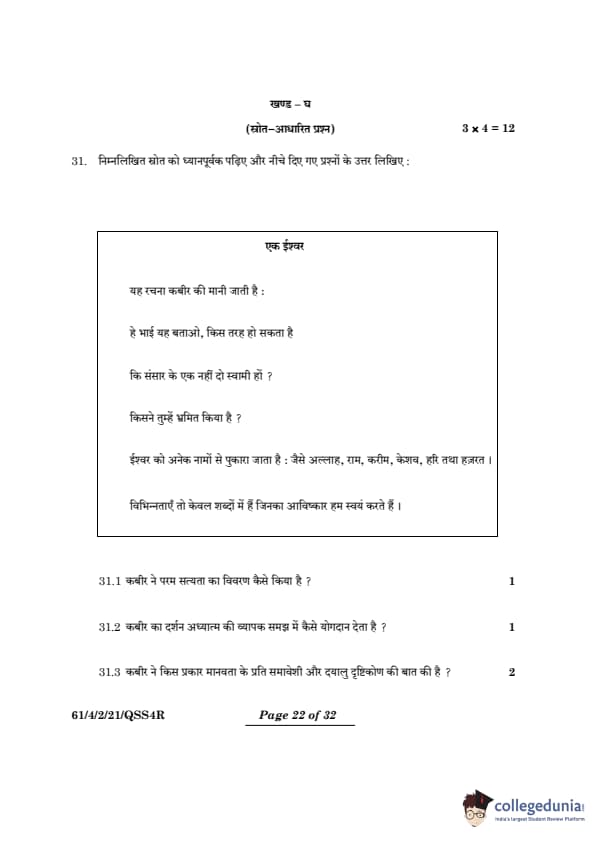
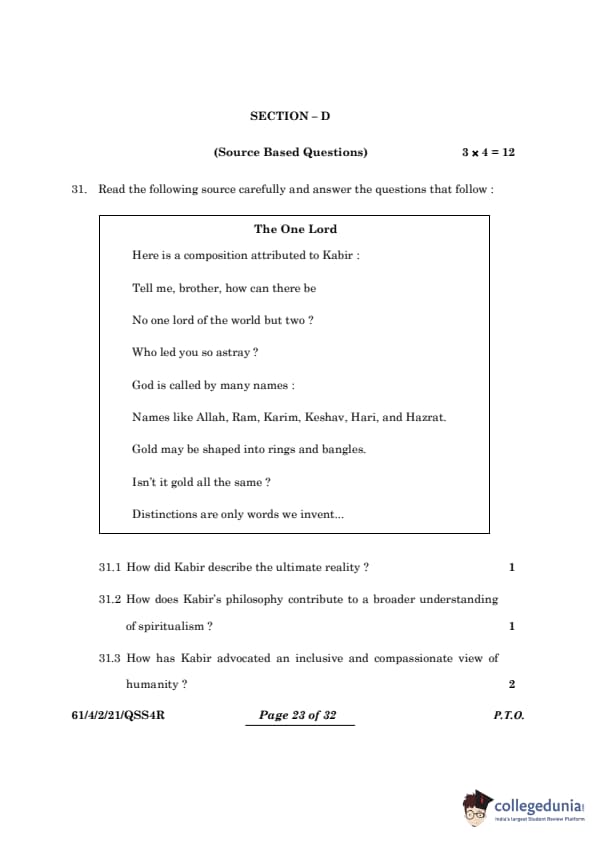
Question 31:
Read the following source carefully and answer the questions that follow :
The One Lord
Here is a composition attributed to Kabir:
Tell me, brother, how can there be
No one lord of the world but two?
Who led you so astray?
God was called by many names:
Names like Allah, Ram, Karim, Keshav, Hari, and Hazrat.
Gold may be shaped into rings and bangles.
Isn't it gold all the same?
Distinctions are only words we invent...
Question 31(a):
How did Kabir describe the ultimate reality?
View Solution
Solution: Kabir described the ultimate reality as singular, emphasizing that there is one and only one God, irrespective of the different names that people use for him. He believed that the creator is one, and cannot be split.
Question 31(b):
How does Kabir’s philosophy contribute to a broader understanding of spiritualism?
View Solution
Solution: Kabir’s philosophy contributes to a broader understanding of spiritualism by emphasizing that all religions are different paths to the same divine entity, regardless of the names or traditions they follow. His philosophy also highlights the artificial nature of distinctions in the human experience and promotes the idea that spiritualism should be about unity and not about division.
Question 31(c):
How has Kabir advocated an inclusive and compassionate view of humanity?
View Solution
Solution: Kabir advocated an inclusive and compassionate view of humanity by focusing on the oneness of God, and how different religions and traditions were merely different forms of the same entity. He also believed in the equality of all human beings, irrespective of their caste or religious affiliations. He preached a universal religion based on love and compassion, advocating for empathy and understanding towards all living beings, which transcends cultural or religious limitations.
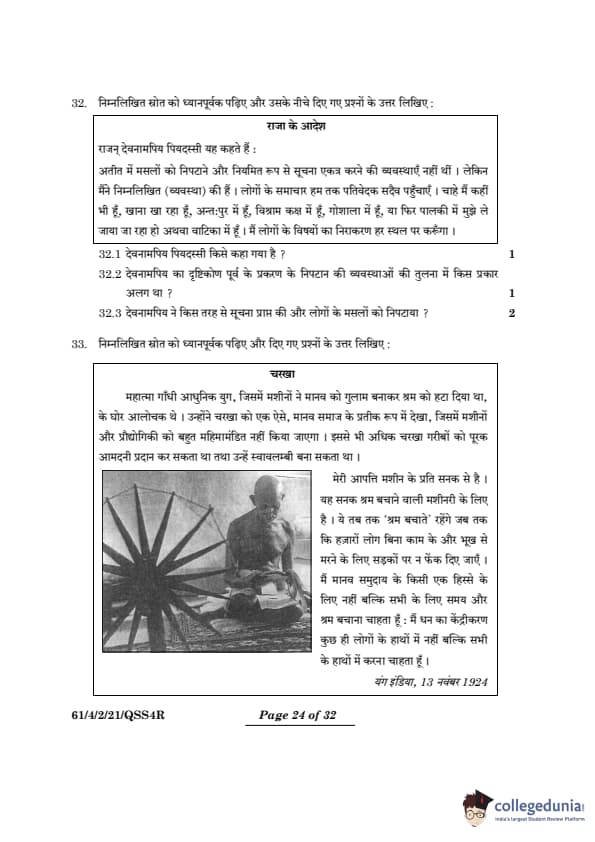
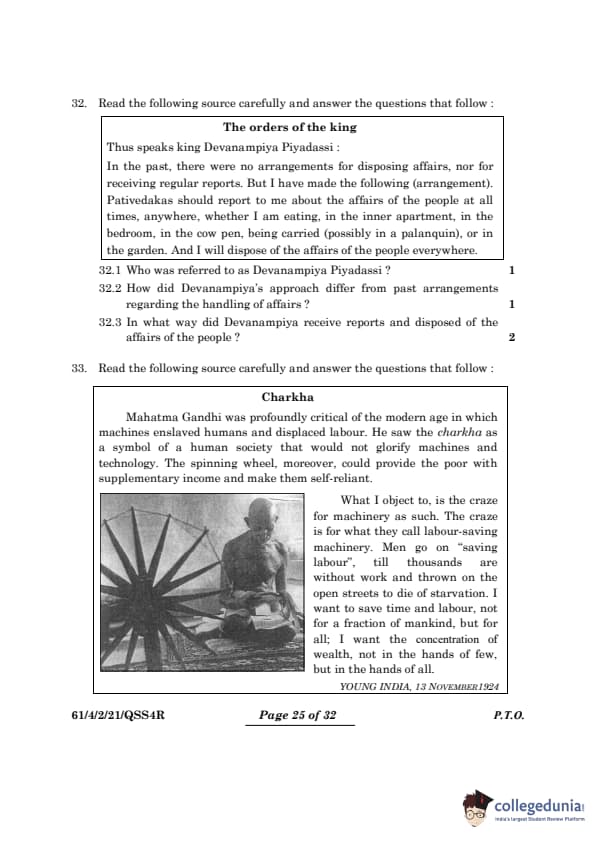
Question 32:
Read the following source carefully and answer the questions that follow:
The orders of the king
Thus speaks king Devanampiya Piyadassi : In the past, there were no arrangements for disposing affairs, nor for receiving regular reports. But I have made the following (arrangement). Pativedakas should report to me about the affairs of the people at all times, anywhere, whether I am eating, in the inner apartment, in the bedroom, in the cow pen, being carried (possibly in a palanquin), or in the garden. And I will dispose of the affairs of the people everywhere.
Question 32(a):
Who was referred to as Devanampiya Piyadassi?
View Solution
Solution: Devanampiya Piyadassi was a title used by King Ashoka, the Mauryan emperor, which also translates to 'Beloved of the Gods'.
Question 32(b):
How did Devanampiya’s approach differ from past arrangements regarding the handling of affairs?
View Solution
Solution: According to the source, earlier, there were no arrangements for disposing of affairs or for getting regular reports, which indicates that the administrative structure was relatively disorganized before Ashoka. Devanampiya created a new system of administration which was very different from earlier practices. According to him, all affairs would now be disposed of at all times. He also ensured that he would get regular reports from all parts of the kingdom.
Question 32(c):
In what way did Devanampiya receive reports and dispose of the affairs of the people?
View Solution
Solution: Devanampiya (Ashoka) implemented a system where “Pativedakas” were used to report to the king about the affairs of his people, highlighting the communication structure which was put in place. Ashoka, according to the source also made himself available for disposing of the affairs of the people at all times, whether during the day or the night, and at any place. This indicated a new way to make administration more efficient.
Question 33:
Read the following source carefully and answer the questions that follow:
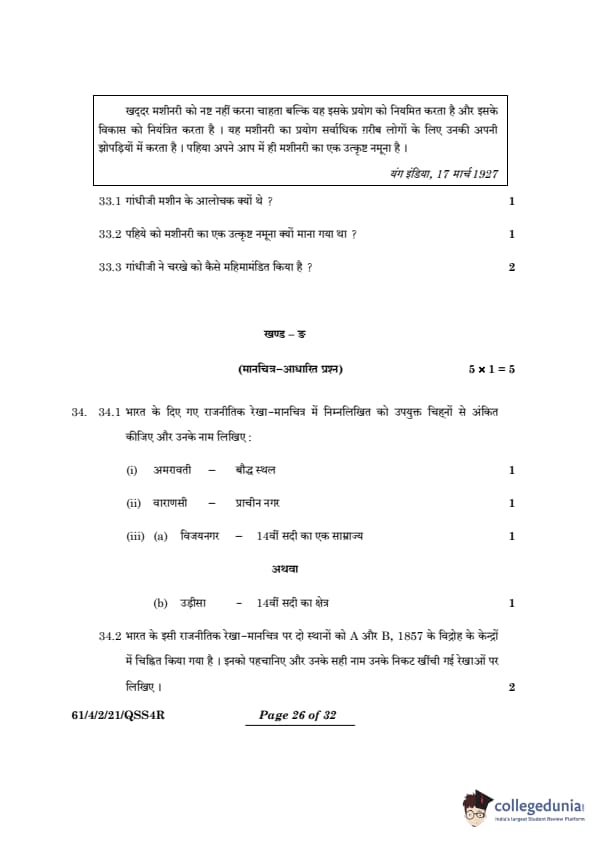
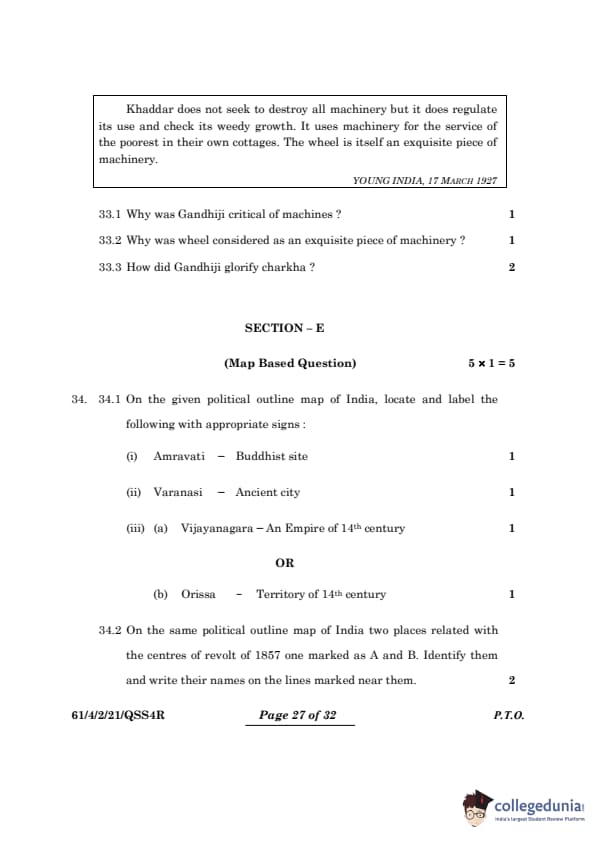
Charkha
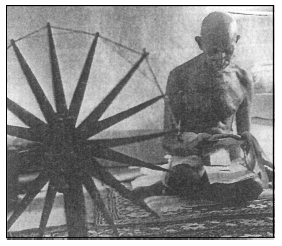
Mahatma Gandhi was profoundly critical of the modern age in which machines enslaved humans and displaced labour. He saw the charkha as a symbol of a human society that would not glorify machines and technology. The spinning wheel, moreover, could provide the poor with supplementary income and make them self-reliant.
What I object to, is the craze for machinery as such. The craze is for what they call labour-saving machinery. Men go on "saving labour", till thousands are without work and thrown on the open streets to die of starvation. I want to save time and labour, not for a fraction of mankind, but for all; I want the concentration of wealth, not in the hands of few, but in the hands of all. - YOUNG INDIA, 13 NOVEMBER 1924
Khaddar does not seek to destroy all machinery but it does regulate its use and check its weedy growth. It uses machinery for the service of the poorest in their own cottages. The wheel is itself an exquisite piece of machinery. - YOUNG INDIA, 17 MARCH 1927
Question 33(a):
Why was Gandhiji critical of machines?
View Solution
Solution: Gandhiji was very critical of machines because he believed they enslaved human beings by displacing human labour, and by reducing their need in production. He believed that they led to large-scale unemployment and social injustice.
Question 33(b):
Why was wheel considered as an exquisite piece of machinery?
View Solution
Solution: The wheel was considered an exquisite piece of machinery because it was seen as a symbol of a human society, as opposed to technology. According to Gandhiji, it also provided the poor with supplemental income. He thought that, unlike other technologies and heavy machinery, the charkha could be used for self-reliance by all, and also provided dignity of labour.
Question 33(c):
How did Gandhiji glorify charkha?
View Solution
Solution: Gandhiji glorified the use of the Charkha, which is a simple spinning wheel, as a means to promote self-reliance and decentralization, which he considered the basis of the Indian economy. He also regarded it as a fundamental prerequisite of Swaraj (self-rule). He appealed to the people to boycott English products and urged them to use indigenous goods and crafts. Through the use of Charkha, Gandhi also promoted cottage industries and small-scale production. The spinning wheel also helped in the creation of employment.
Section E
Map-Based Question
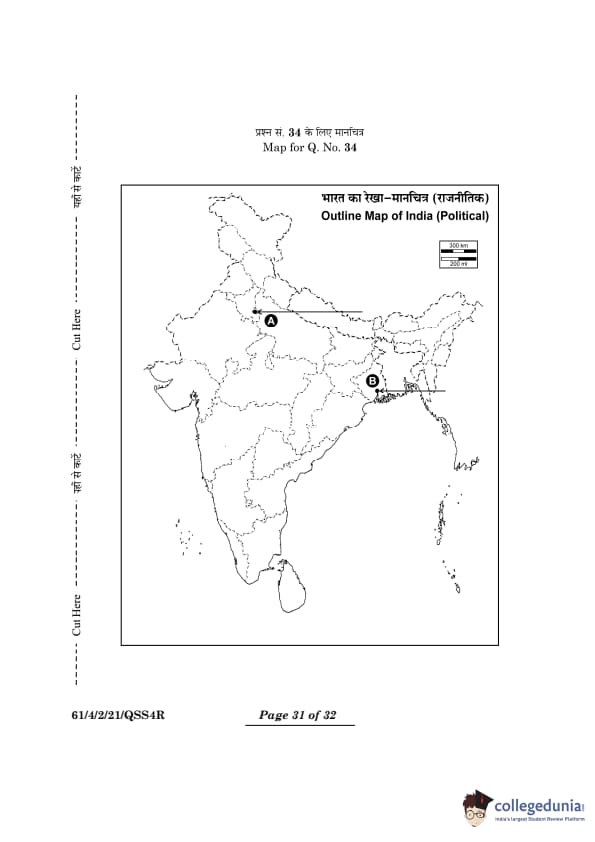
Question 34 (Map-Based Question):
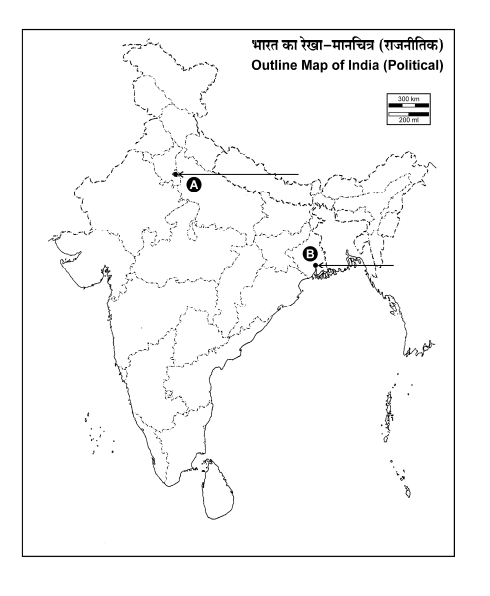
Question 34(a):
On the given political outline map of India, locate and label the following with appropriate signs:
(i) Amravati – Buddhist site
(ii) Varanasi – Ancient city
(iii) (a) Vijayanagara – An Empire of 14th century
OR
(b) Orissa – Territory of 14th century
View Solution
Solution:
(i) Amravati - Buddhist Site: Amravati is located in present-day Andhra Pradesh, and the stupa here is one of the most famous Buddhist sites in the southern region of India. You should mark it towards the south-eastern part of India in Andhra Pradesh.
(ii) Varanasi - Ancient City: Varanasi, also known as Banaras, is located in Uttar Pradesh. It is one of the oldest living cities in the world and an important center of religion and culture. You should label it in the central part of Uttar Pradesh.
(iii) (a) Vijayanagara – An Empire of 14th Century: Vijayanagara is located in Karnataka, present-day Hampi, which was the capital of the Vijayanagara Empire. The empire is famous for its architecture and political might. Mark the location in south-central portion of the Indian peninsula, towards Karnataka.
OR
(iii) (b) Orissa - Territory of 14th Century: The region of Orissa was an important territory during the 14th century, and should be labeled in the eastern part of India, in the coastal region.
Question 34(b):
On the same political outline map of India two places related with the centres of revolt of 1857 one marked as A and B. Identify them and write their names on the lines marked near them.
(A) Delhi
(B) Calcutta
View Solution
Solution:
(A) Delhi: Delhi was one of the major centers of the Revolt of 1857. The city had a crucial symbolic and political significance for the rebels. The location marked A should be labeled as Delhi.
(B) Calcutta: Calcutta was another important center in the revolt of 1857. It was a key administrative center of the British and has a significant place in their colonial rule. You should label the location marked B as Calcutta.
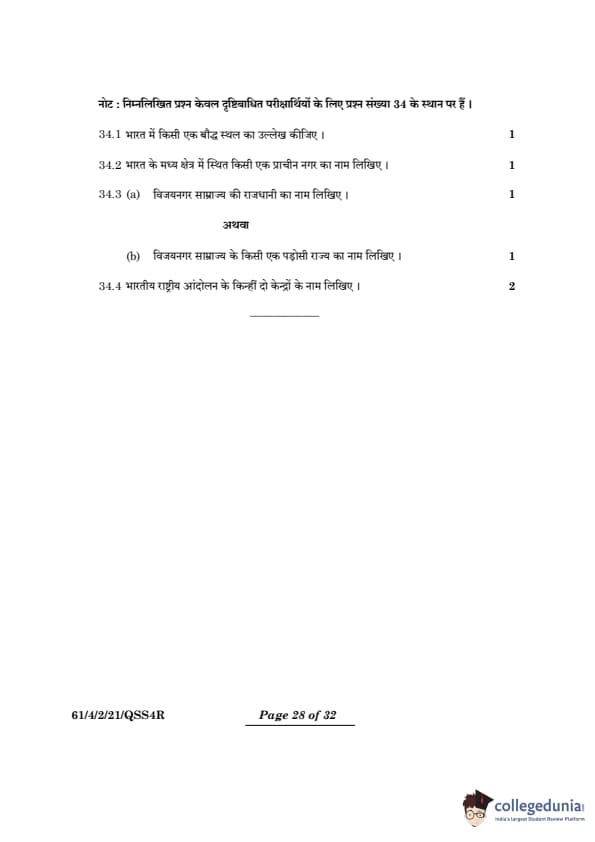
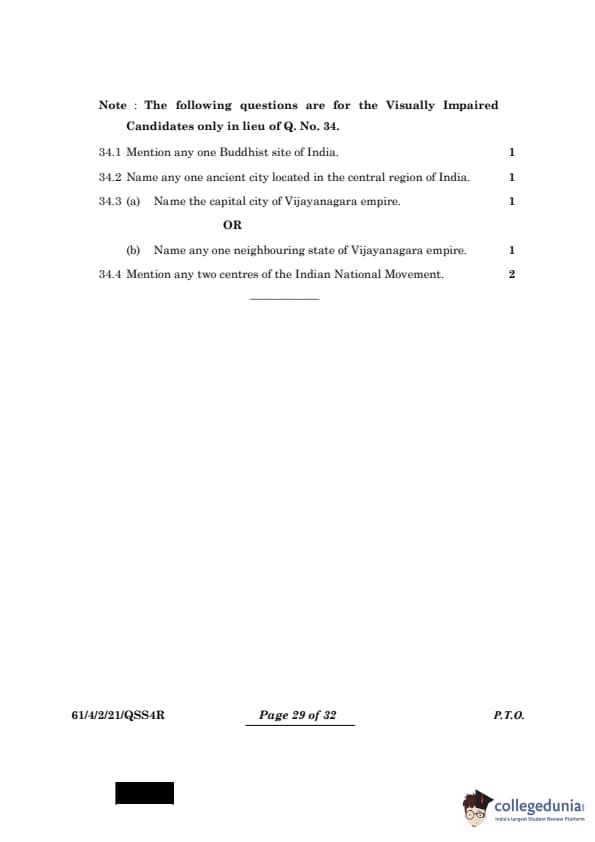
Question 34.1 (For Visually Impaired Candidates Only):
Mention any one Buddhist site of India.
View Solution
Solution: Any of the major Buddhist sites can be mentioned like Nagarjunakonda, Sanchi, Amaravati, Lumbini, Bharhut, Bodh Gaya, Sarnath, Ajanta, Kushinagar etc.
Question 34.2 (For Visually Impaired Candidates Only):
Name any one ancient city located in the central region of India.
View Solution
Solution: Any ancient city in the central region of India can be mentioned like Patliputra, Kosala, Kannauj, Mathura, Avanti, Rajgir, Ujjain, Vidisha or Varanasi etc.
Question 34.3(a) (For Visually Impaired Candidates Only):
Name the capital city of Vijayanagara empire.
View Solution
Solution: Vijayanagara or Hampi was the capital city of the Vijayanagara empire.
Question 34.3(b) (For Visually Impaired Candidates Only):
Name any one neighboring state of Vijayanagara empire.
View Solution
Solution: Any one neighboring state of the Vijayanagara Empire can be mentioned, such as Bidar, Golconda, Berar, Bijapur, Kanchipuram, Ahmednagar, or Mysore.
Question 34.4 (For Visually Impaired Candidates Only):
Mention any two centres of the Indian National Movement.
View Solution
Solution: Any two major centers of the Indian National Movement can be mentioned like Champaran, Kheda, Ahmedabad, Benaras, Amritsar, Chauri Chaura, Lahore, Bardoli, Dandi, Bombay, Karachi etc.





Comments