




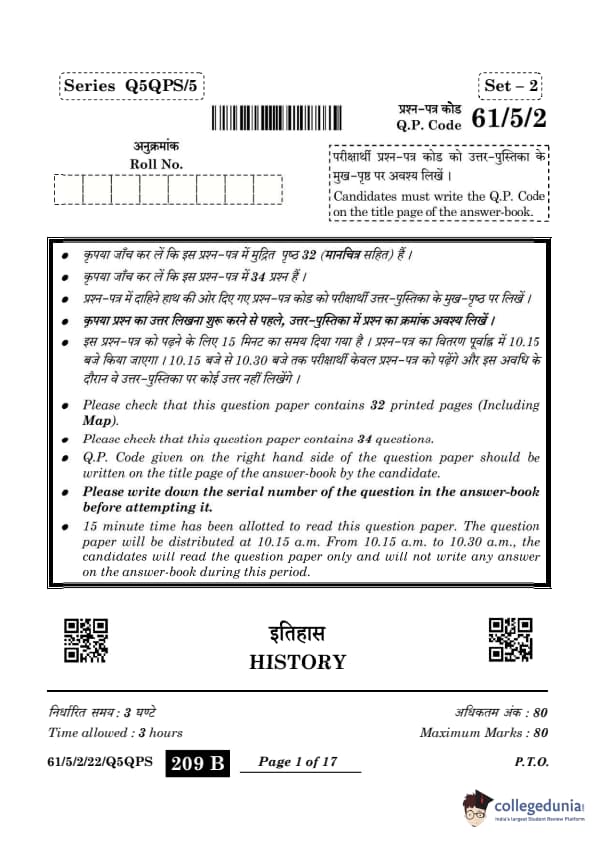
CBSE Class 12 History Set 2 Question Paper PDF (Code: 61/5/2) is now available for download. CBSE conducted the Class 12 History examination on March 28, 2024, from 10:30 AM to 1:30 PM. The question paper consists of 34 questions carrying a total of 80 marks. Section A includes 21 MCQs for 1 mark each, Section B contains 6 short-answer questions for 3 marks each, Section C comprises 3 long-answer questions for 8 marks each, Section D comprises 3 Source-based questions having three sub-questions carries 4 marks each and Section E comprises 1 Map-based question that carries 5 marks.
Candidates can use the link below to download the CBSE Class 12 History Set 2 Question Paper with detailed solutions.
CBSE Class 12 History Question Paper 2024 (Set 2- 61/5/2) with Answer Key
| CBSE Class 12 2024 History Question Paper with Answer Key |  Download Download |
Check Solution |
CBSE Class 12 2024 History Questions with Solutions
SECTION A
(Multiple Choice Type Questions)
Question 1:
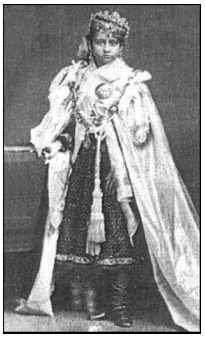
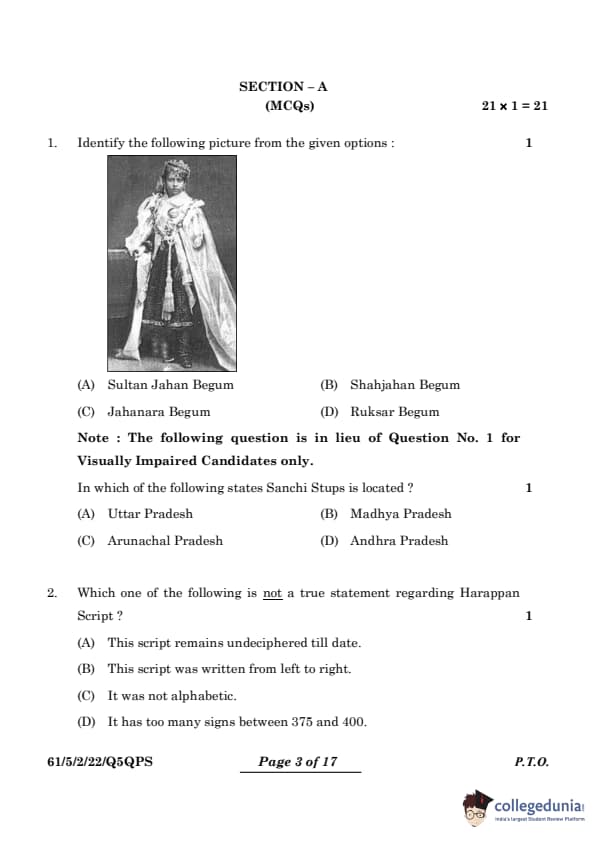
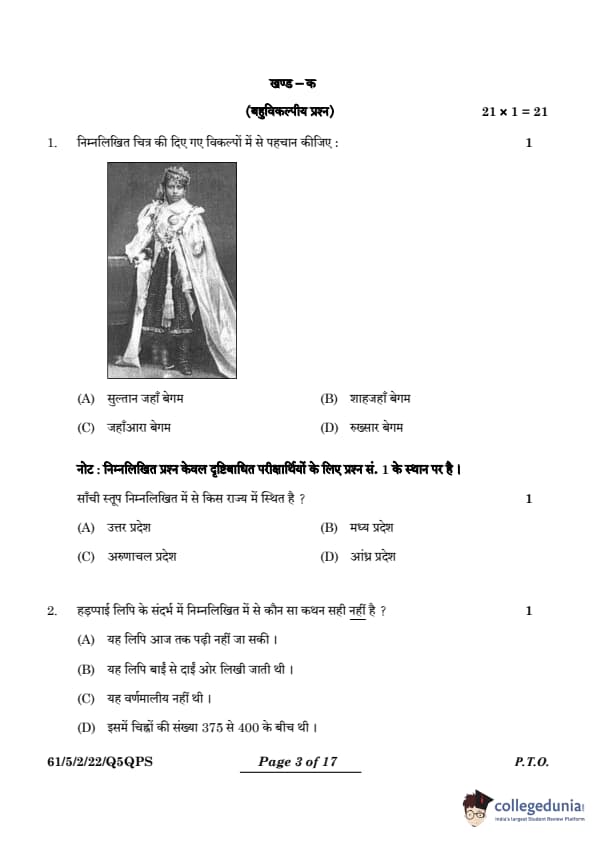
Identify the following picture from the given options:
View Solution
Solution:
(B) Shahjahan Begum: The image shows Shahjahan Begum, who was the Begum of Bhopal, India. She was known for her contribution towards the preservation of Sanchi Stupa. She is also known for her administrative abilities and social reform activities.
(A) Sultan Jahan Begum: Sultan Jahan Begum was also the Begum of Bhopal and the successor of Shahjahan Begum. She continued the work of her mother in the preservation of Sanchi Stupa.
(C) Jahanara Begum: Jahanara Begum was the daughter of Mughal emperor Shah Jahan, and she was an important political figure in the court, but this image does not portray her.
(D) Ruksar Begum: Ruksar Begum is not related to this image, and no information regarding her can be found in the given context.
Question 1 (Visually Impaired Candidates Only):
In which of the following states is Sanchi Stupa located?
View Solution
Solution: The Sanchi Stupa, a significant Buddhist monument, is located in Madhya Pradesh. It is a UNESCO world heritage site and a famous tourist destination.
Question 2:
Which one of the following is not a true statement regarding Harappan Script?
View Solution
Solution:
(A) This script remains undeciphered till date: This is a true statement as the Harappan script has not yet been fully deciphered. This makes it difficult to know what it meant.
(B) This script was written from left to right: This is the incorrect statement. The Harappan script was written from right to left as well as some instances of bidirectional scripts can be found.
(C) It was not alphabetic: This is also a correct statement as Harappan script was logo-syllabic in nature, which means that they had a combination of signs and syllabic characters. This also means it wasn't an alphabet.
(D) It has too many signs between 375 and 400: This is also a true statement as there are several hundred signs found in the Harappan script, making it difficult to interpret.
Question 3:
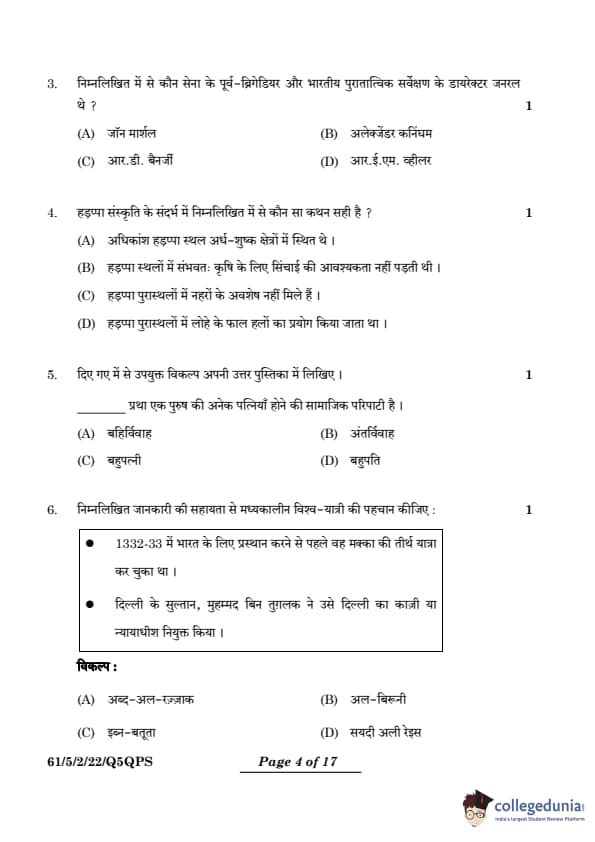
Who among the following was an ex-army official and worked as Director General of Archaeological Survey of India (ASI)?
View Solution
Solution:
John Marshall: John Marshall, although a Director-General of the ASI, was not an ex-army official. He was an archaeologist.
Alexander Cunningham: Alexander Cunningham also served as Director-General of the ASI.
R.D. Bannerjee: Rakhaldas Bandyopadhyay (R.D. Bannerjee), was a prominent Indian archaeologist who worked for the ASI.
R.E.M. Wheeler: Sir Robert Eric Mortimer Wheeler was a British archaeologist and officer in the British Army. He served as Director-General of the ASI. His military background and archaeological work make him the correct answer.
Question 4:
Which one of the following is the correct statement regarding Harappan Culture?
View Solution
Solution:
(A) Most of the Harappan sites were located in semi-arid lands: This is the correct statement. The Harappan civilization flourished in the semi-arid regions of the Indus River Valley, where agriculture relied on effective water management techniques.
(B) Irrigation was probably not required for agriculture at the Harappan sites: This is incorrect. Due to the semi-arid climate, the Harappans relied heavily on various forms of irrigation to sustain agriculture, including canals, wells and reservoirs.
(C) No trace of canals have been found at the Harappan sites: This is also incorrect. Traces of canals have been found at sites like Shortughai in Afghanistan, and also at some other sites, and it indicates the existence of sophisticated water management system for cultivation.
(D) The Iron tipped Ploughshare was used at the Harappan sites: This statement is incorrect because Iron technology was not known to the Harappans. They primarily used stone and bronze tools for cultivation.
Question 5:
Write the appropriate option from the given in four answer sheet.
The practice of _____________ means a man having several wives.
View Solution
Solution:
(C) Polygyny: Polygyny refers to the practice of a man having more than one wife. This practice is often related with social and economic status and hierarchies of ancient society.
(A) Exogamy: Exogamy refers to the practice of marrying outside a particular social group.
(B) Endogamy: Endogamy refers to the practice of marrying within a particular social group.
(D) Polyandry: Polyandry refers to the practice of a woman having more than one husband.
Question 6:
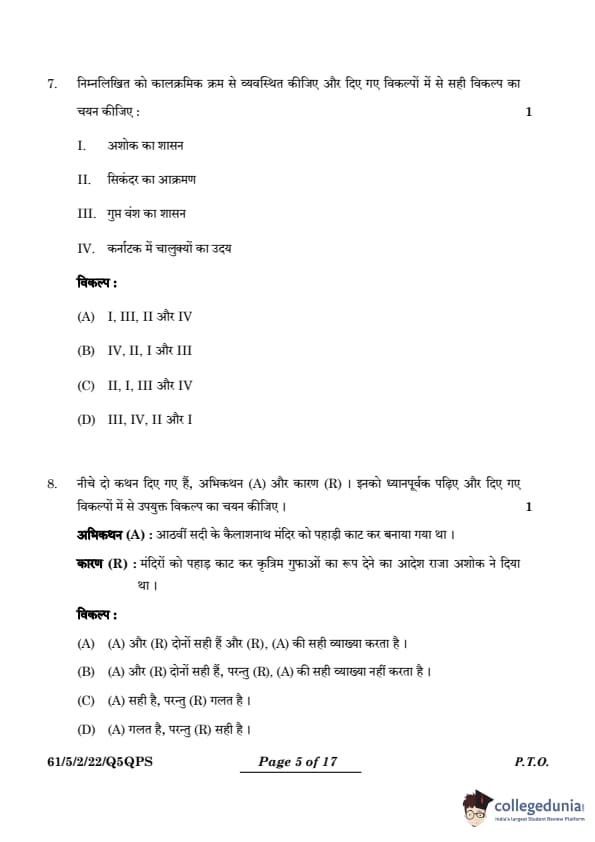
Identify the medieval globe-trotter with the help of the following information:
• Before he set-off for India he made pilgrimage trips to Mecca before 1332-33 C.E.
• The Delhi Sultan Muhammad Bin Tughlaq made him Qazi or the judge of Delhi.
View Solution
Solution:
(C) Ibn Batuta: Ibn Battuta was a Moroccan traveler and scholar who visited India in the 14th century. He had made several pilgrimage trips to Mecca before coming to India. He served as the Qazi of Delhi during the rule of Muhammad Bin Tughlaq.
(A) Abd-al-Razzak: Abd-al-Razzaq was a Timurid envoy and traveler who visited the Vijayanagara Empire in the 15th century. His work is a major source to understand the history of the Vijayanagara Empire.
(B) Al-Biruni: Al-Biruni was an 11th-century scholar who came to India along with Mahmud of Ghazni. His book ‘Kitab-ul-Hind' is a detailed description of Indian society, culture, and religion.
(D) Seydi Ali Reis: Seydi Ali Reis was an Ottoman admiral and cartographer who travelled across various regions of India and his books provide valuable information about his experiences.
Question 7:
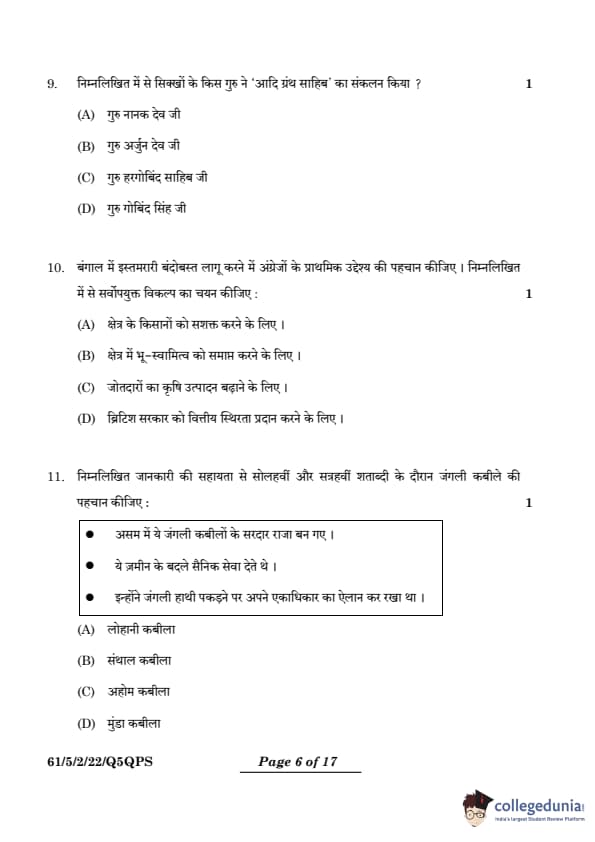
Arrange the following in chronological order and choose the correct option from the following:
I. Rule of Ashoka
II. Invasion of Alexander
III. Rule of Gupta dynasty
IV. Rise of Chalukyas in Karnataka
View Solution
Solution:
II. Invasion of Alexander: The invasion of Alexander took place in the 4th century BCE (326 BCE) and is the earliest event among these options.
I. Rule of Ashoka: Ashoka's rule was during the Mauryan empire, which took place after the invasion of Alexander. Therefore, it comes after the invasion of Alexander.
III. Rule of Gupta dynasty: The Gupta Empire flourished during the 4th-6th centuries CE. This means that the Gupta rule took place after the rule of the Mauryas.
IV. Rise of Chalukyas in Karnataka: The Chalukyas rose to power during the 6th century CE in Karnataka, which makes them the last in the order.
Question 8:
Given below are two statements marked as Assertion (A) and Reason (R). Read them carefully and choose the correct option from the given options.
Assertion (A): In the Eighth Century, the Kailashnath Temple was carved out of mountain.
Reason (R): King Ashoka had given the directive to create artificial caves by cutting into the mountains to resemble temples.
View Solution
Solution:
Step 1: Determine the truth of Assertion (A): The Kailasa or Kailasanatha temple at Ellora in Maharashtra, India, is a remarkable monolithic rock-cut temple dating back to the 8th century during the Rashtrakuta dynasty. Thus, Assertion (A) is true.
Step 2: Evaluate the truth of Reason (R): Emperor Ashoka (3rd century BCE) played an important role in the creation of artificial caves. However, these were for the Ajivikas and Buddhists, and these cave temples were typically simple shelters for monks to reside. The cave temples of Ashoka were not the same as temples with elaborate carvings.
Step 3: Determine if Reason explains Assertion: Ashoka's cave building activities were not related to the Kailashnath Temple and were not a reason for building the temple. They were built many centuries apart for different purposes. Therefore Reason (R) is not the correct explanation for Assertion (A), but both the statements are individually true.
Question 9:
Who among the following Sikh Gurus compiled ‘Adi Granth Sahib’?
View Solution
Solution:
(B) Guru Arjun Dev ji: Guru Arjun Dev ji, the fifth Sikh Guru, compiled the Adi Granth Sahib, which is now known as the Guru Granth Sahib. This text is the central religious text of Sikhism.
(A) Guru Nanak Dev ji: Guru Nanak Dev Ji was the first Sikh Guru and the founder of Sikhism. While his teachings formed the basis of the Adi Granth, he did not compile it.
(C) Guru Hargobind Sahib ji: Guru Hargobind Sahib ji, the sixth Sikh Guru, was a great warrior who is known for his involvement in militarising the Sikh community and not the compilation of Adi Granth.
(D) Guru Gobind Singh ji: Guru Gobind Singh ji, the tenth Sikh Guru, completed the text of the Guru Granth Sahib. He did not compile the initial text of the Adi Granth.
Question 10:
Identify the primary purpose of Britishers to implement Permanent Settlement in Bengal. Choose the best suitable option from the following:
View Solution
Solution:
(D) To provide financial stability to the British govt.: The primary aim of the Permanent Settlement was to provide a steady and predictable source of revenue for the British government, by fixing the land revenue demand.
(A) To empower peasants of the region: This was definitely not the purpose of the system, as the system ended up disempowering them, and many of them became tenants and agricultural labourers.
(B) To abolish land ownership in the region: The system did not abolish land ownership, rather it gave ownership to the zamindars, who were also responsible for collecting tax from the peasants.
(C) To increase agricultural productivity of Jotedars: While the British hoped that the zamindars would improve cultivation practices, this was not the core intention, as it mainly focused on fixing the revenue demands.
Question 11:
Identify the forest tribe during sixteenth and seventeenth century with the help of following information:
- In Assam these Tribal Chiefs became kings.
- They rendered military service in exchange of land.
- They declared their monopoly on catching wild elephants.
View Solution
Solution:
(C) Ahom tribe: The Ahom tribe was located in Assam during the 16th and 17th centuries. Their chiefs became kings, and they had a unique system where tribal chiefs provided military service in exchange for land, and also had monopoly over catching wild elephants, which shows their control over the region and its resources.
(A) Lohani tribe: Lohanis were primarily involved in trade and were not known for becoming kings in the Assam region.
(B) Santhal tribe: The Santhals were mainly concentrated in Bengal and Bihar and are known for their rebellion against the British. They were not linked to the Assam region.
(D) Munda tribe: The Mundas were a tribal community in the Chotanagpur region (Jharkhand) and they also had conflicts with the British during the colonial period.
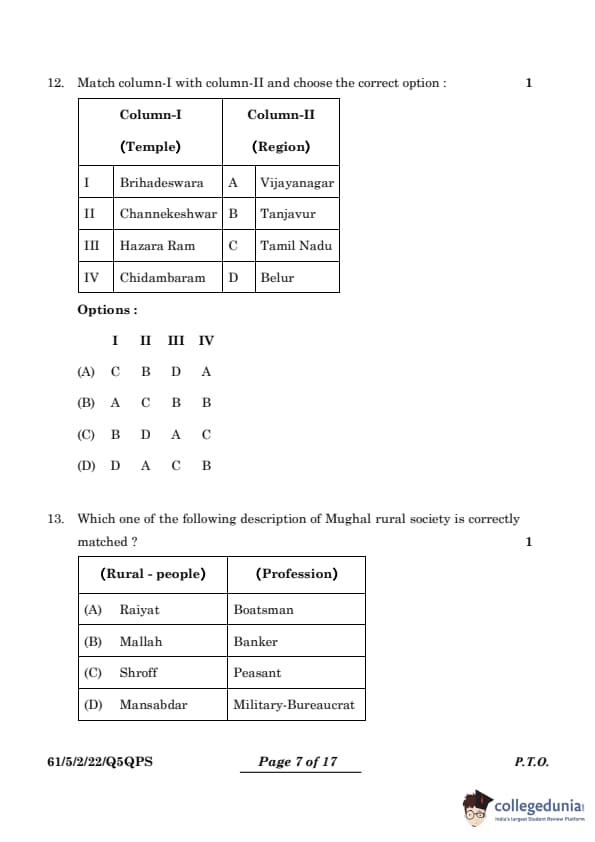
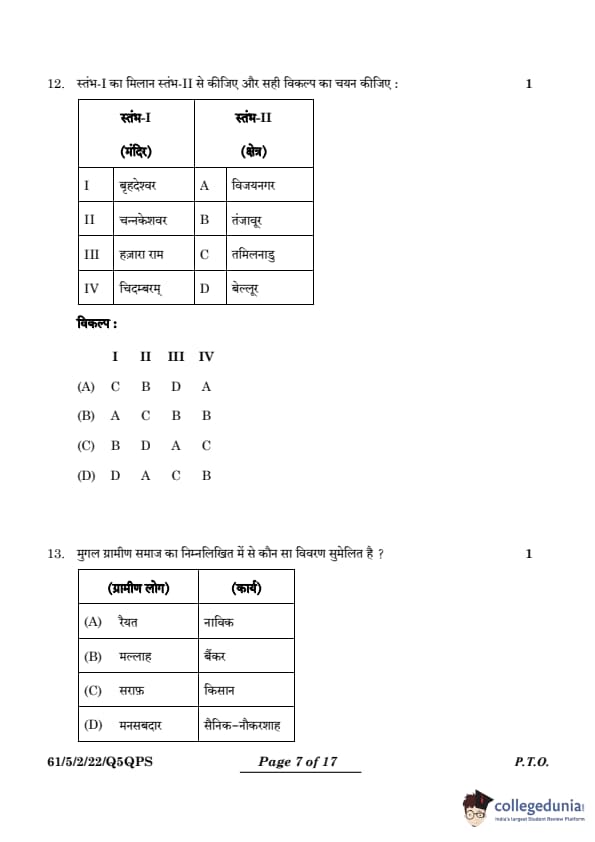
Question 12:
Match column-I with column-II and choose the correct option:
| Column-I (Temple) | Column-II (Region) |
|---|---|
| I Brihadeswara | A Vijayanagar |
| II Channekeshwar | B Tanjavur |
| III Hazara Ram | C Tamil Nadu |
| IV Chidambaram | D Belur |
View Solution
Solution:
I. Brihadeswara - B. Tanjavur: The Brihadeeswarar Temple, also known as the Thanjavur Temple, is a Hindu temple located in Thanjavur, Tamil Nadu, and it was built by the Cholas.
II. Chennakeshava - D. Belur: The Chennakeshava Temple is located in Belur, Karnataka, and is a prominent example of Hoysala architecture.
III. Hazara Ram - A. Vijayanagar: The Hazara Rama Temple is located in Hampi, which was the capital of the Vijayanagara Empire, making Vijayanagar the correct option.
IV. Chidambaram - C. Tamil Nadu: The Chidambaram Temple, also known as the Thillai Nataraja Temple, is located in Chidambaram, Tamil Nadu, and is dedicated to Lord Nataraja.
Question 13:
Which one of the following descriptions of Mughal rural society is correctly matched?
| (Rural - people) | (Profession) |
|---|---|
| (A) Raiyat | Boatsman |
| (B) Mallah | Banker |
| (C) Shroff | Peasant |
| (D) Mansabdar | Military-Bureaucrat |
View Solution
Solution:
(D) Mansabdar - Military-Bureaucrat: Mansabdars were the officials of the Mughal state who served both in the military as well as in the administrative hierarchy of the state, hence this is correctly matched.
(A) Raiyat - Boatsman: Raiyat was a term for peasants or cultivators in the Mughal Empire, not for boatsmen.
(B) Mallah - Banker: Mallah is the word for a boatman or sailor, not a banker.
(C) Shroff - Peasant: Shroff was a moneylender or a banker, and not a peasant.
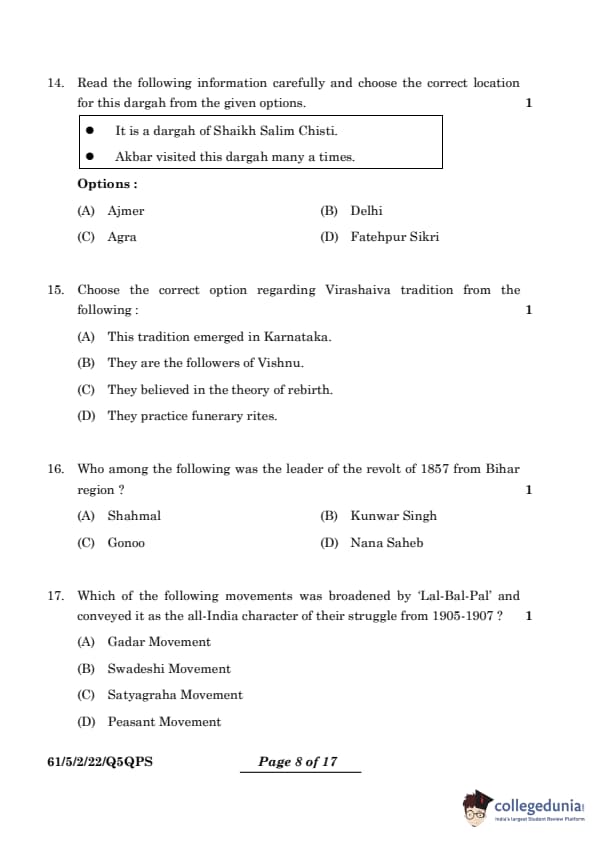
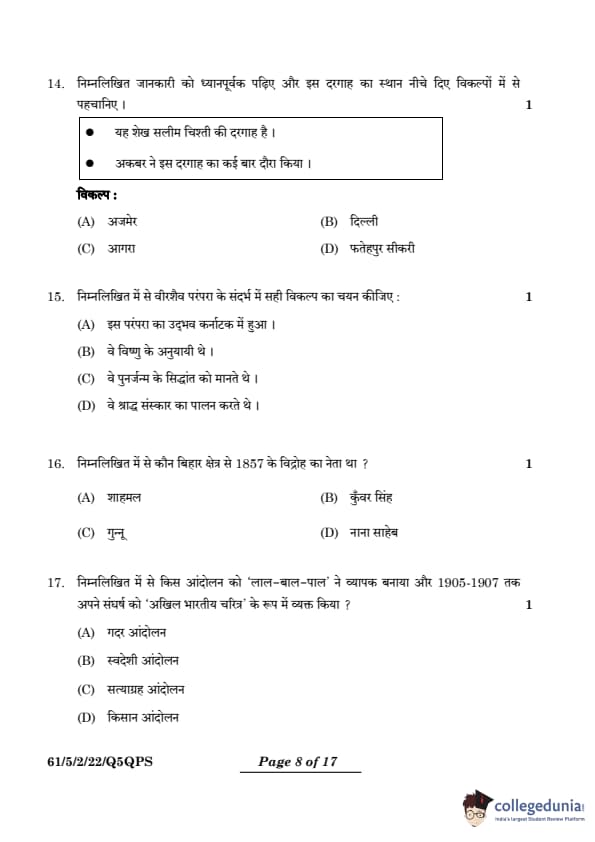
Question 14:
Read the following information carefully and choose the correct location for this dargah from the given options.
- It is a dargah of Shaikh Salim Chisti.
- Akbar visited this dargah many a times.
View Solution
Solution:
(D) Fatehpur Sikri: The dargah of Shaikh Salim Chisti is located in Fatehpur Sikri, near Agra. Akbar visited this dargah many times, and built his capital there in honor of the Sufi saint, reflecting his devotion towards him.
(A) Ajmer: Ajmer is associated with the dargah of Khwaja Moinuddin Chishti, not Shaikh Salim Chisti.
(B) Delhi: Delhi is associated with the dargah of Nizamuddin Auliya, and not Sheikh Salim Chisti.
(C) Agra: While Fatehpur Sikri is near Agra, it is located outside the main city.
Question 15:
Choose the correct option regarding Virashaiva tradition from the following:
View Solution
Solution:
(A) This tradition emerged in Karnataka: This is the correct statement. The Virashaiva tradition, also known as Lingayatism, originated in Karnataka in the 12th century.
(B) They are the followers of Vishnu: This is incorrect. Virashaivas are devotees of Shiva, not Vishnu.
(C) They believed in the theory of rebirth: This statement is incorrect. Virashaivas believe in attaining “moksha”, which is not associated with rebirth, but rather with breaking free from the cycles of birth and death.
(D) They practice funerary rites: This is incorrect. They bury their dead rather than perform the traditional Hindu funerary rites like cremation.
Question 16:
Who among the following was the leader of the revolt of 1857 from Bihar region?
View Solution
Solution:
(B) Kunwar Singh: Kunwar Singh was an important leader of the revolt of 1857 in Bihar, especially in and around the Arrah region. He was a zamindar of Jagdishpur.
(A) Shahmal: Shah Mal was a local leader of the revolt in Baraut, Uttar Pradesh, and not Bihar.
(C) Gonoo: Gonoo was a tribal leader from the Singhbhum area of Jharkhand, and he too was a part of the revolt.
(D) Nana Saheb: Nana Saheb was a prominent leader of the revolt of 1857 from Kanpur, Uttar Pradesh, and he had a major role in the battles of that region.
Question 17:
Which of the following movements was broadened by ‘Lal-Bal-Pal’ and conveyed it as the all-India character of their struggle from 1905-1907?
View Solution
Solution:
(B) Swadeshi Movement: The Swadeshi movement was broadened by leaders like Bal Gangadhar Tilak, Bipin Chandra Pal, and Lala Lajpat Rai, who emphasized the all-India character of the movement. They popularized the use of swadeshi goods and encouraged the boycott of foreign goods, making it a national movement.
(A) Gadar Movement: The Gadar movement was a revolutionary movement based in North America which focused on overthrowing British rule. It was not led by Lal, Bal, and Pal.
(C) Satyagraha Movement: Satyagraha was a form of non-violent resistance started by Gandhiji. It started much later than the Swadeshi movement.
(D) Peasant Movement: While peasant movements were also significant, they were not specifically broadened by Lal-Bal-Pal and were also mostly regional in their reach.
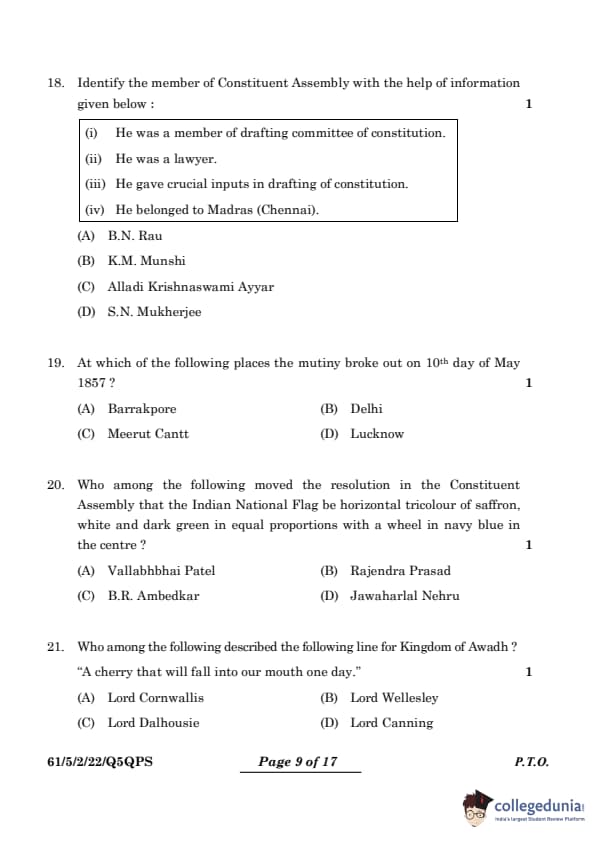
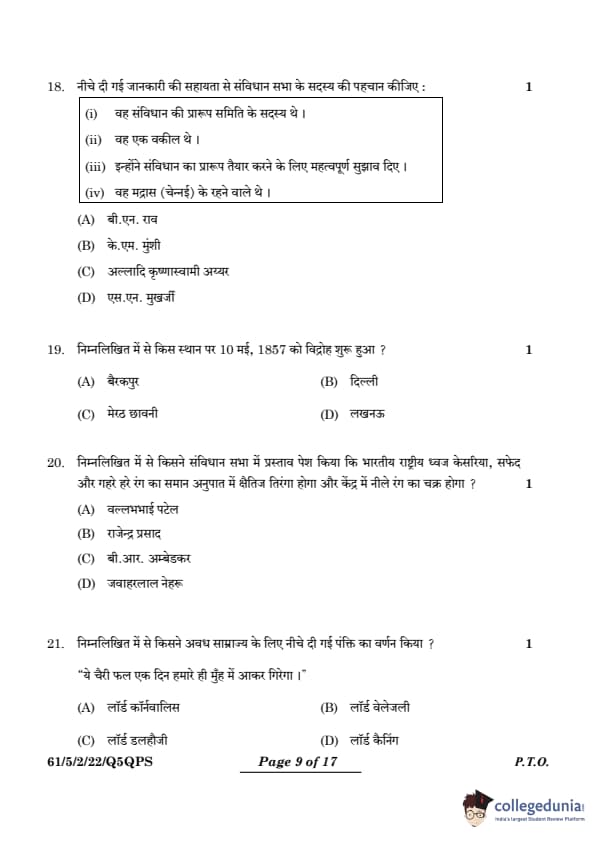
Question 18:
Identify the member of Constituent Assembly with the help of information given below:
(i) He was a member of drafting committee of constitution.
(ii) He was a lawyer.
(iii) He gave crucial inputs in drafting of constitution.
(iv) He belonged to Madras (Chennai).
View Solution
Solution:
(C) Alladi Krishnaswami Ayyar: Alladi Krishnaswami Ayyar was a prominent lawyer and jurist from Madras. He was a key member of the Drafting Committee of the Constituent Assembly.
(A) B.N. Rau: B.N. Rau was a legal advisor and drafted the initial constitution draft. He was also a judge of the Permanent Court of International Justice, but he was not a member of the drafting committee.
(B) K.M. Munshi: K.M. Munshi was also a member of the drafting committee of the constitution and had played a significant role, but he was not from Madras.
(D) S.N. Mukherjee: S.N. Mukherjee was a prominent lawyer and also the chief draftsman of the constituent assembly, but he was not part of the drafting committee.
Question 19:
At which of the following places did the mutiny break out on 10th day of May 1857?
View Solution
Solution:
(C) Meerut Cantt: The mutiny of 1857 broke out on May 10, 1857, in Meerut Cantt. The revolt began with the sepoys revolting against the use of controversial cartridges.
(A) Barrackpore: While Barrackpore was also an important site for army cantonment and had initial incidents of revolt, the major revolt of 1857 began in Meerut.
(B) Delhi: The revolt spread to Delhi after Meerut, and it became a key center of the rebellion, but it did not start from Delhi.
(D) Lucknow: Lucknow was an important region during the revolt and saw major battles, but the revolt did not begin there.
Question 20:
Who among the following moved the resolution in the Constituent Assembly that the Indian National Flag be horizontal tricolour of saffron, white and dark green in equal proportions with a wheel in navy blue in the centre?
View Solution
Solution:
(D) Jawaharlal Nehru: Jawaharlal Nehru was the one who moved the resolution in the Constituent Assembly to adopt the Indian National Flag in its present design.
(A) Vallabhbhai Patel: Vallabhbhai Patel was an important figure in the Congress party, but was not involved in proposing the resolution regarding the flag.
(B) Rajendra Prasad: Rajendra Prasad was the first president of India, but he didn't introduce the resolution regarding the flag.
(C) B.R. Ambedkar: B.R. Ambedkar was the chairman of the Drafting Committee of the Indian Constitution, and was responsible for the constitution's various drafts. However, he was not associated with the resolution of flag.
Question 21:
Who among the following described the following line for Kingdom of Awadh? “A cherry that will fall into our mouth one day.”
View Solution
Solution:
(C) Lord Dalhousie: Lord Dalhousie was the Governor-General of India, who is known for his policy of annexation. He described the kingdom of Awadh using the phrase “a cherry that will fall into our mouth one day,” which reflects the British desire to annex the region.
(A) Lord Cornwallis: Lord Cornwallis is mainly associated with the introduction of the Permanent Settlement, and was the Governor General who was in charge of the British operations before Dalhousie.
(B) Lord Wellesley: Lord Wellesley was the Governor-General who introduced the Subsidiary Alliance system in India.
(D) Lord Canning: Lord Canning was the Governor-General during the 1857 revolt and was also the first viceroy of India.
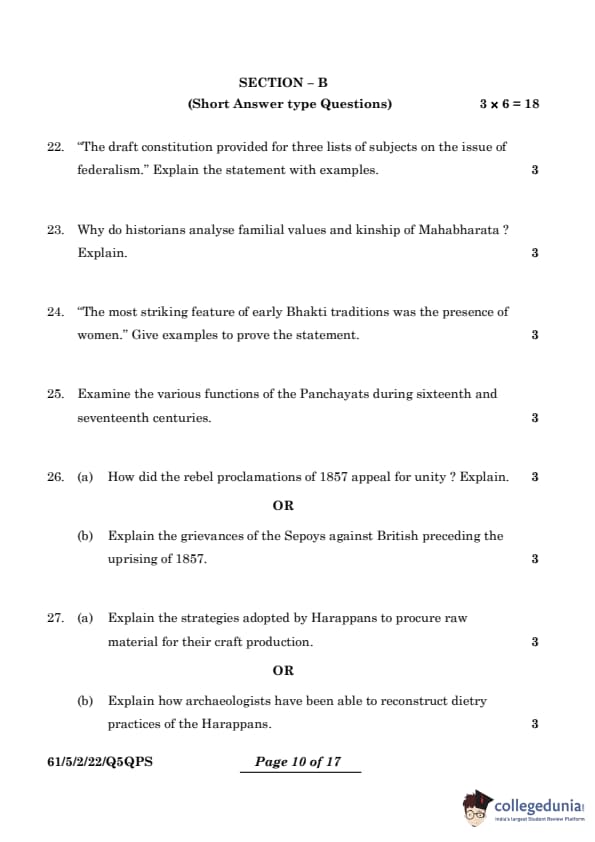
SECTION – B
(Short Answer type Questions)
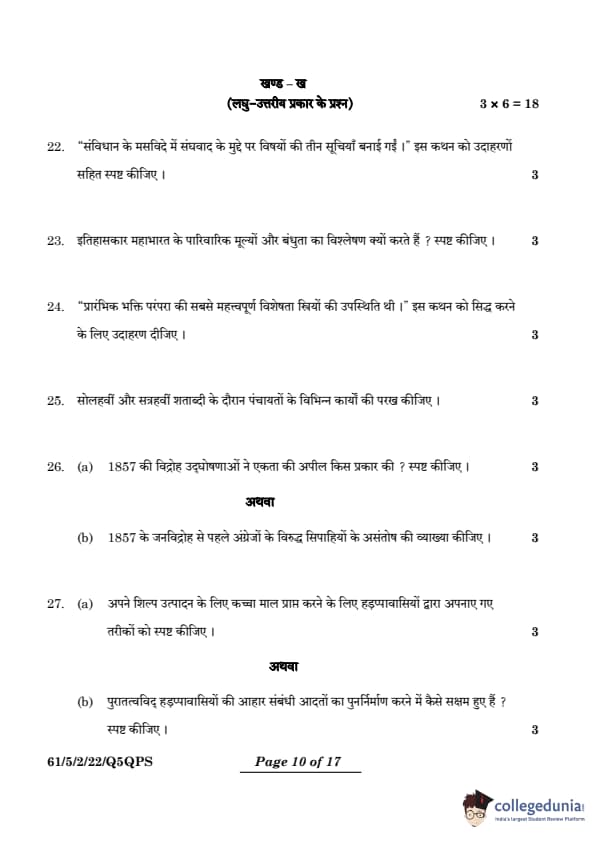
Question 22:
“The draft constitution provided for three lists of subjects on the issue of federalism.” Explain the statement with examples.
View Solution
Solution:
Three Lists of Subjects: The draft constitution of India provided for three lists of subjects to deal with the issue of federalism, with three different lists, namely the Union List, the State List, and the Concurrent List, which aimed to create a balance of power between the centre and the state governments.
Union List: The Union List contains subjects under the exclusive control of the central government. This includes defense, foreign affairs, currency, and other matters of national importance.
State List: The State List contains subjects under the exclusive control of the state governments. These included areas like public health, police, and agriculture, which were considered to be of state concern.
Concurrent List: The Concurrent List contains subjects where both the central and the state governments have jurisdiction, such as education, forests, and electricity.
Union Control Over Many Items: Many more items were placed under exclusive Union control which highlights the strength of the center.
Union Control over Mineral and Key Industries: The Union government also had control over minerals and key industries. This also highlights the centralising tendencies within the political system.
Article 356: Article 356 of the constitution gave the Centre the power to take over a state administration on the recommendation of the Governor.
Preference for Strong Center: Many leaders like Nehru and Dr. Ambedkar favoured a strong central government.
Santhanam’s Views: K. Santhanam favoured more powers to the state, which showcases the debate on power sharing during that time.
Question 23:
Why do historians analyze familial values kinship of Mahabharata? Explain.
View Solution
Solution:
Historians analyze familial values and kinship in the Mahabharata for a variety of reasons:
Information About Elite Families: By analyzing family structures, historians learn about relationships among the ruling elite.
Familial Relationships of Ordinary People: The Mahabharata depicts familial relationships beyond the royal families, offering insight into the lives of ordinary people.
Attitudes Towards Kinship: Analyzing kinship helps investigate attitudes towards family and related societal norms.
People's Thinking: It provides insights into the thought processes and social values by examining how family structure is organized.
Shaping Views and Actions: The analysis reveals how family values and responsibilities influenced people's actions and decisions.
Changes in Attitudes: It helps understand how social structures and ideas about family and kinship evolved over time.
Social Structure: It illuminates social relations and the overall structure of society through the lens of family.
Patrilineal Succession: The study helps understand patrilineal succession practices and their impact.
Position of Men and Women: It reveals the roles and status of men and women within the family and society.
Desire for Sons: It offers insight into the societal preference for sons in ancient India.
Gendered Access to Property: It explores the concept of gendered access to property ownership and inheritance.
Rules about marriage: Studying family structures provides information about marriage rules in ancient India.
Depiction of Social Situations: It allows analysis of social situations like Draupadi's marriage or the game of dice, which are crucial for understanding the social fabric of the time.
Question 24:
“The most striking feature of early Bhakti traditions was the presence of women." Give examples to prove the statement.
View Solution
Solution:
The prominent role of women is a striking feature of early Bhakti traditions. Examples include:
Women Saints: The presence of women saints like Andal and Karaikkal Ammaiyar offered a sense of inclusion, contrasting with the male-dominated orthodox traditions.
Compositions of Andal: Andal's widely known compositions, still sung today, demonstrate her influence and the importance of women's voices.
Devotee of Vishnu: Andal's devotion to Vishnu, expressed through her verses, showcases the depth of women's religious experiences.
Karaikkal Ammaiyar: A devotee of Shiva, Karaikkal Ammaiyar's presence demonstrates that women participated in both Shaivism and Vaishnavism.
Asceticism: Her embrace of asceticism highlights the dedication and spiritual pursuits of women in Bhakti.
Compositions in Nayanar Tradition: The preservation of Karaikkal Ammaiyar's compositions within the Nayanar tradition signifies her importance.
Renunciation of Social Obligations: Many women saints renounced social obligations to focus on devotion, displaying their determination and challenging traditional norms.
Not Alternative Orders: These women often didn't join separate orders, indicating a departure from traditional religious structures.
Challenge to Patriarchal Norms: Their very existence and contributions posed a challenge to patriarchal norms, questioning women's societal position through devotion.
Question 25:
Examine the various functions of the Panchayats during sixteenth and seventeenth centuries.
View Solution
Solution:
Panchayats during the sixteenth and seventeenth centuries performed various crucial functions:
Assembly of Elders: They were assemblies of respected village elders, reflecting a system of local governance prevalent throughout India.
Heterogeneous Body: In mixed-caste villages, panchayats represented diverse communities, indicating broader social representation.
Binding Decision: Panchayat decisions were binding on the community, highlighting their authority.
Headman: A headman (muqaddam or mandal) led the panchayat, serving as the primary village authority.
Selection of Headman: The headman was chosen through consensus of elders and zamindars, reflecting a blend of local choice and influence of the landed elite.
Holding Office: Headmen held office based on the confidence of the village elders, emphasizing community support.
Supervision of Accounts: They oversaw village accounts, managing economic aspects.
Assistance by Accountant: A Patwari (accountant) assisted in maintaining records.
Financial Pool: Panchayats managed a common financial pool, reflecting collective village finances.
Community Welfare: Funds were used for community projects like canals, famine relief, and flood relief, highlighting collective care.
Upholding Caste Boundaries: Panchayats also enforced caste boundaries, perpetuating social hierarchies.
Marriages with Mandals: In eastern India, marriages were held in the presence of mandals, reflecting their role in social rituals.
Levy Fines: Panchayats could levy fines for offences, demonstrating their authority in maintaining law and order.
Give Punishment: They had the power to punish rule-breakers.
Courts of Appeal: They served as courts of appeal for village disputes.
Compromise: In conflicts involving lower castes or state officials, panchayats mediated compromises.
Mediation in Disputes: Jati panchayats mediated civil disputes, particularly in Rajasthan.
Marriages According to Norms: Jati panchayats ensured adherence to caste norms in marriages, promoting social cohesion.
State Recognition: State respect for jati panchayat decisions further demonstrates their power and influence.
Question 26(a):
How did the rebel proclamations of 1857 appeal for unity? Explain.
View Solution
Solution:
The rebel proclamations of 1857 employed several strategies to foster unity:
Appeal to Unity: Proclamations urged unity regardless of caste or creed, presenting a united front against British rule.
Addresses to Hindus and Muslims: Proclamations, especially those by Muslim leaders, addressed both Hindu and Muslim sentiments, emphasizing a shared struggle.
Appeal to Different Sections of Society: Proclamations like the Azamgarh proclamation targeted specific groups like zamindars, merchants, and artisans, appealing to their diverse interests.
United Struggle: The rebellion was framed as a fight for the common interests of both Hindus and Muslims, emphasizing shared grievances.
Glorification of Mughal Period: Proclamations glorified the Mughal past, presenting a shared history and a common cause.
Glorification of Peaceful Coexistence: They emphasized the peaceful coexistence during the Mughal era, promoting unity and harmony.
Call to Join the Fight: Proclamations in Bahadur Shah's name called for a united fight against British rule in the name of both "Muhammad and Mahavir."
Condemning British: They condemned British annexations and broken treaties, further uniting people against a common enemy.
Appeal to Protect Faith: Proclamations urged Indians to protect their faith, adding a religious dimension to the struggle.
Question 26(b):
Explain the grievances of the Sepoys against the British preceding the uprising of 1857.
View Solution
Solution:
Several grievances fueled the Sepoys' discontent before the 1857 uprising:
Change in Sepoy-Officer Relations: The previously cordial relationship between British officers and sepoys deteriorated after the 1820s.
Sense of Superiority: British officers began displaying a sense of superiority and treating sepoys as inferior, leading to humiliation.
Racial Discrimination: Sepoys faced racial discrimination and unfair treatment.
Abuse and Violence: There were instances of physical abuse of sepoys by officers.
Unhappy about Low Wages: Sepoys resented their low wages compared to British soldiers.
Difficult to Get Leave: Sepoys found it difficult to obtain leave to visit their families, creating discontent.
Greased Cartridges: The greased cartridges issue became a major flashpoint, seen as a turning point in the relationship.
Trust Replaced by Suspicion: The greased cartridges incident and other events fostered suspicion and mistrust.
Awadh annexation: The annexation of Awadh and the resulting hardship for peasants further fueled the sepoys' resentment.
Question 27(a):
Explain the strategies adopted by Harappans to procure raw material for their craft production.
View Solution
Solution:
Harappans employed a range of strategies to procure raw materials:
Multiple Methods: They utilized diverse methods showcasing innovation and management skills.
Local Availability of Clay: Clay for pottery was locally sourced.
Procurement of Stone, Timber and Metal: For materials not available locally, they established trade networks.
Transportation: Land and sea routes facilitated transportation, indicating a complex trade and transport system.
Established Settlements: Settlements near raw material sources (e.g., Nageshwar and Balakot for shells, Shortughai for lapis lazuli) highlight the importance of these resources.
Lothal near Sources of Carnelian: Lothal's location near carnelian sources reflects an understanding of resource geography.
Steatite from Rajasthan and Gujarat: Steatite procurement from these regions shows widespread trade connections.
Metal from Rajasthan: Metal (like copper from Khetri) sourcing illustrates the civilization's geographical reach.
Expeditions: They organized expeditions to acquire materials like copper from Khetri and gold from South India.
Communication With Local People: They likely interacted with local tribes for resource access.
Contact with Distant Lands: Micro-beads found in various locations suggest long-distance trade.
Copper from Oman: Archaeological evidence points to copper procurement from Oman.
Mesopotamian Texts: Texts mention trade with regions like Dilmun (Bahrain) and Magan (Oman), further confirming long-distance trade.
Transport Through Bullock Cart: Bullock carts were used for transportation.
Boats Used: Boats were used for river and sea transport.
Question 27(b):
Explain how archaeologists have been able to reconstruct dietary practices of the Harappans.
View Solution
Solution:
Archaeologists have reconstructed Harappan dietary practices through various methods:
Wide Range of Plant Products: Analyzing plant remains reveals a diverse diet including wheat, barley, lentil, chickpea, and sesame.
Grains at Harappan Sites: The variety of grains found at different sites indicates the range of crops grown and consumed.
Millets in Gujarat Sites: Millet remains suggest regional variations in diet.
Rice is Rare: The scarcity of rice remains indicates it wasn't a staple crop.
Study of Charred Grains and Seeds: Archaeo-botanists study charred remains to further understand dietary habits.
Consumption of Animal Products: Animal bones reveal the consumption of animal products.
Bones of Wild Species: Bones of wild animals provide insights into hunting practices and dietary diversity.
Fish and Fowl Bones: Fish and fowl bones indicate their inclusion in the Harappan diet.
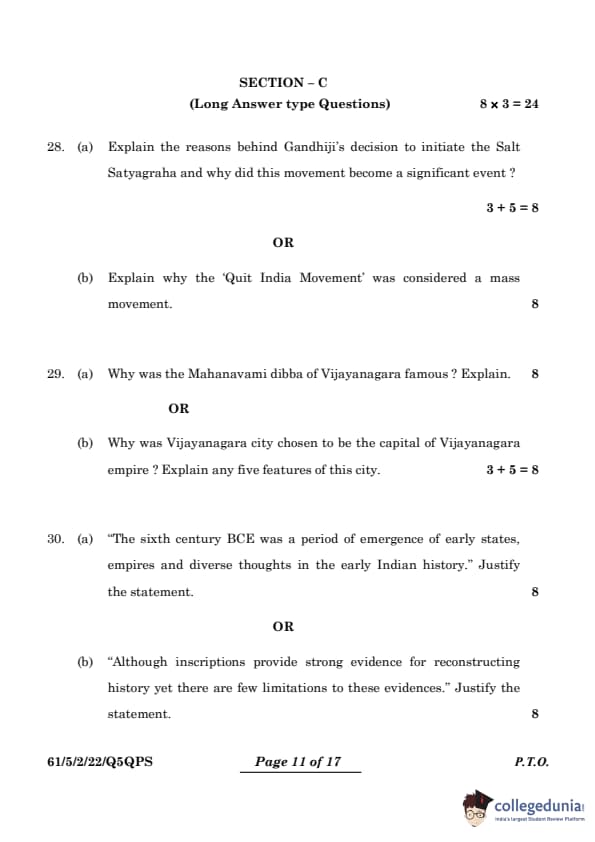
SECTION – C
(Long Answer type Questions)
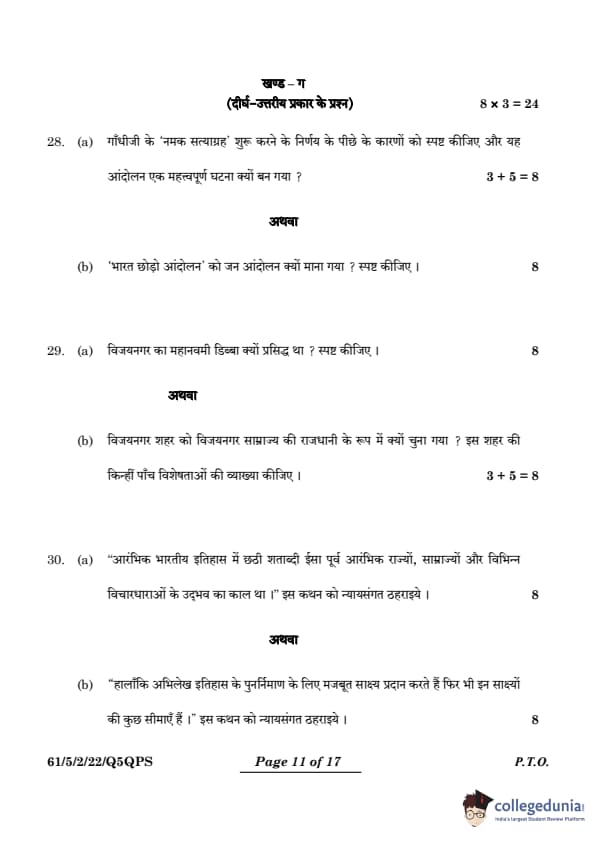
Question 28(a):
Explain the reasons behind Gandhiji's decision to initiate the Salt Satyagraha and why did this movement become a significant event?
View Solution
Solution:
Reasons for Initiating Salt Satyagraha:
Unpopular Salt Law: The British salt tax, levied on a essential commodity, was deeply unpopular and considered unjust.
British Monopoly: The British monopoly over salt production and sale made it lucrative for them but a hardship for Indians.
Destruction and Ban: The government destroyed surplus salt and banned domestic production, creating dependence on British salt and fueling resentment.
High Price: Indians were forced to buy expensive British salt, adding to their economic burden.
Depriving Village Industry: The ban on domestic salt production crippled a traditional village industry.
Significance of the Salt Satyagraha:
Symbol of Protest: Salt, a universal necessity, became a powerful symbol of protest, making it easy for everyone to participate.
Challenge to British: It was a direct, non-violent challenge to unjust British laws.
Global Attention: The Salt March garnered international attention, highlighting India's struggle for independence.
Extensive Coverage: European and American press covered the march extensively.
Women's Participation: Significant women's participation demonstrated the movement's broad reach.
British Realization: The Salt Satyagraha forced the British to acknowledge the illegitimacy of their rule and the need to share power.
People's Participation: It mobilized all sections of society, showcasing mass support for independence.
Protest Against British: The public defiance of salt laws at Dandi strengthened the movement.
Non-Violent Protest: The non-violent nature of the protest highlighted the power of peaceful resistance and gained global recognition.
British Violence: The British response with violence further exposed their oppressive tactics.
Question 28(b):
Explain why the ‘Quit India Movement' was considered a mass movement.
View Solution
Solution:
The Quit India Movement's classification as a mass movement stems from several factors:
Widespread Discontent: The failure of the Cripps Mission created widespread dissatisfaction with British rule.
"Do or Die" Call: Gandhi's call for "Quit India - Do or Die" galvanized the population.
Arrest of Leaders and Spontaneous Participation: The arrest of key leaders sparked spontaneous uprisings across the country.
Younger Activists: Younger activists like Jayaprakash Narayan filled the leadership vacuum, ensuring the movement's continuation.
Independent Governments: The establishment of independent governments in some districts, like Satara, highlights local level mobilization.
Strikes and Sabotage: Widespread strikes and acts of sabotage demonstrated mass resistance.
Underground Resistance: The formation of underground resistance groups showcases diverse participation.
British Repression: Despite British repression, the movement continued, reflecting the people's determination.
Large Scale Participation: Thousands joined the movement, reflecting its mass character.
Energized Youth: Students and youth actively participated, indicating a generational shift towards active resistance.
Question 29(a):
Why was the Mahanavami dibba of Vijayanagara famous? Explain.
View Solution
Solution:
The Mahanavami dibba held immense significance in Vijayanagara:
Mahanavami Festival: It was the central point for the ten-day Mahanavami festival celebrations.
Display of Power and Prestige: Rulers used the platform to showcase their power, prestige, and authority.
Various Ceremonies: The dibba hosted numerous religious and political ceremonies, highlighting its importance.
Worship of the Image: The worship of deities, a key aspect of religious life, took place at the dibba.
Worship of the State Horse: The worship of the state horse during Mahanavami rituals reflects the importance of military power.
Sacrifice of Animals: Animal sacrifices were performed, reflecting religious practices.
Dances and Wrestling Matches: Cultural events like dances and wrestling matches were held.
Processions: Grand processions showcasing military might were organized.
Royal Presentations: Ritual presentations by officials and subordinate kings reinforced the hierarchical structure.
Inspection of the Army: The king inspected armies, asserting military strength.
Gifts and Tributes: The Nayakas presented gifts and tributes, demonstrating loyalty.
Enigmatic Structure: The structure's exact purpose remains partially unclear, adding to its mystique.
Question 29(b):
Why was Vijayanagara city chosen to be the capital of Vijayanagara empire? Explain any five features of this city.
View Solution
Solution:
Reasons for Choosing Vijayanagara as Capital:
Strategic Location: The city's natural defenses, including the surrounding granite hills and the Tungabhadra River, made it a secure and easily defensible location. The river also provided a reliable source of water.
Religious Significance: The presence of important shrines, particularly those of Virupaksha and Pampadevi, added religious importance to the site. The area also had a history of temple building, further enhancing its sacred nature.
Mythological Importance: The association with the monkey kingdom of Vali and Sugriva from the Ramayana lent a mythological significance to the location.
Access to Resources: The fertile Tungabhadra basin and access to trade routes facilitated agricultural and economic prosperity.
Five Features of Vijayanagara City:
Fortified City: Robust fortifications with well-guarded gates provided security.
Distinctive Layout: The city's unique layout, a blend of local and foreign influences, showcased its cosmopolitan nature.
Natural Setting: The presence of trees, water channels, lakes, and plazas reflected a harmonious blend with the natural environment. The city benefitted from the natural basin formed by the Tungabhadra River and the numerous streams flowing down from the surrounding hills.
Water Management: Embankments and reservoirs demonstrated sophisticated water management systems.
Important Structures: Structures like the Mahanavami dibba and audience halls served important functions in the city’s ceremonial and political life. Bazaars and markets reflect the bustling commercial center.
Question 30(a):
“The sixth century BCE was a period of emergence of early states, empires and diverse thoughts in early Indian history.” Justify the statement.
View Solution
Solution:
The sixth century BCE marked a pivotal period in Indian history:
Emergence of States and Cities: The Gangetic plains witnessed the rise of early states and cities, signifying a major transition from earlier social structures.
Janapadas and Mahajanapadas: The development of Janapadas (smaller kingdoms) and Mahajanapadas (larger states) represented significant political entities.
Monarchical System: The prevalence of kingship as a political system provided a degree of centralized authority.
Fortified Cities: Fortified capital cities served as centers of power and defense.
Developing Bureaucracy: The emergence of bureaucracies reflects increasing administrative complexity.
Rules for Governance: Clearer rules of governance indicate growing political organization.
Taxation: The collection of taxes provided resources for administration and military.
Trade and Commerce: The promotion of trade and commerce spurred economic growth.
Maintenance of Armies: The maintenance of armies reflects both military aspirations and the need for defense.
Iron Use: Widespread iron use revolutionized agriculture and warfare.
Coinage: The emergence of coins facilitated trade and economic exchange.
Diverse Thoughts: This period witnessed a flourishing of diverse philosophical and spiritual ideas, including Jainism, Buddhism, and Ajivika.
Dharmasutras: The composition of Dharmasutras, providing codes of conduct, reflects social and ethical developments.
Question 30(b):
"Although inscriptions provide strong evidence for reconstructing history yet there are few limitations to these evidences.” Justify the statement.
View Solution
Solution:
While inscriptions are valuable historical sources, they have limitations:
Strong Evidence: Inscriptions offer direct historical evidence, allowing historians to reconstruct events and understand past societies. They're considered reliable sources.
Limitations: However, various factors limit their use:
Technical Limitations: Faint engravings, damaged inscriptions, and fragmented pieces create challenges in reading and interpretation, leading to uncertainties.
Accessibility: Some inscriptions remain unpublished or untranslated, hindering access for scholars. The ravages of time have also led to the loss of some inscriptions.
Interpretation Challenges: Deciphering meanings and understanding the historical context can be difficult. Important events may not always be recorded.
Bias and Perspective: Inscriptions often focus on the perspectives of the powerful (rulers, elites), neglecting ordinary lives. They primarily record major events, not everyday life. There's a risk of misinterpretation due to the complexity of the process.
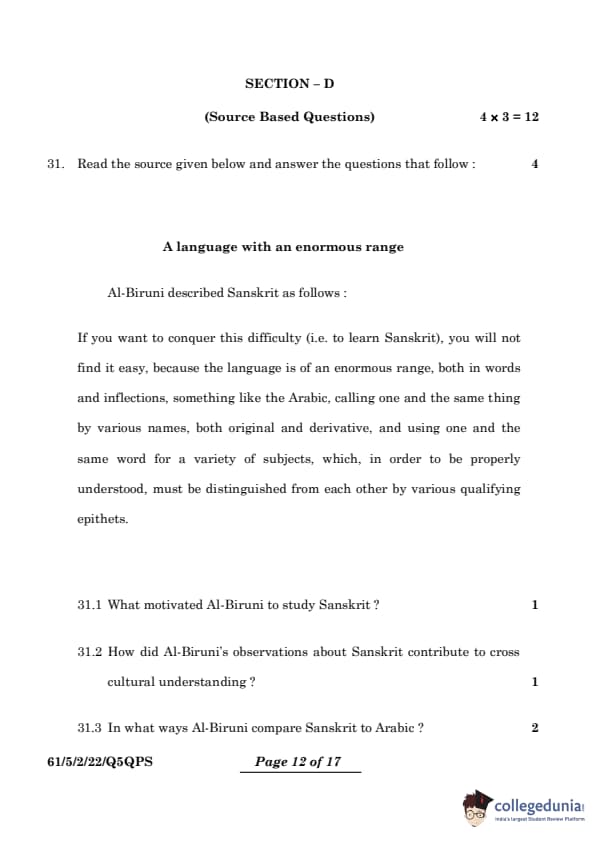
SECTION–D
(Source Based Questions)
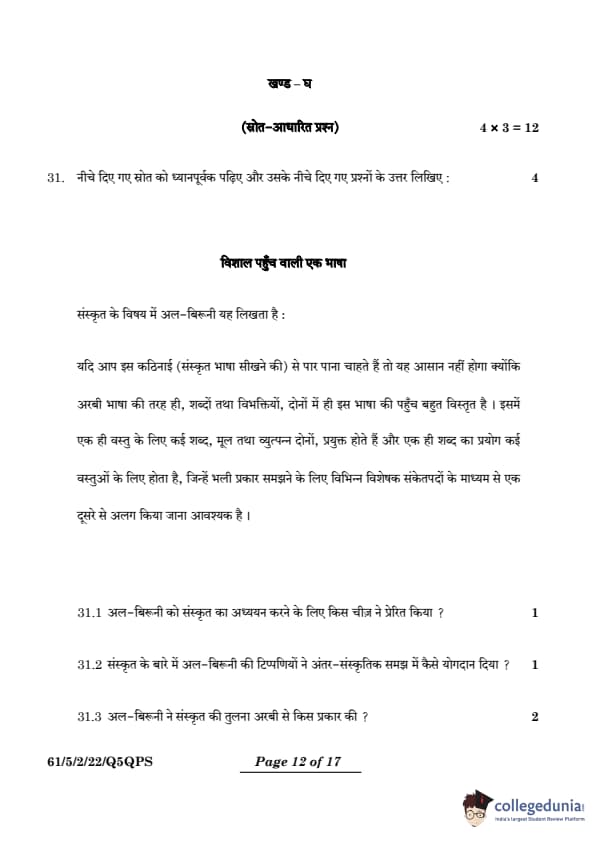
Question 31:
Read the given source below and answer the questions that follow:
A language with an enormous range
Al-Biruni described Sanskrit as follows: If you want to conquer this difficulty (i.e. to learn Sanskrit), you will not find it easy, because the language is of an enormous range, both in words and inflections, something like the Arabic, calling one and the same thing by various names, both original and derivative, and using one and the same word for a variety of subjects, which, in order to be properly understood, must be distinguished from each other by various qualifying epithets.
(31.1) What motivated Al-Biruni to study Sanskrit?
View Solution
Solution:
Al-Biruni's motivation for studying Sanskrit stemmed from multiple factors:
Interest in Languages: He was fascinated by languages and found Sanskrit's complexity intriguing.
Understanding Indian Culture: He sought to understand Indian culture, particularly its caste system and social practices, through its texts.
Overcoming Difficulty: He was driven to overcome the challenges of learning a difficult language.
Access to Translated Works: Having read Sanskrit works translated into Arabic, he desired to engage with the original texts.
Translation Efforts: He contributed to translating Greek works into Sanskrit and Patanjali's grammar into Arabic, indicating a practical need for Sanskrit knowledge.
Ghaznavid Conquest: The conquest facilitated interaction with Brahmanas and access to Sanskrit texts.
(31.2) How did Al-Biruni's observations about Sanskrit contribute to cross-cultural understanding?
View Solution
Solution:
Al-Biruni's observations about Sanskrit played a crucial role in fostering cross-cultural understanding:
Bridge between Cultures: His work acted as a bridge between Arabic and Indian cultures, facilitating communication and exchange.
Understanding Between Cultures: His comparisons of Sanskrit and Arabic helped audiences from both cultures appreciate the nuances of these languages and the cultures they represented.
Highlighting Distinct Features: By highlighting Sanskrit's unique features, he facilitated a deeper understanding of the language among those unfamiliar with it.
Contextual Understanding: He aimed to use Sanskrit as a tool for understanding Indian culture, recognizing the language's importance in accessing its rich intellectual tradition.
(31.3) In what ways does Al-Biruni compare Sanskrit to Arabic?
View Solution
Solution:
Al-Biruni compared Sanskrit and Arabic in several aspects:
Differences: He acknowledges that Sanskrit is distinct from Arabic, but also notes similarities in their structure and complexity.
Difficult Translation: He highlights the difficulty of translating Sanskrit into other languages due to its complex structure.
Enormous Range: He points out the vast range of words and inflections in both languages.
Multiple Names: He notes that both languages use multiple names for the same thing, adding to their complexity.
Same Word, Different Meanings: He observes that both languages use the same word for different subjects, with meaning determined by qualifying words.
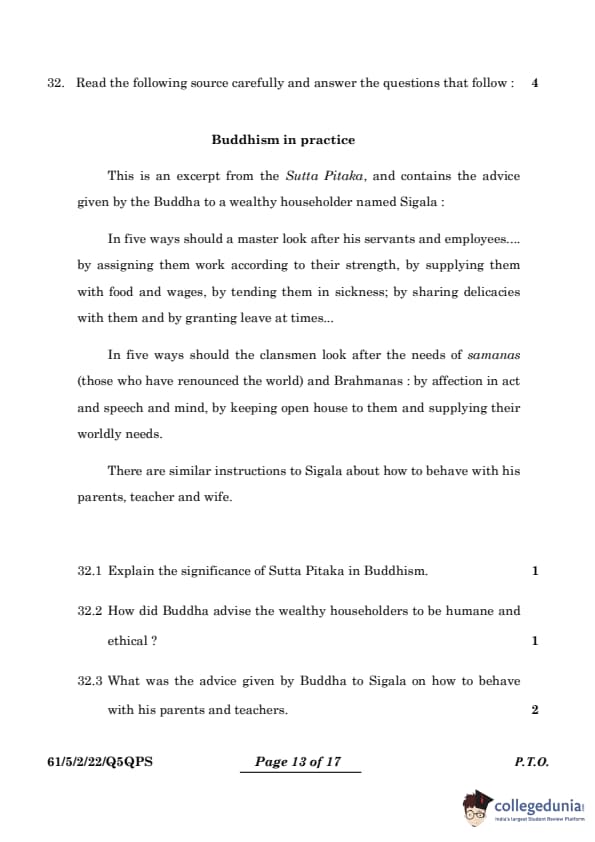
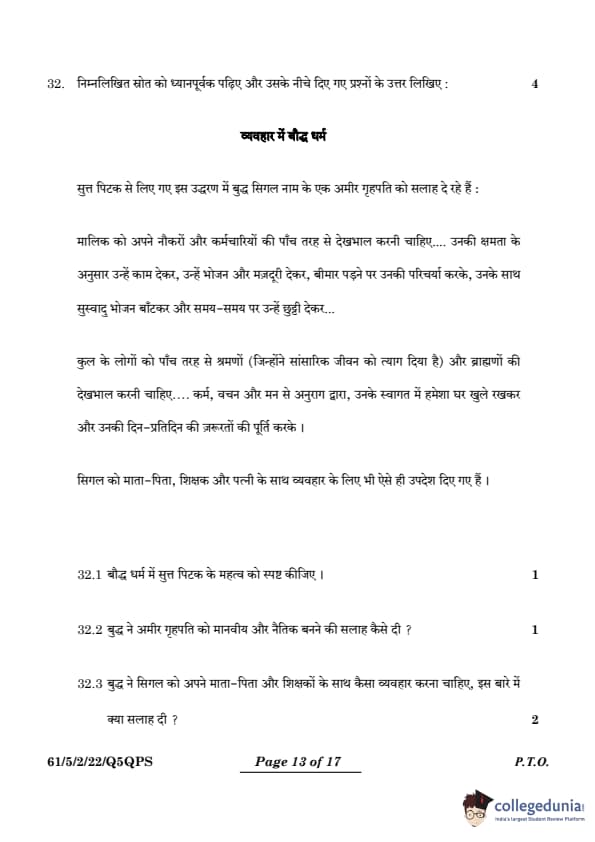
Question 32:
Read the following source carefully and answer the questions that follow:
Buddhism in practice
This is an excerpt from the Sutta Pitaka, and contains the advice given by the Buddha to a wealthy householder named Sigala : In five ways should a master look after his servants and employees.... by assigning them work according to their strength, by supplying them with food and wages, by tending them in sickness; by sharing delicacies with them and by granting leave at times... In five ways should the clansmen look after the needs of samanas (those who have renounced the world) and Brahmanas : by affection in act and speech and mind, by keeping open house to them and supplying their worldly needs. There are similar instructions to Sigala about how to behave with his parents, teacher and wife.
(32.1) Explain the importance of Sutta Pitaka in Buddhism.
View Solution
Solution:
The Sutta Pitaka holds immense importance in Buddhism:
Core Teachings: It contains the Buddha's core teachings, making it a central text and conveying his essential message.
Practical Guidance: It provides practical guidance on how to live ethically and morally, translating Buddhist principles into daily life.
(32.2) How did Buddha advise the wealthy householders to be humane and ethical?
View Solution
Solution:
Buddha's advice to wealthy householders emphasized ethical treatment of employees:
Fair Workload: Assign work according to employees' strength and capabilities.
Fair Compensation: Provide adequate food and wages.
Healthcare: Care for employees in times of sickness.
Generosity: Share delicacies and provide time off.
Respect and Affection: Treat all with respect and affection, both in action and words. Emphasis is on positive social interactions.
(32.3) What was the advice given by Buddha to Sigala on how to behave with his parents and teachers?
View Solution
Solution:
Buddha's advice to Sigala on respecting parents and teachers includes:
Respect and Gratitude: Show consistent respect and express gratitude.
Obedience and Learning: Listen to parents' advice and be a dedicated student, eager to learn from teachers.
Care in Old Age/Sickness: Care for parents during sickness and old age.
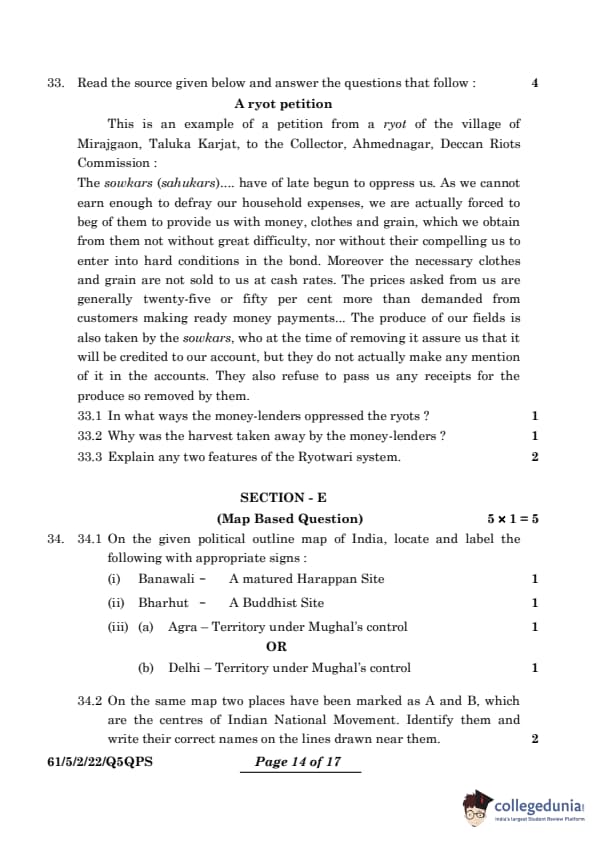
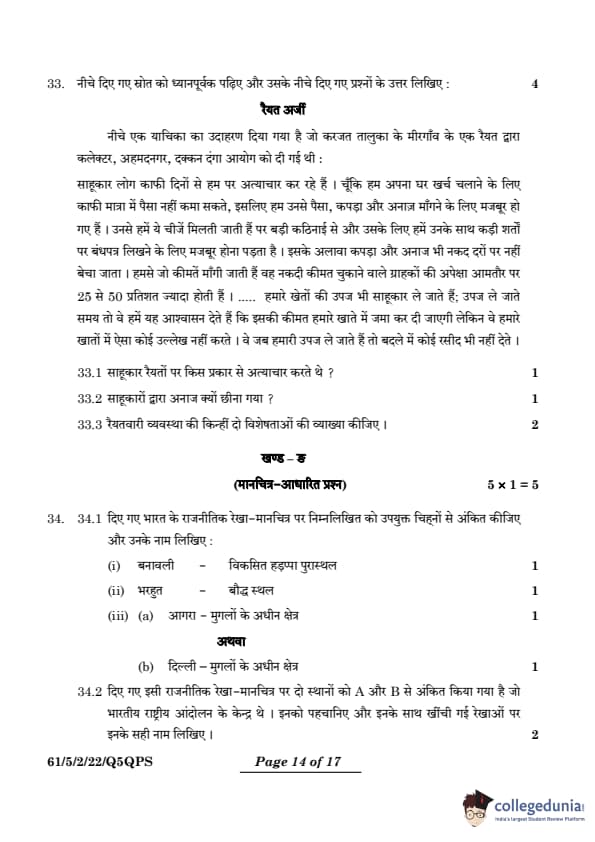
Question 33:
Read the source given below and answer the questions that follow:
A Ryot Petition
This is an example of a petition from a ryot of the village of Mirajgaon, Taluka Karjat, to the Collector, Ahmednagar, Deccan Riots Commission : The sowkars (sahukars).... have of late begun to oppress us. As we cannot earn enough to defray our household expenses, we are actually forced to beg of them to provide us with money, clothes and grain, which we obtain from them not without great difficulty, nor without their compelling us to enter into hard conditions in the bond. Moreover the necessary clothes and grain are not sold to us at cash rates. The prices asked from us are generally twenty-five or fifty per cent more than demanded from customers making ready money payments... The produce of our fields is also taken by the sowkars, who at the time of removing it assure us that it will be credited to our account, but they do not actually make any mention of it in the accounts. They also refuse to pass us any receipts for the produce so removed by them.
(33.1) In what ways the money-lenders oppressed the ryots?
View Solution
Solution:
The money-lenders oppressed the ryots through various exploitative practices:
Exorbitant Interest Rates: They charged excessively high interest rates, trapping ryots in debt cycles.
Ruthless Collection Methods: They employed harsh methods for debt collection, showing no leniency.
Land Seizure: They confiscated land from ryots who couldn't repay their debts.
Forced Dependence: Ryots, unable to meet basic needs, were forced to rely on money-lenders for loans, creating a cycle of dependence.
Manipulation and Fraud: They manipulated laws and accounts, and forced ryots into signing unfair loan agreements. They inflated prices for essential goods sold to indebted ryots and often didn't credit repayments, taking produce without providing receipts.
(33.2) Why was the harvest taken away by the money-lenders?
View Solution
Solution:
Money-lenders took the harvest as a means of:
Debt Recovery: It was their primary method for recovering unpaid debts, ensuring their profits even if it meant impoverishing the ryots.
Exploitation Through Deceit: Despite promising to credit the value of the harvest, they often didn't, making it a deceitful way to seize the ryots’ produce. The lack of receipts further disempowered the ryots.
(33.3) Explain any two features of the Ryotwari system.
View Solution
Solution:
Two key features of the Ryotwari system are:
Direct Settlement with Ryots: Revenue settlements were made directly with the ryot (peasant), eliminating the intermediary role of zamindars.
Periodic Resurveys and Assessments: Lands were resurveyed every 30 years to reassess revenue rates, often leading to increased rates for the benefit of the British.
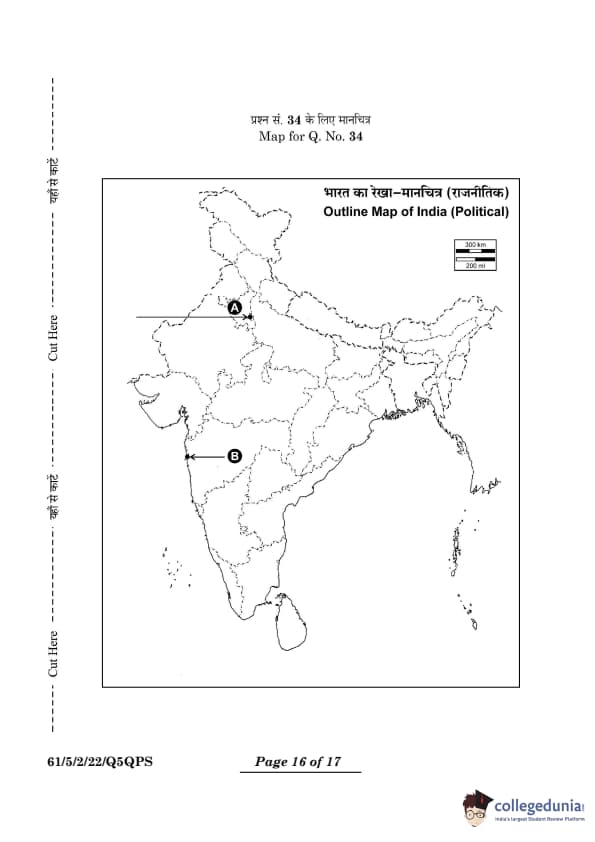
Question 34
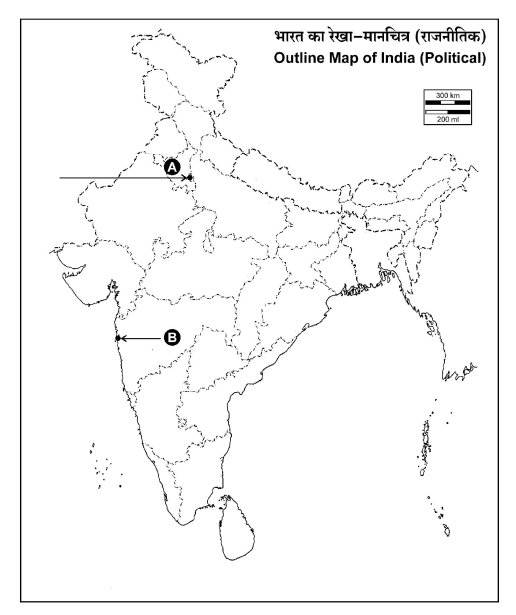
Question 34.1:
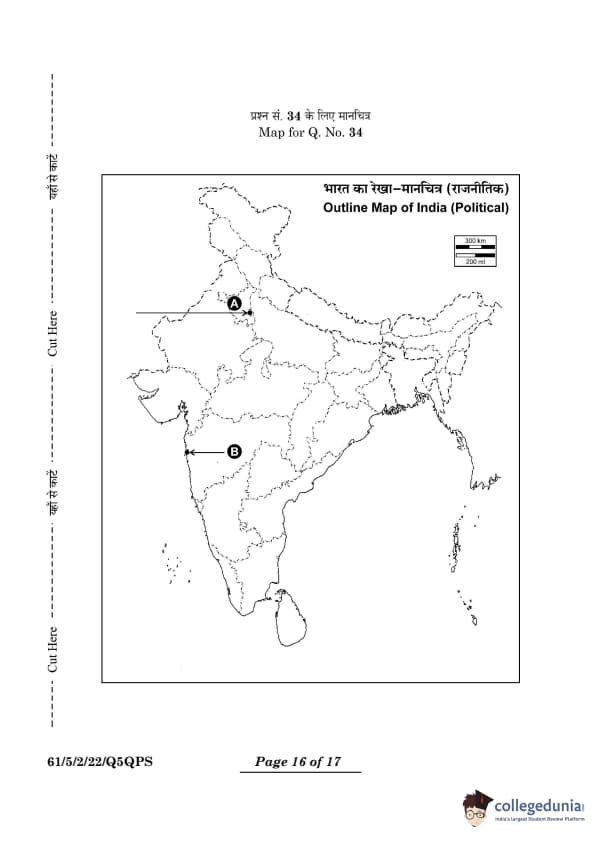
(34.1) On the given political outline map of India, locate and label the following with appropriate signs:
(i) Banawali - A matured Harappan Site
(ii) Bharhut - A Buddhist Site
(iii) (a) Agra - Territory under Mughal's control
View Solution
Solution:
(i) Banawali: Located in present-day Haryana, mark it on the map with the appropriate symbol for a Harappan site.
(ii) Bharhut: Located in present-day Madhya Pradesh, mark it on the map using the symbol for a Buddhist site.
(iii)(a) Agra: Mark Agra in present-day Uttar Pradesh, indicating it as a territory under Mughal control.
Question 34OR(iii)(b):
(iii) (b) Delhi - Territory under Mughal's control
View Solution
Solution:
(iii)(b) Delhi: Mark Delhi on the map, indicating it as a territory under Mughal control.
Question 34.2:
(34.2) On the same map two places have been marked as A and B, which are the centres of Indian National Movement. Identify them and write their correct names on the lines drawn near them.
View Solution
Solution:
(A) Delhi: Label 'A' as Delhi.
(B) Bombay (now Mumbai): Label 'B' as Bombay.
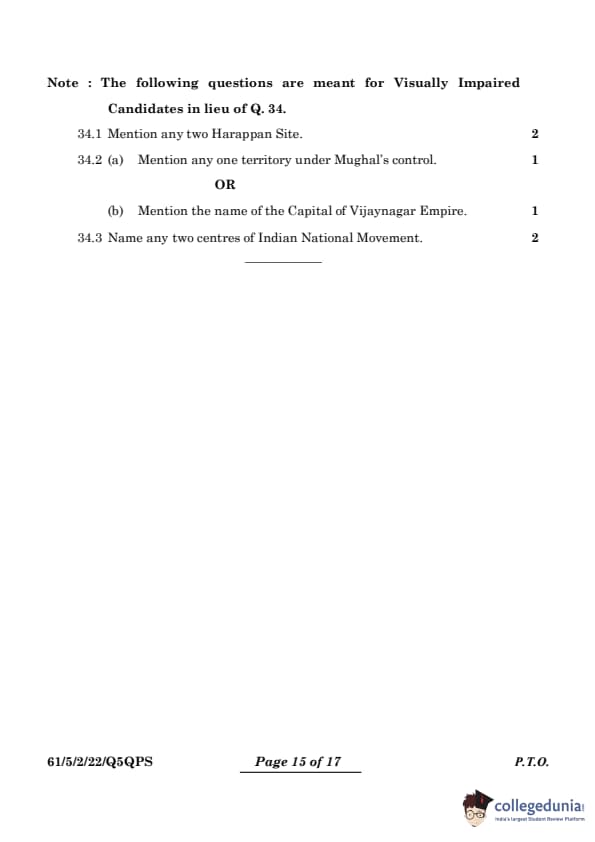
Question 34.1 (Visually Impaired):
Mention any two Harappan Sites
View Solution
Solution: Any two from the following: Harappa, Mohenjodaro, Kalibangan, Lothal, Rakhigarhi, Dholavira, Banawali.
Question 34.2(a) (Visually Impaired):
Mention any one territory under Mughal's control.
View Solution
Solution: Any one of the following: Lahore, Panipat, Delhi, Agra, Ajmer, Amber, or Goa.
Question 34.2(b) (Visually Impaired):
Mention the name of the Capital of Vijayanagara Empire.
View Solution
Solution: Hampi/Vijayanagara.
Question 34.3 (Visually Impaired):
Name any two centres of Indian National Movement.
View Solution
Solution: Any two of the following: Champaran, Kheda, Ahmedabad, Dandi, Bardoli, Bombay, Calcutta, Delhi, Madras, Lahore, Amritsar, Surat, Lucknow.






Comments