



.png?h=35&w=35&mode=stretch)
CBSE Class 12 History Set 3 Question Paper PDF (Code: 61/3/3) is now available for download. CBSE conducted the Class 12 History examination on March 28, 2024, from 10:30 AM to 1:30 PM. The question paper consists of 34 questions carrying a total of 80 marks. Section A includes 21 MCQs for 1 mark each, Section B contains 6 short-answer questions for 3 marks each, Section C comprises 3 long-answer questions for 8 marks each, Section D comprises 3 Source-based questions having three sub-questions carries 4 marks each and Section E comprises 1 Map-based question that carries 5 marks.
Candidates can use the link below to download the CBSE Class 12 History Set 3 Question Paper with detailed solutions.
CBSE Class 12 History Question Paper 2024 (Set 3- 61/3/3) with Answer Key
| CBSE Class 12 2024 History Question Paper with Answer Key |  Download Download |
Check Solution |
CBSE Class 12 2024 History Questions with Solutions
SECTION A
(Multiple Choice Type Questions)
Question 1:
Which of the following options are correct regarding Magadha?
(A) I, II and IV are correct
(B) I, II and III are correct
(C) I, III and IV are correct
(D) II, III and IV are correct
View Solution
Solution:
I. Magadha as the Most Powerful Mahajanapada: Among the sixteen Mahajanapadas, Magadha rose to become the most powerful due to its strategic location in the Gangetic plain, which offered fertile land for agriculture, and abundant natural resources like iron ore, which enabled them to have a strong army. The rulers of Magadha like Bimbisara, Ajatashatru, and others were ambitious and were successful in expanding their control.
II. Rajagaha as Capital: Rajagaha (present-day Rajgir) was indeed the earliest capital of Magadha, and it was chosen because of its location surrounded by hills, which made it a secure and defensible city. Later on the capital was shifted to Pataliputra by the rulers of the Mauryan Dynasty.
III. Not Semi-Arid: Magadha was not in a semi-arid region but in a well-watered and fertile area, which allowed them to produce surplus agricultural goods. This was a source of their wealth.
IV. Rich in Resources: Magadha was rich in natural resources like iron deposits and forest resources which enabled them to produce agricultural tools and weapons for their military. Elephants from the forests also became a key part of their military.
Question 2:
Arrange the following in chronological order and choose the correct option:
(A) I, III, IV, II
(B) III, II, I, IV
(C) II, I, IV, III
(D) IV, III, I, II
View Solution
Solution:
II. Rule of Mahapadma Nanda: Mahapadma Nanda was the first ruler of the Nanda dynasty. This was a powerful kingdom which preceded the Mauryan Dynasty. He is believed to have created a large empire and was known for his conquests in different regions of India.
I. Rule of Asoka: Asoka was the third ruler of the Mauryan dynasty, which came to power after defeating the Nandas. Asoka's reign is known for his policies based on Dhamma and his patronage of Buddhism, which is significant in Indian history.
IV. Rule of Samudragupta: Samudragupta was a key ruler of the Gupta Dynasty. His reign came centuries after the Mauryas and was marked by military expeditions and cultural patronage.
III. Rule of Harshavardhana: Harshavardhana belonged to a later period and ruled during the 7th century CE. He was a key ruler of the Vardhana dynasty, and his rule followed that of Gupta rulers.
Question 3:
Which of the following schools of art is depicted in the given sculpture image of Buddha?
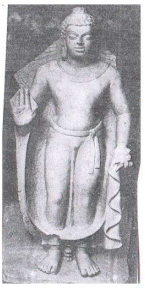
View Solution
Solution:
Mathura School of Art: The sculpture (refer to the image in the original document) shows the Buddha with a shaven head, a round face, and a slight smile. The robe covers one shoulder, and the sculpture has a sense of robustness. This is a common style in Mathura school of art, which used reddish sandstone.
Amravati School of Art: Amravati art is known for its narrative panels and depictions of Buddhist stories. Its sculptures display dynamic figures in motion and it used white marble or limestone.
Gandhara School of Art: Gandhara art, which was mainly prevalent in the region of present-day Pakistan and Afghanistan, had a strong Hellenistic influence with wavy hair, a defined nose, and Greco-Roman style of draping clothes. The material often used in this style was grey schist.
Gothic School of Art: Gothic art was prevalent in medieval Europe, and it is not related to Indian art in any manner. It was characterized by pointed arches and ribbed vaults.
Question 4:
Fill in the blank with the appropriate word from the given options:
The Harappan site of ______ is located in present day Rajasthan.
View Solution
Solution:
Kalibangan: Kalibangan is an important Harappan site located in the Hanumangarh district of Rajasthan. It is known for its well-planned city, fire alters and evidence of ploughed fields.
Rakhigarhi: Rakhigarhi is located in the state of Haryana. It is one of the biggest Harappan sites and is known for its complex settlements.
Lothal: Lothal is situated in the state of Gujarat. It was an important port town.
Manda: Manda is the northernmost site of the Indus Valley Civilization, located in Jammu and Kashmir.
Question 5:
Read the following statements regarding Cunningham and choose the correct option:
(A) I and IV are correct
(B) I and II are correct
(C) I, II and III are correct
(D) I, II and IV are correct
View Solution
Solution:
I. Cunningham as the first DG of ASI: This is absolutely correct. Alexander Cunningham became the first Director-General of the Archaeological Survey of India (ASI), which was formed in 1861.
II. Archaeological Excavations: Cunningham initiated archaeological excavations during the mid-19th century. Though the formal ASI was formed in 1861, he was doing excavation before that also.
Military Precision in Archaeology: Although Cunningham had a military background, his approach to archaeology was more scholarly and less about military precision. His methods were systematic, but this was more based on texts and analysis than military precision.
Use of Chinese Texts: Cunningham often consulted and used the accounts written by Chinese Buddhist pilgrims like Xuanzang to identify and locate many archaeological sites.
Question 6:
Two statements as Assertion (A) and Reason (R) are given below. Read them carefully and choose the correct option:
Assertion (A): Ibn Battuta found Indian agriculture very productive.
Reason (R): The soils were fertile which allowed the farmers to produce two crops a year.
View Solution
Solution:
Assertion A is Correct: Ibn Battuta, in his travelogue ‘Rihla', writes about the thriving agriculture that he observed in India, with fields full of crops, and well-organized methods of cultivation.
Reason R is Correct: The reason is also accurate as the alluvial soil of the Gangetic plains and other regions of India were indeed fertile. This allowed farmers to grow crops twice a year. The availability of water also helped in improving agricultural yields.
Reason Explains Assertion: The Reason given also correctly explains why the Assertion was true. The fertility of the land and the capability to produce two crops annually directly explains the high productivity of Indian agriculture that Ibn Battuta had observed.
Question 7:
Identify the person with the help of following information:
• He was a famous engineer, surveyor, and cartographer.
• He was appointed the first Surveyor General of India in 1815.
View Solution
Solution:
Colin Mackenzie: Colin Mackenzie was a Scottish army officer with the British East India Company. He was appointed as the first Surveyor General of India in 1815 because of his expertise as an engineer, surveyor, and cartographer.
Alexander Greenlaw: Alexander Greenlaw was a photographer and engineer in British India, and he is not known for being a surveyor or cartographer, nor was he the Surveyor General.
John Marshall: John Marshall was a significant figure in Indian archaeology as he was the Director-General of the Archaeological Survey of India, but he was not a surveyor or cartographer.
R.E.M. Wheeler: R.E.M. Wheeler was an archaeologist who also served as the Director-General of ASI. He was not known for his work in surveying or cartography.
Question 8:
Match Column I with Column II and choose the correct option:
| Column I (Characters of Mahabharata) | Column II (Role) |
|---|---|
| 1. Duryodhana | (i) Son of Hidimba |
| 2. Gandhari | (ii) Eldest son of Dhritrashtra |
| 3. Kunti | (iii) Mother of Pandavas |
| 4. Ghatotkacha | (iv) Mother of Duryodhana |
View Solution
Solution:
Duryodhana and Eldest son of Dhritrashtra: Duryodhana, the key antagonist of the Mahabharata, was indeed the eldest son of King Dhritrashtra of the Kuru Dynasty.
Gandhari and Mother of Duryodhana: Gandhari was the wife of King Dhritrashtra and mother to the hundred Kauravas, including Duryodhana, who were the central antagonists in the epic.
Kunti and Mother of Pandavas: Kunti was the mother of the Pandavas: Yudhisthira, Bhima, Arjuna, Nakul and Sahadeva. She was one of the central characters of the epic.
Ghatotkacha and Son of Hidimba: Ghatotkacha was the son of Bhima and Hidimba. He had many supernatural abilities and played a key role in the Kurukshetra war.
Question 9:
Which one of the following pairs is correctly matched?
| Column I (Temple) | Column II (Location) |
|---|---|
| (A) Chidambaram Temple | Thanjavur |
| (B) Brihadishvara Temple | Vijayanagara |
| (C) Chennakeshava Temple | Belur |
| (D) Hazara Rama Temple | Tamil Nadu |
View Solution
Solution:
Chidambaram Temple and Thanjavur: The Chidambaram temple is located in Chidambaram, Tamil Nadu, and not in Thanjavur. It is dedicated to Lord Nataraja and is known for its architecture and unique sculptures.
Brihadishvara Temple and Vijayanagara: The Brihadishvara Temple is in Thanjavur, Tamil Nadu and not in Vijayanagara. It is a beautiful example of the Chola style of temple architecture.
Chennakeshava Temple and Belur: Chennakeshava Temple is a Hoysala style temple located at Belur in Karnataka. Therefore, this is the correct match.
Hazara Rama Temple and Tamil Nadu: The Hazara Rama Temple is a significant temple of the Vijayanagara Empire and is located in Hampi, Karnataka.
Question 10:
Who among the following initiated the task of preparing the critical edition of Mahabharata?
View Solution
Solution:
V.S. Sukthankar: Vishnu Sitaram Sukthankar was a Sanskrit scholar, who initiated the critical edition of Mahabharata. This was a massive scholarly project involving years of research and analysis of different manuscripts.
D.N. Jha: Dwijendra Narayan Jha, a prominent historian, wrote about ancient India. His work focused on economic and social history, and not on Mahabharata.
Irawati Karve: Irawati Karve was a historian and an anthropologist known for her work on kinship systems in India, and her work is not directly linked to the critical edition of Mahabharata.
Ram Karan Sharma: Ram Karan Sharma was a Sanskrit scholar who was also a translator of many Sanskrit texts. He was not directly linked to this project of preparing the critical edition of Mahabharata.
Question 11:
Fill in the blank with the appropriate word from the given options:
The land which was annually cultivated for each crop in succession was called _______ in the Mughal Empire.
View Solution
Solution:
Polaj: In the Mughal land revenue system, ‘Polaj' land was annually cultivated for each crop in succession and was never left fallow.
Parauti: 'Parauti' land was also fertile but was left uncultivated for some time to regain its fertility.
Banjar: 'Banjar' land was infertile and left uncultivated for more than five years.
Chachar: 'Chachar' land was less fertile than Polaj, and was left fallow for three to four years.
Question 12:
Match Column I with Column II and choose the correct option from the following:
| Column I (Traveller) | Column II (Books authored) |
|---|---|
| 1. Abu'l Fazl | (i) Travels in the Mughal Empire |
| 2. Ibn Battuta | (ii) Kitab-ul-Hind |
| 3. Al-Biruni | (iii) Rihla |
| 4. Francois Bernier | (iv) Ain-i-Akbari |
View Solution
Solution:
Abu'l Fazl and Ain-i-Akbari: Abu'l Fazl, a courtier of Emperor Akbar, wrote the ‘Ain-i-Akbari', which is a part of Akbarnama, documenting the administration, culture, and society of the Mughal Empire under Akbar.
Ibn Battuta and Rihla: Ibn Battuta was a Moroccan traveler of the 14th century. He authored the “Rihla”, which provides a detailed description of the places he visited, including India.
Al-Biruni and Kitab-ul-Hind: Al-Biruni, an 11th-century scholar who came with Mahmud Ghazni, authored the “Kitab-ul-Hind”, which detailed his observations about Indian culture, religion, philosophy, and sciences.
Francois Bernier and Travels in the Mughal Empire: Francois Bernier was a French physician and traveler who wrote “Travels in the Mughal Empire", which gives a detailed account of the society and politics of 17th-century Mughal India.
Question 13:
In which of the following districts did the ryots revolt against sahukars of the Ryotwari system?
View Solution
Solution:
Poona: The region of Poona (present-day Pune) in Maharashtra was a major site of the Deccan Riots of 1875, which were uprisings by the ryots against the sahukars or moneylenders. These were primarily caused by high interest rates, land alienation and the exploitation under the Ryotwari system.
Awadh: Awadh was not directly related to the Deccan Riots. It was primarily linked to the 1857 revolt, as the princely state of Awadh was annexed by the British.
Barrackpore: Barrackpore is known for being a site of military cantonment, and was related to some of the mutinies, especially the 1857 mutiny, but not the Deccan Riots.
Bhagalpur: Bhagalpur was a region in Bihar that witnessed the Santal rebellion, which was mainly a response to the exploitation by the British authorities and the zamindars.
Question 14:
Match Column I with Column II and choose the correct option from the following:
| Column I (Leaders of the Revolt of 1857) | Column II (Related Region) |
|---|---|
| 1. Kunwar Singh | (i) Singhbhum |
| 2. Shah Mal | (ii) Arrah |
| 3. Birjis Qadr | (iii) Barout |
| 4. Gonoo | (iv) Lucknow |
View Solution
Solution:
Kunwar Singh and Arrah: Kunwar Singh was a prominent leader of the 1857 revolt in the region of Bihar, particularly in Arrah.
Shah Mal and Barout: Shah Mal was a leader of the peasants in the region of Barout, Uttar Pradesh, during the revolt of 1857.
Birjis Qadr and Lucknow: Birjis Qadr was the son of the Nawab of Awadh, who led the revolt in Lucknow after the princely state was annexed.
Gonoo and Singhbhum: Gonoo, also known as Geynu, was a tribal leader from Singhbhum in present-day Jharkhand. He was one of the leaders who participated in the revolt.
Question 15:
Which one of the following tribes was engaged in overland trade between India and Afghanistan and in the villages and towns in Punjab during the Mughal era?
View Solution
Solution:
Lohanis: The Lohanis were a Pashtun tribe from the Afghanistan region and were known for engaging in the overland trade between India and Afghanistan. They were also involved in trade within Punjab.
Mundas: The Mundas were a tribal group in the Chota Nagpur region (Jharkhand). They were primarily cultivators and not known for overland trade.
Koch: The Koch were a tribal group from Assam and surrounding areas, and their participation in overland trade with Afghanistan was limited.
Ahoms: The Ahoms ruled the region of Assam and were involved in various internal and regional trade. However, they did not engage in any overland trade with Afghanistan.
Question 16:
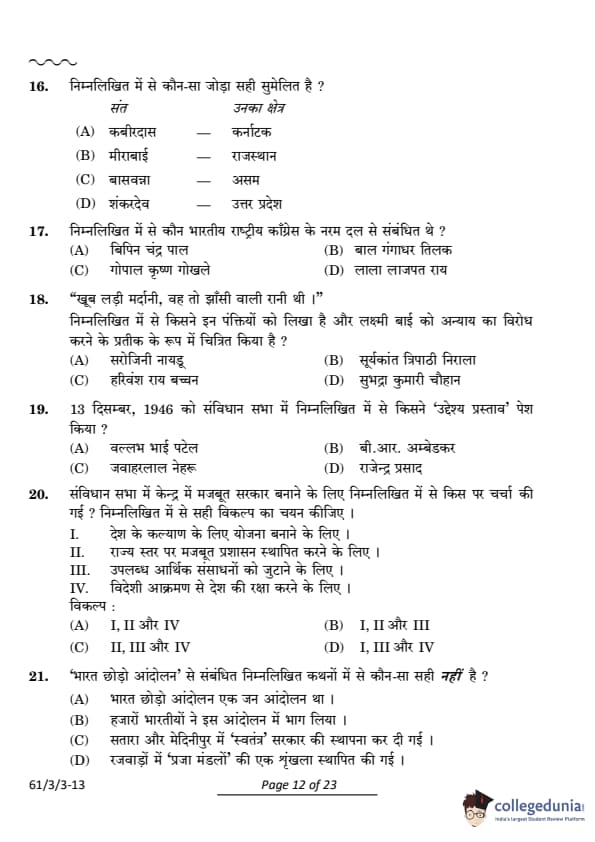
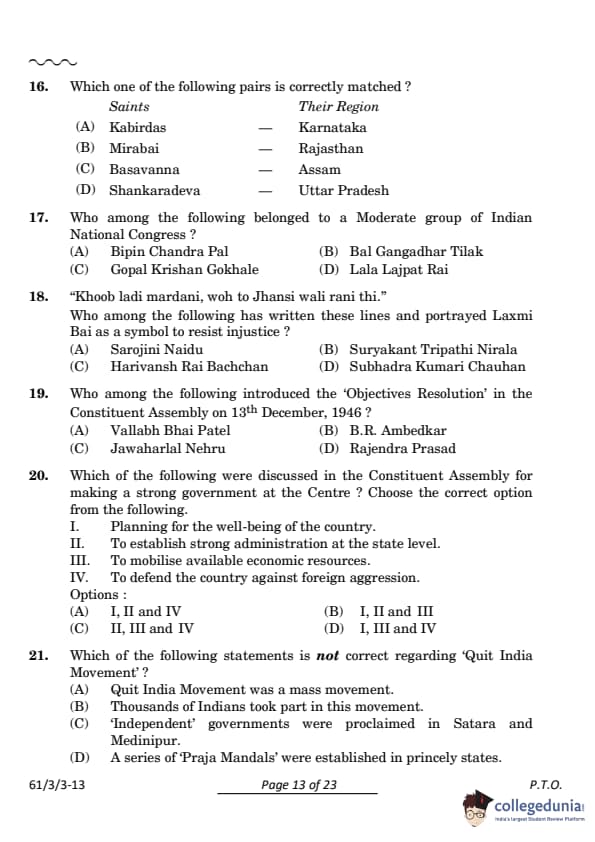
Which one of the following pairs is correctly matched?
| Saints | Their Region |
|---|---|
| (A) Kabirdas | Karnataka |
| (B) Mirabai | Rajasthan |
| (C) Basavanna | Assam |
| (D) Shankaradeva | Uttar Pradesh |
View Solution
Solution:
Mirabai and Rajasthan: Mirabai was a 16th-century Hindu mystic poet and a passionate devotee of Lord Krishna. She was a prominent figure in the Bhakti movement and spent most of her life in Rajasthan, composing devotional songs (bhajans) in the local language. She was born in the Merta region of Rajasthan and was married to Bhoj Raj, the crown prince of Mewar. Therefore, this is the correct match.
Kabirdas and Karnataka: Kabirdas was a 15th-century Indian mystic poet and saint. Though his teachings influenced the Bhakti movement, he is mainly associated with the region of Uttar Pradesh and Varanasi. He did not live in Karnataka.
Basavanna and Assam: Basavanna was a 12th-century philosopher, poet and a social reformer. He was a key figure of the Lingayat movement in Karnataka and not Assam.
Shankaradeva and Uttar Pradesh: Shankaradeva was a 15th-16th century saint who popularized the Vaishnava tradition in Assam, through a new form of theatre called Ankiya Nat. He did not belong to Uttar Pradesh.
Question 17:
Who among the following belonged to a Moderate group of Indian National Congress?
View Solution
Solution:
Gopal Krishna Gokhale: Gopal Krishna Gokhale was a prominent leader of the Indian National Congress who advocated a moderate approach towards achieving self-rule. He was a mentor to Gandhi and believed in constitutional methods and was not in favour of aggressive tactics.
Bipin Chandra Pal: Bipin Chandra Pal was an important leader of the extremist faction within the Indian National Congress, known for advocating more assertive methods to achieve Swaraj. He was a part of the trio Lal-Bal-Pal who advocated a more assertive approach.
Bal Gangadhar Tilak: Bal Gangadhar Tilak was another important leader of the extremist faction, and he advocated for Swaraj as a birthright through mass mobilization and protests. He was called 'Lokmanya' by the people.
Lala Lajpat Rai: Lala Lajpat Rai was also a part of the extremist wing of the Congress, known for his strong nationalistic views. He was a part of the famous Lal-Bal-Pal trio, and an important leader from the Punjab region.
Question 18:
"Khoob ladi mardani, woh to Jhansi wali rani thi.” Who among the following has written these lines and portrayed Laxmi Bai as a symbol to resist injustice?
View Solution
Solution:
Subhadra Kumari Chauhan: Subhadra Kumari Chauhan, a noted Indian poet and freedom fighter, wrote the poem “Jhansi Ki Rani”. This line is taken from her famous poem, which portrays Rani Laxmibai of Jhansi as a symbol of courage and resistance. It is a very popular poem that inspires and motivates people even today.
Sarojini Naidu: Sarojini Naidu was an Indian poet and a prominent leader during India's freedom struggle, but these specific lines are not from her works. She was known as the 'Nightingale of India' for her beautiful poems.
Suryakant Tripathi Nirala: Suryakant Tripathi Nirala, a notable Hindi poet, was not associated with the specific lines about the queen. He was known for his revolutionary and nationalist poems.
Harivansh Rai Bachchan: Harivansh Rai Bachchan was a well-known Hindi poet and writer known for his works like 'Madhushala', and he is not associated with this famous line about Rani Lakshmi Bai.
Question 19:
Who among the following introduced the ‘Objectives Resolution' in the Constituent Assembly on 13th December, 1946?
View Solution
Solution:
Jawaharlal Nehru: Jawaharlal Nehru introduced the ‘Objectives Resolution' in the Constituent Assembly. The resolution laid down the fundamental principles of the Constitution of Independent India. It declared India to be a sovereign, democratic republic and outlined the ideals of justice, liberty and equality that the constitution was intended to secure.
Vallabh Bhai Patel: Vallabhbhai Patel was an important leader of the Indian National Congress and was responsible for integration of the princely states. He also served in the Constituent Assembly but did not introduce the Objectives Resolution.
B.R. Ambedkar: B.R. Ambedkar, as the Chairman of the Drafting Committee, played a crucial role in drafting the Indian Constitution. He did not introduce the resolution.
Rajendra Prasad: Rajendra Prasad was the President of the Constituent Assembly. He was responsible for conducting its proceedings and did not introduce the objectives resolution.
Question 20:
Which of the following were discussed in the Constituent Assembly for making a strong government at the Centre? Choose the correct option from the following.
(A) I, II and IV
(B) I, II and III
(C) II, III and IV
(D) I, III and IV
View Solution
Solution:
I. Planning for the well-being of the country: The Constituent Assembly was highly focused on planning for the welfare of the country, and ensuring basic amenities to all sections of the society.
II. To establish strong administration at the state level: While the need for strong administration was a given, the assembly focused on establishing a strong centre rather than focusing on strong state governments.
III. To mobilize available economic resources: The focus of the assembly was to formulate policies that would help the country to mobilize and utilise economic resources for growth.
IV. To defend the country against foreign aggression: The need to establish a strong military defense was a high priority for the leaders of the time, given the geopolitical situation in the region.
Question 21:
Which of the following statements is not correct regarding ‘Quit India Movement'?
View Solution
Solution:
Quit India Movement as a mass movement: It is true that the Quit India Movement was one of the largest mass movements of India's freedom struggle. It saw participation from different sections of society all over the country.
Thousands of Indians Participation: Thousands of Indians from different walks of life took part in the movement, often braving police brutality and severe jail sentences.
Independent Governments: During the Quit India Movement, provisional independent governments were proclaimed in Satara in Maharashtra and in Medinipur in Bengal, indicating a breakdown of law and order.
Praja Mandals: The Praja Mandal movement was a separate movement in the princely states, which focused on democratization of their political systems and the demand for self-rule in these states. These were not directly associated with the Quit India Movement. Therefore, this statement is incorrect.
SECTION B
(Short Answer Type Questions)
Question 22(a):
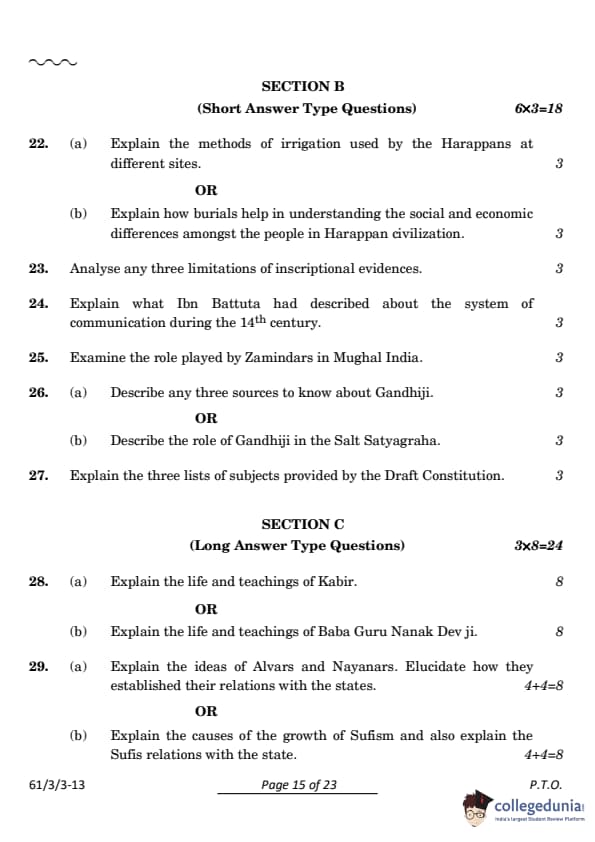
Explain the methods of irrigation used by the Harappans at different sites.
View Solution
Solution:
Semi-Arid Locations: Most Harappan sites were in semi-arid regions where regular rainfall was limited. This made irrigation necessary for continuous cultivation and food production.
Canals in Specific Areas: Traces of canals have been found at Shortughai in Afghanistan, but not in the main regions of Punjab and Sindh. These canals were mainly used for taking water from rivers to nearby fields. The lack of these in Punjab or Sindh may indicate that irrigation by other means was more feasible in these regions.
Use of Wells: Water was also drawn from wells and used for irrigation. This indicates that the civilization was technologically advanced and also understood the importance of well water for irrigation.
Water Reservoirs for Storage: At Dholavira, water reservoirs were found, primarily used to store water for agricultural use and also for other purposes.
Other Points: Other methods like embankments and small dams etc can also be mentioned as methods of irrigation used by them.
Question 22(b):
Explain how burials help in understanding the social and economic differences amongst the people in Harappan civilization.
View Solution
Solution:
Burial pits: Most of the burials of the Harappan civilization took place in simple pits that were dug into the ground. The variability in size, shape and location indicated variability in social classes.
Differentiation in Pits: Some pits had differences in terms of their construction. Sometimes, the pits were lined with bricks, which may indicate the importance or high social standing of the deceased.
Pottery and Ornaments: Some of the burials contained pottery and ornaments, which indicates a belief in the afterlife, and also shows the daily use items of the deceased. The quantity and quality of such items may also indicate the social class of the deceased.
Jewellery in Graves of Both Sexes: The presence of jewellery in the graves of both men and women suggests that both genders were respected and probably had a similar social standing. The type and quantity of jewellery varied according to the social standing of the deceased.
Burial With Precious Items: Some burials also included copper mirrors and jasper beads, which indicates that these individuals may have had access to luxury items, which indicates social stratification.
Lack of Precious Items: In general, Harappan burials lack large quantities of precious items, which indicates that the people did not put much emphasis on burying wealth. It may also indicate a comparatively egalitarian society.
Other Points: Any other relevant points can be mentioned which highlight that there may have been social and economic differences among the people.
Question 23:
Analyse any three limitations of inscriptional evidences.
View Solution
Solution:
Faintly Engraved Letters: Letters in the inscriptions are usually faintly engraved. Over time, they become difficult to read, and therefore, their interpretations and reconstructions can be uncertain.
Damage and Missing Letters: Inscriptions often get damaged because of weather conditions and over time, and sometimes the letters get missing which makes it difficult to interpret the text accurately.
Meaning of Words: It is not always easy to understand the actual meaning of the words used in the inscriptions because the language might be obsolete, and may have lost meaning over time.
Decipherment and Translation: All the inscriptions are not deciphered, published and translated which can make them inaccessible to historians.
Limited Information: Everything that was considered politically or economically significant may not have necessarily been recorded in the inscriptions. The inscriptions primarily focus on the rulers' activities and other key aspects.
Perspective of the Commissioning Authority: The inscriptions often project the perspective of the person who commissioned them, which may not always be an objective view. Therefore, they may not reflect the views of the general population.
Other Points: Any other relevant points.
Question 24:
Explain what Ibn Battuta had described about the system of communication during the 14th century.
View Solution
Solution:
Efficiency of the Postal System: Ibn Battuta was amazed at the speed and efficiency of the postal system in India during the 14th century. He mentions that it was much faster and well-organized.
Information and Credit: The postal system also allowed merchants to send information, as well as remit credit over long distances, which shows its importance in both communication and finance.
Speedy Goods Dispatch: The system could dispatch goods at short notice which indicates a dynamic network for supply and delivery.
Reach and Timeliness: Ibn Battuta mentions that news reports of spies from Sindh would reach the Sultan in Delhi in just five days, showing the speed and timeliness of the communication system, which took 50 days for other travelers.
Two Postal Systems: He notes two kinds of postal systems, which were the horse-post and the foot-post. The horse-post was called “uluq”.
Horse-Post System: The horse-post was run by royal horses which were stationed at a distance of every four miles.
Foot-Post System: The foot-post was called “dawa”, and this covered a distance of one-third of a mile.
Pavilions and Men: Every third of a mile there were villages with pavilions in which men were kept ready to run.
Rod and Bells: The couriers carried a rod with copper bells at the top.
Transferring the Letter: When the courier starts from the city he holds the letter in one hand and the rod with the bells in the other, and when the men in the pavilion hear the bell they get ready.
Continuous Process: As the courier reaches the next point, they transfer the letter and run at top speed, making this a continuous system till the letter reaches its destination.
Foot Post Faster than Horse Post: The foot-post was quicker than the horse-post.
Transport of Goods: Foot posts were also often used to transport fruits of Khurasan which were desired in India.
Other Points: Any other relevant points can be mentioned which highlight the efficiency of the system.
Question 25:
Examine the role played by Zamindars in Mughal India.
View Solution
Solution:
Social and Economic Privileges: Zamindars were landlords who enjoyed certain social and economic privileges and had a high position in society.
Caste as a Factor: Caste was often a factor that influenced their elevated status, and thus, often higher castes had greater access to land and social position.
Services to the State: The Zamindars performed certain services (khidmat) on behalf of the state, which included revenue collection and maintaining local order.
Tax Collection: They collected taxes from the peasants and they were powerful due to this.
Personal Lands: The zamindars held large personal lands which were called 'milkiyat'.
Cultivation of Milkiyat: Milkiyat lands were cultivated for the private use of zamindars using hired labour.
Fortresses and Contingent: Most zamindars had fortresses as well as an armed contingent which was meant to protect their property and also their own authority.
Upper Caste: The Zamindars usually belonged to the upper castes or the so-called 'Intermediate' castes of the time.
Source of Some Zamindaris: Contemporary documents give an impression that conquest may have been a source of the origin of some zamindaris.
Dispossession of Weaker Groups: The dispossession of weaker people was also sometimes a way of expanding zamindari.
Colonization of Agricultural Land: Zamindars spearheaded the colonization of agricultural land, and also helped in settling cultivators.
Sale of Milkiyat Produce: Zamindars sold the produce from their milkiyat lands, thereby acting as important trading agents.
Established Markets: Zamindars also established local markets (haats), where peasants also came to sell their produce.
Relationship with Peasants: The relationship between the Zamindar and peasants involved reciprocity, patronage, and paternalism.
Support of Peasants: The Zamindars also often received the support of the peasantry in their struggle against the state, which shows the complexity of the relations between different sections of the society.
Not Exploitative According to Bhakti Saints: The Bhakti saints often said that they were not exploitative towards the peasants.
Part of Village Panchayats: They were also a part of the village panchayats, as key decision-makers.
Helping in Times of Distress: They also often helped peasants in times of distress, which indicates a complex and varied relationship with local communities.
Other Points: Any other relevant points that describe the role of zamindars may also be mentioned.
Question 26(a):
Describe any three sources to know about Gandhiji.
View Solution
Solution:
Writings and Speeches: Gandhiji's writings, his speeches and the letters he wrote to his contemporaries are important sources which provide insights into his thoughts, his actions, his ideals and his strategies during his lifetime.
Journals Like Harijan: Gandhiji wrote in the journals such as “Harijan", which give us insights into his perspectives on social and political issues of his time.
Autobiographies and Biographies: Many biographies and autobiographies written by or about Gandhiji provide insights into his life and ideas. The most notable one is his autobiography, “My Experiments with Truth", which provides details of his personal life, spiritual journey and political career.
Government Records and Police Reports: Government records and police reports provide details about his movements and his impact on the people during the freedom struggle.
Fortnightly Reports by the Home Department: Fortnightly reports prepared by the Home Department of the colonial government provide useful perspectives on his political activities and their impact on the Indian public.
Newspapers Published in English: Newspapers published in English also provide insight into his actions, his thoughts and how he was portrayed during the colonial period.
Newspapers Published in Other Languages: Newspapers published in other languages also provide important perspectives of his activities from different regional lenses.
Question 26(b):
Describe the role of Gandhiji in the Salt Satyagraha.
View Solution
Solution:
Call for Satyagraha: Gandhiji called for a nationwide civil disobedience movement against the salt laws of the British, highlighting the importance of salt for everyone, as well as the injustice of the colonial policies.
Dandi March: Gandhiji, along with his supporters, began the Dandi March, in which they walked all the way to the coastal town of Dandi to make their own salt.
Disobeying the Law: The civilians across the country disobeyed the salt law by making salt in their own homes, and by buying salt from salt makers, thus challenging the authority of the colonial government.
Resignation of Local Officials: Gandhiji called upon local officials to resign from their government jobs and join the freedom movement, thereby creating a more widespread resistance.
Other Points: Any other relevant points related to Gandhiji's role in the salt satyagraha can also be mentioned.
Question 27:
Explain the three lists of subjects provided by the Draft Constitution.
View Solution
Solution:
Union List: This included subjects under the control of the Central government. This included subjects like defense, foreign affairs, banking, railways, currency etc.
State List: The state list included subjects that were under the control of the State government, like police, agriculture, health, education, etc.
Concurrent List: The concurrent list had subjects on which both the central and the state governments could make laws, which included education, forests, trade unions etc.
Residuary Powers with the Union: Many important subjects, like minerals and key industries, were under the exclusive control of the union government, which ensured the dominance of the central government over the state.
Article 356: The Union government was also given powers under Article 356 to take over a state's administration on the recommendation of the Governor, showing the dominance of the Centre.
Other Points: Any other relevant aspects related to the three lists can be mentioned.
SECTION C
(Long Answer Type Questions)
Question 28(a):
Explain the life and teachings of Kabir.
View Solution
Solution:
Life of Kabir:
Birth and Upbringing: Kabir was born in Varanasi in the late 14th or early 15th century and was raised in a family of Muslim weavers. His date of birth and other historical facts about his life are subject to debate.
Diverse Background: Though his upbringing was in a Muslim family, he was also exposed to Hindu teachings, which provided a rich base for his teachings.
Nirguna Saint: Kabir was a Nirguna saint who did not believe in worshipping a deity with a specific form.
Influence of Bhakti and Sufi Ideals: He was greatly influenced by both Bhakti and Sufi ideals. He tried to bring together these different traditions in his poems and teachings.
Teachings of Kabir:
Compiled Verses: Kabir's verses are compiled in texts like ‘The Kabir Bijak', 'Kabir Granthavali' and the Adi Granth Sahib, which are popular among his followers.
Multiple Languages: His poems are found in several languages and dialects which makes his message more accessible to people from different backgrounds.
Sant Bhasha: Some of his poems are composed in the 'sant bhasha', or the language used by nirguna poets.
Mystical Experiences: Kabir's mystical experiences attempted to describe the ultimate reality. His verses are used by many to seek a connection with the divine.
Syncretic Approach: Kabir tried to describe the Ultimate Reality based on the Islamic, Vedantic and Yogic traditions, which reflects his syncretic approach.
Conflicting Ideas: Diverse and even conflicting ideas are expressed in his poems which makes them a complex source to analyse.
Monotheism and Iconoclasm: His poems draw on Islamic ideas such as monotheism, which is the belief in one god, and also promotes iconoclasm which means rejection of idol worship.
Zikr, Ishq and Nam Simaran: He emphasized the importance of zikr (remembrance) and ishq (love) for God. He also emphasized on ‘nam-simaran' (recitation of the name of the God).
Against Caste System: He was against the caste system and discrimination based on birth and status. His teachings focused on social equality.
Critical of Rituals and Idol Worship: He was also very critical of rituals and idol worship, which he saw as a way of distraction from real devotion.
Critique of Both Hinduism and Islam: Kabir was equally critical of both Hinduism and Islam. His main focus was on devotion, morality and love for humanity and not specific faiths.
Source of Inspiration: Kabir is still a source of inspiration for many people even today, because of his humanistic approach.
Use of Guru and Satguru: The verses attributed to Kabir use the words guru and satguru (true teacher) often, highlighting the importance of a teacher.
Question 28(b):
Explain the life and teachings of Baba Guru Nanak Dev ji.
View Solution
Solution:
Life of Baba Guru Nanak Dev Ji:
Founder of Sikhism: Guru Nanak Dev Ji was the founder of Sikhism. He was born in 1469 in Talwandi (present-day Nankana Sahib, Pakistan).
Advocated Nirguna Bhakti: Guru Nanak advocated Nirguna Bhakti, where the focus was on worshipping God without any specific image.
Teachings of Baba Guru Nanak Dev Ji:
Rejection of External Practices: He rejected the external practices of the religion, emphasizing inner devotion.
Rejection of Rituals: He also rejected sacrifices, ritual baths, and image worship.
Rejection of Scriptures of Both Religions: He rejected the scriptures of both Hinduism and Islam. He believed in a universal God and did not accept the authority of specific scriptures.
Absolute Rab: For him, the Absolute or ‘Rab' had no gender or form, which means that his concept of God was abstract and universal.
Connection to the Divine: He promoted the idea of connecting to the divine by repeating and remembering the name of Rab, and this laid the foundation for the Sikh method of remembering God.
Congregational Worship: He set up rules for congregational worship which was called 'Sangat'.
Hymns called Shabad: He expressed his ideas through hymns called ‘Shabad' which are sung even today.
Ragas and Rabaab: Baba Guru Nanak would sing these compositions in various ragas and his attendant Mardana would play Rabaab.
Adi Granth Sahib: His hymns are compiled in the 'Adi Granth Sahib' which later became the central text of the Sikh tradition.
No New Religion: Though Baba Guru Nanak did not wish to establish a new religion, but after his death his followers consolidated his practices.
Distinguishing from both Hinduism and Islam: His followers were very distinct from both Hindus and Muslims, as they promoted and created a different path.
Other Points: Any other relevant points can be included.
Question 29(a):
Explain the ideas of Alvars and Nayanars. Elucidate how they established their relations with the states.
View Solution
Solution:
Ideas of Alvars and Nayanars:
Against Caste System: Alvars and Nayanars initiated a movement against the caste system, and promoted a society based on devotion and not caste and birth.
Criticism of Brahmin Dominance: They criticized the dominance of the Brahmins and the hierarchical social structure of the time.
Attempt to Reform the System: They attempted to reform the religious and social system and bring equality among the people.
Importance of their Compositions: They also emphasized that their compositions were as important as Vedas, thus challenging the orthodox understanding of religion.
Tamil Veda: Their anthology, 'Nalayira Divya Prabhandham' was often described as the Tamil Veda, highlighting the importance of their literature for the people.
Women Participation: One of the key features was the presence of women in this movement, thus creating an inclusive religious space.
Andal: Andal was an Alvar saint who considered herself to be the beloved of Vishnu.
Karaikkal Ammaiyar: Karaikkal Ammaiyar was a Nayanar who was a devotee of Shiva, which shows diversity in their traditions.
Other points: Any other relevant point that highlights their ideals and methods.
Relations with the States:
Cordial Relations with Rulers: There were many instances of the Alvars and Nayanars having cordial relations with the rulers and their courts.
Royal Patronage: The rulers also provided them royal patronage, and provided them with funds and grants for their maintenance and for propagating their message.
Temple Grants: The Cholas gave grants for building Vishnu and Shiva temples, and thus supported the building of these key religious centres.
Temples under Patronage: Important temples at Thanjavur, and Chidambaram were built under the patronage of Chola rulers, which highlights their support for these devotional traditions.
Claiming Divine Support: The Chola rulers often claimed divine support, which highlights the role of religious leaders for establishing power.
Display of Power: Rulers proclaimed their power by building splendid temples which shows a mix of religion and political power.
Introduction of Hymns: These kings also introduced the singing of Tamil hymns as a means of worship and devotion.
Organization of Texts: They organized these hymns into a text called Tevaram.
Installation of Metal Images: The Chola ruler Parantaka I consecrated metal images of saints like Appar, Sambandar and Sundarar in a Shiva temple, to make them key symbols of both religious and political authority.
Other points: Any other relevant point that highlight their relationship with the state.
Question 29(b):
Explain the causes of the growth of Sufism and also explain the Sufis relations with the state.
View Solution
Solution:
Causes of the Growth of Sufism:
Protest Against Materialism: Sufism grew as a protest against the growing materialism of the Caliphate, which had become focused on wealth accumulation.
Critical of Dogmatic Interpretations: They were also critical of the rigid and dogmatic interpretation of Quran and Sunna. They wanted a more flexible approach to religion.
Emphasis on Love for God: Instead, they emphasized on seeking salvation through intense devotion and love for God. They promoted the more emotional aspect of devotion.
Following the Command of the Prophet: Sufis followed the command of the Prophet, but also combined it with their individual mystical experience.
Perfect Human Being: They considered the Prophet as the perfect human being, and the ideal path for devotion was to focus on his teachings.
Interpretation based on Personal Experience: They also sought interpretations of the Quran based on their own personal experience. This focus on individual experience was one of their most important teachings.
Developed Movement: By the eleventh century, Sufism had developed into a well-established movement with different lineages and traditions.
Other Points: Any other valid point may also be included.
Sufi Relations with the State:
Development of Literature and Practices: The Sufis developed their own literature and Sufi practices which were followed by their disciples.
Austerity and Distance: The Chishti tradition maintained a distance from worldly power and emphasized austerity, which separated them from the political elites.
Acceptance of Unsolicited Grants: They accepted unsolicited grants from the political elites, which allowed them to maintain their own independence.
Charitable Trusts by Sultans: The Sultans also set up charitable trusts as endowments for hospices and granted tax-free land which helped the Sufis.
Demonstration of Association: The Sultans often demonstrated their association with Sufis, to legitimize their power.
Resistance to Shariat Laws: The Delhi Sultan also resisted the ulema's insistence on imposing Shariat law as state law, indicating their independence from the Ulema.
Seeking Authority From God: The Sultans sought support from Sufis, who were seen to derive their authority directly from God, and thus legitimizing the power of the Sultans.
Tombs in the Vicinity of Shrines: Kings wanted to build their tombs near the shrines of Sufi saints and hospices.
Conflict with Sultans: There were many instances of conflict between Sultans and Sufis, which indicates the complexities of this relationship.
High-Sounding Titles: Sufi Shaikhs were given high-sounding titles like Sultan-ul-Mashaikh, highlighting their authority.
Rituals and Authority: To show authority both sultans and Sufis expected rituals of prostration and kissing of the feet.
Other points: Any other relevant points that describe the relation between the state and the Sufis can be mentioned.
Question 30(a):
Examine the factors that influenced the implementation of the Permanent Settlement in Bengal and its consequences.
View Solution
Solution:
Factors Influencing the Implementation of the Permanent Settlement in Bengal:
Addressing Revenue Collection Issues: The British East India Company faced challenges in revenue collection in Bengal after acquiring the Diwani rights. They hoped that the Permanent Settlement would stabilize and increase revenue collection. They needed a method to maximize their income and also avoid rebellions.
Experimenting with Fixed Revenue: The British were experimenting with different land revenue methods, including the permanent settlement. The initial revenue demands were very high, which in hindsight, the company itself realized that it was unsustainable.
Encouraging Investment in Agriculture: British officials thought that the key was to make agriculture more productive and for that they needed investment in agriculture and trade, which was only possible if property rights were given to the landlords.
Securing Property Rights for Zamindars: The officials also believed that securing property rights and permanently fixing the rates of revenue demand was essential to encourage investment and agricultural development. Zamindars would then act as a bridge between the peasants and the government.
Guaranteeing Regular Income: A fixed revenue demand was expected to ensure a regular and predictable flow of income to the company. This was important for the Company as it needed a constant income for trade and other expenses.
Curtailing the Power of Zamindars (Initially): Initially, the Permanent Settlement was meant to curtail the power of the zamindars. However, as time passed, they became more influential in controlling land and peasants. This also highlights the flaws in their planning.
Creating Yeoman Farmers (Unfulfilled): The British hoped for the emergence of a class of yeoman farmers and rich landowners who would have the capital and enterprise to improve agriculture and thus make the British land revenue policies more sustainable and long-lasting. This was not to be the case.
Controlling and Regulating Zamindars: The British recognised the zamindars to be important, but they also wanted to regulate and control them for better governance. In practice, however, this did not materialize.
Ensuring Loyalty: The British also expected that the zamindars, who were essentially nurtured by the British system would be loyal to the Company, thus providing another way to increase control and influence.
Consequences of the Permanent Settlement:
Fixed Revenue for Zamindars: The East India Company fixed the revenue that each zamindar had to pay. This created a permanent tax burden on the zamindars.
Auction of Estates for Non-Payment: The estates of those zamindars who failed to pay the revenue were auctioned off to recover the dues.
Loss of Power by Zamindars: Zamindars lost their traditional power to organize local justice, and this also impacted their social and political power.
Regular Failure of Payment by Zamindars: The zamindars regularly failed to pay the fixed revenue, which highlighted the failure of the system. The amount was not sustainable for many of them, and the system lacked a mechanism to account for crop failures and other agricultural setbacks.
Emergence of a Loyal Zamindar Class: The British were successful in creating a loyal class of zamindars who were mostly loyal to the British government. They became important for the Company's influence.
Accumulation of Unpaid Balances: The rigid nature of the system led to large amounts of unpaid revenue balances, which further made the system unsustainable for both the zamindars and the government.
Disbanding of Zamindari Troops: The zamindars were forced to disband their own troops, leading to a decline in their power.
Abolished Customs Duties: Traditional customs duties were abolished in the region, and this also impacted local traders and merchants.
Collectorate Supervision of Courts: The “cutcheries” were brought under the supervision of a Collector appointed by the Company.
Collectorates as New Authority: The collectorate emerged as an alternative centre of authority which further restricted what the zamindar could do, leading to a loss of power for local landowners and a centralization of authority.
Question 30(b):
"The jotedars became powerful figures in many areas of North Bengal during the end of the 18th century.” Examine the statement.
View Solution
Solution:
Consolidation of Position: In the late 18th century, a group of rich peasants were consolidating their position in the villages of North Bengal, slowly becoming the most influential community of the region.
Vast Land Ownership: Jotedars acquired vast areas of land, sometimes as much as several thousand acres. This demonstrates their power and economic well-being and was the backbone of their rise in the region.
Control over Local Economy: They controlled local trade as well as moneylending, which increased their influence over the region and made it difficult for local peasants and the common people to operate independently.
Power over Cultivators: A large part of their land was cultivated through sharecroppers. They exercised immense power over the poor cultivators and their livelihoods, which highlighted the hierarchical social structure that they represented.
Greater Influence than Zamindars: The power of jotedars was more effective than that of the zamindars in some cases. This highlights a transfer of power from the traditional landlords to a new agrarian class.
Direct Control Over Villagers: The jotedars were located in the villages, which allowed them to control and influence a substantial portion of poor villagers directly.
Resistance to Zamindars: They fiercely resisted efforts by zamindars to increase the revenue, which highlights their political and economic power.
Preventing Zamindari Officials: They also prevented zamindari officials from performing their duties effectively in their villages.
Mobilizing Raiyats: They mobilized “raiyats” or dependent cultivators, and deliberately delayed revenue payments to the zamindars.
SECTION D
(Source-Based Questions)
Question 31:
Read the given source carefully and answer the questions that follow:
What the silk weavers did
Here is an excerpt from the inscription, which is in Sanskrit : Some are intensely attached to music (so) pleasing to the ear; others, being proud of (the authorship of ) a hundred excellent biographies, are conversant with wonderful tales; (others), filled with humility, are absorbed in excellent religious discourses; ... some excel in their own religious rites; likewise by others, who were self-possessed, the science of (Vedic) astronomy was mastered.
31.1 How was love for music expressed in the inscription?
View Solution
Solution: The inscription expresses a deep attachment to music, stating that some people are “intensely attached” to it. This signifies that they had a deep emotional and cultural attachment to music, and it was something that was very significant to them.
It also highlights that music is “pleasing to the ear”, which demonstrates that they found joy and delight in it, and also valued music as an art form which could provide pleasure to people.
31.2 How did individuals demonstrate their mastery in the science of Vedic astronomy?
View Solution
Solution: The inscription emphasizes that individuals were able to demonstrate their mastery in Vedic astronomy through self-possession. The emphasis on self-possession indicates the importance of discipline, focused thinking and control for learning astronomy. It also highlights the idea that through self-possession they could master their craft.
31.3 In what ways did the various talents mentioned in the inscription contribute to the overall fabric of society?
View Solution
Solution:
Development of Diverse Skills: The inscription shows that the society was not homogenous and encouraged diverse skills such as music, writing, religious discourse, and Vedic astronomy. This was a society that valued diversity in terms of skills and talents.
Division of Labor and Occupations: The diverse skills indicate that the society had different occupations and forms of livelihood, thus pointing towards an existence of division of labor and an advanced civilization.
Intermingling of Traditions and Culture: The different skills mentioned in the text points to intermixture of different traditions and cultures, which highlights that the society was inclusive and encouraged both secular and religious knowledge.
Promoting Tolerance and Harmony: The mention of diverse talents and traditions reveals a society which was tolerant and harmonious and valued different types of learning and abilities.
Development of Social Values: The emphasis on self-possession as the means to master Vedic Astronomy indicates the importance they placed on values like focus, discipline and the quest for knowledge.
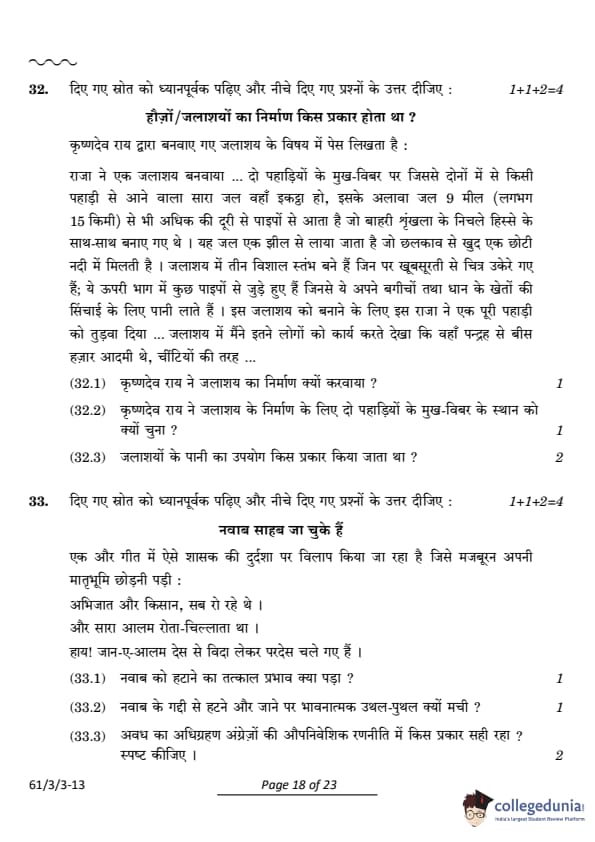
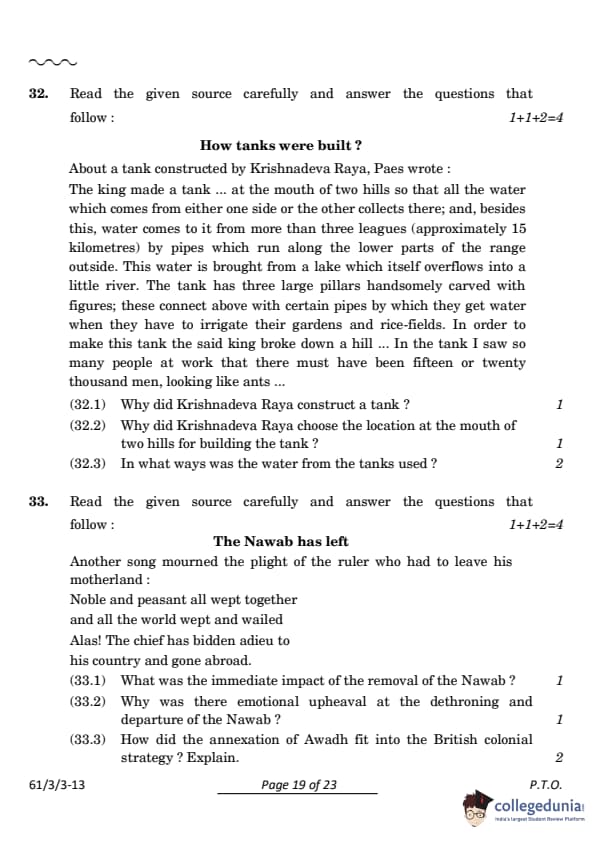
Question 32:
Read the given source carefully and answer the questions that follow:
How tanks were built?
About a tank constructed by Krishnadeva Raya, Paes wrote: The king made a tank at the mouth of two hills so that all the water which comes from either one side or the other collects there; and, besides this, water comes to it from more than three leagues (approximately 15 kilometres) by pipes which run along the lower parts of the range outside. This water is brought from a lake which itself overflows into a little river. The tank has three large pillars handsomely carved with figures; these connect above with certain pipes by which they get water when they have to irrigate their gardens and rice-fields. In order to make this tank the said king broke down a hill ... In the tank I saw so many people at work that there must have been fifteen or twenty thousand men, looking like ants...
32.1 Why did Krishnadeva Raya construct a tank?
View Solution
Solution: The primary reason for the construction of the tank, based on the source, was for water collection, as it states that “all the water which comes from either one side or the other collects there." It also mentions the fact that the water was brought to irrigate their gardens and rice fields, indicating another objective was to facilitate agriculture and economic production.
32.2 Why did Krishnadeva Raya choose the location at the mouth of two hills for building the tank?
View Solution
Solution: The source mentions that this specific location was chosen at the mouth of two hills because it would enable all the water coming from both sides to get accumulated at one place. This makes it a practical choice for a water reservoir. The fact that water was brought from a lake via pipes, indicates that the location was convenient for bringing water from different sources.
32.3 In what ways was the water from the tanks used?
View Solution
Solution: The source clearly mentions that the water from the tank was used to irrigate the gardens and rice fields, which was critical for agriculture and food production. The text also mentions that pipes were used to distribute water which indicates the distribution of water in the city for domestic use.
Question 33:
Read the given source carefully and answer the questions that follow:
The Nawab has left
Another song mourned the plight of the ruler who had to leave his motherland : Noble and peasant all wept together and all the world wept and wailed Alas! The chief has bidden adieu to his country and gone abroad.
33.1 What was the immediate impact of the removal of the Nawab?
View Solution
Solution: The immediate impact of the removal of the Nawab was deep sorrow and grief amongst the people of Awadh. They wept and wailed due to this. The phrases ‘Noble and peasant all wept together' also highlights that all sections of society were equally affected and were unhappy at his departure. The phrase 'all the world wept' implies widespread mourning and a collective sense of loss.
33.2 Why was there emotional upheaval at the dethroning and departure of the Nawab?
View Solution
Solution: The text points towards a very emotional connection of the people with the ruler, highlighting that the people were ‘greatly annoyed’ by his dethroning and departure. The text uses the phrase 'soul had gone out of the body' which demonstrates the emotional attachment that the people had for their ruler, considering him to be their 'chief' or their 'leader'. The mention of a ‘chief’ highlights the cultural and emotional bond that people had with the ruler, who was regarded as a father figure.
33.3 How did the annexation of Awadh fit into the British colonial strategy? Explain.
View Solution
Solution: The text does not directly mention the annexation strategy. However, the text indicates a sense of loss and dispossession on the part of the ruler and his subjects. This indicates that the British were focused on extending their territorial control and influence. The forced departure and deep sorrow felt by the people clearly highlight that the annexation was done against the wishes of the local population. The text indicates that the people were unhappy by the departure of their leader, which implies that British were imposing themselves upon them.
SECTION E
(Map-Based Question)
Question 34:
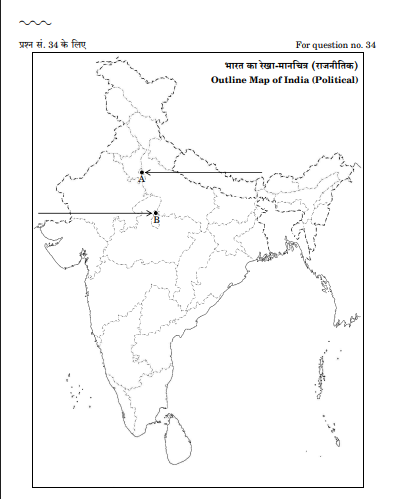
34.1 On the given political outline map of India (on page 23), locate and label the following with appropriate symbols:
(i) Dholavira – a Harappan site
(ii) Meerut Pillar – a site of Asokan inscription
(iii) (A) Vijayanagara
OR
(iii) (b) Bijapur
View Solution
Solution:
(i) Dholavira – a Harappan site: Dholavira is located in the Kutch district of Gujarat. You should mark the location in the upper portion of Gujarat, near the Rann of Kutch. The location should be indicated with the right symbol and its name should also be written near it. It was one of the largest cities of the Indus Valley Civilisation and was a major trade and industrial centre.
(ii) Meerut Pillar – a site of Asokan inscription: The Meerut pillar is located in the city of Meerut in Uttar Pradesh. You should mark this in the map close to Delhi, in the state of Uttar Pradesh. It is a site known for its Ashokan pillar with the inscriptions by the Mauryan king Ashoka. The location should be indicated with the correct symbol and the name should also be written.
(iii)(A) Vijayanagara: Vijayanagara was the capital city of the Vijayanagara Empire. The city is located in present-day Hampi, Karnataka, and you should mark it in the south-central portion of the map, in the state of Karnataka. The location should be indicated with the correct symbol and its name should also be written. It was a large city, which was a major center for trade and political administration.
OR
(iii)(b) Bijapur: Bijapur is a historical city located in Karnataka. The city is located in the northern part of Karnataka. You should mark the location in the map, close to the state of Maharashtra using the right symbol, and write its name near it. It was a major centre of the Adil Shahi Dynasty and was known for its architecture.
34.2 On the same political outline map of India, two places related to British control in 1857 are marked as A and B. Identify them and write their correct names on the lines drawn near them.
Any two Centers under the control of British from the given list.
(A) Delhi
(B) Jhansi
View Solution
Solution:
(A) Delhi: Delhi was a major centre of the 1857 Revolt and the British held it to be one of the most important cities in the country, and was the capital of the British administration. You should identify the place indicated by the letter 'A' on the map and write its name on the line near it. Delhi was a major center of the revolt and of the British administration, and its recapture was very important for the British.
(B) Jhansi: Jhansi was another key site of the revolt of 1857 and was an important city of Bundelkhand region, which was a key site for local rebellion against the British. You should identify the place indicated by the letter 'B' on the map and write its name on the line near it. It was a strong hold of Rani Lakshmi Bai who actively participated in the revolt of 1857 against the British.
Note: The following questions are for the Visually Impaired Candidates, only in lieu of Q. No. 34 :
34.1 Name any one Harappan site.
View Solution
Solution: You can mention any Harappan site like Kalibangan, Banawali, Rakhigarhi, Lothal, Kotdiji, Chanhudaro, Balakot, Dholavira, Nageshwar, Rangpur, Mohenjodaro, and Harappa.
34.2 Mention any one Buddhist site.
View Solution
Solution: You can mention any Buddhist site like Sanchi, Amravati, Nagarjunkonda, Sarnath, Shravasti, Lumbini, Kushinagar, and Bodhgaya.
34.3 (A) Name the capital city of Vijayanagara Empire.
View Solution
Solution: The capital city of Vijayanagara Empire was Hampi, also sometimes called Vijayanagara.
OR
34.3 (b) Mention any one neighbouring state of the Vijayanagara Empire.
View Solution
Solution: You can mention any one neighboring state of the Vijayanagara Empire like Bijapur, Golkonda, Bidar, Ahmadnagar, and Berar.
34.4 Mention any two cities which were under the British control during 1857.
View Solution
Solution: You can mention any two cities which were under the control of the British during the 1857 revolt like Delhi, Jhansi, Gwalior, Lucknow, and Kanpur.












Comments