




CBSE Class 12 History Set 3 Question Paper PDF (Code: 61/4/3) is now available for download. CBSE conducted the Class 12 History examination on March 28, 2024, from 10:30 AM to 1:30 PM. The question paper consists of 34 questions carrying a total of 80 marks. Section A includes 21 MCQs for 1 mark each, Section B contains 6 short-answer questions for 3 marks each, Section C comprises 3 long-answer questions for 8 marks each, Section D comprises 3 Source-based questions having three sub-questions carries 4 marks each and Section E comprises 1 Map-based question that carries 5 marks.
Candidates can use the link below to download the CBSE Class 12 History Set 3 Question Paper with detailed solutions.
CBSE Class 12 History Question Paper 2024 (Set 3- 61/4/3) with Answer Key
| CBSE Class 12 2024 History Question Paper with Answer Key |  Download Download |
Check Solution |
CBSE Class 12 2024 History Questions with Solutions
SECTION A
(Multiple Choice Type Questions)
CBSE 12 History SET-3 (61/4/3) Question Paper with Solutions
Question 1:
Who among the following was the first Director General of Archaeological Survey of India (A.S.I.)?
View Solution
Solution:
Alexander Cunningham: Alexander Cunningham was a British engineer and archaeologist. He is known as the father of Indian archaeology. He was appointed as the first Director-General of the Archaeological Survey of India (ASI) in 1871. His work involved extensive surveys and documentation of various historical sites throughout India, and played a crucial role in the early organization of archaeology in India.
S.N. Roy: S.N. Roy was an Indian archaeologist, not the first Director-General. He made valuable contributions but was not the founder of the ASI.
John Marshall: John Marshall was another important archaeologist. He served as the Director-General of the ASI from 1902 to 1928. His contributions are particularly noted for his work at sites such as Mohenjo-Daro and Harappa, which were key in uncovering the Indus Valley Civilization.
Daya Ram Sahni: Daya Ram Sahni was an Indian archaeologist who played a vital role in the excavations at Harappa, another important site of the Indus Valley civilization, but he was not the first Director-General of the ASI.
Question 2:
Match Column-I with Column-II and choose the correct option from the following:
| Column-I (Harappan Sites) | Column-II (Present region) |
|---|---|
| I. Manda | a. Gujarat |
| II. Rakhigarhi | b. Rajasthan |
| III. Nageshwar | c. Haryana |
| IV. Kalibangan | d. Jammu |
View Solution
Solution:
I. Manda – d. Jammu: Manda is a Harappan site located in the Jammu region, making it the northernmost site of the Indus Valley Civilization. Its location provides valuable insights into the geographical reach of the Indus Valley Civilization.
II. Rakhigarhi – c. Haryana: Rakhigarhi is an important Harappan site in Haryana. It is known for being one of the largest sites of the Indus Valley Civilization.
III. Nageshwar – a. Gujarat: Nageshwar is a Harappan site located in Gujarat, primarily known for being a bead-making site and a coastal settlement. Its importance lies in its links to the trade routes along the Arabian Sea.
IV. Kalibangan – b. Rajasthan: Kalibangan is located in Rajasthan. This site is known for its fire altars and ploughed field.
Question 3:
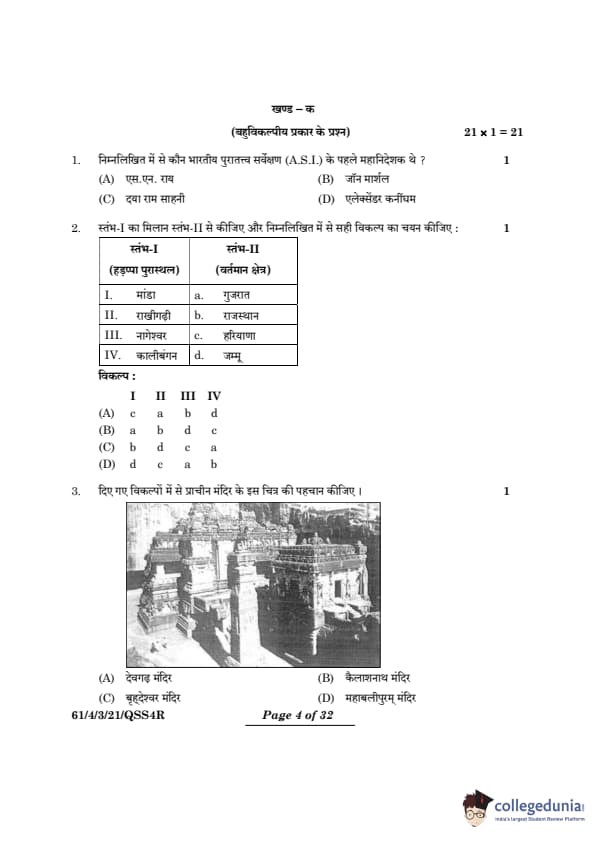
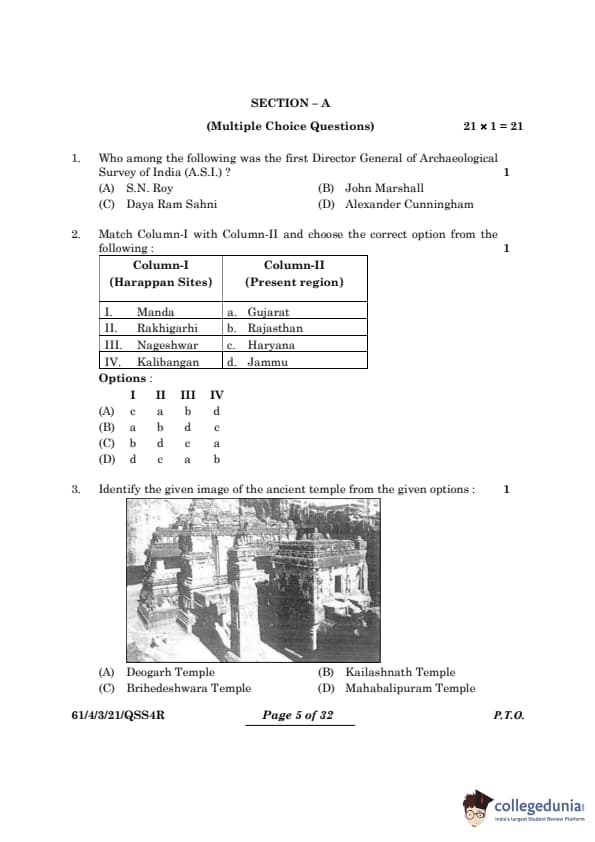
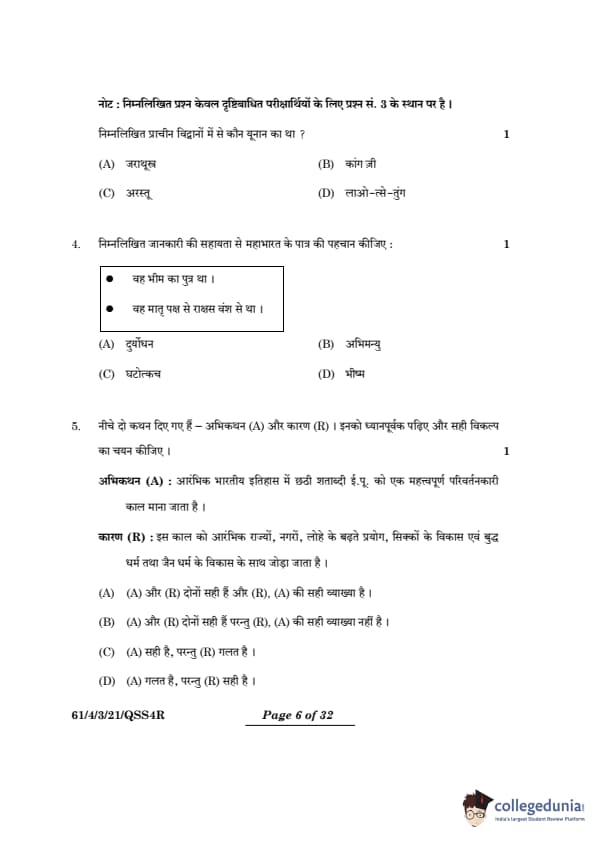
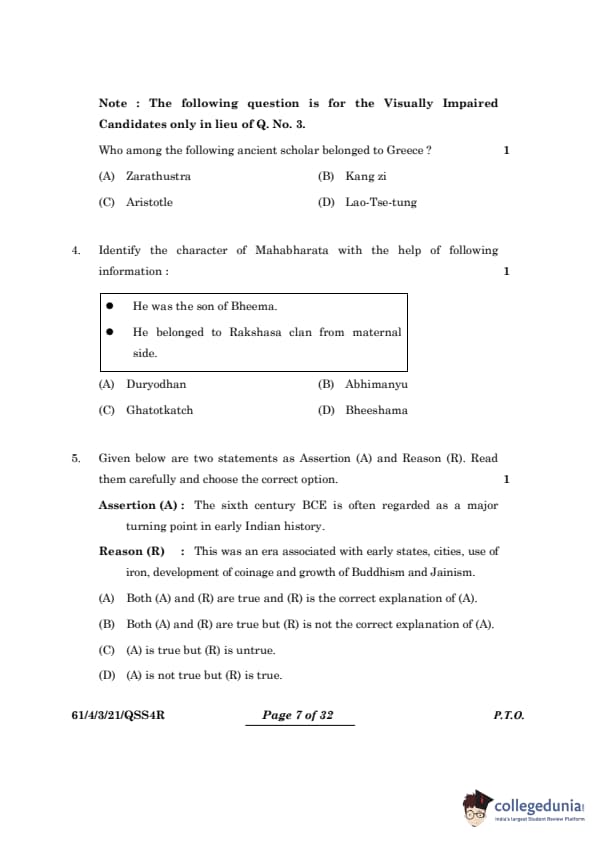
Identify the given image of the ancient temple from the given options:
![[Image of Kailashnath Temple]](https://assets.collegedunia.com/public/image/4_2571e0587433b9d7022e536eea019421.png?tr=w-300,h-199,c-force)
View Solution
Solution:
Kailashnath Temple: The image depicts the Kailashnath Temple in Ellora, Maharashtra, known for its monolithic structure carved out of a single rock. This temple has a distinctive rock-cut architecture, which is an impressive feat of ancient engineering.
Deogarh Temple: The Deogarh Temple, also known as the Dashavatara temple, is located in Uttar Pradesh, and is not the temple shown in the image.
Brihadeshwara Temple: The Brihadeshwara Temple, is a Chola-era temple located in Thanjavur, Tamil Nadu, and its architecture is distinctly different from the temple shown.
Mahabalipuram Temple: The Mahabalipuram temples are located in Tamil Nadu, and are a group of temples, not one single temple as shown in the image.
Question 4:
Identify the character of Mahabharata with the help of following information:
- He was the son of Bheema.
- He belonged to Rakshasa clan from maternal side.
View Solution
Solution:
Ghatotkatch: Ghatotkatch was the son of Bhima and Hidimbi, a Rakshasi, making him the right answer as mentioned in the information provided. He is portrayed as a powerful warrior who played a significant role in the Mahabharata.
Duryodhana: Duryodhana was the eldest son of Dhritarashtra, from the Kaurava clan, and not the son of Bhima.
Abhimanyu: Abhimanyu was the son of Arjuna, and thus he does not match the information provided.
Bheeshama: Bheeshama was a revered elder and not the son of Bhima and also he was not from the Rakshasa clan.
Question 5:
Given below are two statements as Assertion (A) and Reason (R). Read them carefully and choose the correct option.
Assertion (A): The sixth century BCE is often regarded as a major turning point in early Indian history.
Reason (R): This was an era associated with early states, cities, use of iron, development of coinage and growth of Buddhism and Jainism.
View Solution
Solution:
Assertion (A): The sixth century BCE is often regarded as a major turning point in early Indian history: The sixth century BCE was indeed a turning point in early Indian history. The emergence of new religious and political ideas along with increased urbanization and economic activities resulted in significant transformations of society.
Reason (R): This was an era associated with early states, cities, use of iron, development of coinage and growth of Buddhism and Jainism: The Reason (R) provides all the key factors that support Assertion (A). The emergence of powerful Mahajanapadas, rise of cities and the widespread use of iron tools all contributed to a major shift in the material and socio-political dimensions of society. The rise of Buddhism and Jainism challenged the existing Brahmanical order and introduced new socio-religious ideas.
Therefore, since both Assertion (A) and Reason (R) are true, and (R) explains the causes behind (A), option (A) is the correct answer.
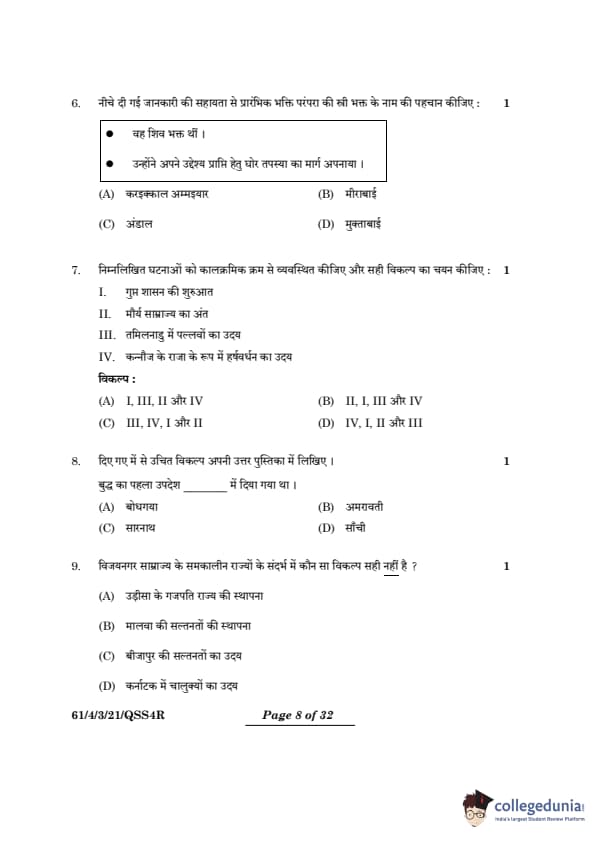
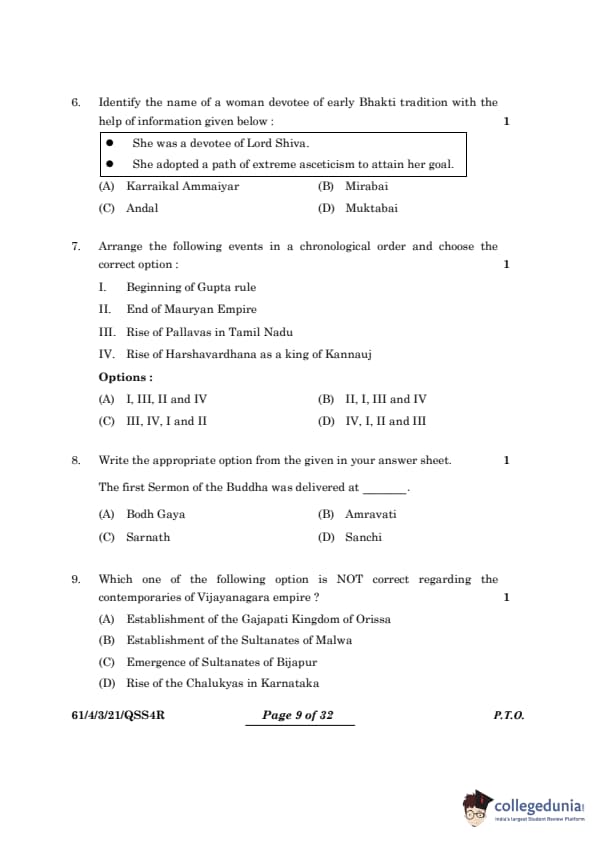
Question 6:
Identify the name of a woman devotee of early Bhakti tradition with the help of information given below:
- She was a devotee of Lord Shiva.
- She adopted a path of extreme asceticism to attain her goal.
View Solution
Solution:
Karraikal Ammaiyar: Karraikal Ammaiyar was a Nayanar saint known for being an ardent devotee of Lord Shiva and followed a path of severe asceticism to achieve her goals.
Mirabai: Mirabai was a Bhakti saint associated with the worship of Lord Krishna, not Shiva, and hence is not the right answer.
Andal: Andal was an Alvar saint associated with the worship of Lord Vishnu, not Shiva, and hence is not the right answer.
Muktabai: Muktabai was a Varkari saint and sister of Dnyaneshwar, she was not primarily associated with worshipping Shiva, and also she is not known for her extreme asceticism.
Question 7:
Arrange the following events in a chronological order and choose the correct option:
- Beginning of Gupta rule
- End of Mauryan Empire
- Rise of Pallavas in Tamil Nadu
- Rise of Harshavardhana as a king of Kannauj
View Solution
Solution:
II. End of Mauryan Empire: The Mauryan Empire ended around the 2nd century BCE. This is the earliest event listed in the options.
I. Beginning of Gupta rule: The Gupta Empire began in the 4th century CE, a few centuries after the end of the Mauryan Empire.
III. Rise of Pallavas in Tamil Nadu: The Pallavas rose to power in Tamil Nadu around the 6th century CE, making it the third event in the chronological order.
IV. Rise of Harshavardhana as a king of Kannauj: Harshavardhana became the ruler of Kannauj in the 7th century CE, making it the latest event mentioned.
Question 8:
Write the appropriate option from the given in your answer sheet. The first Sermon of the Buddha was delivered at __________.
View Solution
Solution:
Sarnath: Sarnath is the place where Buddha delivered his first sermon after attaining enlightenment. This sermon is known as the ‘Dhammacakkappavattana Sutta'.
Bodh Gaya: Bodh Gaya is the place where the Buddha attained enlightenment, not the place where he delivered his first sermon.
Amravati: Amravati was an important Buddhist site in Andhra Pradesh, known for its stupas, but it is not the location of the first sermon.
Sanchi: Sanchi is located in Madhya Pradesh, is known for its famous Stupas.
Question 9:
Which one of the following option is NOT correct regarding the contemporaries of Vijayanagara empire?
View Solution
Solution:
Rise of the Chalukyas in Karnataka: The Chalukya dynasty is not contemporary to the Vijayanagar empire and ruled in the Deccan and South India much earlier than the Vijayanagara Empire.
Establishment of the Gajapati Kingdom of Orissa: The Gajapati kingdom of Orissa was contemporary to the Vijayanagara Empire and was a key political power in the region. They were one of the major contenders to the kingdom of Vijayanagara.
Establishment of the Sultanates of Malwa: The Sultanates of Malwa were indeed contemporary political entities to the Vijayanagara empire in the northern part of the subcontinent.
Emergence of Sultanates of Bijapur: Bijapur was one of the five sultanates in the Deccan region that emerged following the collapse of the Bahmani Sultanate, and was a key contemporary political rival of Vijayanagara.
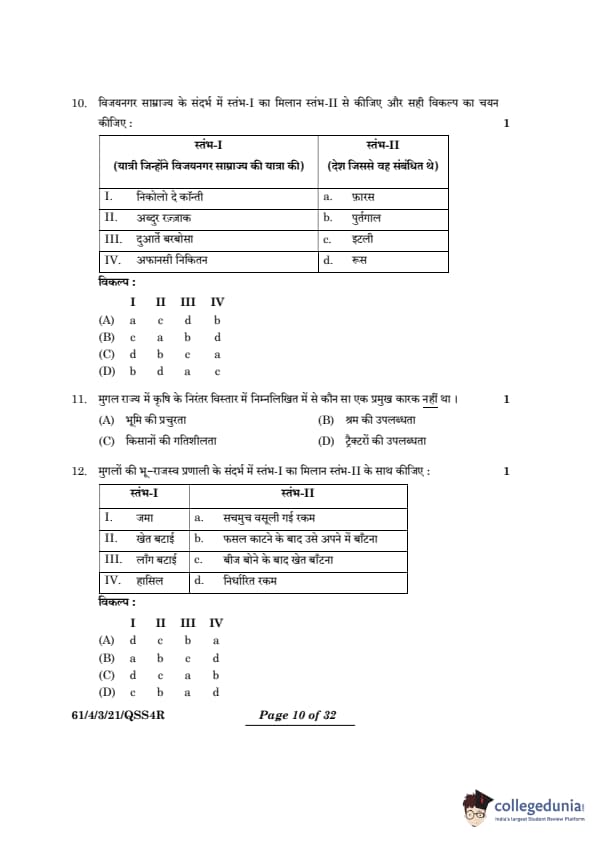
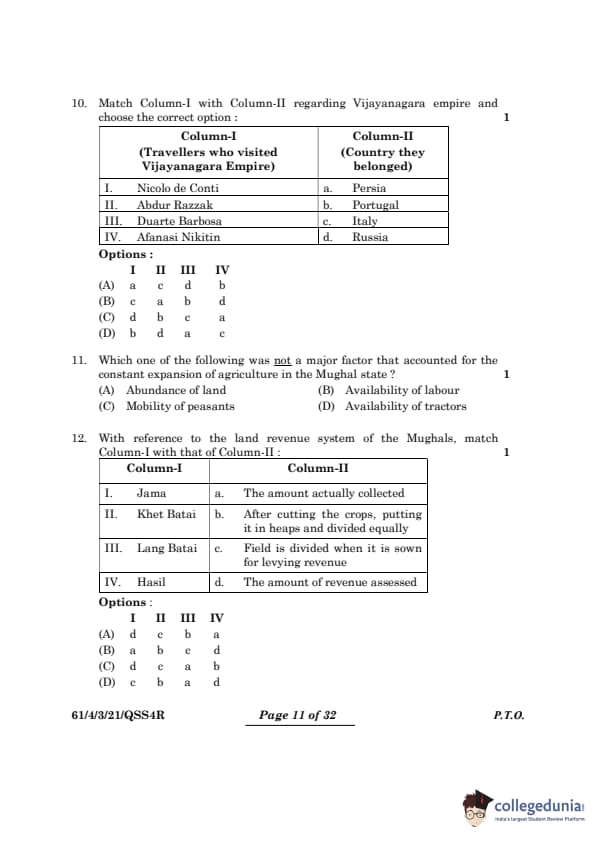
Question 10:
Match Column-I with Column-II regarding Vijayanagara empire and choose the correct option:
| Column-I (Travellers who visited Vijayanagara Empire) | Column-II (Country they belonged) |
|---|---|
| I. Nicolo de Conti | a. Persia |
| II. Abdur Razzak | b. Portugal |
| III. Duarte Barbosa | c. Italy |
| IV. Afanasi Nikitin | d. Russia |
View Solution
Solution:
I. Nicolo de Conti – c. Italy: Nicolo de Conti was an Italian merchant and traveler who visited Vijayanagara in the early 15th century. His accounts provide valuable insight into the city's wealth and splendor.
II. Abdur Razzak – a. Persia: Abdur Razzak was a Persian ambassador who visited Vijayanagara in the 15th century. His accounts describe the city's vibrant court life, architecture, and the trade activities in the region.
III. Duarte Barbosa – b. Portugal: Duarte Barbosa was a Portuguese traveler who visited Vijayanagara in the early 16th century. His observations provide insight into the socio-economic conditions and administrative practices of the region.
IV. Afanasi Nikitin – d. Russia: Afanasi Nikitin was a Russian traveler who visited India and the Bahmani Sultanate, that had close contacts with Vijayanagara during the 15th century. His records, however, do not give detailed information about Vijayanagara in particular.
Question 11:
Which one of the following was not a major factor that accounted for the constant expansion of agriculture in the Mughal state?
View Solution
Solution:
(D) Availability of tractors: The availability of tractors is NOT a major factor in the expansion of agriculture in the Mughal state because tractors were not used during the Mughal period.
(A) Abundance of land: The abundance of cultivable land was a crucial factor that enabled the expansion of agriculture. This, along with the policy of the state to expand its agricultural activities, led to increasing food production.
(B) Availability of labour: A large labour force, including peasants and landless labourers was also necessary for agricultural expansion.
(C) Mobility of peasants: The migration of peasants and their movement to new areas was an important factor in agricultural growth, thus leading to expansion in the agricultural activities.
Question 12:
With reference to the land revenue system of the Mughals, match Column-I with that of Column-II:
| Column-I | Column-II |
|---|---|
| I. Jama | a. The amount actually collected |
| II. Khet Batai | b. After cutting the crops, putting it in heaps and divided equally |
| III. Lang Batai | c. Field is divided when it is sown for levying revenue |
| IV. Hasil | d. The amount of revenue assessed |
View Solution
Solution:
I. Jama – d. The amount of revenue assessed: “Jama" referred to the amount of land revenue that was assessed, which was calculated by taking into consideration the type of land and the kind of crop.
II. Khet Batai – c. Field is divided when it is sown for levying revenue: In ‘Khet Batai' system, the fields were divided when the seeds were being sown for tax assessment.
III. Lang Batai – b. After cutting the crops, putting it in heaps and divided equally: Under this system, after the crops were harvested they were put into heaps and then divided equally for the purpose of revenue assessment.
IV. Hasil – a. The amount actually collected: “Hasil" referred to the actual amount of revenue collected by the state, which would vary from the assessed revenue ("jama”) depending upon various factors.
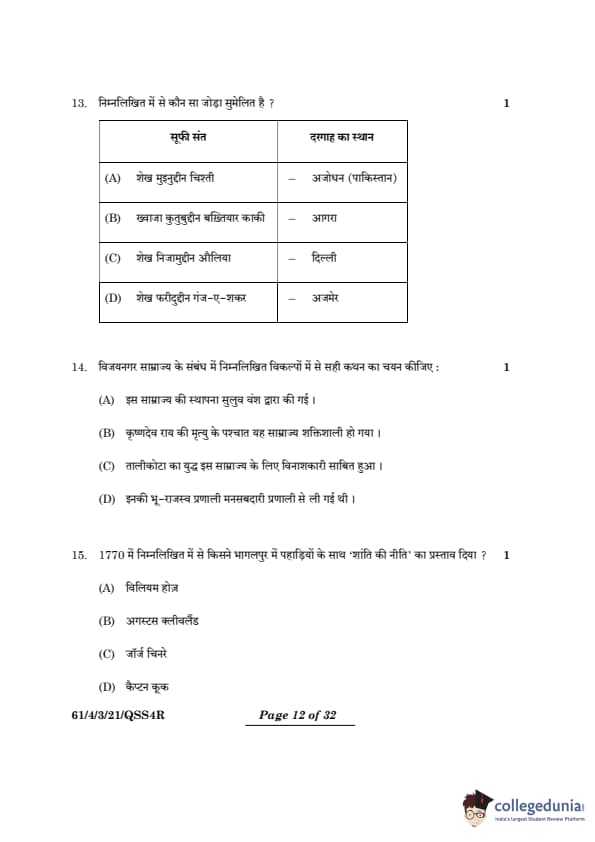
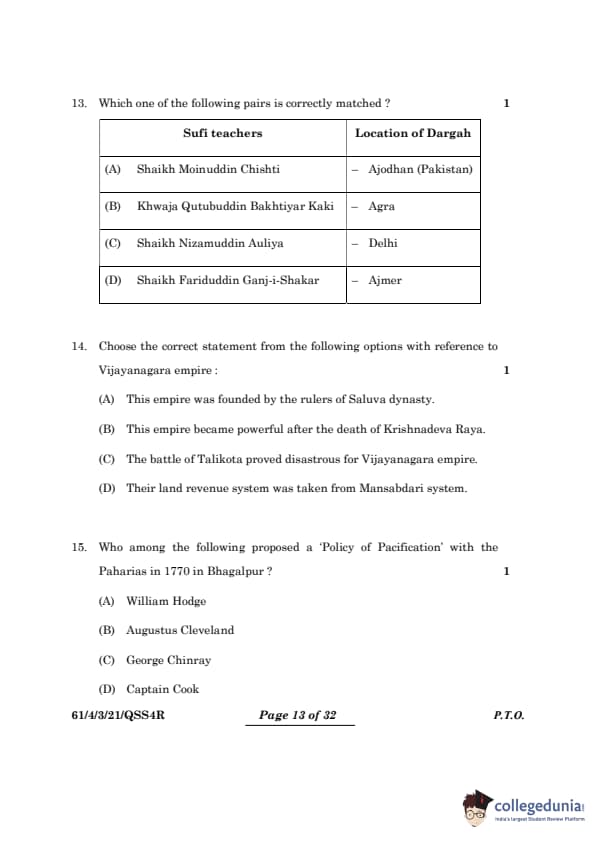
Question 13:
Which one of the following pairs is correctly matched?
| Sufi teachers | Location of Dargah |
|---|---|
| (A) Shaikh Moinuddin Chishti | Ajodhan (Pakistan) |
| (B) Khwaja Qutubuddin Bakhtiyar Kaki | Agra |
| (C) Shaikh Nizamuddin Auliya | Delhi |
| (D) Shaikh Fariduddin Ganj-i-Shakar | Ajmer |
View Solution
Solution:
(C) Shaikh Nizamuddin Auliya – Delhi: Shaikh Nizamuddin Auliya was a prominent Sufi saint of the Chishti order and his dargah is located in Delhi. He played an important role in the spread of Sufi ideas and practices.
(A) Shaikh Moinuddin Chishti – Ajodhan (Pakistan): Shaikh Moinuddin Chishti's dargah is not in Ajodhan but in Ajmer, Rajasthan, making this an incorrect match. He was the founder of the Chishti order in India.
(B) Khwaja Qutubuddin Bakhtiyar Kaki – Agra: Khwaja Qutubuddin Bakhtiyar Kaki's dargah is located in Delhi, and not Agra. He was a disciple of Shaikh Moinuddin Chishti.
(D) Shaikh Fariduddin Ganj-i-Shakar – Ajmer: Shaikh Fariduddin Ganj-i-Shakar, was also a prominent Chishti saint whose dargah is located at Pakpattan (Ajodhan) in Pakistan, and not in Ajmer.
Question 14:
Choose the correct statement from the following options with reference to Vijayanagara empire:
View Solution
Solution:
(C) The battle of Talikota proved disastrous for Vijayanagara empire: The Battle of Talikota in 1565 is a significant event in the history of Vijayanagara. This battle is known to have led to the decline and fragmentation of the empire.
(A) This empire was founded by the rulers of Saluva dynasty: The Vijayanagara empire was not founded by the rulers of the Saluva dynasty, but by Harihara and Bukka of the Sangama Dynasty.
(B) This empire became powerful after the death of Krishnadeva Raya: The empire was at the height of its power during the rule of Krishnadeva Raya, and not after his death.
(D) Their land revenue system was taken from Mansabdari system: The land revenue system in Vijayanagara was different from the Mansabdari system of the Mughal empire.
Question 15:
Who among the following proposed a ‘Policy of Pacification' with the Paharias in 1770 in Bhagalpur ?
View Solution
Solution:
Augustus Cleveland: Augustus Cleveland was a British administrator who proposed a 'Policy of Pacification' to deal with the Paharia tribes in the Bhagalpur region of Bihar.
William Hodge: William Hodge was a British artist known for his paintings and drawings during his travels. He has no connection to the ‘Policy of Pacification'.
George Chinray: George Chinray was an explorer in the Canadian arctic and his work has no relation to the policy of pacification.
Captain Cook: Captain James Cook was a British explorer and navigator, but had no connection to colonial administration or the pacification policy with the Paharias.
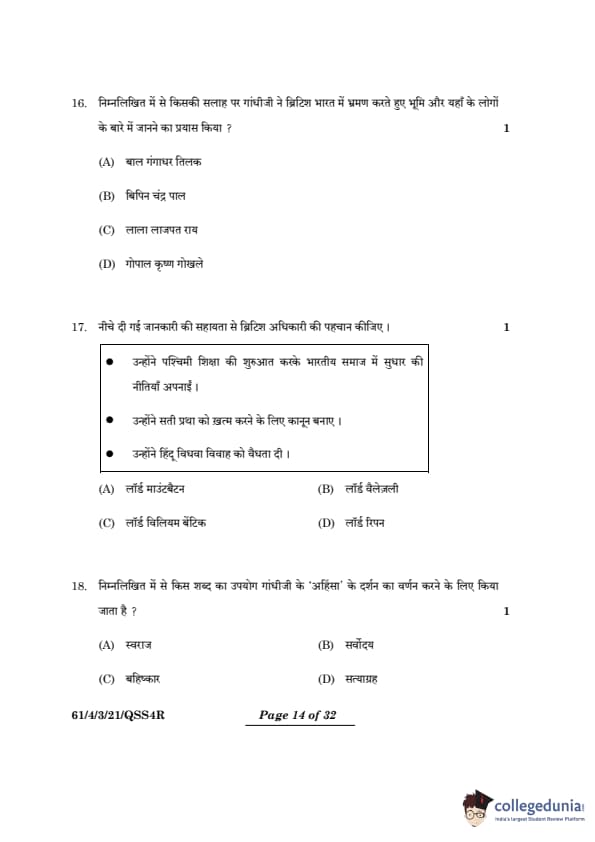
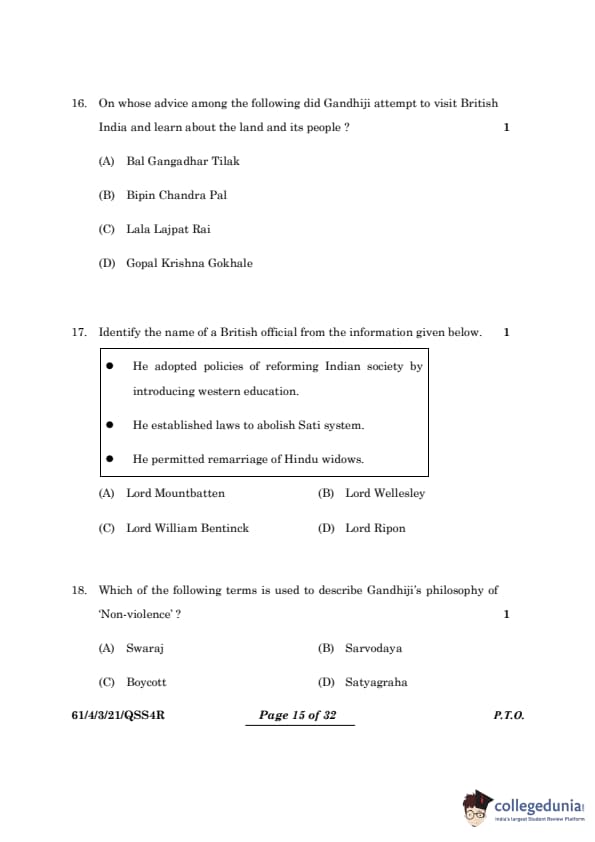
Question 16:
On whose advice among the following did Gandhiji attempt to visit British India and learn about the land and its people ?
View Solution
Solution:
Gopal Krishna Gokhale: Gopal Krishna Gokhale, who was a political mentor to Gandhiji, advised him to travel across British India to understand the land and its people before getting involved in politics. Gokhale emphasized the need for practical knowledge before taking part in the freedom struggle.
Bal Gangadhar Tilak: Bal Gangadhar Tilak was one of the important leaders of the Indian National Congress, who advocated for a more assertive approach to political action, rather than a passive approach.
Bipin Chandra Pal: Bipin Chandra Pal was a leader of the extremist group in the INC, and did not advise Gandhiji in this regard.
Lala Lajpat Rai: Lala Lajpat Rai, also an extremist, worked with the INC and worked to make it a more assertive movement.
Question 17:
Identify the name of a British official from the information given below.
- He adopted policies of reforming Indian society by introducing western education.
- He established laws to abolish Sati system.
- He permitted remarriage of Hindu widows.
View Solution
Solution:
Lord William Bentinck: Lord William Bentinck was the Governor-General of India during whose tenure various reforms were introduced, such as the abolition of Sati, promotion of western education, and legalization of widow remarriage.
Lord Mountbatten: Lord Mountbatten was the last Viceroy of India and was associated with the partition of India.
Lord Wellesley: Lord Wellesley was a Governor-General known for his expansionist policies in India and not for the social reforms listed in the question.
Lord Ripon: Lord Ripon was a Viceroy of India who is known for his progressive policies but did not introduce these specific reforms.
Question 18:
Which of the following terms is used to describe Gandhiji's philosophy of 'Non-violence'?
View Solution
Solution:
Satyagraha: Satyagraha is the term that is best used to describe Gandhiji's philosophy of 'Non-violence'. It literally means 'Truth force', or 'soul force' and focuses on non-violent resistance against injustice through civil disobedience.
Swaraj: Swaraj means self-rule or independence, which was also one of Gandhiji's major goals, but this does not refer to his methodology of non-violence.
Sarvodaya: Sarvodaya refers to the idea of welfare and upliftment of all. It is related to Gandhiji's philosophy, but not his tool for non-violence.
Boycott: Boycott was a strategy employed by Gandhiji to protest against British rule, and it did not describe the philosophy of non-violence itself.
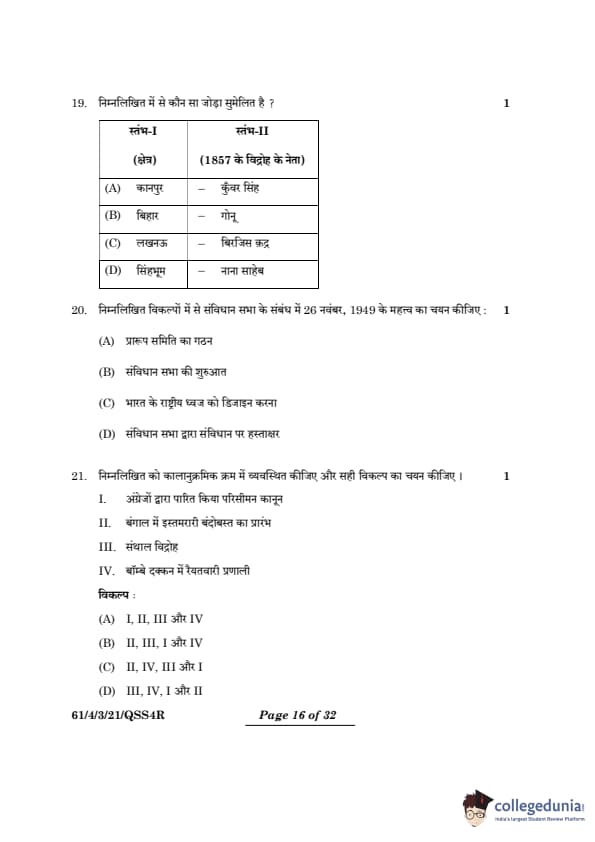
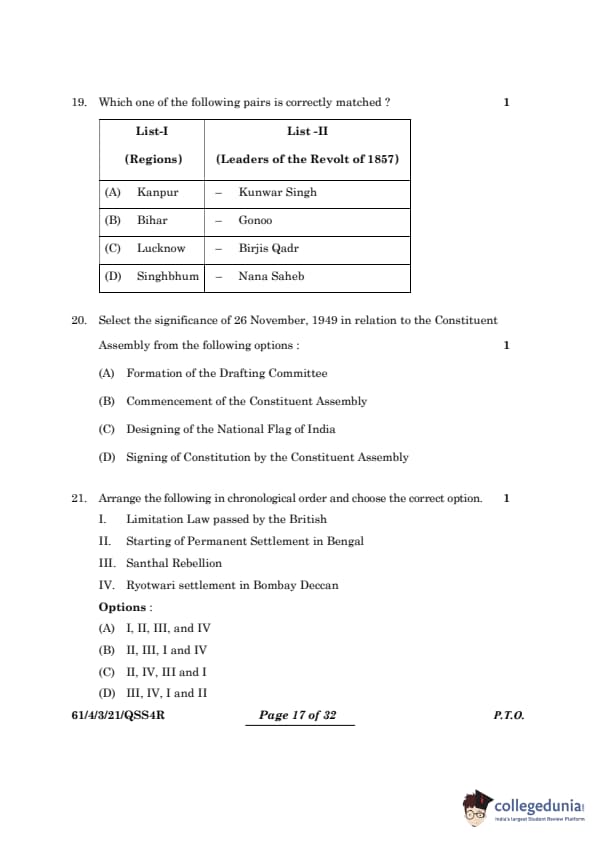
Question 19:
Which one of the following pairs is correctly matched ?
| List-I (Regions) | List -II (Leaders of the Revolt of 1857) |
|---|---|
| (A) Kanpur | Kunwar Singh |
| (B) Bihar | Gonoo |
| (C) Lucknow | Birjis Qadr |
| (D) Singhbhum | Nana Saheb |
View Solution
Solution:
(C) Lucknow – Birjis Qadr: Birjis Qadr was the son of the deposed Nawab of Awadh, and he played a key role in leading the revolt of 1857 in Lucknow.
(A) Kanpur – Kunwar Singh: Kunwar Singh led the rebellion in Bihar, specifically in the Arrah region, and was not associated with Kanpur.
(B) Bihar – Gonoo: Gonoo was a tribal leader from Singhbhum, Jharkhand, and not Bihar.
(D) Singhbhum – Nana Saheb: Nana Saheb, who was based in Kanpur, is not associated with the region of Singhbhum.
Question 20:
Select the significance of 26 November, 1949 in relation to the Constituent Assembly from the following options:
View Solution
Solution:
Signing of Constitution by the Constituent Assembly: November 26, 1949 is the date when the members of the Constituent Assembly adopted and signed the Constitution of India.
Formation of the Drafting Committee: The Drafting Committee was formed on 29th August 1947, earlier than November 26, 1949.
Commencement of the Constituent Assembly: The first meeting of the Constituent Assembly took place on December 9, 1946, which is earlier than 26th November 1949.
Designing of the National Flag of India: The National flag of India was adopted on July 22, 1947, much before 26th November 1949.
Question 21:
Arrange the following in chronological order and choose the correct option:
- Limitation Law passed by the British
- Starting of Permanent Settlement in Bengal
- Santhal Rebellion
- Ryotwari settlement in Bombay Deccan
View Solution
Solution:
II. Starting of Permanent Settlement in Bengal: The Permanent Settlement was introduced in Bengal by the British in 1793. This was the earliest of the four events mentioned here.
IV. Ryotwari settlement in Bombay Deccan: The Ryotwari System was introduced in the Bombay Deccan and other parts of south India in the early 19th century, much later than the Permanent Settlement.
III. Santhal Rebellion: The Santhal rebellion took place in 1855-56, which was after the introduction of both the Permanent and Ryotwari systems.
I. Limitation Law passed by the British: The Limitation Law was passed after the 1857 revolt and aimed at limiting the peasants from accessing the legal system, which makes it the latest of the four events mentioned.
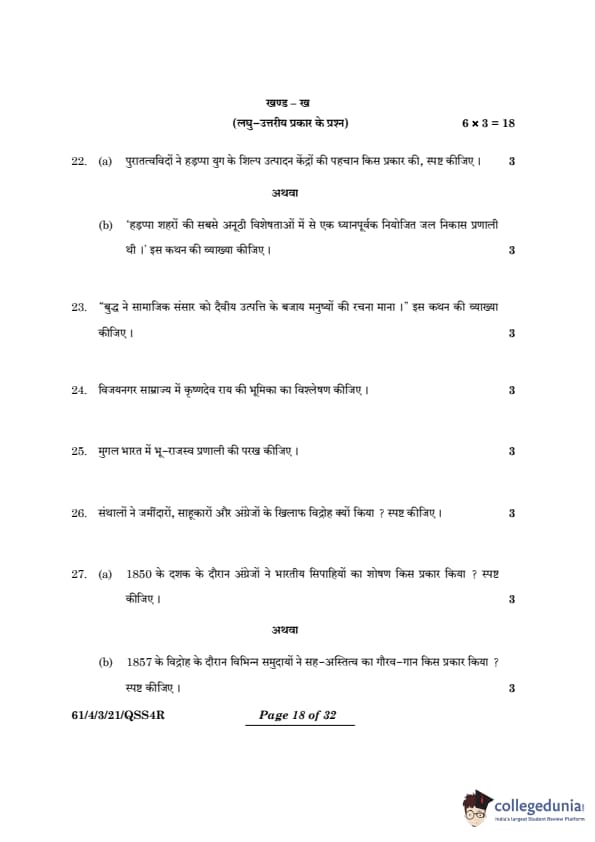
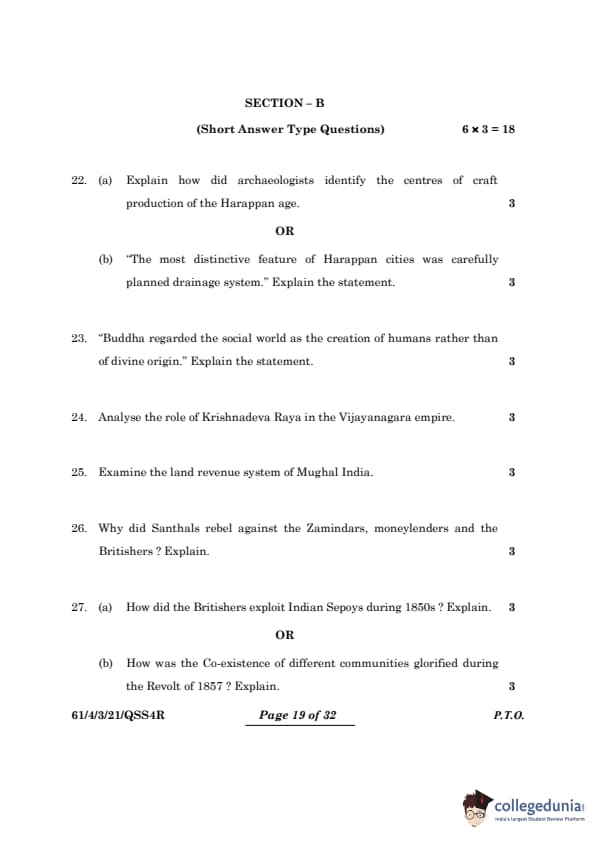
Section B
Short Answer Type Questions
Question 22(a):
Explain how did archaeologists identify the centres of craft production of the Harappan age.
View Solution
Solution:
Raw Materials: Archaeologists identify centers of craft production by locating raw materials like stone nodules, shells, and copper ores, which shows where the manufacturing was done. Finding such materials would point to the possibility of a craft centre.
Unfinished Objects and Rejects: Sites with unfinished objects, rejects, and waste materials are clear indicators of craft production. This includes broken tools, unusable pieces of material, etc., and can help identify the type of craft being produced.
Broken Tools and Equipment: The presence of broken or used tools related to particular crafts helps archaeologists understand the different types of activity carried out at a given place, and thus helps in identifying the centres.
Waste as Indicators: Waste material is very helpful in the identification of craft centres, as the amount of waste generated also highlights the large scale of production being carried out.
Other Relevant Points: Any other relevant points can include specialized workshops, specialized tools etc.
Question 22(b):
“The most distinctive feature of Harappan cities was carefully planned drainage system." Explain the statement.
View Solution
Solution:
Grid Pattern of Streets and Drains: Harappan cities were characterized by a well laid-out grid pattern, with streets and drains planned first, and houses then built around them. This shows that the planning of the settlements was meticulous.
Right Angles: The streets and drains in these cities were constructed at right angles to each other, which provided efficient water and waste management in the city, and was a clear sign of sophisticated planning.
Connection to Street Drains: Every house was connected to the street drains, which ensured that household waste flowed easily into the main channels, keeping the cities clean and hygienic.
Construction of Main Channels: The main drainage channels were made of bricks and mortar, and were covered with loose bricks that could be removed for cleaning, highlighting attention to sanitation and maintenance.
Limestone Covers: In some cases, limestone was used to cover the drains, providing greater stability to the covering system.
Sumps and Cesspits: House drains first emptied into sumps or cesspits where solid matter was separated before the wastewater flowed into the street drains, this is an early example of waste separation.
Sump Arrangement for Cleaning: Very long drainage channels were provided with sumps at intervals for cleaning purposes. This helped keep the channels in good conditions.
Material Left Behind During Cleaning: Heaps of materials, mostly sand, have frequently been found alongside the drainage channels, showing that the system was also properly maintained.
Other Relevant Point: Any other relevant point from the chapter.
Question 23:
"Buddha regarded the social world as the creation of humans rather than of divine origin." Explain the statement.
View Solution
Solution:
Sutta Pitaka: The Sutta Pitaka, which is the key source of the Buddha's teachings, was used to build the basis of this statement that the social world is created by human beings.
Transient and Soulless World: According to Buddhist thought, the world is constantly changing and is transient (anicca) as well as soulless (anatta), highlighting that nothing is eternal and permanent.
Intrinsic Suffering: Suffering (dukkha) is considered as an inextricable part of human life in this constantly changing world, and this is the premise upon which Buddhist philosophy is based.
Middle Path: To rise above the suffering, one had to tread the middle path, which lies between extreme penance and self-indulgence, allowing one to escape the cycle of rebirth.
Social World as a Human Creation: Buddha regarded the social world as a creation of human beings and not a divine entity. According to him, humans are responsible for creating a social order.
Importance of Compassion and Ethics: He encouraged monarchs and gahapatis (householders) to be compassionate and ethical, thereby highlighting their agency.
Individual Agency and Righteous Action: Individual agency and righteous action (karma) are believed to be the only ways to break the cycle of rebirth, which is the ultimate objective in Buddhism.
Other Relevant Point: Any other relevant point from the chapter.
Question 24:
Analyse the role of Krishnadeva Raya in the Vijayanagara empire.
View Solution
Solution:
Tuluva Dynasty: Krishnadeva Raya was the most famous ruler of the Vijayanagara empire, who belonged to the Tuluva dynasty and was known for his military prowess and administrative skills.
Consolidation and Expansion: His rule was marked by consolidation and expansion, which made his kingdom a key power in South India.
Powerful Ruler: He was one of the most powerful rulers of this kingdom, with vast land and resources under his control.
Military Conquests: He defeated the Bahmani kings and the kings of Orissa and also annexed the Raichur Doab which was the land between the Tungabhadra and Krishna rivers. This shows his military achievements and political expansion.
Temple Construction: He is credited with building fine temples and adding impressive gopurams (gateways) to various temples in South India, highlighting his architectural and cultural contributions.
Suburban Township: He also founded a suburban township near Vijayanagar, which was named Nagalapuram after his mother which demonstrates his respect for his family and was also part of town-planning in that period.
Other relevant point: Any other valid points.
Question 25:
Examine the land revenue system of Mughal India.
View Solution
Solution:
Economic Mainstay: Land revenue was the most important source of income for the Mughal Empire and it helped to support a large and vast administration.
Administrative System for Agricultural Production: It was important for the state to create an administrative system to ensure agricultural production, which was done to ensure collection of revenue.
Office of the Diwan: The system included the office (dafter) of the diwan, who was responsible for the fiscal system of the empire, and ensured smooth administration.
Revenue Officials and Record Keepers: Revenue officials and record keepers penetrated the agricultural domain, and played a very decisive role in shaping agrarian relations.
Two-Stages of Land Revenue System: The land revenue system consisted of two stages which was Jama (assessment) and Hasil (collection). This provided a clear mechanism for state income.
Jama and Hasil Collection: The Jama was the amount assessed, as opposed to Hasil, the amount collected. This indicates that a clear distinction was made between what was assessed and what was actually collected.
Payment in Cash and Kind: Akbar decreed that while he should strive to make cultivators pay in cash, he also provided the option of payment in kind, which allowed for flexibility.
Maximising State Claims: While fixing revenue, the attempt of the state was to maximize its claims, showing the imperial nature of the revenue system.
Measurement of Land: Both cultivated and non-cultivated land were measured in each province, and was the key basis of calculation.
Compilation of Land Data: The Ain-i-Akbari compiled the aggregates of such lands during Akbar's rule, helping the state keep records.
Record of Cultivators: Revenue officials were also responsible to prepare annual records of the number of cultivators in each village.
Classification of Land by Emperor Akbar: Emperor Akbar classified the land based on its fertility into Polaj, Parauti, Chachar and Banjar, which helped him in calculating the revenue that had to be collected.
Manasabdari System and Rank: The Mansabdari system, which gave ranks to military officials, was also related to the revenue system, highlighting the importance of both military and civilian administration.
Other relevant points: Any other relevant points from the text.
Question 26:
Why did Santhals rebel against the Zamindars, moneylenders and the Britishers? Explain.
View Solution
Solution:
Excessive Exploitation: The Santhals rebelled against zamindars, moneylenders, and the Britishers because of excessive exploitation, which made their lives miserable.
Reaction to Depotic System: Their rebellion was also a reaction to the despotic British revenue system, usury practices, and the zamindari system. The system of land revenue was very oppressive.
Loss of Land: The Santhals soon realized that the land that they had worked so hard to cultivate was slipping away from them due to the policies of the British.
Heavy Land Taxation: The company was also taxing their land very heavily, and this was another reason for their rebellion.
Consolidation of Zamindari Hold: The zamindars were consolidating their hold on the Damin region which was a key reason for tribal communities to protest.
Rebellion against Exploitation: The Santhals decided it was time to rebel against zamindars, moneylenders, and colonial states in 1850 because of the continuous injustices.
New System Required: They required their own system, which was formed after the revolt, and was led by Sidhu Manjhi.
Other Relevant Point: Any other relevant point from the chapter.
Question 27(a):
How did British exploit Indian sepoys?
View Solution
Solution:
Sense of Superiority: British officers had developed a sense of superiority over Indian soldiers, highlighting the discrimination in the military.
Treating Sepoys as Inferiors: They began treating the sepoys as their ethnic inferiors, which lowered their morale and degraded their self-respect.
Disregarding Feelings: The Britishers disregarded the feelings of Indian sepoys, which indicates the lack of care and empathy in their interactions.
Abuse and Violence: There was increased abuse and physical violence against Indian sepoys, which increased their resentment and dissatisfaction.
Widening Gap: This created a large gap between sepoys and officers in the military, causing a lot of discontentment in the lower ranks.
Suspicion Instead of Trust: Suspicion took the place of trust between the sepoys and their officers, indicating a broken relationship based on resentment and exploitation.
Low Post and Salaries: Indian sepoys were given low posts and salaries as compared to their European counterparts, which further fueled their anger.
Recruitment from Awadh and Eastern UP: The Bengal Army recruited a vast number of its sepoys from the villages of Awadh and eastern Uttar Pradesh.
Awadh as Nursery of Bengal Army: Because of this, Awadh was also called the “nursery of the Bengal Army", highlighting the link between regions and recruitment.
Other Relevant Point: Any other relevant point from the chapter.
Question 27(b):
How was the Co-existence of different communities glorified during the Revolt of 1857? Explain.
View Solution
Solution:
Vision of Unity: The revolt showed a vision of unity and glorified the co-existence of different communities, which was a significant show of unity against colonial rule.
Proclamations: The rebels showcased the coexistence of Hindus and Muslims through the numerous proclamations that were issued by them.
Appeal to All Sections: In 1857, there were multiple appeals to all sections of the population, irrespective of caste and creed. This shows the inclusivity that the rebels were trying to achieve.
War of Hindus and Muslims: The rebellion was also seen as a war in which both Hindus and Muslims had equally to lose or gain, highlighting their shared destiny against colonial power.
Pre-British Past: The ishtahars (proclamations) harked back to the pre-British Hindu-Muslim past, when there was greater harmony among different communities.
Coexistence Under Mughal Rule: They also glorified the coexistence of different communities under the Mughal Empire, highlighting their shared history of intermingling.
Rejection of the British: The proclamations rejected everything that was associated with British rule, showing an attempt to create a new social and political order.
Condemnation of Annexation: The rebels condemned the British for the annexations they had carried out and the treaties that they had broken, thus highlighting their grievances.
Attacking British Rule: Every aspect of British rule was attacked and the firangi (foreigner) was accused of destroying a way of life that was familiar and cherished, showing an overall rejection of colonial rule.
Restoring the Old Order: The rebels wanted to restore the world that they knew, which was rooted in pre-colonial times.
Fear of British Conversion: The fear that the British were destroying the castes and religions of Hindus and Muslims and converting them to Christianity was very rampant. It was the basis of many of the rumours in that period.
People Fighting to Save Their Identity: People were urged to come together and fight to save their livelihood, their faith, their honor and their identity, making it a collective struggle.
Other relevant point: Any other relevant point from the chapter.
Section C
Long Answer Type Questions
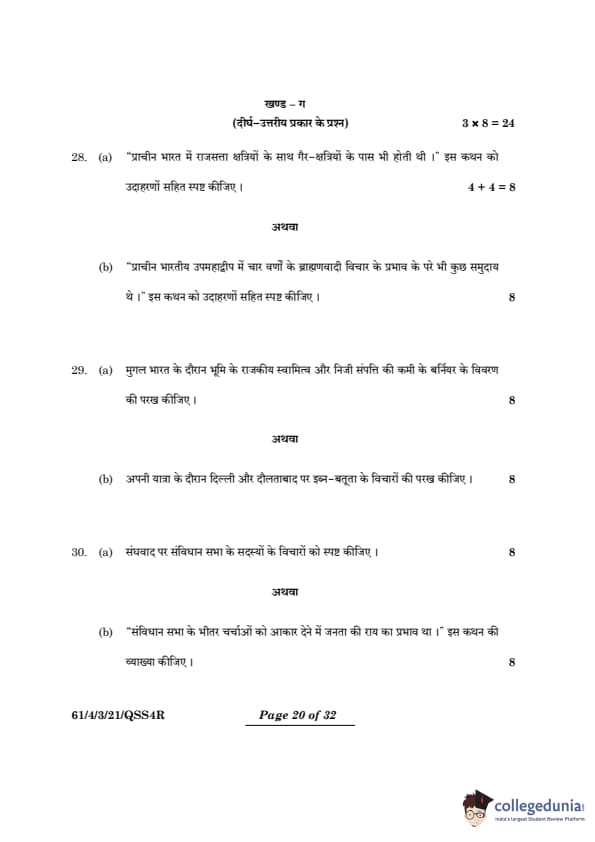
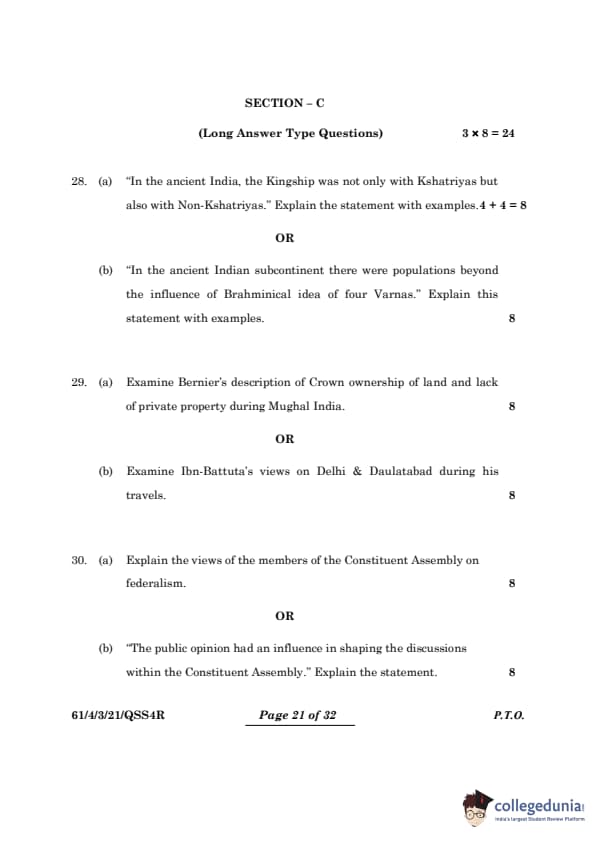
Question 28(a):
“In the ancient India, the Kingship was not only with Kshatriyas but also with Non-Kshatriyas." Explain the statement with examples.
View Solution
Solution:
Kshatriya Rulers:
Shastras and Kshatriyas: According to the shastras (religious texts), the Kshatriyas were the ones who had the right to rule. This is the general idea of how power and position in society was distributed.
Examples: Rulers such as Mahapadmananda, Ajatashatru etc. came from Kshatriya lineages, which was an important factor in determining their rule.
Brahmanical View: The Brahmanas also believed that Kings ought to be Kshatriyas, which shows the importance of the Kshatriyas to state power and religious beliefs.
Examples of Kshatriya Rulers: The Pandavas, Kauravas, Pratiharas, Guptas, Palas, and Rashtrakutas were all Kshatriya rulers, and this highlights the dominance of this group in ancient India.
Followed Shastras: These rulers followed Manusmriti and Dharmashastras to establish their rule and legitimize it through established religious traditions.
Other Relevant Point: Any other relevant point from the chapter.
Non-Kshatriya Rulers:
Different Origins of Rulers: However, several important ruling lineages had origins that were different from what is stated in the Shastras and that shows that a lot of people with other origins also held political power.
Mauryas as Low Origins: The social background of the Mauryas has been hotly debated. Some Brahminical texts described Mauryas as low origin, although other texts do not mention such origins.
Shungas and Kanvas as Brahmins: The Shungas and Kanvas who succeeded the Mauryas were Brahmins or Non-Kshatriyas, thus challenging the existing social order.
Shakas as Mlechhas: The Shakas who came from Central India were regarded as Mlechhas or barbarians, as they did not follow the strict social order laid down by the Shastras.
Satavahana as Brahmin: One of the Satavahana rulers claimed to be a Brahmin which also questions the established ideas on who could rule.
Difficulty in Applying Caste to Kings: It was often difficult to put the kings in the framework of caste, as these kingdoms were established by people based on their own capabilities, and not always on pre-defined categories.
Resources and Support: Only those who had the resources and support could become the king, and it was often not dependent on being a Kshatriya, demonstrating the importance of actual political power.
Other Relevant Point: Any other relevant point from the chapter.
Question 28(b):
“In the ancient Indian subcontinent there were populations beyond the influence of Brahminical idea of four Varnas.” Explain this statement with examples.
View Solution
Solution:
Populations Outside Brahminical Influence: There were several communities whose social practices were not influenced by Brahminical ideas, highlighting the limitations of the varnashrama system.
Description as ‘Odd’ and ‘Uncivilized’: These communities were described as odd, uncivilized, or even animal-like by the Brahmanical texts, revealing the prejudices against these communities.
Forest Dwellers and Hunter-Gatherers: Many of these groups were forest dwellers who were hunters and gatherers and thus did not adhere to the fixed agricultural order of society.
Nishads: There were categories such as Nishads to whom Eklavya is supposed to have belonged. This reveals that people who were skilled in various things but had a different social position were also existing at that time.
Rakshasas: The word Rakshasas was used to describe people whose practices differed from those laid down in Brahmanical texts and thus they were considered ‘different’.
Nomadic Pastoralists: Nomadic pastoralists could not be easily accommodated within the Brahminical framework of settled agriculturists, which highlights the differences in lifestyle that was prevalent.
Mlechhas: Mlechhas were non-Sanskrit speaking people and were also considered as low and outcaste. This further highlights the fact that there were a large number of communities beyond the traditional four Varna system.
Untouchables: Social categories such as untouchables also developed, and they were considered as the lowest in society, and were outside the four varnas. The Chinese Buddhist monk Fa-Xian also wrote about untouchables, showing that they were recognized as a distinct social group.
Chandals: Chandals were placed at the very bottom of the hierarchy in the society, highlighting their low position in social order.
Matanga: Matanga is another term for untouchables which shows the existence of such categories within society.
Other Relevant Points: Any other relevant points.
Question 29(a):
Examine Bernier's description of Crown ownership of land and lack of private property during Mughal India.
View Solution
Solution:
Firm Believer in Private Property: Bernier was a firm believer in the virtues of private property which influenced how he saw the land ownership system in Mughal India.
Harmful Crown Ownership: He believed that the crown ownership of land was harmful for both the state and its people. This was one of his biggest criticisms of the system.
Emperor as Owner: According to Bernier, the Mughal emperor was the owner of the entire land, which he distributed among his nobles, thus he believed that all land was ultimately owned by the emperor.
Disastrous Consequences: He thought that this system had disastrous consequences for both the economy and society. According to him, the lack of private property created problems for both agriculture and society.
Peasant’s Inability to Transfer Land: Because of the crown ownership, the peasants could not pass the land to their children, thus creating a disincentive for them to properly care for the land.
Adverse to Long-Term Investments: The system was averse to any long-term investment in the sustenance and expansion of production, as farmers did not see any incentive in making long-term investments.
Prevented Emergence of ‘Improving Landlords’: According to Bernier, the absence of private property prevented the emergence of a class of ‘improving’ landlords, who would care for the land more than the state could.
Private Property for Peasants: Bernier argued that some private property should be there for the peasants for their personal use, as it would incentivize them to put in more effort.
Help the Poor Peasant Class: He thought that this will help the poor peasant class to increase agricultural output and take care of their land.
No Middle State in India: According to Bernier, there was no middle state in India, with just the very poor and very rich in the society.
Uniform Ruination of Agriculture: He also said that the system led to the uniform ruination of agriculture, thus highlighting its negative impact on the economy.
Oppression of the Peasantry: He also wrote about the excessive oppression of the peasantry, as the farmers did not have land ownership.
Decline in the Living Standards: Bernier was of the opinion that there was a continuous decline in the living standards of all sections of society, except for the ruling aristocracy, and he blamed it on the lack of private land.
Society of Impoverished and Powerful: In the end, he depicted the Indian society as consisting of undifferentiated masses of impoverished people, subjugated by a small minority of a very rich and powerful ruling class, highlighting social hierarchies.
Other Relevant Points: Any other relevant points from the text.
Question 29(b):
Examine Ibn-Battuta’s views on Delhi & Daulatabad during his travel.
View Solution
Solution:
Opportunities and Skills: Ibn Battuta thought that the cities were full of exciting opportunities for those who had the necessary drive, resources, and skills. He also noticed a bustling economy and trade.
Densely Populated and Prosperous: He found the cities to be densely populated and prosperous. However, these cities were often disrupted by wars and invasions.
Crowded Streets and Markets: He noted that the cities had crowded streets and bright, colorful markets that were stacked with a wide variety of goods. This reflects a vibrant social life.
Delhi as a Vast City: Ibn Battuta described Delhi as a vast city with a large population, which he called the largest in India, reflecting its great size and significance.
Daulatabad as a Rival: Daulatabad in Maharashtra was no less, and easily rivaled Delhi in size, according to Ibn Battuta, showing that there was competition between the cities.
Delhi’s Layout and Population: He wrote that the city of Delhi covered a wide area and also had a large population, indicating its urban nature.
Storehouses of Edibles and Ammunitions: He mentions storehouses for storing edibles, magazines, ammunition, ballistas, and siege machines, highlighting Delhi as a political and military center.
Ramparts and Infantry: He also mentions ramparts which had the capacity to store grains for long periods, with horsemen and infantry also present there.
Gates of Delhi: According to him, there were 28 gates of Delhi, where the Budaun darwaza was the largest, with a grain market adjacent to the Gul Darwaza.
Market in Daulatabad: Daulatabad had a marketplace for male and female singers, which was known as Tarababad, which according to Ibn Battuta was one of the greatest and most beautiful bazaars.
Decorated Shops and Female Singers: He mentions that the shops in Daulatabad were decorated with carpets, with a large number of female singers who used to perform there.
Mosques for Prayers: In these bazaars, there were also mosques for offering prayers, demonstrating a blend of trade and religion.
Integration of Religious and Local Traditions: He also mentioned that even Hindu rulers came to the market to worship, which shows the integration of local and religious traditions.
Other relevant point: Any other relevant point from the chapter.
Question 30(a):
Explain the views of the members of the Constituent Assembly on federalism.
View Solution
Solution:
Debate on Rights of Centre and States: The most vigorously debated topics in the Constituent Assembly were related to the rights of the Central Government and the rights of the states. The core issues were about how the powers will be divided among both the units.
Three Lists of Subjects: The Draft Constitution provided for three lists of subjects for the distribution of powers, which were: the Union List, State List, and Concurrent List, which laid out the basis of the constitution.
Union List: The subjects in the Union List were to be the preserve of the Central Government. These are powers that only the central government can exercise.
State List: Those in the State List were vested with the states. These are the powers that only state governments can exercise.
Concurrent List: For the subjects that were included in the Concurrent List, both the Center and the states shared responsibility, which ensured co-operation and coordination.
Union Control and Concurrent List: The Union List and the Concurrent list had more items than in other federations, giving more power to the Union in the country.
Article 356: Article 356 gave the center the powers to take over state administration, based on the recommendation of the Governor, thus showing the power that the center held.
Complex System of Fiscal Federalism: The constitution mandated for a complex system of fiscal federalism, outlining the system for financial management and resource sharing.
Tax Sharing: For some taxes (like customs duties), the Centre retained all the proceeds, while for others (like income tax), they were shared with the states, reflecting different approaches to tax collection and distribution.
Assignment of Taxes to the States: Other taxes (like estate duties) were assigned wholly to the states, giving the states independent financial authority.
State’s Ability to Levy and Collect Taxes: The states, meanwhile, could levy and collect certain taxes on their own. These taxes were land and property taxes, sales tax, and the tax on bottled liquor, giving them financial autonomy.
Other Relevant Points: Any other relevant points.
Question 30(b):
“The public opinion had an influence in shaping the discussions within the Constituent Assembly.” Explain the statement.
View Solution
Solution:
Influence of Public Opinion: The discussions within the Constituent Assembly were greatly influenced by the opinions expressed by the public, which demonstrates the democratic nature of the process.
Reporting in Newspapers: As the deliberations of the Assembly continued, the arguments, discussions, and opinions were reported in newspapers, which allowed public participation.
Public Debate and Discussion: The proposals were publicly debated and discussed through newspapers, which helped in keeping the process transparent and accountable.
Shaping of Consensus: The criticisms and counter-criticisms in the press in turn shaped the nature of the consensus that was ultimately reached on specific issues, showing the influence of public opinions on the final product.
Seeking Public Input: To create a sense of collective participation, the public was asked to send in their views on what needed to be done, showing that the process was intended to be inclusive.
Protection of Minorities: Many of the linguistic minorities wanted the protection of their mother tongues, highlighting the importance that was given to the preservation of their cultural identities.
Safeguarding Religious Minorities: Religious minorities asked for special safeguards to protect their religious rights, showing the importance that the Constitution gave to diversity.
Demands of Dalits: While Dalits demanded an end to all caste oppression and reservation of seats in government bodies, highlighting the social justice aspect of the process.
Cultural Rights and Social Justice: Important issues of cultural rights and social justice were raised and discussed by the Assembly. This shows that the discussions in the assembly were not just theoretical, but they also focused on important questions of social importance.
Debated in Assembly: In the public discussions that took place in the Assembly, many issues were debated at length and in great detail, demonstrating transparency in the process.
Other relevant points: Any other relevant points.
Section D
Source-Based Questions
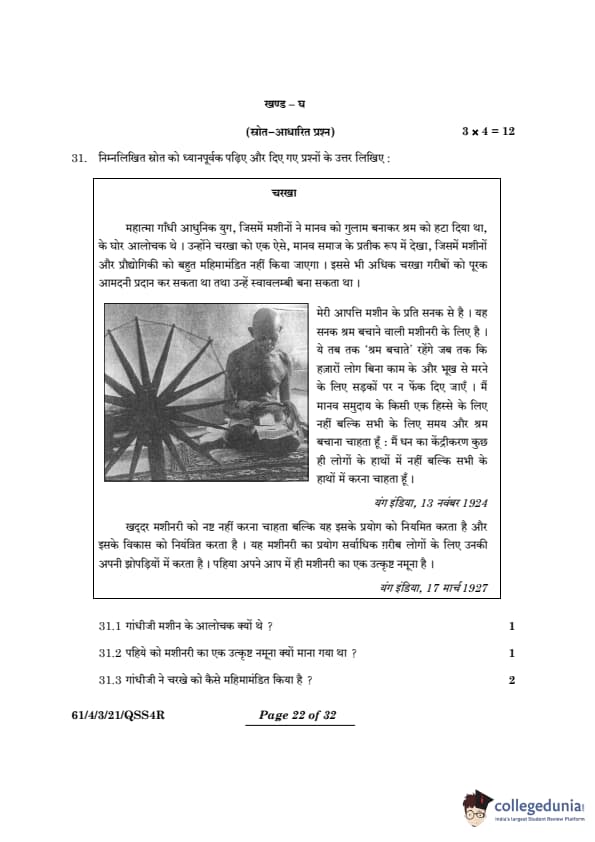
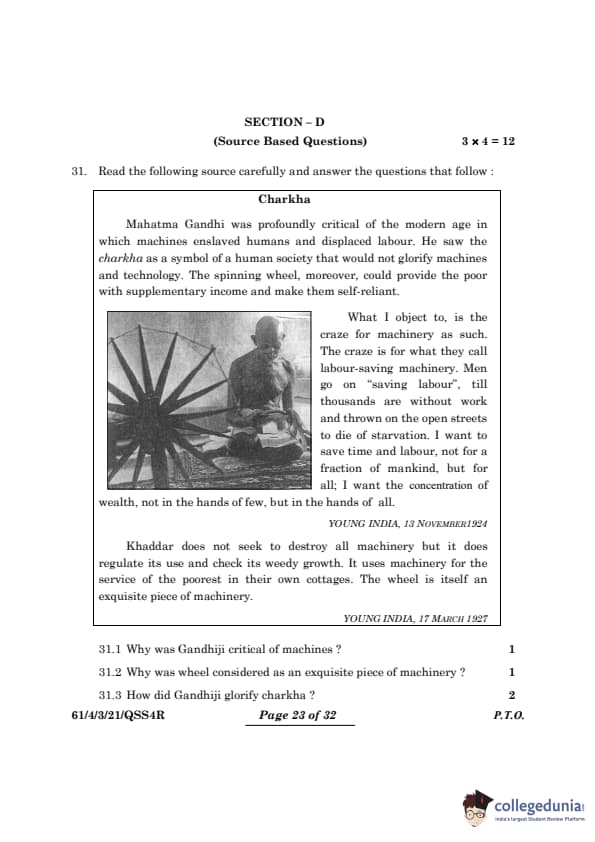
Question 31:
Read the following source carefully and answer the questions that follow:
![[Image of Gandhi at Spinning Wheel]](https://assets.collegedunia.com/public/image/33_ce6ff3f79dc3689c36127fc119948be0.png?tr=w-282,h-246,c-force)
Charkha
Mahatma Gandhi was profoundly critical of the modern age in which machines enslaved humans and displaced labour. He saw the charkha as a symbol of a human society that would not glorify machines and technology. The spinning wheel, moreover, could provide the poor with supplementary income and make them self-reliant.
What I object to, is the craze for machinery as such. The craze is for what they call labour-saving machinery. Men go on "saving labour", till thousands are without work and thrown on the open streets to die of starvation. I want to save time and labour, not for a fraction of mankind, but for all; I want the concentration of wealth, not in the hands of a few, but in the hands of all.
YOUNG INDIA, 13 NOVEMBER 1924
Khaddar does not seek to destroy all machinery but it does regulate its use and check its weedy growth. It uses machinery for the service of the poorest in their own cottages. The wheel is itself an exquisite piece of machinery.
YOUNG INDIA, 17 MARCH 1927
31.1: Why was Gandhiji critical of machines?
View Solution
Solution: Gandhiji was critical of machines because he believed that they enslaved human beings and displaced human labour. He considered the machine to be the cause of great poverty in society. He believed that the excessive focus on labor-saving machines was causing unemployment and starvation and saw this as the great moral crisis of the modern age. He was opposed to the concentration of wealth in the hands of a few, which was driven by these large machines, which would in turn impact the lives of the masses.
31.2: Why was the wheel considered as an exquisite piece of machinery?
View Solution
Solution: The wheel was considered an exquisite piece of machinery because it was significant as a symbol of a human society that focused on the dignity of labour. Also, the spinning wheel (charkha) had the potential to provide the poor with supplementary income, thus making them more self-reliant.
31.3: How did Gandhiji glorify charkha?
View Solution
Solution: Gandhiji promoted the use of charkha as a means to promote self-reliance and independence among the masses. He considered it to be the fundamental prerequisite of “swaraj” (self-rule), which shows the significance he associated with it for freedom. He appealed to the people to boycott English products and urged them to return to indigenous goods, with the idea of increasing self-reliance. Through charkha, Gandhiji wanted to promote cottage industries so that local manufacturing and trade could get a boost. He believed that the Charkha would help in the creation of employment in villages, thus reducing poverty and unemployment.
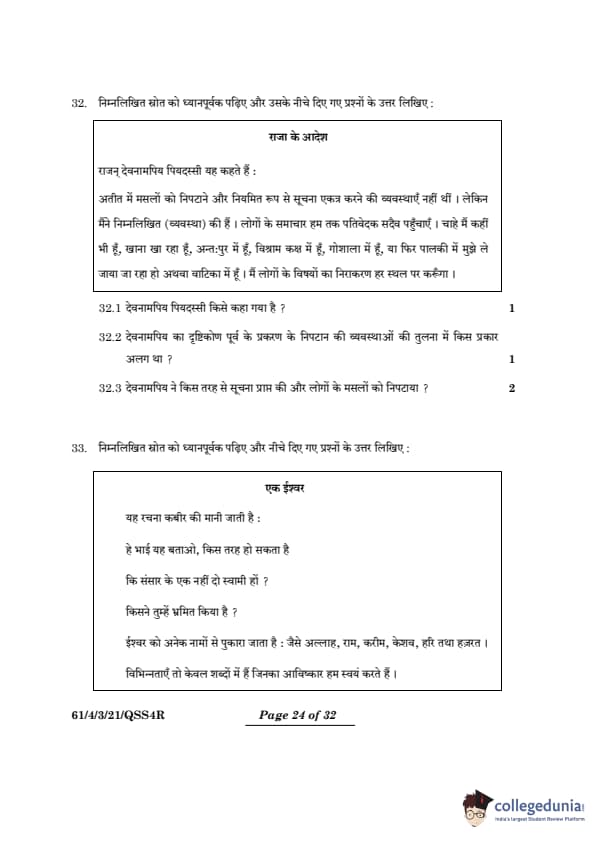
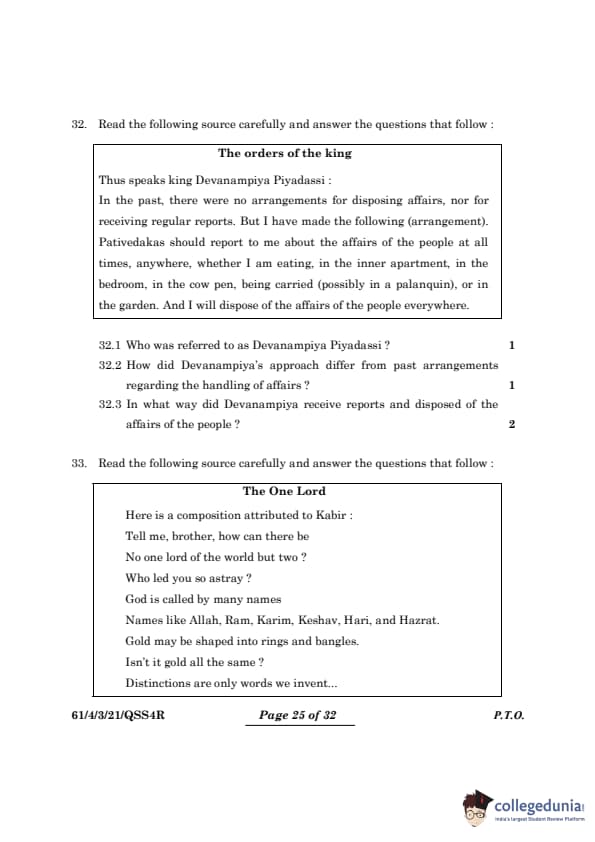
Question 32:
Read the following source carefully and answer the questions that follow:
The orders of the king
Thus speaks king Devanampiya Piyadassi: In the past, there were no arrangements for disposing affairs, nor for receiving regular reports. But I have made the following (arrangement). Pativedakas should report to me about the affairs of the people at all times, anywhere, whether I am eating, in the inner apartment, in the bedroom, in the cow pen, being carried (possibly in a palanquin), or in the garden. And I will dispose of the affairs of the people everywhere.
32.1: Who was referred to as Devanampiya Piyadassi?
View Solution
Solution: The inscription indicates that King Ashoka was referred to as Devanampiya Piyadassi, which literally means “beloved of the Gods.”
32.2: How did Devanampiya’s approach differ from past arrangements regarding the handling of affairs?
View Solution
Solution: Devanampiya introduced a new system of handling the affairs of the people, which was different from previous rulers and their methods of governance. He started the system of disposing of all kinds of affairs by himself, while earlier such decisions were made by the King or a central authority. He also initiated the process of receiving regular reports about the affairs of the people and made himself available to people at all times.
32.3: In what way did Devanampiya receive reports and disposed of the affairs of the people?
View Solution
Solution: Devanampiya made arrangements to have pativedakas or messengers report to the king about the affairs of the people at any time. He made himself available for disposing of the affairs of the people at any time of day or night and at any place which made him accessible and approachable to them.
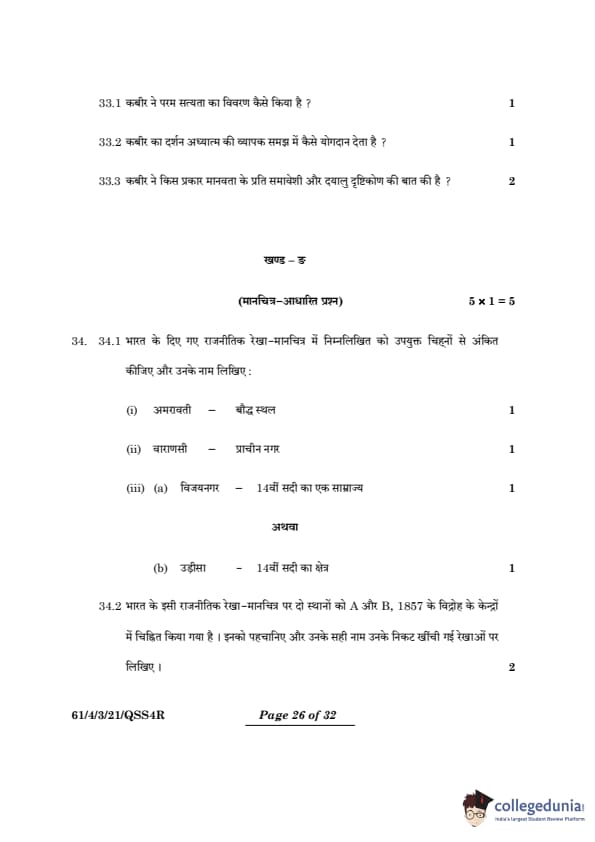
Question 33:
Read the following source carefully and answer the questions that follow:
The One Lord
Here is a composition attributed to Kabir:
Tell me, brother, how can there be
No one lord of the world but two?
Who led you so astray?
God was called by many names:
Names like Allah, Ram, Karim, Keshav, Hari, and Hazrat.
Gold may be shaped into rings and bangles.
Isn’t it gold all the same?
Distinctions are only words we invent…
33.1: How did Kabir describe the ultimate reality?
View Solution
Solution: Kabir described the Ultimate Reality by drawing upon a range of traditions and highlighting that the source of all faith was the same. He described the Ultimate Reality through different names like Ram, Karim, Keshav, Hari, Khuda, Hazrat, and Pir, which all refer to the same supreme power. He also used many terms from Vedantic traditions like Alakh, Nirakar, Brahman, and Atman to convey the same ideas.
33.2: How does Kabir’s philosophy contribute to a broader understanding of spiritualism?
View Solution
Solution: Kabir tried to coordinate and unify different religions and gave a universal path, which could be followed by all human beings. According to him, every life has a relationship with two spiritual principles, which are the soul and God. He used terms from Vedantic traditions, like alakh (unseen) and nirakar (formless), Brahman, Atman, and other terms from Yogic traditions which highlight the various ways of interpreting the ultimate reality. He also drew from mystical traditions like shabda (sound) and shunya (emptiness) to highlight a more experiential path.
33.3: How has Kabir advocated an inclusive and compassionate view of humanity?
View Solution
Solution: Kabir believed in the oneness of God, thereby highlighting that all human beings were children of the same God. He believed that all people were equal and there were no differences based on caste or social hierarchy, which shows the egalitarian aspect of his philosophy. His purpose was to preach a universal religion based on love, compassion, and understanding, which went beyond the narrow confines of religion. He always urged people to be sympathetic to all other living beings, which makes his teachings deeply compassionate. He questioned entrenched religious and social institutions and practices in the search for the divine, showing his criticism for rigid and ritualistic aspects of religion. He told people to be humane and compassionate towards all human beings and other forms of life, which highlights his emphasis on ethics.
Section E
Map-Based Question
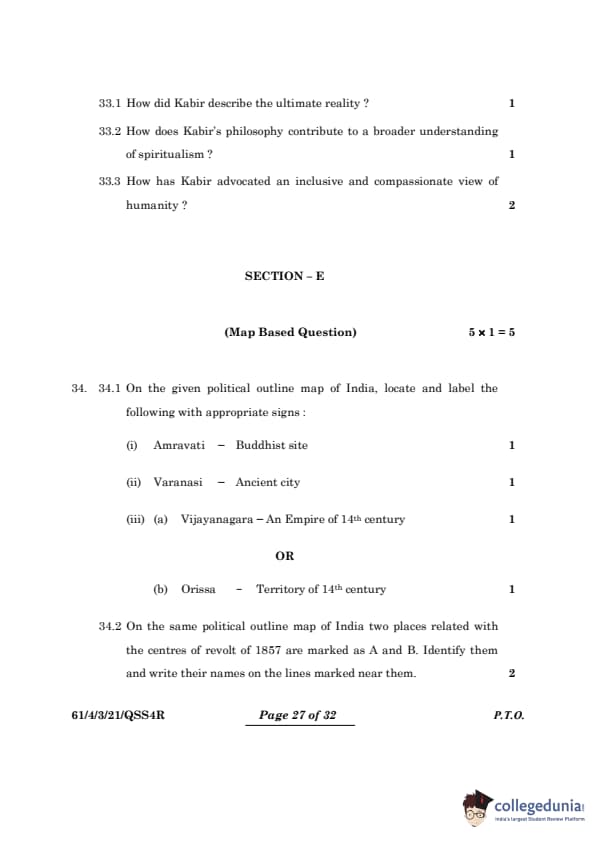
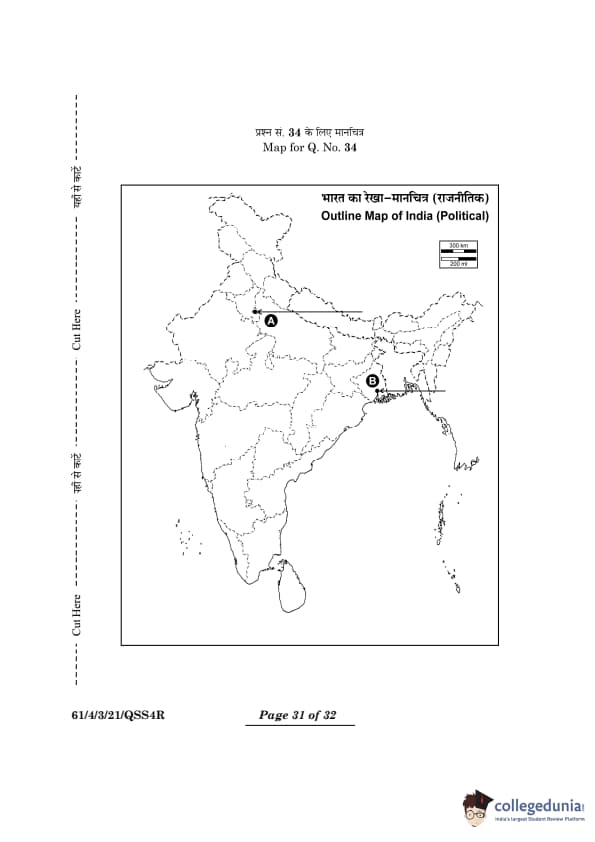
Question 34 (Map-Based Question):
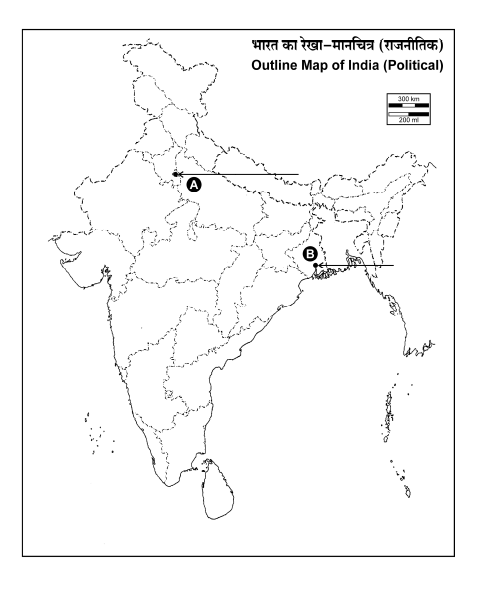
34.1 On the given political outline map of India, locate and label the following with appropriate signs:
(i) Amravati – Buddhist site
(ii) Varanasi – Ancient city
(iii) (a) Vijayanagara – An Empire of 14th century
OR
(iii) (b) Orissa – Territory of 14th century
[Map of India provided for labeling]
View Solution
Solution:
(i) Amravati – Buddhist Site: Amravati is located in the present-day state of Andhra Pradesh. It is renowned for the Mahachaitya, a significant Buddhist monument. It should be marked at its correct location on the map, using the appropriate symbol and label.
(ii) Varanasi – Ancient City: Varanasi (also known as Benaras) is one of the oldest continuously inhabited cities in the world. It is located in Uttar Pradesh, on the banks of the river Ganga and should be marked at its correct location.
(iii) (a) Vijayanagara – An Empire of 14th century: Vijayanagara was an important empire in South India, and its ruins can be found in present-day Hampi (Karnataka), and it should be marked in the southern region of the map.
OR
(iii) (b) Orissa – Territory of 14th century: Orissa, (present-day Odisha) was a significant territory in the 14th century and is located in the eastern part of India, bordering the Bay of Bengal. You should mark the region on the map using the correct symbols.
34.2: On the same political outline map of India two places related with the centres of revolt of 1857 one marked as A and B. Identify them and write their names on the lines marked near them.
(A) [Map Location A]
(B) [Map Location B]
View Solution
Solution:
(A) Delhi: Delhi was a major centre of the 1857 revolt against the British. It was a symbolic centre of the revolt. The location marked as 'A' on the map should be labeled as Delhi.
(B) Calcutta: Calcutta, (present-day Kolkata) was another major centre of the British power and was also a major site in the revolt of 1857. The location marked as 'B' on the map should be labeled as Calcutta.
For Visually Impaired Candidates only in lieu of Q. No. 34.
34.1: Mention any one Buddhist site of India.
View Solution
Solution: Any one of the important Buddhist sites in India can be mentioned. These may include: Nagarjunakonda, Sanchi, Amaravati, Lumbini, Bharhut, Bodh Gaya, Sarnath, Ajanta, or Kushinagar.
34.2: Name any one ancient city located in the central region of India.
View Solution
Solution: Any one of the ancient cities of the central region of India can be mentioned. These could include: Patliputra, Kosala, Kannauj, Mathura, Avanti, Rajgir, Ujjain, Vidisha, or Varanasi.
34.3(a): Name the capital city of Vijayanagara empire.
View Solution
Solution: The capital city of the Vijayanagara Empire was Vijayanagara/Hampi.
34.3(b): Name any one neighboring state of Vijayanagara empire.
View Solution
Solution: Any one of the neighboring states of the Vijayanagara empire can be mentioned, such as: Bidar, Golconda, Berar, Bijapur, Kanchipuram, Ahmednagar, Mysore, etc.
34.4: Mention any two centers of the Indian National Movement.
View Solution
Solution: Any two centers related to the Indian National Movement can be mentioned such as: Champaran, Kheda, Ahmedabad, Benaras, Amritsar, Chauri Chaura, Lahore, Bardoli, Dandi, Bombay (Quit India Resolution), and Karachi.





Comments