




CBSE Class 12 History Set 3 Question Paper PDF (Code: 61/5/3) is now available for download. CBSE conducted the Class 12 History examination on March 28, 2024, from 10:30 AM to 1:30 PM. The question paper consists of 34 questions carrying a total of 80 marks. Section A includes 21 MCQs for 1 mark each, Section B contains 6 short-answer questions for 3 marks each, Section C comprises 3 long-answer questions for 8 marks each, Section D comprises 3 Source-based questions having three sub-questions carries 4 marks each and Section E comprises 1 Map-based question that carries 5 marks.
Candidates can use the link below to download the CBSE Class 12 History Set 3 Question Paper with detailed solutions.
CBSE Class 12 History Question Paper 2024 (Set 3- 61/5/3) with Answer Key
| CBSE Class 12 2024 History Question Paper with Answer Key |  Download Download |
Check Solution |
CBSE Class 12 2024 History Questions with Solutions
SECTION A
(Multiple Choice Type Questions)
Question 1:
Who among the following was an ex-army official and worked as Director General of Archaeological Survey of India (ASI)?
View Solution
Solution:
R.E.M. Wheeler: Sir Robert Eric Mortimer Wheeler was a British archaeologist and former army official who served as the Director-General of the Archaeological Survey of India (ASI) from 1944 to 1948. His military background greatly influenced his approach to archaeology, including his emphasis on precise excavation techniques and stratigraphic analysis.
Alexander Cunningham: Although Alexander Cunningham is known as the first Director-General of ASI, he was a military engineer and not a former army official.
John Marshall: John Marshall served as the Director-General of the ASI. However, he was a historian and archaeologist, but not an ex-army official.
R.D. Bannerjee: Rakhaldas Bandyopadhyay was an Indian archaeologist who made great contributions to Indian archaeology, he was also not a military officer.
Question 2:
Identify the following picture from the given options:
![[Image of Shahjahan Begum]](https://assets.collegedunia.com/public/image/4_e63139092b676963c604542c9d2ec2ba.png?tr=w-205,h-338,c-force)
View Solution
Solution:
Shahjahan Begum: Shahjahan Begum was one of the Begums of Bhopal, who played an active role in preserving the Stupa at Sanchi.
Sultan Jahan Begum: Sultan Jahan Begum was also the Begum of Bhopal who followed the footsteps of Shah Jahan, and also played an active role in preserving the stupa at Sanchi.
Jahanara Begum and Ruksar Begum: Both Jahanara and Ruksar Begums were Mughal princesses who did not play an active role in the preservation of Buddhist stupas.
Question 2 (Visually Impaired Candidates Only):
In which of the following states Sanchi Stupa is located?
View Solution
Solution: The Sanchi Stupa is located in the state of Madhya Pradesh. It is one of the best preserved Buddhist sites in India, and it is also a UNESCO World Heritage Site.
Question 3:
Which one of the following is the correct statement regarding Harappan Culture?
View Solution
Solution:
**(A) Most of the Harappan sites were located in semi-arid lands:** This is the most accurate statement. Many Harappan sites were located in regions with low and unreliable rainfall, which made irrigation very important to ensure agricultural success.
**(B) Irrigation was probably not required for agriculture at the Harappan sites:** This is incorrect. Given that many Harappan sites were in semi-arid areas, irrigation was very much required to ensure agricultural productivity.
**(C) No trace of canals have been found at the Harappan sites:** This statement is incorrect because traces of canals were found at the site of Shortughai in Afghanistan, but not in Punjab or Sindh.
**(D) The Iron-tipped Ploughshare was used at the Harappan sites:** The Harappans did not use iron tools, and they were mainly known for the usage of bronze tools.
Question 4:
Which one of the following is not a true statement regarding Harappan Script?
View Solution
Solution:
**(A) This script remains undeciphered till date:** The Harappan script has not been deciphered so far, which makes it a major challenge for archaeologists and linguists to understand the civilisation better.
**(B) This script was written from left to right:** The Harappan script was generally written from right to left, and not left to right, as is mentioned here. This script was mostly written on seals and other objects.
**(C) It was not alphabetic:** The Harappan script was indeed not alphabetic, but logographic, which means it used symbols to represent words or concepts rather than individual letters.
**(D) It has too many signs between 375 and 400:** The Harappan script is known to have contained around 375 to 400 different signs, indicating a complex system of writing.
Question 5:
Write the appropriate option from the given in your answer sheet. The practice of ______ means a man having several wives.
View Solution
Solution:
Polygyny: Polygyny refers to the practice of a man having more than one wife at the same time.
Exogamy: Exogamy is the practice of marrying outside one's own group.
Endogamy: Endogamy is the practice of marrying within a specific group.
Polyandry: Polyandry is the practice of a woman having more than one husband.
Question 6:
Given below are two statements marked as Assertion (A) and Reason (R). Read them carefully and choose the correct option from the given options.
Assertion (A): In the Eighth Century, the Kailashnath Temple was carved out of mountain.
Reason (R): King Ashoka had given the directive to create artificial caves by cutting into the mountains to resemble temples.
View Solution
Solution:
Step 1: Determine the truth of Assertion (A): The Kailasa or Kailasanatha temple at Ellora in Maharashtra, India, is a remarkable monolithic rock-cut temple dating back to the 8th century during the Rashtrakuta dynasty. Thus, Assertion (A) is true.
Step 2: Evaluate the truth of Reason (R): Emperor Ashoka (3rd century BCE) played an important role in the creation of artificial caves. However, these were for the Ajivikas and Buddhists, and these cave temples were typically simple shelters for monks to reside. The cave temples of Ashoka were not the same as temples with elaborate carvings.
Step 3: Determine if Reason explains Assertion: Ashoka's cave building activities were not related to the Kailashnath Temple and were not a reason for building the temple. They were built many centuries apart for different purposes. Therefore Reason (R) is not the correct explanation for Assertion (A), but both the statements are individually true.
Question 7:
Identify the medieval globe-trotter with the help of the following information:
- Before he set-off for India he made pilgrimage trips to Mecca before 1332-33 C.E.
- The Delhi Sultan Muhammad Bin Tughlaq made him Qazi or the judge of Delhi.
View Solution
Solution:
Ibn Batuta: Ibn Batuta was a Moroccan traveler of the 14th century. He travelled to many parts of the world, and before going to India, had made the pilgrimage to Mecca. He was appointed as the qazi or judge in Delhi by Muhammad bin Tughlaq. His work “Rihla” is a detailed account of his travels.
Abd-al-Razzak: Abd-al-Razzak was a 15th-century Persian traveler who visited South India and has given valuable information about the Vijayanagara Empire.
Al-Biruni: Al-Biruni was an 11th-century scholar from Central Asia and came to India during the time of Mahmud of Ghazni. He was not made a Qazi by the Delhi Sultanate.
Seydi Ali Reis: Seydi Ali Reis was an Ottoman admiral and geographer of the 16th century. He did not visit India in this time frame.
Question 8:
Arrange the following in chronological order and choose the correct option from the following:
I. Rule of Ashoka
II. Invasion of Alexander
III. Rule of Gupta dynasty
IV. Rise of Chalukyas in Karnataka
View Solution
Solution:
II. Invasion of Alexander: Alexander the Great's invasion of India happened in the 4th century BCE. This is placed as the first event, as it is earliest in the order.
I. Rule of Ashoka: Asoka was a Mauryan ruler, and he came after Alexander's invasion. He ruled in the 3rd Century BCE.
III. Rule of Gupta dynasty: The Gupta dynasty rose to power later than the Mauryas, and it is placed in the 4th to 6th Century CE.
IV. Rise of Chalukyas in Karnataka: The Chalukyas of Karnataka rose to power in the 6th Century CE and therefore, they are placed last.
Question 9:
Who among the following Sikh Gurus compiled ‘Adi Granth Sahib'?
View Solution
Solution:
Guru Arjun Dev ji: Guru Arjun Dev ji was the fifth Sikh guru, and he compiled the Adi Granth Sahib, which is a central text of Sikhism. He compiled and edited the verses of the first four gurus and other Bhakti and Sufi saints in the compilation.
Guru Nanak Dev ji: Guru Nanak Dev ji was the founder of Sikhism, and his teachings and hymns were later included in the Adi Granth Sahib by Guru Arjun Dev.
Guru Hargobind Sahib ji: Guru Hargobind Sahib ji was the sixth Sikh Guru, and he did not compile the Adi Granth Sahib, though he made contributions to it.
Guru Gobind Singh ji: Guru Gobind Singh ji was the tenth Sikh guru, and he compiled the Dasam Granth, not the Adi Granth Sahib.
Question 10:
Read the following information carefully and choose the correct location for this dargah from the given options.
- It is a dargah of Shaikh Salim Chisti.
- Akbar visited this dargah many a times.
View Solution
Solution:
Fatehpur Sikri: The dargah of Shaikh Salim Chisti is located in Fatehpur Sikri, Uttar Pradesh. It was also a place often visited by Mughal emperor Akbar. This complex was built as a dedication to the Sufi saint Shaikh Salim Chisti.
Ajmer: Ajmer has the dargah of Khwaja Moinuddin Chisti, and not of Sheikh Salim Chisti.
Delhi: Delhi has the dargah of Nizamuddin Auliya, and not of Sheikh Salim Chisti.
Agra: While Akbar's tomb is located in Agra, Shaikh Salim Chisti's dargah is not present in Agra.
Question 11:
Which one of the following descriptions of Mughal rural society is correctly matched?
| (Rural - people) | (Profession) |
|---|---|
| (A) Raiyat | Boatsman |
| (B) Mallah | Banker |
| (C) Shroff | Peasant |
| (D) Mansabdar | Military-Bureaucrat |
View Solution
Solution:
**(A) Raiyat - Boatsman:** “Raiyat” refers to the peasant farmers in the Mughal era, not boatsmen.
**(B) Mallah - Banker:** “Mallah" refers to boatmen or sailors, and they were not bankers.
**(C) Shroff - Peasant:** “Shroff" refers to the local money lenders and bankers, not peasants.
**(D) Mansabdar - Military-Bureaucrat:** “Mansabdars” in the Mughal administration were officials who had military and administrative responsibilities, making this the correct match.
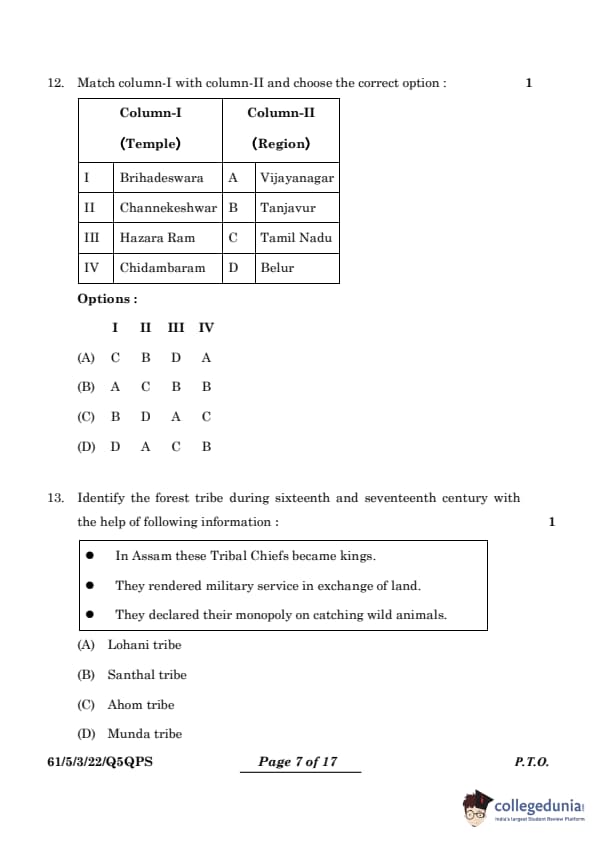
Question 12:
Match column-I with column-II and choose the correct option:
| Column-I (Temple) | Column-II (Region) |
|---|---|
| I Brihadeswara | A Vijayanagar |
| II Channekeshwar | B Tanjavur |
| III Hazara Ram | C Tamil Nadu |
| IV Chidambaram | D Belur |
View Solution
Solution:
I. Brihadeswara - B. Tanjavur: The Brihadeswara Temple, also known as the Big Temple, is located in Thanjavur, Tamil Nadu, and is a great example of Chola architecture.
II. Channekeshwar - D. Belur: The Channekeshwar Temple is located in Belur, Karnataka. It is a significant example of Hoysala architecture.
III. Hazara Ram - A. Vijayanagar: The Hazara Rama Temple is located in Hampi, the capital of the Vijayanagara Empire, which is also now a UNESCO world heritage site.
IV. Chidambaram - C. Tamil Nadu: The Chidambaram Temple is located in Chidambaram, Tamil Nadu, and it is a very old Shiva Temple, known for its intricate architecture.
Question 13:
Identify the forest tribe during the sixteenth and seventeenth centuries with the help of the following information:
- In Assam these Tribal Chiefs became kings.
- They rendered military service in exchange for land.
- They declared their monopoly on catching wild animals.
View Solution
Solution:
Ahom Tribe: The Ahom tribe were the ones who established a kingdom in Assam. They had a system where military service was given in exchange for land, and they also declared a monopoly over catching wild animals, which shows their unique administrative set up.
Lohani tribe: The Lohani tribe were primarily involved in trade and were based in the regions bordering India and Afghanistan, and not Assam.
Santhal tribe: The Santhal tribe are located in the areas of Jharkhand and its surrounding areas, and they did not have a kingdom in Assam.
Munda tribe: The Munda tribe are also primarily found in the regions of Jharkhand, and they did not form any kingdom in Assam.
Question 14:
Identify the primary purpose of Britishers to implement Permanent Settlement in Bengal. Choose the best suitable option from the following:
View Solution
Solution:
**(D) To provide financial stability to British govt.:** The primary objective of the Permanent Settlement was to create a system of fixed revenue collection, which would provide the British government with a stable source of income. This was their main focus, not other aims mentioned in the options.
**(A) To empower peasants of the region:** The system did not aim at empowering the peasants, and in many cases, it even led to their impoverishment.
**(B) To abolish land ownership in the region:** The British did not try to abolish land ownership; rather they fixed the land ownership with the zamindars.
**(C) To increase agricultural productivity of Jotedars:** The system did not focus on jotedars, and instead, the primary focus was on revenue collection from zamindars.
Question 15:
Choose the correct option regarding Virashaiva tradition from the following:
View Solution
Solution:
**(A) This tradition emerged in Karnataka:** The Virashaiva tradition emerged in Karnataka in the 12th century. It was led by Basavanna and other social reformers.
**(B) They are the followers of Vishnu:** The Virashaivas are followers of Shiva, and they consider linga as their primary object of devotion.
**(C) They believed in the theory of rebirth:** The Virashaivas did not believe in rebirth.
**(D) They practice funerary rites:** The Virashaivas do not practice funerary rites, as they bury their dead.
Question 16:
Who among the following was the leader of the revolt of 1857 from Bihar region?
View Solution
Solution:
Kunwar Singh: Kunwar Singh was a prominent leader of the revolt of 1857 from Bihar. He was a zamindar and a key figure in the uprising in that region.
Shahmal: Shahmal was a local leader in the Barout region in present-day Uttar Pradesh, and he was not associated with Bihar.
Gonoo: Gonoo was a tribal leader from Singhbhum and present-day Jharkhand and was not associated with the revolt in Bihar.
Nana Saheb: Nana Saheb was associated with the revolt in Kanpur and the areas around it and was not from Bihar.
Question 17:
At which of the following places did the mutiny break out on the 10th day of May 1857?
View Solution
Solution:
Meerut Cantt: The mutiny of 1857 began in Meerut Cantt on May 10th, 1857, where the soldiers rose against the British officers. This was sparked by the issue of greased cartridges.
Barrackpore: Barrackpore was associated with mutinies and unrest, but not the initial outbreak of the revolt on 10 May 1857. Mangal Pandey of the 34th Bengal Native Infantry unit was associated with this place.
Delhi: Delhi was a very important center of the revolt after the sepoys from Meerut reached there, but not where it started.
Lucknow: Lucknow was one of the most important sites during the revolt, but it did not begin there.
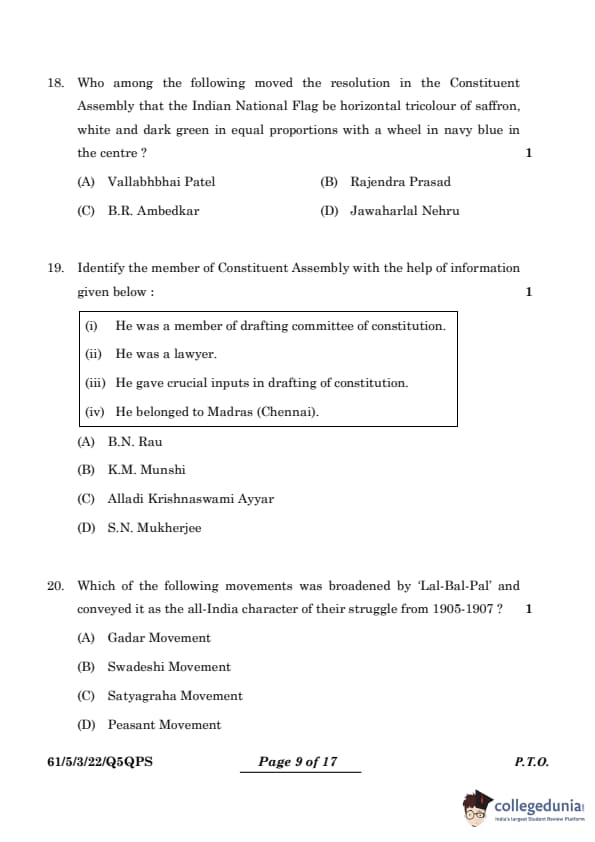
Question 18:
Who among the following moved the resolution in the Constituent Assembly that the Indian National Flag be a horizontal tricolor of saffron, white and dark green in equal proportions with a wheel in navy blue in the center?
View Solution
Solution:
Jawaharlal Nehru: Jawaharlal Nehru moved the resolution in the Constituent Assembly to adopt the Indian National Flag as a horizontal tricolor of saffron, white, and dark green with the Ashoka Chakra in navy blue at the center.
Vallabhbhai Patel: Vallabhbhai Patel was an important member of the Constituent Assembly, but he is not associated with moving this resolution.
Rajendra Prasad: Rajendra Prasad was the president of the Constituent Assembly and was not associated with moving this resolution.
B.R. Ambedkar: B.R. Ambedkar, as the chairman of the drafting committee, played an important role in drafting the Indian Constitution, but not in the adoption of the flag.
Question 19:
Identify the member of Constituent Assembly with the help of information given below:
- He was a member of the drafting committee of the constitution.
- He was a lawyer.
- He gave crucial inputs in drafting of the constitution.
- He belonged to Madras (Chennai).
View Solution
Solution:
Alladi Krishnaswami Ayyar: Alladi Krishnaswami Ayyar was a lawyer and a member of the drafting committee of the Constituent Assembly. He also belonged to Madras (present-day Chennai) and played a key role in shaping the constitution.
B.N. Rau: B.N. Rau was the constitutional advisor to the Constituent Assembly, and he provided important support for the drafting process, but he was not part of the drafting committee.
K.M. Munshi: K.M. Munshi was a prominent member of the drafting committee and a lawyer but did not belong to Madras.
S.N. Mukherjee: S.N. Mukherjee was a jurist and an expert in legal language, and he assisted the drafting committee of the Constituent Assembly, but was not a member of the drafting committee.
Question 20:
Which of the following movements was broadened by ‘Lal-Bal-Pal’ and conveyed it as the all-India character of their struggle from 1905-1907?
View Solution
Solution:
Swadeshi Movement: The Swadeshi Movement, which began in 1905, was broadened by the trio of Lal-Bal-Pal, who also gave the movement an all-India character. They advocated for a more aggressive stance against the British using methods like boycotts, civil disobedience, and national education.
Gadar Movement: The Gadar Movement was a revolutionary movement launched in the early 20th century to attain freedom from British rule but was not directly associated with Lal-Bal-Pal.
Satyagraha Movement: Satyagraha as a form of protest was mainly associated with Gandhi, and it came after 1915. It was not the movement expanded by Lal-Bal-Pal.
Peasant Movement: Peasant movements in India were more focused on local issues and rights of farmers and did not have an all-India character associated with the Swadeshi movement.
Question 21:
Who among the following described the following line for the Kingdom of Awadh? “A cherry that will fall into our mouth one day.”
View Solution
Solution:
Lord Dalhousie: Lord Dalhousie, the Governor-General of India, was the one who famously described the kingdom of Awadh as “a cherry that will fall into our mouth one day.” He used this quote to justify the annexation of Awadh by the British.
Lord Cornwallis: Lord Cornwallis is more associated with the Permanent Settlement in Bengal and not with the annexation of Awadh.
Lord Wellesley: Lord Wellesley was associated with the Subsidiary Alliance system and was not associated with Awadh's annexation.
Lord Canning: Lord Canning was associated with handling the aftermath of the 1857 revolt and was not associated with the annexation of Awadh.
Question 22(a):
Explain the strategies adopted by Harappans to procure raw material for their craft production.
View Solution
Solution:
Multiple Methods and Strategies: The Harappans employed a variety of methods to secure the raw materials needed for their craft production, highlighting their organized approach.
Local Availability of Clay: The clay, which was used in making many crafts, was available locally, and this was an important aspect of their production.
Procuring Stone, Timber, and Metal from Outside: They obtained stone, timber, and metal from outside the settlements, emphasizing their expansive trade networks. This shows that they had an organized network to acquire these resources.
Transportation: Transportation of goods and people was done by land routes as well as sea routes, pointing to a well-developed trade system.
Establishing Settlements in Source Areas: They established settlements near the source areas of raw materials, which helped them extract the resources efficiently. Specific examples are:
- Nageshwar and Balakot: These sites were important for shells.
- Shortughai in Afghanistan: This site was used to procure Lapis Lazuli.
- Lothal: Lothal was close to the sources of carnelian.
- Steatite: Steatite was obtained from South Rajasthan and North Gujarat.
- Metal like copper: Copper was obtained from Rajasthan.
Sending Expeditions: They sent expeditions to source areas, showcasing their efforts to procure resources from distant regions. This also suggests they had an organized system. Important examples include:
- Khetri Region of Rajasthan: This region was important for obtaining Copper.
- South India: This region was important for obtaining Gold.
Communicating with Local People: They also communicated and interacted with local people in those regions. Harappan micro-beads have been found in the regions, suggesting contact and exchange.
Contacts with Distant Lands: They also made contacts with faraway regions to acquire resources, which shows their extensive trade connections.
- Copper from Oman: Copper was possibly obtained from Oman. Distinctive Harappan jars have been found at Omani sites.
- Texts from Mesopotamia: Mesopotamian texts mention contact with various regions like Dilmun (Bahrain), Magan, and Meluhha.
Transportation: Bullock carts were used for the transportation of goods. Boats were also used for transport through rivers and sea routes.
Question 22(b):
Explain how archaeologists have been able to reconstruct dietary practices of the Harappans.
View Solution
Solution:
Wide Range of Plant Products: Archaeologists have been able to reconstruct the dietary practices of the Harappans by studying the wide range of plant products they used. This shows that the diet was based on a variety of cereals, pulses, and other vegetables.
Grains Found at Harappan Sites: Grains such as wheat, barley, lentil, chickpea, and sesame have been found at the sites, which indicate the different types of crops they cultivated.
Millets in Gujarat: Millets have been found at some of the Harappan sites located in Gujarat, showing regional diversity in their diet.
Rarity of Rice: Finds of rice are rare, indicating that it was not a commonly consumed cereal, and it might be that it was cultivated in specific areas.
Charred Grains and Seeds: Dietary practices are reconstructed from finds of charred grains and seeds, and these have also been studied by archaeo-botanists.
Consumption of Animal Products: Harappans consumed a variety of animal products, as inferred from remains found at various sites.
Animal Bones: Bones of animals have been found at many Harappan sites. These were mainly animals used for food, such as goat, sheep, pigs, etc.
Wild Species: Bones of wild species have also been discovered, indicating that the Harappans also hunted for wild animals.
Fish and Fowl: The bones of fish and fowl have also been found at the Harappan sites, which indicates their presence in their diet.
Question 23:
“Mahabharata is a dynamic text.” Explain the statement.
View Solution
Solution:
Growth beyond Sanskrit version: The Mahabharata did not stop growing with the Sanskrit version and instead has constantly grown over centuries. This shows that this text has been dynamic and has been interpreted differently with time.
Written in multiple languages: The epic has been written in many languages through a process of dialogue and translation with different people, showcasing the wide reach and diversity of the text.
Regional Variations: Regional variations have also crept into the main story, giving it regional flavors and different versions.
Retelling in different ways: The central story has been retold in different ways, with different perspectives highlighting the flexibility of its narrative.
Depictions in art: Episodes from the epic have been depicted in sculpture and painting, showcasing its importance in art and architecture.
Themes for performing arts: The epic has provided important themes for performing arts, such as plays and dance, which further highlights the impact of this text on art and culture.
Creative interpretations: Many retellings of the epic draw on the main narrative in creative ways, showcasing that different interpretations of the epic are acceptable. One such example is Mahasweta Devi's Kunti o Nishadi.
Other relevant point: Any other relevant point can be included.
Question 24:
Explain the major features of the Virashaiva tradition.
View Solution
Solution:
Emergence in Karnataka: The Virashaiva tradition emerged in Karnataka during the 12th century, and its origin is linked to the region.
Basavanna as the Leader: The movement was led by a Brahmana named Basavanna, who challenged many social customs and practices.
Followers as Virashaivas or Lingayats: His followers were known as Virashaivas (heroes of Shiva) or Lingayats (wearers of the linga), indicating their specific beliefs.
Important Community Even Today: The Lingayats are still an important and large community in the state of Karnataka, showing its continued relevance.
Worship of Shiva as Linga: They worship Shiva in the form of linga, which is an important symbol for them.
Wearing a Linga: The men of this community usually wear a small linga in a silver case on a loop strung over their left shoulder, which identifies them and is an important element of the faith.
Revered Monks: Those who are revered include the jangama or wandering monks, who play an important role in the spread of their teachings.
Union With Shiva After Death: They believe that on death they will be united with Shiva, which forms the basis of their understanding of death and afterlife.
No Funerary Rites: They do not practice funerary rites, which distinguishes them from other religious traditions.
Burial of Dead: They bury their dead and do not cremate them.
Against the Caste System: They were against the rigid caste system and did not accept the various social divisions and hierarchies.
Against Pollution: They did not favor the notion of “pollution” associated with some groups by birth, showing their inclusive nature.
No Belief in Rebirth: They also did not believe in the theory of rebirth, which makes them different from other Hindu philosophical systems.
Followers from Marginalized Groups: They had numerous followers from marginalized groups, which made them distinct from other religious traditions.
Post-Puberty Marriages: Lingayats encouraged post-puberty marriage.
Widow Remarriage: They also encouraged widow remarriage.
Vachanas in Kannada: Virashaiva tradition can be understood from vachanas, which are compositions in Kannada by the followers of the sect.
Question 25:
Examine the major sources of income of the Panchayats during the sixteenth and seventeenth centuries.
View Solution
Solution:
Contributions by Individuals: Panchayats, which were the local village councils, derived their funds from contributions made by individuals. It shows the self-reliance of these institutions.
Authority to Levy Fines: They had the authority to impose and levy fines for social and legal violations, which became an important source of their income.
Authority to Levy Taxes: They also had the authority to levy taxes on specific items or communities. This further added to the revenue of the panchayats.
Funds for Revenue Officials: Funds were also used for entertaining revenue officials, which were a necessary expenditure to ensure smooth governance.
Funds for Community Welfare Activities: The panchayat funds were also used for community welfare activities such as tiding over natural calamities, construction of bunds, digging of canals, etc. The local population depended on the panchayats for collective action.
Question 26(a):
Why did Awadh become one of the major centers of the Revolt of 1857? Explain.
View Solution
Solution:
Imposition of Subsidiary Alliance: Awadh was made to sign the Subsidiary Alliance treaty in 1801, which marked the beginning of a difficult relationship with the British.
Popular Ruler Wajid Ali Shah: The ruler Wajid Ali Shah was very popular among people, and his people had a good connect with the region and its ruler.
Taking Away Nawab's Powers: The Nawab was popular, but many of his powers were taken away by the British, which showed his lack of control over the region.
Increased Dependence on the British: The Nawab and the kingdom were increasingly becoming dependent on the British.
Annexation of Awadh: In 1856, the British annexed Awadh, citing misrule as their justification. This sparked great resentment among the locals.
Dissatisfaction among People: This annexation further led to dissatisfaction among the people of Awadh, highlighting the emotional and political reasons for revolt.
Dethronement of Nawab Wajid Ali Shah: The dethronement of Nawab Wajid Ali Shah and his exile to Calcutta further ignited resentment in the region.
Widespread Sense of Grief and Loss: The people felt a sense of grief and loss at the Nawab's exile, and it shows how much the people were connected with the royal family.
Material losses: Many people in the region also suffered material losses due to the dissolution of the court and their culture.
Loss of Livelihood: Many people also lost their traditional livelihoods because of the changes made by the British.
Chain of Grievances: A chain of grievances linked the princes, taluqdars, peasants, and sepoys against the British, indicating widespread participation in the revolt.
Loss of Shared World: The people also felt a loss of a shared world and everything people cherished, which indicates a cultural loss along with economic and political disenfranchisement.
Question 26(b):
How did the British suppress the Revolt of 1857? Explain.
View Solution
Solution:
Laws to Suppress the Revolt: The British government passed a series of laws to suppress the revolt. This shows their focus on using the legal system to control the protesters.
Imposition of Martial Law: Martial law was imposed in North India, which provided special powers to the military.
Power to Military Officials: Military officers and ordinary Englishmen were given the power to punish Indians, and this highlights their brutal and aggressive response.
Suspension of Legal Procedures: The processes of law and trial were suspended, and the normal legal procedures were done away with to expedite the processes of punishment.
Punishment by Death: Rebels were punished by death, highlighting the brutal manner in which the rebellion was handled.
Troops to Reconquer North India: The British sent troops to re-conquer North India, and this shows the military might that they used.
Approach to Recapture Delhi: They used a two-pronged approach to recapture Delhi, which had become the central location for the revolt.
More Troops from Britain: They also brought more troops from Britain, showing the scale of resources used to suppress the revolt.
Use of Military Power: The British used their military power on a large scale to end the revolt.
Breaking Unity: They also tried to break the unity between the landholders and the people and targeted the different social and political groups.
Question 27:
“The draft constitution provided for three lists of subjects on the issue of federalism.” Explain the statement with examples.
View Solution
Solution:
Three Lists: The draft constitution provided for three lists of subjects, highlighting the focus on federalism. These lists assigned different levels of power to the central and state governments.
Union List: The Union list included subjects under the control of the Central government, showcasing the central government's sphere of influence.
State List: The State List had subjects that were under the control of the State government, highlighting the powers of the regional governments.
Concurrent List: The Concurrent List included subjects on which both the Central and State governments could legislate, showcasing a balance of power.
More Items Under Union Control: The constitution included many more items under exclusive Union control, showing the importance given to a strong central authority.
Union Control of Key Sectors: The Union also had control of minerals and key industries, which were important for national development and economic control.
Article 356: Article 356 gave the Central government powers to take over a state administration on the recommendation of the Governor, which highlights the provision for dealing with emergencies.
Voices Favoring Strong Centre: Voices like Nehru and Dr. Ambedkar favored a strong center to maintain the unity of the country.
Voices Favoring More Powers to State: K. Santhanam favored more powers to the state governments.
Question 28(a):
“Magadha became the most powerful Mahajanapada between the 6th and 4th centuries BCE.” Justify the statement.
View Solution
Solution:
Magadha's Preeminence: Magadha indeed became the most powerful Mahajanapada between the sixth and fourth centuries BCE, and this was the result of a convergence of many factors.
Fertile Agricultural Land: Magadha was agriculturally highly productive due to the fertile soil and abundant water sources.
Access to Iron: Iron mines were easily accessible, and they provided resources for making agricultural tools and military weapons. The access to iron was especially important during the time when iron technologies were still emerging.
Availability of Elephants: Elephants, a crucial component of the army, were found in forests in the region, which was a major advantage in terms of military strength.
Rivers and Communication: The Ganga river and its tributaries provided a cheap and convenient means of communication and transportation, which allowed the region to have a strong trade network.
Ambitious Kings: Magadha's growth was primarily due to the policies of ambitious kings such as Bimbisara, Ajatasattu, and Mahapadma Nanda. They provided a good base for the kingdom.
Fortified Settlement of Rajagaha: Rajagaha was a fortified settlement, which made the city secure from external aggressions and also provided it with strategic advantages.
Strategic location of Pataliputra: Later, the capital was shifted to Pataliputra, which was strategically located on the banks of the Ganga River, which also gave it logistical advantages.
Question 28(b):
“Mauryan empire was regarded as a major landmark in Indian history.” Justify the statement.
View Solution
Solution:
Major Landmark: The emergence of the Mauryan Empire was regarded as a major landmark in Indian history because of the scale of the empire, its influence, and impact.
Challenging and Exciting: Historians found the possibility of an empire in early India both challenging and exciting. The Mauryan empire was extremely significant and represented the first time that most of the subcontinent had come under one empire.
Mauryan Art and Architecture: The archaeological finds of the Mauryan Empire, like stone sculpture, were examples of the spectacular art of the period. The stupas, pillars, and sculptures of the Mauryan period showcase the distinctive artistic traditions of the time.
Ashokan inscriptions: The message given on Asokan inscriptions was very different from other rulers, as it focused more on ethics and administration rather than wars.
Geographical Extent: Ashokan inscriptions are found all over India, which shows the extent of the empire.
Powerful and Industrious Ruler: It also suggests that Ashoka was a powerful and industrious ruler. The geographical spread of the inscriptions indicates the scale of the Mauryan empire.
Humble Ruler: He was more humble than later rulers who adopted grand titles, and this was a key aspect of his image.
Inspiration to Nationalists: Nationalist leaders in the twentieth century regarded him as an inspiring figure, which also shows the relevance of the empire in the national struggle for independence.
Duration of Empire: The empire lasted for 150 years, which showcases its stability and longevity.
Question 29(a):
Explain the reasons behind Gandhiji's decision to initiate the Salt Satyagraha and why did this movement become a significant event?
View Solution
Solution:
Reasons behind Gandhiji's Decision to Initiate Salt Satyagraha:
Unpopular Salt Law: The salt law was highly unpopular, and this made it an ideal issue to start a mass movement, as salt was a basic necessity for everyone.
Advance Notice: Gandhiji had given advance notice of his salt march to the British, which was also to challenge the British to address their issues.
Starting the March: On 12th March 1930, Gandhiji started the march to break the Salt law, and it highlights his commitment to launching the movement.
British Monopoly Over Manufacture and Sale: The British had a monopoly over the manufacture and sale of salt, and this had become extremely unpopular with time and was seen as an act of economic oppression.
Government Destroys Salt: The government destroyed the salt which they could not sell profitably, which also caused great anger among the locals.
People Not Allowed to Make Salt: People were also not allowed to make salt for domestic use, and this took away a basic right from the local population.
High Prices of Salt: People were forced to buy salt at a high price, which caused an economic burden on the people.
Salt as Symbol of Protest: Salt was used by everyone and therefore became a symbol of protest against the British oppression.
Launching a Salt Satyagraha: Gandhiji decided to launch the Salt Satyagraha as a direct protest against British injustice.
Depriving Village Industry: It deprived the people of a valuable village industry, highlighting the destruction of local economies because of colonial policies.
Destruction of Property by Nature: It involved the destruction of property that nature produced in abundance.
Tax on Salt: The tax on salt was a major concern and was seen as a symbol of injustice.
Significance of the Salt Satyagraha:
Gandhi's Entry into World Stage: It brought Mahatma Gandhi to world attention, indicating his growing global image.
International Media Coverage: The march was widely covered by the European and American press, indicating its importance from an international perspective.
Participation of Women: Women participated in large numbers, highlighting the inclusion of women in nationalist struggles.
Realization of the End of British Raj: The Salt March made the British realize that their Raj would not last forever, indicating a major shift in the political scenario.
Sharing Power: They realized they would have to share some power with the Indians, as the nationalist movement was becoming stronger.
Participation from All Sections of Society: All sections of society participated in the salt march, and this shows its wide reach across economic and social classes.
Making Salt to Protest: People made salt at Dandi to protest against the British, indicating the spirit of civil disobedience.
Non-violent Protest: It was a non-violent protest, showcasing the effectiveness of Gandhiji's approach in a global context.
British Response: The British used violent methods to control the march, further highlighting the injustice of the colonial state.
Unpopularity of British: The British became unpopular among the Indian masses as well as the international community.
Question 29(b):
Explain why the 'Quit India Movement' was considered a mass movement.
View Solution
Solution:
Failure of Cripps Mission: The failure of the Cripps Mission, a British attempt to gain Indian support for World War II, created resentment and distrust, pushing people towards a more decisive step.
Quit India Movement in August 1942: The Quit India Movement began in August 1942, highlighting the scale of the mobilization against British rule.
'Do or Die': It gave the slogan of “Do or Die,” which gave a message of intense resolve. This captured the mood of the people at that time.
Mass Arrests: The movement began when Gandhiji and other top leaders were arrested, showing how it transformed into a decentralized movement.
Youth Participation: Although Gandhiji and other top leaders were jailed, younger activists carried on the struggle like Jayaprakash Narayan, which shows the involvement of the youth.
Proclamation of Independent Governments: Independent governments were proclaimed in many districts like Satara, highlighting the spirit of resistance and self-rule.
Acts of Sabotage and Strikes: People organized strikes and acts of sabotage all over the country, disrupting the administration of the British.
Underground Resistance: Underground resistance was started by socialist leaders of the Congress, indicating that it was a complex movement with many different actors and methods.
Government Response: The British Government responded with force, showing the fear created by the revolt.
Large-Scale Participation: Thousands of Indians joined the movement, and they came from different sections of the society.
Involvement of Youth: The movement energized the young people who left schools and colleges to join the movement, highlighting its impact on the youth.
Genuine Mass Movement: It truly became a genuine mass movement and was not limited to the elites only.
Question 30(a):
Examine the main reasons for the rise and decline of the Vijayanagara Empire.
View Solution
Solution:
Reasons for the Rise of the Vijayanagara Empire:
Claimants to Power: There were many claimants to power in the early years of the empire, which created an environment of competition and expansion.
Sangama Dynasty: The first dynasty, the Sangamas, exercised control till 1485.
Saluvas: They were succeeded by the Saluvas, who ruled till 1503, after which they were taken over by the Tuluvas.
Tuluva Dynasty: The Tuluvas came to power in 1503, and Krishnadeva Raya belonged to this dynasty.
Krishnadeva Raya's Rule: Krishnadeva Raya's rule was characterized by expansion and consolidation, and this also highlights his importance in the history of Vijayanagar.
Land between Tungabhadra and Krishna Rivers: He acquired the land between the Tungabhadra and Krishna rivers. This was an important strategic expansion.
Subduing of Orissa Rulers: The rulers of Orissa were subdued, which shows his military power and strategies.
Defeating the Sultan of Bijapur: He also defeated the Sultan of Bijapur, which added to his military reputation.
Military Preparedness: The kingdom remained in a constant state of military preparedness, which ensured security and stability.
Peace and Prosperity During Krishnadeva Raya's Reign: The empire experienced peace and prosperity during Krishnadeva Raya's reign, demonstrating his effective rule.
Construction of Temples and Gopurams: He built beautiful temples and added gopurams to many South Indian temples, which shows his patronage of religious architecture.
Nagalapuram: He founded a suburban township near Vijayanagara called Nagalapuram, which further highlights the role of urban planning.
Other relevant point: Any other relevant point can be included.
Reasons for the Decline of the Vijayanagara Empire:
Rebellious Nayakas: After Krishnadeva Raya's death, his successors were troubled by rebellious nayakas or military chiefs. This shows their lack of control over the regional leadership.
Shift to Aravidu Dynasty: By 1542, control shifted to the Aravidu dynasty, which also marked a period of instability.
Clashes with Deccan Sultanates: Clashes between the rulers of Vijayanagara and Deccan Sultanates resulted in shifting alliances, indicating a shift in political partnerships.
Alliance Against Vijayanagara: The Deccan Sultanates formed an alliance against Vijayanagara and defeated Rama Raya at the battle of Talikota. This marked a major turning point in the decline.
Destruction of the City: The city was destroyed and abandoned within a few years after the battle of Talikota, signifying the end of its prominence and power.
Question 30(b):
Examine the distinctive aspects of the fortification of the Vijayanagara Empire.
View Solution
Solution:
Abdur Razzaq's Description: Abdur Razzaq was greatly impressed by the fortification of the Vijayanagara Empire, demonstrating how important they were.
Seven Lines of Forts: He described the fortifications consisting of seven lines of forts, which highlights the extensive nature of the defenses.
Encirclement of Agricultural and Forest Lands: The fortification walls encircled agricultural and forest lands, and this highlights that the protection was not just for the city alone but also included the farmlands.
Linking of Hills: The outermost wall linked the hills surrounding the city, which highlights the incorporation of natural barriers into the defenses.
Massive Masonry Construction: The fortifications used massive masonry construction, which was slightly tapered, and indicates the focus on sturdy and defensible structures.
No Mortar: No mortar or cementing agent was used in the construction, and the stones were held together without any external agents. This reveals their advanced construction techniques.
Wedge Shaped Stone Blocks: Stone blocks were wedge-shaped, which held them in place, highlighting a unique and secure method of construction.
Earth and Rubble Walls: The inner portion of the walls was of earth packed with rubble, and this was a method of using readily available material for construction.
Projecting Bastions: Square or rectangular bastions projected outwards, which allowed them to watch the nearby areas.
Cultivated Fields and Gardens: Between the first, second, and the third walls there were cultivated fields, gardens, and houses, which was a clever planning of space.
Usefulness During Siege: Fortifications were useful during sieges, as they would enable the people to carry on agricultural activities.
Agriculture During Siege: Even during a siege, agriculture could be practiced, and crops grown, which implies the self-sustaining nature of their city.
Protection from Starvation: This helped the city prevent starvation during a siege.
Inner Core: The second line of fortification went around the inner core of the urban complex.
Royal Centre: The third line of fortification surrounded the royal center.
Well Guarded Gates: The fort was entered through well-guarded gates, showing focus on security and controlled entry points.
Indo-Islamic Architecture: There was also an influence of Indo-Islamic architecture in some aspects.
Connecting Roads: Roads connected various parts of the city, enabling smooth transport and communication.
Question 31:
Read the source given below and answer the questions that follow:
A ryot petition
This is an example of a petition from a ryot of the village of Mirajgaon, Taluka Karjat, to the Collector, Ahmednagar, Deccan Riots Commission: The sowkars (sahukars)…. have of late begun to oppress us. As we cannot earn enough to defray our household expenses, we are actually forced to beg of them to provide us with money, clothes, and grain, which we obtain from them not without great difficulty, nor without their compelling us to enter into hard conditions in the bond. Moreover, the necessary clothes and grain are not sold to us at cash rates. The prices asked from us are generally twenty-five or fifty percent more than demanded from customers making ready money payments… The produce of our fields is also taken by the sowkars, who at the time of removing it assure us that it will be credited to our account, but they do not actually make any mention of it in the accounts. They also refuse to pass us any receipts for the produce so removed by them.
(31.1) In what ways did the money-lenders oppress the ryots?
View Solution
Solution:
Exorbitant taxes collected: The money lenders collected very high taxes, which became unbearable for the farmers.
Ruthless method of collection: They used ruthless methods of collection and were often known to use force.
Taking Away Land: In case of non-payment, the money-lenders were known to take away land, which further impoverished them.
Forced to Beg for Basic Necessities: The poor peasants were forced to beg for even basic necessities because they were not able to make a living.
Manipulated Laws and Forged Accounts: The money lenders also used manipulation and forgery to exploit the peasants.
Compelled to Sign Bonds: They forced the farmers to sign bonds with stringent conditions, which were often detrimental to the farmers.
No Cash Rates for Grain and Clothes: They also refused to sell clothes and grain to the peasants at cash rates and often charged more.
Produce taken but not credited: Their produce was taken away but not credited to their accounts, and they also did not provide any receipts.
(31.2) Why was the harvest taken away by the money-lenders?
View Solution
Solution:
Recovery of Unpaid Debts: Taking away the harvest was the method the moneylenders used to recover unpaid debts.
False Assurances: They assured the ryot that it would be credited in their accounts, but that was not the case, which shows they used deceptive methods.
No Receipts: They also did not give any receipts.
Other relevant point: Any other relevant point can be included.
(31.3) Explain any two features of the Ryotwari system.
View Solution
Solution:
Revenue Directly Settled with Ryot: Revenue was directly settled with the ryot (peasant) instead of zamindars. It was believed that this would benefit the farmer and the state.
Assessment of Paying Capacity: The average income from different types of soil was estimated, the revenue-paying capacity of the ryot was assessed, and a proportion of it was fixed as the share of the state.
Question 32:
Read the following source carefully and answer the questions that follow:
A language with an enormous range
Al-Biruni described Sanskrit as follows: If you want to conquer this difficulty (i.e., to learn Sanskrit), you will not find it easy because the language is of an enormous range, both in words and inflections, something like the Arabic, calling one and the same thing by various names, both original and derivative, and using one and the same word for a variety of subjects, which, in order to be properly understood, must be distinguished from each other by various qualifying epithets.
(32.1) What motivated Al-Biruni to study Sanskrit?
View Solution
Solution:
Al-Biruni's interest in languages motivated him to study Sanskrit, as he was interested in studying different languages, and he saw it as a challenge worth undertaking.
He also wanted to understand Indian culture through Sanskrit texts, specifically the caste system.
He wanted to overcome the difficulty of learning Sanskrit. This is also why he focused on studying the language in depth.
He had read Sanskrit works translated into Arabic, which led to an interest in studying the language and its literature.
(32.2) How did Al-Biruni's observations about Sanskrit contribute to cross-cultural understanding?
View Solution
Solution:
Al-Biruni's observations served as a bridge between Arabic and Indian cultures, as he made specific mention of the Arabic language in his descriptions.
It helped promote understanding between the Arabic and Indian worlds, highlighting how travelogues serve as a bridge between cultures.
He also highlighted the distinct features of Sanskrit and drew a comparison with Arabic, which provided an interesting perspective.
Those who were familiar with Arabic could comprehend the difficulties of Sanskrit through comparison, making the difficult task of learning Sanskrit easier.
He also tried to understand Indian culture in comparison to his own society, which indicates an attempt at cross-cultural comparison.
He also wanted to understand Indian culture through Sanskrit texts, and this showcases his interest not just in the language but also the knowledge within it.
(32.3) In what ways does Al-Biruni compare Sanskrit to Arabic?
View Solution
Solution:
Difference from Arabic: According to the source, Sanskrit was quite different from Arabic. This highlights the distinct features of both languages.
Difficulty in Translation: The Sanskrit texts could not be easily translated into other languages because it was a difficult language.
Enormous Range: The Sanskrit language has an enormous range, which is mentioned in the text.
Multiple Names: Both languages used multiple names for the same thing, which points toward both similarities and differences between them.
Same Word for Various Subjects: Both languages used the same word for various subjects, which was a source of difficulty in translating it.
Question 33:
Read the following source carefully and answer the questions that follow:
Buddhism in practice
This is an excerpt from the Sutta Pitaka and contains the advice given by the Buddha to a wealthy householder named Sigala: In five ways should a master look after his servants and employees… by assigning them work according to their strength, by supplying them with food and wages, by tending them in sickness, by sharing delicacies with them, and by granting leave at times… In five ways should the clansmen look after the needs of samanas (those who have renounced the world) and Brahmanas: by affection in act and speech and mind, by keeping open house to them and supplying their worldly needs. There are similar instructions to Sigala about how to behave with his parents, teacher, and wife.
(33.1) Explain the importance of Sutta Pitaka in Buddhism.
View Solution
Solution:
The Sutta Pitaka is a crucial text in Buddhism, as it contains the teachings of the Buddha, and it also has the rules and regulations that a Buddhist should follow.
The Sutta Pitaka also guides how different people should behave, both inside as well as outside the monastic order.
This text contains important rules for the lay householders, which provide an ethical framework for people living ordinary lives.
(33.2) How did Buddha advise the wealthy householders to be humane and ethical?
View Solution
Solution:
Work According to Strength: Buddha advised them to assign work to their servants and employees according to their strength, and it promotes compassionate work conditions.
Supply with Food and Wages: He also advised supplying them with food and wages to take care of their basic needs.
Tending them in Sickness: They should also be tended in sickness, which indicates that their welfare is the responsibility of the employer.
Sharing Delicacies: The text mentions that they should also be shared with delicacies, which promotes better relationships.
Granting Leave: They should also be granted leave at times, which takes into account that everyone needs rest and recreation.
Affection in Act, Speech and Mind: They should show affection in act, speech, and mind towards their employees. This highlights the idea that employers should be respectful towards all people.
Sharing and Caring: They should focus on sharing and caring, which highlights the core value of compassion in Buddhism.
Righteous Actions: Buddha also emphasized righteous action as a central element of an ethical life, and it was applicable to everyone irrespective of their social position.
Question 33(c):
What was the advice given by Buddha to Sigala on how to behave with his parents and teachers?
View Solution
Solution:
Show Respect: Buddha advised Sigala to show respect towards his parents and teachers, which was considered extremely important.
Listen to Parents’ Advice: He should also listen to his parents’ advice, as they are guides based on experience.
Look after them in sickness and old age: He should look after them when they are sick and old, highlighting filial duty.
Be a Dedicated Student: He should be a dedicated student and engage in his studies wholeheartedly.
Express Gratitude: He should always express gratitude towards his parents and teachers.
Follow Teacher's Instructions: He should also follow the instructions of his teachers with sincerity.
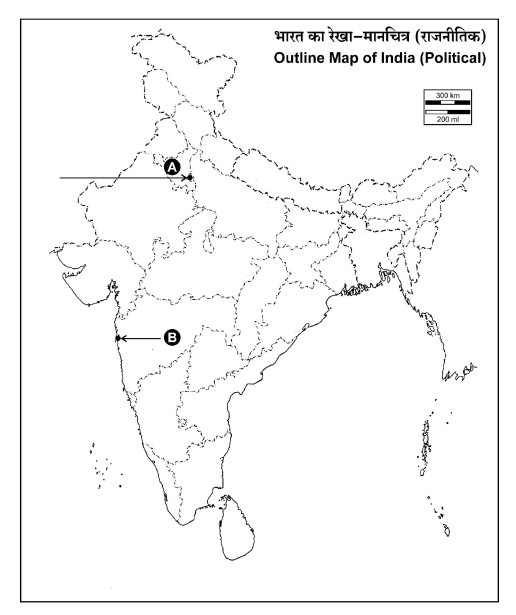
Question 34(a):
On the given political outline map of India, locate and label the following with appropriate signs:
(i) Banawali – A matured Harappan Site
(ii) Bharhut – A Buddhist Site
(iii) (a) Agra – Territory under Mughal’s control
OR
(iii) (b) Delhi – Territory under Mughal’s control
View Solution
Solution:
(i) Banawali – A matured Harappan Site: Banawali is a Harappan site located in the Fatehabad district of Haryana. It is an important example of mature Harappan settlements, and you should mark it in the map in present-day Haryana, using the appropriate symbol.
(ii) Bharhut – A Buddhist Site: Bharhut is known for its Buddhist stupa and its sculptures, located in Madhya Pradesh. It should be marked near the area of Sanchi, using the appropriate symbol.
(iii) (a) Agra – Territory under Mughal’s control: Agra was a key city under Mughal control. It is located in present-day Uttar Pradesh. It is home to numerous Mughal-era monuments like the Taj Mahal and Agra Fort. You should mark it near Delhi using the appropriate symbol.
OR
(iii) (b) Delhi – Territory under Mughal’s control: Delhi was the capital of the Mughal empire and a major center of power. You should mark it in the map using the appropriate symbol in the region of present-day Delhi.
Question 34(b):
On the same map, two places have been marked as A and B, which are centers of the Indian National Movement. Identify them and write their correct names on the lines drawn near them.
A - Delhi
B - Bombay
View Solution
Solution:
A - Delhi: Delhi was a very important city for the Indian national movement, and it was a major center for many political events during the colonial era. You should label the location marked as A as Delhi.
B - Bombay: Bombay (now Mumbai) was another major center for the national movement in India and was the site of many key events. You should label the location marked as B as Bombay.
Question 34.1 (for Visually Impaired Candidates):
Mention any two Harappan Sites.
View Solution
Solution: Any two Harappan sites can be mentioned, for instance: Harappa, Mohenjodaro, Kot Diji, Kalibangan, Ropar, Banawali, Rakhigarhi, Lothal, Dholavira, Nageshwar, or Balakot.
Question 34.2(a) (for Visually Impaired Candidates):
Mention any one territory under Mughal's control.
View Solution
Solution: You can mention any territory under Mughal rule, such as Lahore, Panipat, Delhi, Agra, Ajmer, Amber, or Goa.
Question 34.2(b) (for Visually Impaired Candidates):
Mention the name of the Capital of Vijayanagara Empire.
View Solution
Solution: The capital of the Vijayanagara Empire is Hampi/Vijayanagara.
Question 34.3 (for Visually Impaired Candidates):
Name any two centers of the Indian National Movement.
View Solution
Solution: Any two centers of the Indian National Movement, like Champaran, Kheda, Ahmedabad, Dandi, Bardoli, Bombay, Calcutta, Delhi, Madras, Lahore, Amritsar, Surat, or Lucknow, can be mentioned.











Comments