




CBSE Class 12 History Set 1 Question Paper PDF (Code: 61/2/1) is now available for download. CBSE conducted the Class 12 History examination on April 2, 2025, from 10:30 AM to 1:30 PM. The question paper consists of 34 questions carrying a total of 80 marks. Section A includes 21 MCQs for 1 mark each, Section B contains 6 short-answer questions for 3 marks each, Section C comprises 3 long-answer questions for 8 marks each, Section D comprises 3 Source-based questions having three sub-questions carries 4 marks each and Section E comprises 1 Map-based question that carries 5 marks. Candidates can use the link below to download the CBSE Class 12 History Set 1 Question Paper with detailed solutions.
CBSE Class 12 History Question Paper 2025 (Set 1 – 61/2/1) with Answer Key
| CBSE Class 12 2025 History Question Paper with Answer Key |  Download Download |
Check Solution |

Which one of the following is a correct statement regarding the codes of social behaviour as laid down in Dharamasutras and Dharmashastras during the period of Mahabharata?
View Solution
Which one of the following dynasties did Queen Prabhavati belong to?
View Solution
Two statements are given below as Assertion (A) and Reason (R). Read them carefully and choose the correct option.
Assertion (A): Harappa was a well-planned city.
Reason (R): It had a well-planned drainage system.
View Solution
Which one of the following was a distinctive feature of Harappan architecture?
View Solution
Match Column-I with Column-II and choose the correct option:
Column-I Column-II
Sculpture of Sanchi Symbolic Importance
a. Empty seat i. Indicator of Mahaparinibbana
b. Gajalakshmi ii. Indicator of good fortune
c. Wheel iii. Indicator of auspicious
d. Shalbanjika iv. Indicator of first sermon of Buddha
Options:
View Solution
Identify the ruler from Indian history with the following information:
- Ruler of Bhopal
- Ruled from 1868 to 1901 CE
- Helped in preserving the Sanchi Stupa
View Solution
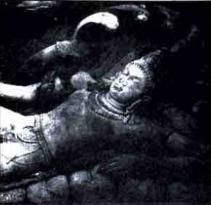
The given sculpture from the fifth century Devgarh temple depicts which of the following deities?
View Solution
Note: The following questions are for the Visually Impaired Candidates only in lieu of Q. No. 7.
Vardhman Mahavir is related to which of the following religions?
View Solution
Which one of the following statements is correct regarding Virashaiva or Lingayat tradition?
View Solution
Arrange the following in chronological order and choose the correct option:
I. Battle of Talikota
II. Establishment of Nagalpuram
III. Formation of Kamalpuram Tank
IV. Emergence of the Sultanate of Golconda
Options:
View Solution
Match Column-I with Column-II and choose the correct option:
Column-I Column-II
Temple Location
a. Brihadeshwara temple 1. Tanjavur
b. Chennakeshava temple 2. Vijayanagara
c. Hazara Ram temple 3. Belur
d. Chidambaram temple 4. Tamil Nadu
Choose the correct option:
View Solution
Identify the ruler of India from the sixteenth century with the following information and choose the correct option:
- He went on a pilgrimage to Ajmer fourteen times.
- He sought blessings for new conquests and the birth of sons from Ajmer Sharif.
View Solution
Who among the following included the composition of Guru Tegh Bahadur ji in the Guru Granth Sahib?
View Solution
Which of the following statements is true regarding the land revenue system of the Mughals?
View Solution
Identify the correct statement from the following regarding the role of women in agrarian society of the Mughal State.
View Solution
Find the odd one out regarding the revolt of 1857 from the following:
View Solution
Fill in the blank with the suitable option given below:
The Revolt of 1857 marked the end of the _______ dynasty in India.
View Solution
Which of the following statements best describes the effect of the Permanent Settlement on zamindars?
View Solution
How was the Constituent Assembly influenced by public opinion? Choose the correct option.
Statements:
I. People aired their views outside the Parliament House.
II. People gave their reactions through the press.
III. The members of the Constituent Assembly used to discuss with the public.
IV. Public expressed their views in the Constituent Assembly.
View Solution
Identify the person from the given information:
1. He was the head of the Advisory Committee of the Constituent Assembly.
2. He was against the separate electorate.
3. He was the first home minister of free India.
View Solution
On whose advice Gandhiji spent a year in travelling around British India for getting to know the land and its people before entering into politics?
View Solution
Why did Gandhi call for a nationwide campaign against the 'Rowlatt Act'? Choose the appropriate option from the following:
Choose the correct option:
View Solution
(a) Why were the seals and sealings used by the Harappans to facilitate long distance communication? Explain with examples.
View Solution
Question 22:
(b) “There were different views of archaeologists on the administration of Harappa.” Explain the statement with examples.
View Solution
Explain any three sources to know about the Maurya Empire.
View Solution
(a) Analyse the role of Amara-nayakas in the Vijayanagara Empire.
View Solution
Question 24:
(b) Analyse the factors that led the rulers of the Vijayanagara empire to choose the site of Vijayanagara as their capital.
View Solution
Describe the role of Panchayats in the Mughal era.
View Solution
Analyse the policies adopted by William Bentinck to reform Indian society.
View Solution
"During the debates in Constituent Assembly, B.R. Ambedkar told that he wanted a strong centre, much stronger than the centre we had created under the Act of 1935." Analyse the statement.
View Solution
(a) Examine the nature and characteristics of the land grants in ancient Indian society.
View Solution
Question 28:
(b) Examine the various strategies used to enhance agricultural output from the sixth BCE onwards.
View Solution
(a) ‘Francois Bernier contrasted what he saw in India with the situation in Europe.’ Explain the statement with examples.
View Solution
Question 29:
(b) ‘Ibn-Battuta has written extensively about his experience in India.’ Explain the statement with examples.
View Solution
(a) Imagine you are leading a historical research team. How would you explain the role of Ryotwari System in fostering rural indebtedness and its long-term consequences on Bombay-Deccan peasantry? Explain.
View Solution
Question 30:
(b). You are asked to prepare a report on how the end of the American Civil War affected the cotton boom in the Indian Deccan. How would you assess the changes? Explain.
View Solution
Question 31:
31. Read the given source carefully and answer the questions that follow:
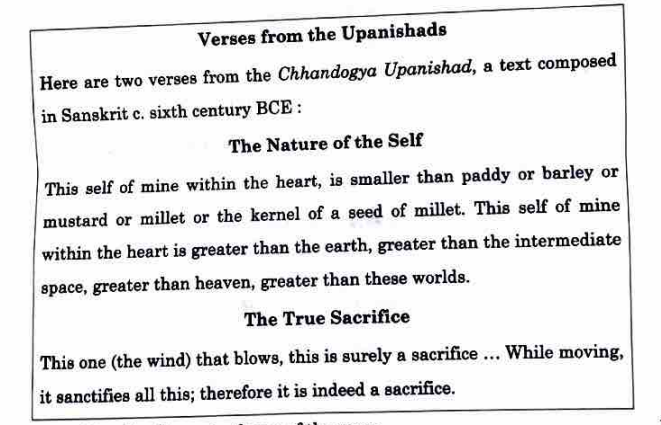
31.1 Mention the main theme of the verse.
31.2 Mention the relationship between the self and the wind in the context of these verses.
31.3 How does this source reflect the philosophical ideas of the Upanishads?
View Solution
Read the following source carefully and answer the questions that follow:
Amir Khusrau (1253-1325), the great poet, musician and disciple of Shaikh Nizamuddin Auliya, gave a unique form to the Chishti 'sama' by introducing the qaul (Arabic word meaning “saying”), a hymn sung at the opening or closing of qawwali. This was followed by sufi poetry in Persian, Hindavi or Urdu, and sometimes using words from all of these languages. Qawwals (those who sing these songs) at the shrine of Shaikh Nizamuddin Auliya always start their recital with the qaul. Today qawwali is performed in shrines all over the subcontinent.
32.1 What unique form did Amir Khusrau introduce to the Chishti ‘sama’?
View Solution
32.2 How did the Chishti-sufi traditions shape Amir Khusrau’s understanding of spirituality?
View Solution
32.3 Analyse the significance of the Sufism in the qawwali performances.
View Solution
Read the following source carefully and answer the questions that follow:
Why was salt the symbol of protest? This is what Mahatma Gandhi wrote:
The volume of information being gained daily shows how wickedly the salt tax has been designed. In order to prevent the use of salt that has not paid the tax which is at times even fourteen times its value, the Government destroys the salt it cannot sell profitably. Thus it taxes the nation’s vital necessity; it prevents the public from manufacturing it and destroys what nature manufactures without effort. No adjective is strong enough for characterizing this wicked dog-in-the-manger policy. From various sources, I hear tales of such wanton destruction of the nation’s property in all parts of India. Maunds if not tons of salt are said to be destroyed on the Konkan coast. The same tale comes from Dandi. Wherever there is likelihood of natural salt being taken away by the people living in the neighbourhood of such areas for their personal use, salt officers are posted for the sole purpose of carrying on destruction. Thus valuable national property is destroyed at national expense and salt taken out of the mouths of the people. The salt monopoly is thus a fourfold curse. It deprives the people of valuable easy village industry, involves wanton destruction of property that nature produces in abun- dance, the destruction itself means more national expenditure and fourthly, to crown this folly, an unheard of tax of more than 1,000 per cent is exacted from a starving people. This tax has remained so long because of the apathy of the general public. Now that it is sufficiently roused, the tax has to go. How soon it will be abolished depends upon the strength the people.
33.1 Why was salt law disliked by the masses?
View Solution
33.2 Why were salt officers appointed by the British Government?
View Solution
33.3 Why did Lord Irwin fail in understanding the significance of Salt March?
View Solution
33.1 On the given political outline map of India, locate and label the following places with appropriate symbols:
View Solution





Comments