




CBSE Class 12 Home Science Question Paper PDF is now available for download. CBSE conducted the Class 12 Home Science examination on March 13, 2024, from 10:30 AM to 1:30 PM. The question paper consists a total of 35 questions divided among 4 sections. Candidates can use the link below to download the CBSE Class 12 History Set 2 Question Paper with detailed solutions.
CBSE Class 12 Home Science Question Paper 2024 with Answer Key
| CBSE Class 12 2024 Home Science Question Paper with Answer Key |  Download Download |
Check Solution |
CBSE Class 12 2024 Home Science Questions with Solutions
SECTION A
Question 1:
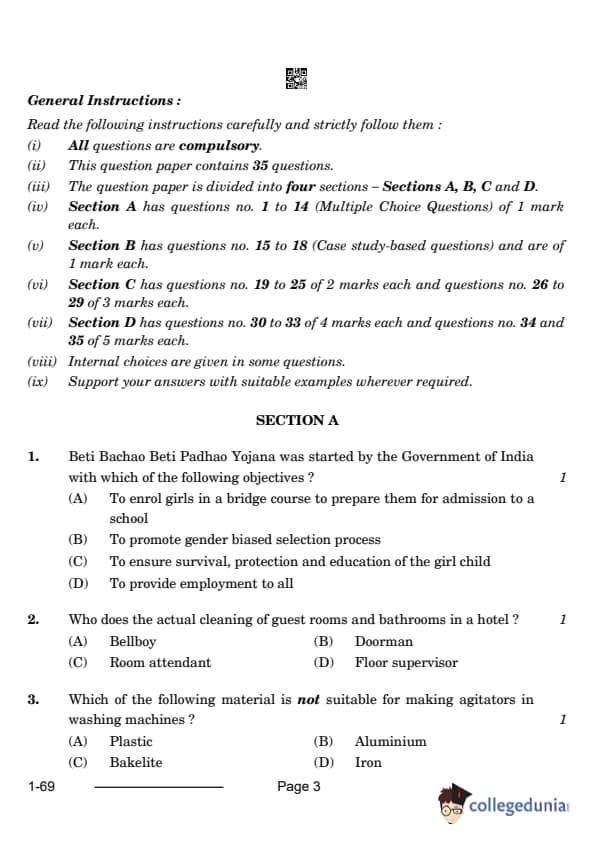
Beti Bachao Beti Padhao Yojana was started by the Government of India with which of the following objectives?
View Solution
The Beti Bachao Beti Padhao (BBBP) Yojana is a national campaign launched by the Government of India. Its main objective is to address the issue of declining child sex ratio and to ensure the survival, protection, and education of the girl child, especially in those areas where there is low female literacy rates. Quick Tip: Remember that government schemes are designed for a specific purpose, with a set of goals and objectives.
Who does the actual cleaning of guest rooms and bathrooms in a hotel?
View Solution
A Room Attendant is responsible for the actual cleaning of guest rooms, bathrooms, and replenishing supplies in hotels.
Bellboys usually assist with luggage and other porter services.
Doormen greet and welcome guests and assist with entry and exit.
Floor Supervisors usually manage the work of room attendants. Quick Tip: It's important to know the different roles of people in hotel management and their different functions.
Which of the following material is \textbf{not} suitable for making agitators in washing machines?
View Solution
Agitators in washing machines require materials that are resistant to corrosion and are lightweight. Plastic, aluminium, and bakelite are suitable for agitators as they are non-corrosive and light in weight.
Iron, on the other hand, is prone to rust and corrosion when exposed to water. It is also heavier, which makes it less desirable as an agitator material in washing machines. Quick Tip: When selecting materials, always take into account factors such as durability, strength, resistance to corrosion, etc.
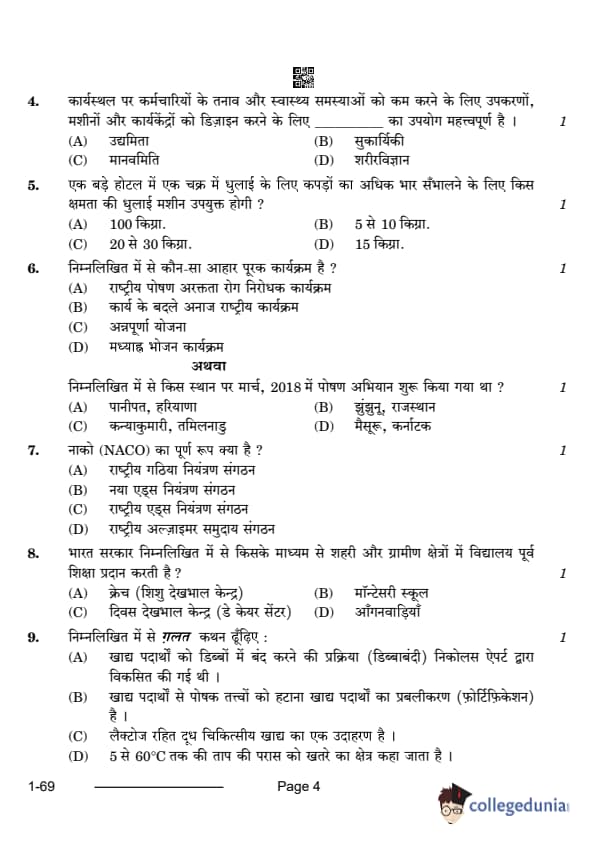
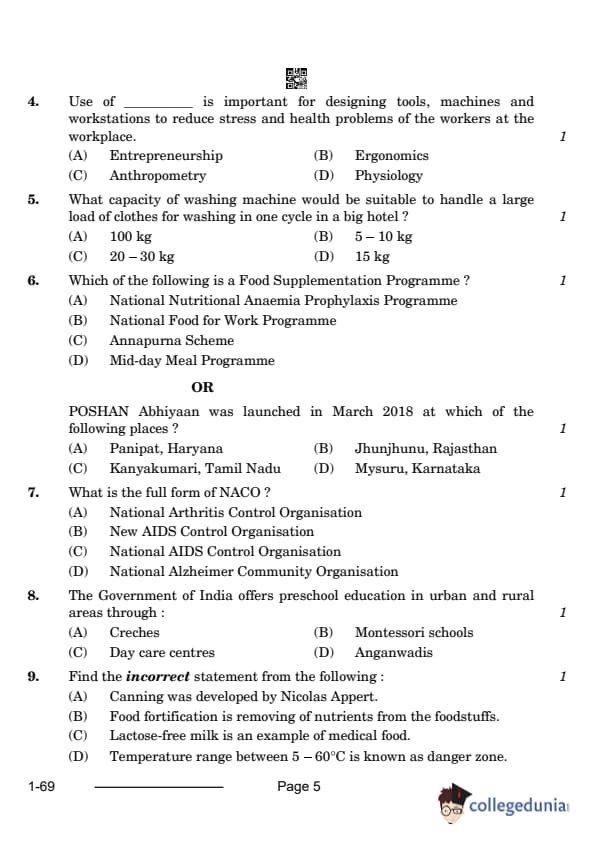
Use of ___________ is important for designing tools, machines and workstations to reduce stress and health problems of the workers at the workplace.
View Solution
Ergonomics is the science of designing and arranging the workplace so that people and things interact efficiently and safely. It focuses on optimizing the interaction between workers and their working environments to reduce stress and health problems.
Entrepreneurship refers to the process of starting and operating a business.
Anthropometry is the study of measurements of the human body.
Physiology is the study of the functioning of the body. Quick Tip: Remember that ergonomics is about designing and arranging the workplace to ensure comfort, efficiency and safety for workers.
What capacity of washing machine would be suitable to handle a large load of clothes for washing in one cycle in a big hotel?
View Solution
Hotels generally require a large capacity washing machine to handle their daily laundry needs in one cycle. The answer is 100 kg, which points to the commercial and bulk operations that they usually handle. Quick Tip: Remember that hotels require heavy-duty washing machines that can handle bulk laundry, hence high capacity machines are necessary.
Which of the following is a Food Supplementation Programme?
View Solution
Step 1: Evaluate the options and what their purposes are.
National Nutritional Anaemia Prophylaxis Programme: It focuses on providing iron and folic acid supplementation, aimed at preventing and reducing anaemia. It improves the nutritional content.
National Food for Work Programme: Focuses on employment opportunities through labor work in exchange for food grains.
Annapurna Scheme: Is to provide food grains at subsidized rates.
Mid-day Meal Programme: Provides prepared or cooked meals to school-going children to improve their nutritional status, school enrollment, and attendance.
Step 2: Identify the correct choice: Hence, the Mid-day Meal Programme increases the supplement of food for the children.
Quick Tip: When you are reading questions on governmental programs, clearly note the objective of the program, and if it addresses an income based issue, or provides resources to help people.
OR
POSHAN Abhiyaan was launched in March 2018 at which of the following places?
View Solution
The POSHAN Abhiyaan (National Nutrition Mission) was launched in March 2018 in Jhunjhunu, Rajasthan, as part of the government’s aim to improve nutritional outcomes for children, pregnant women and lactating mothers. Quick Tip: Remember the launch locations and key objectives of major government campaigns and schemes.
What is the full form of NACO?
View Solution
NACO stands for National AIDS Control Organisation, which is a national body in India that is in charge of the country’s AIDS awareness, prevention, and control programs. Quick Tip: Make sure to remember the full forms of important national and international organizations.
OR
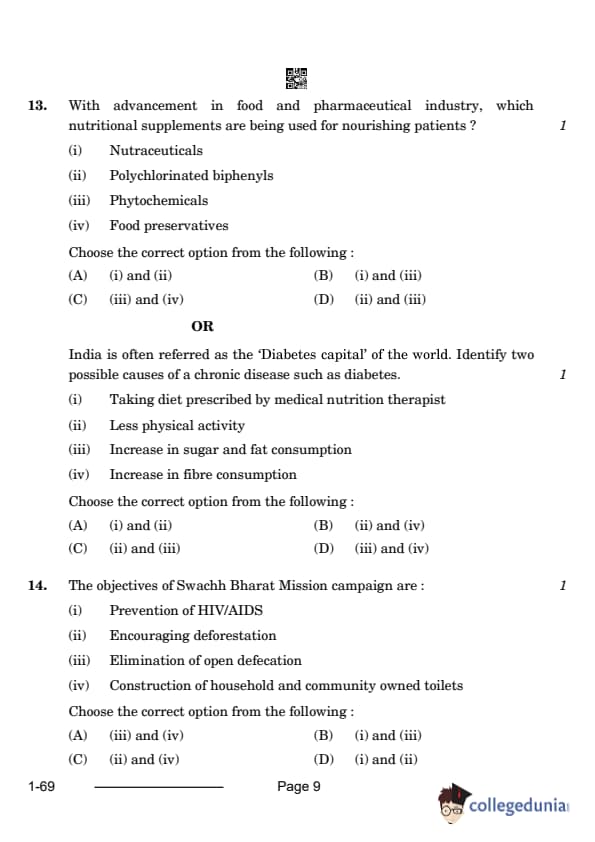
India is often referred as the ‘Diabetes capital’ of the world. Identify two possible causes of a chronic disease such as diabetes.
(i) Taking diet prescribed by medical nutrition therapist
(ii) Less physical activity
(iii) Increase in sugar and fat consumption
(iv) Increase in fibre consumption
Choose the correct option from the following :
View Solution
(i) Taking diet prescribed by medical nutrition therapist: Following a diet prescribed by a medical nutrition therapist is a part of management or treatment of diabetes, not a cause of diabetes.
(ii) Less physical activity: Lack of physical activity or sedentary lifestyles is considered an important risk factor for the development of diabetes.
(iii) Increase in sugar and fat consumption: High intake of sugar and fats is a contributing factor in the development of diabetes.
(iv) Increase in fibre consumption: A diet rich in fiber is actually a recommended dietary practice to manage diabetes. Quick Tip: Always analyze dietary patterns and their role in the causes or management of various diseases.
The Government of India offers preschool education in urban and rural areas through:
View Solution
Anganwadis are village-level centres that are part of the Integrated Child Development Services (ICDS) program of the Indian government and they are designed to provide preschool education, health services and nutritional support to children and mothers. Quick Tip: Always remember that government schemes and programs have different aims and objectives, and they cater to specific groups of people.
Find the \textbf{incorrect} statement from the following:
View Solution
(A) Canning was developed by Nicolas Appert: This statement is correct. Nicolas Appert, a French inventor, is credited with developing the process of canning for food preservation.
(B) Food fortification is removing of nutrients from the foodstuffs: This statement is incorrect. Food fortification involves adding essential nutrients to a food product to improve its nutritional content. Food fortification makes foods more nutritious.
(C) Lactose-free milk is an example of medical food: This statement is correct. Lactose-free milk is a specialized product formulated for people with lactose intolerance.
(D) Temperature range between 5 – 60°C is known as danger zone: This statement is correct. The danger zone is the temperature range in which bacteria thrive, leading to food spoilage and food poisoning. Quick Tip: Remember that food preservation techniques are aimed to increase the nutritional content and/or safety of the foods.
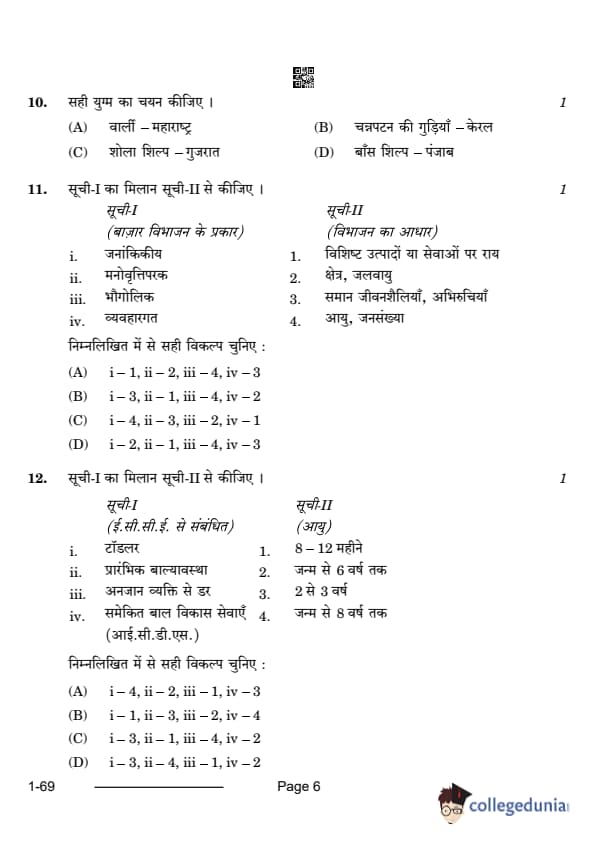
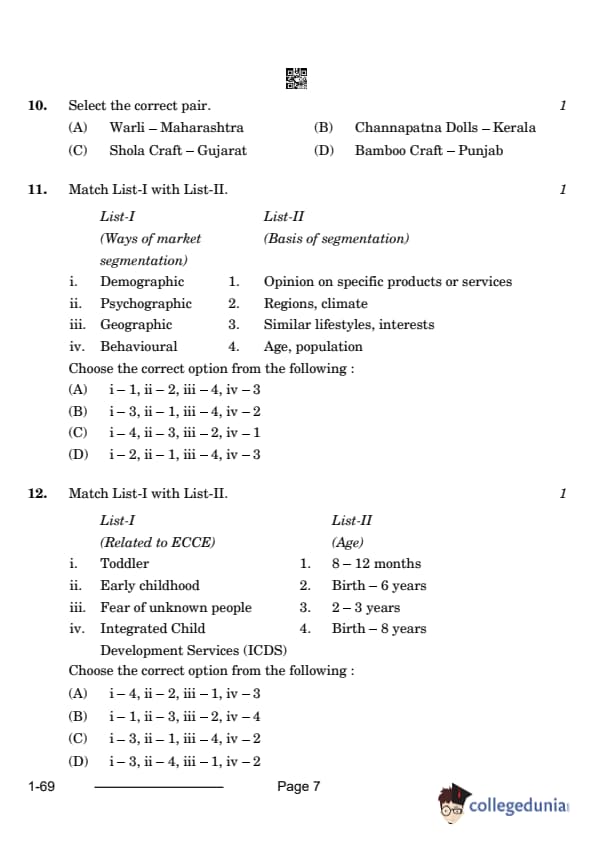
Select the correct pair.
View Solution
Warli - Maharashtra: Warli is a tribal art form from Maharashtra. It is characterized by its simple style and its depiction of scenes from daily life.
Channapatna Dolls – Kerala: Channapatna dolls are a traditional toy made in the Channapatna region of Karnataka, not Kerala.
Shola Craft – Gujarat: Shola craft is a traditional craft from West Bengal, not Gujarat, that is made from the shola pith.
Bamboo Craft – Punjab: Bamboo craft is made in many parts of India, but Punjab is not the region where it is traditionally practised. The state of Andhra Pradesh is known for its bamboo work. Quick Tip: It is useful to remember the geographical association of various art and craft forms.
Match List-I with List-II.
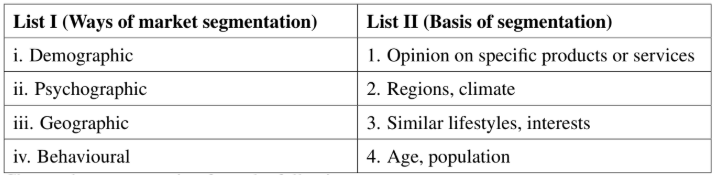
Choose the correct option from the following :
View Solution
i. Demographic and 4. Age, population: Demographic segmentation involves dividing the market based on variables such as age, gender, income, and population.
ii. Psychographic and 3. Similar lifestyles, interests: Psychographic segmentation categorizes consumers based on their lifestyles, interests, values, and attitudes.
iii. Geographic and 2. Regions, climate: Geographic segmentation involves categorizing customers based on their geographical location, such as regions, climate, or city.
iv. Behavioural and 1. Opinion on specific products or services: Behavioral segmentation divides consumers based on their interactions with products or services, like their opinions, or how often they buy a certain product. Quick Tip: Understanding market segmentation is key to analyzing consumer patterns. Memorize the different bases of segmentation.
Match List-I with List-II.
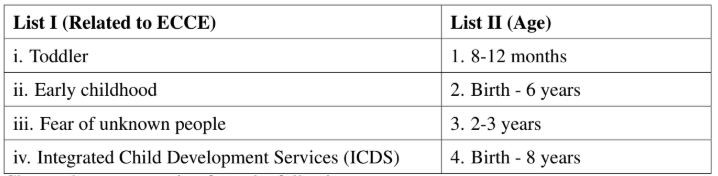
Choose the correct option from the following :
View Solution
i. Toddler and 3. 2-3 years: The toddler age group generally refers to the period between the ages of 2 to 3 years.
ii. Early childhood and 4. Birth - 8 years: Early childhood generally covers the range between birth and 8 years, which is the age range for the Integrated Child Development Services (ICDS) scheme.
iii. Fear of unknown people and 1. 8-12 months: Infants tend to develop stranger anxiety or fear of unknown people around the age of 8-12 months.
iv. Integrated Child Development Services (ICDS) and 2. Birth - 6 years: Integrated Child Development Services (ICDS) is a government scheme that aims to provide holistic development services to children in the age range of 0 to 6 years. Quick Tip: Remember the age ranges of different developmental stages of children, and key milestones achieved in those periods.
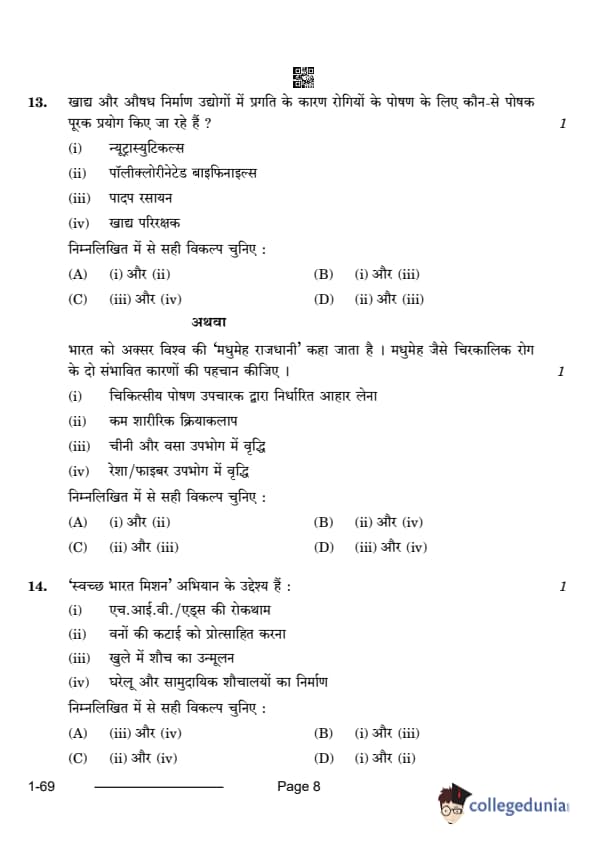
With advancement in food and pharmaceutical industry, which nutritional supplements are being used for nourishing patients ?
(i) Nutraceuticals
(ii) Polychlorinated biphenyls
(iii) Phytochemicals
(iv) Food preservatives
Choose the correct option from the following :
View Solution
(i) Nutraceuticals: Nutraceuticals are products derived from food sources that have additional health benefits. They are used as nutritional supplements for patients.
(ii) Polychlorinated biphenyls: Polychlorinated biphenyls are environmental contaminants and not nutritional supplements. They are harmful substances that should be avoided.
(iii) Phytochemicals: Phytochemicals are naturally occurring compounds in plants that have various health-promoting properties. They are sometimes used as nutritional supplements.
(iv) Food preservatives: Food preservatives are substances that are added to food products to prevent spoilage and are not directly used for nutritional benefits. Quick Tip: Remember the definitions and differences between various food additives, preservatives and supplements.
The objectives of Swachh Bharat Mission campaign are:
(i) Prevention of HIV/AIDS
(ii) Encouraging deforestation
(iii) Elimination of open defecation
(iv) Construction of household and community owned toilets
Choose the correct option from the following :
View Solution
The Swachh Bharat Mission is a national campaign which is primarily focused on cleanliness and sanitation.
(iii) Elimination of open defecation: This is a primary objective of the Swachh Bharat Mission to achieve an open defecation free India.
(iv) Construction of household and community owned toilets: This is another major objective of the mission, which is focused on promoting safe and hygienic sanitation.
The other two points given i.e Prevention of HIV/AIDS and Encouraging Deforestation are not directly related to this campaign. Quick Tip: Remember the stated objectives of major national campaigns and their key components.
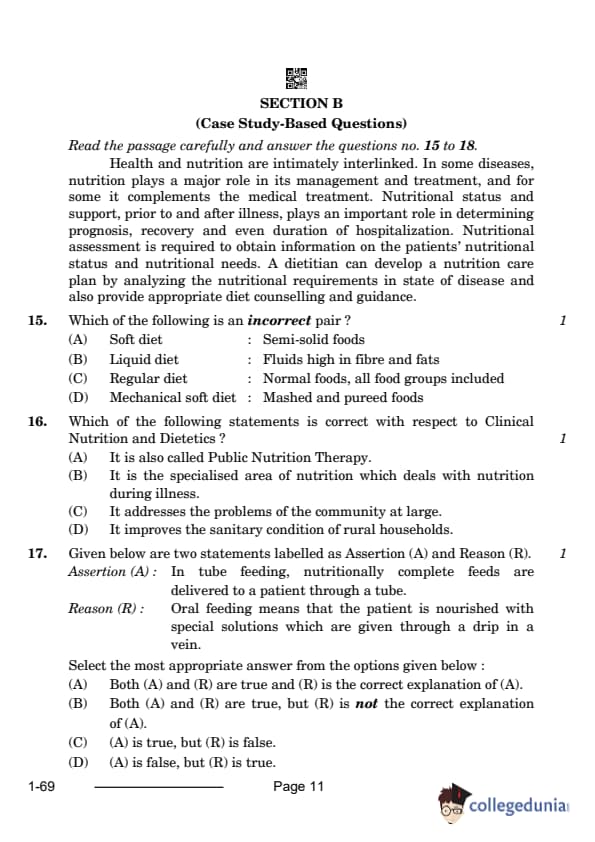
SECTION B
(Case Study-Based Questions)
Read the passage carefully and answer the questions no. 15 to 18.
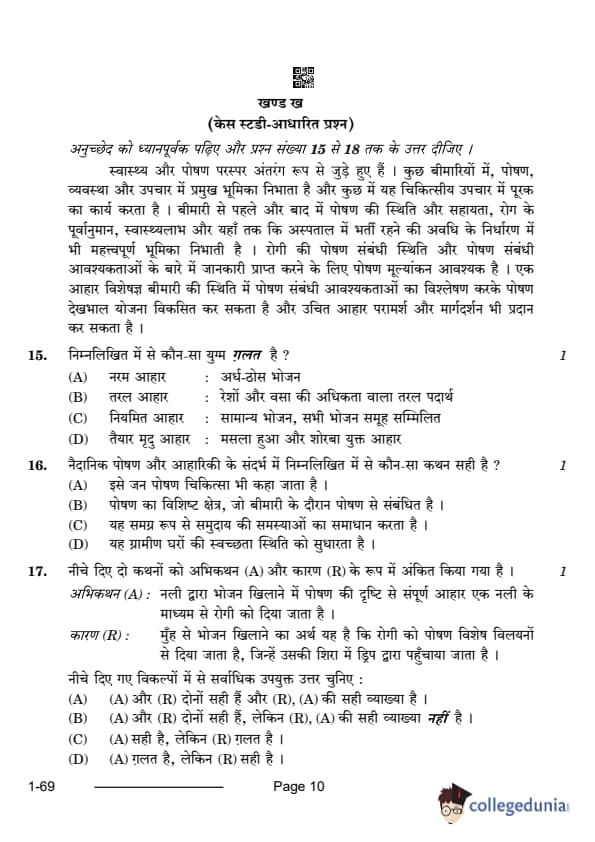
Health and nutrition are intimately interlinked. In some diseases, nutrition plays a major role in its management and treatment, and for some it complements the medical treatment. Nutritional status and support, prior to and after illness, plays an important role in determining prognosis, recovery and even duration of hospitalization. Nutritional assessment is required to obtain information on the patients nutritional status and nutritional needs. A dietitian can develop a nutrition care plan by analyzing the nutritional requirements in state of disease and also provide appropriate diet counselling and guidance.
Question 15:
Which of the following is an \textbf{incorrect} pair ?
(A) Soft diet : Semi-solid foods
(B) Liquid diet : Fluids high in fibre and fats
(C) Regular diet : Normal foods, all food groups included
(D) Mechanical soft diet : Mashed and pureed foods
View Solution
Soft diet: This includes foods that are soft in texture and are easy to chew and digest. Semi-solid foods are the most important aspect of a soft diet.
Liquid diet: This consists of fluids only, with very little fibre or fats. It is a diet given when one is not able to handle solid foods.
Regular diet: A regular diet consists of all the food groups. It is a balanced diet for a healthy person.
Mechanical soft diet: It is a diet where foods are mashed or pureed for easy digestion. This is often given for people with swallowing difficulties or who are unable to chew. Quick Tip: Remember different types of diets and their role in nutrition management during disease conditions. Always analyze the given definitions and then choose the correct answer.
Which of the following statements is correct with respect to Clinical Nutrition and Dietetics?
(A) It is also called Public Nutrition Therapy.
(B) It is the specialized area of nutrition which deals with nutrition during illness.
(C) It addresses the problems of the community at large.
(D) It improves the sanitary condition of rural households.
View Solution
(A) It is also called Public Nutrition Therapy: Clinical Nutrition and Dietetics is more about the nutritional management of patients and not public nutrition, which is focused on community wellness.
(B) It is the specialized area of nutrition which deals with nutrition during illness: This is the correct definition of clinical nutrition and dietetics which is a special field of nutritional science that deals with managing a patient’s health via diet.
(C) It addresses the problems of the community at large: While it aims to improve nutritional health of people, its focus is mainly on individuals who are unwell or are suffering from a specific disease.
(D) It improves the sanitary condition of rural households: Clinical nutrition does not focus on issues like sanitation, but focuses mainly on nutritional needs. Quick Tip: It is important to understand the differences between public nutrition and clinical nutrition.
Given below are two statements labelled as Assertion (A) and Reason (R).
Assertion (A): In tube feeding, nutritionally complete feeds are delivered to a patient through a tube.
Reason (R): Oral feeding means that the patient is nourished with special solutions which are given through a drip in a vein.
Select the most appropriate answer from the options given below :
View Solution
Assertion (A): In tube feeding, nutritionally complete feeds are delivered to a patient through a tube. This statement is true.
Reason (R): Oral feeding means that the patient is nourished with special solutions which are given through a drip in a vein. This statement is false because this describes intravenous feeding, not oral feeding. Oral feeding refers to eating or drinking normally, or through a tube. Quick Tip: Make sure to pay attention to the core concept of a statement and ensure its correctness.
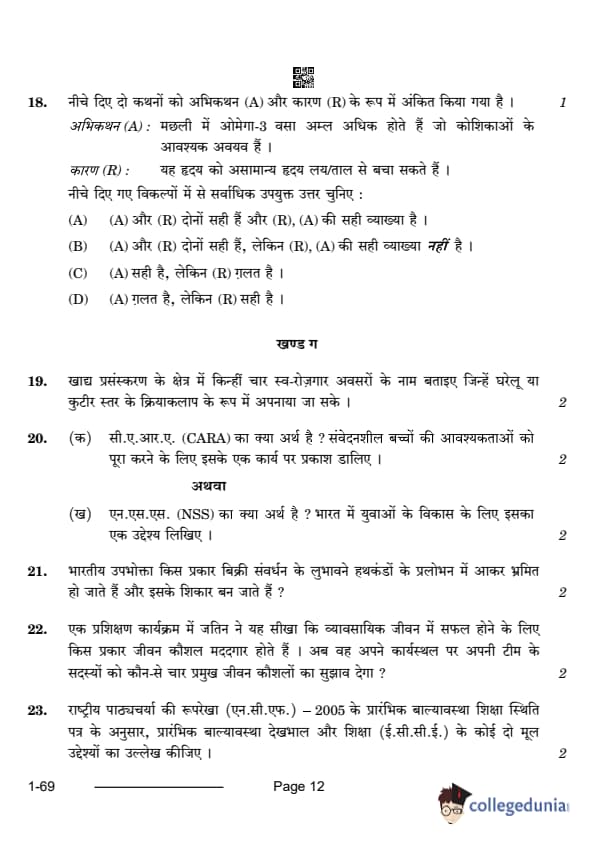
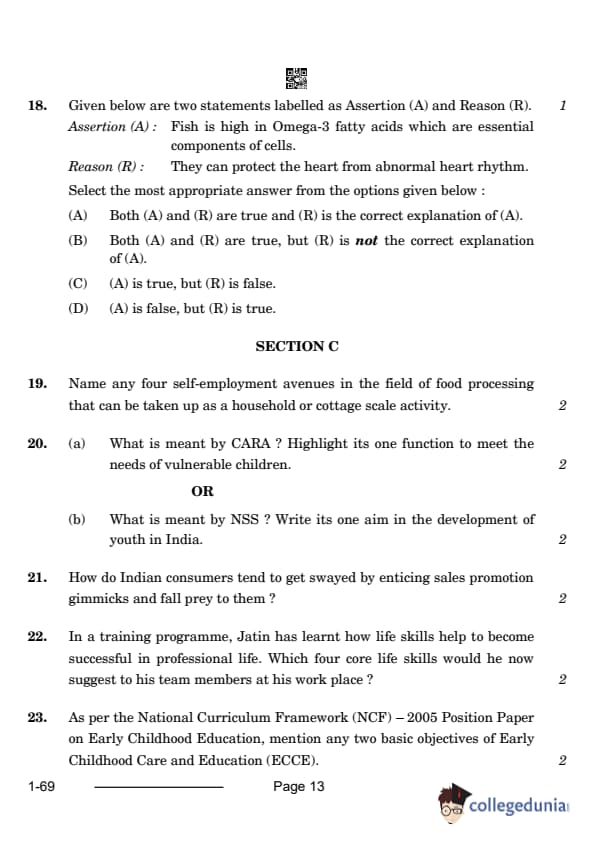
Given below are two statements labelled as Assertion (A) and Reason (R).
Assertion (A): Fish is high in Omega-3 fatty acids which are essential components of cells.
Reason (R): They can protect the heart from abnormal heart rhythm.
Select the most appropriate answer from the options given below :
View Solution
Assertion (A): Fish is high in Omega-3 fatty acids which are essential components of cells. This is indeed true. Fish is known to be a good source of Omega-3 fatty acids which are important for cellular functions and overall health.
Reason (R): They can protect the heart from abnormal heart rhythm. This statement is also true. Omega-3 fatty acids have been found to have a role in protecting the heart from certain health issues.
Explanation: While both statements are true, the reason does not explain why the cells need omega-3 fatty acids. The reason is related to heart health, not specifically cell components. Quick Tip: Pay close attention to how the reason connects with the assertion. They both need to be linked logically for (A) to be the correct answer.
SECTION C
Question 19:
Name any four self-employment avenues in the field of food processing that can be taken up as a household or cottage scale activity.
View Solution
Dehydrated Products/Papad/Wadi: Making and selling dehydrated food items like papad or wadi can be done at a household level.
Murabba/Candy: Making and selling traditional candies, murabba, and other similar confectioneries at home can be a good option.
Pickles/Jam/Jelly/Squash: Production and sale of homemade pickles, jams, jellies, and squashes is a popular cottage industry.
Roasted and Puffed Snacks: This may include making and selling roasted and puffed snacks like salted peanuts and khakhra.
Fried Snacks: This may include preparing and selling fried snacks like mathri, namkeen, thepla, chips and murukku etc.
Bakery Products: Baking and selling homemade bakery items like cakes, biscuits and breads can be a good option.
Sweets/Jaggery making: Making traditional Indian sweets and jaggery is a well-known cottage industry.
Drinking water pouches: Selling drinking water in pouches is a very popular business, which can be undertaken with limited investment.
Other Relevant point: Any other relevant point from the chapter. Quick Tip: Think of local examples from the food industry which are done in small scale setups.
(a) What is meant by CARA? Highlight its one function to meet the needs of vulnerable children.
OR
(b) What is meant by NSS ? Write its one aim in the development of youth in India.
View Solution
(a) Solution: CARA Full Form and Function: CARA stands for the Central Adoption Resource Authority. It is a central agency of the Government of India which plays a key role in legal adoption in the country.
Function: A key function of CARA is to set guidelines for adoption, ensuring the welfare and rights of children. It sets standards for adoption processes and aims to facilitate ethical adoption practices.
Other Functions: It also strengthens adoption rules and facilitates the overall process of adoption. Quick Tip: Remember the full forms of key organizations and their main functions and contributions.
(b) Solution:NSS Full Form and Function: NSS stands for the National Service Scheme. It is a government-sponsored program where school and college students get involved in activities to do social service. This helps to promote youth and their social responsibility. Aim: The main aim of NSS is to involve students in social service and national development programs to promote a feeling of civic responsibility, awareness and national pride. Other Activities: Other activities of NSS include construction, repair of infrastructure, environmental conservation, hygiene and sanitation etc.
Quick Tip:Government initiatives and schemes such as NSS are important for community devel-
opment and youth awareness.
How do Indian consumers tend to get swayed by enticing sales promotion gimmicks and fall prey to them?
View Solution
Exchange Offers: Consumers are often swayed by exchange offers which allows them to replace their old product with new ones, creating a sense of value.
Bonus Offers: Consumers are attracted by products that offer bonus gifts with their purchase. It creates an impression of extra value at the same price.
Lucky Draw: Many consumers are lured to purchase certain items when there is a chance of winning something extra like a lottery or a lucky draw, which works on the consumer’s psychological need for luck.
Misleading Advertisements: Advertisements that exaggerate or misrepresent a product's features can sway the decisions of consumers.
Sales and Discounts: Discounts and sales, especially during festive seasons, attract consumers and they get swayed to purchase more items than they originally intended.
Free Gifts: Free gifts offered with purchases, especially those which look valuable, often lure many consumers.
Attractive Packaging: Consumers get attracted to items with great packaging and attractive colours, even if the content might not be high quality.
Duplicate Products: Many times, imitation or duplicate products are sold as originals which lure the consumers to buy products with low quality. Quick Tip: Always try to relate these concepts to the various examples that you observe in your daily life.
In a training programme, Jatin has learnt how life skills help to become successful in professional life. Which four core life skills would he now suggest to his team members at his work place?
View Solution
Self-awareness: Self-awareness involves understanding one’s own strengths, weaknesses, emotions, and values. It is very important for any professional success, as it promotes personal and professional growth.
Empathy: Empathy is the ability to understand and share the feelings of others. It improves team coordination and reduces interpersonal conflict.
Communication: Good communication skills (verbal and written) are essential for teamwork and also to efficiently convey ideas.
Interpersonal Relationships: This includes building relationships with colleagues and clients, which is key for a positive workplace.
Decision Making: This involves skills such as analysis, problem solving and critical thinking, and they help a team or organization in decision making and planning for the future.
Problem Solving: Problem-solving skills are required to identify and address problems efficiently and help in day-to-day operations.
Creative Thinking: Creative thinking allows new solutions to challenges.
Critical Thinking: Critical thinking improves a team’s abilities to make informed decisions and to analyze situations effectively.
Coping with Emotions: Coping with one’s own emotions and other people’s emotions allows better inter-personal relations and greater productivity.
Coping with Stress: Learning how to cope with workplace stress leads to better management of challenging situations and is essential for well being of the team. Quick Tip: Try to remember core life skills, and remember how they can be applied in the professional sphere to improve productivity and workplace harmony.
As per the National Curriculum Framework (NCF)-2005 Position Paper on Early Childhood Education, mention any two basic objectives of Early Childhood Care and Education (ECCE).
View Solution
Holistic Development of the Child: A key objective of ECCE is to promote the holistic development of the child, so they can realize their full potential. This includes cognitive, physical, social and emotional development.
Preparation for School: ECCE aims to prepare children for school by giving them the required basic knowledge, social skills and cognitive abilities.
Providing Support Services for Women and Children: ECCE programs also aim to provide essential support services for women and children, including health and nutritional needs. Quick Tip: Remember the key objectives and goals of governmental policies.
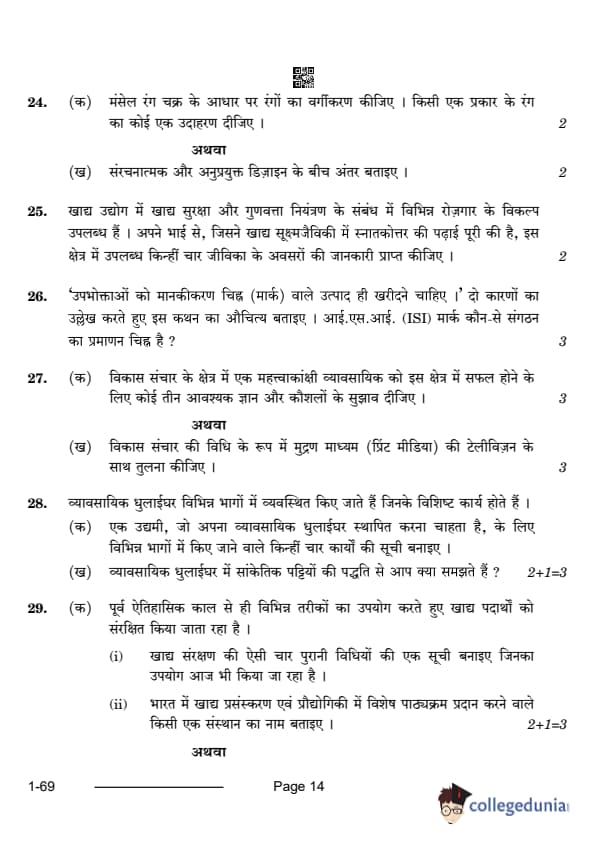
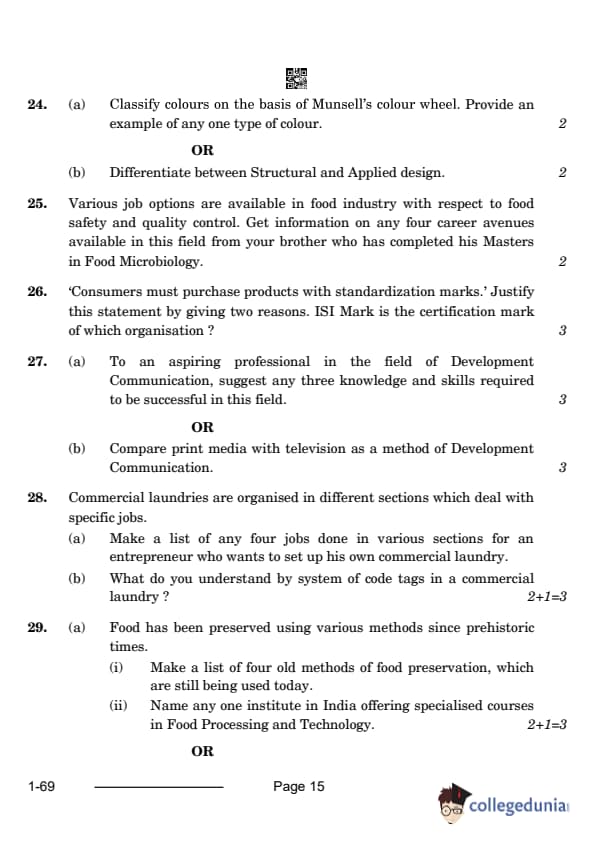
(a) Classify colours on the basis of Munsell's colour wheel. Provide an example of any one type of colour.
OR
(b) Differentiate between Structural and Applied design.
View Solution
(a) Solution:Primary Colors: Primary colors are the basic colors which cannot be created by mixing other colors. They are red, yellow, and blue, and they form the base for all other colours on the wheel.
Secondary Colors: Secondary colors are formed by mixing two primary colors. They are orange (red + yellow), green (yellow + blue), and purple (red + blue or violet).
Tertiary or Intermediate Colors: Tertiary colors are made by mixing a primary color with its adjacent secondary color. Some examples of these colors include red-orange, yellow-orange, yellow-green, blue-green, blue-purple, and red-purple.
Example: An example of any one type of colour is: Red is a primary colour. Quick Tip: Remember the categories of colors in the colour wheel, and understand how they are made.
(b) Solution:Structural Design: Structural design is concerned with the basic cut or shape of garments or apparels. Structural design depends on the form, and it is not based on superimposed ornamentation or decoration. This takes into account the basic processes in making an apparel, such as the type of fibres, variations of weaving or knitting etc. Applied Design:
Applied design refers to the ornamentation of the garments/apparel. It is superimposed on the basic structure of the garment. Applied designs include fabric finishes, dyeing, printing, patch work, mirror work etc.
Quick Tip:
Try to remember the basic differences between the design aspects of a garment - that is,
its structure and its ornamentation.
Various job options are available in food industry with respect to food safety and quality control. Get information on any four career avenues available in this field from your brother who has completed his Masters in Food Microbiology.
View Solution
Food Analysts: Food analysts work in laboratories and analyze food products to ensure that they are safe for consumption and comply with regulations.
Food Quality Control Managers: They work in the food industry and manage the quality control parameters in the laboratories.
Food Inspectors/Testing Professionals: They test food samples at various levels in the food production processes and also work for private and government organizations.
Food Auditors: Food auditors are hired by various organizations to audit the food production process to ensure compliance.
Food Microbiologists: They work as a specialist in fields like HACCP, BIS and AGMARK etc. They work to ensure safety parameters in the industry.
Quality Certification Professionals: They work to ensure that foods are manufactured according to regulations of organizations like ISO, BIS and FSSAI etc.
Teaching and Academics: One may work as a teacher or lecturer in academic institutions specializing in the field of food microbiology, or conduct food safety research.
Research and Development Professionals: They focus on developing new methods and techniques for food safety and improve quality.
Scientific Writers: Scientific writers can take up writing on various aspects of food safety.
Content Creators/Bloggers: Content creators can write blogs and create content on food safety and quality related aspects.
Entrepreneurs: Food technologists can also start their own ventures related to food industry and quality control. Quick Tip: To answer questions related to career options, try to mention specialized roles and think of both public and private sector options.
‘Consumers must purchase products with standardization marks.’ Justify this statement by giving two reasons. ISI Mark is the certification mark of which organisation?
View Solution
Quality of Products: Standardization marks ensure that the products meet certain quality standards, giving consumers an assurance of the quality of the products they buy.
Product Authenticity: These marks provide confidence that the product is not a duplicate, and that it has gone through a certification procedure.
Value for Money: They provide assurance about the value of a product and that the money spent on it is justified.
Consumer Safety: The standardization marks also ensure consumer protection as the products have to adhere to the safety standards.
Product is as per certification guidelines: The certification marks are designed to give a guarantee that a product is manufactured according to established regulations, which also gives credibility to it.
ISI Mark: The ISI mark is the certification mark of the Bureau of Indian Standards (BIS). Quick Tip: Standardization marks are very important for ensuring quality in the market. Always remember that these marks have a direct link with standards and quality.
(a) To an aspiring professional in the field of Development Communication, suggest any three knowledge and skills required to be successful in this field.
OR
(b) Compare print media with television as a method of Development Communication.
View Solution
(a) Solution:Cognitive Skills: Cognitive skills and the ability to comprehend the core issue is key to development communication, especially while engaging with the target groups.
Creative/Presentation Skills: This refers to the ability to present issues in a creative and appealing manner, through media and other modes of communication.
Technical Skills: Technical skills relating to photography, videography, content development and editing are required for various development communication projects.
Questioning Ability: The ability to probe and look into finer details of any issue, and to find new stories is important.
Ability to Work with Diverse Groups: The ability to work with diverse groups and understand other viewpoints helps in communicating effectively and generating content that resonates with diverse sections of the population.
Language Skills: Language skills including reading, writing and speaking are crucial for conveying information clearly.
Computer Skills: Computer skills are needed to handle digital communication methods and to be able to create content for online media.
Knowledge of Laws and Regulations: A good knowledge of relevant laws and regulations ensures ethical and effective communication practices. Quick Tip: When suggesting skills for professionals in the field of communication, make sure to include aspects of both creativity and technical skills.
(b) Solution:Print Media: Print media primarily uses visual modes of communication. It is more suited for literate people as it relies on written text. It is a printed medium which is not as fast as other media, but can be referred to later. It is generally inexpensive to produce and use, which makes it accessible to different sections
of the population. Print media is usually a mobile medium and can be taken from one place to another easily.
Television:
Television uses audio-visual modes of communication. It is well-suited for both literate and illiterate people because of the visual nature of the medium. It is an electronic mode of communication, and is immediate. Television can be expensive for both producing the content and owning a television. Television is a fixed medium, in which you cannot choose when and where to use it.
Quick Tip:Compare various media based on accessibility, reach, cost, and audience. Always use a
table to compare clearly between various features.
Commercial laundries are organised in different sections which deal with specific jobs.
(a) Make a list of any four jobs done in various sections for an entrepreneur who wants to set up his own commercial laundry.
(b) What do you understand by system of code tags in a commercial laundry ?
View Solution
(a) Solution:Collection, Inspection and Sorting: The first job involves the collection of articles, followed by inspection of the items to see what needs to be done. Then it is necessary to sort out the articles based on the type of fabric, colour etc.
Pre-treatments: The next step is providing pre-treatments like mending, repairing and stain removal. These steps ensure that the cleaning process is done efficiently.
Washing: Washing involves using suitable washing methods and chemicals in washing machines to clean the items.
Water Extraction: This is the process where the water is removed from the washed clothes.
Drying: This is when the washed and water extracted items are dried using heat, air or in sun.
Dry Cleaning: Certain items need a special dry cleaning process which involves the use of dry cleaning machines.
Pressing and Ironing: Pressing and Ironing is a crucial job in the laundry to give the final touch to the cleaned items.
Dyeing: Dyeing is a special process that some items might require.
Special Finishes: These finishes includes processes like zari polishing, calendering etc which adds to the look and feel of the garments.
Packing: Items are packed and readied for delivery to the customers.
Distribution: The last step includes delivering the items to the customer. Quick Tip: When listing different steps or processes, make sure to list all of them sequentially.
(b) Solution:
A system of code tags in a commercial laundry helps to keep a record of the laundry items.
Each item of each customer is tagged to keep a track of each order. Code tags help in identifying and matching articles of each customer with their invoice to avoid mixing of the items. This makes sure that the right order is given to the right customer.
Quick Tip:Code tags are a great way to maintain records in commercial setups, and make sure the
various steps of processing a product are error-free.
(a) Food has been preserved using various methods since prehistoric times.
(i) Make a list of four old methods of food preservation, which are still being used today.
(ii) By whom are standards for fortification of staple foods like salt, milk, oils laid down in India ?
OR
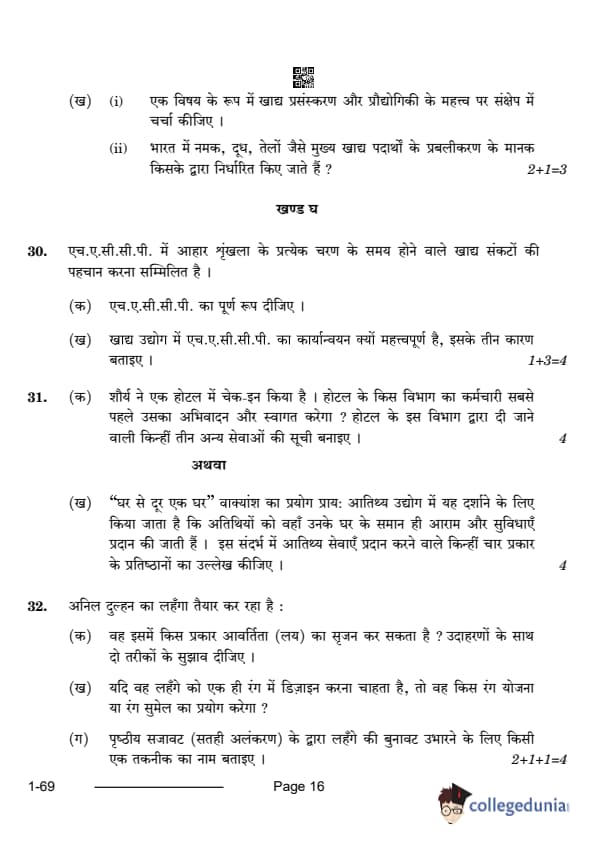
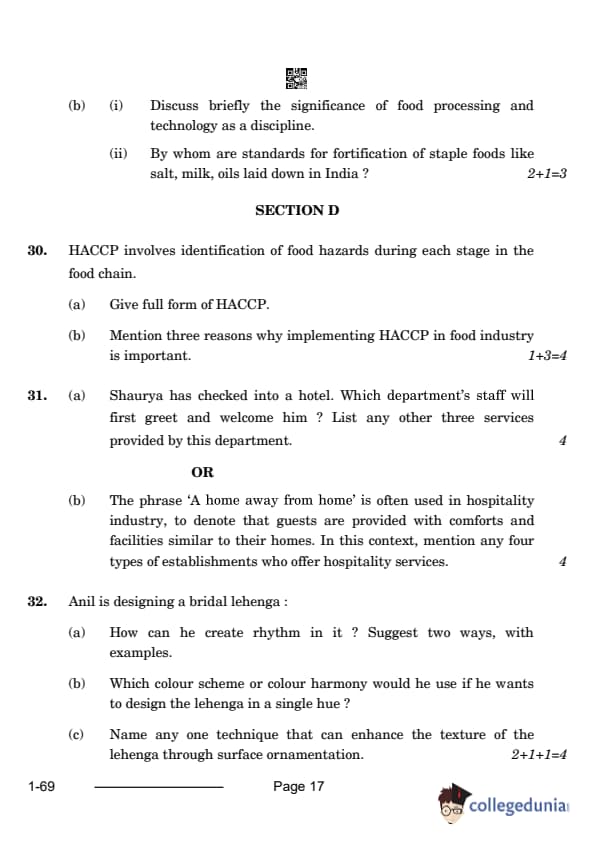
(b) (i) Discuss briefly the significance of food processing and technology as a discipline.
(ii) By whom are standards for fortification of staple foods like salt, milk, oils laid down in India?
View Solution
(a) (i) Solution:Sun Drying: Sun drying is an ancient method which is still used to preserve food. It removes moisture from food, preventing bacterial growth.
Controlled Fermentation: Fermentation is an old technique to preserve food items which changes their taste and texture. It is used to make items like pickles, curd, or some breads.
Salting: Salting is an ancient food preservation method where salt is used to dehydrate food and inhibit bacterial growth and spoilage.
Pickling: Pickling is another traditional preservation method which uses brine or vinegar to preserve the food and give it a different flavor and taste.
Candying: Candying involves preserving foods, mainly fruits, by coating them in sugar syrup.
Roasting: Roasting, as a method of preservation, can also inhibit microbial activity because it removes moisture, and hence it can be used to extend the shelf-life of certain foods.
Smoking: Smoking of foods involves the use of wood smoke to preserve and flavor food products.
Baking: Baking or roasting foods can reduce their moisture content and hence act as a method of preservation.
Using Spices, oil, sugar etc.: The use of spices, oil, and sugar to create an environment unfavorable to bacteria or microbes, is a preservation technique still used in a variety of ways. Quick Tip: Traditional methods of food preservation are not only very important historically but are also very relevant to our present.
(ii) Solution:
Central Food Technological Research Institute (CFTRI), Mysore: The Central Food Technological Research Institute in Mysore is one of the key Indian government institutes offering specialized courses in food technology, which also conducts research in this field. National Institute of Food Technology and Entrepreneurship Management (NIFTEM),
Sonepat: The National Institute of Food Technology and Entrepreneurship Management in Sonepat is another major center for teaching and research in this field.
Quick Tip:Remember important institutes which are relevant for your course.
(b) (i) Solution:
Storage and Processing of Agricultural Products: Food processing and technology helps
to store and process agricultural and horticultural produce. It also helps in better post-harvest
management.
Meeting Consumer Demand: Food technology allows for the increased production of food
products in the face of changing lifestyles. It also serves globalization and the growing
consumer demand for packaged products.
Providing Safe Products: It also helps in producing food products which are safe, and have
minimum amounts of chemicals, pesticides and preservatives.
Increasing Shelf Life: Food processing techniques are used to extend the shelf life of food
products by keeping them fresh for longer.
Convenient Food Products: Food processing makes food items more usable, palatable,
concentrated, and easy to transport. This has allowed the processing of perishable items.
Reduced Preparation Time: Food processing makes food more convenient by reducing the
time required for cooking. It also makes certain foods instantly usable.
Value Addition: Food processing increases the value of various food products, giving it
better market prices and economic value.
Nutrient Content: Fortification is another key technology in food processing that is used to
increase the nutritional content of staple foods.
Meeting the Demands of Lifestyle Diseases: With the increased prevalence of lifestyle
diseases, food technology can be used to modify the nutrient content in specific foods.
Economic Growth: It contributes to the economic growth of the country.
Employment Opportunities: Food processing is also a major source of employment and
can generate opportunities in the rural sector as well.
Quick Tip
When analyzing a discipline like food technology, make sure to mention its importance
from the perspective of health, safety, trade and economy.
(ii)
Solution:
The Food Safety and Standards Authority of India (FSSAI) is the organization which sets
standards for fortification of staple foods like salt, milk and oils etc.
Quick Tip
It is useful to know about FSSAI and its functions in relation to food standards and
safety.
SECTION D
Question 30:
HACCP involves identification of food hazards during each stage in the food chain.
(a) Give full form of HACCP.
(b) Mention three reasons why implementing HACCP in food industry is important.
Correct Answer:
View Solution
(a) Solution:HACCP stands for Hazard Analysis Critical Control Point. Quick Tip: Memorizing the full forms of important abbreviations like HACCP can be very useful.
(b) Solution:
Cost-Effective Approach: HACCP is a cost-effective and preventive approach to food
safety. It ensures that resources are not wasted on reacting to situations, but on preventing
them.
Detection of Hazards: It enables the detection of hazards at every stage of processing and
manufacturing, which makes sure that any potential issue is detected immediately.
Ensuring Good Quality Products: HACCP ensures a good quality product by taking action
as and when a problem occurs at a certain stage. It ensures that no process is neglected.
Efficient Use of Resources: It also helps producers, processors, distributors and exporters to
make effective use of resources.
Consumer Protection: It is important for the protection of consumers and also for trade
between countries, due to its emphasis on food safety.
Ensuring Consistently Good Quality Products: Implementation of HACCP ensures good
quality food products on a consistent basis.
Responsibility for Safe Food: HACCP holds the producers and suppliers responsible for
ensuring safe food according to the FSSA act.
Quick Tip:While explaining the importance of something, look at it from different perspectives
such as cost, resource utilization, benefits etc.
(a) Shaurya has checked into a hotel. Which department's staff will first greet and welcome him? List any other three services provided by this department.
OR
(b) The phrase ‘A home away from home’ is often used in hospitality industry, to denote that guests are provided with comforts and facilities similar to their homes. In this context, mention any four types of establishments who offer hospitality services.
View Solution
Department responsible for greeting: The Front Office department is responsible for first greeting and welcoming guests at the hotel.
Other services provided by Front Office Department:
The front office personnel organize the reservation status of the rooms, and also monitor the available rooms.
They register guests and allocate rooms for their stay.
They maintain the record of check-in and check-out details and also do billing and settlement of bills.
They provide porter services and also help in issuing room keys to guests.
They also relay messages for the guests and coordinate with other departments like housekeeping or room service.
They also provide general information to the guests.
They also record important personal details of guests for smooth service. Quick Tip: Always make sure to focus on both the central role and the supportive roles that a department plays in the hotel industry.
(b) Solution:
Hotel: Hotels provide commercial lodging, meals and other services to their guests. They
are some of the most well known hospitality services.
Motel: Motels provide services similar to hotels, but they provide parking facilities closer to
the rooms.
Lodge: Lodges provide rented accommodations, mainly for sleeping purposes, and they may
or may not provide any additional services.
Resort: Resorts provide a wide range of amenities like leisure activities and sports facilities
and are built to ensure a total vacation experience.
Furnished Apartments: Furnished apartments provide all essential amenities needed by the
guests, and act like a home.
Furnished Camps: Furnished Camps are mainly for people who participate in adventure
activities like hiking, trekking, and camping.
Cruise Lines: Cruise ships provide the services of a cruise with all comforts and amenities.
Guest Houses: Guest houses are smaller establishments that provide a room for stay in a
home like setting.
Quick Tip:
Remember the basic differences between types of lodging that is available in the hospi-
tality industry.
Anil is designing a bridal lehenga:
(a) How can he create rhythm in it ? Suggest two ways, with examples.
(b) Which colour scheme or colour harmony would he use if he wants to design the lehenga in a single hue ?
(c) Name any one technique that can enhance the texture of the lehenga through surface ornamentation.
View Solution
(a) Solution:Repetition: Repetition of design elements such as embroidery, lace, piping or colour patterns can help in creating rhythm in the design of a lehenga. The same motif, when repeated, can create a sense of movement and flow.
Gradation/Cordation: Gradation, which involves a gradual increase or decrease in the size of motifs, lines, colours or textures, helps in establishing a visual rhythm. The way the sizes of motifs are arranged gives it the sense of flow.
Radiation: When elements emanate from a central point, like gathers in the waist of a lehenga, that creates a sense of organized movement.
Parallelism: When lines or shapes are organized parallel to each other, as seen in tucks, pleats, and bands of colour, it gives a sense of flow and rhythm in a design. Quick Tip: Pay attention to the design principles used in textiles and clothing.
(b) Solution:
If the designer wants to create a lehenga using a single hue, he would use a monochromatic
harmony or scheme. This harmony involves the use of a single base hue, along with
variations in tints, tones, and shades.
Quick Tip
Monochromatic color schemes, using tints, tones and shades of single colour, are very
popular for creating a minimalist and elegant design.
(c) Solution:
Surface ornamentation techniques help to enhance the texture of the lehenga and a few such
techniques include: tufting, flock printing, embroidery, mirror work, bead work, lace work,
stone work, appliqu´e work or stitched effects etc.
Quick Tip
Remember various techniques used in fabric embellishment, and analyze how they pro-
vide different visual textures to the surface of a textile.
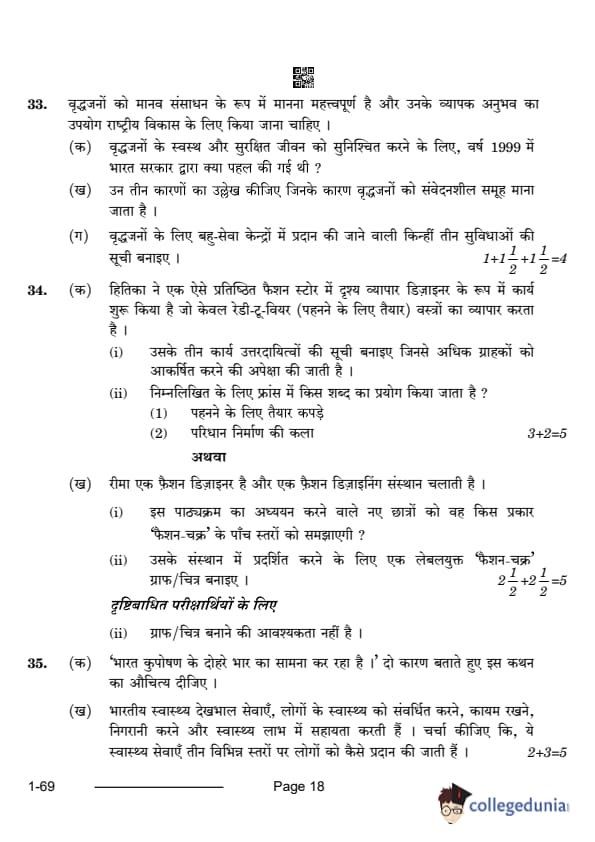
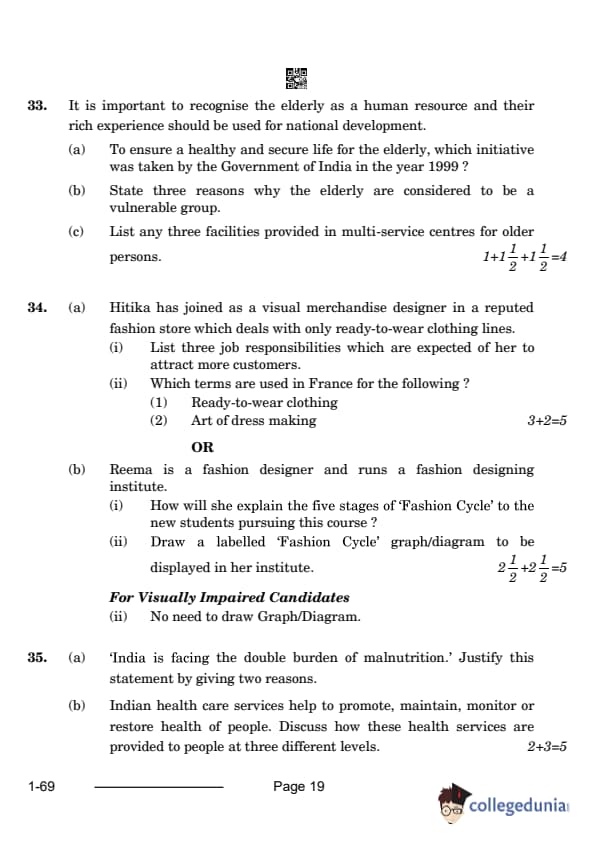
It is important to recognise the elderly as a human resource and their rich experience should be used for national development.
(a) To ensure a healthy and secure life for the elderly, which initiative was taken by the Government of India in the year 1999?
(b) State three reasons why the elderly are considered to be a vulnerable group.
(c) List any three facilities provided in multi-service centres for older persons.
View Solution
The Government of India formulated the National Policy for Older Persons in 1999, which highlights the need for support for the elderly. Quick Tip: Make sure to remember important national initiatives and policies that have been formulated for different sections of the population.
(b) Solution:
Deteriorating Health and Illness: The elderly may face issues due to their deteriorating
health, and various ailments which impact their daily lives. Their physiological reserves also
decline due to ageing.
Ageing and Weakened Defense Mechanisms: As the body ages, defense mechanisms
weaken, leading to disabilities such as low vision, hearing loss and loss of mobility.
Loneliness, Isolation and Dependence: Loneliness, social isolation and dependence on
others can lead to depression and anxiety.
Financial Dependence: Elderly people are often financially dependent on others, and lack
of proper financial support.
Lack of Support: Lack of support from children or misbehavior from family members is
another important factor which makes the elderly vulnerable.
Fragmentation of Families: The breakup of the traditional family structure also makes the
elderly more vulnerable, as they can no longer rely on extended family for support.
Inability to Care for Oneself: Due to failing health, elderly people may find it difficult to
care for their own needs.
Quick Tip
Always think of the various aspects which can cause the elderly to become vulnerable,
like physical, emotional, social and financial needs.
(c) SolutionDay care: Day care centers provide basic facilities like nutritious food and safe drinking
water.
Educational Opportunities: Some multi-service centers also provide learning and
educational opportunities.
Entertainment Opportunities: They also organize entertainment opportunities like
recreation, and cultural programs.
Healthcare/Medical Support: Multi-service centres provide regular health check-ups and
medical support.
Companionship: They provide companionship, and this helps to combat social isolation and
loneliness.
Counselling Services: They provide counselling services to the elderly.
Quick Tip
Always try to include all aspects of support when talking about services, such as physi-
cal, emotional, and social.
Section E
Long Answer Type Questions
Question 34:
(a) Hitika has joined as a visual merchandise designer in a reputed fashion store which deals with only ready-to-wear clothing lines.
(i) List three job responsibilities which are expected of her to attract more customers.
(ii) Which terms are used in France for the following ?
(1) Ready-to-wear clothing
(2) Art of dress making
OR
(b) Reema is a fashion designer and runs a fashion designing institute.
(i) How will she explain the five stages of ‘Fashion Cycle’ to the new students pursuing this course?
(ii) Draw a labelled ‘Fashion Cycle’ graph/ diagram to be displayed in her institute.
View Solution
(i) Solution:Designing Window Displays: Creating attractive window displays to showcase products and attract the attention of potential customers is a crucial job for a merchandise designer.
Arranging Store Merchandise: Arranging clothing and other merchandise within the store, making sure it is aesthetically pleasing and easy to access.
Creating Attractive Props: Creating attractive props to help with the display.
Organizing Clothing Placement: This includes organizing and arranging clothes within a store to highlight certain aspects like color, design or a specific trend.
Styling Mannequins: This includes dressing and styling mannequins to display the different items of clothing effectively.
Spearheading Marketing Campaigns: Merchandise designers also may be required to create and manage the entire marketing campaign for their products. Quick Tip: Try to approach such questions from the perspective of practical skills that are needed to improve business by attracting more customers.
(ii) Solution:
(1) Ready-to-wear clothing: The term used in French for ready-to-wear clothing is
“Prˆet-`a-porter”.
(2) Art of dress making: The term used in French for art of dressmaking is “Couture”.
Quick Tip
It is useful to know some common terms from fashion terminology.
(b)(i)Solution:Introduction of a Style: The fashion cycle begins with the introduction of a new style by a
designer. Here the new ideas and creativity are interpreted and introduced to the market.
Increase in Popularity: When a style begins to get purchased, and worn by people, it begins
to rise in popularity, signaling a growing acceptance.
Peak of Popularity: When a style becomes very popular, manufacturers then begin to copy
it or produce adaptations based on it. This is the stage where the style is at the height of its
popularity.
Decline in Popularity: As copies of the style become widely available, and people begin to
move on, the style then begins to decline in popularity, signalling saturation of the design.
Rejection of a Style/Obsolescence: This is the last phase of the cycle, where the style
becomes obsolete, and people look for newer trends. This rejection of old styles brings about
the need for newer styles, and a new cycle begins.
Quick Tip
The fashion cycle is a continuous process, that can repeat itself. So, remembering the
various stages sequentially will be helpful.
b(ii) Solution:
A labelled graph should be drawn in a bell shaped curve with the following parts:
Y-axis showing “Acceptance (Measured in Sales Volume)”.
X-axis with sections showing Introductory Phase, Acceptance Phase and Rejection Phase.
A label on the graph saying “Fashion Cycle” and the different stages marked with a rise,
peak and decline in the curve.
Note: For Visually Impaired Candidates, no need to draw graph/diagram in part (ii)
Quick Tip
Make sure to draw a well-labelled diagram which is easy to understand.
(a) ‘India is facing the double burden of malnutrition.' Justify this statement by giving two reasons.
(b) Indian health care services help to promote, maintain, monitor or restore health of people. Discuss how these health services are provided to people at three different levels.
View Solution
(a) Solution:Coexistence of Undernutrition and Overnutrition: India is facing a situation where both undernutrition (including deficiencies in essential nutrients) and overnutrition (which include obesity and diet related non-communicable diseases) exist in large numbers. This is what is referred to as a double burden of malnutrition.
Undernutrition: Undernutrition in India is caused by multiple factors like inadequate or faulty diets, disease, poverty, poor maternal health and poor sanitary practices. These factors contribute to children being underweight or stunted, and they also impact their immunity and development.
Overnutrition: Overnutrition and obesity are caused due to changing lifestyles, dependence on faster means of transportation, decreased outdoor activities and dietary changes due to processed foods. Quick Tip: Make sure that you define the term “double burden of malnutrition” in the answer, and also mention the key factors responsible for both undernutrition and overnutrition.
(b) Solution:
Primary Health Care: This is the first point of contact between individuals, families and
communities with the health system. The services are offered in villages through subcenters,
Primary Health Centres and dispensaries.
Secondary Health Care: More complex health issues are tackled at the secondary level,
where they can get referrals to district hospitals and community health centers. The
community health centers function as the first referral level.
Tertiary Health Care: This is the most specialized form of health care and it involves
medical college hospitals, regional hospitals and institutions like AIIMS, which tackle very
complex conditions.
Quick Tip
Remember the differences in structure and the scope of services provided at the three
levels of health care - primary, secondary and tertiary.



Comments