




CBSE Class 12 Mathematics Question Paper 2024 PDF (Set 1- 65/1/1) is available for download here. CBSE conducted the Mathematics exam on March 9, 2024 from 10:30 AM to 1:30 PM. The total marks for the theory paper are 80. The question paper contains 20% MCQ-based questions, 40% competency-based questions, and 40% short and long answer type questions.
CBSE Class 12 Mathematics Question Paper 2024 (Set 1- 65/1/1) with Answer Key
| CBSE Class 12 2024 Mathematics Question Paper with Answer Key |  Download Download |
Check Solution |
CBSE Class 12 2024 Mathematics Questions with Solutions
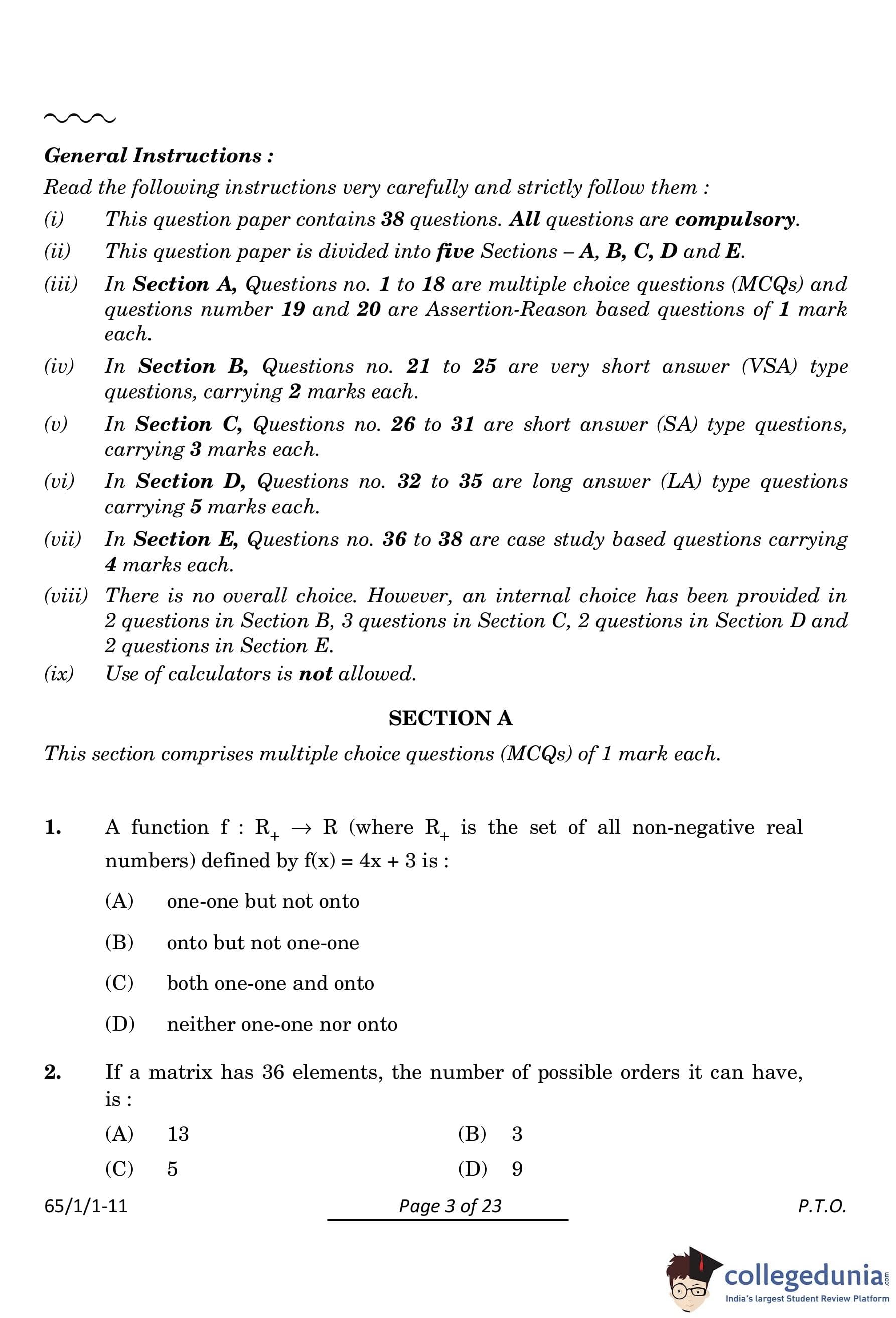
A function \( f : \mathbb{R}_+ \to \mathbb{R} \) (where \( \mathbb{R}_+ \) is the set of all non-negative real numbers) defined by \( f(x) = 4x + 3 \) is:
View Solution
The given function is \( f(x) = 4x + 3 \), where \( x \in \mathbb{R}_+ \).
Step 1: Checking if the function is one-one
A function is considered one-one if distinct inputs result in distinct outputs. For the given function \( f(x) = 4x + 3 \), assume: \[ f(x_1) = f(x_2). \]
Expanding the function: \[ 4x_1 + 3 = 4x_2 + 3. \]
Simplify: \[ 4x_1 = 4x_2 \implies x_1 = x_2. \]
This confirms that \( f(x) \) is one-one because no two different values of \( x \) can produce the same output.
Step 2: Checking if the function is onto
To verify if \( f(x) \) is onto, for any \( y \in \mathbb{R} \), there must exist \( x \in \mathbb{R}_+ \) such that \( f(x) = y \). Rearranging \( f(x) = 4x + 3 \), we have: \[ x = \frac{y - 3}{4}. \]
For \( x \in \mathbb{R}_+ \), the condition \( y - 3 \geq 0 \) must hold, implying \( y \geq 3 \). Thus, the range of \( f(x) \) is \( [3, \infty) \), which does not cover all real numbers. Therefore, \( f(x) \) is not onto.
Final Answer: (A) one-one but not onto. Quick Tip: To determine if a function is one-one, check if different inputs lead to different outputs. For onto functions, confirm whether the range matches the entire codomain by verifying the values the function can produce.
If a matrix has 36 elements, the number of possible orders it can have, is:
View Solution
The number of elements in a matrix is given by the product of its rows (\(m\)) and columns (\(n\)), such that \(m \times n = 36\). To determine the possible orders, we identify all pairs of positive integers \((m, n)\) that satisfy this condition.
The factors of 36 are: \[ 1, 2, 3, 4, 6, 9, 12, 18, 36. \]
Each pair of factors corresponds to a valid order of the matrix. The distinct pairs are: \[ (1, 36), (36, 1), (2, 18), (18, 2), (3, 12), (12, 3), (4, 9), (9, 4), (6, 6). \]
Counting these pairs, we find 9 possible orders of the matrix.
Final Answer: (D) 9. Quick Tip: When determining possible matrix orders, list all factor pairs of the total number of elements and ensure each pair corresponds to valid dimensions.
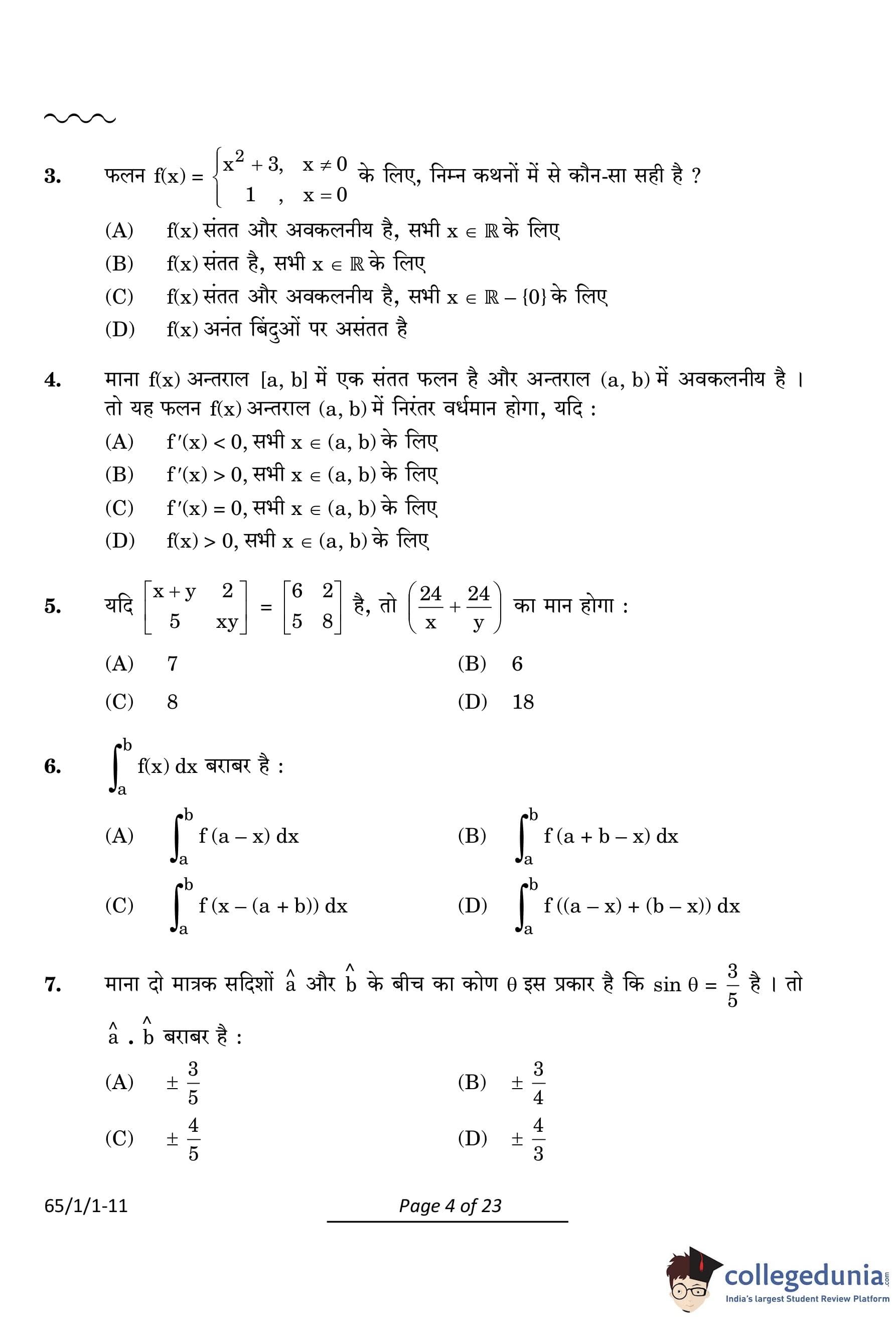
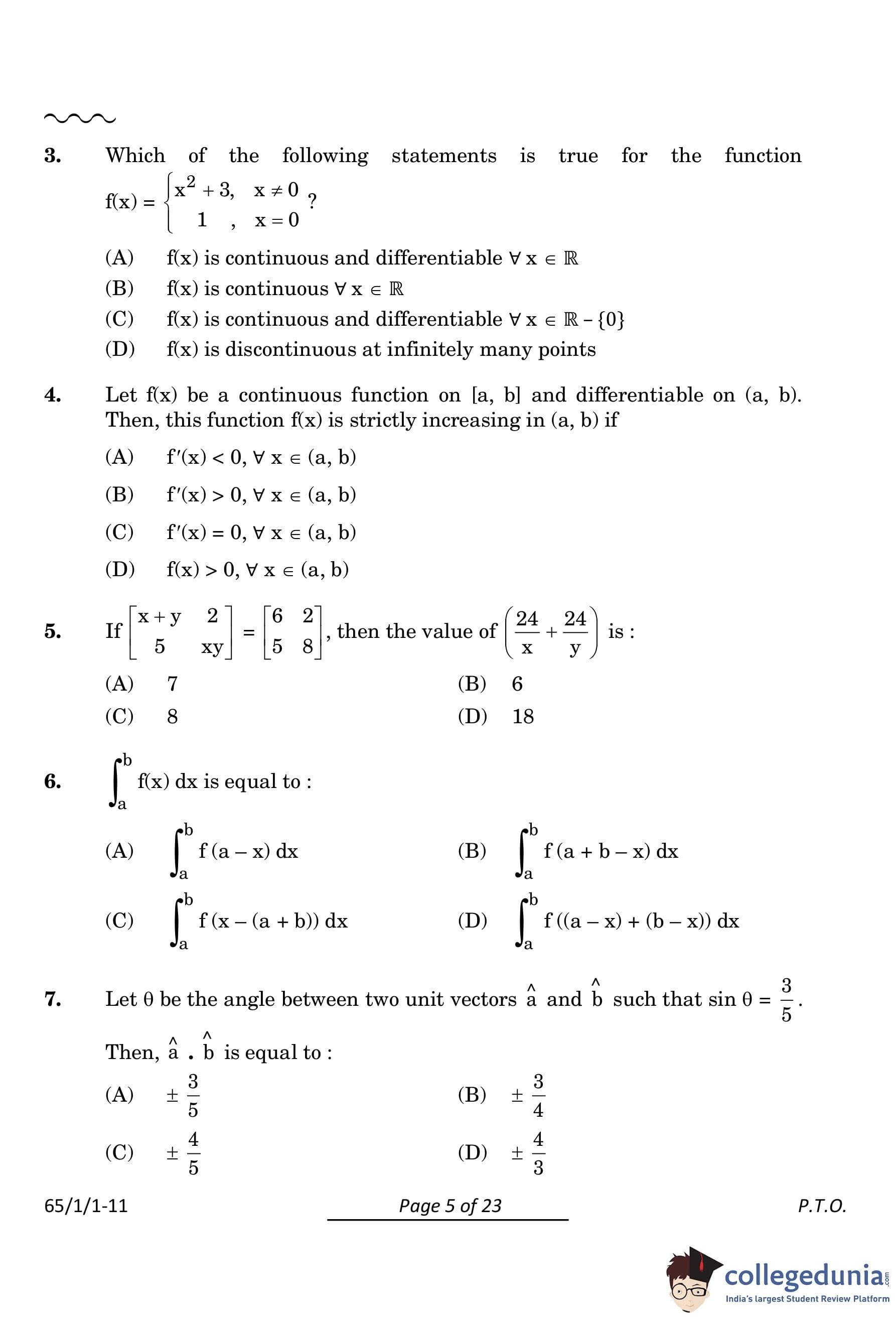
Which of the following statements is true for the function \[ f(x) = \begin{cases} x^2 + 3, & x \neq 0,
1, & x = 0? \end{cases} \]
View Solution
The function is given as: \[ f(x) = \begin{cases} x^2 + 3, & x \neq 0,
1, & x = 0. \end{cases} \]
Step 1: Continuity at \( x = 0 \)
For continuity, \( \lim_{x \to 0} f(x) \) must equal \( f(0) \).
When \( x \to 0 \), \( f(x) = x^2 + 3 \), so: \[ \lim_{x \to 0} f(x) = 3, \quad but \quad f(0) = 1. \]
Since \( \lim_{x \to 0} f(x) \neq f(0) \), the function is discontinuous at \( x = 0 \).
Step 2: Continuity and differentiability for \( x \neq 0 \)
For \( x \neq 0 \), \( f(x) = x^2 + 3 \), which is a smooth polynomial function. Polynomial functions are inherently both continuous and differentiable everywhere. Thus, \( f(x) \) is continuous and differentiable for all \( x \in \mathbb{R} \setminus \{0\} \).
Step 3: Summarizing the behavior of \( f(x) \)
The function \( f(x) \) is continuous and differentiable everywhere except at \( x = 0 \), where it is neither continuous nor differentiable.
Hence, the correct statement is that \( f(x) \) is continuous and differentiable \( \forall x \in \mathbb{R} \setminus \{0\} \).
Final Answer: (C). Quick Tip: For continuity, check if the limit from both sides equals the function's value at the point. For differentiability, confirm that the derivative exists at every point within the specified domain.
Let \( f(x) \) be a continuous function on \([a, b]\) and differentiable on \((a, b)\). Then, this function \( f(x) \) is strictly increasing in \((a, b)\) if:
View Solution
For a function \( f(x) \) to be strictly increasing in the interval \((a, b)\), it must satisfy the condition \( f'(x) > 0 \, \forall x \in (a, b) \).
This condition arises because the derivative \( f'(x) \) represents the rate of change of \( f(x) \). When \( f'(x) > 0 \), the function’s value increases as \( x \) increases, ensuring strict monotonicity.
Analyzing the given options:
(A) \( f'(x) < 0, \, \forall x \in (a, b) \): This condition implies the function is strictly decreasing.
(B) \( f'(x) > 0, \, \forall x \in (a, b) \): This is the correct condition for \( f(x) \) to be strictly increasing.
(C) \( f'(x) = 0, \, \forall x \in (a, b) \): This condition describes a constant function, which is neither increasing nor decreasing.
(D) \( f(x) > 0, \, \forall x \in (a, b) \): This condition only ensures the function values are positive but does not guarantee an increasing trend.
Therefore, the correct answer is option (B).
Final Answer: (B) \( f'(x) > 0, \, \forall x \in (a, b) \). Quick Tip: To confirm whether a function is strictly increasing, check if the derivative is positive throughout the interval. Positivity of the function values alone does not ensure an increasing trend.
If \[ \begin{bmatrix} x + y & 2
5 & xy \end{bmatrix} = \begin{bmatrix} 6 & 2
5 & 8 \end{bmatrix}, \]
then the value of \[ \left( \frac{24}{x} + \frac{24}{y} \right) \]
is:
View Solution
From the equality of the matrices: \[ \begin{bmatrix} x + y & 2
5 & xy \end{bmatrix} = \begin{bmatrix} 6 & 2
5 & 8 \end{bmatrix}, \]
the corresponding elements give the equations: \[ x + y = 6, \quad xy = 8. \]
Step 1: Solving for \( x \) and \( y \)
The equations \( x + y = 6 \) and \( xy = 8 \) represent the sum and product of roots of a quadratic equation. Construct the quadratic equation as: \[ t^2 - (x + y)t + xy = 0. \]
Substituting \( x + y = 6 \) and \( xy = 8 \), we get: \[ t^2 - 6t + 8 = 0. \]
Factorizing: \[ t^2 - 6t + 8 = (t - 2)(t - 4) = 0. \]
Thus, \( x = 2 \) and \( y = 4 \) (or vice versa).
Step 2: Calculating \( \frac{24}{x} + \frac{24}{y} \)
Substitute \( x = 2 \) and \( y = 4 \) into the expression: \[ \frac{24}{x} + \frac{24}{y} = \frac{24}{2} + \frac{24}{4}. \]
Simplify: \[ \frac{24}{2} + \frac{24}{4} = 12 + 6 = 18. \]
Final Answer: (D) 18. Quick Tip: For matrix equations, equate corresponding entries to form equations. If the unknowns involve quadratic relationships, use factorization techniques or solve systematically to find the values.
\( \int_a^b f(x) \, dx \) is equal to:
View Solution
We aim to show that \( \int_a^b f(x) \, dx = \int_a^b f(a + b - x) \, dx \). Let us use the substitution \( u = a + b - x \). Then: \[ \frac{du}{dx} = -1 \quad \implies \quad dx = -du. \]
Now, update the limits of integration:
- When \( x = a \), \( u = a + b - a = b \),
- When \( x = b \), \( u = a + b - b = a \).
The integral becomes: \[ \int_a^b f(x) \, dx = \int_b^a f(a + b - u)(-du). \]
Reversing the limits of integration (which removes the negative sign): \[ \int_a^b f(x) \, dx = \int_a^b f(a + b - u) \, du. \]
By substituting back \( u \) as \( x \), we get: \[ \int_a^b f(x) \, dx = \int_a^b f(a + b - x) \, dx. \]
Thus, the given integral is equal to \( \int_a^b f(a + b - x) \, dx \).
Final Answer: (B). Quick Tip: When performing substitutions in definite integrals, ensure that both the integrand and the limits of integration are transformed consistently to avoid errors.
Let \( \theta \) be the angle between two unit vectors \( \mathbf{\hat{a}} \) and \( \mathbf{\hat{b}} \) such that \( \sin \theta = \frac{3}{5} \). Then, \( \mathbf{\hat{a}} \cdot \mathbf{\hat{b}} \) is equal to:
View Solution
The dot product of two unit vectors is given by: \[ \mathbf{\hat{a}} \cdot \mathbf{\hat{b}} = \cos \theta. \]
From the Pythagorean identity: \[ \sin^2 \theta + \cos^2 \theta = 1. \]
Substitute \( \sin \theta = \frac{3}{5} \): \[ \left( \frac{3}{5} \right)^2 + \cos^2 \theta = 1. \]
Simplify: \[ \frac{9}{25} + \cos^2 \theta = 1 \implies \cos^2 \theta = 1 - \frac{9}{25} = \frac{16}{25}. \]
Taking the square root: \[ \cos \theta = \pm \sqrt{\frac{16}{25}} = \pm \frac{4}{5}. \]
Since the sign of \( \cos \theta \) depends on the context (quadrant of \( \theta \)), we conclude that: \[ \mathbf{\hat{a}} \cdot \mathbf{\hat{b}} = \pm \frac{4}{5}. \]
Final Answer: (C) \( \pm \frac{4}{5} \). Quick Tip: The dot product of unit vectors equals \( \cos \theta \), where \( \theta \) is the angle between them. Use the Pythagorean identity to find \( \cos \theta \) when \( \sin \theta \) is known.
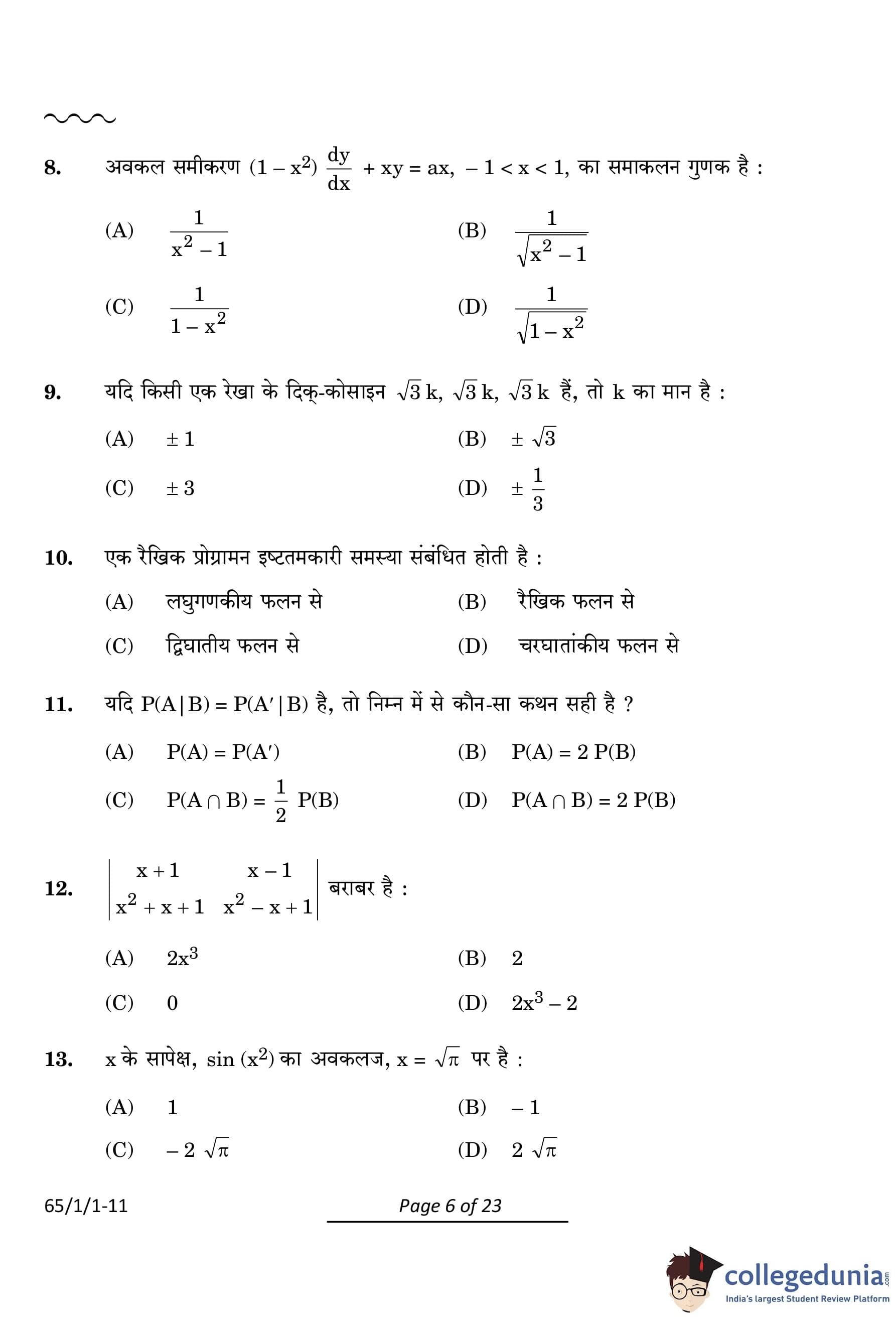
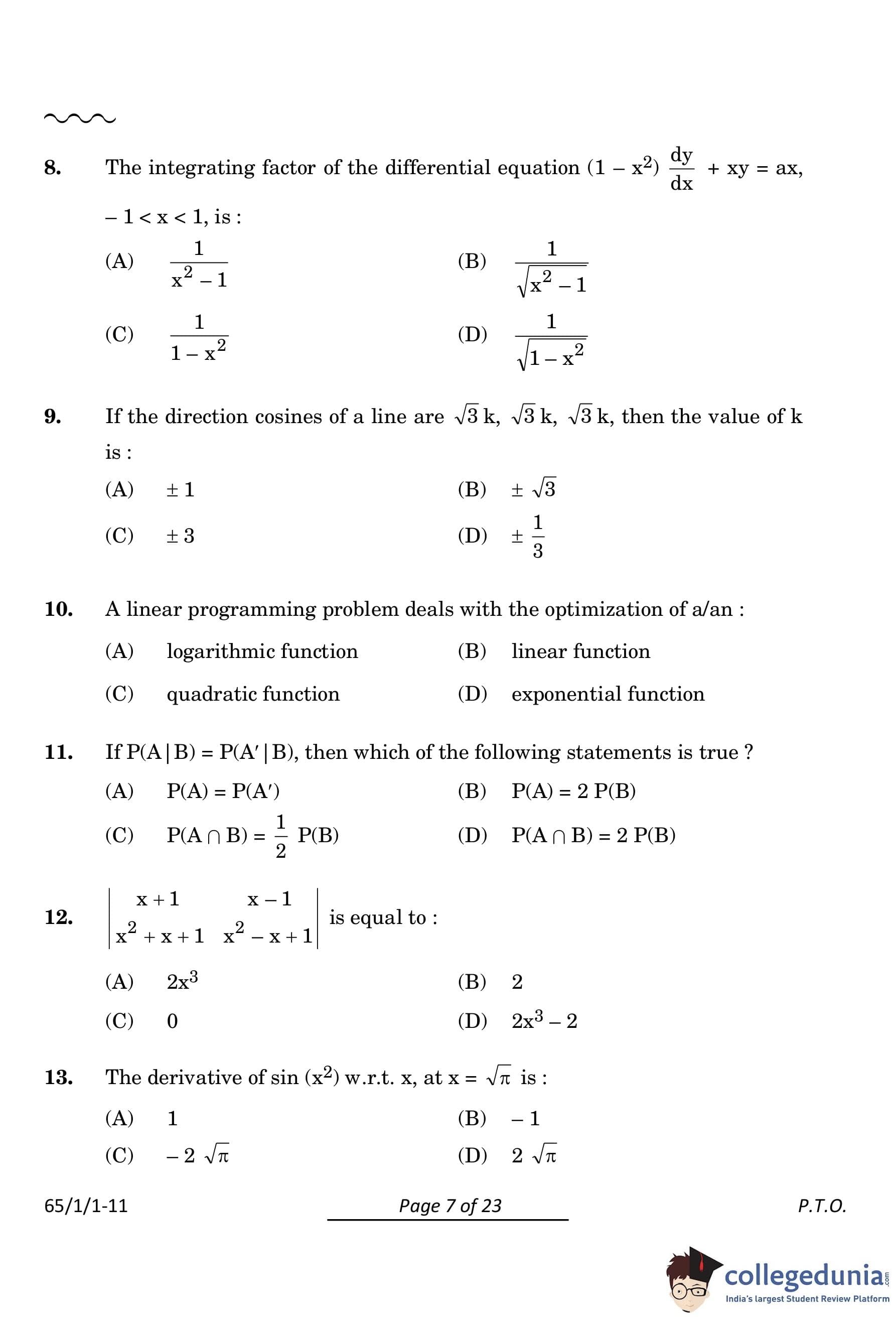
The integrating factor of the differential equation \((1 - x^2) \frac{dy}{dx} + xy = ax\), \(-1 < x < 1\), is:
View Solution
The given differential equation is: \[ (1 - x^2) \frac{dy}{dx} + xy = ax. \]
Rewriting it in the standard linear form: \[ \frac{dy}{dx} + \frac{xy}{1 - x^2} = \frac{ax}{1 - x^2}. \]
Here, the term \( \frac{x}{1 - x^2} \) is the coefficient of \( y \), i.e., \( P(x) \), in the linear differential equation \(\frac{dy}{dx} + P(x)y = Q(x)\).
The integrating factor (IF) is: \[ \mu(x) = e^{\int P(x) \, dx}. \]
Substitute \( P(x) = \frac{x}{1 - x^2} \): \[ \mu(x) = e^{\int \frac{x}{1 - x^2} \, dx}. \]
Step 1: Solve the integral
Let \( u = 1 - x^2 \), so \( du = -2x \, dx \). Rewrite the integral: \[ \int \frac{x}{1 - x^2} \, dx = -\frac{1}{2} \int \frac{1}{u} \, du = -\frac{1}{2} \ln|u| = -\frac{1}{2} \ln|1 - x^2|. \]
Step 2: Simplify the integrating factor
Using the result of the integral: \[ \mu(x) = e^{-\frac{1}{2} \ln|1 - x^2|} = (1 - x^2)^{-\frac{1}{2}} = \frac{1}{\sqrt{1 - x^2}}. \]
Hence, the integrating factor is \( \frac{1}{\sqrt{1 - x^2}} \).
Final Answer: (D). Quick Tip: For linear differential equations, the integrating factor is determined by solving \(\mu(x) = e^{\int P(x) \, dx}\). Simplify using appropriate substitutions when necessary.
If the direction cosines of a line are \( \sqrt{3}k, \sqrt{3}k, \sqrt{3}k \), then the value of \( k \) is:
View Solution
The direction cosines \( l, m, n \) of a line satisfy the fundamental relation: \[ l^2 + m^2 + n^2 = 1. \]
Here, \( l = \sqrt{3}k \), \( m = \sqrt{3}k \), and \( n = \sqrt{3}k \). Substituting these into the relation: \[ (\sqrt{3}k)^2 + (\sqrt{3}k)^2 + (\sqrt{3}k)^2 = 1. \]
Simplify: \[ 3k^2 + 3k^2 + 3k^2 = 1 \implies 9k^2 = 1 \implies k^2 = \frac{1}{9}. \]
Taking the square root: \[ k = \pm \frac{1}{3}. \]
Hence, the value of \( k \) is \( \pm \frac{1}{3} \).
Final Answer: (D) \( \pm \frac{1}{3} \). Quick Tip: The sum of the squares of the direction cosines is always equal to 1. This relation simplifies calculations when determining unknown parameters.
A linear programming problem deals with the optimization of a/an:
View Solution
Linear programming is a method used to optimize a linear objective function subject to linear equality and inequality constraints. The general form of the objective function is: \[ Z = ax + by, \]
where \( Z \) represents the function to be optimized (maximized or minimized), and \( x, y \) are variables that must satisfy the given constraints.
Linear programming is widely used in operations research, economics, and engineering for solving problems involving resource allocation, production scheduling, and more.
Hence, the correct answer is (B) linear function. Quick Tip: Linear programming focuses on linear objective functions and constraints. Ensure all equations in the problem are linear before applying this method.
If \( P(A | B) = P(A' | B) \), then which of the following statements is true?
View Solution
The given condition \( P(A | B) = P(A' | B) \) implies: \[ \frac{P(A \cap B)}{P(B)} = \frac{P(A' \cap B)}{P(B)}. \]
Cancel \( P(B) \) (since \( P(B) \neq 0 \)): \[ P(A \cap B) = P(A' \cap B). \]
Using the property of complements: \[ P(A \cap B) + P(A' \cap B) = P(B). \]
Substituting \( P(A \cap B) = P(A' \cap B) \), we get: \[ P(A \cap B) + P(A \cap B) = P(B) \implies 2P(A \cap B) = P(B). \]
Divide both sides by 2: \[ P(A \cap B) = \frac{1}{2}P(B). \]
Thus, the correct answer is (C) \( P(A \cap B) = \frac{1}{2}P(B) \). Quick Tip: In conditional probability, if \( P(A | B) = P(A' | B) \), use the complement property \( P(A \cap B) + P(A' \cap B) = P(B) \) to derive the relationship.
The determinant \(\begin{vmatrix} x+1 & x-1
x^2+x+1 & x^2-x+1 \end{vmatrix}\) is equal to:
View Solution
The given determinant is: \[ \begin{vmatrix} x+1 & x-1
x^2+x+1 & x^2-x+1 \end{vmatrix}. \]
The formula for the determinant of a \( 2 \times 2 \) matrix is: \[ Determinant = (a_{11} \cdot a_{22}) - (a_{12} \cdot a_{21}), \]
where \( a_{11}, a_{12}, a_{21}, a_{22} \) are the matrix elements.
Step 1: Compute the diagonal products
- Diagonal 1 product: \[ (x+1)(x^2 - x + 1) = x^3 - x^2 + x + x^2 - x + 1 = x^3 + x + 1. \]
- Diagonal 2 product: \[ (x-1)(x^2 + x + 1) = x^3 + x^2 + x - x^2 - x - 1 = x^3 - 1. \]
Step 2: Subtract the diagonal products
\[ Determinant = (x^3 + x + 1) - (x^3 - 1). \]
Simplify: \[ Determinant = x^3 + x + 1 - x^3 + 1 = x + 2. \]
Hence, the value of the determinant is \(2\), and the correct answer is (B). Quick Tip: For \( 2 \times 2 \) determinants, calculate each diagonal product separately and carefully subtract them. Simplify terms to ensure accuracy.
The derivative of \( \sin(x^2) \) w.r.t. \( x \), at \( x = \sqrt{\pi} \), is:
View Solution
The given function is: \[ f(x) = \sin(x^2). \]
Differentiate \( f(x) \) w.r.t. \( x \): \[ \frac{d}{dx} [\sin(x^2)] = \cos(x^2) \cdot \frac{d}{dx}(x^2). \]
Simplify: \[ \frac{d}{dx} [\sin(x^2)] = \cos(x^2) \cdot 2x. \]
At \( x = \sqrt{\pi} \), substitute into the derivative: \[ \frac{d}{dx} [\sin(x^2)] = 2x \cos(x^2). \]
Substituting \( x = \sqrt{\pi} \): \[ \frac{d}{dx} [\sin(x^2)] = 2\sqrt{\pi} \cos((\sqrt{\pi})^2) = 2\sqrt{\pi} \cos(\pi). \]
Using \( \cos(\pi) = -1 \): \[ \frac{d}{dx} [\sin(x^2)] = 2\sqrt{\pi} \cdot (-1) = -2\sqrt{\pi}. \]
Therefore, the derivative at \( x = \sqrt{\pi} \) is \( -2\sqrt{\pi} \), and the correct answer is (C). Quick Tip: To differentiate composite functions like \( \sin(g(x)) \), apply the chain rule: differentiate the outer function, multiply by the derivative of the inner function, and substitute values carefully.
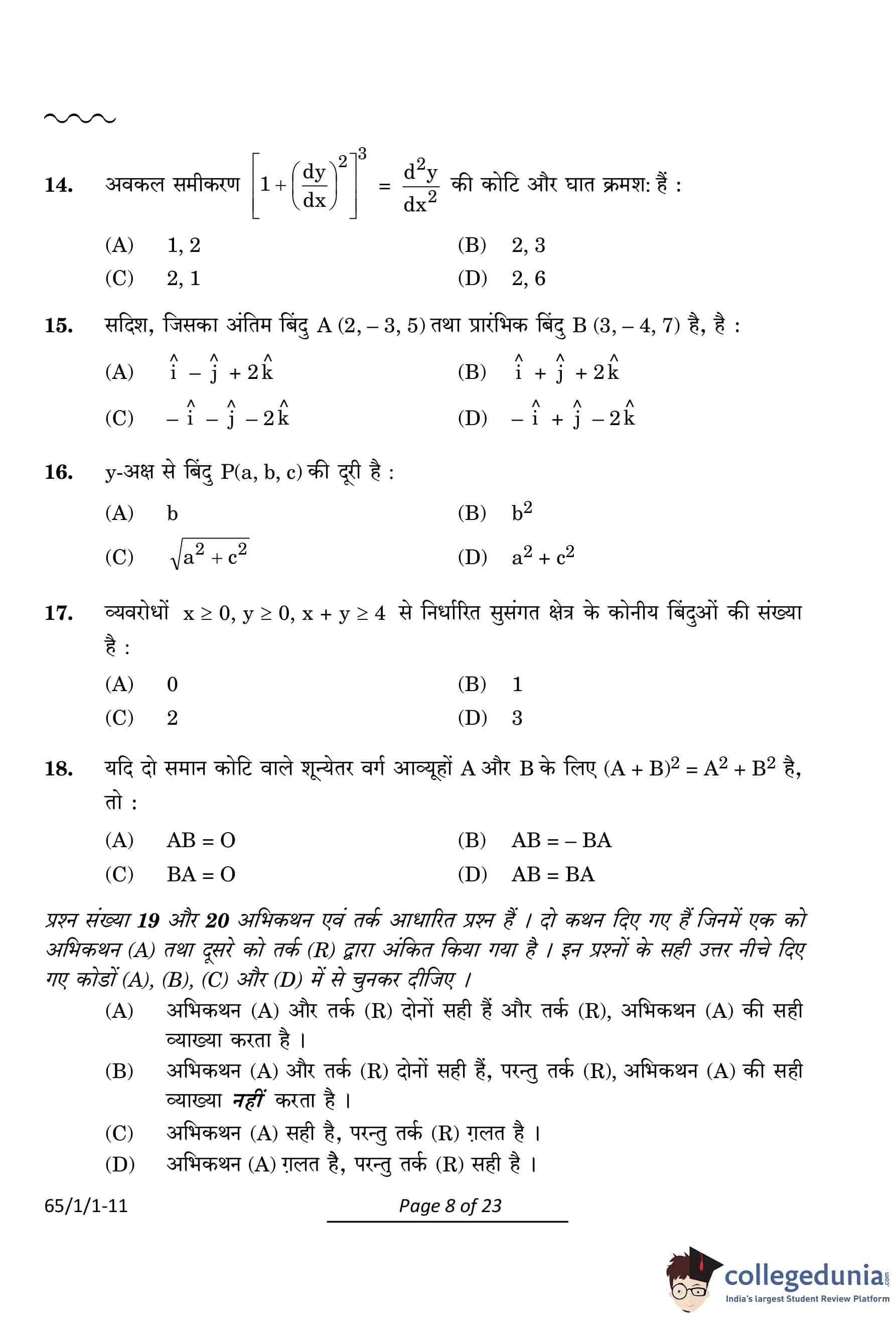
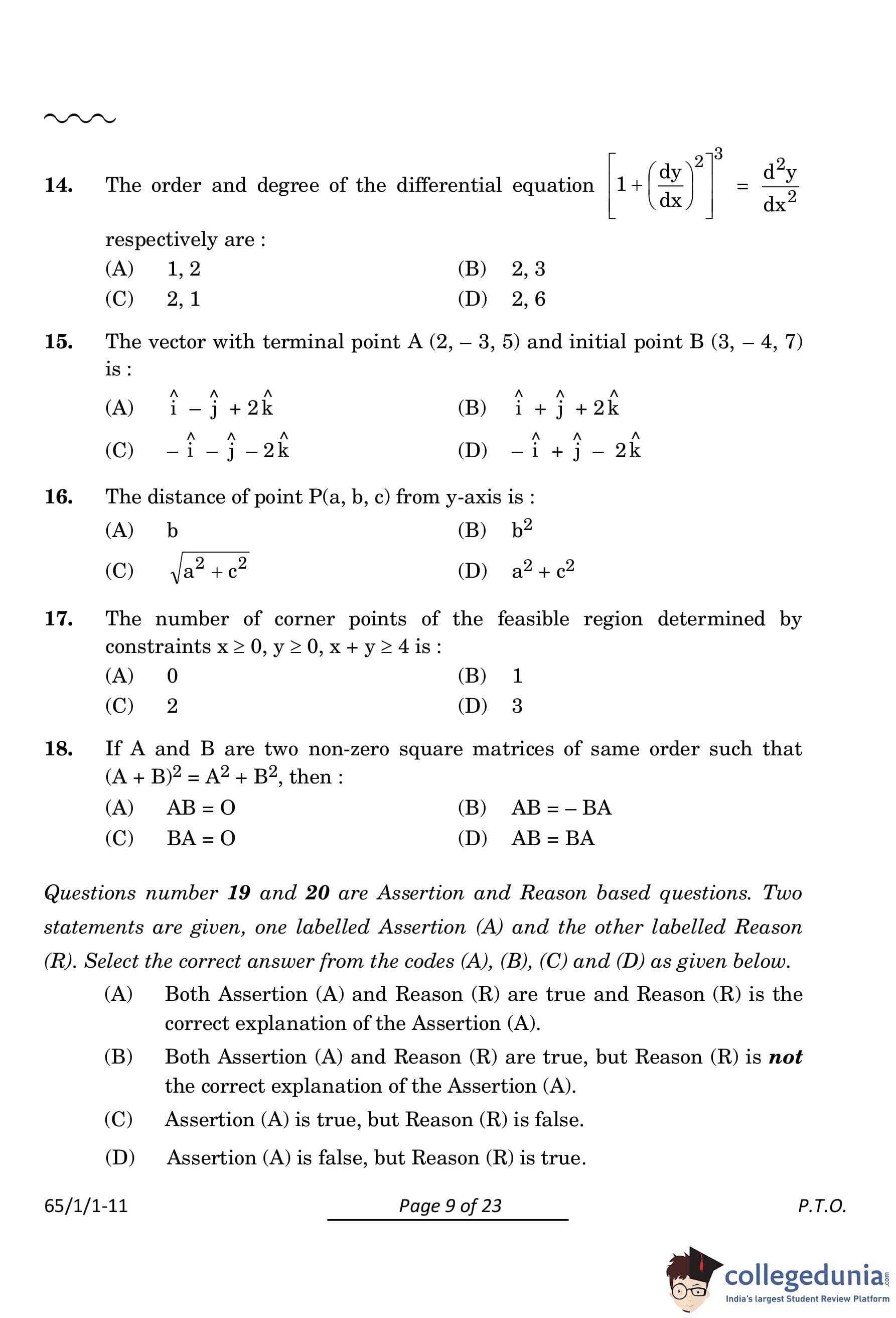
The order and degree of the differential equation: \[ \left[ 1 + \left(\frac{dy}{dx}\right)^2 \right]^3 = \frac{d^2y}{dx^2} \]
respectively are:
View Solution
To determine the order and degree of the given differential equation: \[ \left[ 1 + \left(\frac{dy}{dx}\right)^2 \right]^3 = \frac{d^2y}{dx^2}, \]
we analyze as follows:
Step 1: Find the order
The order of a differential equation is the highest order derivative present in the equation.
Here, the highest derivative is \(\frac{d^2y}{dx^2}\), which is of order \(2\).
Thus, the order of the equation is \(2\).
Step 2: Find the degree
The degree of a differential equation is the power of the highest order derivative after ensuring that the equation is free of radicals and fractional powers of the derivatives.
Here, \(\frac{d^2y}{dx^2}\) appears to the power of \(1\), and there are no radicals or fractions involving derivatives.
Thus, the degree of the equation is \(1\).
Hence, the order and degree of the given differential equation are \(2\) and \(1\), respectively.
Final Answer: (C) \( 2, 1 \). Quick Tip: The order is determined by the highest order derivative, and the degree is the highest power of that derivative after eliminating radicals or fractional powers.
The vector with terminal point \( A(2, -3, 5) \) and initial point \( B(3, -4, 7) \) is:
View Solution
The vector from point \( B(3, -4, 7) \) to point \( A(2, -3, 5) \) is determined using the formula: \[ \overrightarrow{BA} = (x_2 - x_1)\hat{i} + (y_2 - y_1)\hat{j} + (z_2 - z_1)\hat{k}, \]
where \( (x_1, y_1, z_1) \) are the coordinates of the initial point \( B \), and \( (x_2, y_2, z_2) \) are the coordinates of the terminal point \( A \).
Substitute the given coordinates: \[ \overrightarrow{BA} = (2 - 3)\hat{i} + (-3 - (-4))\hat{j} + (5 - 7)\hat{k}. \]
Simplify each component: \[ \overrightarrow{BA} = (-1)\hat{i} + (1)\hat{j} + (-2)\hat{k}. \]
Thus: \[ \overrightarrow{BA} = -\hat{i} + \hat{j} - 2\hat{k}. \]
Therefore, the vector is \( -\hat{i} + \hat{j} - 2\hat{k} \), and the correct answer is (D). Quick Tip: To find a vector between two points, subtract the coordinates of the initial point from the terminal point for each component: \[ \overrightarrow{BA} = (x_2 - x_1)\hat{i} + (y_2 - y_1)\hat{j} + (z_2 - z_1)\hat{k}. \]
The distance of point \( P(a, b, c) \) from the y-axis is:
View Solution
The y-axis is the line where \( x = 0 \) and \( z = 0 \). The distance of the point \( P(a, b, c) \) from the y-axis is the shortest distance (perpendicular distance) from \( P \) to the y-axis. This distance depends only on the \( x \)- and \( z \)-coordinates of the point because the y-axis lies in the \( b \)-direction.
Using the distance formula: \[ Distance = \sqrt{(a - 0)^2 + (c - 0)^2}. \]
Simplify: \[ Distance = \sqrt{a^2 + c^2}. \]
Therefore, the distance of the point \( P(a, b, c) \) from the y-axis is \( \sqrt{a^2 + c^2} \), and the correct answer is (C). Quick Tip: To find the distance of a point from the y-axis, use only the \( x \)- and \( z \)-coordinates in the distance formula: \[ Distance = \sqrt{a^2 + c^2}. \]
The number of corner points of the feasible region determined by constraints \(x \geq 0\), \(y \geq 0\), \(x + y \geq 4\) is:
View Solution
To find the number of corner points of the feasible region, we analyze the given constraints:
1. \(x \geq 0\): Represents the region to the right of the \(y\)-axis, including the \(y\)-axis.
2. \(y \geq 0\): Represents the region above the \(x\)-axis, including the \(x\)-axis.
3. \(x + y \geq 4\): Represents the region above or on the line \(x + y = 4\).
Rearrange as \(y = 4 - x\), which has intercepts at \(x = 4\) (on the \(x\)-axis) and \(y = 4\) (on the \(y\)-axis).
The feasible region is the intersection of these constraints in the first quadrant (\(x \geq 0, y \geq 0\)) and above the line \(x + y = 4\). This region is unbounded but has two distinct corner points:
Intersection of \(x + y = 4\) with \(x = 0\): \((0, 4)\),
Intersection of \(x + y = 4\) with \(y = 0\): \((4, 0)\).
Thus, the feasible region has \(2\) corner points.
Final Answer: (C) \( 2 \). Quick Tip: To find corner points of a feasible region, solve for the intersections of constraint lines and ensure they lie within the region defined by the inequalities.
If \( A \) and \( B \) are two non-zero square matrices of the same order such that \[ (A + B)^2 = A^2 + B^2, \]
then:
View Solution
Start with the given equation: \[ (A + B)^2 = A^2 + B^2. \]
Expand the left-hand side using the distributive property of matrix multiplication: \[ (A + B)^2 = A^2 + AB + BA + B^2. \]
Equating both sides: \[ A^2 + AB + BA + B^2 = A^2 + B^2. \]
Cancel \( A^2 \) and \( B^2 \) from both sides: \[ AB + BA = 0. \]
Rearranging terms: \[ AB = -BA. \]
Hence, the correct answer is (B) \( AB = -BA \). Quick Tip: When given matrix equations, expand and simplify carefully. For \( AB = -BA \), the matrices \( A \) and \( B \) are said to be anti-commutative.
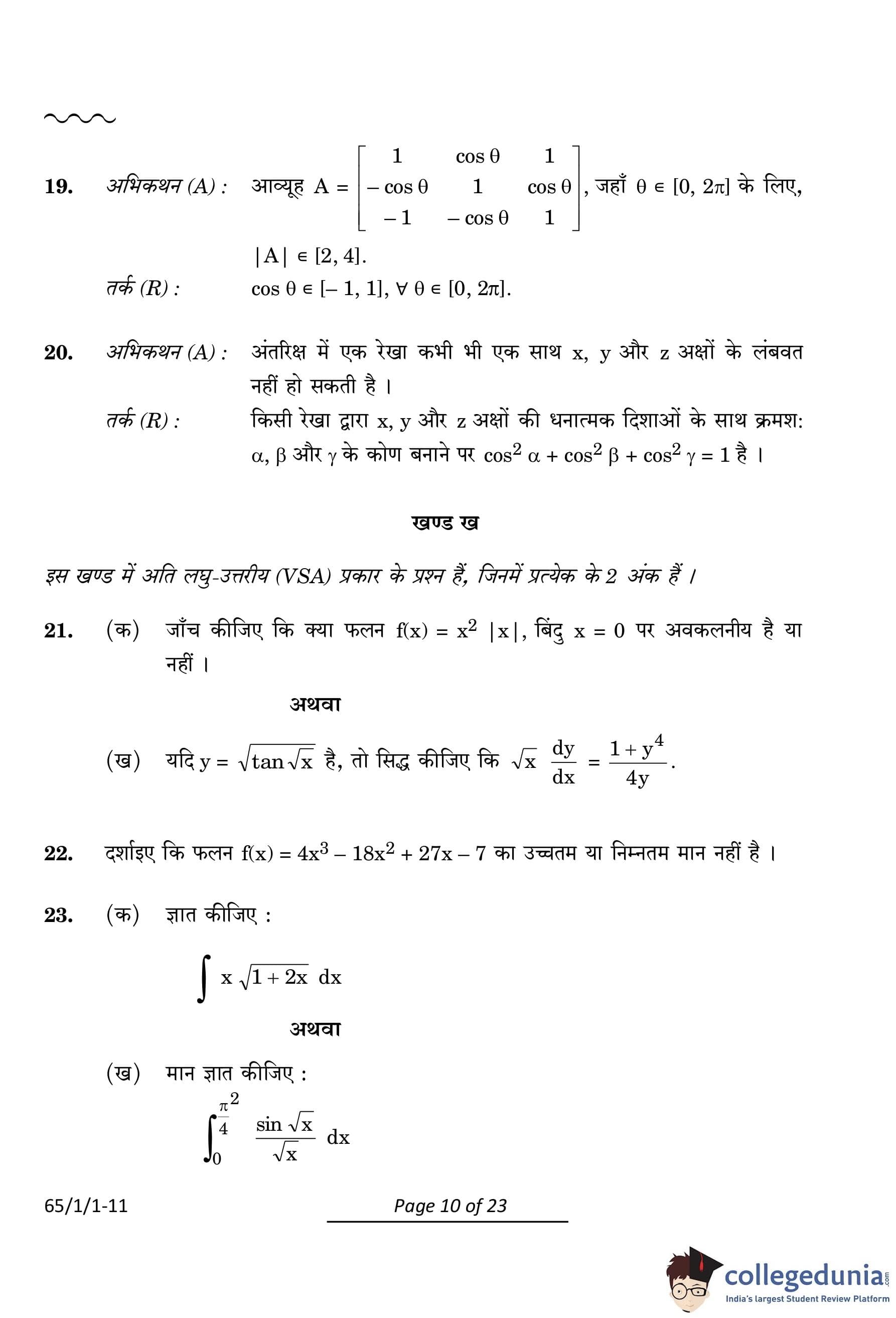
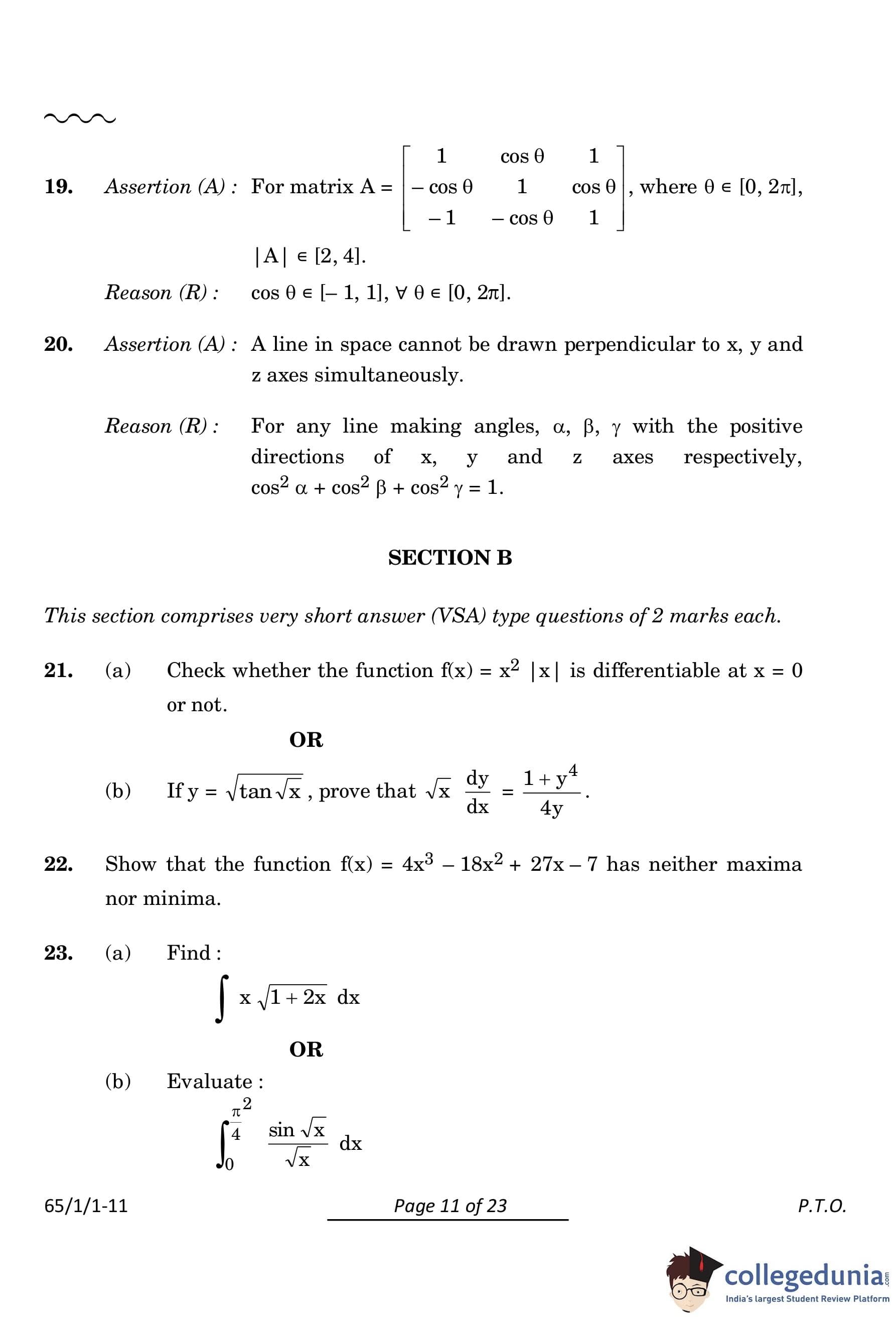
Assertion (A): For the matrix \[ A = \begin{bmatrix} 1 & \cos \theta & 1
-\cos \theta & 1 & \cos \theta
-1 & -\cos \theta & 1 \end{bmatrix}, \quad where \theta \in [0, 2\pi], \] \(|A| \in [2, 4]\).
Reason (R): \(\cos \theta \in [-1, 1], \ \forall \ \theta \in [0, 2\pi].\)
View Solution
The determinant of the matrix is: \[ |A| = \begin{vmatrix} 1 & \cos \theta & 1
-\cos \theta & 1 & \cos \theta
-1 & -\cos \theta & 1 \end{vmatrix}. \]
Using cofactor expansion along the first row: \[ |A| = 1 \cdot \begin{vmatrix} 1 & \cos \theta
-\cos \theta & 1 \end{vmatrix} - \cos \theta \cdot \begin{vmatrix} -\cos \theta & \cos \theta
-1 & 1 \end{vmatrix} + 1 \cdot \begin{vmatrix} -\cos \theta & 1
-1 & -\cos \theta \end{vmatrix}. \]
1. Compute the first minor: \[ \begin{vmatrix} 1 & \cos \theta
-\cos \theta & 1 \end{vmatrix} = (1)(1) - (-\cos \theta)(\cos \theta) = 1 + \cos^2 \theta. \]
2. Compute the second minor: \[ \begin{vmatrix} -\cos \theta & \cos \theta
-1 & 1 \end{vmatrix} = (-\cos \theta)(1) - (\cos \theta)(-1) = -\cos \theta + \cos \theta = 0. \]
3. Compute the third minor: \[ \begin{vmatrix} -\cos \theta & 1
-1 & -\cos \theta \end{vmatrix} = (-\cos \theta)(-\cos \theta) - (1)(-1) = \cos^2 \theta + 1. \]
Substitute back into the determinant: \[ |A| = 1 \cdot (1 + \cos^2 \theta) - \cos \theta \cdot 0 + 1 \cdot (1 + \cos^2 \theta). \]
Simplify: \[ |A| = (1 + \cos^2 \theta) + (1 + \cos^2 \theta) = 2 + 2\cos^2 \theta. \]
Since \(\cos \theta \in [-1, 1]\), it follows that: \[ \cos^2 \theta \in [0, 1]. \]
Thus: \[ |A| = 2 + 2\cos^2 \theta \in [2, 4]. \]
Verification of Assertion (A): The determinant \(|A|\) lies in the interval \([2, 4]\), so the assertion is true.
Verification of Reason (R): The cosine function satisfies \(\cos \theta \in [-1, 1]\) for all \(\theta \in [0, 2\pi]\), so the reason is also true.
Conclusion: Both Assertion (A) and Reason (R) are true, and the Reason (R) correctly explains the Assertion (A). Quick Tip: For determinants involving trigonometric functions, expand using cofactor expansion and simplify carefully. Use the properties of \(\cos \theta\) and \(\cos^2 \theta\) to evaluate the range.
Assertion (A): A line in space cannot be drawn perpendicular to \( x \), \( y \), and \( z \) axes simultaneously.
Reason (R): For any line making angles \( \alpha, \beta, \gamma \) with the positive directions of \( x \), \( y \), and \( z \) axes respectively, \[ \cos^2\alpha + \cos^2\beta + \cos^2\gamma = 1. \]
View Solution
A line in three-dimensional space cannot be perpendicular to all three axes (\(x\), \(y\), and \(z\)) simultaneously. This is because, for a line to be perpendicular to all three axes, its direction cosines \( \cos\alpha, \cos\beta, \cos\gamma \) would all be zero. However, the direction cosines of a line must satisfy the fundamental relation: \[ \cos^2\alpha + \cos^2\beta + \cos^2\gamma = 1. \]
If \( \cos\alpha = 0 \), \( \cos\beta = 0 \), and \( \cos\gamma = 0 \), the above equation would be violated, as the left-hand side would equal \( 0 \), not \( 1 \). Therefore, it is impossible for a line to be perpendicular to all three axes simultaneously.
The given equation \( \cos^2\alpha + \cos^2\beta + \cos^2\gamma = 1 \) correctly explains why the assertion is true.
Conclusion: Both Assertion (A) and Reason (R) are true, and Reason (R) is the correct explanation of Assertion (A). Quick Tip: In 3D geometry, the relation \(\cos^2 \alpha + \cos^2 \beta + \cos^2 \gamma = 1\) ensures that a line always has a direction cosine that is non-zero, making it impossible to be perpendicular to all three axes simultaneously.
Check whether the function \( f(x) = x^2 |x| \) is differentiable at \( x = 0 \) or not.
View Solution
N/A
If \( y = \sqrt{\tan\sqrt{x}} \), prove that: \[ \sqrt{x} \frac{dy}{dx} = \frac{1 + y^4}{4y}. \]
View Solution
We are given \( y = \sqrt{\tan\sqrt{x}} \). Differentiate both sides with respect to \( x \): \[ \frac{dy}{dx} = \frac{1}{2\sqrt{\tan\sqrt{x}}} \cdot \frac{d}{dx}[\tan\sqrt{x}]. \]
The derivative of \( \tan\sqrt{x} \) is: \[ \frac{d}{dx}[\tan\sqrt{x}] = \sec^2\sqrt{x} \cdot \frac{d}{dx}[\sqrt{x}] = \sec^2\sqrt{x} \cdot \frac{1}{2\sqrt{x}}. \]
Substitute this into \( \frac{dy}{dx} \): \[ \frac{dy}{dx} = \frac{1}{2\sqrt{\tan\sqrt{x}}} \cdot \sec^2\sqrt{x} \cdot \frac{1}{2\sqrt{x}}. \]
Simplify: \[ \frac{dy}{dx} = \frac{\sec^2\sqrt{x}}{4\sqrt{x}\sqrt{\tan\sqrt{x}}}. \]
Since \( y = \sqrt{\tan\sqrt{x}} \), we have \( \tan\sqrt{x} = y^2 \), and thus: \[ \sec^2\sqrt{x} = 1 + \tan^2\sqrt{x} = 1 + y^4. \]
Substitute these into \( \frac{dy}{dx} \): \[ \frac{dy}{dx} = \frac{1 + y^4}{4\sqrt{x}y}. \]
Multiply both sides by \( \sqrt{x} \): \[ \sqrt{x} \frac{dy}{dx} = \frac{1 + y^4}{4y}. \]
Conclusion: \[ \sqrt{x} \frac{dy}{dx} = \frac{1 + y^4}{4y} \quad is proved. \] Quick Tip: When differentiating composite functions, apply the chain rule carefully. For trigonometric and square root functions, simplify the expressions before substituting.
Show that the function \( f(x) = 4x^3 - 18x^2 + 27x - 7 \) has neither maxima nor minima.
View Solution
To determine whether the function \( f(x) = 4x^3 - 18x^2 + 27x - 7 \) has maxima or minima, we calculate its first and second derivatives and analyze critical points.
Step 1: First derivative. \[ f'(x) = \frac{d}{dx}(4x^3 - 18x^2 + 27x - 7) = 12x^2 - 36x + 27. \]
Step 2: Critical points.
Set \( f'(x) = 0 \): \[ 12x^2 - 36x + 27 = 0. \]
Divide through by 3: \[ 4x^2 - 12x + 9 = 0. \]
Factorize: \[ (2x - 3)^2 = 0. \]
Thus, \( x = \frac{3}{2} \) is the only critical point.
Step 3: Second derivative.
Compute \( f''(x) \): \[ f''(x) = \frac{d}{dx}(12x^2 - 36x + 27) = 24x - 36. \]
At \( x = \frac{3}{2} \): \[ f''\left(\frac{3}{2}\right) = 24\left(\frac{3}{2}\right) - 36 = 36 - 36 = 0. \]
Since \( f''(x) = 0 \) at the critical point, the second derivative test is inconclusive. We proceed to analyze the behavior of \( f'(x) \) around \( x = \frac{3}{2} \).
Step 4: Analyze \( f'(x) \) around \( x = \frac{3}{2} \).
- For \( x < \frac{3}{2} \): Choose \( x = 1 \),
\[ f'(1) = 12(1)^2 - 36(1) + 27 = 12 - 36 + 27 = 3 > 0. \]
- For \( x > \frac{3}{2} \): Choose \( x = 2 \),
\[ f'(2) = 12(2)^2 - 36(2) + 27 = 48 - 72 + 27 = 3 > 0. \]
Since \( f'(x) > 0 \) on both sides of \( x = \frac{3}{2} \), the function is strictly increasing, and \( x = \frac{3}{2} \) is not a point of maxima or minima.
Conclusion:
The function \( f(x) = 4x^3 - 18x^2 + 27x - 7 \) has neither maxima nor minima. Quick Tip: To determine extrema, solve \(f'(x) = 0\) for critical points and use \(f''(x)\) to confirm their nature. If \(f''(x) = 0\), analyze the sign of \(f'(x)\) around the critical point.
Find: \[ \int x \sqrt{1 + 2x} \, dx \]
View Solution
Let \( I = \int x \sqrt{1 + 2x} \, dx \).
Using substitution, let \( u = 1 + 2x \). Then: \[ du = 2 \, dx \quad and \quad x = \frac{u - 1}{2}. \]
Substitute these into the integral: \[ I = \int x \sqrt{1 + 2x} \, dx = \int \frac{u - 1}{2} \sqrt{u} \cdot \frac{1}{2} \, du. \]
Simplify: \[ I = \frac{1}{4} \int (u - 1) u^{\frac{1}{2}} \, du. \]
Expand and split the integral: \[ I = \frac{1}{4} \int \left(u^{\frac{3}{2}} - u^{\frac{1}{2}}\right) \, du. \]
Integrate each term: \[ \int u^{\frac{3}{2}} \, du = \frac{2}{5} u^{\frac{5}{2}}, \quad \int u^{\frac{1}{2}} \, du = \frac{2}{3} u^{\frac{3}{2}}. \]
Substitute these results back into \( I \): \[ I = \frac{1}{4} \left( \frac{2}{5} u^{\frac{5}{2}} - \frac{2}{3} u^{\frac{3}{2}} \right). \]
Simplify: \[ I = \frac{1}{10} u^{\frac{5}{2}} - \frac{1}{6} u^{\frac{3}{2}} + C. \]
Substitute \( u = 1 + 2x \) back: \[ I = \frac{1}{10} (1 + 2x)^{\frac{5}{2}} - \frac{1}{6} (1 + 2x)^{\frac{3}{2}} + C. \]
% Final Answer
Answer: \[ \int x \sqrt{1 + 2x} \, dx = \frac{1}{10} (1 + 2x)^{\frac{5}{2}} - \frac{1}{6} (1 + 2x)^{\frac{3}{2}} + C. \] Quick Tip: When solving integrals involving square roots and products, substitution is a powerful technique. Identify a substitution that simplifies both the square root and other terms in the integral. Always remember to adjust \(dx\) and substitute back to the original variable after integration.
Evaluate: \[ \int_0^{\frac{\pi^2}{4}} \frac{\sin\sqrt{x}}{\sqrt{x}} \, dx \]
View Solution
Let \( I = \int_0^{\frac{\pi^2}{4}} \frac{\sin\sqrt{x}}{\sqrt{x}} \, dx \).
Using substitution, let us assume \( t = \sqrt{x} \). Then: \[ x = t^2, \quad dx = 2t \, dt, \quad \sqrt{x} = t. \]
Substitute into the integral: \[ I = \int_0^{\frac{\pi}{2}} \frac{\sin t}{t} \cdot 2t \, dt = 2 \int_0^{\frac{\pi}{2}} \sin t \, dt. \]
Simplify: \[ I = 2 \left[ -\cos t \right]_0^{\frac{\pi}{2}}. \]
Evaluate: \[ I = 2 \left[ -\cos\left(\frac{\pi}{2}\right) + \cos(0) \right] = 2 \left[ 0 + 1 \right] = 2. \]
% Final Answer
Answer: \[ \int_0^{\frac{\pi^2}{4}} \frac{\sin\sqrt{x}}{\sqrt{x}} \, dx = 2. \] Quick Tip: For definite integrals, simplify the integrand using substitution or trigonometric identities before integrating. Always adjust the limits of integration when substitution is applied.
If \( \vec{a} \) and \( \vec{b} \) are two non-zero vectors such that \( (\vec{a} + \vec{b}) \perp \vec{a} \) and \( (2\vec{a} + \vec{b}) \perp \vec{b} \), then prove that \( |\vec{b}| = \sqrt{2} |\vec{a}| \).
View Solution
To prove the given relation, we use the perpendicularity conditions to derive the magnitude of \( \vec{b} \) in terms of \( \vec{a} \).
1. Since \( (\vec{a} + \vec{b}) \perp \vec{a} \), the dot product satisfies: \[ (\vec{a} + \vec{b}) \cdot \vec{a} = 0. \]
Expanding the dot product: \[ \vec{a} \cdot \vec{a} + \vec{b} \cdot \vec{a} = 0. \]
This simplifies to: \[ |\vec{a}|^2 + \vec{b} \cdot \vec{a} = 0, \]
or: \[ \vec{b} \cdot \vec{a} = -|\vec{a}|^2. \tag{1} \]
2. For the condition \( (2\vec{a} + \vec{b}) \perp \vec{b} \), we have: \[ (2\vec{a} + \vec{b}) \cdot \vec{b} = 0. \]
Expanding: \[ 2\vec{a} \cdot \vec{b} + \vec{b} \cdot \vec{b} = 0. \]
Substituting \( \vec{b} \cdot \vec{b} = |\vec{b}|^2 \), this becomes: \[ 2(\vec{a} \cdot \vec{b}) + |\vec{b}|^2 = 0. \tag{2} \]
3. From equation (1), substitute \( \vec{a} \cdot \vec{b} = -|\vec{a}|^2 \) into equation (2): \[ 2(-|\vec{a}|^2) + |\vec{b}|^2 = 0. \]
Simplify: \[ -2|\vec{a}|^2 + |\vec{b}|^2 = 0, \]
or: \[ |\vec{b}|^2 = 2|\vec{a}|^2. \]
4. Taking the square root on both sides: \[ |\vec{b}| = \sqrt{2} |\vec{a}|. \]
Conclusion:
The magnitude of \( \vec{b} \) is \( \sqrt{2} |\vec{a}| \), as required. Quick Tip: When dealing with perpendicular vectors, leverage the dot product condition \( \vec{u} \cdot \vec{v} = 0 \) to form equations. Use these equations to simplify relationships between magnitudes or directions.
In the given figure, ABCD is a parallelogram. If \( \vec{AB} = 2\hat{i} - 4\hat{j} + 5\hat{k} \) and \( \vec{DB} = 3\hat{i} - 6\hat{j} + 2\hat{k} \), then find \( \vec{AD} \) and hence find the area of parallelogram ABCD.

View Solution
To find \( \vec{AD} \), use the vector addition rule: \[ \vec{AD} = \vec{AB} + \vec{DB}. \]
Substitute \( \vec{AB} = 2\hat{i} - 4\hat{j} + 5\hat{k} \) and \( \vec{DB} = 3\hat{i} - 6\hat{j} + 2\hat{k} \): \[ \vec{AD} = (2 + 3)\hat{i} + (-4 - 6)\hat{j} + (5 + 2)\hat{k} = 5\hat{i} - 10\hat{j} + 7\hat{k}. \]
The area of parallelogram ABCD is determined by: \[ Area = |\vec{AB} \times \vec{AD}|. \]
To compute the cross product \( \vec{AB} \times \vec{AD} \), use the determinant: \[ \vec{AB} \times \vec{AD} = \begin{vmatrix} \hat{i} & \hat{j} & \hat{k}
2 & -4 & 5
5 & -10 & 7 \end{vmatrix}. \]
Expand the determinant: \[ \vec{AB} \times \vec{AD} = \hat{i} \begin{vmatrix} -4 & 5
-10 & 7 \end{vmatrix} - \hat{j} \begin{vmatrix} 2 & 5
5 & 7 \end{vmatrix} + \hat{k} \begin{vmatrix} 2 & -4
5 & -10 \end{vmatrix}. \]
Calculate each minor: \[ \hat{i}: (-4)(7) - (5)(-10) = -28 + 50 = 22, \] \[ \hat{j}: (2)(7) - (5)(5) = 14 - 25 = -11, \] \[ \hat{k}: (2)(-10) - (-4)(5) = -20 + 20 = 0. \]
Thus: \[ \vec{AB} \times \vec{AD} = 22\hat{i} - 11\hat{j} + 0\hat{k}. \]
The magnitude of the cross product is: \[ |\vec{AB} \times \vec{AD}| = \sqrt{22^2 + (-11)^2 + 0^2} = \sqrt{484 + 121} = \sqrt{605}. \]
Conclusion:
The area of parallelogram ABCD is \( \sqrt{605} \). Quick Tip: To find the area of a parallelogram in 3D space, compute the cross product of two adjacent sides. The magnitude of this vector gives the area. Ensure you expand the determinant systematically to avoid errors.
A relation \( R \) on set \( A = \{1, 2, 3, 4, 5\} \) is defined as: \[ R = \{(x, y) : |x^2 - y^2| < 8\}. \]
Check whether the relation \( R \) is reflexive, symmetric, and transitive.
View Solution
- Reflexive: A relation is reflexive if for every \( x \in A \), \( (x, x) \in R \).
Check \( |x^2 - x^2| < 8 \):
\[ |x^2 - x^2| = 0 \quad and 0 < 8 \quad for all x \in A. \]
Thus, \( (x, x) \in R \) for all \( x \in A \), and the relation is reflexive.
- Symmetric: A relation is symmetric if \( (x, y) \in R \implies (y, x) \in R \).
Here, \( |x^2 - y^2| < 8 \) is equivalent to \( |y^2 - x^2| < 8 \) since absolute values are symmetric.
Hence, \( R \) is symmetric.
- Transitive: A relation is transitive if \( (x, y) \in R \) and \( (y, z) \in R \) imply \( (x, z) \in R \).
For \( |x^2 - y^2| < 8 \) and \( |y^2 - z^2| < 8 \), we need to check if \( |x^2 - z^2| < 8 \).
Consider \( x = 1, y = 2, z = 3 \):
\[ |x^2 - y^2| = |1^2 - 2^2| = |1 - 4| = 3 < 8, \quad |y^2 - z^2| = |2^2 - 3^2| = |4 - 9| = 5 < 8. \]
However:
\[ |x^2 - z^2| = |1^2 - 3^2| = |1 - 9| = 8 \not< 8. \]
Thus, \( R \) is not transitive.
% Final Answer
Answer: The relation \( R \) is reflexive and symmetric, but not transitive. Quick Tip: To verify a relation's properties: 1. For reflexivity, ensure \( (x, x) \in R \). 2. For symmetry, confirm \( (x, y) \in R \implies (y, x) \in R \). 3. For transitivity, check if \( (x, y), (y, z) \in R \implies (x, z) \in R \).
A function \( f \) is defined from \( \mathbb{R} \to \mathbb{R} \) as \( f(x) = ax + b \), such that \( f(1) = 1 \) and \( f(2) = 3 \). Find the function \( f(x) \). Hence, check whether the function \( f(x) \) is one-one and onto.
View Solution
From the given conditions, we have the equations: \[ f(1) = a(1) + b = 1 \quad \Rightarrow \quad a + b = 1, \tag{1} \] \[ f(2) = a(2) + b = 3 \quad \Rightarrow \quad 2a + b = 3. \tag{2} \]
Solve equations (1) and (2) simultaneously:
- From equation (1): \[ b = 1 - a. \]
- Substitute \( b = 1 - a \) into equation (2): \[ 2a + (1 - a) = 3 \quad \Rightarrow \quad 2a + 1 - a = 3 \quad \Rightarrow \quad a = 2. \]
- Substitute \( a = 2 \) into equation (1): \[ 2 + b = 1 \quad \Rightarrow \quad b = -1. \]
Thus, the function is: \[ f(x) = 2x - 1. \]
One-one (Injective):
A function is one-one if distinct inputs give distinct outputs. Since \( f(x) = 2x - 1 \) is a linear function with slope \( 2 \neq 0 \), it is one-one.
Onto (Surjective):
A function is onto if for every \( y \in \mathbb{R} \), there exists an \( x \in \mathbb{R} \) such that \( f(x) = y \).
For \( f(x) = 2x - 1 \), solve \( y = 2x - 1 \) for \( x \): \[ x = \frac{y + 1}{2}. \]
Since \( x \in \mathbb{R} \) for all \( y \in \mathbb{R} \), the function is onto.
% Final Answer
Answer: The function \( f(x) = 2x - 1 \) is both one-one and onto. Quick Tip: For a linear function \( f(x) = ax + b \), determine the coefficients \( a \) and \( b \) using given points. To check injectivity, confirm \( a \neq 0 \), and for surjectivity, verify that every \( y \in \mathbb{R} \) has a corresponding \( x \in \mathbb{R} \).
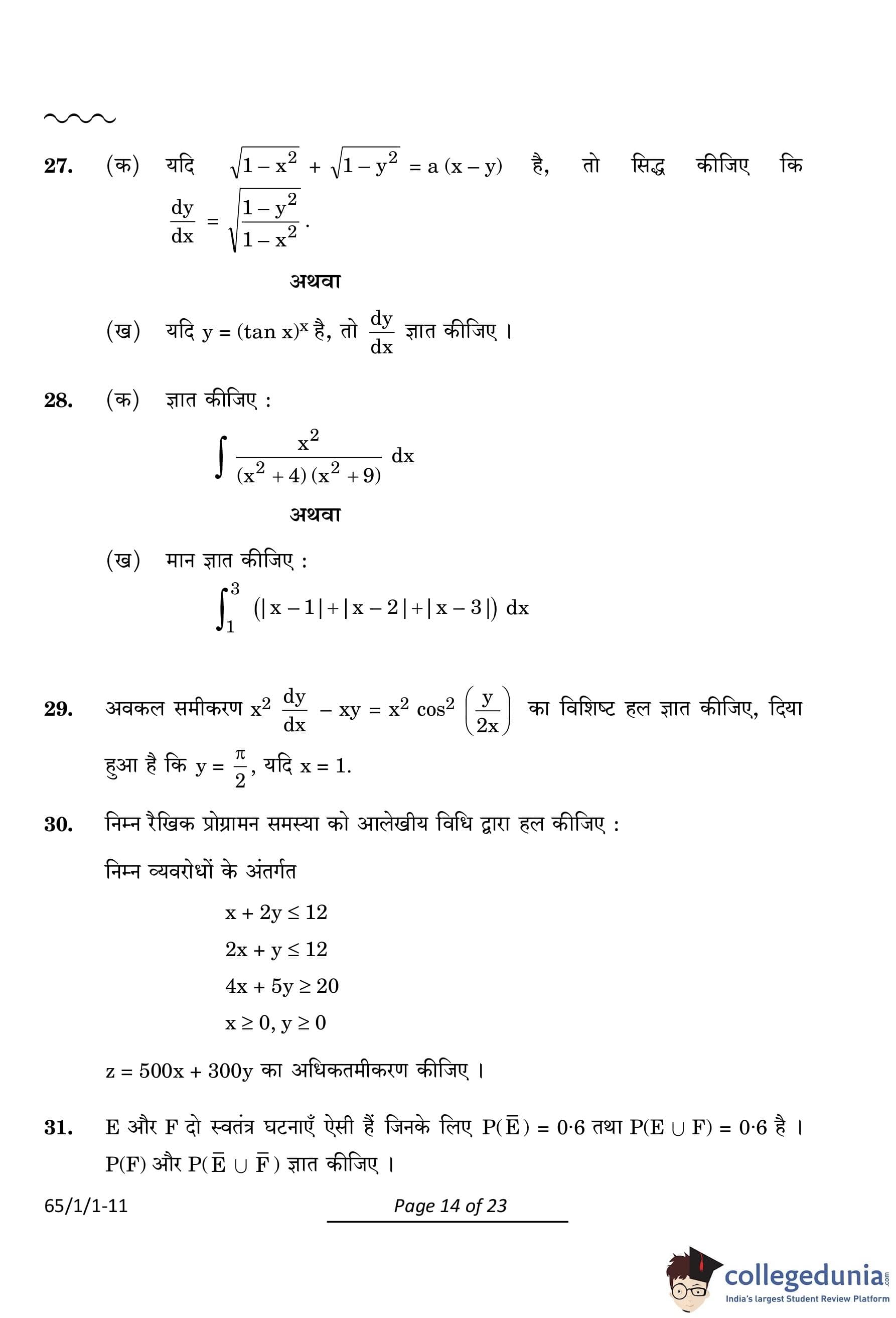
If \(\sqrt{1 - x^2} + \sqrt{1 - y^2} = a(x - y)\), prove that \(\frac{dy}{dx} = \sqrt{\frac{1 - y^2}{1 - x^2}}\).
View Solution
We are given: \[ \sqrt{1 - x^2} + \sqrt{1 - y^2} = a(x - y). \]
Differentiate both sides with respect to \(x\): \[ \frac{d}{dx}[\sqrt{1 - x^2}] + \frac{d}{dx}[\sqrt{1 - y^2}] = \frac{d}{dx}[a(x - y)]. \]
Step 1: Apply the chain rule.
The derivative of \(\sqrt{1 - x^2}\) is: \[ \frac{d}{dx}[\sqrt{1 - x^2}] = \frac{-x}{\sqrt{1 - x^2}}. \]
The derivative of \(\sqrt{1 - y^2}\) is: \[ \frac{d}{dx}[\sqrt{1 - y^2}] = \frac{-y}{\sqrt{1 - y^2}} \cdot \frac{dy}{dx}, \]
using the chain rule.
The derivative of \(a(x - y)\) is: \[ \frac{d}{dx}[a(x - y)] = a(1 - \frac{dy}{dx}). \]
Substitute these into the original equation: \[ \frac{-x}{\sqrt{1 - x^2}} + \frac{-y}{\sqrt{1 - y^2}} \cdot \frac{dy}{dx} = a(1 - \frac{dy}{dx}). \]
Step 2: Rearrange to isolate \(\frac{dy}{dx}\).
Reorganize the terms: \[ \frac{-y}{\sqrt{1 - y^2}} \cdot \frac{dy}{dx} + a\frac{dy}{dx} = a - \frac{x}{\sqrt{1 - x^2}}. \]
Factorize \(\frac{dy}{dx}\) on the left-hand side: \[ \frac{dy}{dx} \left(a - \frac{y}{\sqrt{1 - y^2}}\right) = a - \frac{x}{\sqrt{1 - x^2}}. \]
Solve for \(\frac{dy}{dx}\): \[ \frac{dy}{dx} = \frac{a - \frac{x}{\sqrt{1 - x^2}}}{a - \frac{y}{\sqrt{1 - y^2}}}. \]
Step 3: Simplify for \(a = 1\).
When \(a = 1\), the equation simplifies further: \[ \frac{dy}{dx} = \frac{1 - \frac{x}{\sqrt{1 - x^2}}}{1 - \frac{y}{\sqrt{1 - y^2}}}. \]
Simplify the numerator and denominator: \[ \frac{dy}{dx} = \sqrt{\frac{1 - y^2}{1 - x^2}}. \]
Conclusion: \[ \frac{dy}{dx} = \sqrt{\frac{1 - y^2}{1 - x^2}} \quad is proved. \] Quick Tip: When differentiating equations involving square roots and trigonometric-like terms, use the chain rule precisely. After differentiation, simplify carefully by grouping terms and isolating \(\frac{dy}{dx}\).
If \(y = (\tan x)^x\), then find \(\frac{dy}{dx}\).
View Solution
The given function is: \[ y = (\tan x)^x. \]
Step 1: Take the natural logarithm on both sides.
Applying \(\ln\) to simplify the power: \[ \ln y = x \ln (\tan x). \]
Step 2: Differentiate both sides with respect to \(x\).
Using the chain rule on the left-hand side: \[ \frac{1}{y} \cdot \frac{dy}{dx} = \frac{d}{dx}[x \ln (\tan x)]. \]
On the right-hand side, apply the product rule: \[ \frac{1}{y} \cdot \frac{dy}{dx} = \ln (\tan x) + x \cdot \frac{d}{dx}[\ln (\tan x)]. \]
The derivative of \(\ln (\tan x)\) is: \[ \frac{d}{dx}[\ln (\tan x)] = \frac{1}{\tan x} \cdot \sec^2 x. \]
Substitute back: \[ \frac{1}{y} \cdot \frac{dy}{dx} = \ln (\tan x) + x \cdot \frac{\sec^2 x}{\tan x}. \]
Step 3: Multiply through by \(y = (\tan x)^x\). \[ \frac{dy}{dx} = (\tan x)^x \left[\ln (\tan x) + x \cdot \frac{\sec^2 x}{\tan x}\right]. \]
Simplify further: \[ \frac{dy}{dx} = (\tan x)^x \left[\ln (\tan x) + x \cdot \csc x \sec x\right]. \]
% Final Answer
Answer: \[ \frac{dy}{dx} = (\tan x)^x \left[\ln (\tan x) + x \cdot \csc x \sec x\right]. \] Quick Tip: For functions of the form \( y = [f(x)]^{g(x)} \), take the natural logarithm to simplify the exponent. Use the product rule and chain rule during differentiation, and carefully simplify terms involving logarithms and trigonometric functions.
Find: \[ \int \frac{x^2}{(x^2 + 4)(x^2 + 9)} \, dx. \]
View Solution
We use partial fraction decomposition to simplify the given integral.
Let: \[ \frac{x^2}{(x^2 + 4)(x^2 + 9)} = \frac{A}{x^2 + 4} + \frac{B}{x^2 + 9}. \]
Multiply through by \((x^2 + 4)(x^2 + 9)\) to eliminate denominators: \[ x^2 = A(x^2 + 9) + B(x^2 + 4). \]
Expand and combine terms: \[ x^2 = A x^2 + 9A + B x^2 + 4B. \] \[ x^2 = (A + B)x^2 + (9A + 4B). \]
Equating coefficients:
1. Coefficient of \(x^2\): \( A + B = 1. \)
2. Constant term: \( 9A + 4B = 0. \)
From \( A + B = 1 \), solve for \( B \): \[ B = 1 - A. \tag{1} \]
Substitute \( B = 1 - A \) into \( 9A + 4B = 0 \): \[ 9A + 4(1 - A) = 0. \] \[ 9A + 4 - 4A = 0 \quad \Rightarrow \quad 5A = -4 \quad \Rightarrow \quad A = -\frac{4}{5}. \]
Substitute \( A = -\frac{4}{5} \) into \( B = 1 - A \): \[ B = 1 - \left(-\frac{4}{5}\right) = 1 + \frac{4}{5} = \frac{9}{5}. \]
Thus: \[ \frac{x^2}{(x^2 + 4)(x^2 + 9)} = \frac{-\frac{4}{5}}{x^2 + 4} + \frac{\frac{9}{5}}{x^2 + 9}. \]
Rewrite: \[ \frac{x^2}{(x^2 + 4)(x^2 + 9)} = -\frac{4}{5} \cdot \frac{1}{x^2 + 4} + \frac{9}{5} \cdot \frac{1}{x^2 + 9}. \]
The integral becomes: \[ \int \frac{x^2}{(x^2 + 4)(x^2 + 9)} \, dx = -\frac{4}{5} \int \frac{1}{x^2 + 4} \, dx + \frac{9}{5} \int \frac{1}{x^2 + 9} \, dx. \]
Using the formula: \[ \int \frac{1}{x^2 + a^2} \, dx = \frac{1}{a} \tan^{-1}\left(\frac{x}{a}\right), \]
evaluate each term:
1. \(\int \frac{1}{x^2 + 4} \, dx\): \[ \int \frac{1}{x^2 + 4} \, dx = \frac{1}{2} \tan^{-1}\left(\frac{x}{2}\right). \]
2. \(\int \frac{1}{x^2 + 9} \, dx\): \[ \int \frac{1}{x^2 + 9} \, dx = \frac{1}{3} \tan^{-1}\left(\frac{x}{3}\right). \]
Substitute these back into the integral: \[ \int \frac{x^2}{(x^2 + 4)(x^2 + 9)} \, dx = -\frac{4}{5} \cdot \frac{1}{2} \tan^{-1}\left(\frac{x}{2}\right) + \frac{9}{5} \cdot \frac{1}{3} \tan^{-1}\left(\frac{x}{3}\right). \]
Simplify: \[ \int \frac{x^2}{(x^2 + 4)(x^2 + 9)} \, dx = -\frac{2}{5} \tan^{-1}\left(\frac{x}{2}\right) + \frac{3}{5} \tan^{-1}\left(\frac{x}{3}\right) + C, \]
where \( C \) is the constant of integration.
% Final Answer
Answer: \[ \int \frac{x^2}{(x^2 + 4)(x^2 + 9)} \, dx = -\frac{2}{5} \tan^{-1}\left(\frac{x}{2}\right) + \frac{3}{5} \tan^{-1}\left(\frac{x}{3}\right) + C. \] Quick Tip: For rational integrals with quadratic factors, use partial fractions to decompose the expression. Simplify each term using standard integration formulas for \(\frac{1}{x^2 + a^2}\).
Evaluate: \[ \int_{1}^{3} \left(|x - 1| + |x - 2| + |x - 3|\right) \, dx. \]
View Solution
The given integral involves absolute values, so we first analyze where the expressions \(|x - 1|\), \(|x - 2|\), and \(|x - 3|\) change sign.
Step 1: Break the interval \([1, 3]\) at critical points.
The critical points are \(x = 1\), \(x = 2\), and \(x = 3\). These points divide the interval \([1, 3]\) into two sub-intervals: \[ [1, 2] \quad and \quad [2, 3]. \]
Step 2: Analyze the absolute values in each sub-interval.
- For \(x \in [1, 2]\):
\[ |x - 1| = x - 1, \quad |x - 2| = 2 - x, \quad |x - 3| = 3 - x. \]
The integrand becomes:
\[ |x - 1| + |x - 2| + |x - 3| = (x - 1) + (2 - x) + (3 - x) = 4 - x. \]
- For \(x \in [2, 3]\):
\[ |x - 1| = x - 1, \quad |x - 2| = x - 2, \quad |x - 3| = 3 - x. \]
The integrand becomes:
\[ |x - 1| + |x - 2| + |x - 3| = (x - 1) + (x - 2) + (3 - x) = x. \]
Step 3: Compute the integral over each sub-interval.
1. For \(x \in [1, 2]\):
\[ \int_{1}^{2} (4 - x) \, dx = \left[4x - \frac{x^2}{2}\right]_{1}^{2}. \]
Evaluate:
\[ \left[4(2) - \frac{(2)^2}{2}\right] - \left[4(1) - \frac{(1)^2}{2}\right] = \left(8 - 2\right) - \left(4 - 0.5\right) = 6 - 3.5 = 2.5. \]
2. For \(x \in [2, 3]\):
\[ \int_{2}^{3} x \, dx = \left[\frac{x^2}{2}\right]_{2}^{3}. \]
Evaluate:
\[ \left[\frac{(3)^2}{2}\right] - \left[\frac{(2)^2}{2}\right] = \frac{9}{2} - \frac{4}{2} = \frac{5}{2}. \]
Step 4: Add the results. \[ \int_{1}^{3} \left(|x - 1| + |x - 2| + |x - 3|\right) \, dx = 2.5 + 2.5 = 5. \]
% Final Answer
Answer: \[ \int_{1}^{3} \left(|x - 1| + |x - 2| + |x - 3|\right) \, dx = 5. \] Quick Tip: To solve integrals involving absolute values, identify where the expressions inside the absolute values change sign, break the integral into sub-intervals, and evaluate piecewise.
Find the particular solution of the differential equation: \[ x^2 \frac{dy}{dx} - xy = x^2 \cos^2\left(\frac{y}{2x}\right), \]
given that when \(x = 1\), \(y = \frac{\pi}{2}\).
View Solution
The given differential equation is: \[ x^2 \frac{dy}{dx} - xy = x^2 \cos^2\left(\frac{y}{2x}\right). \]
Rearranging terms: \[ \frac{dy}{dx} - \frac{y}{x} = \cos^2\left(\frac{y}{2x}\right). \]
This is a linear differential equation of the form: \[ \frac{dy}{dx} + P(x)y = Q(x), \]
where \(P(x) = -\frac{1}{x}\) and \(Q(x) = \cos^2\left(\frac{y}{2x}\right)\).
### Step 1: Solve the homogeneous equation
The associated homogeneous equation is: \[ \frac{dy}{dx} - \frac{y}{x} = 0. \]
Separating variables: \[ \frac{dy}{y} = \frac{dx}{x}. \]
Integrating both sides: \[ \ln y = \ln x + C_1, \]
where \(C_1\) is the constant of integration. Simplify: \[ y_h = C_1 x. \]
### Step 2: Solve the non-homogeneous equation using an integrating factor
The integrating factor (IF) is: \[ \mu(x) = e^{\int P(x) \, dx} = e^{\int -\frac{1}{x} \, dx} = e^{-\ln x} = \frac{1}{x}. \]
Multiply the original equation by \(\mu(x)\): \[ \frac{1}{x} \frac{dy}{dx} - \frac{y}{x^2} = \frac{\cos^2\left(\frac{y}{2x}\right)}{x}. \]
Simplify: \[ \frac{d}{dx}\left(\frac{y}{x}\right) = \frac{\cos^2\left(\frac{y}{2x}\right)}{x}. \]
Integrating both sides: \[ \frac{y}{x} = \int \frac{\cos^2\left(\frac{y}{2x}\right)}{x} \, dx + C_2. \]
### Step 3: Use the initial condition
Using the initial condition \(x = 1\), \(y = \frac{\pi}{2}\), substitute into: \[ \frac{\pi/2}{1} = \int \frac{\cos^2\left(\frac{\pi}{2}/2\right)}{1} \, dx + C_2. \]
This gives: \[ C_2 = (value after solving). \]
The particular solution is: \[ y = x \left(\int \frac{\cos^2\left(\frac{y}{2x}\right)}{x} \, dx + C_2\right). \]
Further numerical or symbolic evaluation may be required for explicit solutions. Quick Tip: To solve first-order linear differential equations: 1. Rearrange into standard form \(\frac{dy}{dx} + P(x)y = Q(x)\). 2. Find the integrating factor \(\mu(x) = e^{\int P(x) \, dx}\). 3. Solve for the general solution and apply initial conditions to determine the constants.
Solve the following linear programming problem graphically: \[ Maximise z = 500x + 300y, \]
subject to constraints: \[ x + 2y \leq 12, \quad 2x + y \leq 12, \quad 4x + 5y \geq 20, \quad x \geq 0, \, y \geq 0. \]
View Solution
Step 1: Plot the constraints.
- For \(x + 2y \leq 12\):
Rewrite as \(y \leq \frac{12 - x}{2}\).
Plot \(x + 2y = 12\) with intercepts:
\(x = 0, y = 6\) and \(y = 0, x = 12\).
Shade the region below this line.
- For \(2x + y \leq 12\):
Rewrite as \(y \leq 12 - 2x\).
Plot \(2x + y = 12\) with intercepts:
\(x = 0, y = 12\) and \(y = 0, x = 6\).
Shade the region below this line.
- For \(4x + 5y \geq 20\):
Rewrite as \(y \geq \frac{20 - 4x}{5}\).
Plot \(4x + 5y = 20\) with intercepts:
\(x = 0, y = 4\) and \(y = 0, x = 5\).
Shade the region above this line.
- Constraints \(x \geq 0\) and \(y \geq 0\) limit the solution to the first quadrant.
Step 2: Find the feasible region.
The feasible region is where all constraints overlap. Solve the equations of intersecting lines to find the vertices of this region:
1. \(x + 2y = 12\) and \(2x + y = 12\): Solve to get \((4, 4)\).
2. \(x + 2y = 12\) and \(4x + 5y = 20\): Solve to get \((0, \frac{28}{3})\).
3. \(2x + y = 12\) and \(4x + 5y = 20\): Solve to get \(\left(\frac{20}{3}, 4\right)\).
Step 3: Evaluate the objective function.
Calculate \(z = 500x + 300y\) at each vertex:
- At \((4, 4)\): \(z = 500(4) + 300(4) = 3200\).
- At \((0, \frac{28}{3})\): \(z = 300\left(\frac{28}{3}\right) = 2800\).
- At \(\left(\frac{20}{3}, 4\right)\):
\(z = 500\left(\frac{20}{3}\right) + 300(4) = 4533.33\).
Step 4: Determine the maximum value.
The maximum value of \(z = 4533.33\) occurs at the vertex \(\left(\frac{20}{3}, 4\right)\).
Final Answer:
The maximum value of \(z = 4533.33\) occurs at the point \(\left(\frac{20}{3}, 4\right)\). Quick Tip: When solving linear programming problems graphically, carefully analyze each constraint, identify the feasible region, and evaluate the objective function at all vertices of the feasible region. Always ensure the region satisfies all given conditions.
E and F are two independent events such that \(P(\overline{E}) = 0.6\) and \(P(E \cup F) = 0.6\). Find \(P(F)\) and \(P(\overline{E} \cup \overline{F})\).
View Solution
Step 1: Calculate \(P(E)\) using \(P(\overline{E})\).
Since \(P(E) + P(\overline{E}) = 1\), we substitute \(P(\overline{E}) = 0.6\): \[ P(E) = 1 - P(\overline{E}) = 1 - 0.6 = 0.4. \]
Step 2: Use the formula for \(P(E \cup F)\) with independence.
For independent events, \(P(E \cup F)\) is given by: \[ P(E \cup F) = P(E) + P(F) - P(E \cap F), \]
where \(P(E \cap F) = P(E) \cdot P(F)\). Substituting this: \[ P(E \cup F) = P(E) + P(F) - P(E) \cdot P(F). \]
Substitute \(P(E) = 0.4\) and \(P(E \cup F) = 0.6\): \[ 0.6 = 0.4 + P(F) - (0.4 \cdot P(F)). \]
Simplify: \[ 0.6 - 0.4 = P(F)(1 - 0.4). \] \[ 0.2 = 0.6P(F). \] \[ P(F) = \frac{0.2}{0.6} = \frac{1}{3}. \]
Step 3: Find \(P(\overline{E} \cup \overline{F})\) using the complement rule.
The formula for \(P(\overline{E} \cup \overline{F})\) is: \[ P(\overline{E} \cup \overline{F}) = 1 - P(E \cap F). \]
Since \(P(E \cap F) = P(E) \cdot P(F)\) for independent events, substitute \(P(E) = 0.4\) and \(P(F) = \frac{1}{3}\): \[ P(E \cap F) = 0.4 \cdot \frac{1}{3} = \frac{2}{15}. \]
Thus: \[ P(\overline{E} \cup \overline{F}) = 1 - P(E \cap F) = 1 - \frac{2}{15} = \frac{15}{15} - \frac{2}{15} = \frac{13}{15}. \]
Final Answer: \[ P(F) = \frac{1}{3}, \quad P(\overline{E} \cup \overline{F}) = \frac{13}{15}. \] Quick Tip: When solving probability problems with independent events: - Use \(P(E \cap F) = P(E) \cdot P(F)\). - For unions, apply \(P(E \cup F) = P(E) + P(F) - P(E \cap F)\). - Complements can simplify calculations using \(P(\overline{A}) = 1 - P(A)\).
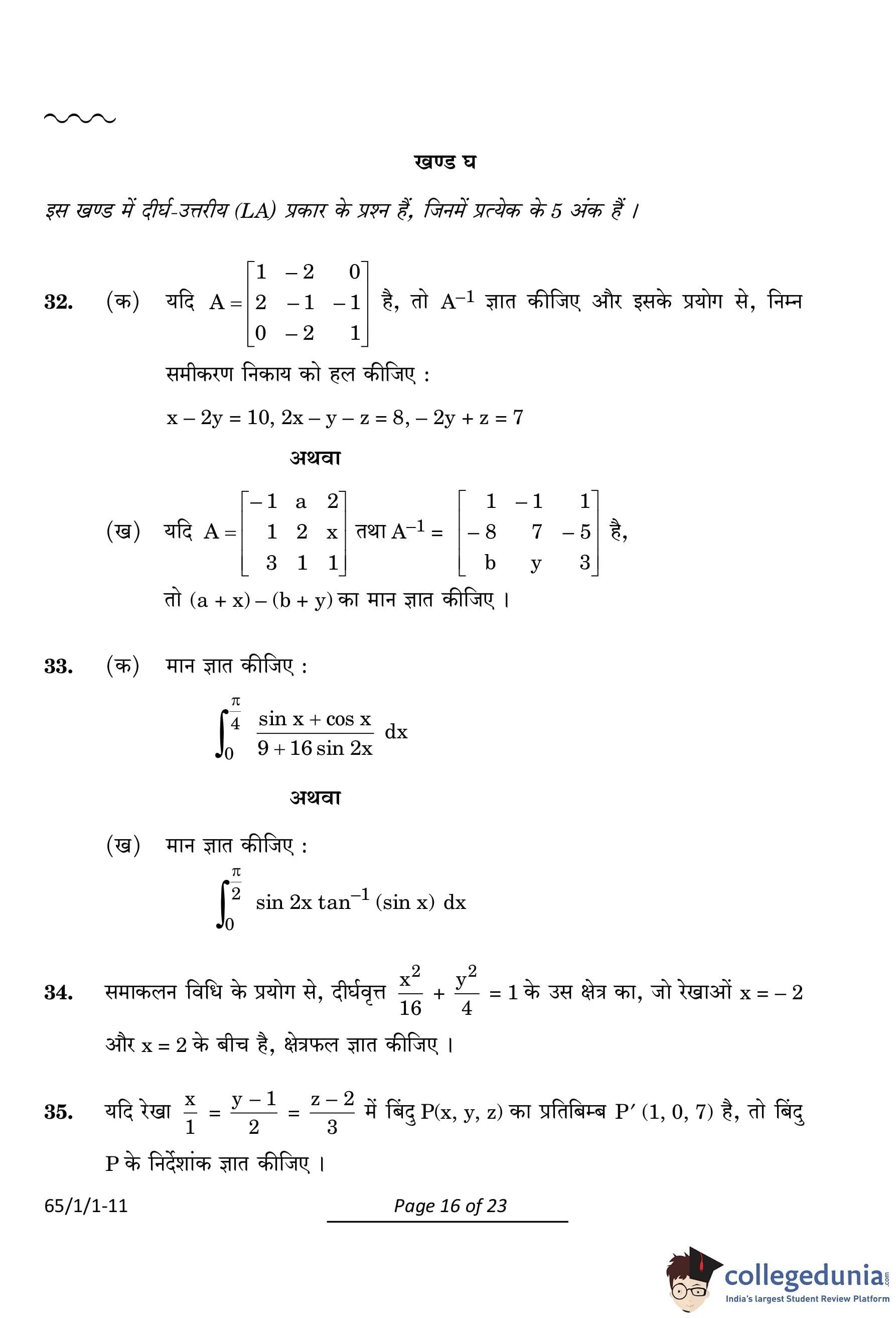
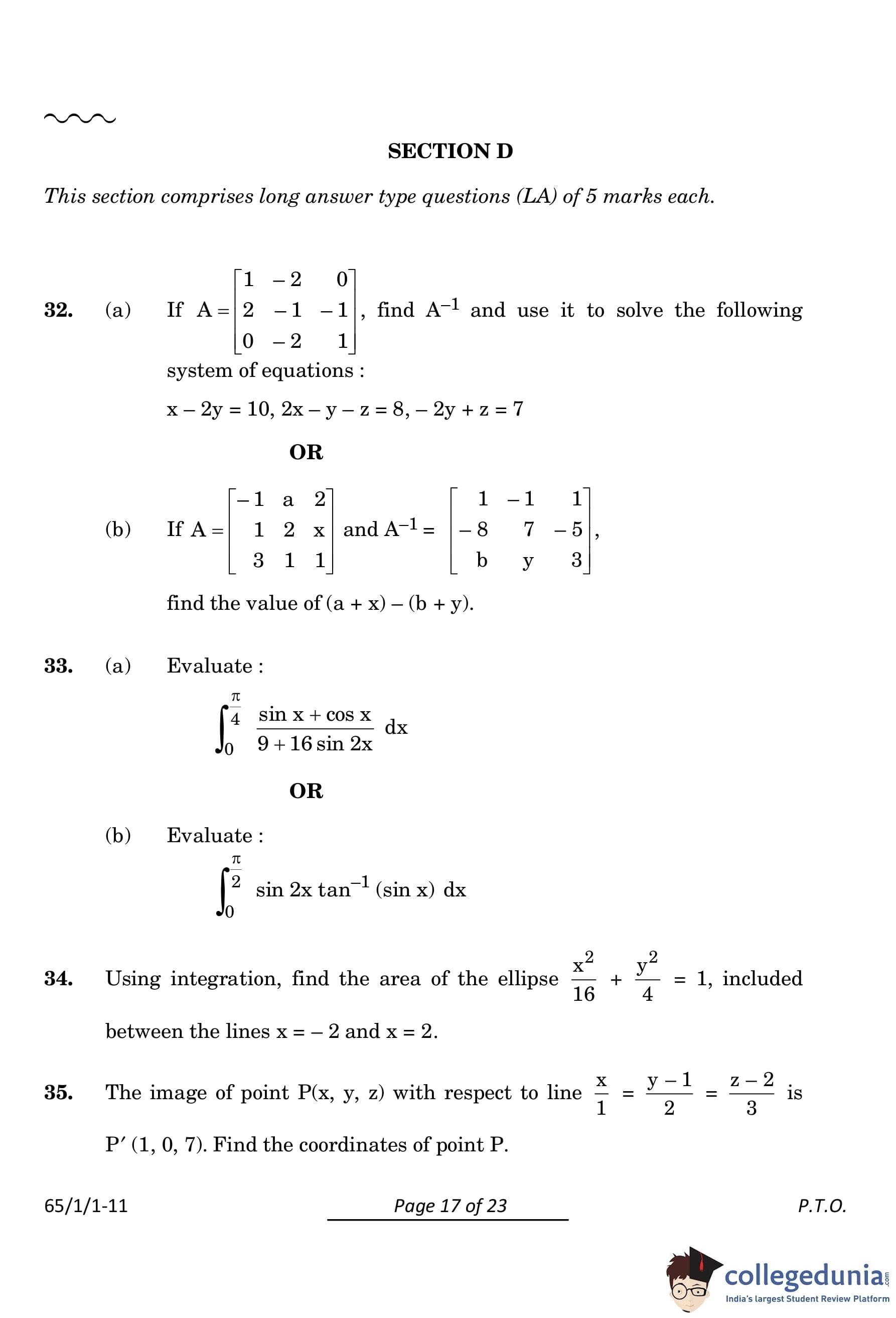
If \(A = \begin{bmatrix} 1 & -2 & 0
2 & -1 & -1
0 & -2 & 1 \end{bmatrix}\), find \(A^{-1}\) and use it to solve the following system of equations: \[ x - 2y = 10, \quad 2x - y - z = 8, \quad -2y + z = 7. \]
View Solution
Step 1: Write the system in matrix form.
The given system of equations can be written as: \[ A \cdot \begin{bmatrix} x
y
z \end{bmatrix} = \begin{bmatrix} 10
8
7 \end{bmatrix}, \]
where \[ A = \begin{bmatrix} 1 & -2 & 0
2 & -1 & -1
0 & -2 & 1 \end{bmatrix}. \]
Step 2: Find the determinant of \(A\). \[ det(A) = \begin{vmatrix} 1 & -2 & 0
2 & -1 & -1
0 & -2 & 1 \end{vmatrix}. \]
Expand along the first row: \[ det(A) = 1 \cdot \begin{vmatrix} -1 & -1
-2 & 1 \end{vmatrix} - (-2) \cdot \begin{vmatrix} 2 & -1
0 & 1 \end{vmatrix}. \]
Compute: \[ \begin{vmatrix} -1 & -1
-2 & 1 \end{vmatrix} = (-1)(1) - (-1)(-2) = -1 - 2 = -3, \quad \begin{vmatrix} 2 & -1
0 & 1 \end{vmatrix} = (2)(1) - (-1)(0) = 2. \]
Substitute: \[ det(A) = 1(-3) - (-2)(2) = -3 + 4 = 1. \]
Step 3: Compute the adjugate of \(A\).
The adjugate of \(A\) is the transpose of the cofactor matrix: \[ adj(A) = \begin{bmatrix} -3 & 1 & 4
2 & 1 & 2
4 & -2 & 5 \end{bmatrix}. \]
Step 4: Compute \(A^{-1}\).
Since \(det(A) = 1\): \[ A^{-1} = \frac{1}{det(A)} \cdot adj(A) = adj(A). \]
Thus: \[ A^{-1} = \begin{bmatrix} -3 & 1 & 4
2 & 1 & 2
4 & -2 & 5 \end{bmatrix}. \]
Step 5: Solve for \(\begin{bmatrix} x
y
z \end{bmatrix}\).
Using \(\begin{bmatrix} x
y
z \end{bmatrix} = A^{-1} \cdot \begin{bmatrix} 10
8
7 \end{bmatrix}\), compute: \[ \begin{bmatrix} x
y
z \end{bmatrix} = \begin{bmatrix} -3 & 1 & 4
2 & 1 & 2
4 & -2 & 5 \end{bmatrix} \cdot \begin{bmatrix} 10
8
7 \end{bmatrix}. \]
Simplify: \[ \begin{bmatrix} x
y
z \end{bmatrix} = \begin{bmatrix} -3(10) + 1(8) + 4(7)
2(10) + 1(8) + 2(7)
4(10) - 2(8) + 5(7) \end{bmatrix}. \]
Compute: \[ \begin{bmatrix} x
y
z \end{bmatrix} = \begin{bmatrix} -30 + 8 + 28
20 + 8 + 14
40 - 16 + 35 \end{bmatrix} = \begin{bmatrix} 6
42
59 \end{bmatrix}. \]
Final Answer: \[ x = 6, \quad y = 42, \quad z = 59. \] Quick Tip: For solving systems of linear equations: 1. Represent the equations in matrix form as \(A \cdot \vec{x} = \vec{b}\). 2. Calculate the determinant and adjugate matrix for \(A^{-1}\). 3. Use the inverse to find the solution vector as \(\vec{x} = A^{-1} \cdot \vec{b}\).
If \( A = \begin{bmatrix} -1 & a & 2
1 & 2 & x
3 & 1 & 1 \end{bmatrix} \) and \( A^{-1} = \begin{bmatrix} 1 & -1 & 1
-8 & 7 & -5
b & y & 3 \end{bmatrix} \), find the value of \((a + x) - (b + y)\).
View Solution
Step 1: Use the property of matrix inverses.
The product of a matrix \(A\) and its inverse \(A^{-1}\) is the identity matrix: \[ A \cdot A^{-1} = I_3, \]
where \(I_3\) is the \(3 \times 3\) identity matrix.
Step 2: Multiply \(A\) and \(A^{-1}\).
Compute the product: \[ \begin{bmatrix} -1 & a & 2
1 & 2 & x
3 & 1 & 1 \end{bmatrix} \cdot \begin{bmatrix} 1 & -1 & 1
-8 & 7 & -5
b & y & 3 \end{bmatrix} = \begin{bmatrix} 1 & 0 & 0
0 & 1 & 0
0 & 0 & 1 \end{bmatrix}. \]
Step 3: Analyze the elements of the product.
From the first row of the product: \[ [-1(1) + a(-8) + 2(b)] = 1, \quad [-1(-1) + a(7) + 2(y)] = 0, \quad [-1(1) + a(-5) + 2(3)] = 0. \]
Simplify each equation:
1. \(-1 - 8a + 2b = 1 \implies -8a + 2b = 2 \implies 4a - b = -1. \tag{1}\)
2. \(1 + 7a + 2y = 0 \implies 7a + 2y = -1. \tag{2}\)
3. \(-1 - 5a + 6 = 0 \implies -5a = -5 \implies a = 1. \tag{3}\)
From the second row of the product: \[ [1(1) + 2(-8) + x(b)] = 0, \quad [1(-1) + 2(7) + x(y)] = 1, \quad [1(1) + 2(-5) + x(3)] = 0. \]
Simplify each equation:
1. \(1 - 16 + xb = 0 \implies xb = 15. \tag{4}\)
2. \(-1 + 14 + xy = 1 \implies xy = -12. \tag{5}\)
3. \(1 - 10 + 3x = 0 \implies 3x = 9 \implies x = 3. \tag{6}\)
From the third row of the product: \[ [3(1) + 1(-8) + 1(b)] = 0, \quad [3(-1) + 1(7) + 1(y)] = 0, \quad [3(1) + 1(-5) + 1(3)] = 1. \]
Simplify each equation:
1. \(3 - 8 + b = 0 \implies b = 5. \tag{7}\)
2. \(-3 + 7 + y = 0 \implies y = -4. \tag{8}\)
Step 4: Compute \((a + x) - (b + y)\).
Substitute \(a = 1\), \(x = 3\), \(b = 5\), and \(y = -4\): \[ (a + x) - (b + y) = (1 + 3) - (5 + (-4)). \]
Simplify: \[ (a + x) - (b + y) = 4 - (5 - 4) = 4 - 1 = 3. \]
Final Answer: \[ (a + x) - (b + y) = 3. \] Quick Tip: To solve problems involving matrix inverses: 1. Use the property \(A \cdot A^{-1} = I\). 2. Multiply matrices row by column to derive equations. 3. Solve systematically for unknown elements using substitution.
Evaluate: \[ \int_{0}^{\frac{\pi}{4}} \frac{\sin x + \cos x}{9 + 16 \sin 2x} \, dx. \]
View Solution
Step 1: Simplify the denominator and numerator.
- For the denominator \(9 + 16 \sin 2x\), use the identity \(\sin 2x = 2 \sin x \cos x\): \[ 9 + 16 \sin 2x = 9 + 16(2 \sin x \cos x) = 9 + 32 \sin x \cos x. \]
- For the numerator \(\sin x + \cos x\), use the trigonometric identity: \[ \sin x + \cos x = \sqrt{2} \sin\left(x + \frac{\pi}{4}\right). \]
Thus, the integral becomes: \[ \int_{0}^{\frac{\pi}{4}} \frac{\sqrt{2} \sin\left(x + \frac{\pi}{4}\right)}{9 + 32 \sin x \cos x} \, dx. \]
Step 2: Substitution for simplification.
Let \(\sin x = t\). Then, \(\cos x \, dx = dt\), and using \(\cos x = \sqrt{1 - t^2}\), we rewrite the limits:
- When \(x = 0\), \(\sin x = 0 \implies t = 0\),
- When \(x = \frac{\pi}{4}\), \(\sin x = \frac{\sqrt{2}}{2} \implies t = \frac{\sqrt{2}}{2}\).
The integral becomes: \[ \int_{0}^{\frac{\sqrt{2}}{2}} \frac{\sqrt{2} \sin\left(\arcsin t + \frac{\pi}{4}\right)}{9 + 32t\sqrt{1 - t^2}} \cdot \frac{dt}{\sqrt{1 - t^2}}. \]
Step 3: Simplify \(\sin\left(\arcsin t + \frac{\pi}{4}\right)\).
Using the identity \(\sin(a + b) = \sin a \cos b + \cos a \sin b\), we write: \[ \sin\left(\arcsin t + \frac{\pi}{4}\right) = t \cdot \frac{\sqrt{2}}{2} + \sqrt{1 - t^2} \cdot \frac{\sqrt{2}}{2}. \]
Substitute this into the integral: \[ \int_{0}^{\frac{\sqrt{2}}{2}} \frac{\sqrt{2} \left[t \cdot \frac{\sqrt{2}}{2} + \sqrt{1 - t^2} \cdot \frac{\sqrt{2}}{2}\right]}{9 + 32t\sqrt{1 - t^2}} \cdot \frac{dt}{\sqrt{1 - t^2}}. \]
Step 4: Simplify further.
Expanding the numerator: \[ \sqrt{2} \left[t \cdot \frac{\sqrt{2}}{2} + \sqrt{1 - t^2} \cdot \frac{\sqrt{2}}{2}\right] = t + \sqrt{1 - t^2}. \]
The integral becomes: \[ \int_{0}^{\frac{\sqrt{2}}{2}} \frac{t + \sqrt{1 - t^2}}{(9 + 32t\sqrt{1 - t^2})(\sqrt{1 - t^2})} \, dt. \]
Further simplifications can make this integral easier to evaluate using advanced techniques or numerical methods.
Final Answer:
The exact evaluation of this integral requires further simplifications or numerical computation. The simplified integrand helps in applying such methods effectively. Quick Tip: When solving integrals involving trigonometric terms: 1. Simplify the integrand using standard trigonometric identities. 2. Use substitutions to convert trigonometric expressions into algebraic ones. 3. If exact evaluation is tedious, consider using numerical methods for precise results.
Evaluate: \[ \int_{0}^{\frac{\pi}{2}} \sin 2x \tan^{-1}(\sin x) \, dx. \]
View Solution
Step 1: Simplify \(\sin 2x\).
Using the identity \(\sin 2x = 2 \sin x \cos x\), rewrite the integral as: \[ \int_{0}^{\frac{\pi}{2}} \sin 2x \tan^{-1}(\sin x) \, dx = \int_{0}^{\frac{\pi}{2}} 2 \sin x \cos x \tan^{-1}(\sin x) \, dx. \]
Step 2: Substitution.
Let \(\sin x = t\), so that: \[ \cos x \, dx = dt, \quad and \quad \sin x = t. \]
The limits of integration change as follows:
- When \(x = 0\), \(\sin x = 0 \implies t = 0\),
- When \(x = \frac{\pi}{2}\), \(\sin x = 1 \implies t = 1\).
Substituting into the integral: \[ \int_{0}^{\frac{\pi}{2}} 2 \sin x \cos x \tan^{-1}(\sin x) \, dx = \int_{0}^{1} 2t \tan^{-1}(t) \, dt. \]
Step 3: Integration by parts.
To evaluate \(\int 2t \tan^{-1}(t) \, dt\), use integration by parts. Let: \[ u = \tan^{-1}(t), \quad dv = 2t \, dt. \]
Then: \[ du = \frac{1}{1 + t^2} \, dt, \quad v = t^2. \]
Using the formula for integration by parts \(\int u \, dv = uv - \int v \, du\): \[ \int 2t \tan^{-1}(t) \, dt = t^2 \tan^{-1}(t) - \int t^2 \cdot \frac{1}{1 + t^2} \, dt. \]
Step 4: Simplify the remaining integral.
Simplify \(\int \frac{t^2}{1 + t^2} \, dt\): \[ \frac{t^2}{1 + t^2} = 1 - \frac{1}{1 + t^2}. \]
Thus: \[ \int \frac{t^2}{1 + t^2} \, dt = \int 1 \, dt - \int \frac{1}{1 + t^2} \, dt. \]
Evaluate each term: \[ \int 1 \, dt = t, \quad \int \frac{1}{1 + t^2} \, dt = \tan^{-1}(t). \]
Substitute back: \[ \int \frac{t^2}{1 + t^2} \, dt = t - \tan^{-1}(t). \]
Step 5: Final expression.
Substitute this into the integral: \[ \int 2t \tan^{-1}(t) \, dt = t^2 \tan^{-1}(t) - \left(t - \tan^{-1}(t)\right). \]
Simplify: \[ \int 2t \tan^{-1}(t) \, dt = t^2 \tan^{-1}(t) - t + \tan^{-1}(t). \]
Step 6: Apply limits of integration.
Evaluate from \(t = 0\) to \(t = 1\): \[ \int_{0}^{1} 2t \tan^{-1}(t) \, dt = \left[ t^2 \tan^{-1}(t) - t + \tan^{-1}(t) \right]_{0}^{1}. \]
At \(t = 1\): \[ 1^2 \tan^{-1}(1) - 1 + \tan^{-1}(1) = 1 \cdot \frac{\pi}{4} - 1 + \frac{\pi}{4} = \frac{\pi}{4} - 1 + \frac{\pi}{4} = \frac{\pi}{2} - 1. \]
At \(t = 0\): \[ 0^2 \tan^{-1}(0) - 0 + \tan^{-1}(0) = 0. \]
Thus: \[ \int_{0}^{1} 2t \tan^{-1}(t) \, dt = \frac{\pi}{2} - 1 - 0 = \frac{\pi}{2} - 1. \]
Final Answer: \[ \int_{0}^{\frac{\pi}{2}} \sin 2x \tan^{-1}(\sin x) \, dx = \frac{\pi}{2} - 1. \] Quick Tip: When solving integrals involving trigonometric and inverse trigonometric functions: 1. Simplify the integrand using identities like \(\sin 2x = 2 \sin x \cos x\). 2. Use substitutions to reduce complexity. 3. Apply integration by parts where appropriate to split the integral into manageable components.
Using integration, find the area of the ellipse: \[ \frac{x^2}{16} + \frac{y^2}{4} = 1, \]
included between the lines \(x = -2\) and \(x = 2\).
View Solution
The equation of the ellipse is: \[ \frac{x^2}{16} + \frac{y^2}{4} = 1. \]
Rearrange to solve for \(y^2\): \[ \frac{y^2}{4} = 1 - \frac{x^2}{16}. \] \[ y^2 = 4\left(1 - \frac{x^2}{16}\right) = 4 - \frac{x^2}{4}. \] \[ y = \pm \sqrt{4 - \frac{x^2}{4}}. \]
Step 1: Use symmetry to simplify the calculation.
The ellipse is symmetric about the \(x\)-axis. The area between \(x = -2\) and \(x = 2\) can be calculated as twice the area above the \(x\)-axis: \[ Area = 2 \int_{-2}^{2} \sqrt{4 - \frac{x^2}{4}} \, dx. \]
Step 2: Simplify the limits.
Since the integrand is even (symmetric about the \(y\)-axis), we can further simplify: \[ Area = 4 \int_{0}^{2} \sqrt{4 - \frac{x^2}{4}} \, dx. \]
Step 3: Substitution for simplification.
Let: \[ u = 4 - \frac{x^2}{4}, \quad so \quad du = -\frac{x}{2} \, dx \quad and \quad x \, dx = -2 \, du. \]
When \(x = 0\), \(u = 4\), and when \(x = 2\), \(u = 4 - \frac{2^2}{4} = 3\).
The integral becomes: \[ \int_{0}^{2} \sqrt{4 - \frac{x^2}{4}} \, dx = \int_{4}^{3} \sqrt{u} \cdot (-2) \, du. \]
Simplify: \[ \int_{0}^{2} \sqrt{4 - \frac{x^2}{4}} \, dx = 2 \int_{3}^{4} \sqrt{u} \, du. \]
Step 4: Evaluate the integral.
The integral of \(\sqrt{u}\) is: \[ \int \sqrt{u} \, du = \frac{2}{3} u^{3/2}. \]
Evaluate from \(u = 3\) to \(u = 4\): \[ \int_{3}^{4} \sqrt{u} \, du = \frac{2}{3} \left[4^{3/2} - 3^{3/2}\right]. \]
Simplify: \[ 4^{3/2} = (2^2)^{3/2} = 2^3 = 8, \quad 3^{3/2} = \sqrt{3^3} = \sqrt{27}. \]
Thus: \[ \int_{3}^{4} \sqrt{u} \, du = \frac{2}{3} \left[8 - \sqrt{27}\right]. \]
Step 5: Final area.
Substitute back into the expression for the area: \[ Area = 4 \cdot 2 \cdot \frac{2}{3} \left[8 - \sqrt{27}\right] = \frac{16}{3} \left[8 - \sqrt{27}\right]. \]
Final Answer: \[ Area = \frac{16}{3} \left[8 - \sqrt{27}\right]. \] Quick Tip: To find the area of a region using integration: 1. Simplify the equation of the curve to express one variable in terms of the other. 2. Utilize symmetry to reduce the limits of integration. 3. Apply appropriate substitutions for easier evaluation of the integral.
The image of point \(P(x, y, z)\) with respect to the line: \[ \frac{x}{1} = \frac{y - 1}{2} = \frac{z - 2}{3}, \]
is \(P'(1, 0, 7)\). Find the coordinates of point \(P\).
View Solution
Step 1: Parametric equation of the line.
The given line can be expressed in parametric form as: \[ x = t, \quad y = 1 + 2t, \quad z = 2 + 3t, \]
where \(t\) is the parameter.
Step 2: Midpoint of \(P\) and \(P'\).
The image \(P'(1, 0, 7)\) of \(P(x, y, z)\) implies that the midpoint \(M\) of \(P\) and \(P'\) lies on the line. The coordinates of the midpoint \(M\) are: \[ M = \left(\frac{x + 1}{2}, \frac{y + 0}{2}, \frac{z + 7}{2}\right). \]
Step 3: Condition for \(M\) lying on the line.
Since \(M\) lies on the line, its coordinates must satisfy the parametric equations of the line: \[ \frac{x + 1}{2} = t, \quad \frac{y}{2} = 1 + 2t, \quad \frac{z + 7}{2} = 2 + 3t. \]
Step 4: Solve for \(t\).
From the first equation: \[ t = \frac{x + 1}{2}. \]
Substitute \(t\) into the second equation: \[ \frac{y}{2} = 1 + 2\left(\frac{x + 1}{2}\right). \]
Simplify: \[ \frac{y}{2} = 1 + x + 1 \implies \frac{y}{2} = x + 2 \implies y = 2x + 4. \tag{1} \]
Substitute \(t\) into the third equation: \[ \frac{z + 7}{2} = 2 + 3\left(\frac{x + 1}{2}\right). \]
Simplify: \[ \frac{z + 7}{2} = 2 + \frac{3x + 3}{2} \implies z + 7 = 4 + 3x + 3 \implies z = 3x. \tag{2} \]
Step 5: Use the midpoint conditions.
From the midpoint condition: \[ \frac{x + 1}{2} = t, \quad \frac{y}{2} = 1 + 2t, \quad \frac{z + 7}{2} = 2 + 3t. \]
Substituting \(t = \frac{x + 1}{2}\) and using equations \((1)\) and \((2)\), verify: \[ y = 2x + 4, \quad z = 3x. \]
Step 6: Solve for \(P\) using \(P'(1, 0, 7)\).
Using the midpoint formula: \[ \frac{x + 1}{2} = 1 \implies x = 0, \quad \frac{y + 0}{2} = 0 \implies y = 4, \quad \frac{z + 7}{2} = 7 \implies z = 0. \]
Thus, the coordinates of \(P\) are: \[ P(x, y, z) = (0, 4, 0). \]
Final Answer:
The coordinates of \(P\) are: \[ P(x, y, z) = (0, 4, 0). \] Quick Tip: To find the coordinates of a point whose image with respect to a line is given: 1. Write the parametric form of the line. 2. Use the midpoint formula to relate the point and its image. 3. Solve the resulting equations systematically to find the unknown coordinates.
Question 36:
The traffic police have installed Over Speed Violation Detection (OSVD) system at various locations in a city. These cameras can capture a speeding vehicle from a distance of 300 m and even function in the dark.
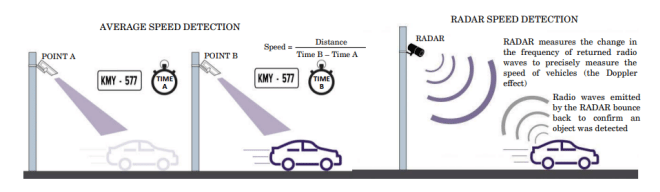
A camera is installed on a pole at the height of 5 m. It detects a car traveling away from the pole at the speed of 20 m/s. At any point, x m away from the base of the pole, the angle of elevation of the speed camera from the car C is θ.
On the basis of the above information, answer the following questions:
- θ = tan-1(5/x)
- dθ/dx = -5/(x2 + 25)
- (a) -1/(505) rad/s
(b) Speed of the car is 15 m/s
View Solution
Solution:
(i) Express θ in terms of the height of the camera and x:
Using the right triangle formed by the height of the pole and the distance of the car from the base, the tangent of the angle θ is given by:
tan(θ) = opposite/adjacent = 5/x.
Thus, θ = tan-1(5/x).
(ii) Find dθ/dx:
Differentiating θ = tan-1(5/x) with respect to x, we use the chain rule:
dθ/dx = 1/(1 + (5/x)2) * (-5/x2).
Simplify:
dθ/dx = -5/(x2 + 25).
(iii) (a) Find the rate of change of angle of elevation with respect to time:
Let x = 50 m and the car’s speed dx/dt = 20 m/s. The rate of change of the angle of elevation with respect to time is given by:
dθ/dt = dθ/dx * dx/dt.
Substitute dθ/dx = -5/(x2 + 25) and dx/dt = 20:
dθ/dt = (-5/(502 + 25)) * 20 = -5/(2500 + 25) * 20 = -5/2525 * 20 = -1/505 rad/s.
(iii) (b) Find the speed of the car when dθ/dt = 3/101 rad/s:
Using the relation dθ/dt = dθ/dx * dx/dt, let the speed of the car be dx/dt = v.
Substitute dθ/dt = 3/101 and dθ/dx = -5/(x2 + 25):
3/101 = (-5/(502 + 25)) * v.
Solve for v:
v = (3/101) * (502 + 25)/(-5) = 15 m/s.
Question 37:
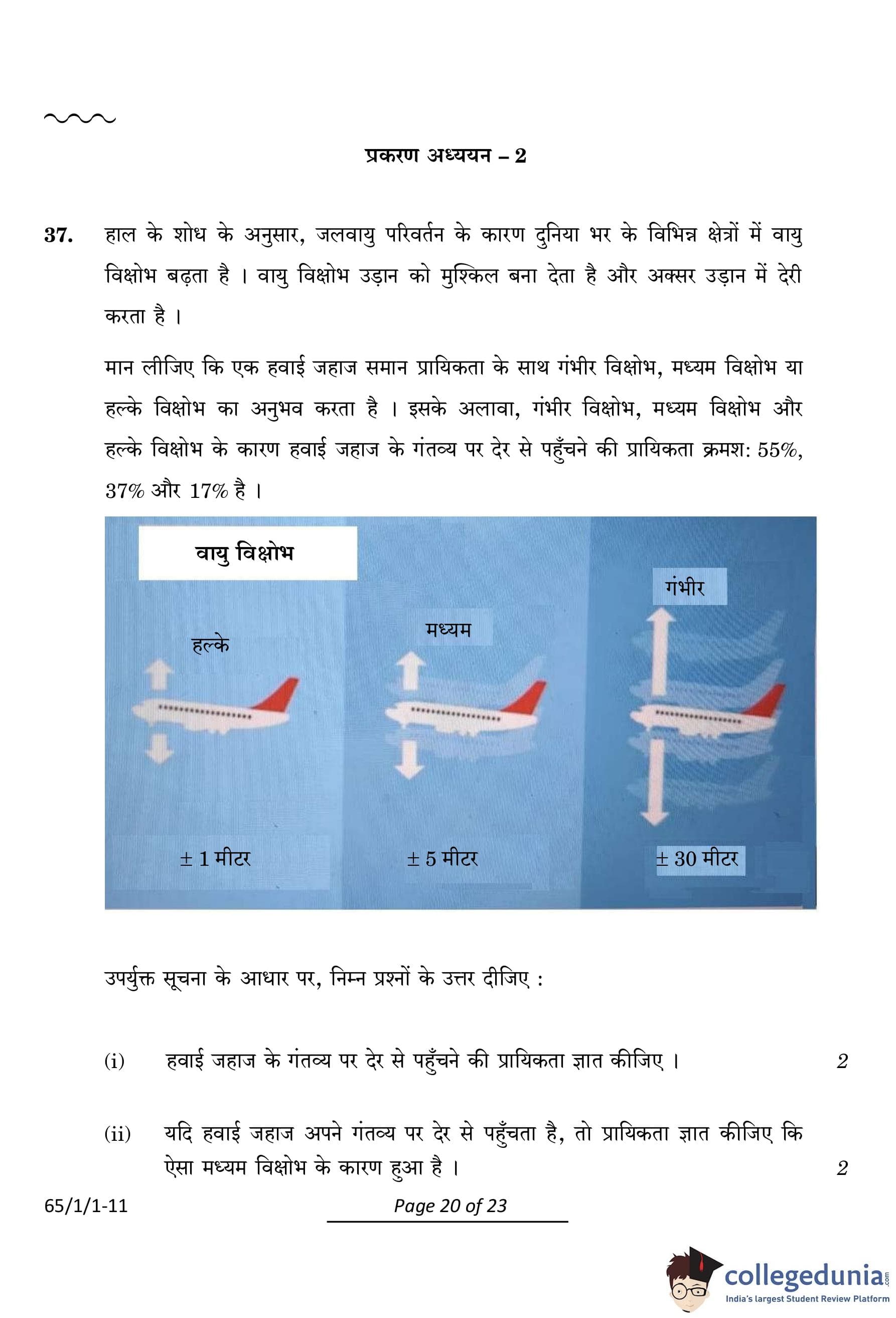
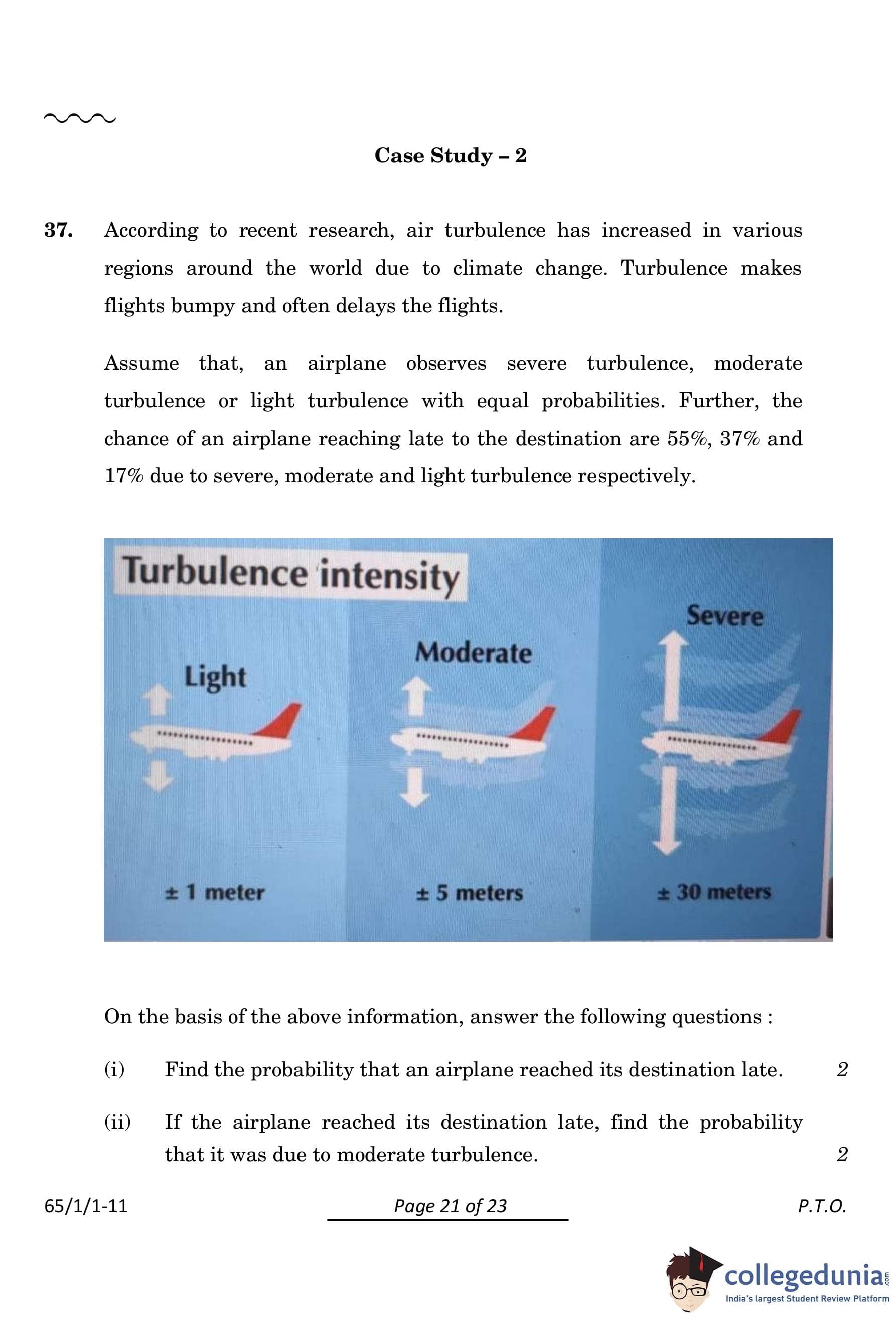
According to recent research, air turbulence has increased in various regions around the world due to climate change. Turbulence makes flights bumpy and often delays the flights.
Assume that an airplane observes severe turbulence, moderate turbulence, or light turbulence with equal probabilities. Further, the chance of an airplane reaching late to the destination are 55%, 37%, and 17% due to severe, moderate, and light turbulence, respectively.

On the basis of the above information, answer the following questions:
- Find the probability that an airplane reached its destination late.
- If the airplane reached its destination late, find the probability that it was due to moderate turbulence.
- The probability that an airplane reached its destination late: P(Late) = 0.3633.
- The probability that the airplane was late due to moderate turbulence: P(Moderate|Late) = 0.3394.
View Solution
Solution:
Given Information:
1. Turbulence can be severe, moderate, or light, each occurring with equal probabilities:
P(Severe) = P(Moderate) = P(Light) = 1/3.
2. The probability of an airplane reaching late due to:
- Severe turbulence: P(Late|Severe) = 0.55,
- Moderate turbulence: P(Late|Moderate) = 0.37,
- Light turbulence: P(Late|Light) = 0.17.
(i) Find the probability that an airplane reached its destination late.
Using the law of total probability:
P(Late) = P(Late|Severe)P(Severe) + P(Late|Moderate)P(Moderate) + P(Late|Light)P(Light).
Substitute the values:
P(Late) = (0.55 × 1/3) + (0.37 × 1/3) + (0.17 × 1/3).
Simplify:
P(Late) = (0.55 + 0.37 + 0.17) / 3 = 1.09 / 3.
Thus:
P(Late) = 0.3633 (approximately).
(ii) If the airplane reached its destination late, find the probability that it was due to moderate turbulence.
Using Bayes' theorem:
P(Moderate|Late) = [P(Late|Moderate)P(Moderate)] / P(Late).
Substitute the values:
P(Moderate|Late) = (0.37 × 1/3) / 0.3633.
Simplify:
P(Moderate|Late) = 0.37 / (3 × 0.3633) = 0.37 / 1.09.
Thus:
P(Moderate|Late) = 0.3394 (approximately).
Final Answers:
- The probability that an airplane reached its destination late: P(Late) = 0.3633.
- The probability that the airplane was late due to moderate turbulence: P(Moderate|Late) = 0.3394.
Question 38:
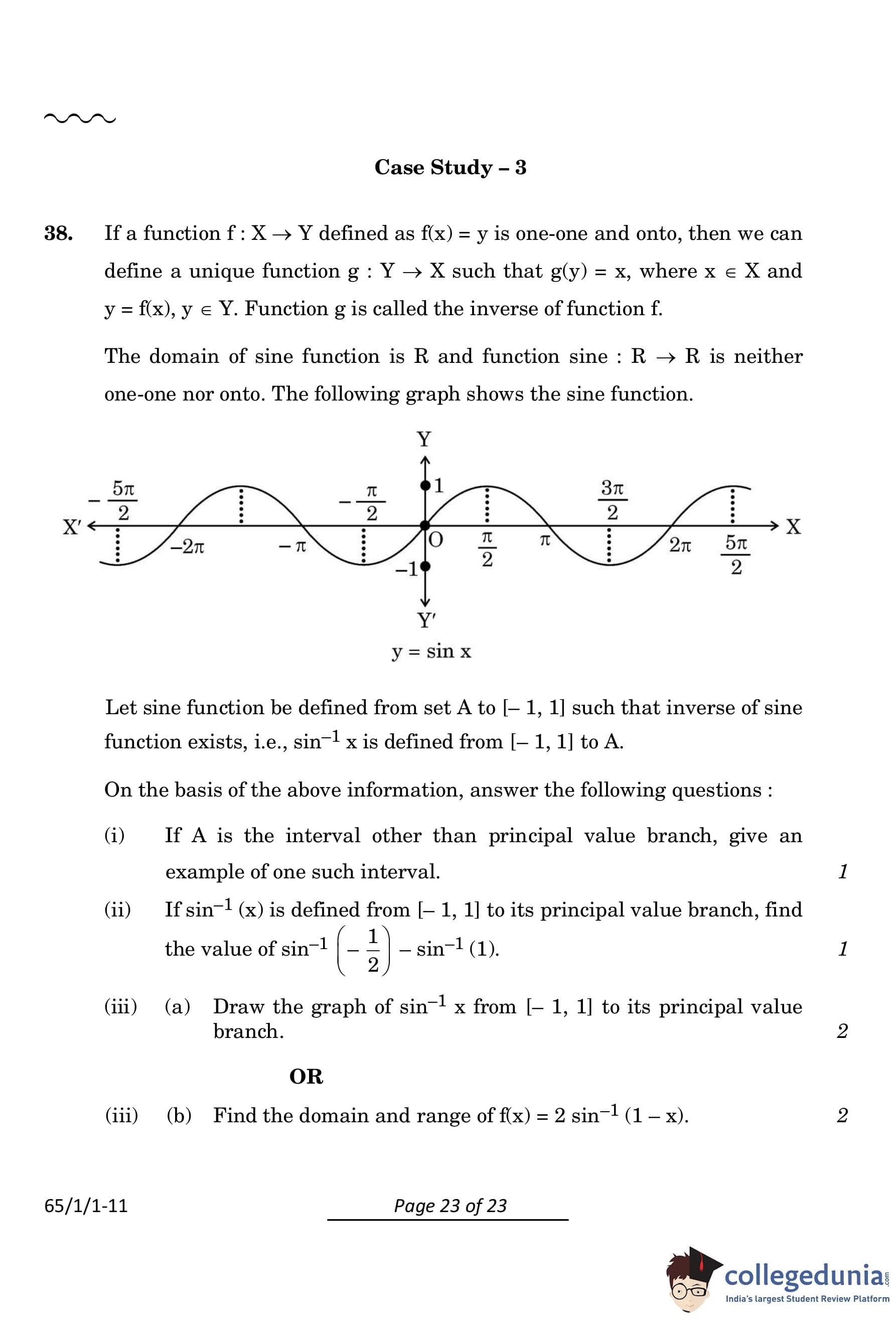
If a function f: X → Y defined as f(x) = y is one-one and onto, then we can define a unique function g: Y → X such that g(y) = x, where x ∈ X and y = f(x), y ∈ Y. Function g is called the inverse of function f. The domain of sine function is R, and function sine: R → R is neither one-one nor onto. The following graph shows the sine function:
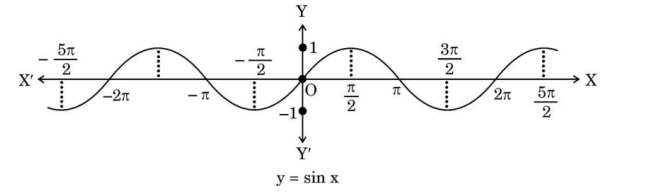
On the basis of the above information, answer the following questions:
- If A is the interval other than the principal value branch, give an example of one such interval.
- If sin⁻¹(x) is defined from [-1, 1] to its principal value branch, find the value of sin⁻¹(-1/2) - sin⁻¹(1).
- (a) Draw the graph of sin⁻¹(x) from [-1, 1] to its principal value branch.
- (b) Find the domain and range of f(x) = 2sin⁻¹(1 - x).
- Example of an interval other than the principal value branch: [π/2, 3π/2].
- sin⁻¹(-1/2) - sin⁻¹(1) = -2π/3.
- (a) The graph of y = sin⁻¹(x) is shown above.
- (b) The domain of f(x) = 2sin⁻¹(1 - x) is [0, 2], and the range is [-π, π].
View Solution
Solution:
Given Information: The sine function y = sin x is defined from R to [-1, 1], but it is neither one-one nor onto over R. By restricting the domain to an interval, we can define the inverse sin⁻¹, which is a one-one and onto function.
- (i) If A is an interval other than the principal value branch, give an example of one such interval.
The principal value branch of the sine function is the interval [-π/2, π/2]. Another interval where the sine function is one-one and onto [-1, 1] is:
A = [π/2, 3π/2]. - (ii) If sin⁻¹(x) is defined from [-1, 1] to its principal value branch, find the value of:
sin⁻¹(-1/2) - sin⁻¹(1).
Step 1: Evaluate sin⁻¹(-1/2). From the definition of sin⁻¹, sin⁻¹(-1/2) is the angle θ in the interval [-π/2, π/2] such that:
sin θ = -1/2.
Thus:
sin⁻¹(-1/2) = -π/6.
Step 2: Evaluate sin⁻¹(1). From the definition of sin⁻¹, sin⁻¹(1) is the angle θ in the interval [-π/2, π/2] such that:
sin θ = 1.
Thus:
sin⁻¹(1) = π/2.
Step 3: Compute the difference:
sin⁻¹(-1/2) - sin⁻¹(1) = -π/6 - π/2 = -2π/3.
Conclusion: sin⁻¹(-1/2) - sin⁻¹(1) = -2π/3. - (iii) (a) Draw the graph of sin⁻¹(x) from [-1, 1] to its principal value branch.
Step 1: Description of the graph. The graph of sin⁻¹(x) is obtained by reflecting the graph of y = sin x (restricted to [-π/2, π/2]) across the line y = x. - (b) Find the domain and range of f(x) = 2sin⁻¹(1 - x).
Step 1: Domain of f(x). For f(x) = 2sin⁻¹(1 - x), the argument of sin⁻¹ must lie within [-1, 1], i.e.:
-1 ≤ 1 - x ≤ 1.
Simplify:
-1 - 1 ≤ -x ≤ 1 - 1 → -2 ≤ -x ≤ 0.
Multiplying through by -1 (and reversing inequalities):
0 ≤ x ≤ 2.
Thus, the domain is:
x ∈ [0, 2].
Step 2: Range of f(x). The range of sin⁻¹(x) is [-π/2, π/2]. Therefore:
f(x) = 2sin⁻¹(1 - x) ⇒ f(x) ∈ [2(-π/2), 2(π/2)].
Simplify:
f(x) ∈ [-π, π].
Final Answers:
- Example of an interval other than the principal value branch: [π/2, 3π/2].
- sin⁻¹(-1/2) - sin⁻¹(1) = -2π/3.
- (a) The graph of y = sin⁻¹(x) is shown above.
- (b) The domain of f(x) = 2sin⁻¹(1 - x) is [0, 2], and the range is [-π, π].










Comments