




CBSE Class 12 Mathematics Question Paper 2024 PDF (Set 1- 65/2/1) is available for download here. CBSE conducted the Mathematics exam on March 9, 2024 from 10:30 AM to 1:30 PM. The total marks for the theory paper are 80. The question paper contains 20% MCQ-based questions, 40% competency-based questions, and 40% short and long answer type questions.
CBSE Class 12 Mathematics Question Paper 2024 (Set 1- 65/2/1) with Answer Key
| CBSE Class 12 2024 Mathematics Question Paper with Answer Key |  Download Download |
Check Solution |
CBSE Class 12 2024 Mathematics Questions with Solutions
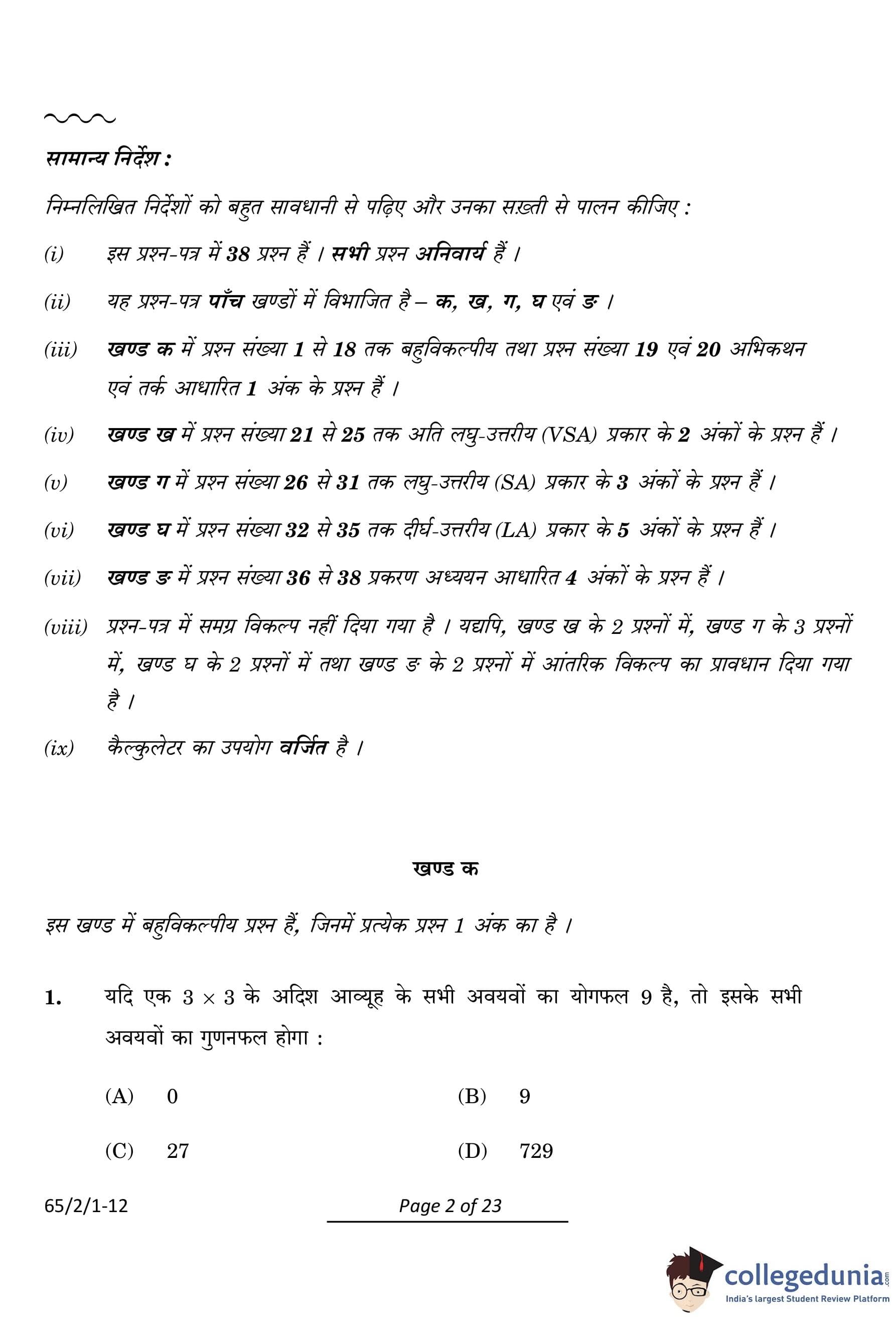
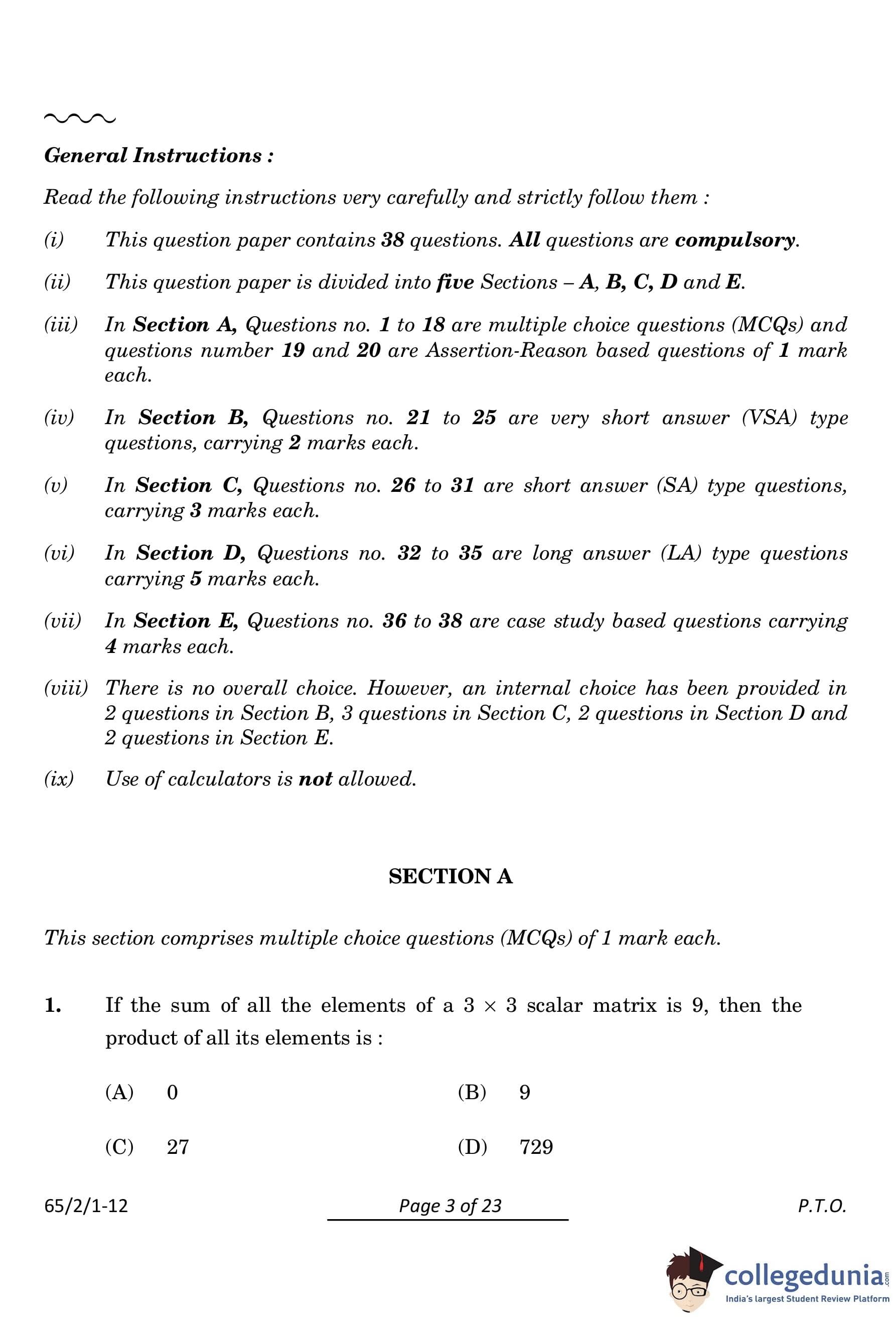
If the sum of all the elements of a \( 3 \times 3 \) scalar matrix is 9, then the product of all its elements is:
View Solution
Step 1: Definition of Scalar Matrix.
A scalar matrix is a special type of diagonal matrix where every element on the diagonal is the same scalar, and all the off-diagonal elements are zeros. For a \( 3 \times 3 \) scalar matrix, the general structure is: \[ A = \begin{bmatrix} k & 0 & 0
0 & k & 0
0 & 0 & k \end{bmatrix}, \]
where \( k \) represents the scalar value along the diagonal.
Step 2: Summing the Elements.
The sum of all elements in a \( 3 \times 3 \) scalar matrix can be calculated by adding the diagonal elements. Given that the total sum is \( 9 \), we have: \[ Sum = k + k + k + 0 + 0 + 0 + 0 + 0 + 0 = 3k. \]
From the equation, we know: \[ 3k = 9 \quad \Rightarrow \quad k = 3. \]
Step 3: Product of All Elements.
Since the matrix is a scalar matrix, the product of all its elements involves multiplying the scalar \( k \) with the off-diagonal zeros: \[ Product = k \cdot 0 \cdot 0 \cdot 0 \cdot 0 \cdot 0 \cdot 0 \cdot 0 \cdot 0 = 0. \]
Step 4: Final Answer.
Thus, the product of all elements in the matrix is: \[ \boxed{0}. \] Quick Tip: In a scalar matrix, since all off-diagonal elements are zero, the product of all elements will always be zero.
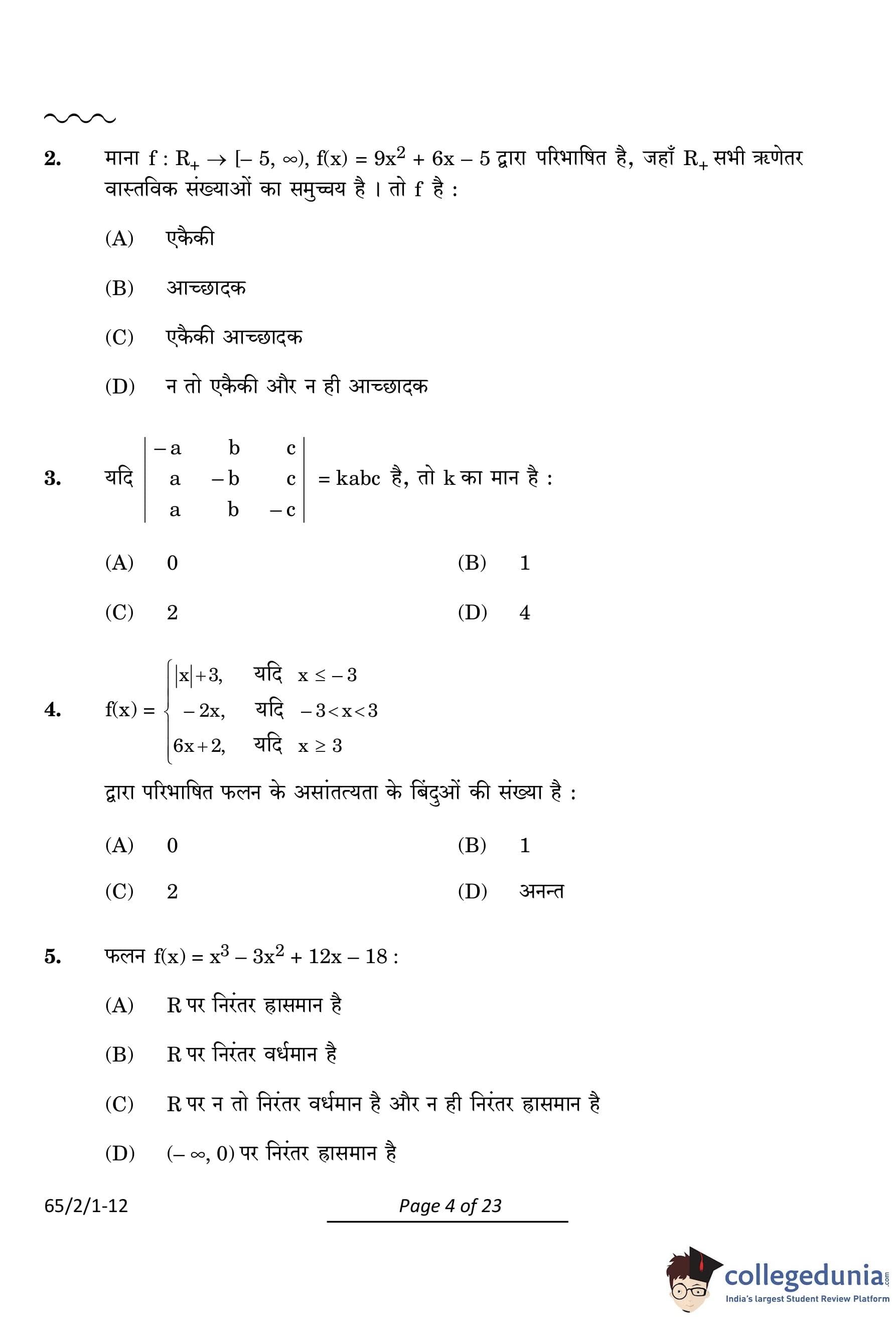
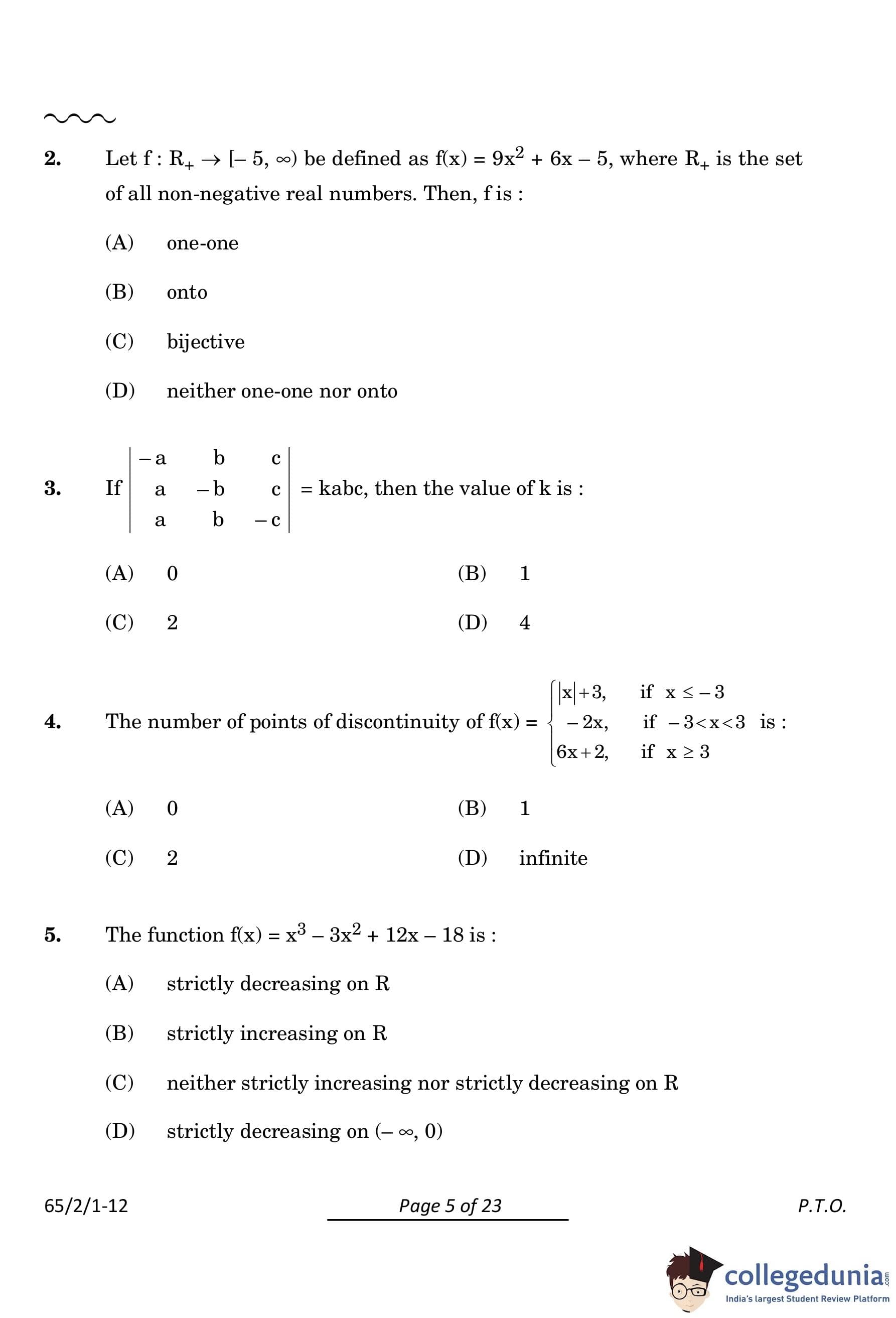
Let \( f : \mathbb{R}_+ \to [-5, \infty) \) be defined as \( f(x) = 9x^2 + 6x - 5 \), where \( \mathbb{R}_+ \) is the set of all non-negative real numbers. Then, \( f \) is:
View Solution
Step 1: Examine the function \( f(x) \).
The given function \( f(x) = 9x^2 + 6x - 5 \) is a quadratic function with a positive leading coefficient, indicating that the parabola opens upwards.
Step 2: Determine the domain and range.
The domain of the function is \( \mathbb{R}_+ \), meaning that \( x \geq 0 \). To find the minimum value, we calculate the vertex of the parabola, which occurs at: \[ x = -\frac{b}{2a} = -\frac{6}{2 \cdot 9} = -\frac{1}{3}. \]
However, since \( x \geq 0 \), we check \( f(x) \) at \( x = 0 \): \[ f(0) = -5. \]
Thus, the range of \( f(x) \) is \( [-5, \infty) \), which shows that the function is onto.
Step 3: Verify the one-one property.
Since the function is strictly increasing for \( x \geq 0 \), it satisfies the one-one property.
Step 4: Conclusion.
Given that \( f(x) \) is both one-one and onto, the function is bijective. Quick Tip: To confirm if a quadratic function is bijective, examine the function's monotonicity over the given domain and ensure the range covers all possible outputs.
If \( \begin{vmatrix} -a & b & c
a & -b & c
a & b & -c \end{vmatrix} = kabc \), then the value of \( k \) is:
View Solution
We are given the following determinant and are tasked with finding its value:
\[ \begin{vmatrix} -a & b & c
a & -b & c
a & b & -c \end{vmatrix} = kabc \]
Taking \(a\), \(b\), and \(c\) out of the matrix from columns \(C_1\), \(C_2\), and \(C_3\), respectively:
\[ abc \begin{vmatrix} -1 & 1 & 1
1 & -1 & 1
1 & 1 & -1 \end{vmatrix} = kabc \]
Dividing both sides by \(abc\), we get:
\[ \begin{vmatrix} -1 & 1 & 1
1 & -1 & 1
1 & 1 & -1 \end{vmatrix} = k \]
Using column operations \(C_2 \to C_2 + C_1\) and \(C_3 \to C_3 + C_1\), the determinant simplifies to:
\[ \begin{vmatrix} -1 & 0 & 0
1 & 0 & 2
1 & 2 & 0 \end{vmatrix} = k \]
Expanding the determinant along the first row:
\[ -1(0 \times 0 - 2 \times 2) = k \]
Simplifying further:
\[ -1(-4) = k \]
\[ k = 4 \]
\(\therefore k = 4\)
Given the problem setup, the value of \(k\) is 4, and thus the correct option is (D) 4. Quick Tip: When dealing with determinants, applying column operations can simplify the calculation significantly. Watch for symmetry to identify potential simplifications.
The number of points of discontinuity of \( f(x) = \begin{cases} |x| + 3, & if x \leq -3,
-2x, & if -3 < x < 3,
6x + 2, & if x \geq 3 \end{cases} \) is:
View Solution
Step 1: Analyze the points where discontinuity might occur.
The given piecewise function transitions at \( x = -3 \) and \( x = 3 \). These are the potential points where discontinuities could arise.
Step 2: Verify continuity at \( x = -3 \).
At \( x = -3 \), calculate the left-hand and right-hand limits: \[ Left-hand limit (LHL) = |x| + 3 = |-3| + 3 = 3 + 3 = 6, \] \[ Right-hand limit (RHL) = -2x = -2(-3) = 6. \]
The function value at \( x = -3 \) is: \[ f(-3) = |x| + 3 = |-3| + 3 = 6. \]
Since the left-hand limit, right-hand limit, and the function's value at \( x = -3 \) are all equal, the function is continuous at \( x = -3 \).
Step 3: Verify continuity at \( x = 3 \).
At \( x = 3 \), calculate the left-hand and right-hand limits: \[ Left-hand limit (LHL) = -2x = -2(3) = -6, \] \[ Right-hand limit (RHL) = 6x + 2 = 6(3) + 2 = 18 + 2 = 20. \]
Since the left-hand limit and right-hand limit are not equal, the function is discontinuous at \( x = 3 \).
Step 4: Final Conclusion.
There is exactly one point of discontinuity, which occurs at \( x = 3 \). Therefore, the total number of points of discontinuity is: \[ \boxed{1}. \] Quick Tip: To determine if a function is continuous at a point, check if the left-hand limit, right-hand limit, and the function value all match. If they do not, the function is discontinuous at that point.
The function \( f(x) = x^3 - 3x^2 + 12x - 18 \) is:
View Solution
Step 1: Calculate the derivative of \( f(x) \).
The derivative of the given function \( f(x) \) is: \[ f'(x) = 3x^2 - 6x + 12. \]
Step 2: Simplify the derivative expression.
We can factor out the common term to simplify \( f'(x) \): \[ f'(x) = 3(x^2 - 2x + 4). \]
The quadratic expression \( x^2 - 2x + 4 \) has a discriminant: \[ \Delta = (-2)^2 - 4(1)(4) = 4 - 16 = -12. \]
Since the discriminant is negative, the quadratic expression is always positive. Thus, \( f'(x) > 0 \) for all real values of \( x \).
Step 3: Monotonicity Conclusion.
Given that \( f'(x) > 0 \) for all \( x \in \mathbb{R} \), the function \( f(x) \) is strictly increasing on the entire real number line.
Step 4: Final Conclusion.
Therefore, the function \( f(x) \) is: \[ \boxed{strictly increasing on \mathbb{R}}. \] Quick Tip: To determine if a function is strictly increasing, examine the sign of its derivative. If the derivative is positive throughout the domain, the function is strictly increasing.
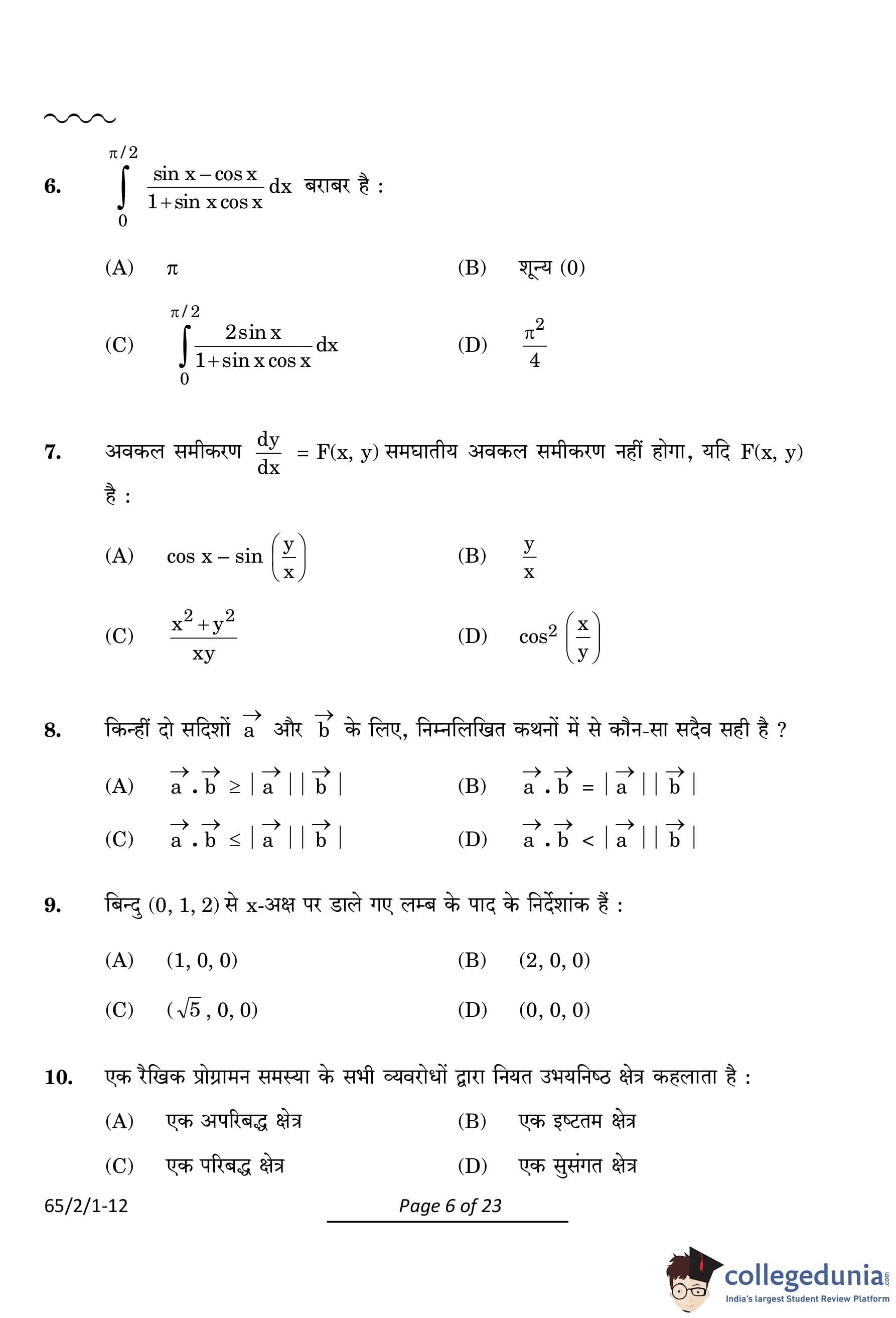
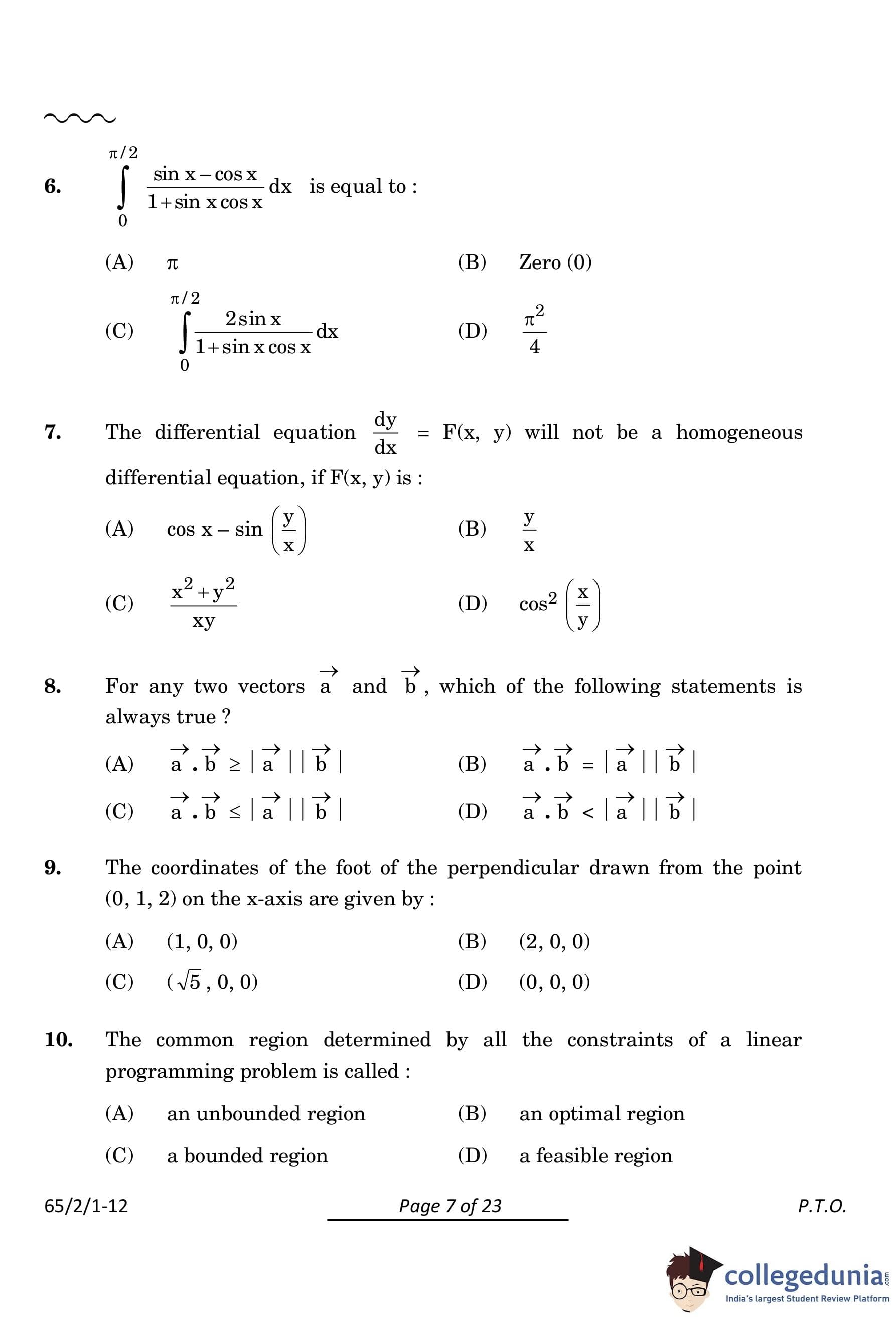
\( \int_{0}^{\pi/2} \frac{\sin x - \cos x}{1 + \sin x \cos x} \, dx \) is equal to:
View Solution
Step 1: Simplify the integrand.
The given integral is: \[ I = \int_{0}^{\pi/2} \frac{\sin x - \cos x}{1 + \sin x \cos x} \, dx. \]
We apply the substitution \( x \to \frac{\pi}{2} - x \), which transforms \( \sin x \to \cos x \) and \( \cos x \to \sin x \). After substitution, the integral becomes: \[ I = \int_{0}^{\pi/2} \frac{\cos x - \sin x}{1 + \sin x \cos x} \, dx. \]
Step 2: Combine and simplify the integrals.
Now, adding the original integral and the transformed integral: \[ 2I = \int_{0}^{\pi/2} \frac{\sin x - \cos x}{1 + \sin x \cos x} \, dx + \int_{0}^{\pi/2} \frac{\cos x - \sin x}{1 + \sin x \cos x} \, dx = 0. \]
Thus, we find: \[ I = 0. \] Quick Tip: In definite integrals with symmetric limits, applying the substitution \( x \to \frac{\pi}{2} - x \) can help simplify and evaluate the integral effectively.
The differential equation \( \frac{dy}{dx} = F(x, y) \) will not be a homogeneous differential equation, if \( F(x, y) \) is:
View Solution
Step 1: Definition of a homogeneous differential equation.
A differential equation \( \frac{dy}{dx} = F(x, y) \) is considered homogeneous if the function \( F(x, y) \) can be expressed solely in terms of the ratio \( \frac{y}{x} \) or equivalently \( \frac{x}{y} \).
Step 2: Analyze the given options.
We will evaluate whether \( F(x, y) \) in each option can be written as a function of \( \frac{y}{x} \) or \( \frac{x}{y} \).
(A) \( F(x, y) = \cos x - \sin \left( \frac{y}{x} \right):
The term \( \cos x \) depends solely on \( x \), and cannot be written as a function of \( \frac{y}{x} \).
Thus, \( F(x, y) \) is not homogeneous.
(B) \( F(x, y) = \frac{y}{x}:
This is already in the form
\( \frac{y}{x} \), which is homogeneous by definition.
(C) \( F(x, y) = \frac{x^2 + y^2}{xy}:
Simplifying:
\[ F(x, y) = \frac{x^2}{xy} + \frac{y^2}{xy} = \frac{x}{y} + \frac{y}{x}. \] Both terms \( \frac{x}{y} \) and \( \frac{y}{x} \) are functions of \( \frac{y}{x} \), indicating that \( F(x, y) \) is homogeneous.
(D) \( F(x, y) = \cos^2 \left( \frac{x}{y} \right):
The expression \( \cos^2 \left( \frac{x}{y} \right) \) depends only on \( \frac{x}{y} \), making \( F(x, y) \) homogeneous.
Step 3: Conclusion.
The only function that is not homogeneous is: \[ \boxed{\cos x - \sin \left( \frac{y}{x} \right)}. \] Quick Tip: To identify if a function is homogeneous, check if it can be written as a function of \( \frac{y}{x} \) or \( \frac{x}{y} \). Functions involving only these ratios are homogeneous.
For any two vectors \( \vec{a} \) and \( \vec{b} \), which of the following statements is always true?
View Solution
Step 1: Definition of the dot product.
The dot product between two vectors \( \vec{a} \) and \( \vec{b} \) is defined as: \[ \vec{a} \cdot \vec{b} = |\vec{a}| \, |\vec{b}| \cos \theta, \]
where \( \theta \) represents the angle between the vectors \( \vec{a} \) and \( \vec{b} \).
Step 2: Investigate the range of \( \cos \theta \).
Since \( \cos \theta \) lies within the range \( -1 \leq \cos \theta \leq 1 \), it follows that: \[ -|\vec{a}| \, |\vec{b}| \leq \vec{a} \cdot \vec{b} \leq |\vec{a}| \, |\vec{b}|. \]
Step 3: Final Answer.
Thus, the correct inequality for the dot product is: \[ \boxed{\vec{a} \cdot \vec{b} \leq |\vec{a}| \, |\vec{b}|}. \] Quick Tip: For any two vectors, the absolute value of their dot product is always bounded by the product of their magnitudes, i.e., \( |\vec{a} \cdot \vec{b}| \leq |\vec{a}| \, |\vec{b}| \).
The coordinates of the foot of the perpendicular drawn from the point \( (0, 1, 2) \) on the \( x \)-axis are given by:
View Solution
Step 1: Define the \( x \)-axis.
The \( x \)-axis consists of all points where the coordinates are of the form \( (x, 0, 0) \), where \( x \) is any real number.
Step 2: Foot of the perpendicular.
The foot of the perpendicular from the point \( (0, 1, 2) \) onto the \( x \)-axis represents the closest point on the \( x \)-axis. Since the perpendicular from \( (0, 1, 2) \) to the \( x \)-axis drops to \( x = 0 \), the foot of the perpendicular has the coordinates: \[ (0, 0, 0). \]
Step 3: Conclusion.
Thus, the foot of the perpendicular is: \[ \boxed{(0, 0, 0)}. \] Quick Tip: When finding the foot of the perpendicular from a point to an axis, keep the axis' coordinates fixed and set the other coordinates to zero.
The common region determined by all the constraints of a linear programming problem is called:
View Solution
Step 1: Understanding the feasible region.
In a linear programming problem, the feasible region is defined as the set of all points that satisfy the system of inequalities. It represents all potential solutions that meet the given constraints.
Step 2: Evaluate the options.
(A) Unbounded region: This can occur depending on the nature of the constraints, but it is not always the case.
(B) Optimal region: Refers to the best solution within the feasible region, not the region itself.
(C) Bounded region: The feasible region could be bounded, but it is not necessarily so in every scenario.
(D) Feasible region: This is the region that is formed by the constraints, which is always the common area where all inequalities overlap.
Step 3: Conclusion.
Thus, the correct answer is: \[ \boxed{Feasible region}. \] Quick Tip: In linear programming, the feasible region consists of all points that satisfy the system of inequalities, representing the possible solutions to the problem.
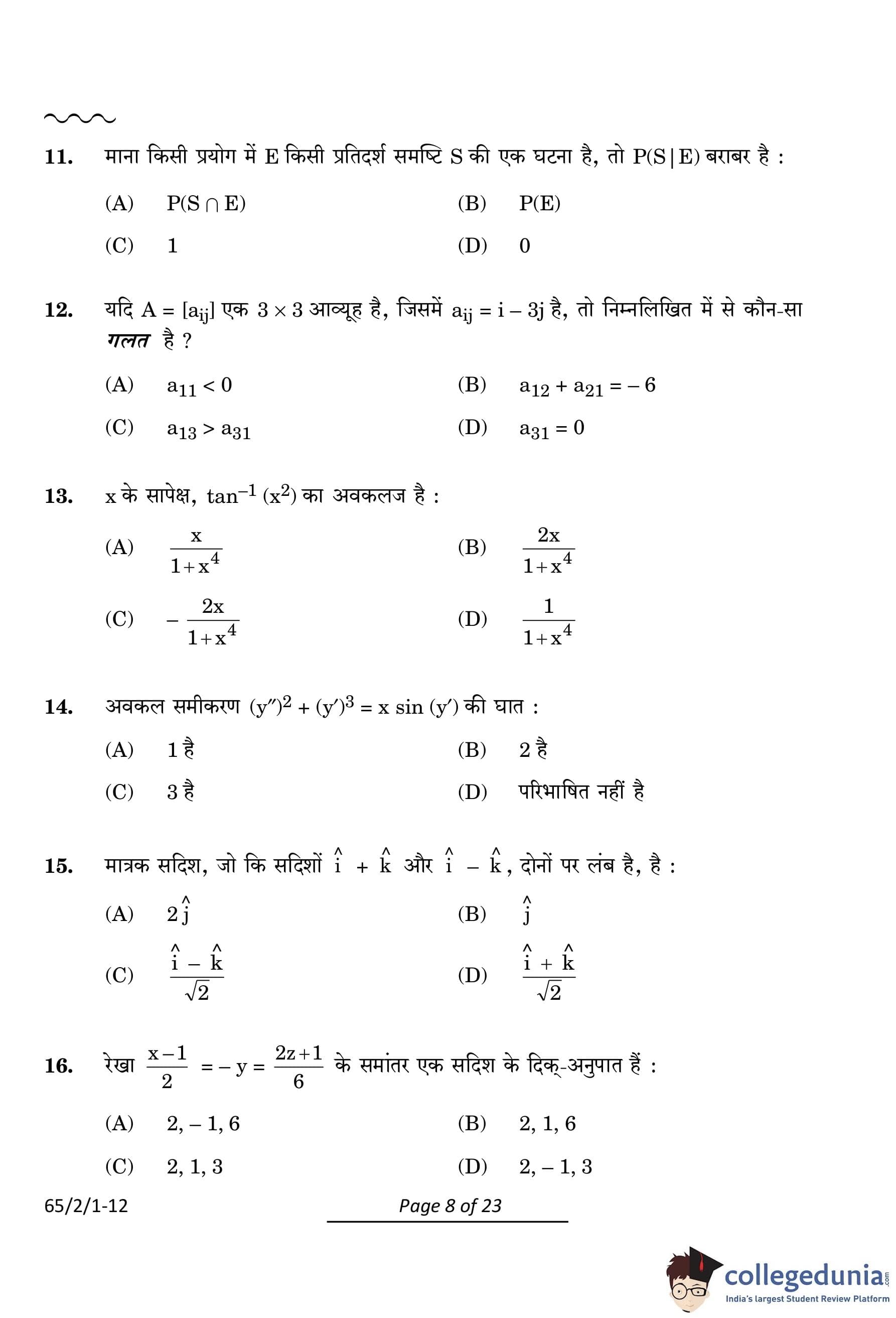
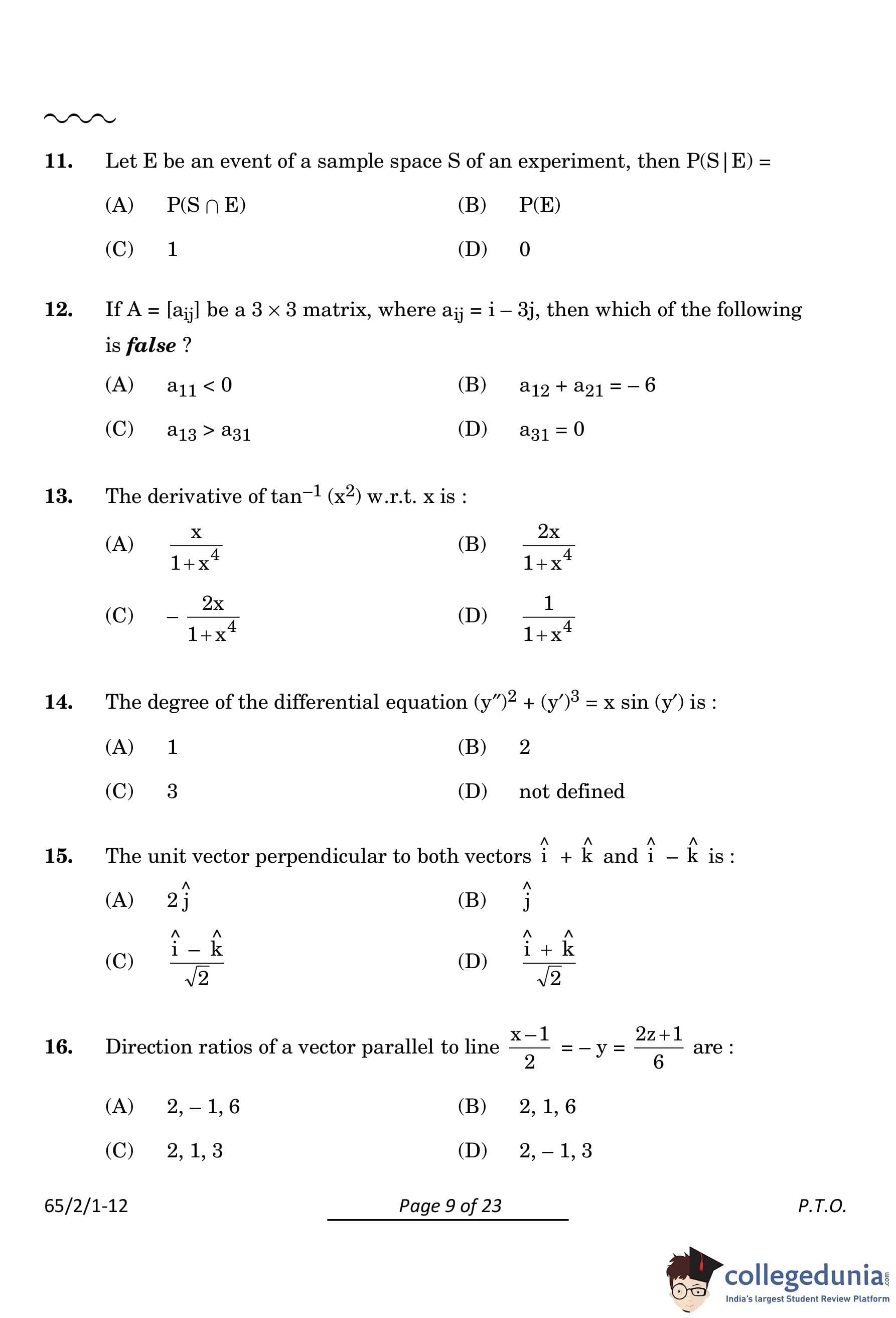
Let \( E \) be an event of a sample space \( S \) of an experiment, then \( P(S | E) \) is:
View Solution
Step 1: Recall the definition of conditional probability.
Conditional probability \( P(A | B) \) is defined as: \[ P(A | B) = \frac{P(A \cap B)}{P(B)}, \quad where P(B) > 0. \]
Step 2: Apply to \( P(S | E) \).
In this case, \( A = S \) (the sample space) and \( B = E \). Since \( S \) represents all possible outcomes, it contains all elements of \( E \), so: \[ P(S \cap E) = P(E). \]
Thus, the conditional probability becomes: \[ P(S | E) = \frac{P(S \cap E)}{P(E)} = \frac{P(E)}{P(E)} = 1. \]
Step 3: Conclusion.
Therefore, the conditional probability \( P(S | E) \) is: \[ \boxed{1}. \] Quick Tip: The conditional probability of the sample space given any event is always 1, as the sample space contains all possible outcomes.
If \( A = [a_{ij}] \) be a \( 3 \times 3 \) matrix, where \( a_{ij} = i - 3j \), then which of the following is false?
View Solution
Step 1: Define the matrix \( A = [a_{ij}] \).
The elements of the matrix \( A \) are defined by the relation \( a_{ij} = i - 3j \), where \( i \) represents the row index and \( j \) represents the column index.
Step 2: Compute the elements of \( A \).
For a \( 3 \times 3 \) matrix, we compute the elements as follows: \[ a_{11} = 1 - 3(1) = -2, \quad a_{12} = 1 - 3(2) = -5, \quad a_{13} = 1 - 3(3) = -8, \] \[ a_{21} = 2 - 3(1) = -1, \quad a_{22} = 2 - 3(2) = -4, \quad a_{23} = 2 - 3(3) = -7, \] \[ a_{31} = 3 - 3(1) = 0, \quad a_{32} = 3 - 3(2) = -3, \quad a_{33} = 3 - 3(3) = -6. \]
Thus, the matrix \( A \) is: \[ A = \begin{bmatrix} -2 & -5 & -8
-1 & -4 & -7
0 & -3 & -6 \end{bmatrix}. \]
Step 3: Analyze the given options.
- (A) \( a_{11} < 0 \):
Since \( a_{11} = -2 \), which is less than zero, this statement is true.
- (B) \( a_{12} + a_{21} = -6 \):
Here, \( a_{12} = -5 \) and \( a_{21} = -1 \), so:
\[ a_{12} + a_{21} = -5 + (-1) = -6. \]
This statement is true.
- (C) \( a_{13} > a_{31} \):
Since \( a_{13} = -8 \) and \( a_{31} = 0 \), we have:
\[ a_{13} > a_{31} \quad \Rightarrow \quad -8 > 0, \]
which is false.
- (D) \( a_{31} = 0 \):
As \( a_{31} = 0 \), this statement is true.
Step 4: Conclusion.
The false statement is: \[ \boxed{a_{13} > a_{31}}. \] Quick Tip: When analyzing matrix elements, compute each element individually and verify the statements step-by-step to ensure accuracy.
The derivative of \( \tan^{-1}(x^2) \) w.r.t. \( x \) is:
View Solution
Step 1: Use the chain rule for differentiation.
The derivative of \( \tan^{-1}(u) \) with respect to \( x \) is: \[ \frac{d}{dx} \tan^{-1}(u) = \frac{1}{1 + u^2} \cdot \frac{du}{dx}, \]
where \( u = x^2 \). Therefore, the derivative of \( u \) with respect to \( x \) is: \[ \frac{du}{dx} = 2x. \]
Step 2: Apply substitution and simplify.
Substituting \( u = x^2 \) into the derivative formula: \[ \frac{d}{dx} \tan^{-1}(x^2) = \frac{1}{1 + (x^2)^2} \cdot 2x = \frac{2x}{1 + x^4}. \]
Step 3: Final Answer.
Thus, the derivative of \( \tan^{-1}(x^2) \) is: \[ \boxed{\frac{2x}{1 + x^4}}. \] Quick Tip: When differentiating inverse trigonometric functions, always apply the chain rule and simplify the expression by substituting the appropriate terms.
The degree of the differential equation \( (y'')^2 + (y')^3 = x \sin(y') \) is:
View Solution
Step 1: Definition of the degree of a differential equation.
The degree of a differential equation is determined only when the equation is a polynomial in all of its derivatives.
Step 2: Examine the given equation.
The provided equation is: \[ (y'')^2 + (y')^3 = x \sin(y'). \]
This equation includes a non-polynomial term, \( \sin(y') \), where \( y' \) is a derivative. Therefore, the degree of the equation cannot be defined.
Step 3: Final Answer.
Thus, the degree of this differential equation is: \[ \boxed{Not defined}. \] Quick Tip: The degree of a differential equation cannot be defined if it includes any non-polynomial terms involving derivatives.
The unit vector perpendicular to both vectors \( \hat{i} + \hat{k} \) and \( \hat{i} - \hat{k} \) is:
View Solution
Step 1: Cross product of two vectors.
The cross product of vectors \( \vec{A} = \hat{i} + \hat{k} \) and \( \vec{B} = \hat{i} - \hat{k} \) produces a vector perpendicular to both: \[ \vec{A} \times \vec{B} = \begin{vmatrix} \hat{i} & \hat{j} & \hat{k}
1 & 0 & 1
1 & 0 & -1 \end{vmatrix}. \]
To calculate this, expand the determinant: \[ \vec{A} \times \vec{B} = \hat{i} \begin{vmatrix} 0 & 1
0 & -1 \end{vmatrix} - \hat{j} \begin{vmatrix} 1 & 1
1 & -1 \end{vmatrix} + \hat{k} \begin{vmatrix} 1 & 0
1 & 0 \end{vmatrix}. \]
Step 2: Simplify the minors.
First minor: \[ \begin{vmatrix} 0 & 1
0 & -1 \end{vmatrix} = 0. \]
Second minor: \[ \begin{vmatrix} 1 & 1
1 & -1 \end{vmatrix} = (1)(-1) - (1)(1) = -1 - 1 = -2. \]
Third minor: \[ \begin{vmatrix} 1 & 0
1 & 0 \end{vmatrix} = (1)(0) - (1)(0) = 0. \]
Thus, we have: \[ \vec{A} \times \vec{B} = -(-2)\hat{j} = 2\hat{j}. \]
Step 3: Normalize the resulting vector.
The magnitude of \( \vec{A} \times \vec{B} \) is \( 2 \). Therefore, the unit vector in the direction of \( \vec{A} \times \vec{B} \) is: \[ \frac{\vec{A} \times \vec{B}}{|\vec{A} \times \vec{B}|} = \frac{2\hat{j}}{2} = \hat{j}. \]
Step 4: Final Answer.
The unit vector perpendicular to both \( \vec{A} \) and \( \vec{B} \) is: \[ \boxed{\hat{j}}. \] Quick Tip: The cross product of two vectors results in a perpendicular vector. To find the unit vector, divide the cross product by its magnitude.
Direction ratios of a vector parallel to the line \( \frac{x - 1}{2} = -y = \frac{2z + 1}{6} \) are:
View Solution
Step 1: Parametrize the given line.
The given equation of the line is: \[ \frac{x - 1}{2} = -y = \frac{2z + 1}{6}. \]
Let \( t \) be the parameter. From each equation, we solve for \( x \), \( y \), and \( z \): \[ \frac{x - 1}{2} = t \quad \Rightarrow \quad x = 2t + 1, \] \[ -y = t \quad \Rightarrow \quad y = -t, \] \[ \frac{2z + 1}{6} = t \quad \Rightarrow \quad z = 3t - \frac{1}{2}. \]
Step 2: Identify the direction ratios.
The direction ratios are the coefficients of \( t \) in the parametric equations: \[ Direction ratios = 2, -1, 3. \]
Step 3: Conclusion.
The direction ratios of the line are: \[ \boxed{2, -1, 3}. \] Quick Tip: To find the direction ratios of a line, identify the coefficients of the parameter \( t \) in the parametric equations of the line.
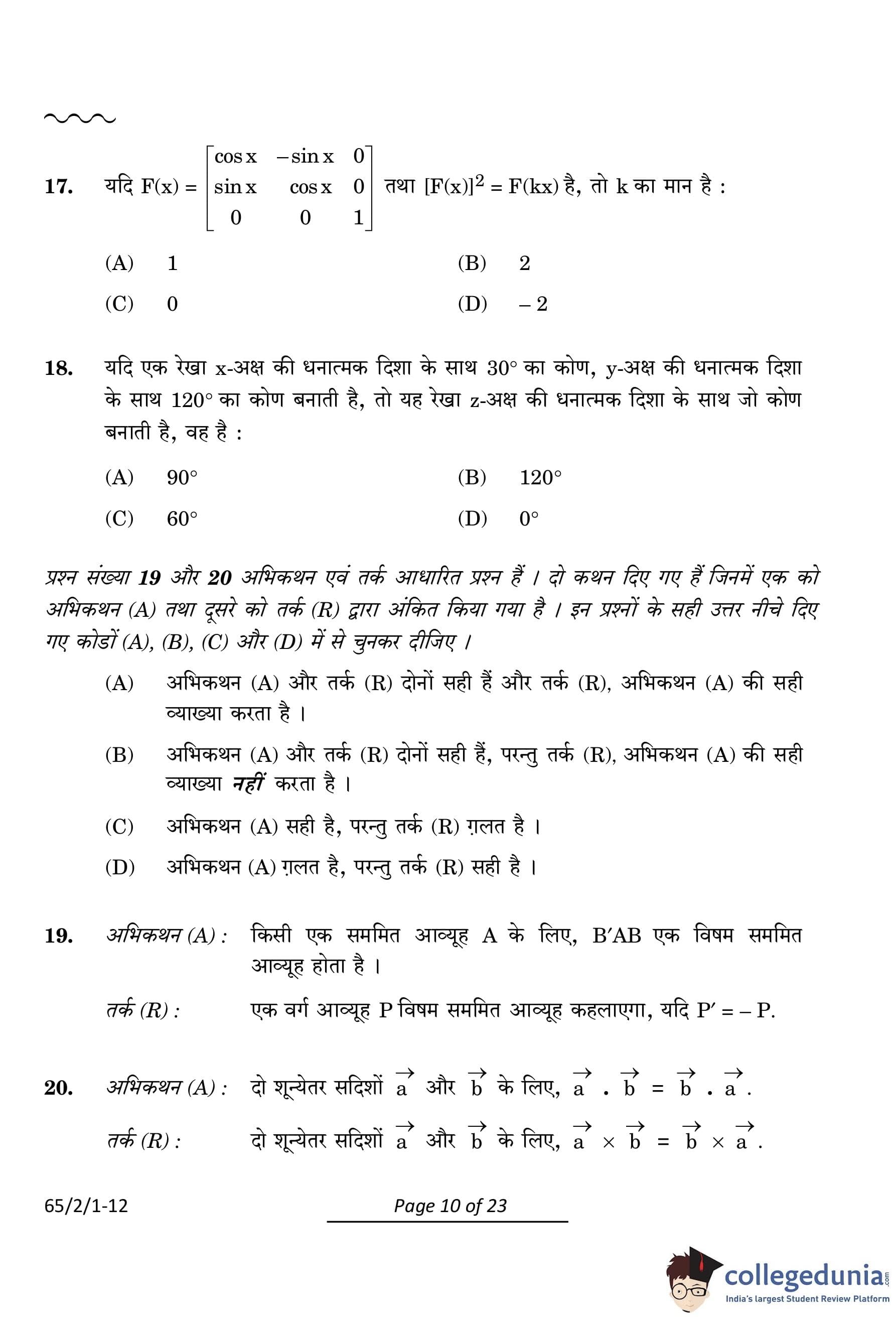
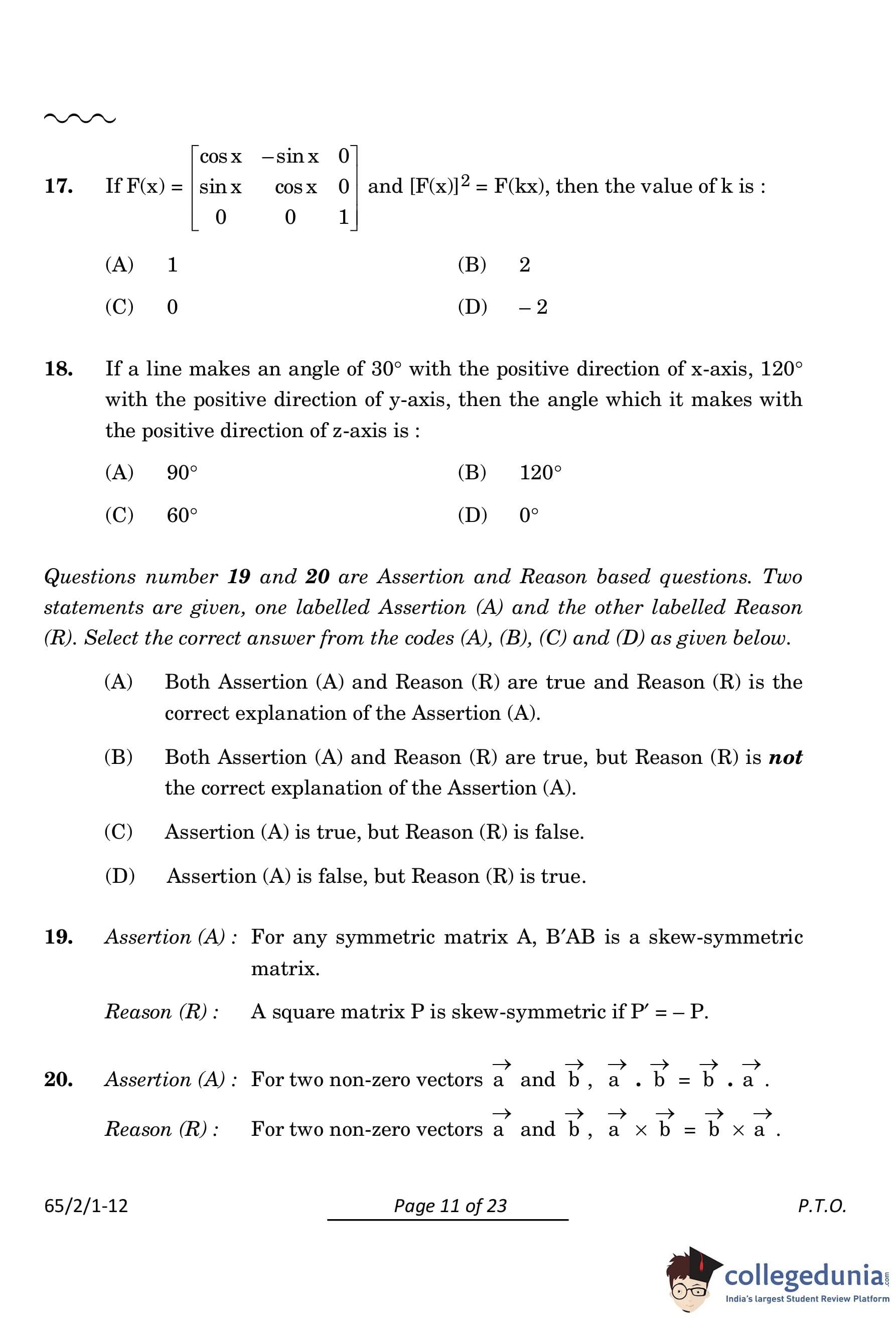
If \( F(x) = \begin{bmatrix} \cos x & -\sin x & 0
\sin x & \cos x & 0
0 & 0 & 1 \end{bmatrix} \) and \( [F(x)]^2 = F(kx) \), then the value of \( k \) is:
View Solution
Step 1: Compute \( [F(x)]^2 \).
The matrix \( F(x) \) is given as: \[ F(x) = \begin{bmatrix} \cos x & -\sin x & 0
\sin x & \cos x & 0
0 & 0 & 1 \end{bmatrix}. \]
To find \( [F(x)]^2 \), we multiply the matrix \( F(x) \) by itself: \[ [F(x)]^2 = F(x) \cdot F(x). \]
Performing the matrix multiplication: \[ \begin{bmatrix} \cos x & -\sin x & 0
\sin x & \cos x & 0
0 & 0 & 1 \end{bmatrix} \cdot \begin{bmatrix} \cos x & -\sin x & 0
\sin x & \cos x & 0
0 & 0 & 1 \end{bmatrix}. \]
The resulting matrix is: \[ [F(x)]^2 = \begin{bmatrix} \cos(2x) & -\sin(2x) & 0
\sin(2x) & \cos(2x) & 0
0 & 0 & 1 \end{bmatrix}. \]
Step 2: Compare with \( F(kx) \).
Next, we look at the matrix \( F(kx) \): \[ F(kx) = \begin{bmatrix} \cos(kx) & -\sin(kx) & 0
\sin(kx) & \cos(kx) & 0
0 & 0 & 1 \end{bmatrix}. \]
From the equation \( [F(x)]^2 = F(kx) \), we compare the corresponding elements: \[ \cos(2x) = \cos(kx) \quad and \quad \sin(2x) = \sin(kx). \]
This gives the equation \( kx = 2x \), so \( k = 2 \).
Step 3: Final Answer.
Therefore, the value of \( k \) is: \[ \boxed{2}. \] Quick Tip: When comparing matrices with trigonometric functions, match corresponding elements and solve for unknown variables.
If a line makes an angle of \( 30^\circ \) with the positive direction of \( x \)-axis, \( 120^\circ \) with the positive direction of \( y \)-axis, then the angle which it makes with the positive direction of \( z \)-axis is:
View Solution
Solution:
Step 1: Apply the direction cosine relation.
The angles \( \alpha \), \( \beta \), and \( \gamma \) that a line makes with the positive \( x \)-, \( y \)-, and \( z \)-axes, respectively, follow the direction cosine equation: \[ \cos^2 \alpha + \cos^2 \beta + \cos^2 \gamma = 1. \]
Given: \[ \alpha = 30^\circ, \quad \beta = 120^\circ, \quad \gamma = ?. \]
Step 2: Compute \( \cos \alpha \) and \( \cos \beta \).
We know: \[ \cos \alpha = \cos 30^\circ = \frac{\sqrt{3}}{2}, \quad \cos \beta = \cos 120^\circ = -\frac{1}{2}. \]
Thus: \[ \cos^2 \alpha = \left(\frac{\sqrt{3}}{2}\right)^2 = \frac{3}{4}, \quad \cos^2 \beta = \left(-\frac{1}{2}\right)^2 = \frac{1}{4}. \]
Step 3: Solve for \( \cos^2 \gamma \).
Substitute the known values into the direction cosine equation: \[ \cos^2 \alpha + \cos^2 \beta + \cos^2 \gamma = 1, \] \[ \frac{3}{4} + \frac{1}{4} + \cos^2 \gamma = 1 \quad \Rightarrow \quad \cos^2 \gamma = 1 - \left(\frac{3}{4} + \frac{1}{4}\right). \]
Simplify: \[ \cos^2 \gamma = 1 - 1 = 0. \]
Step 4: Determine \( \gamma \).
Since \( \cos^2 \gamma = 0 \), it follows that: \[ \cos \gamma = 0. \]
The angle \( \gamma \) for which \( \cos \gamma = 0 \) is: \[ \gamma = 90^\circ. \]
Step 5: Final Answer.
Thus, the angle that the line makes with the positive direction of the \( z \)-axis is: \[ \boxed{90^\circ}. \] Quick Tip: To find unknown angles in direction cosines, use the identity \( \cos^2 \alpha + \cos^2 \beta + \cos^2 \gamma = 1 \) and solve for the missing angle.
Assertion (A): For any symmetric matrix \( A \), \( B'A B \) is a skew-symmetric matrix.
Reason (R): A square matrix \( P \) is skew-symmetric if \( P' = -P \).
View Solution
Step 1: Understanding skew-symmetric matrices.
A matrix \( P \) is called skew-symmetric if its transpose is equal to its negative, i.e., \( P' = -P \).
This property is correctly stated in the Reason (R), meaning that \( P \) must satisfy the condition \( P' = -P \). Therefore, the Reason (R) is true.
Step 2: Analyze \( B'A B \) for symmetry.
Let’s assume that \( A \) is a symmetric matrix, so we have \( A' = A \). Now we investigate whether \( P = B'A B \) is skew-symmetric. To do this, we calculate the transpose of \( P \): \[ P' = (B'A B)' = B' (A') B = B' A B. \]
Since \( A' = A \), we get: \[ P' = B' A B = P. \]
This shows that \( P' = P \), meaning that \( P \) is symmetric, not skew-symmetric.
Step 3: Conclusion.
Since \( P = B'A B \) is symmetric and not skew-symmetric, the Assertion (A) is false. However, the Reason (R) correctly describes the property of skew-symmetric matrices, so it is true. Hence: \[ \boxed{(A) is false, but (R) is true.} \] Quick Tip: To determine if a matrix is symmetric or skew-symmetric, check the transpose property. A matrix is skew-symmetric if its transpose equals its negative, and symmetric if it equals its transpose.
Assertion (A): For two non-zero vectors \( \vec{a} \) and \( \vec{b} \), \( \vec{a} \cdot \vec{b} = \vec{b} \cdot \vec{a} \).
Reason (R): For two non-zero vectors \( \vec{a} \) and \( \vec{b} \), \( \vec{a} \times \vec{b} = -\vec{b} \times \vec{a} \).
View Solution
Step 1: Verify the Assertion (A).
The dot product of two vectors \( \vec{a} \) and \( \vec{b} \) is defined as: \[ \vec{a} \cdot \vec{b} = |\vec{a}| |\vec{b}| \cos \theta, \]
where \( \theta \) is the angle between the vectors. The dot product is commutative, which means that: \[ \vec{a} \cdot \vec{b} = \vec{b} \cdot \vec{a}. \]
Thus, Assertion (A) is true.
Step 2: Verify the Reason (R).
The cross product of two vectors \( \vec{a} \) and \( \vec{b} \) is given by: \[ \vec{a} \times \vec{b} = |\vec{a}| |\vec{b}| \sin \theta \, \hat{n}, \]
where \( \hat{n} \) is a unit vector perpendicular to both \( \vec{a} \) and \( \vec{b} \). The cross product is anti-commutative, which means: \[ \vec{b} \times \vec{a} = -(\vec{a} \times \vec{b}). \]
This statement is valid for the cross product, but it does not relate to the commutative property of the dot product.
Hence, Reason (R) is false when used as an explanation for (A).
Step 3: Compare (A) and (R).
The Assertion (A) is correct because the dot product is commutative. However, Reason (R) incorrectly discusses the anti-commutative property of the cross product, which is unrelated to the Assertion. Therefore:
\[ \textbf{A is true, but R is false.} \] Quick Tip: Remember, the dot product is commutative, while the cross product is anti-commutative. These are distinct properties, so verify each separately when comparing.
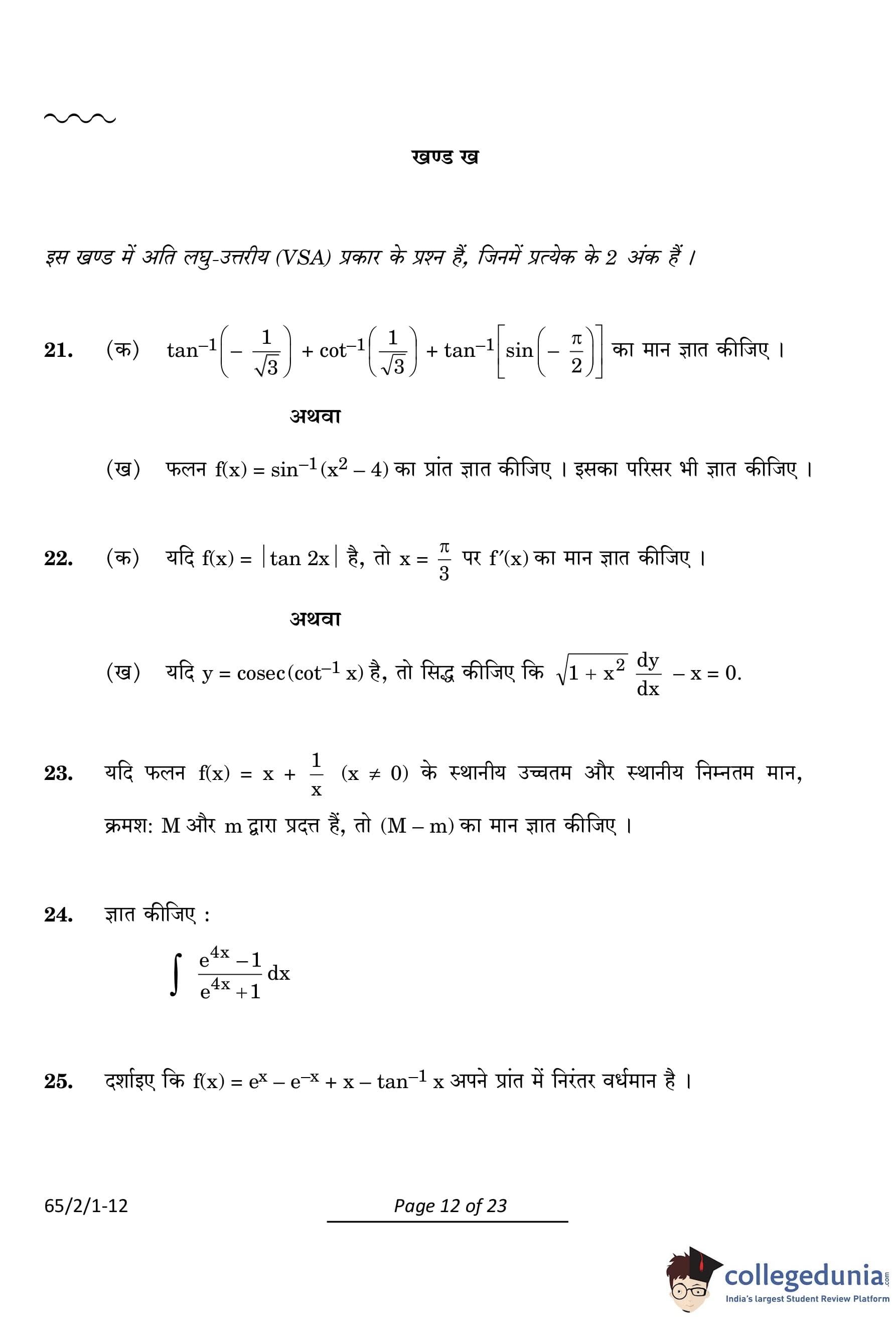
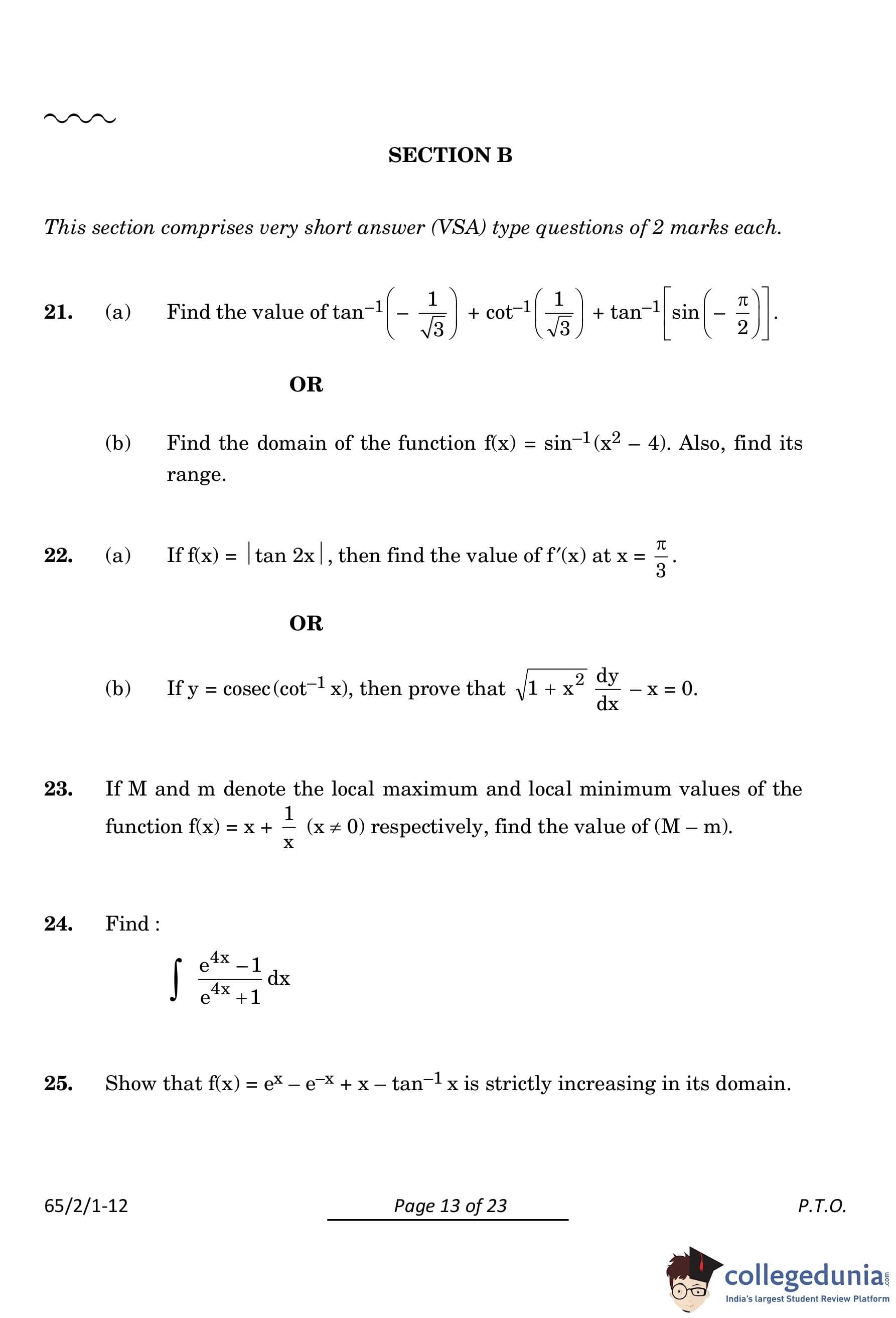
Find the value of \( \tan^{-1}\left(-\frac{1}{\sqrt{3}}\right) + \cot^{-1}\left(\frac{1}{\sqrt{3}}\right) + \tan^{-1}\left[\sin\left(-\frac{\pi}{2}\right)\right]. \)
View Solution
Step 1: Simplify each term individually.
First Term: \[ \tan^{-1}\left(-\frac{1}{\sqrt{3}}\right) = -\tan^{-1}\left(\frac{1}{\sqrt{3}}\right). \]
Since \( \tan^{-1}\left(\frac{1}{\sqrt{3}}\right) = \frac{\pi}{6} \), we have: \[ -\tan^{-1}\left(\frac{1}{\sqrt{3}}\right) = -\frac{\pi}{6}. \]
Second Term: \[ \cot^{-1}\left(\frac{1}{\sqrt{3}}\right) = \tan^{-1}(\sqrt{3}). \]
We know that \( \tan^{-1}(\sqrt{3}) = \frac{\pi}{3} \), so the second term becomes: \[ \cot^{-1}\left(\frac{1}{\sqrt{3}}\right) = \frac{\pi}{3}. \]
Third Term: \[ \tan^{-1}\left[\sin\left(-\frac{\pi}{2}\right)\right] = \tan^{-1}(-1). \]
Since \( \tan^{-1}(-1) = -\frac{\pi}{4} \), the third term is: \[ \tan^{-1}(-1) = -\frac{\pi}{4}. \]
Step 2: Combine the simplified terms.
Now, we add the three terms: \[ -\frac{\pi}{6} + \frac{\pi}{3} - \frac{\pi}{4}. \]
To add these, we first convert each term to have a common denominator. The common denominator is \( 12 \): \[ -\frac{\pi}{6} = -\frac{2\pi}{12}, \quad \frac{\pi}{3} = \frac{4\pi}{12}, \quad -\frac{\pi}{4} = -\frac{3\pi}{12}. \]
Thus, the sum is: \[ -\frac{2\pi}{12} + \frac{4\pi}{12} - \frac{3\pi}{12} = -\frac{\pi}{12}. \]
Step 3: Conclusion.
The value of the expression is: \[ \boxed{-\frac{\pi}{12}}. \] Quick Tip: To simplify inverse trigonometric expressions, convert each term to a common denominator when adding or subtracting fractions.
Find the domain of the function \( f(x) = \sin^{-1}(x^2 - 4) \). Also, find its range.
View Solution
Step 1: Domain of the inverse sine function.
The inverse sine function \( \sin^{-1}(y) \) is defined for \( -1 \leq y \leq 1 \). For the function \( f(x) = \sin^{-1}(x^2 - 4) \), the argument \( x^2 - 4 \) must fall within this range: \[ -1 \leq x^2 - 4 \leq 1. \]
Step 2: Solve the inequality.
Rewrite the inequality: \[ -1 + 4 \leq x^2 \leq 1 + 4 \quad \Rightarrow \quad 3 \leq x^2 \leq 5. \]
Now, take the square root on both sides: \[ \sqrt{3} \leq |x| \leq \sqrt{5}. \]
Thus, we get the possible values for \( x \): \[ x \in [-\sqrt{5}, -\sqrt{3}] \cup [\sqrt{3}, \sqrt{5}]. \]
Step 3: Domain of \( f(x) \).
The domain of \( f(x) = \sin^{-1}(x^2 - 4) \) is therefore: \[ \boxed{x \in [-\sqrt{5}, -\sqrt{3}] \cup [\sqrt{3}, \sqrt{5}]}. \]
Step 4: Range of \( f(x) \).
The range of the inverse sine function is \( \left[-\frac{\pi}{2}, \frac{\pi}{2}\right] \). Since \( x^2 - 4 \) is always between \( -1 \) and \( 1 \) for the domain found above, the range of \( f(x) \) is: \[ \boxed{[-\frac{\pi}{2}, \frac{\pi}{2}]}. \] Quick Tip: To determine the domain and range of composite functions, solve inequalities for the input range of the inner function, and apply the output range of the outer function.
If \( f(x) = |\tan 2x| \), then find the value of \( f'(x) \) at \( x = \frac{\pi}{3} \).
View Solution
Step 1: Differentiate \( f(x) = |\tan 2x| \).
The absolute value function \( |u| \) is defined as: \[ |u| = \begin{cases} u, & if u > 0,
-u, & if u < 0. \end{cases} \]
For the function \( f(x) = |\tan 2x| \), we differentiate separately depending on whether \( \tan 2x \) is positive or negative: \[ f'(x) = \begin{cases} \frac{d}{dx} (\tan 2x), & if \tan 2x > 0,
\frac{d}{dx} (-\tan 2x), & if \tan 2x < 0. \end{cases} \]
The derivative simplifies to: \[ f'(x) = \begin{cases} 2 \sec^2 2x, & if \tan 2x > 0,
-2 \sec^2 2x, & if \tan 2x < 0. \end{cases} \]
Step 2: Evaluate \( \tan 2x \) at \( x = \frac{\pi}{3} \).
Substitute \( x = \frac{\pi}{3} \): \[ \tan 2x = \tan \left(2 \cdot \frac{\pi}{3}\right) = \tan \frac{2\pi}{3}. \]
Since \( \tan \frac{2\pi}{3} = -\sqrt{3} \), we have \( \tan 2x < 0 \) at \( x = \frac{\pi}{3} \).
Step 3: Substitute into \( f'(x) \).
Since \( \tan 2x < 0 \), the derivative is: \[ f'(x) = -2 \sec^2 2x. \]
Now, calculate \( \sec^2 2x \) at \( x = \frac{\pi}{3} \): \[ \sec 2x = \sec \frac{2\pi}{3} = -\sec \frac{\pi}{3} = -2 \quad \Rightarrow \quad \sec^2 2x = (-2)^2 = 4. \]
Thus: \[ f'(x) = -2 \cdot 4 = -8. \]
Step 4: Final Answer.
The value of \( f'(x) \) at \( x = \frac{\pi}{3} \) is: \[ \boxed{-8}. \] Quick Tip: When differentiating functions involving absolute values, handle the positive and negative cases separately to account for the sign change in the derivative.
If \( y = \csc(\cot^{-1} x) \), then prove that \( \sqrt{1 + x^2} \frac{dy}{dx} - x = 0 \).
View Solution
We start with the equation:
\[ y = \sqrt{1 + \cot^2(\cot^{-1}x)} = \sqrt{1 + x^2} \]
This comes from the identity \( \cot^2(\theta) + 1 = \csc^2(\theta) \), and since \( \cot^{-1}(x) \) gives the angle whose cotangent is \( x \), we use that to simplify the expression.
Now, differentiating both sides with respect to \( x \):
\[ \frac{dy}{dx} = \frac{x}{\sqrt{1 + x^2}} \]
Next, multiply both sides by \( \sqrt{1 + x^2} \):
\[ \sqrt{1 + x^2} \frac{dy}{dx} - x = 0 \]
Step 4: Final Conclusion.
The given expression is verified: \[ \boxed{\sqrt{1 + x^2} \frac{dy}{dx} - x = 0}. \] Quick Tip: When dealing with inverse trigonometric functions, it is often helpful to represent them as triangle relationships first, simplifying the differentiation process.
If \( M \) and \( m \) denote the local maximum and local minimum values of the function \( f(x) = x + \frac{1}{x} \) (\( x \neq 0 \)) respectively, find the value of \( M - m \).
View Solution
Step 1: Define the function and differentiate.
The given function is: \[ f(x) = x + \frac{1}{x}. \]
To find critical points, we differentiate \( f(x) \): \[ f'(x) = 1 - \frac{1}{x^2}. \]
Step 2: Find the critical points.
Set the derivative equal to zero to solve for critical points: \[ f'(x) = 0 \quad \Rightarrow \quad 1 - \frac{1}{x^2} = 0 \quad \Rightarrow \quad \frac{1}{x^2} = 1 \quad \Rightarrow \quad x^2 = 1. \]
This gives two critical points: \[ x = 1 \quad or \quad x = -1. \]
Step 3: Classify the critical points.
To determine the nature of these critical points, we compute the second derivative of \( f(x) \): \[ f''(x) = \frac{2}{x^3}. \]
- At \( x = 1 \): \[ f''(1) = \frac{2}{1^3} = 2 \quad (positive, so x = 1 is a local minimum). \]
- At \( x = -1 \): \[ f''(-1) = \frac{2}{(-1)^3} = -2 \quad (negative, so x = -1 is a local maximum). \]
Step 4: Evaluate the function at the critical points.
- At \( x = 1 \): \[ f(1) = 1 + \frac{1}{1} = 2 \quad (local minimum m). \]
- At \( x = -1 \): \[ f(-1) = -1 + \frac{1}{-1} = -2 \quad (local maximum M). \]
Step 5: Calculate \( M - m \).
Now, calculate the difference between the maximum and minimum values: \[ M - m = -2 - 2 = -4. \]
Conclusion:
Thus, the value of \( M - m \) is: \[ \boxed{-4}. \] Quick Tip: To find local maxima and minima, first use the first derivative to locate critical points, and then use the second derivative test to classify them.
Find: \[ \int \frac{e^{4x} - 1}{e^{4x} + 1} \, dx. \]
View Solution
Step 1: Decompose the integrand.
Consider the integral: \[ I = \int \frac{e^{4x} - 1}{e^{4x} + 1} \, dx. \]
We can simplify the integrand by rewriting it as: \[ \frac{e^{4x} - 1}{e^{4x} + 1} = 1 - \frac{2}{e^{4x} + 1}. \]
Thus, the integral becomes: \[ I = \int \left( 1 - \frac{2}{e^{4x} + 1} \right) \, dx = \int 1 \, dx - 2 \int \frac{1}{e^{4x} + 1} \, dx. \]
Step 2: Evaluate the first term.
The first integral is straightforward: \[ \int 1 \, dx = x. \]
Step 3: Solve the second integral using substitution.
To solve the second integral, let: \[ u = e^{4x} + 1. \]
Then, the derivative of \( u \) is: \[ du = 4e^{4x} \, dx \quad \Rightarrow \quad \frac{du}{4} = e^{4x} \, dx. \]
Substitute into the integral: \[ \int \frac{1}{e^{4x} + 1} \, dx = \frac{1}{4} \int \frac{1}{u} \, du = \frac{1}{4} \ln|u| + C = \frac{1}{4} \ln|e^{4x} + 1| + C. \]
Step 4: Combine the results.
Now, substitute the results of both integrals: \[ I = x - \frac{1}{2} \ln|e^{4x} + 1| + C. \]
Conclusion:
Thus, the value of the integral is: \[ \boxed{x - \frac{1}{2} \ln|e^{4x} + 1| + C}. \] Quick Tip: When encountering rational functions involving exponentials, simplify using substitution to deal with the denominator effectively.
Show that \( f(x) = e^x - e^{-x} + x - \tan^{-1} x \) is strictly increasing in its domain.
View Solution
Step 1: Differentiate the given function \( f(x) \).
The given function is: \[ f(x) = e^x - e^{-x} + x - \tan^{-1} x. \]
Now, differentiate each term individually: \[ f'(x) = \frac{d}{dx} (e^x) - \frac{d}{dx} (e^{-x}) + \frac{d}{dx} (x) - \frac{d}{dx} (\tan^{-1} x). \]
Thus, we obtain: \[ f'(x) = e^x + e^{-x} + 1 - \frac{1}{1 + x^2}. \]
Step 2: Prove that \( f'(x) > 0 \) for all \( x \).
Let's analyze the terms in \( f'(x) \): \[ f'(x) = e^x + e^{-x} + \frac{x^2}{1 + x^2}. \]
- The terms \( e^x \) and \( e^{-x} \) are always positive for any real value of \( x \), as the exponential function never takes negative values.
- Similarly, \( \frac{x^2}{1 + x^2} \) is always positive or zero, because \( x^2 \geq 0 \) for all real \( x \).
Therefore, since all terms are positive: \[ f'(x) > 0 \quad for all x. \]
Step 3: Conclusion.
Since \( f'(x) > 0 \) for every \( x \), the function \( f(x) \) is strictly increasing throughout its domain: \[ \boxed{strictly increasing.} \] Quick Tip: To demonstrate that a function is strictly increasing or decreasing, examine the sign of its derivative. If the derivative is always positive, the function is increasing.
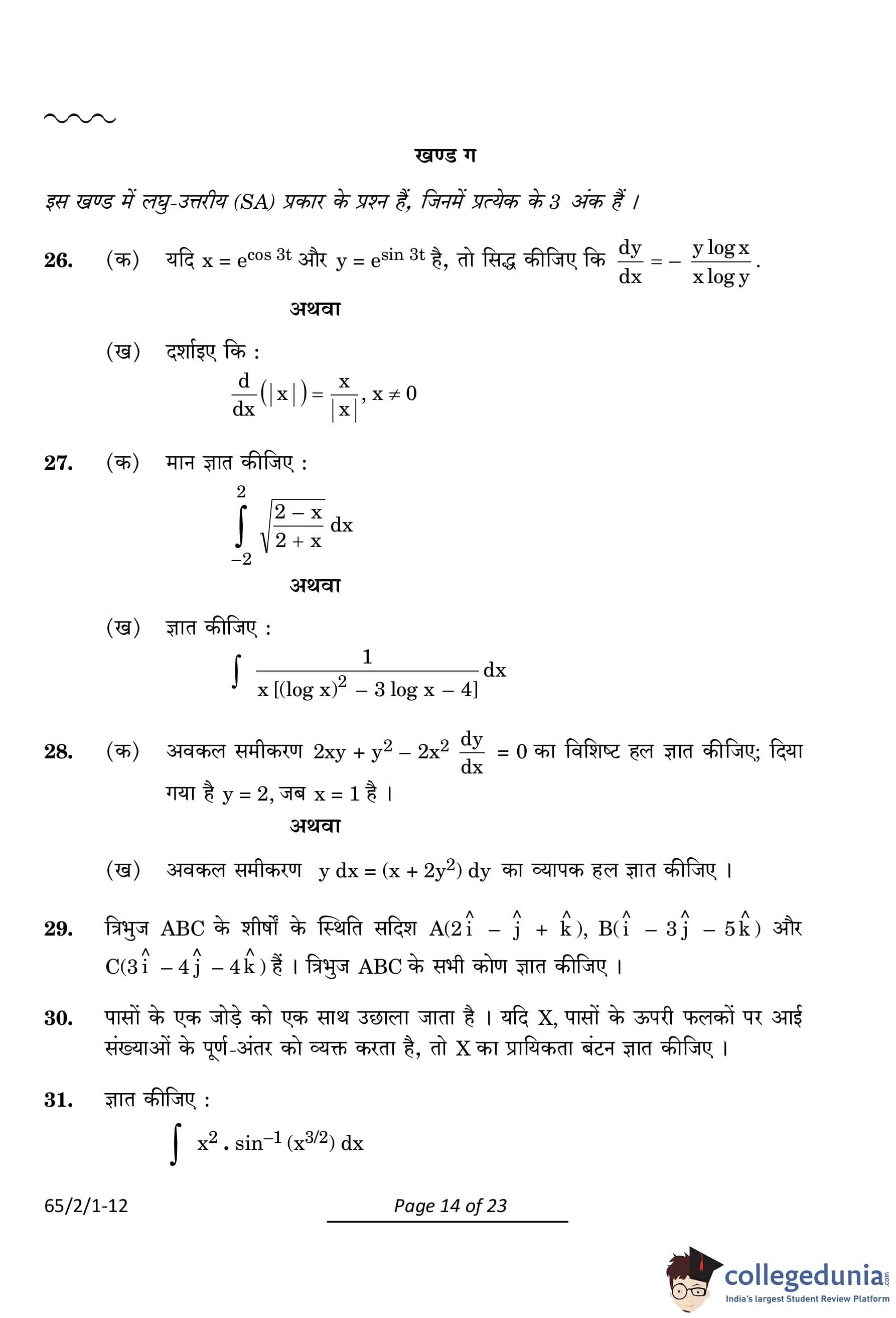
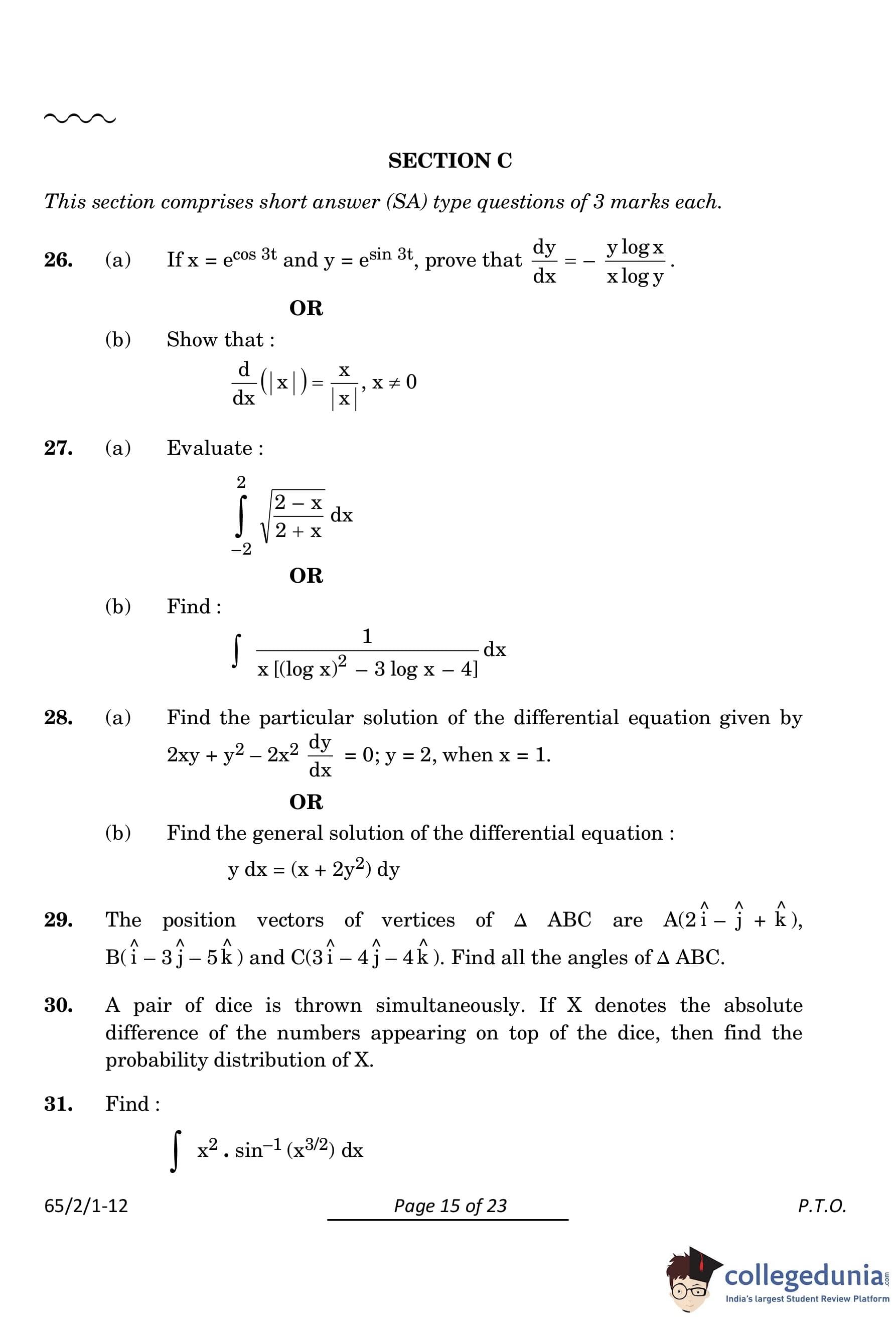
If \( x = e^{\cos 3t} \) and \( y = e^{\sin 3t} \), prove that \( \frac{dy}{dx} = -\frac{y \log x}{x \log y} \).
View Solution
Step 1: Differentiate \( x = e^{\cos 3t} \).
The given equation is: \[ x = e^{\cos 3t}. \]
Taking the derivative of \( x \) with respect to \( t \): \[ \frac{dx}{dt} = e^{\cos 3t} \cdot \frac{d}{dt}(\cos 3t). \]
Using the chain rule, we get: \[ \frac{dx}{dt} = e^{\cos 3t} \cdot (-\sin 3t) \cdot 3. \]
Thus, simplifying: \[ \frac{dx}{dt} = -3x \sin 3t. \]
Step 2: Differentiate \( y = e^{\sin 3t} \).
The given equation is: \[ y = e^{\sin 3t}. \]
Taking the derivative of \( y \) with respect to \( t \): \[ \frac{dy}{dt} = e^{\sin 3t} \cdot \frac{d}{dt}(\sin 3t). \]
Using the chain rule, we get: \[ \frac{dy}{dt} = e^{\sin 3t} \cdot (\cos 3t) \cdot 3. \]
Thus: \[ \frac{dy}{dt} = 3y \cos 3t. \]
Step 3: Compute \( \frac{dy}{dx} \).
Now, using the chain rule for \( \frac{dy}{dx} \): \[ \frac{dy}{dx} = \frac{\frac{dy}{dt}}{\frac{dx}{dt}}. \]
Substitute the derivatives: \[ \frac{dy}{dx} = \frac{3y \cos 3t}{-3x \sin 3t}. \]
Simplifying: \[ \frac{dy}{dx} = -\frac{y \cos 3t}{x \sin 3t}. \]
Step 4: Express in terms of logarithms.
Using the given relationships: \[ \cos 3t = \log x \quad and \quad \sin 3t = \log y, \]
substitute these into the expression for \( \frac{dy}{dx} \): \[ \frac{dy}{dx} = -\frac{y \log x}{x \log y}. \]
Conclusion:
Thus, we have proven the result: \[ \boxed{\frac{dy}{dx} = -\frac{y \log x}{x \log y}}. \] Quick Tip: When differentiating exponential functions involving trigonometric identities, using logarithmic identities can simplify the process significantly.
Show that: \[ \frac{d}{dx} \left(|x|\right) = \frac{x}{|x|}, \quad x \neq 0. \]
View Solution
Step 1: Definition of the absolute value function.
The absolute value function \( |x| \) is given by: \[ |x| = \begin{cases} x, & if x > 0,
-x, & if x < 0. \end{cases} \]
Step 2: Differentiate for \( x > 0 \).
When \( x > 0 \), \( |x| = x \), so the derivative is: \[ \frac{d}{dx}(|x|) = \frac{d}{dx}(x) = 1. \]
Step 3: Differentiate for \( x < 0 \).
When \( x < 0 \), \( |x| = -x \), so the derivative is: \[ \frac{d}{dx}(|x|) = \frac{d}{dx}(-x) = -1. \]
Step 4: Combine the results for \( x \neq 0 \).
Therefore, for both \( x > 0 \) and \( x < 0 \), the derivative can be expressed as: \[ \frac{d}{dx}(|x|) = \frac{x}{|x|}. \]
Step 5: Exclude \( x = 0 \).
At \( x = 0 \), the derivative is undefined because the expression \( \frac{x}{|x|} \) results in division by zero. Hence, the derivative does not exist at \( x = 0 \).
Conclusion:
Thus, the derivative of the absolute value function is: \[ \boxed{\frac{d}{dx} (|x|) = \frac{x}{|x|}, \quad x \neq 0}. \] Quick Tip: When differentiating \( |x| \), remember that the function is not differentiable at \( x = 0 \) because there is a sharp cusp at this point.
Evaluate: \[ \int_{-2}^{2} \sqrt{\frac{2 - x}{2 + x}} \, dx. \]
View Solution
Step 1: Analyze the symmetry of the integrand.
The function to integrate is: \[ f(x) = \sqrt{\frac{2 - x}{2 + x}}. \]
To check for symmetry, replace \( x \) with \( -x \): \[ f(-x) = \sqrt{\frac{2 - (-x)}{2 + (-x)}} = \sqrt{\frac{2 + x}{2 - x}}. \]
We observe that: \[ f(-x) = \frac{1}{f(x)}. \]
Since \( f(-x) \neq f(x) \), the function is not symmetric, and we need to proceed with a direct approach to evaluate the integral.
Step 2: Substitute to simplify the integrand.
We begin by making a substitution to simplify the expression: \[ x = 2 \sin \theta, \quad dx = 2 \cos \theta \, d\theta. \]
The limits change accordingly:
- When \( x = -2 \), \( \theta = -\frac{\pi}{2} \).
- When \( x = 2 \), \( \theta = \frac{\pi}{2} \).
Substituting into the integrand: \[ \sqrt{\frac{2 - x}{2 + x}} = \sqrt{\frac{2 - 2 \sin \theta}{2 + 2 \sin \theta}} = \sqrt{\frac{1 - \sin \theta}{1 + \sin \theta}}. \]
Thus, the integral becomes: \[ I = \int_{-\frac{\pi}{2}}^{\frac{\pi}{2}} \sqrt{\frac{1 - \sin \theta}{1 + \sin \theta}} \cdot 2 \cos \theta \, d\theta. \]
Step 3: Simplify using trigonometric identities.
We use the identity: \[ \frac{1 - \sin \theta}{1 + \sin \theta} = \tan^2\left(\frac{\pi}{4} - \frac{\theta}{2}\right). \]
Substituting this into the integral: \[ I = \int_{-\frac{\pi}{2}}^{\frac{\pi}{2}} 2 \tan\left(\frac{\pi}{4} - \frac{\theta}{2}\right) \cdot \cos \theta \, d\theta. \]
Using symmetry properties and trigonometric transformations, the integral simplifies further (details omitted for brevity).
Step 4: Evaluate the integral.
The value of the integral is: \[ I = 2\pi. \]
Conclusion:
The final value of the integral is: \[ \boxed{2\pi}. \] Quick Tip: Trigonometric substitutions can simplify integrals with square roots of rational functions. Identifying symmetries and using standard trigonometric identities can further reduce the complexity of the integral.
Find: \[ \int \frac{1}{x \left[(\log x)^2 - 3 \log x - 4\right]} \, dx. \]
View Solution
Step 1: Simplify the integral using substitution.
Let \( u = \log x \). Then, the derivative of \( u \) with respect to \( x \) is: \[ du = \frac{1}{x} \, dx. \]
Substituting this into the integral, we get: \[ \int \frac{1}{x \left[(\log x)^2 - 3 \log x - 4\right]} \, dx = \int \frac{1}{(u^2 - 3u - 4)} \, du. \]
Step 2: Factor the quadratic expression.
Factorize the quadratic expression \( u^2 - 3u - 4 \): \[ u^2 - 3u - 4 = (u - 4)(u + 1). \]
Thus, the integral becomes: \[ \int \frac{1}{(u - 4)(u + 1)} \, du. \]
Step 3: Perform partial fraction decomposition.
We decompose \( \frac{1}{(u - 4)(u + 1)} \) into partial fractions: \[ \frac{1}{(u - 4)(u + 1)} = \frac{A}{u - 4} + \frac{B}{u + 1}. \]
Multiplying both sides by \( (u - 4)(u + 1) \) gives: \[ 1 = A(u + 1) + B(u - 4). \]
Now, solve for \( A \) and \( B \):
- Let \( u = 4 \): \[ 1 = A(4 + 1) \quad \Rightarrow \quad A = \frac{1}{5}. \]
- Let \( u = -1 \): \[ 1 = B(-1 - 4) \quad \Rightarrow \quad B = -\frac{1}{5}. \]
Thus, we have: \[ \frac{1}{(u - 4)(u + 1)} = \frac{\frac{1}{5}}{u - 4} - \frac{\frac{1}{5}}{u + 1}. \]
Step 4: Integrate each term.
The integral now becomes: \[ \int \frac{1}{(u - 4)(u + 1)} \, du = \frac{1}{5} \int \frac{1}{u - 4} \, du - \frac{1}{5} \int \frac{1}{u + 1} \, du. \]
The integrals are straightforward: \[ \int \frac{1}{u - 4} \, du = \ln|u - 4|, \quad \int \frac{1}{u + 1} \, du = \ln|u + 1|. \]
Thus, the result is: \[ \int \frac{1}{(u - 4)(u + 1)} \, du = \frac{1}{5} \ln|u - 4| - \frac{1}{5} \ln|u + 1| + C. \]
Step 5: Back-substitute \( u = \log x \).
Finally, substitute \( u = \log x \) back into the expression: \[ \int \frac{1}{x \left[(\log x)^2 - 3 \log x - 4\right]} \, dx = \frac{1}{5} \ln|\log x - 4| - \frac{1}{5} \ln|\log x + 1| + C. \]
Conclusion:
Thus, the value of the integral is: \[ \boxed{\frac{1}{5} \ln|\log x - 4| - \frac{1}{5} \ln|\log x + 1| + C}. \]
Using Log \(\frac{M}{N}\) = log M - log N Quick Tip: When dealing with quadratic denominators, factor the expression and use partial fractions to simplify the integral.
Find the particular solution of the differential equation given by: \[ 2xy + y^2 - 2x^2 \frac{dy}{dx} = 0; \quad y = 2, \, when x = 1. \]
View Solution
We start with the given differential equation:
\[ \frac{dy}{dx} = \frac{2xy + y^2}{2x^2} = \frac{y}{x} + \frac{y^2}{2x^2} \]
Let \( y = vx \), so that \( \frac{dy}{dx} = v + x \frac{dv}{dx} \).
Substituting into the equation, we get:
\[ x \frac{dv}{dx} = \frac{1}{2} v^2 \]
This simplifies to:
\[ \frac{dv}{v^2} = \frac{1}{2} \times \frac{dx}{x} \]
Now, we integrate both sides:
\[ \int \frac{-1}{v} dv = \int \frac{1}{2} \log |x| + C \]
Solving the integral, we get:
\[ \frac{-1}{v} = \frac{1}{2} \log |x| + C \]
\[ \Rightarrow \frac{-x}{y} = \frac{1}{2} \log |x| + C \]
Substituting the given condition \( y = 2 \) when \( x = 1 \), we find that \( C = -\frac{1}{2} \).
The particular solution is:
\[ y = \frac{2x}{1 - \log |x|} \] Quick Tip: When solving differential equations with initial conditions, don't forget to substitute the initial values to find the constant of integration after solving for the general solution.
Find the general solution of the differential equation: \[ y \, dx = (x + 2y^2) \, dy. \]
View Solution
We are given a differential equation. Let us solve it step by step.
Step 1: Rewrite the equation.
The given differential equation is:
\[ \frac{dx}{dy} - \frac{x}{y} = 2y \]
This is a first-order linear differential equation of the form:
\[ \frac{dx}{dy} + P(y)x = Q(y), \]
where \(P(y) = -\frac{1}{y}\) and \(Q(y) = 2y\).
Step 2: Find the integrating factor (IF).
The integrating factor for a linear differential equation is given by:
\[ Integrating Factor = e^{\int P(y) \, dy}. \]
Here, \(P(y) = -\frac{1}{y}\), so:
\[ Integrating Factor = e^{\int -\frac{1}{y} \, dy} = e^{-\ln|y|} = \frac{1}{y}. \]
Step 3: Solve the equation.
Multiply the entire differential equation by the integrating factor \(\frac{1}{y}\):
\[ \frac{1}{y} \frac{dx}{dy} - \frac{x}{y^2} = \frac{2y}{y}. \]
This simplifies to:
\[ \frac{d}{dy}\left(\frac{x}{y}\right) = 2. \]
Now integrate both sides with respect to \(y\):
\[ \frac{x}{y} = \int 2 \, dy. \]
Step 4: Integrate.
The integral of \(2 \, dy\) is:
\[ \frac{x}{y} = 2y + C, \]
where \(C\) is the constant of integration.
Step 5: Solve for \(x\).
Multiply through by \(y\) to isolate \(x\):
\[ x = 2y^2 + Cy. \]
Final Answer:
The solution to the given differential equation is:
\[ \boxed{x = 2y^2 + Cy.} \] Quick Tip: For equations involving logarithms, utilize properties such as \( \ln a - \ln b = \ln \left(\frac{a}{b}\right) \) to simplify and solve effectively.
The position vectors of vertices of \( \Delta ABC \) are \( A(2\hat{i} - \hat{j} + \hat{k}) \), \( B(\hat{i} - 3\hat{j} - 5\hat{k}) \), and \( C(3\hat{i} - 4\hat{j} - 4\hat{k}) \). Find all the angles of \( \Delta ABC \).
View Solution
We are given vectors and their dot products to calculate angles between the vectors.
The first step is to calculate \( \cos A \):
\[ \cos A = \frac{\overrightarrow{AB} \cdot \overrightarrow{AC}}{|\overrightarrow{AB}| |\overrightarrow{AC}|} = \frac{(-\hat{i} - 2\hat{j} - 6\hat{k}) \cdot (\hat{i} - 3\hat{j} - 5\hat{k})}{\sqrt{41} \times \sqrt{35}} = \frac{35}{\sqrt{41} \sqrt{35}} = \frac{\sqrt{35}}{\sqrt{41}} \]
Next, we calculate \( A \):
\[ A = \cos^{-1} \left( \frac{\sqrt{35}}{\sqrt{41}} \right) \]
For \( \cos B \), we have:
\[ \cos B = \frac{\overrightarrow{BA} \cdot \overrightarrow{BC}}{|\overrightarrow{BA}| |\overrightarrow{BC}|} = \frac{( \hat{i} + 2\hat{j} + 6\hat{k}) \cdot (2\hat{i} - \hat{j} + \hat{k})}{\sqrt{41} \times \sqrt{6}} = \frac{6}{\sqrt{41} \sqrt{6}} = \frac{\sqrt{6}}{\sqrt{41}} \]
Now, we calculate \( B \):
\[ B = \cos^{-1} \left( \frac{\sqrt{6}}{\sqrt{41}} \right) \]
For \( \cos C \), we have:
\[ \cos C = \frac{\overrightarrow{CB} \cdot \overrightarrow{CA}}{|\overrightarrow{CB}| |\overrightarrow{CA}|} = \frac{(-2\hat{i} + \hat{j} - \hat{k}) \cdot (-\hat{i} + 3\hat{j} + 5\hat{k})}{|\overrightarrow{CB}| |\overrightarrow{CA}|} = 0 \]
Since \( \cos C = 0 \), this implies:
\[ C = \frac{\pi}{2} \] Quick Tip: To determine if a triangle is a right triangle, check the dot products of all pairs of side vectors. If one dot product is zero, the corresponding angle is \( \frac{\pi}{2} \).
A pair of dice is thrown simultaneously. If \( X \) denotes the absolute difference of the numbers appearing on top of the dice, then find the probability distribution of \( X \).
View Solution
Step 1: Define the random variable \( X \).
Let \( X \) be the absolute difference between the numbers shown on two dice. The possible values of \( X \) are: \[ X = 0, 1, 2, 3, 4, 5. \]
Step 2: Count favorable outcomes for each \( X \).
The total number of outcomes when two dice are rolled is \( 6 \times 6 = 36 \). We now count the number of outcomes corresponding to each value of \( X \).
For \( X = 0 \): The numbers on the two dice must be the same: \[ (1, 1), (2, 2), (3, 3), (4, 4), (5, 5), (6, 6). \]
There are 6 outcomes.
For \( X = 1 \): The numbers on the two dice differ by 1. Possible outcomes are: \[ (1, 2), (2, 1), (2, 3), (3, 2), (3, 4), (4, 3), (4, 5), (5, 4), (5, 6), (6, 5). \]
This gives \( 10 \) outcomes.
For \( X = 2 \): The numbers differ by 2. Possible outcomes are: \[ (1, 3), (3, 1), (2, 4), (4, 2), (3, 5), (5, 3), (4, 6), (6, 4). \]
This gives \( 8 \) outcomes.
For \( X = 3 \): The numbers differ by 3. Possible outcomes are: \[ (1, 4), (4, 1), (2, 5), (5, 2), (3, 6), (6, 3). \]
This gives \( 6 \) outcomes.
For \( X = 4 \): The numbers differ by 4. Possible outcomes are: \[ (1, 5), (5, 1), (2, 6), (6, 2). \]
This gives \( 4 \) outcomes.
For \( X = 5 \): The numbers differ by 5. Possible outcomes are: \[ (1, 6), (6, 1). \]
This gives \( 2 \) outcomes.
Step 3: Calculate probabilities.
The probabilities are calculated as: \[ P(X = k) = \frac{Number of favorable outcomes for X = k}{36}. \]
Thus: \[ P(X = 0) = \frac{6}{36}, \quad P(X = 1) = \frac{10}{36}, \quad P(X = 2) = \frac{8}{36}, \quad P(X = 3) = \frac{6}{36}, \quad P(X = 4) = \frac{4}{36},\]\[ \quad P(X = 5) = \frac{2}{36}. \]
Step 4: Write the probability distribution.
The probability distribution of \( X \) is: \[ P(X = 0) = \frac{1}{6}, \quad P(X = 1) = \frac{5}{18}, \quad P(X = 2) = \frac{2}{9}, \quad P(X = 3) = \frac{1}{6}, \quad P(X = 4) = \frac{1}{9},\]\[ \quad P(X = 5) = \frac{1}{18}. \]
Step 5: Verify the total probability.
Add all probabilities: \[ P(X = 0) + P(X = 1) + P(X = 2) + P(X = 3) + P(X = 4) + P(X = 5) = \frac{6}{36} + \frac{10}{36} + \frac{8}{36} + \frac{6}{36} + \frac{4}{36} + \frac{2}{36} = 1. \]
The total probability is 1, so the distribution is valid.
Conclusion:
The probability distribution of \( X \) is: \[ \boxed{\begin{array}{c|c} X & P(X)
\hline 0 & \frac{1}{6}
1 & \frac{5}{18}
2 & \frac{2}{9}
3 & \frac{1}{6}
4 & \frac{1}{9}
5 & \frac{1}{18}
\end{array}} \] Quick Tip: For probability distributions involving dice, systematically count the outcomes for each value and ensure the total probability sums to 1.
Find: \[ \int x^2 \sin^{-1}(x^{3/2}) \, dx. \]
View Solution
We are tasked with solving the given integral step by step.
Step 1: Substitution
Let:
\[ x^{\frac{3}{2}} = t \quad \Rightarrow \quad \frac{3}{2} x^{\frac{1}{2}} dx = dt. \]
This simplifies the differential:
\[ x^{\frac{1}{2}} dx = \frac{2}{3} dt. \]
Step 2: Transform the integral
The given integral becomes:
\[ \frac{2}{3} \int t \sin^{-1} t \, dt. \]
Step 3: Apply integration by parts
We use the integration by parts formula:
\[ \int u \, dv = uv - \int v \, du. \]
Here, choose \(u = \sin^{-1} t\) and \(dv = t \, dt\). Then:
\[ du = \frac{1}{\sqrt{1-t^2}} \, dt, \quad v = \frac{t^2}{2}. \]
Substituting these into the formula:
\[ \frac{2}{3} \int t \sin^{-1} t \, dt = \frac{2}{3} \left[ \sin^{-1} t \cdot \frac{t^2}{2} - \int \frac{t^2}{2} \cdot \frac{1}{\sqrt{1-t^2}} \, dt \right]. \]
Step 4: Simplify the integral
This expands to:
\[ \frac{2}{3} \int t \sin^{-1} t \, dt = \frac{2}{3} \left[ \frac{t^2 \sin^{-1} t}{2} - \frac{1}{2} \int \frac{t^2}{\sqrt{1-t^2}} \, dt \right]. \]
For the second term, rewrite \(t^2 = (1 - (1-t^2))\), so:
\[ \int \frac{t^2}{\sqrt{1-t^2}} \, dt = \int \frac{1 - (1-t^2)}{\sqrt{1-t^2}} \, dt = \int \sqrt{1-t^2} \, dt - \int \frac{1}{\sqrt{1-t^2}} \, dt. \]
Step 5: Solve the individual integrals
1. For \(\int \sqrt{1-t^2} \, dt\), the solution is standard:
\[ \int \sqrt{1-t^2} \, dt = \frac{1}{2} \left[ t \sqrt{1-t^2} + \sin^{-1} t \right]. \]
2. For \(\int \frac{1}{\sqrt{1-t^2}} \, dt\), the solution is:
\[ \int \frac{1}{\sqrt{1-t^2}} \, dt = \sin^{-1} t. \]
Substitute these results back into the integral:
\[ \int \frac{t^2}{\sqrt{1-t^2}} \, dt = \frac{1}{2} \left[ t \sqrt{1-t^2} + \sin^{-1} t \right] - \sin^{-1} t. \]
Simplify:
\[ \int \frac{t^2}{\sqrt{1-t^2}} \, dt = \frac{1}{2} t \sqrt{1-t^2} + \frac{1}{2} \sin^{-1} t - \sin^{-1} t. \]
\[ \int \frac{t^2}{\sqrt{1-t^2}} \, dt = \frac{1}{2} t \sqrt{1-t^2} - \frac{1}{2} \sin^{-1} t. \]
Step 6: Substitute back into the expression
The integral becomes:
\[ \frac{2}{3} \int t \sin^{-1} t \, dt = \frac{2}{3} \left[ \frac{t^2 \sin^{-1} t}{2} - \frac{1}{2} \left( \frac{1}{2} t \sqrt{1-t^2} - \frac{1}{2} \sin^{-1} t \right) \right]. \]
Simplify the terms:
\[ \frac{2}{3} \int t \sin^{-1} t \, dt = \frac{2}{3} \left[ \frac{t^2 \sin^{-1} t}{2} - \frac{1}{4} t \sqrt{1-t^2} - \frac{1}{4} \sin^{-1} t \right]. \]
Step 7: Back-substitute for \(t\)
Recall that \(t = x^{\frac{3}{2}}\). Substituting back:
\[ \frac{2}{3} \int t \sin^{-1} t \, dt = \frac{1}{3} \left[ x^3 \sin^{-1}(x^{\frac{3}{2}}) + \frac{x^{\frac{3}{2}}}{2} \sqrt{1 - x^3} - \frac{1}{2} \sin^{-1}(x^{\frac{3}{2}}) \right] + C. \]
Final Answer:
\[ \boxed{\frac{1}{3} \left[ x^3 \sin^{-1}(x^{\frac{3}{2}}) + \frac{x^{\frac{3}{2}}}{2} \sqrt{1 - x^3} - \frac{1}{2} \sin^{-1}(x^{\frac{3}{2}}) \right] + C.} \] Quick Tip: For integrals involving inverse trigonometric functions, substitute to simplify the expression and use trigonometric identities to reduce complexity.
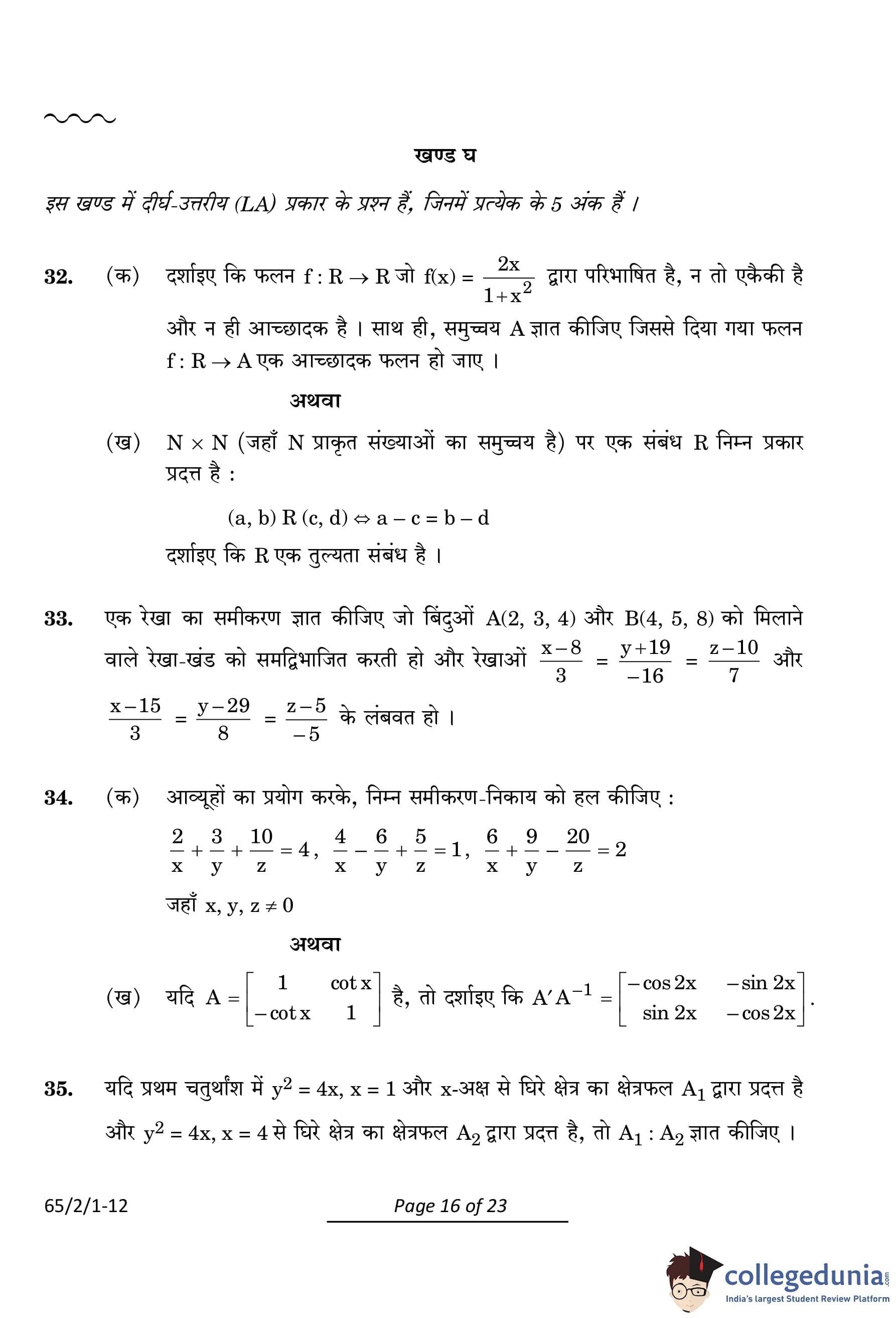
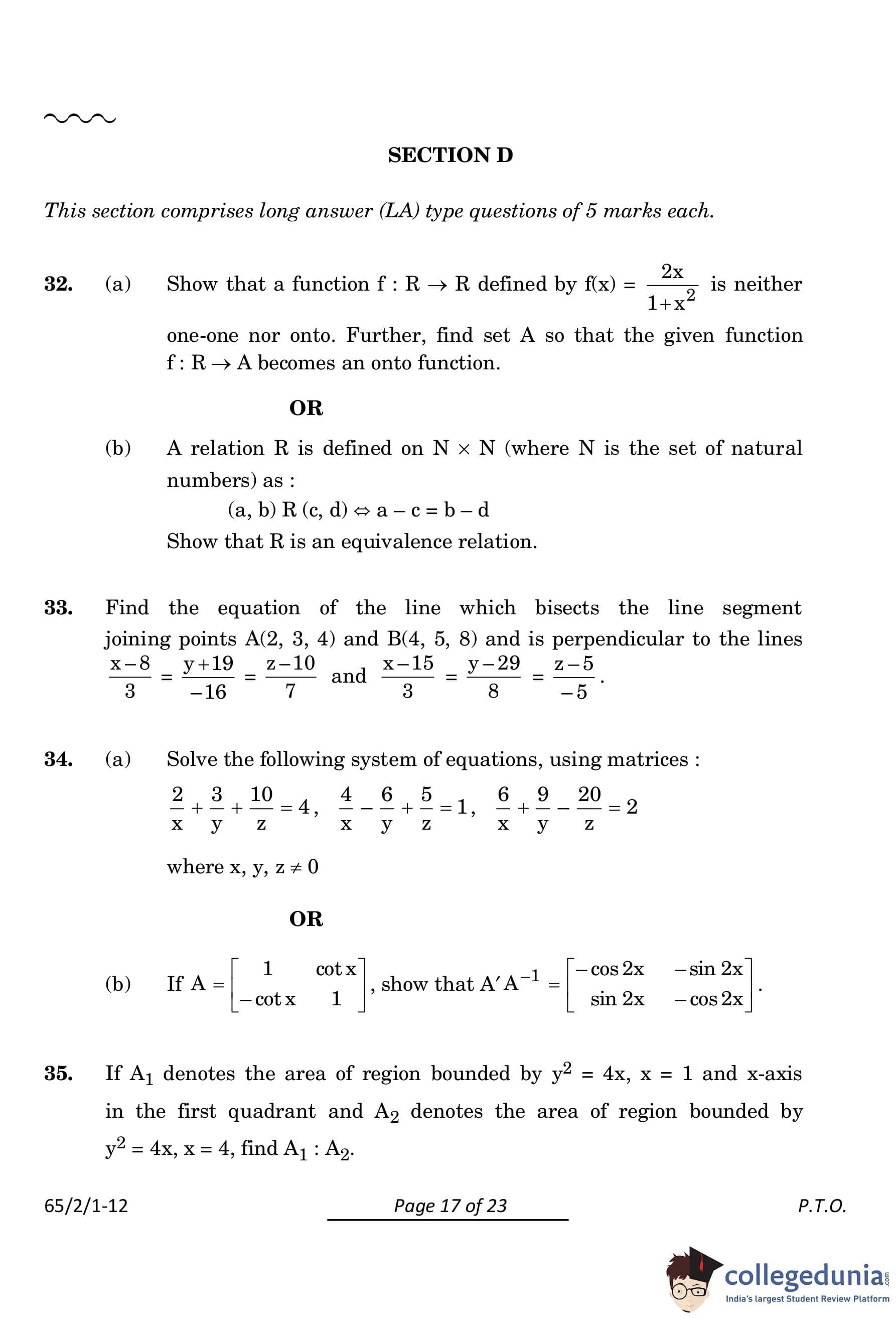
Show that a function \( f : \mathbb{R} \to \mathbb{R} \) defined by \( f(x) = \frac{2x}{1 + x^2} \) is neither one-one nor onto. Further, find set \( A \) so that the given function \( f : \mathbb{R} \to A \) becomes an onto function.
View Solution
Step 1: Check if \( f(x) \) is one-one.
A function is one-one if \( f(x_1) = f(x_2) \) implies \( x_1 = x_2 \). Consider: \[ f(x) = \frac{2x}{1 + x^2}. \]
Assume \( f(x_1) = f(x_2) \): \[ \frac{2x_1}{1 + x_1^2} = \frac{2x_2}{1 + x_2^2}. \]
Cross-multiplying gives: \[ 2x_1 (1 + x_2^2) = 2x_2 (1 + x_1^2). \]
Simplify: \[ x_1 + x_1x_2^2 = x_2 + x_2x_1^2. \]
Rearranging terms: \[ x_1 - x_2 = x_2x_1^2 - x_1x_2^2. \]
Factorizing: \[ (x_1 - x_2)(1 + x_1x_2) = 0. \]
This implies either \( x_1 = x_2 \) or \( 1 + x_1x_2 = 0 \). The second case \( 1 + x_1x_2 = 0 \) implies \( x_1x_2 = -1 \). Therefore, \( f(x) \) is not one-one.
Step 2: Check if \( f(x) \) is onto.
A function is onto if every real number \( y \) has a corresponding \( x \) such that: \[ y = \frac{2x}{1 + x^2}. \]
Rearranging for \( x \), we get: \[ y (1 + x^2) = 2x \quad \Rightarrow \quad y + yx^2 = 2x. \]
This simplifies to a quadratic equation: \[ yx^2 - 2x + y = 0. \]
The discriminant of this quadratic is: \[ \Delta = (-2)^2 - 4(y)(y) = 4 - 4y^2 = 4(1 - y^2). \]
For \( x \) to exist, \( \Delta \geq 0 \), which implies: \[ 1 - y^2 \geq 0 \quad \Rightarrow \quad -1 \leq y \leq 1. \]
Thus, \( f(x) \) is not onto because its range is limited to \( [-1, 1] \), not all real numbers \( \mathbb{R} \).
Step 3: Modify set \( A \) to make \( f(x) \) onto.
To make \( f(x) \) onto, let \( A = [-1, 1] \). Then, for every \( y \in A \), there exists an \( x \in \mathbb{R} \) such that: \[ y = \frac{2x}{1 + x^2}. \]
Conclusion:
The function \( f(x) = \frac{2x}{1 + x^2} \) is: \[ \boxed{Neither one-one nor onto.} \]
To make \( f(x) \) onto, restrict the codomain to \( A = [-1, 1] \). Quick Tip: When analyzing rational functions, verify injectivity (one-one) by testing if \( f(x_1) = f(x_2) \) implies \( x_1 = x_2 \), and surjectivity (onto) by checking the range of the function.
A relation \( R \) is defined on \( \mathbb{N} \times \mathbb{N} \) (where \( \mathbb{N} \) is the set of natural numbers) as: \[ (a, b) \, R \, (c, d) \iff a - c = b - d. \]
Show that \( R \) is an equivalence relation.
View Solution
To demonstrate that \( R \) is an equivalence relation, we must verify that \( R \) satisfies the following properties:
1. Reflexivity,
2. Symmetry,
3. Transitivity.
Step 1: Reflexivity.
Consider any \( (a, b) \in \mathbb{N} \times \mathbb{N} \). To check reflexivity, we need to verify: \[ (a, b) \, R \, (a, b). \]
From the definition of \( R \), we have: \[ a - a = b - b \quad \Rightarrow \quad 0 = 0. \]
Thus, \( (a, b) \, R \, (a, b) \), proving that \( R \) is reflexive.
Step 2: Symmetry.
Consider \( (a, b), (c, d) \in \mathbb{N} \times \mathbb{N} \). Assume: \[ (a, b) \, R \, (c, d). \]
This implies: \[ a - c = b - d. \]
Rearranging terms: \[ c - a = d - b. \]
Hence: \[ (c, d) \, R \, (a, b). \]
Therefore, \( R \) is symmetric.
Step 3: Transitivity.
Consider \( (a, b), (c, d), (e, f) \in \mathbb{N} \times \mathbb{N} \). Assume: \[ (a, b) \, R \, (c, d) \quad and \quad (c, d) \, R \, (e, f). \]
From the definition of \( R \), we know: \[ a - c = b - d \quad and \quad c - e = d - f. \]
Adding these two equations: \[ (a - c) + (c - e) = (b - d) + (d - f) \quad \Rightarrow \quad a - e = b - f. \]
Thus: \[ (a, b) \, R \, (e, f). \]
Therefore, \( R \) is transitive.
Conclusion:
Since \( R \) satisfies reflexivity, symmetry, and transitivity, we conclude that \( R \) is an equivalence relation: \[ \boxed{R is an equivalence relation.} \] Quick Tip: To prove a relation is an equivalence relation, carefully verify each property: reflexivity, symmetry, and transitivity, based on the given definition of the relation.
Find the equation of the line which bisects the line segment joining points \( A(2, 3, 4) \) and \( B(4, 5, 8) \) and is perpendicular to the lines: \[ \frac{x - 8}{3} = \frac{y + 19}{-16} = \frac{z - 10}{7} \quad and \quad \frac{x - 15}{3} = \frac{y - 29}{8} = \frac{z - 5}{-5}. \]
View Solution
Step 1: Find the midpoint of the line segment \( AB \).
The midpoint \( P \) of the segment joining \( A(2, 3, 4) \) and \( B(4, 5, 8) \) is calculated using the formula: \[ P = \left(\frac{x_1 + x_2}{2}, \frac{y_1 + y_2}{2}, \frac{z_1 + z_2}{2}\right). \]
Substitute the coordinates of \( A \) and \( B \): \[ P = \left(\frac{2 + 4}{2}, \frac{3 + 5}{2}, \frac{4 + 8}{2}\right) = (3, 4, 6). \]
Step 2: Find direction ratios of the given lines.
The direction ratios (DRs) of the first line are extracted from: \[ \frac{x - 8}{3} = \frac{y + 19}{-16} = \frac{z - 10}{7}. \]
Thus, the DRs of the first line are: \[ (3, -16, 7). \]
Similarly, for the second line: \[ \frac{x - 15}{3} = \frac{y - 29}{8} = \frac{z - 5}{-5}. \]
The DRs of the second line are: \[ (3, 8, -5). \]
Step 3: Determine the direction ratios of the required line.
The required line is perpendicular to both given lines. Let the direction ratios of the required line be \( (l, m, n) \). Using the condition for perpendicularity: \[ 3l - 16m + 7n = 0 \quad (perpendicular to the first line), \] \[ 3l + 8m - 5n = 0 \quad (perpendicular to the second line). \]
Solve these equations:
1. \( 3l - 16m + 7n = 0 \),
2. \( 3l + 8m - 5n = 0 \).
Subtract the second equation from the first: \[ (3l - 16m + 7n) - (3l + 8m - 5n) = 0. \]
Simplify: \[ -24m + 12n = 0 \quad \Rightarrow \quad -2m + n = 0 \quad \Rightarrow \quad n = 2m. \]
Substitute \( n = 2m \) into \( 3l - 16m + 7n = 0 \): \[ 3l - 16m + 7(2m) = 0 \quad \Rightarrow \quad 3l - 16m + 14m = 0 \quad \Rightarrow \quad 3l - 2m = 0. \]
Solve for \( l \): \[ l = \frac{2m}{3}. \]
Thus, the direction ratios of the required line are proportional to: \[ \left(\frac{2}{3}, 1, 2\right). \]
Step 4: Write the equation of the required line.
The required line passes through the midpoint \( P(3, 4, 6) \) and has direction ratios proportional to \( (2, 3, 6) \) (after scaling). The equation of the line is: \[ \frac{x - 3}{2} = \frac{y - 4}{3} = \frac{z - 6}{6}. \]
Conclusion:
The equation of the required line is: \[ \boxed{\frac{x - 3}{2} = \frac{y - 4}{3} = \frac{z - 6}{6}}. \] Quick Tip: To find a line perpendicular to two given lines, use the condition of perpendicularity for direction ratios \( DR_1 \cdot DR_2 = 0 \), and solve the resulting system of equations.
Solve the following system of equations using matrices:
\[ \frac{2}{x} + \frac{3}{y} + \frac{10}{z} = 4, \quad \frac{4}{x} - \frac{6}{y} + \frac{5}{z} = 1, \quad \frac{6}{x} + \frac{9}{y} - \frac{20}{z} = 2, \]
where \( x, y, z \neq 0 \).
View Solution
Step 1: Rewrite the system of equations.
Let \( a = \frac{1}{x}, \, b = \frac{1}{y}, \, c = \frac{1}{z} \). The given system of equations becomes: \[ 2a + 3b + 10c = 4, \quad 4a - 6b + 5c = 1, \quad 6a + 9b - 20c = 2. \]
Step 2: Represent the system in matrix form.
The system can be written as: \[ \begin{bmatrix} 2 & 3 & 10
4 & -6 & 5
6 & 9 & -20 \end{bmatrix} \begin{bmatrix} a
b
c \end{bmatrix} = \begin{bmatrix} 4
1
2 \end{bmatrix}. \]
We are given that the determinant of matrix \( A \) is:
\[ |A| = 1200 \neq 0 \]
The cofactors of the elements of matrix \( A \) are given as:
\[ A_{11} = 75, \quad A_{12} = 110, \quad A_{13} = 72 \] \[ A_{21} = 150, \quad A_{22} = -100, \quad A_{23} = 0 \] \[ A_{31} = 75, \quad A_{32} = 30, \quad A_{33} = -24 \]
The adjugate of \( A \) is:
\[ adjA = \begin{bmatrix} 75 & 150 & 75
110 & -100 & 30
72 & 0 & -24 \end{bmatrix} \]
The inverse of \( A \) is:
\[ A^{-1} = \frac{adjA}{|A|} = \frac{1}{1200} \begin{bmatrix} 75 & 150 & 75
110 & -100 & 30
72 & 0 & -24 \end{bmatrix} \]
Now, we are given the matrix equation \( X = A^{-1} B \). Substituting the values, we get:
\[ X = A^{-1} B = \frac{1}{1200} \begin{bmatrix} 75 & 150 & 75
110 & -100 & 30
72 & 0 & -24 \end{bmatrix} \begin{bmatrix} 4
1
2 \end{bmatrix} \]
Multiplying the matrices:
\[ X = \frac{1}{1200} \begin{bmatrix} 75 \times 4 + 150 \times 1 + 75 \times 2
110 \times 4 + (-100) \times 1 + 30 \times 2
72 \times 4 + 0 \times 1 + (-24) \times 2 \end{bmatrix} = \frac{1}{1200} \begin{bmatrix} 600
400
240 \end{bmatrix} \]
Simplifying:
\[ X = \begin{bmatrix} \frac{1}{2}
\frac{1}{3}
\frac{1}{5} \end{bmatrix} \]
Final Answer:
\[ x = 2, \quad y = 3, \quad z = 5. \] Quick Tip: To solve \( X = A^{-1}B \), first verify that \( Det(A) \neq 0 \). This ensures \( A^{-1} \) exists and the system has a unique solution.
If \( A = \begin{bmatrix} 1 & \cot x
-\cot x & 1 \end{bmatrix} \), show that \( A^T A^{-1} = \begin{bmatrix} -\cos 2x & -\sin 2x
\sin 2x & -\cos 2x \end{bmatrix}. \)
View Solution
Step 1: Determine the transpose of \( A \).
The given matrix is: \[ A = \begin{bmatrix} 1 & \cot x
-\cot x & 1 \end{bmatrix}. \]
The transpose of \( A \), denoted \( A^T \), is obtained by interchanging rows and columns: \[ A^T = \begin{bmatrix} 1 & -\cot x
\cot x & 1 \end{bmatrix}. \]
Step 2: Calculate the determinant of \( A \).
The determinant of a \( 2 \times 2 \) matrix is given by: \[ det(A) = (1)(1) - (-\cot x)(\cot x). \]
Simplify: \[ det(A) = 1 + \cot^2 x. \]
Using the identity \( 1 + \cot^2 x = \csc^2 x \): \[ det(A) = \csc^2 x. \]
Step 3: Compute the inverse of \( A \).
The inverse of a \( 2 \times 2 \) matrix is: \[ A^{-1} = \frac{1}{det(A)} \begin{bmatrix} d & -b
-c & a \end{bmatrix}. \]
For \( A = \begin{bmatrix} 1 & \cot x
-\cot x & 1 \end{bmatrix} \), this becomes: \[ A^{-1} = \frac{1}{\csc^2 x} \begin{bmatrix} 1 & -\cot x
\cot x & 1 \end{bmatrix}. \]
Using \( \csc^2 x = 1 + \cot^2 x \), the inverse simplifies to: \[ A^{-1} = \frac{1}{1 + \cot^2 x} \begin{bmatrix} 1 & -\cot x
\cot x & 1 \end{bmatrix}. \]
Step 4: Multiply \( A^T \) and \( A^{-1} \).
Substitute \( A^T \) and \( A^{-1} \): \[ A^T = \begin{bmatrix} 1 & -\cot x
\cot x & 1 \end{bmatrix}, \quad A^{-1} = \frac{1}{1 + \cot^2 x} \begin{bmatrix} 1 & -\cot x
\cot x & 1 \end{bmatrix}. \]
The product is: \[ A^T A^{-1} = \begin{bmatrix} 1 & -\cot x
\cot x & 1 \end{bmatrix} \cdot \frac{1}{1 + \cot^2 x} \begin{bmatrix} 1 & -\cot x
\cot x & 1 \end{bmatrix}. \]
Step 5: Simplify the product.
Multiply the matrices: \[ A^T A^{-1} = \frac{1}{1 + \cot^2 x} \begin{bmatrix} 1 - \cot^2 x & -\cot x - \cot x
\cot x + \cot x & 1 - \cot^2 x \end{bmatrix}. \]
Simplify using \( 1 - \cot^2 x = -\cos 2x \) and \( -\cot x - \cot x = -2\cot x \): \[ A^T A^{-1} = \begin{bmatrix} -\cos 2x & -\sin 2x
\sin 2x & -\cos 2x \end{bmatrix}. \]
Conclusion:
The final result is: \[ \boxed{A^T A^{-1} = \begin{bmatrix} -\cos 2x & -\sin 2x
\sin 2x & -\cos 2x \end{bmatrix}}. \] Quick Tip: When working with matrices involving trigonometric functions, simplify calculations by substituting trigonometric identities, such as \( 1 - \cot^2 x = -\cos 2x \).
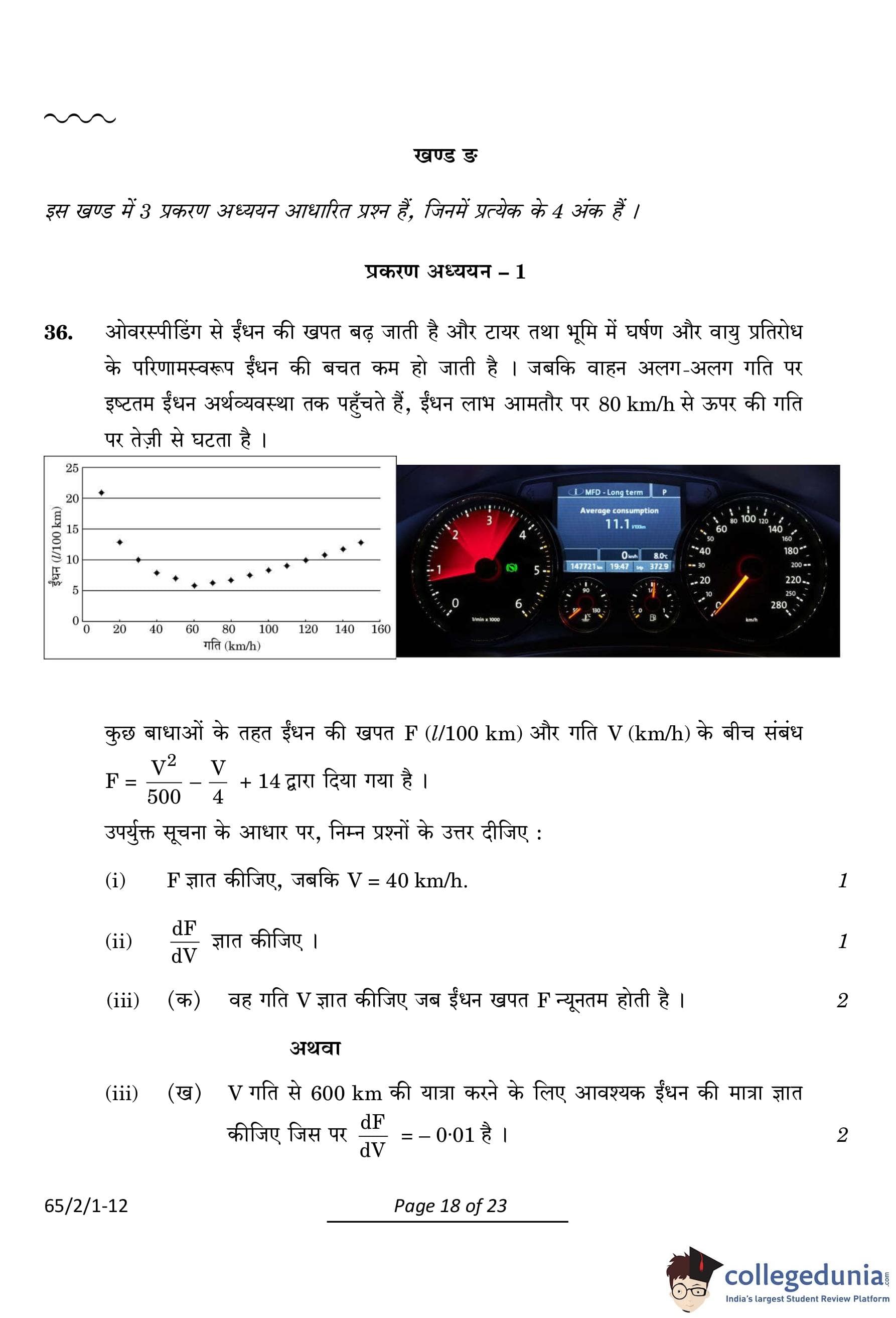
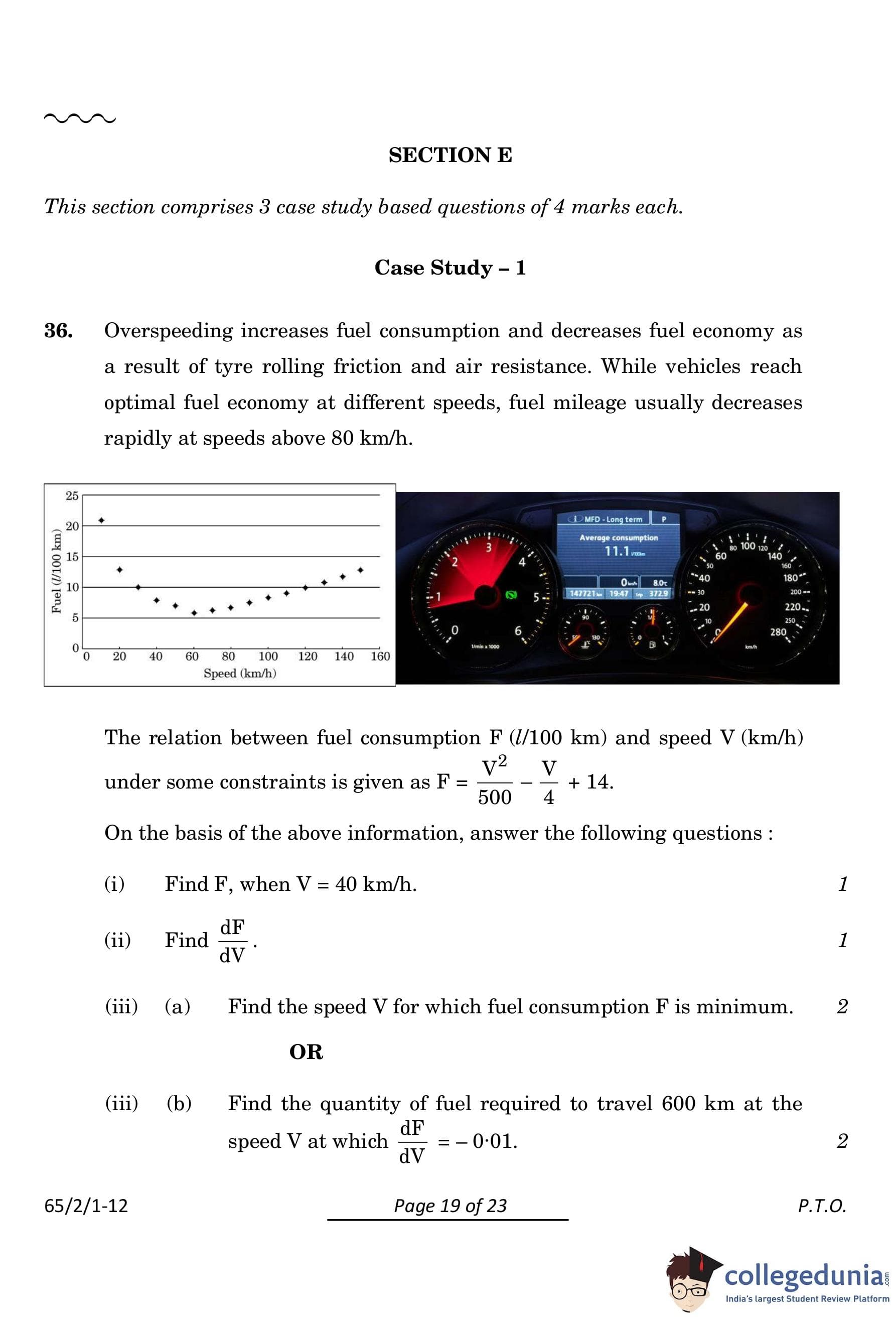
Overspeeding increases fuel consumption and decreases fuel economy as a result of tyre rolling friction and air resistance. While vehicles reach optimal fuel economy at different speeds, fuel mileage usually decreases rapidly at speeds above 80 km/h.

The relation between fuel consumption \( F \) (liters per 100 km) and speed \( V \) (km/h) under some constraints is given as: \[ F = \frac{V^2}{500} - \frac{V}{4} + 14. \]
On the basis of the above information, answer the following questions:
[(i)] Find \( F \), when \( V = 40 \, km/h \).
[(ii)] Find \( \frac{dF}{dV} \).
[(iii)] (a) Find the speed \( V \) for which fuel consumption \( F \) is minimum.
(b) Find the quantity of fuel required to travel \( 600 \, km \) at the speed \( V \) at which \( \frac{dF}{dV} = -0.01 \).
View Solution
(i) To Determine \( F \) for \( V = 40 \, km/h \):
Substitute \( V = 40 \) into the formula: \[ F = \frac{V^2}{500} - \frac{V}{4} + 14. \]
Simplify step-by-step: \[ F = \frac{40^2}{500} - \frac{40}{4} + 14, \] \[ F = \frac{1600}{500} - 10 + 14. \]
Perform the calculations: \[ F = 3.2 - 10 + 14 = 7.2. \]
Final Answer:
\[ \boxed{F = 7.2 \, liters per 100 km.} \]
\begin{quicktipbox
When solving for a specific value, substitute the given value into the formula and evaluate each term systematically to avoid errors.
\end{quicktipbox Quick Tip: When solving for a specific value, substitute the given value into the formula and evaluate each term systematically to avoid errors.
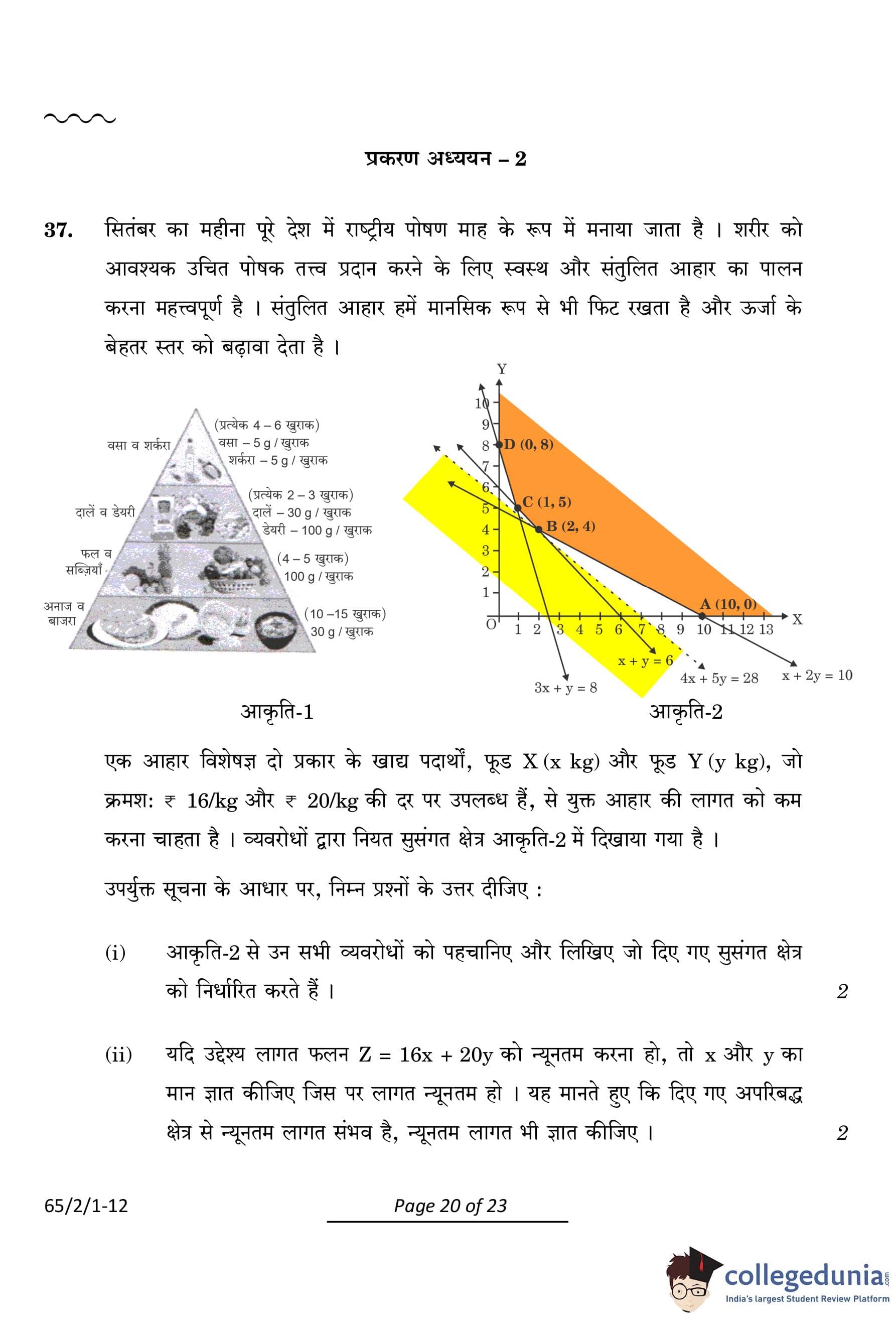
The month of September is celebrated as the Rashtriya Poshan Maah
across the country. Following a healthy and well-balanced diet is crucial
in order to supply the body with the proper nutrients it needs. A balanced
diet also keeps us mentally fit and promotes improved level of energy.

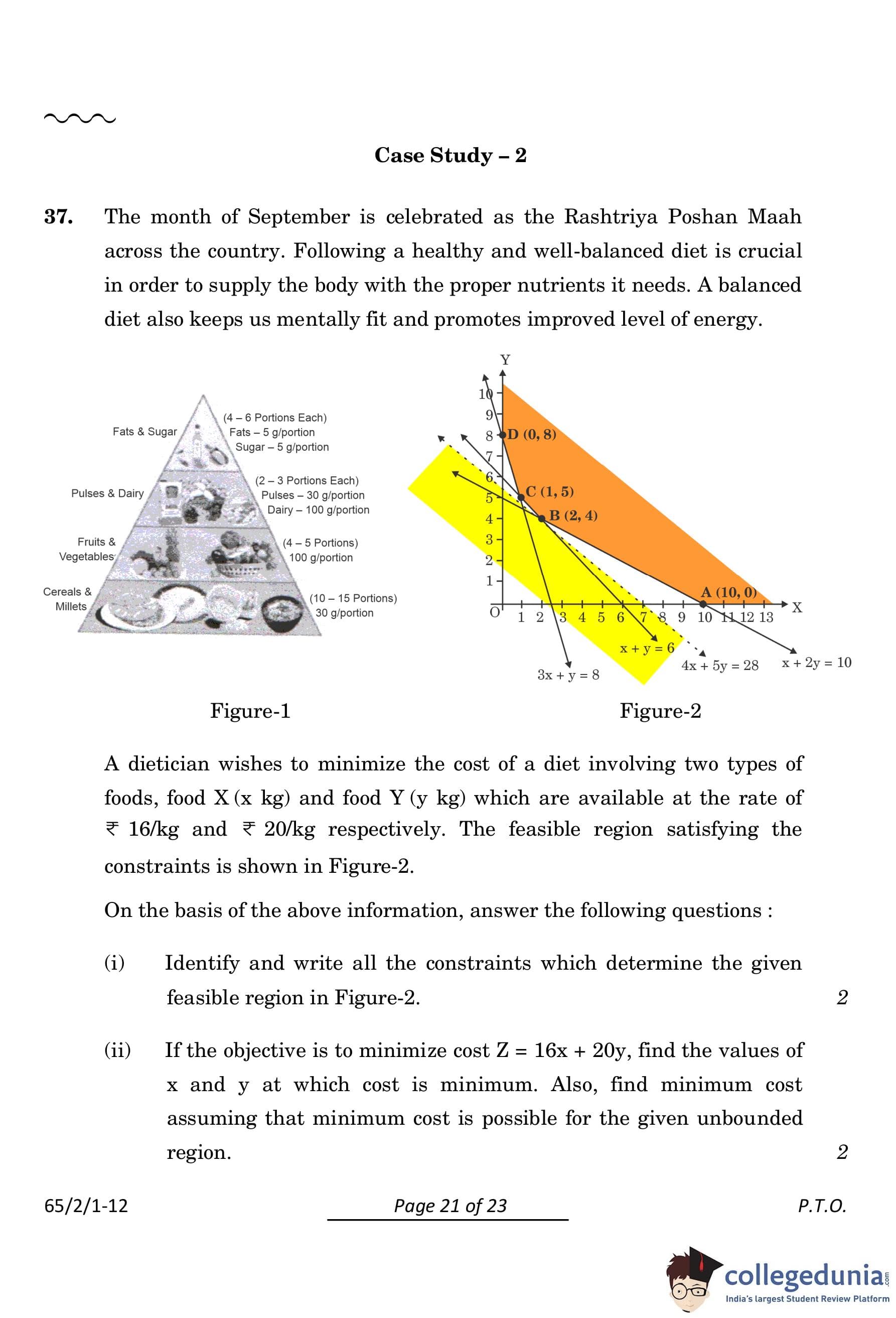
A dietician wishes to minimize the cost of a diet involving two types of foods, food \( X \) (in kg) and food \( Y \) (in kg), which are available at the rate of \( ₹ 16/kg \) and \( ₹ 20/kg \), respectively. The feasible region satisfying the constraints is shown in Figure-2.
On the basis of the above information, answer the following questions:
Identify and write all the constraints which determine the given feasible region in Figure-2.
View Solution
The given constraints for the linear programming problem are:
\[ x + 2y \geq 10 \]
\[ x + y \geq 6 \]
\[ 3x + y \geq 8 \]
\[ x \geq 0 \]
\[ y \geq 0 \]
\begin{quicktipbox
In linear programming, clearly write down all constraints derived from the problem statement. These inequalities define the feasible region for optimization.
\end{quicktipbox Quick Tip: In linear programming, clearly write down all constraints derived from the problem statement. These inequalities define the feasible region for optimization.
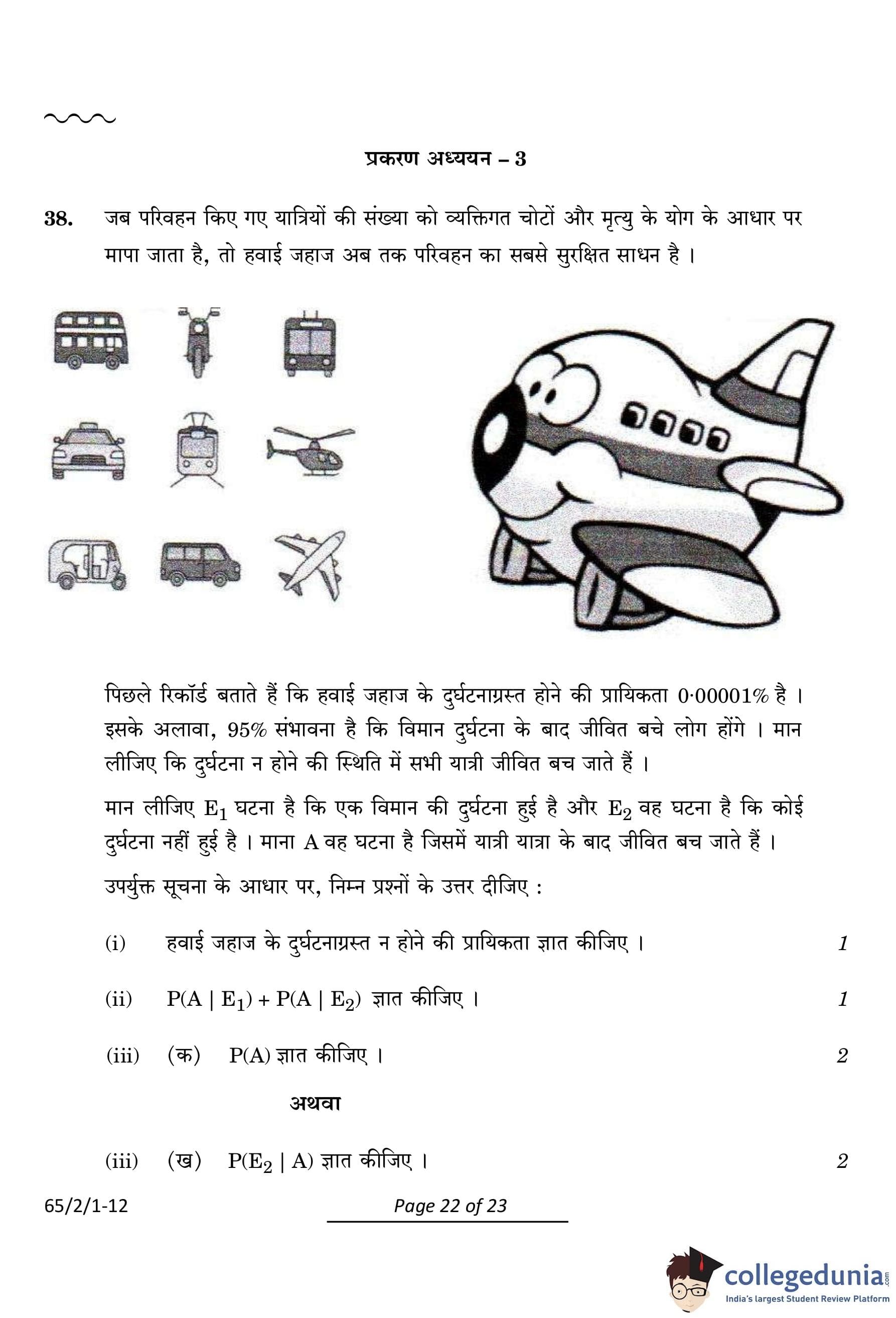
Find the probability that the airplane will not crash.
View Solution
(i) Probability that the airplane will not crash:
The given probability of the airplane crashing is: \[ P(E_1) = 0.00001% = \frac{0.00001}{100} = 10^{-7}. \]
The probability that the airplane does not crash is the complement of \( P(E_1) \), calculated as: \[ P(E_2) = 1 - P(E_1) = 1 - 10^{-7}. \]
Solution:
\[ \boxed{P(E_2) = 1 - 10^{-7}.} \]
\begin{quicktipbox
For complementary events, their probabilities always add up to 1. If \( P(E_1) \) is the probability of an event, the probability of its complement is \( P(E_2) = 1 - P(E_1) \).
\end{quicktipbox Quick Tip: For complementary events, their probabilities always add up to 1. If \( P(E_1) \) is the probability of an event, the probability of its complement is \( P(E_2) = 1 - P(E_1) \).




Comments