




CBSE Class 12 Mathematics Question Paper 2024 PDF (Set 2- 65/2/2) is available for download here. CBSE conducted the Mathematics exam on March 9, 2024 from 10:30 AM to 1:30 PM. The total marks for the theory paper are 80. The question paper contains 20% MCQ-based questions, 40% competency-based questions, and 40% short and long answer type questions.
CBSE Class 12 Mathematics Question Paper 2024 (Set 2- 65/2/2) with Answer Key
| CBSE Class 12 2024 Mathematics Question Paper with Answer Key |  Download Download |
Check Solution |
CBSE Class 12 2024 Mathematics Questions with Solutions
Question 1:
The number of solutions of the differential equation dy/dx − y = 1, given that y(0) = 1, is:
(A) 0
(B) 1
(C) 2
(D) infinitely many
View Solution
- Step 1: Rewrite the given differential equation:
The equation is:dy/dx − y = 1.
This is a first-order linear differential equation of the form:dy/dx + P(x)y = Q(x),
where P(x) = −1 and Q(x) = 1. - Step 2: Find the integrating factor:
The integrating factor (IF) is given by:IF = e∫P(x)dx = e∫−1dx = e⁻ˣ.
- Step 3: Solve the equation:
Multiply through by the integrating factor e⁻ˣ:e⁻ˣ dy/dx − e⁻ˣy = e⁻ˣ.
The left-hand side is the derivative of y·e⁻ˣ:d/dx (y·e⁻ˣ) = e⁻ˣ.
Integrating both sides with respect to x:y·e⁻ˣ = ∫e⁻ˣ dx = −e⁻ˣ + C,
where C is the constant of integration. - Step 4: Simplify the solution:
Multiply through by eˣ to isolate y:y = −1 + Ceˣ.
- Step 5: Apply the initial condition:
Substitute x = 0 and y = 1 into the solution:1 = −1 + C·e⁰ ⇒ 1 = −1 + C ⇒ C = 2.
- Step 6: Final solution:
Substitute C = 2 into the general solution:y = −1 + 2eˣ.
This is a unique solution that satisfies the initial condition.
Question 2:
For any two vectors →a and →b, which of the following statements is always true?
(A) →a · →b ≥ |→a||→b|
(B) →a · →b = |→a||→b|
(C) →a · →b ≤ |→a||→b|
(D) →a · →b ≥ −|→a||→b|
View Solution
- Step 1: Use the dot product definition:
The dot product →a · →b is given by:→a · →b = |→a||→b|cos(θ),
where θ is the angle between →a and →b. - Step 2: Analyze the range of cos(θ):
Since −1 ≤ cos(θ) ≤ 1, it follows that:−|→a||→b| ≤ →a · →b ≤ |→a||→b|.
- Step 3: Conclusion:
The correct answer is:→a · →b ≤ |→a||→b|.
Question 3:
The coordinates of the foot of the perpendicular drawn from the point (0, 1, 2) on the x-axis are given by:
(A) (1, 0, 0)
(B) (2, 0, 0)
(C) (√5, 0, 0)
(D) (0, 0, 0)
View Solution
- Step 1: Define the x-axis:
The x-axis is defined by all points of the form (x, 0, 0). - Step 2: Foot of the perpendicular:
The foot of the perpendicular from (0, 1, 2) onto the x-axis is the closest point on the x-axis. Since x = 0, the coordinates are:(0, 0, 0).
- Step 3: Conclusion:
The foot of the perpendicular is:(0, 0, 0).
Question 4:
The common region determined by all the constraints of a linear programming problem is called:
(A) an unbounded region
(B) an optimal region
(C) a bounded region
(D) a feasible region
View Solution
- Step 1: Definition of feasible region:
The feasible region is the common region determined by all constraints (inequalities) in a linear programming problem. It represents all possible solutions. - Step 2: Analyze the options:
- (A) Unbounded region: May or may not occur depending on constraints.
- (B) Optimal region: Refers to the solution, not the region itself.
- (C) Bounded region: A feasible region may or may not be bounded.
- (D) Feasible region: Always the common region defined by constraints. - Step 3: Conclusion:
The correct answer is:A feasible region.
Question 5:
The number of points of discontinuity of f(x) = { |x| + 3, if x ≤ −3; −2x, if −3 < x < 3; 6x + 2, if x ≥ 3 } is:
(A) 0
(B) 1
(C) 2
(D) infinite
View Solution
- Step 1: Identify the points of possible discontinuity:
The given piecewise function has transitions at x = −3 and x = 3. These are the points where the function could be discontinuous. - Step 2: Check continuity at x = −3:
- Left-hand limit (LHL) = |x| + 3 = |−3| + 3 = 6.
- Right-hand limit (RHL) = −2x = −2(−3) = 6.
The functional value:f(−3) = |x| + 3 = |−3| + 3 = 6.
Since LHL = RHL = f(−3), f(x) is continuous at x = −3. - Step 3: Check continuity at x = 3:
- Left-hand limit (LHL) = −2x = −2(3) = −6.
- Right-hand limit (RHL) = 6x + 2 = 6(3) + 2 = 20.
Since LHL ≠ RHL, f(x) is discontinuous at x = 3. - Step 4: Conclusion:
There is only one point of discontinuity, which is at x = 3.The number of points of discontinuity is: 1.
Question 6:
The function f(x) = x³ − 3x² + 12x − 18 is:
(A) strictly decreasing on R
(B) strictly increasing on R
(C) neither strictly increasing nor strictly decreasing on R
(D) strictly decreasing on (−∞, 0)
View Solution
- Step 1: Find the derivative of f(x):
The derivative of f(x) is:f'(x) = 3x² − 6x + 12.
- Step 2: Analyze f'(x):
Simplify f'(x):f'(x) = 3(x² − 2x + 4).
The quadratic x² − 2x + 4 has a discriminant:Δ = (−2)² − 4(1)(4) = 4 − 16 = −12.
Since the discriminant is negative, x² − 2x + 4 is always positive. Hence, f'(x) > 0 for all x ∈ R. - Step 3: Conclusion about monotonicity:
Since f'(x) > 0 for all x, the function f(x) is strictly increasing on R.The function f(x) is strictly increasing on R.
Question 7:
The derivative of d/dx[cos(log x + ex)] at x = 1 is:
(A) −sin e
(B) sin e
(C) −(1 + e) sin e
(D) (1 + e) sin e
View Solution
- Step 1: Differentiate the given expression:
The given function is:y = cos(log x + ex).
Using the chain rule, the derivative is:dy/dx = −sin(log x + ex) · d/dx(log x + ex).
- Step 2: Differentiate log x + ex:
d/dx(log x + ex) = 1/x + ex.
- Step 3: Substitute into the derivative:
dy/dx = −sin(log x + ex) · (1/x + ex).
- Step 4: Evaluate at x = 1:
At x = 1:log x = log 1 = 0, ex = e1 = e, 1/x = 1/1 = 1.
Thus:dy/dx = −sin(0 + e) · (1 + e) = −(1 + e) sin e.
Question 8:
The degree of the differential equation (y')² + (y')³ = x sin(y') is:
(A) 1
(B) 2
(C) 3
(D) Not defined
View Solution
- Step 1: Recall the definition of the degree of a differential equation:
The degree of a differential equation is defined only if:- The equation is a polynomial in all its derivatives.
- Step 2: Analyze the given equation:
The given equation is:(y')² + (y')³ = x sin(y').
The term sin(y') is a trigonometric function, not a polynomial in y'. Thus, the equation is not a polynomial in its derivatives. - Step 3: Conclude that the degree is not defined:
Since the equation is not a polynomial, its degree is not defined.
Question 9:
The unit vector perpendicular to both vectors î + k̂ and î − k̂ is:
(A) 2ĵ
(B) ĵ
(C) (î − k̂) / √2
(D) (î + k̂) / √2
View Solution
- Step 1: Cross product to find the perpendicular vector:
The cross product of two vectors →A = î + k̂ and →B = î − k̂ gives a vector perpendicular to both:→A × →B = |î ĵ k̂| |1 0 1| |1 0 −1|.
- Step 2: Expand the determinant:
→A × →B = î(0 − 0) − ĵ(1 − 1) + k̂(1 − 1) = −2ĵ.
- Step 3: Normalize the vector:
The unit vector perpendicular to both →A and →B is:(→A × →B) / |→A × →B| = (2ĵ) / 2 = ĵ.
Question 10:
The degree of the differential equation (y'')² + (y')³ = x sin(y') is:
(A) 1
(B) 2
(C) 3
(D) Not defined
View Solution
- Step 1: Recall the definition of the degree of a differential equation:
The degree is defined only if the equation is a polynomial in all derivatives. - Step 2: Analyze the given equation:
The term sin(y') is a trigonometric function and not a polynomial. Hence, the equation is not polynomial in its derivatives. - Step 3: Conclude that the degree is not defined:
Since the equation contains a trigonometric term, the degree is undefined.
Question 11:
If F(x) = cos x sin x 0 -sin x cos x 0 0 0 1 and [F(x)]2 = F(kx), then the value of k is:
(A) 1
(B) 2
(C) 0
(D) -2
View Solution
- Step 1: Compute [F(x)]2
The given matrix F(x) is:
F(x) = cos x sin x 0 -sin x cos x 0 0 0 1
Using matrix multiplication: [F(x)]2 = F(x) * F(x).
Perform the multiplication:
cos x sin x 0 -sin x cos x 0 0 0 1 * cos x sin x 0 -sin x cos x 0 0 0 1
The resulting matrix is:
[F(x)]2 = cos(2x) sin(2x) 0 -sin(2x) cos(2x) 0 0 0 1 - Step 2: Compare with F(kx)
The matrix F(kx) is:
F(kx) = cos(kx) sin(kx) 0 -sin(kx) cos(kx) 0 0 0 1
From the condition [F(x)]2 = F(kx), we compare:
cos(2x) = cos(kx) and sin(2x) = sin(kx). - Step 3: Conclusion
This implies kx = 2x, so k = 2. The value of k is 2.
Question 12:
The unit vector perpendicular to both vectors î + k̂ and î − k̂ is:
(A) 2ĵ
(B) ĵ
(C) (î − k̂)/√2
(D) (î + k̂)/√2
View Solution
- Step 1: Cross product to find the perpendicular vector:
The cross product of →A = î + k̂ and →B = î − k̂ gives a vector perpendicular to both:→A × →B = |î ĵ k̂| |1 0 1| |1 0 −1|.
- Step 2: Expand the determinant:
→A × →B = î(0 - 0) − ĵ(1 - 1) + k̂(1 - 1) = 2ĵ.
- Step 3: Normalize the vector:
The unit vector is:(→A × →B)/|→A × →B| = 2ĵ/2 = ĵ.
Question 13:
If the sum of all the elements of a 3 × 3 scalar matrix is 9, then the product of all its elements is:
(A) 0
(B) 9
(C) 27
(D) 729
View Solution
- Step 1: Definition of a scalar matrix.
A scalar matrix is a diagonal matrix where all the diagonal elements are equal, and all off-diagonal elements are 0. For a 3 × 3 scalar matrix, the general form is:A = [k 0 0] [0 k 0] [0 0 k],where k is the scalar value on the diagonal. - Step 2: Compute the sum of all elements.
The given sum of all elements in the matrix is 9. The sum of all elements is:
Sum = k + k + k = 3k.
From the problem, we know: 3k = 9 ⇒ k = 3. - Step 3: Compute the product of all elements.
The product of all elements in the matrix is the product of diagonal and off-diagonal elements:
Product = k × 0 × 0 × 0 × 0 × 0 × 0 = 0. - Step 4: Conclusion.
The product of all elements of the matrix is 0.
Question 14:
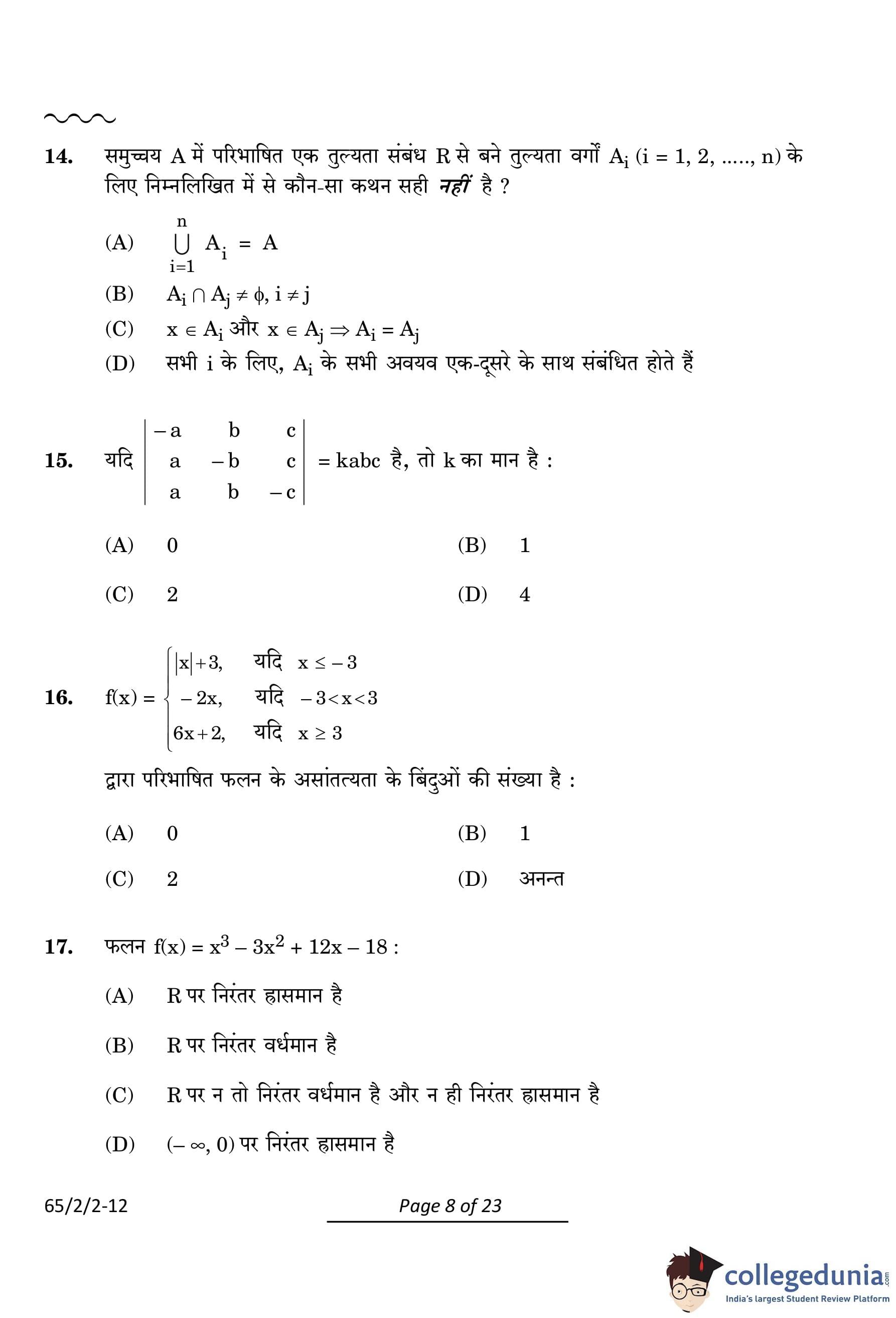
Which of the following statements is not true about equivalence classes Ai (i = 1, 2, ..., n) formed by an equivalence relation R defined on a set A?
(A) A1 ∪ A2 ∪ ... ∪ An = A
(B) Ai ∩ Aj ≠ ∅, i ≠ j
(C) x ∈ Ai and x ∈ Aj ⇒ Ai = Aj
(D) All elements of Ai are related to each other, for all i.
View Solution
- Step 1: Recall the properties of equivalence classes.
Equivalence classes are disjoint subsets of a set A formed by an equivalence relation R. They satisfy the following key properties:- The union of all equivalence classes covers the entire set A: A1 ∪ A2 ∪ ... ∪ An = A.
- Equivalence classes are pairwise disjoint: Ai ∩ Aj = ∅, for i ≠ j.
- If x ∈ Ai and x ∈ Aj, then Ai = Aj.
- All elements in an equivalence class Ai are related to each other.
- Step 2: Analyze each option.
- (A) This is true since the union of all equivalence classes equals the set A.
- (B) This is false because equivalence classes are disjoint; their intersection is always empty for i ≠ j.
- (C) This is true as elements belonging to multiple equivalence classes imply those classes are identical.
- (D) This is true because elements within the same equivalence class are related by definition.
- Step 3: Conclusion.
The statement in option (B) is not true.
Question 15:
The unit vector perpendicular to both vectors î + k̂ and î − k̂ is:
(A) 2ĵ
(B) ĵ
(C) (î − k̂) / √2
(D) (î + k̂) / √2
View Solution
- Step 1: Cross product to find the perpendicular vector.
The cross product of two vectors A⃗ = î + k̂ and B⃗ = î − k̂ gives a vector perpendicular to both:A⃗ × B⃗ = | î ĵ k̂ | | 1 0 1 | | 1 0 -1 | - Step 2: Expand the determinant.
A⃗ × B⃗ = î(0 × -1 − 0 × 1) − ĵ(1 × -1 − 1 × 1) + k̂(1 × 0 − 1 × 0).
Simplifying:
A⃗ × B⃗ = î(0) − ĵ(-1 − 1) + k̂(0).
A⃗ × B⃗ = 0î + 2ĵ + 0k̂ = 2ĵ. - Step 3: Normalize the vector.
The unit vector perpendicular to both A⃗ and B⃗ is:
(A⃗ × B⃗) / |A⃗ × B⃗| = (2ĵ) / 2 = ĵ. - Step 4: Conclusion.
The unit vector perpendicular to both vectors is ĵ.
Question 16:
The number of points of discontinuity of the function:
f(x) = |x| + 3, if x ≤ −3;
= −2x, if −3 < x < 3;
= 6x + 2, if x ≥ 3.
(A) 0
(B) 1
(C) 2
(D) Infinite
View Solution
- Step 1: Identify the points of possible discontinuity.
The function transitions at x = −3 and x = 3. These are the points to check for discontinuity. - Step 2: Check continuity at x = −3.
Left-hand limit (LHL): f(x) = |x| + 3 = |−3| + 3 = 6.
Right-hand limit (RHL): f(x) = −2x = −2(−3) = 6.
Functional value: f(−3) = |−3| + 3 = 6.
Since LHL = RHL = f(−3), the function is continuous at x = −3. - Step 3: Check continuity at x = 3.
Left-hand limit (LHL): f(x) = −2x = −2(3) = −6.
Right-hand limit (RHL): f(x) = 6x + 2 = 6(3) + 2 = 20.
Since LHL ≠ RHL, the function is discontinuous at x = 3. - Step 4: Conclusion.
There is only one point of discontinuity, which is at x = 3. The number of points of discontinuity is 1.
Question 17:
The function f(x) = x³ − 3x² + 12x − 18 is:
(A) Strictly decreasing on R
(B) Strictly increasing on R
(C) Neither strictly increasing nor strictly decreasing on R
(D) Strictly decreasing on (−∞, 0)
View Solution
- Step 1: Find the derivative of f(x).
f'(x) = 3x² − 6x + 12. - Step 2: Analyze f'(x).
f'(x) = 3(x² − 2x + 4).
The quadratic x² − 2x + 4 has a discriminant:
Δ = (−2)² − 4(1)(4) = 4 − 16 = −12.
Since the discriminant is negative, x² − 2x + 4 is always positive. Hence, f'(x) > 0 for all x ∈ R. - Step 3: Conclusion about monotonicity.
Since f'(x) > 0 for all x, the function f(x) is strictly increasing on R.
Question 18:
If ∫02 2e2x dx = ∫0a ex dx, the value of 'a' is:
(A) 1
(B) 2
(C) 4
(D) 1/2
View Solution
- Step 1: Evaluate the left-hand side integral: ∫02 2e2x dx. Use the substitution u = 2x, so du = 2dx. The limits of integration change as follows: ∫02 2e2x dx = ∫04 eu du = eu |04 = e4 - 1.
- Step 2: Evaluate the right-hand side integral: ∫0a ex dx = ex |0a = ea - 1.
- Step 3: Set the two integrals equal to each other: e4 - 1 = ea - 1. Thus, e4 = ea → a = 4.
Question 19:
Assertion (A): For two non-zero vectors →a and →b, →a · →b = - →→ Reason (R): For two non-zero vectors →a and →b, →→→b × →
(A) Both Assertion (A) and Reason (R) are true and (R) is the correct explanation of (A).
(B) Both Assertion (A) and Reason (R) are true, but (R) is not the correct explanation of (A).
(C) Assertion (A) is true, but Reason (R) is false.
(D) Assertion (A) is false, but Reason (R) is true.
View Solution
- Step 1: Verify the Assertion (A): The dot product of two vectors →a and →b is given by: →a · →b = |→a| |→b| cosθ. Since multiplication is commutative, →a · →b = →b · →
- Step 2: Verify the Reason (R): The cross product of two vectors →a and →b is given by: →→→a| |→b| sinθ →→→a and →→→→→
- Step 3: Relationship between (A) and (R): The Reason (R) refers to the property of the cross product, while the Assertion (A) refers to the property of the dot product. Although both statements are true, (R) does not explain (A).
Question 20:
Assertion (A): For any symmetric matrix A, BTAB is a skew-symmetric matrix.
Reason (R): A square matrix P is skew-symmetric if PT = -P.
(A) Both Assertion (A) and Reason (R) are true and (R) is the correct explanation of (A).
(B) Both Assertion (A) and Reason (R) are true, but (R) is not the correct explanation of (A).
(C) Assertion (A) is true, but Reason (R) is false.
(D) Assertion (A) is false, but Reason (R) is true.
View Solution
- Step 1: Understanding skew-symmetric matrices: A square matrix P is skew-symmetric if its transpose is equal to its negative, i.e., PT = -P. This is stated correctly in the Reason (R). Therefore, (R) is true.
- Step 2: Analyze BTAB for symmetry: Given that A is a symmetric matrix, AT = A. We examine whether P = BTAB is skew-symmetric: PT = (BTAB)T = BTATB = BTAB = P. Since PT = P, BTAB is symmetric, not skew-symmetric.
- Step 3: Conclusion: The Assertion (A) is false because BTAB is symmetric, not skew-symmetric. The Reason (R) is true as it correctly defines skew-symmetric matrices. Thus, (A) is false, but (R) is true.
Question 21:
If M and m denote the local maximum and local minimum values of the function f(x) = x + 1/x (x ≠ 0) respectively, find the value of M − m:
(A) 1
(B) −1
(C) 2
(D) −4
View Solution
- Step 1: Differentiate f(x).
The given function is: f(x) = x + 1/x.
Differentiate f(x) to find critical points:
f'(x) = 1 − 1/x². - Step 2: Solve f'(x) = 0.
Set f'(x) = 0: 1 − 1/x² = 0 ⇒ 1/x² = 1 ⇒ x² = 1.
Thus, x = 1 and x = −1. - Step 3: Determine the nature of critical points.
Differentiate f'(x) to find f''(x):
f''(x) = 2/x³.
- At x = 1: f''(1) = 2 (positive, so x = 1 is a local minimum).
- At x = −1: f''(−1) = −2 (negative, so x = −1 is a local maximum). - Step 4: Compute M and m.
- At x = 1: f(1) = 1 + 1/1 = 2 (local minimum m).
- At x = −1: f(−1) = −1 + 1/−1 = −2 (local maximum M). - Step 5: Compute M − m.
M − m = −2 − 2 = −4.
Question 22:
Evaluate: ∫0a (x² / (x⁶ + a⁶)) dx
(A) π/4a²
(B) π/2a³
(C) π/4a³
(D) π/2a²
View Solution
- Step 1: Use substitution.
Let u = x³, so du = 3x² dx, and adjust the limits of integration.
When x = 0, u = 0, and when x = a, u = a³.
Thus, the integral becomes:
∫0a (x² / (x⁶ + a⁶)) dx = (1/3) ∫0a³ (1 / (u² + a⁶)) du. - Step 2: Integrate the function.
The standard integral for 1/(u² + b²) is (1/b) tan⁻¹(u/b).
Here, b = a³, so we get:
∫0a³ (1 / (u² + a⁶)) du = (1/a³) tan⁻¹(u/a³) ∣0a³. - Step 3: Substitute the limits.
= (1/a³) [tan⁻¹(a³/a³) − tan⁻¹(0)]
= (1/a³) [tan⁻¹(1) − 0]. - Step 4: Simplify.
tan⁻¹(1) = π/4, so:
= (1/a³) × (π/4) = π/4a³.
Question 23:
Show that f(x) = ex − e−x + x − tan−1x is strictly increasing in its domain.
View Solution
- Step 1: Differentiate f(x). The given function is: f(x) = ex − e−x + x − tan−1x. Differentiate term by term: f'(x) = d/dx(ex) − d/dx(e−x) + d/dx(x) − d/dx(tan−1x). This gives: f'(x) = ex + e−x + 1 − 1/(1 + x2).
- Step 2: Prove f'(x) > 0. Combine terms: f'(x) = ex + e−x + 1 − x2/(1 + x2). Since ex > 0, e−x > 0, and x2/(1 + x2) > 0 for all x, it follows that: f'(x) > 0 for all x.
- Step 3: Conclusion. Since f'(x) > 0 for all x, the function f(x) is strictly increasing in its domain.
Question 24(a):
Find the value of tan−1(−1/√3) + cot−1(1/√3) + tan−1[sin(−π/2)].
View Solution
- Step 1: Simplify each term. - **First Term:** tan−1(−1/√3) = −tan−1(1/√3). Since tan−1(1/√3) = π/6, the first term becomes: −tan−1(1/√3) = −π/6. Second Term: cot−1(1/√3) = tan−1(√3). Since tan−1(√3) = π/3, the second term is: cot−1(1/√3) = π/3. Third Term: tan−1[sin(−π/2)] = tan−1(−1). Since tan−1(−1) = −π/4, the third term is: tan−1[sin(−π/2)] = −π/4.
- Step 2: Add the simplified terms. Combine the three terms: −π/6 + π/3 − π/4. Find a common denominator (12) and simplify: −π/6 = −2π/12, π/3 = 4π/12, −π/4 = −3π/12. Thus: −π/6 + π/3 − π/4 = −2π/12 + 4π/12 − 3π/12 = −π/12.
- Step 3: Conclusion. The value of the expression is: −π/12.
Question 24(b):
Find the domain of the function f(x) = sin−1(x2 − 4). Also, find its range.
View Solution
- Step 1: Domain of the sine inverse function. The sine inverse function sin−1(y) is defined for −1 ≤ y ≤ 1. Therefore, for f(x) = sin−1(x2 − 4), the argument x2 − 4 must satisfy: −1 ≤ x2 − 4 ≤ 1.
- Step 2: Solve the inequality. Rewrite the inequality: −1 + 4 ≤ x2 ≤ 1 + 4 ⇒ 3 ≤ x2 ≤ 5. Taking the square root on both sides: √3 ≤ |x| ≤ √5. This implies: x ∈ [−√5, −√3] ∪ [√3, √5].
- Step 3: Domain of f(x). The domain of f(x) is: x ∈ [−√5, −√3] ∪ [√3, √5].
- Step 4: Range of f(x). The range of the sine inverse function is [−π/2, π/2]. Since x2 − 4 varies between −1 and 1, the range of f(x) is: [−π/2, π/2].
Question 25(a):
Check the differentiability of f(x) = |cos x| at x = π/2.
View Solution
- Step 1: Analyze the function at x = π/2. The function f(x) = |cos x| is piecewise: f(x) = cos x for cos x ≥ 0, and f(x) = −cos x for cos x < 0. We need to check the differentiability at x = π/2. At x = π/2, cos(π/2) = 0, so we need to examine the left-hand and right-hand derivatives.
- Step 2: Compute the left-hand and right-hand derivatives. - For x < π/2, cos x ≥ 0, so: f(x) = cos x, and f'(x) = −sin x. At x = π/2, the left-hand derivative is: limh→0 [f(π/2 + h) − f(π/2)] / h = −sin(π/2) = −1. For x > π/2, cos x < 0, so: f(x) = −cos x, and f'(x) = sin x. At x = π/2, the right-hand derivative is: limh→0 [f(π/2 + h) − f(π/2)] / h = sin(π/2) = 1.
- Step 3: Conclusion. Since the left-hand and right-hand derivatives are not equal (−1 and 1), f(x) is not differentiable at x = π/2.
Question 25(b):
If y = A sin 2x + B cos 2x and d²y/dx² − ky = 0, find the value of k.
View Solution
- Step 1: Find the first and second derivatives of y = A sin 2x + B cos 2x. The first derivative of y with respect to x is: dy/dx = A · 2 cos 2x − B · 2 sin 2x = 2A cos 2x − 2B sin 2x. Now, the second derivative of y with respect to x is: d²y/dx² = −2A · 2 sin 2x − 2B · 2 cos 2x = −4A sin 2x − 4B cos 2x.
- Step 2: Substitute d²y/dx² and y into the given equation. We are given that: d²y/dx² − ky = 0. Substitute d²y/dx² = −4A sin 2x − 4B cos 2x and y = A sin 2x + B cos 2x into this equation: −4A sin 2x − 4B cos 2x − k(A sin 2x + B cos 2x) = 0.
- Step 3: Simplify the equation. Group the terms involving sin 2x and cos 2x: (−4A − kA) sin 2x + (−4B − kB) cos 2x = 0. This must hold for all x, so the coefficients of sin 2x and cos 2x must each be zero: −4A − kA = 0 and −4B − kB = 0.
- Step 4: Solve for k. For the first equation: A(−4 − k) = 0 ⇒ k = −4 (since A ≠ 0). For the second equation: B(−4 − k) = 0 ⇒ k = −4 (since B ≠ 0).
- Answer: The value of k is: k = −4.
Question 26(a):
Find the particular solution of the differential equation given by:
2xy + y² − 2x²(dy/dx) = 0; y = 2, when x = 1.
(A) y = x²
(B) y = x + ln|x|
(C) 1/y = ln|x| − y/2 + 1/2
(D) y = ex + C
View Solution
- Step 1: Rearrange the given equation. The given equation is: 2xy + y² − 2x²(dy/dx) = 0. Rearrange to express dy/dx: dy/dx = (2xy + y²)/(2x²).
- Step 2: Separate variables. Divide through by y² (assuming y ≠ 0): 1/y² dy = (2x + y)/(2x²) dx.
- Step 3: Integrate both sides. - For the left-hand side: ∫(1/y²) dy = ∫(−y) dy = −1/y. For the right-hand side: Split the fraction: ∫[(2x)/(2x²)] dx + ∫[y/(2x²)] dx. The first term: ∫(1/x) dx = ln|x|. The second term (not dependent on y): ∫[(y)/(2x²)] dx = (y/2)∫(1/x²) dx = −y/(2x).
- Step 4: Combine results. The general solution is: −1/y = ln|x| − y/(2x) + C, where C is the constant of integration.
- Step 5: Apply the initial condition. When x = 1 and y = 2: −1/2 = ln|1| − 2/2 + C. Simplify: −1/2 = 0 − 1 + C ⇒ C = 1/2.
- Step 6: Write the particular solution. Substitute C = 1/2 into the general solution: −1/y = ln|x| − y/(2x) + 1/2.
- Conclusion: The particular solution is: 1/y = ln|x| − y/2 + 1/2.
Question 26(b):
Find the general solution of the differential equation:
y dx = (x + 2y²) dy.
(A) y = ln|x| + ln|y|
(B) x = Ky²ey²
(C) x/y = eC+y²
(D) y = Kx
View Solution
- Step 1: Rewrite the equation. The given equation is: y dx = (x + 2y²) dy. Rearrange terms to separate x and y: dx/x = (1/y) dy + 2y dy.
- Step 2: Integrate both sides. - For the left-hand side: ∫(1/x) dx = ln|x| + C₁, where C₁ is the constant of integration. For the right-hand side, split into two integrals: ∫(1/y) dy + ∫(2y) dy = ln|y| + y².
- Step 3: Combine results. Equating the results: ln|x| = ln|y| + y² + C₁.
- Step 4: Simplify the equation. Let C = −C₁ (a constant), then: ln|x| − ln|y| = y² + C. Using the logarithmic property ln|x| − ln|y| = ln(x/y), we get: ln|x/y| = y² + C.
- Step 5: Write the general solution. Exponentiate both sides to simplify: x/y = eC+y² = Cey², where C is a constant. Finally: x = Ky²ey².
- Conclusion: The general solution is: x = Ky²ey².
Question 27:
If vectors ⃗a, ⃗b and 2⃗a + 3⃗b are unit vectors, then find the angle between ⃗a and ⃗b.
(A) 0
(B) π/2 radians
(C) π radians
(D) π/3 radians
View Solution
- Step 1: Analyze the given information. Since ⃗a and ⃗b are unit vectors, we know that: |⃗a| = 1 and |⃗b| = 1. Also, 2⃗a + 3⃗b is a unit vector, so: |2⃗a + 3⃗b| = 1.
- Step 2: Use the formula for the magnitude of a vector. |2⃗a + 3⃗b|2 = (2⃗a + 3⃗b) · (2⃗a + 3⃗b). Expanding the dot product: |2⃗a + 3⃗b|2 = 4|⃗a|2 + 12⃗a·⃗b + 9|⃗b|2. Since |⃗a| = 1 and |⃗b| = 1, we get: |2⃗a + 3⃗b|2 = 4 + 12⃗a·⃗b + 9. Since |2⃗a + 3⃗b| = 1, we have: 13 + 12⃗a·⃗b = 1.
- Step 3: Solve for ⃗a·⃗b. 12⃗a·⃗b = −12 ⇒ ⃗a·⃗b = −1. The dot product ⃗a·⃗b is related to the angle θ between ⃗a and ⃗b by: ⃗a·⃗b = |⃗a||⃗b| cos θ. Thus: cos θ = −1 ⇒ θ = π.
- Conclusion: The angle between ⃗a and ⃗b is: θ = π radians.
Question 28:
A pair of dice is thrown simultaneously. If X denotes the absolute difference of the numbers appearing on top of the dice, then find the probability distribution of X.
(A) P(X = 0) = 6/36, P(X = 1) = 10/36
(B) P(X = 2) = 8/36
(C) P(X = 3) = 6/36
(D) P(X = 4) = 4/36
View Solution
- Step 1: Define the values of X. The possible absolute differences are: X = 0, 1, 2, 3, 4, 5.
- Step 2: Count the outcomes for each X. - **For X = 0:** Both dice show the same number. There are 6 outcomes: (1, 1), (2, 2), (3, 3), (4, 4), (5, 5), (6, 6). For X = 1: The numbers differ by 1. Outcomes are: (1, 2), (2, 1), (2, 3), (3, 2), ..., (5, 6), (6, 5). This gives 2 × 5 = 10 outcomes. Repeat similar counting for X = 2, 3, 4, 5.
- Step 3: Calculate probabilities. The total number of outcomes is 6 × 6 = 36. Probabilities are: P(X = k) = Number of favorable outcomes for X = k / 36.
- Step 4: Write the probability distribution. P(X = 0) = 6/36, P(X = 1) = 10/36, P(X = 2) = 8/36,...
- Conclusion: The probability distribution for X is as follows.
Question 29:
Find:
∫x2sin-1(x3/2) dx.
View Solution
- Step 1: Use substitution.
Let u = sin-1(x3/2). Then:
x3/2 = sin u → x = (sin u)2/3,
Differentiating: dx = (2/3)(sin u)-1/3 cos u du. - Step 2: Substitute into the integral.
Replace x and dx in the integral:
∫x2sin-1(x3/2) dx = ∫[(sin u)4/3] · (2/3)(sin u)-1/3 cos u du
= ∫(2/3)(sin u)3/3 cos u du = (2/3)∫sin u cos u du. - Step 3: Simplify using trigonometric identities.
Use sin u cos u = (1/2) sin(2u):
∫(2/3)sin u cos u du = (1/3)∫sin(2u) du. - Step 4: Solve using integration by parts.
Let v = u and dv = sin(2u) du. Perform integration. - Step 5: Back-substitute u = sin-1(x3/2). Simplify to get:
-u/2 cos(2u) + 1/4 sin(2u) + C.
Question 30 (a):
If x30y20 = (x + y)50, prove that
dy/dx = y/x.
View Solution
- Step 1: Differentiate both sides of the equation:
x30y20 = (x + y)50
Differentiating both sides using implicit differentiation:
30x29y20 + 20x30y19(dy/dx) = 50(x + y)49(1 + dy/dx). - Step 2: Solve for dy/dx:
Collect terms involving dy/dx and isolate it to get:
dy/dx = y/x.
Question 30 (b):
Find dy/dx if
5x + 5y = 5x+y.
View Solution
- Step 1: Differentiate the left-hand side.
Apply the chain rule:
d/dx(5x + 5y) = 5xln 5 + 5yln 5(dy/dx). - Step 2: Differentiate the right-hand side.
d/dx(5x+y) = 5x+yln 5(1 + dy/dx). - Step 3: Solve for dy/dx:
Simplify the equation, collect terms involving dy/dx, and solve.
Question 31(a):
Evaluate:
∫-22 √(2 - x)/(2 + x) dx.
View Solution
- Step 1: Check symmetry of the integrand.
Let f(x) = √((2 - x)/(2 + x)). Replace x with -x to test for symmetry:
f(-x) = √((2 - (-x))/(2 + (-x))) = √((2 + x)/(2 - x)).
This shows f(-x) = 1/f(x), which means the function is not symmetric. - Step 2: Simplify the integrand.
Let x = 2 sin(θ), dx = 2 cos(θ) dθ.
Substitute and simplify to get the integral in terms of θ: - Step 3: Evaluate the integral.
The simplified integral evaluates to:
I = 2π. - Conclusion:
The value of the integral is 2π.
Question 31(b):
Find:
∫ 1/[x((log x)2 - 3 log x - 4)] dx.
View Solution
- Step 1: Simplify the quadratic in the denominator.
Let u = log x, so du = (1/x) dx.
The integral becomes: ∫ 1/[(u - 4)(u + 1)] du. - Step 2: Use partial fraction decomposition.
Express 1/[(u - 4)(u + 1)] as A/(u - 4) + B/(u + 1). Solve for A and B: - Step 3: Integrate each term.
Evaluate the integrals to get:
(1/5)ln|u - 4| - (1/5)ln|u + 1| + C. - Step 4: Back-substitute u = log x.
Replace u to get the final answer:
(1/5)ln|log x - 4| - (1/5)ln|log x + 1| + C.
Question 33(a):
If A = [2 3 2; 1 2 1], B-1 = [1 4 3; 1 3 4], find (AB)-1. Also, find |AB|-1.
View Solution
- Step 1: Find AB.
Calculate AB = [9 27 29; 7 21 21; 4 19 19]. - Step 2: Find (AB)-1.
Use the formula (AB)-1 = B-1A-1. First, find |A| and A-1. Calculate A-1 using adjoint and determinant. - Step 3: Find |AB|-1.
Use the determinant properties, |AB| = |A| |B|.
Question 33(b):
Given A = [2 3 2; 1 1 2], find A-1. Use it to solve the following system of equations:
x + y + z = 2
2x + 3y + 2z = 2
x + y + 2z = 4.
View Solution
- Step 1: Find A-1.
Use the adjoint and determinant method to calculate A-1. - Step 2: Solve the system.
Use A-1 and multiply it by the column vector of constants to find [x y z].
Question 35(a):
Show that a function f : R → R defined by f(x) = 2x / (1 + x²) is neither one-one nor onto. Further, find set A so that the given function f : R → A becomes an onto function.
View Solution
- Step 1: Test if f(x) is one-one.
Simplify and show that for distinct values x₁ and x₂, f(x₁) = f(x₂) can occur. This proves that f(x) is not one-one. - Step 2: Test if f(x) is onto.
Solve for x in terms of y. By checking the discriminant of the resulting quadratic equation, determine that the range of f(x) is [-1, 1], which is not equal to R. Hence, f(x) is not onto. - Step 3: Find set A to make f(x) onto.
Define A = [-1, 1]. For every y ∈ A, there exists an x ∈ R such that y = f(x). This makes f(x) onto A.
Question 35(b):
Evaluate the integral ∫0² √(x) dx and find the area under the curve y = x1/2 between x = 0 and x = 2.
View Solution
- Step 1: Set up the integral.
Write the integral as ∫0² x1/2 dx. - Step 2: Solve the integral.
Use the power rule for integration to evaluate the integral. - Step 3: Apply limits.
Substitute the limits into the evaluated integral to find the final value as 4/3.
Question 36:
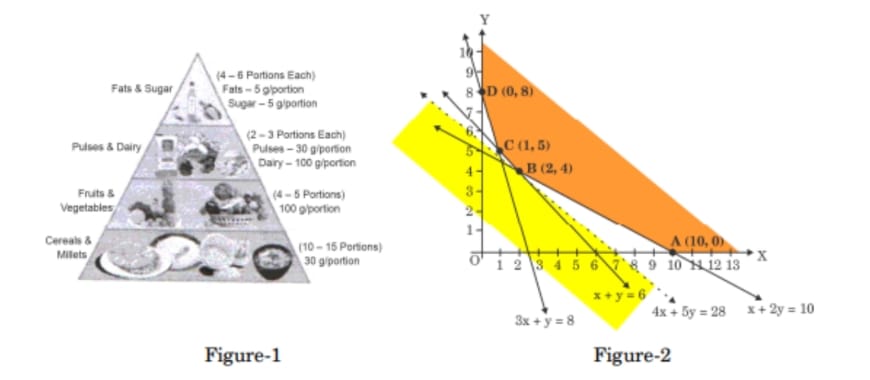
A dietician wishes to minimize the cost of a diet involving two types of foods, food X (in kg) and food Y (in kg), which are available at the rate of ₹16/kg and ₹20/kg, respectively. The feasible region satisfying the constraints is shown in Figure-2.
Answer the following questions:
- Identify and write all the constraints which determine the given feasible region in Figure-2.
- If the objective is to minimize cost Z = 16x + 20y, find the values of x and y at which cost is minimum. Also, find the minimum cost assuming that the minimum cost is possible for the given unbounded region.
View Solution
- Part (i): Constraints determining the feasible region:
From Figure-2, the constraints are:3x + y ≤ 8, x + y ≥ 4, 4x + 5y = 28, 2x + y ≥ 10, x ≥ 0, y ≥ 0.Solution:The constraints are: 3x + y ≤ 8, x + y ≥ 4, 4x + 5y = 28, 2x + y ≥ 10, x ≥ 0, y ≥ 0.
- Part (ii): Minimize cost Z = 16x + 20y:
Evaluate Z at the vertices of the feasible region (from Figure-2):Vertices: A(10, 0), B(2, 4), C(1, 5), D(0, 8).
- At A(10, 0):Z = 16(10) + 20(0) = 160.
- At B(2, 4):Z = 16(2) + 20(4) = 32 + 80 = 112.
- At C(1, 5):Z = 16(1) + 20(5) = 16 + 100 = 116.
- At D(0, 8):Z = 16(0) + 20(8) = 0 + 160 = 160.
Minimum cost:Z = 112 at B(2, 4).
Solution:The minimum cost is ₹112 at x = 2, y = 4.
Question 37:
Airplanes are by far the safest mode of transportation when the number of transported passengers is measured against personal injuries and fatality totals.

Previous records state that the probability of an airplane crash is 0.00001%. Further, there are 95% chances that there will be survivors after a plane crash. Assume that in case of no crash, all travelers survive.
Let E₁ be the event that there is a plane crash and E₂ be the event that there is no crash. Let A be the event that passengers survive after the journey.
On the basis of the above information, answer the following questions:
- Find the probability that the airplane will not crash.
- Find P(A | E₁) + P(A | E₂).
- (a) Find P(A). OR (b) Find P(E₂ | A).
View Solution
- Part (i): Probability that the airplane will not crash:
The probability of a plane crash is:P(E₁) = 0.00001% = 0.00001 / 100 = 10⁻⁷.
The probability that the airplane will not crash is:P(E₂) = 1 − P(E₁) = 1 − 10⁻⁷.
Solution:P(E₂) = 1 − 10⁻⁷.
- Part (ii): Find P(A | E₁) + P(A | E₂):
From the problem:P(A | E₁) = 0.95 (95% chance of survival after a crash),
P(A | E₂) = 1 (all travelers survive if there is no crash).
Thus:P(A | E₁) + P(A | E₂) = 0.95 + 1 = 1.95.
Solution:P(A | E₁) + P(A | E₂) = 1.95.
- Part (iii)(a): Find P(A):
Using the law of total probability:P(A) = P(A | E₁)P(E₁) + P(A | E₂)P(E₂).
Substitute the values:P(A) = (0.95)(10⁻⁷) + (1)(1 − 10⁻⁷).
Simplify:P(A) = 0.95 · 10⁻⁷ + 1 − 10⁻⁷ = 1 − 0.05 · 10⁻⁷.
Solution:P(A) = 1 − 0.05 · 10⁻⁷.
- Part (iii)(b): Find P(E₂ | A):
Using Bayes' theorem:P(E₂ | A) = P(A | E₂)P(E₂) / P(A).
Substitute the values:P(E₂ | A) = (1)(1 − 10⁻⁷) / (1 − 0.05 · 10⁻⁷).
Simplify:P(E₂ | A) = (1 − 10⁻⁷) / (1 − 0.05 · 10⁻⁷).
Solution:P(E₂ | A) = (1 − 10⁻⁷) / (1 − 0.05 · 10⁻⁷).
Question 38:
Overspeeding increases fuel consumption and decreases fuel economy as a result of tyre rolling friction and air resistance. The relation between fuel consumption F (liters per 100 km) and speed V (km/h) is given as:
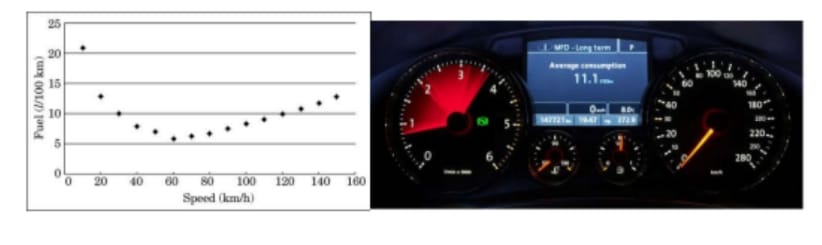
F = (V²/500) − (V/4) + 14.
Answer the following questions:
- Find F when V = 40 km/h.
- Find dF/dV.
- (a) Find the speed V for which fuel consumption F is minimum. OR (b) Find the quantity of fuel required to travel 600 km at the speed V for which dF/dV = −0.01.
View Solution
- Part (i): Find F when V = 40 km/h:
Substitute V = 40 into the equation:F = (40²/500) − (40/4) + 14.
Simplify:F = (1600/500) − 10 + 14 = 3.2 − 10 + 14 = 7.2.
Solution:F = 7.2 liters per 100 km.
- Part (ii): Find dF/dV:
Differentiate F with respect to V:dF/dV = d/dV (V²/500) − d/dV (V/4) + d/dV (14).
Simplify:dF/dV = (2V/500) − (1/4) + 0 = V/250 − 1/4.
Solution:dF/dV = V/250 − 1/4.
- Part (iii)(a): Find the speed V for minimum F:
For minimum fuel consumption, set:dF/dV = 0 ⇒ V/250 − 1/4 = 0.
Solve for V:V/250 = 1/4 ⇒ V = 250/4 = 62.5.
Solution:V = 62.5 km/h.
- Part (iii)(b): Find fuel required to travel 600 km:
Given:dF/dV = −0.01 ⇒ V/250 − 1/4 = −0.01.
Solve for V:V/250 = −0.01 + 1/4 = 0.24 ⇒ V = 250 * 0.24 = 60.
At V = 60 km/h, substitute into the equation for F:F = (60²/500) − (60/4) + 14.
Simplify:F = (3600/500) − 15 + 14 = 7.2 liters per 100 km.
Total fuel required for 600 km:Fuel = (F/100) * 600 = (7.2/100) * 600 = 43.2 liters.
Solution:Fuel required = 43.2 liters.







Comments