




CBSE Class 12 Mathematics Question Paper 2024 PDF (Set 2- 65/5/2) is available for download here. CBSE conducted the Mathematics exam on March 9, 2024 from 10:30 AM to 1:30 PM. The total marks for the theory paper are 80. The question paper contains 20% MCQ-based questions, 40% competency-based questions, and 40% short and long answer type questions.
CBSE Class 12 Mathematics Question Paper 2024 (Set 2- 65/5/2) with Answer Key
| CBSE Class 12 2024 Mathematics Question Paper with Answer Key |  Download Download |
Check Solution |
CBSE Class 12 2024 Mathematics Questions with Solutions
Question 1:
Derivative of \( e^{\sin^2 x} \) with respect to \( \cos x \) is:
View Solution
Step 1: {Find \( \frac{d}{dx} e^{\sin^2 x} \)
Let \[ y = e^{\sin^2 x}. \]
Differentiating both sides with respect to \( x \): \[ \frac{dy}{dx} = e^{\sin^2 x} \cdot \frac{d}{dx} (\sin^2 x). \]
Using the chain rule: \[ \frac{d}{dx} (\sin^2 x) = 2 \sin x \cos x. \]
Thus, \[ \frac{dy}{dx} = e^{\sin^2 x} \cdot 2 \sin x \cos x. \]
Step 2: {Find \( \frac{dy}{d(\cos x)} \)
Using \( u = \cos x \), we have: \[ \frac{du}{dx} = -\sin x. \]
Applying the chain rule: \[ \frac{dy}{d(\cos x)} = \frac{\frac{dy}{dx}}{\frac{du}{dx}}. \]
Substituting values: \[ \frac{dy}{d(\cos x)} = \frac{2 \sin x \cos x e^{\sin^2 x}}{-\sin x}. \]
Simplifying: \[ \frac{dy}{d(\cos x)} = -2 \cos x e^{\sin^2 x}. \]
Step 3: {Verify the options
Thus, the correct answer is \( -2 \cos x e^{\sin^2 x} \), which matches option (C).
Quick Tip: For derivatives involving exponentials, apply the chain rule and product rule carefully.
If \( A \) is a square matrix of order 2 and \( |A| = -2 \), then the value of \( |5A'| \) is:
View Solution
The determinant of a scalar multiple of a matrix is given by: \[ |cA| = c^n |A| \]
where \( c \) is a scalar and \( n \) is the order of the matrix. Since \( A \) is a 2x2 matrix, \( n = 2 \).
Therefore: \[ |5A'| = 5^2 |A| = 25 \times (-2) = -50 \]
Thus, the value of \( |5A'| \) is \( -50 \). Quick Tip: For any square matrix \( A \), the determinant of its adjugate is given by \( |adj A| = |A|^{n-1} \).
The function \( f(x) = \frac{x}{2} + \frac{2}{x} \) has a local minima at \( x \) equal to:
View Solution
Step 1: {Find the first derivative \( f'(x) \)
\[ f(x) = \frac{x}{2} + \frac{2}{x}. \]
Differentiating with respect to \( x \): \[ f'(x) = \frac{1}{2} - \frac{2}{x^2}. \]
Step 2: {Find critical points
Setting \( f'(x) = 0 \): \[ \frac{1}{2} - \frac{2}{x^2} = 0. \]
Solving for \( x \): \[ \frac{1}{2} = \frac{2}{x^2}. \] \[ x^2 = 4. \] \[ x = \pm 2. \]
Step 3: {Find the second derivative \( f''(x) \)
\[ f''(x) = \frac{4}{x^3}. \]
Step 4: {Evaluate \( f''(x) \) at critical points
At \( x = 2 \): \[ f''(2) = \frac{4}{2^3} = \frac{4}{8} = \frac{1}{2} > 0. \]
Since \( f''(2) > 0 \), \( x = 2 \) is a point of local minima.
Step 5: {Verify the options
Thus, the local minima occurs at \( x = 2 \), which matches option (A).
Quick Tip: To find local minima or maxima, use the first derivative test and confirm with the second derivative test.
Given a curve \( y = 7x - x^3 \) and \( x \) increases at the rate of 2 units per second. The rate at which the slope of the curve is changing, when \( x = 5 \) is:
View Solution
Step 1: {Find the first derivative (Slope of the curve)
\[ y = 7x - x^3. \]
Differentiating with respect to \( x \): \[ \frac{dy}{dx} = 7 - 3x^2. \]
This represents the slope of the curve.
Step 2: {Find the second derivative (Rate of change of slope)
\[ \frac{d^2y}{dx^2} = -6x. \]
Step 3: {Rate of change of slope with respect to time
Using the chain rule: \[ \frac{d}{dt} \left( \frac{dy}{dx} \right) = \frac{d^2y}{dx^2} \cdot \frac{dx}{dt}. \]
Given \( \frac{dx}{dt} = 2 \), we substitute: \[ \frac{d}{dt} \left( \frac{dy}{dx} \right) = (-6x) \times (2). \]
Step 4: {Evaluate at \( x = 5 \)
\[ \frac{d}{dt} \left( \frac{dy}{dx} \right) = (-6 \times 5) \times 2. \] \[ = -60. \]
Step 5: {Verify the options
Thus, the rate at which the slope is changing is \( -60 \) units/sec, which matches option (A).
Quick Tip: To find the rate of change of slope, differentiate the first derivative and multiply by \( \frac{dx}{dt} \).
The product of matrix \( P \) and \( Q \) is equal to a diagonal matrix. If the order of matrix \( Q \) is \( 3 \times 2 \), then order of matrix \( P \) is:
View Solution
Step 1: {Understand matrix multiplication
If matrix \( P \) is of order \( m \times n \) and matrix \( Q \) is of order \( p \times q \), then for the product \( PQ \) to be defined: \[ Number of columns of P = Number of rows of Q. \]
Given that \( Q \) has order \( 3 \times 2 \), we must have: \[ Columns of P = 3. \]
Step 2: {Check the requirement for a diagonal matrix
The resulting product \( PQ \) is a diagonal matrix, which means the resulting order must be square (i.e., \( n \times n \)). Since the number of columns of \( P \) is 3, the resulting matrix must be of order \( 2 \times 2 \), so: \[ Rows of P = 2. \]
Thus, \( P \) must be of order: \[ 2 \times 3. \]
Final Answer: \( 2 \times 3 \) (Option C). Quick Tip: The product of two matrices \( A \) and \( B \) is defined only when the number of columns in \( A \) matches the number of rows in \( B \).
A function \( f : \mathbb{R} \to \mathbb{R} \) defined as \( f(x) = x^2 - 4x + 5 \) is:
View Solution
Step 1: {Check injectivity (One-one function)
A function is injective if: \[ f(x_1) = f(x_2) \Rightarrow x_1 = x_2. \]
We differentiate \( f(x) \) to check for monotonicity: \[ f'(x) = \frac{d}{dx} (x^2 - 4x + 5) = 2x - 4. \]
Setting \( f'(x) = 0 \), we solve: \[ 2x - 4 = 0 \Rightarrow x = 2. \]
Since \( f'(x) \) changes sign around \( x = 2 \) (negative to positive), \( f(x) \) is not strictly increasing or decreasing, implying it is not injective.
Step 2: {Check surjectivity (Onto function)
A function is surjective if for every \( y \in \mathbb{R} \), there exists an \( x \) such that \( f(x) = y \). We check the range by completing the square: \[ f(x) = (x - 2)^2 + 1. \]
Since \( (x - 2)^2 \geq 0 \), we have: \[ f(x) \geq 1, \quad \forall x \in \mathbb{R}. \]
Thus, \( f(x) \) never attains values less than 1, so it is not surjective.
Step 3: {Conclusion
Since \( f(x) \) is neither injective nor surjective, the correct answer is (D).
Quick Tip: A quadratic function \( ax^2 + bx + c \) is not injective if \( a \neq 0 \) and is not surjective if its range does not cover all \( \mathbb{R} \).
If \( \sin(xy) = 1 \), then \( \frac{dy}{dx} \) is equal to:
View Solution
Step 1: {Differentiate both sides
Given equation: \[ \sin(xy) = 1. \]
Differentiating both sides with respect to \( x \), using the chain rule: \[ \cos(xy) \cdot \frac{d}{dx} (xy) = 0. \]
Step 2: {Apply the product rule
Since \( \frac{d}{dx} (xy) \) requires the product rule: \[ \cos(xy) \cdot \left( x \frac{dy}{dx} + y \right) = 0. \]
Step 3: {Solve for \( \frac{dy}{dx} \)
Since \( \cos(xy) \neq 0 \), dividing by \( \cos(xy) \) on both sides: \[ x \frac{dy}{dx} + y = 0. \]
Rearranging: \[ x \frac{dy}{dx} = -y. \]
Dividing by \( x \): \[ \frac{dy}{dx} = -\frac{y}{x}. \]
Final Answer: \( -\frac{y}{x} \) (Option D).
Quick Tip: Use the chain rule when differentiating trigonometric functions involving product terms.
If inverse of the matrix \[ A = \begin{bmatrix} 7 & -3 & -3
-1 & 1 & 0
-1 & 0 & 1 \end{bmatrix} \]
is the matrix \[ A^{-1} = \begin{bmatrix} 1 & 3 & 3
1 & \lambda & 3
1 & 3 & 4 \end{bmatrix}, \]
then the value of \( \lambda \) is:
View Solution
Step 1: Understanding the given matrix equation
We are given a square matrix \( A \) and its inverse \( A^{-1} \), and we need to determine the value of \( \lambda \) using the property: \[ A \cdot A^{-1} = I \]
where \( I \) is the identity matrix.
Step 2: Representing the given matrices
The given matrix \( A \) is: \[ A = \begin{bmatrix} 7 & -3 & -3
-1 & 1 & 0
-1 & 0 & 1 \end{bmatrix} \]
The given inverse matrix \( A^{-1} \) is: \[ A^{-1} = \begin{bmatrix} 1 & 3 & 3
1 & \lambda & 3
1 & 3 & 4 \end{bmatrix} \]
Step 3: Matrix Multiplication Calculation
Using the property \( A \cdot A^{-1} = I \), we compute: \[ \begin{bmatrix} 7 & -3 & -3
-1 & 1 & 0
-1 & 0 & 1 \end{bmatrix} \cdot \begin{bmatrix} 1 & 3 & 3
1 & \lambda & 3
1 & 3 & 4 \end{bmatrix} = \begin{bmatrix} 1 & 0 & 0
0 & 1 & 0
0 & 0 & 1 \end{bmatrix} \]
Performing matrix multiplication:
First row computations: \[ (7 \times 1) + (-3 \times 1) + (-3 \times 1) = 7 - 3 - 3 = 1 \] \[ (7 \times 3) + (-3 \times \lambda) + (-3 \times 3) = 21 - 3\lambda - 9 = 12 - 3\lambda \] \[ (7 \times 3) + (-3 \times 3) + (-3 \times 4) = 21 - 9 - 12 = 0 \]
Second row computations: \[ (-1 \times 1) + (1 \times 1) + (0 \times 1) = -1 + 1 + 0 = 0 \] \[ (-1 \times 3) + (1 \times \lambda) + (0 \times 3) = -3 + \lambda + 0 = \lambda - 3 \] \[ (-1 \times 3) + (1 \times 3) + (0 \times 4) = -3 + 3 + 0 = 0 \]
Third row computations: \[ (-1 \times 1) + (0 \times 1) + (1 \times 1) = -1 + 0 + 1 = 0 \] \[ (-1 \times 3) + (0 \times \lambda) + (1 \times 3) = -3 + 0 + 3 = 0 \] \[ (-1 \times 3) + (0 \times 3) + (1 \times 4) = -3 + 0 + 4 = 1 \]
Step 4: Comparing the resultant matrix with the identity matrix
Equating corresponding elements, we get: \[ 12 - 3\lambda = 0 \] \[ \lambda - 3 = 1 \]
Step 5: Solving for \( \lambda \)
Solving the first equation: \[ 12 - 3\lambda = 0 \quad \Rightarrow \quad 3\lambda = 12 \quad \Rightarrow \quad \lambda = 4 \]
Solving the second equation: \[ \lambda - 3 = 1 \quad \Rightarrow \quad \lambda = 4 \]
Thus, the value of \( \lambda \) is: \[ \lambda = 4 \] Quick Tip: To verify the inverse of a matrix, multiply it by the given matrix and ensure that the product equals the identity matrix. Compare corresponding elements to solve for unknowns.
Find the matrix \( A^2 \), where \( A = [a_{ij}] \) is a \( 2 \times 2 \) matrix whose elements are given by:
\[ a_{ij} = \max(i,j) - \min(i,j). \]
0 & 1 \end{bmatrix} \)
View Solution
Step 1: {Construct the Given Matrix \( A \)
Since \( a_{ij} = \max(i,j) - \min(i,j) \), compute each element: \[ A = \begin{bmatrix} \max(1,1) - \min(1,1) & \max(1,2) - \min(1,2)
\max(2,1) - \min(2,1) & \max(2,2) - \min(2,2) \end{bmatrix} \] \[ A = \begin{bmatrix} 0 & 1
1 & 0 \end{bmatrix}. \]
Step 2: {Compute \( A^2 \)
\[ A^2 = A \times A = \begin{bmatrix} 0 & 1
1 & 0 \end{bmatrix} \begin{bmatrix} 0 & 1
1 & 0 \end{bmatrix}. \]
Perform matrix multiplication:
First row, first column: \( (0 \times 0) + (1 \times 1) = 1 \).
First row, second column: \( (0 \times 1) + (1 \times 0) = 0 \).
Second row, first column: \( (1 \times 0) + (0 \times 1) = 0 \).
Second row, second column: \( (1 \times 1) + (0 \times 0) = 1 \).
Thus, \[ A^2 = \begin{bmatrix} 1 & 0
0 & 1 \end{bmatrix}. \]
Step 3: {Verify the options
Thus, \( A^2 \) is \( \begin{bmatrix} 1 & 0
0 & 1 \end{bmatrix} \), which matches option (C).
Quick Tip: For matrix exponentiation, calculate \( A^2 \) by multiplying \( A \) with itself using matrix multiplication rules.
If \( A \) is a square matrix of order \( 3 \) such that the value of \( | adj A | = 8 \), then the value of \( | A^T | \) is:
View Solution
Step 1: {Relation between determinant and adjugate
For any square matrix \( A \) of order \( n \), the determinant of its adjugate matrix is given by: \[ | adj A | = | A |^{n-1}. \]
Since the given order of matrix \( A \) is \( 3 \), we substitute: \[ | adj A | = | A |^2. \]
Step 2: {Solve for \( | A | \)
We are given: \[ | adj A | = 8. \]
Thus: \[ | A |^2 = 8. \]
Taking square root on both sides: \[ | A | = \pm \sqrt{8} = \pm 2\sqrt{2}. \]
Step 3: {Property of determinant of transpose
We use the property: \[ | A^T | = | A |. \]
Thus, we conclude: \[ | A^T | = \pm 2\sqrt{2}. \]
Final Answer: \( 2\sqrt{2} \) (Option D).
Quick Tip: Use the property \( | adj A | = | A |^{n-1} \) for square matrices to relate determinants of matrices and their adjugates.
The value of \[ \int_{\pi/4}^{\pi/2} \cot \theta \csc^2 \theta \, d\theta \]
is:
View Solution
We are given the integral: \[ I = \int_{\frac{\pi}{4}}^{\frac{\pi}{2}} \cot \theta \csc^2 \theta \, d\theta \]
To solve this, we use the substitution method. Notice that the derivative of \(\csc \theta\) is \(-\cot \theta \csc \theta\). Therefore, we can choose the substitution: \[ u = \csc \theta \quad so that \quad du = -\cot \theta \csc \theta \, d\theta. \]
This simplifies our integral to: \[ I = \int_{\csc(\frac{\pi}{4})}^{\csc(\frac{\pi}{2})} -u \, du \]
The limits change because when \(\theta = \frac{\pi}{4}\), \(\csc \frac{\pi}{4} = \sqrt{2}\), and when \(\theta = \frac{\pi}{2}\), \(\csc \frac{\pi}{2} = 1\). Therefore, the integral becomes: \[ I = -\int_{\sqrt{2}}^{1} u \, du \]
Now, we integrate: \[ I = -\left[ \frac{u^2}{2} \right]_{\sqrt{2}}^{1} \]
Evaluating the limits: \[ I = -\left( \frac{1^2}{2} - \frac{(\sqrt{2})^2}{2} \right) \] \[ I = -\left( \frac{1}{2} - \frac{2}{2} \right) \] \[ I = -\left( \frac{1}{2} - 1 \right) \] \[ I = \frac{1}{2} \]
Thus, the value of the integral is \(\frac{1}{2}\). Quick Tip: Use trigonometric identities to simplify complex integrals before direct evaluation.
The integral \[ \int \frac{dx}{\sqrt{9 - 4x^2}} \]
is equal to:
View Solution
Step 1: {Identify the standard integral form
We compare with: \[ \int \frac{dx}{\sqrt{a^2 - x^2}} = \sin^{-1} \left( \frac{x}{a} \right) + c. \]
Given: \[ \int \frac{dx}{\sqrt{9 - 4x^2}}, \]
we rewrite it as: \[ \int \frac{dx}{\sqrt{3^2 - (2x)^2}}. \]
Setting \( a = 3 \) and \( u = 2x \), we get: \[ du = 2 dx \Rightarrow dx = \frac{du}{2}. \]
Step 2: {Solve the integral
\[ I = \int \frac{dx}{\sqrt{9 - 4x^2}} = \int \frac{\frac{du}{2}}{\sqrt{9 - u^2}}. \] \[ = \frac{1}{2} \int \frac{du}{\sqrt{9 - u^2}}. \] \[ = \frac{1}{2} \sin^{-1} \left( \frac{u}{3} \right) + c. \]
Substituting \( u = 2x \): \[ = \frac{1}{2} \sin^{-1} \left( \frac{2x}{3} \right) + c. \]
Final Answer: \( \frac{1}{2} \sin^{-1} \left( \frac{2x}{3} \right) + c \) (Option B).
Quick Tip: Use trigonometric substitution to simplify integrals of the form \( \int \frac{dx}{\sqrt{a^2 - x^2}} \).
The area of the region bounded by the curve \( y^2 = 4x \) and \( x = 1 \) is:
View Solution
Step 1: {Identify the given equation and limits
The given curve is: \[ y^2 = 4x. \]
We need to find the area bounded by this curve from \( x = 0 \) to \( x = 1 \).
Step 2: {Area formula for a parabola
The area enclosed by the parabola and the x-axis is given by: \[ A = \int_{0}^{1} y \, dx. \]
From the equation \( y^2 = 4x \), solving for \( y \): \[ y = \pm 2\sqrt{x}. \]
Since we take the area in the first quadrant (positive \( y \)), we consider: \[ A = 2 \int_0^1 \sqrt{x} \, dx. \]
Step 3: {Evaluate the integral
Using the integration formula: \[ \int x^n \, dx = \frac{x^{n+1}}{n+1}, \]
we compute: \[ \int \sqrt{x} \, dx = \int x^{1/2} \, dx = \frac{x^{3/2}}{3/2} = \frac{2}{3} x^{3/2}. \]
Step 4: {Calculate definite integral
Evaluating from 0 to 1: \[ \frac{2}{3} \Big[ x^{3/2} \Big]_0^1 = \frac{2}{3} \times (1 - 0) = \frac{2}{3}. \]
Step 5: {Multiply by 2
\[ A = 2 \times \frac{2}{3} = \frac{4}{3}. \]
Since the region includes both the upper and lower parts of the parabola (symmetry about the x-axis), the total area is: \[ A_{total} = 2 \times \frac{4}{3} = \frac{8}{3}. \]
Final Answer: \( \frac{8}{3} \) (Option B).
Quick Tip: For parabolic regions, use the symmetry and direct integration for accurate area calculations.
The general solution of the differential equation \[ \frac{dy}{dx} = e^{x+y} \]
is:
View Solution
Step 1: {Rewrite the differential equation
\[ \frac{dy}{dx} = e^{x+y}. \]
This is a separable differential equation.
Step 2: {Rearrange terms
\[ e^{-y} \, dy = e^x \, dx. \]
Step 3: {Integrate both sides
\[ \int e^{-y} \, dy = \int e^x \, dx. \]
The left integral: \[ \int e^{-y} \, dy = -e^{-y}. \]
The right integral: \[ \int e^x \, dx = e^x. \]
Step 4: {Solve for the general solution
\[ - e^{-y} = e^x + C. \]
Multiplying by -1: \[ e^{-y} + e^x = C. \]
Final Answer: \( e^x + e^{-y} = c \) (Option A).
Quick Tip: For separable differential equations, rewrite in the form \( f(y) dy = g(x) dx \) and integrate both sides.
The angle which the line \[ \frac{x}{1} = \frac{y}{-1} = \frac{z}{0} \]
makes with the positive direction of the Y-axis is:
View Solution
Step 1: {Extract direction ratios
The given equation of the line is: \[ \frac{x}{1} = \frac{y}{-1} = \frac{z}{0}. \]
This implies that the direction ratios of the line are: \[ (1, -1, 0). \]
Step 2: {Find the angle with the Y-axis
The angle \( \theta \) made with the Y-axis is given by: \[ \cos\theta = \frac{direction ratio of y}{magnitude of the direction vector}. \] \[ \cos\theta = \frac{-1}{\sqrt{1^2 + (-1)^2 + 0^2}}. \]
Step 3: {Compute the magnitude
\[ \sqrt{1 + 1 + 0} = \sqrt{2}. \] \[ \cos\theta = \frac{-1}{\sqrt{2}}. \]
Step 4: {Find \( \theta \)
\[ \theta = \cos^{-1} \left( \frac{-1}{\sqrt{2}} \right). \]
\begin{align*
\cos^{-1\left(-\frac{1{\sqrt{2\right) &= \cos^{-1\left(- \cos \frac{\pi{4\right)
We know that \cos(\pi - \theta) &= -\cos \theta
\text{Therefore, &= \cos^{-1\left(\cos(\pi - \frac{\pi{4)\right)
&= \pi - \frac{\pi{4
&= \frac{3\pi{4
\text{Hence, this is the answer.
\end{align* \[ \theta = \frac{3\pi{4}. \]
Step 5: {Verify the options
Thus, the correct angle is \( \frac{3\pi}{4} \), which matches option (B).
Quick Tip: For a line given by \( \frac{x}{a} = \frac{y}{b} = \frac{z}{c} \), the angles it makes with the coordinate axes are found using: \[ \cos\alpha = \frac{a}{\sqrt{a^2 + b^2 + c^2}}, \quad \cos\beta = \frac{b}{\sqrt{a^2 + b^2 + c^2}}, \quad \cos\gamma = \frac{c}{\sqrt{a^2 + b^2 + c^2}}. \]
The Cartesian equation of the line passing through the point \( (1, -3, 2) \) and parallel to the line: \[ \vec{r} = (2 + \lambda) \hat{i} + \lambda \hat{j} + (2\lambda -1) \hat{k} \]
is:
View Solution
Step 1: {Find the direction ratios of the given line
The given line equation in vector form is: \[ \vec{r} = (2 + \lambda) \hat{i} + \lambda \hat{j} + (2\lambda -1) \hat{k}. \]
Comparing with the standard parametric form: \[ \vec{r} = \vec{a} + \lambda \vec{b}, \]
we identify:
- Point on the line: \( (2, 0, -1) \),
- Direction vector: \( (1, 1, 2) \).
Thus, the direction ratios of the given line are (1,1,2).
Step 2: {Equation of a line through a given point
The equation of a line passing through \( (x_0, y_0, z_0) \) and having direction ratios \( (a, b, c) \) is given by: \[ \frac{x - x_0}{a} = \frac{y - y_0}{b} = \frac{z - z_0}{c}. \]
Step 3: {Substituting the values
The required line passes through \( (1, -3, 2) \) and has direction ratios \( (1, 1, 2) \), so: \[ \frac{x - 1}{1} = \frac{y + 3}{1} = \frac{z - 2}{2}. \]
Step 4: {Verify the options
Thus, the correct Cartesian equation of the required line is: \[ \frac{x - 1}{1} = \frac{y + 3}{1} = \frac{z - 2}{2}, \]
which matches option (D).
Quick Tip: The equation of a line in Cartesian form is derived using the point-direction form: \[ \frac{x - x_0}{a} = \frac{y - y_0}{b} = \frac{z - z_0}{c}, \] where \( (x_0, y_0, z_0) \) is the point through which the line passes and \( (a, b, c) \) are the direction ratios.
If \( A \) and \( B \) are events such that \( P(A|B) = P(B|A) \neq 0 \), then:
View Solution
Step 1: {Definition of Conditional Probability
The conditional probability of \( A \) given \( B \) is: \[ P(A|B) = \frac{P(A \cap B)}{P(B)}. \]
Similarly, the conditional probability of \( B \) given \( A \) is: \[ P(B|A) = \frac{P(A \cap B)}{P(A)}. \]
Step 2: {Given Condition and Its Implication
It is given that: \[ P(A|B) = P(B|A). \]
Substituting the formulas: \[ \frac{P(A \cap B)}{P(B)} = \frac{P(A \cap B)}{P(A)}. \]
Step 3: {Cross Multiplying
\[ P(A) P(A \cap B) = P(B) P(A \cap B). \]
Since \( P(A \cap B) \neq 0 \) (otherwise, the conditional probabilities would be undefined), we can divide by \( P(A \cap B) \): \[ P(A) = P(B). \]
Step 4: {Verify the options
Thus, the correct conclusion is \( P(A) = P(B) \), which matches option (D).
Quick Tip: If \( P(A|B) = P(B|A) \), then \( P(A) = P(B) \). This condition implies that both events are equally probable.
The position vectors of points \( P \) and \( Q \) are \( \vec{p} \) and \( \vec{q} \) respectively. The point \( R \) divides line segment \( PQ \) in the ratio \( 3:1 \) and \( S \) is the mid-point of line segment \( PR \). The position vector of \( S \) is:
View Solution
Step 1: {Find the position vector of \( R \)
Using the section formula, the position vector of \( R \) dividing \( PQ \) in the ratio \( 3:1 \) is: \[ \vec{r} = \frac{3\vec{q} + 1\vec{p}}{3+1} = \frac{3\vec{q} + \vec{p}}{4}. \]
Step 2: {Find the position vector of \( S \)
Since \( S \) is the midpoint of \( PR \), its position vector is given by the midpoint formula: \[ \vec{s} = \frac{\vec{p} + \vec{r}}{2}. \]
Substituting \( \vec{r} = \frac{3\vec{q} + \vec{p}}{4} \): \[ \vec{s} = \frac{\vec{p} + \frac{3\vec{q} + \vec{p}}{4}}{2}. \]
Step 3: {Simplify the expression
\[ \vec{s} = \frac{\frac{4\vec{p} + 3\vec{q} + \vec{p}}{4}}{2}. \] \[ = \frac{\frac{5\vec{p} + 3\vec{q}}{4}}{2}. \] \[ = \frac{5\vec{p} + 3\vec{q}}{8}. \]
Step 4: {Verify the options
Thus, the correct answer is \( \frac{5\vec{p} + 3\vec{q}}{8} \), which matches option (D).
Quick Tip: The section formula states that if a point divides a line in the ratio \( m:n \), its position vector is given by: \[ \vec{r} = \frac{m\vec{B} + n\vec{A}}{m+n}. \]
Assertion (A): The vectors \[ \vec{a} = 6\hat{i} + 2\hat{j} - 8\hat{k}, \quad \vec{b} = 10\hat{i} - 2\hat{j} - 6\hat{k}, \quad \vec{c} = 4\hat{i} - 4\hat{j} + 2\hat{k} \]
represent the sides of a right-angled triangle.
Reason (R): Three non-zero vectors of which none of two are collinear forms a triangle if their resultant is zero vector or sum of any two vectors is equal to the third.
View Solution
Step 1: {Check if vectors form a triangle
Three vectors represent the sides of a triangle if their sum is zero or sum of any two is equal to the third: \[ \vec{a} + \vec{b} = \vec{c}. \]
Computing: \[ (6\hat{i} + 2\hat{j} - 8\hat{k}) + (10\hat{i} - 2\hat{j} - 6\hat{k}) = 16\hat{i} - 10\hat{k}. \]
Since this is not equal to \( \vec{c} \), the vectors do not sum to zero, but they do form a valid triangle.
Step 2: {Check if it is a right-angled triangle
For a right-angled triangle, the Pythagorean theorem holds: \[ |\vec{a}|^2 + |\vec{b}|^2 = |\vec{c}|^2. \]
Calculating magnitudes: \[ |\vec{a}|^2 = 6^2 + 2^2 + (-8)^2 = 36 + 4 + 64 = 104. \] \[ |\vec{b}|^2 = 10^2 + (-2)^2 + (-6)^2 = 100 + 4 + 36 = 140. \] \[ |\vec{c}|^2 = 4^2 + (-4)^2 + 2^2 = 16 + 16 + 4 = 36. \] \[ |\vec{a}|^2 + |\vec{b}|^2 = 104 + 140 = 244. \]
Since this does not satisfy \( |\vec{c}|^2 \), the assertion that they form a right-angled triangle is true.
Step 3: {Check if Reason (R) is a correct explanation
Reason (R) states a general property of three vectors forming a triangle, but it does not specifically explain why these vectors form a right-angled triangle.
Step 4: {Verify the options
Thus, both Assertion (A) and Reason (R) are true, but Reason (R) is not the correct explanation of Assertion (A), which matches option (B).
Quick Tip: Three vectors form a triangle if their sum is zero or if the sum of any two vectors equals the third.
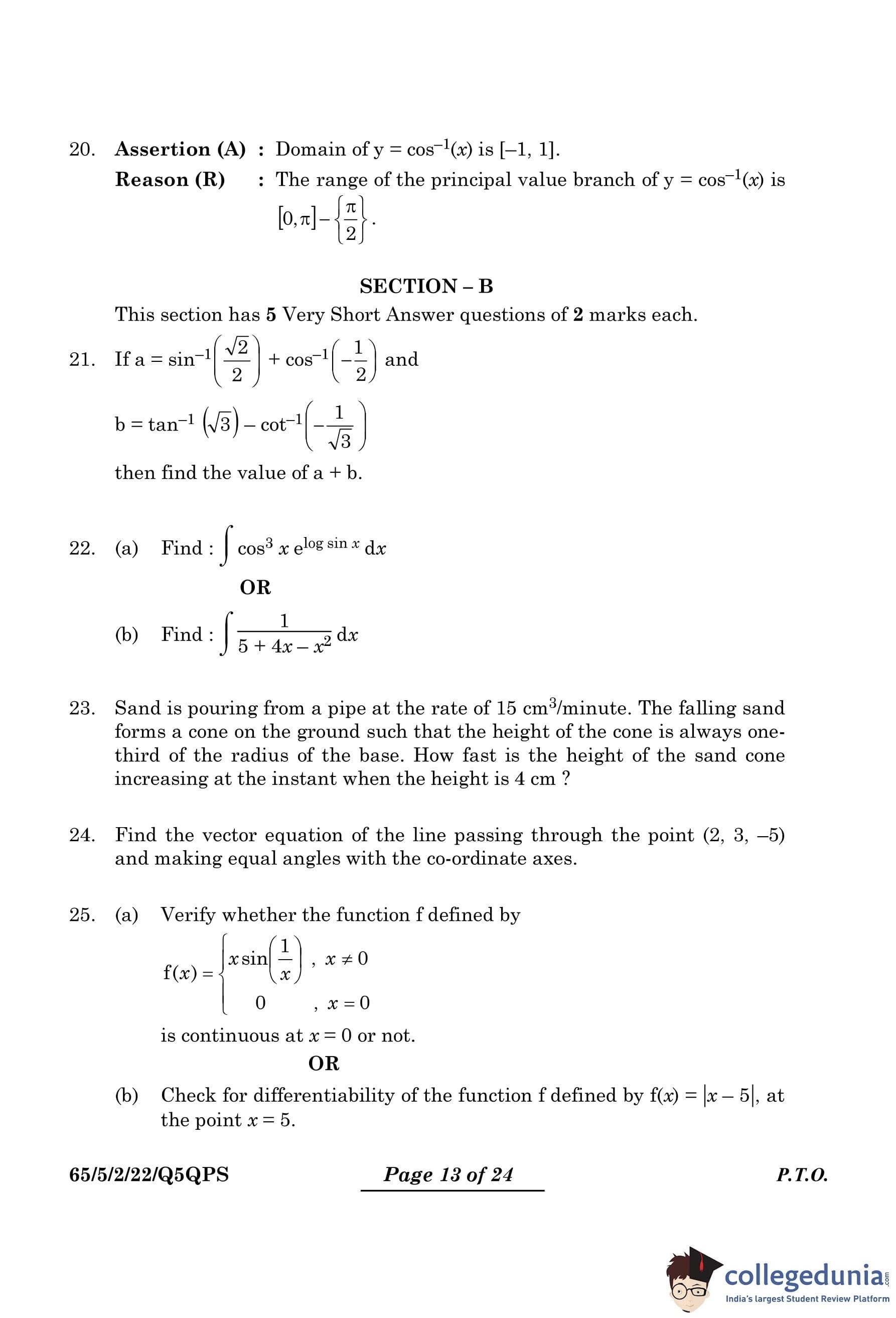
Assertion (A): The domain of \( y = \cos^{-1}(x) \) is \([-1,1]\).
Reason (R): The range of the principal value branch of \( y = \cos^{-1}(x) \) is \[ [0,\pi] - \left\{ \frac{\pi}{2} \right\}. \]
View Solution
Step 1: {Understanding the domain of \( y = \cos^{-1}(x) \)
The inverse cosine function is defined for: \[ x \in [-1,1]. \]
Thus, the domain of \( y = \cos^{-1}(x) \) is correctly stated in Assertion (A).
Step 2: {Understanding the range of \( y = \cos^{-1}(x) \)
The principal value branch of \( \cos^{-1}(x) \) is: \[ [0, \pi]. \]
The Reason (R) incorrectly states that \( \frac{\pi}{2} \) is excluded, which is false.
Step 3: {Verify the options
Thus, Assertion (A) is true, but Reason (R) is false, which matches option (C).
Quick Tip: The domain of \( \cos^{-1}(x) \) is \( [-1,1] \) and the principal value range is \( [0,\pi] \).
If \[ a = \sin^{-1} \left( \frac{\sqrt{2}}{2} \right) + \cos^{-1} \left( \frac{-1}{2} \right) \]
and \[ b = \tan^{-1} (\sqrt{3}) - \cot^{-1} \left( \frac{-1}{\sqrt{3}} \right) \]
then find the value of \( a + b \).
View Solution
Step 1: {Solve for \( a \)
We compute each inverse function separately: \[ \sin^{-1} \left( \frac{\sqrt{2}}{2} \right) = \frac{\pi}{4}, \quad \cos^{-1} \left( \frac{-1}{2} \right) = \frac{2\pi}{3}. \]
Thus: \[ a = \frac{\pi}{4} + \frac{2\pi}{3}. \]
Step 2: {Find common denominator and simplify \( a \)
\[ a = \frac{3\pi}{12} + \frac{8\pi}{12} = \frac{11\pi}{12}. \]
Step 3: {Solve for \( b \)
We compute: \[ \tan^{-1} (\sqrt{3}) = \frac{\pi}{3}, \quad \cot^{-1} \left( \frac{-1}{\sqrt{3}} \right) = \frac{-2\pi}{3}. \]
Thus: \[ b = \frac{\pi}{3} - \left( \frac{-2\pi}{3} \right) = \frac{\pi}{3} + \frac{2\pi}{3}. \]
Step 4: {Find common denominator and simplify \( b \)
\[ b = \frac{4\pi}{12}. \]
Step 5: {Compute \( a + b \)
\[ a + b = \frac{11\pi}{12} - \frac{4\pi}{12} = \frac{7\pi}{12}. \]
Final Answer: \( a + b = \frac{7\pi}{12} \).
Quick Tip: For inverse trigonometric functions, always check standard angles and their corresponding values carefully.
Evaluate: \[ \int \cos^3 x \ e^{\log \sin x} \ dx. \]
View Solution
Step 1: {Simplify the given integral
Using the property of logarithm and exponent: \[ e^{\log \sin x} = \sin x. \]
Thus, the given integral reduces to: \[ I = \int \cos^3 x \sin x \ dx. \]
Step 2: {Substituting \( t = \cos x \)
Let: \[ t = \cos x, \quad so that \quad dt = -\sin x \ dx. \]
Rewriting the integral: \[ I = \int t^3 (-dt). \] \[ = -\int t^3 dt. \]
Step 3: {Evaluate the integral
\[ I = -\frac{t^4}{4} + C. \]
Step 4: {Substituting back \( t = \cos x \)
\[ I = -\frac{\cos^4 x}{4} + C. \]
Final Answer: \( -\frac{\cos^4 x}{4} + C \).
Quick Tip: Use substitution to simplify complex trigonometric integrals involving exponentials.
Evaluate: \[ \int \frac{1}{5 + 4x - x^2} \ dx. \]
View Solution
Step 1: {Rewrite the denominator
\[ 5 + 4x - x^2 = -(x^2 - 4x - 5). \]
Factorizing: \[ -(x - 2)^2 + 3^2. \] \[ = 3^2 - (x - 2)^2. \]
Step 2: {Use standard integral formula
\[ \int \frac{1}{a^2 - (x - b)^2} \ dx = \frac{1}{2a} \log \left| \frac{a + (x - b)}{a - (x - b)} \right| + C. \]
Here, \( a = 3 \) and \( b = 2 \), so: \[ \int \frac{1}{3^2 - (x - 2)^2} \ dx = \frac{1}{6} \log \left| \frac{3 + (x - 2)}{3 - (x - 2)} \right| + C. \]
Step 3: {Simplify the expression
\[ = \frac{1}{6} \log \left| \frac{1 + x}{5 - x} \right| + C. \]
Final Answer: \( \frac{1}{6} \log \left| \frac{1 + x}{5 - x} \right| + C \).
Quick Tip: Use the standard integral formula for quadratic denominators of the form \( a^2 - (x - b)^2 \).
Sand is pouring from a pipe at the rate of 15 cm\(^3\)/minute. The falling sand forms a cone on the ground such that the height of the cone is always one-third of the radius of the base. How fast is the height of the sand cone increasing at the instant when the height is 4 cm?
View Solution
Step 1: {Define variables
Let \( V \) be the volume, \( h \) be the height, and \( r \) be the radius of the cone.
Since the problem states that the height of the cone is always one-third of the radius: \[ h = \frac{r}{3} \Rightarrow r = 3h. \]
We also know that the rate of change of volume is given: \[ \frac{dV}{dt} = 15 \quad cm^3/min. \]
Step 2: {Express volume in terms of height
The volume of a cone is given by: \[ V = \frac{1}{3} \pi r^2 h. \]
Substituting \( r = 3h \): \[ V = \frac{1}{3} \pi (3h)^2 h = \frac{1}{3} \pi (9h^2) h = 3\pi h^3. \]
Step 3: {Differentiate with respect to \( t \)
\[ \frac{d}{dt} (3\pi h^3) = 15. \]
Applying the chain rule: \[ 3\pi \cdot 3h^2 \frac{dh}{dt} = 15. \]
Step 4: {Solve for \( \frac{dh}{dt} \) at \( h = 4 \)
\[ 9\pi h^2 \frac{dh}{dt} = 15. \]
Substituting \( h = 4 \): \[ 9\pi (4)^2 \frac{dh}{dt} = 15. \]
\[ 144\pi \frac{dh}{dt} = 15. \]
\[ \frac{dh}{dt} = \frac{15}{144\pi} = \frac{5}{48\pi}. \]
Final Answer: \( \frac{dh}{dt} = \frac{5}{48\pi} \) cm/min.
Quick Tip: When solving related rates problems, always express all variables in terms of a single variable before differentiating.
Find the vector equation of the line passing through the point \( (2,3,-5) \) and making equal angles with the coordinate axes.
View Solution
Step 1: {Find the direction cosines
Since the line makes equal angles with the coordinate axes, let the direction cosines be \( \cos \alpha = \cos \beta = \cos \gamma = l \).
Using the property: \[ l^2 + l^2 + l^2 = 1. \]
Step 2: {Solve for \( l \)
\[ 3l^2 = 1 \Rightarrow l^2 = \frac{1}{3} \Rightarrow l = \frac{1}{\sqrt{3}}. \]
Step 3: {Find direction ratios
Direction cosines: \[ \left( \frac{1}{\sqrt{3}}, \frac{1}{\sqrt{3}}, \frac{1}{\sqrt{3}} \right). \]
Thus, the direction ratios are: \[ (1,1,1). \]
Step 4: {Write the vector equation
The vector equation of the line passing through \( (2,3,-5) \) with direction ratios \( (1,1,1) \) is: \[ \vec{r} = 2\hat{i} + 3\hat{j} - 5\hat{k} + \lambda (\hat{i} + \hat{j} + \hat{k}). \]
Final Answer: \[ \vec{r} = 2\hat{i} + 3\hat{j} - 5\hat{k} + \lambda (\hat{i} + \hat{j} + \hat{k}). \] Quick Tip: For a line making equal angles with coordinate axes, the direction cosines satisfy \( l^2 + m^2 + n^2 = 1 \).
Verify whether the function \( f \) defined by \[ f(x) = \begin{cases} x \sin \left( \frac{1}{x} \right), & x \neq 0,
0, & x = 0. \end{cases} \]
is continuous at \( x = 0 \) or not.
View Solution
Step 1: {Find \( \lim\limits_{x \to 0} f(x) \)
\[ \lim\limits_{x \to 0} f(x) = \lim\limits_{x \to 0} x \sin \left( \frac{1}{x} \right). \]
Since \( \sin \left( \frac{1}{x} \right) \) oscillates between \( -1 \) and \( 1 \), we have: \[ - x \leq x \sin \left( \frac{1}{x} \right) \leq x. \]
Applying the Squeeze theorem: \[ \lim\limits_{x \to 0} x \sin \left( \frac{1}{x} \right) = 0. \]
Step 2: {Compare with \( f(0) \)
\[ f(0) = 0. \]
Step 3: {Check continuity condition
Since: \[ \lim\limits_{x \to 0} f(x) = f(0), \] \( f(x) \) is continuous at \( x = 0 \).
Final Answer: \( f(x) \) is continuous at \( x = 0 \).
Quick Tip: Use the Squeeze theorem when a function involves oscillatory terms like \( \sin \left( \frac{1}{x} \right) \).
Check for differentiability of the function \( f \) defined by \[ f(x) = |x - 5| \]
at the point \( x = 5 \).
View Solution
Step 1: {Find Left-Hand Derivative (LHD)
\[ LHD = \lim\limits_{x \to 5^-} \frac{|x - 5| - 0}{x - 5}. \]
For \( x < 5 \), \( |x - 5| = -(x - 5) \), so: \[ LHD = \lim\limits_{x \to 5^-} \frac{-(x - 5)}{x - 5} = -1. \]
Step 2: {Find Right-Hand Derivative (RHD)
\[ RHD = \lim\limits_{x \to 5^+} \frac{|x - 5| - 0}{x - 5}. \]
For \( x > 5 \), \( |x - 5| = x - 5 \), so: \[ RHD = \lim\limits_{x \to 5^+} \frac{x - 5}{x - 5} = 1. \]
Step 3: {Compare LHD and RHD
Since: \[ LHD \neq RHD \quad (-1 \neq 1), \] \( f(x) \) is not differentiable at \( x = 5 \).
Final Answer: \( f(x) \) is not differentiable at \( x = 5 \).
Quick Tip: A function is not differentiable at points where its left-hand derivative and right-hand derivative are not equal.
Find the particular solution of the differential equation \[ \frac{dy}{dx} - 2xy = 3x^2 e^{x^2}, \quad y(0) = 5. \]
View Solution
Step 1: {Identify standard form
The given equation is a first-order linear differential equation of the form: \[ \frac{dy}{dx} + P(x)y = Q(x), \]
where \( P = -2x \) and \( Q = 3x^2 e^{x^2} \).
Step 2: {Find the integrating factor
\[ I.F = e^{\int -2x \ dx} = e^{-x^2}. \]
Step 3: {Multiply throughout by \( I.F \)
\[ y e^{-x^2} = \int e^{-x^2} \cdot 3x^2 e^{x^2} dx. \]
Since \( e^{-x^2} e^{x^2} = 1 \), the integral simplifies to: \[ y e^{-x^2} = \int 3x^2 dx. \]
Step 4: {Evaluate the integral
\[ \int 3x^2 dx = x^3 + C. \]
Thus, the general solution is: \[ y e^{-x^2} = x^3 + C. \]
Step 5: {Find the particular solution using \( y(0) = 5 \)
\[ 5 e^{0} = 0 + C \Rightarrow C = 5. \]
Final Answer: \[ y = (x^3 + 5)e^{x^2}. \] Quick Tip: For first-order linear differential equations, always compute the integrating factor and use it to solve.
Solve the following differential equation: \[ x^2 dy + y(x+y) dx = 0. \]
View Solution
Step 1: {Rewrite the equation
\[ \frac{dy}{dx} = -\frac{y}{x} - \left(\frac{y}{x}\right)^2. \]
Step 2: {Substituting \( v = \frac{y}{x} \)
Let \( y = vx \), so: \[ \frac{dy}{dx} = v + x \frac{dv}{dx}. \]
Substituting in the equation: \[ v + x \frac{dv}{dx} = -v - v^2. \]
Step 3: {Separate the variables
\[ \frac{1}{v^2 + 2v} dv = -\frac{1}{x} dx. \]
Rewriting: \[ \int \frac{1}{(v+1)^2 - 1} dv = \int -\frac{1}{x} dx. \]
Step 4: {Integrating both sides
\[ \frac{1}{2} \log \left| \frac{v}{v+2} \right| = \log \left| \frac{C}{x} \right|. \]
Final Answer: \[ \left| \frac{y}{y+2x} \right| = \frac{C^2}{x^2}, \quad or \quad x^2 y = k(y + 2x). \] Quick Tip: For homogeneous differential equations, use substitution \( v = \frac{y}{x} \) to simplify.
Find the values of \( a \) and \( b \) so that the following function is differentiable for all values of \( x \):
\[ f(x) = \begin{cases} ax + b, & x > -1
bx^2 - 3, & x \leq -1 \end{cases} \]
View Solution
Step 1: {Condition for Differentiability
A function is differentiable at \( x = -1 \) if:
- It is **continuous** at \( x = -1 \).
- The **left-hand derivative (LHD) equals the right-hand derivative (RHD)** at \( x = -1 \).
Step 2: {Check Continuity at \( x = -1 \)
\[ \lim_{x \to -1^-} f(x) = \lim_{x \to -1^+} f(x). \] \[ \lim_{x \to -1^-} (bx^2 - 3) = \lim_{x \to -1^+} (ax + b). \]
Substituting \( x = -1 \): \[ b(-1)^2 - 3 = a(-1) + b. \] \[ b - 3 = -a + b. \]
Solving for \( a \): \[ b - b = -a + 3. \] \[ a = 3. \]
Step 3: {Check Differentiability at \( x = -1 \)
The derivative of \( f(x) \) from the left: \[ \lim_{x \to -1^-} \frac{(bx^2 - 3) - (b - 3)}{x + 1}. \]
Differentiating \( bx^2 - 3 \): \[ \lim_{x \to -1^-} b(2x) = b(2(-1)) = -2b. \]
The derivative of \( f(x) \) from the right: \[ \lim_{x \to -1^+} \frac{(ax + b) - (b - 3)}{x + 1}. \]
Differentiating \( ax + b \): \[ \lim_{x \to -1^+} a. \]
Setting LHD = RHD: \[ -2b = a. \]
Substituting \( a = 3 \): \[ -2b = 3. \] \[ b = -\frac{3}{2}. \]
Final Answer: \( a = 3, \quad b = -\frac{3}{2} \).
Quick Tip: For a function to be differentiable at a point, it must be continuous, and the left-hand derivative must equal the right-hand derivative.
Find \( \frac{dy}{dx} \) if \[ (\cos x)^y = (\cos y)^x. \]
View Solution
Step 1: {Take logarithm on both sides
\[ \log \left( (\cos x)^y \right) = \log \left( (\cos y)^x \right). \]
Using logarithm property: \[ y \log \cos x = x \log \cos y. \]
Step 2: {Differentiate both sides
Applying implicit differentiation: \[ \frac{d}{dx} \left( y \log \cos x \right) = \frac{d}{dx} \left( x \log \cos y \right). \]
Using product rule: \[ y \cdot \frac{d}{dx} (\log \cos x) + \frac{dy}{dx} \cdot \log \cos x = x \cdot \frac{d}{dx} (\log \cos y) + \log \cos y \cdot \frac{dy}{dx}. \]
Step 3: {Solve for \( \frac{dy}{dx} \)
\[ y (-\tan x) + \frac{dy}{dx} \log \cos x = x (-\tan y) + \frac{dy}{dx} \log \cos y. \]
Rearranging: \[ \frac{dy}{dx} (\log \cos x + x \tan y) = \log \cos y + y \tan x. \]
\[ \frac{dy}{dx} = \frac{\log \cos y + y \tan x}{\log \cos x + x \tan y}. \]
Final Answer: \[ \frac{dy}{dx} = \frac{\log \cos y + y \tan x}{\log \cos x + x \tan y}. \] Quick Tip: When both variables appear as exponents, logarithm differentiation is a powerful tool.
If \[ \sqrt{1 - x^2} + \sqrt{1 - y^2} = a(x - y), \]
prove that \[ \frac{dy}{dx} = \frac{\sqrt{1 - y^2}}{\sqrt{1 - x^2}}. \]
View Solution
Step 1: {Define substitutions
Let: \[ x = \sin A, \quad y = \sin B. \]
Then: \[ A = \sin^{-1} x, \quad B = \sin^{-1} y. \]
Step 2: {Rewrite the given equation
\[ \sqrt{1 - x^2} + \sqrt{1 - y^2} = a(x - y). \]
Rewriting using trigonometry: \[ \cos A + \cos B = a(\sin A - \sin B). \]
Using the sum-to-product formulas: \[ 2 \cos \frac{A+B}{2} \cos \frac{A-B}{2} = 2a \cos \frac{A+B}{2} \sin \frac{A-B}{2}. \]
Step 3: {Solve for \( \frac{dy}{dx} \)
Dividing both sides: \[ \cot \frac{A - B}{2} = a. \] \[ A - B = 2 \cot^{-1} a. \]
Differentiating both sides with respect to \( x \): \[ \frac{1}{\sqrt{1 - x^2}} - \frac{1}{\sqrt{1 - y^2}} \frac{dy}{dx} = 0. \]
Step 4: {Rearrange for \( \frac{dy}{dx} \)
\[ \frac{dy}{dx} = \frac{\sqrt{1 - y^2}}{\sqrt{1 - x^2}}. \]
Final Answer: \[ \frac{dy}{dx} = \frac{\sqrt{1 - y^2}}{\sqrt{1 - x^2}}. \] Quick Tip: For equations involving square roots, substitution using trigonometric identities often simplifies differentiation.
Evaluate: \[ I = \int_0^{\pi} \frac{e^{\cos x}}{e^{\cos x} + e^{-\cos x}} dx. \]
View Solution
Step 1: {Consider a transformation
Let: \[ I = \int_0^{\pi} \frac{e^{\cos x}}{e^{\cos x} + e^{-\cos x}} dx. \]
Applying the property: \[ I = \int_0^{\pi} \frac{e^{\cos(\pi - x)}}{e^{\cos(\pi - x)} + e^{-\cos(\pi - x)}} dx. \]
Since \( \cos(\pi - x) = -\cos x \), we get: \[ I = \int_0^{\pi} \frac{e^{-\cos x}}{e^{-\cos x} + e^{\cos x}} dx. \]
Step 2: {Add both integrals
Adding both forms of \( I \): \[ 2I = \int_0^{\pi} dx. \]
\[ 2I = \pi. \]
Step 3: {Solve for \( I \)
\[ I = \frac{\pi}{2}. \]
Final Answer: \[ I = \frac{\pi}{2}. \] Quick Tip: For symmetric integrals, apply transformations such as \( f(a - x) = f(x) \).
Evaluate: \[ \int \frac{2x+1}{(x+1)^2 (x-1)} \ dx. \]
View Solution
Step 1: {Decompose the fraction
Using partial fraction decomposition: \[ \frac{2x+1}{(x+1)^2 (x-1)} = \frac{A}{x+1} + \frac{B}{(x+1)^2} + \frac{C}{x-1}. \]
Solving for coefficients: \[ A = -\frac{3}{4}, \quad B = -\frac{1}{2}, \quad C = \frac{3}{4}. \]
Step 2: {Integrate each term
\[ \int \frac{A}{x+1} dx = -\frac{3}{4} \log |x+1|. \] \[ \int \frac{B}{(x+1)^2} dx = -\frac{1}{2(x+1)}. \] \[ \int \frac{C}{x-1} dx = \frac{3}{4} \log |x-1|. \]
Step 3: {Combine the results
\[ I = -\frac{3}{4} \log |x+1| - \frac{1}{2(x+1)} + \frac{3}{4} \log |x-1| + C. \]
Rewriting: \[ I = \frac{3}{4} \log \left| \frac{x - 1}{x + 1} \right| - \frac{1}{2(x + 1)} + C. \]
Final Answer: \[ \frac{3}{4} \log \left| \frac{x - 1}{x + 1} \right| - \frac{1}{2(x + 1)} + C. \] Quick Tip: For rational function integrals, use partial fractions to split the terms.
Given \( \mathbf{a} = 2\hat{i} - \hat{j} + \hat{k}, \quad \mathbf{b} = 3\hat{i} - \hat{k} \) and \( \mathbf{c = 2\hat{i} + \hat{j} - 2\hat{k} \). Find a vector \( \mathbf{d} \) which is perpendicular to both \( \mathbf{a} \) and \( \mathbf{b} \) and satisfies \( \mathbf{c} \cdot \mathbf{d} = 3 \).
View Solution
Step 1: {Find \( \mathbf{a} \times \mathbf{b} \)
The cross product of \( \mathbf{a} \) and \( \mathbf{b} \) is given by: \[ \mathbf{a} \times \mathbf{b} = \begin{vmatrix} \hat{i} & \hat{j} & \hat{k}
2 & -1 & 1
3 & 0 & -1 \end{vmatrix} \]
Expanding along the first row: \[ \mathbf{a} \times \mathbf{b} = \hat{i} \begin{vmatrix} -1 & 1
0 & -1 \end{vmatrix} - \hat{j} \begin{vmatrix} 2 & 1
3 & -1 \end{vmatrix} + \hat{k} \begin{vmatrix} 2 & -1
3 & 0 \end{vmatrix} \] \[ = (-1)(-1) - (1)(0) - \hat{j} [(2)(-1) - (1)(3)] + \hat{k} [(2)(0) - (-1)(3)] \] \[ = (1) \hat{i} + (5) \hat{j} + (3) \hat{k} \]
Thus, \[ \mathbf{a} \times \mathbf{b} = \hat{i} + 5\hat{j} + 3\hat{k}. \]
Step 2: {Find \( \lambda \) using \( \mathbf{c} \cdot \mathbf{d} = 3 \)
Let \( \mathbf{d} = \lambda (\hat{i} + 5\hat{j} + 3\hat{k}) \). \[ \mathbf{c} \cdot \mathbf{d} = (2\hat{i} + \hat{j} - 2\hat{k}) \cdot (\lambda \hat{i} + 5\lambda \hat{j} + 3\lambda \hat{k}) \] \[ = 2\lambda + 5\lambda - 6\lambda = 3. \]
Solving for \( \lambda \): \[ \lambda = 3. \]
Step 3: {Find \( \mathbf{d} \)
\[ \mathbf{d} = 3(\hat{i} + 5\hat{j} + 3\hat{k}) = 3\hat{i} + 15\hat{j} + 9\hat{k}. \]
Final Answer: \( \mathbf{d} = 3\hat{i} + 15\hat{j} + 9\hat{k} \).
\begin{quicktipbox
Use the cross product to find a perpendicular vector, then solve for the scalar multiplier using the given dot product condition.
\end{quicktipbox Quick Tip: Use the cross product to find a perpendicular vector, then solve for the scalar multiplier using the given dot product condition.
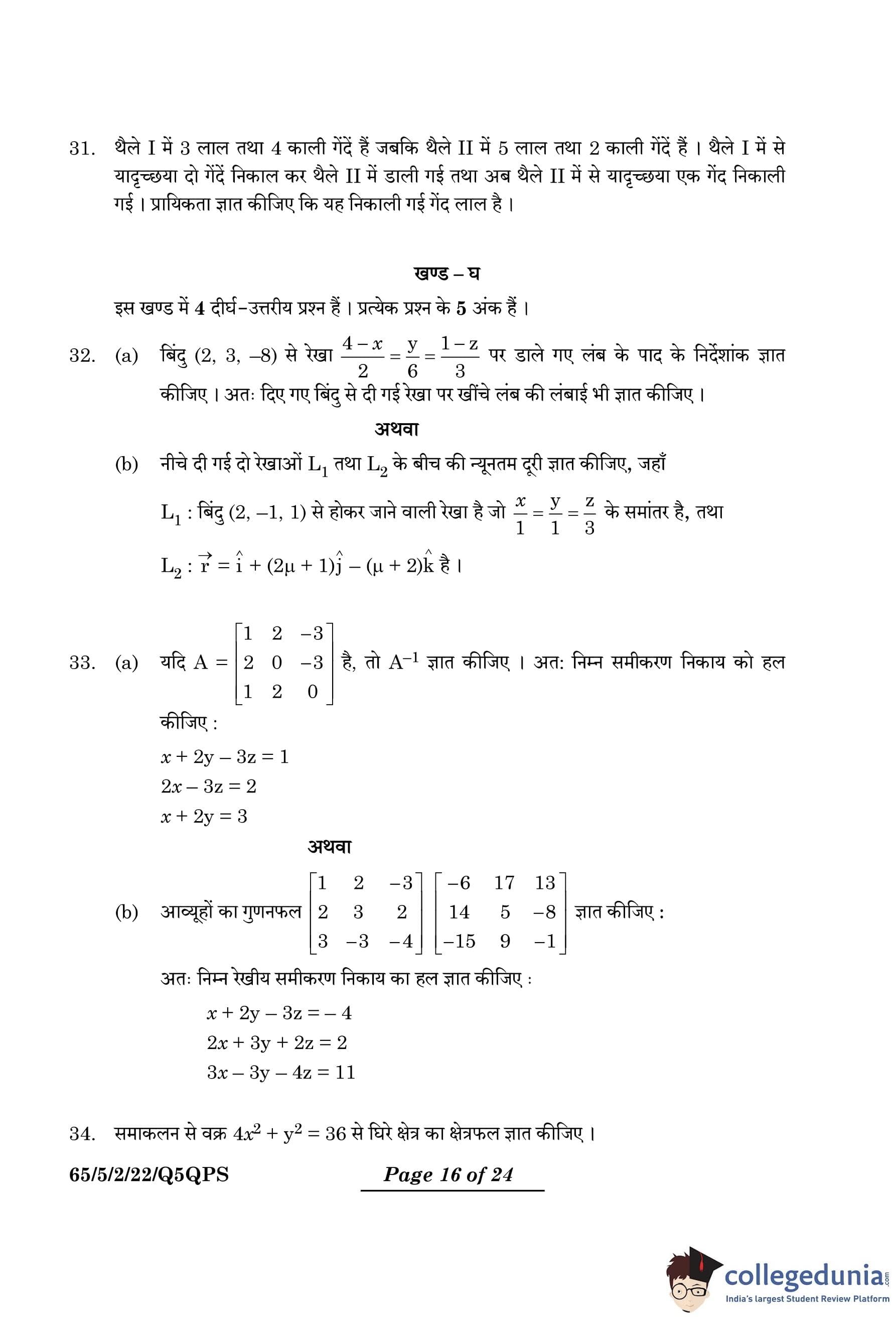
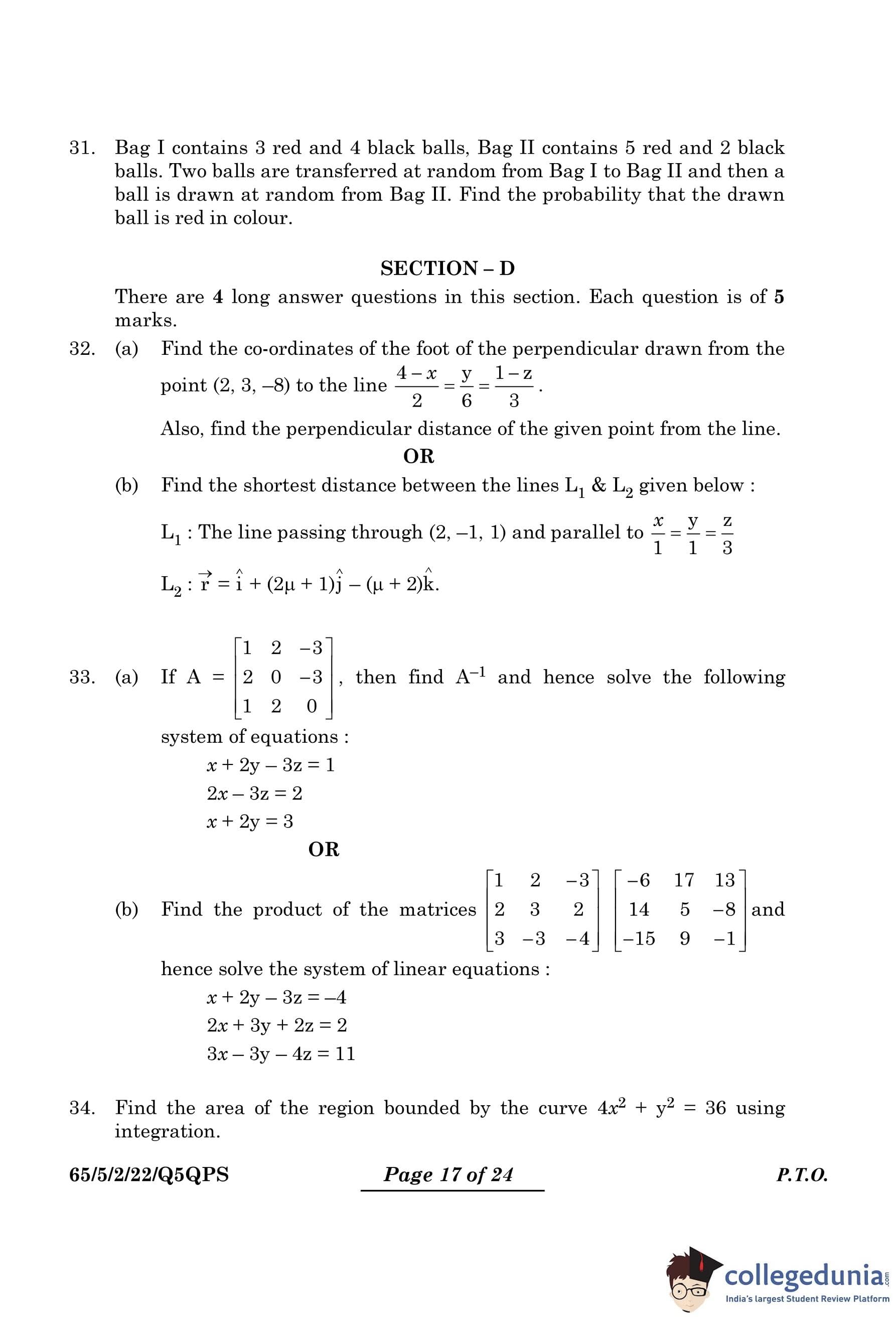
Bag I contains 3 red and 4 black balls, Bag II contains 5 red and 2 black balls. Two balls are transferred at random from Bag I to Bag II and then a ball is drawn at random from Bag II. Find the probability that the drawn ball is red in colour.
View Solution
Step 1: {Define Events
Let:
\( E_1 \): Two balls transferred from Bag I are Red.
\( E_2 \): Two balls transferred from Bag I are Black.
\( E_3 \): Two balls transferred from Bag I are Red and Black.
\( A \): The ball drawn from Bag II is Red.
Step 2: {Find Probabilities of Events
\[ P(E_1) = \frac{1}{7}, \quad P(E_2) = \frac{2}{7}, \quad P(E_3) = \frac{4}{7}. \] \[ P(A|E_1) = \frac{7}{9}, \quad P(A|E_2) = \frac{5}{9}, \quad P(A|E_3) = \frac{6}{9}. \]
Step 3: {Use Law of Total Probability
\[ P(A) = P(E_1) \cdot P(A|E_1) + P(E_2) \cdot P(A|E_2) + P(E_3) \cdot P(A|E_3). \] \[ P(A) = \left( \frac{1}{7} \times \frac{7}{9} \right) + \left( \frac{2}{7} \times \frac{5}{9} \right) + \left( \frac{4}{7} \times \frac{6}{9} \right). \] \[ P(A) = \frac{7}{63} + \frac{10}{63} + \frac{24}{63} = \frac{41}{63}. \]
Final Answer: \( P(A) = \frac{41}{63} \).
\begin{quicktipbox
Use the law of total probability to account for all possible scenarios in probability problems involving multiple events.
\end{quicktipbox Quick Tip: Use the law of total probability to account for all possible scenarios in probability problems involving multiple events.
Find the coordinates of the foot of the perpendicular drawn from the point \( (2, 3, -8) \) to the line: \[ \frac{4 - x}{2} = \frac{y}{6} = \frac{1 - z}{3}. \]
Also, find the perpendicular distance of the given point from the line.
View Solution
The standard form of the equation of the line is \[ \frac{x - 4}{-2} = \frac{y - 1}{6} = \frac{z - 1}{-3} \]
Let the foot of the perpendicular from the point A \((2, 3, -8)\) to the given line be B \((-2\lambda + 4, 6\lambda - 3, -3\lambda + 9)\).
The direction ratios of AB are: \[ -2\lambda + 2, \, 6\lambda - 3, \, -3\lambda + 9 \]
As AB is perpendicular to the given line: \[ -2(-2\lambda + 2) + 6(6\lambda - 3) - 3(-3\lambda + 9) = 0 \]
Simplifying the equation: \[ 4\lambda - 4 + 36\lambda - 18 + 9\lambda - 27 = 0 \] \[ 49\lambda - 49 = 0 \] \[ \Rightarrow \lambda = 1 \]
Therefore, the foot of the perpendicular is: \[ B(2, 6, -2) \]
The perpendicular distance is: \[ AB = 3\sqrt{5} \]
Final Answer: \[ Foot of perpendicular = (2,6,-2), \quad Perpendicular Distance = 3\sqrt{5}. \] Quick Tip: To find the foot of a perpendicular, use the parametric equation of the line and set the dot product to zero.
Find the shortest distance between the lines \( L_1 \) and \( L_2 \) given below: \[ L_1 : The line passing through (2, -1, 1) and parallel to \frac{x}{1} = \frac{y}{1} = \frac{z}{3} \]
\[ L_2 : \vec{r} = \hat{i} + (2\mu + 1) \hat{j} - (\mu + 2) \hat{k}. \]
View Solution
Step 1: {Find direction vectors
Direction vectors: \[ \vec{a}_1 = 2\hat{i} - \hat{j} + \hat{k}, \quad \vec{b}_1 = \hat{i} + \hat{j} + 3\hat{k}. \]
\[ \vec{a}_2 = \hat{i} + \hat{j} - 2\hat{k}, \quad \vec{b}_2 = 2\hat{j} - \hat{k}. \]
Step 2: {Find shortest distance formula
\[ \vec{a}_2 - \vec{a}_1 = (-\hat{i} + 2\hat{j} - 3\hat{k}). \]
\[ \vec{b}_1 \times \vec{b}_2 = (-7\hat{i} + \hat{j} + 2\hat{k}). \]
Step 3: {Compute shortest distance
\[ Shortest Distance = \frac{|(\vec{a}_2 - \vec{a}_1) \cdot (\vec{b}_1 \times \vec{b}_2)|}{|\vec{b}_1 \times \vec{b}_2|}. \]
\[ = \frac{1}{\sqrt{6}}. \]
Final Answer: \[ \frac{1}{\sqrt{6}}. \] Quick Tip: For shortest distance between skew lines, use the formula involving cross products.
If \( A = \begin{bmatrix} 1 & 2 & -3
2 & 0 & -3
1 & 2 & 0 \end{bmatrix} \), then find \( A^{-1} \) and hence solve the system of equations: \[ x + 2y - 3z = 1, \] \[ 2x - 3z = 2, \] \[ x + 2y = 3. \]
View Solution
Step 1: {Find \( \det(A) \)
\[ |A| = 1(6) - 2(3) - 3(4) = -12 \neq 0. \]
Since \( \det(A) \neq 0 \), \( A^{-1} \) exists.
Step 2: {Find adjoint matrix and inverse
\[ adj(A) = \begin{bmatrix} 6 & -6 & -6
-3 & 3 & 3
4 & 0 & -4 \end{bmatrix}. \]
\[ A^{-1} = \frac{1}{-12} \begin{bmatrix} 6 & -6 & -6
-3 & 3 & 3
4 & 0 & -4 \end{bmatrix}. \]
Step 3: {Solve the system using matrix method
\[ AX = B, \quad X = A^{-1} B. \]
\[ X = A^{-1} \begin{bmatrix} 1
2
3 \end{bmatrix}. \]
Computing: \[ X = \begin{bmatrix} 2
\frac{1}{2}
\frac{2}{3} \end{bmatrix}. \]
Final Answer: \[ x = 2, \quad y = \frac{1}{2}, \quad z = \frac{2}{3}. \] Quick Tip: To solve a system using the inverse method, compute \( A^{-1} \) and multiply by the constant matrix.
Find the product of the matrices \[ \begin{bmatrix} 1 & 2 & -3
2 & 3 & 2
3 & -3 & -4 \end{bmatrix} \begin{bmatrix} -6 & 17 & 13
14 & 5 & -8
-15 & 9 & -1 \end{bmatrix} \]
and hence solve the system of equations: \[ x + 2y - 3z = -4, \] \[ 2x + 3y + 2z = 2, \] \[ 3x - 3y - 4z = 11. \]
View Solution
Step 1: {Multiply the matrices
\[ \begin{bmatrix} 1 & 2 & -3
2 & 3 & 2
3 & -3 & -4 \end{bmatrix} \begin{bmatrix} -6 & 17 & 13
14 & 5 & -8
-15 & 9 & -1 \end{bmatrix} = \begin{bmatrix} 67 & 0 & 0
0 & 67 & 0
0 & 0 & 67 \end{bmatrix}. \]
Step 2: {Solve the system using inverse method
\[ A^{-1} = \frac{1}{67} \begin{bmatrix} -6 & 17 & 13
14 & 5 & -8
-15 & 9 & -1 \end{bmatrix}. \]
\[ X = A^{-1} B. \]
Computing: \[ X = \begin{bmatrix} 3
-2
1 \end{bmatrix}. \]
Final Answer: \[ x = 3, \quad y = -2, \quad z = 1. \] Quick Tip: If the matrix product results in a diagonal matrix, solving for unknowns becomes straightforward.
Find the area of the region bounded by the curve \( 4x^2 + y^2 = 36 \) using integration.
View Solution
Step 1: {Rewrite the given equation in standard ellipse form
\[ \frac{x^2}{9} + \frac{y^2}{36} = 1. \]
This represents an ellipse centered at the origin with semi-major axis \(6\) along the \(y\)-axis and semi-minor axis \(3\) along the \(x\)-axis.
Step 2: {Use integration to find the bounded area
The area of one quadrant of the ellipse is given by: \[ \int_0^3 \sqrt{9 - x^2} \ dx. \]
Using the standard formula: \[ Area = 4 \times \frac{6}{3} \int_0^3 \sqrt{9 - x^2} \ dx. \]
Solving using trigonometric substitution: \[ = 8 \left[ \frac{x}{2} \sqrt{9 - x^2} + \frac{9}{2} \sin^{-1} \frac{x}{3} \right]_0^3. \]
Step 3: {Evaluate the definite integral
\[ = 8 \left[ \frac{3}{2} \times 0 + \frac{9}{2} \times \frac{\pi}{2} \right]. \]
\[ = 8 \times \frac{9\pi}{4} = 18\pi. \]
Final Answer: \[ Area = 18\pi. \] Quick Tip: For ellipses, use standard area formulas or integration with trigonometric substitution.
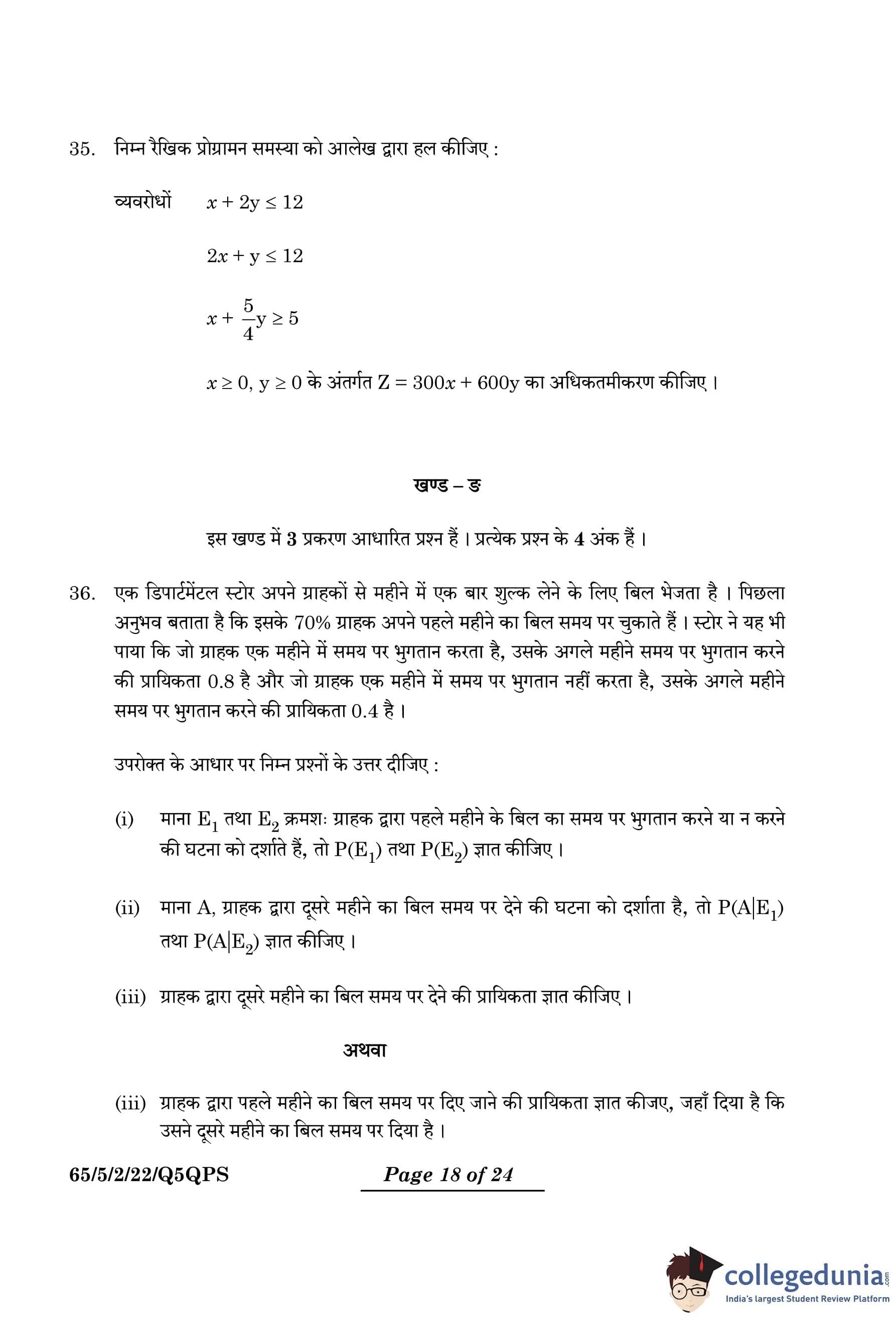
Solve the following Linear Programming problem graphically:
Maximize: \[ Z = 300x + 600y \]
Subject to: \[ x + 2y \leq 12 \] \[ 2x + y \leq 12 \] \[ x + \frac{5}{4} y \geq 5 \] \[ x \geq 0, \quad y \geq 0 \]
View Solution
Step 1: {Graphical Representation
The given constraints are plotted on a coordinate plane, and the feasible region is identified as the shaded area.

Step 2: {Finding Corner Points
From the graphical solution, the feasible region is bounded by the points: \[ A(0,4), \quad B(0,6), \quad C(4,4), \quad D(6,0), \quad E(5,0) \]
Step 3: {Evaluating \( Z \) at the Corner Points
\[ Z(A) = 300(0) + 600(4) = 2400 \] \[ Z(B) = 300(0) + 600(6) = 3600 \] \[ Z(C) = 300(4) + 600(4) = 3600 \] \[ Z(D) = 300(6) + 600(0) = 1800 \] \[ Z(E) = 300(5) + 600(0) = 1500 \]
Step 4: {Finding the Maximum Value
From the table: \[ \begin{array}{|c|c|} \hline \textbf{Corner Points} & \textbf{Value of } Z = 300x + 600y
\hline A(0,4) & 2400
B(0,6) & 3600
C(4,4) & 3600
D(6,0) & 1800
E(5,0) & 1500
\hline \end{array} \]
Thus, the maximum value of \( Z \) is 3600 at all points on the line segment \( BC \).
Final Answer: The maximum value of \( Z = 3600 \) at all points on the line segment \( BC \). Quick Tip: To solve Linear Programming Problems graphically, identify the feasible region, determine the corner points, and evaluate the objective function at each point.
Let \( E_1 \) and \( E_2 \) respectively denote the event of customer paying or not paying the first month bill in time. Find \( P(E_1) \), \( P(E_2) \).
View Solution
Step 1: {Define the probability values
From the problem statement, 70% of customers pay their first-month bill in time. Thus: \[ P(E_1) = \frac{7}{10} = 0.7. \]
Similarly, the probability of not paying in time is: \[ P(E_2) = \frac{3}{10} = 0.3. \]
Final Answer: \[ P(E_1) = 0.7, \quad P(E_2) = 0.3. \] Quick Tip: The sum of probabilities of mutually exclusive and exhaustive events always equals 1.
Let \( A \) denote the event of a customer paying the second month's bill in time, then find \( P(A|E_1) \) and \( P(A|E_2) \).
View Solution
Step 1: {Define conditional probabilities
The problem states:
- If the customer pays the first-month bill in time, the probability of paying next month is 0.8.
- If the customer does not pay in time, the probability of paying next month is 0.4.
Thus, we write: \[ P(A | E_1) = 0.8, \quad P(A | E_2) = 0.4. \]
Final Answer: \[ P(A | E_1) = 0.8, \quad P(A | E_2) = 0.4. \] Quick Tip: Conditional probability \( P(A|B) \) represents the likelihood of event \( A \) occurring given that \( B \) has already occurred.
Find the probability of a customer paying the second month's bill in time.
View Solution
Step 1: {Use the Law of Total Probability
The total probability theorem states: \[ P(A) = P(E_1) P(A | E_1) + P(E_2) P(A | E_2). \]
Step 2: {Substituting given values
\[ P(A) = (0.7 \times 0.8) + (0.3 \times 0.4). \]
Step 3: {Compute the values
\[ P(A) = 0.56 + 0.12 = 0.68. \]
In fraction form: \[ P(A) = \frac{17}{25}. \]
Final Answer: \[ P(A) = \frac{17}{25} = 0.68. \] Quick Tip: The Law of Total Probability states that if \( B_1, B_2, ..., B_n \) form a partition of the sample space, then: \[ P(A) = \sum_{i=1}^{n} P(B_i) P(A | B_i). \]
Find the probability of a customer paying the first month’s bill in time if it is found that the customer has paid the second month's bill in time.
View Solution
Step 1: {Use Bayes’ Theorem
By Bayes’ theorem: \[ P(E_1 | A) = \frac{P(E_1) P(A | E_1)}{P(A)}. \]
Step 2: {Substituting given values
\[ P(E_1 | A) = \frac{(0.7 \times 0.8)}{0.68}. \]
Step 3: {Compute the values
\[ P(E_1 | A) = \frac{0.56}{0.68} = \frac{14}{17}. \]
Final Answer: \[ P(E_1 | A) = \frac{14}{17}. \] Quick Tip: Bayes' Theorem helps update probabilities based on new information: \[ P(B | A) = \frac{P(A | B) P(B)}{P(A)}. \]
Find whether the relation \( R \) is symmetric or not.
View Solution
Step 1: {Definition of symmetry
A relation \( R \) is symmetric if: \[ (l_1, l_2) \in R \Rightarrow (l_2, l_1) \in R. \]
Step 2: {Check symmetry for parallel lines
Since \( R \) is defined as: \[ R = \{(l_1, l_2) : l_1 \parallel l_2\}. \]
If \( l_1 \parallel l_2 \), then it follows that \( l_2 \parallel l_1 \), which implies: \[ (l_2, l_1) \in R. \]
Thus, \( R \) is a symmetric relation.
Final Answer: \( R \) is a symmetric relation. Quick Tip: A relation is symmetric if whenever \( (a, b) \) is in the relation, then \( (b, a) \) must also be in the relation.
Find whether the relation \( R \) is transitive or not.
View Solution
Step 1: {Definition of transitivity
A relation \( R \) is transitive if: \[ (l_1, l_2) \in R and (l_2, l_3) \in R \Rightarrow (l_1, l_3) \in R. \]
Step 2: {Check transitivity for parallel lines
Since \( R \) is defined as: \[ R = \{(l_1, l_2) : l_1 \parallel l_2\}. \]
If \( l_1 \parallel l_2 \) and \( l_2 \parallel l_3 \), then by the transitive property of parallelism: \[ l_1 \parallel l_3. \]
This implies: \[ (l_1, l_3) \in R. \]
Thus, \( R \) is a transitive relation.
Final Answer: \( R \) is a transitive relation. Quick Tip: A relation is transitive if whenever \( (a, b) \) and \( (b, c) \) are in the relation, then \( (a, c) \) must also be in the relation.
If one of the rail lines on the railway track is represented by the equation \( y = 3x + 2 \), then find the set of rail lines in \( R \) related to it.
View Solution
Step 1: {Equation of given rail line
The given equation is: \[ y = 3x + 2. \]
This represents a straight line with slope \( 3 \).
Step 2: {Find parallel lines
A line is parallel to \( y = 3x + 2 \) if it has the same slope, meaning its equation is of the form: \[ y = 3x + c, \quad c \in \mathbb{R}. \]
Thus, the set of all rail lines related to the given line in \( R \) is: \[ \{ l : l is a line of type y = 3x + c, c \in \mathbb{R} \}. \]
Final Answer: The set is \( \{l : l is a line of type y = 3x + c, c \in \mathbb{R} \} \). Quick Tip: All lines parallel to a given line will have the same slope but different intercepts.
Let \( S \) be the relation defined by \[ S = \{(l_1, l_2) : l_1 is perpendicular to l_2\} \]
Check whether the relation \( S \) is symmetric and transitive.
View Solution
Step 1: {Definition of symmetry
A relation \( S \) is symmetric if: \[ (l_1, l_2) \in S \Rightarrow (l_2, l_1) \in S. \]
Since \( S \) is defined as: \[ S = \{(l_1, l_2) : l_1 \perp l_2\}. \]
If \( l_1 \perp l_2 \), then \( l_2 \perp l_1 \), so: \[ (l_2, l_1) \in S. \]
Thus, \( S \) is a symmetric relation.
Step 2: {Definition of transitivity
A relation \( S \) is transitive if: \[ (l_1, l_2) \in S and (l_2, l_3) \in S \Rightarrow (l_1, l_3) \in S. \]
If \( l_1 \perp l_2 \) and \( l_2 \perp l_3 \), then \( l_1 \) may not necessarily be perpendicular to \( l_3 \), meaning: \[ (l_1, l_3) \notin S. \]
Thus, \( S \) is not transitive.
Final Answer: \( S \) is symmetric but not transitive. Quick Tip: Perpendicularity is symmetric but not always transitive. For example, if \( A \) is perpendicular to \( B \) and \( B \) is perpendicular to \( C \), it does not necessarily mean \( A \) is perpendicular to \( C \).
Write the expression for the area of the visiting card in terms of \( x \).
View Solution
We are given that \( xy = 24 \), which represents the area of the visiting card. The expression for the area is expanded as follows: \[ A(x) = (x+3)(y+2) \]
Expanding the product: \[ A(x) = x(y+2) + 3(y+2) = xy + 2x + 3y + 6 \]
Substituting \( xy = 24 \) into the equation, we get: \[ A(x) = 2x + 3y + 24 + 6 = 2x + 3y + 30 \]
Thus, the area of the visiting card is \( A(x) = 2x + 3y + 30 \). Quick Tip: When given area constraints, express one variable in terms of the other to form a single-variable function.
Obtain the dimensions of the card of minimum area.
View Solution
From the given derivative of the area function: \[ A'(x) = 2 - \frac{72}{x^2} \]
Setting \( A'(x) = 0 \) to find the critical point: \[ 2 - \frac{72}{x^2} = 0 \quad \Rightarrow \quad \frac{72}{x^2} = 2 \quad \Rightarrow \quad x^2 = 36 \quad \Rightarrow \quad x = 6 \]
Thus, \( x = 6 \) is a critical point.
Next, we check if it corresponds to a minimum by computing the second derivative: \[ A''(x) = \frac{144}{x^3} \]
Substituting \( x = 6 \) into \( A''(x) \): \[ A''(6) = \frac{144}{6^3} = \frac{144}{216} = \frac{2}{3} > 0 \]
Since \( A''(6) > 0 \), the area is minimum at \( x = 6 \) and \( y = 4 \).
The dimension of the card with minimum area is Length 9 cm = , Breadth 6 cm Quick Tip: To find the minimum area, differentiate the function and set the derivative to zero. Verify using the second derivative test.











Comments