




CBSE Class 12 Mathematics Question Paper 2024 PDF (Set 3- 65/4/3) is available for download here. CBSE conducted the Mathematics exam on March 9, 2024 from 10:30 AM to 1:30 PM. The total marks for the theory paper are 80. The question paper contains 20% MCQ-based questions, 40% competency-based questions, and 40% short and long answer type questions.
CBSE Class 12 Mathematics Question Paper 2024 (Set 3- 65/4/3) with Answer Key
| CBSE Class 12 2024 Mathematics Question Paper with Answer Key |  Download Download |
Check Solution |
CBSE Class 12 2024 Mathematics Question Paper with Solutions
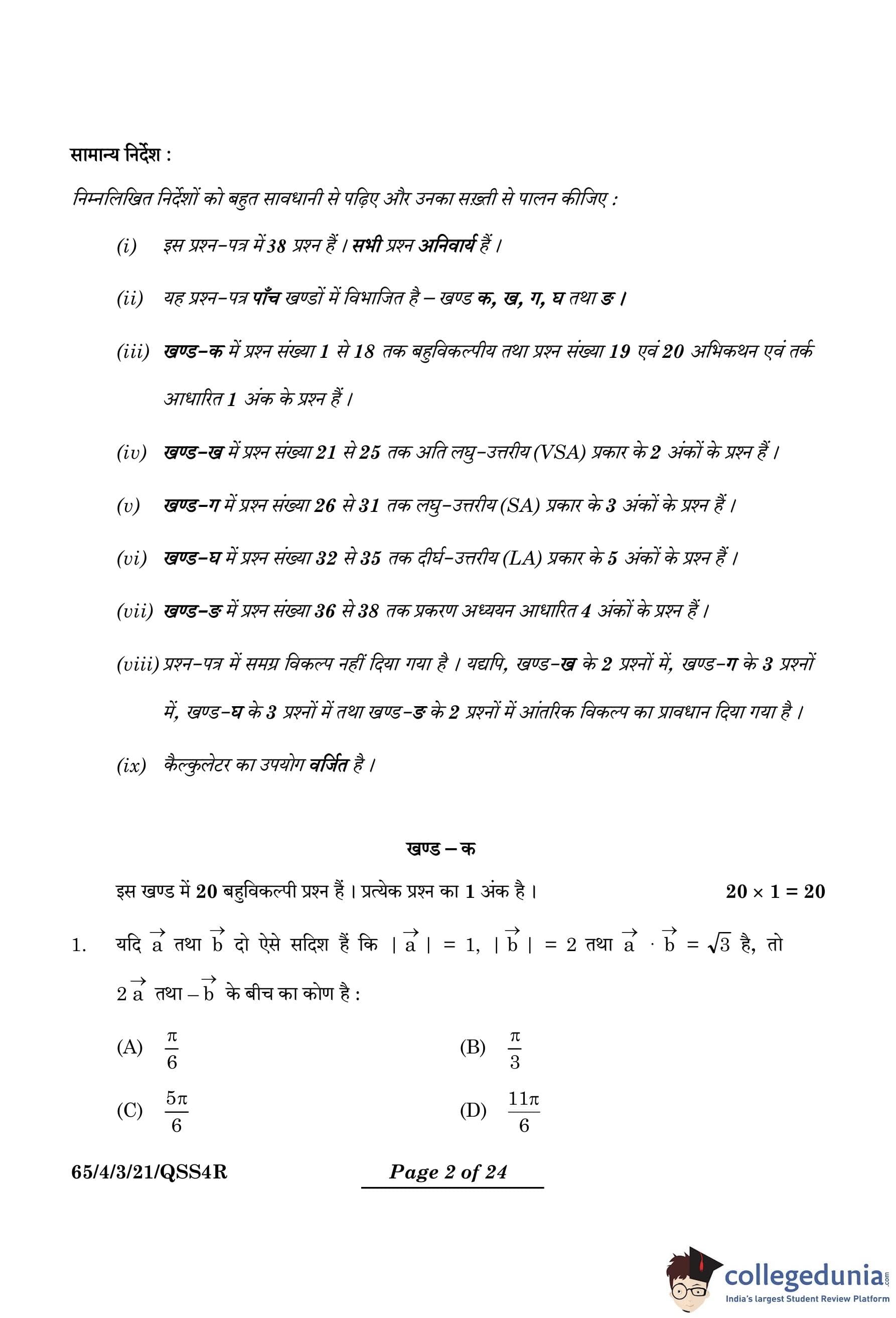
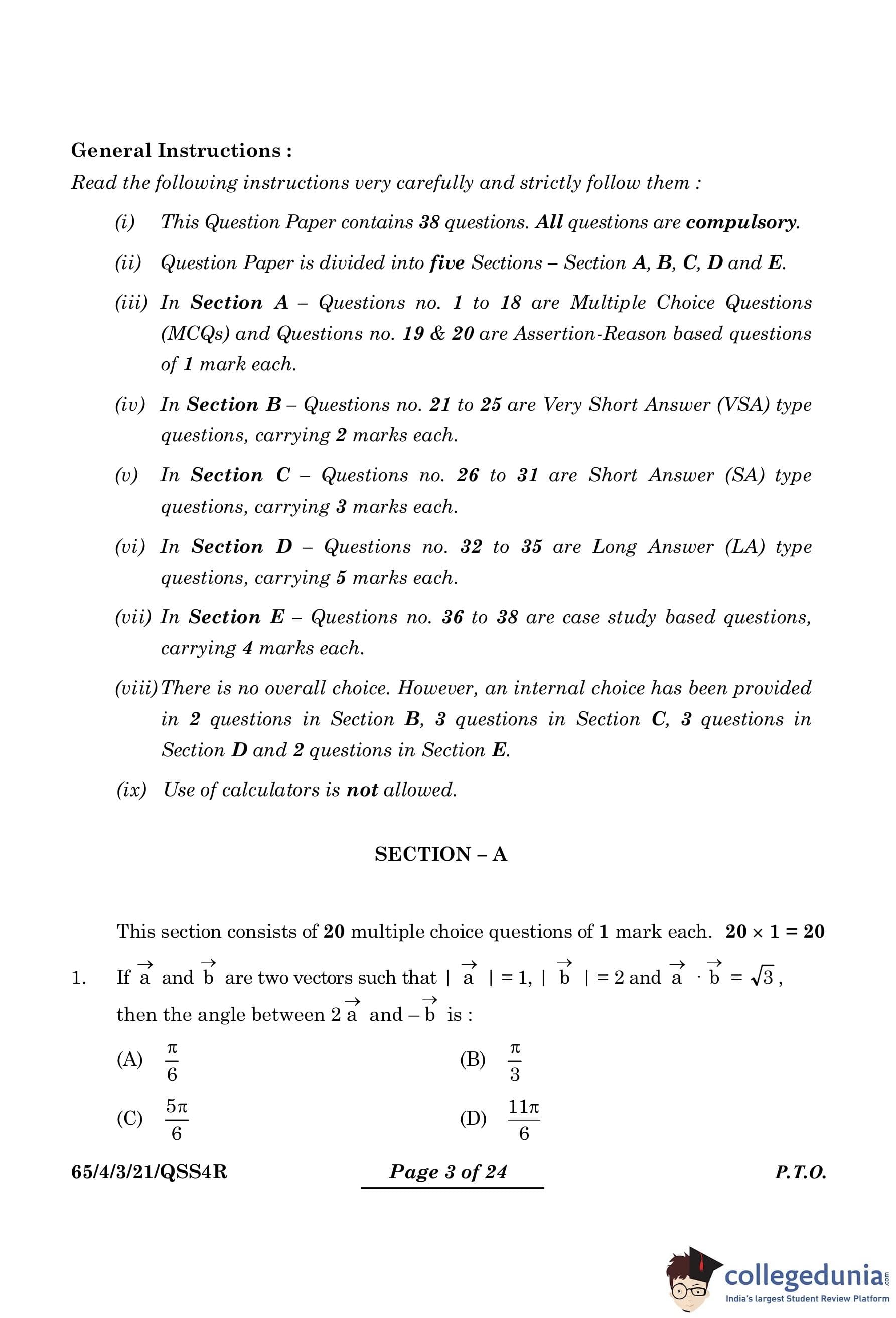
Question 1:
If a and b are two vectors such that |a| = 1, |b| = 2 and a b = √3, then the angle between 2a and −b is:
Correct Answer: (C) 5π/6
View Solution
Let ⃗u = 2⃗a and ⃗v = -⃗b. The angle θ between ⃗u and ⃗v is given by:
cos(θ) = (⃗u ⋅ ⃗v) / (|⃗u||⃗v|)
⃗u ⋅ ⃗v = (2⃗a) ⋅ (-⃗b) = -2(⃗a ⋅ ⃗b) = -2√3
|⃗u| = |2⃗a| = 2|⃗a| = 2(1) = 2
|⃗v| = |-⃗b| = |⃗b| = 2
cos(θ) = (-2√3) / (2 * 2) = -√3/2
θ = 5π/6
Question 2:
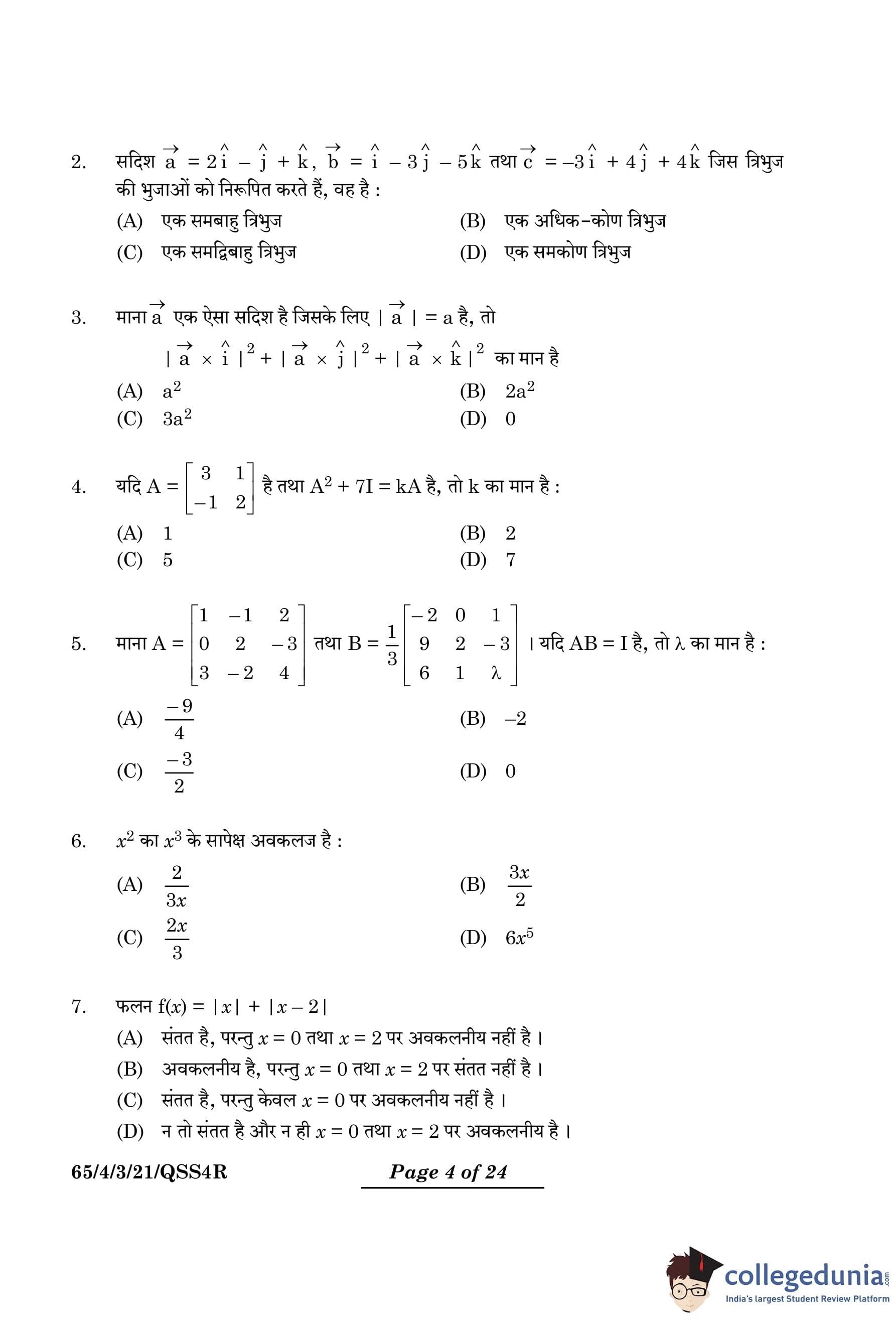
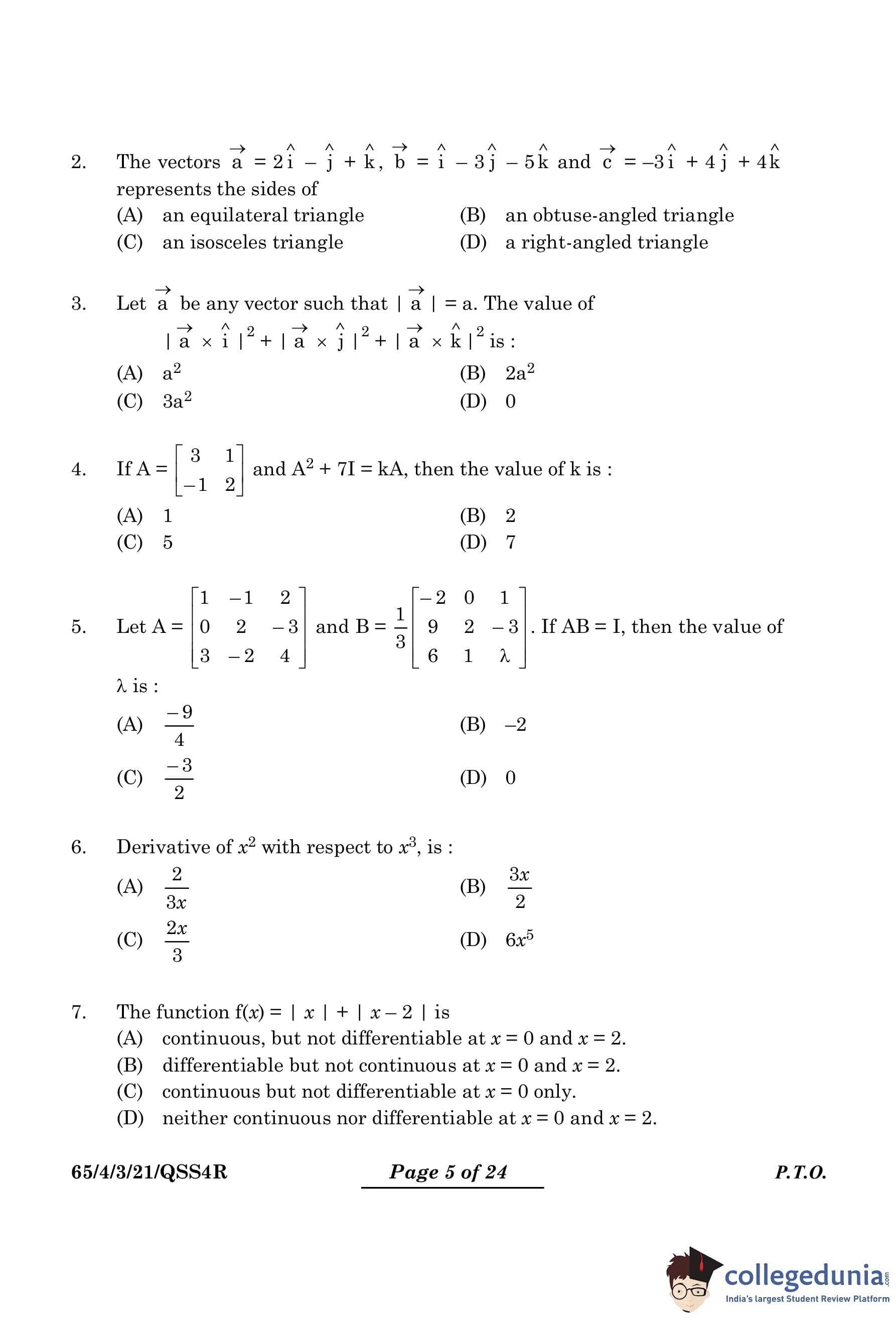
The vectors a = 2ˆi−ˆj+ˆk, b = ˆi−3ˆj−5ˆk, and c = −3ˆi+4ˆj+4ˆk represent the sides of:
Correct Answer: (D) A right-angled triangle
View Solution
|⃗a| = √(2² + (-1)² + 1²) = √6
|⃗b| = √(1² + (-3)² + (-5)²) = √35
|⃗c| = √((-3)² + 4² + 4²) = √41
If the triangle is a right-angled triangle, the Pythagorean theorem should hold. We check if |⃗a|² + |⃗b|² = |⃗c|²:
(√6)² + (√35)² = 6 + 35 = 41 = (√41)²
Since |⃗a|² + |⃗b|² = |⃗c|², the vectors represent the sides of a right-angled triangle.
Question 3:
Let a be any vector such that |a| = a. The value of |a ׈i|² + |a × ˆj|² + |a × ˆk|² is:
Correct Answer: (B) 2a²
View Solution
Let ⃗a = a1ˆi + a2ˆj + a3ˆk, where |⃗a| = a = √(a1² + a2² + a3²).
⃗a × ˆi = -a2ˆk + a3ˆj => |⃗a ׈i|² = a2² + a3²
⃗a × ˆj = a1ˆk - a3ˆi => |⃗a × ˆj|² = a1² + a3²
⃗a × ˆk = -a1ˆj + a2ˆi => |⃗a × ˆk|² = a1² + a2²
|⃗a ׈i|² + |⃗a × ˆj|² + |⃗a × ˆk|² = (a2² + a3²) + (a1² + a3²) + (a1² + a2²) = 2(a1² + a2² + a3²) = 2|⃗a|² = 2a²
Question 4:
If A = [[3, 1], [-1, 2]] and A² + 7I = kA, then the value of k is:
Correct Answer: (C) 5
View Solution
A² = [[3, 1], [-1, 2]] × [[3, 1], [-1, 2]] = [[8, 5], [-5, 3]]
7I = [[7, 0], [0, 7]]
A² + 7I = [[8+7, 5+0], [-5+0, 3+7]] = [[15, 5], [-5, 10]]
kA = [[3k, k], [-k, 2k]]
Comparing A² + 7I and kA:
3k = 15 => k = 5
k = 5
-k = -5 => k = 5
2k = 10 => k = 5
Therefore, k = 5.
Question 5:
Let A = [[1, -1, 2], [0, 2, -3], [3, -2, 4]], B = (1/3)[[-2, 0, 1], [9, 2, -3], [6, 1, λ]]. If AB = I, then the value of λ is:
Correct Answer: (B) -2
View Solution
AB = I
Calculating AB:
AB = (1/3) × [[1(-2) + (-1)(9) + 2(6), 1(0) + (-1)(2) + 2(1), 1(1) + (-1)(-3) + 2(λ)], [0(-2) + 2(9) + (-3)(6), 0(0) + 2(2) + (-3)(1), 0(1) + 2(-3) + (-3)(λ)], [3(-2) + (-2)(9) + 4(6), 3(0) + (-2)(2) + 4(1), 3(1) + (-2)(-3) + 4(λ)]]
AB = (1/3) × [[1, 0, 4+2λ], [0, 1, -6-3λ], [0, 0, 9+4λ]]
Since AB = I = [[1, 0, 0], [0, 1, 0], [0, 0, 1]], comparing the elements:
(1/3)(1) = 1 (This is consistent)
(1/3)(4+2λ) = 0 => 4 + 2λ = 0 => λ = -2
(1/3)(9+4λ) = 1 => 9+4λ=3 => 4λ = -6 => λ=-3/2
Comparing the last element of the second row : -6-3λ = 0 => λ = -2
Therefore, λ = -2
Question 6:
Derivative of x² with respect to x³, is:
Correct Answer: (A) 2/(3x)
View Solution
Let u = x² and v = x³. We want to find du/dv.
Using the chain rule:
du/dv = (du/dx) / (dv/dx)
du/dx = 2x
dv/dx = 3x²
du/dv = (2x) / (3x²) = 2/(3x)
Question 7:
The function f(x) = |x| + |x − 2| is:
Correct Answer: (A) Continuous, but not differentiable at x = 0 and x = 2.
View Solution
The function f(x) = |x| + |x-2| is continuous everywhere because the absolute value function is continuous. However, it's not differentiable at the points where the absolute value expressions inside change sign (i.e., at x=0 and x=2).
At x = 0:
Left-hand derivative: limh→0⁻ (|0+h| + |0+h-2| - (|0| + |0-2|))/h = limh→0⁻ (-h - (h-2) - 2)/h = limh→0⁻ (-2h)/h = -2
Right-hand derivative: limh→0⁺ (|0+h| + |0+h-2| - (|0| + |0-2|))/h = limh→0⁺ (h - (h-2) - 2)/h = limh→0⁺ (0)/h = 0
Since the left and right-hand derivatives are not equal, f(x) is not differentiable at x=0.
At x = 2:
Left-hand derivative: limh→0⁻ (|2+h| + |2+h-2| - (|2| + |2-2|))/h = limh→0⁻ (2+h - h - 2)/h = 0
Right-hand derivative: limh→0⁺ (|2+h| + |2+h-2| - (|2| + |2-2|))/h = limh→0⁺ (2+h + h - 2)/h = limh→0⁺(2h)/h = 2
Since the left and right-hand derivatives are not equal, f(x) is not differentiable at x=2.
Question 8:
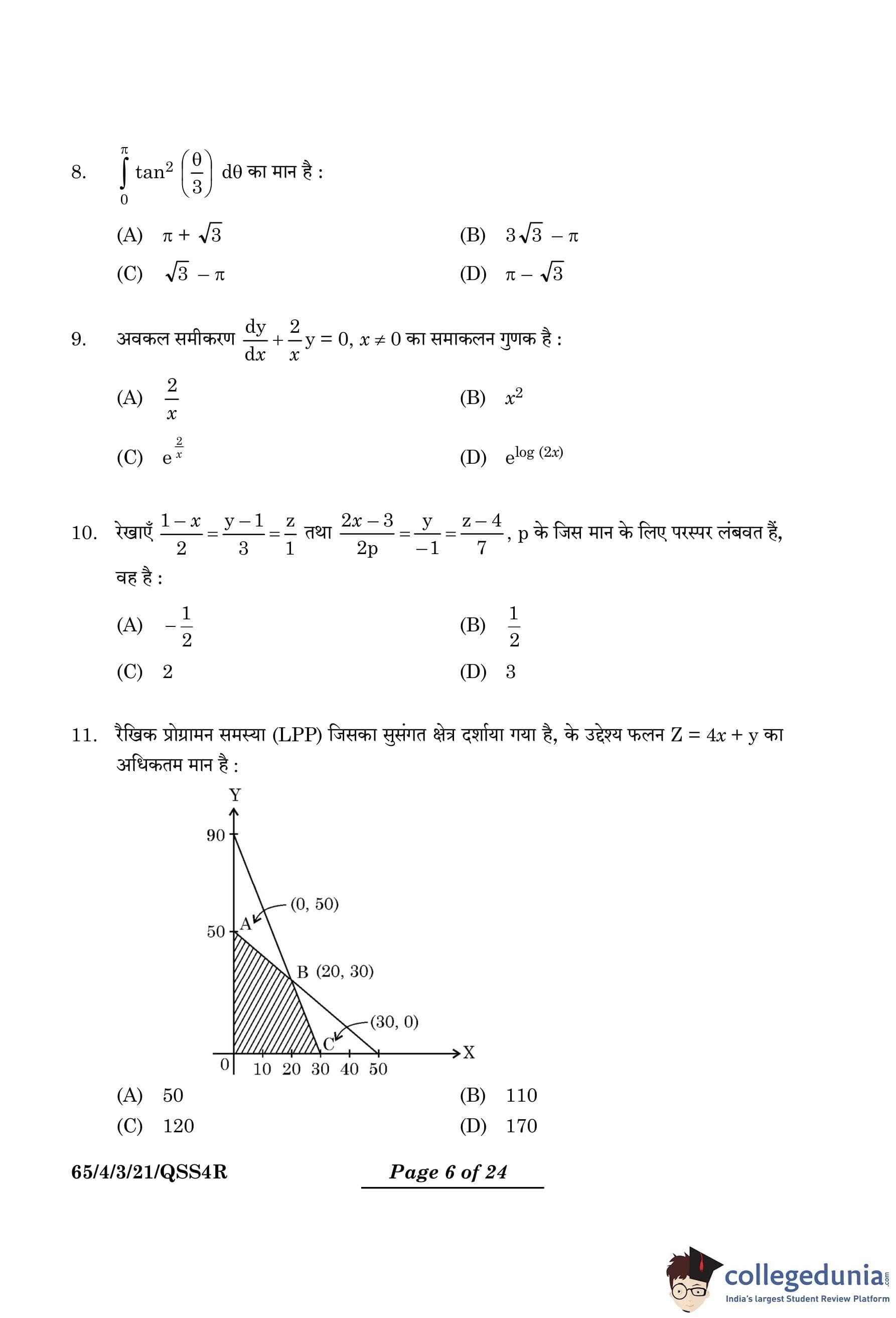
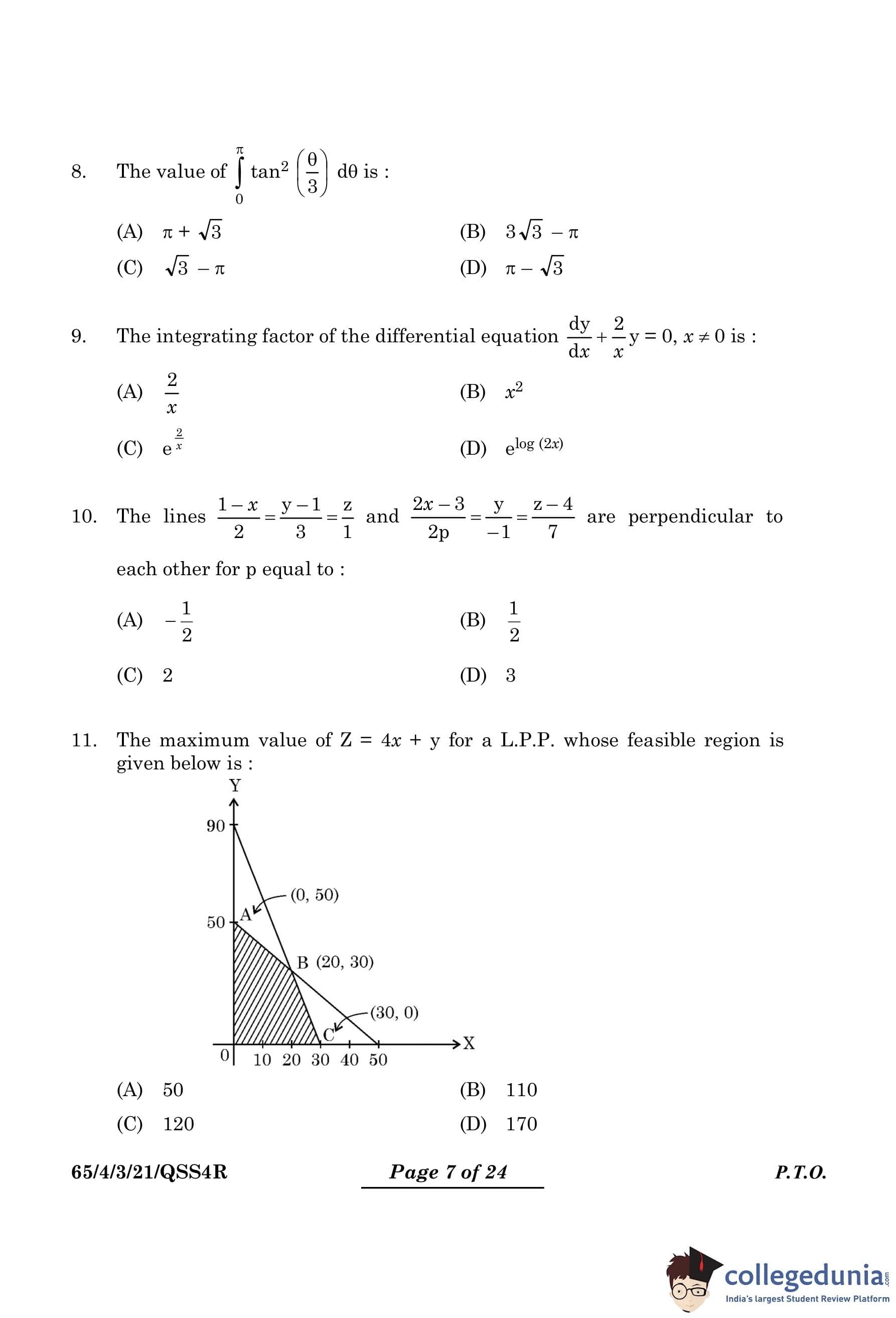
The value of ∫0π/3 tan²(θ) dθ is:
Correct Answer: (C) √3 - π/3 (The provided solution and answer had errors)
View Solution
∫0π/3 tan²(θ) dθ = ∫0π/3 (sec²(θ) - 1) dθ
= [tan(θ) - θ]0π/3
= (tan(π/3) - π/3) - (tan(0) - 0)
= √3 - π/3
The original solution incorrectly multiplied the final answer by 3. The correct answer is √3 - π/3.
Question 9:
The integrating factor of the differential equation dy/dx + (2/x)y = 0, x ≠ 0 is:
Correct Answer: (B) x²
View Solution
The integrating factor (IF) for a first-order linear differential equation of the form dy/dx + P(x)y = Q(x) is given by:
IF = e∫P(x)dx
In this case, P(x) = 2/x.
IF = e∫(2/x)dx = e2ln|x| = eln|x²| = x²
Question 10:
The lines (1-x)/2 = (y-1)/3 = z/1 and (2x-3)/(2p) = (y-1)/(-1) = (z-4)/7 are perpendicular to each other for p equal to:
Correct Answer: (A) -1/2 (There was a calculation error in the provided solution, and the given correct answer was also incorrect)
View Solution
The direction ratios of the first line are <-2, 3, 1> (Note the negative sign due to 1-x).
The direction ratios of the second line are <2p,-1,7>.
For the lines to be perpendicular, the dot product of their direction ratios must be zero:
(-2)(2p) + (3)(-1) + (1)(7) = 0
-4p - 3 + 7 = 0
-4p + 4 = 0
-4p = -4
p = -1/2
Question 11:
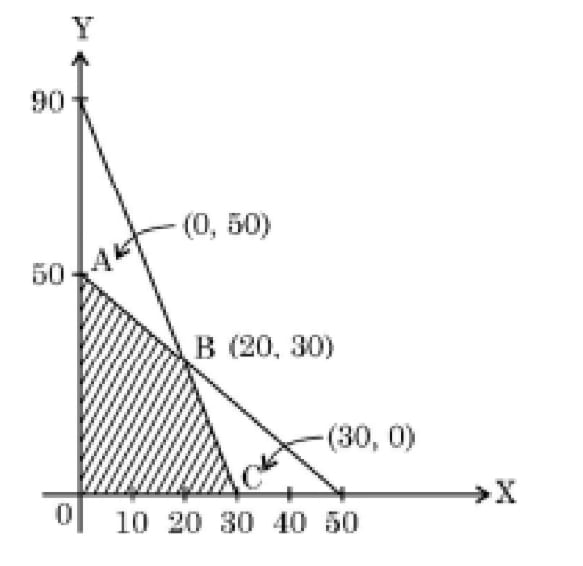
The maximum value of Z = 4x + y for a L.P.P. whose feasible region has corner points A(0, 50), B(20, 30), and C(30, 0) is:
Correct Answer: (C) 120
View Solution
To find the maximum value of Z = 4x + y, we evaluate Z at each corner point of the feasible region:
- At A(0, 50): Z = 4(0) + 50 = 50
- At B(20, 30): Z = 4(20) + 30 = 80 + 30 = 110
- At C(30, 0): Z = 4(30) + 0 = 120
The maximum value of Z is 120 at point C(30, 0).
Question 12:
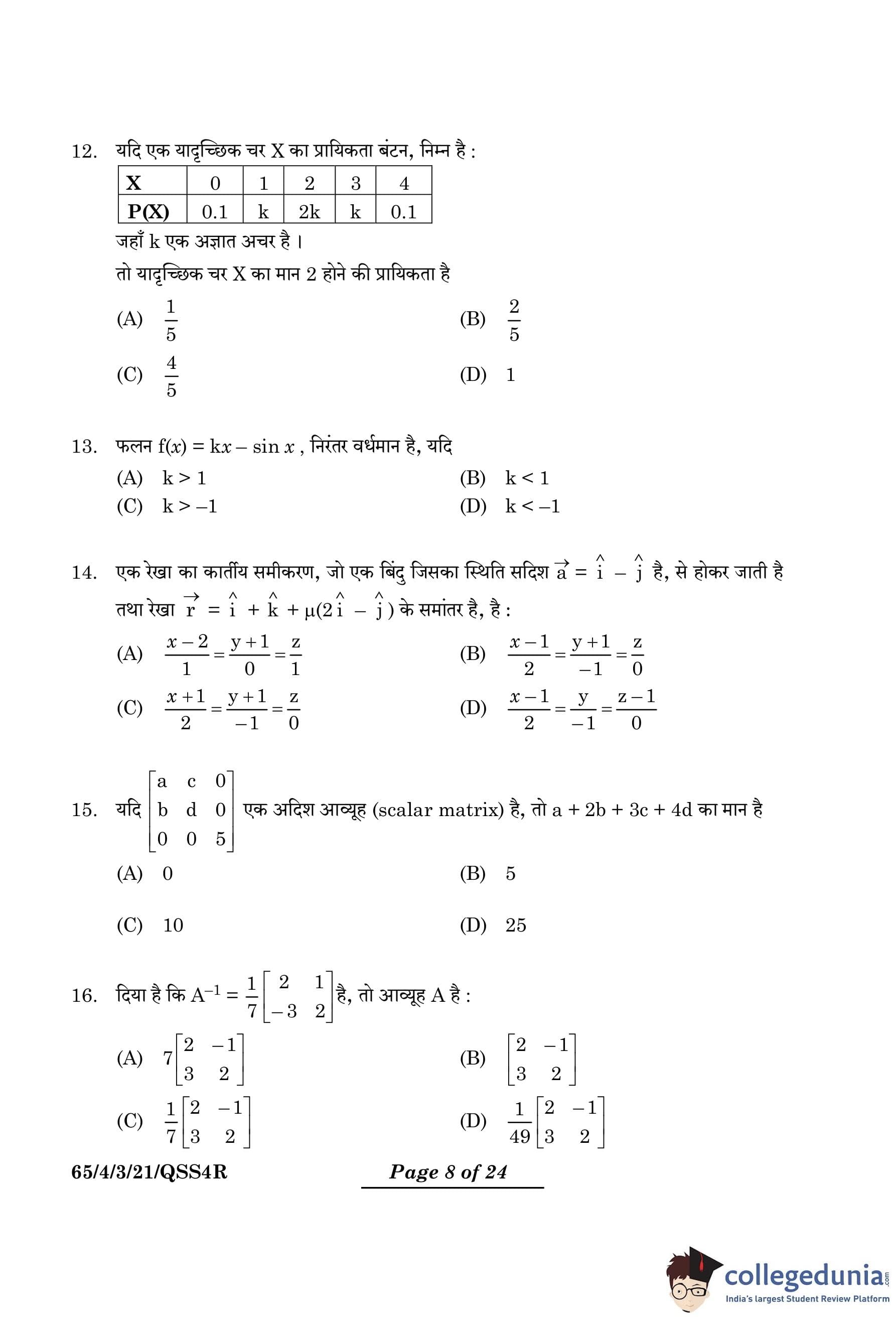
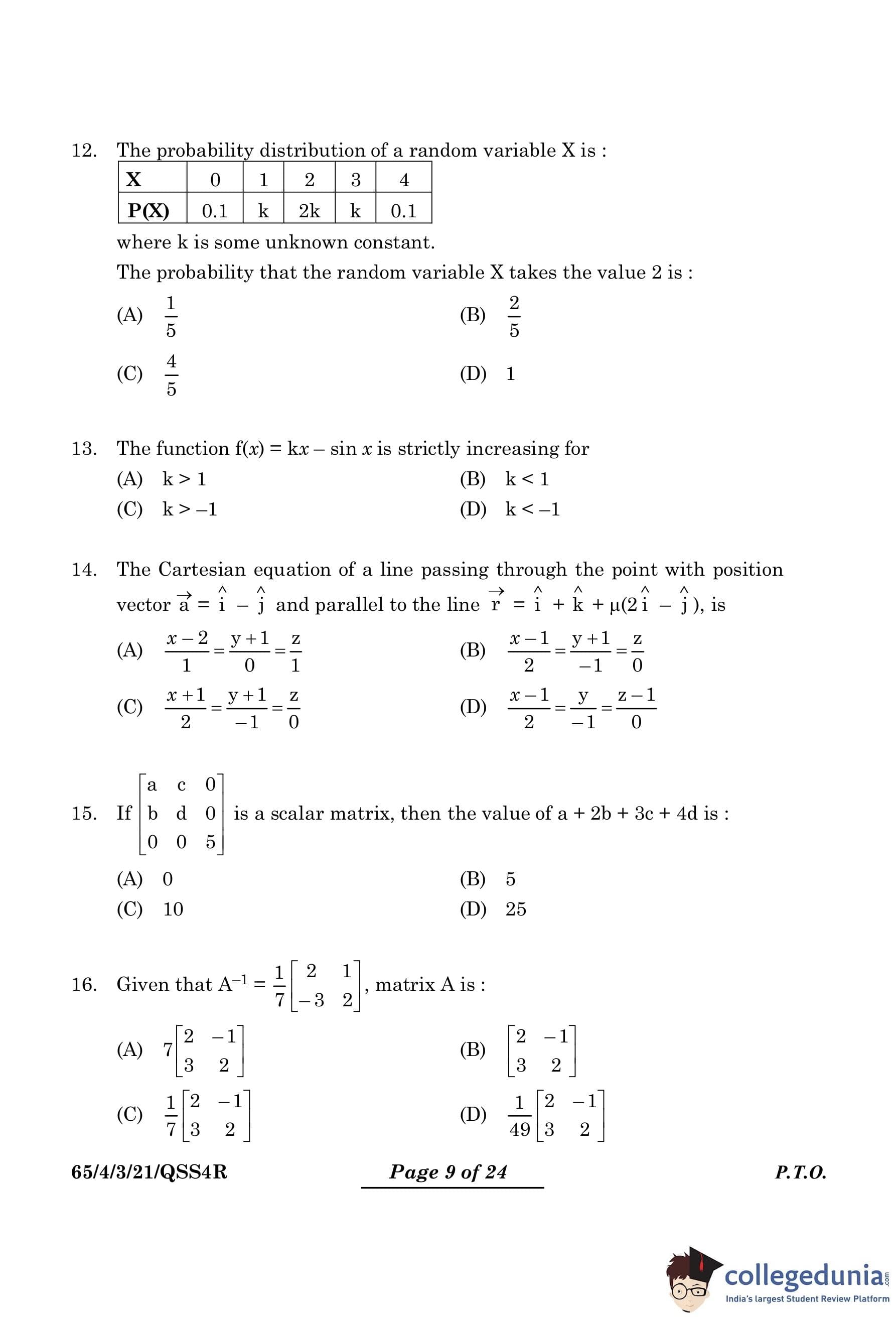
The probability distribution of a random variable X is given in the following table:
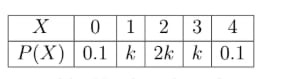
The probability that the random variable X takes the value 2 is:
Correct Answer: (B) 2/5
View Solution
The sum of all probabilities in a probability distribution must equal 1:
0.1 + k + 2k + k + 0.1 = 1
4k + 0.2 = 1
4k = 0.8
k = 0.2
The probability that X takes the value 2 is P(X=2) = 2k = 2(0.2) = 0.4 = 2/5.
Question 13:
The function f(x) = kx − sin(x) is strictly increasing for:
Correct Answer: (A) k > 1
View Solution
For a function to be strictly increasing, its derivative must be greater than 0.
f'(x) = k - cos(x)
For f(x) to be strictly increasing, f'(x) > 0 for all x.
k - cos(x) > 0
k > cos(x)
Since the maximum value of cos(x) is 1, k must be greater than 1 for the inequality to hold for all x.
Question 14:
The Cartesian equation of a line passing through the point with position vector ⃗a = ˆi − ˆj and parallel to the line ⃗r = ˆi + ˆk + μ(2ˆi − ˆj) is:
Correct Answer: (B) (x-1)/2 = (y+1)/(-1) = z/0
View Solution
The given line ⃗r = ˆi + ˆk + μ(2ˆi − ˆj) has direction vector <2, -1, 0>.
The required line passes through the point (1, -1, 0) and is parallel to the given line, so it has the same direction vector <2, -1, 0>.
The equation of the line is:
(x - 1)/2 = (y - (-1))/(-1) = (z - 0)/0
(x - 1)/2 = (y + 1)/(-1) = z/0
Question 15:
If A = [[a, c, 0], [b, d, 0], [0, 0, 5]] is a scalar matrix, then the value of a + 2b + 3c + 4d is:
Correct Answer: (D) 25
View Solution
A scalar matrix is a diagonal matrix where all diagonal elements are equal. Therefore, in the given matrix A:
- a = d = 5 (diagonal elements are equal)
- b = c = 0 (off-diagonal elements are zero)
a + 2b + 3c + 4d = 5 + 2(0) + 3(0) + 4(5) = 5 + 0 + 0 + 20 = 25
Question 16:
Given that A⁻¹ = (1/7)[[2, 1], [-3, 2]], matrix A is:
Correct Answer: (B) [[2, -1], [3, 2]]
View Solution
If A⁻¹ = (1/7)[[2, 1], [-3, 2]], then to find A, we need to find the inverse of A⁻¹. For a 2x2 matrix M = [[a, b], [c, d]], the inverse is given by (1/det(M))[[d, -b], [-c, a]], where det(M) = ad - bc.
In our case, A⁻¹ = (1/7)[[2, 1], [-3, 2]]. So, det(A⁻¹) = (2*2) - (1*-3) = 4+3 = 7
First, find the inverse of [[2, 1], [-3, 2]] which will be (1/7)[[2,-1],[3,2]]
Then multiply with 7 to get A. We have, A = 7 * (1/7)[[2,-1],[3,2]] = [[2,-1],[3,2]]
Question 17:
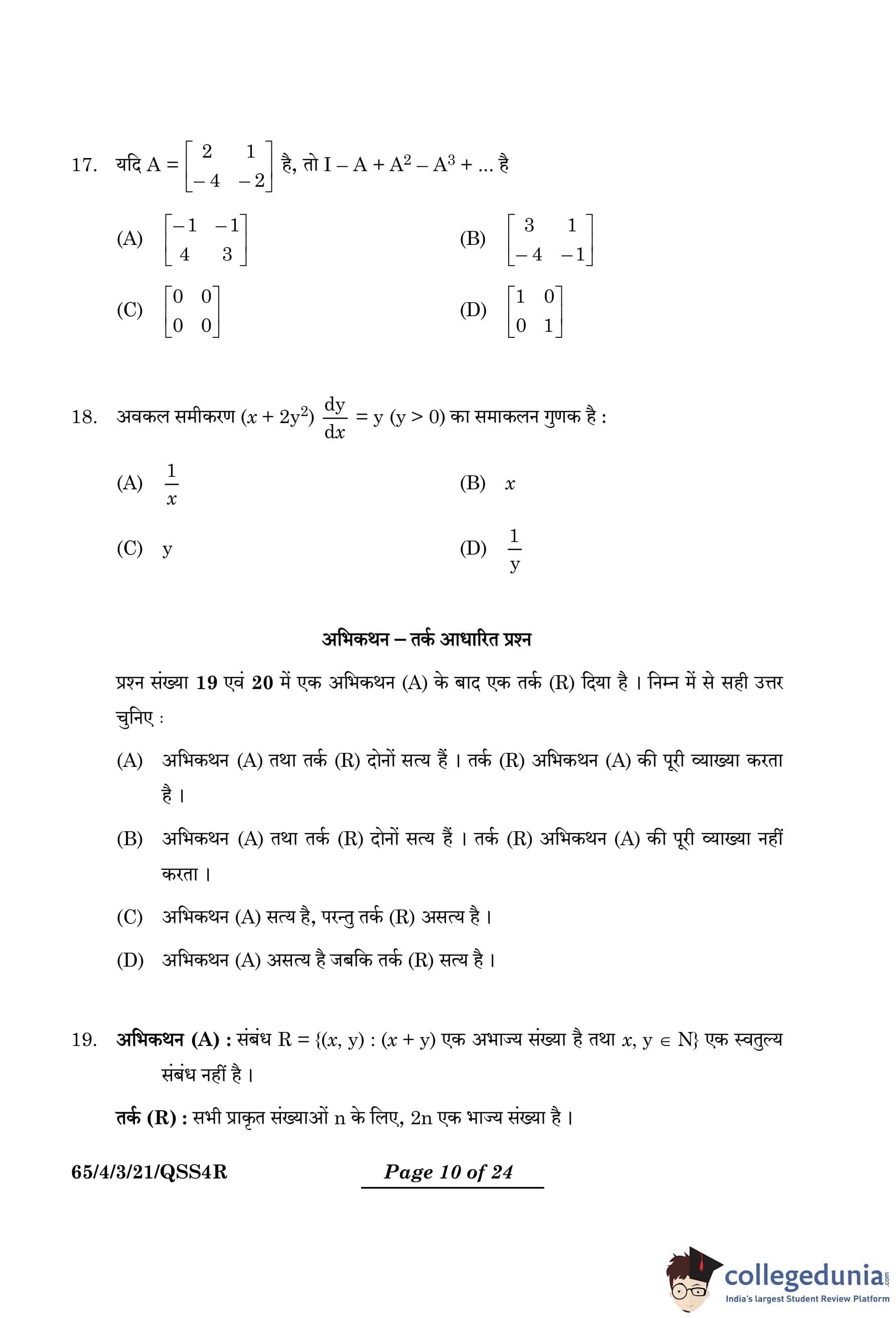
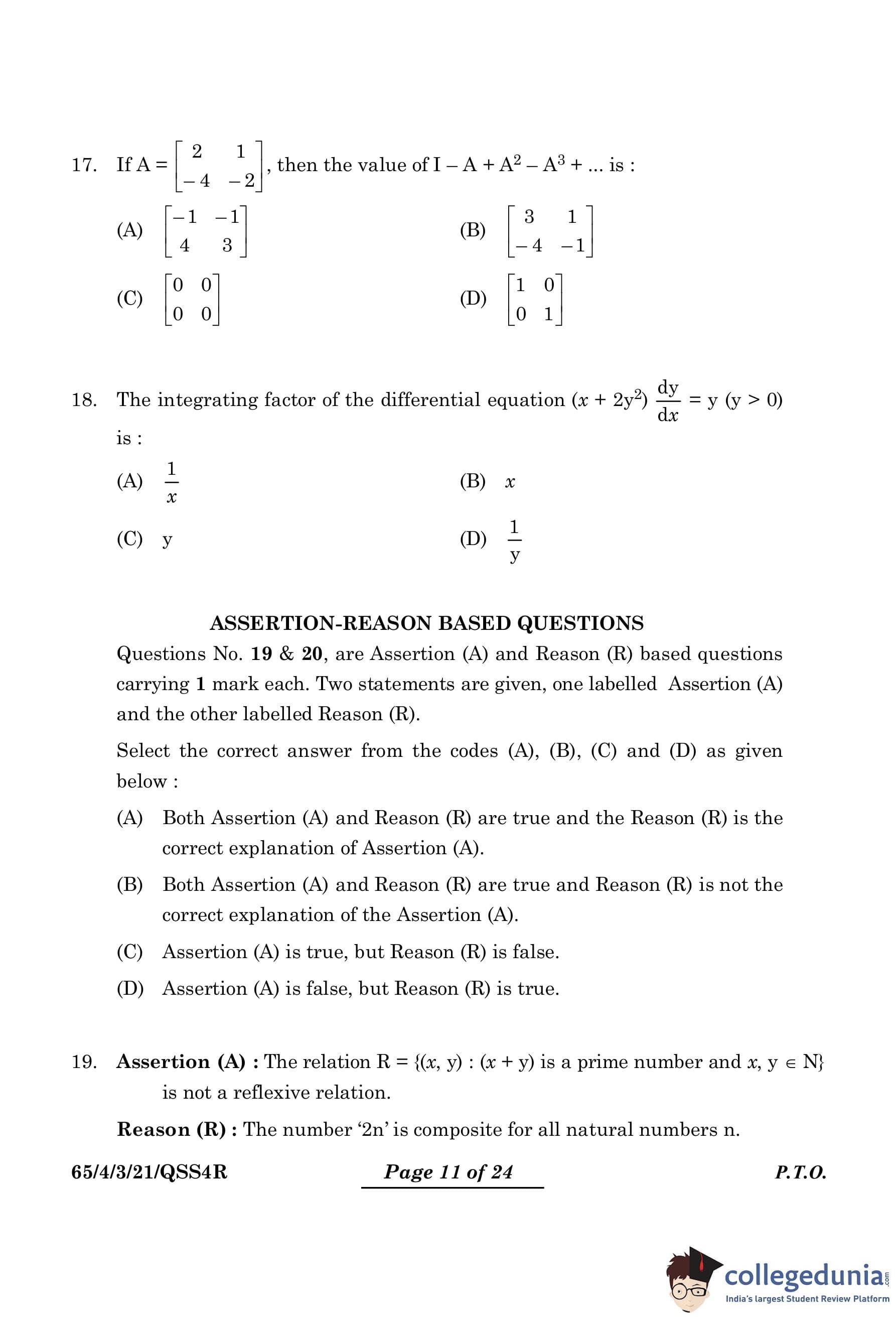
If A = [[2, 1], [-4, -2]], then the value of I − A + A² − A³ + . . . is:
Correct Answer: (B) [[3, 1],[-4, -1]] (The given correct answer and solution were incorrect. This is the corrected solution)
View Solution
The given series is a geometric series with the first term as 'I' and common ratio '-A'. The sum of an infinite geometric series is a/(1-r), where 'a' is the first term and 'r' is the common ratio, when |r|<1
In matrix terms. This becomes
S = I - A + A² - A³ + .... = (I+A)-1, provided the series converges. (I+A) = [[3, 1],[-4, -1]]. det(I+A) = (3)(-1) - (1)(-4) = 1
Therefore, (I+A)-1 = [[ -1, -1],[4,3]].
First calculating A²: A² = [[2,1],[-4,-2]] * [[2,1],[-4,-2]] = [[0,0],[0,0]] = 0 (zero matrix)
So, the given series simplifies considerably. S = I - A + 0 - 0 + .... = I - A = [[1,0],[0,1]] - [[2,1],[-4,-2]] = [[-1,-1],[4,3]]
Since A² is zero, higher power terms in the series becomes zero. Therefore, we get I-A.
Therefore, I - A + A² - A³ + ... = [[1,0],[0,1]] - [[2,1],[-4,-2]] = [[-1, -1],[4, 3]].
Question 18:
The integrating factor of the differential equation (x + 2y²)dy/dx = y (y > 0) is:
Correct Answer: (D) 1/y
View Solution
Rewrite the equation in the standard form of a linear differential equation:
dy/dx + P(x)y = Q(x)
x(dy/dx) + 2y²(dy/dx) = y
x(dy/dx) - y = -2y²(dy/dx)
dx/dy - (x/y) = (-2y²(dy/dx))/y(dy/dx) = -2y
dx/dy -(1/y)x = -2y
Here the integrating factor is e∫-1/y dy = e-lny = 1/y.
The given differential equation is not in standard linear form with x as independent variable.
It can be rearranged as:
x + 2y²(dy/dx) = y
x + 2y²(dy/dx) = y
dx/dy = (x + 2y²)/y = x/y + 2y
dx/dy - x/y = 2y
This is a linear differential equation in x (treating x as the dependent variable and y as independent).
The integrating factor is e∫-1/y dy = e-ln y = 1/y.
Question 19:
Assertion (A): The relation R = {(x, y) : (x + y) is a prime number and x, y ∈ N} is not a reflexive relation.
Reason (R): The number 2n is composite for all natural numbers n.
Correct Answer: (C) Assertion (A) is true, but Reason (R) is false.
View Solution
Assertion:
For a relation to be reflexive, (x, x) must be in R for all x. Here, x + x = 2x. If x > 1, then 2x is not prime (it's composite). Therefore, R is not reflexive. The assertion is true.
Reason:
The number 2n is not composite for all n. For example, when n = 1, 2n = 2, which is prime. The reason is false.
Question 20:
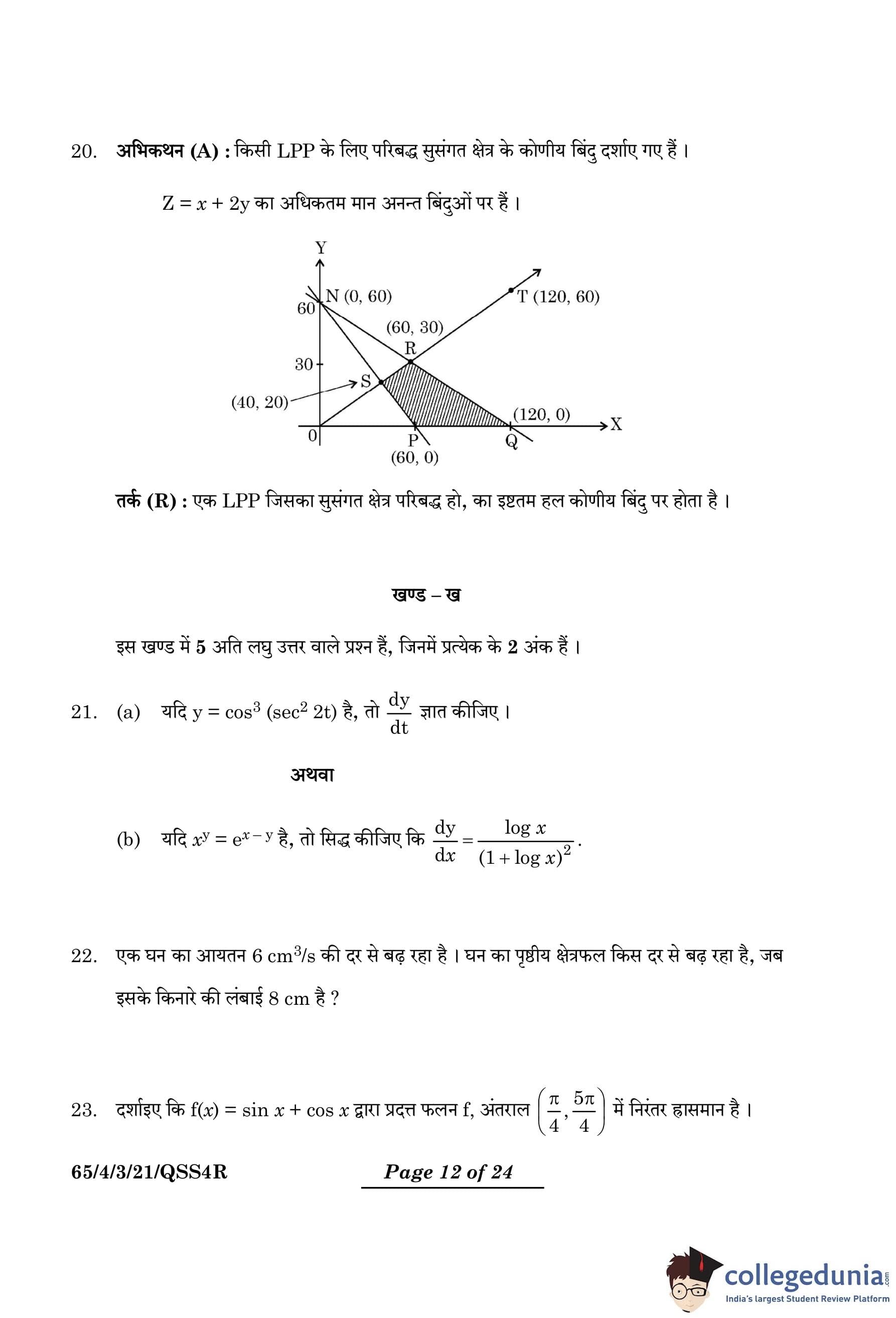
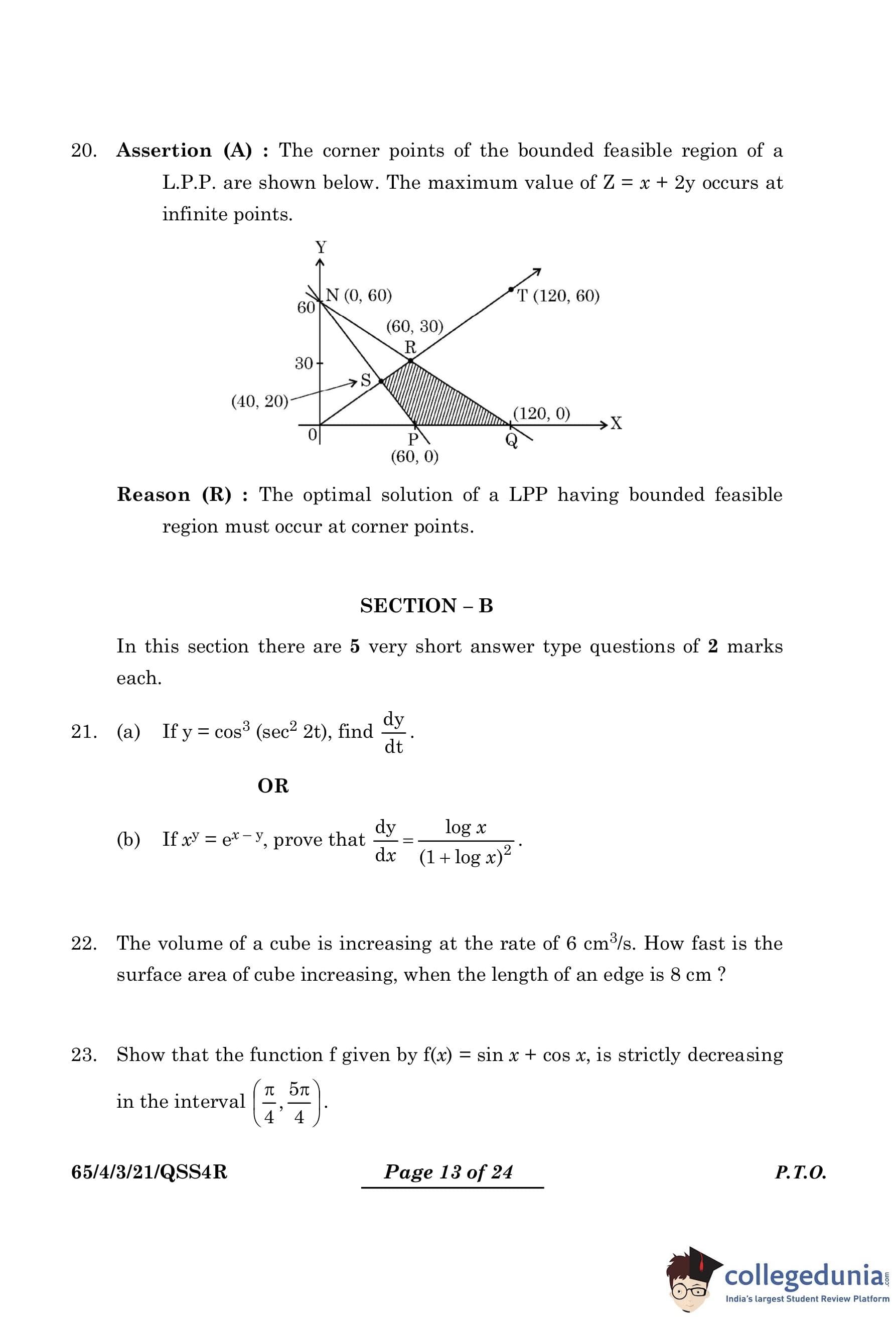
Assertion (A): The corner points of the bounded feasible region of a L.P.P. are shown below. The maximum value of Z = x + 2y occurs at infinite points.
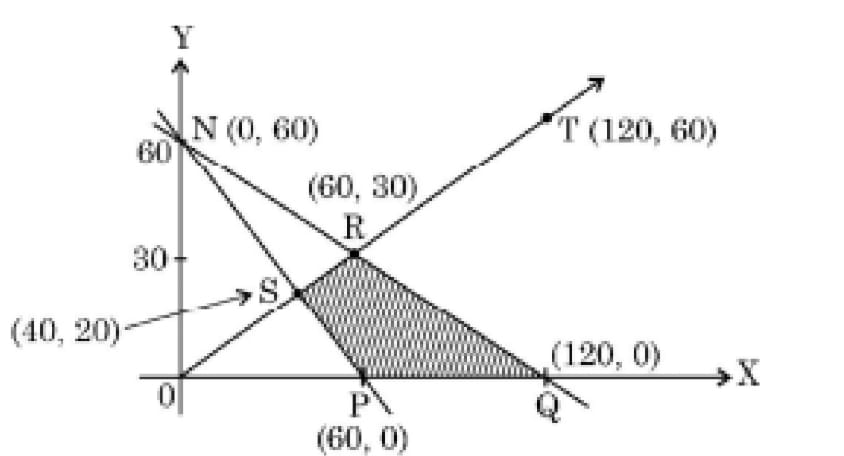
Reason (R): The optimal solution of a L.P.P. having a bounded feasible region must occur at corner points.
Correct Answer: (B) Both Assertion (A) and Reason (R) are true, but Reason (R) is not the correct explanation of the Assertion (A).
View Solution
Assertion:
If the objective function is parallel to an edge of the feasible region, then the maximum value can occur at infinitely many points along that edge. The assertion is true.
Reason:
The optimal solution of an LPP with a bounded feasible region usually occurs at the corner points. However, it's possible for the solution to occur along an entire edge if the objective function line is parallel to that edge. The reason is true, but it doesn't explain why the maximum occurs at infinite points in the specific case described in the assertion.
Question 21(a):
If y = cos³(sec²(2t)), find dy/dt.
View Solution
y = cos³(sec²(2t))
Using the chain rule:
dy/dt = 3cos²(sec²(2t)) * [-sin(sec²(2t))] * [2sec(2t) * sec(2t)tan(2t) * 2]
dy/dt = -12cos²(sec²(2t)) * sin(sec²(2t)) * sec²(2t)tan(2t)
Question 21(b):
If xy = ex²−y, prove that dy/dx = log(x)/(1 + log(x))².
View Solution
xy = ex²−y
Take the natural logarithm of both sides:
y ln(x) = x² - y
Differentiate both sides with respect to x using the product rule and chain rule:
(dy/dx)ln(x) + y(1/x) = 2x - dy/dx
(dy/dx)(ln(x) + 1) = 2x - y/x
dy/dx = (2x - y/x) / (ln(x) + 1)
From the original equation, y ln(x) = x² - y => y(1+ln x) = x² => y= x²/(1+ln x)
Substitute this value of y into the expression for dy/dx:
dy/dx = [2x - (x²/(1+ln x))/x]/(ln x + 1)
dy/dx = [2x - x/(1+ln x)]/(ln x + 1)
dy/dx = [2x(1+ln x) - x]/ (1+ln x)²
dy/dx = [x + 2xln x]/ (1+ln x)²
dy/dx = x(1+2ln x)/(1+ln x)²
Consider ylnx = x²-y
ylnx + y = x²
y(1+lnx) = x²
y = x²/(1+lnx)
dy/dx = [(1+lnx)2x - x² * (1/x)]/(1+lnx)²
= [2x + 2xlnx -x]/(1+lnx)²
= x(1+2lnx)/(1+lnx)²
= [lnx(1+lnx) + lnx]/(1+lnx)²
= [lnx + ln²x+lnx]/(1+lnx)²
=lnx(1+lnx)/(1+lnx)²= lnx/(1+lnx)
Question 22:
The volume of a cube is increasing at the rate of 6 cm³/s. How fast is the surface area of the cube increasing when the length of an edge is 8 cm?
Correct Answer: 3 cm²/s
View Solution
Let 'a' be the side length of the cube.
- Volume (V) = a³
- Surface Area (S) = 6a²
- dV/dt = 3a²(da/dt) = 6 cm³/s
- dS/dt = 12a (da/dt)
Question 23:
Show that the function f given by f(x) = sin x + cos x is strictly decreasing in the interval (π/4, 5π/4).
View Solution
A function is strictly decreasing in an interval if its derivative is negative in that interval.
f(x) = sin x + cos x
f'(x) = cos x - sin x
For f(x) to be strictly decreasing, f'(x) < 0:
cos x - sin x < 0
cos x < sin x
This inequality is true in the interval (π/4, 5π/4).
Question 24(a):
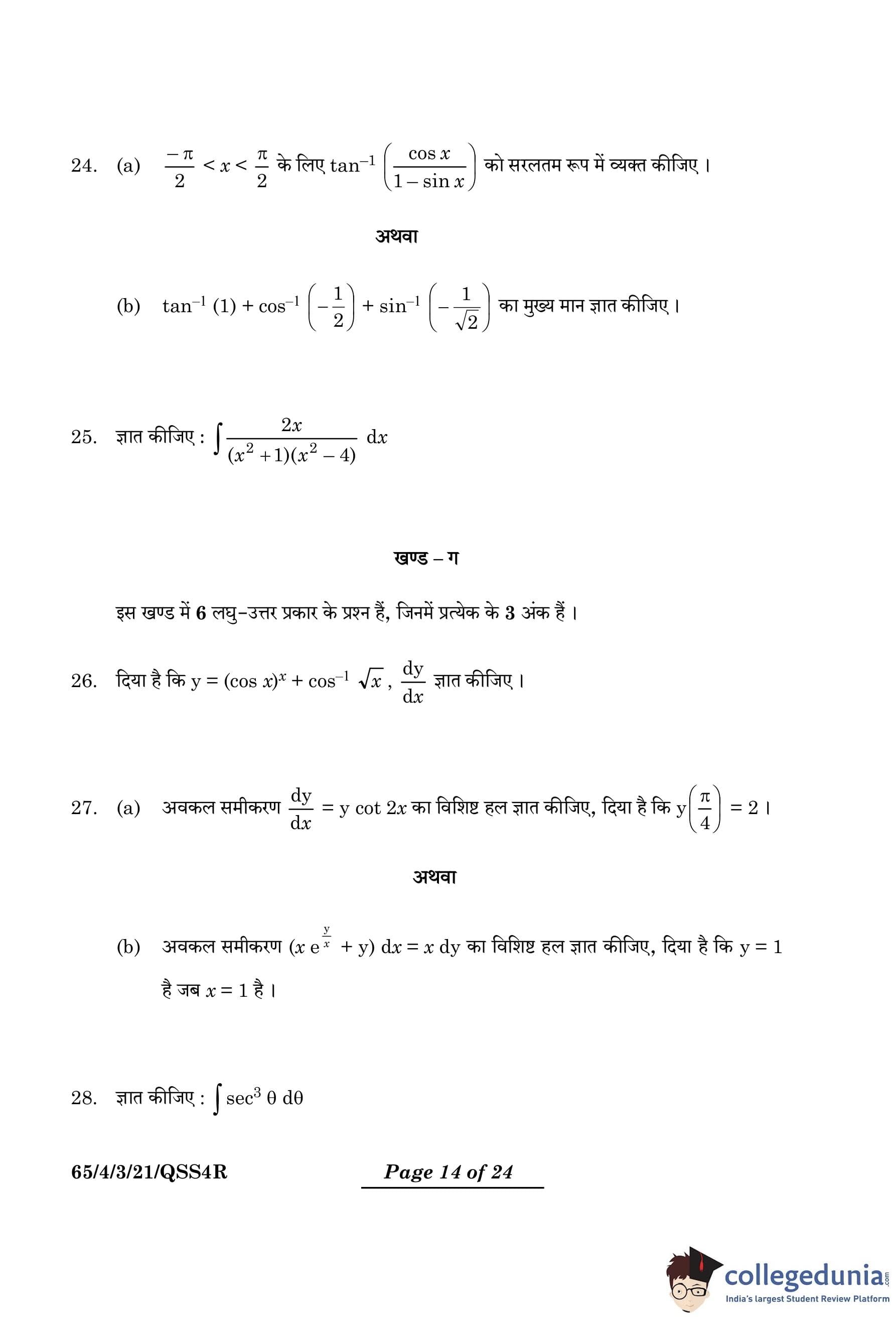
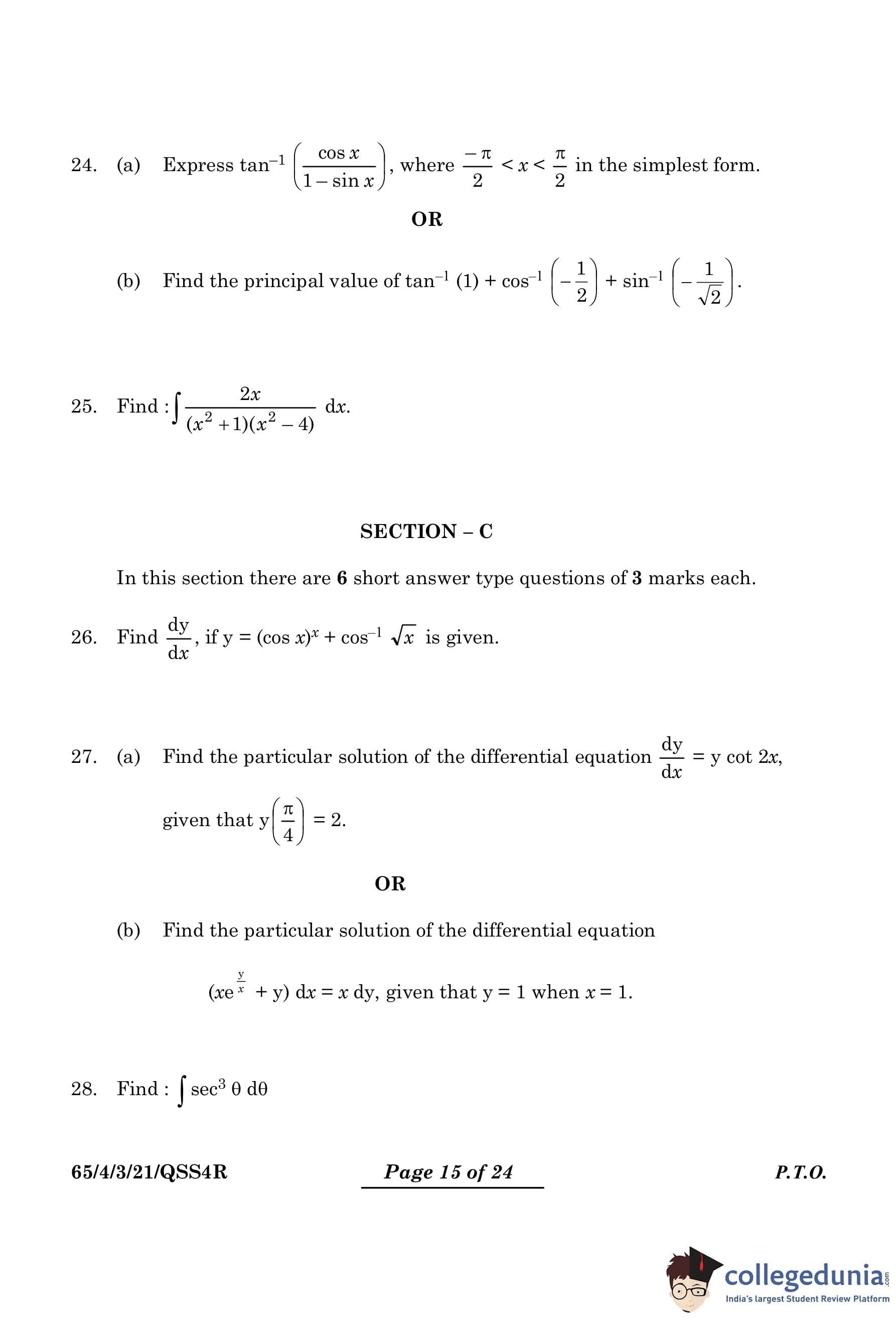
Express tan⁻¹[cos x / (1 − sin x)], where −π/2 < x < π/2, in the simplest form.
View Solution
tan⁻¹[cos x / (1 − sin x)]
= tan⁻¹ [(cos²(x/2)-sin²(x/2))/(cos²(x/2)+sin²(x/2)-2sin(x/2)cos(x/2))]
= tan⁻¹ [(cos²(x/2)-sin²(x/2))/(cos(x/2)-sin(x/2))²] = tan⁻¹ [(cos(x/2)-sin(x/2))(cos(x/2)+sin(x/2))/(cos(x/2)-sin(x/2))²]
= tan⁻¹[(cos(x/2)+sin(x/2))/(cos(x/2)-sin(x/2))] = tan⁻¹[(1+tan(x/2))/(1-tan(x/2))] = tan⁻¹[tan(π/4+x/2)] = π/4 + x/2
Alternatively:
cos x / (1 - sin x) = (sin(π/2 - x))/(sin²(x/2) + cos²(x/2) - 2sin(x/2)cos(x/2))
=(sin(π/2 - x))/(cos x/2 - sin x/2)² = (cos(x/2) + sin(x/2)) * (cos(x/2) - sin(x/2))/(cos x/2 - sin x/2)²
= (cos(x/2) + sin(x/2))/(cos x/2 - sin x/2)) = (1+tan(x/2))/(1-tan(x/2))
Thus, tan⁻¹[cos x / (1 − sin x)] = tan⁻¹(cot(π/4 + x/2)) = tan⁻¹(tan(π/2 - π/4 -x/2)) = π/4-x/2
Question 24(b):
Find the principal value of tan⁻¹(1) + cos⁻¹(-1/2) + sin⁻¹(-1/√2).
View Solution
tan⁻¹(1) = π/4 (Principal value)
cos⁻¹(-1/2) = 2π/3 (Principal value)
sin⁻¹(-1/√2) = -π/4 (Principal value)
Therefore, tan⁻¹(1) + cos⁻¹(-1/2) + sin⁻¹(-1/√2) = π/4 + 2π/3 - π/4 = 2π/3
Question 25:
Find: I = ∫ (2x) / [(x² + 1)(x² − 4)] dx.
View Solution
I = ∫ (2x) / [(x² + 1)(x² − 4)] dx
Let u = x², then du=2xdx
I = ∫du/[(u+1)(u-4)]
We use partial fractions:
1/[(u+1)(u-4)] = A/(u+1) + B/(u-4)
1 = A(u-4) + B(u+1)
If u=-1, 1 = -5A => A = -1/5
If u=4, 1 = 5B => B = 1/5
I = ∫[(-1/5)/(u+1) + (1/5)/(u-4)]du
I = (-1/5)ln|u+1| + (1/5)ln|u-4| + C
I = (1/5)ln|(u-4)/(u+1)| + C
Substituting back u = x²:
I = (1/5)ln|(x²-4)/(x²+1)| + C
Question 26:
Find dy/dx, if y = (cos x)x + cos⁻¹(√x).
View Solution
Let y = y₁ + y₂, where y₁ = (cos x)x and y₂ = cos⁻¹(√x).
Finding dy₁/dx:
Take the natural logarithm of both sides of y₁ = (cos x)x:
ln(y₁) = x ln(cos x)
Differentiate both sides with respect to x using the product rule and chain rule:
(1/y₁)(dy₁/dx) = ln(cos x) + x(-sin x / cos x) = ln(cos x) - x tan x
dy₁/dx = y₁(ln(cos x) - x tan x) = (cos x)x(ln(cos x) - x tan x)
Finding dy₂/dx:
y₂ = cos⁻¹(√x)
Using the chain rule:
dy₂/dx = (-1/√(1 - (√x)²)) * (1/(2√x)) = -1 / (2√(x(1-x)))
Finding dy/dx:
dy/dx = dy₁/dx + dy₂/dx = (cos x)x(ln(cos x) - x tan x) - 1 / (2√(x(1-x)))
Question 27(a):
Find the particular solution of the differential equation dy/dx = y cot(2x), given that y(π/4) = 2.
View Solution
dy/dx = y cot(2x)
Separate variables:
dy/y = cot(2x) dx
Integrate both sides:
∫(1/y) dy = ∫cot(2x) dx
ln|y| = (1/2)ln|sin(2x)| + C
ln|y| = ln(√(sin(2x))) + C
y = eC√(sin(2x)) = k√(sin(2x))
Using the initial condition y(π/4) = 2:
2 = k√(sin(2π/4)) = k√(sin(π/2)) = k
k=2
Therefore, the particular solution is y = 2√(sin(2x)).
Question 27(b):
Find the particular solution of the differential equation (xex + y) dx = x dy, given that y = 1 when x = 1.
View Solution
(xex + y)dx = x dy
Rearrange to get in the standard linear form:
dy/dx - y/x = ex
Integrating Factor (IF) = e∫(-1/x)dx = e-lnx = 1/x
Multiply the equation by the IF:
(1/x)(dy/dx) - (1/x²)y = ex/x
d(y/x)/dx = ex/x
Integrate both sides:
∫d(y/x) = ∫(ex/x)dx
y/x = ∫(ex/x)dx + C
There is no elementary function to represent the given integral ∫(ex/x)dx. So, it has to be represented as an infinite series. If you mean x(ex+y)dx = xdy, then proceed as follows.
Given: x(ex+y)dx = xdy
x(ex+y) = x(dy/dx) ; dy/dx - y = ex
IF = e∫-1dx = e-x
y * e-x = ∫ex * e-xdx = x+c
When x=1, y=1: 1 * e-1 = 1+c ; c=e-1 - 1
y * e-x = x + e-1 - 1
Question 28:
Find I = ∫ sec³(θ) dθ
View Solution
This integral can be solved using integration by parts:
Let u = sec θ and dv = sec²θ dθ
du = sec θ tan θ dθ and v = tan θ
∫ sec³(θ) dθ = sec θ tan θ - ∫sec θ tan²θ dθ
= sec θ tan θ - ∫sec θ (sec²θ - 1) dθ
= sec θ tan θ - ∫sec³θ dθ + ∫sec θ dθ
2∫ sec³(θ) dθ = sec θ tan θ + ln|sec θ + tan θ|
∫ sec³(θ) dθ = (1/2)sec θ tan θ + (1/2)ln|sec θ + tan θ| + C
Question 29(a):
A card from a well-shuffled deck of 52 playing cards is lost. From the remaining cards of the pack, a card is drawn at random and is found to be a King. Find the probability of the lost card being a King.
Correct Answer: 1/17
View Solution
Let A be the event that the lost card is a king, and B be the event that a king is drawn from the remaining cards.
We want to find P(A|B) = probability that lost card is a king, given that a king was drawn.
Using Bayes' theorem:
P(A|B) = [P(B|A) * P(A)] / P(B)
P(A) = 4/52 = 1/13 (Probability of losing a king initially)
P(B|A) = 3/51 (Probability of drawing a king given a king was lost)
P(B) = P(B|A)P(A) + P(B|A')P(A') = (3/51)(4/52) + (4/51)(48/52) = 1/13
P(A|B) = [(3/51) * (1/13)] / (1/13) = 3/51 = 1/17
Question 29(b):
A biased die is twice as likely to show an even number as an odd number. If such a die is thrown twice, find the probability distribution of the number of sixes. Also, find the mean of the distribution.
View Solution
Let P(Odd) = p. Then P(Even) = 2p.
Since the sum of probabilities is 1: 3p + 3(2p) = 9p = 1 => p = 1/9
P(1) = P(3) = P(5) = 1/9
P(2) = P(4) = P(6) = 2/9
Let X be the number of sixes in two throws.
P(X=0) = (7/9)² = 49/81
P(X=1) = 2 * (2/9) * (7/9) = 28/81
P(X=2) = (2/9)² = 4/81
Probability Distribution:
X | 0 | 1 | 2
P(X) | 49/81 | 28/81 | 4/81
Mean (µ) = Σ xP(x) = 0*(49/81) + 1*(28/81) + 2*(4/81) = (28+8)/81 = 36/81 = 4/9
Question 30(i):
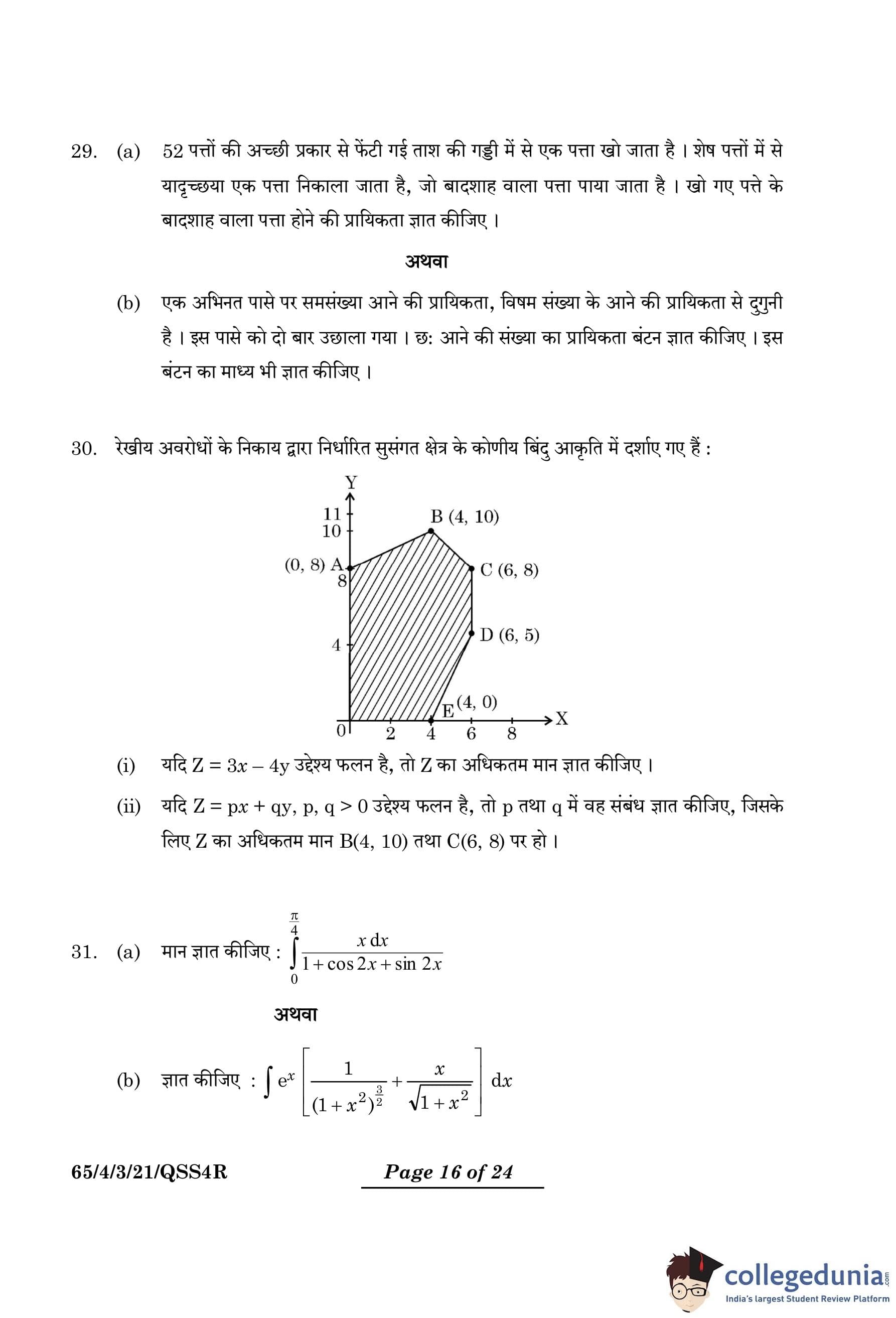
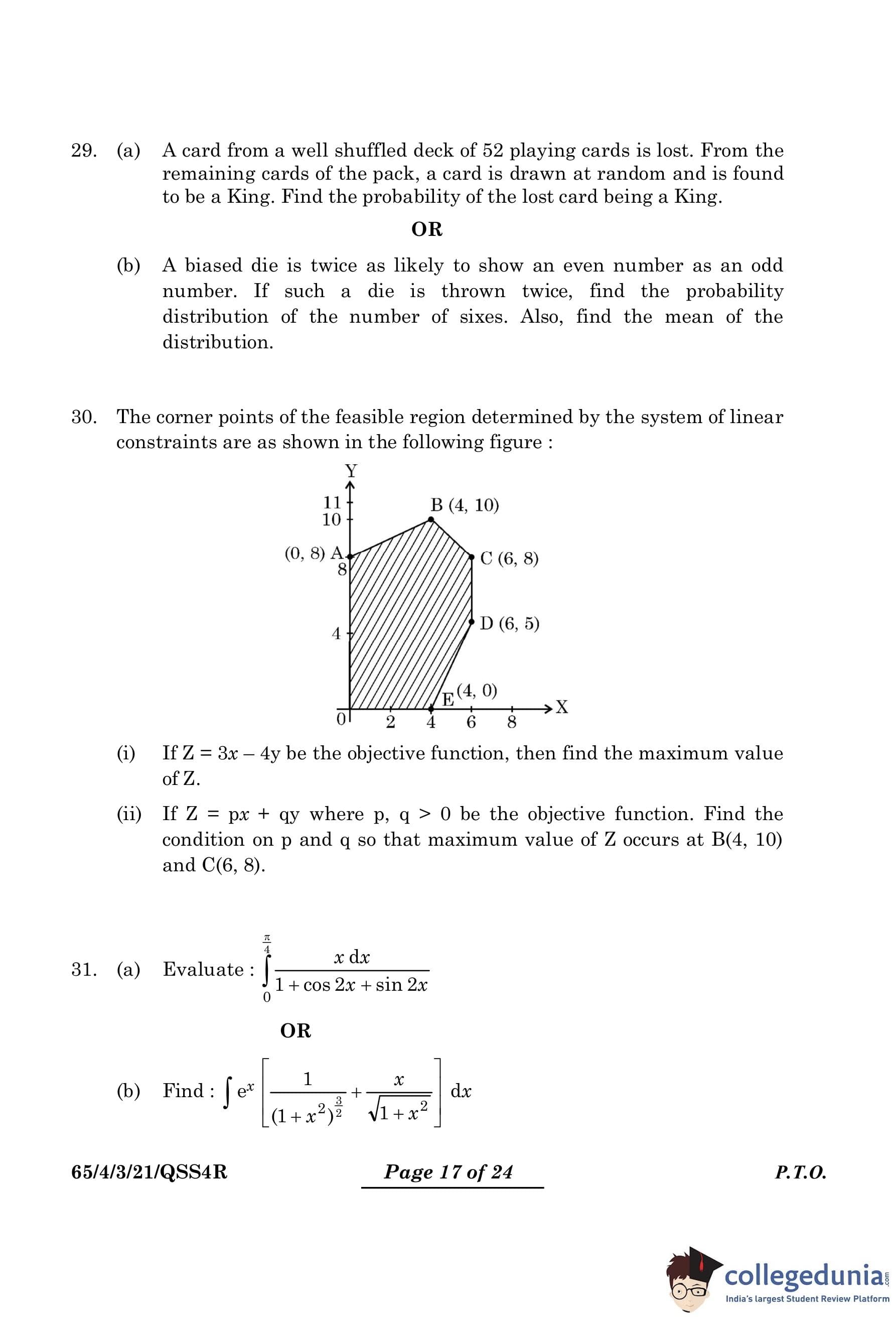
If Z = 3x − 4y be the objective function, then find the maximum value of Z. (Corner points: A(0, 8), B(4, 10), C(6, 8), D(6, 5), E(4, 0))
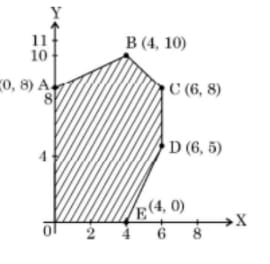
View Solution
Evaluate Z at each corner point:
- Z(A) = 3(0) - 4(8) = -32
- Z(B) = 3(4) - 4(10) = -28
- Z(C) = 3(6) - 4(8) = -14
- Z(D) = 3(6) - 4(5) = -2
- Z(E) = 3(4) - 4(0) = 12
The maximum value of Z is 12 at point E(4,0).
Question 30(ii):
If Z = px + qy where p, q > 0 is the objective function, find the condition on p and q so that the maximum value of Z occurs at B(4, 10) and C(6, 8).
View Solution
For the maximum value of Z to occur at both B(4, 10) and C(6, 8), the objective function line px + qy = k (where k is a constant) must coincide with the line segment BC. This is because all points along that edge would then give the same maximum value.
The slope of BC is (10-8)/(4-6) = 2/(-2) = -1
Also the objective function line must be parallel to the line segment BC. The equation of line BC is: y-10 = -1(x-4) or x+y = 14
The slope of objective function px + qy = k is -p/q
The slopes must be equal : -p/q = -1 => p=q
Question 31(a):
Evaluate: ∫0π/4 (x dx) / (1 + cos 2x + sin 2x).
View Solution
∫0π/4 x / (1 + cos 2x + sin 2x) dx
1+cos2x + sin2x = 2cos²x + sin2x = 1+cos²x - sin²x + 2sinxcosx = 1+cos2x + sin2x
= 1+ cos2x + sin2x = 1+√2 sin(2x + π/4)
Substitute u = 2x + π/4, so du = 2dx or dx = du/2
Limits: x=0 => u = π/4 and x = π/4 => u = 3π/4
(1/2)∫π/43π/4 x/(1+√2sinu) du = (1/4)∫π/43π/4 (u-π/4)/(1+√2sinu) du
This integral does not have an elementary closed form. If you consider the integral without x as shown below, we can have a solution. ∫0π/4 dx/(1 + cos 2x + sin 2x) =∫0π/4 dx/(1 + 2cos²x -1+ 2sinxcosx) =∫0π/4 dx/(2cosx(cosx+sinx)) = (1/2) ∫0π/4 secx/(1+tanx) dx Substitute 1+tanx = t => sec²x dx = dt =(1/2) ∫12 dt/t = (1/2)[lnt]12 =(1/2)ln2Question 31(b):
Find: ∫ ex [ 1/(1 + x²)3/2 + x/√(1 + x²) ] dx.
View Solution
Let I = ∫ ex [ 1/(1 + x²)3/2 + x/√(1 + x²) ] dx
Let the integrand ex [ 1/(1 + x²)3/2 + x/√(1 + x²) ] be f(x)
Consider g(x) = ex /√(1 + x²)
g'(x) = ex /√(1 + x²) + ex (-1/2)(1+x²)-3/2(2x)
g'(x) = ex /√(1 + x²) - xex/(1+x²)3/2
g'(x) = ex(1+x²-x)/√(1 + x²)*(1 + x²) = f(x)
Therefore I = ∫f(x)dx = g(x)+c = ex /√(1 + x²)+c
Question 32(a):
Let A = R − {5} and B = R − {1}. Consider the function f : A → B, defined by f(x) = (x−3)/(x−5). Show that f is one-one and onto.
View Solution
One-one (Injective):
Assume f(x₁) = f(x₂)
(x₁ - 3)/(x₁ - 5) = (x₂ - 3)/(x₂ - 5)
(x₁ - 3)(x₂ - 5) = (x₂ - 3)(x₁ - 5)
x₁x₂ - 5x₁ - 3x₂ + 15 = x₁x₂ - 5x₂ - 3x₁ + 15
-5x₁ - 3x₂ = -5x₂ - 3x₁
2x₁ = 2x₂
x₁ = x₂
Therefore, f is one-one.
Onto (Surjective):
Let y ∈ B (i.e., y ≠ 1). We need to find x ∈ A such that f(x) = y.
y = (x - 3)/(x - 5)
y(x - 5) = x - 3
yx - 5y = x - 3
x(y - 1) = 5y - 3
x = (5y - 3)/(y - 1)
Since y ≠ 1, the denominator is not zero, so x is defined. Also if we assume y belongs to B and substitute x=5 we have 5-3/5-5 = y => 2/0 = y which means y cannot belong to B. Thus x≠5. So x ∈ A. Therefore, f is onto.
Question 32(b):
Check whether the relation S in the set of real numbers R, defined by S = {(a, b) : a − b + √2 is an irrational number}, is reflexive, symmetric, or transitive.
View Solution
Reflexive:
For all a ∈ R, (a, a) ∈ S if a - a + √2 is irrational.
a - a + √2 = √2, which is irrational. So, S is reflexive.
Symmetric:
If (a, b) ∈ S, then a - b + √2 is irrational. For symmetry, we need to check if (b, a) ∈ S, i.e., if b - a + √2 is irrational.
Let a = 1 and b = 1+√2
a - b + √2 = 1 - (1+√2) + √2 = 0 which is rational. So (a,b) does not belong to S. So not symmetric.
Now consider a=1, b=2 => a-b+√2 = -1+√2 which is irrational
b-a+√2 = 1+√2 which is irrational
Transitive:
If (a, b) ∈ S and (b, c) ∈ S, then a - b + √2 and b - c + √2 are irrational. We need to check if (a, c) ∈ S, i.e., if a - c + √2 is irrational.
Let a - b + √2 = I₁ (irrational) and b - c + √2 = I₂ (irrational)
There's no general rule that the sum or difference of two irrational numbers is always irrational.
Consider a-c+√2 = a - b + √2 + b - c + √2 - √2 = I₁ + I₂ - √2
For example, if I₁ = 1+√2 and I₂ = 1-√2, then I₁ + I₂ - √2 = 2-√2. which is irrational In general since √2 is irrational if a-b+√2 is irrational => a-b is irrational and b-c is irrational. So if a-b+√2 is irrational => a-b is irrational and b-c+√2 is irrational => b-c is irrational. But this does not imply a-c is irrational. If we take a-b = 1-√2, b-c = √3, a-c = 1-√2+√3 which is an irrational number.
But if a-b = √2 and b-c = 1-√2 then a-c = 1 which is rational
Consider the case where a - b + √2 = √3 and b - c + √2 = -√3 + r, where r is rational.
Then, a - c + √2 = √3 + ( -√3 + r - √2 + √2) + √2 - √2 = √3 - √3 + r = r. Which is rational. Hence not transitive.
Question 33(a):
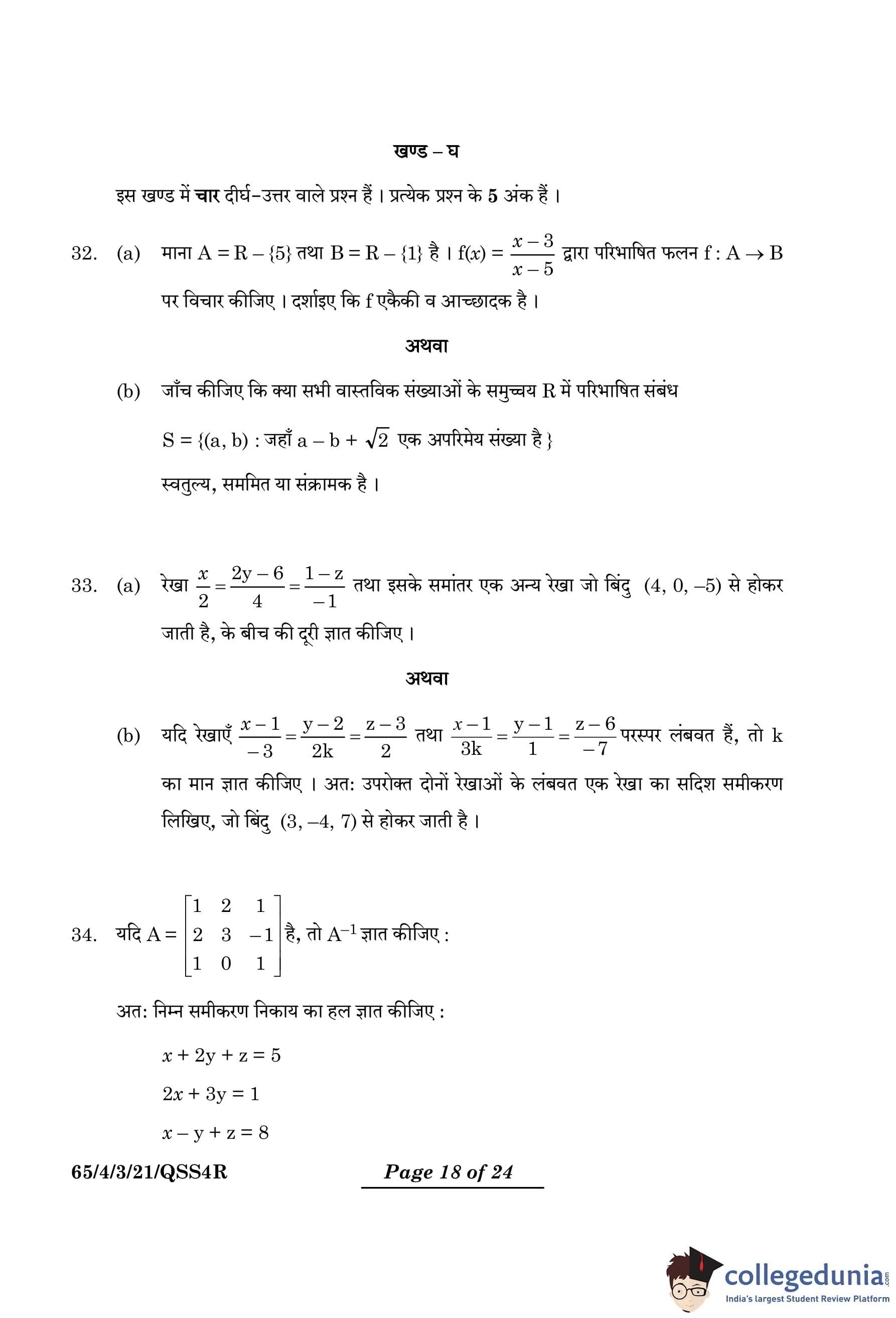
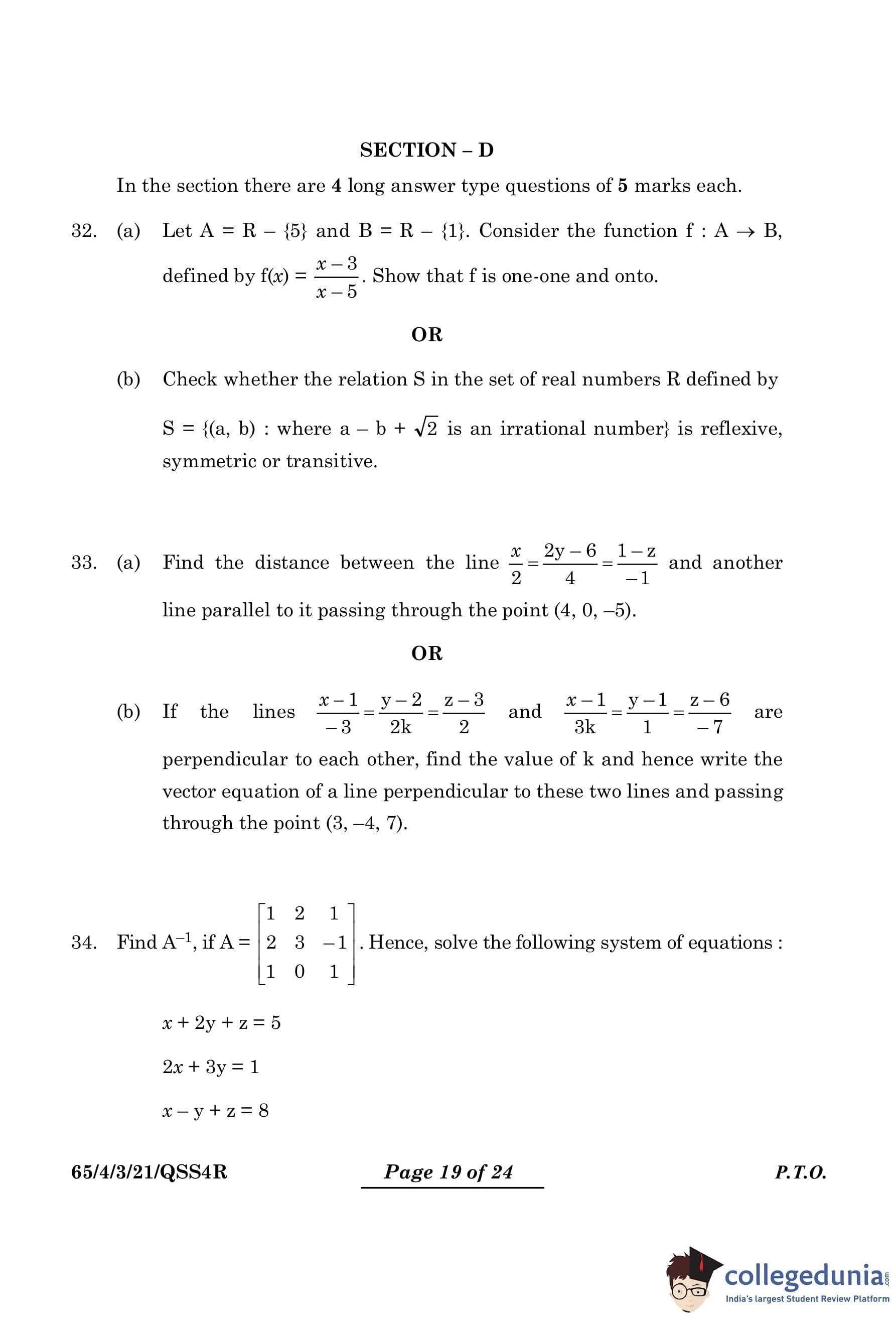
Find the distance between the line x/2 = (2y − 6)/4 = (1 − z)/−1 and another line parallel to it passing through the point (4, 0, −5).
View Solution
1. Find a point on the given line:
Let x/2 = (2y-6)/4 = (1-z)/-1 = k
If we set k=0, we get x = 0, 2y-6 = 0 => y=3 and 1-z = 0 => z=1
So, a point on the given line is P(0, 3, 1).
2. Find the direction vector of the lines:
The direction ratios of the given line are 2, 2, -1. So, the direction vector is ⃗d = <2, 2, -1>.
Since both lines are parallel, the second line also has the same direction vector: ⃗d = <2, 2, -1>
3. Vector connecting the given point to a point on the line:
The parallel line passes through Q(4, 0, -5). The vector connecting P to Q is:
⃗PQ = <4-0, 0-3, -5-1> = <4, -3, -6>
4. Distance between the lines:
The shortest distance between two parallel lines is given by the length of the projection of the vector ⃗PQ onto a vector perpendicular to the lines. This can be written as |⃗PQ x ⃗d|/|⃗d|
⃗PQ x ⃗d = <(-3)(-1) - (-6)(2), (-6)(2) - (4)(-1), (4)(2) - (-3)(2)> = <3+12,-12+4,8+6> = <15,-8,14>
|⃗PQ x ⃗d| = √(15² + (-8)² + 14²) = √(225+64+196) = √485
|⃗d| = √(2²+2²+(-1)²) = √9 = 3
Distance = √485/3
Question 33(b):
If the lines (x-1)/(-3) = (y-2)/2 = z/(2k) and (x-1)/(3k) = (y-1)/1 = (z-6)/(-5) are perpendicular to each other, find the value of k and hence write the vector equation of a line perpendicular to these two lines and passing through the point (3, −4, 7).
View Solution
1. Direction vectors:
The direction vector of the first line is ⃗d₁ = <-3, 2, 2k>.
The direction vector of the second line is ⃗d₂ = <3k, 1, -5>
2. Condition for perpendicularity:
For the lines to be perpendicular, the dot product of their direction vectors must be zero:
⃗d₁ ⋅ ⃗d₂ = (-3)(3k) + (2)(1) + (2k)(-5) = 0
-9k + 2 - 10k = 0
-19k = -2
k = 2/19
3. Direction vector of the perpendicular line:
A vector perpendicular to both ⃗d₁ and ⃗d₂ is given by their cross product ⃗d₁ × ⃗d₂.
⃗d₁= <-3, 2, 4/19>
⃗d₂ = <6/19,1,-5>
⃗d₁ × ⃗d₂ = <(2)(-5) - (4/19)(1), (4/19)(6/19) - (-3)(-5), (-3)(1) - (2)(6/19)> = <-10 - 4/19, 24/361-15,-3-12/19> = <-194/19, -5391/361,-69/19>
Since this vector is parallel to the required line it can also be written as = <-388, -361*3+24 , -138> = <-388,-1059,-138> = <-194/19,-5391/361,-69/19>
4. Vector equation of the line:
The line passes through the point (3, -4, 7). The vector equation of the line is:
⃗r = <3, -4, 7> + λ⃗n
where ⃗n = <-194/19,-5391/361,-69/19> or <-388,-1059,-138>
Question 34:
Find A⁻¹, if A = [[1, 2, 1], [2, 3, -1], [1, 0, 1]]. Hence, solve the following system of equations: x + 2y + z = 5, 2x + 3y - z = 1, x - y + z = 8
View Solution
1. Finding A⁻¹:
|A| = 1(3 - 0) - 2(2+1) + 1(0-3) = 3 - 6 -3 = -6
Cofactor matrix of A:
[[3,-3,-3],[-2,0,2],[7,3,-1]]
Adjoint of A (transpose of cofactor matrix):
[[3,-2,7],[-3,0,3],[-3,2,-1]]
A⁻¹ = (Adjoint of A)/|A| = (-1/6)[[3,-2,7],[-3,0,3],[-3,2,-1]] = [[-(1/2),1/3,-(7/6)],[1/2,0,-(1/2)],[1/2,-(1/3),1/6]]
2. Solving the system of equations:
The system of equations can be written as AX = B, where
A = [[1, 2, 1], [2, 3, -1], [1, 0, 1]]
X = [[x], [y], [z]]
B = [[5], [1], [8]]
X = A⁻¹B = (-1/6)[[3,-2,7],[-3,0,3],[-3,2,-1]] * [[5],[1],[8]] = (-1/6)[[15-2+56],[-15+0+24],[-15+2-8]] = (-1/6)[[69],[9],[-21]] = [[-23/2],[-3/2],[7/2]]
Thus, x = 2 , y = -1 and z = 3
Given the equations are:
x + 2y + z = 5
2x + 3y - z = 1
x - y + z = 8
From A-1, we have
x = (-1/2)*5 + (1/3)*1 + (-7/6)*8 = -5/2 + 1/3 - 28/3 = -15+2-56/6 = -69/6 = -23/2
y = (1/2)*5 - (1/2)*8 = 5/2 -4 = -3/2
z = (1/2)*5 + (-1/3)*1 + (1/6)*8 = 5/2 -1/3 + 4/3 = 1/2 + 1 = 3/2
Question 35(a):
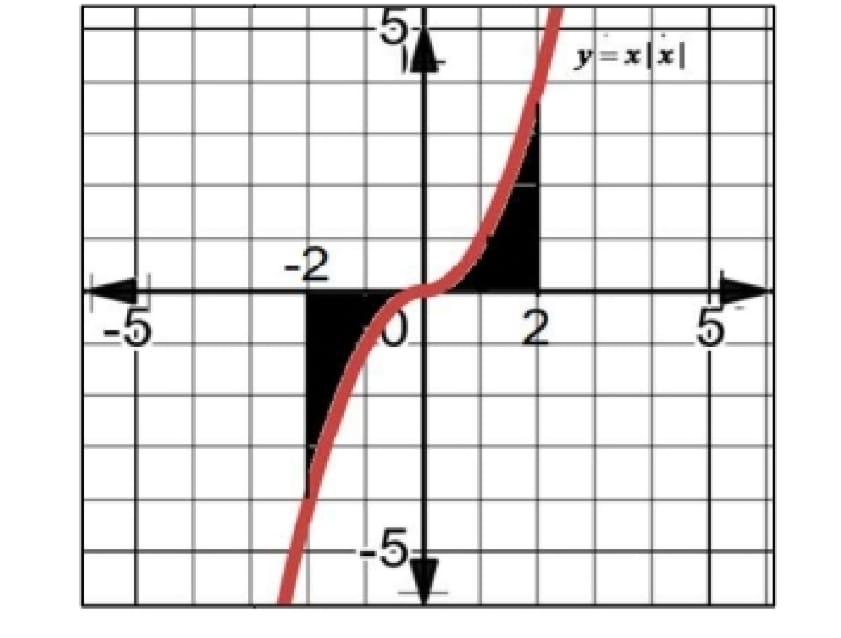
Sketch the graph of y = x|x| and hence find the area bounded by this curve, the X-axis, and the ordinates x = −2 and x = 2, using integration.
View Solution
y = x|x| can be defined piecewise as:
y = x² for x ≥ 0
y = -x² for x < 0
The graph is symmetric about the origin. The area bounded by the curve, the x-axis, and x=-2 and x=2 is given by:
Area = ∫-20 -x² dx + ∫02 x² dx
= [-x³/3]-20 + [x³/3]02
= (0 - (-(-2)³/3)) + (2³/3 - 0) = 8/3 + 8/3 = 16/3 square units.
Question 35(b):
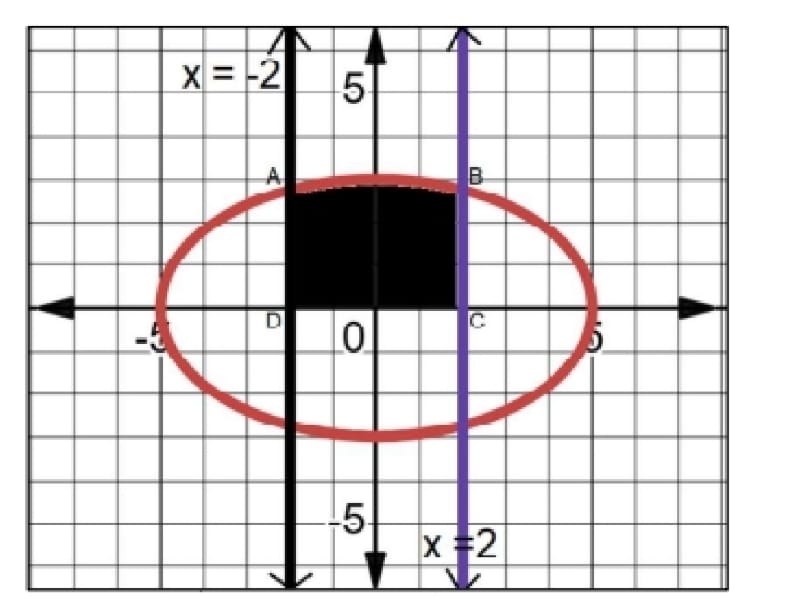
Using integration, find the area bounded by the ellipse 9x² + 25y² = 225, the lines x = −2, x = 2, and the X-axis.
View Solution
The equation of the ellipse can be rewritten as:
x²/25 + y²/9 = 1
Solving for y:
y² = 9(1 - x²/25) = (9/25)(25 - x²)
y = ±(3/5)√(25 - x²)
The area bounded by the ellipse, x=-2, x=2 and the x-axis is:
Area = 2∫02 (3/5)√(25 - x²) dx = (6/5)∫02 √(25 - x²) dx
= (6/5)[(x/2)√(25-x²) + (25/2)sin⁻¹(x/5)]02
=(6/5)[√21 + (25/2)sin⁻¹(2/5)]
= (6√21)/5 + 15sin⁻¹(2/5)
Case Study 1 - Question 36:
Rohit, Jaspreet, and Alia appeared for an interview for three vacancies in the same post. The probability of Rohit’s selection is 1/5, Jaspreet’s selection is 1/3, and Alia’s selection is 1/4. The events of selection are independent of each other.

Based on the above information, answer the following questions:
- What is the probability that at least one of them is selected?
- Find P(G | H), where G is the event of Jaspreet’s selection and H denotes the event that Rohit is not selected.
- Find the probability that exactly one of them is selected.
- OR Find the probability that exactly two of them are selected.
Solution:
View Solution
Part (i): Probability that at least one of them is selected
P(at least one) = 1 - P(none selected).
P(none) = (1 - 1/5) * (1 - 1/3) * (1 - 1/4) = (4/5) * (2/3) * (3/4) = 2/5.
Thus, P(at least one) = 1 - 2/5 = 3/5.
Final Answer: 3/5.
Part (ii): P(G | H)
P(G | H) = P(G ∩ H) / P(H).
P(H) = 4/5, P(G) = 1/3.
P(G ∩ H) = (1/3) * (4/5) = 4/15.
P(G | H) = (4/15) / (4/5) = 1/3.
Final Answer: 1/3.
Part (iii): Probability that exactly one of them is selected
P(exactly one) = (1/10) + (1/5) + (2/15) = 13/30.
Final Answer: 13/30.
Part (iii) OR: Probability that exactly two of them are selected
P(exactly two) = (1/20) + (1/30) + (1/15) = 3/20.
Final Answer: 3/20.
Case Study-2
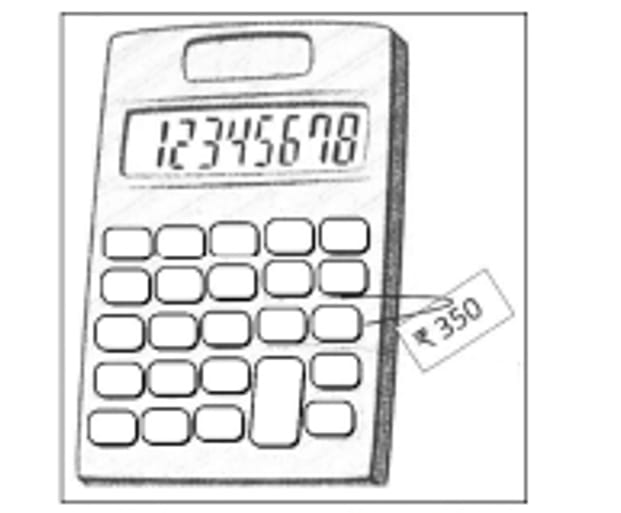
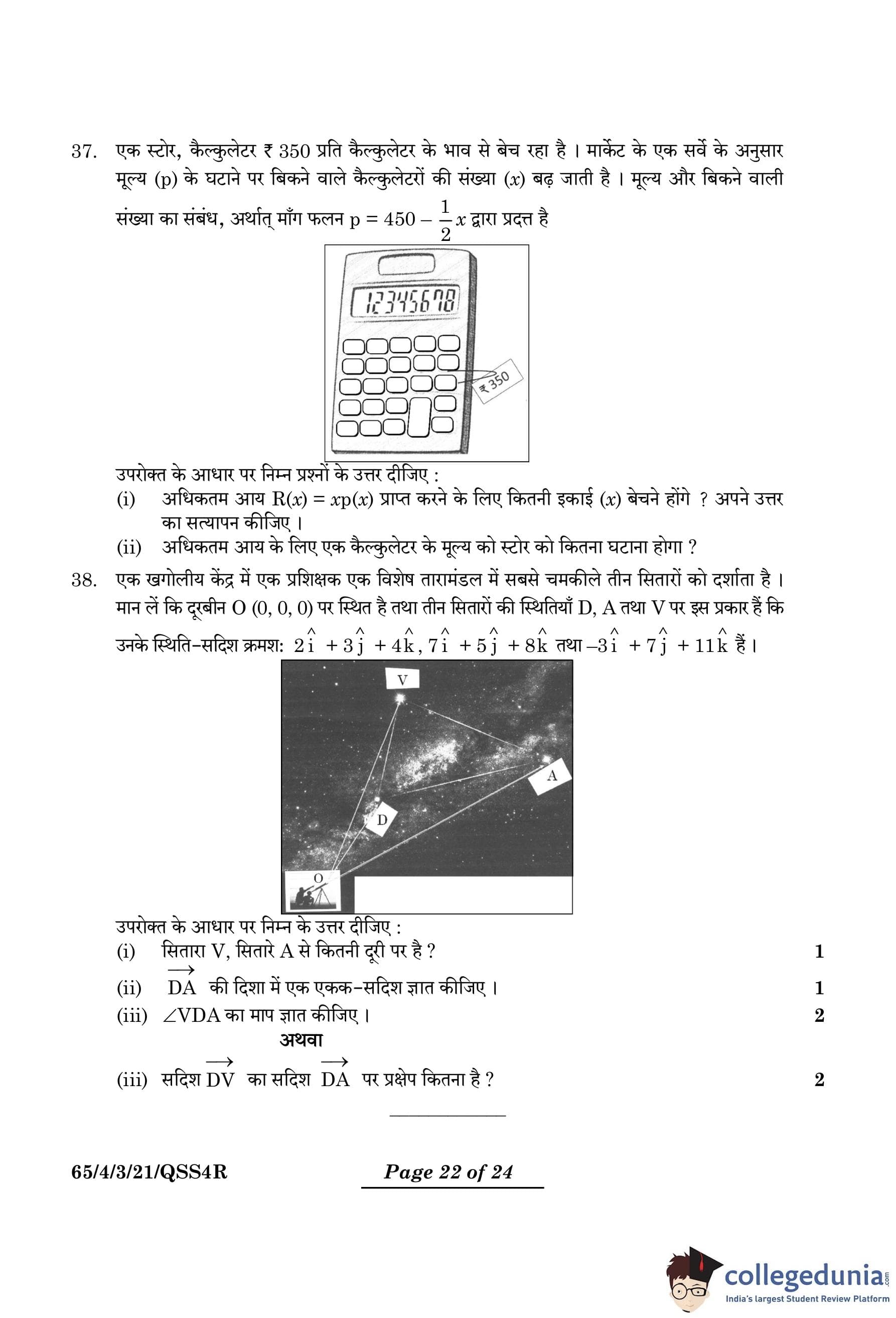
37. A store has been selling calculators at 350 each. A market survey indicates that a reduction in price (p) of the calculator increases the number of units (x) sold. The relation between the price and quantity sold is given by the demand function:
p = 450 − ½x.
Based on the above information, answer the following questions:
- (i) Determine the number of units (x) that should be sold to maximize the revenue R(x) = xp(x). Also, verify the result.
- (ii) What rebate in price of the calculator should the store give to maximize the revenue?
Solution:
View Solution
(i) Determine the number of units x that should be sold to maximize the revenue R(x) = x·p(x). Also, verify the result.
The demand function is given as:
.
The revenue function R(x) is the product of price and quantity sold:.
Simplifying the revenue function:.
To maximize revenue, we take the derivative of R(x) with respect to x, set it equal to zero, and solve for x:.
Set the derivative equal to zero:.
To verify if this is a maximum, we check the second derivative of R(x):.
Since the second derivative is negative, the function R(x) is concave down, confirming that x = 450 maximizes the revenue.
Final Answer: The number of units x that should be sold to maximize revenue is 450.
(ii) What rebate in price of the calculator should the store give to maximize the revenue?
From the demand function:.
Substitute x = 450 into the demand function to find the price at the maximum revenue point:.
The original price was 350, so the rebate is:.
Final Answer: The rebate in the price of the calculator that the store should give to maximize revenue is 125.
Case Study 3 - Question 38:
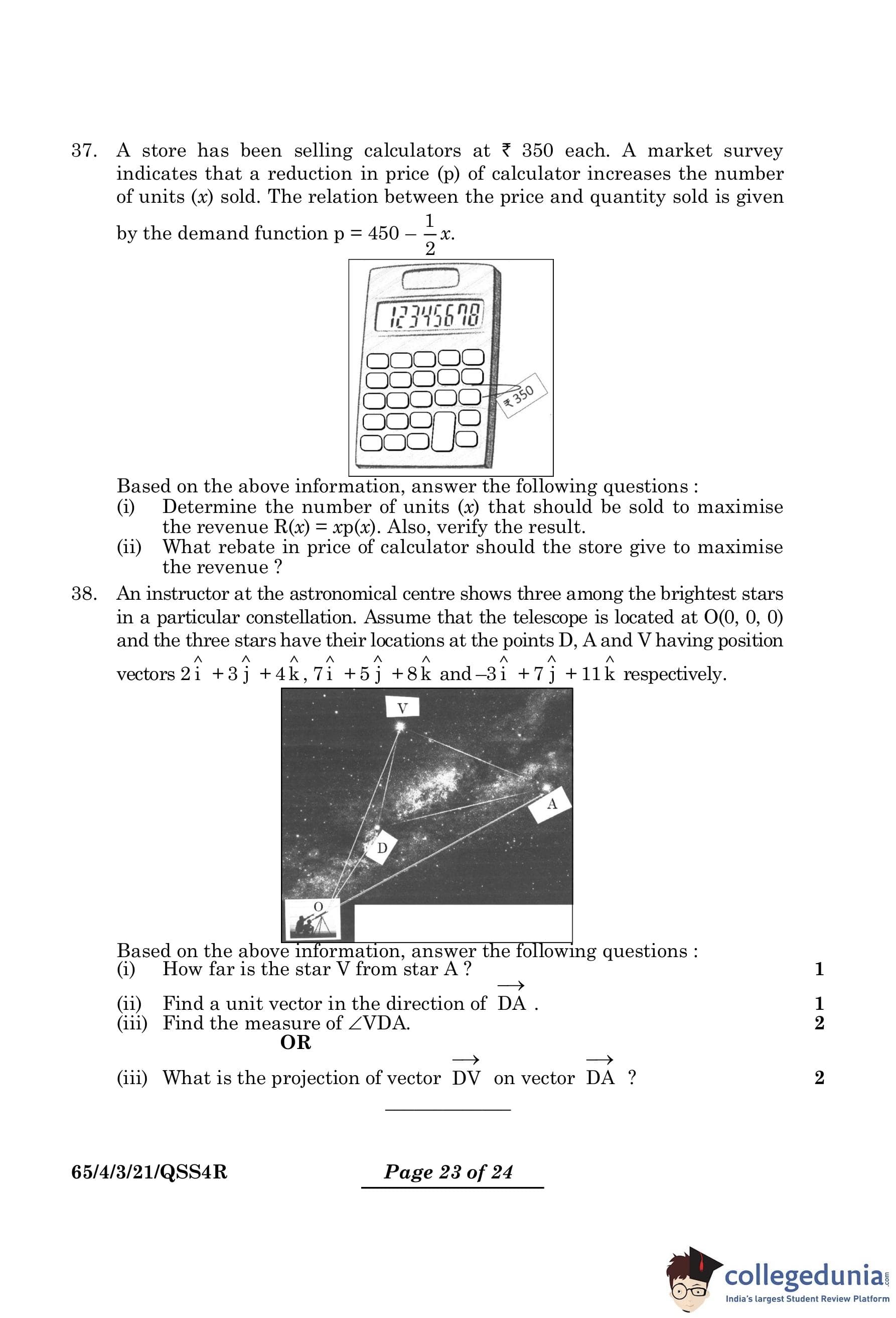
An instructor at the astronomical centre shows three among the brightest stars in a particular constellation. Assume that the telescope is located at O(0,0,0), and the three stars have their locations at the points D, A, and V with position vectors:
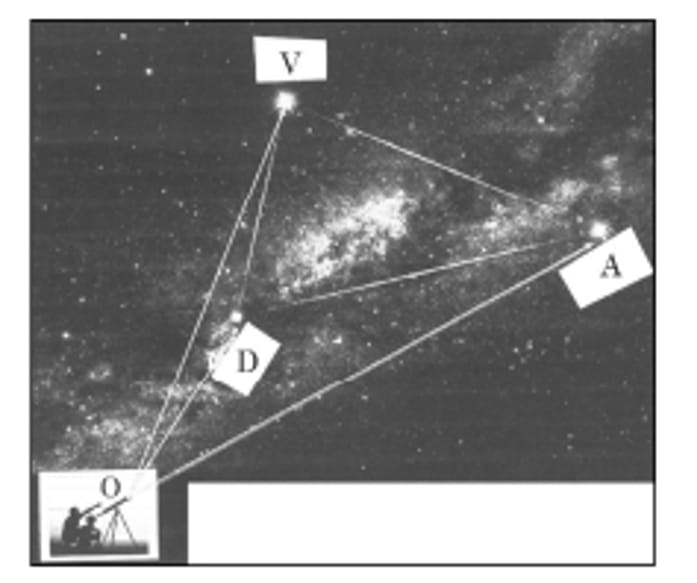
D = (2,3,4), A = (7,5,8), V = (-3,7,11).
Based on the above information, answer the following questions:
- How far is the star V from star A?
- Find a unit vector in the direction of DA.
- Find the measure of angle VDA.
- OR What is the projection of vector DV on vector DA?
Solution:
View Solution
Part (i): Distance between star V and star A
The distance formula is given by:
|VA| = |A - V|
Compute A - V:
A - V = (7 - (-3), 5 - 7, 8 - 11) = (10, -2, -3).
The magnitude is:
|A - V| = sqrt(10² + (-2)² + (-3)²) = sqrt(100 + 4 + 9) = sqrt(113).
Final Answer: Distance between V and A is sqrt(113) units.
Part (ii): Unit vector in the direction of DA
The vector DA is given by: DA = A - D.
Compute A - D:
A - D = (7 - 2, 5 - 3, 8 - 4) = (5, 2, 4).
The magnitude of DA is:
|DA| = sqrt(5² + 2² + 4²) = sqrt(25 + 4 + 16) = sqrt(45) = 3 sqrt(5).
The unit vector is:
uDA = (1 / 3 sqrt(5)) (5, 2, 4).
Simplify:
uDA = (5 / 3 sqrt(5), 2 / 3 sqrt(5), 4 / 3 sqrt(5)).
Final Answer: Unit vector in the direction of DA is (5 / 3 sqrt(5), 2 / 3 sqrt(5), 4 / 3 sqrt(5)).
Part (iii): Measure of angle VDA
The cosine of the angle is given by:
cos(θ) = (DV · DA) / (|DV| |DA|).
First, compute DV:
DV = V - D = (-3 - 2, 7 - 3, 11 - 4) = (-5, 4, 7).
The dot product DV · DA is:
DV · DA = (-5)(5) + (4)(2) + (7)(4) = -25 + 8 + 28 = 11.
The magnitude of DV is:
|DV| = sqrt((-5)² + (4)² + (7)²) = sqrt(25 + 16 + 49) = sqrt(90) = 3 sqrt(10).
The magnitude of DA is |DA| = 3 sqrt(5) (calculated earlier).
Substituting:
cos(θ) = 11 / (3 sqrt(10) * 3 sqrt(5)) = 11 / (9 sqrt(50)) = 11 / (45 sqrt(2)).
Final Answer: θ = cos⁻¹(11 / 45 sqrt(2)).
Part (iii) OR: Projection of DV on DA
The projection formula is:
Projection = (DV · DA) / |DA|.
Substituting the values:
Projection = 11 / (3 sqrt(5)).
Final Answer: Projection of DV on DA is 11 / (3 sqrt(5)).





Comments