




CBSE Class 12 Mathematics Set 1- (65/1/1) Question Paper 2026 is available for download here. CBSE conducted Class 12 Mathematics exam on March 9, 2026 from 10:30 AM to 1:30 PM. The Mathematics theory paper is of 80 marks, and the internal assessment is of 20 marks.
Mathematics question paper includes MCQs (1 mark each), short-answer type questions (2 & 3 marks each), and long-answer type questions (4 & 6 marks each) which makes up the total of 80 marks.
Download CBSE Class 12 Mathematics Set-1 (65/1/1) Question Paper 2026 with detailed solutions from the links provided below.
CBSE Class 12 Mathematics Set 1- (65/1/1) Question Paper 2026 with Solution PDF
| CBSE Class 12 Mathematics Question Paper 2026 Set 1- (65/1/1) | Download PDF | Check Solutions |

If \( 2 \cos^{-1}x = y \), then
View Solution
Step 1: Understanding the Concept:
The principal value range of the inverse cosine function \( \cos^{-1}x \) is \( [0, \pi] \).
Hence, for every permissible value of \( x \), the output of \( \cos^{-1}x \) lies within \( 0 \) and \( \pi \), including both endpoints.
Step 2: Key Formula or Approach:
The range of the base inverse function is:
\[ 0 \leq \cos^{-1}x \leq \pi \]
Step 3: Detailed Explanation:
Given the function:
\[ y = 2 \cos^{-1}x \]
We begin with the known range of \( \cos^{-1}x \):
\[ 0 \leq \cos^{-1}x \leq \pi \]
To determine the range of \( y \), multiply the entire inequality by the positive constant \( 2 \):
\[ 2 \times 0 \leq 2 \times \cos^{-1}x \leq 2 \times \pi \]
\[ 0 \leq 2 \cos^{-1}x \leq 2\pi \]
Replacing \( 2 \cos^{-1}x \) with \( y \), we obtain:
\[ 0 \leq y \leq 2\pi \]
This corresponds to option (C).
Step 4: Final Answer:
The range of \( y \) is \( 0 \leq y \leq 2\pi \).
Quick Tip: First determine the principal range of the inverse trigonometric function.
If the function is multiplied by a constant \( k \), the endpoints of the range are multiplied by \( k \).
If a constant is added to the function, the entire range shifts accordingly.
Which of the following cannot be the order of a row-matrix?
View Solution
Step 1: Understanding the Concept:
A row-matrix is a type of matrix that consists of only one horizontal row of elements.
The order of a matrix is written as \( (number of rows) \times (number of columns) \).
Step 2: Key Formula or Approach:
For a matrix to be classified as a row-matrix, its order must be of the form \( 1 \times n \), where \( n \geq 1 \).
Step 3: Detailed Explanation:
Let us examine each of the given options:
(A) \( 2 \times 1 \): This matrix contains 2 rows and 1 column. Since it has more than one row, it represents a column-matrix rather than a row-matrix.
(B) \( 1 \times 2 \): This matrix has 1 row and 2 columns, which satisfies the definition of a row-matrix.
(C) \( 1 \times 1 \): This matrix has a single row and a single column. Because it has exactly one row, it can also be considered a row-matrix (and simultaneously a column-matrix).
(D) \( 1 \times n \): This represents the general form of a row-matrix containing \( n \) columns.
Therefore, option (A) is the only order that cannot represent a row-matrix.
Step 4: Final Answer:
The order \( 2 \times 1 \) cannot represent a row-matrix.
Quick Tip: Remember:
Row matrix: \( 1 \times n \) (exactly one row)
Column matrix: \( m \times 1 \) (exactly one column)
Which of the following properties is/are true for two matrices of suitable orders?
(i) \( (A + B)' = A' + B' \)
(ii) \( (A - B)' = B' - A' \)
(iii) \( (AB)' = A'B' \)
(iv) \( (kAB)' = kB'A' \) (k is a scalar)
View Solution
Step 1: Understanding the Concept:
The transpose of a matrix, represented by \( A' \), is obtained by switching its rows with columns.
Transpose operations satisfy several standard algebraic properties.
Step 2: Key Formula or Approach:
Important transpose properties include:
1. \( (A + B)' = A' + B' \)
2. \( (A - B)' = A' - B' \)
3. \( (AB)' = B'A' \) (Reversal property)
4. \( (kA)' = kA' \)
Step 3: Detailed Explanation:
Now examine each statement:
(i) \( (A + B)' = A' + B' \): This follows the transpose rule for addition of matrices, so it is correct.
(ii) \( (A - B)' = B' - A' \): The correct identity is \( (A - B)' = A' - B' \). Since the order is reversed here, the statement is incorrect.
(iii) \( (AB)' = A'B' \): The correct rule states \( (AB)' = B'A' \). Because the order of matrices must reverse, this statement is incorrect.
(iv) \( (kAB)' = kB'A' \): Applying scalar and product transpose rules gives:
\[ (kAB)' = k(AB)' = k(B'A') \]
As \( k \) is a scalar, it remains unchanged. Hence, this statement is correct.
Therefore, statements (i) and (iv) are valid.
Step 4: Final Answer:
Statements (i) and (iv) are true.
Quick Tip: A key rule to remember is the \textbf{reversal property}:
For transpose, \( (AB)' = B'A' \), and for inverses, \( (AB)^{-1} = B^{-1}A^{-1} \).
In both cases, the order of matrices reverses when dealing with products.
Question 4:
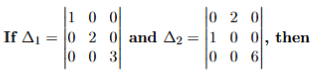
View Solution
Step 1: Understanding the Concept:
The determinant of a matrix can be evaluated either by expansion or by applying determinant properties.
For a diagonal matrix, the determinant equals the product of its diagonal entries.
Also, if two rows or columns of a determinant are interchanged, the value of the determinant changes sign.
Step 2: Key Formula or Approach:
For a \( 3 \times 3 \) diagonal matrix \( D = diag(a, b, c) \), the determinant is: \[ |D| = abc \]
If two rows are swapped, then: \[ R_i \leftrightarrow R_j \Rightarrow New determinant = -(Original determinant) \]
Step 3: Detailed Explanation:
First evaluate \( \Delta_1 \):
Since \( \Delta_1 \) is a diagonal matrix, its determinant is the product of the diagonal elements: \[ \Delta_1 = 1 \times 2 \times 3 = 6 \]
Next evaluate \( \Delta_2 \):
It is convenient to expand along the third row because it contains two zeros: \[ \Delta_2 = 6 \begin{vmatrix} 0 & 2
1 & 0 \end{vmatrix} \]
Now compute the \( 2 \times 2 \) determinant: \[ \begin{vmatrix} 0 & 2
1 & 0 \end{vmatrix} = (0 \times 0 - 2 \times 1) = -2 \]
Thus, \[ \Delta_2 = 6(-2) = -12 \]
Now compare the two determinants: \[ \frac{\Delta_2}{\Delta_1} = \frac{-12}{6} = -2 \]
Therefore, \[ \Delta_2 = -2\Delta_1 \]
This corresponds to option (B).
Step 4: Final Answer:
\[ \Delta_2 = -2\Delta_1 \] Quick Tip: Another approach is to transform \( \Delta_1 \) into \( \Delta_2 \).
First interchange \( R_1 \) and \( R_2 \), which changes the determinant sign to \( -6 \).
Then multiply \( R_3 \) by \( 2 \), doubling the determinant.
Thus the overall change is \( -1 \times 2 = -2 \), giving \( \Delta_2 = -2\Delta_1 \).
One of the values of \( x \) for which \( \begin{vmatrix} \cos x & \sin x
-\cos x & \sin x \end{vmatrix} = 1 \) is
View Solution
Step 1: Understanding the Concept:
The determinant of a \( 2 \times 2 \) matrix \( \begin{vmatrix} a & b
c & d \end{vmatrix} \)
is calculated as \( ad - bc \).
After expanding the determinant, the resulting expression forms a trigonometric equation.
Step 2: Key Formula or Approach:
1. Determinant expansion: \[ \begin{vmatrix} \cos x & \sin x
-\cos x & \sin x \end{vmatrix} = (\cos x)(\sin x) - (\sin x)(-\cos x) \]
2. Trigonometric identity: \[ 2\sin x \cos x = \sin(2x) \]
Step 3: Detailed Explanation:
Expand the determinant: \[ (\cos x)(\sin x) - (\sin x)(-\cos x) = 1 \]
Simplify the expression: \[ \sin x \cos x + \sin x \cos x = 1 \]
\[ 2\sin x \cos x = 1 \]
Using the double-angle identity for sine: \[ \sin(2x) = 1 \]
The sine function equals 1 for angles such as \( \frac{\pi}{2}, \frac{5\pi}{2}, \ldots \).
Taking the principal solution: \[ 2x = \frac{\pi}{2} \]
Dividing both sides by 2: \[ x = \frac{\pi}{4} \]
This corresponds to option (B).
Step 4: Final Answer:
A value of \( x \) that satisfies the equation is \[ x = \frac{\pi}{4} \] Quick Tip: When solving trigonometric equations, try to convert expressions into standard identities such as \( \sin 2x \) or \( \cos 2x \).
Also remember the general solution: \( \sin \theta = 1 \Rightarrow \theta = (4n+1)\frac{\pi}{2} \), where \( n \in \mathbb{Z} \).
If \( A \) and \( B \) are skew symmetric matrices of same order, then which of the following matrices is also skew symmetric?
View Solution
Step 1: Understanding the Concept:
A matrix \( M \) is called skew-symmetric if its transpose satisfies the condition \( M' = -M \).
Since \( A \) and \( B \) are skew-symmetric matrices, we have: \[ A' = -A \quad and \quad B' = -B \]
Step 2: Key Formula or Approach:
Important transpose properties used here are: \[ (X \pm Y)' = X' \pm Y', \qquad (XY)' = Y'X' \]
Step 3: Detailed Explanation:
Now examine each option by taking its transpose.
(A) \( (AB)' = B'A' = (-B)(-A) = BA \).
This is generally not equal to \( -AB \). Hence, \( AB \) is not necessarily skew-symmetric.
(B) \( (AB + BA)' = (AB)' + (BA)' = B'A' + A'B' \).
Substituting \( A' = -A \) and \( B' = -B \): \[ (-B)(-A) + (-A)(-B) = BA + AB = AB + BA \]
Thus, the matrix equals its transpose, meaning it is symmetric, not skew-symmetric.
(C) \( ((A+B)^2)' = ((A+B)(A+B))' \).
Using the transpose rule for products: \[ (A+B)'(A+B)' \]
Since \( (A+B)' = A' + B' = -A - B = -(A+B) \), we get: \[ (-(A+B))(-(A+B)) = (A+B)^2 \]
Hence this matrix is symmetric.
(D) \( (A - B)' = A' - B' \).
Substituting \( A' = -A \) and \( B' = -B \): \[ (-A) - (-B) = -A + B = -(A - B) \]
Since the transpose equals the negative of the matrix, \( A - B \) is skew-symmetric.
Step 4: Final Answer:
The matrix \( A - B \) is skew-symmetric.
Quick Tip: Any linear combination of skew-symmetric matrices such as \( \alpha A + \beta B \) is also skew-symmetric.
Subtraction is a special case where \( \alpha = 1 \) and \( \beta = -1 \).
The least value of \( f(x) = x^3 - 12x, x \in [0, 3] \) is
View Solution
Step 1: Understanding the Concept:
To determine the absolute minimum (least value) of a continuous function over a closed interval \( [a,b] \), we evaluate the function at all critical points inside the interval and also at the endpoints \( a \) and \( b \).
Step 2: Key Formula or Approach:
1. Compute the derivative \( f'(x) \) and solve \( f'(x)=0 \) to obtain critical points.
2. Compare the values \( f(a), f(b) \), and \( f(c) \) for any critical point \( c \in (a,b) \).
Step 3: Detailed Explanation:
The function given is \( f(x) = x^3 - 12x \) for \( x \in [0,3] \).
First compute the derivative: \[ f'(x) = 3x^2 - 12 \]
Set the derivative equal to zero: \[ 3x^2 - 12 = 0 \] \[ 3x^2 = 12 \] \[ x^2 = 4 \] \[ x = \pm 2 \]
Among these, only \( x = 2 \) lies in the interval \( [0,3] \), so \( x=-2 \) is discarded.
Now evaluate the function at the relevant points:
At \( x=0 \): \[ f(0) = 0^3 - 12(0) = 0 \]
At \( x=2 \): \[ f(2) = 2^3 - 12(2) = 8 - 24 = -16 \]
At \( x=3 \): \[ f(3) = 3^3 - 12(3) = 27 - 36 = -9 \]
Comparing the values \( 0, -16, -9 \), the smallest value is \( -16 \).
Step 4: Final Answer:
The least value of the function on the interval \( [0,3] \) is \[ -16 \] Quick Tip: When finding the least value on a closed interval, check both critical points and the endpoints.
A local minimum inside the interval may not always be the absolute minimum.
If \( \int \frac{3ax}{b^2 + c^2x^2} dx = A \log |b^2 + c^2x^2| + K \), then the value of \( A \) is
View Solution
Step 1: Understanding the Concept:
The given integral can be evaluated using the substitution method.
Observe that the derivative of the denominator is proportional to the numerator, which suggests using the logarithmic integration rule.
Step 2: Key Formula or Approach:
We use the standard result: \[ \int \frac{f'(x)}{f(x)}\,dx = \log|f(x)| + C \]
Step 3: Detailed Explanation:
Let \[ I = \int \frac{3ax}{b^2 + c^2x^2}\,dx \]
Set \[ u = b^2 + c^2x^2 \]
Differentiate with respect to \(x\): \[ du = 2c^2x\,dx \]
Thus, \[ x\,dx = \frac{du}{2c^2} \]
Substitute into the integral: \[ I = \int \frac{3a}{u} \cdot \frac{du}{2c^2} \]
Factor out the constants: \[ I = \frac{3a}{2c^2} \int \frac{1}{u}\,du \]
Integrate: \[ I = \frac{3a}{2c^2}\log|u| + K \]
Substitute \(u = b^2 + c^2x^2\): \[ I = \frac{3a}{2c^2}\log|b^2 + c^2x^2| + K \]
Comparing with the form \(A\log|b^2 + c^2x^2| + K\), we obtain: \[ A = \frac{3a}{2c^2} \]
Step 4: Final Answer:
\[ A = \frac{3a}{2c^2} \] Quick Tip: Look for integrals of the type \( \frac{f'(x)}{f(x)} \).
Here, the derivative of the denominator is \(2c^2x\) while the numerator is \(3ax\).
Their ratio \( \frac{3ax}{2c^2x} = \frac{3a}{2c^2} \) directly gives the coefficient of the logarithmic term.
The value of \( \int_{-1}^1 \frac{x^3}{x^2 + 2|x| + 1} dx \) is
View Solution
Step 1: Understanding the Concept:
When the limits of a definite integral are symmetric about zero (i.e., from \( -a \) to \( a \)), it is useful to check whether the integrand is an even or an odd function.
Step 2: Key Formula or Approach:
Property: \[ \int_{-a}^{a} f(x)\,dx = 0 \quad if f(x) is an odd function (f(-x)=-f(x)). \]
Step 3: Detailed Explanation:
Let \[ f(x)=\frac{x^3}{x^2+2|x|+1}. \]
Now evaluate \( f(-x) \): \[ f(-x)=\frac{(-x)^3}{(-x)^2+2|-x|+1}. \]
Since \[ (-x)^3=-x^3,\quad (-x)^2=x^2,\quad |-x|=|x|, \]
we obtain \[ f(-x)=\frac{-x^3}{x^2+2|x|+1}. \]
Thus, \[ f(-x)=-\left(\frac{x^3}{x^2+2|x|+1}\right)=-f(x). \]
Hence, \( f(x) \) is an odd function.
Since the integral is taken over the symmetric interval \( [-1,1] \), the integral of an odd function over this interval is zero.
Step 4: Final Answer:
\[ \int_{-1}^{1}\frac{x^3}{x^2+2|x|+1}\,dx=0. \] Quick Tip: For symmetric limits \( [-a,a] \), always check parity.
Here \(x^3\) is an odd function and \(x^2+2|x|+1\) is even.
Odd \( \div \) Even \(=\) Odd, so the definite integral over \( [-1,1] \) is \(0\).
The area bounded by the curve \( y = x|x| \), x-axis and the ordinates \( x = -1 \) and \( x = 1 \) is given by
View Solution
Step 1: Understanding the Concept:
The area bounded between a curve and the \(x\)-axis from \(x=a\) to \(x=b\) is given by \[ \int_a^b |y|\,dx. \]
Since area represents a physical quantity, it must always be non-negative.
Step 2: Key Formula or Approach:
Here the curve is \(y = x|x|\). Thus the required area is \[ Area=\int_{-1}^{1} |x|x||\,dx. \]
Using the definition of absolute value: \[ |x| = \begin{cases} -x, & x<0
x, & x\ge 0 \end{cases} \]
Hence, \[ y=x|x|= \begin{cases} x(-x)=-x^2, & x<0
x(x)=x^2, & x\ge 0 \end{cases} \]
Step 3: Detailed Explanation:
The area can therefore be written as \[ Area=\int_{-1}^{0}|-x^2|\,dx+\int_{0}^{1}|x^2|\,dx. \]
Since \(x^2\ge0\) for all \(x\), \[ Area=\int_{-1}^{0}x^2\,dx+\int_{0}^{1}x^2\,dx. \]
Evaluate each integral: \[ Area=\left[\frac{x^3}{3}\right]_{-1}^{0}+\left[\frac{x^3}{3}\right]_{0}^{1}. \]
\[ =\left(0-\left(-\frac{1}{3}\right)\right)+\left(\frac{1}{3}-0\right). \]
\[ =\frac{1}{3}+\frac{1}{3}=\frac{2}{3}. \]
Step 4: Final Answer:
The total area bounded by the curve and the \(x\)-axis is \[ \frac{2}{3} square units. \] Quick Tip: The function \(y=x|x|\) is symmetric about the origin.
Thus the area can also be computed as \[ Area=2\int_{0}^{1}x^2\,dx =2\left[\frac{x^3}{3}\right]_0^1 =\frac{2}{3}. \]
The integrating factor of differential equation \( R \frac{dx}{dy} + Px = Q \) where \( P, Q, R \) are functions of \( y \) is
View Solution
Step 1: Understanding the Concept:
A first-order linear differential equation in \(x\) (with \(x\) as the dependent variable) is written in the standard form \[ \frac{dx}{dy}+h(y)x=g(y). \]
Step 2: Key Formula or Approach:
For a differential equation in this form, the integrating factor (IF) is \[ IF=e^{\int h(y)\,dy}. \]
Step 3: Detailed Explanation:
The given differential equation is \[ R\frac{dx}{dy}+Px=Q. \]
To convert it into the standard form, divide the entire equation by \(R\): \[ \frac{dx}{dy}+\left(\frac{P}{R}\right)x=\frac{Q}{R}. \]
Comparing this with \[ \frac{dx}{dy}+h(y)x=g(y), \]
we identify \[ h(y)=\frac{P}{R}. \]
Hence the integrating factor becomes \[ IF=e^{\int h(y)\,dy} = e^{\int \frac{P}{R}\,dy}. \]
Thus the integrating factor is \(e^{\int \frac{P}{R}dy}\).
Step 4: Final Answer:
\[ Integrating Factor = e^{\int \frac{P}{R}\,dy}. \] Quick Tip: Before finding the integrating factor, always rewrite the equation so that the coefficient of the derivative term (such as \(dx/dy\) or \(dy/dx\)) is equal to 1.
The coefficient of the variable term then directly gives \(h(y)\) for the integrating factor formula.
The order and degree of the differential equation \( \frac{d}{dx}(e^y) = 0 \) respectively are
View Solution
Step 1: Understanding the Concept:
The order of a differential equation is the highest order derivative present in the equation.
The degree is the power of the highest order derivative after the equation is expressed as a polynomial in derivatives.
Step 2: Key Formula or Approach:
First expand the derivative \( \frac{d}{dx} \) using the chain rule to obtain the differential equation explicitly.
Step 3: Detailed Explanation:
Given: \[ \frac{d}{dx}(e^y)=0 \]
Differentiate using the chain rule: \[ \frac{d}{dx}(e^y)=e^y\frac{dy}{dx}. \]
Thus the equation becomes \[ e^y\frac{dy}{dx}=0. \]
Since \(e^y \neq 0\) for any real value of \(y\), divide both sides by \(e^y\): \[ \frac{dy}{dx}=0. \]
From this simplified equation:
The highest derivative present is \( \frac{dy}{dx} \), so the order is \(1\).
The power of this derivative is \(1\), so the degree is \(1\).
Hence the pair \((order,degree)=(1,1)\).
Step 4: Final Answer:
Order \(=1\), Degree \(=1\). Quick Tip: Always expand any indicated derivatives such as \( \frac{d}{dx}(\cdot) \) before determining order and degree.
Degree is defined only when the equation can be written as a polynomial in derivatives \(y',y'',\dots\).
The value of \( p \) for which vectors \( \hat{i} + 2\hat{j} + 3\hat{k} \) and \( 2\hat{i} - p\hat{j} + \hat{k} \) are perpendicular to each other is
View Solution
Step 1: Understanding the Concept:
Two non-zero vectors are perpendicular (orthogonal) if and only if their scalar (dot) product is zero.
Step 2: Key Formula or Approach:
If \( \vec{a} = a_1\hat{i} + a_2\hat{j} + a_3\hat{k} \) and \( \vec{b} = b_1\hat{i} + b_2\hat{j} + b_3\hat{k} \), then:
\( \vec{a} \perp \vec{b} \iff \vec{a} \cdot \vec{b} = a_1b_1 + a_2b_2 + a_3b_3 = 0 \).
Step 3: Detailed Explanation:
Let \( \vec{a} = 1\hat{i} + 2\hat{j} + 3\hat{k} \) and \( \vec{b} = 2\hat{i} - p\hat{j} + 1\hat{k} \).
Set the dot product to zero:
\[ (1)(2) + (2)(-p) + (3)(1) = 0 \]
\[ 2 - 2p + 3 = 0 \]
\[ 5 - 2p = 0 \]
\[ 2p = 5 \]
\[ p = \frac{5}{2} \]
This matches option (C).
Step 4: Final Answer:
The value of \( p \) is \( \frac{5}{2} \).
Quick Tip: Dot product calculation: Multiply corresponding coefficients and add them up.
Condition for perpendicular vectors is always \( \vec{a} \cdot \vec{b} = 0 \).
The value of \( m \) for which the points with position vectors \( -\hat{i} - \hat{j} + 2\hat{k} \), \( 2\hat{i} + m\hat{j} + 5\hat{k} \) and \( 3\hat{i} + 11\hat{j} + 6\hat{k} \) are collinear, is
View Solution
Step 1: Understanding the Concept:
Three points \( A, B, C \) are collinear if the vectors formed by them, say \( \vec{AB} \) and \( \vec{BC} \), are parallel.
Parallel vectors have proportional direction ratios.
Step 2: Key Formula or Approach:
1. Find \( \vec{AB} = PV of B - PV of A \) and \( \vec{BC} = PV of C - PV of B \).
2. If \( \vec{AB} \parallel \vec{BC} \), then \( \frac{a_1}{b_1} = \frac{a_2}{b_2} = \frac{a_3}{b_3} \).
Step 3: Detailed Explanation:
Let \( A(-1, -1, 2) \), \( B(2, m, 5) \), and \( C(3, 11, 6) \).
Vector \( \vec{AB} = (2 - (-1))\hat{i} + (m - (-1))\hat{j} + (5 - 2)\hat{k} = 3\hat{i} + (m+1)\hat{j} + 3\hat{k} \)
Vector \( \vec{BC} = (3 - 2)\hat{i} + (11 - m)\hat{j} + (6 - 5)\hat{k} = 1\hat{i} + (11-m)\hat{j} + 1\hat{k} \)
For collinearity, the ratio of components must be equal:
\[ \frac{3}{1} = \frac{m+1}{11-m} = \frac{3}{1} \]
Taking the equality:
\[ 3 = \frac{m+1}{11-m} \]
\[ 3(11 - m) = m + 1 \]
\[ 33 - 3m = m + 1 \]
\[ 32 = 4m \implies m = 8 \]
This corresponds to option (A).
Step 4: Final Answer:
The points are collinear for \( m = 8 \).
Quick Tip: Check the ratios of \( \hat{i} \) and \( \hat{k} \) components first.
Here, \( 3/1 = 3/1 \). This tells us the factor is 3.
Simply set: \( y-comp of \vec{AB} = 3 \times y-comp of \vec{BC} \).
\( (m+1) = 3(11-m) \implies m = 8 \).
If \( |\vec{a}| = 8, |\vec{b}| = 3 \) and \( |\vec{a} \times \vec{b}| = 12 \), then the value of \( |\vec{a} \cdot \vec{b}| \)
View Solution
Step 1: Understanding the Concept:
The magnitudes of the dot product and cross product are related through the angle between the vectors, or more directly by Lagrange's identity.
Step 2: Key Formula or Approach:
Lagrange's Identity: \( |\vec{a} \cdot \vec{b}|^2 + |\vec{a} \times \vec{b}|^2 = |\vec{a}|^2 |\vec{b}|^2 \).
Step 3: Detailed Explanation:
Let \( D = |\vec{a} \cdot \vec{b}| \) and \( C = |\vec{a} \times \vec{b}| \).
We are given: \( |\vec{a}| = 8, |\vec{b}| = 3 \), and \( C = 12 \).
Substitute these into the identity:
\[ D^2 + (12)^2 = (8)^2 \times (3)^2 \]
\[ D^2 + 144 = 64 \times 9 \]
\[ D^2 + 144 = 576 \]
\[ D^2 = 576 - 144 \]
\[ D^2 = 432 \]
Now, take the square root to find \( D \):
\[ D = \sqrt{432} = \sqrt{144 \times 3} = 12\sqrt{3} \]
This matches option (C).
Step 4: Final Answer:
The value of the dot product magnitude is \( 12\sqrt{3} \).
Quick Tip: Alternatively, find \( \sin \theta = \frac{|\vec{a} \times \vec{b}|}{|\vec{a}| |\vec{b}|} = \frac{12}{24} = \frac{1}{2} \).
Then \( \cos \theta = \frac{\sqrt{3}}{2} \).
Then \( |\vec{a} \cdot \vec{b}| = |\vec{a}| |\vec{b}| \cos \theta = 24 \times \frac{\sqrt{3}}{2} = 12\sqrt{3} \).
The length of perpendicular drawn from point \( (2, 5, 7) \) on line \( \frac{x}{1} = \frac{y}{0} = \frac{z}{0} \) is
View Solution
Step 1: Understanding the Concept:
The given line has direction ratios (1, 0, 0), which means it is parallel to the x-axis. Since it passes through (0,0,0), it is exactly the x-axis.
Step 2: Key Formula or Approach:
The perpendicular distance of a point \( (x_1, y_1, z_1) \) from the x-axis is given by \( \sqrt{y_1^2 + z_1^2} \).
Step 3: Detailed Explanation:
The point is \( P(2, 5, 7) \).
The line is the x-axis.
The foot of the perpendicular from \( P \) onto the x-axis is obtained by setting the \( y \) and \( z \) coordinates to 0. So, the foot is \( M(2, 0, 0) \).
The length of the perpendicular is the distance between \( P \) and \( M \):
\[ d = \sqrt{(2 - 2)^2 + (5 - 0)^2 + (7 - 0)^2} \]
\[ d = \sqrt{0^2 + 5^2 + 7^2} \]
\[ d = \sqrt{25 + 49} = \sqrt{74} \]
This matches option (C).
Step 4: Final Answer:
The length of the perpendicular is \( \sqrt{74} \).
Quick Tip: General shortcut: Distance of \( (x, y, z) \) from:
- x-axis: \( \sqrt{y^2 + z^2} \)
- y-axis: \( \sqrt{x^2 + z^2} \)
- z-axis: \( \sqrt{x^2 + y^2} \)
The feasible region of a linear programming problem with objective function \( Z = 5x + 7y \) is shown below: [Triangle with vertices (0,2), (3,4), (7,0)]. The maximum value of \( Z - minimum value of Z \) is
View Solution
Step 1: Understanding the Concept:
According to the Corner Point Theorem, the optimal values of a linear objective function occur at the vertices of the bounded feasible region.
Step 2: Key Formula or Approach:
Calculate \( Z = 5x + 7y \) at each corner point.
Corners identified from graph: \( (0, 0), (7, 0), (3, 4), (0, 2) \).
Step 3: Detailed Explanation:
1. At \( (0, 0) \): \( Z = 5(0) + 7(0) = 0 \)
2. At \( (7, 0) \): \( Z = 5(7) + 7(0) = 35 \)
3. At \( (3, 4) \): \( Z = 5(3) + 7(4) = 15 + 28 = 43 \)
4. At \( (0, 2) \): \( Z = 5(0) + 7(2) = 14 \)
Maximum value \( = 43 \) (at \( (3, 4) \)).
Minimum value \( = 0 \) (at \( (0, 0) \)).
Difference \( = Max Z - Min Z = 43 - 0 = 43 \).
This matches option (D).
Step 4: Final Answer:
The required difference is \( 43 \).
Quick Tip: Always check the origin if it's part of the feasible region. For positive coefficients in \( Z \), the origin usually gives the minimum value.
The degree of an objective function of a linear programming problem is
View Solution
Step 1: Understanding the Concept:
Linear programming problems (LPP) are named "linear" because all relationships—both constraints and the objective function—are linear equations or inequalities.
Step 2: Key Formula or Approach:
The objective function is typically written as \( Z = ax + by \).
Step 3: Detailed Explanation:
In the expression \( Z = ax + by \), the variables \( x \) and \( y \) are to the first power.
The highest power of variables in a linear expression is always 1.
Therefore, the degree of any linear objective function is always 1.
Step 4: Final Answer:
The degree is 1.
Quick Tip: The word "Linear" means degree 1. This applies to the objective function and all constraint inequalities in LPP.
Assertion (A): In an experiment of throwing an unbiased die, the probability of getting a prime number given that number appearing on the die being odd is \( 2/3 \).
Reason (R): For any two events \( A \) and \( B, P(A|B) = \frac{P(A \cap B)}{P(B)} \).
View Solution
Step 1: Understanding the Concept:
This problem deals with conditional probability, which measures the probability of an event given that another event has occurred.
Step 2: Key Formula or Approach:
Formula for conditional probability: \( P(A|B) = \frac{n(A \cap B)}{n(B)} \) for equally likely outcomes.
Step 3: Detailed Explanation:
Let \( S = \{1, 2, 3, 4, 5, 6\} \).
Event \( B \) (number is odd) \( = \{1, 3, 5\} \), so \( n(B) = 3 \).
Event \( A \) (number is prime) \( = \{2, 3, 5\} \).
The intersection \( A \cap B \) (odd prime numbers) \( = \{3, 5\} \), so \( n(A \cap B) = 2 \).
By the definition of conditional probability:
\[ P(A|B) = \frac{n(A \cap B)}{n(B)} = \frac{2}{3} \]
So, Assertion (A) is true.
Reason (R) states the standard conditional probability formula, which is the logic used to verify (A).
Thus, (R) is the correct explanation for (A).
Step 4: Final Answer:
The answer is (A).
Quick Tip: In conditional probability \( P(A|B) \), the set \( B \) becomes your "new sample space". Just count how many elements from \( A \) are inside this new set \( B \).
Assertion (A): Lines given by \( x = py + q, z = ry + s \) and \( x = p'y + q', z = r'y + s' \) are perpendicular to each other when \( pp' + rr' = 1 \).
Reason (R): Two lines \( \vec{r} = \vec{a_1} + \lambda \vec{b_1} \) and \( \vec{r} = \vec{a_2} + \mu \vec{b_2} \) are perpendicular to each other if \( \vec{b_1} \cdot \vec{b_2} = 0 \).
View Solution
Step 1: Understanding the Concept:
Two lines are perpendicular if their direction vectors are perpendicular (dot product is zero).
Step 2: Key Formula or Approach:
Convert asymmetric line equations into symmetric form to find direction ratios.
Step 3: Detailed Explanation:
Line 1: \( x-q = py \) and \( z-s = ry \).
Rewriting: \( \frac{x-q}{p} = y = \frac{z-s}{r} \). Direction vector \( \vec{b_1} = (p, 1, r) \).
Line 2: \( \frac{x-q'}{p'} = y = \frac{z-s'}{r'} \). Direction vector \( \vec{b_2} = (p', 1, r') \).
For perpendicularity: \( \vec{b_1} \cdot \vec{b_2} = 0 \)
\[ p \cdot p' + 1 \cdot 1 + r \cdot r' = 0 \]
\[ pp' + rr' + 1 = 0 \implies pp' + rr' = -1 \]
Assertion (A) says the condition is \( pp' + rr' = 1 \). This is mathematically false.
Reason (R) correctly describes the condition for perpendicular lines in vector form.
Thus, (A) is false and (R) is true.
Step 4: Final Answer:
Option (D) is correct.
Quick Tip: Standard condition for these specific line forms is \( aa' + bb' + cc' = 0 \). Here the 'b' coefficients are both 1, so the condition must include a '+1' term.
Check whether function \( f(x) \) defined as
\( f(x) = \begin{cases} \frac{|x-3|}{2(x-3)} & , x < 3
\frac{x-6}{6} & , x \geq 3 \end{cases} \)
is continuous at \( x = 3 \) or not?
View Solution
Step 1: Understanding the Concept:
A function is continuous at \( x=a \) if \( \lim_{x \to a^-} f(x) = \lim_{x \to a^+} f(x) = f(a) \).
Step 2: Key Formula or Approach:
For \( x < 3 \), \( |x-3| = -(x-3) \).
Step 3: Detailed Explanation:
1. Left Hand Limit (LHL):
\[ \lim_{x \to 3^-} f(x) = \lim_{x \to 3^-} \frac{-(x-3)}{2(x-3)} = \lim_{x \to 3^-} \left(-\frac{1}{2}\right) = -0.5 \]
2. Right Hand Limit (RHL):
\[ \lim_{x \to 3^+} f(x) = \lim_{x \to 3^+} \frac{x-6}{6} = \frac{3-6}{6} = \frac{-3}{6} = -0.5 \]
3. Value of function \( f(3) \):
From the definition \( x \geq 3 \): \( f(3) = \frac{3-6}{6} = -0.5 \)
Since \( LHL = RHL = f(3) = -0.5 \), the function is continuous.
Step 4: Final Answer:
The function is continuous at \( x = 3 \).
Quick Tip: Always simplify modulus expressions based on the limit direction before evaluating the limit.
If \( \sqrt{3}(x^2 + y^2) = 4xy \), then find \( \frac{dy}{dx} \) at \( \left(\frac{1}{2}, \frac{\sqrt{3}}{2}\right) \).
View Solution
Step 1: Understanding the Concept:
Use implicit differentiation to find the derivative when \( y \) is not isolated.
Step 2: Key Formula or Approach:
Differentiate both sides with respect to \( x \). Use product rule for \( xy \).
Step 3: Detailed Explanation:
\[ \sqrt{3}(2x + 2y y') = 4(x y' + y) \]
Divide by 2: \( \sqrt{3}x + \sqrt{3}y y' = 2x y' + 2y \)
Substitute \( x = 1/2, y = \sqrt{3}/2 \):
\[ \sqrt{3}(1/2) + \sqrt{3}(\sqrt{3}/2) y' = 2(1/2) y' + 2(\sqrt{3}/2) \]
\[ \frac{\sqrt{3}}{2} + \frac{3}{2} y' = y' + \sqrt{3} \]
\[ \frac{3}{2} y' - y' = \sqrt{3} - \frac{\sqrt{3}}{2} \]
\[ \frac{1}{2} y' = \frac{\sqrt{3}}{2} \implies y' = \sqrt{3} \]
Step 4: Final Answer:
\( \frac{dy}{dx} = \sqrt{3} \).
Quick Tip: Plug in values immediately after differentiation to avoid complicated algebraic rearrangements.
A room freshner bottle in the shape of an inverted cone sprays the perfume... volume decreases at \( 1 \, mm^3/min \). Find rate of level drop when level is \( 10 \, mm \) and semi-vertical angle is \( \pi/6 \).
View Solution
Step 1: Understanding the Concept:
Related rates problem. Volume change is related to height change.
Step 2: Key Formula or Approach:
\( V = \frac{1}{3} \pi r^2 h \). Also \( r = h \tan \alpha \).
Step 3: Detailed Explanation:
\( \alpha = \pi/6 \implies r = h \tan(\pi/6) = h/\sqrt{3} \).
\( V = \frac{1}{3} \pi (\frac{h}{\sqrt{3}})^2 h = \frac{\pi h^3}{9} \).
Differentiate wrt \( t \): \( \frac{dV}{dt} = \frac{\pi h^2}{3} \frac{dh}{dt} \).
Given \( \frac{dV}{dt} = -1 \) and \( h = 10 \):
\[ -1 = \frac{\pi (100)}{3} \frac{dh}{dt} \implies \frac{dh}{dt} = -\frac{3}{100\pi} \]
Rate of drop is \( \frac{3}{100\pi} \).
Step 4: Final Answer:
\( \frac{3}{100\pi} \, mm/min \).
Quick Tip: In cone problems, always express \( r \) in terms of \( h \) first to simplify the volume formula.





Comments