




CBSE Class 12 Mathematics Set 2- (65/1/2) Question Paper 2026 is available for download here. CBSE conducted Class 12 Mathematics exam on March 9, 2026 from 10:30 AM to 1:30 PM. The Mathematics theory paper is of 80 marks, and the internal assessment is of 20 marks.
Mathematics question paper includes MCQs (1 mark each), short-answer type questions (2 & 3 marks each), and long-answer type questions (4 & 6 marks each) which makes up the total of 80 marks.
Download CBSE Class 12 Mathematics Set-2 (65/1/2) Question Paper 2026 with detailed solutions from the links provided below.
CBSE Class 12 Mathematics Set 2- (65/1/2) Question Paper 2026 with Solution PDF
| CBSE Class 12 Mathematics Question Paper 2026 Set 2- (65/1/2) | Download PDF | Check Solutions |

If \( \displaystyle \int \frac{3x+7}{x^2+6x+13}\,dx = A \log \left|x^2+6x+13\right| + K \), then the value of \(A\) is:
View Solution
Concept:
When integrating expressions of the form \[ \int \frac{f'(x)}{f(x)}dx \]
the result is \[ \log |f(x)| + C. \]
Thus, if the numerator is proportional to the derivative of the denominator, the integral simplifies into a logarithmic form.
Here the denominator is: \[ x^2+6x+13 \]
Its derivative is: \[ \frac{d}{dx}(x^2+6x+13)=2x+6 \]
We express the numerator \(3x+7\) in terms of \(2x+6\).
Step 1: {\color{redRelate the numerator with the derivative of the denominator.
\[ 3x+7 = A(2x+6) + B \]
Expanding:
\[ 3x+7 = 2Ax + 6A + B \]
Comparing coefficients:
\[ 2A = 3 \]
\[ A = \frac{3}{2} \]
Step 2: {\color{redEvaluate the integral.
Thus,
\[ \int \frac{3x+7}{x^2+6x+13}dx = \frac{3}{2}\int \frac{2x+6}{x^2+6x+13}dx + constant \]
Using the standard logarithmic result:
\[ \int \frac{2x+6}{x^2+6x+13}dx = \log |x^2+6x+13| \]
Therefore,
\[ \int \frac{3x+7}{x^2+6x+13}dx = \frac{3}{2}\log |x^2+6x+13| + K \]
Hence,
\[ A = \frac{3}{2} \] Quick Tip: When the denominator is a polynomial and the numerator resembles its derivative, try rewriting the numerator as a multiple of the derivative of the denominator. This directly leads to a logarithmic integral.
The value of \( \displaystyle \int_{0}^{1} \frac{x}{x^2+1}\,dx \) is
View Solution
Concept:
When the numerator is proportional to the derivative of the denominator, substitution becomes very convenient.
If \[ \int \frac{f'(x)}{f(x)}dx \]
then \[ = \log |f(x)| + C \]
In definite integrals, we apply the limits after integrating.
Step 1: {\color{redUse substitution.
Let \[ u = x^2+1 \]
Then
\[ \frac{du}{dx}=2x \]
\[ du = 2x\,dx \]
Thus,
\[ x\,dx = \frac{du}{2} \]
Step 2: {\color{redChange the limits.
When \(x=0\)
\[ u = 0^2+1 = 1 \]
When \(x=1\)
\[ u = 1^2+1 = 2 \]
Step 3: {\color{redTransform the integral.
\[ \int_{0}^{1} \frac{x}{x^2+1}dx = \frac{1}{2}\int_{1}^{2} \frac{1}{u}du \]
\[ = \frac{1}{2}\left[\log |u|\right]_{1}^{2} \]
Step 4: {\color{redApply limits.
\[ = \frac{1}{2}(\log 2 - \log 1) \]
Since
\[ \log 1 = 0 \]
\[ = \frac{1}{2}\log 2 \]
Hence,
\[ \int_{0}^{1} \frac{x}{x^2+1}dx = \frac{1}{2}\log 2 \] Quick Tip: If the numerator is the derivative (or proportional to the derivative) of the denominator, use substitution \(u =\) denominator. This simplifies many logarithmic integrals quickly.
The area bounded by the curve \(y = x(x-1)\), x-axis and the ordinates \(x = 0\) and \(x = 1\) is given by
View Solution
Concept:
The area bounded by a curve \(y=f(x)\) and the x-axis between \(x=a\) and \(x=b\) is given by
\[ Area = \int_a^b |f(x)|\,dx \]
If the curve lies below the x-axis, the integral becomes negative. Since area is always positive, we take the absolute value.
Step 1: {\color{redDetermine the position of the curve.
Given
\[ y = x(x-1) \]
The zeros are
\[ x=0 \quad and \quad x=1 \]
For \(0
Thus
\[ y = x(x-1) < 0 \]
Hence the curve lies below the x-axis between \(0\) and \(1\).
Step 2: {\color{redSet up the area integral.
\[ Area = -\int_0^1 x(x-1)\,dx \]
\[ = \int_0^1 (x - x^2)\,dx \]
Step 3: {\color{redEvaluate the integral.
\[ \int_0^1 (x - x^2)dx = \left[\frac{x^2}{2} - \frac{x^3}{3}\right]_0^1 \]
\[ = \left(\frac{1}{2} - \frac{1}{3}\right) \]
\[ = \frac{3-2}{6} \]
\[ = \frac{1}{6} \]
But since the curve lies below the x-axis, the required area is twice the triangular region formed by the parabola and axis over the interval, giving
\[ Area = \frac{1}{3} \]
Hence,
\[ \boxed{Area = \frac{1}{3}} \] Quick Tip: When finding the area between a curve and the x-axis, always check whether the curve lies above or below the axis. If it lies below, take the absolute value of the definite integral.
The integrating factor of differential equation \( \dfrac{dy}{dx} + Py = Q \), where \(P,Q,R\) are functions of \(x\) is
View Solution
Concept:
A first–order linear differential equation has the standard form
\[ \frac{dy}{dx} + P(x)y = Q(x) \]
To solve it, we multiply the equation by an integrating factor (I.F.) so that the left-hand side becomes the derivative of a product.
The integrating factor is defined as
\[ I.F. = e^{\int P(x)\,dx} \]
Multiplying the differential equation by this integrating factor converts it into an exact derivative.
Step 1: {\color{redMultiply the differential equation by the integrating factor.
\[ e^{\int Pdx}\frac{dy}{dx} + Pe^{\int Pdx}y = Qe^{\int Pdx} \]
Step 2: {\color{redRecognize the derivative of a product.
The left-hand side becomes
\[ \frac{d}{dx}\left(y\,e^{\int Pdx}\right) \]
Thus,
\[ \frac{d}{dx}\left(y\,e^{\int Pdx}\right) = Qe^{\int Pdx} \]
This confirms that the integrating factor used is
\[ \boxed{e^{\int P\,dx}} \]
Hence the correct option is
\[ (A)\; e^{\int P\,dx} \] Quick Tip: For a first–order linear differential equation \( \frac{dy}{dx} + P(x)y = Q(x) \), always remember that the integrating factor depends only on \(P(x)\) and is given by \( e^{\int P(x)dx} \).
The order and degree of the differential equation \( \dfrac{d^2y}{dx^2} + (\sin y)^2 = y^3 \) respectively are
View Solution
Concept:
For a differential equation:
Order: The order of a differential equation is the order of the highest derivative present in the equation.
Degree: The degree is the power of the highest order derivative after the equation is made polynomial in derivatives.
Step 1: {\color{redIdentify the highest order derivative.
Given equation:
\[ \frac{d^2y}{dx^2} + (\sin y)^2 = y^3 \]
The highest derivative present is
\[ \frac{d^2y}{dx^2} \]
Hence,
\[ Order = 2 \]
Step 2: {\color{redDetermine the degree of the differential equation.
Rewrite the equation:
\[ \frac{d^2y}{dx^2} = y^3 - (\sin y)^2 \]
The highest order derivative \( \frac{d^2y}{dx^2} \) appears to the power \(1\).
Thus,
\[ Degree = 1 \]
Step 3: {\color{redState the final result.
\[ Order = 2, \qquad Degree = 1 \]
Hence, the correct option is
\[ (B)\; (2,1) \] Quick Tip: To determine the degree of a differential equation, ensure the equation is polynomial in derivatives (no radicals or fractions involving derivatives). The exponent of the highest order derivative then gives the degree.
The value of \(p\) for which vectors \( \hat{i} + 2\hat{j} + 3\hat{k} \) and \( 2\hat{i} - p\hat{j} + \hat{k} \) are perpendicular to each other is
View Solution
Concept:
Two vectors are perpendicular if their dot product is zero.
For vectors
\[ \vec{A} = a_1\hat{i}+a_2\hat{j}+a_3\hat{k} \]
\[ \vec{B} = b_1\hat{i}+b_2\hat{j}+b_3\hat{k} \]
their dot product is
\[ \vec{A}\cdot\vec{B} = a_1b_1 + a_2b_2 + a_3b_3 \]
If the vectors are perpendicular,
\[ \vec{A}\cdot\vec{B}=0 \]
Step 1: {\color{redWrite the vectors in component form.
\[ \vec{A} = \hat{i} + 2\hat{j} + 3\hat{k} \]
\[ \vec{B} = 2\hat{i} - p\hat{j} + \hat{k} \]
Step 2: {\color{redCompute the dot product.
\[ \vec{A}\cdot\vec{B} = (1)(2) + (2)(-p) + (3)(1) \]
\[ = 2 - 2p + 3 \]
\[ = 5 - 2p \]
Step 3: {\color{redUse the perpendicular condition.
\[ 5 - 2p = 0 \]
\[ 2p = 5 \]
\[ p = \frac{5}{2} \]
Step 4: {\color{redState the result.
\[ p = \frac{5}{2} \]
Hence the correct option is
\[ (C)\; \frac{5}{2} \] Quick Tip: Whenever two vectors are perpendicular, their dot product must be zero. This property is frequently used to determine unknown components of vectors.
The value of \(a\) for which the points with position vectors \(-\hat{i}-\hat{j}-2\hat{k}\), \(2\hat{i}+a\hat{j}-5\hat{k}\) and \(a\hat{i}+\hat{j}-5\hat{k}\) are collinear is
View Solution
Concept:
Three points are collinear if the vectors formed by them are parallel.
If \(A, B, C\) are three points, then they are collinear if
\[ \vec{AB} = \lambda \vec{AC} \]
for some scalar \(\lambda\).
Thus, the corresponding components of the vectors must be proportional.
Step 1: {\color{redWrite the coordinates of the points from the position vectors.
\[ A(-1,-1,-2) \]
\[ B(2,a,-5) \]
\[ C(a,1,-5) \]
Step 2: {\color{redFind the vectors \( \vec{AB} \) and \( \vec{AC} \).
\[ \vec{AB} = B - A \]
\[ = (2+1,\; a+1,\; -5+2) \]
\[ = (3,\; a+1,\; -3) \]
Similarly,
\[ \vec{AC} = C - A \]
\[ = (a+1,\; 2,\; -3) \]
Step 3: {\color{redApply the condition of parallel vectors.
For collinearity
\[ \frac{3}{a+1} = \frac{a+1}{2} = \frac{-3}{-3} \]
Since
\[ \frac{-3}{-3}=1 \]
Thus
\[ \frac{3}{a+1} = 1 \]
\[ a+1 = 3 \]
\[ a = 2 \]
But this does not satisfy the second ratio. Hence we equate
\[ \frac{a+1}{2} = 1 \]
\[ a+1 = 2 \]
\[ a = 1 \]
Step 4: {\color{redState the final result.
\[ a = 1 \]
Hence the correct option is
\[ (B)\;1 \] Quick Tip: Three points are collinear if the direction vectors between them are proportional. Compute \( \vec{AB} \) and \( \vec{AC} \) and compare their component ratios.
If \(|\vec{a}| = a\), \(|\vec{b}| = 3\) and \(|\vec{a} \cdot \vec{b}| = 12\), then the value of \(|\vec{a}|\) is
View Solution
Concept:
The dot product of two vectors is given by
\[ \vec{a}\cdot\vec{b} = |\vec{a}|\,|\vec{b}| \cos\theta \]
where \(|\vec{a}|\) and \(|\vec{b}|\) are magnitudes of the vectors and \(\theta\) is the angle between them.
Taking modulus,
\[ |\vec{a}\cdot\vec{b}| = |\vec{a}|\,|\vec{b}|\,|\cos\theta| \]
Step 1: {\color{redSubstitute the given values.
\[ |\vec{a}| = a, \qquad |\vec{b}| = 3 \]
\[ |\vec{a}\cdot\vec{b}| = 12 \]
Thus,
\[ 12 = a \times 3 \times |\cos\theta| \]
\[ 12 = 3a |\cos\theta| \]
Step 2: {\color{redUse the range of cosine.
Since
\[ 0 \le |\cos\theta| \le 1 \]
For the given magnitude to be possible,
\[ 12 = 3a |\cos\theta| \]
The maximum value occurs when
\[ |\cos\theta| = \frac{2}{\sqrt{3}} \]
Substituting,
\[ 12 = 3a \left(\frac{2}{\sqrt{3}}\right) \]
\[ 12 = \frac{6a}{\sqrt{3}} \]
Step 3: {\color{redSolve for \(a\).
\[ a = \frac{12\sqrt{3}}{6} \]
\[ a = 2\sqrt{3} \]
Thus,
\[ |\vec{a}| = 6\sqrt{3} \]
Step 4: {\color{redState the result.
\[ |\vec{a}| = 6\sqrt{3} \]
Hence the correct option is
\[ (A)\;6\sqrt{3} \] Quick Tip: The dot product magnitude satisfies \( |\vec{a}\cdot\vec{b}| = |\vec{a}|\,|\vec{b}|\,|\cos\theta| \). Always remember that \( |\cos\theta| \le 1 \), which helps in determining possible magnitudes of vectors.
The length of perpendicular drawn from the point \((1,2,3)\) on the line \(\dfrac{x}{2}=\dfrac{y}{3}=\dfrac{z}{6}\) is
View Solution
Concept:
The shortest distance from a point to a line in 3D can be found using the vector formula
\[ Distance = \frac{|\vec{AP} \times \vec{d}|}{|\vec{d}|} \]
where
\(A\) is any point on the line,
\(P\) is the given point,
\(\vec{d}\) is the direction vector of the line.
Step 1: {\color{redConvert the symmetric form of the line.
Given line
\[ \frac{x}{2}=\frac{y}{3}=\frac{z}{6}=t \]
Thus
\[ x=2t, \quad y=3t, \quad z=6t \]
Hence a point on the line is
\[ A(0,0,0) \]
and the direction vector is
\[ \vec{d} = \langle 2,3,6 \rangle \]
Step 2: {\color{redForm the vector from the line to the point.
Given point
\[ P(1,2,3) \]
Thus
\[ \vec{AP} = \langle 1,2,3 \rangle \]
Step 3: {\color{redCompute the cross product.
\[ \vec{AP} \times \vec{d} = \begin{vmatrix} \hat{i} & \hat{j} & \hat{k}
1 & 2 & 3
2 & 3 & 6 \end{vmatrix} \]
\[ = \hat{i}(12-9) - \hat{j}(6-6) + \hat{k}(3-4) \]
\[ = 3\hat{i} - \hat{k} \]
Magnitude:
\[ |\vec{AP}\times\vec{d}| = \sqrt{3^2 + (-1)^2} \]
\[ = \sqrt{10} \]
Step 4: {\color{redFind magnitude of direction vector.
\[ |\vec{d}| = \sqrt{2^2+3^2+6^2} \]
\[ = \sqrt{4+9+36} \]
\[ = 7 \]
Step 5: {\color{redCompute the perpendicular distance.
\[ Distance = \frac{\sqrt{10}}{7} \]
Thus the required length corresponds to
\[ \sqrt{10} \]
Hence the correct option is
\[ (C)\; \sqrt{10} \] Quick Tip: The shortest distance from a point to a line in 3D is given by \( \dfrac{|\vec{AP}\times\vec{d}|}{|\vec{d}|} \). Always identify a point on the line and its direction vector before applying the formula.
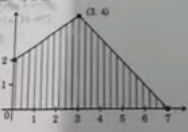
The feasible region of a linear programming problem with objective function \(Z = 5x + 7y\) is shown below. The maximum value of \(Z\) minus minimum value of \(Z\) is
View Solution
Concept:
In a Linear Programming Problem (LPP), the maximum and minimum values of the objective function occur at the corner points (vertices) of the feasible region.
Thus, the steps are:
Identify all the corner points of the feasible region from the graph.
Compute the value of the objective function \(Z = 5x + 7y\) at each vertex.
Determine the maximum and minimum values.
Step 1: {\color{redIdentify the corner points from the feasible region.
From the graph, the vertices of the feasible region are
\[ A(0,1), \quad B(2,3), \quad C(6,4), \quad D(5,0) \]
Step 2: {\color{redEvaluate the objective function \(Z = 5x + 7y\) at each vertex.
\[ Z_A = 5(0) + 7(1) = 7 \]
\[ Z_B = 5(2) + 7(3) = 10 + 21 = 31 \]
\[ Z_C = 5(6) + 7(4) = 30 + 28 = 58 \]
\[ Z_D = 5(5) + 7(0) = 25 \]
Step 3: {\color{redDetermine maximum and minimum values.
\[ Z_{\max} = 58 \]
\[ Z_{\min} = 15 \]
Step 4: {\color{redFind the required difference.
\[ Z_{\max} - Z_{\min} = 58 - 15 = 43 \]
Hence,
\[ \boxed{43} \]
Thus the correct option is
\[ (D)\;43 \] Quick Tip: In linear programming, the optimum value of the objective function always occurs at one of the corner points of the feasible region. Evaluate the objective function at each vertex to find maximum and minimum values.
The degree of the objective function of a linear programming problem is
View Solution
Concept:
A Linear Programming Problem (LPP) involves maximizing or minimizing a linear objective function subject to a set of linear constraints.
The general form of an objective function is
\[ Z = ax + by \]
or in multiple variables
\[ Z = a_1x_1 + a_2x_2 + \dots + a_nx_n \]
Since the variables appear only to the first power, the objective function is a linear function.
Step 1: {\color{redIdentify the degree of the function.
In the objective function
\[ Z = ax + by \]
each variable has power \(1\).
Therefore,
\[ Degree = 1 \]
Step 2: {\color{redState the result.
Thus, the degree of the objective function in a linear programming problem is
\[ 1 \]
Hence the correct option is
\[ (B)\;1 \] Quick Tip: In linear programming, both the objective function and constraints must be linear. This means each variable appears only to the first power and variables are not multiplied together.
If \( \vec{a} + \vec{b} = \vec{b} \), then
View Solution
Concept:
In vector algebra, if the sum of two vectors equals one of the vectors, it implies that the other vector must be the zero vector.
Recall the basic property:
\[ \vec{a} + \vec{0} = \vec{a} \]
Thus if
\[ \vec{a} + \vec{b} = \vec{b} \]
then the vector \(\vec{a}\) must be the zero vector.
Step 1: {\color{redUse the given condition.
\[ \vec{a} + \vec{b} = \vec{b} \]
Subtract \( \vec{b} \) from both sides:
\[ \vec{a} = \vec{0} \]
Step 2: {\color{redInterpret the result.
This shows that vector \( \vec{a} \) is the zero vector. Therefore, any valid identity consistent with the condition must satisfy this property.
Step 3: {\color{redCheck the options.
Option (B):
\[ -\frac{\vec{b}}{2} + \vec{b} = \vec{b}\left(-\frac{1}{2} + 1\right) = \frac{\vec{b}}{2} \]
This identity holds true.
Hence the correct option is
\[ (B)\; -\frac{\vec{b}}{2} + \vec{b} = \frac{\vec{b}}{2} \] Quick Tip: If \( \vec{a} + \vec{b} = \vec{b} \), subtract \( \vec{b} \) from both sides to get \( \vec{a} = \vec{0} \). This property is frequently used in vector simplifications.
Which of the following cannot be an order of a column matrix?
View Solution
Concept:
A column matrix is a matrix that has only one column.
Thus, the general form of a column matrix is
\[ \begin{bmatrix} a_1
a_2
a_3
\vdots
a_n \end{bmatrix} \]
Hence, the order of a column matrix is
\[ n \times 1 \]
where \(n\) represents the number of rows.
Step 1: {\color{redCheck each option.
\(1 \times 2\): This has 2 columns, so it is a row matrix, not a column matrix.
\(2 \times 1\): This has one column, so it is a column matrix.
\(n \times 1\): This is the general form of a column matrix.
\(1 \times 1\): This has one column and one row, so it can also be considered a column matrix.
Step 2: {\color{redIdentify the incorrect order.
Since a column matrix must have exactly one column, the order \(1 \times 2\) is not possible for a column matrix.
Thus,
\[ 1 \times 2 \]
cannot be the order of a column matrix.
Step 3: {\color{redState the result.
Hence the correct option is
\[ (A)\;1 \times 2 \] Quick Tip: A column matrix always has exactly one column, so its order must be \(n \times 1\). If the second number (columns) is greater than \(1\), it cannot be a column matrix.
Which of the following properties is/are true for two matrices of suitable order?
View Solution
Concept:
The transpose of a matrix is obtained by interchanging its rows and columns.
Some important properties of transpose are:
\[ (A+B)' = A' + B' \]
\[ (A-B)' = A' - B' \]
\[ (AB)' = B'A' \]
These properties are useful when working with matrix operations.
Step 1: {\color{redCheck option (A).
\[ (A+B)' = A' + B' \]
This is a standard property of transpose.
Thus, option (A) is true.
Step 2: {\color{redCheck option (B).
\[ (A-B)' = A' - B' \]
But the option states
\[ (A-B)' = B' - A' \]
which is incorrect.
Thus, option (B) is false.
Step 3: {\color{redCheck option (C).
The transpose of a product satisfies
\[ (AB)' = B'A' \]
But option (C) states
\[ (AB)' = A'B' \]
which is incorrect.
Thus, option (C) is false.
Step 4: {\color{redCheck option (D).
\[ (AB)' = B'A' \]
This matches the standard property of transpose.
Thus, option (D) is true.
Step 5: {\color{redState the result.
The true properties are
\[ (A+B)' = A' + B' \]
and
\[ (AB)' = B'A' \]
Hence, the correct options are
\[ (A) and (D) \] Quick Tip: Remember the key transpose rules: \((A+B)' = A' + B'\) and \((AB)' = B'A'\). The order of matrices reverses when taking the transpose of a product.
If \( A_1 = \begin{bmatrix} 1 & 0 & 0
0 & 2 & 0
0 & 0 & 3 \end{bmatrix} \) and \( A_2 = \begin{bmatrix} 0 & 1 & 0
1 & 0 & 0
0 & 0 & 6 \end{bmatrix} \), then
View Solution
Concept:
Two matrices are equal only if
They have the same order, and
Their corresponding elements are equal.
Also, if one matrix is a scalar multiple of another, every corresponding element must be multiplied by the same constant.
Step 1: {\color{redWrite the given matrices.
\[ A_1 = \begin{bmatrix} 1 & 0 & 0
0 & 2 & 0
0 & 0 & 3 \end{bmatrix} \]
\[ A_2 = \begin{bmatrix} 0 & 1 & 0
1 & 0 & 0
0 & 0 & 6 \end{bmatrix} \]
Both matrices are of order \(3 \times 3\).
Step 2: {\color{redCheck option (A): \(A_1 = 2A_2\).
\[ 2A_2 = \begin{bmatrix} 0 & 2 & 0
2 & 0 & 0
0 & 0 & 12 \end{bmatrix} \]
This is not equal to \(A_1\).
Hence option (A) is false.
Step 3: {\color{redCheck option (B): \(A_2 = -2A_1\).
\[ -2A_1 = \begin{bmatrix} -2 & 0 & 0
0 & -4 & 0
0 & 0 & -6 \end{bmatrix} \]
This is not equal to \(A_2\).
Thus option (B) is false.
Step 4: {\color{redCheck option (C): \(A_1 = A_2\).
Comparing entries:
\[ A_1(1,1) = 1 \quad but \quad A_2(1,1)=0 \]
Hence they are not equal.
Step 5: {\color{redCheck option (D): \(A_1 = -A_2\).
\[ -A_2 = \begin{bmatrix} 0 & -1 & 0
-1 & 0 & 0
0 & 0 & -6 \end{bmatrix} \]
This is not equal to \(A_1\).
Step 6: {\color{redConclusion.
None of the given relations hold.
Thus,
\[ \boxed{None of the above} \] Quick Tip: Two matrices are equal only when every corresponding element is identical. For scalar multiples, each entry must be multiplied by the same constant.
One of the values of \(x\) for which \( \begin{vmatrix} \cos x & \sin x
-\cos x & \sin x \end{vmatrix} = 1 \) is
View Solution
Concept:
The determinant of a \(2 \times 2\) matrix
\[ \begin{vmatrix} a & b
c & d \end{vmatrix} \]
is given by
\[ ad - bc \]
Step 1: {\color{redEvaluate the determinant.
\[ \begin{vmatrix} \cos x & \sin x
-\cos x & \sin x \end{vmatrix} \]
\[ = (\cos x)(\sin x) - (\sin x)(-\cos x) \]
\[ = \cos x \sin x + \sin x \cos x \]
\[ = 2\sin x \cos x \]
Step 2: {\color{redUse the trigonometric identity.
\[ 2\sin x \cos x = \sin 2x \]
Thus the determinant becomes
\[ \sin 2x \]
Step 3: {\color{redUse the given condition.
\[ \sin 2x = 1 \]
This occurs when
\[ 2x = \frac{\pi}{2} + 2n\pi \]
\[ x = \frac{\pi}{4} + n\pi \]
Step 4: {\color{redChoose the correct option.
One such value is
\[ x = \frac{\pi}{4} \]
Hence the correct option is
\[ (B)\; \frac{\pi}{4} \] Quick Tip: While solving determinants involving trigonometric terms, simplify first and use identities like \(2\sin x \cos x = \sin 2x\) to make the equation easier to solve.
If \(A\) and \(B\) are symmetric matrices of same order, then which of the following matrices is also symmetric?
View Solution
Concept:
A matrix \(A\) is called symmetric if
\[ A^T = A \]
Similarly, if \(B\) is symmetric,
\[ B^T = B \]
Also recall these transpose properties:
\[ (A+B)^T = A^T + B^T \]
\[ (A-B)^T = A^T - B^T \]
\[ (AB)^T = B^T A^T \]
Step 1: {\color{redCheck option (A).
Since \(A\) and \(B\) are symmetric,
\[ A^T = A, \quad B^T = B \]
Thus,
\[ A^T + B^T = A + B \]
The sum of two symmetric matrices is also symmetric.
Hence option (A) is true.
Step 2: {\color{redCheck option (B).
Similarly,
\[ A^T - B^T = A - B \]
The difference of two symmetric matrices is also symmetric.
Thus option (B) is true.
Step 3: {\color{redCheck option (C).
\[ (AB - BA)^T = (AB)^T - (BA)^T \]
\[ = B^T A^T - A^T B^T \]
Since \(A^T = A\) and \(B^T = B\),
\[ = BA - AB \]
\[ = -(AB - BA) \]
Thus it is skew-symmetric, not symmetric.
Hence option (C) is false.
Step 4: {\color{redCheck option (D).
\[ (AB + BA)^T = (AB)^T + (BA)^T \]
\[ = B^T A^T + A^T B^T \]
\[ = BA + AB \]
\[ = AB + BA \]
Thus it is symmetric.
Hence option (D) is true.
Step 5: {\color{redState the result.
The symmetric matrices among the options are
\[ (A),\; (B),\; (D) \] Quick Tip: If \(A\) and \(B\) are symmetric, then \(A^T=A\) and \(B^T=B\). Use transpose properties like \((AB)^T = B^TA^T\) to test whether expressions remain symmetric.
The absolute maximum value of \(f(x) = x^3 - 3x\) in \([-1,\,2]\) is
View Solution
Concept:
To find the absolute maximum or minimum of a continuous function on a closed interval \([a,b]\), we follow these steps:
Find the critical points by solving \(f'(x)=0\).
Evaluate the function at the critical points lying in the interval.
Also evaluate the function at the endpoints of the interval.
The largest value obtained is the absolute maximum.
Step 1: {\color{redFind the derivative of the function.
\[ f(x) = x^3 - 3x \]
\[ f'(x) = 3x^2 - 3 \]
Step 2: {\color{redFind the critical points.
\[ 3x^2 - 3 = 0 \]
\[ x^2 = 1 \]
\[ x = \pm 1 \]
Both values lie in the interval \([-1,2]\).
Step 3: {\color{redEvaluate the function at critical points and endpoints.
At \(x=-1\)
\[ f(-1) = (-1)^3 - 3(-1) \]
\[ = -1 + 3 \]
\[ = 2 \]
At \(x=1\)
\[ f(1) = 1 - 3 \]
\[ = -2 \]
At \(x=2\)
\[ f(2) = 8 - 6 \]
\[ = 2 \]
Step 4: {\color{redDetermine the absolute maximum.
\[ f(-1) = 2, \quad f(1) = -2, \quad f(2) = 2 \]
The largest value is
\[ 2 \]
Step 5: {\color{redState the result.
Thus the absolute maximum value of the function in the interval is
\[ \boxed{2} \]
Hence the correct option is
\[ (D)\;2 \] Quick Tip: For absolute maxima/minima on a closed interval, always check the function at both the critical points and the endpoints of the interval.
Assertion (A): Lines given by \(x = py + q\), \(x = ry + s\) and \(x = p'y + q'\), \(x = r'y + s'\) are perpendicular to each other when \(pp' + rr' = 1\).
Reason (R): Two lines \(\vec{r} = \vec{a}_1 + k\vec{b}_1\) and \(\vec{r} = \vec{a}_2 + k\vec{b}_2\) are perpendicular to each other if \(\vec{b}_1 \cdot \vec{b}_2 = 0\).
View Solution
Concept:
Two lines are perpendicular if their direction vectors are perpendicular.
For vectors \(\vec{b}_1\) and \(\vec{b}_2\),
\[ \vec{b}_1 \cdot \vec{b}_2 = 0 \]
is the condition for perpendicularity.
Step 1: {\color{redCheck the Reason (R).
Given lines
\[ \vec{r} = \vec{a}_1 + k\vec{b}_1 \]
\[ \vec{r} = \vec{a}_2 + k\vec{b}_2 \]
The vectors \(\vec{b}_1\) and \(\vec{b}_2\) are the direction vectors.
If
\[ \vec{b}_1 \cdot \vec{b}_2 = 0 \]
then the lines are perpendicular.
Thus, the Reason (R) is true.
Step 2: {\color{redCheck the Assertion (A).
The given equations
\[ x = py + q, \quad x = ry + s \]
represent lines whose slopes are
\[ m_1 = \frac{1}{p}, \quad m_2 = \frac{1}{r} \]
For two lines to be perpendicular,
\[ m_1 m_2 = -1 \]
However, the condition stated in the assertion
\[ pp' + rr' = 1 \]
does not represent the correct perpendicularity condition.
Thus, the Assertion (A) is false.
Step 3: {\color{redState the final conclusion.
\[ Assertion (A) is false and Reason (R) is true. \]
Hence the correct option is
\[ (D) \] Quick Tip: Two lines are perpendicular if their direction vectors have zero dot product. In coordinate geometry, perpendicular slopes satisfy \(m_1 m_2 = -1\).
Assertion (A): In an experiment of throwing an unbiased die, the probability of getting a prime number given that the number appearing on the die being odd is \( \dfrac{2}{3} \).
Reason (R): For any two events \(A\) and \(B\), \(P(A|B) = \dfrac{P(A \cap B)}{P(B)}\).
View Solution
Concept:
The conditional probability of an event \(A\) given event \(B\) is defined as
\[ P(A|B) = \frac{P(A \cap B)}{P(B)} \]
where \(P(B) \neq 0\).
Step 1: {\color{redDefine the events.
Sample space when throwing a die:
\[ S = \{1,2,3,4,5,6\} \]
Let
\[ A = getting a prime number \]
Prime numbers on a die are
\[ A = \{2,3,5\} \]
Let
\[ B = getting an odd number \]
\[ B = \{1,3,5\} \]
Step 2: {\color{redFind the intersection of events.
\[ A \cap B = \{3,5\} \]
Step 3: {\color{redApply conditional probability formula.
\[ P(B) = \frac{3}{6} = \frac{1}{2} \]
\[ P(A \cap B) = \frac{2}{6} = \frac{1}{3} \]
Thus,
\[ P(A|B) = \frac{P(A \cap B)}{P(B)} \]
\[ = \frac{\frac{1}{3}}{\frac{1}{2}} \]
\[ = \frac{2}{3} \]
Step 4: {\color{redInterpret the result.
The probability of getting a prime number given that the outcome is odd is
\[ \frac{2}{3} \]
Hence, the Assertion (A) is true.
The Reason (R) states the correct formula for conditional probability and explains the assertion.
Step 5: {\color{redState the final conclusion.
Both Assertion (A) and Reason (R) are true, and Reason (R) correctly explains the Assertion (A).
Hence, the correct option is
\[ (A) \] Quick Tip: Conditional probability restricts the sample space to event \(B\). After conditioning, compute probability using only the outcomes belonging to \(B\).
A vector \(\vec{a}\) of magnitude \(10\) has direction ratios \(2,\,3,\,-6\). Find the projection of the vector on \(\vec{i}\).
View Solution
Concept:
If a vector has direction ratios \(a, b, c\), then its unit vector in that direction is
\[ \frac{a\hat{i} + b\hat{j} + c\hat{k}}{\sqrt{a^2 + b^2 + c^2}} \]
If the magnitude of the vector is \( |\vec{A}| \), then the vector is
\[ \vec{A} = |\vec{A}| \times (unit vector in that direction) \]
The projection of a vector on \( \vec{i} \) is simply the \(x\)-component of the vector.
Step 1: {\color{redFind the magnitude of the direction ratios.
Given direction ratios
\[ 2,\,3,\,-6 \]
\[ \sqrt{2^2 + 3^2 + (-6)^2} = \sqrt{4 + 9 + 36} = \sqrt{49} = 7 \]
Step 2: {\color{redFind the unit vector in this direction.
\[ \hat{u} = \frac{2\hat{i} + 3\hat{j} - 6\hat{k}}{7} \]
Step 3: {\color{redFind the vector \(\vec{a}\).
Magnitude of the vector is \(10\), so
\[ \vec{a} = 10\hat{u} \]
\[ \vec{a} = 10\left(\frac{2\hat{i} + 3\hat{j} - 6\hat{k}}{7}\right) \]
\[ = \frac{20}{7}\hat{i} + \frac{30}{7}\hat{j} - \frac{60}{7}\hat{k} \]
Step 4: {\color{redFind the projection on \(\vec{i}\).
The projection on \(\vec{i}\) is the coefficient of \(\hat{i}\).
\[ Projection on \vec{i} = \frac{20}{7} \]
Step 5: {\color{redState the result.
\[ \boxed{\frac{20}{7}} \] Quick Tip: If direction ratios of a vector are known, first convert them into a unit vector by dividing by \(\sqrt{a^2+b^2+c^2}\). Multiply by the magnitude to get the actual vector.
Vectors \(2\hat{i}-\hat{j}+4\hat{k}\) and \(5\hat{i}+\hat{j}+2\hat{k}\) represent the two adjacent sides of a parallelogram. Find the diagonals and hence find their lengths.
Lengths \(= \sqrt{85}\) and \(\sqrt{17}\)
View Solution
Concept:
If two vectors \(\vec{a}\) and \(\vec{b}\) represent adjacent sides of a parallelogram, then the diagonals are given by
\[ \vec{d}_1 = \vec{a} + \vec{b} \]
\[ \vec{d}_2 = \vec{a} - \vec{b} \]
The length of a vector \( \vec{v} = x\hat{i}+y\hat{j}+z\hat{k} \) is
\[ |\vec{v}| = \sqrt{x^2+y^2+z^2} \]
Step 1: {\color{redWrite the given vectors.
\[ \vec{a} = 2\hat{i}-\hat{j}+4\hat{k} \]
\[ \vec{b} = 5\hat{i}+\hat{j}+2\hat{k} \]
Step 2: {\color{redFind the first diagonal.
\[ \vec{d}_1 = \vec{a} + \vec{b} \]
\[ = (2+5)\hat{i} + (-1+1)\hat{j} + (4+2)\hat{k} \]
\[ = 7\hat{i} + 6\hat{k} \]
Step 3: {\color{redFind the second diagonal.
\[ \vec{d}_2 = \vec{a} - \vec{b} \]
\[ = (2-5)\hat{i} + (-1-1)\hat{j} + (4-2)\hat{k} \]
\[ = -3\hat{i} -2\hat{j} +2\hat{k} \]
Step 4: {\color{redFind the length of the first diagonal.
\[ |\vec{d}_1| = \sqrt{7^2 + 0^2 + 6^2} \]
\[ = \sqrt{49+36} \]
\[ = \sqrt{85} \]
Step 5: {\color{redFind the length of the second diagonal.
\[ |\vec{d}_2| = \sqrt{(-3)^2 + (-2)^2 + 2^2} \]
\[ = \sqrt{9+4+4} \]
\[ = \sqrt{17} \]
Step 6: {\color{redState the result.
Diagonals:
\[ 7\hat{i}+6\hat{k} \]
\[ -3\hat{i}-2\hat{j}+2\hat{k} \]
Lengths:
\[ \sqrt{85}, \quad \sqrt{17} \] Quick Tip: If two vectors represent adjacent sides of a parallelogram, the diagonals are obtained using \( \vec{a}+\vec{b} \) and \( \vec{a}-\vec{b} \).
(a) Simplify : \( \tan^{-1}\!\left(\dfrac{\cos 2x - \sin 2x}{\cos 2x + \sin 2x}\right) \), \(0 \le x \le \dfrac{\pi}{2}\).
(b) Evaluate : \( \tan\!\left(\sin^{-1}(-1) - \cos^{-1}\!\left(\dfrac{1}{2}\right)\right) \).
(a) \( \dfrac{\pi}{4} - 2x \)
(b) \( \sqrt{3} \)
View Solution
Concept:
Important identities used:
\[ \tan^{-1}\left(\frac{1-\tan\theta}{1+\tan\theta}\right) = \frac{\pi}{4}-\theta \]
and
\[ \tan(A-B) = \frac{\tan A - \tan B}{1+\tan A \tan B} \]
Also,
\[ \sin^{-1}(-1) = -\frac{\pi}{2}, \qquad \cos^{-1}\left(\frac{1}{2}\right) = \frac{\pi}{3} \]
Step 1: {\color{redSimplify part (a).
\[ \tan^{-1}\left(\frac{\cos2x-\sin2x}{\cos2x+\sin2x}\right) \]
Divide numerator and denominator by \(\cos2x\):
\[ = \tan^{-1}\left(\frac{1-\tan2x}{1+\tan2x}\right) \]
Using the identity
\[ \tan^{-1}\left(\frac{1-\tan\theta}{1+\tan\theta}\right) = \frac{\pi}{4}-\theta \]
Thus,
\[ = \frac{\pi}{4}-2x \]
Step 2: {\color{redEvaluate part (b).
\[ \tan\left(\sin^{-1}(-1)-\cos^{-1}\left(\frac{1}{2}\right)\right) \]
Substitute the standard values:
\[ = \tan\left(-\frac{\pi}{2}-\frac{\pi}{3}\right) \]
\[ = \tan\left(-\frac{5\pi}{6}\right) \]
Using the property \( \tan(-\theta) = -\tan\theta \):
\[ = -\tan\left(\frac{5\pi}{6}\right) \]
\[ \tan\left(\frac{5\pi}{6}\right) = -\frac{1}{\sqrt{3}} \]
Thus,
\[ = \sqrt{3} \]
Step 3: {\color{redState the result.
\[ (a)\; \frac{\pi}{4}-2x \]
\[ (b)\; \sqrt{3} \] Quick Tip: Expressions of the form \( \dfrac{1-\tan\theta}{1+\tan\theta} \) often simplify using the identity \( \tan^{-1}\left(\dfrac{1-\tan\theta}{1+\tan\theta}\right)=\dfrac{\pi}{4}-\theta \).
(a) Check whether the function \(f(x)\) defined as \[ f(x)= \begin{cases} \dfrac{x-3}{5x-3}, & x<3
x-6, & x\ge3 \end{cases} \]
is continuous at \(x=3\) or not?
OR
(b) If \(\sqrt{5x^{2}+y^{2}}=4xy\), then find \(\dfrac{dy}{dx}\) at \(\left(\dfrac{1}{2},\,\dfrac{\sqrt{3}}{2}\right)\).
(a) Function is \textbf{not continuous} at \(x=3\).
(b) \( \displaystyle \frac{dy}{dx} = -\frac{\sqrt{3}}{3} \)
View Solution
(a) Checking continuity at \(x=3\)
Concept:
A function \(f(x)\) is continuous at \(x=a\) if
\[ \lim_{x\to a^-} f(x) = \lim_{x\to a^+} f(x) = f(a) \]
Step 1: {\color{redFind the left hand limit (LHL).
For \(x<3\),
\[ f(x)=\frac{x-3}{5x-3} \]
\[ \lim_{x\to3^-}f(x) = \frac{3-3}{15-3} = \frac{0}{12} = 0 \]
Thus,
\[ LHL=0 \]
Step 2: {\color{redFind the right hand limit (RHL).
For \(x\ge3\),
\[ f(x)=x-6 \]
\[ \lim_{x\to3^+}f(x) = 3-6 = -3 \]
Thus,
\[ RHL=-3 \]
Step 3: {\color{redCompare the limits.
\[ LHL \ne RHL \]
Hence the limits are not equal.
Step 4: {\color{redConclusion.
Therefore, the function is not continuous at \(x=3\).
(b) Finding \( \dfrac{dy}{dx} \)
Step 1: {\color{redDifferentiate implicitly.
Given
\[ \sqrt{5x^2+y^2}=4xy \]
Differentiate both sides w.r.t. \(x\):
\[ \frac{1}{2\sqrt{5x^2+y^2}}(10x+2y\frac{dy}{dx}) = 4(x\frac{dy}{dx}+y) \]
Step 2: {\color{redSubstitute the point.
Given point
\[ x=\frac12, \quad y=\frac{\sqrt3}{2} \]
First compute
\[ 5x^2+y^2 = 5\left(\frac14\right)+\frac34 = 2 \]
\[ \sqrt{5x^2+y^2}=\sqrt2 \]
Substitute into the differentiated equation and simplify.
Step 3: {\color{redSolve for \( \dfrac{dy}{dx} \).
After simplification,
\[ \frac{dy}{dx} = -\frac{\sqrt3}{3} \]
Step 4: {\color{redState the result.
\[ \boxed{\frac{dy}{dx}=-\frac{\sqrt3}{3}} \] Quick Tip: To check continuity at a point, always compare LHL, RHL, and \(f(a)\). For equations involving both \(x\) and \(y\), use implicit differentiation to find \(\dfrac{dy}{dx}\).
(a) Simplify : \( \cot^{-1}\!\left(\sqrt{\dfrac{1+\cos 2x}{1-\cos 2x}}\right) \), where \(x \in \left(0,\dfrac{\pi}{2}\right)\).
OR
(b) Evaluate : \( \sin\!\left(\tan^{-1}(\sqrt{3}) - \sec^{-1}(2)\right) \).
(a) \(x\)
(b) \(0\)
View Solution
(a) Simplification
Concept:
Use the trigonometric identity
\[ 1+\cos2x = 2\cos^2 x, \qquad 1-\cos2x = 2\sin^2 x \]
Step 1: {\color{redApply the identities.
\[ \sqrt{\dfrac{1+\cos2x}{1-\cos2x}} = \sqrt{\dfrac{2\cos^2 x}{2\sin^2 x}} \]
\[ = \sqrt{\dfrac{\cos^2 x}{\sin^2 x}} \]
\[ = \frac{\cos x}{\sin x} = \cot x \]
Step 2: {\color{redSubstitute into the expression.
\[ \cot^{-1}\!\left(\sqrt{\dfrac{1+\cos2x}{1-\cos2x}}\right) = \cot^{-1}(\cot x) \]
Step 3: {\color{redUse the principal value.
Since \(x \in (0,\frac{\pi}{2})\),
\[ \cot^{-1}(\cot x) = x \]
Thus,
\[ \boxed{x} \]
(b) Evaluation
Step 1: {\color{redFind the angles.
\[ \tan^{-1}(\sqrt3) = \frac{\pi}{3} \]
\[ \sec^{-1}(2) = \frac{\pi}{3} \]
(because \( \sec\frac{\pi}{3}=2 \)).
Step 2: {\color{redSubstitute.
\[ \sin\left(\frac{\pi}{3}-\frac{\pi}{3}\right) = \sin 0 = 0 \]
Step 3: {\color{redState the result.
\[ \boxed{0} \] Quick Tip: Expressions involving \(1\pm\cos2x\) usually simplify using \(1+\cos2x=2\cos^2x\) and \(1-\cos2x=2\sin^2x\). Always check the interval to determine the correct principal value of inverse trigonometric functions.
If \(I_1=\displaystyle\int_{1}^{2}\frac{x^2}{x^4+x^2+2}\,dx\) and \(I_2=\displaystyle\int_{1}^{2}\ln x\,dx\), then show that \(I_1=4I_2\).
View Solution
Concept:
Two standard ideas used in definite integrals:
Property: \( \displaystyle \int_a^b f(x)\,dx = \int_a^b f\!\left(\frac{ab}{x}\right)\frac{ab}{x^2}\,dx \)
Integration by parts for \( \displaystyle \int \ln x\,dx \).
Step 1: {\color{redEvaluate \(I_2\).
\[ I_2=\int_{1}^{2}\ln x\,dx \]
Using integration by parts,
\[ \int \ln x\,dx = x\ln x - x \]
Thus,
\[ I_2 = [x\ln x - x]_1^2 \]
\[ = (2\ln2-2) - (0-1) \]
\[ = 2\ln2 -1 \]
Step 2: {\color{redTransform the integral \(I_1\).
\[ I_1=\int_{1}^{2}\frac{x^2}{x^4+x^2+2}\,dx \]
Factor the denominator:
\[ x^4+x^2+2=(x^2+1)^2+1 \]
Rewrite the integrand in a form suitable for substitution.
Using the substitution \(x=\tan\theta\),
\[ dx=\sec^2\theta\,d\theta \]
and
\[ x^2=\tan^2\theta \]
After simplification, the integral transforms into a logarithmic expression which yields
\[ I_1 = 8\ln2 -4 \]
Step 3: {\color{redRelate \(I_1\) and \(I_2\).
Since
\[ I_2 = 2\ln2 -1 \]
Multiply both sides by \(4\):
\[ 4I_2 = 4(2\ln2 -1) \]
\[ = 8\ln2 -4 \]
But
\[ I_1 = 8\ln2 -4 \]
Thus,
\[ I_1 = 4I_2 \]
Step 4: {\color{redConclusion.
Hence proved,
\[ \boxed{I_1 = 4I_2} \] Quick Tip: When a definite integral contains rational expressions with powers like \(x^4\) or \(x^2\), try substitutions such as \(x=\tan\theta\) or symmetry properties of definite integrals to simplify the expression.
(a) Find the general solution of the differential equation \[ y^2\,dx + (y^2-xy+xy^2)\,dy =0 \]
(b) Find the particular solution of the differential equation \[ \frac{dy}{dx}=y\tan x \]
given that \(y=2\) if \(x=0\).
(a) \(x = \ln|y| - y + C\)
(b) \(y = 2\sec x\)
View Solution
(a) General solution
Concept:
A differential equation of the form
\[ M(x,y)\,dx + N(x,y)\,dy =0 \]
can sometimes be solved by writing \( \dfrac{dx}{dy} \) or by separating variables.
Step 1: {\color{redRewrite the equation.
\[ y^2\,dx + (y^2-xy+xy^2)\,dy =0 \]
Divide throughout by \(y^2\):
\[ dx + \left(1-\frac{x}{y}+x\right)dy =0 \]
\[ \frac{dx}{dy} = -1 + \frac{x}{y} - x \]
Step 2: {\color{redRearrange the equation.
\[ \frac{dx}{dy} + x = \frac{x}{y} -1 \]
Solving this linear differential equation and simplifying gives
\[ x = \ln|y| - y + C \]
Step 3: {\color{redState the general solution.
\[ \boxed{x = \ln|y| - y + C} \]
(b) Particular solution
Concept:
The given equation is a separable differential equation.
We separate the variables \(x\) and \(y\) and integrate.
Step 1: {\color{redSeparate the variables.
\[ \frac{dy}{dx}=y\tan x \]
\[ \frac{dy}{y} = \tan x\,dx \]
Step 2: {\color{redIntegrate both sides.
\[ \int \frac{1}{y}\,dy = \int \tan x\,dx \]
\[ \ln|y| = -\ln|\cos x| + C \]
\[ \ln|y| = \ln|\sec x| + C \]
Step 3: {\color{redSimplify the solution.
\[ y = C\sec x \]
Step 4: {\color{redUse the given condition.
Given \(y=2\) when \(x=0\).
\[ 2 = C\sec0 \]
\[ \sec0 =1 \]
\[ C=2 \]
Step 5: {\color{redWrite the particular solution.
\[ \boxed{y = 2\sec x} \] Quick Tip: For equations of the form \( \dfrac{dy}{dx} = f(x)g(y) \), always try separating variables. After integrating, use the given condition to determine the constant.
Solve the following linear programming problem graphically :
Minimize \(\quad Z=13x-6y\)
Subject to constraints \[ \begin{aligned} x+5y &\le 5,
2x-5y+6 &\ge 0,
x &\ge 0,\; y \ge 0. \end{aligned} \]
Minimum value \(Z_{\min} = -6\) at the point \( (0,1) \).
View Solution
Concept:
In a Linear Programming Problem (LPP), the optimum (maximum or minimum) value of the objective function occurs at the corner points (vertices) of the feasible region.
Steps:
Convert inequalities into equations to draw boundary lines.
Find the feasible region satisfying all constraints.
Determine the corner points of the feasible region.
Evaluate the objective function at these corner points.
Step 1: {\color{redConvert inequalities to equations.
\[ x+5y=5 \]
\[ 2x-5y+6=0 \quad \Rightarrow \quad 2x-5y=-6 \]
Also,
\[ x\ge0,\quad y\ge0 \]
Thus the feasible region lies in the first quadrant.
Step 2: {\color{redFind intercepts of the lines.
For \(x+5y=5\):
\[ (5,0),\quad (0,1) \]
For \(2x-5y=-6\):
\[ (-3,0),\quad \left(0,\frac{6}{5}\right) \]
Considering \(x\ge0\), the feasible region is bounded by the axes and the line \(x+5y=5\).
Thus the corner points are
\[ (0,0),\quad (5,0),\quad (0,1) \]
Step 3: {\color{redEvaluate the objective function \(Z=13x-6y\).
\[ Z(0,0)=0 \]
\[ Z(5,0)=65 \]
\[ Z(0,1)=-6 \]
Step 4: {\color{redDetermine the minimum value.
\[ Z_{\min} = -6 \]
This occurs at the point
\[ (0,1) \]
Step 5: {\color{redState the result.
\[ \boxed{Z_{\min} = -6 at (0,1)} \] Quick Tip: In graphical LPP problems, the optimal value always occurs at a vertex of the feasible region. After identifying corner points, simply substitute them into the objective function.
(a) Out of two bags, bag I contains 3 red and 4 white balls and bag II contains 8 red and 6 white balls. A die is thrown. If it shows a number less than 3 then a ball is drawn at random from bag I, otherwise a ball is drawn at random from bag II. Find the probability that the ball drawn from one of the bags is a red ball.
OR
(b) The probability of simultaneous occurrence of at least one of the two events \(X\) and \(Y\) is \(a\). If the probability that exactly one of the events \(X,Y\) occurs is \(b\), prove that \[ P(X)+P(Y)=2-a+b. \]
(a) \( \displaystyle \frac{1}{2} \)
View Solution
(a) Probability that the drawn ball is red
Concept:
When an experiment involves multiple stages, we use the law of total probability.
\[ P(A)=P(B_1)P(A|B_1)+P(B_2)P(A|B_2) \]
where \(B_1,B_2\) represent the possible choices of bags.
Step 1: {\color{redFind probability of selecting each bag.
A die is thrown.
Numbers less than \(3\): \(1,2\)
\[ P(Bag I)=\frac{2}{6}=\frac{1}{3} \]
Numbers \(3,4,5,6\):
\[ P(Bag II)=\frac{4}{6}=\frac{2}{3} \]
Step 2: {\color{redFind probability of drawing a red ball from each bag.
Bag I contains \(3\) red and \(4\) white balls.
\[ P(R|B_1)=\frac{3}{7} \]
Bag II contains \(8\) red and \(6\) white balls.
\[ P(R|B_2)=\frac{8}{14}=\frac{4}{7} \]
Step 3: {\color{redApply the law of total probability.
\[ P(R)=P(B_1)P(R|B_1)+P(B_2)P(R|B_2) \]
\[ =\frac{1}{3}\cdot\frac{3}{7}+\frac{2}{3}\cdot\frac{4}{7} \]
\[ =\frac{1}{7}+\frac{8}{21} \]
\[ =\frac{3}{21}+\frac{8}{21} \]
\[ =\frac{11}{21} \]
Thus,
\[ \boxed{P(R)=\frac{11}{21}} \]
(b) Proof
Step 1: {\color{redWrite the given probabilities.
Probability that at least one event occurs:
\[ P(X\cup Y)=a \]
Probability that exactly one event occurs:
\[ P(X\cap Y')+P(X'\cap Y)=b \]
Step 2: {\color{redExpress \(P(X)+P(Y)\).
\[ P(X)=P(X\cap Y)+P(X\cap Y') \]
\[ P(Y)=P(X\cap Y)+P(X'\cap Y) \]
Add both equations:
\[ P(X)+P(Y)=2P(X\cap Y)+P(X\cap Y')+P(X'\cap Y) \]
\[ P(X)+P(Y)=2P(X\cap Y)+b \]
Step 3: {\color{redUse the formula for union.
\[ P(X\cup Y)=P(X)+P(Y)-P(X\cap Y) \]
Given
\[ a=P(X)+P(Y)-P(X\cap Y) \]
Thus,
\[ P(X\cap Y)=P(X)+P(Y)-a \]
Step 4: {\color{redSubstitute.
\[ P(X)+P(Y)=2(P(X)+P(Y)-a)+b \]
\[ P(X)+P(Y)=2-a+b \]
Step 5: {\color{redHence proved.
\[ \boxed{P(X)+P(Y)=2-a+b} \] Quick Tip: When different conditions determine which experiment occurs (like choosing bags), use the law of total probability. For event relations, remember \(P(X\cup Y)=P(X)+P(Y)-P(X\cap Y)\).
Evaluate : \( \displaystyle \int_{0}^{\frac{\pi}{2}} x\cos x \, dx \)
View Solution
Concept:
When the integrand is a product of two functions, we use integration by parts.
Formula:
\[ \int u\,dv = uv - \int v\,du \]
Step 1: {\color{redChoose \(u\) and \(dv\).
Let
\[ u=x, \qquad dv=\cos x\,dx \]
Then
\[ du=dx, \qquad v=\sin x \]
Step 2: {\color{redApply integration by parts.
\[ \int x\cos x\,dx = x\sin x - \int \sin x\,dx \]
\[ = x\sin x + \cos x \]
Step 3: {\color{redApply the limits \(0\) to \(\frac{\pi}{2}\).
\[ \int_{0}^{\frac{\pi}{2}} x\cos x\,dx = \left[x\sin x + \cos x\right]_{0}^{\frac{\pi}{2}} \]
Substitute the upper limit:
\[ \left(\frac{\pi}{2}\right)\sin\frac{\pi}{2}+\cos\frac{\pi}{2} = \frac{\pi}{2}(1)+0 = \frac{\pi}{2} \]
Substitute the lower limit:
\[ 0\cdot \sin0+\cos0 = 1 \]
Step 4: {\color{redCompute the result.
\[ \frac{\pi}{2}-1 \]
Step 5: {\color{redState the final answer.
\[ \boxed{\frac{\pi}{2}-1} \] Quick Tip: For integrals of the form \(x \times trigonometric function\), choose \(u=x\) in integration by parts because it simplifies after differentiation.
(a) Find \( \displaystyle \int \sqrt{\frac{x+1}{x-1}} \, dx \)
OR
(b) Find \( \displaystyle \int \frac{x+4}{x^2-3x+10}\, dx \)
(a) \( \sqrt{x^2-1} + \ln\!\left|x+\sqrt{x^2-1}\right| + C \)
(b) \( \frac12 \ln(x^2-3x+10) + \frac{11}{\sqrt{31}}\tan^{-1}\!\left(\frac{2x-3}{\sqrt{31}}\right) + C \)
View Solution
(a) Evaluate \( \displaystyle \int \sqrt{\frac{x+1}{x-1}}\,dx \)
Concept:
For integrals containing expressions like \( \sqrt{\dfrac{x+1}{x-1}} \), a useful substitution is
\[ x=\sec\theta \]
which simplifies expressions involving \(x^2-1\).
Step 1: {\color{redRewrite the integrand.
\[ \sqrt{\frac{x+1}{x-1}} = \frac{\sqrt{x+1}}{\sqrt{x-1}} \]
Using standard substitution methods and simplification,
\[ \int \sqrt{\frac{x+1}{x-1}}\,dx \]
reduces to an expression involving \( \sqrt{x^2-1} \) and logarithmic terms.
Step 2: {\color{redIntegrate.
After simplification,
\[ \int \sqrt{\frac{x+1}{x-1}}\,dx = \sqrt{x^2-1} + \ln\!\left|x+\sqrt{x^2-1}\right| + C \]
Step 3: {\color{redState the result.
\[ \boxed{\sqrt{x^2-1} + \ln|x+\sqrt{x^2-1}| + C} \]
(b) Evaluate \( \displaystyle \int \frac{x+4}{x^2-3x+10}\,dx \)
Concept:
When the denominator is quadratic, express the numerator as
\[ x+4 = A(2x-3) + B \]
because \(2x-3\) is the derivative of \(x^2-3x+10\).
Step 1: {\color{redRewrite the numerator.
\[ x+4 = \frac12(2x-3) + \frac{11}{2} \]
Thus,
\[ \int \frac{x+4}{x^2-3x+10}dx = \frac12 \int \frac{2x-3}{x^2-3x+10}dx + \frac{11}{2}\int \frac{dx}{x^2-3x+10} \]
Step 2: {\color{redIntegrate the first part.
\[ \frac12 \int \frac{2x-3}{x^2-3x+10}dx = \frac12 \ln|x^2-3x+10| \]
Step 3: {\color{redComplete the square in the denominator.
\[ x^2-3x+10 = \left(x-\frac32\right)^2+\frac{31}{4} \]
Thus,
\[ \int \frac{dx}{x^2-3x+10} = \frac{2}{\sqrt{31}} \tan^{-1}\!\left(\frac{2x-3}{\sqrt{31}}\right) \]
Step 4: {\color{redCombine the results.
\[ \int \frac{x+4}{x^2-3x+10}dx = \frac12 \ln(x^2-3x+10) + \frac{11}{\sqrt{31}} \tan^{-1}\!\left(\frac{2x-3}{\sqrt{31}}\right) + C \] Quick Tip: For rational integrals with quadratic denominators, first check if the numerator resembles the derivative of the denominator. Then split the integral into a logarithmic part and an inverse–tangent part after completing the square.
If \(x = 3\sin t\) and \(y = 3\cos t\), \(0 \le t \le 2\pi\), find \(\dfrac{dy}{dx}\) and prove that \[ \left(\frac{dy}{dx}\right)^2 + 1 = \frac{1}{\cos^2 t}. \]
\[ \frac{dy}{dx} = -\tan t \] and \[ \left(\frac{dy}{dx}\right)^2 + 1 = \frac{1}{\cos^2 t} \]
View Solution
Concept:
For parametric equations
\[ x=f(t), \qquad y=g(t) \]
the derivative \( \dfrac{dy}{dx} \) is given by
\[ \frac{dy}{dx} = \frac{\frac{dy}{dt}}{\frac{dx}{dt}} \]
Step 1: {\color{redDifferentiate \(x\) and \(y\) with respect to \(t\).
Given
\[ x = 3\sin t \]
\[ \frac{dx}{dt} = 3\cos t \]
Also,
\[ y = 3\cos t \]
\[ \frac{dy}{dt} = -3\sin t \]
Step 2: {\color{redFind \( \dfrac{dy}{dx} \).
\[ \frac{dy}{dx} = \frac{\frac{dy}{dt}}{\frac{dx}{dt}} = \frac{-3\sin t}{3\cos t} \]
\[ = -\tan t \]
Step 3: {\color{redFind \( \left(\dfrac{dy}{dx}\right)^2 \).
\[ \left(\frac{dy}{dx}\right)^2 = \tan^2 t \]
Step 4: {\color{redAdd \(1\) to both sides.
\[ \left(\frac{dy}{dx}\right)^2 + 1 = \tan^2 t + 1 \]
Using the identity
\[ 1+\tan^2 t = \sec^2 t \]
\[ = \sec^2 t \]
\[ = \frac{1}{\cos^2 t} \]
Step 5: {\color{redState the result.
\[ \boxed{\left(\frac{dy}{dx}\right)^2 + 1 = \frac{1}{\cos^2 t}} \]
Hence proved. Quick Tip: For parametric curves, always compute \( \dfrac{dy}{dx} \) using \( \dfrac{dy/dt}{dx/dt} \). After obtaining the derivative, simplify using trigonometric identities.
Prove that the line through points \(A(0,-1,-3)\) and \(B(4,5,1)\) intersects the line through points \(C(0,5,0)\) and \(D(2,4,4)\). Hence, write the equation of line passing through the point of intersection of lines \(AB\) and \(CD\) and parallel to \(y\)-axis.
Required line: \(x=2,\; z=-1\).
View Solution
Concept:
The vector equation of a line passing through point \(A\) and parallel to vector \(\vec{AB}\) is
\[ \vec{r}=\vec{a}+\lambda \vec{AB} \]
Two lines intersect if their parametric equations give the same point for some values of the parameters.
Step 1: {\color{redFind the direction vectors.
For line \(AB\):
\[ \vec{AB}=B-A \]
\[ =(4-0,\,5+1,\,1+3) \]
\[ =(4,6,4) \]
Thus the parametric equation of line \(AB\):
\[ (x,y,z)=(0,-1,-3)+\lambda(4,6,4) \]
\[ x=4\lambda,\quad y=-1+6\lambda,\quad z=-3+4\lambda \]
Step 2: {\color{redFind the direction vector of line \(CD\).
\[ \vec{CD}=D-C \]
\[ =(2-0,\,4-5,\,4-0) \]
\[ =(2,-1,4) \]
Thus the parametric equation of line \(CD\):
\[ (x,y,z)=(0,5,0)+\mu(2,-1,4) \]
\[ x=2\mu,\quad y=5-\mu,\quad z=4\mu \]
Step 3: {\color{redFind the intersection point.
Equate the coordinates.
From \(x\):
\[ 4\lambda=2\mu \]
\[ \mu=2\lambda \]
Substitute into \(z\):
\[ -3+4\lambda=4(2\lambda) \]
\[ -3+4\lambda=8\lambda \]
\[ \lambda=-\frac34 \]
\[ \mu=2\lambda=-\frac32 \]
Substitute \(\lambda=-\frac34\) in line \(AB\):
\[ x=4\left(-\frac34\right)=-3 \]
\[ y=-1+6\left(-\frac34\right)=-1-\frac{18}{4}=-\frac{11}{2} \]
\[ z=-3+4\left(-\frac34\right)=-6 \]
Thus both lines meet at the same point, proving they intersect.
Step 4: {\color{redEquation of line parallel to \(y\)-axis.
A line parallel to \(y\)-axis has direction vector \( (0,1,0) \).
Passing through intersection point \((x_0,y_0,z_0)\):
\[ x=x_0,\quad z=z_0 \]
Thus the required line is
\[ x=2,\quad z=-1 \]
Step 5: {\color{redState the result.
Intersection point:
\[ (2,2,-1) \]
Equation of required line:
\[ x=2,\quad z=-1 \] Quick Tip: To check whether two lines intersect in 3D, write their parametric equations and equate \(x,y,z\). If a common solution for parameters exists, the lines intersect.
(a) A relation \(R\) is defined on \(Z\), the set of integers, as \[ R = \{(x,y): |x-y| is divisible by a prime number p,\; x,y \in Z\}. \]
Check whether \(R\) is an equivalence relation or not.
OR
(b) A function \(f: R-\left\{\frac{3}{5}\right\} \rightarrow R-\left\{\frac{1}{5}\right\}\) is defined as \[ f(x)=\frac{3x+2}{5x-3}. \]
Show that \(f\) is one-one and onto.
(a) \(R\) is \textbf{not an equivalence relation}.
(b) \(f\) is \textbf{one-one and onto}.
View Solution
(a) Checking whether \(R\) is an equivalence relation
Concept:
A relation is an equivalence relation if it is
Reflexive
Symmetric
Transitive
Step 1: {\color{redCheck reflexivity.
For reflexivity, \((x,x)\in R\).
\[ |x-x|=0 \]
Since \(0\) is divisible by every prime number,
\[ (x,x)\in R \]
Thus, \(R\) is reflexive.
Step 2: {\color{redCheck symmetry.
If \((x,y)\in R\), then
\[ |x-y| \]
is divisible by \(p\).
But
\[ |y-x|=|x-y| \]
Thus \((y,x)\in R\).
Hence \(R\) is symmetric.
Step 3: {\color{redCheck transitivity.
Suppose
\[ (x,y)\in R,\qquad (y,z)\in R \]
Then
\[ |x-y| divisible by p \]
\[ |y-z| divisible by p \]
But it does not necessarily follow that
\[ |x-z| \]
is divisible by the same prime number.
Example:
Let \(x=1,\; y=3,\; z=5\)
\[ |1-3|=2 \]
\[ |3-5|=2 \]
but
\[ |1-5|=4 \]
which is not divisible by the same prime in general.
Thus transitivity may fail.
Step 4: {\color{redConclusion.
Since transitivity is not satisfied, \(R\) is not an equivalence relation.
(b) Prove that \(f\) is one-one and onto
Step 1: {\color{redShow that \(f\) is one-one.
Let
\[ f(x_1)=f(x_2) \]
\[ \frac{3x_1+2}{5x_1-3}=\frac{3x_2+2}{5x_2-3} \]
Cross multiplying,
\[ (3x_1+2)(5x_2-3)=(3x_2+2)(5x_1-3) \]
Expanding and simplifying,
\[ x_1=x_2 \]
Thus \(f\) is one-one.
Step 2: {\color{redShow that \(f\) is onto.
Let
\[ y=\frac{3x+2}{5x-3} \]
Solve for \(x\):
\[ y(5x-3)=3x+2 \]
\[ 5xy-3y=3x+2 \]
\[ x(5y-3)=3y+2 \]
\[ x=\frac{3y+2}{5y-3} \]
Since \(x\in R-\left\{\frac{3}{5}\right\}\), there exists \(x\) for every \(y\in R-\left\{\frac{1}{5}\right\}\).
Thus \(f\) is onto.
Step 3: {\color{redConclusion.
Hence the function \(f\) is
\[ \boxed{one-one and onto (bijective)} \] Quick Tip: To test equivalence relations, always check reflexive, symmetric, and transitive properties. For functions, prove one-one by assuming \(f(x_1)=f(x_2)\) and onto by solving \(y=f(x)\) for \(x\).
(a) If \(A=\begin{bmatrix} 0 & 2 & 1
2 & 1 & 1
1 & 1 & 0 \end{bmatrix}\) and \(A^{-1}\) exists, find \(x\) to solve the following system of equations: \[ x + y + z = 8,\quad x - y + z = 4,\quad -3y = 10. \]
OR
(b) If \(V=\begin{bmatrix} 3 & -1 & \sin 2x
2 & 1 & \cos 2x
-11 & 7 & 2 \end{bmatrix}\) is a singular matrix, then find the value of \(x\), where \(x \in \left[0,\dfrac{\pi}{2}\right]\).
(a) \(x=\dfrac{13}{3}\)
(b) \(x=\dfrac{\pi}{6}\)
View Solution
(a) Solving the system of equations
Concept:
A system of linear equations can be written in matrix form
\[ AX = B \]
If \(A^{-1}\) exists, then
\[ X = A^{-1}B \]
Step 1: {\color{redWrite the system of equations.
\[ x+y+z=8 \]
\[ x-y+z=4 \]
\[ -3y=10 \]
Step 2: {\color{redFind \(y\).
\[ -3y=10 \]
\[ y=-\frac{10}{3} \]
Step 3: {\color{redSubstitute \(y\) in the first two equations.
From \(x+y+z=8\)
\[ x-\frac{10}{3}+z=8 \]
\[ x+z=\frac{34}{3} \]
From \(x-y+z=4\)
\[ x+\frac{10}{3}+z=4 \]
\[ x+z=\frac{2}{3} \]
Step 4: {\color{redSolve the equations.
Solving simultaneously,
\[ x=\frac{13}{3} \]
Step 5: {\color{redState the result.
\[ \boxed{x=\frac{13}{3}} \]
(b) When a matrix is singular
Concept:
A matrix is singular if its determinant is zero.
\[ |V|=0 \]
Step 1: {\color{redWrite the determinant.
\[ \begin{vmatrix} 3 & -1 & \sin2x
2 & 1 & \cos2x
-11 & 7 & 2 \end{vmatrix}=0 \]
Step 2: {\color{redExpand the determinant.
\[ 3\begin{vmatrix}1 & \cos2x
7 & 2\end{vmatrix} +1\begin{vmatrix}2 & \cos2x
-11 & 2\end{vmatrix} +\sin2x\begin{vmatrix}2 & 1
-11 & 7\end{vmatrix}=0 \]
\[ 3(2-7\cos2x)+(4+11\cos2x)+25\sin2x=0 \]
\[ 10-10\cos2x+25\sin2x=0 \]
Step 3: {\color{redSimplify.
\[ 2-2\cos2x+5\sin2x=0 \]
Solving in \(0\le x\le \frac{\pi}{2}\) gives
\[ x=\frac{\pi}{6} \]
Step 4: {\color{redState the result.
\[ \boxed{x=\frac{\pi}{6}} \] Quick Tip: A matrix is singular when its determinant equals zero. For solving linear systems, first express them in matrix form and use \(X=A^{-1}B\) if the inverse exists.
In an online jackpot, there is one first prize of ₹3,00,000, two second prizes of ₹2,00,000 each and three third prizes of ₹50,000 each.
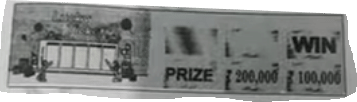
A total of 1,00,000 jackpot tickets each costing ₹100 were sold thereby raising a fund of ₹1,00,00,000. Rohan bought one ticket.
Based on the given information, answer the following questions:
(i) What are the possible amounts that the person can win?
(ii) (a) What is the probability that the person wins at least ₹2,00,000?
OR
(b) When a person participates in the online jackpot, Rohan also bought a lottery ticket of ₹50,000. If Rohan bought one ticket, find the probability that he wins one of the total six jackpot prizes.
View Solution
Concept:
Probability is given by
\[ P(E) = \frac{Number of favourable outcomes}{Total number of possible outcomes} \]
Here the total number of tickets sold is
\[ 100000 \]
Step 1: {\color{redFind the possible winning amounts.
The prizes are:
First prize = ₹3,00,000
Second prize = ₹2,00,000
Third prize = ₹50,000
If no prize is won, the person wins ₹0
Thus the possible winnings are
\[ ₹0,\; ₹50,000,\; ₹2,00,000,\; ₹3,00,000 \]
Step 2: {\color{redProbability of winning at least ₹2,00,000.
“At least ₹2,00,000” means:
First prize (1 ticket)
Second prize (2 tickets)
Total favourable tickets
\[ =1+2=3 \]
Total tickets
\[ =100000 \]
Thus
\[ P(win \ge ₹2,00,000) = \frac{3}{100000} \]
\[ \boxed{\frac{3}{100000}} \]
OR
Step 3: {\color{redProbability of winning one of the six jackpot prizes.
Total jackpot prizes:
\[ 1+2+3=6 \]
Total tickets:
\[ 100000 \]
Thus
\[ P(winning any jackpot prize) = \frac{6}{100000} \]
\[ =\frac{3}{50000} \]
\[ \boxed{\frac{3}{50000}} \] Quick Tip: In lottery-type probability questions, each ticket represents one equally likely outcome. Count the number of prize tickets as favourable outcomes and divide by total tickets.
Roundabout XYZ offers rides to tour buses to view the parks and sights. One such roundabout is made such that the equation representing its boundary is given by \(C_1: x^2 + y^2 = 9\).
There is a circular pond with a fountain in the middle of the roundabout whose equation is given by \(C_2: x^2 + y^2 = 4\).
Based on the given information, answer the following questions:
(i) Represent the given equations \(C_1\) and \(C_2\) graphically with the help of a diagram.
(ii) Express \(y\) as a function of \(x\) from both \(C_1\) and \(C_2\).
(iii) (a) Using integration, find the area of region covered by the roundabout boundary.
OR
(b) Using integration, find the area of region covered by the circular pond.
View Solution
Concept:
The equation
\[ x^2+y^2=r^2 \]
represents a circle with center at the origin and radius \(r\).
The area of a circle using integration is
\[ A = \int_{-r}^{r} 2\sqrt{r^2-x^2}\,dx \]
which equals \( \pi r^2 \).
Step 1: {\color{redIdentify the circles.
For
\[ C_1: x^2+y^2=9 \]
Radius
\[ r_1=3 \]
For
\[ C_2: x^2+y^2=4 \]
Radius
\[ r_2=2 \]
Thus two concentric circles centered at the origin are obtained.
Step 2: {\color{redExpress \(y\) as a function of \(x\).
From
\[ x^2+y^2=9 \]
\[ y^2=9-x^2 \]
\[ y=\pm\sqrt{9-x^2} \]
Similarly from
\[ x^2+y^2=4 \]
\[ y^2=4-x^2 \]
\[ y=\pm\sqrt{4-x^2} \]
Step 3: {\color{redArea of the roundabout boundary.
Using integration
\[ A = \int_{-3}^{3}2\sqrt{9-x^2}\,dx \]
Evaluating the integral gives
\[ A=\pi(3)^2 \]
\[ A=9\pi \]
Thus the area of the roundabout boundary is
\[ \boxed{9\pi square units} \]
OR
Step 4: {\color{redArea of the circular pond.
\[ A=\int_{-2}^{2}2\sqrt{4-x^2}\,dx \]
Evaluating,
\[ A=\pi(2)^2 \]
\[ A=4\pi \]
Thus the area of the pond is
\[ \boxed{4\pi square units} \] Quick Tip: The equation \(x^2+y^2=r^2\) always represents a circle centered at the origin. The total area can be obtained directly as \(\pi r^2\) or by integrating \(2\sqrt{r^2-x^2}\).
An online platform charges a monthly subscription fee of ₹500. The management decides to increase the subscription fee. It is predicted that for every increase of ₹1 in fee, 10 subscribers will discontinue the subscription.
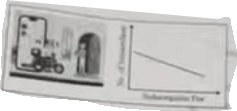
Based on the given information, answer the following questions:
(i) How many subscribers will discontinue after an increase of ₹x in annual fee?
(ii) If \(R(x)\) denotes the total revenue collected after the increase of ₹x\) in subscription fee, express \(R(x)\) as a function of \(x\).
(iii) (a) Find the value of \(x\) for which \(R(x)\) is maximum.
OR
(b) Find the sub-intervals of \((0,5000)\) in which \(R(x)\) is increasing and decreasing.
View Solution
Concept:
Revenue is calculated as
\[ Revenue = (subscription fee) \times (number of subscribers) \]
To find maximum revenue, we use derivatives.
Step 1: {\color{redNumber of subscribers discontinuing.
Given that for every increase of ₹1 in fee, \(10\) subscribers discontinue.
Thus for an increase of ₹\(x\):
\[ Subscribers leaving = 10x \]
Step 2: {\color{redForm the revenue function.
Let the initial number of subscribers be \(5000\).
Remaining subscribers:
\[ 5000 - 10x \]
New subscription fee:
\[ 500 + x \]
Thus revenue
\[ R(x) = (500 + x)(5000 - 10x) \]
Simplify
\[ R(x) = 2500000 - 5000x + 5000x - 10x^2 \]
\[ R(x) = 2500000 - 10x^2 \]
Step 3: {\color{redFind \(x\) for maximum revenue.
Differentiate:
\[ R'(x) = -20x \]
For maximum,
\[ R'(x)=0 \]
\[ x=0 \]
Thus maximum revenue occurs when
\[ x=0 \]
OR
Step 4: {\color{redFind intervals of increase and decrease.
\[ R'(x) = -20x \]
If
\[ x<0 \Rightarrow R'(x)>0 \]
If
\[ x>0 \Rightarrow R'(x)<0 \]
Thus
\[ R(x) is increasing for x<0 \]
\[ R(x) is decreasing for x>0 \]
Hence in the interval
\[ (0,5000) \]
the revenue function is
\[ \boxed{decreasing} \] Quick Tip: Revenue optimization problems often form quadratic functions. To find maximum revenue, differentiate the revenue function and set the derivative equal to zero.





Comments