




The CBSE Class 12 Painting Question Paper 2026 is available for download here of CBSE Board Exam 2026. This CBSE 12th Painting solved question paper includes detailed solutions, answer key, and the latest CBSE marking scheme to help students understand the exam pattern and important topics.
By practicing the CBSE Class 12 Painting 2026 board exam paper PDF, students can improve answer-writing strategy, time management, and overall exam performance.
CBSE Class 12 Painting Question Paper 2026 with Solution PDF
| CBSE Class 12 Painting Question Paper 2026 with Solution PDF | Download PDF | Check Solutions |
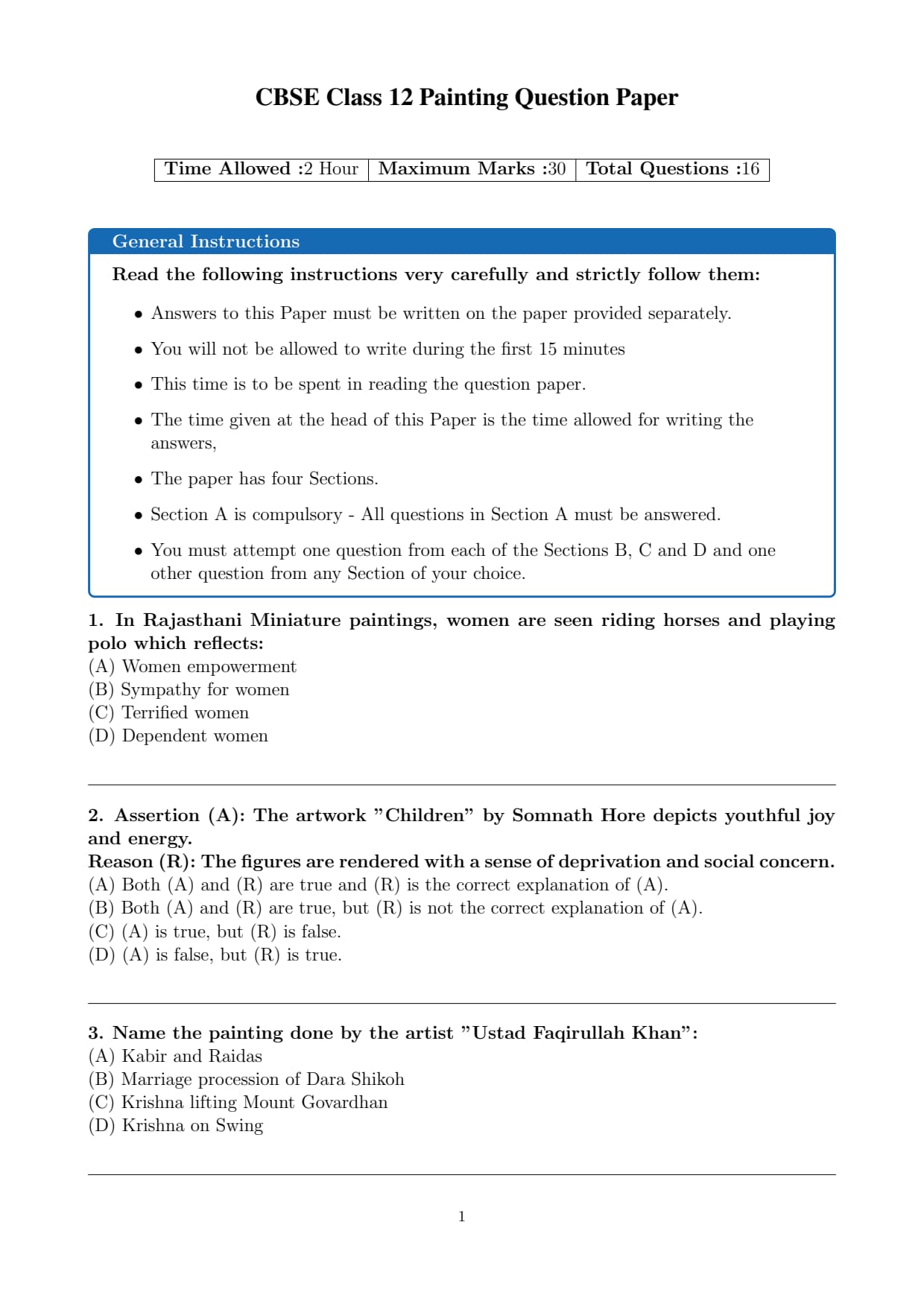
In Rajasthani Miniature paintings, women are seen riding horses and playing polo which reflects:
Assertion (A): The artwork "Children" by Somnath Hore depicts youthful joy and energy.
Reason (R): The figures are rendered with a sense of deprivation and social concern.
Name the painting done by the artist "Ustad Faqirullah Khan":
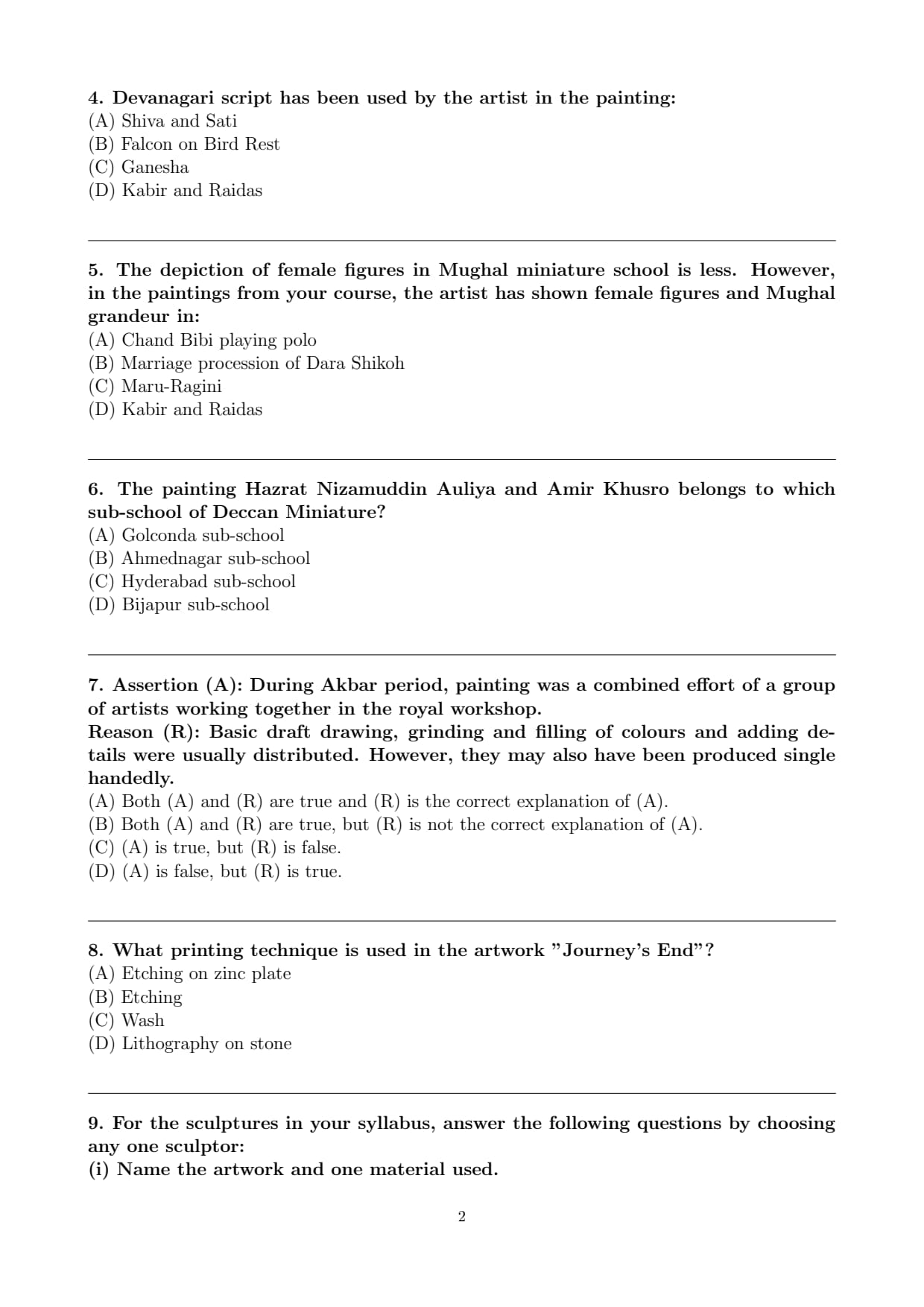
Devanagari script has been used by the artist in the painting:
The depiction of female figures in Mughal miniature school is less. However, in the paintings from your course, the artist has shown female figures and Mughal grandeur in:
The painting Hazrat Nizamuddin Auliya and Amir Khusro belongs to which sub-school of Deccan Miniature?
Assertion (A): During Akbar period, painting was a combined effort of a group of artists working together in the royal workshop.
Reason (R): Basic draft drawing, grinding and filling of colours and adding details were usually distributed. However, they may also have been produced single handedly.
What printing technique is used in the artwork "Journey's End"?
For the sculptures in your syllabus, answer the following questions by choosing any one sculptor:
(i) Name the artwork and one material used.
(ii) Describe the subject-matter and according to you, what message is the artist trying to give through the artwork? Write in brief.
(a) Ramkinkar Baij
OR
(b) Devi Prasad Roy Chaudhury
Pahari miniature reflects the freedom the artists were given to show diversity of artistic expression within miniature style. Choose one of the paintings given below and answer:
(i) Write the name of the artist and the sub-school of painting.
(ii) Explain any two characteristics of the sub-school.
(a) Krishna with Gopis
OR
(b) Nand, Yashoda and Krishna with kinsmen going to Vrindavan
(a) From this renowned Rajasthani miniature painting, we imbibe high moral values of "Raghukul". Here dominance of white, blue and green colours and repetition of human figures help to convey the narrative successfully.
(i) Identify and name the painting \& the artist.
(ii) Which two human values do you learn from this painting?
OR
(b) In this Deccan painting, women are depicted on horses playing polo.
(i) Write the name of the painting \& its sub-school.
(ii) Explain this artwork on the basis of aesthetic parameters and how it reflects women empowerment, in brief.
The colour schemes and subject-matter themes are very attractive in the two styles given below. Answer the following by picking your sub-school from your syllabus:
(a) Kishangarh sub-school
OR
(b) Mewar sub-school
(i) Write the name of the artist and the painting from your syllabus.
(ii) Explain any two characteristic features of this sub-school.
(a) (i) Which colours depicted in the Indian National Flag inspire us towards courage and sacrifice, peace and faith?
(ii) Explain how the flag inspires and helps in making you a committed citizen.
OR
(b) Artwork are artist’s interpretations of what they experience. Answer the following for the painting from your course by Raja Ravi Varma:
(i) Name the painting and its medium.
(ii) Explain how skillfully the artist used the colours for expressing the emotions required to portray the subject-matter in this painting.
In the miniature painting, Krishna on Swing, attention is given to the flow of concept. The illustration not only builds a narrative but also develops curiosity. Justify the statement and answer:
(a) Name of the artist, medium, sub-school and how many female figures are shown in the artwork.
(b) Explain the compositional arrangement.
(c) Write any four characteristics of Rajasthani Miniature School seen in the painting.
From an evolutionary point of view, one such artist who brought the divine characters to life is Nandalal Bose. From your course of study, answer the following for his artwork:
(a) Name the artwork, medium and two human values shown.
(b) Discuss how the artist has used colour and space to show the compositional arrangement. Explain.
(c) Name any four other artists apart from Nandalal Bose that were part of the national freedom struggle from your syllabus.
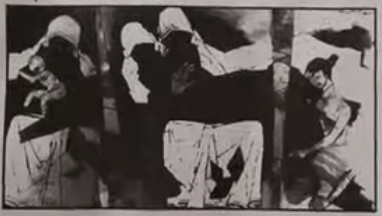
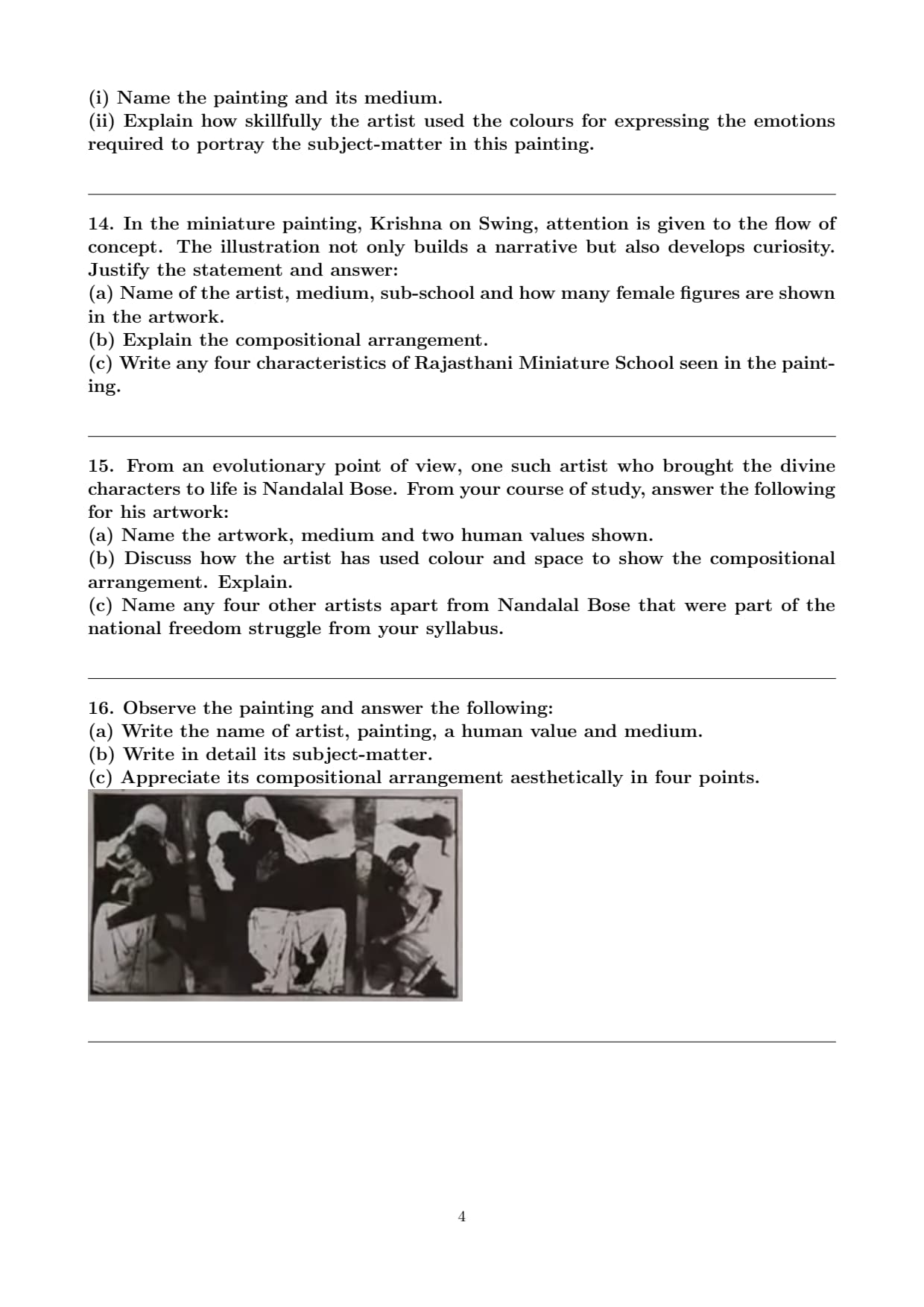
Observe the painting and answer the following:
(a) Write the name of artist, painting, a human value and medium.
(b) Write in detail its subject-matter.
(c) Appreciate its compositional arrangement aesthetically in four points.




Comments